
Nehemiah 4:14

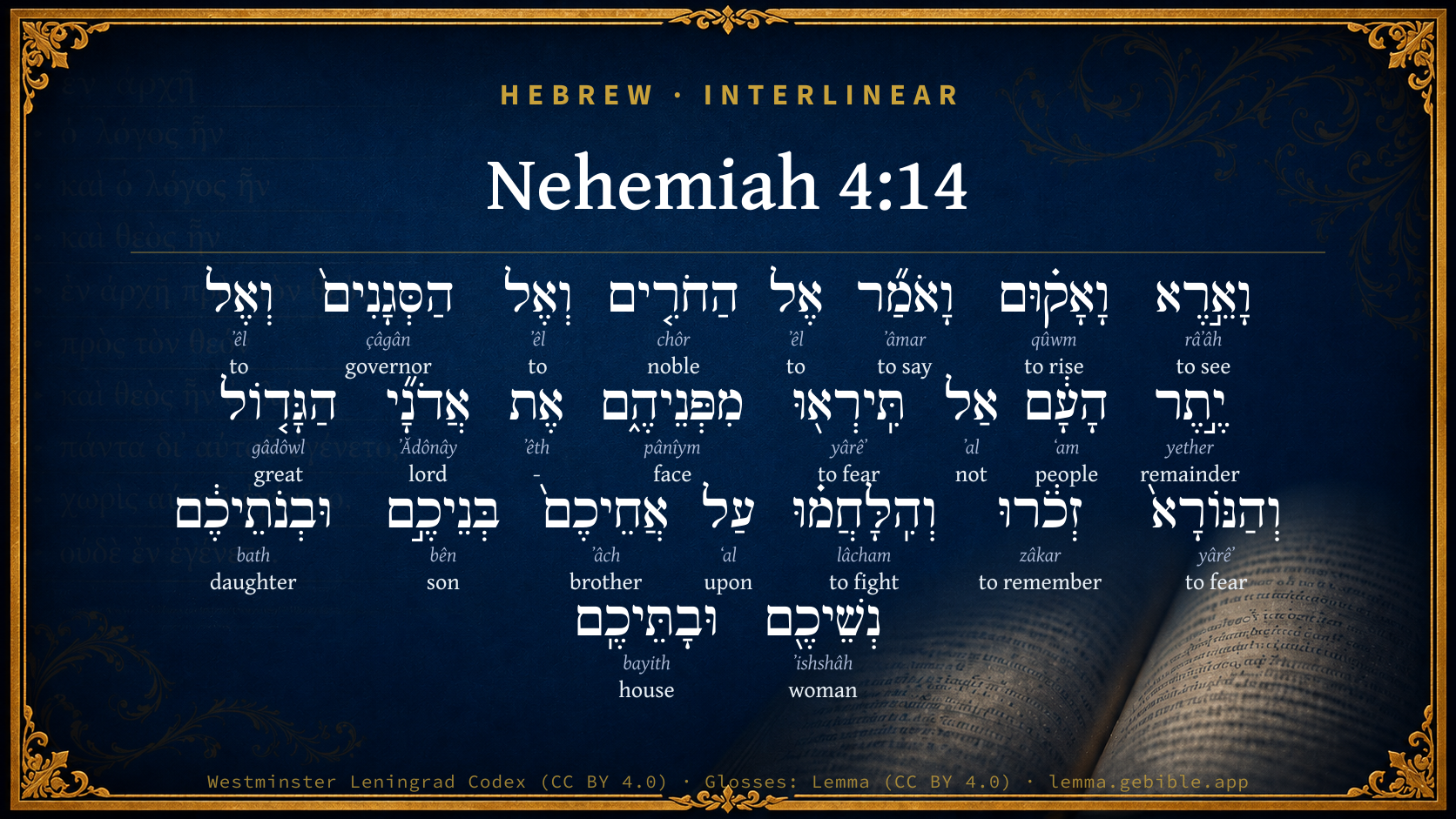
Hebrew (Westminster Leningrad Codex) Nehemiah 4:14 appears in the Hebrew Old Testament. The text above is from the Westminster Leningrad Codex. Each word links to its Strong’s number, a concise gloss, and parsing drawn from the Open Scriptures Hebrew Bible morphology. Click any word for its full Brown-Driver-Briggs (BDB) entry.
Download image
Cite this verse

Nehemiah 4:14 (World English Bible). Public Domain. Lemma interlinear Bible study tool, https://lemma.gebible.app/v/nehemiah/4/14.

Show BibTeX & RIS
BibTeX
RIS
English Translation
I looked, and rose up, and said to the nobles, and to the rulers, and to the rest of the people, Don't be you afraid of them: remember the Lord, who is great and awesome, and fight for your brothers, your sons, and your daughters, your wives, and your houses.
World English Bible · Public Domain
Download a study sheet

One document with this verse’s original text, its word-by-word gloss line, the meaning frame, cross-references with their text, attributed commentary, and full source and license credits — printable, and it pastes into notes with its structure intact.

This verse Autodidact and up

Study sheet (.html) Plain text (.txt)

A passage Seminary Student

Up to 50 verses in one chapter. A passage sheet keeps up to 6 commentary sources and 12 cross-references per verse, in the order this page ranks them, and says so on the sheet whenever that leaves anything out. Ask for a single verse and you get the Autodidact verse sheet above.

Everything on this page stays free to read, with no account — the sheet is a download of what is already on screen, not access to it.

Want to remove ads? Support Godless Engineer
Compare translations 3

The same verse in 3 English versions, stacked beneath the original-language interlinear above. Click any original word for its lexicon entry.

Each is an independent rendering of the whole verse — the interlinear is not word-aligned to these translations.

Highlighted words mark where these versions differ — a whole-verse word diff, not a word-by-word alignment.

  • World English Bible Public Domain
    I looked, and rose up, and said to the nobles, and to the rulers, and to the rest of the people, Don't be you afraid of them: remember the Lord, who is great and awesome, and fight for your brothers, your sons, and your daughters, your wives, and your houses.
  • King James Version Public Domain
    And I looked, and rose up, and said unto the nobles, and to the rulers, and to the rest of the people, Be not ye afraid of them: remember the LORD, which is great and terrible, and fight for your brethren, your sons, and your daughters, your wives, and your houses.
  • unfoldingWord Literal Text CC BY-SA 4.0
    And I looked, and I rose up, and I said to the nobles, and to the prefects, and to the rest of the people, “Do not be afraid of their faces. Remember my great and fearsome Lord! And fight for your brothers, your sons and your daughters, your wives and your houses.”

unfoldingWord Literal Text — © unfoldingWord, licensed CC BY-SA 4.0. Word-aligned USFM3 via Door43 (git.door43.org/unfoldingWord/en_ult).

Versions to compare (up to 4)

3 of 4 selected

Show all 18 translations

Every available English version of this verse, each an independent rendering of the whole verse.

  • World English Bible Public Domain
    I looked, and rose up, and said to the nobles, and to the rulers, and to the rest of the people, Don't be you afraid of them: remember the Lord, who is great and awesome, and fight for your brothers, your sons, and your daughters, your wives, and your houses.
  • Berean Standard Bible Public Domain
    After I had made an inspection, I stood up and said to the nobles, the officials, and the rest of the people, “Do not be afraid of them. Remember the Lord, who is great and awesome, and fight for your brothers, your sons and your daughters, your wives and your homes.”
  • Majority Standard Bible Public Domain
    After I had made an inspection, I stood up and said to the nobles, the officials, and the rest of the people, “Do not be afraid of them. Remember the Lord, who is great and awesome, and fight for your brothers, your sons and your daughters, your wives and your homes.”
  • King James Version Public Domain
    And I looked, and rose up, and said unto the nobles, and to the rulers, and to the rest of the people, Be not ye afraid of them: remember the LORD, which is great and terrible, and fight for your brethren, your sons, and your daughters, your wives, and your houses.
  • American Standard Version (1901) Public Domain
    And I looked, and rose up, and said unto the nobles, and to the rulers, and to the rest of the people, Be not ye afraid of them: remember the Lord, who is great and terrible, and fight for your brethren, your sons, and your daughters, your wives, and your houses.
  • Revised Version (1885) Public Domain
    And I looked, and rose up, and said unto the nobles, and to the rulers, and to the rest of the people, Be not ye afraid of them: remember the Lord, which is great and terrible, and fight for your brethren, your sons and your daughters, your wives and your houses.
  • Geneva Bible (1599) Public Domain
    Then I behelde, and rose vp, and said vnto the Princes, and to the rulers, and to the rest of the people, Be not afrayde of them: remember the great Lord, and fearefull, and fight for your brethren, your sonnes, and your daughters, your wiues, and your houses.
  • Douay-Rheims (1899) Public Domain
    And I looked and rose up: and I said to the chief men and the magistrates, and to the rest of the common people: be not afraid of them. Remember the Lord who is great and terrible, and fight for your brethren, your sons, and your daughters, and your wives, and your houses.
  • Young's Literal Translation Public Domain
    And I see, and rise up, and say unto the freemen, and unto the prefects, and unto the rest of the people, `Be not afraid of them; the Lord, the great and the fearful, remember ye, and fight for your brethren, your sons, and your daughters, your wives, and your houses.'
  • Literal Standard Version CC BY-SA 4.0
    And I see, and rise up, and say to the nobles, and to the prefects, and to the rest of the people, “Do not be afraid of them; remember the Lord, the great and the fearful, and fight for your brothers, your sons, and your daughters, your wives, and your houses.”
  • Unlocked Literal Bible CC BY-SA 4.0
    Then I looked, and stood up, and I said to the nobles, and to the rulers, and to the rest of the people, “Do not be afraid of them. Call to mind the Lord, who is great and awesome. Fight for your families, your sons and your daughters, your wives, and your homes.”
  • unfoldingWord Literal Text CC BY-SA 4.0
    And I looked, and I rose up, and I said to the nobles, and to the prefects, and to the rest of the people, “Do not be afraid of their faces. Remember my great and fearsome Lord! And fight for your brothers, your sons and your daughters, your wives and your houses.”
  • Darby Bible Public Domain
    And I looked, and rose up, and said to the nobles, and to the rulers, and to the rest of the people, Be not afraid of them: remember the Lord who is great and terrible, and fight for your brethren, your sons and your daughters, your wives and your houses.
  • World Messianic Bible Public Domain
    I looked, and rose up, and said to the nobles, to the rulers, and to the rest of the people, “Don’t be afraid of them! Remember the Lord, who is great and awesome, and fight for your brothers, your sons, your daughters, your wives, and your houses.”
  • Webster's Bible Public Domain
    And I looked, and arose, and said to the nobles, and to the rulers, and to the rest of the people, Be ye not afraid of them: remember the Lord who is great and terrible, and fight for your brethren, your sons, and your daughters, your wives, and your houses.
  • Free Bible Version CC BY-SA 4.0
    After inspecting our defenses, I stood up and addressed the nobles, the officials, and the rest of the people, saying, “Don't be afraid of them! Remember the Lord, who is powerful and formidable! Fight for your brothers, your sons and your daughters, your wives and your homes!”
  • Bible in Basic English Public Domain
    And after looking, I got up and said to the great ones and to the chiefs and to the rest of the people, Have no fear of them: keep in mind the Lord who is great and greatly to be feared, and take up arms for your brothers, your sons, and your daughters, your wives and your houses.
  • JPS Tanakh (1917) Public Domain
    (4-8) And I looked, and rose up, and said unto the nobles, and to the rulers, and to the rest of the people: 'Be not ye afraid of them; remember the Lord, who is great and awful, and fight for your brethren, your sons and your daughters, your wives and your houses.'

Literal Standard Version (2020), Covenant Press — licensed CC BY-SA 4.0. Text via the HelloAO Bible API (eBible.org). Unlocked Literal Bible (unfoldingWord) — licensed CC BY-SA 4.0. Text via the HelloAO Bible API (eBible.org). unfoldingWord Literal Text — © unfoldingWord, licensed CC BY-SA 4.0. Word-aligned USFM3 via Door43 (git.door43.org/unfoldingWord/en_ult). Free Bible Version, Dr. Jonathan Gallagher — licensed CC BY-SA 4.0. Text via the HelloAO Bible API (eBible.org).

Word by word

More ways to search: Search by grammar → Find every occurrence → Compare this word →

Practice this passage: Drill this verse → Learn its vocabulary →

הַחֹרִ֤ים
chôr
H2715
“the · nobles”
Particle, Definite Article + Noun, Common, Masculine, Plural, Absolute
Part of Speech
Particle + Noun
Type
Common
Gender
Masculine
Number
Plural
State
Absolute
Full BDB Definition

Origin: from H2787

TWOT: 757a

a noble, freeborn one
  1. וָאֵ֣רֶא râʼâh H7200 “and · to see” Conjunction + Verb, Qal, Sequential Imperfect, 1st Person, Common, Singular
  2. וָאָק֗וּם qûwm H6965 “and · to rise” Conjunction + Verb, Qal, Sequential Imperfect, 1st Person, Common, Singular
  3. וָאֹמַ֞ר ʼâmar H559 “and · to say” Conjunction + Verb, Qal, Sequential Imperfect, 1st Person, Common, Singular
  4. אֶל ʼêl H413 “to” Preposition
  5. וְאֶל ʼêl H413 “and · to” Conjunction + Preposition
  6. הַסְּגָנִים֙ çâgân H5461 “the · governors” Particle, Definite Article + Noun, Common, Masculine, Plural, Absolute
  7. וְאֶל ʼêl H413 “and · to” Conjunction + Preposition
  8. יֶ֣תֶר yether H3499 “remainder of” Noun, Common, Masculine, Singular, Construct
  9. הָעָ֔ם ʻam H5971 “the · people” Particle, Definite Article + Noun, Common, Masculine, Singular, Absolute
  10. אַל ʼal H408 “not” Particle, Negative
  11. תִּֽירְא֖וּ yârêʼ H3372 “to fear” Verb, Qal, Jussive, 2nd Person, Masculine, Plural
  12. מִפְּנֵיהֶ֑ם pânîym H6440 “from · face(s) · their” Preposition + Noun, Common, Both, Plural, Construct + Suffix, Personal, 3rd Person, Masculine, Plural
  13. אֶת ʼêth H853 “-” Particle, Direct Object
  14. אֲדֹנָ֞י ʼĂdônây H136 “Lord · my” Noun, Common, Masculine, Plural, Construct + Suffix, Personal, 1st Person, Common, Singular
  15. הַגָּד֤וֹל gâdôwl H1419 “the · great” Particle, Definite Article + Adjective, Adjective, Masculine, Singular, Absolute
  16. וְהַנּוֹרָא֙ yârêʼ H3372 “and · the · fearing” Conjunction + Particle, Definite Article + Verb, Niphal, Participle Active, Masculine, Singular, Absolute
  17. זְכֹ֔רוּ zâkar H2142 “remember” Verb, Qal, Imperative, 2nd Person, Masculine, Plural
  18. וְהִֽלָּחֲמ֗וּ lâcham H3898 “and · fight” Conjunction + Verb, Niphal, Imperative, 2nd Person, Masculine, Plural
  19. עַל ʻal H5921 “upon” Preposition
  20. אֲחֵיכֶם֙ ʼâch H251 “brothers · your” Noun, Common, Masculine, Plural, Construct + Suffix, Personal, 2nd Person, Masculine, Plural
  21. בְּנֵיכֶ֣ם bên H1121 “sons · your” Noun, Common, Masculine, Plural, Construct + Suffix, Personal, 2nd Person, Masculine, Plural
  22. וּבְנֹתֵיכֶ֔ם bath H1323 “and · daughters · your” Conjunction + Noun, Common, Feminine, Plural, Construct + Suffix, Personal, 2nd Person, Masculine, Plural
  23. נְשֵׁיכֶ֖ם ʼishshâh H802 “women · your” Noun, Common, Feminine, Plural, Construct + Suffix, Personal, 2nd Person, Masculine, Plural
  24. וּבָתֵּיכֶֽם bayith H1004 “and · houses · your” Conjunction + Noun, Common, Masculine, Plural, Construct + Suffix, Personal, 2nd Person, Masculine, Plural

About this verse

These counts appear in no published source. They are computed here, from the morphology-tagged text and Lemma’s own curated glosses. What Lemma adds →

25
words
22
distinct lemmas
Historical
section

Notable vocabulary

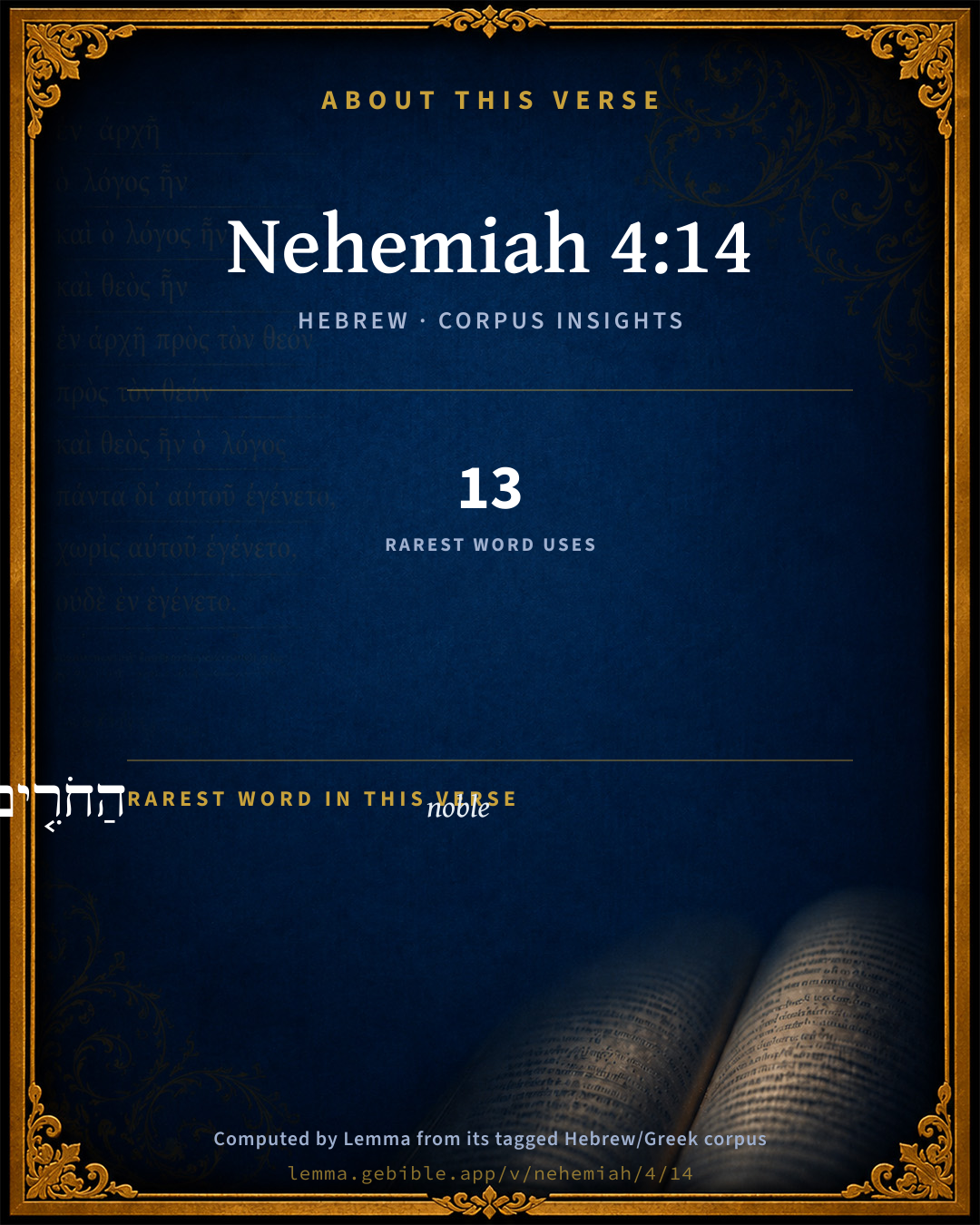
The rarest word here is הַחֹרִ֤ים noble H2715 — appearing just 13 times in the whole Hebrew Bible.

Shared distinctive vocabulary

הַחֹרִ֤ים noble H2715 occurs in 13 verses of the Hebrew Bible. Also found in:

Grammatical profile

  • 7 verbs
  • 11 nouns
  • 1 adjective
  • 4 prepositions
  • 2 particles

Verb forms

  • וָאֵ֣רֶא Qal · Sequential Imperfect
  • וָאָק֗וּם Qal · Sequential Imperfect
  • וָאֹמַ֞ר Qal · Sequential Imperfect
  • תִּֽירְא֖וּ Qal · Jussive
  • וְהַנּוֹרָא֙ Niphal · Participle Active
  • זְכֹ֔רוּ Qal · Imperative
  • וְהִֽלָּחֲמ֗וּ Niphal · Imperative

Repetition

Words recur within this verse — often emphatic in Hebrew:

  • תִּֽירְא֖וּ to fear H3372 ×2
  • אֶל to H413 ×3

Cross-references

28

Topical passages linked to Nehemiah 4:14 in the Treasury of Scripture Knowledge — connected by theme and wording, ordered by reader-vote popularity; previews shown in the World English Bible.

  • 2 Samuel 10:12 Be of good courage, and let us play the man for our people, and for the cities of our God: and Yahweh do that which seems him good.
  • Numbers 14:9 Only don't rebel against Yahweh, neither fear the people of the land; for they are bread for us: their defense is removed from over them, and Yahweh is with us: don't fear them.
  • Isaiah 41:10–14 Don't you be afraid, for I am with you; don't be dismayed, for I am your God; I will strengthen you; yes, I will help you; yes, I will uphold you with the right hand of my righteousness.
  • Hebrews 13:6 So that with good courage we say, "The Lord is my helper. I will not fear. What can man do to me?"
  • Psalms 66:3 Tell God, "How awesome are your deeds! Through the greatness of your power, your enemies submit themselves to you.
  • Psalms 20:7 Some trust in chariots, and some in horses, But we trust the name of Yahweh our God.
  • Psalms 65:5 By awesome deeds of righteousness, you answer us, God of our salvation. You who are the hope of all the ends of the earth, Of those who are far away on the sea;
  • Matthew 10:28 Don't be afraid of those who kill the body, but are not able to kill the soul. Rather, fear him who is able to destroy both soul and body in Gehenna.
  • Deuteronomy 1:21 Behold, Yahweh your God has set the land before you: go up, take possession, as Yahweh, the God of your fathers, has spoken to you; don't be afraid, neither be dismayed.
  • Deuteronomy 1:29–30 Then I said to you, Don't dread, neither be afraid of them.
  • Deuteronomy 10:17 For Yahweh your God, he is God of gods, and Lord of lords, the great God, the mighty, and the awesome, who doesn't regard persons, nor takes reward.
  • Deuteronomy 20:3–4 and shall tell them, Hear, Israel, you draw near this day to battle against your enemies: don't let your heart faint; don't be afraid, nor tremble, neither be scared of them;
  • Joshua 1:9 Haven't I commanded you? Be strong and of good courage; don't be afraid, neither be dismayed: for Yahweh your God is with you wherever you go.
  • 2 Chronicles 32:7 Be strong and of good courage, don't be afraid nor dismayed for the king of Assyria, nor for all the multitude who is with him; for there is a greater with us than with him:
  • Nehemiah 1:5 and said, I beg you, Yahweh, the God of heaven, the great and awesome God, who keeps covenant and loving kindness with those who love him and keep his commandments:
  • Job 37:22 Out of the north comes golden splendor; With God is awesome majesty.
  • Psalms 27:1 Yahweh is my light and my salvation. Whom shall I fear? Yahweh is the strength of my life. Of whom shall I be afraid?
  • Psalms 143:5 I remember the days of old. I meditate on all your doings. I contemplate the work of your hands.
  • Isaiah 51:12–13 I, even I, am he who comforts you: who are you, that you are afraid of man who shall die, and of the son of man who shall be made as grass;
  • Nahum 1:2–7 Yahweh is a jealous God and avenges. Yahweh avenges and is full of wrath. Yahweh takes vengeance on his adversaries, and he maintains wrath against his enemies.
  • Hebrews 12:20–21 for they could not stand that which was commanded, "If even an animal touches the mountain, it shall be stoned;"
  • Hebrews 12:28–29 Therefore, receiving a Kingdom that can't be shaken, let us have grace, through which we serve God acceptably, with reverence and awe,
  • Psalms 46:11 Yahweh of Hosts is with us. The God of Jacob is our refuge. Selah.
  • Psalms 66:5 Come, and see God's deeds-- Awesome work on behalf of the children of men.
  • Psalms 77:10–20 Then I thought, "I will appeal to this: The years of the right hand of the Most High."
  • Isaiah 63:11–13 Then he remembered the days of old, Moses [and] his people, [saying], Where is he who brought them up out of the sea with the shepherds of his flock? where is he who put his holy Spirit in the midst of them?
  • Isaiah 64:1–3 Oh that you would tear the heavens, that you would come down, that the mountains might quake at your presence,
  • 2 Chronicles 20:15–17 and he said, Listen you, all Judah, and you inhabitants of Jerusalem, and you king Jehoshaphat: Thus says Yahweh to you, Don't be afraid you, neither be dismayed by reason of this great multitude; for the battle is not yours, but God's.

Cross-references courtesy of OpenBible.info (CC BY 4.0).

Hebrew and Greek witnesses Masoretic Hebrew ↔ Greek Septuagint

The same verse in the two great witnesses to the Old Testament, shown verse-for-verse.

These are two independent witnesses, not word-aligned to each other, and the Septuagint is shown in lemma (dictionary) form.

Hebrew Nehemiah 4:14 Masoretic · Westminster Leningrad Codex

וָאֵ֣רֶא וָאָק֗וּם וָאֹמַ֞ר אֶל הַחֹרִ֤ים וְאֶל הַסְּגָנִים֙ וְאֶל יֶ֣תֶר הָעָ֔ם אַל תִּֽירְא֖וּ מִפְּנֵיהֶ֑ם אֶת אֲדֹנָ֞י הַגָּד֤וֹל וְהַנּוֹרָא֙ זְכֹ֔רוּ וְהִֽלָּחֲמ֗וּ עַל אֲחֵיכֶם֙ בְּנֵיכֶ֣ם וּבְנֹתֵיכֶ֔ם נְשֵׁיכֶ֖ם וּבָתֵּיכֶֽם

I looked, and rose up, and said to the nobles, and to the rulers, and to the rest of the people, Don't be you afraid of them: remember the Lord, who is great and awesome, and fight for your brothers, your sons, and your daughters, your wives, and your houses.

World English Bible · Public Domain

Greek LXX Structure differs

The Septuagint has no separate book of Nehemiah. Its Greek text is the second half of Esdras B (2 Esdras), chapters 11–23; Ezra is the first half (1–10).

A verse-for-verse comparison isn’t shown here because the chapters and verses don’t line up. Switch to the LXX edition with the MT / LXX toggle above to read the Greek directly.

Hebrew: Westminster Leningrad Codex (CC BY 4.0). Greek: Septuagint (public domain); English from a public-domain English Septuagint. How the Septuagint differs from the Hebrew →

Commentary

Notes on Nehemiah 4:14 from classic Christian and Jewish commentators (each source and its license shown beneath its notes). The classic Christian expositions comment on the surrounding passage and are grouped to its opening verse, so a note may address several verses; the Jewish commentaries on the Tanakh (Rashi and others) are per-verse, so they appear only where the commentator wrote on this verse.

Lemma curates 59 commentaries, every one of them public domain or Creative Commons licensed, each selected and text-cleaned for this edition rather than reprinted as found. About our sources →

Trapp's Complete Commentary

John Trapp

Neh 4:14 And I looked, and rose up, and said unto the nobles, and to the rulers, and to the rest of the people, Be not ye afraid of them: remember the Lord, [which is] great and terrible, and fight for your brethren, your sons, and your daughters, your wives, and your houses.

Ver. 14. And I looked, and rose up] Et vidi, et surrexi, et dixi, so the original runs. He saw the enemy a-coming, he started up, and he made this excellent exhortation; which puts me in mind of that which one once said of Julius Caesar, If you had never known him to have been a soldier, yet hear him but speak only, and you will conclude him to be one, Si acta eius penitus ignorasses, per linguam tanten militem esse diceres.

And said unto the nobles] In a short but pithy oration; such as was that of Joab, 2Sa 10:12, of which Pellican saith, Non potuit vex duce dignior cogitari, as brave a speech as a man could make; or that of Hunniades, about to join battle with the Turks (see Turk. Hist. fol. 272); or, lastly, that of the Prince of Orange at the battle of Newport; where they had the sea on one side and the Spaniards on the other. If, said he, you will live, you must either eat up these Spaniards or drink up this sea. So here, Either you must fight lustily, or all you have is forfeited assuredly.

Be not ye afraid of them] Away with that cowardly passion, which unmans a man, et rectum tollit de cardine mentem, robs him of all power and policy.

Remember the Lord] Whom he that feareth needs fear none else. "The name of the Lord is a strong tower," &c.

Who is great and terrible] For the defence of his people, and offence of his enemies. The Lord is a man of war, Exo 15:3. Yea, he alone is a whole army of men, van and rear both, Isa 52:12; and may better say to his soldiers than Antigonus did to his, when they were afraid of the enemy’s numbers, How many do ye reckon me for?

And fight for your brethren] Whether by race, or religion.

Your sons, and your daughters] Those φιλτατα, as the Greeks call them; Charissimi, as the Latins; dearest pledges.

Your wives, and your houses] In the last commandment houses are set first before wives, because a house is to be first provided; neither will a wise man take a wife before he hath a house. Here wives are set before houses; because far more precious, and a main part of a man’s self, Eph 5:28. House and riches are the inheritance of the fathers, but a prudent wife is of the Lord, Pro 19:14. She was one of the first real and royal gifts bestowed by God upon Adam. By the way note, that if men may fight for their civil right to their houses and lands, have they not as good warrant to fight for their religion, especially since they have the laws of the land for it; and, besides, a civil right at least to the outward peaceable profession and practice of it? The Athenians themselves, though their religion was no better than superstition, Act 17:22, yet they bound themselves, by a public and solemn oath, to defend it to the utmost. The words of the oath were these: I will fight for the temples and holy rites, both alone and with others, Aμυνω δε και υπεο ιεοων και υπερ οσιων και μονος και μετα πολλων..

John Trapp, A Commentary or Exposition upon All the Books of the Old and New Testament (1647–1656) — public domain. Text from a community e-Sword module.

The Biblical Illustrator

Joseph S. Exell

Neh_4:14

Remember the Lord, which is great.

The power of memory

Consider--

I. The power of memory.

II. The application of the text to ourselves.

1. Parents should remember that God regards them as stewards, to whom are committed the care, the instruction, and the discipline of their offspring.

2. Children should remember that forgetfulness of the claims of home, of a father, of a mother, is a forgetfulness of God.

3. Employers should remember the Lord in the example which He furnishes of gentleness, patience, kindness, forbearance, and deep humility.

4. Servants should remember the Lord, that He took upon Him the form of a servant. Conclusion: Remember the promises He has made, the deliverances He has wrought, the blessings He has conferred, the invitations He has given, and the relations He now fills. Remember Him--in calamity to trust Him, in prosperity to praise Him, in danger to call upon Him, in difficulty to expect His interference. Remember Him, for it is your duty, it is your privilege. Remember Him, for He never forgets you. (W. Horwood.)

God is on the field

Always believe that God is on your side. He is on the field when most invisible. In one of the great continental cities the regalia are not kept behind iron bars as in the Tower of London, but lie upon an open table. It might appear an easy thing for some thief to snatch a diamond or a jewel from the glittering array, and yet no man dare put out his band to take one, for that table is charged with electricity, and woe to the person who touches it. The protection is complete; you cannot see it, but there it is. Only live in daily--hourly communion with Christ. Dont break the spiritual connection, and you are as safe from Satan and sin as the jewels from the devices of the thief. Greater is He that is for us than all enemies that can be against us. (E. Abbott.)

The Biblical Illustrator, edited by Joseph S. Exell (c. 1880s–1900s) — public domain. Text from a community e-Sword module.

Joseph Benson's Commentary

Neh 4:14. I said unto the nobles, Be not afraid of them — All was at stake; therefore he exhorts them to be valiant, trusting in God. Remember the Lord, who is great and terrible, &c. — You think your enemies are great and terrible; but what are they in comparison with God? especially in opposition to him?

Joseph Benson's Commentary on the Old and New Testaments (1811–1818) — public domain. Text from a community e-Sword module.

Tyndale Open Study Notes

Tyndale Open Resources

4:14 The strongest motivation for hope was Israel’s great and glorious God, who had delivered his people from mighty nations before (cp. 2 Chr 32:7-8; see Exod 14:13-14; Deut 8:1-3; 20:3; Josh 10:25). Another motivation was to protect their own families and properties.

Tyndale Open Study Notes — © Tyndale Open Resources, licensed CC BY-SA 4.0. Text via the HelloAO Bible API.

Geneva Bible (1599)

Geneva Bible translators

Who is ever at hand to deliver his out of danger: and therefore seeing they should fight for the maintenance of God’s glory, and for the preservation of their own lives and of theirs, he encourageth them to play the valiant men.

Geneva Bible (1599) marginal notes — public domain. Text via Bolls.life.

Adam Clarke's Commentary

Verse 14. Be not ye afraid of them] Are they more terrible or stronger than God?

Fight for your brethren] Your own countrymen, who worship the same God, and are come from the same stock; your sons, whom they wish to slay or lead into captivity; your daughters and wives, whom they wish to deflower and defile; and your houses, which they wish to seize and occupy as their own. They had every thing at stake; and therefore they must fight pro aris et focis, for their religion, their lives, and their property. A people thus interested, who once take up the sword, can never be conquered.

There is an address made to the Greeks by their leader in AEschylus, Pers. ver. 402, similar to this, to excite them against the Persians: -

- Ω Παιδες Ἑλληνων, ιτε,

Ελευθερουτε πατριδ,ελευθερουτε δε

Παιδας, γυνιακας, θεων ρε πατρῳων ἑδη,

Θηκας τε προγονων· νυν ὑπερ παντων αγων.

"-----------Sons of the Greeks, go on!

Free now your country, and your children free;

Your wives, the temples of your fathers' gods,

And dear abodes of farthest ancestors:--

Now strike the blow for all!" J. B. B. C.

Adam Clarke's Commentary on the Bible (1810–1826) — public domain. Text from a community e-Sword/MySword module.

Ellicott's Commentary for English Readers

(14) And I looked.—It appears that the energetic appeal now described was uttered on the actual approach of an attacking party.

A Bible Commentary for English Readers, edited by Charles John Ellicott (1878–1897) — public domain. Text from a community e-Sword module.

The Cambridge Bible for Schools and Colleges

gen. ed. J. J. S. Perowne

14. And I looked, and rose up] Nehemiah’s ‘look’ seems to denote his inspection of the guards which he had stationed.

unto the nobles, and to the rulers] R.V. marg. ‘Or, deputies’. Upon the difference of these two classes see note on Neh_2:16.

the Lord] R.V. the Lord. The sacred name here used is ‘Adonai,’ not ‘Jahveh;’ see on Neh_1:11, (Neh_3:5).

which is great and terrible] For these epithets, see note on Neh_1:5, and compare Neh_9:22. The attributes of power and awe belong to the God of Israel and ensure the victory of those that trust him, cf. Deu_3:22, Deut. 20:31, 32.

fight for your brethren … houses] Nehemiah exhorts his men to fight courageously. To the Jews the contest must be for their very existence as a people. Their foes are banded together to compass the extermination of their race and name. The brotherhood of the race (brethren), the blessings of family and home (sons and daughters), the ties of personal affection (wives) or cherished ancestral inheritance (house) were at stake. The enemy against whom they fought knew no pity.

The Cambridge Bible for Schools and Colleges (gen. ed. J. J. S. Perowne; Cambridge University Press, 1878–1918) — public domain. Text from a community e-Sword module.

John Gill's Exposition

And I looked,.... Took a view of the people, and observed that they were in their proper place, and sufficiently armed, and also whether the enemy was coming:

and rose up and said unto the nobles, and to the rulers, and to the rest of the people; who were under their nobles and rulers, as their captains and commanders:

be not ye afraid of them; of their enemies, their numbers, and their threats:

remember the Lord, which is great and terrible; who is greater than they, and is to be feared and trusted in by his people, and is terrible even to the kings of the earth:

and fight for your brethren, your sons and your daughters, your wives and your houses; intimating, that they were in danger of losing all that was near and dear, valuable and precious to them, if they did not fight for them; and therefore it became them to quit themselves like men, and be strong.

John Gill's Exposition of the Whole Bible (1746–1763) — public domain (CC PDM 1.0). Text via the HelloAO Bible API.

Haydock's Catholic Bible Commentary

Remember. These are the most powerful arguments to encourage an army. (Haydock)

George Leo Haydock (1774–1849), Haydock's Catholic Family Bible and Commentary, 1859 edition — public domain. Excludes Psalms (Douay-Rheims chapter numbering differs from Protestant) and Deuterocanonical books (Catholic canon only).

Whedon's Commentary on the Bible

Daniel D. Whedon

14. I looked — To see if all my orders had been carried out.

Rose up — To pass around and address the nobles and others with words of encouragement and cheer.

Daniel D. Whedon (gen. ed.), Commentary on the Old and New Testaments (1874–1909) — public domain. Text from a community e-Sword module.

The Pulpit Commentary

And I looked, and rose up, and said. A particular occasion seems to be spoken of. The allies had joined their forces; the army was advancing; Nehemiah had obtained information of the quarter from which the attack was to be expected; he had posted his men (ver. 13); when he "looked, and rose up," and spoke, it was probably as the enemy was coming up to the attack; he then made this short but stirring appeal. That no conflict followed would seem to show, that "when the enemy approached, and saw from a distance the whole people awaiting them in perfect equipment, order, and spirit," they lost heart and "turned back" (Ewald, "History of Israel," vol. 5. p. 155). The Lord, which is great and terrible. See the comment on Neh_1:5.

Courage in the Christian war.

"Be not ye afraid of them," etc. A stirring battle-cry. Suitable in the Christian warfare.

I THE CHURCH"S WARFARE. Each for himself and his family; all for the common good. Against the world, the flesh, and the devil, in all the forms they assume: infidelity, heresy, ungodliness, wickedness of all kinds. The war is

1. Defensive. To preserve themselves, and their households and Churches, from spiritual and moral evil.

2. Offensive. To subdue the world to Christ. Destroying the errors and sins which prevail in it, and rescuing their victims.

II THE CHURCH"S LIABILITY TO FEAR. On account of the number, and power, and subtlety of her enemies, and the hardships and perils of the war. There is a fear which is good. "Happy is the man that feareth alway." But not the craven fear which shuns the fight.

III THE CHURCH"S REMEDY AGAINST FEAR.

1. Remembrance of God.

(1) His greatness. "Greater is he that is in you than he that is in the world." He has all power to sustain his servants, give them the victory, and reward the victors.

(2) His terribleness. To his enemies to subdue them; to his professed friends if they decline to do battle for him. "Fear him, ye saints, and you will then Have nothing else to fear.

1. Thought of the interests involved. As here, of brothers, sons, daughters, wives, and houses.

2. Mutual encouragement. "Be not afraid," etc.

The Pulpit Commentary (1880–1919), ed. H.D.M. Spence-Jones & Joseph S. Exell — public domain. Text from a community e-Sword module.

John Wesley's Explanatory Notes

Looked - He looked up, engaged God for him, and put himself and his cause under the Divine protection. That was his way, and should be ours: all his cares, all his griefs, all his fears he spread before God. Great and terrible - You think your enemies are great and terrible. But what are they in comparison of God? Especially in opposition to him?

John Wesley, Explanatory Notes Upon the Whole Bible (1754–1765) — public domain. Text via the GEBible commentary corpus.

Keil & Delitzsch

C. F. Keil & F. Delitzsch

"And I looked, and rose up, and said." These words can only mean: When I saw the people thus placed with their weapons, I went to them, and said to the nobles, etc., "Be not afraid of them (the enemies); remember the Lord, the great and the terrible," who will fight for you against your enemies (Deu 3:22; Deu 20:3, and Deu 31:6), "and fight ye for your brethren, your sons and your daughters, your wives and your houses," whom the enemies would destroy.

Keil & Delitzsch — Biblical Commentary on the Old Testament (1861–1891) — public domain (CC PDM 1.0). Text via the HelloAO Bible API. (Old Testament only.)

Rashi

Rabbi Shlomo Yitzchaki (Rashi)

will fight for us [as translated,] will fight for us.

Rashi on the Tanakh — English translations: “The Judaica Press complete Tanach with Rashi, translated by A. J. Rosenberg” (CC BY 4.0); “Pentateuch with Rashi's commentary by M. Rosenbaum and A.M. Silbermann, 1929-1934” (public domain); “The Metsudah Tanach series, Lakewood, N.J” (CC BY 4.0); and “The Book of Joshua, Metsudah Publications, 1997” (CC BY 4.0). Text via Sefaria.

Lesson kit

Teaching starters — assembled from the data on this page, not authored interpretation. Every prompt links to the verse data it draws on. Edit before teaching.

Nehemiah, in the Historical, opens this verse with 25 words (22 distinct Hebrew lemmas). Its most distinctive word is chôr (“noble”). A historical commentator’s framing appears above. Read the whole chapter for the surrounding context.

Discussion questions

  1. What does “noble” (chôr) contribute to the verse as a whole?
  2. 1 Kings 21:8 shares the word «noble» with this verse. How do the two illuminate each other?
  3. “to fear” occurs 2× in this one verse. What is the effect of the repetition?
  4. These translations render this verse differently. What is at stake in choosing one wording over another?
  5. The verb «וָאֵ֣רֶא» is Qal Sequential Imperfect. How does its form color the action?
  6. Reading how Trapp's Complete Commentary and The Biblical Illustrator read this verse, where do the two commentators agree and where do they part?

Things to notice

Reading settings

Reading text

Shown beneath each verse's original-language words.

Old Testament
Old Testament edition

Read the OT as the Masoretic Hebrew (MT) or the Greek Septuagint (LXX).

English shown for the Greek Septuagint (in the Hebrew ↔ Greek comparison).

Comparing translations? Open the Compare panel on any verse page to stack up to four side by side.