Deuteronomy 10:21

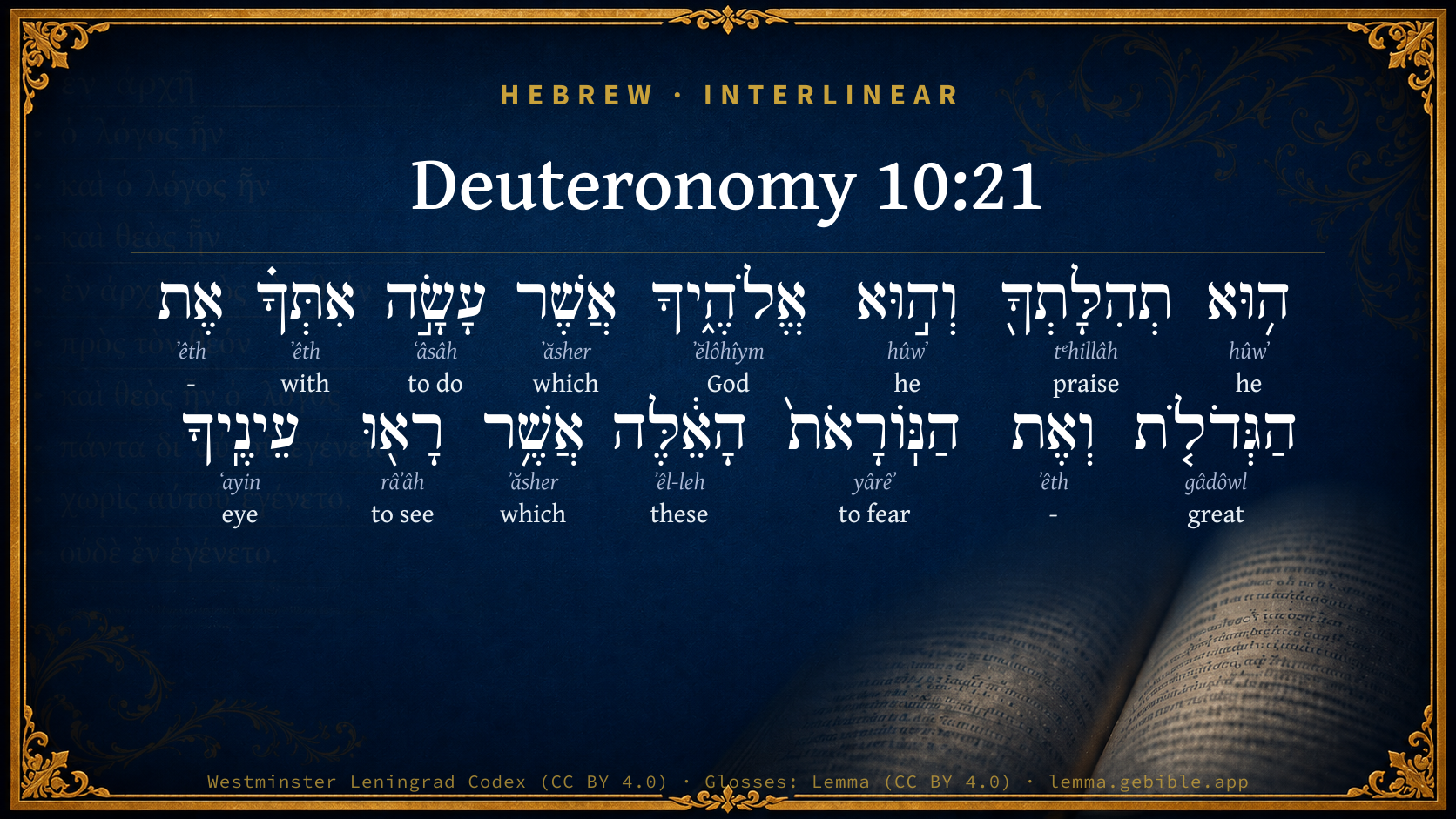
Hebrew (Westminster Leningrad Codex) Deuteronomy 10:21 appears in the Hebrew Old Testament. The text above is from the Westminster Leningrad Codex. Each word links to its Strong’s number, a concise gloss, and parsing drawn from the Open Scriptures Hebrew Bible morphology. Click any word for its full Brown-Driver-Briggs (BDB) entry.
Download image
Cite this verse

Deuteronomy 10:21 (World English Bible). Public Domain. Lemma interlinear Bible study tool, https://lemma.gebible.app/v/deuteronomy/10/21.

Show BibTeX & RIS
BibTeX
RIS
English Translation
He is your praise, and he is your God, who has done for you these great and awesome things, which your eyes have seen.
World English Bible · Public Domain
Download a study sheet

One document with this verse’s original text, its word-by-word gloss line, the meaning frame, cross-references with their text, attributed commentary, and full source and license credits — printable, and it pastes into notes with its structure intact.

This verse Autodidact and up

Study sheet (.html) Plain text (.txt)

A passage Seminary Student

Up to 50 verses in one chapter. A passage sheet keeps up to 6 commentary sources and 12 cross-references per verse, in the order this page ranks them, and says so on the sheet whenever that leaves anything out. Ask for a single verse and you get the Autodidact verse sheet above.

Everything on this page stays free to read, with no account — the sheet is a download of what is already on screen, not access to it.

Want to remove ads? Support Godless Engineer
Compare translations 3

The same verse in 3 English versions, stacked beneath the original-language interlinear above. Click any original word for its lexicon entry.

Each is an independent rendering of the whole verse — the interlinear is not word-aligned to these translations.

Highlighted words mark where these versions differ — a whole-verse word diff, not a word-by-word alignment.

  • World English Bible Public Domain
    He is your praise, and he is your God, who has done for you these great and awesome things, which your eyes have seen.
  • King James Version Public Domain
    He is thy praise, and he is thy God, that hath done for thee these great and terrible things, which thine eyes have seen.
  • unfoldingWord Literal Text CC BY-SA 4.0
    He your praise, and he your God, who has done for you these great and fearsome things, which your eyes have seen.

unfoldingWord Literal Text — © unfoldingWord, licensed CC BY-SA 4.0. Word-aligned USFM3 via Door43 (git.door43.org/unfoldingWord/en_ult).

Versions to compare (up to 4)

3 of 4 selected

Show all 18 translations

Every available English version of this verse, each an independent rendering of the whole verse.

  • World English Bible Public Domain
    He is your praise, and he is your God, who has done for you these great and awesome things, which your eyes have seen.
  • Berean Standard Bible Public Domain
    He is your praise and He is your God, who has done for you these great and awesome wonders that your eyes have seen.
  • Majority Standard Bible Public Domain
    He is your praise and He is your God, who has done for you these great and awesome wonders that your eyes have seen.
  • King James Version Public Domain
    He is thy praise, and he is thy God, that hath done for thee these great and terrible things, which thine eyes have seen.
  • American Standard Version (1901) Public Domain
    He is thy praise, and he is thy God, that hath done for thee these great and terrible things, which thine eyes have seen.
  • Revised Version (1885) Public Domain
    He is thy praise, and he is thy God, that hath done for thee these great and terrible things, which thine eyes have seen.
  • Geneva Bible (1599) Public Domain
    He is thy praise, and hee is thy God, that hath done for thee these great and terrible things, which thine eyes haue seene.
  • Douay-Rheims (1899) Public Domain
    He is thy praise, and thy God, that hath done for thee these great and terrible things, which thy eyes have seen.
  • Young's Literal Translation Public Domain
    He `is' thy praise, and He `is' thy God, who hath done with thee these great and fearful `things' which thine eyes have seen:
  • Literal Standard Version CC BY-SA 4.0
    He [is] your praise, and He [is] your God, who has done these great and fearful [things] with you which your eyes have seen.
  • Unlocked Literal Bible CC BY-SA 4.0
    He is your praise, and he is your God, who has done for you these great and fearsome things, which your eyes have seen.
  • unfoldingWord Literal Text CC BY-SA 4.0
    He your praise, and he your God, who has done for you these great and fearsome things, which your eyes have seen.
  • Darby Bible Public Domain
    He is thy praise, and he is thy God, who hath done for thee these great and terrible things, which thine eyes have seen.
  • World Messianic Bible Public Domain
    He is your praise, and he is your God, who has done for you these great and awesome things which your eyes have seen.
  • Webster's Bible Public Domain
    He is thy praise, and he is thy God, that hath done for thee these great and terrible things which thy eyes have seen.
  • Free Bible Version CC BY-SA 4.0
    He is the one you should praise and he is your God, who has carried out for you these incredible and awesome miracles that you've seen with your own eyes.
  • Bible in Basic English Public Domain
    He is your God, the God of your praise, your God who has done for you all these works of power which your eyes have seen.
  • JPS Tanakh (1917) Public Domain
    He is thy glory, and He is thy God, that hath done for thee these great and tremendous things, which thine eyes have seen.

Literal Standard Version (2020), Covenant Press — licensed CC BY-SA 4.0. Text via the HelloAO Bible API (eBible.org). Unlocked Literal Bible (unfoldingWord) — licensed CC BY-SA 4.0. Text via the HelloAO Bible API (eBible.org). unfoldingWord Literal Text — © unfoldingWord, licensed CC BY-SA 4.0. Word-aligned USFM3 via Door43 (git.door43.org/unfoldingWord/en_ult). Free Bible Version, Dr. Jonathan Gallagher — licensed CC BY-SA 4.0. Text via the HelloAO Bible API (eBible.org).

Word by word

More ways to search: Search by grammar → Find every occurrence → Compare this word →

Practice this passage: Drill this verse → Learn its vocabulary →

תְהִלָּתְךָ֖
tᵉhillâh
H8416
“praise · your”
Noun, Common, Feminine, Singular, Construct + Suffix, Personal, 2nd Person, Masculine, Singular
Part of Speech
Noun
Type
Common
Gender
Feminine
Number
Singular
State
Construct
Full BDB Definition

Origin: from H1984

TWOT: 500c

praise, song or hymn of praise - praise, adoration, thanksgiving (paid to God) - act of general or public praise - praise-song (as title) - praise (demanded by qualities or deeds or attributes of God) - renown, fame, glory - of Damascus, God - object of praise, possessor of renown (figuratively)
  1. ה֥וּא hûwʼ H1931 “he” Pronoun, Personal, 3rd Person, Masculine, Singular
  2. וְה֣וּא hûwʼ H1931 “and · he” Conjunction + Pronoun, Personal, 3rd Person, Masculine, Singular
  3. אֱלֹהֶ֑יךָ ʼĕlôhîym H430 “God(s) · your” Noun, Common, Masculine, Plural, Construct + Suffix, Personal, 2nd Person, Masculine, Singular
  4. אֲשֶׁר ʼăsher H834 “which” Particle, Relative
  5. עָשָׂ֣ה ʻâsâh H6213 “to do” Verb, Qal, Perfect, 3rd Person, Masculine, Singular
  6. אִתְּךָ֗ ʼêth H854 “with · you” Preposition + Suffix, Personal, 2nd Person, Masculine, Singular
  7. אֶת ʼêth H853 “-” Particle, Direct Object
  8. הַגְּדֹלֹ֤ת gâdôwl H1419 “the · great” Particle, Definite Article + Adjective, Adjective, Feminine, Plural, Absolute
  9. וְאֶת ʼêth H853 “and · -” Conjunction + Particle, Direct Object
  10. הַנּֽוֹרָאֹת֙ yârêʼ H3372 “the · fearing” Particle, Definite Article + Verb, Niphal, Participle Active, Feminine, Plural, Absolute
  11. הָאֵ֔לֶּה ʼêl-leh H428 “the · these” Particle, Definite Article + Pronoun, Demonstrative, Common, Plural
  12. אֲשֶׁ֥ר ʼăsher H834 “which” Particle, Relative
  13. רָא֖וּ râʼâh H7200 “to see” Verb, Qal, Perfect, 3rd Person, Common, Plural
  14. עֵינֶֽיךָ ʻayin H5869 “eyes · your” Noun, Common, Both, Dual, Construct + Suffix, Personal, 2nd Person, Masculine, Singular

About this verse

These counts appear in no published source. They are computed here, from the morphology-tagged text and Lemma’s own curated glosses. What Lemma adds →

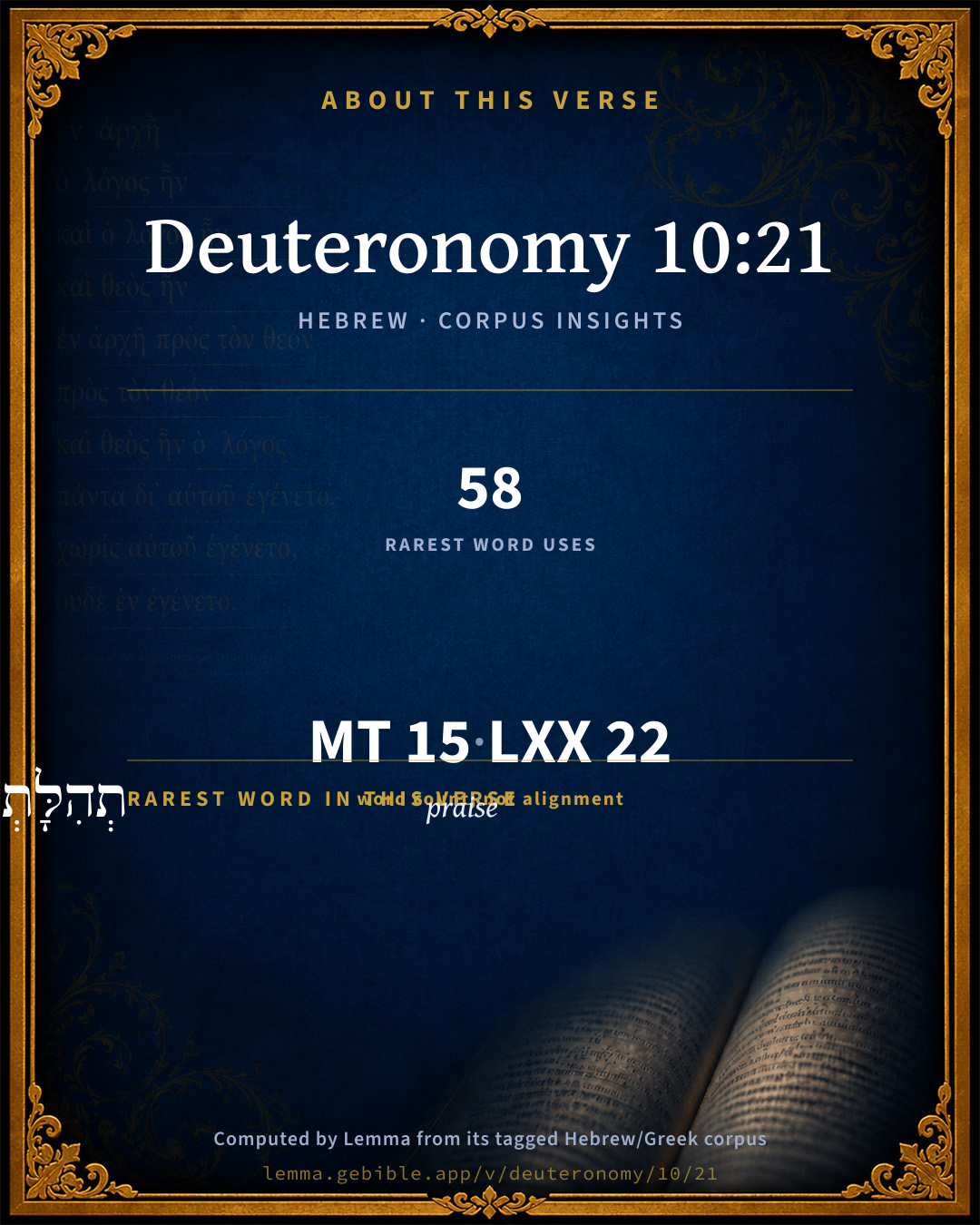
15
words
12
distinct lemmas
Pentateuch
section

Shared distinctive vocabulary

תְהִלָּתְךָ֖ praise H8416 occurs in 57 verses of the Hebrew Bible. Also found in:

Grammatical profile

  • 3 verbs
  • 3 nouns
  • 1 adjective
  • 3 pronouns
  • 1 preposition
  • 4 particles

Verb forms

  • עָשָׂ֣ה Qal · Perfect
  • הַנּֽוֹרָאֹת֙ Niphal · Participle Active
  • רָא֖וּ Qal · Perfect

Repetition

Words recur within this verse — often emphatic in Hebrew:

  • ה֥וּא he H1931 ×2
  • אֲשֶׁר which H834 ×2

Hebrew & Septuagint length

In English translation the verse runs 24 words from the Hebrew and 27 from the Septuagint (LXX English) — closely comparable.

A rough comparison of the two English renderings, which tokenize alike — not a word-level alignment.

Word counts can differ between the Hebrew and the Greek without any difference in meaning — e.g. the Hebrew direct-object marker אֵת has no separate Greek word, and Greek often adds the article ὁ.

In the original languages it is 15 Hebrew tokens and 22 Greek tokens — but the two are counted differently (Hebrew bundles its prefixes and suffixes into one token; the Greek is in lemma form), so that isn’t a like-for-like length.

Cross-references

14

Topical passages linked to Deuteronomy 10:21 in the Treasury of Scripture Knowledge — connected by theme and wording, ordered by reader-vote popularity; previews shown in the World English Bible.

  • Jeremiah 17:14 Heal me, O Yahweh, and I shall be healed; save me, and I shall be saved: for you are my praise.
  • Exodus 15:2 Yah is my strength and song, He has become my salvation: This is my God, and I will praise him; My father's God, and I will exalt him.
  • Revelation 21:23 The city has no need for the sun, neither of the moon, to shine, for the very glory of God illuminated it, and its lamp is the Lamb.
  • Deuteronomy 4:32–35 For ask now of the days that are past, which were before you, since the day that God created man on the earth, and from the one end of the sky to the other, whether there has been [any such thing] as this great thing is, or has been heard like it?
  • 2 Samuel 7:23 What one nation in the earth is like your people, even like Israel, whom God went to redeem to himself for a people, and to make him a name, and to do great things for you, and awesome things for your land, before your people, whom you redeem to you out of Egypt, [from] the nations and their gods?
  • Psalms 22:3 But you are holy, You who inhabit the praises of Israel.
  • 1 Samuel 12:24 Only fear Yahweh, and serve him in truth with all your heart; for consider how great things he has done for you.
  • Psalms 106:21–22 They forgot God, their Savior, Who had done great things in Egypt,
  • Psalms 109:1 God of my praise, don't remain silent,
  • Isaiah 12:2–6 Behold, God is my salvation. I will trust, and will not be afraid; for Yah, Yahweh, is my strength and song; and he has become my salvation."
  • Isaiah 60:19 The sun shall be no more your light by day; neither for brightness shall the moon give light to you: but Yahweh will be to you an everlasting light, and your God your glory.
  • Isaiah 64:3 When you did terrible things which we didn't look for, you came down, the mountains quaked at your presence.
  • Jeremiah 32:20–21 who performed signs and wonders in the land of Egypt, even to this day, both in Israel and among [other] men; and made you a name, as in this day;
  • Luke 2:32 A light for revelation to the Gentiles, And the glory of your people Israel."

Cross-references courtesy of OpenBible.info (CC BY 4.0).

Hebrew and Greek witnesses Masoretic Hebrew ↔ Greek Septuagint

The same verse in the two great witnesses to the Old Testament, shown verse-for-verse.

These are two independent witnesses, not word-aligned to each other, and the Septuagint is shown in lemma (dictionary) form.

Hebrew Deuteronomy 10:21 Masoretic · Westminster Leningrad Codex

ה֥וּא תְהִלָּתְךָ֖ וְה֣וּא אֱלֹהֶ֑יךָ אֲשֶׁר עָשָׂ֣ה אִתְּךָ֗ אֶת הַגְּדֹלֹ֤ת וְאֶת הַנּֽוֹרָאֹת֙ הָאֵ֔לֶּה אֲשֶׁ֥ר רָא֖וּ עֵינֶֽיךָ

He is your praise, and he is your God, who has done for you these great and awesome things, which your eyes have seen.

World English Bible · Public Domain

Greek LXX Deuteronomy 10:21 Septuagint · lemma form

οὗτος καύχημα σύ καί οὗτος θεός σύ ὅστις ποιέω ἐν σύ ὁ μέγας καί ὁ ἔνδοξος οὗτος ὅς ὁράω ὁ ὀφθαλμός σύ

He is your boast, and he is your God, who has wrought in the midst of you these great and glorious things, which your eyes have seen.

LXX2012 (modern English Septuagint) · Public Domain

Hebrew: Westminster Leningrad Codex (CC BY 4.0). Greek: Septuagint (public domain); English from LXX2012 (modern English Septuagint) (Public Domain). How the Septuagint differs from the Hebrew →

Targum (Aramaic paraphrase)

2

The Targum is the ancient Jewish Aramaic paraphrase of the Hebrew Scriptures — an interpretive translation, not the Hebrew text itself. Onkelos (literal) and Pseudo-Jonathan (expansive) render the Torah, and Jonathan the Prophets. Coverage is partial: where no permissively-licensed English translation exists for a verse, only the Aramaic is shown. This is verse-level text, not a word-by-word alignment to the Hebrew.

  1. Targum Onkelos Torah (Genesis–Deuteronomy)
    הוּא תֻשְׁבַּחְתָּךְ וְהוּא אֱלָהָךְ דַעֲבַד עִמָךְ יָת רַבְרְבָתָא וְיָת חֲסִינָתָא הָאִלֵין דִי חֲזוֹ עֵינָיךְ

    (no public-domain English translation for this verse)

    Targum Onkelos — Aramaic: “Onkelos Genesis” (public domain); “Onkelos Exodus” (public domain); “Onkelos Leviticus” (public domain); “Onkelos Numbers” (public domain); “Onkelos Deuteronomy” (public domain). English: “Sefaria Community Translation” (CC0 1.0 (public-domain dedication)); “J.W. Etheridge. The Targums of Onkelos and Jonathan Ben Uzziel on the Pentateuch. London: Longmans, Green, 1862” (public domain). Text via Sefaria.

  2. Targum Pseudo-Jonathan Torah (Genesis–Deuteronomy)
    הוּא תוּשְׁבַּחְתְּכוֹן וְהוּא אֱלָהָכוֹן דְּעָבַד עִמְכוֹן יַת רַבְרְבָתָא וְיַת חֲסִינָתָא הָאִילֵין דַּחֲמִיתוּן בְּעֵינֵיכוֹן

    He is your praise, and He is your God, who hath done for thee these great and mighty acts which thou hast beheld with thy eyes.

    Targum Pseudo-Jonathan — Aramaic: “Targum Jonathan on Genesis” (public domain); “Targum Jonathan on Exodus” (public domain); “Targum Jonathan on Leviticus” (public domain); “Targum Jonathan on Numbers” (public domain); “Targum Jonathan on Deuteronomy” (public domain). English: “The Targum of Jonathan ben Uzziel, trans. J. W. Etheridge, London, 1862” (public domain). Text via Sefaria.

Commentary

Notes on Deuteronomy 10:21 from classic Christian and Jewish commentators (each source and its license shown beneath its notes). The classic Christian expositions comment on the surrounding passage and are grouped to its opening verse, so a note may address several verses; the Jewish commentaries on the Tanakh (Rashi and others) are per-verse, so they appear only where the commentator wrote on this verse.

Lemma curates 59 commentaries, every one of them public domain or Creative Commons licensed, each selected and text-cleaned for this edition rather than reprinted as found. About our sources →

Trapp's Complete Commentary

John Trapp

Deu 10:21 He [is] thy praise, and he [is] thy God, that hath done for thee these great and terrible things, which thine eyes have seen.

Ver. 21. He is thy praise.] Thy praised One, {Psa 18:3} or, Thy praiseworthy One. He is also thy chief glory and praise amongst all nations, who shall admire thy happiness in such a God.

John Trapp, A Commentary or Exposition upon All the Books of the Old and New Testament (1647–1656) — public domain. Text from a community e-Sword module.

The Biblical Illustrator

Joseph S. Exell

Deu_10:21

Done for thee these great and terrible things.

The great doings of God

I. In what the great deeds of God consist.

1. In Salvation. God, who delivered Israel from the bondage of Egypt, has wrought a great work of deliverance on behalf of the human race. Greater than any deed of vengeance is the Divine interposition by which mankind is saved from the penalty and the curse of sin.

2. In the supply of all wants. The Lord, who gave Israel bread from heaven and water from the flint rock, has made, in the dispensation of His grace, a sufficient supply for the spiritual needs of all mankind.

3. In protection and deliverance from all dangers, and from the assaults of every foe.

II. By what the great deeds of God are prompted.

1. By the spectacle of the need, the misery, the helplessness of men.

2. By the pity and loving kindness of the Infinite Heart.

III. To what the great deeds of God should lead those who profit by them.

1. To gratitude and praise. The Lord hath done great things for us, whereof we are glad. Bless the Lord, O my soul.

2. To cheerful obedience. The memory of Divine favours should not only awaken gladness; it should remind us of Gods claims upon us, upon our love, our life, our all. (Family Churchman.)

Praise and obedience

He who would serve God must begin by praising God, for a grateful heart is the mainspring of obedience. We must offer the salt of gratitude with the sacrifice of obedience; our lives should be anointed with the precious oil of thankfulness. As soldiers march to music, so while we walk in the paths of righteousness we should keep step to the notes of thanksgiving. Larks sing as they mount, so should we magnify the Lord for His mercies, while we are winging our way to heaven. Our thanksgiving is not a swallow which is gone with the summer. The birds within our bosom sing all the year round, and on such a day as this their song is doubly welcome. The fire of gratitude will help to warm us--heap on the big logs of loving memories. No cold shall freeze the genial current of our soul; our praise shall flow on when brooks and rivers are bound in ice. Let us see who among us can best rejoice in the Lord in all weathers.

The Biblical Illustrator, edited by Joseph S. Exell (c. 1880s–1900s) — public domain. Text from a community e-Sword module.

Adam Clarke's Commentary

Verse 21. He is thy praise] It is an eternal honour to any soul to be in the friendship of God. Why are people ashamed of being thought religious? Because they know nothing of religion. He who knows his Maker may glory in his God, for without him what has any soul but disgrace, pain, shame, and perdition? How strange is it that those who fear God should be ashamed to own it, while sinners boldly proclaim their relationship to Satan!

Adam Clarke's Commentary on the Bible (1810–1826) — public domain. Text from a community e-Sword/MySword module.

The Cambridge Bible for Schools and Colleges

gen. ed. J. J. S. Perowne

21. He] in an emphatic position.

thy praise] Either the object of thy praise (cp. Psa_109:1, God of my praise), or cause of thy fame, thy renown, viz. by the deeds He has done for thee, Jer_17:14.

great and terrible things] Deu_4:34 great terrors; cp. Deu_6:22, Deu_7:19.

which thine eyes have seen] So Deu_4:9; Deu_7:19; Deu_29:3 (2), all Sg. as here; but in Deu_29:2 (1) before your eyes; cp. Deu_11:2. The nation is regarded as identical through all its generations. See on Deu_4:9.

The Cambridge Bible for Schools and Colleges (gen. ed. J. J. S. Perowne; Cambridge University Press, 1878–1918) — public domain. Text from a community e-Sword module.

John Gill's Exposition

He is thy praise,.... The object and matter of it, who deserves the praises of all his creatures, because of his perfections, works, and blessings of goodness; for all mercies temporal and spiritual come from him, and therefore he is greatly to be praised for them: praise is his due, and it is comely in his people to give it to him; see Jer 17:14.

and he is thy God which hath done for thee these great and terrible things which thine eyes have seen; which were done upon the Egyptians for their sakes, both in the land of Egypt and at the Red sea; and also what he had done for them in the wilderness, to Sihon and Og, kings of the Amorites, Psa 106:22.

John Gill's Exposition of the Whole Bible (1746–1763) — public domain (CC PDM 1.0). Text via the HelloAO Bible API.

Haydock's Catholic Bible Commentary

Praise, the object whom thou must praise, and the source of all thy happiness and glory. Other nations will revere the Jews on this account. (Calmet) --- An ancient oracle could not refuse giving them this singular commendation, though to the prejudice of idolatry. "Chaldeans alone philosophy may claim --- but Hebrews worship God, the self-born King --- with pure religion." (Haydock) --- agnos, (Calmet) St. Cyril, contra Julian 5., and St. Justin Martyr, Hortatory Address to the Greeks xi., read auton, him. But the meaning is clear from the context. The palm of wisdom is given to the Chaldeans for natural learning, and to the Jews for divinity. (Watson, Proleg. xii.) Porphyrius owns the oracle. (Theodoret) (Haydock)

George Leo Haydock (1774–1849), Haydock's Catholic Family Bible and Commentary, 1859 edition — public domain. Excludes Psalms (Douay-Rheims chapter numbering differs from Protestant) and Deuterocanonical books (Catholic canon only).

Matthew Poole's English Annotations

Thy praise; either,

1. The object and matter of thy praise, as Exo 15:2, whom thou shouldst ever praise. Or rather,

2. The ground of thy praise, i.e. of thy praise-worthiness; he who makes thee honourable and glorious above those people whose God he is not.

Matthew Poole's English Annotations on the Holy Bible (1683–1685) — public domain. Text from a community e-Sword/MySword module.

The Pulpit Commentary

He is thy praise, i.e. the Object of thy praise; the Being who had given them abundant cause to praise him, and whom they were bound continually to praise (cf. Psa_22:3 Psa_109:1; Jer_17:14) Terrible things; acts which by their greatness and awful effects inspired fear and dread into those by whom they were witnessed. For thee; literally, with thee, i.e. either in thy view or towards thee, for thy behoof (comp. Deu_1:30; 1Sa_12:7; Zec_7:9; and such an expression as "deal kindly literally, do Madness) with,". (Gen_24:49, etc.)

The Pulpit Commentary (1880–1919), ed. H.D.M. Spence-Jones & Joseph S. Exell — public domain. Text from a community e-Sword module.

John Wesley's Explanatory Notes

Thy praise - The object and matter of thy praise, as Exod. xv, 2, whom thou shouldest ever praise.

John Wesley, Explanatory Notes Upon the Whole Bible (1754–1765) — public domain. Text via the GEBible commentary corpus.

Ramban (Nachmanides)

Rabbi Moshe ben Nachman (Ramban / Nachmanides)

HE IS THY PRAISE, AND HE IS THY G-D. The meaning thereof is that He should be your [sole object of] praise, that you are to devote all your praise to Him, praising Him always and not to give His glory to another, neither His praise to graven images, nor to the gods and lords mentioned. Or he may be stating: “He is thy praise, for through Him you are praised above all peoples,” similar in expression to the verses, For Thou art the glory of their strength; O Eternal, my strength, and my stronghold.

And He is thy G-d, for He has especially addressed His Name to you, that you be unto Himself for a people, and that He may be unto thee a G-d, unlike the rest of the peoples to whom He is the G-d of [the various] gods [i.e., angels, etc.] that He allotted to them, as I have explained, because he has done for you the great and tremendous things from which you can recognize that you are His portion and His inheritance, and His eyes are always upon you for good.

Ramban (Nachmanides) on the Tanakh — English translation: “Commentary on the Torah by Ramban (Nachmanides). Translated and annotated by Charles B. Chavel. New York, Shilo Pub. House, 1971-1976” (CC BY 4.0). Text via Sefaria.

Lesson kit

Teaching starters — assembled from the data on this page, not authored interpretation. Every prompt links to the verse data it draws on. Edit before teaching.

Deuteronomy, in the Pentateuch, opens this verse with 15 words (12 distinct Hebrew lemmas). Its most distinctive word is tᵉhillâh (“praise”). A historical commentator’s framing appears above. Read the whole chapter for the surrounding context.

Discussion questions

  1. How does “praise” (tᵉhillâh) shape what this verse is saying?
  2. How does Exodus 15:11, which shares the word «praise», read alongside this verse?
  3. What does the repetition of “he” (2× in this one verse) do in this verse?
  4. These translations render this verse differently; the difference is in the English rendering, not the original. What questions does that raise?
  5. «עָשָׂ֣ה» is a Qal Perfect verb. How does that grammatical form shape the action described?
  6. Compare how Trapp's Complete Commentary and The Biblical Illustrator read this verse. Where do they agree or differ?

Things to notice

Reading settings

Reading text

Shown beneath each verse's original-language words.

Old Testament
Old Testament edition

Read the OT as the Masoretic Hebrew (MT) or the Greek Septuagint (LXX).

English shown for the Greek Septuagint (in the Hebrew ↔ Greek comparison).

Comparing translations? Open the Compare panel on any verse page to stack up to four side by side.