
1 Kings 3:28

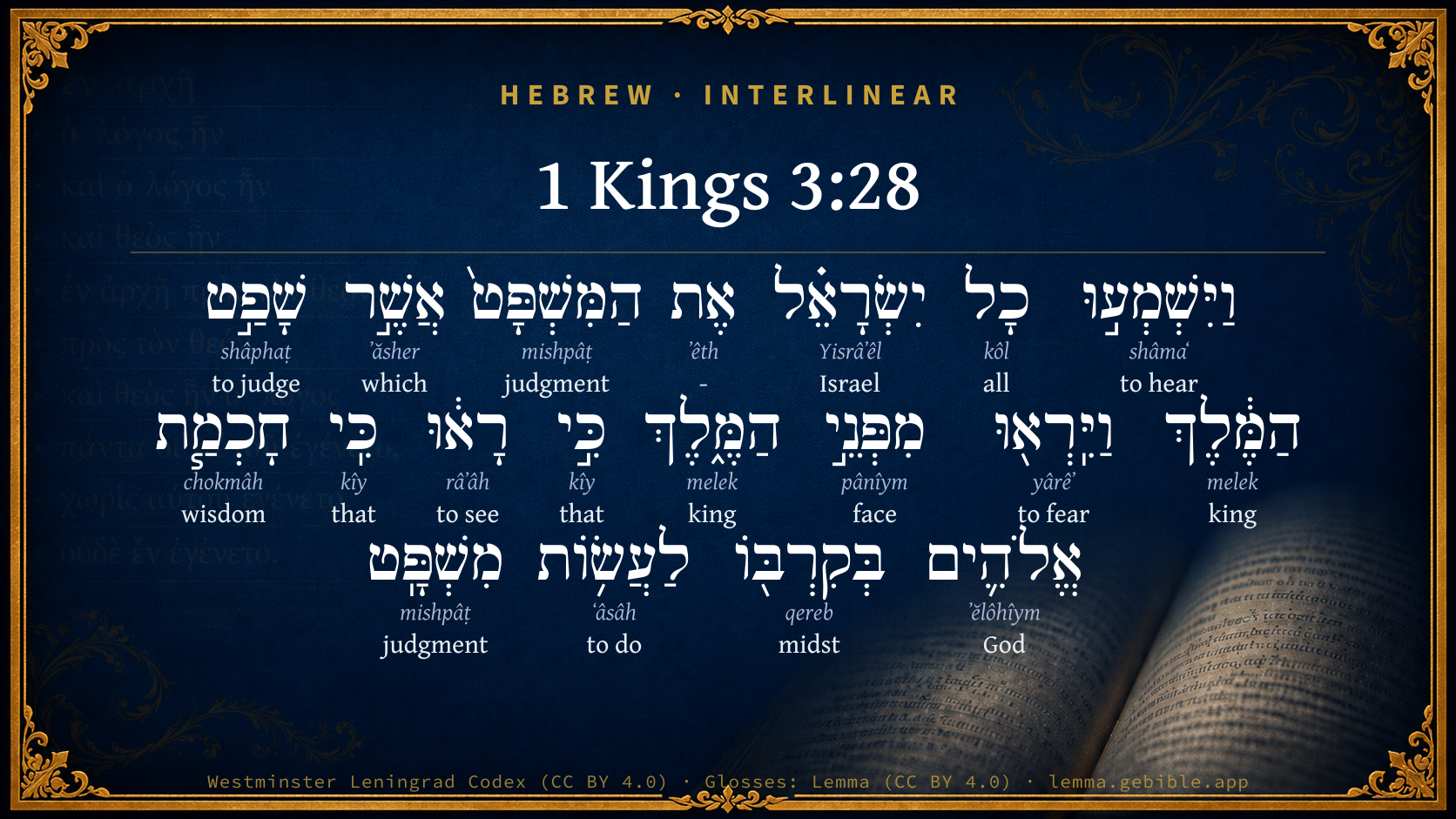
Hebrew (Westminster Leningrad Codex) 1 Kings 3:28 appears in the Hebrew Old Testament. The text above is from the Westminster Leningrad Codex. Each word links to its Strong’s number, a concise gloss, and parsing drawn from the Open Scriptures Hebrew Bible morphology. Click any word for its full Brown-Driver-Briggs (BDB) entry.
Download image
Cite this verse

1 Kings 3:28 (World English Bible). Public Domain. Lemma interlinear Bible study tool, https://lemma.gebible.app/v/1-kings/3/28.

Show BibTeX & RIS
BibTeX
RIS
English Translation
All Israel heard of the judgment which the king had judged; and they feared the king: for they saw that the wisdom of God was in him, to do justice.
World English Bible · Public Domain
Download a study sheet

One document with this verse’s original text, its word-by-word gloss line, the meaning frame, cross-references with their text, attributed commentary, and full source and license credits — printable, and it pastes into notes with its structure intact.

This verse Autodidact and up

Study sheet (.html) Plain text (.txt)

A passage Seminary Student

Up to 50 verses in one chapter. A passage sheet keeps up to 6 commentary sources and 12 cross-references per verse, in the order this page ranks them, and says so on the sheet whenever that leaves anything out. Ask for a single verse and you get the Autodidact verse sheet above.

Everything on this page stays free to read, with no account — the sheet is a download of what is already on screen, not access to it.

Want to remove ads? Support Godless Engineer
Compare translations 3

The same verse in 3 English versions, stacked beneath the original-language interlinear above. Click any original word for its lexicon entry.

Each is an independent rendering of the whole verse — the interlinear is not word-aligned to these translations.

Highlighted words mark where these versions differ — a whole-verse word diff, not a word-by-word alignment.

  • World English Bible Public Domain
    All Israel heard of the judgment which the king had judged; and they feared the king: for they saw that the wisdom of God was in him, to do justice.
  • King James Version Public Domain
    And all Israel heard of the judgment which the king had judged; and they feared the king: for they saw that the wisdom of God was in him, to do judgment.
  • unfoldingWord Literal Text CC BY-SA 4.0
    And all of Israel heard the judgment that the king had judged, and they were afraid from the face of the king, because they saw that the wisdom of God was within him to do justice.

unfoldingWord Literal Text — © unfoldingWord, licensed CC BY-SA 4.0. Word-aligned USFM3 via Door43 (git.door43.org/unfoldingWord/en_ult).

Versions to compare (up to 4)

3 of 4 selected

Show all 18 translations

Every available English version of this verse, each an independent rendering of the whole verse.

  • World English Bible Public Domain
    All Israel heard of the judgment which the king had judged; and they feared the king: for they saw that the wisdom of God was in him, to do justice.
  • Berean Standard Bible Public Domain
    When all Israel heard of the judgment the king had given, they stood in awe of him, for they saw that the wisdom of God was in him to administer justice.
  • Majority Standard Bible Public Domain
    When all Israel heard of the judgment the king had given, they stood in awe of him, for they saw that the wisdom of God was in him to administer justice.
  • King James Version Public Domain
    And all Israel heard of the judgment which the king had judged; and they feared the king: for they saw that the wisdom of God was in him, to do judgment.
  • American Standard Version (1901) Public Domain
    And all Israel heard of the judgment which the king had judged; and they feared the king: for they saw that the wisdom of God was in him, to do justice.
  • Revised Version (1885) Public Domain
    And all Israel heard of the judgment which the king had judged; and they feared the king: for they saw that the wisdom of God was in him, to do judgment.
  • Geneva Bible (1599) Public Domain
    And all Israel heard the iudgement, which the King had iudged, and they feared the King: for they sawe that the wisedome of God was in him to doe iustice.
  • Douay-Rheims (1899) Public Domain
    And all Israel heard the judgment which the king had judged, and they feared the king, seeing that the wisdom of God was in him to do judgment.
  • Young's Literal Translation Public Domain
    And all Israel hear of the judgment that the king hath judged, and fear because of the king, for they have seen that the wisdom of God `is' in his heart, to do judgment.
  • Literal Standard Version CC BY-SA 4.0
    And all [in] Israel hear of the judgment that the king has judged, and fear because of the king, for they have seen that the wisdom of God [is] in his heart to do judgment.
  • Unlocked Literal Bible CC BY-SA 4.0
    When all Israel heard of the judgment which the king had rendered, they feared the king, because they saw that the wisdom of God was in him for giving judgments.
  • unfoldingWord Literal Text CC BY-SA 4.0
    And all of Israel heard the judgment that the king had judged, and they were afraid from the face of the king, because they saw that the wisdom of God was within him to do justice.
  • Darby Bible Public Domain
    And all Israel heard of the judgment which the king had judged; and they feared the king, for they saw that the wisdom of God was in him, to do justice.
  • World Messianic Bible Public Domain
    All Israel heard of the judgment which the king had judged; and they feared the king, for they saw that the wisdom of God was in him to do justice.
  • Webster's Bible Public Domain
    And all Israel heard of the judgment which the king had judged; and they feared the king: for they saw that the wisdom of God was in him, to do judgment.
  • Free Bible Version CC BY-SA 4.0
    When everyone in Israel heard about the verdict the king had delivered, they had great respect for the king, because they recognized the wisdom God had given him to judge rightly.
  • Bible in Basic English Public Domain
    And news of this decision which the king had made went through all Israel; and they had fear of the king, for they saw that the wisdom of God was in him to give decisions.
  • JPS Tanakh (1917) Public Domain
    And all Israel heard of the judgment which the king had judged; and they feared the king; for they saw that the wisdom of God was in him, to do justice.

Literal Standard Version (2020), Covenant Press — licensed CC BY-SA 4.0. Text via the HelloAO Bible API (eBible.org). Unlocked Literal Bible (unfoldingWord) — licensed CC BY-SA 4.0. Text via the HelloAO Bible API (eBible.org). unfoldingWord Literal Text — © unfoldingWord, licensed CC BY-SA 4.0. Word-aligned USFM3 via Door43 (git.door43.org/unfoldingWord/en_ult). Free Bible Version, Dr. Jonathan Gallagher — licensed CC BY-SA 4.0. Text via the HelloAO Bible API (eBible.org).

Word by word

More ways to search: Search by grammar → Find every occurrence → Compare this word →

Practice this passage: Drill this verse → Learn its vocabulary →

חָכְמַ֧ת
chokmâh
H2451
“wisdom of”
Noun, Common, Feminine, Singular, Construct
Part of Speech
Noun
Type
Common
Gender
Feminine
Number
Singular
State
Construct
Full BDB Definition

Origin: from H2449

TWOT: 647a

wisdom - skill (in war) - wisdom (in administration) - shrewdness, wisdom - wisdom, prudence (in religious affairs) - wisdom (ethical and religious)
  1. וַיִּשְׁמְע֣וּ shâmaʻ H8085 “and · to hear” Conjunction + Verb, Qal, Sequential Imperfect, 3rd Person, Masculine, Plural
  2. כָל kôl H3605 “all of” Noun, Common, Masculine, Singular, Construct
  3. יִשְׂרָאֵ֗ל Yisrâʼêl H3478 “Israel” Noun, Proper
  4. אֶת ʼêth H853 “-” Particle, Direct Object
  5. הַמִּשְׁפָּט֙ mishpâṭ H4941 “the · judgment” Particle, Definite Article + Noun, Common, Masculine, Singular, Absolute
  6. אֲשֶׁ֣ר ʼăsher H834 “which” Particle, Relative
  7. שָׁפַ֣ט shâphaṭ H8199 “to judge” Verb, Qal, Perfect, 3rd Person, Masculine, Singular
  8. הַמֶּ֔לֶךְ melek H4428 “the · king” Particle, Definite Article + Noun, Common, Masculine, Singular, Absolute
  9. וַיִּֽרְא֖וּ yârêʼ H3372 “and · to fear” Conjunction + Verb, Qal, Sequential Imperfect, 3rd Person, Masculine, Plural
  10. מִפְּנֵ֣י pânîym H6440 “from · face(s) of” Preposition + Noun, Common, Both, Plural, Construct
  11. הַמֶּ֑לֶךְ melek H4428 “the · king” Particle, Definite Article + Noun, Common, Masculine, Singular, Absolute
  12. כִּ֣י kîy H3588 “that” Conjunction
  13. רָא֔וּ râʼâh H7200 “to see” Verb, Qal, Perfect, 3rd Person, Common, Plural
  14. כִּֽי kîy H3588 “that” Conjunction
  15. אֱלֹהִ֛ים ʼĕlôhîym H430 “God(s)” Noun, Common, Masculine, Plural, Absolute
  16. בְּקִרְבּ֖וֹ qereb H7130 “in/at · midst · his” Preposition + Noun, Common, Masculine, Singular, Construct + Suffix, Personal, 3rd Person, Masculine, Singular
  17. לַעֲשׂ֥וֹת ʻâsâh H6213 “to do” Preposition + Verb, Qal, Infinitive Construct
  18. מִשְׁפָּֽט mishpâṭ H4941 “judgment” Noun, Common, Masculine, Singular, Absolute

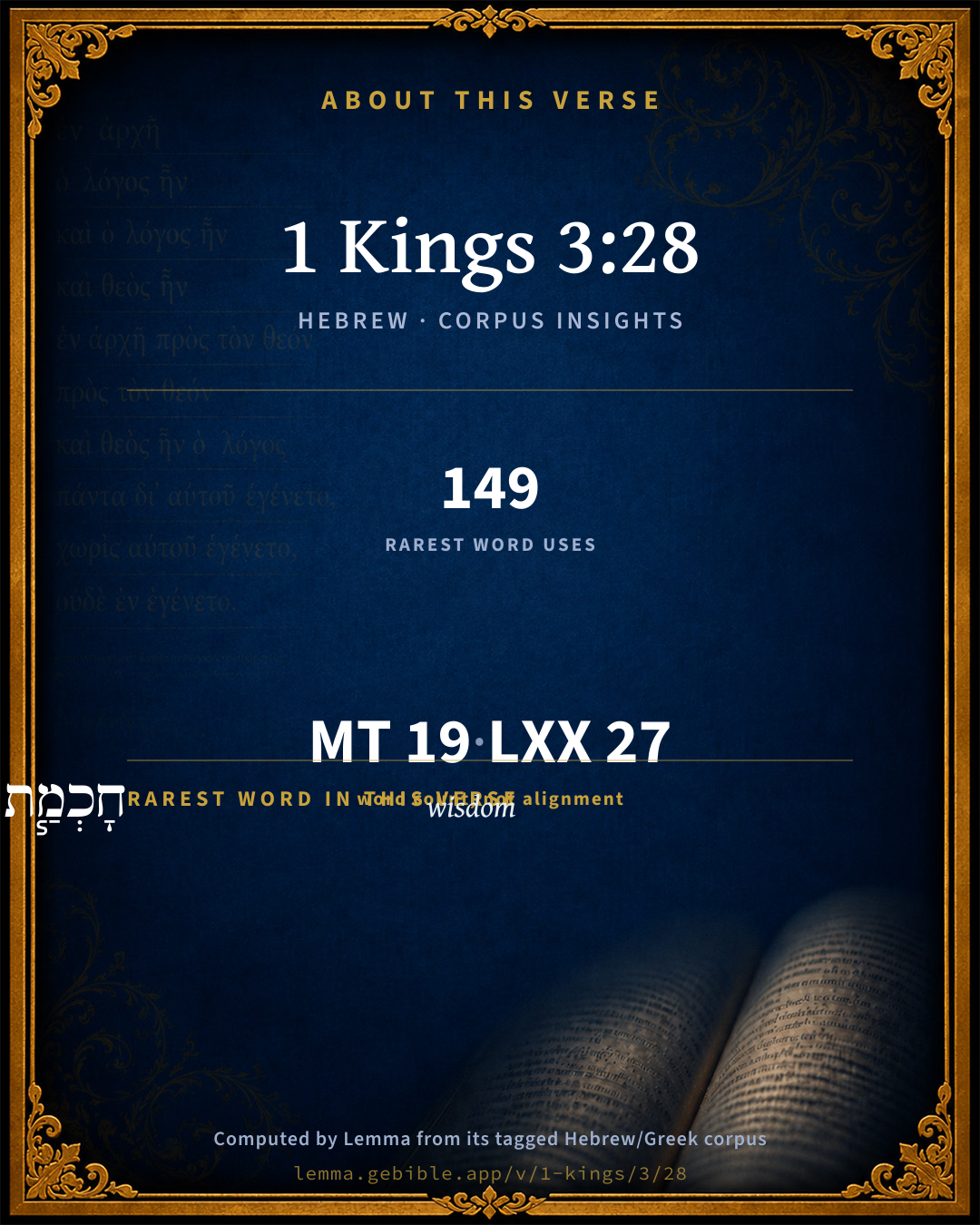
About this verse

These counts appear in no published source. They are computed here, from the morphology-tagged text and Lemma’s own curated glosses. What Lemma adds →

19
words
16
distinct lemmas
Historical
section

Grammatical profile

  • 5 verbs
  • 10 nouns
  • 2 conjunctions
  • 2 particles

Verb forms

  • וַיִּשְׁמְע֣וּ Qal · Sequential Imperfect
  • שָׁפַ֣ט Qal · Perfect
  • וַיִּֽרְא֖וּ Qal · Sequential Imperfect
  • רָא֔וּ Qal · Perfect
  • לַעֲשׂ֥וֹת Qal · Infinitive Construct

Repetition

Words recur within this verse — often emphatic in Hebrew:

  • הַמִּשְׁפָּט֙ judgment H4941 ×2
  • הַמֶּ֔לֶךְ king H4428 ×2
  • כִּ֣י that H3588 ×2

Hebrew & Septuagint length

In English translation the verse runs 30 words from the Hebrew and 30 from the Septuagint (LXX English) — the same length.

A rough comparison of the two English renderings, which tokenize alike — not a word-level alignment.

Word counts can differ between the Hebrew and the Greek without any difference in meaning — e.g. the Hebrew direct-object marker אֵת has no separate Greek word, and Greek often adds the article ὁ.

In the original languages it is 19 Hebrew tokens and 27 Greek tokens — but the two are counted differently (Hebrew bundles its prefixes and suffixes into one token; the Greek is in lemma form), so that isn’t a like-for-like length.

Cross-references

15

Topical passages linked to 1 Kings 3:28 in the Treasury of Scripture Knowledge — connected by theme and wording, ordered by reader-vote popularity; previews shown in the World English Bible.

  • 1 Kings 3:9–12 Give your servant therefore an understanding heart to judge your people, that I may discern between good and evil; for who is able to judge this your great people?
  • Daniel 2:47 The king answered to Daniel, and said, Of a truth your God is the God of gods, and the Lord of kings, and a revealer of secrets, seeing you have been able to reveal this secret.
  • Colossians 2:3 in whom are all the treasures of wisdom and knowledge hidden.
  • 1 Corinthians 1:24 but to those who are called, both Jews and Greeks, Christ is the power of God and the wisdom of God.
  • Proverbs 24:21 My son, fear Yahweh and the king. Don't join those who are rebellious:
  • Ecclesiastes 7:19 Wisdom is a strength to the wise man more than ten rulers who are in a city.
  • Daniel 2:21 He changes the times and the seasons; he removes kings, and sets up kings; he gives wisdom to the wise, and knowledge to those who have understanding;
  • Ezra 7:25 You, Ezra, after the wisdom of your God who is in your hand, appoint magistrates and judges, who may judge all the people who are beyond the River, all such as know the laws of your God; and teach you him who doesn't know them.
  • Exodus 14:31 Israel saw the great work which Yahweh did to the Egyptians, and the people feared Yahweh; and they believed in Yahweh, and in his servant Moses.
  • Joshua 4:14 On that day Yahweh magnified Joshua in the sight of all Israel; and they feared him, as they feared Moses, all the days of his life.
  • 1 Samuel 12:18 So Samuel called to Yahweh; and Yahweh sent thunder and rain that day: and all the people greatly feared Yahweh and Samuel.
  • 1 Chronicles 29:24 All the princes, the mighty men, and also all of the sons of king David submitted themselves to Solomon the king.
  • Psalms 72:2 He will judge your people with righteousness, And your poor with justice.
  • Daniel 5:11 There is a man in your kingdom, in whom is the spirit of the holy gods; and in the days of your father light and understanding and wisdom, like the wisdom of the gods, were found in him; and the king Nebuchadnezzar your father, the king, [I say], your father, made him master of the magicians, enchanters, Chaldeans, and soothsayers;
  • 1 Corinthians 1:30 But of him, you are in Christ Jesus, who was made to us wisdom from God, and righteousness and sanctification, and redemption:

Cross-references courtesy of OpenBible.info (CC BY 4.0).

Hebrew and Greek witnesses Masoretic Hebrew ↔ Greek Septuagint

The same verse in the two great witnesses to the Old Testament, shown verse-for-verse.

These are two independent witnesses, not word-aligned to each other, and the Septuagint is shown in lemma (dictionary) form.

Hebrew 1 Kings 3:28 Masoretic · Westminster Leningrad Codex

וַיִּשְׁמְע֣וּ כָל יִשְׂרָאֵ֗ל אֶת הַמִּשְׁפָּט֙ אֲשֶׁ֣ר שָׁפַ֣ט הַמֶּ֔לֶךְ וַיִּֽרְא֖וּ מִפְּנֵ֣י הַמֶּ֑לֶךְ כִּ֣י רָא֔וּ כִּֽי חָכְמַ֧ת אֱלֹהִ֛ים בְּקִרְבּ֖וֹ לַעֲשׂ֥וֹת מִשְׁפָּֽט

All Israel heard of the judgment which the king had judged; and they feared the king: for they saw that the wisdom of God was in him, to do justice.

World English Bible · Public Domain

Greek LXX 1 Kings 3:28 Septuagint · lemma form

καί ἀκούω πᾶς ἰσραήλ ὁ κρίμα οὗτος ὅς κρίνω ὁ βασιλεύς καί φοβέω ἀπό πρόσωπον ὁ βασιλεύς ὅτι ὁράω ὅτι φρόνησις θεός ἐν αὐτός ὁ ποιέω δικαίωμα

and all Israel heard this judgment which the king judged, and they feared before the king; because they saw that the wisdom of God was in him, to execute judgment.

LXX2012 (modern English Septuagint) · Public Domain

Hebrew: Westminster Leningrad Codex (CC BY 4.0). Greek: Septuagint (public domain); English from LXX2012 (modern English Septuagint) (Public Domain). How the Septuagint differs from the Hebrew →

Targum (Aramaic paraphrase)

1

The Targum is the ancient Jewish Aramaic paraphrase of the Hebrew Scriptures — an interpretive translation, not the Hebrew text itself. Onkelos (literal) and Pseudo-Jonathan (expansive) render the Torah, and Jonathan the Prophets. Coverage is partial: where no permissively-licensed English translation exists for a verse, only the Aramaic is shown. This is verse-level text, not a word-by-word alignment to the Hebrew.

  1. Targum Jonathan Prophets (Joshua–Malachi)
    וּשְׁמָעוּ כָל יִשְׂרָאֵל יַת דִינָא דְדָן מַלְכָּא וּדְחִילוּ מִן קֳדָם מַלְכָּא אֲרֵי חֲזוֹ אֲרֵי חוּכְמְתָא מִן קֳדָם יְיָ בִּמְעוֹהִי לְמֶעְבַּד דִינָא:

    (no public-domain English translation for this verse)

    Targum Jonathan — Aramaic: “Mikraot Gedolot” (public domain). English: “Sefaria Community Translation” (CC0 1.0 (public-domain dedication)); “London "Chaldee Paraphrase," 1871” (public domain). Text via Sefaria.

Commentary

Notes on 1 Kings 3:28 from classic Christian and Jewish commentators (each source and its license shown beneath its notes). The classic Christian expositions comment on the surrounding passage and are grouped to its opening verse, so a note may address several verses; the Jewish commentaries on the Tanakh (Rashi and others) are per-verse, so they appear only where the commentator wrote on this verse.

Lemma curates 59 commentaries, every one of them public domain or Creative Commons licensed, each selected and text-cleaned for this edition rather than reprinted as found. About our sources →

Trapp's Complete Commentary

John Trapp

1Ki 3:28 And all Israel heard of the judgment which the king had judged; and they feared the king: for they saw that the wisdom of God [was] in him, to do judgment.

Ver. 28. And all Israel heard,] sc., Of the king’s singular sagacity.

And they feared the king.] Good men reverenced him; bad men stood in awe of him, as a sharp and severe judge.

John Trapp, A Commentary or Exposition upon All the Books of the Old and New Testament (1647–1656) — public domain. Text from a community e-Sword module.

Tyndale Open Study Notes

Tyndale Open Resources

3:28 Kings often claimed special wisdom and the ability to make just decisions. As God promised, Solomon’s wisdom was greater than that of other wise men (4:29-34; 10:6-9, 23-24).

Tyndale Open Study Notes — © Tyndale Open Resources, licensed CC BY-SA 4.0. Text via the HelloAO Bible API.

Adam Clarke's Commentary

Verse 28. They feared the king] This decision proved that they could not impose upon him; and they were afraid to do those things which might bring them before his judgment-seat.

They saw that the wisdom of God was in him] They perceived that he was taught of God, judged impartially, and could not be deceived. What was done to the other woman we are not told; justice certainly required that she should be punished for her lies and fraud.

Adam Clarke's Commentary on the Bible (1810–1826) — public domain. Text from a community e-Sword/MySword module.

The Cambridge Bible for Schools and Colleges

gen. ed. J. J. S. Perowne

28. they feared the king] As having a power beyond what they had seen in any other to detect wrong, and to find out truth and falsehood, and so to make certain the punishment of evildoers. There was no escape from such a judge.

the wisdom of God] i.e. Wisdom which God had given, and which made the king skilful in trying the very thoughts of those who came before him. A superhuman discernment had taken up its home within him.

The Cambridge Bible for Schools and Colleges (gen. ed. J. J. S. Perowne; Cambridge University Press, 1878–1918) — public domain. Text from a community e-Sword module.

Albert Barnes' Notes on the Bible

The wisdom of God - i. e. “Divine wisdom,” “a wisdom given by God” 1Ki 3:12. The ready tact and knowledge of human nature exhibited in this pattern judgment, and its special fitness to impress Orientals, have generally been admitted.

Albert Barnes' Notes on the Bible (1834–1885) — public domain. Text from a community e-Sword/MySword module.

Matthew Poole's English Annotations

The wisdom of God; either great and eminent wisdom,

as the cedars or mountains of God are the highest and most eminent of the kind; or Divine wisdom with which God had inspired him for the better government of his people.

Was in him to judgment; to assist him in wisely examining and justly determining the causes and controversies of his people.

Matthew Poole's English Annotations on the Holy Bible (1683–1685) — public domain. Text from a community e-Sword/MySword module.

Whedon's Commentary on the Bible

Daniel D. Whedon

28. The wisdom of God was in him — That is, wisdom given by God. The people perceived that their king was divinely gifted to execute justice. His manner of procedure was very foreign from our forms of justice, but it was truly Oriental, and showed the Divine gift of detecting and exposing the guilty, and defending the innocent, which is the great end of all true litigation.

Daniel D. Whedon (gen. ed.), Commentary on the Old and New Testaments (1874–1909) — public domain. Text from a community e-Sword module.

The Pulpit Commentary

And an Israel heard of the judgment which the king had judged, and they feared the king, (i.e., were impressed and awed by his almost supernatural penetration. Bahr refers to Luk_4:36 Luk_8:25) for they saw that the wisdom of God (for which he asked (ver. 9) and which God gave (ver. 12) was in him (Heb. within him) to do Judgment. Most of the commentators cite from Grotius, the familiar story found in Diodorus Siculus, of Ariopharnes, king of Thrace. Three youths claimed before this king each to be the son, and therefore successor, of a deceased king of the Cimmerians. He decided that that one was the real son who refused to cast a javelin at his father"s corpse.

Solomon"s Judgment a Foreshadowing of the Judgment to come.

Again we see in Solomon a type of the true "Son of David." The arraignment of the two harlots is an adumbration of the "great assize." This striking scene the young king sitting on his throne, probably in a void place at the gate of the city, in the bright clear Eastern morning; around him his guards, counsellors, and ministers of state; (1Ki_12:6) before him the two harlots and the helpless child carries our thoughts to a day of storm and cloud, a day of darkness and dread, when the "Son of Man shall sit upon the throne of His glory," with "the holy angels" around Him and "all nations" before Him. (St. Mat_25:31) Let us see in this first judgment, then, an outline of the last. Observe:

I THE JUDGE. It is

(1) the Son of David. We do not read of David"s judgments. This a duty which he was apparently remiss in discharging (2Sa 15) He devolved the duty of judging and punishing upon his son. (1Ki_2:1-10) Even so, the "Eternal Father judgeth no man, but hath committed all judgment to the Son." Because He is the Son of David, i.e., the Son of Man, our Lord will judge the sons of men. The Judge is, therefore, one who knows us, one who feels for us. It is

(2) the wisest of men. "He was wiser than all men". (1Ki_4:31) The wisdom of God was in him to do judgment . (1Co_5:11 1Co_6:9-19 Gal_5:19-21.

III THE JUDGMENT. Thereby

(1) a sin was brought to light. No eye saw that midnight theft. They two were alone. But the deed is now dragged to the light of day. And the Lord "will bring to light the hidden things of darkness." What was "whispered in the ear in closets shall be proclaimed upon the housetops.

(2) A wrong was redressed. The pretended mother probably held the child when they came before the king. The true mother carried it in her arms when they left the judgement seat. Restitution, i.e., was enforced. And the judgement seat of Christ shall accomplish the restitution of all things. There every wrong shall have its remedy. Now the "foundations of the earth are out of course." Might stands for right. Possession is nine points of the law. But in that day suum cuique." It is related of one of the Wesleys that on paying an account which was a gross imposition, he wrote upon the bill, "To be readjusted in that day.

(3) Character was revealed. The true mother and the pretended alike proclaim themselves. A word from each decides the question, and reveals their inmost thoughts. So shall it be at the end of the world. "Out of thine own mouth will I judge thee." "By thy words thou shalt be justified, and by thy words thou shalt be condemned." The Son of Man shall "make manifest the counsels of the heart.

IV THE REWARD AND PUNISHMENT. To the one the tribunal brought justification, joy, peace. To the other, condemnation, shame, contempt. But notice especially

(1) the difference it made in their emotions and

(2) the difference in their reputations.

(1) The joy of the mother who had received her child again may be better imagined than described. The same may be said of the vexation, confusion, remorse, of the pretender when her villainy was made manifest. And in these emotions we may see a faint image of the unspeakable joy of the saved: of the weeping and gnashing of teeth of the lost.

(2) The true mother would have the sympathy of bystanders, the congratulations of her friends, etc.; the other would be pointed at with scorn and reproach. Here, too, we have a picture, albeit an imperfect one, of the issues of the day of judgment. To the saint, the "Come ye blessed" of the Judge will lead to "pleasures forevermore;" to the sinner, "Depart ye cursed" will be the beginning of "shame and everlasting contempt."

The Pulpit Commentary (1880–1919), ed. H.D.M. Spence-Jones & Joseph S. Exell — public domain. Text from a community e-Sword module.

John Wesley's Explanatory Notes

Wisdom of God - Divine wisdom with which God had inspired him for the government of his people.

John Wesley, Explanatory Notes Upon the Whole Bible (1754–1765) — public domain. Text via the GEBible commentary corpus.

Keil & Delitzsch

C. F. Keil & F. Delitzsch

This judicial decision convinced all the people that Solomon was endowed with divine wisdom for the administration of justice.

Keil & Delitzsch — Biblical Commentary on the Old Testament (1861–1891) — public domain (CC PDM 1.0). Text via the HelloAO Bible API. (Old Testament only.)

Lesson kit

Teaching starters — assembled from the data on this page, not authored interpretation. Every prompt links to the verse data it draws on. Edit before teaching.

1 Kings, in the Historical, opens this verse with 19 words (16 distinct Hebrew lemmas). Its most distinctive word is chokmâh (“wisdom”). A historical commentator’s framing appears above. Read the whole chapter for the surrounding context.

Discussion questions

  1. The word chokmâh carries the sense “wisdom.” How does it shape the verse?
  2. 1 Kings 3:9–12 shares this passage’s theme. How do the two illuminate each other?
  3. “judgment” occurs 2× in this one verse. What is the effect of the repetition?
  4. The translations on this page render this verse differently — a whole-verse word diff, not a word-by-word alignment. What might account for the different wordings?
  5. The verb «וַיִּשְׁמְע֣וּ» is Qal Sequential Imperfect. How does its form color the action?
  6. Reading how Trapp's Complete Commentary and Tyndale Open Study Notes read this verse, where do the two commentators agree and where do they part?

Things to notice

Reading settings

Reading text

Shown beneath each verse's original-language words.

Old Testament
Old Testament edition

Read the OT as the Masoretic Hebrew (MT) or the Greek Septuagint (LXX).

English shown for the Greek Septuagint (in the Hebrew ↔ Greek comparison).

Comparing translations? Open the Compare panel on any verse page to stack up to four side by side.