
1 Samuel 21:12

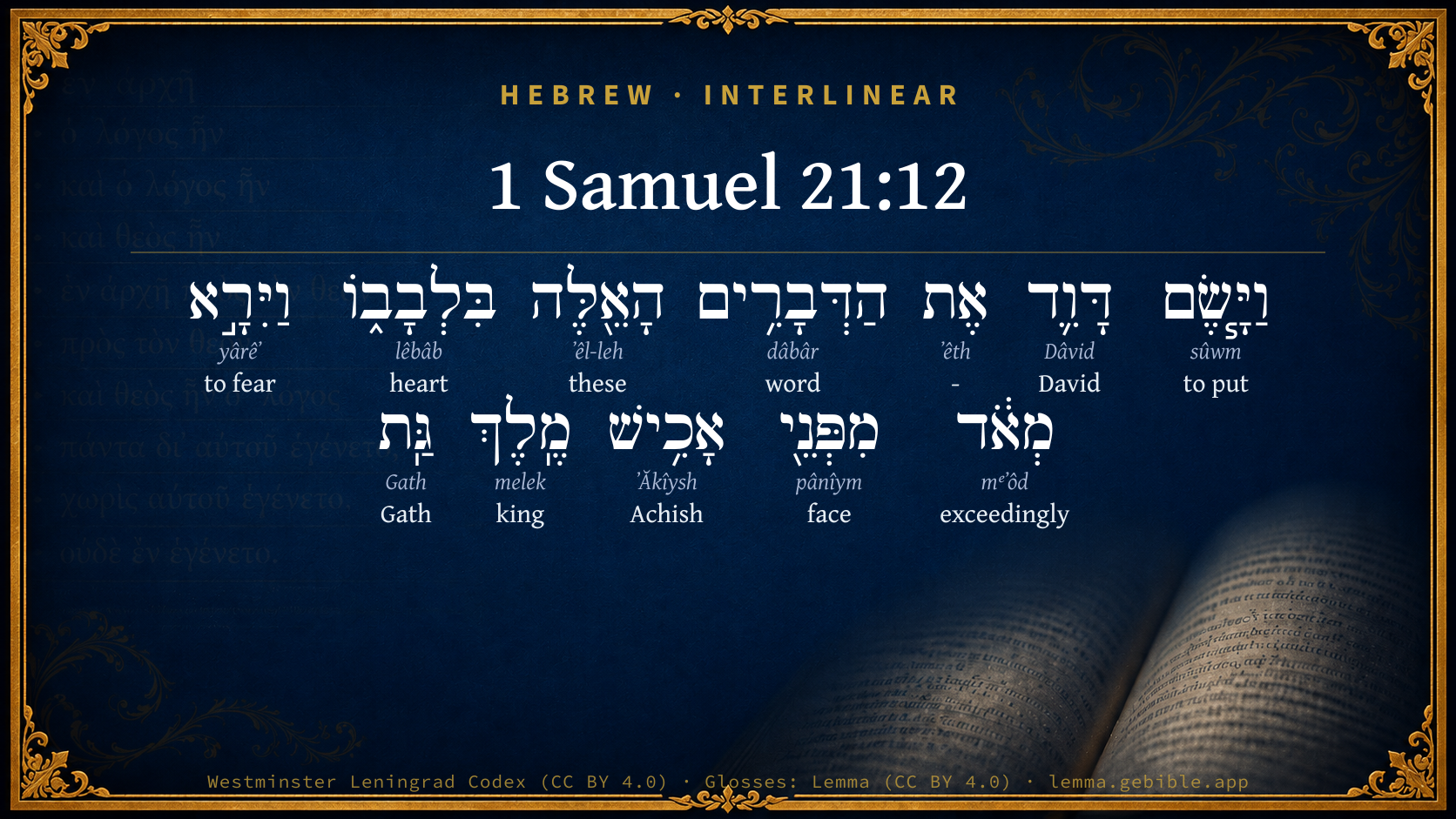
Hebrew (Westminster Leningrad Codex) 1 Samuel 21:12 appears in the Hebrew Old Testament. The text above is from the Westminster Leningrad Codex. Each word links to its Strong’s number, a concise gloss, and parsing drawn from the Open Scriptures Hebrew Bible morphology. Click any word for its full Brown-Driver-Briggs (BDB) entry.
Download image
Cite this verse

1 Samuel 21:12 (World English Bible). Public Domain. Lemma interlinear Bible study tool, https://lemma.gebible.app/v/1-samuel/21/12.

Show BibTeX & RIS
BibTeX
RIS
English Translation
David laid up these words in his heart, and was very afraid of Achish the king of Gath.
World English Bible · Public Domain
Download a study sheet

One document with this verse’s original text, its word-by-word gloss line, the meaning frame, cross-references with their text, attributed commentary, and full source and license credits — printable, and it pastes into notes with its structure intact.

This verse Autodidact and up

Study sheet (.html) Plain text (.txt)

A passage Seminary Student

Up to 50 verses in one chapter. A passage sheet keeps up to 6 commentary sources and 12 cross-references per verse, in the order this page ranks them, and says so on the sheet whenever that leaves anything out. Ask for a single verse and you get the Autodidact verse sheet above.

Everything on this page stays free to read, with no account — the sheet is a download of what is already on screen, not access to it.

Want to remove ads? Support Godless Engineer
Compare translations 3

The same verse in 3 English versions, stacked beneath the original-language interlinear above. Click any original word for its lexicon entry.

Each is an independent rendering of the whole verse — the interlinear is not word-aligned to these translations.

Highlighted words mark where these versions differ — a whole-verse word diff, not a word-by-word alignment.

  • World English Bible Public Domain
    David laid up these words in his heart, and was very afraid of Achish the king of Gath.
  • King James Version Public Domain
    And David laid up these words in his heart, and was sore afraid of Achish the king of Gath.
  • unfoldingWord Literal Text CC BY-SA 4.0
    And David put these words in his heart, and he was very afraid from the face of Achish, the king of Gath.

unfoldingWord Literal Text — © unfoldingWord, licensed CC BY-SA 4.0. Word-aligned USFM3 via Door43 (git.door43.org/unfoldingWord/en_ult).

Versions to compare (up to 4)

3 of 4 selected

Show all 18 translations

Every available English version of this verse, each an independent rendering of the whole verse.

  • World English Bible Public Domain
    David laid up these words in his heart, and was very afraid of Achish the king of Gath.
  • Berean Standard Bible Public Domain
    Now David took these words to heart and was very much afraid of Achish the king of Gath.
  • Majority Standard Bible Public Domain
    Now David took these words to heart and was very much afraid of Achish the king of Gath.
  • King James Version Public Domain
    And David laid up these words in his heart, and was sore afraid of Achish the king of Gath.
  • American Standard Version (1901) Public Domain
    And David laid up these words in his heart, and was sore afraid of Achish the king of Gath.
  • Revised Version (1885) Public Domain
    And David laid up these words in his heart, and was sore afraid of Achish the king of Gath.
  • Geneva Bible (1599) Public Domain
    And Dauid considered these wordes, and was sore afraide of Achish the King of Gath.
  • Douay-Rheims (1899) Public Domain
    But David laid up these words in his heart, and was exceedingly afraid at the face of Achis the king of Geth.
  • Young's Literal Translation Public Domain
    And David layeth these words in his heart, and is exceedingly afraid of the face of Achish king of Gath,
  • Literal Standard Version CC BY-SA 4.0
    And David lays these words in his heart, and is exceedingly afraid of the face of Achish king of Gath,
  • Unlocked Literal Bible CC BY-SA 4.0
    David took these words to heart and was very afraid of Achish, the king of Gath.
  • unfoldingWord Literal Text CC BY-SA 4.0
    And David put these words in his heart, and he was very afraid from the face of Achish, the king of Gath.
  • Darby Bible Public Domain
    And David took to heart these words, and was much afraid of Achish the king of Gath.
  • World Messianic Bible Public Domain
    David laid up these words in his heart, and was very afraid of Achish the king of Gath.
  • Webster's Bible Public Domain
    And David laid up these words in his heart, and was greatly afraid of Achish the king of Gath.
  • Free Bible Version CC BY-SA 4.0
    David listened carefully to what they said and this made him very afraid of Achish, the king of Gath.
  • Bible in Basic English Public Domain
    And David took these words to heart, fearing Achish, the king of Gath.
  • JPS Tanakh (1917) Public Domain
    (21-13) And David laid up these words in his heart, and was sore afraid of Achish the king of Gath.

Literal Standard Version (2020), Covenant Press — licensed CC BY-SA 4.0. Text via the HelloAO Bible API (eBible.org). Unlocked Literal Bible (unfoldingWord) — licensed CC BY-SA 4.0. Text via the HelloAO Bible API (eBible.org). unfoldingWord Literal Text — © unfoldingWord, licensed CC BY-SA 4.0. Word-aligned USFM3 via Door43 (git.door43.org/unfoldingWord/en_ult). Free Bible Version, Dr. Jonathan Gallagher — licensed CC BY-SA 4.0. Text via the HelloAO Bible API (eBible.org).

Word by word

More ways to search: Search by grammar → Find every occurrence → Compare this word →

Practice this passage: Drill this verse → Learn its vocabulary →

אָכִ֥ישׁ
ʼĂkîysh
H397
“Achish”
Noun, Proper
Part of Speech
Noun
Type
Proper
Full BDB Definition

Origin: of uncertain derivation

TWOT: None

Achish = "I will blacken (or terrify)" or " only a man" - Philistine king of Gath
  1. וַיָּ֧שֶׂם sûwm H7760 “and · to put” Conjunction + Verb, Qal, Sequential Imperfect, 3rd Person, Masculine, Singular
  2. דָּוִ֛ד Dâvid H1732 “David” Noun, Proper
  3. אֶת ʼêth H853 “-” Particle, Direct Object
  4. הַדְּבָרִ֥ים dâbâr H1697 “the · words” Particle, Definite Article + Noun, Common, Masculine, Plural, Absolute
  5. הָאֵ֖לֶּה ʼêl-leh H428 “the · these” Particle, Definite Article + Pronoun, Demonstrative, Common, Plural
  6. בִּלְבָב֑וֹ lêbâb H3824 “in/at · heart · his” Preposition + Noun, Common, Masculine, Singular, Construct + Suffix, Personal, 3rd Person, Masculine, Singular
  7. וַיִּרָ֣א yârêʼ H3372 “and · to fear” Conjunction + Verb, Qal, Sequential Imperfect, 3rd Person, Masculine, Singular
  8. מְאֹ֔ד mᵉʼôd H3966 “exceedingly” Adverb
  9. מִפְּנֵ֖י pânîym H6440 “from · face(s) of” Preposition + Noun, Common, Both, Plural, Construct
  10. מֶֽלֶךְ melek H4428 “king of” Noun, Common, Masculine, Singular, Construct
  11. גַּֽת Gath H1661 “Gath” Noun, Proper

About this verse

These counts appear in no published source. They are computed here, from the morphology-tagged text and Lemma’s own curated glosses. What Lemma adds →

12
words
12
distinct lemmas
Historical
section

Notable vocabulary

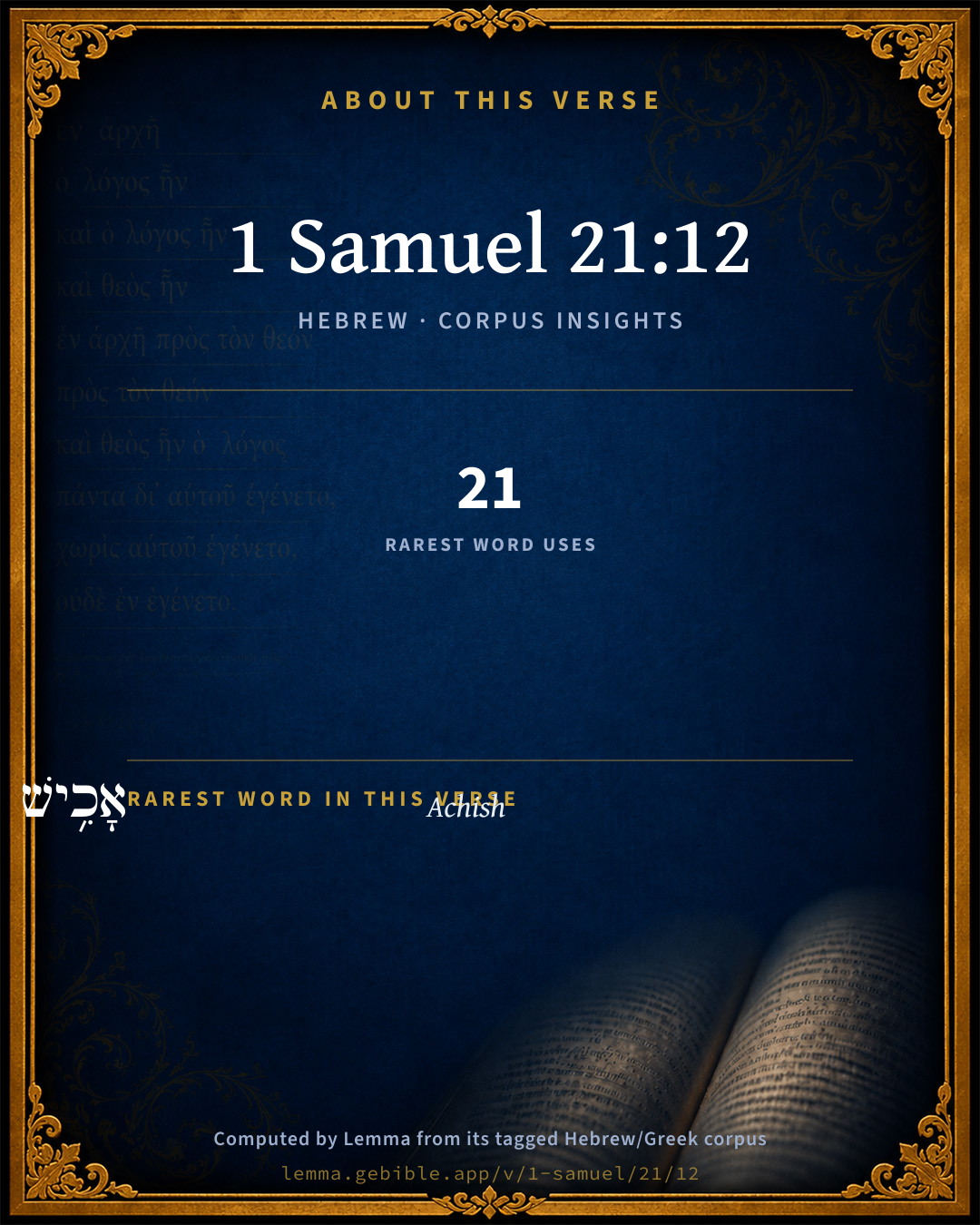
The rarest word here is אָכִ֥ישׁ Achish H397 — appearing just 21 times in the whole Hebrew Bible.

Shared distinctive vocabulary

אָכִ֥ישׁ Achish H397 occurs in 20 verses of the Hebrew Bible. Also found in:

Grammatical profile

  • 2 verbs
  • 7 nouns
  • 1 pronoun
  • 1 adverb
  • 1 particle

Verb forms

  • וַיָּ֧שֶׂם Qal · Sequential Imperfect
  • וַיִּרָ֣א Qal · Sequential Imperfect

Hebrew & Septuagint length

In English translation the verse runs 18 words from the Hebrew and 18 from the Septuagint (LXX English) — the same length.

A rough comparison of the two English renderings, which tokenize alike — not a word-level alignment.

Word counts can differ between the Hebrew and the Greek without any difference in meaning — e.g. the Hebrew direct-object marker אֵת has no separate Greek word, and Greek often adds the article ὁ.

Cross-references

8

Topical passages linked to 1 Samuel 21:12 in the Treasury of Scripture Knowledge — connected by theme and wording, ordered by reader-vote popularity; previews shown in the World English Bible.

  • Luke 2:19 But Mary kept all these sayings, pondering them in her heart.
  • Psalms 34:4 I sought Yahweh, and he answered me, And delivered me from all my fears.
  • Psalms 56:3 When I am afraid, I will put my trust in you.
  • Genesis 12:11–13 It happened, when he was come near to enter into Egypt, that he said to Sarai his wife, "See now, I know that you are a beautiful woman to look on.
  • Genesis 26:7 The men of the place asked him about his wife. He said, "She is my sister," for he was afraid to say, "My wife," lest, he thought, the men of the place might kill me for Rebekah, because she was beautiful to look on.
  • 1 Samuel 21:10 David arose, and fled that day for fear of Saul, and went to Achish the king of Gath.
  • Psalms 119:11 I have hidden your word in my heart, That I might not sin against you.
  • Luke 2:51 And he went down with them, and came to Nazareth. He was subject to them, and his mother kept all these sayings in her heart.

Cross-references courtesy of OpenBible.info (CC BY 4.0).

Hebrew and Greek witnesses Masoretic Hebrew ↔ Greek Septuagint

The same verse in the two great witnesses to the Old Testament, shown verse-for-verse.

These are two independent witnesses, not word-aligned to each other, and the Septuagint is shown in lemma (dictionary) form.

Hebrew 1 Samuel 21:12 Masoretic · Westminster Leningrad Codex

וַיָּ֧שֶׂם דָּוִ֛ד אֶת הַדְּבָרִ֥ים הָאֵ֖לֶּה בִּלְבָב֑וֹ וַיִּרָ֣א מְאֹ֔ד מִפְּנֵ֖י אָכִ֥ישׁ מֶֽלֶךְ גַּֽת

David laid up these words in his heart, and was very afraid of Achish the king of Gath.

World English Bible · Public Domain

Greek LXX 1 Samuel 21:12 Septuagint · lemma form

καί εἶπον ὁ παῖς αγχους πρός αὐτός οὐ οὗτος δαυίδ ὁ βασιλεύς ὁ γῆ οὐ οὗτος ἐκἄρχω ὁ χορεύουσαι λέγω πατάσσω σαούλ ἐν χιλιάς αὐτός καί δαυίδ ἐν μυριάς αὐτός

And David laid up the words in his heart, and was greatly afraid of Anchus king of Geth.

LXX2012 (modern English Septuagint) · Public Domain

On this verse, Keil & Delitzsch discusses the Septuagint’s reading. Read the note in Commentary ↓

Hebrew: Westminster Leningrad Codex (CC BY 4.0). Greek: Septuagint (public domain); English from LXX2012 (modern English Septuagint) (Public Domain). How the Septuagint differs from the Hebrew →

Targum (Aramaic paraphrase)

1

The Targum is the ancient Jewish Aramaic paraphrase of the Hebrew Scriptures — an interpretive translation, not the Hebrew text itself. Onkelos (literal) and Pseudo-Jonathan (expansive) render the Torah, and Jonathan the Prophets. Coverage is partial: where no permissively-licensed English translation exists for a verse, only the Aramaic is shown. This is verse-level text, not a word-by-word alignment to the Hebrew.

  1. Targum Jonathan Prophets (Joshua–Malachi)
    וַאֲמַרוּ עַבְדֵי אָכִישׁ לֵיהּ הֲלָא דֵין דָוִד מַלְכָּא דְאַרְעָא הֲלָא לְדֵין מְשַׁבְּחִין בְּחִנְגַיָא לְמֵימַר קְטַל שָׁאוּל בְּאַלְפִין וְדָוִד בִּרְבְוָן:

    (no public-domain English translation for this verse)

    Targum Jonathan — Aramaic: “Mikraot Gedolot” (public domain). English: “Sefaria Community Translation” (CC0 1.0 (public-domain dedication)); “London "Chaldee Paraphrase," 1871” (public domain). Text via Sefaria.

Commentary

Notes on 1 Samuel 21:12 from classic Christian and Jewish commentators (each source and its license shown beneath its notes). The classic Christian expositions comment on the surrounding passage and are grouped to its opening verse, so a note may address several verses; the Jewish commentaries on the Tanakh (Rashi and others) are per-verse, so they appear only where the commentator wrote on this verse.

Lemma curates 59 commentaries, every one of them public domain or Creative Commons licensed, each selected and text-cleaned for this edition rather than reprinted as found. About our sources →

Trapp's Complete Commentary

John Trapp

1Sa 21:12 And David laid up these words in his heart, and was sore afraid of Achish the king of Gath.

Ver. 12. And David laid up.] He was much affected with them, and as greatly afflicted as if he had been crushed in a winepress: so the word Gath signifieth.

John Trapp, A Commentary or Exposition upon All the Books of the Old and New Testament (1647–1656) — public domain. Text from a community e-Sword module.

Joseph Benson's Commentary

1Sa 21:12. David laid up these words in his heart — It is probable he had been at first well received, but this discourse deeply affected him, and made him think himself not safe there. For, when he found that his fame was spread among them, as having slain such numbers of the Philistines, he concluded that they would be instigated to take revenge on him now they had him in their power. And was sore afraid — Lest either their revenge or policy should prompt them to kill him. Perhaps he was the more apprehensive, because he wore Goliath’s sword, which was, probably, well known at Gath.

Joseph Benson's Commentary on the Old and New Testaments (1811–1818) — public domain. Text from a community e-Sword module.

Tyndale Open Study Notes

Tyndale Open Resources

21:12-13 The lengthy title of Ps 34 refers to this incident but names the Philistine king Abimelech rather than Achish. “Abimelech” might have been the common title for Philistine kings (in Hebrew it means “my father the king”). The name Abimelech also appears in Gen 20:2; 26:1.

Tyndale Open Study Notes — © Tyndale Open Resources, licensed CC BY-SA 4.0. Text via the HelloAO Bible API.

Geneva Bible (1599)

Geneva Bible translators

Hebrew, put these words in his heart.

Geneva Bible (1599) marginal notes — public domain. Text via Bolls.life.

Ellicott's Commentary for English Readers

(12) And David laid up these words.—Now, for the first time, David saw how widely travelled was a renown of which he in his humbleness of heart had thought so little, and at once a deadly fear took possession of him. The life he held so cheaply when in battle with the enemies of his country now, strange to say, in his deep degradation and poverty, became of real value to him, and he adopted the piteous and humiliating device of feigning madness, hoping thus to change the wondering admiration of the servants of Achish into pitying scorn. What David hoped took place, and he was driven out of Gath with ignominy; but there is no reason for supposing that had he maintained a quiet dignity of behaviour any evil would have happened to him. The Philistines, for those wild times, seem to have been a cultured people, and by no means devoid of generous instincts. Not one word, strangely enough, is reported to have been spoken about the great injury he had done to the Philistine nation when he slew Goliath. It has been suggested with considerable ingenuity that the great name of the dead champion, the hero of so many battle-fields, was never brought forward here, perhaps out of a natural indisposition to recall a grievous calamity, but more likely out of regard for Goliath’s family and friends. Singularly little is told us, in fact, about this renowned hero, whom tradition hints at as the great warrior in the decisive battle when the Ark was captured and the sons of Eli were slain. The Talmud has a curious comment on this strange silence—“Not half the praises of Goliath are related in Scripture; hence it follows that it is wrong to tell the praises of the wicked.”—Treatise Soteh, fol. 42, Colossians 2.

A Bible Commentary for English Readers, edited by Charles John Ellicott (1878–1897) — public domain. Text from a community e-Sword module.

John Gill's Exposition

And David laid up these words in his heart,.... Pondered upon them, and thought them over in his mind, finding that he was known, and his character also, and considered with himself what might be the consequence of this:

and was sore afraid of Achish the king of Gath; lest he should be set against him, and be prevailed upon by his servants to take away his life, or deliver him up into the hands of Saul.

John Gill's Exposition of the Whole Bible (1746–1763) — public domain (CC PDM 1.0). Text via the HelloAO Bible API.

Matthew Poole's English Annotations

Lest either their revenge or policy should prompt them to kill him.

Matthew Poole's English Annotations on the Holy Bible (1683–1685) — public domain. Text from a community e-Sword/MySword module.

Whedon's Commentary on the Bible

Daniel D. Whedon

12. David laid up these words in his heart — Until he heard the servants say these things he hoped to escape recognition; but now, when he finds that they suspect him to be the great hero who slew Goliath, he is oppressed with a host of fears.

Daniel D. Whedon (gen. ed.), Commentary on the Old and New Testaments (1874–1909) — public domain. Text from a community e-Sword module.

John Wesley's Explanatory Notes

Was afraid - Lest either their revenge or policy should prompt them to kill him. Perhaps he was the more apprehensive, because he wore Goliath's sword, which was probably well known at Gath. He now learned by experience what he afterward taught us, Psalm 1xviii, 9. It is better to trust in the Lord, than to put any confidence in princes.

John Wesley, Explanatory Notes Upon the Whole Bible (1754–1765) — public domain. Text via the GEBible commentary corpus.

Keil & Delitzsch

C. F. Keil & F. Delitzsch

But David took these words to heart, and was in great fear of Achish, lest he should treat him as an enemy, and kill him. In order to escape this danger, "he disguised his understanding (i.e., pretended to be out of his mind) in their eyes (i.e., before the courtiers of Achish), behaved insanely under their hands (when they tried to hold him as a madman), scribbled upon the door-wings, and let his spittle run down into his beard." The suffix to וישׁנּו is apparently superfluous, as the object, את־טעמו, follows immediately afterwards. But it may be accounted for from the circumstantiality of the conversation of every-day life, as in Sa2 14:6, and (though these cases are not perfectly parallel) Exo 2:6; Pro 5:22; Eze 10:3 (cf. Gesenius' Gramm. 121, 6, Anm. 3). ויתו, from תּוה, to make signs, i.e., to scribble. The lxx and Vulgate render it ἐτυμπανίζειν, impingebat, he drummed, smote with his fists upon the wings of the door, which would make it appear as if they had read ויּתף (from תּפף), which seems more suitable to the condition of a madman whose saliva ran out of his mouth.

Keil & Delitzsch — Biblical Commentary on the Old Testament (1861–1891) — public domain (CC PDM 1.0). Text via the HelloAO Bible API. (Old Testament only.)

unfoldingWord translationNotes

Door43 World Missions Community

David took these words to heart

Here "took ... to heart" is a metonym to think seriously about what was said. AT: "David thought seriously about what the servants said" (See: Metonymy)

in their hands

Here "hands" are a synecdoche for the person. AT: "in their presence" (See: Synecdoche)

translationWords

David

word

heart

king

fear

gate

unfoldingWord translationNotes — © Distant Shores Media and the Door43 World Missions Community, licensed CC BY-SA 4.0. Source: git.door43.org/Door43/en_tn.

Rashi

Rabbi Shlomo Yitzchaki (Rashi)

Is this not Dovid, the king of the land. They said to Achish, "There was a stipulation between us: 'If he will be able to fight me and kill me, then we will become your slaves.' You have no choice but to get off your throne and let him become king of this land."

Rashi on the Tanakh — English translations: “The Judaica Press complete Tanach with Rashi, translated by A. J. Rosenberg” (CC BY 4.0); “Pentateuch with Rashi's commentary by M. Rosenbaum and A.M. Silbermann, 1929-1934” (public domain); “The Metsudah Tanach series, Lakewood, N.J” (CC BY 4.0); and “The Book of Joshua, Metsudah Publications, 1997” (CC BY 4.0). Text via Sefaria.

Lesson kit

Teaching starters — assembled from the data on this page, not authored interpretation. Every prompt links to the verse data it draws on. Edit before teaching.

1 Samuel, in the Historical, opens this verse with 12 words (12 distinct Hebrew lemmas). Its most distinctive word is ʼĂkîysh (“Achish”). A historical commentator’s framing appears above. Read the whole chapter for the surrounding context.

Discussion questions

  1. What does “Achish” (ʼĂkîysh) contribute to the verse as a whole?
  2. 1 Samuel 21:10 shares the word «Achish» with this verse. How do the two illuminate each other?
  3. The translations on this page render this verse differently — a whole-verse word diff, not a word-by-word alignment. What might account for the different wordings?
  4. The verb «וַיָּ֧שֶׂם» is Qal Sequential Imperfect. How does its form color the action?
  5. Reading how Trapp's Complete Commentary and Joseph Benson's Commentary read this verse, where do the two commentators agree and where do they part?

Things to notice

Reading settings

Reading text

Shown beneath each verse's original-language words.

Old Testament
Old Testament edition

Read the OT as the Masoretic Hebrew (MT) or the Greek Septuagint (LXX).

English shown for the Greek Septuagint (in the Hebrew ↔ Greek comparison).

Comparing translations? Open the Compare panel on any verse page to stack up to four side by side.