
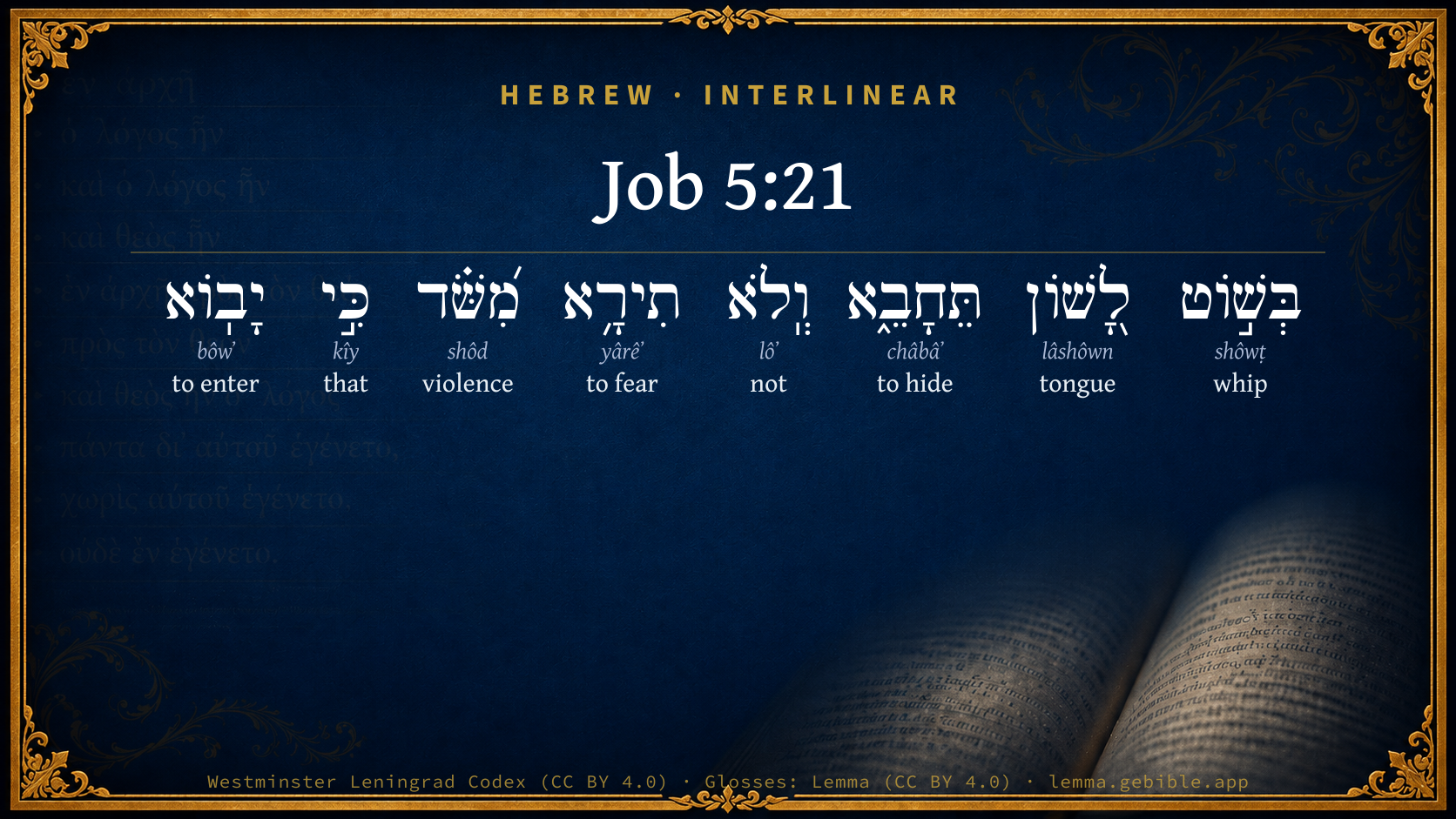
Job 5:21

Hebrew (Westminster Leningrad Codex) Job 5:21 appears in the Hebrew Old Testament. The text above is from the Westminster Leningrad Codex. Each word links to its Strong’s number, a concise gloss, and parsing drawn from the Open Scriptures Hebrew Bible morphology. Click any word for its full Brown-Driver-Briggs (BDB) entry.
Download image
Cite this verse

Job 5:21 (World English Bible). Public Domain. Lemma interlinear Bible study tool, https://lemma.gebible.app/v/job/5/21.

Show BibTeX & RIS
BibTeX
RIS
English Translation
You shall be hidden from the scourge of the tongue, Neither shall you be afraid of destruction when it comes.
World English Bible · Public Domain
Highlights
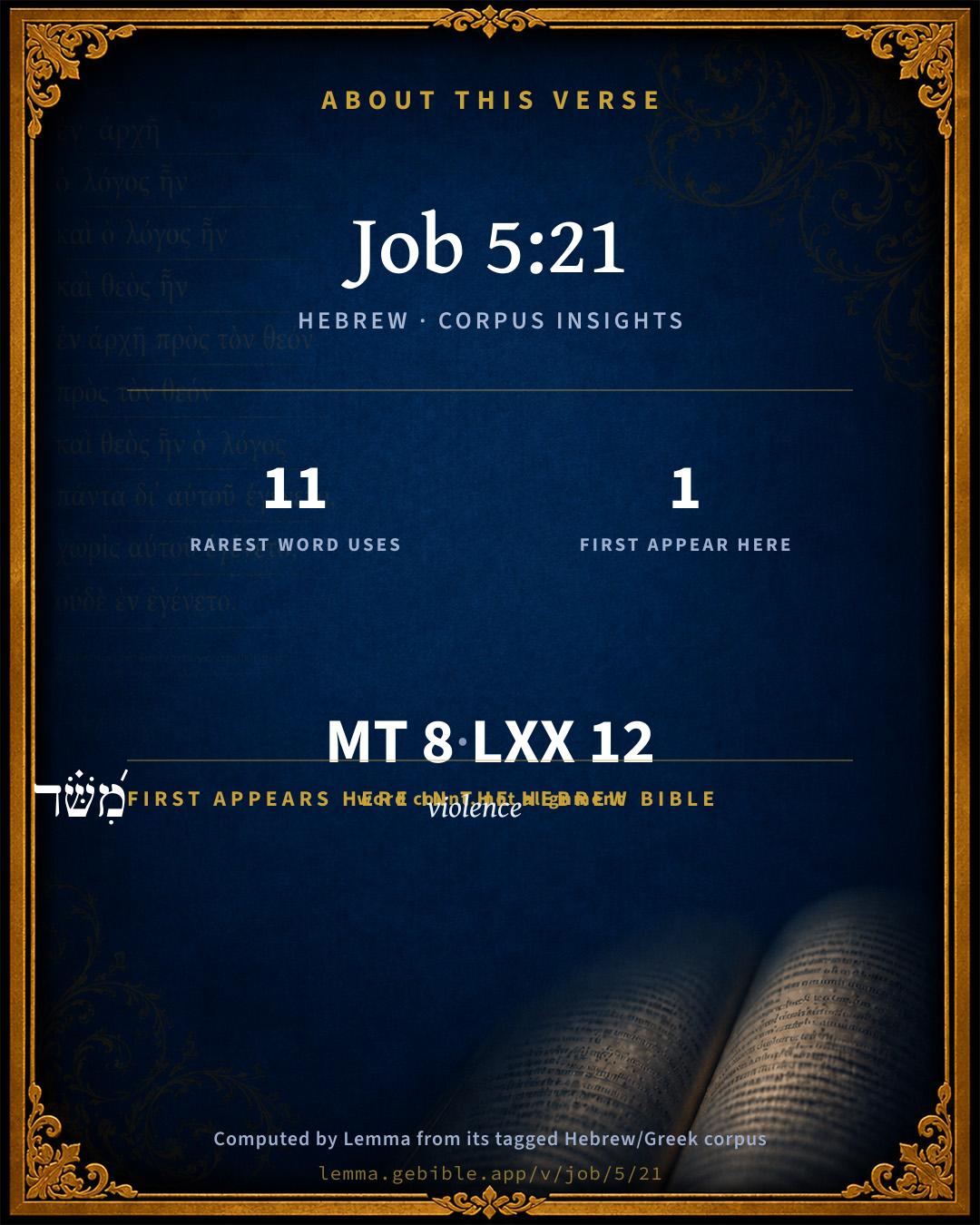
  • 1 first appearance in the Hebrew Bible
Full analysis ↓
Download a study sheet

One document with this verse’s original text, its word-by-word gloss line, the meaning frame, cross-references with their text, attributed commentary, and full source and license credits — printable, and it pastes into notes with its structure intact.

This verse Autodidact and up

Study sheet (.html) Plain text (.txt)

A passage Seminary Student

Up to 50 verses in one chapter. A passage sheet keeps up to 6 commentary sources and 12 cross-references per verse, in the order this page ranks them, and says so on the sheet whenever that leaves anything out. Ask for a single verse and you get the Autodidact verse sheet above.

Everything on this page stays free to read, with no account — the sheet is a download of what is already on screen, not access to it.

Want to remove ads? Support Godless Engineer
Compare translations 3

The same verse in 3 English versions, stacked beneath the original-language interlinear above. Click any original word for its lexicon entry.

Each is an independent rendering of the whole verse — the interlinear is not word-aligned to these translations.

Highlighted words mark where these versions differ — a whole-verse word diff, not a word-by-word alignment.

  • World English Bible Public Domain
    You shall be hidden from the scourge of the tongue, Neither shall you be afraid of destruction when it comes.
  • King James Version Public Domain
    Thou shalt be hid from the scourge of the tongue: neither shalt thou be afraid of destruction when it cometh.
  • unfoldingWord Literal Text CC BY-SA 4.0
    From the scourge of the tongue you will be hidden, and you will not fear destruction when it comes.

unfoldingWord Literal Text — © unfoldingWord, licensed CC BY-SA 4.0. Word-aligned USFM3 via Door43 (git.door43.org/unfoldingWord/en_ult).

Versions to compare (up to 4)

3 of 4 selected

Show all 18 translations

Every available English version of this verse, each an independent rendering of the whole verse.

  • World English Bible Public Domain
    You shall be hidden from the scourge of the tongue, Neither shall you be afraid of destruction when it comes.
  • Berean Standard Bible Public Domain
    You will be hidden from the scourge of the tongue, and will not fear havoc when it comes.
  • Majority Standard Bible Public Domain
    You will be hidden from the scourge of the tongue, and will not fear havoc when it comes.
  • King James Version Public Domain
    Thou shalt be hid from the scourge of the tongue: neither shalt thou be afraid of destruction when it cometh.
  • American Standard Version (1901) Public Domain
    Thou shalt be hid from the scourge of the tongue; Neither shalt thou be afraid of destruction when it cometh.
  • Revised Version (1885) Public Domain
    Thou shalt be hid from the scourge of the tongue; neither shalt thou be afraid of destruction when it cometh.
  • Geneva Bible (1599) Public Domain
    Thou shalt be hid from the scourge of the tongue, and thou shalt not be afraid of destruction when it commeth.
  • Douay-Rheims (1899) Public Domain
    Thou shalt he hidden from the scourge of the tongue: and thou shalt not fear calamity when it cometh.
  • Young's Literal Translation Public Domain
    When the tongue scourgeth thou art hid, And thou art not afraid of destruction, When it cometh.
  • Literal Standard Version CC BY-SA 4.0
    When the tongue scourges you are hid, || And you are not afraid of destruction, || When it comes.
  • Unlocked Literal Bible CC BY-SA 4.0
    You will be hidden from the scourge of the tongue; and you will not be afraid of destruction when it comes.
  • unfoldingWord Literal Text CC BY-SA 4.0
    From the scourge of the tongue you will be hidden, and you will not fear destruction when it comes.
  • Darby Bible Public Domain
    Thou shalt be hidden from the scourge of the tongue; and thou shalt not be afraid of destruction when it cometh.
  • World Messianic Bible Public Domain
    You will be hidden from the scourge of the tongue, neither will you be afraid of destruction when it comes.
  • Webster's Bible Public Domain
    Thou shalt be hid from the scourge of the tongue: neither shalt thou be afraid of destruction when it cometh.
  • Free Bible Version CC BY-SA 4.0
    You will be protected from sharp-tongued slander; and when violence comes you will not be afraid.
  • Bible in Basic English Public Domain
    He will keep you safe from the evil tongue; and you will have no fear of wasting when it comes.
  • JPS Tanakh (1917) Public Domain
    Thou shalt be hid from the scourge of the tongue; neither shalt thou be afraid of destruction when it cometh.

Literal Standard Version (2020), Covenant Press — licensed CC BY-SA 4.0. Text via the HelloAO Bible API (eBible.org). Unlocked Literal Bible (unfoldingWord) — licensed CC BY-SA 4.0. Text via the HelloAO Bible API (eBible.org). unfoldingWord Literal Text — © unfoldingWord, licensed CC BY-SA 4.0. Word-aligned USFM3 via Door43 (git.door43.org/unfoldingWord/en_ult). Free Bible Version, Dr. Jonathan Gallagher — licensed CC BY-SA 4.0. Text via the HelloAO Bible API (eBible.org).

Word by word

More ways to search: Search by grammar → Find every occurrence → Compare this word →

Practice this passage: Drill this verse → Learn its vocabulary →

About this verse

These counts appear in no published source. They are computed here, from the morphology-tagged text and Lemma’s own curated glosses. What Lemma adds →

8
words
8
distinct lemmas
Wisdom
section

Notable vocabulary

The rarest word here is בְּשׁ֣וֹט whip H7752 — appearing just 11 times in the whole Hebrew Bible.

First appearance in Scripture

This word makes its first canonical appearance in the Hebrew Bible here:

  • מִ֝שֹּׁ֗ד violence H7701

Shared distinctive vocabulary

בְּשׁ֣וֹט whip H7752 occurs in 11 verses of the Hebrew Bible. Also found in:

Grammatical profile

  • 3 verbs
  • 3 nouns
  • 1 conjunction
  • 1 particle

Verb forms

  • תֵּחָבֵ֑א Niphal · Imperfect
  • תִירָ֥א Qal · Imperfect
  • יָבֽוֹא Qal · Imperfect

Hebrew & Septuagint length

In English translation the verse runs 20 words from the Hebrew and 19 from the Septuagint (LXX English) — closely comparable.

A rough comparison of the two English renderings, which tokenize alike — not a word-level alignment.

Word counts can differ between the Hebrew and the Greek without any difference in meaning — e.g. the Hebrew direct-object marker אֵת has no separate Greek word, and Greek often adds the article ὁ.

In the original languages it is 8 Hebrew tokens and 12 Greek tokens — but the two are counted differently (Hebrew bundles its prefixes and suffixes into one token; the Greek is in lemma form), so that isn’t a like-for-like length.

Cross-references

8

Topical passages linked to Job 5:21 in the Treasury of Scripture Knowledge — connected by theme and wording, ordered by reader-vote popularity; previews shown in the World English Bible.

  • Psalms 31:20 In the shelter of your presence you will hide them from the plotting of man. You will keep them secretly in a dwelling away from the strife of tongues.
  • Psalms 91:5–7 You shall not be afraid of the terror by night, Nor of the arrow that flies by day;
  • Proverbs 12:18 There is one who speaks rashly like the piercing of a sword, But the tongue of the wise heals.
  • Psalms 55:21 His mouth was smooth as butter, But his heart was war. His words were softer than oil, Yet they were drawn swords.
  • Jeremiah 18:18 Then said they, Come, and let us devise devices against Jeremiah; for the law shall not perish from the priest, nor counsel from the wise, nor the word from the prophet. Come, and let us strike him with the tongue, and let us not give heed to any of his words.
  • Psalms 57:4 My soul is among lions. I lie among those who are set on fire, Even the sons of men, whose teeth are spears and arrows, And their tongue a sharp sword.
  • Isaiah 54:17 No weapon that is formed against you shall prosper; and every tongue that shall rise against you in judgment you shall condemn. This is the heritage of the servants of Yahweh, and their righteousness which is of me, says Yahweh.
  • James 3:5–8 So the tongue is also a little member, and boasts great things. See how a small fire can spread to a large forest!

Cross-references courtesy of OpenBible.info (CC BY 4.0).

Hebrew and Greek witnesses Masoretic Hebrew ↔ Greek Septuagint

The same verse in the two great witnesses to the Old Testament, shown verse-for-verse.

These are two independent witnesses, not word-aligned to each other, and the Septuagint is shown in lemma (dictionary) form.

Hebrew Job 5:21 Masoretic · Westminster Leningrad Codex

בְּשׁ֣וֹט לָ֭שׁוֹן תֵּחָבֵ֑א וְֽלֹא תִירָ֥א מִ֝שֹּׁ֗ד כִּ֣י יָבֽוֹא

You shall be hidden from the scourge of the tongue, Neither shall you be afraid of destruction when it comes.

World English Bible · Public Domain

Greek LXX Job 5:21 Septuagint · lemma form

ἀπό μάστιξ γλῶσσα σύ κρύπτω καί οὐ μή φοβέω ἀπό κακός ἔρχομαι

He shall hide you from the scourge of the tongue: and you shall not be afraid of coming evils.

LXX2012 (modern English Septuagint) · Public Domain

Hebrew: Westminster Leningrad Codex (CC BY 4.0). Greek: Septuagint (public domain); English from LXX2012 (modern English Septuagint) (Public Domain). How the Septuagint differs from the Hebrew →

Commentary

Notes on Job 5:21 from classic Christian and Jewish commentators (each source and its license shown beneath its notes). The classic Christian expositions comment on the surrounding passage and are grouped to its opening verse, so a note may address several verses; the Jewish commentaries on the Tanakh (Rashi and others) are per-verse, so they appear only where the commentator wrote on this verse.

Lemma curates 59 commentaries, every one of them public domain or Creative Commons licensed, each selected and text-cleaned for this edition rather than reprinted as found. About our sources →

Trapp's Complete Commentary

John Trapp

Job 5:21 Thou shalt be hid from the scourge of the tongue: neither shalt thou be afraid of destruction when it cometh.

Ver. 21. Thou shalt be hid from the scourge of the tongue] That is, from reproaches and slanders, which is a tongue smiting, Jer 18:18, as smart as any hand smiting, and draws blood, Eze 22:9. Backbiting is backbeating (Speed.). The devil is both a liar and a murderer, Joh 8:44. Humphrey, duke of Gloucester, was by the people of England thought to be doubly murdered (saith the chronicler), viz. by detraction and deadly practice. Plato commendeth that law of the Lydians that punished detracters like as they did murderers; because their words are swords, and their breath, as fire, devoureth, Isa 33:10. Now from such pests the Lord promiseth to hide his people, that either the traducer shall not find them, or not fasten upon them: Dabbar is the Hebrew for a word, Debher for a pest (Drus.). Some render the text thus, He shall be hid, cum vagabitur lingua, when the tongue wandereth or walketh about. Their tongue walketh through the earth, Psa 73:9, it runs all the world over, and, like a mad dog, snaps at every one. Hence the Hebrew word Ragal, to defame or slander, Psa 15:3, properly noteth a footing it up and down, a going to and fro to carry tales and rumours, 2Sa 19:27. Now from such a mischief, from the lash of such lewd tongues, God will hide his people under the hollow of his hand, because he knows that many a good heart is more afflicted with words than with blows, Psa 42:3. St Paul reckoned that it were better for him to die than that any man should make his glorying void, that is, take away his good name, and so disable him from doing good by his ministry, 1Co 9:15.

Neither shalt thou be afraid of destruction when it cometh] Much less at the rumour of it, Mat 24:6 Luk 24:6. Thou shalt walk about the world as a conqueror, being above fear, then when others are below hope. Noah like-thou shall be, - mediis tranquillus in undis, calm in the midst of the waves, and not as Magormissabib, a terror to thyself and all about thee, Jer 20:3.

John Trapp, A Commentary or Exposition upon All the Books of the Old and New Testament (1647–1656) — public domain. Text from a community e-Sword module.

Albert Barnes' Notes on the Bible

Thou shalt be hid from the scourge of the tongue - Margin, Or, “when the tongue scourgeth.” The word rendered “scourge” - שׁוט shôṭ - means properly a whip. It is used of God when he scourges people by calamities and punishments; Isa 10:26; Job 9:23. See the use of the verb שׁוּט shûṭ in Job 2:7. Here it is used to denote a slanderous tongue, as being that which inflicts a severe wound upon the reputation and peace of an individual. The idea is, that God would guard the reputation of those who commit themselves to him, and that they shall be secure from slander, “whose breath,” Shakespeare says, “outvenoms all the worms of Nile.”

Neither shalt thou be afraid when destruction cometh - That is, your mind shall be calm in those calamities which threaten destruction. When war rages, when the tempest howls, when the pestilence breathes upon a community, then your mind shall be at peace. A similar thought occurs in Isa 26:3 : “Thou wilt keep him in perfect peace whose mind is stayed on thee;” and the same sentiment is beautifully illustrated at length in Ps. 91. The Chaldee Paraphrase applies all this to events which had occurred in the history of the Hebrews. Thus, Job 5:20 : “In the famine in Egypt, he redeemed thee from death; and in the war with Amalek, from being slain by the sword;” Job 5:21 : “In the injury inflicted by the tongue of Balaam thou wert hid among the clouds, and thou didst not fear from the desolation of the Midianites when it came;” Job 5:22 : “In the desolation of Sihon, and in the famine of the desert, thou didst laugh; and of the camps of Og, who was like a wild beast of the earth, thou wert not afraid.”

Albert Barnes' Notes on the Bible (1834–1885) — public domain. Text from a community e-Sword/MySword module.

The Biblical Illustrator

Joseph S. Exell

Job_5:21

Thou shalt be hid from the scourge of the tongue.

The scourge of the tongue

I. The scourge. The scourge of the tongue.

1. There is the lying tongue. It perverts facts. It turns the lame out of the way and misleads the blind.

2. There is the cursing tongue.

3. There is the obscene tongue.

4. There is the scolding tongue. What martyrs have some members of a family become! A scolding tongue withers and blights everything it comes across, just like the lightning withers and blasts the tree it strikes. It is as a goad to an ox, the mosquito to the traveller, the thorn eating into the gangrened flesh.

II. The deliverance. Thou shall be hid from the scourge of the tongue. It is one of the peculiarities of Gods promises that He does not undertake to remove evils. We shall be hid--

1. By the direct influence of Divine power. God will restrain the evil speaker and the rage of the ungodly.

2. By the sanctifying influence of Divine grace. There axe some creatures who when water is poured on them repel the same by the nature of their skin or feathers. So the heart which is prepared by grace, casts aside and rejects the evil word, or the cruel insinuation, or the boisterous abuse; these things have no power over it.

3. By the resignation of a chastened spirit. The chastened spirit of the Christian disarms the shafts of the evil tongue, and, bending before the furious blast, is spared the poignant stings of malice.

4. By the prospect of future freedom. The nauseous taste of medicine is little heeded when the anticipated end is considered, which is restored health and renewed strength. So in the view of future glory and entire sanctification, the present bitterness will be little regarded. (J. J. S. Bird.)

The scourge of the tongue

Some folks lay themselves out to be as unpleasant as they can and say disagreeable things. They are the wasps of human intercourse. The candid friends whom Canning so abhorred, the people who speak their mind, but have a mind that were far better not spoken. (H. O. Mackey.)

The Biblical Illustrator, edited by Joseph S. Exell (c. 1880s–1900s) — public domain. Text from a community e-Sword module.

Joseph Benson's Commentary

Job 5:21-22. Thou shalt be hid — Protected, as in some secret and safe place; from the scourge of the tongue — From false accusations, and virulent slanders and reproaches. Neither shalt thou be afraid of destruction — Thou shalt have no cause to fear it, because God will secure thee in it and from it: when it cometh — Namely, upon others, near or round about thee. Bishop Patrick’s paraphrase on the verse is, “False accusers shall not be able to hurt thee; and when whole countries are depopulated, thou shalt be secure.” At destruction, &c., thou shalt laugh — With a laughter of joy and triumph; arising from a just security and confidence in God’s watchful and gracious providence. Neither shalt thou be afraid of the beasts of the field — The wild beasts, which were numerous and mischievous in those parts. As no apprehensions of fear shall possess thee in other heavy calamities, so neither shalt thou be under any dreadful consternation, should even the most fierce and savage beasts of the earth rise up against and be ready to devour thee. Perhaps it is not possible for that peace of mind, which arises from a good conscience and a confidence in the divine care and protection, to be expressed more elegantly or poetically than it is in this verse. Thus, leviathan, so far from being terrified, is said to laugh at the shaking of a spear, Job 41:29. And God himself, in the same beautiful style, is represented as disdaining the politic intrigues of kings, and the crafty counsels of the rulers of the earth against his church. He that sitteth in the heavens shall laugh, the Lord shall have them in derision, Psa 2:4.

Joseph Benson's Commentary on the Old and New Testaments (1811–1818) — public domain. Text from a community e-Sword module.

Jamieson, Fausset & Brown

Robert Jamieson, A. R. Fausset & David Brown

(Psa 31:20; Jer 18:18). Smite (Psalm 73. 9).

Jamieson, Fausset & Brown — Commentary Critical and Explanatory on the Whole Bible (1871) — public domain (CC PDM 1.0). Text via the HelloAO Bible API.

Adam Clarke's Commentary

Verse 21. Thou shalt be hid from the scourge of the tongue] The Targum refers this to the incantations of Balaam: "From injury by the tongue of Balaam thou shalt be hidden in the clouds; and thou shalt not fear from the blasting of the Midianites, when it shall come."

Perhaps no evil is more dreadful than the scourge of the tongue: evil-speaking, detraction, backbiting, calumny, slander, tale-bearing, whispering, and scandalizing, are some of the terms which we use when endeavouring to express the baleful influence and effects of that member, which is a world of fire, kindled from the nethermost hell. The Scripture abounds with invectives and execrations against it. See Ps 31:20; Ps 52:2-4; Pr 12:18; Pr 14:3; Jas 3:1-8.

Neither shalt thou be afraid] "Thou shouldst have such strong confidence in God, that even in the presence of destruction thou shouldst not fear death," the God of life and power being with thee.

Adam Clarke's Commentary on the Bible (1810–1826) — public domain. Text from a community e-Sword/MySword module.

Ellicott's Commentary for English Readers

(21) Shalt thou be afraid.—Comp. the expression in Job_5:15.

A Bible Commentary for English Readers, edited by Charles John Ellicott (1878–1897) — public domain. Text from a community e-Sword module.

John Gill's Exposition

Thou shall be hid from the scourge of the tongue,.... Of Satan, as Jarchi, the accuser of the brethren; or rather from the evil tongue of wicked men, their slanders, calumnies, and reproaches; the tongue is a small weapon, but it is a cutting one; it is like a scourge or whip, with which wicked men strike hard: the enemies of Jeremiah encouraged one another to smite him with their tongue, Jer 18:18; and a sad thing it is to be under the lash of some men's tongues, and a great mercy it is to be delivered from them: God does sometimes hide his people, and keeps them secretly, as in a pavilion, from the strife of tongues; Psa 31:20; he either restrains the tongues of men, lays an embargo on them, and will not suffer them to say that evil of his people which Satan and their wicked hearts prompt them to; or, if they are suffered to defame and speak evil of good men, yet they do it in such a romantic way, and so overcharge and load it, that it is not credited by any what they say, even by those of their own party; so that the characters of God's people suffer not by their lies and calumnies: some render it, "when the tongue wanders about" (g); walks through the earth, and spares none, all ranks and degrees of men; God hides his people from being hurt by it, see Psa 73:9; Aben Ezra interprets the word rendered "tongue" of a nation or people; and so it may be understood of one nation entering into another, passing through it, and making desolations in it; as the Scythians, Gauls, Goths, Huns, and Vandals, have done in different ages; and that, in such a time of calamity, God has his hiding places in Providence for the protection and safety of his people: but the Targum interprets it of an evil tongue, and particularly of the tongue of Balaam:

neither shall thou be afraid of destruction when it cometh: meaning either of pestilence, which is the destruction that wastes at noonday, Psa 91:6; which, when it comes into a nation or neighbourhood, shall not come nigh the good man, and infect him; or if it does, shall not carry him off; and if it does that, it carries him home to heaven and happiness, and therefore he has no reason to be afraid of it: or of a general calamity; as when there is a complication of judgments in a nation, or in the world in general, as war, famine, pestilence, earthquakes, &c. as if all were just falling to pieces and into ruin; and yet even then the saints have no cause to fear; see Psa 46:1; or the destruction of the whole world at the last day, when the heavens and earth, and all therein, shall be burnt up: for then good and righteous men will be safe with Christ, and dwell with him in the new heavens and the new earth, which shall be prepared for them; see Pe2 3:10; the Targum refers this to the destruction of the Midianites.

(g) "dum pervagabitur", Vatablus; "quum grassatur", Cocceius, Godurcus; "grassabitur", Grotius; so Aben Ezra and Ben Gersom, and R. Jonah, in Ben Melech.

John Gill's Exposition of the Whole Bible (1746–1763) — public domain (CC PDM 1.0). Text via the HelloAO Bible API.

Haydock's Catholic Bible Commentary

CHAPTER V.

Scourge. Ecclesiasticus (xxvi. 9., and xxviii. 21.) has the same expression. See James iii. 6. (Calmet) --- Calamity, from robbers, as the Hebrew shod, (Haydock) intimates. The word is rendered destruction, vastitate, ver. 22. (Menochius)

George Leo Haydock (1774–1849), Haydock's Catholic Family Bible and Commentary, 1859 edition — public domain. Excludes Psalms (Douay-Rheims chapter numbering differs from Protestant) and Deuterocanonical books (Catholic canon only).

Matthew Poole's English Annotations

Hid, i.e. protected, as in some secret and safe place.

From the scourge of the tongue, i.e. from false accusations and virulent slanders and reproaches, either by diverting their tongues to other persons or things, or by clearing thy integrity.

Neither shalt thou be afraid; thou shalt have no cause to fear it, because God will secure thee in it and from it.

When it cometh, to wit, upon others; near thee, or round about thee.

Matthew Poole's English Annotations on the Holy Bible (1683–1685) — public domain. Text from a community e-Sword/MySword module.

Whedon's Commentary on the Bible

Daniel D. Whedon

21. Scourge of the tongue — The Targum refers this to the incantations of Balaam, but without reason. The word scourge, שׁושׂ, means whip, and is used here figuratively, with prime reference, perhaps, to the whip so frequently depicted on the monuments of Egypt. The same word, שׁושׂ, used of Satan’s rapid and destructive course and rendered “going to and fro,” means literally “whipping through,” Job_1:7. Jeremiah (Jer_18:18) makes similar allusion to the tongue as a whip. Comp. Isa_28:15. Hitzig finds the secret of the figure used here in the resemblance of the sound of the tongue to that of a whip, or in their like flexibility — a thought which Homer has, “flexible is the tongue of mortals.” — Iliad, 20:248. It is worthy of remark, (Schlottmann calls it a certain irony,) that the very evil — calumny — from which Job is assured he should be hidden, in case he yields to the divine chastisement, is that with which the friends already threaten him.

Daniel D. Whedon (gen. ed.), Commentary on the Old and New Testaments (1874–1909) — public domain. Text from a community e-Sword module.

The Pulpit Commentary

Thou shalt be hid from the scourge of the tongue. (comp. Psa_31:20) God will also protect his own from "the scourge of the tongue," i.e. from calumny, from abuse, from bitter words (see the comment on ver. 15). Neither shalt thou be afraid of destruction when it cometh; rather, of devastation. Shod (rwOv) populationes, praedationes, calamitosas tempestates, terrae motus, ruinas, incendia, mala omnia vastitatem inducentia, amplectitur" (Schultens).

The Pulpit Commentary (1880–1919), ed. H.D.M. Spence-Jones & Joseph S. Exell — public domain. Text from a community e-Sword module.

Rashi

Rabbi Shlomo Yitzchaki (Rashi)

from the scourging tongue of the Adversary you shall be hidden. These are the seven troubles: 1 famine, 2) the sword, 3) the tongue, 4) plunder etc., and 5) the beasts of the land, which are brigands.

Rashi on the Tanakh — English translations: “The Judaica Press complete Tanach with Rashi, translated by A. J. Rosenberg” (CC BY 4.0); “Pentateuch with Rashi's commentary by M. Rosenbaum and A.M. Silbermann, 1929-1934” (public domain); “The Metsudah Tanach series, Lakewood, N.J” (CC BY 4.0); and “The Book of Joshua, Metsudah Publications, 1997” (CC BY 4.0). Text via Sefaria.

Lesson kit

Teaching starters — assembled from the data on this page, not authored interpretation. Every prompt links to the verse data it draws on. Edit before teaching.

Job, in the Wisdom, opens this verse with 8 words (8 distinct Hebrew lemmas). Its most distinctive word is shôwṭ (“whip”). A historical commentator’s framing appears above. Read the whole chapter for the surrounding context.

Discussion questions

  1. The word shôwṭ carries the sense “whip.” How does it shape the verse?
  2. This is the first place “violence” appears in Scripture (first appears here). What does its debut here establish?
  3. How does 1 Kings 12:11, which shares the word «whip», read alongside this verse?
  4. These translations render this verse differently. What is at stake in choosing one wording over another?
  5. «תֵּחָבֵ֑א» is a Niphal Imperfect verb. How does that grammatical form shape the action described?
  6. Compare how Trapp's Complete Commentary and Albert Barnes' Notes on the Bible read this verse. Where do they agree or differ?

Things to notice

Reading settings

Reading text

Shown beneath each verse's original-language words.

Old Testament
Old Testament edition

Read the OT as the Masoretic Hebrew (MT) or the Greek Septuagint (LXX).

English shown for the Greek Septuagint (in the Hebrew ↔ Greek comparison).

Comparing translations? Open the Compare panel on any verse page to stack up to four side by side.