
Jeremiah 46:27

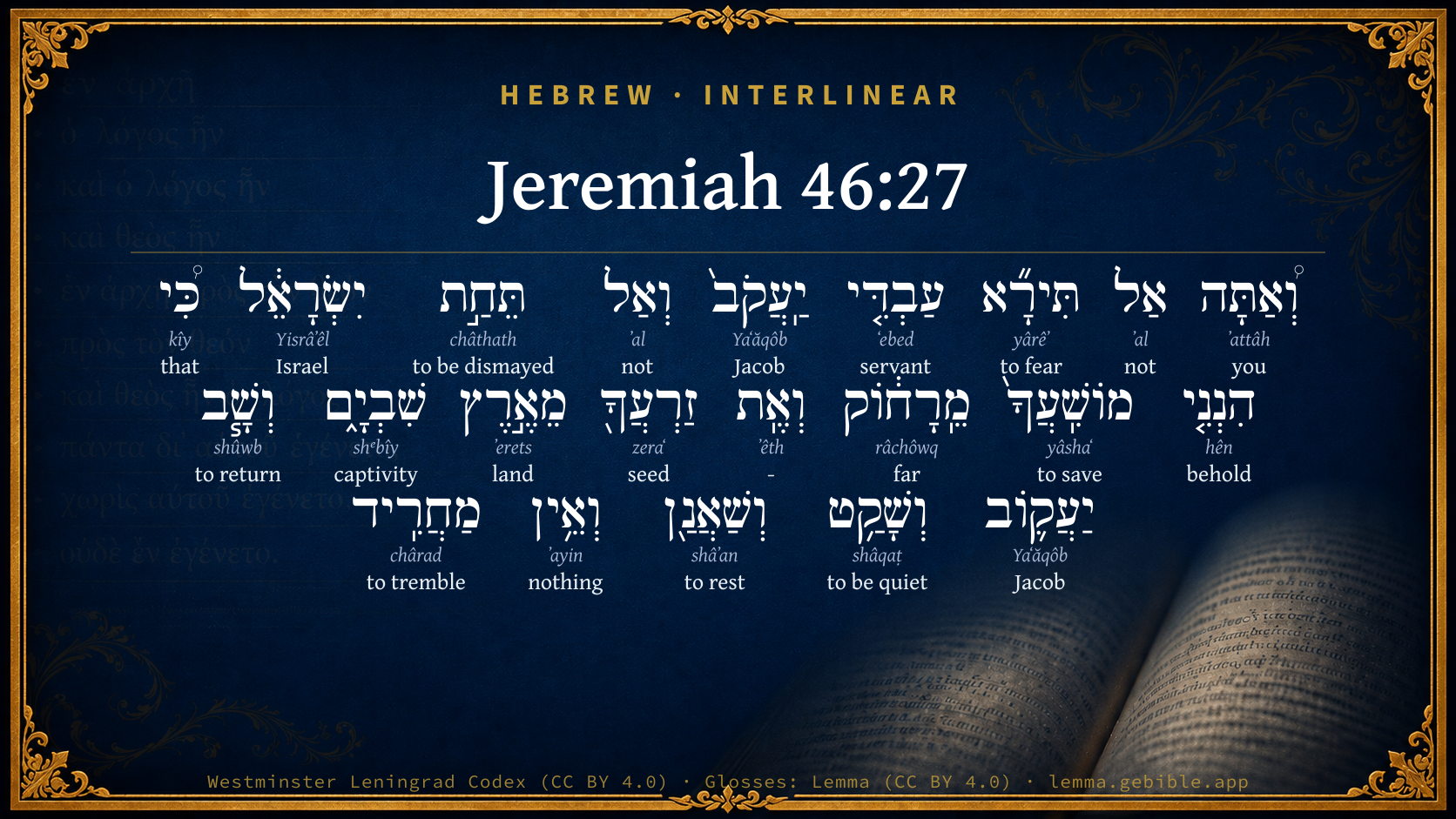
Hebrew (Westminster Leningrad Codex) Jeremiah 46:27 appears in the Hebrew Old Testament. The text above is from the Westminster Leningrad Codex. Each word links to its Strong’s number, a concise gloss, and parsing drawn from the Open Scriptures Hebrew Bible morphology. Click any word for its full Brown-Driver-Briggs (BDB) entry.
Download image
Cite this verse

Jeremiah 46:27 (World English Bible). Public Domain. Lemma interlinear Bible study tool, https://lemma.gebible.app/v/jeremiah/46/27.

Show BibTeX & RIS
BibTeX
RIS
English Translation
But don't be afraid you, Jacob my servant, neither be dismayed, Israel: for, behold, I will save you from afar, and your seed from the land of their captivity; and Jacob shall return, and shall be quiet and at ease, and none shall make him afraid.
World English Bible · Public Domain
Download a study sheet

One document with this verse’s original text, its word-by-word gloss line, the meaning frame, cross-references with their text, attributed commentary, and full source and license credits — printable, and it pastes into notes with its structure intact.

This verse Autodidact and up

Study sheet (.html) Plain text (.txt)

A passage Seminary Student

Up to 50 verses in one chapter. A passage sheet keeps up to 6 commentary sources and 12 cross-references per verse, in the order this page ranks them, and says so on the sheet whenever that leaves anything out. Ask for a single verse and you get the Autodidact verse sheet above.

Everything on this page stays free to read, with no account — the sheet is a download of what is already on screen, not access to it.

Want to remove ads? Support Godless Engineer
Compare translations 3

The same verse in 3 English versions, stacked beneath the original-language interlinear above. Click any original word for its lexicon entry.

Each is an independent rendering of the whole verse — the interlinear is not word-aligned to these translations.

Highlighted words mark where these versions differ — a whole-verse word diff, not a word-by-word alignment.

  • World English Bible Public Domain
    But don't be afraid you, Jacob my servant, neither be dismayed, Israel: for, behold, I will save you from afar, and your seed from the land of their captivity; and Jacob shall return, and shall be quiet and at ease, and none shall make him afraid.
  • King James Version Public Domain
    But fear not thou, O my servant Jacob, and be not dismayed, O Israel: for, behold, I will save thee from afar off, and thy seed from the land of their captivity; and Jacob shall return, and be in rest and at ease, and none shall make him afraid.
  • unfoldingWord Literal Text CC BY-SA 4.0
    But you, my servant Jacob, do not fear. Do not be dismayed, Israel, for see, I am about to bring you back from far away, and your offspring from the land of their captivity. Then Jacob will return, find peace, and be secure, and there will be no one to terrify him.

unfoldingWord Literal Text — © unfoldingWord, licensed CC BY-SA 4.0. Word-aligned USFM3 via Door43 (git.door43.org/unfoldingWord/en_ult).

Versions to compare (up to 4)

3 of 4 selected

Show all 18 translations

Every available English version of this verse, each an independent rendering of the whole verse.

  • World English Bible Public Domain
    But don't be afraid you, Jacob my servant, neither be dismayed, Israel: for, behold, I will save you from afar, and your seed from the land of their captivity; and Jacob shall return, and shall be quiet and at ease, and none shall make him afraid.
  • Berean Standard Bible Public Domain
    But you, O Jacob My servant, do not be afraid, and do not be dismayed, O Israel. For I will surely save you out of a distant place, your descendants from the land of their captivity! Jacob will return to quiet and ease, with no one to make him afraid.
  • Majority Standard Bible Public Domain
    But you, O Jacob My servant, do not be afraid, and do not be dismayed, O Israel. For I will surely save you out of a distant place, your descendants from the land of their captivity! Jacob will return to quiet and ease, with no one to make him afraid.
  • King James Version Public Domain
    But fear not thou, O my servant Jacob, and be not dismayed, O Israel: for, behold, I will save thee from afar off, and thy seed from the land of their captivity; and Jacob shall return, and be in rest and at ease, and none shall make him afraid.
  • American Standard Version (1901) Public Domain
    But fear not thou, O Jacob my servant, neither be dismayed, O Israel: for, lo, I will save thee from afar, and thy seed from the land of their captivity; and Jacob shall return, and shall be quiet and at ease, and none shall make him afraid.
  • Revised Version (1885) Public Domain
    But fear not thou, O Jacob my servant, neither be dismayed, O Israel: for, low, I will save thee from afar, and thy seed from the land of their captivity; and Jacob shall return, and shall be quiet and at ease, and none shall make him afraid.
  • Geneva Bible (1599) Public Domain
    But feare not thou, O my seruant Iaakob, and be not thou afraid, O Israel: for behold, I will deliuer thee from a farre countrey, and thy seede from the land of their captiuitie, and Iaakob shall returne and be in rest, and prosperitie, and none shall make him afraid.
  • Douay-Rheims (1899) Public Domain
    And thou my servant Jacob, fear not and be not thou dismayed, O Israel: for behold I will save thee from afar off, and thy seed out of the land of thy captivity: and Jacob shall return and be at rest, and prosper: and there shall be none to terrify him.
  • Young's Literal Translation Public Domain
    And thou, thou dost not fear, my servant Jacob, Nor `art' thou dismayed, O Israel, For lo, I am saving thee from afar, And thy seed from the land of their captivity, And Jacob hath turned back, And hath been at rest, and been at ease, And there is none disturbing.
  • Literal Standard Version CC BY-SA 4.0
    And you, you do not fear, My servant Jacob, || Nor [are] you dismayed, O Israel, || For behold, I am saving you from afar—And your seed from the land of their captivity, || And Jacob has turned back, || And has been at rest, and been at ease, || And there is none disturbing.
  • Unlocked Literal Bible CC BY-SA 4.0
    But you, my servant Jacob, do not fear. Do not be dismayed, Israel, for see, I am about to bring you back from far away, and your offspring from the land of their captivity. Then Jacob will return, find peace, and be secure, and there will be no one to terrify him.
  • unfoldingWord Literal Text CC BY-SA 4.0
    But you, my servant Jacob, do not fear. Do not be dismayed, Israel, for see, I am about to bring you back from far away, and your offspring from the land of their captivity. Then Jacob will return, find peace, and be secure, and there will be no one to terrify him.
  • Darby Bible Public Domain
    But thou, my servant Jacob, fear not, neither be dismayed, Israel: for behold, I will save thee from afar, and thy seed from the land of their captivity; and Jacob shall return, and be in rest and at ease, and none shall make [him] afraid.
  • World Messianic Bible Public Domain
    “But don’t you be afraid, Jacob my servant. Don’t be dismayed, Israel; for, behold, I will save you from afar, and your offspring from the land of their captivity. Jacob will return, and will be quiet and at ease. No one will make him afraid.
  • Webster's Bible Public Domain
    But fear not thou, O my servant Jacob, and be not dismayed, O Israel: for behold, I will save thee from afar, and thy seed from the land of their captivity; and Jacob shall return, and be in rest and at ease, and none shall make him afraid.
  • Free Bible Version CC BY-SA 4.0
    But you, descendants of Jacob my servant, you don't have to be fearful. Israelites, you don't need to be discouraged. I promise to rescue you from your distant places of exile, your descendants from the countries where they're being held captive. You will go home to a quiet and comfortable life, free from any threats.
  • Bible in Basic English Public Domain
    But have no fear, O Jacob, my servant, and do not be troubled, O Israel: for see, I will make you come back from far away, and your seed from the land where they are prisoners; and Jacob will come back, and will be quiet and in peace, and no one will give him cause for fear.
  • JPS Tanakh (1917) Public Domain
    But fear not thou, O Jacob My servant, neither be dismayed, O Israel; for, lo, I will save thee from afar, and thy seed from the land of their captivity; and Jacob shall again be quiet and at ease, and none shall make him afraid.

Literal Standard Version (2020), Covenant Press — licensed CC BY-SA 4.0. Text via the HelloAO Bible API (eBible.org). Unlocked Literal Bible (unfoldingWord) — licensed CC BY-SA 4.0. Text via the HelloAO Bible API (eBible.org). unfoldingWord Literal Text — © unfoldingWord, licensed CC BY-SA 4.0. Word-aligned USFM3 via Door43 (git.door43.org/unfoldingWord/en_ult). Free Bible Version, Dr. Jonathan Gallagher — licensed CC BY-SA 4.0. Text via the HelloAO Bible API (eBible.org).

Word by word

More ways to search: Search by grammar → Find every occurrence → Compare this word →

Practice this passage: Drill this verse → Learn its vocabulary →

וְשַׁאֲנַ֖ן
shâʼan
H7599
“and · to rest”
Conjunction + Verb, Palel, Perfect, 3rd Person, Masculine, Singular
Part of Speech
Conjunction + Verb
Stem
Palel
Form
Perfect
Person
3rd Person
Gender
Masculine
Number
Singular
Full BDB Definition

Origin: a primitive root

TWOT: 2304

(Pilel) to be at ease, be at peace, rest, rest securely, be quiet
  1. וְ֠אַתָּה ʼattâh H859 “and · you” Conjunction + Pronoun, Personal, 2nd Person, Masculine, Singular
  2. אַל ʼal H408 “not” Particle, Negative
  3. תִּירָ֞א yârêʼ H3372 “to fear” Verb, Qal, Jussive, 2nd Person, Masculine, Singular
  4. עַבְדִּ֤י ʻebed H5650 “servant · my” Noun, Common, Masculine, Singular, Construct + Suffix, Personal, 1st Person, Common, Singular
  5. יַֽעֲקֹב֙ Yaʻăqôb H3290 “Jacob” Noun, Proper
  6. וְאַל ʼal H408 “and · not” Conjunction + Particle, Negative
  7. תֵּחַ֣ת châthath H2865 “to be dismayed” Verb, Niphal, Jussive, 2nd Person, Masculine, Singular
  8. יִשְׂרָאֵ֔ל Yisrâʼêl H3478 “Israel” Noun, Proper
  9. כִּ֠י kîy H3588 “that” Conjunction
  10. הִנְנִ֤י hên H2005 “behold · me” Particle, Demonstrative + Suffix, Personal, 1st Person, Common, Singular
  11. מוֹשִֽׁעֲךָ֙ yâshaʻ H3467 “saving · you” Verb, Hiphil, Participle Active, Masculine, Singular, Construct + Suffix, Personal, 2nd Person, Masculine, Singular
  12. מֵֽרָח֔וֹק râchôwq H7350 “from · far” Preposition + Adjective, Adjective, Masculine, Singular, Absolute
  13. וְאֶֽת ʼêth H853 “and · -” Conjunction + Particle, Direct Object
  14. זַרְעֲךָ֖ zeraʻ H2233 “seed · your” Noun, Common, Masculine, Singular, Construct + Suffix, Personal, 2nd Person, Masculine, Singular
  15. מֵאֶ֣רֶץ ʼerets H776 “from · land of” Preposition + Noun, Common, Both, Singular, Construct
  16. שִׁבְיָ֑ם shᵉbîy H7628 “captivity · their” Noun, Common, Both, Singular, Construct + Suffix, Personal, 3rd Person, Masculine, Plural
  17. וְשָׁ֧ב shûwb H7725 “and · to return” Conjunction + Verb, Qal, Sequential Perfect, 3rd Person, Masculine, Singular
  18. יַעֲק֛וֹב Yaʻăqôb H3290 “Jacob” Noun, Proper
  19. וְשָׁקַ֥ט shâqaṭ H8252 “and · to be quiet” Conjunction + Verb, Qal, Sequential Perfect, 3rd Person, Masculine, Singular
  20. וְאֵ֥ין ʼayin H369 “and · nothing” Conjunction + Particle, Negative
  21. מַחֲרִֽיד chârad H2729 “trembling” Verb, Hiphil, Participle Active, Masculine, Singular, Absolute

About this verse

These counts appear in no published source. They are computed here, from the morphology-tagged text and Lemma’s own curated glosses. What Lemma adds →

22
words
20
distinct lemmas
Prophets
section

Notable vocabulary

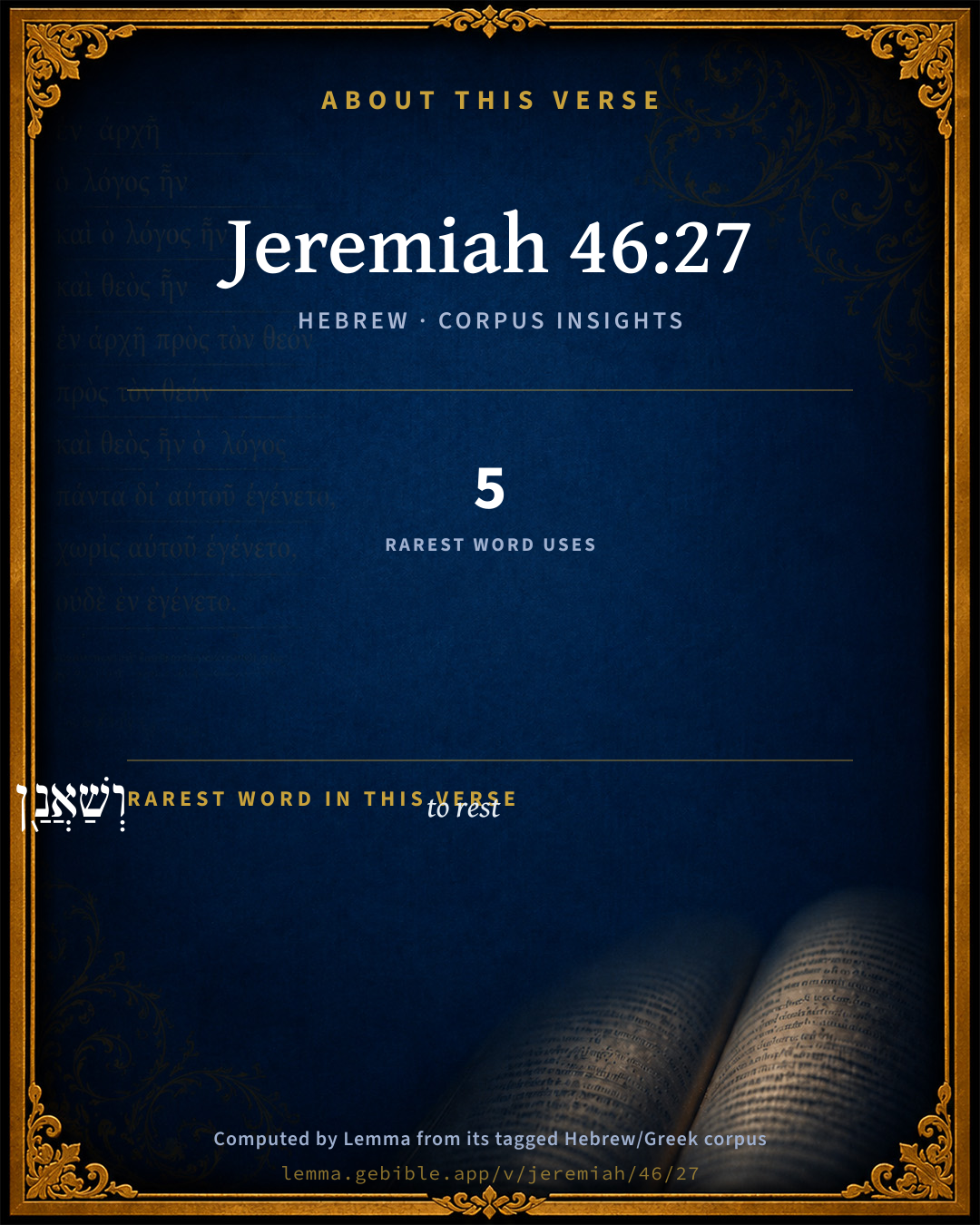
The rarest word here is וְשַׁאֲנַ֖ן to rest H7599 — appearing just 5 times in the whole Hebrew Bible.

Shared distinctive vocabulary

וְשַׁאֲנַ֖ן to rest H7599 occurs in 5 verses of the Hebrew Bible. Also found in:

Grammatical profile

  • 7 verbs
  • 7 nouns
  • 1 adjective
  • 1 pronoun
  • 1 conjunction
  • 5 particles

Verb forms

  • תִּירָ֞א Qal · Jussive
  • תֵּחַ֣ת Niphal · Jussive
  • מוֹשִֽׁעֲךָ֙ Hiphil · Participle Active
  • וְשָׁ֧ב Qal · Sequential Perfect
  • וְשָׁקַ֥ט Qal · Sequential Perfect
  • וְשַׁאֲנַ֖ן Palel · Perfect
  • מַחֲרִֽיד Hiphil · Participle Active

Repetition

Words recur within this verse — often emphatic in Hebrew:

  • יַֽעֲקֹב֙ Jacob H3290 ×2
  • אַל not H408 ×2

Cross-references

20

Topical passages linked to Jeremiah 46:27 in the Treasury of Scripture Knowledge — connected by theme and wording, ordered by reader-vote popularity; previews shown in the World English Bible.

  • Isaiah 43:5 Don't be afraid; for I am with you: I will bring your seed from the east, and gather you from the west;
  • Isaiah 43:1 But now thus says Yahweh who created you, Jacob, and he who formed you, Israel: Don't be afraid, for I have redeemed you; I have called you by your name, you are mine.
  • Jeremiah 30:10–11 Therefore don't you be afraid, O Jacob my servant, says Yahweh; neither be dismayed, Israel: for, behold, I will save you from afar, and your seed from the land of their captivity; and Jacob shall return, and shall be quiet and at ease, and none shall make him afraid.
  • Isaiah 41:13–14 For I, Yahweh your God, will hold your right hand, saying to you, Don't be afraid; I will help you.
  • Jeremiah 29:14 I will be found by you, says Yahweh, and I will turn again your captivity, and I will gather you from all the nations, and from all the places where I have driven you, says Yahweh; and I will bring you again to the place from where I caused you to be carried away captive.
  • Jeremiah 50:19 I will bring Israel again to his pasture, and he shall feed on Carmel and Bashan, and his soul shall be satisfied on the hills of Ephraim and in Gilead.
  • Isaiah 44:2 Thus says Yahweh who made you, and formed you from the womb, who will help you: Don't be afraid, Jacob my servant; and you, Jeshurun, whom I have chosen.
  • Jeremiah 23:3–4 I will gather the remnant of my flock out of all the countries where I have driven them, and will bring them again to their folds; and they shall be fruitful and multiply.
  • Jeremiah 23:6 In his days Judah shall be saved, and Israel shall dwell safely; and this is his name by which he shall be called: Yahweh our righteousness.
  • Jeremiah 33:16 In those days shall Judah be saved, and Jerusalem shall dwell safely; and this is [the name] by which she shall be called: Yahweh our righteousness.
  • Amos 9:14 I will bring back the captivity of my people Israel, And they will rebuild the ruined cities, and inhabit them; and they will plant vineyards, and drink wine from them. They shall also make gardens, And eat the fruit of them.
  • Isaiah 11:11–16 It shall happen in that day, that the Lord will set his hand again the second time to recover the remnant of his people, who shall remain, from Assyria, and from Egypt, and from Pathros, and from Cush, and from Elam, and from Shinar, and from Hamath, and from the islands of the sea.
  • Jeremiah 32:37 Behold, I will gather them out of all the countries, where I have driven them in my anger, and in my wrath, and in great indignation; and I will bring them again to this place, and I will cause them to dwell safely:
  • Ezekiel 39:25 Therefore thus says the Lord Yahweh: Now will I bring back the captivity of Jacob, and have mercy on the whole house of Israel; and I will be jealous for my holy name.
  • Micah 7:11–16 A day to build your walls-- In that day, he will extend your boundary.
  • Jeremiah 31:8–11 Behold, I will bring them from the north country, and gather them from the uttermost parts of the earth, [and] with them the blind and the lame, the woman with child and her who travails with child together: a great company shall they return here.
  • Ezekiel 34:10–14 Thus says the Lord Yahweh: Behold, I am against the shepherds; and I will require my sheep at their hand, and cause them to cease from feeding the sheep; neither shall the shepherds feed themselves any more; and I will deliver my sheep from their mouth, that they may not be food for them.
  • Ezekiel 34:25–26 I will make with them a covenant of peace, and will cause evil animals to cease out of the land; and they shall dwell securely in the wilderness, and sleep in the woods.
  • Ezekiel 36:24 For I will take you from among the nations, and gather you out of all the countries, and will bring you into your own land.
  • Ezekiel 37:21–22 Say to them, Thus says the Lord Yahweh: Behold, I will take the children of Israel from among the nations, where they are gone, and will gather them on every side, and bring them into their own land:

Cross-references courtesy of OpenBible.info (CC BY 4.0).

Hebrew and Greek witnesses Masoretic Hebrew ↔ Greek Septuagint

The same verse in the two great witnesses to the Old Testament, shown verse-for-verse.

These are two independent witnesses, not word-aligned to each other, and the Septuagint is shown in lemma (dictionary) form.

Hebrew Jeremiah 46:27 Masoretic · Westminster Leningrad Codex

וְ֠אַתָּה אַל תִּירָ֞א עַבְדִּ֤י יַֽעֲקֹב֙ וְאַל תֵּחַ֣ת יִשְׂרָאֵ֔ל כִּ֠י הִנְנִ֤י מוֹשִֽׁעֲךָ֙ מֵֽרָח֔וֹק וְאֶֽת זַרְעֲךָ֖ מֵאֶ֣רֶץ שִׁבְיָ֑ם וְשָׁ֧ב יַעֲק֛וֹב וְשָׁקַ֥ט וְשַׁאֲנַ֖ן וְאֵ֥ין מַחֲרִֽיד

But don't be afraid you, Jacob my servant, neither be dismayed, Israel: for, behold, I will save you from afar, and your seed from the land of their captivity; and Jacob shall return, and shall be quiet and at ease, and none shall make him afraid.

World English Bible · Public Domain

Greek LXX Structure differs

In the Septuagint, Jeremiah is about an eighth shorter than the Hebrew and arranges its material differently — the Oracles Against the Nations (Hebrew chapters 46–51) appear in the middle of the Greek book, after 25:13. Because the chapter and verse boundaries do not line up, a verse-for-verse comparison with the Hebrew is not shown.

A verse-for-verse comparison isn’t shown here because the chapters and verses don’t line up. Switch to the LXX edition with the MT / LXX toggle above to read the Greek directly.

Hebrew: Westminster Leningrad Codex (CC BY 4.0). Greek: Septuagint (public domain); English from a public-domain English Septuagint. How the Septuagint differs from the Hebrew →

Targum (Aramaic paraphrase)

1

The Targum is the ancient Jewish Aramaic paraphrase of the Hebrew Scriptures — an interpretive translation, not the Hebrew text itself. Onkelos (literal) and Pseudo-Jonathan (expansive) render the Torah, and Jonathan the Prophets. Coverage is partial: where no permissively-licensed English translation exists for a verse, only the Aramaic is shown. This is verse-level text, not a word-by-word alignment to the Hebrew.

  1. Targum Jonathan Prophets (Joshua–Malachi)
    וְאַתְּ לָא תִדְחַל עַבְדִי יַעֲקֹב וְלָא תִתְּבַר יִשְׂרָאֵל אֲרֵי הָא אֲנָא פְּרִיק לִיךְ מֵרָחִיק וְיַת בְּנָךְ מֵאֲרַע גָלוּתְהוֹן וִיתוּבוּן דְבֵית יַעֲקֹב וְיִשְׁקְטוּן וְיִשְׁרוּן לְרוֹחֲצָן וְלֵית דְמָנִיד:

    (no public-domain English translation for this verse)

    Targum Jonathan — Aramaic: “Mikraot Gedolot” (public domain). English: “Sefaria Community Translation” (CC0 1.0 (public-domain dedication)); “London "Chaldee Paraphrase," 1871” (public domain). Text via Sefaria.

Commentary

Notes on Jeremiah 46:27 from classic Christian and Jewish commentators (each source and its license shown beneath its notes). The classic Christian expositions comment on the surrounding passage and are grouped to its opening verse, so a note may address several verses; the Jewish commentaries on the Tanakh (Rashi and others) are per-verse, so they appear only where the commentator wrote on this verse.

Lemma curates 59 commentaries, every one of them public domain or Creative Commons licensed, each selected and text-cleaned for this edition rather than reprinted as found. About our sources →

Trapp's Complete Commentary

John Trapp

Jer 46:27 But fear not thou, O my servant Jacob, and be not dismayed, O Israel: for, behold, I will save thee from afar off, and thy seed from the land of their captivity; and Jacob shall return, and be in rest and at ease, and none shall make [him] afraid.

Ver. 27. But fear not thou, O my servant Jacob.] If Egypt find so much favour, {as Jer 46:26} what mayest not thou hope for? See the same, Jer 30:10.

John Trapp, A Commentary or Exposition upon All the Books of the Old and New Testament (1647–1656) — public domain. Text from a community e-Sword module.

Joseph Benson's Commentary

Jer 46:27-28. But fear not thou, O my servant Jacob; for I will make a full end of all the nations whither, &c. — See notes on Jer 30:10-11, from whence these two verses are taken, containing a comfortable promise to the Jews, that God will not make an utter destruction of them as he hath done of several other nations, against which the prophets have denounced his judgments; but will still preserve a remnant of them, to whom he will perform the promises made to their fathers: see also note on Jer 30:16-17.

Joseph Benson's Commentary on the Old and New Testaments (1811–1818) — public domain. Text from a community e-Sword module.

Whedon's Commentary on the Bible

Daniel D. Whedon

MESSAGE TO ISRAEL, Jer_46:27-28.

27, 28. Fear not… Jacob — God’s true Israel is not utterly cast off. Though he may bring other nations to a full end, yet this one has a permanent life laid in the divine purpose.

Daniel D. Whedon (gen. ed.), Commentary on the Old and New Testaments (1874–1909) — public domain. Text from a community e-Sword module.

Lange's Commentary on the Holy Scriptures

Appendix to the Prophecies against Egypt; a Consolatory Declaration to Israel

Jer_46:27-28

27          But fear thou not, my servant Jacob,

And be thou not dismayed, O Israel;

For behold, I will save thee from afar

And thy seed from the land of their captivity,

And Jacob shall return and be at rest,

And quiet, and none shall make him afraid.

28     Fear thou not, my servant Jacob,

Saith Jehovah, for I am with thee.

For I will make a full end of the nations,

Whither I have dispersed thee:

But I will not make a full end of thee,

I will correct thee in measure and not leave thee unpunished.

EXEGETICAL AND CRITICAL

It is acknowledged that these words stand in the original and suitable connection in Jeremiah 30, as well as that they are not necessary to Jeremiah 46, and would not be missed if they were omitted. Still it may be said that every injury befalling the enemies of the theocracy is a corroboration of the latter, and that it cannot be unsuitable also to express in words this mutual relation founded in the nature of the case, the two going constantly hand in hand in chh. 50, 51. (Comp. Jer_50:4-6; Jer_50:17-19; Jer_50:28; Jer_50:33; Jer_51:5-6; Jer_51:10; Jer_51:35; Jer_51:45; Jer_51:50). But the overthrow of the Babylonian kingdom by Cyrus bore the deliverance of Judah immediately in its womb. This can be said of the conquest of Egypt no more than of that of the other small nations against which chh. 47–49 are directed. Hence in these three chapters there is no trace of that mutual relation. Why then just here? And how does it agree with the fact that elsewhere in Egypt Jeremiah pronounces only the severest threatenings against the Israelites (chh. 42–44)? There is much then that is opposed to the genuineness of the passage, while on the other hand it is easy to suppose that a later seer saw fit to oppose this light to the former shadow. Moreover, as we have said, the words are not absolutely unsuitable here, and we cannot therefore deny the possibility, that Jeremiah, who, as is well known, is very fond of quoting himself, himself felt the need of causing the light of Israel to shine brightly on the dark background of their ancient enemy, Egypt.

DOCTRINAL AND ETHICAL

1. Förster states four reasons why the prophets had to proclaim judgment on the heathen nations also. The first is διδασκαλικός: it is to be known that the prosperity of the heathen is not lasting, but that heathendom has no basis of true prosperity. The second reason is παρηγορικός: the pious are not to fear that the heathen will get the upper hand and suppress the church. The third is ἐπανορθωτικός: God’s people are to guard against forming alliances with the heathen and trusting in their help. The fourth is ἐλεγκτικός: a conclusion is to be drawn a minori ad majus: if God does not spare the heathen who are deprived of His light, how much less will He spare His people, if they despise the light of His word.

2. “Jeremiah’s God is also the Lord of all the heathen and makes their destinies. They find it so according to their words and especially their posture towards the chosen people Israel. They haste to their destruction, for one nation only is eternal; this, however, is the nation which has been passed through a thousand sieves and in comparison with others is no nation. That which is in Israel, as in other nations, passes away, and only that which it has above other nations remains eternal. Jeremiah prophesies most against Egypt, Moab and Babylon, in which the wealth, the jealous, scoffing manner of the mean world, and the cavalier spirit of great states is rebuked. … He who rightly understands this sees here not sermons addressed to generations long since passed away, but to the natural humanity streaming through this world, as it is continually presented with new names and yet always with the same carnal impulses and based on the same unreason. To him, who thus understands Jeremiah, he is again alive, and the Jewish legend is fulfilled, that Jeremiah must come again before the Messianic kingdom can bloom up again in glory. Yea, let Jeremiah rise truly for thee to mourn, and Christ, with the hosannas of His eternal hosts of disciples, will not longer be hidden from thee, and in Him thou wilt have all things.” Diedrich.

3. On Jer_46:6. “The race is not to the swift. Ecc_9:11. Therefore let not the strong man glory in his strength. Jer_9:22. Also are horses and chariots and such like things of no avail: for to those who have not God on their side, all is lost.” Cramer.

4. On Jer_46:10. “God may long delay His reckoning. This Pharaoh-necho had killed the pious Josiah, conquered his son Jehoahaz and laid the land of Judah under tribute. But guilt rusts not, however old, and though God comes slowly He comes surely.” Cramer.

5. On Jer_46:10. “Although the ungodly go free for a long time and rejoice with timbrel and harp and are glad with pipes and spend their days in wealth (Job_21:12), yet he lets them go free like sheep for the slaughter, and spares them for the day of slaughter (Jer_12:3).” Cramer.

6. On Jer_46:25. “Bonum confidere in Domino et non in principibus (Psalms 146). When their help is most needed they lie down and die.” Förster.

7. On Jer_46:27-28. “When God turns things upside down and takes care that neither root nor branch remains, His little flock must be preserved. The punishments which redound to the destruction of the ungodly redound to the amelioration of the godly. For from these He takes the eternal punishment, and the temporal must also redound to their advantage, but the ungodly drink it to the dregs.” Cramer.

Lange's Commentary on the Holy Scriptures (Critical, Doctrinal, and Homiletical), ed. John Peter Lange, English translation edited by Philip Schaff (1864–1880) — public domain. Text from a community e-Sword module.

Tyndale Open Study Notes

Tyndale Open Resources

46:27 I will bring you home again: The exiles began returning to Judea in 538 BC. Israel was disciplined but not destroyed.

Tyndale Open Study Notes — © Tyndale Open Resources, licensed CC BY-SA 4.0. Text via the HelloAO Bible API.

Geneva Bible (1599)

Geneva Bible translators

God comforteth all his that were in captivity, but specially the small Church of the Jews, whereof were Jeremiah and Baruch, which remained among the Egyptians: for the Lord never forsaketh his, Isa. 44:2; Jer. 30:10.

Geneva Bible (1599) marginal notes — public domain. Text via Bolls.life.

Jamieson, Fausset & Brown

Robert Jamieson, A. R. Fausset & David Brown

Repeated from Jer 30:10-11. When the Church (and literal Israel) might seem utterly consumed, there still remains hidden hope, because God, as it were, raises His people from the dead (Rom 11:15). Whereas the godless "nations" are consumed even though they survive, as are the Egyptians after their overthrow; because they are radically accursed and doomed [CALVIN].

Next: Jeremiah Chapter 47

Jamieson, Fausset & Brown — Commentary Critical and Explanatory on the Whole Bible (1871) — public domain (CC PDM 1.0). Text via the HelloAO Bible API.

Adam Clarke's Commentary

Verse 27. Fear not - my servant Jacob] In the midst of wrath God remembers mercy. Though Judah shall be destroyed, Jerusalem taken, the temple burnt to the ground, and the people carried into captivity, yet the nation shall not be destroyed. A seed shall be preserved, out of which the nation shall revive.

Adam Clarke's Commentary on the Bible (1810–1826) — public domain. Text from a community e-Sword/MySword module.

John Calvin's Commentaries

The Prophet now directs his discourse to the Israelites; for we have already said that he was not appointed a teacher to heathen nations. Whatever, then, he spoke of heathen nations had a reference to the benefit of his people; and for this purpose, as we have said, the Prophets extended their prophecies respecting God’s judgments to all nations; for otherwise the Israelites would have been disheartened, as though their condition was worse than that of others: “What can this mean? God has chosen us as his peculiar people; in the meantime we alone are miserable: God pours forth on us his whole rigor, and yet he spares the unbelieving. It would have been better for us to have been rejected wholly by him, for the covenant which he has made with us only renders us more miserable than others.” Thus the miserable Israelites might have rushed headlong into despair, had nothing been done in time to relieve them. And then the Prophets, or rather the Spirit of God who spoke by them, regarded another thing; for if nothing had been predicted they would have passed by, with closed eyes, those judgments which God executed on all their neighbors, for all that Isaiah, Jeremiah, and Ezekiel had predicted was fulfilled. Had they been silent respecting the ruin of Egypt, of the Philistines and the Moabites, the people, owing to their torpor, would not have considered God’s judgments, but would have thought them to have all happened by chance. The Prophets then represented as in a mirror the power of God, that the Israelites might know that it extended to the whole world and to every nation.

This is the reason why Jeremiah now turns his discourse to the chosen people, and says, Fear not, my servant Jacob He still speaks in God’s name. Now God calls Jacob his servant, not on the ground of obedience, but because he had chosen him. Then by this word God sets forth the favor of adoption, and not the obedience of the people, for we know how refractory and disobedient they were; we know that they were continually shaking off the yoke, that they insulted as it were God himself; very far were they from quietly submitting to his authority as it became servants. Here, then, the obedience of the Israelites is not commended, but that election is set forth by which God had set them apart from other nations. How then was Jacob God’s servant? not because he deserved that honor by his own merits, but because God had been pleased gratuitously to choose him for himself. So also David says,

“I am thy servant, the son of thy handmaid,” (Psalm 116:16)

He means that he was as it were a hereditary servant, who had been already dedicated to God before he was conceived in his mother’s womb. But as this mode of speaking often occurs, I pass it by with only a few words.

Fear not, O Jacob, he says, and be not broken in mind, O Israel There are indeed two names used, but God thus addresses his people often; and why? because I wall save thee We now then see why God called Jacob his servant, even because the salvation of the elect people depended on this peculiar privilege, that God had chosen them for himself; I will save thee, he says, from far The ten tribes, as it is well known, had already been driven far, and a part of Judah had been led into exile. Distance took away the hope of a return. Hence God here declares that a long distance would be no hindrance to him to restore his people when it seemed good to him; Behold, I will save thee He then obviates this objection; “What! why then does God thus suffer us to be driven to foreign lands? why have we not staid in our own land?” God, he says, will not be less able to save thee in the remotest places, than if thou hadst remained in thy native country, and in thine own habitation. And he adds, and thy seed, from the land of their captivity

We hence learn, that though the Prophet spoke of the temporal restoration of the people, he yet had a regard to higher and greater things, even that the captives should recumb on God’s mercy, and believe that he would be propitious to them even when dead. This passage then shews that the hope of God’s children is not confined to this life, but extends farther, in order that they may know that God will be propitious to them after death, and that they may sustain themselves with the assurance of his favor, for otherwise this promise that God would restore their children after their death would have been absurd. “But why is he implacable to us? why does he not restore us sooner?” The Jews might have raised this objection; but the Prophet reminds them, that though they were not to be restored immediately to their country, yet the covenant of God would remain valid, and its stability would appear after seventy years.

We now perceive why the Prophet said, Jacob shall return and rest, and shall be secure I wonder that some have rendered the last words, “and shall be happy,” for שאנן, shanun, means to be secure, or to rest; and then the Prophet explains himself, nor will there be any to terrify We indeed know that it is the main part of happiness when no fear disturbs us, when our minds are in a composed and quiet state. Further, by these words he intimates the continuance of God’s favor, as though he had said that his favor would not only be evident in restoring the people from exile, but in restoring the miserable in such a way as to grant them full and continued happiness. It follows, —

John Calvin's Commentaries (1540-1563) — public domain. Text from the Calvin Translation Society English edition (1840s-50s) via the Christian Classics Ethereal Library (ccel.org). Calvin's coverage is partial (roughly two-thirds of the Bible); uncommented books and verses are honest gaps, never fabricated. The 19th-century editor's footnotes and remarks are omitted so the notes are faithfully Calvin's own voice.

Ellicott's Commentary for English Readers

(27, 28) Fear not thou, O my servant Jacob . . .—The words that follow are found also in Jer_30:10-11, and have been commented on there, and were either inserted here by the prophet himself, or by some later editor of his writings, as an appropriate conclusion, contrasting the care of Jehovah for His people with the sentence upon the power in which they were trusting for protection. Why should they insist, as in Jer_43:7, on placing themselves in a position which would involve them in the destruction which the prophet thus foretells? The words, it may be noticed, are a manifest echo of the words of Isaiah (Isa_41:13; Isa_43:5). Such a consolation was, we may well believe, needed by the people when they saw the armies of Nebuchadnezzar laying waste the country in whose protection they had trusted, and where they had hoped to find a home. Better things, they are told, were in store for them, even a return to the land of their fathers.

A Bible Commentary for English Readers, edited by Charles John Ellicott (1878–1897) — public domain. Text from a community e-Sword module.

The Cambridge Bible for Schools and Colleges

gen. ed. J. J. S. Perowne

27, 28. See introd. summary to the ch. See also on ch. Jer_30:10-11, where almost exactly the same words are found in MT. Also for “correct” (Jer_46:28) See on Jer_2:19. The vv. imply that the exile has begun and thus cannot date from “the fourth year of Jehoiakim” (Jer_46:1).

The Cambridge Bible for Schools and Colleges (gen. ed. J. J. S. Perowne; Cambridge University Press, 1878–1918) — public domain. Text from a community e-Sword module.

John Gill's Exposition

But fear thou not, O my servant Jacob; and be not dismayed, O Israel,.... The same things are said in Jer 30:10; See Gill on Jer 30:10;

for, behold, I will save thee from afar off, and thy seed from the land their captivity; Grotius thinks the Jews carried into Egypt by Pharaohnecho, along with Jehoahaz, are meant; but it does not appear that any were carried captive along with him, Kg2 23:33. Jarchi supposes these to be the righteous in Egypt, who were carried thither by Johanan against their will; but though they may be included, even that small remnant that should escape, Jer 44:28; yet the Jews in Babylon, and other provinces, are chiefly designed; and the words are intended to comfort them in their captivity, with a promise of their return, lest they should be discouraged, in hearing that the Egyptians should inhabit their own land again, and they not theirs:

and Jacob shall return, and be in rest, and at ease, and none shall make him afraid: this will have its full accomplishment hereafter in the latter day; when the Jews will be converted, and return to their own land, and never be disturbed more, as they have been, ever since their return from the Babylonish captivity. So Kimchi says this passage respects time to come.

John Gill's Exposition of the Whole Bible (1746–1763) — public domain (CC PDM 1.0). Text via the HelloAO Bible API.

Albert Barnes' Notes on the Bible

These two verses are a repetition of Jer 30:10-11, with those slight variations which Jeremiah always makes when quoting himself. Egypt’s fall and restoration have been foretold; but the prophet closes with a word of exhortation to the many erring Jews who dwelt there. Why should they flee from their country, and trust in a pagan power, instead of endeavoring to live in a manner worthy of the noble destiny which was their true glory and ground of confidence?

Albert Barnes' Notes on the Bible (1834–1885) — public domain. Text from a community e-Sword/MySword module.

Haydock's Catholic Bible Commentary

Off from all countries, (Calmet) particularly from Egypt; (Haydock) on occasion of which country’s deliverance, that of Jacob is foretold. (Calmet) --- If God would bring the Egyptians back, much more would he deliver the Jews. (Worthington)

George Leo Haydock (1774–1849), Haydock's Catholic Family Bible and Commentary, 1859 edition — public domain. Excludes Psalms (Douay-Rheims chapter numbering differs from Protestant) and Deuterocanonical books (Catholic canon only).

The Pulpit Commentary

Vers. 27, 28. A word of comfort to Israel, obviously not written at the same time as the preceding prophecy. The prophet is suddenly transported in imagination into the period of the Babylonian exile. Egypt and its fortunes are far away; the troubles of Israel entirely absorb his attention. After thinking sadly of the reverses of his people, he bursts out with an encouraging exhortation not to fear, though, humanly speaking, there was everything to fear. Did Jeremiah write these verses here? There is strong reason to doubt it; for they occur, with insignificant variations, in Jer_30:10, Jer_30:11, where they cohere far better with the context than here.

Vers. 27, 28. God"s care of his own.

I THE NEED OF THE FULLEST POSSIBLE ASSURANCE. Jehovah, who has visited Israel with many and great sufferings, will also visit other peoples. Egypt is spoken of in this chapter; and Philistia, Moab Ammon, and Babylon in following chapters. Hence the need of Divine words such as would keep the believing element in Israel calm and confident through all these disturbances, and so it ever is meant to be with the true Israel of God. God is ready with comforting words amid the necessary turmoil of external conditions.

II THE SOLID GROUNDS OF THIS ASSURANCE. They lie in Jehovah"s continued connection with Israel, and his purposes for its safety, peace, and prosperity. We have no assurance in ourselves or our circumstances, but the moment we can feel that we are in God"s hands, that he has plans with respect to us, and a future preparing for us, then assurance is possible. God never tells man to take courage and put away fear without giving good reason for the exhortation, and showing that fear is rather the unreasonable feeling to allow. The moment we can take in the full force of that wonderful word, "I am with thee," then we are freed from alarms and from dependence on the shifting phenomena of this present life.

III THE DIFFERENCE GOD WILL MAKE BETWEEN ISRAEL AND OTHER NATIONS. A full end is to be made of them. And a full end has been made of them. Here, of course, the distinction must be borne in mind between nations and the individuals composing them. A nation is but a certain arrangement of human beings, and this arrangement may be productive of such wrong feelings and such danger to the world as to make it fitting that the nation should cease. But the people composing the nation remain, and their descendants pass into new and better combinations. So with regard to Israel; the people who are to return and be in rest and without fear, the people who are not to be made a full end of, are those of whom literal Israel is but the type. There are really but two nations in the world those who believe in God and in his Son, and show their faith by their works; and those who trust in themselves, in their power and their purposes. Of all these latter God must make a full end, if in no other way by bringing them to see their folly, so that they may turn to the ways of faith.

IV JEHOVAH"S CHASTISEMENT OF HIS OWN EVEN WHILE HE PROTECTS THEM. There is a purpose in all suffering, a real need for it. Men seem to be mixed up indiscriminately, and suffering looks as if it often fell irrespective of character, but this is only a seeming. The suffering of Israel, though it may look the same outwardly, is really as different as possible from the suffering of Egypt. There is a fire which ends in the destruction of what passes through it. It must be so, for the thing is destructible and shows its nature when the fire tries it. The same fire attacking indestructible things only separates destructible accretions from them, and consumes these accretions away. God"s intention is that the believer may be able to say, "I cannot be destroyed in this furnace of trials; I cannot go to pieces as others do. But still I must remain in is for a while; I must submit to God"s wise ordinances so that at last I may return to my true rest and fear no more forever. Y.

The Pulpit Commentary (1880–1919), ed. H.D.M. Spence-Jones & Joseph S. Exell — public domain. Text from a community e-Sword module.

unfoldingWord translationNotes

Door43 World Missions Community

my servant Jacob, do not fear. Do not be dismayed, Israel

These two phrases mean the same thing. Here "Jacob" and "Israel" represent the people of Israel. Yahweh is emphasizing that the people should not be afraid. AT: "people of Israel, my servants, do not be afraid" (See: Parallelism and Metonymy)

from the land of their captivity

"from the land where they are captives"

I will bring complete destruction against all the nations

The abstract noun "destruction" can be stated using the verb "destroy." AT: "I will completely destroy all the nations" (See: Abstract Nouns)

will certainly not leave you unpunished

This can be stated in positive form. AT: "will certainly punish you" (See: Double Negatives)

translationWords

Jacob

fear

offspring

captive

peace

terror

nation

discipline

just

unfoldingWord translationNotes — © Distant Shores Media and the Door43 World Missions Community, licensed CC BY-SA 4.0. Source: git.door43.org/Door43/en_tn.

Rashi

Rabbi Shlomo Yitzchaki (Rashi)

You fear not The righteous men who were in Egypt, who were exiled there against their will.

Rashi on the Tanakh — English translations: “The Judaica Press complete Tanach with Rashi, translated by A. J. Rosenberg” (CC BY 4.0); “Pentateuch with Rashi's commentary by M. Rosenbaum and A.M. Silbermann, 1929-1934” (public domain); “The Metsudah Tanach series, Lakewood, N.J” (CC BY 4.0); and “The Book of Joshua, Metsudah Publications, 1997” (CC BY 4.0). Text via Sefaria.

Lesson kit

Teaching starters — assembled from the data on this page, not authored interpretation. Every prompt links to the verse data it draws on. Edit before teaching.

Jeremiah, in the Prophets, opens this verse with 22 words (20 distinct Hebrew lemmas). Its most distinctive word is shâʼan (“to rest”). A historical commentator’s framing appears above. Read the whole chapter for the surrounding context.

Discussion questions

  1. How does “to rest” (shâʼan) shape what this verse is saying?
  2. Job 3:18 shares the word «to rest» with this verse. How do the two illuminate each other?
  3. “Jacob” occurs 2× in this one verse. What is the effect of the repetition?
  4. The translations on this page render this verse differently — a whole-verse word diff, not a word-by-word alignment. What might account for the different wordings?
  5. The verb «תִּירָ֞א» is Qal Jussive. How does its form color the action?
  6. Reading how Trapp's Complete Commentary and Joseph Benson's Commentary read this verse, where do the two commentators agree and where do they part?

Things to notice

Reading settings

Reading text

Shown beneath each verse's original-language words.

Old Testament
Old Testament edition

Read the OT as the Masoretic Hebrew (MT) or the Greek Septuagint (LXX).

English shown for the Greek Septuagint (in the Hebrew ↔ Greek comparison).

Comparing translations? Open the Compare panel on any verse page to stack up to four side by side.