
1 Chronicles 16:25

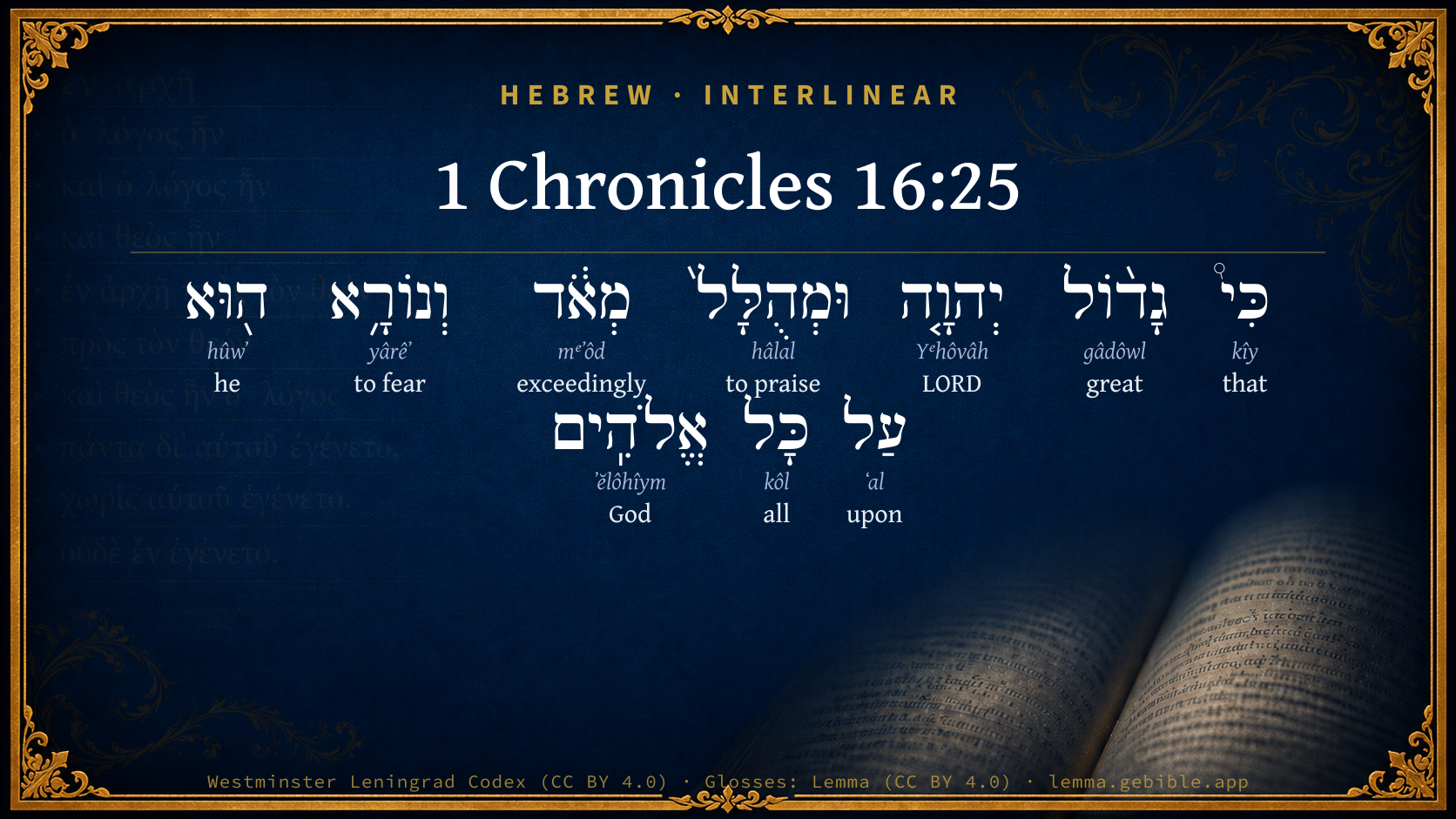
Hebrew (Westminster Leningrad Codex) 1 Chronicles 16:25 appears in the Hebrew Old Testament. The text above is from the Westminster Leningrad Codex. Each word links to its Strong’s number, a concise gloss, and parsing drawn from the Open Scriptures Hebrew Bible morphology. Click any word for its full Brown-Driver-Briggs (BDB) entry.
Download image
Cite this verse

1 Chronicles 16:25 (World English Bible). Public Domain. Lemma interlinear Bible study tool, https://lemma.gebible.app/v/1-chronicles/16/25.

Show BibTeX & RIS
BibTeX
RIS
English Translation
For great is Yahweh, and greatly to be praised: He also is to be feared above all gods.
World English Bible · Public Domain
Download a study sheet

One document with this verse’s original text, its word-by-word gloss line, the meaning frame, cross-references with their text, attributed commentary, and full source and license credits — printable, and it pastes into notes with its structure intact.

This verse Autodidact and up

Study sheet (.html) Plain text (.txt)

A passage Seminary Student

Up to 50 verses in one chapter. A passage sheet keeps up to 6 commentary sources and 12 cross-references per verse, in the order this page ranks them, and says so on the sheet whenever that leaves anything out. Ask for a single verse and you get the Autodidact verse sheet above.

Everything on this page stays free to read, with no account — the sheet is a download of what is already on screen, not access to it.

Want to remove ads? Support Godless Engineer
Compare translations 3

The same verse in 3 English versions, stacked beneath the original-language interlinear above. Click any original word for its lexicon entry.

Each is an independent rendering of the whole verse — the interlinear is not word-aligned to these translations.

Highlighted words mark where these versions differ — a whole-verse word diff, not a word-by-word alignment.

  • World English Bible Public Domain
    For great is Yahweh, and greatly to be praised: He also is to be feared above all gods.
  • King James Version Public Domain
    For great is the LORD, and greatly to be praised: he also is to be feared above all gods.
  • unfoldingWord Literal Text CC BY-SA 4.0
    For Yahweh great and is praised much, and he is feared above all gods.

unfoldingWord Literal Text — © unfoldingWord, licensed CC BY-SA 4.0. Word-aligned USFM3 via Door43 (git.door43.org/unfoldingWord/en_ult).

Versions to compare (up to 4)

3 of 4 selected

Show all 18 translations

Every available English version of this verse, each an independent rendering of the whole verse.

  • World English Bible Public Domain
    For great is Yahweh, and greatly to be praised: He also is to be feared above all gods.
  • Berean Standard Bible Public Domain
    For great is the LORD, and greatly to be praised; He is to be feared above all gods.
  • Majority Standard Bible Public Domain
    For great is the LORD, and greatly to be praised; He is to be feared above all gods.
  • King James Version Public Domain
    For great is the LORD, and greatly to be praised: he also is to be feared above all gods.
  • American Standard Version (1901) Public Domain
    For great is Jehovah, and greatly to be praised: He also is to be feared above all gods.
  • Revised Version (1885) Public Domain
    For great is the LORD, and highly to be praised: he also is to be feared above all gods.
  • Geneva Bible (1599) Public Domain
    For the Lord is great and much to be praised, and hee is to bee feared aboue all gods.
  • Douay-Rheims (1899) Public Domain
    For the Lord is great and exceedingly to be praised: and he is to be feared above all gods.
  • Young's Literal Translation Public Domain
    For great `is' Jehovah, and praised greatly, And fearful He `is' above all gods.
  • Literal Standard Version CC BY-SA 4.0
    For great [is] YHWH, and greatly praised, || And He [is] fearful above all gods.
  • Unlocked Literal Bible CC BY-SA 4.0
    For Yahweh is great and is to be praised greatly, and he is to be feared above all other gods.
  • unfoldingWord Literal Text CC BY-SA 4.0
    For Yahweh great and is praised much, and he is feared above all gods.
  • Darby Bible Public Domain
    For Jehovah is great, and exceedingly to be praised; And he is terrible above all gods.
  • World Messianic Bible Public Domain
    For great is the LORD, and greatly to be praised. He also is to be feared above all gods.
  • Webster's Bible Public Domain
    For great is the LORD, and greatly to be praised: he also is to be feared above all gods.
  • Free Bible Version CC BY-SA 4.0
    For the Lord is great, and deserves the best praise! He is to be respected with awe above all gods.
  • Bible in Basic English Public Domain
    For the Lord is great, and greatly to be praised; and he is more to be feared than all other gods.
  • JPS Tanakh (1917) Public Domain
    For great is the LORD, and highly to be praised; He also is to be feared above all gods.

Literal Standard Version (2020), Covenant Press — licensed CC BY-SA 4.0. Text via the HelloAO Bible API (eBible.org). Unlocked Literal Bible (unfoldingWord) — licensed CC BY-SA 4.0. Text via the HelloAO Bible API (eBible.org). unfoldingWord Literal Text — © unfoldingWord, licensed CC BY-SA 4.0. Word-aligned USFM3 via Door43 (git.door43.org/unfoldingWord/en_ult). Free Bible Version, Dr. Jonathan Gallagher — licensed CC BY-SA 4.0. Text via the HelloAO Bible API (eBible.org).

Word by word

More ways to search: Search by grammar → Find every occurrence → Compare this word →

Practice this passage: Drill this verse → Learn its vocabulary →

וּמְהֻלָּל֙
hâlal
H1984
“and · praised”
Conjunction + Verb, Pual, Participle Passive, Masculine, Singular, Absolute
Part of Speech
Conjunction + Verb
Stem
Pual
Form
Participle Passive
Gender
Masculine
Number
Singular
State
Absolute
Full BDB Definition

Origin: a primitive root

TWOT: 499 , 500

to shine - (Qal) to shine (figuratively of God's favour) - (Hiphil) to flash forth light - to praise, boast, be boastful - (Qal) - to be boastful - boastful ones, boasters (participle) - (Piel) - to praise - to boast, make a boast - (Pual) - to be praised, be made praiseworthy, be commended, be worthy of praise - (Hithpael) to boast, glory, make one's boast - (Poel) to make a fool of, make into a fool - (Hithpoel) to act madly, act like a madman
  1. כִּי֩ kîy H3588 “that” Conjunction
  2. גָד֨וֹל gâdôwl H1419 “great” Adjective, Adjective, Masculine, Singular, Absolute
  3. יְהוָ֤ה Yᵉhôvâh H3068 “LORD” Noun, Proper
  4. מְאֹ֔ד mᵉʼôd H3966 “exceedingly” Adverb
  5. וְנוֹרָ֥א yârêʼ H3372 “and · fearing” Conjunction + Verb, Niphal, Participle Active, Masculine, Singular, Absolute
  6. ה֖וּא hûwʼ H1931 “he” Pronoun, Personal, 3rd Person, Masculine, Singular
  7. עַל ʻal H5921 “upon” Preposition
  8. כָּל kôl H3605 “all of” Noun, Common, Masculine, Singular, Construct
  9. אֱלֹהִֽים ʼĕlôhîym H430 “God(s)” Noun, Common, Masculine, Plural, Absolute

About this verse

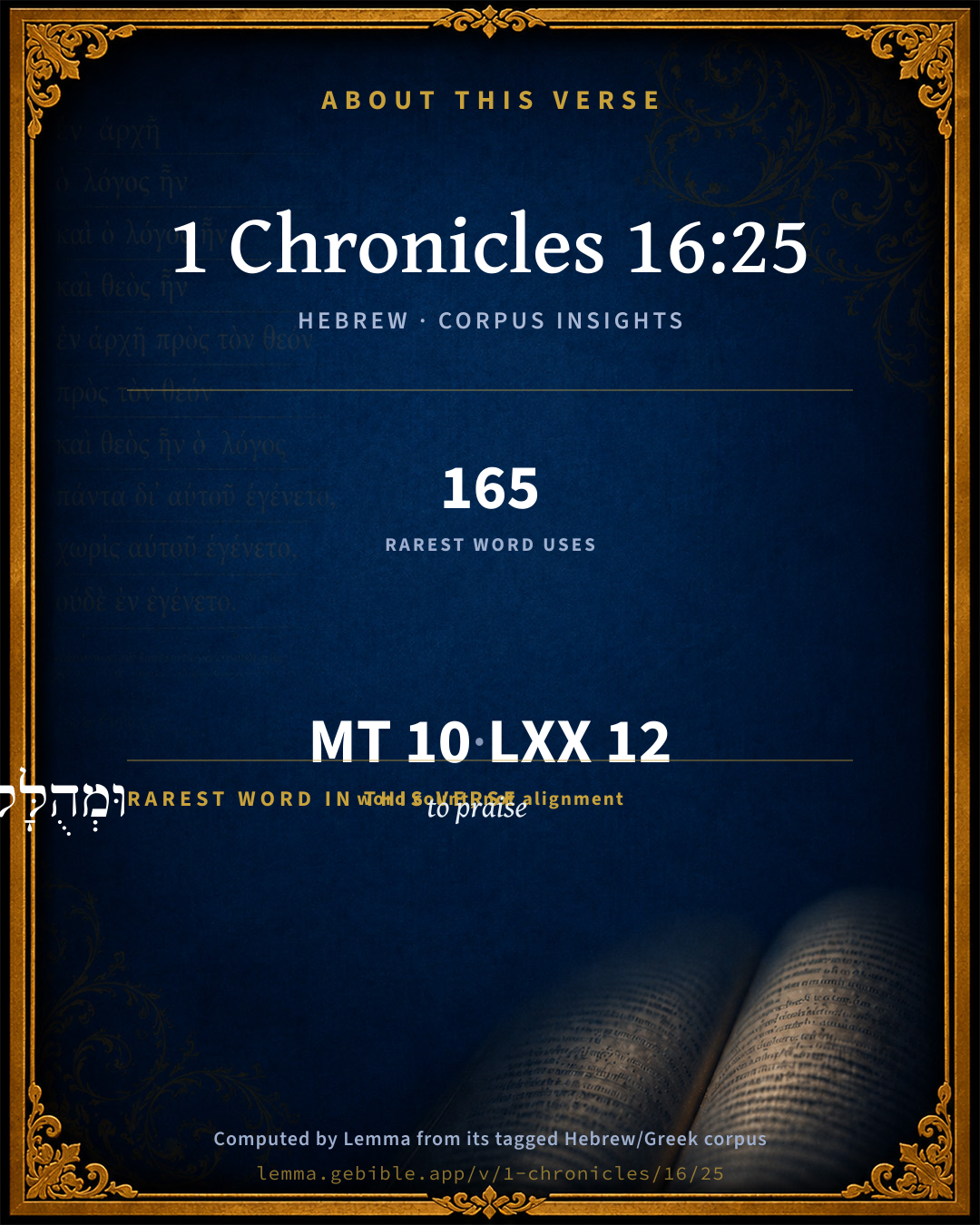
These counts appear in no published source. They are computed here, from the morphology-tagged text and Lemma’s own curated glosses. What Lemma adds →

10
words
10
distinct lemmas
Historical
section

Grammatical profile

  • 2 verbs
  • 3 nouns
  • 1 adjective
  • 1 pronoun
  • 1 preposition
  • 1 conjunction
  • 1 adverb

Verb forms

  • וּמְהֻלָּל֙ Pual · Participle Passive
  • וְנוֹרָ֥א Niphal · Participle Active

Hebrew & Septuagint length

In English translation the verse runs 18 words from the Hebrew and 18 from the Septuagint (LXX English) — the same length.

A rough comparison of the two English renderings, which tokenize alike — not a word-level alignment.

Word counts can differ between the Hebrew and the Greek without any difference in meaning — e.g. the Hebrew direct-object marker אֵת has no separate Greek word, and Greek often adds the article ὁ.

In the original languages it is 10 Hebrew tokens and 12 Greek tokens — but the two are counted differently (Hebrew bundles its prefixes and suffixes into one token; the Greek is in lemma form), so that isn’t a like-for-like length.

Cross-references

9

Topical passages linked to 1 Chronicles 16:25 in the Treasury of Scripture Knowledge — connected by theme and wording, ordered by reader-vote popularity; previews shown in the World English Bible.

  • Psalms 66:3–5 Tell God, "How awesome are your deeds! Through the greatness of your power, your enemies submit themselves to you.
  • Psalms 89:7 A very awesome God in the council of the holy ones, To be feared above all those who are around him?
  • Jeremiah 10:6–10 There is none like you, Yahweh; you are great, and your name is great in might.
  • Revelation 15:3–4 They sang the song of Moses, the servant of God, and the song of the Lamb, saying, "Great and marvelous are your works, Lord God, the Almighty; Righteous and true are your ways, you King of the nations.
  • Exodus 15:11 Who is like you, Yahweh, among the gods? Who is like you, glorious in holiness, Fearful in praises, doing wonders?
  • Psalms 76:7 You, even you, are to be feared. Who can stand in your sight when you are angry?
  • Psalms 144:3–6 Yahweh, what is man, that you care for him? Or the son of man, that you think of him?
  • Isaiah 40:12–17 Who has measured the waters in the hollow of his hand, and meted out the sky with the span, and comprehended the dust of the earth in a measure, and weighed the mountains in scales, and the hills in a balance?
  • Jeremiah 5:22 Don't you fear me? says Yahweh: won't you tremble at my presence, who have placed the sand for the bound of the sea, by a perpetual decree, that it can't pass it? and though the waves of it toss themselves, yet they can't prevail; though they roar, yet they can't pass over it.

Cross-references courtesy of OpenBible.info (CC BY 4.0).

Hebrew and Greek witnesses Masoretic Hebrew ↔ Greek Septuagint

The same verse in the two great witnesses to the Old Testament, shown verse-for-verse.

These are two independent witnesses, not word-aligned to each other, and the Septuagint is shown in lemma (dictionary) form.

Hebrew 1 Chronicles 16:25 Masoretic · Westminster Leningrad Codex

כִּי֩ גָד֨וֹל יְהוָ֤ה וּמְהֻלָּל֙ מְאֹ֔ד וְנוֹרָ֥א ה֖וּא עַל כָּל אֱלֹהִֽים

For great is Yahweh, and greatly to be praised: He also is to be feared above all gods.

World English Bible · Public Domain

Greek LXX 1 Chronicles 16:25 Septuagint · lemma form

ὅτι μέγας κύριος καί αἰνετός σφόδρα φοβερός εἰμί ἐπί πᾶς ὁ θεός

For the Lord is great, and greatly to be praised: he is to be feared above all gods.

LXX2012 (modern English Septuagint) · Public Domain

Hebrew: Westminster Leningrad Codex (CC BY 4.0). Greek: Septuagint (public domain); English from LXX2012 (modern English Septuagint) (Public Domain). How the Septuagint differs from the Hebrew →

Commentary

Notes on 1 Chronicles 16:25 from classic Christian and Jewish commentators (each source and its license shown beneath its notes). The classic Christian expositions comment on the surrounding passage and are grouped to its opening verse, so a note may address several verses; the Jewish commentaries on the Tanakh (Rashi and others) are per-verse, so they appear only where the commentator wrote on this verse.

Lemma curates 59 commentaries, every one of them public domain or Creative Commons licensed, each selected and text-cleaned for this edition rather than reprinted as found. About our sources →

The Biblical Illustrator

Joseph S. Exell

1Ch_16:25

He also is to be feared above all gods.

The theology of The Old Testament

in the perusal of the Old Testament few sentiments more frequently meet our eye than comparisons between the great object of worship among the Jews and those imaginary deities to which the Gentiles in general paid adoration. This contrast pervades alike their doctrines of religion, their precepts of morality, and their hymns of thanks and praise. To the mind of a legislator, a judge, or a prophet of Israel, comparisons of this kind naturally and unavoidably arose, when he witnessed the ignorance, the polytheism, and the superstitions of the nations around him. As the religious sentiments of the Jews and Gentiles correspond with the objects of their faith and worship respectively, a concise comparison between the theology of the Bible and that of the heathen philosophers cannot fail to be interesting and instructive.

I. The Greeks and Romans undoubtedly excelled the Jews, if not in the natural endowments of the mind, at least in every artificial improvement. But in their doctrines respecting the Creator, and His providence and His laws, they can come in no competition with the nation whom they fancied they had reason to despise.

II. The writers of Greece and Rome greatly exceeded those of Judea in the variety of their publications in the variety of the subjects to which their genius appears to have been adapted. In the authors of the Old Testament, when we again advert to the peculiar subject of their excellence, we find such poetical addresses of reverence or supplication to the supreme Being, and such descriptions of His proceedings and His providence, as the whole circle of human literature cannot elsewhere supply.

III. Amongst the Greeks and Romans the most rational opinions entertained on these difficult and important subjects were confined to a small number of the superior classes of society. From the unlearned populace those opinions were, for reasons of pride or policy, systematically and successfully concealed. Amongst the Jews, on the other hand, we find no traces of one creed for the learned and another for the ignorant.

IV. The philosophers of Greece and Rome, if they did not themselves believe, permitted or taught the people in general to believe that a different deity presided over every separate nation and every separate city; over almost every different profession among men, and almost every different object of nature; that these various deities often disagreed in their interests and opinions, and opposed each other in their wishes and pursuits. The Jews believed and taught that there was One mighty Being, the Maker and Ruler of the world; to whose authority every other sentient being owed implicit obedience.

V. The public worship of the Gentiles was addressed on various occasions to as various objects that were no Gods; and their rites and ceremonies were contaminated always by superstition, and not seldom by impiety. The worship of the Jew was addressed to one God, under one uniform character, as the only proper object of adoration; whose perfections no image could fitly represent, and to whom pure and spiritual worship was the most acceptable. To the one the Sabbath was a pious rest from his labours. With the other, religious festivals were seasons of intemperance, often immoral, and always licentious. (W. Barrow, LL. D.)

The Biblical Illustrator, edited by Joseph S. Exell (c. 1880s–1900s) — public domain. Text from a community e-Sword module.

The Cambridge Bible for Schools and Colleges

gen. ed. J. J. S. Perowne

25. to be feared above all gods] i.e. to be feared as being above all “that are called gods,” these being “things of nought” (1Ch_16:26, R.V. mg.). The real existence of false gods is not assumed.

The Cambridge Bible for Schools and Colleges (gen. ed. J. J. S. Perowne; Cambridge University Press, 1878–1918) — public domain. Text from a community e-Sword module.

Scofield Reference Notes

C. I. Scofield

feared

(See Scofield "Psa 19:9").

The Scofield Reference Bible (1917 edition), notes by C. I. Scofield — public domain. Text from a community e-Sword module.

unfoldingWord translationNotes

Door43 World Missions Community

Yahweh is great and is to be praised greatly

This can be translated in active form. AT: "Yahweh is great. Praise him greatly" or "Yahweh is great, and people should praise him greatly" (See: Active or Passive)

he is to be feared above all other gods

This can be translated in active form. AT: "fear him above all other gods" (See: Active or Passive)

Splendor and majesty are in his presence

The author speaks as if splendor and majesty are people who can stand before a king. (See: Personification)

in his presence

"all around him" or "where he is"

Strength and joy are in his place

The author speaks as if strength and joy are people who can be in Yahweh's sanctuary. (See: Personification)

in his place

"in his temple" or "in his sanctuary"

translationWords

praise

fear

false god

false god

heaven

splendor

majesty

strength

joy

unfoldingWord translationNotes — © Distant Shores Media and the Door43 World Missions Community, licensed CC BY-SA 4.0. Source: git.door43.org/Door43/en_tn.

Lesson kit

Teaching starters — assembled from the data on this page, not authored interpretation. Every prompt links to the verse data it draws on. Edit before teaching.

1 Chronicles, in the Historical, opens this verse with 10 words (10 distinct Hebrew lemmas). Its most distinctive word is hâlal (“to praise”). A historical commentator’s framing appears above. Read the whole chapter for the surrounding context.

Discussion questions

  1. How does “to praise” (hâlal) shape what this verse is saying?
  2. How does Psalms 66:3–5, which shares this passage’s theme, read alongside this verse?
  3. The translations on this page render this verse differently — a whole-verse word diff, not a word-by-word alignment. What might account for the different wordings?
  4. «וּמְהֻלָּל֙» is a Pual Participle Passive verb. How does that grammatical form shape the action described?
  5. Compare how The Biblical Illustrator and The Cambridge Bible for Schools and Colleges read this verse. Where do they agree or differ?

Things to notice

Reading settings

Reading text

Shown beneath each verse's original-language words.

Old Testament
Old Testament edition

Read the OT as the Masoretic Hebrew (MT) or the Greek Septuagint (LXX).

English shown for the Greek Septuagint (in the Hebrew ↔ Greek comparison).

Comparing translations? Open the Compare panel on any verse page to stack up to four side by side.