
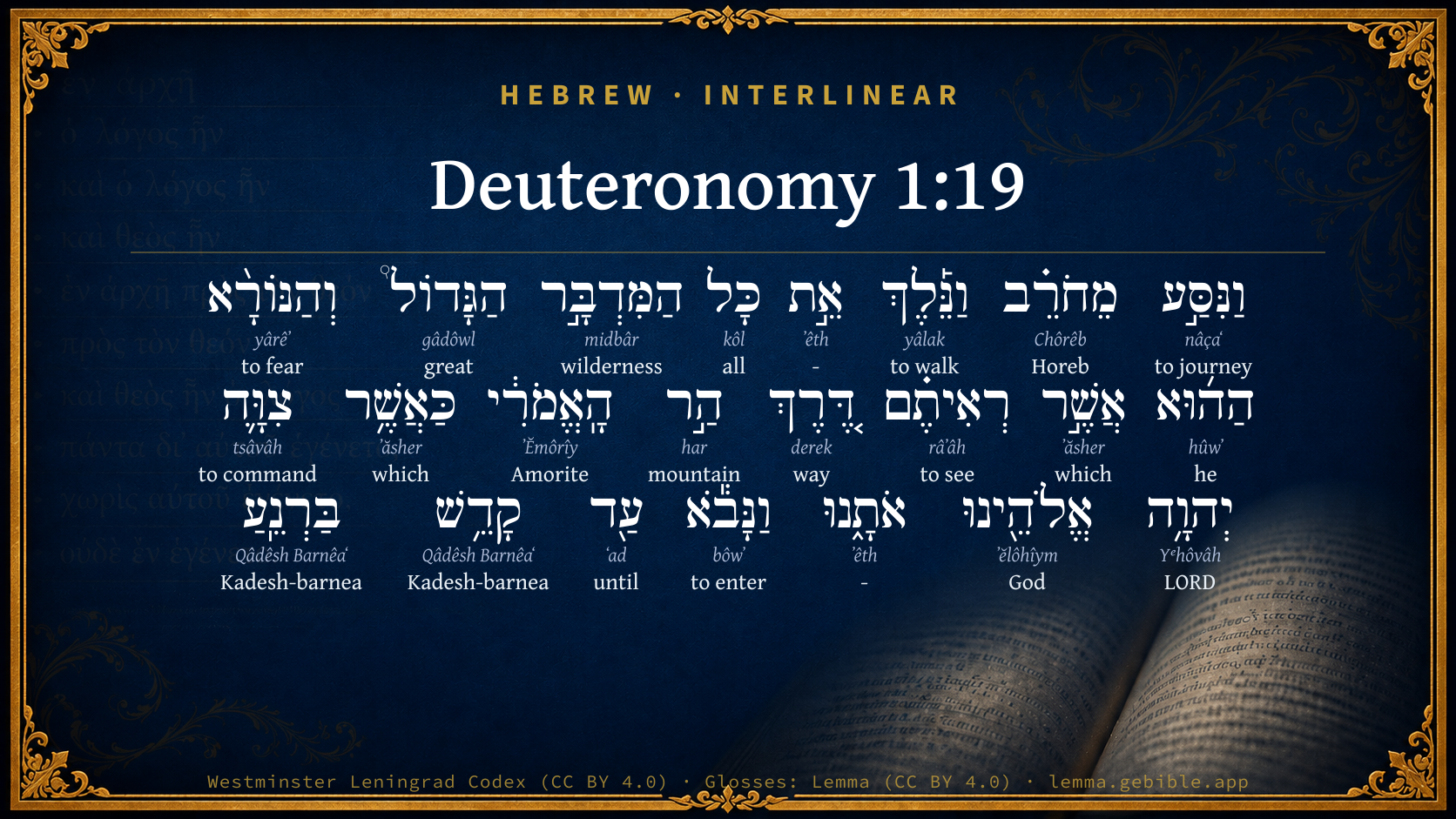
Deuteronomy 1:19

Hebrew (Westminster Leningrad Codex) Deuteronomy 1:19 appears in the Hebrew Old Testament. The text above is from the Westminster Leningrad Codex. Each word links to its Strong’s number, a concise gloss, and parsing drawn from the Open Scriptures Hebrew Bible morphology. Click any word for its full Brown-Driver-Briggs (BDB) entry.
Download image
Cite this verse

Deuteronomy 1:19 (World English Bible). Public Domain. Lemma interlinear Bible study tool, https://lemma.gebible.app/v/deuteronomy/1/19.

Show BibTeX & RIS
BibTeX
RIS
English Translation
We traveled from Horeb, and went through all that great and terrible wilderness which you saw, by the way to the hill-country of the Amorites, as Yahweh our God commanded us; and we came to Kadesh-barnea.
World English Bible · Public Domain
Download a study sheet

One document with this verse’s original text, its word-by-word gloss line, the meaning frame, cross-references with their text, attributed commentary, and full source and license credits — printable, and it pastes into notes with its structure intact.

This verse Autodidact and up

Study sheet (.html) Plain text (.txt)

A passage Seminary Student

Up to 50 verses in one chapter. A passage sheet keeps up to 6 commentary sources and 12 cross-references per verse, in the order this page ranks them, and says so on the sheet whenever that leaves anything out. Ask for a single verse and you get the Autodidact verse sheet above.

Everything on this page stays free to read, with no account — the sheet is a download of what is already on screen, not access to it.

Want to remove ads? Support Godless Engineer
Compare translations 3

The same verse in 3 English versions, stacked beneath the original-language interlinear above. Click any original word for its lexicon entry.

Each is an independent rendering of the whole verse — the interlinear is not word-aligned to these translations.

Highlighted words mark where these versions differ — a whole-verse word diff, not a word-by-word alignment.

  • World English Bible Public Domain
    We traveled from Horeb, and went through all that great and terrible wilderness which you saw, by the way to the hill-country of the Amorites, as Yahweh our God commanded us; and we came to Kadesh-barnea.
  • King James Version Public Domain
    And when we departed from Horeb, we went through all that great and terrible wilderness, which ye saw by the way of the mountain of the Amorites, as the LORD our God commanded us; and we came to Kadeshbarnea.
  • unfoldingWord Literal Text CC BY-SA 4.0
    And we journeyed from Horeb and went through all that great and terrible wilderness that you saw on the way to the hill of the Amorites, as Yahweh our God had commanded us; and we came to Kadesh Barnea.

unfoldingWord Literal Text — © unfoldingWord, licensed CC BY-SA 4.0. Word-aligned USFM3 via Door43 (git.door43.org/unfoldingWord/en_ult).

Versions to compare (up to 4)

3 of 4 selected

Show all 18 translations

Every available English version of this verse, each an independent rendering of the whole verse.

  • World English Bible Public Domain
    We traveled from Horeb, and went through all that great and terrible wilderness which you saw, by the way to the hill-country of the Amorites, as Yahweh our God commanded us; and we came to Kadesh-barnea.
  • Berean Standard Bible Public Domain
    And just as the LORD our God had commanded us, we set out from Horeb and went toward the hill country of the Amorites, through all the vast and terrifying wilderness you have seen. When we reached Kadesh-barnea,
  • Majority Standard Bible Public Domain
    And just as the LORD our God had commanded us, we set out from Horeb and went toward the hill country of the Amorites, through all the vast and terrifying wilderness you have seen. When we reached Kadesh-barnea,
  • King James Version Public Domain
    And when we departed from Horeb, we went through all that great and terrible wilderness, which ye saw by the way of the mountain of the Amorites, as the LORD our God commanded us; and we came to Kadeshbarnea.
  • American Standard Version (1901) Public Domain
    And we journeyed from Horeb, and went through all that great and terrible wilderness which ye saw, by the way to the hill-country of the Amorites, as Jehovah our God commanded us; and we came to Kadesh-barnea.
  • Revised Version (1885) Public Domain
    And we journeyed from Horeb, and went through all that great and terrible wilderness which ye saw, by the way to the hill country of the Amorites, as the LORD our God commanded us; and we came to Kadesh-barnea.
  • Geneva Bible (1599) Public Domain
    Then we departed from Horeb, and went through all that great and terrible wildernesse (as yee haue seene) by the way of the mountaine of the Amorites, as the Lord our God commanded vs: and we came to Kadesh-barnea.
  • Douay-Rheims (1899) Public Domain
    There shall be no difference of persons, you shall hear the little as well as the great: neither shall you respect any man's person, because it is the judgment of God. And if any thing seem hard to you, refer it to me, and I will hear it.
  • Young's Literal Translation Public Domain
    `And we journey from Horeb, and go `through' all that great and fearful wilderness which ye have seen -- the way of the hill-country of the Amorite, as Jehovah our God hath commanded us, and we come in unto Kadesh-Barnea.
  • Literal Standard Version CC BY-SA 4.0
    And we journey from Horeb, and go [through] all that great and fearful wilderness which you have seen, the way of the hill-country of the Amorite, as our God YHWH has commanded us, and we come to Kadesh-Barnea.
  • Unlocked Literal Bible CC BY-SA 4.0
    We journeyed away from Horeb and went through all that great and terrible wilderness that you saw, on our way to the hill country of the Amorites, as Yahweh our God had commanded us; and we came to Kadesh Barnea.
  • unfoldingWord Literal Text CC BY-SA 4.0
    And we journeyed from Horeb and went through all that great and terrible wilderness that you saw on the way to the hill of the Amorites, as Yahweh our God had commanded us; and we came to Kadesh Barnea.
  • Darby Bible Public Domain
    And we departed from Horeb and went through all that great and terrible wilderness, which ye saw, on the way to the mountain of the Amorites, as Jehovah our God had commanded us; and we came to Kadesh-barnea.
  • World Messianic Bible Public Domain
    We traveled from Horeb and went through all that great and terrible wilderness which you saw, by the way to the hill country of the Amorites, as the LORD our God commanded us; and we came to Kadesh Barnea.
  • Webster's Bible Public Domain
    And when we departed from Horeb, we went through all that great and terrible wilderness, which ye saw by the way of the mountain of the Amorites, as the LORD our God commanded us; and we came to Kadesh-barnea.
  • Free Bible Version CC BY-SA 4.0
    Following the orders of the Lord our God, we left Horeb and set off towards the hill country of the Amorites, passing through the whole of the large and terrifying desert that you yourselves have experienced. When we reached Kadesh-barnea,
  • Bible in Basic English Public Domain
    Then we went on from Horeb, through all that great and cruel waste which you saw, on our way to the hill-country of the Amorites, as the Lord gave us orders; and we came to Kadesh-barnea.
  • JPS Tanakh (1917) Public Domain
    And we journeyed from Horeb, and went through all that great and dreadful wilderness which ye saw, by the way to the hill-country of the Amorites, as the LORD our God commanded us; and we came to Kadesh-barnea.

Literal Standard Version (2020), Covenant Press — licensed CC BY-SA 4.0. Text via the HelloAO Bible API (eBible.org). Unlocked Literal Bible (unfoldingWord) — licensed CC BY-SA 4.0. Text via the HelloAO Bible API (eBible.org). unfoldingWord Literal Text — © unfoldingWord, licensed CC BY-SA 4.0. Word-aligned USFM3 via Door43 (git.door43.org/unfoldingWord/en_ult). Free Bible Version, Dr. Jonathan Gallagher — licensed CC BY-SA 4.0. Text via the HelloAO Bible API (eBible.org).

Word by word

More ways to search: Search by grammar → Find every occurrence → Compare this word →

Practice this passage: Drill this verse → Learn its vocabulary →

מֵחֹרֵ֗ב
Chôrêb
H2722
“from · Horeb”
Preposition + Noun, Proper
Part of Speech
Preposition + Noun
Type
Proper
Full BDB Definition

Origin: from H2717

TWOT: 731c

Horeb = "desert" - another name for Mount Sinai from which God gave the law to Moses and the Israelites
  1. וַנִּסַּ֣ע nâçaʻ H5265 “and · to journey” Conjunction + Verb, Qal, Sequential Imperfect, 1st Person, Common, Plural
  2. וַנֵּ֡לֶךְ yâlak H3212 “and · to walk” Conjunction + Verb, Qal, Sequential Imperfect, 1st Person, Common, Plural
  3. אֵ֣ת ʼêth H853 “-” Particle, Direct Object
  4. כָּל kôl H3605 “all of” Noun, Common, Masculine, Singular, Construct
  5. הַמִּדְבָּ֣ר midbâr H4057 “the · wilderness” Particle, Definite Article + Noun, Common, Masculine, Singular, Absolute
  6. הַגָּדוֹל֩ gâdôwl H1419 “the · great” Particle, Definite Article + Adjective, Adjective, Masculine, Singular, Absolute
  7. וְהַנּוֹרָ֨א yârêʼ H3372 “and · the · fearing” Conjunction + Particle, Definite Article + Verb, Niphal, Participle Active, Masculine, Singular, Absolute
  8. הַה֜וּא hûwʼ H1931 “the · he” Particle, Definite Article + Pronoun, Personal, 3rd Person, Masculine, Singular
  9. אֲשֶׁ֣ר ʼăsher H834 “which” Particle, Relative
  10. רְאִיתֶ֗ם râʼâh H7200 “to see” Verb, Qal, Perfect, 2nd Person, Masculine, Plural
  11. דֶּ֚רֶךְ derek H1870 “way of” Noun, Common, Both, Singular, Construct
  12. הַ֣ר har H2022 “mountain of” Noun, Common, Masculine, Singular, Construct
  13. הָֽאֱמֹרִ֔י ʼĔmôrîy H567 “the · Amorite” Particle, Definite Article + Noun, Gentilic, Masculine, Singular, Absolute
  14. כַּאֲשֶׁ֥ר ʼăsher H834 “like/as · which” Preposition + Particle, Relative
  15. צִוָּ֛ה tsâvâh H6680 “to command” Verb, Piel, Perfect, 3rd Person, Masculine, Singular
  16. יְהוָ֥ה Yᵉhôvâh H3068 “LORD” Noun, Proper
  17. אֱלֹהֵ֖ינוּ ʼĕlôhîym H430 “God(s) · our” Noun, Common, Masculine, Plural, Construct + Suffix, Personal, 1st Person, Common, Plural
  18. אֹתָ֑נוּ ʼêth H853 “- · us” Particle, Direct Object + Suffix, Personal, 1st Person, Common, Plural
  19. וַנָּבֹ֕א bôwʼ H935 “and · to enter” Conjunction + Verb, Qal, Sequential Imperfect, 1st Person, Common, Plural
  20. עַ֖ד ʻad H5704 “until” Preposition
  21. קָדֵ֥שׁ Qâdêsh Barnêaʻ H6947 “Kadesh-barnea” Noun, Proper
  22. בַּרְנֵֽעַ Qâdêsh Barnêaʻ H6947 “Kadesh-barnea” Noun, Proper

About this verse

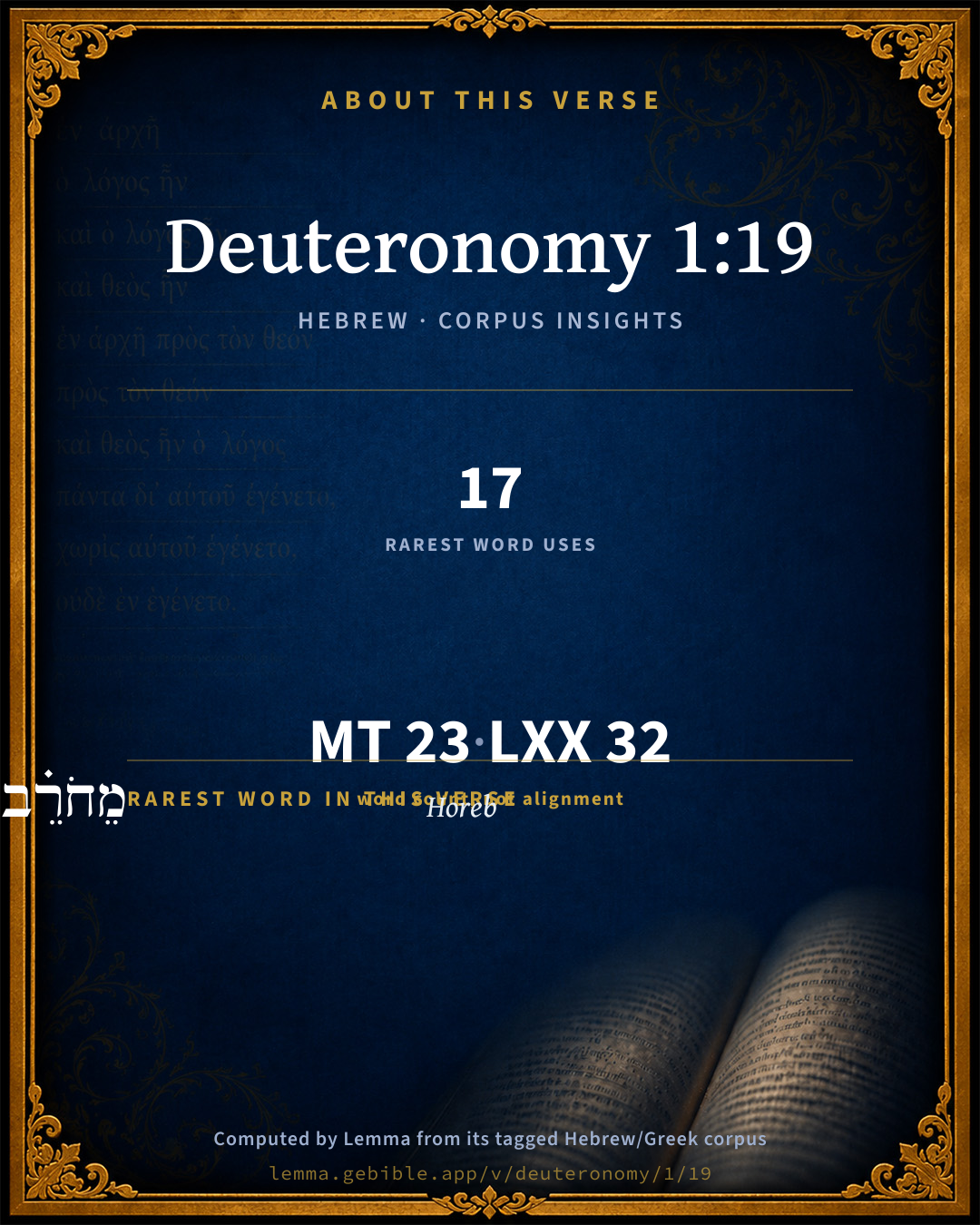
These counts appear in no published source. They are computed here, from the morphology-tagged text and Lemma’s own curated glosses. What Lemma adds →

23
words
20
distinct lemmas
Pentateuch
section

Notable vocabulary

The rarest word here is מֵחֹרֵ֗ב Horeb H2722 — appearing just 17 times in the whole Hebrew Bible.

Shared distinctive vocabulary

מֵחֹרֵ֗ב Horeb H2722 occurs in 17 verses of the Hebrew Bible. Also found in:

Grammatical profile

  • 6 verbs
  • 10 nouns
  • 1 adjective
  • 1 pronoun
  • 1 preposition
  • 4 particles

Verb forms

  • וַנִּסַּ֣ע Qal · Sequential Imperfect
  • וַנֵּ֡לֶךְ Qal · Sequential Imperfect
  • וְהַנּוֹרָ֨א Niphal · Participle Active
  • רְאִיתֶ֗ם Qal · Perfect
  • צִוָּ֛ה Piel · Perfect
  • וַנָּבֹ֕א Qal · Sequential Imperfect

Repetition

Words recur within this verse — often emphatic in Hebrew:

  • קָדֵ֥שׁ Kadesh-barnea H6947 ×2
  • אֲשֶׁ֣ר which H834 ×2

Hebrew & Septuagint length

In English translation the verse runs 36 words from the Hebrew and 41 from the Septuagint (LXX English) — closely comparable.

A rough comparison of the two English renderings, which tokenize alike — not a word-level alignment.

Word counts can differ between the Hebrew and the Greek without any difference in meaning — e.g. the Hebrew direct-object marker אֵת has no separate Greek word, and Greek often adds the article ὁ.

In the original languages it is 23 Hebrew tokens and 32 Greek tokens — but the two are counted differently (Hebrew bundles its prefixes and suffixes into one token; the Greek is in lemma form), so that isn’t a like-for-like length.

Cross-references

6

Topical passages linked to Deuteronomy 1:19 in the Treasury of Scripture Knowledge — connected by theme and wording, ordered by reader-vote popularity; previews shown in the World English Bible.

  • Deuteronomy 1:2 It is eleven days' [journey] from Horeb by the way of Mount Seir to Kadesh-barnea.
  • Deuteronomy 8:15 who led you through the great and terrible wilderness, [in which were] fiery serpents and scorpions, and thirsty ground where was no water; who brought you forth water out of the rock of flint;
  • Jeremiah 2:6 Neither said they, Where is Yahweh who brought us up out of the land of Egypt, who led us through the wilderness, through a land of deserts and of pits, through a land of drought and of the shadow of death, through a land that none passed through, and where no man lived?
  • Numbers 13:26 They went and came to Moses, and to Aaron, and to all the congregation of the children of Israel, to the wilderness of Paran, to Kadesh; and brought back word to them, and to all the congregation, and shown them the fruit of the land.
  • Deuteronomy 32:10 He found him in a desert land, In the waste howling wilderness; He compassed him about, he cared for him, He kept him as the apple of his eye.
  • Numbers 10:12 The children of Israel set forward according to their journeys out of the wilderness of Sinai; and the cloud abode in the wilderness of Paran.

Cross-references courtesy of OpenBible.info (CC BY 4.0).

Hebrew and Greek witnesses Masoretic Hebrew ↔ Greek Septuagint

The same verse in the two great witnesses to the Old Testament, shown verse-for-verse.

These are two independent witnesses, not word-aligned to each other, and the Septuagint is shown in lemma (dictionary) form.

Hebrew Deuteronomy 1:19 Masoretic · Westminster Leningrad Codex

וַנִּסַּ֣ע מֵחֹרֵ֗ב וַנֵּ֡לֶךְ אֵ֣ת כָּל הַמִּדְבָּ֣ר הַגָּדוֹל֩ וְהַנּוֹרָ֨א הַה֜וּא אֲשֶׁ֣ר רְאִיתֶ֗ם דֶּ֚רֶךְ הַ֣ר הָֽאֱמֹרִ֔י כַּאֲשֶׁ֥ר צִוָּ֛ה יְהוָ֥ה אֱלֹהֵ֖ינוּ אֹתָ֑נוּ וַנָּבֹ֕א עַ֖ד קָדֵ֥שׁ בַּרְנֵֽעַ

We traveled from Horeb, and went through all that great and terrible wilderness which you saw, by the way to the hill-country of the Amorites, as Yahweh our God commanded us; and we came to Kadesh-barnea.

World English Bible · Public Domain

Greek LXX Deuteronomy 1:19 Septuagint · lemma form

καί ἀποαἴρω ἐκ χωρηβ πορεύομαι πᾶς ὁ ἔρημος ὁ μέγας καί ὁ φοβερός ἐκεῖνος ὅς ὁράω ὁδός ὄρος ὁ ἀμορραῖος καθότι ἐντέλλομαι κύριος ὁ θεός ἐγώ ἐγώ καί ἔρχομαι ἕως καδης βαρνη

And we departed from Choreb, and went through all that great wilderness and terrible, which you⌃ saw, by the way of the mountain of the Amorite, as the Lord our God charged us, and we came as far as Cades Barne.

LXX2012 (modern English Septuagint) · Public Domain

Hebrew: Westminster Leningrad Codex (CC BY 4.0). Greek: Septuagint (public domain); English from LXX2012 (modern English Septuagint) (Public Domain). How the Septuagint differs from the Hebrew →

Targum (Aramaic paraphrase)

2

The Targum is the ancient Jewish Aramaic paraphrase of the Hebrew Scriptures — an interpretive translation, not the Hebrew text itself. Onkelos (literal) and Pseudo-Jonathan (expansive) render the Torah, and Jonathan the Prophets. Coverage is partial: where no permissively-licensed English translation exists for a verse, only the Aramaic is shown. This is verse-level text, not a word-by-word alignment to the Hebrew.

  1. Targum Onkelos Torah (Genesis–Deuteronomy)
    וּנְטַלְנָא מֵחוֹרֵב וְהַלִיכְנָא יָת כָּל מַדְבְּרָא רַבָּא וּדְחִילָא הַהוּא דִי חֲזֵיתוּן אוֹרַח טוּרָא דֶאֱמוֹרָאָה כְּמָא דִי פַקִיד יְיָ אֱלָהָנָא יָתָנָא וַאֲתֵינָא עַד רְקַם גֵיאָה

    (no public-domain English translation for this verse)

    Targum Onkelos — Aramaic: “Onkelos Genesis” (public domain); “Onkelos Exodus” (public domain); “Onkelos Leviticus” (public domain); “Onkelos Numbers” (public domain); “Onkelos Deuteronomy” (public domain). English: “Sefaria Community Translation” (CC0 1.0 (public-domain dedication)); “J.W. Etheridge. The Targums of Onkelos and Jonathan Ben Uzziel on the Pentateuch. London: Longmans, Green, 1862” (public domain). Text via Sefaria.

  2. Targum Pseudo-Jonathan Torah (Genesis–Deuteronomy)
    וּנְטָלָנָא מֵחוֹרֵב וְהַלִיכְנָא יַת כָּל מַדְבְּרָא רַבָּא וּדְחִילָא הַהוּא דַחֲמִיתוּן חֵיוָן כִּכְשׁוּרִין וְעַקְרַבִּין כְּקַשְׁתִּין סַרְיָין רַמְיָין לְקוֹבְלֵיכוֹן אוֹרַח טַוְורָא דְאֵימוֹרָאָה הֵיכְמָא דְפַקֵּיד יְיָ אֱלָהָנָא יָתָנָא וְאָתֵינָא עַד רְקַם גֵּיעָה

    And we journeyed from Horeb, and came through all that great and fearful desert, where you saw serpents like boughs, and loathsome scorpions darting at you like arrows, on the way of the mountain of the Amoraah, as the Lord our God had commanded us, and came to Rekem Giah.

    Targum Pseudo-Jonathan — Aramaic: “Targum Jonathan on Genesis” (public domain); “Targum Jonathan on Exodus” (public domain); “Targum Jonathan on Leviticus” (public domain); “Targum Jonathan on Numbers” (public domain); “Targum Jonathan on Deuteronomy” (public domain). English: “The Targum of Jonathan ben Uzziel, trans. J. W. Etheridge, London, 1862” (public domain). Text via Sefaria.

Commentary

Notes on Deuteronomy 1:19 from classic Christian and Jewish commentators (each source and its license shown beneath its notes). The classic Christian expositions comment on the surrounding passage and are grouped to its opening verse, so a note may address several verses; the Jewish commentaries on the Tanakh (Rashi and others) are per-verse, so they appear only where the commentator wrote on this verse.

Lemma curates 59 commentaries, every one of them public domain or Creative Commons licensed, each selected and text-cleaned for this edition rather than reprinted as found. About our sources →

Matthew Henry's Commentary

Moses here makes a large rehearsal of the fatal turn which was given to their affairs by their own sins, and God's wrath, when, from the very borders of Canaan, the honour of conquering it, and the pleasure of possessing it, the whole generation was hurried back into the wilderness, and their carcases fell there. It was a memorable story; we read it Num. 13 and 14, but divers circumstances are found here which are not related there.

I. He reminds them of their march from Horeb to Kadesh-barnea (Deu 1:19), through that great and terrible wilderness. This he takes notice of, 1. To make them sensible of the great goodness of God to them, in guiding them through so great a wilderness, and protecting them from the mischiefs they were surrounded with in such a terrible wilderness. The remembrance of our dangers should make us thankful for our deliverances. 2. To aggravate the folly of those who, in their discontent, would have gone back to Egypt through the wilderness, though they had forfeited, and had no reason to expect, the divine guidance, in such a retrograde motion.

II. He shows them how fair they stood for Canaan at that time, Deu 1:20, Deu 1:21. He told them with triumph, the land is set before you, go up and possess it. He lets them see how near they were to a happy settlement when they put a bar in their own door, that their sin might appear the more exceedingly sinful. It will aggravate the eternal ruin of hypocrites that they were not far from the kingdom of God and yet came short, Mar 12:34.

III. He lays the blame of sending the spies upon them, which did not appear in Numbers, there it is said (Deu 13:1, Deu 13:2) that the Lord directed the sending of them, but here we find that the people first desired it, and God, in permitting it, gave them up to their counsels: You said, We will send men before us, Deu 1:22. Moses had given them God's word (Deu 1:20, Deu 1:21), but they could not find in their hearts to rely upon that: human policy goes further with them than divine wisdom, and they will needs light a candle to the sun. As if it were not enough that they were sure of a God before them, they must send men before them.

IV. He repeats the report which the spies brought of the goodness of the land which they were sent to survey, Deu 1:24, Deu 1:25. The blessings which God has promised are truly valuable and desirable, even the unbelievers themselves being judges: never any looked into the holy land, but they must own it a good land. Yet they represented the difficulties of conquering it as insuperable (Deu 1:28); as if it were in vain to think of attacking them either by battle, "for the people are taller than we," or by siege, "for the cities are walled up to heaven," an hyperbole which they made use of to serve their ill purpose, which was to dishearten the people, and perhaps they intended to reflect on the God of heaven himself, as if they were able to defy him, like the Babel-builders, the top of whose tower must reach to heaven, Gen 11:4. Those places only are walled up to heaven that are compassed with God's favour as with a shield.

V. He tells them what pains he took with them to encourage them, when their brethren had said so much to discourage them (Deu 1:29): Then I said unto you, Dread not. Moses suggested enough to have stilled the tumult, and to have kept them with their faces towards Canaan. He assured them that God was present with them, and president among them, and would certainly fight for them, Deu 1:30. And for proof of his power over their enemies he refers them to what they had seen done in Egypt, where their enemies had all possible advantages against them and yet were humbled and forced to yield, Deu 1:30. And for proof of God's goodwill to them, and the real kindness which he intended them, he refers them to what they had seen in the wilderness (Deu 1:31, Deu 1:33), through which they had been guided by the eye of divine wisdom in a pillar of cloud and fire (which guided both their motions and their rests), and had been carried in the arms of divine grace with as much care and tenderness as were ever shown to any child borne in the arms of a nursing father. And was there any room left to distrust this God? Or were they not the most ungrateful people in the world, who, after such sensible proofs of the divine goodness, hardened their hearts in the day of temptation? Moses had complained once that God had charged him to carry this people as a nursing father doth the sucking child (Num 11:12); but here he owns that it was God that so carried them, and perhaps this is alluded to (Act 13:18), where he is said to bear them, or to suffer their manners.

VI. He charges them with the sin which they were guilty of upon this occasion. Though those to whom he was now speaking were a new generation, yet he lays it upon them: You rebelled, and you murmured; for many of these were then in being, though under twenty years old, and perhaps were engaged in the riot; and the rest inherited their fathers' vices, and smarted for them. Observe what he lays to their charge. 1. Disobedience and rebellion against God's law: You would not go up, but rebelled, Deu 1:26. The rejecting of God's favours is really a rebelling against his authority. 2. Invidious reflections upon God's goodness. They basely suggested: Because the Lord hated us, he brought us out of Egypt, Deu 1:27. What could have been more absurd, more disingenuous, and more reproachful to God? 3. An unbelieving heart at the bottom of all this: You did not believe the Lord your God, Deu 1:32. All your disobedience to God's laws, and distrust of his power and goodness, flow from a disbelief of his word. A sad pass it has come to with us when the God of eternal truth cannot be believed.

VII. He repeats the sentence passed upon them for this sin, which now they had seen the execution of. 1. They were all condemned to die in the wilderness, and none of them must be suffered to enter Canaan except Caleb and Joshua, Deu 1:34-38. So long they must continue in their wanderings in the wilderness that most of them would drop off of course, and the youngest of them should be cut off. Thus they could not enter in because of unbelief. It was not the breach of any of the commands of the law that shut them out of Canaan, no, not the golden calf, but their disbelief of that promise which was typical of gospel grace, to signify that no sin will ruin us but unbelief, which is a sin against the remedy. 2. Moses himself afterwards fell under God's displeasure for a hasty word which they provoked him to speak: The Lord was angry with me for your sakes, Deu 1:37. Because all the old stock must go off, Moses himself must not stay behind. Their unbelief let death into the camp, and, having entered, even Moses falls within his commission. 3. Yet here is mercy mixed with wrath. (1.) That, though Moses might not bring them into Canaan, Joshua should (v. 38): Encourage him; for he would be discouraged from taking up a government which he saw Moses himself fall under the weight of; but let him be assured that he shall accomplish that for which he is raised up: He shall cause Israel to inherit it. Thus what the law could not do, in that it was weak, Jesus, our Joshua, does by bringing in the better hope. (2.) That, though this generation should not enter into Canaan, the next should, Deu 1:39. As they had been chosen for their fathers' sakes, so their children might justly have been rejected for their sakes. But mercy rejoiceth against judgement.

VIII. He reminds them of their foolish and fruitless attempt to get this sentence reversed when it was too late. 1. They tried it by their reformation in this particular; whereas they had refused to go up against the Canaanites, now they would go up, aye, that they would, in all haste, and they girded on their weapons of war for that purpose, Deu 1:41. Thus, when the door is shut, and the day of grace is over, there will be found those that stand without and knock. But this, which looked like a reformation, proved but a further rebellion. God, by Moses, prohibited the attempt (Deu 1:42): yet they went presumptuously up to the hill (Deu 1:43), acting now in contempt of the threatening, as before in contempt of the promise, as if they were governed by a spirit of contradiction; and it sped accordingly (Deu 1:44): they were chased and destroyed; and, by this defeat which they suffered when they provoked God to leave them, they were taught what success they might have had if they had kept themselves in his love. 2. They tried by their prayers and tears to get the sentence reversed: They returned and wept before the Lord, Deu 1:45. While they were fretting and quarrelling, it is said (Num 14:1): They wept that night; those were tears of rebellion against God, these were tears of repentance and humiliation before God. Note, Tears of discontent must be wept over again; the sorrow of the world worketh death, and is to be repented of; it is not so with godly sorrow, that will end in joy. But their weeping was all to no purpose. The Lord would not harken to your voice, because you would not harken to his; the decree had gone forth, and, like Esau, they found no place of repentance, though they sought it carefully with tears.

Matthew Henry's Commentary on the Whole Bible (1708–1710) — public domain (CC PDM 1.0). Text via the HelloAO Bible API.

The Cambridge Bible for Schools and Colleges

gen. ed. J. J. S. Perowne

19. From Ḥoreb to Ḳadesh-Barnea‘

A very brief account, indicating only the beginning and the end of the march, with the character of the wilderness between, and the further goal, the Mt of the Amorite: but it is possible that Deu_1:1 b, 2 (q.v.) were originally an addition or note to this.—The account of this march in JE, Num_10:33 to Num_21:16, includes the start from the Mt of Jehovah, the formulas recited on the lifting and the resting of the Ark, the disaffection of the people on the lack of flesh, the institution of 70 elders, the grant of flesh and its fatality, the presumptuousness of Miriam and Aaron, the encampment in the wilderness of Paran. Three stages are named, Tab‘erah, Num_11:3, Ḳibroth Ḥaṭṭa’avah and Ḥaṣeroth, Num_11:35 : the first two also in Num_9:22. P dates the start from Sinai on the 20th of the 2nd month of the 2nd year, states that the guiding cloud settled in the wilderness of Paran, and adds the order of the host, Num_10:11-28.

Deu_1:19. And we journeyed] Rather broke up or set out, A.V. departed. Heb. nasa‘ was originally to pull up the tent-pegs, break camp, but came to cover the journey that ensued, to march by stages (Gen_12:19; Gen_35:21). That the earlier meaning is intended here is clear from the following verb.

that great and terrible wilderness] Deu_8:15. This was much the most desolate tract of the wilderness crossed by Israel. See Palmer on the Desert of el-Tih (Desert of the Exodus), 284–288, and Musil, Edom.

Kadesh-barnea] See above on Deu_1:2.

The Cambridge Bible for Schools and Colleges (gen. ed. J. J. S. Perowne; Cambridge University Press, 1878–1918) — public domain. Text from a community e-Sword module.

Trapp's Complete Commentary

John Trapp

Deu 1:19 And when we departed from Horeb, we went through all that great and terrible wilderness, which ye saw by the way of the mountain of the Amorites, as the LORD our God commanded us; and we came to Kadeshbarnea.

Ver. 19. That great and terrible wilderness.] Abounding with want of all necessities, {Jer 2:6} and surrounded with many, mighty, and malicious enemies. Such is this present evil world to those that are bound for the heavenly Canaan. Many miseries and molestations, both Satanical and secular, they are sure to meet with, this world being a place of that nature, that, as it is reported of the Straits of Magellan, {a} which way soever a man bend his course, if homeward, he is sure to have the wind against him.

{a} Heyl., Geog., p. 802.

John Trapp, A Commentary or Exposition upon All the Books of the Old and New Testament (1647–1656) — public domain. Text from a community e-Sword module.

The Biblical Illustrator

Joseph S. Exell

Deu_1:19

That great and terrible wilderness.

Memorable experiences

There are some things that are never to be forgotten in life. There are troubles whose shadow is as long as lifes whole day. The troubles are past, but the shadow is still there; the victory is won, but the battle seems still to be booming in our ear. We are miles and miles away from the desert--yea, half a continent and more--but who can ever forget all that great and terrible wilderness? Yet life would be poor without it. The memory of that wilderness chastens our joy, touches our prayer into a more solemn and tender music, and makes us more valiant, because more hopeful, in reference to all the future. There cannot be two such wildernesses in the whole universe. We are the better for the wildernesses of life, and we cannot escape them. Oh, that great and terrible wilderness! It comes after us now like a ghost; it darkens upon our vision in the dream-time; we repeat the journey in the night season, and feel all the sleet and cold, all the dreariness and helplessness of the old experience. How many a joy we have forgotten; but we cannot play with that great and terrible wilderness. The very pronouncement of the words makes us cold. It was great; it was terrible; it was a wilderness. But, rightly trodden, its barren sand made us men; taken in the right spirit, we thought we saw in it the beginning of the garden of God. Every man does not pass through exactly the same wilderness; it is not needful that he should do so in order to confirm this doctrine--namely, that in all lives there are great dreary spaces that we approach with fear and traverse almost with despair. What are the thoughts that such a review should excite? Can we look back upon that way, through all the great and terrible wilderness, without remembering the Divine help which we received? God was God in the wilderness; God looked at us through the darkness, and there was no blaze of anger in His eye. Who can forget the touch that came upon our burning brow in the night time? Who can forget the ever-branching tree just by the side of the bitter pool? Who can forget the clump of palm trees where no palm trees were expected? Who can cease to remember the voice of leadership--the strong, authoritative man who came amongst us like a revelation from God, and spoke broad words in broad tones, and was a tower of strength to us in the time of our weakness, and wonder, and fear--the sympathetic pastor, the mighty preacher, the kind friend, the one who understood us wholly through and through? Then, is there no Divine purpose, the recollection of which may sustain us in traversing wildernesses and lonely deserts? Who made the world? Is the world a fatherless thing, a self-rounded thing that may split up at any moment, or is there method in it? Is there a God above it? Is there a throne anywhere? And the King, is He but a name or an echo? I see purpose in my life; I see it now--Thou hast done all things well. I did not think so at the time; I should have made the wilderness a mile shorter, but it was on the last mile that I saw the brightest angel. I would have come to honour and renown sooner; but I see now that the very movements were ticked off, and that a moment earlier would have been a mistake. I would have come, says another Christian man, to a sense of competency, and comfort, and household security ten years ago; but in my soul I see that ten years ago I could not have borne what I now carry gracefully. Thou hast done all things well. I would not have had seven graves in the cemetery, nor two, nor one; but I see now that I am the richer for the seven; I would not now have it otherwise. They are my best estate; I have property in them; I grow my choicest flowers there; there I meet with the angels that understand me. There is a method in all this; I accept it; I will bow down before it; I will kiss the rod that lacerated me to the bone; it was in my Fathers hand. Then is there to be no human gratitude springing out of all this? Is ours to be a false life--an unsympathetic existence? As we have received help of God, let us give help to others. (J. Parker, D. D.)

The utility of sandy deserts

If we do not at once see the use of a thing which is unbeautiful, we are apt to disdain it altogether. Utility or beauty we demand as a characteristic of everything. But let it be constantly remembered that our limited vision and knowledge often prevent our discerning the uses which exist in things. Do not be deceived by the mere appearance. The sandy deserts which one might have been inclined to consider as mere encumbrances on the earth are of high importance in creating winds. They send off vast streams of hot air into the higher regions of the atmosphere, and hence the cooler air off the coasts is sucked away in an opposite direction. The deserts, indeed, may be regarded as vast suction pumps placed at certain stations on the earth, to create useful winds and help the transport of moisture to lands that are in want of it. But for the Thibetan deserts there would have been no southwest monsoon; and without the monsoon the fertile plains of Hindostan would have been a waste of sand. (Scientific Illustrations.)

The Biblical Illustrator, edited by Joseph S. Exell (c. 1880s–1900s) — public domain. Text from a community e-Sword module.

Joseph Benson's Commentary

Deu 1:19. Great and terrible wilderness — Great, because it extended a great way; and terrible, because mostly desolate, or only inhabited by wild beasts. By the way of the mountain of the Amorites — All the way you went toward that mountain.

Joseph Benson's Commentary on the Old and New Testaments (1811–1818) — public domain. Text from a community e-Sword module.

Keil & Delitzsch

C. F. Keil & F. Delitzsch

Everything had been done on the part of God and Moses to bring Israel speedily and safely to Canaan. The reason for their being compelled to remain in the desert for forty years was to be found exclusively in their resistance to the commandments of God. The discontent of the people with the guidance of God was manifested at the very first places of encampment in the desert (Num 11 and 12); but Moses passed over this, and simply reminded them of the rebellion at Kadesh (Num 13 and 14), because it was this which was followed by the condemnation of the rebellious generation to die out in the wilderness.

Deu 1:19-25

"When we departed from Horeb, we passed through the great and dreadful wilderness, which ye have seen," i.e., become acquainted with, viz., the desert of et Tih, "of the way to the mountains of the Amorites, and came to Kadesh-Barnea" (see at Num 12:16). הלך, with an accusative, to pass through a country (cf. Deu 2:7; Isa 50:10, etc.). Moses had there explained to the Israelites, that they had reached the mountainous country of the Amorites, which Jehovah was about to give them; that the land lay before them, and they might take possession of it without fear (Deu 1:20, Deu 1:21). But they proposed to send out men to survey the land, with its towns, and the way into it. Moses approved of this proposal, and sent out twelve men, one from each tribe, who went through the land, etc. (as is more fully related in Num 13, and has been expounded in connection with that passage, Deu 1:22-25). Moses' summons to them to take the land (Deu 1:20, Deu 1:21) is not expressly mentioned there, but it is contained implicite in the fact that spies were sent out; as the only possible reason for doing this must have been, that they might force a way into the land, and take possession of it. In Deu 1:25, Moses simply mentions so much of the report of the spies as had reference to the nature of the land, viz., that it was good, that he may place in immediate contrast with this the refusal of the people to enter in.

Deu 1:26-27

"But ye would not go up, and were rebellious against the mouth (i.e., the express will) of Jehovah our God, and murmured in your tents, and said, Because Jehovah hated us, He hath brought us forth out of the land of Egypt, to give us into the hand of the Amorites to destroy us." שׂנאה, either an infinitive with a feminine termination, or a verbal noun construed with an accusative (see Ges. 133; Ewald, 238, a.). - By the allusion to the murmuring in the tents, Moses points them to Num 14:1, and then proceeds to describe the rebellion of the congregation related there (Deu 1:2-4), in such a manner that the state of mind manifested on that occasion presents the appearance of the basest ingratitude, inasmuch as the people declared the greatest blessing conferred upon them by God, viz., their deliverance from Egypt, to have been an act of hatred on His part. At the same time, by addressing the existing members of the nation, as if they themselves had spoken so, whereas the whole congregation that rebelled at Kadesh had fallen in the desert, and a fresh generation was now gathered round him, Moses points to the fact, that the sinful corruption which broke out at that time, and bore such bitter fruit, had not died out with the older generation, but was germinating still in the existing Israel, and even though it might be deeply hidden in their hearts, would be sure to break forth again.

Deu 1:28

"Whither shall we go up? Our brethren (the spies) have quite discouraged our heart" (המס, lit., to cause to flow away; cf. Jos 2:9), viz., through their report (Num 13:28-29, Num 13:31-33), the substance of which is repeated here. The expression בּשּׁמים, "in heaven," towering up into heaven, which is added to "towns great and fortified," is not an exaggeration, but, as Moses also uses it in Deu 9:1, a rhetorical description of the impression actually received with regard to the size of the towns.

(Note: "The eyes of weak faith or unbelief saw the towns really towering up to heaven. Nor did the height appear less, even to the eyes of faith, in relation, that is to say, to its own power. Faith does not hide the difficulties from itself, that it may not rob the Lord, who helps it over them, of any of the praise that is justly His due" (Schultz).)

"The sons of the Anakims:" see at Num 13:22.

Deu 1:29-31

The attempt made by Moses to inspire the despondent people with courage, when they were ready to despair of ever conquering the Canaanites, by pointing them to the help of the Lord, which they had experienced in so mighty and visible a manner in Egypt and the desert, and to urge them to renewed confidence in this their almighty Helper and Guide, was altogether without success. And just because the appeal of Moses was unsuccessful, it is passed over in the historical account in Num 13; all that is mentioned there (Deu 1:6-9) being the effort made by Joshua and Caleb to stir up the people, and that on account of the effects which followed the courageous bearing of these two men, so far as their own future history was concerned. The words "goeth before you," in Deu 1:30, are resumed in Deu 1:33, and carried out still further. "Jehovah,...He shall fight for you according to all (כּכל) that," i.e., in exactly the same manner, as, "He did for you in Egypt," especially at the crossing of the Red Sea (Ex 14), "and in the wilderness, which thou hast seen (ראית, as in Deu 1:19), where (אשׁר without בּו in a loose connection; see Ewald, 331, c. and 333, a.) Jehovah thy God bore thee as a man beareth his son;" i.e., supported, tended, and provided for thee in the most fatherly way (see the similar figure in Num 11:12, and expanded still more fully in Psa 23:1-6).

Deu 1:32-33

"And even at this word ye remained unbelieving towards the Lord;" i.e., notwithstanding the fact that I reminded you of all the gracious help that he had experienced from your God, ye persisted in your unbelief. The participle אינכם מאמינם, "ye were not believing," is intended to describe their unbelief as a permanent condition. This unbelief was all the more grievous a sin, because the Lord their God went before them all the way in the pillar of cloud and fire, to guide and to defend them. On the fact itself, comp. Num 9:15., Num 10:33, with Exo 13:21-22.

Deu 1:34-37

Jehovah was angry, therefore, when He heard these loud words, and swore that He would not let any one of those men, that evil generation, enter the promised land, with the exception of Caleb, because he had followed the Lord faithfully (cf. Num 14:21-24). The hod in זוּלתי is the antiquated connecting vowel of the construct state.

But in order that he might impress upon the people the judgment of the holy God in all its stern severity, Moses added in Deu 1:37 : "also Jehovah was angry with me for your sakes, saying, Thou also shalt not go in thither;" and he did this before mentioning Joshua, who was excepted from the judgment as well as Caleb, because his ultimate intention was to impress also upon the minds of the people the fact, that even in wrath the Lord had been mindful of His covenant, and when pronouncing the sentence upon His servant Moses, had given the people a leader in the person of Joshua, who was to bring them into the promised inheritance. We are not to infer from the close connection in which this event, which did not take place according to Num 20:1-13 till the second arrival of the congregation at Kadesh, is placed with the earlier judgment of God at Kadesh, that the two were contemporaneous, and so supply, after "the Lord as angry with me," the words "on that occasion." For Moses did not intend to teach the people history and chronology, but to set before them the holiness of the judgments of the Lord. By using the expression "for your sakes," Moses did not wish to free himself from guilt. Even in this book his sin at the water of strife is not passed over in silence (cf. Deu 32:51). But on the present occasion, if he had given prominence to his own fault, he would have weakened the object for which he referred to this event, viz., to stimulate the consciences of the people, and instil into them a wholesome dread of sin, by holding up before them the magnitude of their guilt. But in order that he might give no encouragement to false security respecting their own sin, on the ground that even highly gifted men of God fall into sin as well, Moses simply pointed out the fact, that the quarrelling of the people with him occasioned the wrath of God to fall upon him also.

Deu 1:38-44

"Who standeth before thee," equivalent to "in thy service" (Exo 24:13; Exo 33:11 : for this meaning, see Deu 10:8; Deu 18:7; Kg1 1:28). "Strengthen him:" comp. Deu 31:7; and with regard to the installation of Joshua as the leader of Israel, see Num 27:18-19. The suffix in ינחילנּה points back to הארץ in Deu 1:35. Joshua would divide the land among the Israelites for an inheritance, viz., (v. 39) among the young Israelites, the children of the condemned generation, whom Moses, when making a further communication of the judicial sentence of God (Num 14:31), had described as having no share in the sins of their parents, by adding, "who know not to-day what is good and evil." This expression is used to denote a condition of spiritual infancy and moral responsibility (Isa 7:15-16). It is different in Sa2 19:36. - In Deu 1:40-45 he proceeds to describe still further, according to Num 14:39-45, how the people, by resisting the command of God to go back into the desert (Deu 1:41, compared with Num 14:25), had simply brought still greater calamities upon themselves, and had had to atone for the presumptuous attempt to force a way into Canaan, in opposition to the express will of the Lord, by enduring a miserable defeat. Instead of "they acted presumptuously to go up" (Num 14:44), Moses says here, in Deu 1:41, "ye acted frivolously to go up;" and in Deu 1:43, "ye acted rashly, and went up." הזיד from זוּד, to boil, or boil over (Gen 25:29), signifies to act thoughtlessly, haughtily, or rashly. On the particular fact mentioned in Deu 1:44, see at Num 14:45.

Deu 1:45-46

"Then ye returned and wept before Jehovah," i.e., before the sanctuary; "but Jehovah did not hearken to your voice." שׁוּב does not refer to the return to Kadesh, but to an inward turning, not indeed true conversion to repentance, but simply the giving up of their rash enterprise, which they had undertaken in opposition to the commandment of God-the return from a defiant attitude to unbelieving complaining on account of the misfortune that had come upon them. Such complaining God never hears. "And ye sat (remained) in Kadesh many days, that ye remained," i.e., not "as many days as ye had been there already before the return of the spies," or "as long as ye remained in all the other stations together, viz., the half of thirty-eight years" (as Seder Olam and many of the Rabbins interpret); but "just as long as ye did remain there," as we may see from a comparison of Deu 9:25. It seemed superfluous to mention more precisely the time they spent in Kadesh, because that was well known to the people, whom Moses was addressing. He therefore contented himself with fixing it by simply referring to its duration, which was known to them all. It is no doubt impossible for us to determine the time they remained in Kadesh, because the expression "many days" is imply a relative one, and may signify many years, just as well as many months or weeks. But it by no means warrants the assumption of Fires and others, that no absolute departure of the whole of the people from Kadesh ever took place. Such an assumption is at variance with Deu 2:1. The change of subjects, "ye sat," etc. (Deu 1:46), and "we turned and removed" (Deu 2:1), by no means proves that Moses only went away with that part of the congregation which attached itself to him, whilst the other portion, which was most thoroughly estranged from him, or rather from the Lord, remained there still. The change of subject is rather to be explained from the fact that Moses was passing from the consideration of the events in Kadesh, which he held up before the people as a warning, to a description of the further guidance of Israel. The reference to those events had led him involuntarily, from Deu 1:22 onwards, to distinguish between himself and the people, and to address his words to them for the purpose of bringing out their rebellion against God. And now that he had finished with this, he returned to the communicative mode of address with which he set out in Deu 1:6, but which he had suspended again until Deu 1:19.

Keil & Delitzsch — Biblical Commentary on the Old Testament (1861–1891) — public domain (CC PDM 1.0). Text via the HelloAO Bible API. (Old Testament only.)

Tyndale Open Study Notes

Tyndale Open Resources

1:19-25 See Num 13.

1:19 Kadesh-barnea, a great oasis with abundant wells and springs, was about fifty miles south of Beersheba, the traditional southern point of Israel (see 2 Sam 3:10; 1 Chr 21:2).

Tyndale Open Study Notes — © Tyndale Open Resources, licensed CC BY-SA 4.0. Text via the HelloAO Bible API.

Jamieson, Fausset & Brown

Robert Jamieson, A. R. Fausset & David Brown

we went through all that great and terrible wilderness--of Paran, which included the desert and mountainous space lying between the wilderness of Shur westward, or towards Egypt and mount Seir, or the land of Edom eastwards; between the land of Canaan northwards, and the Red Sea southwards; and thus it appears to have comprehended really the wilderness of Sin and Sinai [FISK]. It is called by the Arabs El Tih, "the wandering." It is a dreary waste of rock and of calcareous soil covered with black sharp flints; all travellers, from a feeling of its complete isolation from the world, describe it as a great and terrible wilderness.

Jamieson, Fausset & Brown — Commentary Critical and Explanatory on the Whole Bible (1871) — public domain (CC PDM 1.0). Text via the HelloAO Bible API.

Ellicott's Commentary for English Readers

(19) By the way of the mountain of the Amorites.—Rather, in the direction of the mount. They did not pass the Mount of the Amorites, but went through the “great and terrible wilderness” from Sinai to Kadesh-barnea. So Moses says in Deu_1:20, “Ye are come unto the mount of the Amorites.”

A Bible Commentary for English Readers, edited by Charles John Ellicott (1878–1897) — public domain. Text from a community e-Sword module.

Albert Barnes' Notes on the Bible

That great and terrible wilderness - Compare Deu 8:15. This language is such as people would employ after having passed with toil and suffering through the worst part of it, the southern half of the Arabah (see Num 21:4 note); and more especially when they had but recently rested from their marches in the plain of Shittim, the largest and richest oasis in the whole district on the Eastern bank near the mouth of the Jordan.

Albert Barnes' Notes on the Bible (1834–1885) — public domain. Text from a community e-Sword/MySword module.

Whedon's Commentary on the Bible

Daniel D. Whedon

19. Terrible wilderness, which ye saw — Had full experience of: the wilderness of Paran, called to-day et Tih — the Wandering. See Num_10:12.

Daniel D. Whedon (gen. ed.), Commentary on the Old and New Testaments (1874–1909) — public domain. Text from a community e-Sword module.

The Pulpit Commentary

CHAPTER Numbers 13.; but the words are those, not of a compiler, but of one who had been himself a witness of all he narrates.

Vers. 19-26. That great and terrible wilderness: the desert forming the western side of the Stony Arabia. It bears now the name of Et-Tih, i.e. The Wandering, a name "doubtless derived from the wanderings of the Israelites, the tradition of which has been handed down through a period of three thousand years It is a pastoral country; unfitted as a whole for cultivation, because of its scanty soil and scarcity of water" (Dr. Porter, in Kitto"s "Biblical Cyclopedia," vol. 3. p. 1075). In the northern part especially the country is rugged and bare, with vast tracts of sand, over which the scorching simoom often sweeps (see on ver. 1). This wilderness they had seen, had known, and had experience of, anti their experience had been such that the district through which they had been doomed to wander appeared to them dreadful. Passing by the way of the Amorites, as they had been commanded (ver. 7), they came to Kadesh-barnea. (see Num_12:16) Their discontent broke out oftener than once, before they reached this place; (see Num 11:, Num_11:12) but Moses, in this recapitulation, passes over these earlier instances of their rebelliousness, and hastens to remind them of the rebellion at Kadesh, (Nu 13 Nu 14) because it was this which led to the nation being doomed to wander in the wilderness until the generation that came out of Egypt had died. It was through faith in God that Canaan was to be gained and occupied by Israel; but this faith they lacked, and so they came short of what God had summoned them to attain Psa_78:22 Psa_106:24; Heb_3:18, Heb_3:19; comp. Isa_7:9. Hence, when they had come to the very borders of the Promised Land, and the hills of Canaan were before their eyes, and Moses said to them, in the name of God, Go up, possess ("asyndeton emphaticum," Mi-chaelis), they hung back, and proposed that men should be sent out to survey the land and bring a report concerning it. This was approved of by Moses; but when the spies returned and gave their report, the people were discouraged, and refused to go up. They were thus rebellious against the commandment (literally, the mouth, the express will) of Jehovah their God; and not only so, but with signal ingratitude and impiety they murmured against him, and attributed their deliverance out of Egypt to God"s hatred of them, that he might destroy them. (see Num_13:1-33, to which the narrative here corresponds)

HOMILETICS.

Vers. 19-33. Sending the spies.

This paragraph contains a brief review of events which are recorded in Num 13:, Num_13:14. Israel had left the wilderness of Sinai; the cloud now rested in the wilderness of Paran. At this point they were not very many days" journey from the land of promise. But it would seem that they did not like to go in and take possession of the land without more information than they as yet possessed as to its accessibility and its fitness for their permanent home. So they proposed that spies should be sent ahead. We gather that, at the desire of the people, Moses asked advice of the Lord, and in consequence he wag bidden to accede to their request. Twelve men were sent. Ten brought an evil report of the land; two only were full of heart and hope, strong in faith, giving glory to God. Numbers carried more weight than worth. The report of ten bore down that of two. The people would not believe the Lord. They said in their unbelief, "Let us make a captain, and return into Egypt," and even (Neh_9:17) "appointed a captain to return to their bondage." And a sad and sorrowful glance does Moses cast over the sin of that time. Let us glance at it too. We will endeavor to gather a true estimate of the course which Israel took, taking care, as we go on, to see how far the incidents recorded here convey instruction to many whose feelings are analogous to theirs, In estimating this case, let us look

I AT THE COURSE ISRAEL TOOK IN SENDING THE SPIES.

1. It was unnecessary. For they had been redeemed by a strong hand and by a stretched-out arm from the bondage and degradation of Egypt; their deliverance had been effected for them by the free love, spontaneous care, and watchful providence of God. Surely it should not have been hard to argue on this wise: "He who has shown us such wondrous mercy will not be wanting to us to the end." It was surely needless to send out any scouts to Canaan, to survey the land before them. A wiser and better care than theirs had done this for them, and there was no more need for them to send to spy out the land than to have sent pioneers to clear their way through the deep! But, in thus chiding Israel, are we not really rebuking ourselves? We have to bethink us of a rescue, before which that of Israel fades into nothingness. And how has our rescue in Christ been effected? By our power or skill? Nay, but by a wisdom, power, and love, which in blessed union did combine in the cross of Christ to save us. Is not, then, the inference more than warranted, "He that spared not," etc. But if so, why need we strain our eyes to pierce the gloom that hangs over our future course? We need not faithlessly forecast.

2. It was undesirable, and that on several grounds.

(1) It was manifestly hindering their march.

(2) They were confronted by the prospect of an accumulation of difficulties which would come only one at a time.

(3) Israel therefore darkened the present by prying into the future. So it is now. "Sufficient unto the day is the evil thereof." Our daily course, with its mingled comforts and cares, may be so peaceful if we will calmly leave the future to him who knows and plans all; but if we, with our short foresight and our little strength, will foolishly set before us in one perplexing combination all the difficulties which will come only one by one; if we think and speak as if our God would leave us alone when they come, we shall dishonor him, and shade the present by anticipating the future.

II LET US LOOK AT THE CONCLUSIOIN TO WHICH ISRAEL CAME ON THE REPORT OF THE SPIES. They resolved to go back and to return to Egypt, and appointed a captain to lead them. It was one-sided, forgetful, ungrateful, and ruinous.

1. It was one-sided. True, the sons of Anak were in the way. But who was above them all? See Caleb"s putting of the case, in Num_14:6-9.

2. It was forgetful For was not the fact of all these enemies being in the land explicitly named in one of the earliest promises; (Exo_3:17) and had not God promised to drive them out?

3. It was ungrateful. After all the love which had been shown them, how could they so requite it?

4. It was ruinous. (see Num_4:33-38; Deu_1:32-39) But are there not some now who start fairly in the Christian race, or seem to do so, and yet who, when some difficulty meets or threatens them, turn hack and go away? (cf. Mat_13:20, Mat_13:21) Nor can we safely neglect the warning consequent on this incident given in Heb_3:4. To quit the leadership of Christ because of present or impending difficulties will be much more grievously sinful than it was for Israel to propose to quit the leadership of Moses. The four points named above will apply also here. It will be:

1. One-sided. For supposing, as we try to peer into the future, possible or even certain difficulties do present themselves, ought we not to remember that with the demand on the strength there will be given strength to meet the demand? Why look at one without looking at the other?

2. It will be forgetful. For what are the words of Holy Writ? What are we bidden to expect? Have we ever been told that we are to have a smooth path through life? Have we never read that "through much tribulation we must enter the kingdom?" Have we not read that we must expect to be "partakers" of Christ"s sufferings?

3. It will be ungrateful. Did not our Savior tread a thorny path for us; and have we no return to make in treading a thorny path for him? Do we thus intend to repay the sorrow and blood of Calvary?

4. It will be ruinous if we turn back. Difficulties we seek to shun will be multiplied a hundred-fold. The ease we would fain secure will not be ours. While, instead of having to conquer the sons of Anak, we shall have to encounter the condemnation of our Savior and Lord. Let us press onward still to the rest which remaineth. On! for honor demands it. On! for gratitude requires it. On! for love, infinite love, expects it. On! only a step at a time, and if the giant Anakim appear, the Lord will fight for us. On! and if we come to Jericho"s walls, faith"s trumpet blast shall bring them to the ground. On! and you will have many a cluster of grapes sent to you by the Lord of the land, to show you its richness, and that you may taste of its fruits ere you enter there! Trust your God, ye people, follow the Lord fully, and not all the powers of earth or hell shall keep you from the promised rest!

HOMILIES BY D. DAVIES. Vers. 19-46. Irrecoverableness of wasted opportunity.

I THE CULMINATION OF OPPORTUNITY OFTEN FINDS A MAN UNPREPARED TO OCCUPY IT. The point of time referred to here was the supreme moment in Israel"s history. They had relinquished Egypt, endured privation, performed a toilsome journey, for one object, viz. to possess Canaan; yet, when they touched the threshold of the inheritance, they failed to rise to the conception of their privilege. They hesitated, dawdled, feared and failed. Men play with opportunity as a toy, and when their eyes open to see its value, lo! it has vanished. Possibly, there is a supreme moment in every man"s history; yet often he is too indolent to improve it. Every morning is not a May-day. Many reach the margin of a glorious destiny, and then turn back to the desert, The path of duty is very plain; but self-indulgence makes us blind as a mole.

II THE DISHONESTY OF PRUDENTIAL PLEAS. These Hebrew men thought themselves very sagacious to suggest the experiment of the spies; and God endured their whim. Yet there was no reason for this precaution. With God as a Pioneer and Protector, they might have known that it was safer to follow the fiery pillar than to remain at ease in their tents. The command was plain up and possess." Therefore all delay, and all reconnoitering, was sin. If we were to deal honestly with inclination, if every whisper of conscience were obeyed, we should often see through the thin guise of our own pretences; we should strip the veneer of insincerity from our deeds. In some dark cavern of our hearts we may find, by honest search, some wish that we are ashamed to avow. There is often a conspiracy in the man against himself. We hunt for excuses to cover disobedience.

III UNBELIEF DEVELOPS, THROUGH MANY STAGES, INTO RANK REBELLION. The report of the spies confirmed the word of God. This always accords with external fact, and with human experience. God had not said that the Canaanites were few or weak. What mattered it how tall and brawny they were, if so be God were on their side, and fought for them? Old Unbelief is a fool, and ought to be decorated with cap and bells. Unbelief is poison, and saps the basis of our strength, enervates our courage, and melts our iron into flux. Unbelief develops into falsehood, and perverts the truth of God into lying. Unbelief maligns and traduces God charges him with the basest crime. It calls evil good; purest love it styles blackest hate. It is the essence of blasphemy. It is the crime of crimes the seed of misery the germ of hell.

IV THE RETRIBUTIONS OF GOD ARE SEVERE AND EQUITABLE. Much that human judgment deems to be retribution is not penalty. Bodily suffering is usually corrective, not destructive. The retributions of God are co-related to the sin. Men pamper the passion for drink: inappeasable thirst shall be their doom. Men say to God, "Depart from me!" God responds, "Depart from me!" The Hebrews would not march into possession of Canaan: therefore they shall dwell and die in the desert. Retribution is related to sin as fruit to blossom as wages to work. There comes a point where return is impossible. God swears that it shall be so. The oath is an oath of righteousness. Nevertheless, out of the crowds of the nameless ungodly, individual liegemen shall be honored, even Caleb and Joshua. These are elect spirits choice natures. In the day of overwhelming calamity, God does not overlook the solitary righteous. "He hideth him in the hollow of his hand." The proofs of inviolable equity are written in gigantic capitals on the heavens and on the earth.

V THE FORECASTS OF FEAR ARE OFTEN THE REVERSE OF REALITY, Cowardly and disobedient Hebrews pretended a far-reaching concern for their children. "If we are slain in this invasion of Canaan, what will become of our little ones? thus argued these malcontents. "Can we endure to think that they shall become a prey to these human wolves?" They were frightened at a mirage terrified at the shadow of their own folly. Facts were the very reverse of their fears. These little ones" God would take into training drill them by the hardy discipline of the wilderness, and qualify them for warfare and for conquest.

VI REPENTANCE HAS MANY COUNTERFEITS. There is often confession of our folly, and yet no repentance; promise of amendment, yet no repentance. There may he poignant regret for the past, bitter shame, sharp remorse, deep compunction, severe self-judgment, yet no repentance. For repentance is soul-submission unto God. It brings our feeling, desire, will, into harmony with God"s feeling and will. Repentance has not thoroughly penetrated the soul until we love what God loves, and hate what God hates. True repentance works for righteousness. Deceit may so worm itself in the heart as to intertwine itself round every fiber of our being. We may ultimately become so blind as not to discern between truth and falsehood. The repentance of these Jews was a carnal sorrow that produced fruits of death.

VII PRESUMPTION IS AS CRIMINAL AS PUSILLANIMITY. We dishonor God as much by going beyond the line of duty, as by falling short of it. Each alike is an act of disobedience. We cannot atone for cowardice yesterday by an excess of rashness today. The essence of obedience is promptitude. It is not the same whether we observe the command today, or tomorrow. Between the two there may be a gulf deep as hell itself. The prohibitions of God are as sacred as his positive commands. What is a duty today may be a sin tomorrow, because the precept may be withdrawn. Some commands are eternally permanent; some have only temporary prevalence.

VIII REPENTANCE OFTEN COMES TOO LATE. During lifetime, repentance has moral productiveness. We may not attain the precise object, which by repentance we hoped to gain; nevertheless, real repentance brings relief and gladness to the soul! Esau was afterwards a better man for his repentance, though he could not recover his birthright. To these Hebrews, repentance came too late for them ever to possess the earthly Canaan: let us hope it availed to gain them the heavenly. It is possible for repentance, long-delayed, to be unavailing. "Because," says God, "I have called, and ye refused ... I also will laugh at your calamity, Then shall they call upon me, but I will not answer." "He swore in his wrath, They shall not enter into my rest." When all gracious remedies are exhausted, "it is impossible to renew men unto repentance." It is a perilous thing to tamper with conscience, or to trifle with God. D.

HOMILIES BY J. ORR Ver. 19. That great and terrible wilderness.

An emblem of the rough and afflictive way by which God leads his people to the higher rest.

I THE FACT OF THIS WILDERNESS DISCIPLINE. We need not exaggerate. We admit all that can be said of the world as a fair and delightful residence, in which we have much to make us happy. But it cannot be denied that the picture has a darker side. The man who has drunk deepest of the world"s pleasures is he who can tell best how unsatisfying it is as a portion for the spirit. There are more sad and weary hearts in this same world than a glance at the surface of society would lead us to suspect. There are numbers to whom life is one hard, dreary, terrible, hopeless struggle with adverse conditions. The joy of a life is often blighted by a solitary stroke; and in how many eases does some secret grief embitter what seems from the outside a prosperous existence! The believer is no more exempt than others from these ordinary griefs of life from poverty, trial, pain, bereavement. But he has thoughts and feelings of his own, which add to the pain of his situation. He is a Christian, and contact with the world"s evil tries and grieves him as it will not do a worldly man. His hope is beyond, and this makes earth, with its imperfect conditions, its broken ideals, its unsatisfied yearnings, seem drearier to him. Like his Master, his ear is quicker to catch the strain of human woe still sad music of humanity than the strain of noisier mirth. All this compels him to look at life prevailingly under an aspect of privation, discipline, and trial, and it is in no unreal sense that he speaks of it as the "wilderness." When troubles crowd on him, it is literally, as to others, "waste and howling," a "great and terrible" desert.

II THE ENDS OF THIS WILDERNESS DISCIPLINE. These are numerous.

1. In part the discipline is inevitable bound up with the conditions of existence in a world "made subject to vanity." But:

1. The discipline is useful.

1. It tries and proves the heart. (Deu_8:2)

2. It inures to hardship.

3. It develops the nobler qualities of character faith, patience, resignation, etc.. (Rom_5:3)

4. It makes the lest sweeter when it comes. (Rev_7:14 Rev_14:13) J.O.

HOMILIES BY R.M. EDGAR Vers. 19-33. The unbelief in sending and in hearkening to the spies.

Moses reminds his audience of the conduct of their fathers at Kadeshbarnea, when exhorted to go up and possess the land. Duty was clear. They had been brought up out of Egypt for the very purpose of entering into and possessing the land of Canaan. But instead of courageously following the path of duty, they resolved to send over spies. The result was an evil report and an evil resolution on the people"s part not to attempt invasion. The bitter end was death in the wilderness and exclusion from the land of promise.

I GOD OFFERED CANAAN TO HIS PEOPLE AS A SUITABLE INHERITANCE. It was the promise of this land which led to the exodus. The sojourn at Horeb was to organize the nation and give it laws. All was ready for an entrance into the land. Its suitability was guaranteed in the Divine promise; and if the people had been willing to walk by faith, then the invasion would have been immediate and successful. (On the suitability of the land, cf. Moorhouse"s "Hulsean Lectures," the last sermon in the volume, on "The Land and the People." In Kinglake"s "Invasion of the Crimea," we have a similar instance in the allies not taking Sebastopol by assault immediately after Alma.)

II THE SUGGESTION ABOUT SPIES WAS REALLY A RESOLVE TO WALK BY SIGHT AND NOT BY FAITH. Moses at first approved of it, although it never came from him. He thought that anything the spies saw would only confirm them in the resolution to invade the land. But in principle it was unbelief in God. It was virtually resolving not to follow his advice unless it seemed the best. It was putting clear duty to the trial of prudence. It was a resolve to walk by appearances and not by faith. And this is the universal tendency of the human heart. Prudence often conflicts with faith and hinders wholesome action. Prudence has no voice in the matter after God has spoken. He may lead us through over-prudence, in absence of express commandment; but when the command is clear, prudence should hide its head and allow faith to obey.

III IT WAS STILL WORSE TO HEARKEN TO THE SPIES WHOSE COUNSEL CONFLICTED WITH THE COMMAND OF GOD. Having embarked on prudential considerations, they must needs follow them out to their unbelieving end. The spies returned, and could not but acknowledge that the land was good. From Eshcol they carried on a staff a bunch of grapes sufficient of itself to vindicate the Divine choice of the land. "But the inhabitants," said ten of the spies, "are gigantic, and the cities walled up to heaven; and there is no use in thinking of successfully invading it." In vain did Caleb and Joshua counsel courage instead of cowardice, faith instead of fear. The people resolved to take counsel of their fears and unbelief. They would not enter the land of promise. So is it often in the lives of men. God offers salvation and a good land to all who will believe upon him. But men fear the giants and their castles. They imagine that the difficulties of the life of faith are beyond their powers, and so shirk them. But when God points out a path of difficulty, it is not that we may encounter its perils in our own strength, but in his. Faith will carry us through, while sense and sight are sure to fail us. R.M.E.

The Pulpit Commentary (1880–1919), ed. H.D.M. Spence-Jones & Joseph S. Exell — public domain. Text from a community e-Sword module.

Kretzmann's Popular Commentary

Paul E. Kretzmann

Kadesh-Barnea and the Spies. —

v. 19. And when we departed from Horeb, Num 10:11, we went through all that great and terrible wilderness which ye saw by the way of the mountain of the Amorites, during their journey to reach that country, as the Lord, our God, commanded us; and we came to Kadesh-barnea, which may be considered as being located in the extreme southern boundary of the Amorite country.

v. 20. And I said unto you, Ye are come unto the mountain of the Amorites, the range which separated them from Canaan, and which here stands for the entire country, which the Lord, our God, doth give unto us. Moses represented the goal as even then attained.

v. 21. Behold, the Lord, thy God, hath set the land before thee, He had made them a present of the entire country in advance; go up and possess it, as the Lord God of thy fathers hath said unto thee; fear not, neither be discouraged.

v. 22. And ye came near unto me, every one of you, and said, We will send men before us, and they shall search us out the land, and bring us word again by what way we must go up, and into what cities we shall come. This account supplements that of Numbers 13, showing that Moses was in favor of going right ahead with the conquest of the country, and that the Lord had given command to send spies only after the people had suggested this course.

v. 23. And the saying pleased me well; and I took twelve men of you, one of a tribe, Num 13:3-16.

v. 24. And they turned, set out, and went up into the mountain, the mountainous country of Canaan, and came unto the Valley of Eshcol, and searched it out, Num 13:22-24.

v. 25. And they took of the fruit of the land in their hands, and brought it down unto us, and brought us word again, and said, It is a good land which the Lord, our God, doth give us. It was in this point, with regard to the fertility of the land, that the report of all the spies had agreed.

v. 26. Notwithstanding ye would not go up, being influenced by the terror which had taken hold upon the majority of the spies, Num 13:31, but rebelled against the commandment of the Lord, your God;

v. 27. and ye murmured in your tents, Num 14:1-4. for so the rebellion had begun, and said, Because the Lord hated us, He hath brought us forth out of the land of Egypt, to deliver us into the hands of the Amorites, to destroy us. By addressing the present generation in the words of this accusation, Moses indicated that the same rebellious spirit that actuated their fathers lived also in them.

v. 28. Whither shall we go up? Our brethren have discouraged our heart, saying, The people is greater and taller than we; the cities are great and walled up to heaven; and, moreover, we have seen the sons of the Anakim there. Num 13:28-33.

v. 29. Then I said unto you, Dread not, neither be afraid of them. Moses had seconded the efforts of Joshua and Caleb.

v. 30. The Lord, our God, which goeth before you, He shall fight for you, according to all that he did for you in Egypt before your eyes;

v. 31. and in the wilderness, where thou hast seen how that the Lord, thy God, bare thee, as a man doth bear his son, in all the way that ye went, until ye came into this place. Cf Exo 19:4. They had experienced the merciful kindness of God which took up the faint and perishing, the care which bore them upon His arm and brought them safely through every danger; and they should continue to trust in the almighty power of Jehovah as being able to bring them into the Land of Promise.

v. 32. Yet in this thing ye did not believe the Lord, your God,

v. 33. who went in the way before you, to search you out a place to pitch your tents in, in fire by night, to show you by what way ye should go, and in a cloud by day. The entire behavior of the children of Israel at that time had been based upon lack of faith in the Lord, it flowed from unbelief.

v. 34. And the Lord heard the voice of your words, and was wroth, and sware, saying,

v. 35. Surely there shall not one of these men of this evil generation see that good land which I sware to give unto your fathers,

v. 36. save Caleb, the son of Jephunneh; he shall see it, and to him will I give the land that he hath trodden upon, and to his children, because he hath wholly followed the Lord, Num 14:22-24.

v. 37. Also the Lord was angry with me for your sakes, namely, at Meribah, an incident which Moses includes at this point for the sake of cumulative effect, saying, Thou also shalt not go in thither, Num 20:12. This is not inserted in chronological sequence, but in logical connection, and is very effective.

v. 38. But Joshua, the son of Nun, which standeth before thee, he shall go in thither; encourage him, for he shall cause Israel to inherit it. Cf Num 14:30; Num 27:18-19.

v. 39. Moreover, your little ones, which ye said should be a prey, and your children, which in that day had no knowledge between good and evil, having no part in that particular transgression of their parents, they shall go in thither, and unto them will I give it, and they shall possess it, Num 14:31.

v. 40. But as for you, turn you, away from the inviting richness of the Land of Promise, and take your journey into the wilderness by the way of the Red Sea, Num 14:25.

v. 41. Then ye answered and said unto me, We have sinned against the Lord, we will go up and fight, according to all that the Lord, our God, commanded us, Num 14:40. And when ye had girded on every man his weapons of war, ye were ready to go up in to the hill; in their presumptuousness they thought it an easy matter to storm the pass on their own account.

v. 42. And the Lord said unto me, Say unto them, Go not up, neither fight; for I am not among you; lest ye be smitten before your enemies; their defeat without His assistance was a foregone conclusion.

v. 43. So I spake unto you; and ye would not hear, but rebelled against the commandment of the Lord, and went presumptuously, with proud, defiant insolence, up in to the hill.

v. 44. And the Amorites, which dwelt in that mountain, and had prepared for a possible invasion, came out against you, and chased you as bees do, and destroyed you in Seir, even unto Hormah, pursuing them far into Edomitish territory.

v. 45. And ye returned and wept before the Lord, before the Tabernacle; but the Lord would not hearken to your voice nor give ear unto you. That was Jehovah’s attitude during the next years, for He refused to change His sentence which condemned all adult Israelites to death in the wilderness.

v. 46. So ye abode in Kadesh many days, according unto the days that ye abode there. The exact length of time during which the people remained at this station after the return of the spies is a matter of conjecture only. We believers of the New Testament should remember the many evidences of the goodness and mercy of the Lord, who leads us through the wilderness of this world with such tender love and holds out before us the certainty of the heavenly inheritance. The remembrance of our disobedience in the past should serve to keep us truly humble and cause us to cling to the Lord in the confidence of a firm faith.

Paul E. Kretzmann, Popular Commentary of the Bible (1921–1924) — public domain. Text from a community e-Sword module.

unfoldingWord translationNotes

Door43 World Missions Community

General Information:

Moses continues reminding the people of Israel what the previous generation of Israelites did.

terrible wilderness that you saw

"large and dangerous desert that you crossed through"

translationWords

Horeb

desert

Amorite

Yahweh

God

command

Kadesh

unfoldingWord translationNotes — © Distant Shores Media and the Door43 World Missions Community, licensed CC BY-SA 4.0. Source: git.door43.org/Door43/en_tn.

Rashi

Rabbi Shlomo Yitzchaki (Rashi)

המדבר הגדול והנורא [THAT]. GREAT AND FEARFUL WILDERNESS — [It is termed fearful] because there were in it serpents thick as beams and scorpions as bows (Sifrei Devarim 18:2).

Rashi on the Tanakh — English translations: “The Judaica Press complete Tanach with Rashi, translated by A. J. Rosenberg” (CC BY 4.0); “Pentateuch with Rashi's commentary by M. Rosenbaum and A.M. Silbermann, 1929-1934” (public domain); “The Metsudah Tanach series, Lakewood, N.J” (CC BY 4.0); and “The Book of Joshua, Metsudah Publications, 1997” (CC BY 4.0). Text via Sefaria.

Sforno

Rabbi Ovadia Sforno

And we walked the entire great wilderness. A path that had not been travelled before by men, due to the great number of snakes, scorpions and other dangerous obstacles, as the verse states, “Snake serpent and scorpion” (Devarim 8:15). Our Rabbis have already told us that the snakes were the size of beams, and the scorpions the size of bows. Hashem did all of this for them in order to shorten the path for them, so that they could enter the land immediately, before their pots became like thorns and they had sinned too much. But even so it was not sufficient, because they still managed to sin with the complainers, and with their desire for meat, and with the spies.

Sforno on the Tanakh — English translation: “Yalkut, Sifsei Chachomim Chumash, Metsudah Publications, 2009” (CC BY 4.0). Text via Sefaria.

Lesson kit

Teaching starters — assembled from the data on this page, not authored interpretation. Every prompt links to the verse data it draws on. Edit before teaching.

Deuteronomy, in the Pentateuch, opens this verse with 23 words (20 distinct Hebrew lemmas). Its most distinctive word is Chôrêb (“Horeb”). A historical commentator’s framing appears above. Read the whole chapter for the surrounding context.

Discussion questions

  1. The word Chôrêb carries the sense “Horeb.” How does it shape the verse?
  2. Exodus 3:1 shares the word «Horeb» with this verse. How do the two illuminate each other?
  3. “Kadesh-barnea” occurs 2× in this one verse. What is the effect of the repetition?
  4. The translations on this page render this verse differently — a whole-verse word diff, not a word-by-word alignment. What might account for the different wordings?
  5. The verb «וַנִּסַּ֣ע» is Qal Sequential Imperfect. How does its form color the action?
  6. Reading how Matthew Henry's Commentary and The Cambridge Bible for Schools and Colleges read this verse, where do the two commentators agree and where do they part?

Things to notice

Reading settings

Reading text

Shown beneath each verse's original-language words.

Old Testament
Old Testament edition

Read the OT as the Masoretic Hebrew (MT) or the Greek Septuagint (LXX).

English shown for the Greek Septuagint (in the Hebrew ↔ Greek comparison).

Comparing translations? Open the Compare panel on any verse page to stack up to four side by side.