2 Kings 25:26

Hebrew (Westminster Leningrad Codex) 2 Kings 25:26 appears in the Hebrew Old Testament. The text above is from the Westminster Leningrad Codex. Each word links to its Strong’s number, a concise gloss, and parsing drawn from the Open Scriptures Hebrew Bible morphology. Click any word for its full Brown-Driver-Briggs (BDB) entry.
Download image
Cite this verse

2 Kings 25:26 (World English Bible). Public Domain. Lemma interlinear Bible study tool, https://lemma.gebible.app/v/2-kings/25/26.

Show BibTeX & RIS
BibTeX
RIS
English Translation
All the people, both small and great, and the captains of the forces, arose, and came to Egypt; for they were afraid of the Chaldeans.
World English Bible · Public Domain
Download a study sheet

One document with this verse’s original text, its word-by-word gloss line, the meaning frame, cross-references with their text, attributed commentary, and full source and license credits — printable, and it pastes into notes with its structure intact.

This verse Autodidact and up

Study sheet (.html) Plain text (.txt)

A passage Seminary Student

Up to 50 verses in one chapter. A passage sheet keeps up to 6 commentary sources and 12 cross-references per verse, in the order this page ranks them, and says so on the sheet whenever that leaves anything out. Ask for a single verse and you get the Autodidact verse sheet above.

Everything on this page stays free to read, with no account — the sheet is a download of what is already on screen, not access to it.

Want to remove ads? Support Godless Engineer
Compare translations 3

The same verse in 3 English versions, stacked beneath the original-language interlinear above. Click any original word for its lexicon entry.

Each is an independent rendering of the whole verse — the interlinear is not word-aligned to these translations.

Highlighted words mark where these versions differ — a whole-verse word diff, not a word-by-word alignment.

  • World English Bible Public Domain
    All the people, both small and great, and the captains of the forces, arose, and came to Egypt; for they were afraid of the Chaldeans.
  • King James Version Public Domain
    And all the people, both small and great, and the captains of the armies, arose, and came to Egypt: for they were afraid of the Chaldees.
  • unfoldingWord Literal Text CC BY-SA 4.0
    Then all of the people from small and to great and the captains of the armies arose and went Egypt, for they were afraid from the face of the Chaldeans.

unfoldingWord Literal Text — © unfoldingWord, licensed CC BY-SA 4.0. Word-aligned USFM3 via Door43 (git.door43.org/unfoldingWord/en_ult).

Versions to compare (up to 4)

3 of 4 selected

Show all 18 translations

Every available English version of this verse, each an independent rendering of the whole verse.

  • World English Bible Public Domain
    All the people, both small and great, and the captains of the forces, arose, and came to Egypt; for they were afraid of the Chaldeans.
  • Berean Standard Bible Public Domain
    Then all the people small and great, together with the commanders of the army, arose and fled to Egypt for fear of the Chaldeans.
  • Majority Standard Bible Public Domain
    Then all the people small and great, together with the commanders of the army, arose and fled to Egypt for fear of the Chaldeans.
  • King James Version Public Domain
    And all the people, both small and great, and the captains of the armies, arose, and came to Egypt: for they were afraid of the Chaldees.
  • American Standard Version (1901) Public Domain
    And all the people, both small and great, and the captains of the forces, arose, and came to Egypt; for they were afraid of the Chaldeans.
  • Revised Version (1885) Public Domain
    And all the people, both small and great, and the captains of the forces, arose, and came to Egypt: for they were afraid of the Chaldeans.
  • Geneva Bible (1599) Public Domain
    Then all ye people both small and great, and the captaines of the armie arose, and came to Egypt: for they were afraide of the Caldees.
  • Douay-Rheims (1899) Public Domain
    And all the people both little and great, and the captains of the soldiers, rising up went to Egypt, fearing the Chaldees.
  • Young's Literal Translation Public Domain
    And all the people rise, from small even unto great, and the heads of the forces, and come in to Egypt, for they have been afraid of the presence of the Chaldeans.
  • Literal Standard Version CC BY-SA 4.0
    And all the people rise, from small even to great, and the heads of the forces, and come to Egypt, for they have been afraid of the presence of the Chaldeans.
  • Unlocked Literal Bible CC BY-SA 4.0
    Then all the people, from the least to the greatest, and the commanders of the soldiers, arose and went to Egypt, because they were afraid of the Babylonians.
  • unfoldingWord Literal Text CC BY-SA 4.0
    Then all of the people from small and to great and the captains of the armies arose and went Egypt, for they were afraid from the face of the Chaldeans.
  • Darby Bible Public Domain
    And all the people, both small and great, and the captains of the forces, arose and came to Egypt; for they were afraid of the Chaldeans.
  • World Messianic Bible Public Domain
    All the people, both small and great, and the captains of the forces arose and came to Egypt; for they were afraid of the Kasdim.
  • Webster's Bible Public Domain
    And all the people, both small and great, and the captains of the armies, arose, and came to Egypt: for they were afraid of the Chaldees.
  • Free Bible Version CC BY-SA 4.0
    As a result, all the people, from the least to the greatest, along with the army commanders, ran away to Egypt, terrified of what the Babylonians would do.
  • Bible in Basic English Public Domain
    Then all the people, small and great, and the captains of the forces, got up and went away to Egypt, for fear of the Chaldaeans.
  • JPS Tanakh (1917) Public Domain
    And all the people, both small and great, and the captains of the forces, arose, and came to Egypt; for they were afraid of the Chaldeans.

Literal Standard Version (2020), Covenant Press — licensed CC BY-SA 4.0. Text via the HelloAO Bible API (eBible.org). Unlocked Literal Bible (unfoldingWord) — licensed CC BY-SA 4.0. Text via the HelloAO Bible API (eBible.org). unfoldingWord Literal Text — © unfoldingWord, licensed CC BY-SA 4.0. Word-aligned USFM3 via Door43 (git.door43.org/unfoldingWord/en_ult). Free Bible Version, Dr. Jonathan Gallagher — licensed CC BY-SA 4.0. Text via the HelloAO Bible API (eBible.org).

Word by word

More ways to search: Search by grammar → Find every occurrence → Compare this word →

Practice this passage: Drill this verse → Learn its vocabulary →

כַשְׂדִּֽים
Kasdîy
H3778
“Chaldea”
Noun, Proper
Part of Speech
Noun
Type
Proper
Full BDB Definition

Origin: (occasionally with enclitic) Kasdiymah kas-dee'- maw

TWOT: None

Chaldea or Chaldeans = "clod-breakers" - a territory in lower Mesopotamia bordering on the Persian Gulf (noun proper locative) - the inhabitants of Chaldea, living on the lower Euphrates and Tigris (noun proper masculine) - those persons considered the wisest in the land (by extension) (noun proper masculine)
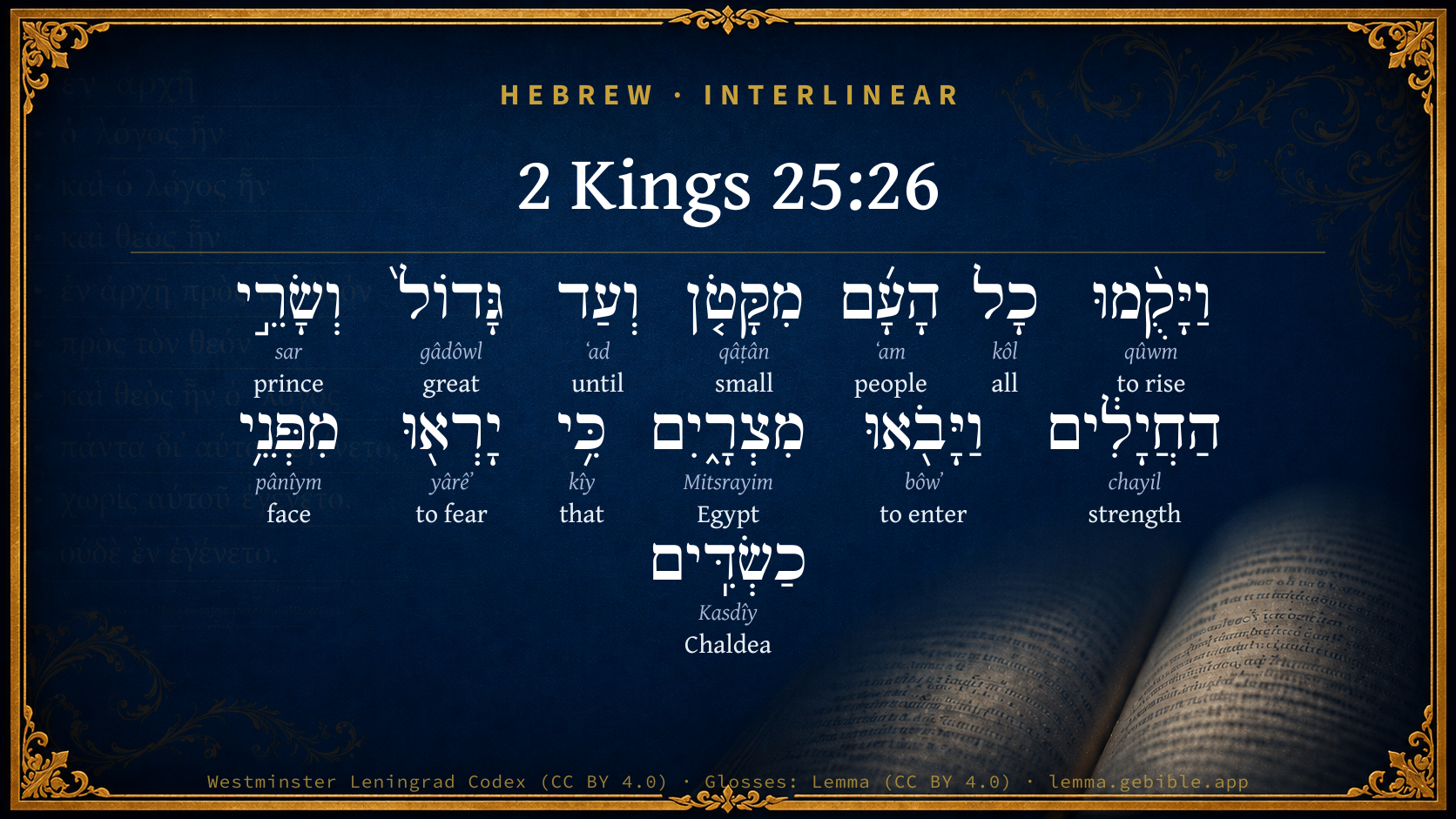
  1. וַיָּקֻ֨מוּ qûwm H6965 “and · to rise” Conjunction + Verb, Qal, Sequential Imperfect, 3rd Person, Masculine, Plural
  2. כָל kôl H3605 “all of” Noun, Common, Masculine, Singular, Construct
  3. הָעָ֜ם ʻam H5971 “the · people” Particle, Definite Article + Noun, Common, Masculine, Singular, Absolute
  4. מִקָּטֹ֤ן qâṭân H6996 “from · small” Preposition + Adjective, Adjective, Masculine, Singular, Absolute
  5. וְעַד ʻad H5704 “and · until” Conjunction + Preposition
  6. גָּדוֹל֙ gâdôwl H1419 “great” Adjective, Adjective, Masculine, Singular, Absolute
  7. וְשָׂרֵ֣י sar H8269 “and · princes of” Conjunction + Noun, Common, Masculine, Plural, Construct
  8. הַחֲיָלִ֔ים chayil H2428 “the · forces” Particle, Definite Article + Noun, Common, Masculine, Plural, Absolute
  9. וַיָּבֹ֖אוּ bôwʼ H935 “and · to enter” Conjunction + Verb, Qal, Sequential Imperfect, 3rd Person, Masculine, Plural
  10. מִצְרָ֑יִם Mitsrayim H4714 “Egypt” Noun, Proper
  11. כִּ֥י kîy H3588 “that” Conjunction
  12. יָרְא֖וּ yârêʼ H3372 “to fear” Verb, Qal, Perfect, 3rd Person, Common, Plural
  13. מִפְּנֵ֥י pânîym H6440 “from · face(s) of” Preposition + Noun, Common, Both, Plural, Construct

About this verse

These counts appear in no published source. They are computed here, from the morphology-tagged text and Lemma’s own curated glosses. What Lemma adds →

14
words
14
distinct lemmas
Historical
section

Grammatical profile

  • 3 verbs
  • 7 nouns
  • 2 adjectives
  • 1 preposition
  • 1 conjunction

Verb forms

  • וַיָּקֻ֨מוּ Qal · Sequential Imperfect
  • וַיָּבֹ֖אוּ Qal · Sequential Imperfect
  • יָרְא֖וּ Qal · Perfect

Hebrew & Septuagint length

In English translation the verse runs 25 words from the Hebrew and 27 from the Septuagint (LXX English) — closely comparable.

A rough comparison of the two English renderings, which tokenize alike — not a word-level alignment.

Word counts can differ between the Hebrew and the Greek without any difference in meaning — e.g. the Hebrew direct-object marker אֵת has no separate Greek word, and Greek often adds the article ὁ.

In the original languages it is 14 Hebrew tokens and 25 Greek tokens — but the two are counted differently (Hebrew bundles its prefixes and suffixes into one token; the Greek is in lemma form), so that isn’t a like-for-like length.

Cross-references

3

Topical passages linked to 2 Kings 25:26 in the Treasury of Scripture Knowledge — connected by theme and wording, ordered by reader-vote popularity; previews shown in the World English Bible.

  • Jeremiah 43:4–7 So Johanan the son of Kareah, and all the captains of the forces, and all the people, didn't obey the voice of Yahweh, to dwell in the land of Judah.
  • Jeremiah 41:16–18 Then took Johanan the son of Kareah, and all the captains of the forces who were with him, all the remnant of the people whom he had recovered from Ishmael the son of Nethaniah, from Mizpah, after that he had killed Gedaliah the son of Ahikam, [to wit], the men of war, and the women, and the children, and the eunuchs, whom he had brought back from Gibeon:
  • Jeremiah 42:14–22 saying, No; but we will go into the land of Egypt, where we shall see no war, nor hear the sound of the trumpet, nor have hunger of bread; and there will we dwell:

Cross-references courtesy of OpenBible.info (CC BY 4.0).

Hebrew and Greek witnesses Masoretic Hebrew ↔ Greek Septuagint

The same verse in the two great witnesses to the Old Testament, shown verse-for-verse.

These are two independent witnesses, not word-aligned to each other, and the Septuagint is shown in lemma (dictionary) form.

Hebrew 2 Kings 25:26 Masoretic · Westminster Leningrad Codex

וַיָּקֻ֨מוּ כָל הָעָ֜ם מִקָּטֹ֤ן וְעַד גָּדוֹל֙ וְשָׂרֵ֣י הַחֲיָלִ֔ים וַיָּבֹ֖אוּ מִצְרָ֑יִם כִּ֥י יָרְא֖וּ מִפְּנֵ֥י כַשְׂדִּֽים

All the people, both small and great, and the captains of the forces, arose, and came to Egypt; for they were afraid of the Chaldeans.

World English Bible · Public Domain

Greek LXX 2 Kings 25:26 Septuagint · lemma form

καί ἀναἵστημι πᾶς ὁ λαός ἀπό μικρός καί ἕως μέγας καί ὁ ἄρχων ὁ δύναμις καί εἰςἔρχομαι εἰς αἴγυπτος ὅτι φοβέω ἀπό πρόσωπον ὁ χαλδαῖος

And all the people, great and small rose up, they and the captains of the forces, and went into Egypt; because they were afraid of the Chaldeans.

LXX2012 (modern English Septuagint) · Public Domain

Hebrew: Westminster Leningrad Codex (CC BY 4.0). Greek: Septuagint (public domain); English from LXX2012 (modern English Septuagint) (Public Domain). How the Septuagint differs from the Hebrew →

Targum (Aramaic paraphrase)

1

The Targum is the ancient Jewish Aramaic paraphrase of the Hebrew Scriptures — an interpretive translation, not the Hebrew text itself. Onkelos (literal) and Pseudo-Jonathan (expansive) render the Torah, and Jonathan the Prophets. Coverage is partial: where no permissively-licensed English translation exists for a verse, only the Aramaic is shown. This is verse-level text, not a word-by-word alignment to the Hebrew.

  1. Targum Jonathan Prophets (Joshua–Malachi)
    וְקָמוּ כָל עַמָא מִזְעֵירָא וְעַד רַבָּא וְרַבָּנֵי חֵילְוָתָא וַאֲתוֹ לְמִצְרָיִם אֲרֵי דְחִילוּ מִן קֳדָם כַסְדָאֵי:

    (no public-domain English translation for this verse)

    Targum Jonathan — Aramaic: “Mikraot Gedolot” (public domain). English: “Sefaria Community Translation” (CC0 1.0 (public-domain dedication)); “London "Chaldee Paraphrase," 1871” (public domain). Text via Sefaria.

Commentary

Notes on 2 Kings 25:26 from classic Christian and Jewish commentators (each source and its license shown beneath its notes). The classic Christian expositions comment on the surrounding passage and are grouped to its opening verse, so a note may address several verses; the Jewish commentaries on the Tanakh (Rashi and others) are per-verse, so they appear only where the commentator wrote on this verse.

Lemma curates 59 commentaries, every one of them public domain or Creative Commons licensed, each selected and text-cleaned for this edition rather than reprinted as found. About our sources →

Trapp's Complete Commentary

John Trapp

2Ki 25:26 And all the people, both small and great, and the captains of the armies, arose, and came to Egypt: for they were afraid of the Chaldees.

Ver. 26. And came to Egypt.] Their rendezvous was at Bethlehem; where when the prophet Jeremiah had forbidden them from God to go to Egypt upon pain of utter destruction, they nevertheless would needlessly go, and did: taking along with them also Jeremiah and Baruch. {Jer 43:4}

“ Ah quoties docta plus valet arte malum! ”

Jeremiah, though their prisoner, ceased not to reprove them in Egypt for their obstinacy and idolatry, and to foretell their destruction: for the which his ungrateful countrymen stoned him to death, as other histories report. Hoc fuit διδακτρον, saith one. This was the reward that that faithful servant of God received for his one and forty years’ pains taken amongst them.

John Trapp, A Commentary or Exposition upon All the Books of the Old and New Testament (1647–1656) — public domain. Text from a community e-Sword module.

Joseph Benson's Commentary

2Ki 25:26. And all the people arose, and came to Egypt — Contrary to the persuasion of Jeremiah, who pressed them to stay in the land, that it might not altogether lie uncultivated, (seeing they were to be settled in it again, according to the word of the Lord by the Prophet Isaiah, chap. Isa 44:28, and Isa 45:1,) assuring them that they should be safe if they would stay in the land of Judah, but should perish if they went into Egypt. See Jer 42:9-10, &c. But they would not hearken. Thus this populous and fertile country was laid waste and desolate, part of the people being carried captive to Babylon, part of those who were left in the land being slain with Gedaliah, and the remainder fleeing into Egypt. So that it was left to be overrun with briers and thorns, and to be inhabited by wild beasts. Only some of the neighbouring nations seem to have settled themselves in some parts of it. And from hence the Jews found much greater difficulty when they came to be restored than they would have done if some of them had continued in their country and cultivated it. For they were afraid of the Chaldees —

The Chaldeans had reason enough to be offended at the murder of Gedaliah; but, if those that remained had humbly remonstrated to them, that it was only the act of Ishmael and his party, we may suppose they who were innocent of it, nay, who suffered greatly by it, would not have been punished for it: but, under pretence of this apprehension they all went into Egypt, where, it is probable, they mixed with the Egyptians by degrees, and were never heard of more as Israelites. Thus there was a full end made of them by their own folly and disobedience, and Egypt had the last of them, that the last verse of that chapter of threatenings might be fulfilled after all the rest, (Deu 28:68,) The Lord shall bring thee into Egypt again. For a more particular account of these events see the prophecy of Jeremiah, from chap. 40. to chap. 45.

Joseph Benson's Commentary on the Old and New Testaments (1811–1818) — public domain. Text from a community e-Sword module.

Tyndale Open Study Notes

Tyndale Open Resources

25:26 Then all the people of Judah, led by Johanan, fled in panic to Egypt against Jeremiah’s counsel (see Jer 42:1–43:7).

Tyndale Open Study Notes — © Tyndale Open Resources, licensed CC BY-SA 4.0. Text via the HelloAO Bible API.

Geneva Bible (1599)

Geneva Bible translators

Contrary to Jeremiah’s counsel, Jer. 40-43.

Geneva Bible (1599) marginal notes — public domain. Text via Bolls.life.

Jamieson, Fausset & Brown

Robert Jamieson, A. R. Fausset & David Brown

and all the people . . . came to Egypt--In spite of Jeremiah's dissuasions (Jer 43:7-8) they settled in various cities of that country (Jer 44:1).

Jamieson, Fausset & Brown — Commentary Critical and Explanatory on the Whole Bible (1871) — public domain (CC PDM 1.0). Text via the HelloAO Bible API.

Ellicott's Commentary for English Readers

(26) Arose and came to Egypt.—They took Jeremiah with them (Jer_43:6). This verse only gives the end of the story as it is told in Jeremiah.

A Bible Commentary for English Readers, edited by Charles John Ellicott (1878–1897) — public domain. Text from a community e-Sword module.

The Cambridge Bible for Schools and Colleges

gen. ed. J. J. S. Perowne

26. all the people … and the captains of the armies [R.V. forces] arose and came to Egypt] Feeling now sure that there would be reason to fear because of the servants of the Chaldæans. They were in a panic, and fled away in spite of the exhortations of Jeremiah, and they carried Jeremiah with them into Egypt (Jer_43:1-7). On their arrival at Tahpanhes and on the prophetic action of Jeremiah there, read Jer_43:8-13. Other Jewish settlements in Egypt mentioned by the prophet (Jer_44:1) are Migdol, Noph and the country of Pathros.

The Cambridge Bible for Schools and Colleges (gen. ed. J. J. S. Perowne; Cambridge University Press, 1878–1918) — public domain. Text from a community e-Sword module.

Haydock's Catholic Bible Commentary

Chaldees. They went under the conduct of Johanan, in opposition to the declaration of Jeremias, xliii. 7., and xliv. 1. (Calmet)

George Leo Haydock (1774–1849), Haydock's Catholic Family Bible and Commentary, 1859 edition — public domain. Excludes Psalms (Douay-Rheims chapter numbering differs from Protestant) and Deuterocanonical books (Catholic canon only).

Whedon's Commentary on the Bible

Daniel D. Whedon

26. Both small and great — All classes and all ages.

Captains of the armies — Commanders of the military forces that had been subject to Gedaliah. At the head of them was Johanan, who had just taken command, and had led them successfully against Ishmael.

Came to Egypt — Against the word of the Lord and the warnings of the prophet Jeremiah. Chap. 42. They thought it best for them now to seek the protection of that power that had interposed to help them during the late siege of Jerusalem, and had obliged the Chaldees for a time to retire from the city. Jer_37:5-11.

They were afraid of the Chaldees — So fearful an impression had the horrors of the late siege and the Chaldean power made upon them, that they could not feel safe anywhere in the dominions of Nebuchadnezzar. They had been made to feel the tremendous power of that “bitter and hasty nation… terrible and dreadful,” of whom Habakkuk had prophesied. Hab_1:5-11.

Daniel D. Whedon (gen. ed.), Commentary on the Old and New Testaments (1874–1909) — public domain. Text from a community e-Sword module.

The Pulpit Commentary

And all the people, both small and great, and the captains of the armies (see above, ver. 23). The leader of the movement was Johanan, the son of Careah. Having first attacked Ishmael, and forced him to fly to the Ammonites, (Jer_41:15) he almost immediately afterwards conceived a fear of Nebuchadnezzar, who would, he thought, resent the murder of Gedaliah, and even avenge it upon these who had done all they could to prevent it. He therefore gathered together the people, and made a preliminary retreat to Chimham, near Bethlehem, (Jer_41:17) on the road to Egypt, whence he subsequently, against the earnest remonstrances and prophetic warnings of Jer_42:9-22, carried them on into Egypt itself. (Jer_43:1-7) The first settle-merit was made at Tahpanhes, or Daphnae. Arose, and came into Egypt: for they were afraid of the Chaldees. (see Jer_41:18 Jer_43:3) There does not appear to have been any real reason for this fear.

Nebuchadnezzar might have been trusted to distinguish between the act of an individual and conspiracy on the part of the nation.

The Pulpit Commentary (1880–1919), ed. H.D.M. Spence-Jones & Joseph S. Exell — public domain. Text from a community e-Sword module.

John Wesley's Explanatory Notes

Egypt - And here they probably mixt with the Egyptians by degrees, and were heard of no more as Israelites.

John Wesley, Explanatory Notes Upon the Whole Bible (1754–1765) — public domain. Text via the GEBible commentary corpus.

Lesson kit

Teaching starters — assembled from the data on this page, not authored interpretation. Every prompt links to the verse data it draws on. Edit before teaching.

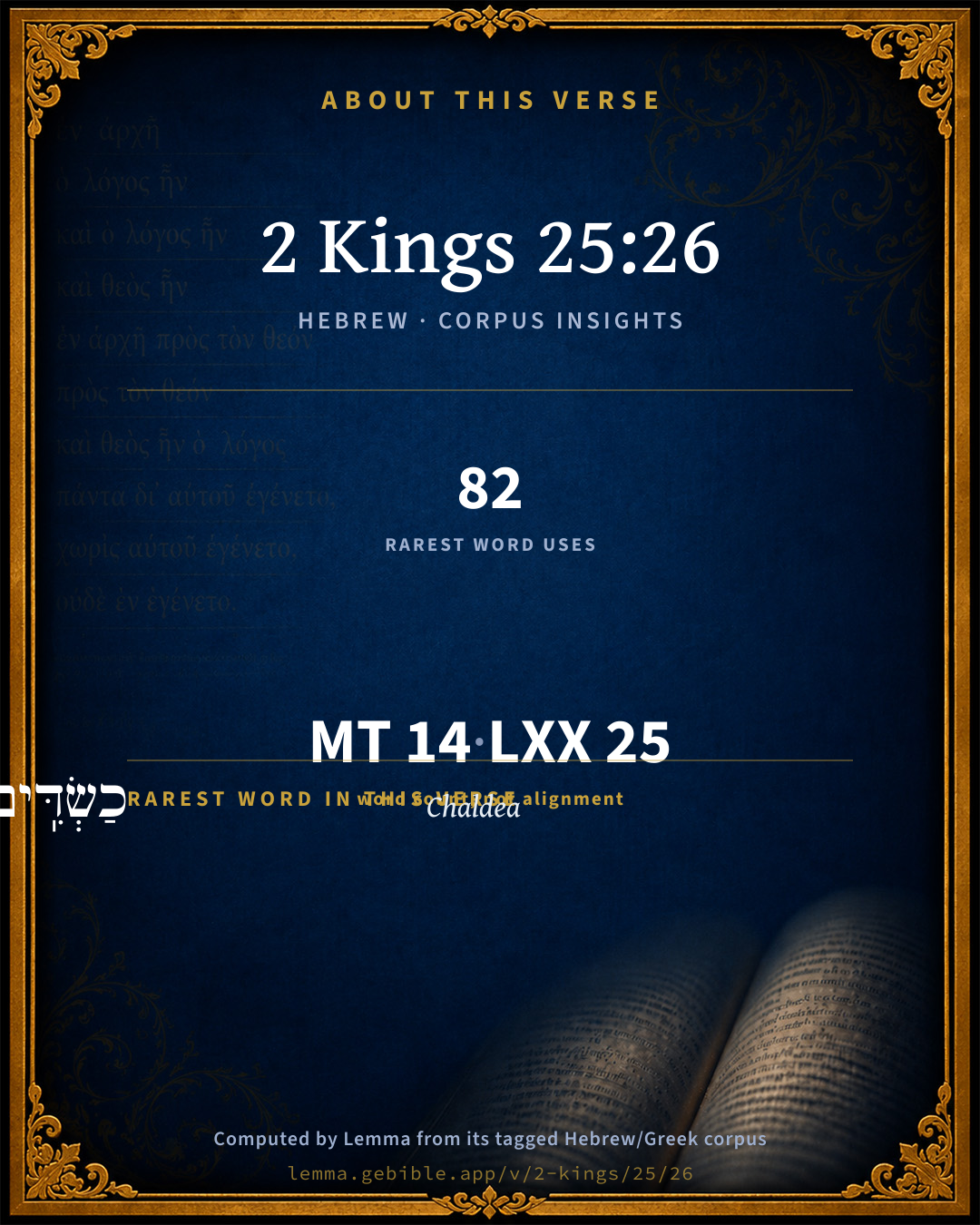
2 Kings, in the Historical, opens this verse with 14 words (14 distinct Hebrew lemmas). Its most distinctive word is Kasdîy (“Chaldea”). A historical commentator’s framing appears above. Read the whole chapter for the surrounding context.

Discussion questions

  1. How does “Chaldea” (Kasdîy) shape what this verse is saying?
  2. How does Jeremiah 43:4–7, which shares this passage’s theme, read alongside this verse?
  3. These translations render this verse differently; the difference is in the English rendering, not the original. What questions does that raise?
  4. «וַיָּקֻ֨מוּ» is a Qal Sequential Imperfect verb. How does that grammatical form shape the action described?
  5. Compare how Trapp's Complete Commentary and Joseph Benson's Commentary read this verse. Where do they agree or differ?

Things to notice

Reading settings

Reading text

Shown beneath each verse's original-language words.

Old Testament
Old Testament edition

Read the OT as the Masoretic Hebrew (MT) or the Greek Septuagint (LXX).

English shown for the Greek Septuagint (in the Hebrew ↔ Greek comparison).

Comparing translations? Open the Compare panel on any verse page to stack up to four side by side.