
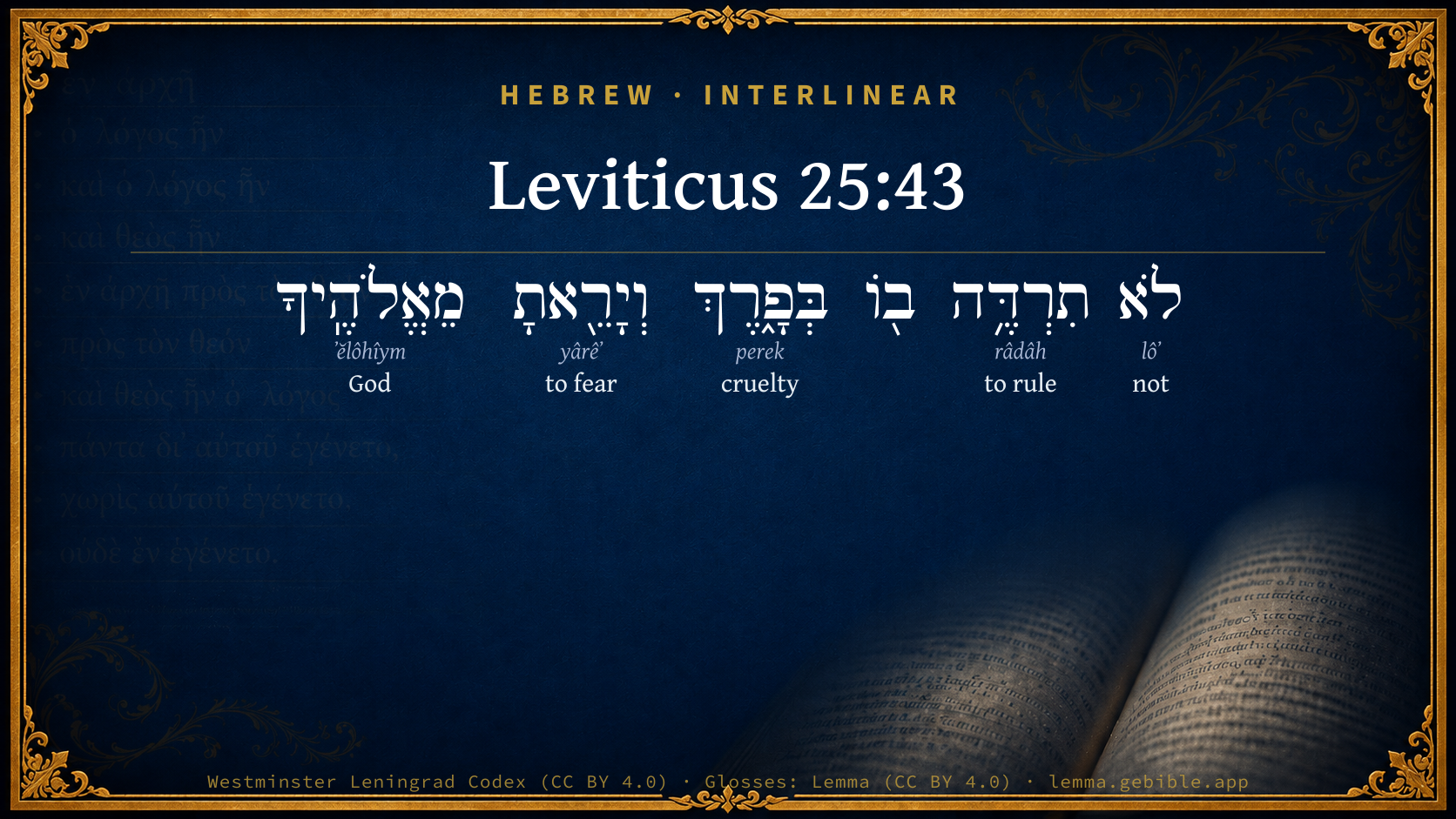
Leviticus 25:43

Hebrew (Westminster Leningrad Codex) Leviticus 25:43 appears in the Hebrew Old Testament. The text above is from the Westminster Leningrad Codex. Each word links to its Strong’s number, a concise gloss, and parsing drawn from the Open Scriptures Hebrew Bible morphology. Click any word for its full Brown-Driver-Briggs (BDB) entry.
Download image
Cite this verse

Leviticus 25:43 (World English Bible). Public Domain. Lemma interlinear Bible study tool, https://lemma.gebible.app/v/leviticus/25/43.

Show BibTeX & RIS
BibTeX
RIS
English Translation
You shall not rule over him with harshness, but shall fear your God.
World English Bible · Public Domain
Download a study sheet

One document with this verse’s original text, its word-by-word gloss line, the meaning frame, cross-references with their text, attributed commentary, and full source and license credits — printable, and it pastes into notes with its structure intact.

This verse Autodidact and up

Study sheet (.html) Plain text (.txt)

A passage Seminary Student

Up to 50 verses in one chapter. A passage sheet keeps up to 6 commentary sources and 12 cross-references per verse, in the order this page ranks them, and says so on the sheet whenever that leaves anything out. Ask for a single verse and you get the Autodidact verse sheet above.

Everything on this page stays free to read, with no account — the sheet is a download of what is already on screen, not access to it.

Want to remove ads? Support Godless Engineer
Compare translations 3

The same verse in 3 English versions, stacked beneath the original-language interlinear above. Click any original word for its lexicon entry.

Each is an independent rendering of the whole verse — the interlinear is not word-aligned to these translations.

Highlighted words mark where these versions differ — a whole-verse word diff, not a word-by-word alignment.

  • World English Bible Public Domain
    You shall not rule over him with harshness, but shall fear your God.
  • King James Version Public Domain
    Thou shalt not rule over him with rigor; but shalt fear thy God.
  • unfoldingWord Literal Text CC BY-SA 4.0
    You shall not rule over him with harshness, but you shall fear from your God.

unfoldingWord Literal Text — © unfoldingWord, licensed CC BY-SA 4.0. Word-aligned USFM3 via Door43 (git.door43.org/unfoldingWord/en_ult).

Versions to compare (up to 4)

3 of 4 selected

Show all 18 translations

Every available English version of this verse, each an independent rendering of the whole verse.

  • World English Bible Public Domain
    You shall not rule over him with harshness, but shall fear your God.
  • Berean Standard Bible Public Domain
    You are not to rule over them harshly, but you shall fear your God.
  • Majority Standard Bible Public Domain
    You are not to rule over them harshly, but you shall fear your God.
  • King James Version Public Domain
    Thou shalt not rule over him with rigor; but shalt fear thy God.
  • American Standard Version (1901) Public Domain
    Thou shalt not rule over him with rigor, but shalt fear thy God.
  • Revised Version (1885) Public Domain
    Thou shalt not rule over him with rigour; but shalt fear thy God.
  • Geneva Bible (1599) Public Domain
    Thou shalt not rule ouer him cruelly, but shalt feare thy God.
  • Douay-Rheims (1899) Public Domain
    Afflict him not by might, but fear thy God.
  • Young's Literal Translation Public Domain
    thou rulest not over him with rigour, and thou hast been afraid of thy God.
  • Literal Standard Version CC BY-SA 4.0
    you do not rule over him with rigor, and you have been afraid of your God.
  • Unlocked Literal Bible CC BY-SA 4.0
    You must not rule over them harshly, but you must honor your God.
  • unfoldingWord Literal Text CC BY-SA 4.0
    You shall not rule over him with harshness, but you shall fear from your God.
  • Darby Bible Public Domain
    Thou shalt not rule over him with rigour; and thou shalt fear thy God.
  • World Messianic Bible Public Domain
    You shall not rule over him with harshness, but shall fear your God.
  • Webster's Bible Public Domain
    Thou shalt not rule over him with rigor, but shalt fear thy God.
  • Free Bible Version CC BY-SA 4.0
    Don't treat them with brutality. Have respect for your God.
  • Bible in Basic English Public Domain
    Do not be a hard master to him, but have the fear of God before you.
  • JPS Tanakh (1917) Public Domain
    Thou shalt not rule over him with rigour; but shalt fear thy God.

Literal Standard Version (2020), Covenant Press — licensed CC BY-SA 4.0. Text via the HelloAO Bible API (eBible.org). Unlocked Literal Bible (unfoldingWord) — licensed CC BY-SA 4.0. Text via the HelloAO Bible API (eBible.org). unfoldingWord Literal Text — © unfoldingWord, licensed CC BY-SA 4.0. Word-aligned USFM3 via Door43 (git.door43.org/unfoldingWord/en_ult). Free Bible Version, Dr. Jonathan Gallagher — licensed CC BY-SA 4.0. Text via the HelloAO Bible API (eBible.org).

Word by word

More ways to search: Search by grammar → Find every occurrence → Compare this word →

Practice this passage: Drill this verse → Learn its vocabulary →

About this verse

These counts appear in no published source. They are computed here, from the morphology-tagged text and Lemma’s own curated glosses. What Lemma adds →

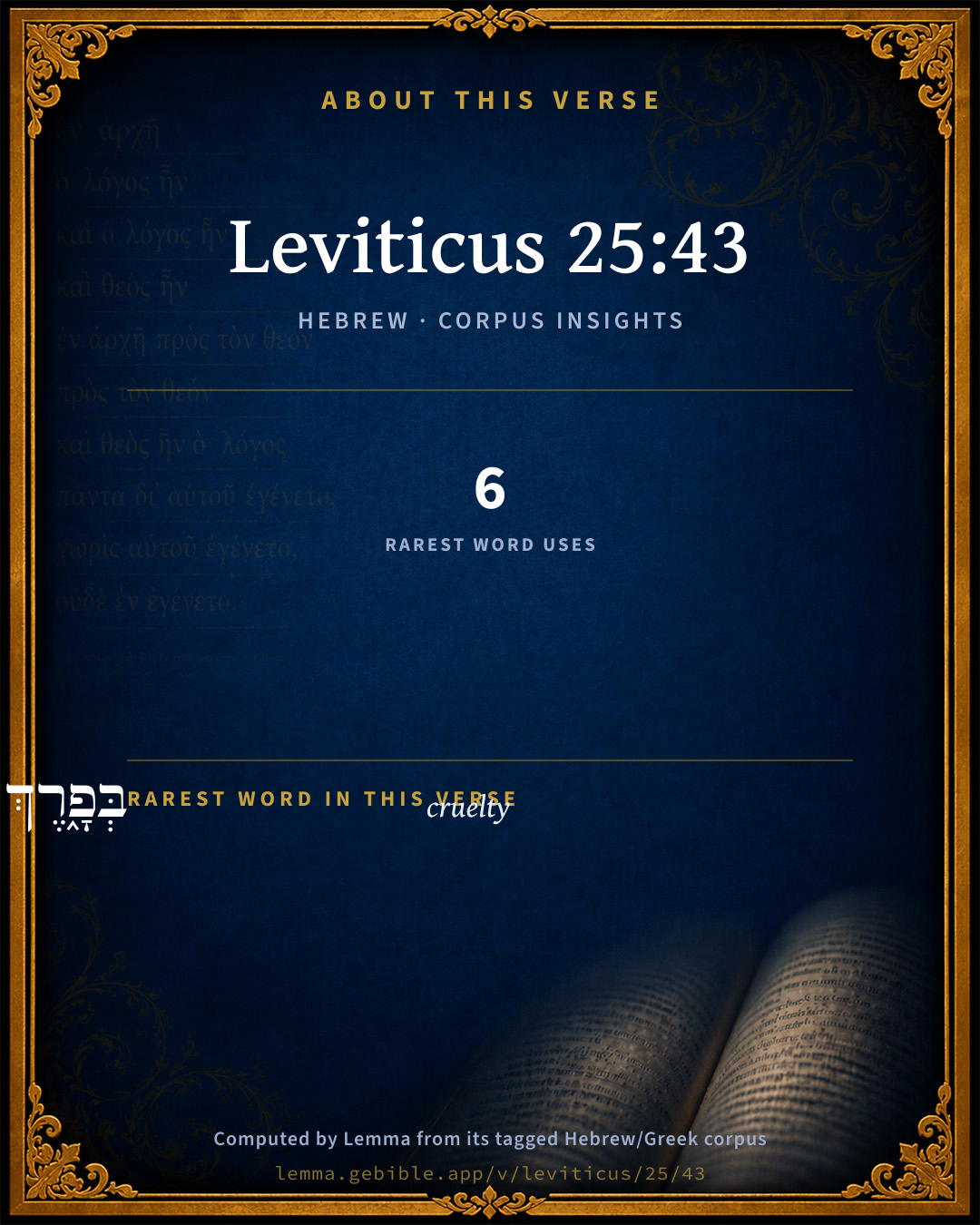
6
words
5
distinct lemmas
Pentateuch
section

Notable vocabulary

The rarest word here is בְּפָ֑רֶךְ cruelty H6531 — appearing just 6 times in the whole Hebrew Bible.

Shared distinctive vocabulary

בְּפָ֑רֶךְ cruelty H6531 occurs in 6 verses of the Hebrew Bible. Also found in:

Grammatical profile

  • 2 verbs
  • 2 nouns
  • 1 preposition
  • 1 particle

Verb forms

  • תִרְדֶּ֥ה Qal · Imperfect
  • וְיָרֵ֖אתָ Qal · Sequential Perfect

Hebrew & Septuagint length

In English translation the verse runs 13 words from the Hebrew and 14 from the Septuagint (LXX English) — closely comparable.

A rough comparison of the two English renderings, which tokenize alike — not a word-level alignment.

Word counts can differ between the Hebrew and the Greek without any difference in meaning — e.g. the Hebrew direct-object marker אֵת has no separate Greek word, and Greek often adds the article ὁ.

Cross-references

17

Topical passages linked to Leviticus 25:43 in the Treasury of Scripture Knowledge — connected by theme and wording, ordered by reader-vote popularity; previews shown in the World English Bible.

  • Colossians 4:1 Masters, give to your servants that which is just and equal, knowing that you also have a Master in heaven.
  • Exodus 1:13–14 The Egyptians ruthlessly made the children of Israel serve,
  • Leviticus 25:17 You shall not wrong one another; but you shall fear your God: for I am Yahweh your God.
  • Leviticus 25:46 You may make them an inheritance for your children after you, to hold for a possession; of them may you take your slaves forever: but over your brothers the children of Israel you shall not rule, one over another, with harshness.
  • Leviticus 25:53 As a servant hired year by year shall he be with him: he shall not rule with harshness over him in your sight.
  • Ezekiel 34:4 You haven't strengthened the diseased, neither have you healed that which was sick, neither have you bound up that which was broken, neither have you brought back that which was driven away, neither have you sought that which was lost; but with force and with rigor have you ruled over them.
  • Ephesians 6:9 You masters, do the same things to them, and give up threatening, knowing that he who is both their Master and yours is in heaven, and there is no partiality with him.
  • Exodus 1:17 But the midwives feared God, and didn't do what the king of Egypt commanded them, but saved the baby boys alive.
  • Exodus 1:21 It happened, because the midwives feared God, that he gave them families.
  • Exodus 2:23 It happened in the course of those many days, that the king of Egypt died, and the children of Israel sighed because of the bondage, and they cried, and their cry came up to God because of the bondage.
  • Exodus 3:7 Yahweh said, "I have surely seen the affliction of my people who are in Egypt, and have heard their cry because of their taskmasters, for I know their sorrows.
  • Exodus 3:9 Now, behold, the cry of the children of Israel has come to me. Moreover I have seen the oppression with which the Egyptians oppress them.
  • Exodus 5:14 The officers of the children of Israel, whom Pharaoh's taskmasters had set over them, were beaten, and demanded, "Why haven't you fulfilled your quota both yesterday and today, in making brick as before?"
  • Deuteronomy 25:18 how he met you by the way, and struck the hindmost of you, all who were feeble behind you, when you were faint and weary; and he didn't fear God.
  • Isaiah 47:6 I was angry with my people, I profaned my inheritance, and gave them into your hand: you did show them no mercy; on the aged have you very heavily laid your yoke.
  • Isaiah 58:3 Why have we fasted, [say they], and you don't see? [why] have we afflicted our soul, and you take no knowledge? Behold, in the day of your fast you find [your own] pleasure, and exact all your labors.
  • Malachi 3:5 I will come near to you to judgment; and I will be a swift witness against the sorcerers, and against the adulterers, and against the perjurers, and against those who oppress the hireling in his wages, the widow, and the fatherless, and who deprive the foreigner of justice, and don't fear me," says Yahweh of Hosts.

Cross-references courtesy of OpenBible.info (CC BY 4.0).

Hebrew and Greek witnesses Masoretic Hebrew ↔ Greek Septuagint

The same verse in the two great witnesses to the Old Testament, shown verse-for-verse.

These are two independent witnesses, not word-aligned to each other, and the Septuagint is shown in lemma (dictionary) form.

Hebrew Leviticus 25:43 Masoretic · Westminster Leningrad Codex

לֹא תִרְדֶּ֥ה ב֖וֹ בְּפָ֑רֶךְ וְיָרֵ֖אתָ מֵאֱלֹהֶֽיךָ

You shall not rule over him with harshness, but shall fear your God.

World English Bible · Public Domain

Greek LXX Leviticus 25:43 Septuagint · lemma form

οὐ κατατείνω αὐτός ἐν ὁ μόχθος καί φοβέω κύριος ὁ θεός σύ

You shall not oppress him with labor, and shall fear the Lord your God.

LXX2012 (modern English Septuagint) · Public Domain

On this verse, Haydock's Catholic Bible Commentary discusses the Septuagint’s reading. Read the note in Commentary ↓

Hebrew: Westminster Leningrad Codex (CC BY 4.0). Greek: Septuagint (public domain); English from LXX2012 (modern English Septuagint) (Public Domain). How the Septuagint differs from the Hebrew →

Targum (Aramaic paraphrase)

2

The Targum is the ancient Jewish Aramaic paraphrase of the Hebrew Scriptures — an interpretive translation, not the Hebrew text itself. Onkelos (literal) and Pseudo-Jonathan (expansive) render the Torah, and Jonathan the Prophets. Coverage is partial: where no permissively-licensed English translation exists for a verse, only the Aramaic is shown. This is verse-level text, not a word-by-word alignment to the Hebrew.

  1. Targum Onkelos Torah (Genesis–Deuteronomy)
    לָא תִפְלָח בֵּהּ בְּקַשְׁיוּ וְתִדְחַל מֵאֱלָהָךְ

    (no public-domain English translation for this verse)

    Targum Onkelos — Aramaic: “Onkelos Genesis” (public domain); “Onkelos Exodus” (public domain); “Onkelos Leviticus” (public domain); “Onkelos Numbers” (public domain); “Onkelos Deuteronomy” (public domain). English: “Sefaria Community Translation” (CC0 1.0 (public-domain dedication)); “J.W. Etheridge. The Targums of Onkelos and Jonathan Ben Uzziel on the Pentateuch. London: Longmans, Green, 1862” (public domain). Text via Sefaria.

  2. Targum Pseudo-Jonathan Torah (Genesis–Deuteronomy)
    לָא תִשְׁתַּעְבְּדוּן בֵּיהּ בְּקַשְׁיוּ וְתִדְחַל מֵאֱלָהָךְ

    Neither may you make him serve with rigour, but thou shalt fear the Lord thy God.

    Targum Pseudo-Jonathan — Aramaic: “Targum Jonathan on Genesis” (public domain); “Targum Jonathan on Exodus” (public domain); “Targum Jonathan on Leviticus” (public domain); “Targum Jonathan on Numbers” (public domain); “Targum Jonathan on Deuteronomy” (public domain). English: “The Targum of Jonathan ben Uzziel, trans. J. W. Etheridge, London, 1862” (public domain). Text via Sefaria.

Commentary

Notes on Leviticus 25:43 from classic Christian and Jewish commentators (each source and its license shown beneath its notes). The classic Christian expositions comment on the surrounding passage and are grouped to its opening verse, so a note may address several verses; the Jewish commentaries on the Tanakh (Rashi and others) are per-verse, so they appear only where the commentator wrote on this verse.

Lemma curates 59 commentaries, every one of them public domain or Creative Commons licensed, each selected and text-cleaned for this edition rather than reprinted as found. About our sources →

Trapp's Complete Commentary

John Trapp

Lev 25:43 Thou shalt not rule over him with rigour; but shalt fear thy God.

Ver. 43. Rule over him with rigour.] As the Egyptians did over the Israelites. {Exo 1:13} Thy servant is made of the same earth with thee, and hath right to the same heaven with thee. See Gal 3:28. The servant paid the half shekel as well as the master. Stand not therefore on terms of inequality, but know that yourselves also have a Master in heaven. Do therefore to them "that which is right and equal." {Col 4:1}

John Trapp, A Commentary or Exposition upon All the Books of the Old and New Testament (1647–1656) — public domain. Text from a community e-Sword module.

Tyndale Open Study Notes

Tyndale Open Resources

25:43 As human beings created in God’s image (Gen 1:26, 27; Prov 14:31; 17:5) and as fellow Israelites in covenant with God, even bondservants were to be treated with respect. God’s law includes numerous provisions for their protection (see Exod 21:20, 26-27). All human beings must be treated in a way that reflects reverence for God (see Prov 14:31; 17:5; Jas 2:14-16; 3:9-10).

Tyndale Open Study Notes — © Tyndale Open Resources, licensed CC BY-SA 4.0. Text via the HelloAO Bible API.

Adam Clarke's Commentary

Verse 43. Thou shalt not rule over him with rigour] What is rigorous service? "Service which is not determined, and service whereof there is no need." This is the definition given by the Jews; but much more is implied in this command than is expressed here. Labour beyond the person's strength, or labour too long continued, or in unhealthy or uncomfortable places and circumstances, or without sufficient food, c., is labour exacted with rigour, and consequently inhuman and this law is made, not for the Mosaic dispensation and the Jewish people, but for every dispensation and for every people under heaven.

Adam Clarke's Commentary on the Bible (1810–1826) — public domain. Text from a community e-Sword/MySword module.

Ellicott's Commentary for English Readers

(43) Thou shalt not rule over him with rigour.—The master is forbidden to tyrannise over him as if he were a slave without any rights.

A Bible Commentary for English Readers, edited by Charles John Ellicott (1878–1897) — public domain. Text from a community e-Sword module.

John Gill's Exposition

Thou shalt not rule over him with rigour,.... As the Egyptians ruled over the Israelites, and made them to serve, Exo 1:13; where the same word is used as here, and seems designed to put them in mind of it, that so they might abstain from such usage of their brethren, which they had met with from their most cruel enemies; it signifies tyranny and oppression, treating them with great severity, laying hard and heavy tasks and burdens upon them they could not bear; enjoining them things they could not perform, and ordering them to do what were unnecessary, and without any limitation with respect to time:

but shalt fear thy God; that has been good to thee, and has brought thee out of hard and rigorous bondage in Egypt; and which should be remembered with thankfulness, and they should fear to offend so good a God by using a brother cruelly.

John Gill's Exposition of the Whole Bible (1746–1763) — public domain (CC PDM 1.0). Text via the HelloAO Bible API.

Albert Barnes' Notes on the Bible

Fear thy God - Yahweh was the Lord and Master of His people. To treat a Hebrew as a slave was therefore to interfere with the rights of Yahweh. Compare Rom 14:4.

Albert Barnes' Notes on the Bible (1834–1885) — public domain. Text from a community e-Sword/MySword module.

Haydock's Catholic Bible Commentary

Might. Hebrew, "rigour or haughtiness." Septuagint, "Do not make him strain himself with work."

George Leo Haydock (1774–1849), Haydock's Catholic Family Bible and Commentary, 1859 edition — public domain. Excludes Psalms (Douay-Rheims chapter numbering differs from Protestant) and Deuterocanonical books (Catholic canon only).

Matthew Poole's English Annotations

Though thou dost not fear them who are in thy power, and unable to right themselves, yet fear that God who hath commanded thee to use them kindly, and who can and will avenge their cause, if thou dost oppress them.

Matthew Poole's English Annotations on the Holy Bible (1683–1685) — public domain. Text from a community e-Sword/MySword module.

Whedon's Commentary on the Bible

Daniel D. Whedon

43. Not rule… with rigour — Literally, thou shalt not tread on him. The rabbins specified a variety of duties as coming under these general precepts; as compensation for personal injury, exemption from such menial duties as unbinding the master’s sandals or carrying him on a litter, while he was shielded from serious abusive words. The master was also obliged to maintain the servant’s wife and children, though, if they were free, he could exact no work from them. At the end of his term of service the master was forbidden “to let him go away empty.” Deu_15:13-14.

Fear thy God — Genuine piety always bears good will towards man as its first fruit. Act_16:33; Eph_6:9.

Daniel D. Whedon (gen. ed.), Commentary on the Old and New Testaments (1874–1909) — public domain. Text from a community e-Sword module.

The Pulpit Commentary

Thou shalt not rule over him with rigour; but shalt fear thy God, is paralleled by the New Testament injunction, "And, ye masters, do the same things unto them, forbearing threatening: knowing that your Master also is in heaven; neither is there respect of persons with him". (Eph_6:9)

The Pulpit Commentary (1880–1919), ed. H.D.M. Spence-Jones & Joseph S. Exell — public domain. Text from a community e-Sword module.

John Wesley's Explanatory Notes

Fear thy God - Though thou dost not fear them who are in thy power, and unable to right themselves, yet fear that God who hath commanded thee to use them kindly, and who can and will avenge their cause, if thou oppress them.

John Wesley, Explanatory Notes Upon the Whole Bible (1754–1765) — public domain. Text via the GEBible commentary corpus.

Scofield Reference Notes

C. I. Scofield

fear

(See Scofield "Psa 19:9")

The Scofield Reference Bible (1917 edition), notes by C. I. Scofield — public domain. Text from a community e-Sword module.

Rashi

Rabbi Shlomo Yitzchaki (Rashi)

לא תרדה בו בפרך THOU SHALT NOT RULE OVER HIM WITH RIGOUR — i. e. do not force him to do some useless work with the sole purpose of vexing him. Do not e.g. say to him, “Warm me this cup of drink" when this is unnecessary; nor: “Hoe beneath this vine tree until I come" whilst he does not know when you may be expected to come back. Perhaps you will say, “No one knows the fact — whether it is necessary or not, so I will tell him that it is necessary”! — the thing is thus entrusted to his (the master’s) heart only, therefore Scripture states, “but be afraid of thy God!” (Sifra, Behar, Section 6 2; see Rashi on Leviticus 19:32).

Rashi on the Tanakh — English translations: “The Judaica Press complete Tanach with Rashi, translated by A. J. Rosenberg” (CC BY 4.0); “Pentateuch with Rashi's commentary by M. Rosenbaum and A.M. Silbermann, 1929-1934” (public domain); “The Metsudah Tanach series, Lakewood, N.J” (CC BY 4.0); and “The Book of Joshua, Metsudah Publications, 1997” (CC BY 4.0). Text via Sefaria.

Lesson kit

Teaching starters — assembled from the data on this page, not authored interpretation. Every prompt links to the verse data it draws on. Edit before teaching.

Leviticus, in the Pentateuch, opens this verse with 6 words (5 distinct Hebrew lemmas). Its most distinctive word is perek (“cruelty”). A historical commentator’s framing appears above. Read the whole chapter for the surrounding context.

Discussion questions

  1. How does “cruelty” (perek) shape what this verse is saying?
  2. Exodus 1:13 shares the word «cruelty» with this verse. How do the two illuminate each other?
  3. These translations render this verse differently. What is at stake in choosing one wording over another?
  4. The verb «תִרְדֶּ֥ה» is Qal Imperfect. How does its form color the action?
  5. Reading how Trapp's Complete Commentary and Tyndale Open Study Notes read this verse, where do the two commentators agree and where do they part?

Things to notice

Reading settings

Reading text

Shown beneath each verse's original-language words.

Old Testament
Old Testament edition

Read the OT as the Masoretic Hebrew (MT) or the Greek Septuagint (LXX).

English shown for the Greek Septuagint (in the Hebrew ↔ Greek comparison).

Comparing translations? Open the Compare panel on any verse page to stack up to four side by side.