

Ecclesiastes 8:12

Hebrew (Westminster Leningrad Codex) Ecclesiastes 8:12 appears in the Hebrew Old Testament. The text above is from the Westminster Leningrad Codex. Each word links to its Strong’s number, a concise gloss, and parsing drawn from the Open Scriptures Hebrew Bible morphology. Click any word for its full Brown-Driver-Briggs (BDB) entry.
Download image
Cite this verse

Ecclesiastes 8:12 (World English Bible). Public Domain. Lemma interlinear Bible study tool, https://lemma.gebible.app/v/ecclesiastes/8/12.

Show BibTeX & RIS
BibTeX
RIS
English Translation
Though a sinner commits crimes a hundred times, and lives long, yet surely I know that it will be better with those who fear God, who are reverent before him.
World English Bible · Public Domain
Download a study sheet

One document with this verse’s original text, its word-by-word gloss line, the meaning frame, cross-references with their text, attributed commentary, and full source and license credits — printable, and it pastes into notes with its structure intact.

This verse Autodidact and up

Study sheet (.html) Plain text (.txt)

A passage Seminary Student

Up to 50 verses in one chapter. A passage sheet keeps up to 6 commentary sources and 12 cross-references per verse, in the order this page ranks them, and says so on the sheet whenever that leaves anything out. Ask for a single verse and you get the Autodidact verse sheet above.

Everything on this page stays free to read, with no account — the sheet is a download of what is already on screen, not access to it.

Want to remove ads? Support Godless Engineer
Compare translations 3

The same verse in 3 English versions, stacked beneath the original-language interlinear above. Click any original word for its lexicon entry.

Each is an independent rendering of the whole verse — the interlinear is not word-aligned to these translations.

Highlighted words mark where these versions differ — a whole-verse word diff, not a word-by-word alignment.

  • World English Bible Public Domain
    Though a sinner commits crimes a hundred times, and lives long, yet surely I know that it will be better with those who fear God, who are reverent before him.
  • King James Version Public Domain
    Though a sinner do evil an hundred times, and his days be prolonged, yet surely I know that it shall be well with them that fear God, which fear before him:
  • unfoldingWord Literal Text CC BY-SA 4.0
    that a sinner is doing evil a hundred times and lengthening for himself— yet also I know that it will be good for those who fear God, who fear from before his face.

unfoldingWord Literal Text — © unfoldingWord, licensed CC BY-SA 4.0. Word-aligned USFM3 via Door43 (git.door43.org/unfoldingWord/en_ult).

Versions to compare (up to 4)

3 of 4 selected

Show all 18 translations

Every available English version of this verse, each an independent rendering of the whole verse.

  • World English Bible Public Domain
    Though a sinner commits crimes a hundred times, and lives long, yet surely I know that it will be better with those who fear God, who are reverent before him.
  • Berean Standard Bible Public Domain
    Although a sinner does evil a hundred times and still lives long, yet I also know that it will go well with those who fear God, who are reverent in His presence.
  • Majority Standard Bible Public Domain
    Although a sinner does evil a hundred times and still lives long, yet I also know that it will go well with those who fear God, who are reverent in His presence.
  • King James Version Public Domain
    Though a sinner do evil an hundred times, and his days be prolonged, yet surely I know that it shall be well with them that fear God, which fear before him:
  • American Standard Version (1901) Public Domain
    Though a sinner do evil a hundred times, and prolong his `days', yet surely I know that it shall be well with them that fear God, that fear before him:
  • Revised Version (1885) Public Domain
    Though a sinner do evil an hundred times, and prolong his days, yet surely I know that it shall be well with them that fear God, which fear before him:
  • Geneva Bible (1599) Public Domain
    Though a sinner doe euill an hundreth times, and God prolongeth his dayes, yet I knowe that it shalbe well with them that feare the Lord, and doe reuerence before him.
  • Douay-Rheims (1899) Public Domain
    But though a sinner do evil a hundred times, and by patience be borne withal, I know from thence that it shall be well with them that fear God, who dread his face.
  • Young's Literal Translation Public Domain
    Though a sinner is doing evil a hundred `times', and prolonging `himself' for it, surely also I know that there is good to those fearing God, who fear before Him.
  • Literal Standard Version CC BY-SA 4.0
    Though a sinner is doing evil one hundred [times], and prolonging [himself] for it, surely also I know that there is good to those fearing God, who fear before Him.
  • Unlocked Literal Bible CC BY-SA 4.0
    Even though a sinner does evil a hundred times and still lives a long time, yet I know that it will be better for those who respect God, for those who stand before him and show him respect.
  • unfoldingWord Literal Text CC BY-SA 4.0
    that a sinner is doing evil a hundred times and lengthening for himself— yet also I know that it will be good for those who fear God, who fear from before his face.
  • Darby Bible Public Domain
    Though a sinner do evil a hundred times, and prolong his [days], yet I know that it shall be well with them that fear God, because they fear before him;
  • World Messianic Bible Public Domain
    Though a sinner commits crimes a hundred times, and lives long, yet surely I know that it will be better with those who fear God, who are reverent before him.
  • Webster's Bible Public Domain
    Though a sinner doeth evil a hundred times, and his days are prolonged, yet surely I know that it will be well with them that fear God, who fear before him:
  • Free Bible Version CC BY-SA 4.0
    Even though a sinner may do wrong a hundred times, and live a long life, I'm convinced that those who do what God says will be better off.
  • Bible in Basic English Public Domain
    Though a sinner does evil a hundred times and his life is long, I am certain that it will be well for those who go in fear of God and are in fear before him.
  • JPS Tanakh (1917) Public Domain
    because a sinner doeth evil a hundred times, and prolongeth his days — though yet I know that it shall be well with them that fear God, that fear before Him;

Literal Standard Version (2020), Covenant Press — licensed CC BY-SA 4.0. Text via the HelloAO Bible API (eBible.org). Unlocked Literal Bible (unfoldingWord) — licensed CC BY-SA 4.0. Text via the HelloAO Bible API (eBible.org). unfoldingWord Literal Text — © unfoldingWord, licensed CC BY-SA 4.0. Word-aligned USFM3 via Door43 (git.door43.org/unfoldingWord/en_ult). Free Bible Version, Dr. Jonathan Gallagher — licensed CC BY-SA 4.0. Text via the HelloAO Bible API (eBible.org).

Word by word

More ways to search: Search by grammar → Find every occurrence → Compare this word →

Practice this passage: Drill this verse → Learn its vocabulary →

וּמַאֲרִ֣יךְ
ʼârak
H748
“and · being long”
Conjunction + Verb, Hiphil, Participle Active, Masculine, Singular, Absolute
Part of Speech
Conjunction + Verb
Stem
Hiphil
Form
Participle Active
Gender
Masculine
Number
Singular
State
Absolute
Full BDB Definition

Origin: a primitive root

TWOT: 162

to be long, prolong - (Qal) to be long - (Hiphil) - to prolong (days) - to make long (tent cords) - to grow long, continue long
  1. אֲשֶׁ֣ר ʼăsher H834 “which” Particle, Relative
  2. חֹטֶ֗א châṭâʼ H2398 “sinning” Verb, Qal, Participle Active, Masculine, Singular, Absolute
  3. עֹשֶׂ֥ה ʻâsâh H6213 “doing” Verb, Qal, Participle Active, Masculine, Singular, Absolute
  4. רָ֛ע raʻ H7451 “evil” Adjective, Adjective, Masculine, Singular, Absolute
  5. מְאַ֖ת mêʼâh H3967 “hundred” Adjective, Cardinal number, Both, Singular, Construct
  6. כִּ֚י kîy H3588 “that” Conjunction
  7. גַּם gam H1571 “also” Particle, Accusative
  8. יוֹדֵ֣עַ yâdaʻ H3045 “knowing” Verb, Qal, Participle Active, Masculine, Singular, Absolute
  9. אָ֔נִי ʼănîy H589 “I” Pronoun, Personal, 1st Person, Common, Singular
  10. אֲשֶׁ֤ר ʼăsher H834 “which” Particle, Relative
  11. יִהְיֶה hâyâh H1961 “to be” Verb, Qal, Imperfect, 3rd Person, Masculine, Singular
  12. טּוֹב֙ ṭôwb H2896 “good” Adjective, Adjective, Masculine, Singular, Absolute
  13. לְיִרְאֵ֣י yârêʼ H3372 “to/for · fearing of” Preposition + Adjective, Adjective, Masculine, Plural, Construct
  14. הָאֱלֹהִ֔ים ʼĕlôhîym H430 “the · God(s)” Particle, Definite Article + Noun, Common, Masculine, Plural, Absolute
  15. אֲשֶׁ֥ר ʼăsher H834 “which” Particle, Relative
  16. יִֽירְא֖וּ yârêʼ H3372 “to fear” Verb, Qal, Imperfect, 3rd Person, Masculine, Plural
  17. מִלְּפָנָֽיו pânîym H6440 “from · to/for · face(s) · his” Preposition + Preposition + Noun, Common, Both, Plural, Construct + Suffix, Personal, 3rd Person, Masculine, Singular

About this verse

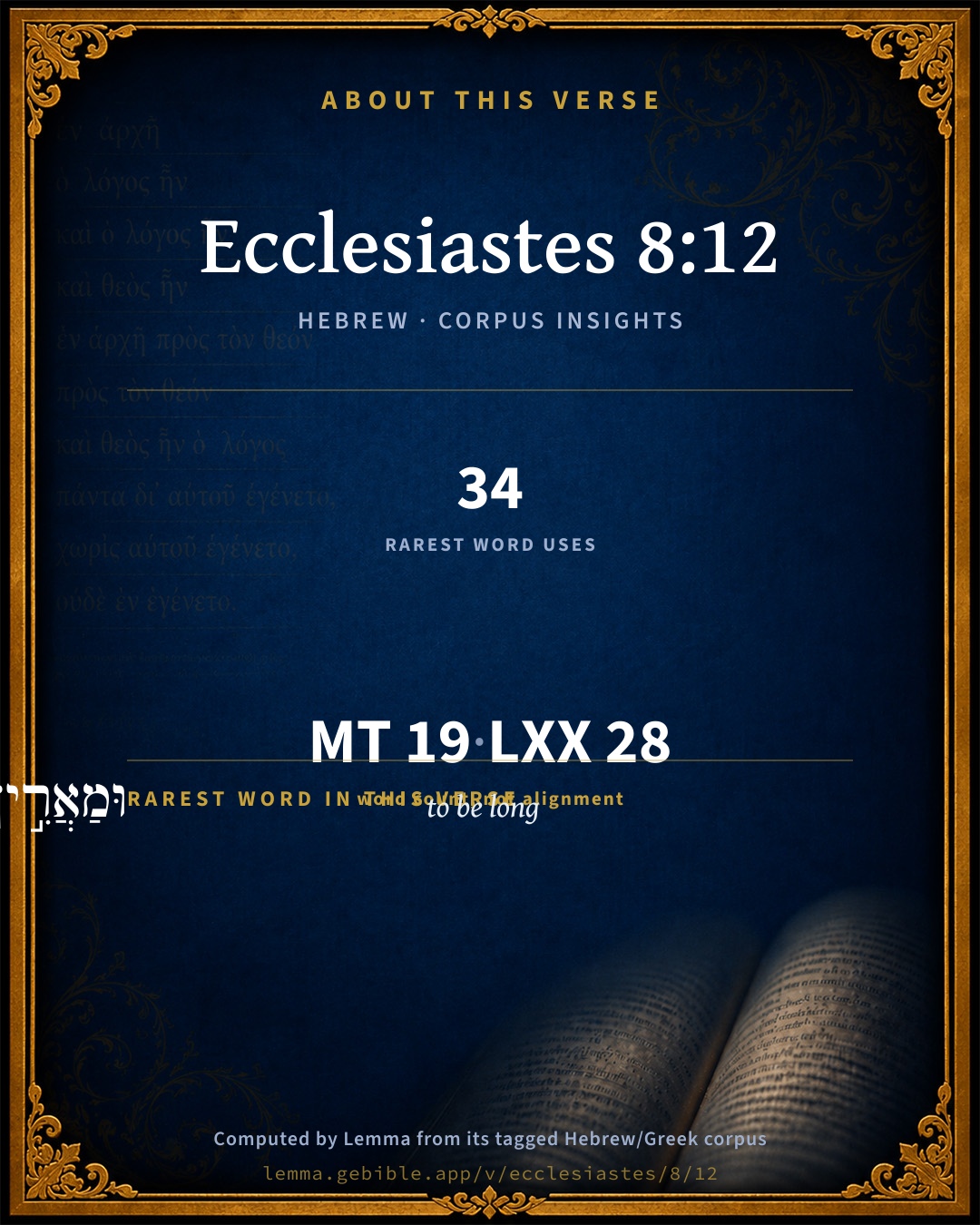
These counts appear in no published source. They are computed here, from the morphology-tagged text and Lemma’s own curated glosses. What Lemma adds →

19
words
15
distinct lemmas
Wisdom
section

Shared distinctive vocabulary

וּמַאֲרִ֣יךְ to be long H748 occurs in 34 verses of the Hebrew Bible. Also found in:

Grammatical profile

  • 6 verbs
  • 2 nouns
  • 4 adjectives
  • 1 pronoun
  • 1 preposition
  • 1 conjunction
  • 4 particles

Verb forms

  • חֹטֶ֗א Qal · Participle Active
  • עֹשֶׂ֥ה Qal · Participle Active
  • וּמַאֲרִ֣יךְ Hiphil · Participle Active
  • יוֹדֵ֣עַ Qal · Participle Active
  • יִהְיֶה Qal · Imperfect
  • יִֽירְא֖וּ Qal · Imperfect

Repetition

Words recur within this verse — often emphatic in Hebrew:

  • לְיִרְאֵ֣י to fear H3372 ×2
  • אֲשֶׁ֣ר which H834 ×3

Hebrew & Septuagint length

In English translation the verse runs 30 words from the Hebrew and 32 from the Septuagint (LXX English) — closely comparable.

A rough comparison of the two English renderings, which tokenize alike — not a word-level alignment.

Word counts can differ between the Hebrew and the Greek without any difference in meaning — e.g. the Hebrew direct-object marker אֵת has no separate Greek word, and Greek often adds the article ὁ.

In the original languages it is 19 Hebrew tokens and 28 Greek tokens — but the two are counted differently (Hebrew bundles its prefixes and suffixes into one token; the Greek is in lemma form), so that isn’t a like-for-like length.

Cross-references

25

Topical passages linked to Ecclesiastes 8:12 in the Treasury of Scripture Knowledge — connected by theme and wording, ordered by reader-vote popularity; previews shown in the World English Bible.

  • Psalms 37:11 But the humble shall inherit the land, And shall delight themselves in the abundance of peace.
  • Luke 1:50 His mercy is for generations of generations on those who fear him.
  • 2 Peter 2:9 the Lord knows how to deliver the godly out of temptation and to keep the unrighteous under punishment for the day of judgment;
  • Ecclesiastes 7:15 All this have I seen in my days of vanity: there is a righteous man who perishes in his righteousness, and there is a wicked man who lives long in his evil-doing.
  • Psalms 37:18–19 Yahweh knows the days of the perfect. Their inheritance shall be forever.
  • Ecclesiastes 3:14 I know that whatever God does, it shall be forever. Nothing can be added to it, nor anything taken from it; and God has done it, that men should fear before him.
  • Isaiah 3:10–11 Tell the righteous "Good!" For they shall eat the fruit of their deeds.
  • Isaiah 65:20–24 There shall be no more there an infant of days, nor an old man who has not filled his days; for the child shall die one hundred years old, and the sinner being one hundred years old shall be accursed.
  • Romans 9:22 What if God, willing to show his wrath, and to make his power known, endured with much patience vessels of wrath made for destruction,
  • Proverbs 1:32–33 For the backsliding of the simple will kill them. The careless ease of fools will destroy them.
  • Matthew 25:34 Then the King will tell those on his right hand, 'Come, blessed of my Father, inherit the Kingdom prepared for you from the foundation of the world;
  • Romans 2:5 But according to your hardness and unrepentant heart you are treasuring up for yourself wrath in the day of wrath, revelation, and of the righteous judgment of God;
  • Deuteronomy 12:25 You shall not eat it; that it may go well with you, and with your children after you, when you shall do that which is right in the eyes of Yahweh.
  • 1 Kings 2:5–9 Moreover you know also what Joab the son of Zeruiah did to me, even what he did to the two captains of the hosts of Israel, to Abner the son of Ner, and to Amasa the son of Jether, whom he killed, and shed the blood of war in peace, and put the blood of war on his sash that was about his loins, and in his shoes that were on his feet.
  • 1 Kings 21:25 (But there was none like Ahab, who did sell himself to do that which was evil in the sight of Yahweh, whom Jezebel his wife stirred up.
  • 1 Kings 22:34–35 A certain man drew his bow at a venture, and struck the king of Israel between the joints of the armor: therefore he said to the driver of his chariot, Turn your hand, and carry me out of the host; for I am severely wounded.
  • 1 Chronicles 16:30 Tremble before him, all the earth: The world also is established that it can't be moved.
  • Psalms 96:9 Worship Yahweh in holy array. Tremble before him, all the earth.
  • Psalms 112:1 Praise Yah! Blessed is the man who fears Yahweh, Who delights greatly in his commandments.
  • Psalms 115:13 He will bless those who fear Yahweh, Both small and great.
  • Proverbs 13:21 Misfortune pursues sinners, But prosperity rewards the righteous.
  • Ecclesiastes 5:16 This also is a grievous evil, that in all points as he came, so shall he go. And what profit does he have who labors for the wind?
  • Ecclesiastes 7:18 It is good that you should take hold of this. Yes, also from that don't withdraw your hand; for he who fears God will come forth from them all.
  • Isaiah 65:13–14 Therefore thus says the Lord Yahweh, Behold, my servants shall eat, but you shall be hungry; behold, my servants shall drink, but you shall be thirsty; behold, my servants shall rejoice, but you shall be disappointed;
  • Matthew 25:41–46 Then he will say also to those on the left hand, 'Depart from me, you cursed, into the eternal fire which is prepared for the devil and his angels;

Cross-references courtesy of OpenBible.info (CC BY 4.0).

Hebrew and Greek witnesses Masoretic Hebrew ↔ Greek Septuagint

The same verse in the two great witnesses to the Old Testament, shown verse-for-verse.

These are two independent witnesses, not word-aligned to each other, and the Septuagint is shown in lemma (dictionary) form.

Hebrew Ecclesiastes 8:12 Masoretic · Westminster Leningrad Codex

אֲשֶׁ֣ר חֹטֶ֗א עֹשֶׂ֥ה רָ֛ע מְאַ֖ת וּמַאֲרִ֣יךְ ל֑וֹ כִּ֚י גַּם יוֹדֵ֣עַ אָ֔נִי אֲשֶׁ֤ר יִהְיֶה טּוֹב֙ לְיִרְאֵ֣י הָאֱלֹהִ֔ים אֲשֶׁ֥ר יִֽירְא֖וּ מִלְּפָנָֽיו

Though a sinner commits crimes a hundred times, and lives long, yet surely I know that it will be better with those who fear God, who are reverent before him.

World English Bible · Public Domain

Greek LXX Ecclesiastes 8:12 Septuagint · lemma form

ὅς ἁμαρτάνω ποιέω ὁ πονηρός ἀπό τότε καί ἀπό μακρότης αὐτός ὅτι καί γέ γιγνώσκω ἐγώ ὅτι εἰμί ἀγαθός ὁ φοβέω ὁ θεός ὅπως φοβέω ἀπό πρόσωπον αὐτός

He that has sinned has done evil from that time, and long from beforehand: nevertheless I know, that it is well with them that fear God, that they may fear before him:

LXX2012 (modern English Septuagint) · Public Domain

On this verse, Haydock's Catholic Bible Commentary discusses the Septuagint’s reading. Read the note in Commentary ↓

Hebrew: Westminster Leningrad Codex (CC BY 4.0). Greek: Septuagint (public domain); English from LXX2012 (modern English Septuagint) (Public Domain). How the Septuagint differs from the Hebrew →

Commentary

Notes on Ecclesiastes 8:12 from classic Christian and Jewish commentators (each source and its license shown beneath its notes). The classic Christian expositions comment on the surrounding passage and are grouped to its opening verse, so a note may address several verses; the Jewish commentaries on the Tanakh (Rashi and others) are per-verse, so they appear only where the commentator wrote on this verse.

Lemma curates 59 commentaries, every one of them public domain or Creative Commons licensed, each selected and text-cleaned for this edition rather than reprinted as found. About our sources →

Trapp's Complete Commentary

John Trapp

Ecc 8:12 Though a sinner do evil an hundred times, and his [days] be prolonged, yet surely I know that it shall be well with them that fear God, which fear before him:

Ver. 12. Though a sinner doth evil an hundred times.] Commit the same sin a hundred times over, which is no small aggravation of his sin, as numbers added to numbers are first ten times more, then a hundred, then a thousand, &c. And truly a sinner left to himself would sin in infinitum, which may be one reason of the infinite torments of hell; he can set no bounds to himself, till he hecome a brat of fathomless perdition; the devil commits that sin "unto death" every day, and oft in the day. His imps also resemble him herein. Hence their sins are mortal, saith St John, {1Jn 5:17} rather immortal, as saith St Paul. {Rom 2:5}

And his days be prolonged.] By the long sufferance of God, which is so great, that Jonah was displeased at it. {Jon 4:1-2} Averroes turned atheist upon it. But Micah admires it, {Mic 7:18} and Moses makes excellent use of it, when he prays, {Exo 34:6-9} "O Lord, let my Lord, I pray thee, go along with us, for it is a stiff-necked people." As who should say, None but a god is able to endure this perverse people; my patience and meekness is far too short; and yet Moses, by God’s own testimony, was the meekest man upon earth. That the vilest of men may live a long while is evident; but for no goodwill that God bears them, but that, heaping up sin, they may heap up wrath, and by abuse of Divine patience, be fitted for the hottest fire in hell, {Rom 9:22} as stubble laid out drying, {Nah 1:10} or as grapes let hang in the sunshine, till ripe for the winepress of wrath. {Rev 19:15} Surely as one day of man’s life is to be preferred before the longest life of a stag or a raven; so one day spent religiously is far better than a hundred years spent wickedly. Non refert quanta sit vitae diuturnitas, sed qualis sit administratio, saith Vives. The business is not how long, but how well any man liveth. Jerome reads this verse thus, Quia peccator facit malura centies, et elongat ei Deus, ex hoc cognosco ego, &c.: Because a sinner doeth evil a hundred times, and God doth lengthen his days unto him, from hence I know that it shall be well with them that fear God, &c. And he sets this sense upon it - Inasmuch as God so long spares wretched sinners, waiting their return, he will surely be good to pious persons. Symmachus, Aquila, and Theodotion read it thus: Peccans enim malus mortuus est, longa aetate concessa ei, An evil man sinning is dead, a long age being granted to him: dead he is in sin, though his days be prolonged.

Yet surely I know that it shall be well,] q.d., This shall not stagger me, or shake mine assurance of the Divine providence; for I know well that "yet God is good to Israel, to the pure in heart." {Psa 73:1} And although they die young - as ωκυμοροι οι θεοφιλεις, those whom God loves he soon takes to himself - yet it may be said of them, as Ambrose saith of Abraham, Mortuus est in bona senectute, eo quod in bonitate propositi permansit, He died in a good old age, because he died in a good sound mind. Or as Jerome saith of a godly young man of his time, that in brevi vitae spacio tempora virtutum multa replevit, {a} he lived long in a little time; for some men live more in a month than others do in many years. They that die soon, but in God’s fear and favour, though as grapes they be gathered before they are ripe, and as lambs slain before they be grown, yet, besides the happiness of heaven, they have this benefit, they are freed from the violence of the winepress that others fall into, and escape many storms that others live to taste of. A good man, saith a late divine, {b} prolongs his days though he die young, because he is ripe before taken from the tree: he even falls into the hand of God that gathers him.

{a} Jer., Epist.

{b} Dr Preston.

John Trapp, A Commentary or Exposition upon All the Books of the Old and New Testament (1647–1656) — public domain. Text from a community e-Sword module.

The Biblical Illustrator

Joseph S. Exell

Ecc_8:12

Yet surely I know that it shall be well with them that fear God.

The Christians welfare certified

In this verse the character and condition of sinners are contrasted with those of the righteous. However long the sinner lives in sin, and however prosperous he may seem to be, yet it shall be ill with him; but however it may seem sometimes to be with the righteous man, in the long run, it shall be well with him. The text is well calculated to check the folly and presumption of the sinner, and to comfort the righteous man in the trials of life; and especially in the apparent delay of justice in permitting the triumphs of the ungodly.

I. The persons who are here described--them that fear God. This is in the Word of God a common designation of the people of God. The fear of the Lord is emphasized as the beginning of wisdom. What is meant by this fear? What kind of fear is it? It is not servile fear. It may have that characteristic in its beginning; but it will not long continue in that atmosphere. The man who is learning a new language, or to speak his own correctly, speaks for a time laboriously under the fear of violating some grammatical rule; but after a time the knowledge of the language becomes a part of his very nature, and he rises above the fear of violating the rules of grammar and comes into the love of correct speech. So, starting in the Christian life on the low plane of fear in its lower senses, we rise into the perfect love of God which casteth out all fear; we love truth, holiness and God for their own sake; we would serve God if there were no hell to be shunned and no heaven to be won; we think little of either; the love of Christ constraineth us. We fear simply lest we may offend God, our Father, Friend, and Redeemer. This fear is filial. It is the fear of a son, and not that of a slave.

II. The promise concerning the people of God: It shall be well with them. It is not said that believers shall not have their share in the ordinary trials of life. The Bible nowhere promises us exemption from these trials. It does not assure us that we shall not go into the furnace, nor into the deep waters; but it does promise that the fire shall not consume us and the waters shall not overflow us. It is not said that Christians shall not have extraordinary trials. Christianity develops manhood; vastly enlarges the sphere of life. It gives a broader surface across which the winds of adversity may sweep. It gives greater possibilities of enjoyment; and these make greater trials certain. A Christian man is higher, deeper, and broader than other men are. He has more fully developed all his capacities both for joy and sorrow. The more our natures are developed, the greater, also, will be our responsibilities. Loyalty to God put Joseph into prison; made Elijah face cruel Ahab and wicked Jezebel; drove Daniel into a den of lions; hurled the three faithful Hebrews into the seven-times heated furnace; put Peter into the common prison, and Paul and Silas into the inner prison, with their feet fast in the stocks. But it was still well with them. This fact is the glory of our faith; this is the joy of our life in God. Joseph finds his prison the vestibule to the palace of the Pharaohs; Elijahs fiery mission is but the prelude to the chariot of fire which carried him to glory and to God.

III. The absolute certainty here expressed. Yet surely I know. The inspired preacher had good grounds for his knowledge. Because of Gods character men may be sure that it will be well with those who fear Him. God must be right, God must do right. (R. S. MacArthur, D. D.)

Well with these who fear God

I. The character here mentioned--them that fear God. The fear of God is that principle which reverences God and respects His authority. It is one of the great blessings of the new covenant, produced in the heart by the Holy Spirit.

1. This fear is the result of regeneration. An unrenewed man does not fear God (Rom_3:18). But regeneration turns the heart from unlawful objects to God as the chief good.

2. This fear is the result of adoption. God is regarded as a Father, worthy of reverence and love.

3. This fear is manifested by hatred to that which is hateful to God.

4. Manifested by delighting in that which is pleasing to God. The fruits of the Spirit (Gal_5:22-23). Delight in His house, in His people, in His service, etc.

5. This fear is submission to His will. Their will is revealed in His Word; it is manifested in His appointments. As to doctrines, ordinances and precepts, I do not follow my own mind. In afflictions I do not resist or repine. It is the Lord; let Him do as seemeth good in His sight.

II. The happiness here referred to--It shall be well with them.

1. It is well with them already. Are they not saved from guilt and condemnation? Have they not hope? They fear God, and from that principle arises their happiness.

2. It shall be well with them hereafter. They are under the conduct of Divine providence. God appoints the bounds of their habitations. It shall be well in adversity. Well in death. The retrospect of life will give no pain. The righteous hath hope in His death. Well in the resurrection. The rearers of God will be raised to immortal life (Rom_8:11; Php_3:20-21). Well in the judgment day. It shall be well with them then. It shall be well with them for ever--Their sun shall no more go down.

III. The certainty here affirmed--Surely I know.

1. I know from experience. I never found happiness in sin--I have found it in the fear of God.

2. I know it from observation. Mark the perfect man. Let me die the death of the righteous. (Homilist.)

Five fears

Now, you will notice that fear may be yoked into the service of God. True fear, not fearing, but believing, saves the soul; not doubt, but confidence, is the strength and the deliverance of the Christian. Still, fear, as being one of those powers which God hath given us, is not in itself sinful. Fear may be used for the most sinful purposes; at the same time it may be so ennobled by grace, and so used for the service of God, that it may become the very grandest part of man. In fact, Scripture has honoured fear, for the whole of piety is comprehended in these words, Fear God: the fear of the Lord: them that fear Him. These phrases are employed to express true piety, and the men who possess it.

I. There is, first, the fear caused by an awakening conscience. This is the lowest grade of godly fear; here all true piety takes its rise. We shall never forget, to our dying day, that hour of desperate grief when first we discovered our lost estate. Sinner, it shall be well with thee if thou art now made to fear the wrath of God on account of thy sin; if God the Spirit hath poured forth the vials of Almighty wrath into thy soul, so that thou art cast down and sore vexed. Think not thou shalt be destroyed; it shall be well with thee. Your distresses are very painful, but they are not singular; others have had to endure the same. But I will tell thee something else to comfort thee; I will put this question to thee--Wouldst thou wish to go back and become what thou once wast? Sins are now so painful that thou canst scarce eat, or drink, or sleep.

II. There are many who have believed, and are truly converted, who have a fear which I may call the fear of anxiety. They are afraid that they are not converted. They are converted, there is no doubt of it. Sometimes they know they are so themselves, but, for the most part, they are afraid. First, they will tell you they are afraid they never repented enough; the work in their heart, s, they say, was not deep; it was just superficial surface-ploughing, and never entered into their souls. Then they are quite sure they never came to Christ aright; they think they came the wrong way. How that can be no one knows, for they could not come at all except the Father drew them; and the Father did not draw them the wrong way. They say they can trust Christ, but they are afraid they do not trust Him aright; and they always, do what you may, come back to the old condition; they are always afraid. And now, what shall I say to these good souls? Why, I will say this, Surely I know that it shall be well with them that fear God, which fear before Him. Not only those who believe, but those who fear, have got a promise, I would to God that they had more faith; I would that they could lay hold on the Saviour, and had more assurance, and even attain unto a perfect confidence; but if they cannot, shall I utter a word that would hurt them? God forbid; Surely it shall be well even with them that fear God, with them that fear before Him.

III. And now, in the next place, there is a fear which works caution. When we get a little further advanced in the Christian life, our present state is not so much a matter of anxiety as our future state. These persons say, I dare not join the Church, because I am afraid I shall fall. That fear is good, in itself. But do you think that you would not bring disgrace on Christs cause as it is? You are always at the place of worship; you are never away. You were always looked upon as being one of the Church, though you have not made a profession. Now, if you were to sin, would it not dishonour the Church even now? And then I will ask you this question, Where do you think a man is safest,--in the paths of obedience, or in the paths of disobedience? You are afraid you will fall into sin--Surely I know that it shall be well with them that fear God, which fear before Him. If you should tell me you were not afraid of falling, I would not have you in the Church for the world; you would be no Christian. I love your fear, and love you, too, for it; you are my brother and sister in Jesus ii you can truly say that you fear lest you should sin. Seek then, my friends, to grow in this fear of caution; obtain more and more of it; and whilst thou dost not distrust the Saviour, learn to distrust thyself more and more every day.

IV. I notice, in the next place, the fear which I may call the fear of jealousy. Strong love will usually promote jealousy. The true believer, when he gets his Saviour in full possession, and in blissful communion, is so jealous lest any rival should intrude in his heart; he is afraid lest his dearest friend should get more of his heart than the Saviour has. He is afraid of his wealth; he trembles at his health, at his fame, at everything that is dear to him, lest it should engross his heart. Oh, how often does he pray, My Lord, let me not be of a divided spirit; cast down each idol--self-will, self-righteousness. And I tell you the more he loves, the more he will fear lest he should provoke his Saviour by bringing a rival into his heart, and setting up Antichrist in his spirit; so that fear just goes in proportion to love; and the bright love is congenial, and must walk side by side with the deepest jealousy and the profoundest fear.

V. I will conclude by just mentioning that fear which is felt when we have had divine manifestations. Did you never, in the silence of the night, look up and view the stars, feeding, like sheep on the azure pastures of the sky? Have you never thought of those great worlds, far, far away, divided from us by ahnost illimitable leagues of space? Did you never, whilst musing on the starry heavens, lose yourself in thoughts of God? and have you never felt, at such a time, that you could say with Jacob, How dreadful is this place! This is none other than the house of God, and the very gate of heaven? Now, this kind of fear if you have ever felt it, if it has been produced in your heart by contemplation of God, is a high and hallowed thing, and to you this promise is addressed--Surely I know that it shall be well with them that fear God, which fear before Him. (C. H. Spurgeon.)

The Biblical Illustrator, edited by Joseph S. Exell (c. 1880s–1900s) — public domain. Text from a community e-Sword module.

Joseph Benson's Commentary

Ecc 8:12-13. Though a sinner do evil a hundred times — Frequently, and innumerably; and his days be prolonged — The time of his life and prosperity; yet it shall be well with them that fear God — This implies both that good men might for a time suffer grievous things from tyrants, oppressors, and persecutors, and that it should be very ill with the wicked, which, indeed, is expressed in the following verse: which fear before him — Who stand in awe of God, and fear and forbear to sin, out of a sincere regard and reverence for him. But it shall not be well with the wicked — That is, it shall go very ill with him; great miseries are prepared for him; neither shall he prolong his days — Namely, very long, as he desires; which are as a shadow — His life, though it may seem long, yet in truth is but a shadow, which will quickly vanish and disappear. Because he feareth not God — He is cut off, and this misery is prepared for him as the punishment of his casting off the fear and service of God.

Joseph Benson's Commentary on the Old and New Testaments (1811–1818) — public domain. Text from a community e-Sword module.

Tyndale Open Study Notes

Tyndale Open Resources

8:12-13 Injustice is momentary and does not upset God’s plans for justice (3:16-17; 12:14). In reality, wickedness does not pay.

Tyndale Open Study Notes — © Tyndale Open Resources, licensed CC BY-SA 4.0. Text via the HelloAO Bible API.

Jamieson, Fausset & Brown

Robert Jamieson, A. R. Fausset & David Brown

He says this, lest the sinner should abuse the statement (Ecc 7:15), "A wicked man prolongeth his life."

before him--literally, "at His presence"; reverently serve Him, realizing His continual presence.

Jamieson, Fausset & Brown — Commentary Critical and Explanatory on the Whole Bible (1871) — public domain (CC PDM 1.0). Text via the HelloAO Bible API.

Adam Clarke's Commentary

Verse 12. Though a sinner do evil a hundred times] If God bear so long with a transgressor, waiting in his longsuffering for him to repent and turn to him, surely he will be peculiarly kind to them that fear him, and endeavour to walk uprightly before him.

Adam Clarke's Commentary on the Bible (1810–1826) — public domain. Text from a community e-Sword/MySword module.

Ellicott's Commentary for English Readers

(12) Though.—Better, Because; the first part of this verse being in continuation of the preceding. The latter part of the verse states the faith which the writer holds in spite of apparent contrary experience.

A Bible Commentary for English Readers, edited by Charles John Ellicott (1878–1897) — public domain. Text from a community e-Sword module.

The Cambridge Bible for Schools and Colleges

gen. ed. J. J. S. Perowne

12. Though a sinner do evil an hundred times] The definite number is used, of course, as in Pro_17:10; or the “hundred years” of Isa_65:20; or the “seventy times seven” of Mat_18:22, for the indefinite. There is no adequate reason for inserting “years” instead of “times.” By some grammarians it is maintained that the conjunctions should be read “Because a sinner …” and “although I know,” but the Authorised Version is supported by high authority.

yet surely I know that it shall be well with them that fear God] The adverb “surely” has nothing answering to it in the Hebrew, and seems an attempt to represent the emphasis of the Hebrew pronoun. Better, perhaps, I for my part. We may compare the manner in which Æschylus utters a like truth on the moral government of the world:

δίχα δʼ ἄλλων μονόφρων εἰμί. τὸ γὰρ δυσσεβὲς ἔργον

μετὰ μὲν πλείονα τίκτει, σφετέρᾳ δʼ εἰκότα γέννᾳ.

“But I, apart from all,

Hold this my creed alone:

For impious act it is that offspring breeds,

Like to their parent stock.”

Agam. 757, 8.

There is an obviously intentional contrast between what the thinker has seen (Ecc_8:9), and what he now says he knows as by an intuitive conviction. His faith is gaining strength, and he believes, though, it may be, with no sharply defined notion as to time and manner, that the righteousness of God, which seems to be thwarted by the anomalies of the world, will in the long run assert itself. There is at least an inward peace with those who fear God, which no tyrant or oppressor can interfere with. The seeming tautology of the last clause is best explained by supposing that the term “God-fearers” had become (as in Mal_3:16) the distinctive name of a religious class, such as the Chasidim (the “Assideans” of 1Ma_2:42; 1Ma_7:13; 2Ma_14:6), or “devout ones” were in the time of the Maccabees. The Debater, with the keen scent for the weaknesses of a hypocritical formalism, which we have seen in ch. Ecc_5:1-7, says with emphatic iteration, as it were, “when I say ‘God-fearing’ I mean those that do fear God in reality as well as name.” So in French men talk of la vérité vraie, or we might speak of “a liberal indeed liberal,” “religious people who are religious,” and so on.

The Cambridge Bible for Schools and Colleges (gen. ed. J. J. S. Perowne; Cambridge University Press, 1878–1918) — public domain. Text from a community e-Sword module.

John Gill's Exposition

Though a sinner do evil an hundred times,.... That is ever so many times, a certain number for an uncertain; though he lives in a continued course of sin, being resolved upon the above consideration to give himself a swing to his lusts. The Targum renders it a hundred years; though be should live so long in sin, yet at last should be accursed Isa 65:20. This and what follows are said to check the boldness and presumption of the sinner upon the patience of God; and to make the people of God easy under the delay of justice, and the prosperity of the wicked;

and his days be prolonged: or rather, "and he prolongs unto him" (o); that is, God prolongs unto him, not days only, but the execution of the sentence against his evil works; or defers his wrath and punishment; so Jarchi,

"and the holy blessed God prolongs to him, and does not take vengeance on him;''

and to this purpose is the Targum,

"and from the Lord is given to him space to return;''

yet surely I know; from the word and promise, and from experience, having observed it in a multitude of instances, which have abundantly confirmed the truth;

that it shall be well with them that fear God; not with a servile but filial fear, with a holy, humble, fiducial, affectionate, and an obediential fear; not through any terrible apprehension of his majesty, his judgment, his wrath now and hereafter; but under a sense of his being and perfections, and especially his mercy, grace, and goodness: it is well with such persons in all things; with respect to things temporal they shall not want what is proper for them; and with respect to things spiritual they are interested in the love, grace, and mercy of God; have much made known to them; are remembered by him; the sun of righteousness rises upon them; the eye of God is on them, and his heart towards them, and his hand communicates every needful supply to them; and they are guarded, not only by his angels, but by himself; and it is well with them at all times; in times of public calamity they are either taken from it beforehand, or preserved in it; all afflictions are for their good; it goes well with them at death and judgment; and they will be happy both in the millennium state and in the ultimate glory, So the Targum,

"it shall be well in the world to come with them that fear the Lord;''

see Psa 34:7; with this compare Isa 3:10; it is added,

which fear before him: whose fear is not hypocritical, but sincere and hearty; not in show only, but in reality; not the precepts of men, and as before them, but as the sight of God; having always a sense of omniscience and omnipresence before them; and especially this fear is exercised by them when they are his house, in the assembly of his saints, attending his word and ordinances: or "which fear at his presence"; which fills them with a holy awe, as wall as with joy and gladness. The Targum is,

"which fear before him, and do his will.''

(o) "et prolongans ei", Montanus; "et prolongat in Deus dies", Pagninus; so Mercerus, Junius & Tremellius, supply it; "et prorogat dei Deus poenam", Piscator; "et differt Deus iram suam propter illium", Vatablus.

John Gill's Exposition of the Whole Bible (1746–1763) — public domain (CC PDM 1.0). Text via the HelloAO Bible API.

Albert Barnes' Notes on the Bible

His days be prolonged - i. e., in his wickedness Ecc 8:8.

“I” is emphatic, as if to mark the opposition to the “sons of men” Ecc 8:11.

Albert Barnes' Notes on the Bible (1834–1885) — public domain. Text from a community e-Sword/MySword module.

Haydock's Catholic Bible Commentary

Face. If God shew such clemency to the wicked, will he disregard his servants? Greek interpreters have read in a different meaning. (Calmet) --- Septuagint, "the sinner has done evil from that time, and for a long while," (Tirinus) &c. See St. Jerome. (Haydock)

George Leo Haydock (1774–1849), Haydock's Catholic Family Bible and Commentary, 1859 edition — public domain. Excludes Psalms (Douay-Rheims chapter numbering differs from Protestant) and Deuterocanonical books (Catholic canon only).

Matthew Poole's English Annotations

An hundred times; frequently and innumerably.

His days; the time of his life and prosperity.

It shall be well with them that fear God; whereby he implies, both that good men might for a time suffer grievous things from such wicked tyrants, and that it should be very ill with the wicked, which is manifest from the contrary course and condition of good and bad men, and which is expressed in the following words: compare Psa 2:12. Before him; or, at his presence; who stand in awe of God, and forbear and fear to sin out of a sincere respect and reverence to God.

Matthew Poole's English Annotations on the Holy Bible (1683–1685) — public domain. Text from a community e-Sword/MySword module.

Whedon's Commentary on the Bible

Daniel D. Whedon

12. Though — Better, Because.

A hundred times — The Hebrew says, “A hundred.” We may supply “times” or years. Seeing it is long delay which is spoken of, years is better. Days does not occur in the Hebrew, which says, And to him is an extender; that is, he has a successor. Making here the period, the next clause begins, But I for all that know, etc. Koheleth was not the only one of God’s ancient people who was pained and perplexed at the contrast between what he saw and what he knew. The psalmist had said, “When I sought to understand this, it was too painful for me.” Yet he holds by his faith rather than by his sight.

Daniel D. Whedon (gen. ed.), Commentary on the Old and New Testaments (1874–1909) — public domain. Text from a community e-Sword module.

The Pulpit Commentary

Though a sinner do evil a hundred times. The sentence begins again, as ver. 11, with asher, followed by a participle; and the conjunction ought to be rendered "because," the statement made in the former verse being resumed and strengthened. The Vulgate has attamen, which our version follows. The Septuagint goes astray, translating, ov hmarten, "He that has sinned has done evil from that time." The sinner is here supposed to have transgressed continually without cheek or punishment. The expression, "a hundred times," is used indefinitely, as Pro_17:10; Isa_65:20. And his days be prolonged; better, prolongeth his days for it; i.e. in the practice of evil, with a kind of contentment and satisfaction, the pronoun being the ethic dative. Contrary to the usual course of temporal retribution, the sinner often lives to old age The Vulgate has, Et per patientiam sustentatur, which signifies that he is kept in life by God"s long-suffering. Ginsburg gives, "and is perpetuated," i.e. in his progeny which is a possible, but not a probable, rendering. Yet surely I know; rather, though I for my part know. He has seen sinners prosper; this experience has been forced upon him; yet he holds an inward conviction that God"s moral government will vindicate itself at some time and in some signal manner. It shall be well with them that fear God, which fear before him. This is not really tautological; it is compared to St. Paul"s expression, (1Ti_5:3) "widows that are widows indeed" (ontwv), implying that they are, in fact and life, what they profess to be. Delitzsch and Plumptre suggest that in Koheleth"s time "Godfearers" had become the name of a religious class, as the Chasidim, or "Assideaus," in RAPC 1Ma 2:42 7:13, etc. Certainly a trace of this so-named party is seen in Psa_118:4; Mal_3:16. When this adjustment of anomalies shall take place, whether in this life or in another, the writer says not here. In spite of all contrary appearances, he holds firm to his faith that it will be welt with the righteous in the long run. The comfort and peace of a conscience at rest, and the inward feeling that his life was ordered after God"s will, would compensate a good man for much outward trouble; and if to this was added the assured hope of another life, it might indeed be said that it was well with him. The Septuagint has, "that they may fear before him," which implies that the mercy and loving-kindness of God, manifested in his care of the righteous, lead to piety and true religion. Cheyne ("Job and Solomon") combining this verse with the next, produces a sense which is certainly not in the present Hebrew text, "For I know that it ever happens that a sinner does evil for a long time, and yet lives long, whilst he who fears before God is short-lived as a shadow.

Vers. 12-14.

The certainty of retribution.

Again and again the writer of this remarkable book reverts to the same mysterious and perplexing facts of human society. As soon as men began to observe carefully and to think seriously, they were distressed by the inequality of the human lot, and by the apparent absence of a just arrangement of human affairs. If a family is wisely and righteously ordered, the obedient children are rewarded; whilst the selfish, willful, rebellious children are chastised. In a well-administered government the law-abiding citizens are regarded and treated with favor, whilst the strong arm of the law is brought down heavily upon the idle and the criminal. Now, if God be the Father and the King of humanity, how is it that the affairs of the world are not so administered that the good are recompensed, and the wicked duly, swiftly, and effectively punished? Can there be a just Ruler who is also omniscient to observe and almighty to carry out his purposes of righteous government? Such are the thoughts which have passed through the minds of reflecting men in every age, and which passed through the mind of the writer of this Book of Ecclesiastes, and which are expressed in this passage.

I THE PERPLEXING FACTS OF OBSERVATION. These are recorded in the fourteenth verse, and are described as "a vanity which is done upon the earth.

1. The just suffer the inflictions which seem appropriate to the wicked.

2. The wicked reap the prosperity which might be expected to recompense the righteous. These are facts of human life which belong to no age, to no state of society more than to another. Taken by themselves, they do not satisfy the intellect, the conscience, of the inquirer.

II THE ASSURED CONVICTION OF FAITH. The Preacher, regarding the admitted facts with the eye of faith, comes to a conclusion which is not supported by mere reasoning upon observed facts. For him, and indeed for every truly religious man, there is a test of character which determines the destiny of spiritual beings; the discrimination is made between those who fear God and those who fear him not. Time and earth may not witness the award; but it is the award of the Almighty Judge and Lord.

1. It will not be well with the wicked, even though he may be permitted to continue anti to repeat his offences.

2. On the other hand, it shall be well with them that fear God. Such convictions are implanted by God himself; the righteous Lord has implanted them in the mind of his righteous people, and nothing can shake them, deep-seated as they are in the moral nature, which is the most abiding work of the Creator-Spirit.

III THE ATTITUDE OF GODLY WISDOM. Those who, in the face of the facts described, nevertheless cherish the convictions approved, may reasonably apply such convictions to the practical control of the moral life.

1. Patience should be cultivated in the presence of perplexing and often distressing anomalies. We must wait in order that we may see the end, which is not yet.

2. Quiet confidence is ever the strength of God"s people. They do not lean upon circumstances; they lean upon God, who never changes, and who will not fail those who place their trust in him.

3. Expectation of deliverance and acceptance. God may tarry; but he will surely appear, and will vindicate and save his own. Our salvation is nearer than when we first believed. Much has happened to test our faith, our endurance; but when the trial has been sufficiently prolonged and severe to answer the purpose of our all-wise Father, it will be brought to an end. "Unto the upright light ariseth out of darkness;" "The Lord is mindful of his own. T.

The Pulpit Commentary (1880–1919), ed. H.D.M. Spence-Jones & Joseph S. Exell — public domain. Text from a community e-Sword module.

Keil & Delitzsch

C. F. Keil & F. Delitzsch

"Who is like the wise? and who understandeth the interpretation of things? The wisdom of a man maketh his face bright, and the rudeness of his face is changed." Unlike this saying: "Who is like the wise?" are the formulas חכם מי, Hos 14:9, Jer 11:11, Psa 107:43, which are compared by Hitzig and others. "Who is like the wise?" means: Who is equal to him? and this question, after the scheme מי־כמכה, Exo 15:11, presents him as one who has not his like among men. Instead of כּה the word כּחכם might be used, after לחכם, Ecc 2:16, etc. The syncope is, as at Eze 40:25, omitted, which frequently occurs, particularly in the more modern books, Eze 47:22; Ch2 10:7; Ch2 25:10; Ch2 29:27; Neh 9:19; Neh 12:38. The regular giving of Dagesh to כ after מי, with Jethib, not Mahpach, is as at Ecc 8:7 after כּי; Jethib is a disjunctive. The second question is not כּיודע, but יודע וּמי, and thus does not mean: who is like the man of understanding, but: who understands, viz., as the wise man does; thus it characterizes the incomparably excellent as such. Many interpreters (Oetinger, Ewald, Hitz., Heiligst., Burg., Elst., Zckl.) persuade themselves that דּבר פּשׁר is meant of the understanding of the proverb, 8b. The absence of the art., says Hitzig, does not mislead us: of a proverb, viz., the following; but in this manner determinate ideas may be made from all indeterminate ones. Rightly, Gesenius: explicationem ullius rei; better, as at Ecc 7:8 : cujusvis rei. Ginsburg compares נבון דּבר, Sa1 16:18, which, however, does not mean him who has the knowledge of things, but who is well acquainted with words. It is true that here also the chief idea פּשׁר first leads to the meaning verbum (according to which the lxx, Jer., the Targ., and Syr. translate; the Venet.: ἑρμηνείαν λόγου); but since the unfolding or explaining (pēshěr) refers to the actual contents of the thing spoken, verbi and rei coincide. The wise man knows how to explain difficult things, to unfold mysterious things; in short, he understands how to go to the foundation of things.

Keil & Delitzsch — Biblical Commentary on the Old Testament (1861–1891) — public domain (CC PDM 1.0). Text via the HelloAO Bible API. (Old Testament only.)

Scofield Reference Notes

C. I. Scofield

fear

(See Scofield "Psa 19:9")

The Scofield Reference Bible (1917 edition), notes by C. I. Scofield — public domain. Text from a community e-Sword module.

unfoldingWord translationNotes

Door43 World Missions Community

a hundred times

"100 times" (See: Numbers)

it will be better for those who respect God

The phrase "it will be better" is an idiom. AT: "life will be better for those who respect God" (See: Idiom)

who respect God ... who stand before him and show him respect

These two phrases mean basically the same thing and are combined to emphasize people respecting God. (See: Parallelism)

his life will not be prolonged

This can be stated in active form. AT: "God will not prolong his life" (See: Active or Passive)

His days are like a fleeting shadow

This speaks of how the wicked man's life passes quickly by saying that it is like a shadow that quickly disappears. AT: "His days will pass as quickly as a shadow disappears" (See: Simile)

His days are

"His life is"

translationWords

sin

God

honor

evil

shadow

unfoldingWord translationNotes — © Distant Shores Media and the Door43 World Missions Community, licensed CC BY-SA 4.0. Source: git.door43.org/Door43/en_tn.

Rashi

Rabbi Shlomo Yitzchaki (Rashi)

For a sinner, etc. because they see that the sinner does evil a hundred thousand and myriads [of times], and the Holy One, blessed be He, grants him an extension.

a hundred This is an ellipsis, and it is connected to the words preceding it, saying: a hundred days, a hundred years, a hundred thousand. And so, (Isa. 51:21): “and drunk”, וּשְׁכֻרַת, is an ellipsis, and it is missing [the word כַּעַס]: drunk from wrath and not from wine, like other drunkenness.

but I know too For despite all this, that He does not hasten to mete retribution upon the wicked to make a distinction between the righteous and the wicked, I know that each one will ultimately receive his recompense, and that those who fear Him will fare well.

Rashi on the Tanakh — English translations: “The Judaica Press complete Tanach with Rashi, translated by A. J. Rosenberg” (CC BY 4.0); “Pentateuch with Rashi's commentary by M. Rosenbaum and A.M. Silbermann, 1929-1934” (public domain); “The Metsudah Tanach series, Lakewood, N.J” (CC BY 4.0); and “The Book of Joshua, Metsudah Publications, 1997” (CC BY 4.0). Text via Sefaria.

Lesson kit

Teaching starters — assembled from the data on this page, not authored interpretation. Every prompt links to the verse data it draws on. Edit before teaching.

Ecclesiastes, in the Wisdom, opens this verse with 19 words (15 distinct Hebrew lemmas). Its most distinctive word is ʼârak (“to be long”). A historical commentator’s framing appears above. Read the whole chapter for the surrounding context.

Discussion questions

  1. What does “to be long” (ʼârak) contribute to the verse as a whole?
  2. How does Genesis 26:8, which shares the word «to be long», read alongside this verse?
  3. What does the repetition of “to fear” (2× in this one verse) do in this verse?
  4. These translations render this verse differently; the difference is in the English rendering, not the original. What questions does that raise?
  5. «חֹטֶ֗א» is a Qal Participle Active verb. How does that grammatical form shape the action described?
  6. Compare how Trapp's Complete Commentary and The Biblical Illustrator read this verse. Where do they agree or differ?

Things to notice

Reading settings

Reading text

Shown beneath each verse's original-language words.

Old Testament
Old Testament edition

Read the OT as the Masoretic Hebrew (MT) or the Greek Septuagint (LXX).

English shown for the Greek Septuagint (in the Hebrew ↔ Greek comparison).

Comparing translations? Open the Compare panel on any verse page to stack up to four side by side.