2 Chronicles 20:3

Hebrew (Westminster Leningrad Codex) 2 Chronicles 20:3 appears in the Hebrew Old Testament. The text above is from the Westminster Leningrad Codex. Each word links to its Strong’s number, a concise gloss, and parsing drawn from the Open Scriptures Hebrew Bible morphology. Click any word for its full Brown-Driver-Briggs (BDB) entry.
Download image
Cite this verse

2 Chronicles 20:3 (World English Bible). Public Domain. Lemma interlinear Bible study tool, https://lemma.gebible.app/v/2-chronicles/20/3.

Show BibTeX & RIS
BibTeX
RIS
English Translation
Jehoshaphat feared, and set himself to seek to Yahweh; and he proclaimed a fast throughout all Judah.
World English Bible · Public Domain
Download a study sheet

One document with this verse’s original text, its word-by-word gloss line, the meaning frame, cross-references with their text, attributed commentary, and full source and license credits — printable, and it pastes into notes with its structure intact.

This verse Autodidact and up

Study sheet (.html) Plain text (.txt)

A passage Seminary Student

Up to 50 verses in one chapter. A passage sheet keeps up to 6 commentary sources and 12 cross-references per verse, in the order this page ranks them, and says so on the sheet whenever that leaves anything out. Ask for a single verse and you get the Autodidact verse sheet above.

Everything on this page stays free to read, with no account — the sheet is a download of what is already on screen, not access to it.

Want to remove ads? Support Godless Engineer
Compare translations 3

The same verse in 3 English versions, stacked beneath the original-language interlinear above. Click any original word for its lexicon entry.

Each is an independent rendering of the whole verse — the interlinear is not word-aligned to these translations.

Highlighted words mark where these versions differ — a whole-verse word diff, not a word-by-word alignment.

  • World English Bible Public Domain
    Jehoshaphat feared, and set himself to seek to Yahweh; and he proclaimed a fast throughout all Judah.
  • King James Version Public Domain
    And Jehoshaphat feared, and set himself to seek the LORD, and proclaimed a fast throughout all Judah.
  • unfoldingWord Literal Text CC BY-SA 4.0
    And he feared, and Jehoshaphat set his face to seek Yahweh. And he proclaimed a fast over all Judah.

unfoldingWord Literal Text — © unfoldingWord, licensed CC BY-SA 4.0. Word-aligned USFM3 via Door43 (git.door43.org/unfoldingWord/en_ult).

Versions to compare (up to 4)

3 of 4 selected

Show all 18 translations

Every available English version of this verse, each an independent rendering of the whole verse.

  • World English Bible Public Domain
    Jehoshaphat feared, and set himself to seek to Yahweh; and he proclaimed a fast throughout all Judah.
  • Berean Standard Bible Public Domain
    Jehoshaphat was alarmed and set his face to seek the LORD. And he proclaimed a fast throughout Judah.
  • Majority Standard Bible Public Domain
    Jehoshaphat was alarmed and set his face to seek the LORD. And he proclaimed a fast throughout Judah.
  • King James Version Public Domain
    And Jehoshaphat feared, and set himself to seek the LORD, and proclaimed a fast throughout all Judah.
  • American Standard Version (1901) Public Domain
    And Jehoshaphat feared, and set himself to seek unto Jehovah; and he proclaimed a fast throughout all Judah.
  • Revised Version (1885) Public Domain
    And Jehoshaphat feared, and set himself to seek unto the LORD; and he proclaimed a fast throughout all Judah.
  • Geneva Bible (1599) Public Domain
    And Iehoshaphat feared, and set him selfe to seeke the Lord, and proclaimed a fast throughout all Iudah.
  • Douay-Rheims (1899) Public Domain
    And Josaphat being seized with fear betook himself wholly to pray to the Lord, and he proclaimed a fast for all Juda.
  • Young's Literal Translation Public Domain
    And Jehoshaphat feareth, and setteth his face to seek to Jehovah, and proclaimeth a fast over all Judah;
  • Literal Standard Version CC BY-SA 4.0
    And Jehoshaphat fears, and sets his face to seek for YHWH, and proclaims a fast over all Judah;
  • Unlocked Literal Bible CC BY-SA 4.0
    Jehoshaphat became afraid and set himself to seek Yahweh. He proclaimed a fast throughout all Judah.
  • unfoldingWord Literal Text CC BY-SA 4.0
    And he feared, and Jehoshaphat set his face to seek Yahweh. And he proclaimed a fast over all Judah.
  • Darby Bible Public Domain
    And Jehoshaphat feared, and set himself to seek Jehovah, and proclaimed a fast throughout Judah.
  • World Messianic Bible Public Domain
    Jehoshaphat was alarmed, and set himself to seek the LORD. He proclaimed a fast throughout all Judah.
  • Webster's Bible Public Domain
    And Jehoshaphat feared, and set himself to seek the LORD, and proclaimed a fast throughout all Judah.
  • Free Bible Version CC BY-SA 4.0
    Jehoshaphat was afraid, and went to ask the Lord what to do. He also ordered everyone throughout Judah to fast.
  • Bible in Basic English Public Domain
    Then Jehoshaphat, in his fear, went to the Lord for directions, and gave orders all through Judah for the people to go without food.
  • JPS Tanakh (1917) Public Domain
    And Jehoshaphat feared, and set himself to seek unto the LORD; and he proclaimed a fast throughout all Judah.

Literal Standard Version (2020), Covenant Press — licensed CC BY-SA 4.0. Text via the HelloAO Bible API (eBible.org). Unlocked Literal Bible (unfoldingWord) — licensed CC BY-SA 4.0. Text via the HelloAO Bible API (eBible.org). unfoldingWord Literal Text — © unfoldingWord, licensed CC BY-SA 4.0. Word-aligned USFM3 via Door43 (git.door43.org/unfoldingWord/en_ult). Free Bible Version, Dr. Jonathan Gallagher — licensed CC BY-SA 4.0. Text via the HelloAO Bible API (eBible.org).

Word by word

More ways to search: Search by grammar → Find every occurrence → Compare this word →

Practice this passage: Drill this verse → Learn its vocabulary →

צ֖וֹם
tsôwm
H6685
“fast”
Noun, Common, Masculine, Singular, Absolute
Part of Speech
Noun
Type
Common
Gender
Masculine
Number
Singular
State
Absolute
Full BDB Definition

Origin: from H6684

TWOT: 1890a

fast, fasting
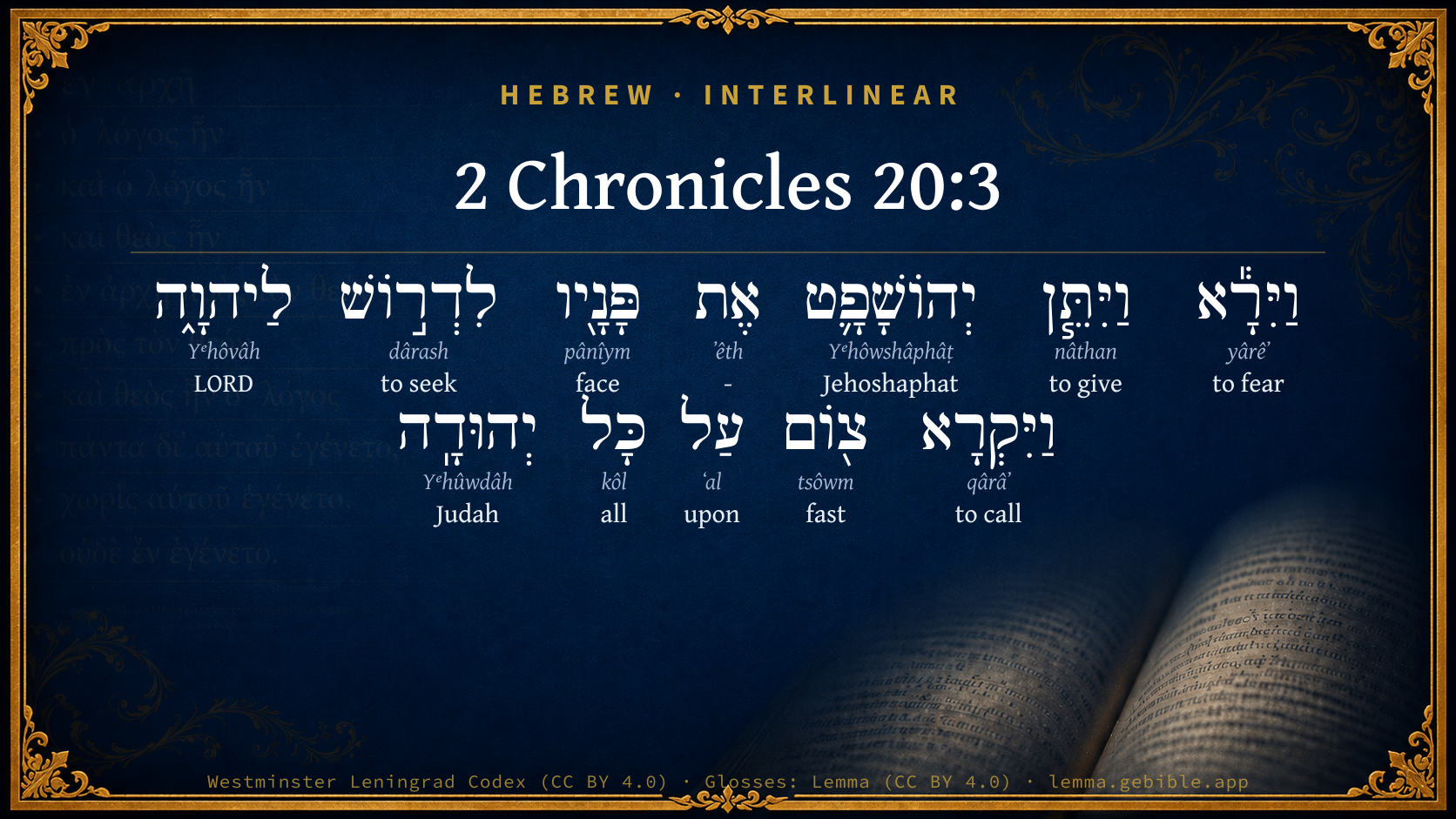
  1. וַיִּרָ֕א yârêʼ H3372 “and · to fear” Conjunction + Verb, Qal, Sequential Imperfect, 3rd Person, Masculine, Singular
  2. וַיִּתֵּ֧ן nâthan H5414 “and · to give” Conjunction + Verb, Qal, Sequential Imperfect, 3rd Person, Masculine, Singular
  3. יְהוֹשָׁפָ֛ט Yᵉhôwshâphâṭ H3092 “Jehoshaphat” Noun, Proper
  4. אֶת ʼêth H853 “-” Particle, Direct Object
  5. פָּנָ֖יו pânîym H6440 “face(s) · his” Noun, Common, Both, Plural, Construct + Suffix, Personal, 3rd Person, Masculine, Singular
  6. לִדְר֣וֹשׁ dârash H1875 “to seek” Preposition + Verb, Qal, Infinitive Construct
  7. לַיהוָ֑ה Yᵉhôvâh H3068 “to/for · LORD” Preposition + Noun, Proper
  8. וַיִּקְרָא qârâʼ H7121 “and · to call” Conjunction + Verb, Qal, Sequential Imperfect, 3rd Person, Masculine, Singular
  9. עַל ʻal H5921 “upon” Preposition
  10. כָּל kôl H3605 “all of” Noun, Common, Masculine, Singular, Construct
  11. יְהוּדָֽה Yᵉhûwdâh H3063 “Judah” Noun, Proper

About this verse

These counts appear in no published source. They are computed here, from the morphology-tagged text and Lemma’s own curated glosses. What Lemma adds →

12
words
12
distinct lemmas
Historical
section

Shared distinctive vocabulary

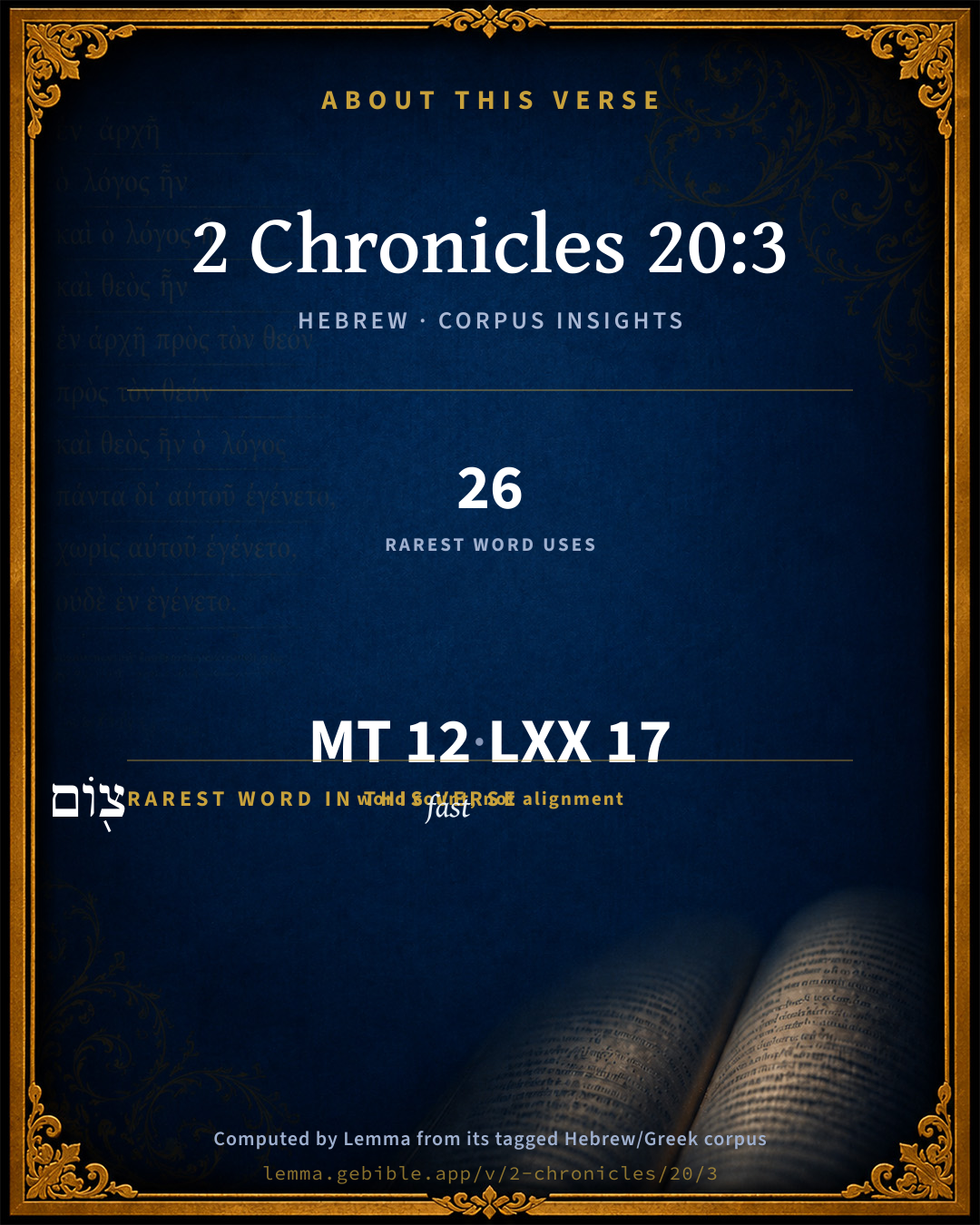
צ֖וֹם fast H6685 occurs in 22 verses of the Hebrew Bible. Also found in:

Grammatical profile

  • 4 verbs
  • 6 nouns
  • 1 preposition
  • 1 particle

Verb forms

  • וַיִּרָ֕א Qal · Sequential Imperfect
  • וַיִּתֵּ֧ן Qal · Sequential Imperfect
  • לִדְר֣וֹשׁ Qal · Infinitive Construct
  • וַיִּקְרָא Qal · Sequential Imperfect

Hebrew & Septuagint length

In English translation the verse runs 17 words from the Hebrew and 21 from the Septuagint (LXX English) — closely comparable.

A rough comparison of the two English renderings, which tokenize alike — not a word-level alignment.

Word counts can differ between the Hebrew and the Greek without any difference in meaning — e.g. the Hebrew direct-object marker אֵת has no separate Greek word, and Greek often adds the article ὁ.

In the original languages it is 12 Hebrew tokens and 17 Greek tokens — but the two are counted differently (Hebrew bundles its prefixes and suffixes into one token; the Greek is in lemma form), so that isn’t a like-for-like length.

Cross-references

17

Topical passages linked to 2 Chronicles 20:3 in the Treasury of Scripture Knowledge — connected by theme and wording, ordered by reader-vote popularity; previews shown in the World English Bible.

  • Daniel 9:3 I set my face to the Lord God, to seek by prayer and petitions, with fasting and sackcloth and ashes.
  • 1 Samuel 7:6 They gathered together to Mizpah, and drew water, and poured it out before Yahweh, and fasted on that day, and said there, We have sinned against Yahweh. Samuel judged the children of Israel in Mizpah.
  • 2 Chronicles 19:3 Nevertheless there are good things found in you, in that you have put away the Asheroth out of the land, and have set your heart to seek God.
  • Esther 4:16 Go, gather together all the Jews who are present in Shushan, and fast you for me, and neither eat nor drink three days, night or day: I also and my maidens will fast in like manner; and so will I go in to the king, which is not according to the law: and if I perish, I perish.
  • Jeremiah 36:9 Now it happened in the fifth year of Jehoiakim the son of Josiah, king of Judah, in the ninth month, that all the people in Jerusalem, and all the people who came from the cities of Judah to Jerusalem, proclaimed a fast before Yahweh.
  • Joel 1:14 Sanctify a fast. Call a solemn assembly. Gather the elders, And all the inhabitants of the land, to the house of Yahweh, your God, And cry to Yahweh.
  • Joel 2:12–18 "Yet even now," says Yahweh, "turn to me with all your heart, And with fasting, and with weeping, and with mourning."
  • Jonah 3:5–9 The people of Nineveh believed God; and they proclaimed a fast, and put on sackcloth, from the greatest of them even to the least of them.
  • Ezra 8:21–23 Then I proclaimed a fast there, at the river Ahava, that we might humble ourselves before our God, to seek of him a straight way for us, and for our little ones, and for all our substance.
  • Genesis 32:24–28 Jacob was left alone, and wrestled with a man there until the breaking of the day.
  • Judges 20:26 Then all the children of Israel, and all the people, went up, and came to Bethel, and wept, and sat there before Yahweh, and fasted that day until even; and they offered burnt-offerings and peace-offerings before Yahweh.
  • Psalms 56:3–4 When I am afraid, I will put my trust in you.
  • Isaiah 37:3–6 They said to him, Thus says Hezekiah, This day is a day of trouble, and of rebuke, and of rejection; for the children have come to the birth, and there is no strength to bring forth.
  • Matthew 10:28 Don't be afraid of those who kill the body, but are not able to kill the soul. Rather, fear him who is able to destroy both soul and body in Gehenna.
  • Genesis 32:7–11 Then Jacob was greatly afraid and was distressed: and he divided the people who were with him, and the flocks, and the herds, and the camels, into two companies;
  • 2 Chronicles 11:16 After them, out of all the tribes of Israel, such as set their hearts to seek Yahweh, the God of Israel, came to Jerusalem to sacrifice to Yahweh, the God of their fathers.
  • Jonah 1:16 Then the men feared Yahweh exceedingly; and they offered a sacrifice to Yahweh, and made vows.

Cross-references courtesy of OpenBible.info (CC BY 4.0).

Hebrew and Greek witnesses Masoretic Hebrew ↔ Greek Septuagint

The same verse in the two great witnesses to the Old Testament, shown verse-for-verse.

These are two independent witnesses, not word-aligned to each other, and the Septuagint is shown in lemma (dictionary) form.

Hebrew 2 Chronicles 20:3 Masoretic · Westminster Leningrad Codex

וַיִּרָ֕א וַיִּתֵּ֧ן יְהוֹשָׁפָ֛ט אֶת פָּנָ֖יו לִדְר֣וֹשׁ לַיהוָ֑ה וַיִּקְרָא צ֖וֹם עַל כָּל יְהוּדָֽה

Jehoshaphat feared, and set himself to seek to Yahweh; and he proclaimed a fast throughout all Judah.

World English Bible · Public Domain

Greek LXX 2 Chronicles 20:3 Septuagint · lemma form

καί φοβέω καί δίδωμι ιωσαφατ ὁ πρόσωπον αὐτός ἐκζητέω ὁ κύριος καί κηρύσσω νηστεία ἐν πᾶς ἰουδά

And Josaphat was alarmed, and set his face to seek the Lord earnestly, and he proclaimed a fast in all Juda.

LXX2012 (modern English Septuagint) · Public Domain

Hebrew: Westminster Leningrad Codex (CC BY 4.0). Greek: Septuagint (public domain); English from LXX2012 (modern English Septuagint) (Public Domain). How the Septuagint differs from the Hebrew →

Commentary

Notes on 2 Chronicles 20:3 from classic Christian and Jewish commentators (each source and its license shown beneath its notes). The classic Christian expositions comment on the surrounding passage and are grouped to its opening verse, so a note may address several verses; the Jewish commentaries on the Tanakh (Rashi and others) are per-verse, so they appear only where the commentator wrote on this verse.

Lemma curates 59 commentaries, every one of them public domain or Creative Commons licensed, each selected and text-cleaned for this edition rather than reprinted as found. About our sources →

Trapp's Complete Commentary

John Trapp

2Ch 20:3 And Jehoshaphat feared, and set himself to seek the LORD, and proclaimed a fast throughout all Judah.

Ver. 3 And Jehoshaphat feared … and proclaimed a fast.] When the Turks fast it is a sure sign that they are in a bodily fear: they also cast dust upon their heads, and their hands up towards heaven, when they are about to enter battle. {a} But Jehoshaphat’s fear was not only natural, of the enemy, but reverential, of God; and his fast not a moral but a religious abstinence, that he might thereby amerce the flesh, afflict the soul, and pray with more edge and earnestness.

{a} Turk. Hist., 157.

John Trapp, A Commentary or Exposition upon All the Books of the Old and New Testament (1647–1656) — public domain. Text from a community e-Sword module.

The Biblical Illustrator

Joseph S. Exell

2Ch_20:3

And proclaimed a fast throughout all Judah.

Objections to fasting answered

(on the occasion of a public fast):--A fast may be defined to be a voluntary abstinence from food, as a token of our humiliation before God. Objections--

1. There may be this outward mark of repentance without any real sorrow for sin. Answer--The outward expression then becomes a mockery.

2. A public fast has the appearance of ostentation. Answer--If you alone were to keep the fast, it might aver the appearance of ostentation, but in the case of public fasting, it becomes a duty not only really to fast, but to show openly your compliance with a prescribed service, and gladly to embrace the opportunity of humbling yourselves before God.

3. If we feel repentance in our hearts, God, who sees our hearts, does not require to be informed of it by any external expression. Answer--The same may be said of prayer and also of all the means of grace which God has appointed.

4. Why should fasting in particular be selected as an external mark of humiliation. Answer--

(1) Fasting has always been the public token of humility, and this in heathen nations as well as amongst Jews and Christians.

(2) It was enjoined of God upon the Jews.

(3) It was practised by our Saviour and His disciples; and recommended by them to the world.

(4) It has all the qualities that might reasonably be expected in an external act of humiliation.

(a) It is a duty easily practised.

(b) Requiring no apparatus.

(c) Connected with no expense.

(d) Simple in its own nature.

(e) Equally adapted to all ranks, climates, and places.

(f) It involves an act of self-denial.

(g) It is an act connected with the mortification of those very appetites whence many of the sins for which we thus humble ourselves proceed.

5. Fasting may disorder a person of weak health, and thus indispose him even for the service of the day. Answer--The spirit of the Christian system, insists only on the principle, and leaves the application of it to the case and conscience of the worshipper.

6. A public command to fast is a species of compulsion, and therefore inconsistent with the notion of a voluntary act of humiliation. Answer--All that is done by the command of the Government is, to render that convenient which might otherwise be very inconvenient, and that practicable which might be otherwise impracticable.

7. It is unreasonable to expect the poor to give up a days labour, and to abridge their diet who scarcely ever enjoy a full meal. Answer--It is a voluntary sacrifice: God enjoins no man to make it who is unwilling. No man will really be a loser by serving God. (J. Venn, M. A.)

The Biblical Illustrator, edited by Joseph S. Exell (c. 1880s–1900s) — public domain. Text from a community e-Sword module.

Joseph Benson's Commentary

2Ch 20:3. Jehoshaphat feared — Partly from human frailty, and partly from the remembrance of his own guilt, and the wrath of God denounced against him for it, 2Ch 19:2. And set himself to seek the Lord — The phrase denotes his settled resolution, seriousness, and earnestness in it, and the preparing and fixing of his heart for it. And proclaimed a fast — Partly in token of his humiliation and penitence for his sins, and partly to render himself and his people more fervent in their prayers.

Joseph Benson's Commentary on the Old and New Testaments (1811–1818) — public domain. Text from a community e-Sword module.

Tyndale Open Study Notes

Tyndale Open Resources

20:3-12 Jehoshaphat responded to the news of war with neighboring nations with a prayer of lament, keeping with the ideals of Solomon’s prayer (6:24-40).

Tyndale Open Study Notes — © Tyndale Open Resources, licensed CC BY-SA 4.0. Text via the HelloAO Bible API.

Geneva Bible (1599)

Geneva Bible translators

This declareth what the fear of the godly is, which is as the prick to stir them to prayer, and to depend on the Lord, whereas it moveth the wicked either to seek after worldly means and policies, or else to fall into despair.

Geneva Bible (1599) marginal notes — public domain. Text via Bolls.life.

Jamieson, Fausset & Brown

Robert Jamieson, A. R. Fausset & David Brown

Jehoshaphat . . . proclaimed a fast throughout all Judah--Alarmed by the intelligence and conscious of his total inability to repel this host of invaders, Jehoshaphat felt his only refuge was at the horns of the altar. He resolved to employ the aid of his God, and, in conformity with this resolution, he summoned all his subjects to observe a solemn fast at the sanctuary. It was customary with the Hebrew kings to proclaim fasts in perilous circumstances, either in a city, a district, or throughout the entire kingdom, according to the greatness of the emergency. On this occasion, it was a universal fast, which extended to infants (Ch2 20:13; see also Joe 2:15-16; Jon 3:7).

Jamieson, Fausset & Brown — Commentary Critical and Explanatory on the Whole Bible (1871) — public domain (CC PDM 1.0). Text via the HelloAO Bible API.

Adam Clarke's Commentary

Verse 3. Jehoshaphat feared] He found that he could not possibly stand against such a numerous army, and therefore could not expect to be delivered except by the strong arm of God. To get this assistance, it was necessary to seek it; and to get such extraordinary help, they should seek it in an extraordinary way; hence he proclaimed a universal fast, and all the people came up to Jerusalem to seek the Lord.

Adam Clarke's Commentary on the Bible (1810–1826) — public domain. Text from a community e-Sword/MySword module.

Ellicott's Commentary for English Readers

(3) And Jehoshaphat.—And he was afraid (scil., at the news). And Jehoshaphat set his face, &c. Literally, put his face—a phrase used in Dan_9:3 (comp. 2Ki_12:18), and implying resolved, determined.

To seek the Lord.—The Hebrew construction is that of 2Ch_15:13 (le is here a sign of the accusative).

Proclaimed a fast.—An act of national self-humiliation, implying an admission of guilt, and intended to evoke the Divine pity and succour. (Comp. Jdg_20:26; Joe_2:12-17; 1Sa_7:6; Ezr_8:21.)

A Bible Commentary for English Readers, edited by Charles John Ellicott (1878–1897) — public domain. Text from a community e-Sword module.

The Cambridge Bible for Schools and Colleges

gen. ed. J. J. S. Perowne

3. set himself to seek the Lord] Render, set his face to seek unto the LORD.

proclaimed a fast] A fast involved the assembling of the people; 1Ki_21:9; 1Ki_21:12; Jer_36:6; Jer_36:9; Joe_2:15. Special fasts were proclaimed for war, famine, or any other calamity or serious event.

The Cambridge Bible for Schools and Colleges (gen. ed. J. J. S. Perowne; Cambridge University Press, 1878–1918) — public domain. Text from a community e-Sword module.

John Gill's Exposition

And Jehoshaphat feared,.... Exceedingly, as the Targum adds, not merely because of the number of his enemies, for he had forces enough to go forth against them, see Ch2 17:14, but chiefly because the Lord had told him that wrath was upon him from him, Ch2 19:2 and he might fear that this was the time for the execution of it:

and set himself to seek the Lord; by prayer and supplication, with all seriousness, fervour, and constancy:

and proclaimed a fast throughout all Judah; a day of humiliation and mourning for sin before the Lord; when they were ordered to abstain from bodily food and labour, that they might be fit and more at leisure for spiritual exercises.

John Gill's Exposition of the Whole Bible (1746–1763) — public domain (CC PDM 1.0). Text via the HelloAO Bible API.

Albert Barnes' Notes on the Bible

General fasts had been previously observed by the Israelites (e. g. Jdg 20:26; 1Sa 7:6); but we do not hear of any fast having been “proclaimed” by authority before this.

Albert Barnes' Notes on the Bible (1834–1885) — public domain. Text from a community e-Sword/MySword module.

Haydock's Catholic Bible Commentary

Juda. The whole kingdom was concerned. Sometimes a fast was proclaimed for one city, 3 K. xxi. 9., and Jonas iii. 7. C. --- They were accustomed to fast, not only to subdue the flesh, but also for other necessities. W.

George Leo Haydock (1774–1849), Haydock's Catholic Family Bible and Commentary, 1859 edition — public domain. Excludes Psalms (Douay-Rheims chapter numbering differs from Protestant) and Deuterocanonical books (Catholic canon only).

Matthew Poole's English Annotations

Jehoshaphat feared; partly from human frailty, and partly from the remembrance of his own guilt, and the wrath of God denounced against him for it, 2Ch 19:2.

Set himself to seek the Lord: the phrase notes his settled resolution, seriousness, and earnestness in it, and the preparing and fixing his heart for it.

Proclaimed a fast; partly in token of his humiliation and penitence for his sins, and partly to make himself and his people more fervent in their prayers.

Matthew Poole's English Annotations on the Holy Bible (1683–1685) — public domain. Text from a community e-Sword/MySword module.

The Pulpit Commentary

Proclaimed a fast. This is the first recorded occasion of a general fast by royal proclamation, and of individual fasting it is remarkable that there is no record before the time and the act of Moses (as e.g. ; Exo_34:28) after which, for individual fasting, come occasions like those of David (2Sa_12:16) and Elijah; (1Ki_19:8) for general fasting, occasions like those of Jos_7:6; Jud_1:20:26; 1Sa_7:6; and for partial fasting, by semi-royal authority, that "proclaimed" by Jezebel. (1Ki_21:9, 1Ki_21:12)

The Pulpit Commentary (1880–1919), ed. H.D.M. Spence-Jones & Joseph S. Exell — public domain. Text from a community e-Sword module.

Keil & Delitzsch

C. F. Keil & F. Delitzsch

This report filled Jehoshaphat with fear, and he resolved to seek help of the Lord. ??????? נתן = שׂוּם , cf. Kg2 12:18; Jer 42:15, to direct the face to anything, i.e., to purpose something, come to a determination. He proclaimed a fast in all Judah, that the people might bow themselves before God, and supplicate His help, as was wont to be done in great misfortunes; cf. Jdg 20:26; Sa1 7:6; Isa 2:15. In consequence of the royal appeal, Judah came together to seek of the Lord, i.e., to pray for help, by fasting and prayer in the temple; and it was not only the inhabitants of Jerusalem who thus assembled, for they came out of all the cities of the kingdom. מיהוה בּקּשׁ, to seek of the Lord, sc. help, is expressed in the last clause by את־יהוה בּקּשׁ to seek the Lord.

Keil & Delitzsch — Biblical Commentary on the Old Testament (1861–1891) — public domain (CC PDM 1.0). Text via the HelloAO Bible API. (Old Testament only.)

unfoldingWord translationNotes

Door43 World Missions Community

set himself to seek

This is an idiom. AT: "determined himself to seek" or "devoted himself to seek" (See: Idiom)

to seek Yahweh

This speaks of seeking Yahweh's advice as if he were looking for Yahweh. AT: "to seek Yahweh's advice" (See: Metonymy)

He proclaimed a fast

The word "fast" can be expressed as a verb. AT: "He proclaimed that all the people should fast" (See: Abstract Nouns)

Judah gathered

This refers to the people of Judah. AT: "The people of Judah gathered" (See: Metonymy)

translationWords

fear

Yahweh

preach

fast

Judah

unfoldingWord translationNotes — © Distant Shores Media and the Door43 World Missions Community, licensed CC BY-SA 4.0. Source: git.door43.org/Door43/en_tn.

Lesson kit

Teaching starters — assembled from the data on this page, not authored interpretation. Every prompt links to the verse data it draws on. Edit before teaching.

2 Chronicles, in the Historical, opens this verse with 12 words (12 distinct Hebrew lemmas). Its most distinctive word is tsôwm (“fast”). A historical commentator’s framing appears above. Read the whole chapter for the surrounding context.

Discussion questions

  1. What does “fast” (tsôwm) contribute to the verse as a whole?
  2. How does 2 Samuel 12:16, which shares the word «fast», read alongside this verse?
  3. These translations render this verse differently. What is at stake in choosing one wording over another?
  4. «וַיִּרָ֕א» is a Qal Sequential Imperfect verb. How does that grammatical form shape the action described?
  5. Compare how Trapp's Complete Commentary and The Biblical Illustrator read this verse. Where do they agree or differ?

Things to notice

Reading settings

Reading text

Shown beneath each verse's original-language words.

Old Testament
Old Testament edition

Read the OT as the Masoretic Hebrew (MT) or the Greek Septuagint (LXX).

English shown for the Greek Septuagint (in the Hebrew ↔ Greek comparison).

Comparing translations? Open the Compare panel on any verse page to stack up to four side by side.