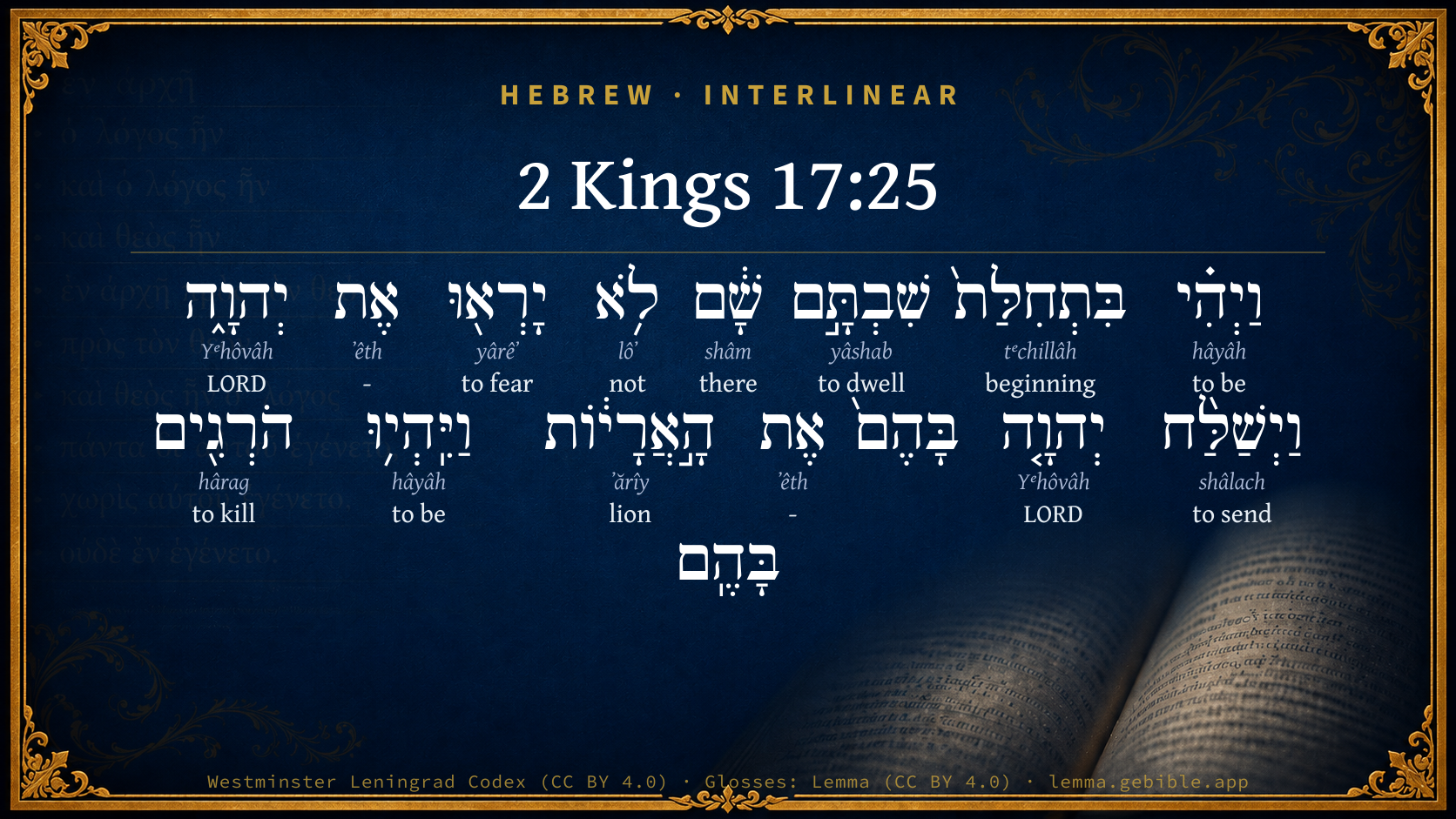
2 Kings 17:25

Hebrew (Westminster Leningrad Codex) 2 Kings 17:25 appears in the Hebrew Old Testament. The text above is from the Westminster Leningrad Codex. Each word links to its Strong’s number, a concise gloss, and parsing drawn from the Open Scriptures Hebrew Bible morphology. Click any word for its full Brown-Driver-Briggs (BDB) entry.
Download image
Cite this verse

2 Kings 17:25 (World English Bible). Public Domain. Lemma interlinear Bible study tool, https://lemma.gebible.app/v/2-kings/17/25.

Show BibTeX & RIS
BibTeX
RIS
English Translation
So it was, at the beginning of their dwelling there, that they didn't fear Yahweh: therefore Yahweh sent lions among them, which killed some of them.
World English Bible · Public Domain
Download a study sheet

One document with this verse’s original text, its word-by-word gloss line, the meaning frame, cross-references with their text, attributed commentary, and full source and license credits — printable, and it pastes into notes with its structure intact.

This verse Autodidact and up

Study sheet (.html) Plain text (.txt)

A passage Seminary Student

Up to 50 verses in one chapter. A passage sheet keeps up to 6 commentary sources and 12 cross-references per verse, in the order this page ranks them, and says so on the sheet whenever that leaves anything out. Ask for a single verse and you get the Autodidact verse sheet above.

Everything on this page stays free to read, with no account — the sheet is a download of what is already on screen, not access to it.

Want to remove ads? Support Godless Engineer
Compare translations 3

The same verse in 3 English versions, stacked beneath the original-language interlinear above. Click any original word for its lexicon entry.

Each is an independent rendering of the whole verse — the interlinear is not word-aligned to these translations.

Highlighted words mark where these versions differ — a whole-verse word diff, not a word-by-word alignment.

  • World English Bible Public Domain
    So it was, at the beginning of their dwelling there, that they didn't fear Yahweh: therefore Yahweh sent lions among them, which killed some of them.
  • King James Version Public Domain
    And so it was at the beginning of their dwelling there, that they feared not the LORD: therefore the LORD sent lions among them, which slew some of them.
  • unfoldingWord Literal Text CC BY-SA 4.0
    And it happened, at the beginning of their settling there, they did not fear Yahweh. And Yahweh sent lions among them, and they were killing among them.

unfoldingWord Literal Text — © unfoldingWord, licensed CC BY-SA 4.0. Word-aligned USFM3 via Door43 (git.door43.org/unfoldingWord/en_ult).

Versions to compare (up to 4)

3 of 4 selected

Show all 18 translations

Every available English version of this verse, each an independent rendering of the whole verse.

  • World English Bible Public Domain
    So it was, at the beginning of their dwelling there, that they didn't fear Yahweh: therefore Yahweh sent lions among them, which killed some of them.
  • Berean Standard Bible Public Domain
    Now when the settlers first lived there, they did not worship the LORD, so He sent lions among them, which killed some of them.
  • Majority Standard Bible Public Domain
    Now when the settlers first lived there, they did not worship the LORD, so He sent lions among them, which killed some of them.
  • King James Version Public Domain
    And so it was at the beginning of their dwelling there, that they feared not the LORD: therefore the LORD sent lions among them, which slew some of them.
  • American Standard Version (1901) Public Domain
    And so it was, at the beginning of their dwelling there, that they feared not Jehovah: therefore Jehovah sent lions among them, which killed some of them.
  • Revised Version (1885) Public Domain
    And so it was, at the beginning of their dwelling there, that they feared not the LORD: therefore the LORD sent lions among them, which killed some of them.
  • Geneva Bible (1599) Public Domain
    And at the beginning of their dwelling there, they feared not the Lord: therefore the Lord sent lions among them, which slewe them.
  • Douay-Rheims (1899) Public Domain
    And when they began to dwell there, they feared not the Lord: and the Lord sent lions among them, which killed them.
  • Young's Literal Translation Public Domain
    and it cometh to pass, at the commencement of their dwelling there, they have not feared Jehovah, and Jehovah doth send among them the lions, and they are destroying among them.
  • Literal Standard Version CC BY-SA 4.0
    and it comes to pass, at the commencement of their dwelling there, they have not feared YHWH, and YHWH sends the lions among them, and they are destroying among them.
  • Unlocked Literal Bible CC BY-SA 4.0
    It happened at the beginning of their residence there that they did not honor Yahweh. So Yahweh sent lions among them which killed some of them.
  • unfoldingWord Literal Text CC BY-SA 4.0
    And it happened, at the beginning of their settling there, they did not fear Yahweh. And Yahweh sent lions among them, and they were killing among them.
  • Darby Bible Public Domain
    And so it was, at the beginning of their dwelling there, that they feared not Jehovah; and Jehovah sent lions among them, which killed [some] of them.
  • World Messianic Bible Public Domain
    So it was, at the beginning of their dwelling there, that they didn’t fear the LORD. Therefore the LORD sent lions among them, which killed some of them.
  • Webster's Bible Public Domain
    And so it was at the beginning of their dwelling there, that they feared not the LORD: therefore the LORD sent lions among them, which slew some of them.
  • Free Bible Version CC BY-SA 4.0
    When they first started living there they did not worship the Lord, so he sent lions there among them, killing some of them.
  • Bible in Basic English Public Domain
    Now when first they were living there they did not give worship to the Lord. So the Lord sent lions among them, causing the death of some of them.
  • JPS Tanakh (1917) Public Domain
    And so it was, at the beginning of their dwelling there, that they feared not the LORD; therefore the LORD sent lions among them, which killed some of them.

Literal Standard Version (2020), Covenant Press — licensed CC BY-SA 4.0. Text via the HelloAO Bible API (eBible.org). Unlocked Literal Bible (unfoldingWord) — licensed CC BY-SA 4.0. Text via the HelloAO Bible API (eBible.org). unfoldingWord Literal Text — © unfoldingWord, licensed CC BY-SA 4.0. Word-aligned USFM3 via Door43 (git.door43.org/unfoldingWord/en_ult). Free Bible Version, Dr. Jonathan Gallagher — licensed CC BY-SA 4.0. Text via the HelloAO Bible API (eBible.org).

Word by word

More ways to search: Search by grammar → Find every occurrence → Compare this word →

Practice this passage: Drill this verse → Learn its vocabulary →

בִּתְחִלַּת֙
tᵉchillâh
H8462
“in/at · beginning of”
Preposition + Noun, Common, Feminine, Singular, Construct
Part of Speech
Preposition + Noun
Type
Common
Gender
Feminine
Number
Singular
State
Construct
Full BDB Definition

Origin: from H2490 in the sense of opening

TWOT: 661d

beginning, first - the first time - from the beginning, in the beginning (with preposition)
  1. וַיְהִ֗י hâyâh H1961 “and · to be” Conjunction + Verb, Qal, Sequential Imperfect, 3rd Person, Masculine, Singular
  2. שִׁבְתָּ֣ם yâshab H3427 “to dwell · them” Verb, Qal, Infinitive Construct + Suffix, Personal, 3rd Person, Masculine, Plural
  3. שָׁ֔ם shâm H8033 “there” Adverb
  4. לֹ֥א lôʼ H3808 “not” Particle, Negative
  5. יָרְא֖וּ yârêʼ H3372 “to fear” Verb, Qal, Perfect, 3rd Person, Common, Plural
  6. אֶת ʼêth H853 “-” Particle, Direct Object
  7. יְהוָ֑ה Yᵉhôvâh H3068 “LORD” Noun, Proper
  8. וַיְשַׁלַּ֨ח shâlach H7971 “and · to send” Conjunction + Verb, Piel, Sequential Imperfect, 3rd Person, Masculine, Singular
  9. יְהוָ֤ה Yᵉhôvâh H3068 “LORD” Noun, Proper
  10. אֶת ʼêth H853 “-” Particle, Direct Object
  11. הָ֣אֲרָי֔וֹת ʼărîy H738 “the · lions” Particle, Definite Article + Noun, Common, Masculine, Plural, Absolute
  12. וַיִּֽהְי֥וּ hâyâh H1961 “and · to be” Conjunction + Verb, Qal, Sequential Imperfect, 3rd Person, Masculine, Plural
  13. הֹרְגִ֖ים hârag H2026 “killing” Verb, Qal, Participle Active, Masculine, Plural, Absolute

About this verse

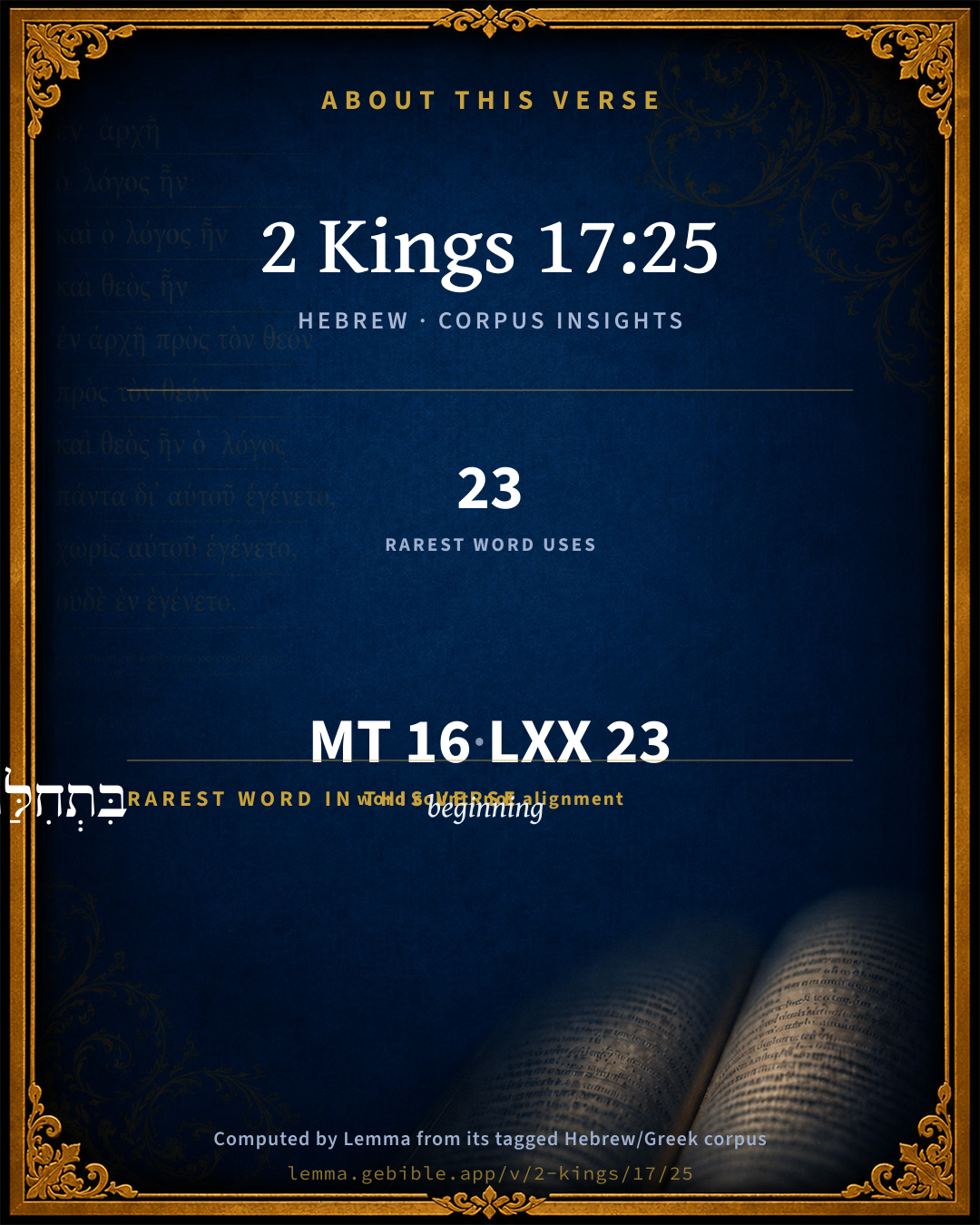
These counts appear in no published source. They are computed here, from the morphology-tagged text and Lemma’s own curated glosses. What Lemma adds →

16
words
11
distinct lemmas
Historical
section

Notable vocabulary

The rarest word here is בִּתְחִלַּת֙ beginning H8462 — appearing just 23 times in the whole Hebrew Bible.

Shared distinctive vocabulary

בִּתְחִלַּת֙ beginning H8462 occurs in 21 verses of the Hebrew Bible. Also found in:

Grammatical profile

  • 6 verbs
  • 4 nouns
  • 2 prepositions
  • 1 adverb
  • 3 particles

Verb forms

  • וַיְהִ֗י Qal · Sequential Imperfect
  • שִׁבְתָּ֣ם Qal · Infinitive Construct
  • יָרְא֖וּ Qal · Perfect
  • וַיְשַׁלַּ֨ח Piel · Sequential Imperfect
  • וַיִּֽהְי֥וּ Qal · Sequential Imperfect
  • הֹרְגִ֖ים Qal · Participle Active

Repetition

Words recur within this verse — often emphatic in Hebrew:

  • וַיְהִ֗י to be H1961 ×2
  • יְהוָ֑ה LORD H3068 ×2

Hebrew & Septuagint length

In English translation the verse runs 26 words from the Hebrew and 30 from the Septuagint (LXX English) — closely comparable.

A rough comparison of the two English renderings, which tokenize alike — not a word-level alignment.

Word counts can differ between the Hebrew and the Greek without any difference in meaning — e.g. the Hebrew direct-object marker אֵת has no separate Greek word, and Greek often adds the article ὁ.

In the original languages it is 16 Hebrew tokens and 23 Greek tokens — but the two are counted differently (Hebrew bundles its prefixes and suffixes into one token; the Greek is in lemma form), so that isn’t a like-for-like length.

Cross-references

15

Topical passages linked to 2 Kings 17:25 in the Treasury of Scripture Knowledge — connected by theme and wording, ordered by reader-vote popularity; previews shown in the World English Bible.

  • 2 Kings 17:32 So they feared Yahweh, and made to them from among themselves priests of the high places, who sacrificed for them in the houses of the high places.
  • 2 Kings 17:34 To this day they do after the former manner: they don't fear Yahweh, neither do they after their statutes, or after their ordinances, or after the law or after the commandment which Yahweh commanded the children of Jacob, whom he named Israel;
  • 2 Kings 17:41 So these nations feared Yahweh, and served their engraved images; their children likewise, and their children's children, as did their fathers, so do they to this day.
  • Joshua 22:25 for Yahweh has made the Jordan a border between us and you, you children of Reuben and children of Gad; you have no portion in Yahweh: so might your children make our children cease from fearing Yahweh.
  • 1 Kings 13:24 When he was gone, a lion met him by the way, and killed him: and his body was cast in the way, and the donkey stood by it; the lion also stood by the body.
  • 1 Kings 20:36 Then said he to him, Because you have not obeyed the voice of Yahweh, behold, as soon as you are departed from me, a lion shall kill you. As soon as he was departed from him, a lion found him, and killed him.
  • 2 Kings 2:24 He looked behind him and saw them, and cursed them in the name of Yahweh. There came forth two she-bears out of the wood, and mauled forty-two lads of them.
  • 2 Kings 17:28 So one of the priests whom they had carried away from Samaria came and lived in Bethel, and taught them how they should fear Yahweh.
  • Jeremiah 5:6 Therefore a lion out of the forest shall kill them, a wolf of the evenings shall destroy them, a leopard shall watch against their cities; everyone who goes out there shall be torn in pieces; because their transgressions are many, [and] their backsliding is increased.
  • Jeremiah 10:7 Who should not fear you, King of the nations? for to you does it appertain; because among all the wise men of the nations, and in all their royal estate, there is none like you.
  • Jeremiah 15:3 I will appoint over them four kinds, says Yahweh: the sword to kill, and the dogs to tear, and the birds of the sky, and the animals of the earth, to devour and to destroy.
  • Ezekiel 14:15 If I cause evil animals to pass through the land, and they ravage it, and it be made desolate, so that no man may pass through because of the animals;
  • Ezekiel 14:21 For thus says the Lord Yahweh: How much more when I send my four sore judgments on Jerusalem, the sword, and the famine, and the evil animals, and the pestilence, to cut off from it man and animal!
  • Daniel 6:26 I make a decree, that in all the dominion of my kingdom men tremble and fear before the God of Daniel; for he is the living God, and steadfast forever, His kingdom that which shall not be destroyed; and his dominion shall be even to the end.
  • Jonah 1:9 He said to them, "I am a Hebrew, and I fear Yahweh, the God of heaven, who has made the sea and the dry land."

Cross-references courtesy of OpenBible.info (CC BY 4.0).

Hebrew and Greek witnesses Masoretic Hebrew ↔ Greek Septuagint

The same verse in the two great witnesses to the Old Testament, shown verse-for-verse.

These are two independent witnesses, not word-aligned to each other, and the Septuagint is shown in lemma (dictionary) form.

Hebrew 2 Kings 17:25 Masoretic · Westminster Leningrad Codex

וַיְהִ֗י בִּתְחִלַּת֙ שִׁבְתָּ֣ם שָׁ֔ם לֹ֥א יָרְא֖וּ אֶת יְהוָ֑ה וַיְשַׁלַּ֨ח יְהוָ֤ה בָּהֶם֙ אֶת הָ֣אֲרָי֔וֹת וַיִּֽהְי֥וּ הֹרְגִ֖ים בָּהֶֽם

So it was, at the beginning of their dwelling there, that they didn't fear Yahweh: therefore Yahweh sent lions among them, which killed some of them.

World English Bible · Public Domain

Greek LXX 2 Kings 17:25 Septuagint · lemma form

καί γίγνομαι ἐν ἀρχή ὁ καθέδρα αὐτός οὐ φοβέω ὁ κύριος καί ἀποστέλλω κύριος ἐν αὐτός ὁ λέων καί εἰμί ἀποκτείνω ἐν αὐτός

And it was so at the beginning of their establishment there that they feared not the Lord, and the Lord sent lions among them, and they killed some of them.

LXX2012 (modern English Septuagint) · Public Domain

Hebrew: Westminster Leningrad Codex (CC BY 4.0). Greek: Septuagint (public domain); English from LXX2012 (modern English Septuagint) (Public Domain). How the Septuagint differs from the Hebrew →

Targum (Aramaic paraphrase)

1

The Targum is the ancient Jewish Aramaic paraphrase of the Hebrew Scriptures — an interpretive translation, not the Hebrew text itself. Onkelos (literal) and Pseudo-Jonathan (expansive) render the Torah, and Jonathan the Prophets. Coverage is partial: where no permissively-licensed English translation exists for a verse, only the Aramaic is shown. This is verse-level text, not a word-by-word alignment to the Hebrew.

  1. Targum Jonathan Prophets (Joshua–Malachi)
    וַהֲוָה בִּשְׁרָיוּת לְמֵיתַבְהוֹן תַּמָן לָא הֲווֹ דַחֲלִין מִן קֳדָם יְיָ וְגָרֵי יְיָ בְּהוֹן יַת אַרְיְוָתָא וַהֲווֹ קַטְלִין בְּהוֹן:

    (no public-domain English translation for this verse)

    Targum Jonathan — Aramaic: “Mikraot Gedolot” (public domain). English: “Sefaria Community Translation” (CC0 1.0 (public-domain dedication)); “London "Chaldee Paraphrase," 1871” (public domain). Text via Sefaria.

Commentary

Notes on 2 Kings 17:25 from classic Christian and Jewish commentators (each source and its license shown beneath its notes). The classic Christian expositions comment on the surrounding passage and are grouped to its opening verse, so a note may address several verses; the Jewish commentaries on the Tanakh (Rashi and others) are per-verse, so they appear only where the commentator wrote on this verse.

Lemma curates 59 commentaries, every one of them public domain or Creative Commons licensed, each selected and text-cleaned for this edition rather than reprinted as found. About our sources →

Trapp's Complete Commentary

John Trapp

2Ki 17:25 And [so] it was at the beginning of their dwelling there, [that] they feared not the LORD: therefore the LORD sent lions among them, which slew [some] of them.

Ver. 25. That they feared not the Lord.] As he expected they should some way own him in a land which he was pleased to own. To do wickedly in a land of uprightness is a foul business. {Isa 26:10}

John Trapp, A Commentary or Exposition upon All the Books of the Old and New Testament (1647–1656) — public domain. Text from a community e-Sword module.

Joseph Benson's Commentary

2Ki 17:25. And so it was that they feared not the Lord — They did not acknowledge nor worship the true God in any sort. Therefore the Lord sent lions among them — For their gross neglect and contempt of God, which was contrary to the principles and practices of the heathen, who used to worship the gods of the nations where they lived, and gave that honour to their false gods which here they denied to the true. Hereby also God asserted his own sovereignty over that land, and made them to understand that neither the Israelites were cast out, nor they brought in, by their valour or strength, but by God’s providence, who, as he had cast the Israelites out for their neglect of God’s service, so both could and would, in his due time, turn them out also, if they were guilty of the same sins.

Joseph Benson's Commentary on the Old and New Testaments (1811–1818) — public domain. Text from a community e-Sword module.

Geneva Bible (1599)

Geneva Bible translators

That is, they served him not: therefore, lest they should blaspheme him, as though there were no God, because he chastised the Israelites, he showeth his mighty power among them by this strange punishment.

Geneva Bible (1599) marginal notes — public domain. Text via Bolls.life.

Adam Clarke's Commentary

Verse 25. The Lord sent lions among them] The land being deprived of its inhabitants, wild beasts would necessarily increase, even without any supernatural intervention; and this the superstitious new comers supposed to be a plague sent upon them, because they did not know how to worship him who was the God of the land; for they thought, like other heathens that every district had its own tutelary deity. Yet it is likely that God did send lions as a scourge on this bad people.

Adam Clarke's Commentary on the Bible (1810–1826) — public domain. Text from a community e-Sword/MySword module.

Ellicott's Commentary for English Readers

(25) The Lord sent (the) lions.—In the interval between the Assyrian depopulation and the re-peopling of the land, the lions indigenous to the country had multiplied naturally enough. Their ravages were understood by the colonists as a token of the wrath of the local deity on account of their neglect of his worship. The sacred writer endorses this interpretation of the incident, probably remembering Lev_26:22. (Comp. Exo_23:29; Eze_14:15.)

Which slew.—The form of the verb implies a state of things which lasted some time. Literally, and they were killing among them.

A Bible Commentary for English Readers, edited by Charles John Ellicott (1878–1897) — public domain. Text from a community e-Sword module.

The Cambridge Bible for Schools and Colleges

gen. ed. J. J. S. Perowne

25. the Lord sent lions among them, which slew [R.V. killed] some of them] The word rendered ‘slew’ is not the same here as that in the next verse. This statement must be considered as the thought of the people themselves. How far it might also be shared by the writer of Kings we cannot know. These heathen people having regarded their own divinities as especially attached to certain places, would consider that Israel had also its own local deity. Him and His worship they were ignorant of, and when the wild beasts increased upon them it was a natural idea with them to regard the plague as inflicted by the god of the country. That wild beasts were not uncommon in the Holy Land at this period we can see from other places of the history, and when the land was less thickly populated, such beasts as remained would have more chance of multiplying.

The Cambridge Bible for Schools and Colleges (gen. ed. J. J. S. Perowne; Cambridge University Press, 1878–1918) — public domain. Text from a community e-Sword module.

John Gill's Exposition

And so it was at the beginning of their dwelling there, that they feared not the Lord,.... Did not serve him in any manner, but their idols only, which they brought with them; whereas it was usual with Heathens to serve the gods of the country, as they reputed them, where they came, along with their own; but even this those men did not do:

therefore the Lord sent lions among them; even into their cities, into which lions sometimes came (l), especially when old, out of the thickets of Jordan and other places where they haunted, see Jer 49:19.

which slew some of them; this the Lord did to assert his sovereignty, authority, and mighty power, and to let them know that he could as easily clear the land of them, as they, by his permission, had cleared the land of the Israelites, Josephus (m) calls this a plague that was sent among them.

(l) Aristot. Hist. Animal. l. 9. c. 44. Plin. Nat. Hist. l. 8. c. 16. (m) Ut supra. (Antiqu. l. 9. c. 14. sect. 1.)

John Gill's Exposition of the Whole Bible (1746–1763) — public domain (CC PDM 1.0). Text via the HelloAO Bible API.

Albert Barnes' Notes on the Bible

The depopulation of the country, insufficiently remedied by the influx of foreigners, had the natural consequence of multiplying the wild beasts and making them bolder. Probably a certain number had always lurked in the jungle along the course of the Jordan Jer 49:19; Jer 50:44; and these now ventured into the hill country, and perhaps even into the cities. The colonists regarded their sufferings from the lions as a judgment upon them from “the god of the land” (2Ki 17:26; compare 1Ki 20:23 note).

Albert Barnes' Notes on the Bible (1834–1885) — public domain. Text from a community e-Sword/MySword module.

Haydock's Catholic Bible Commentary

Lions. The Samaritan Chronicle says the fruits, though beautiful to the eye, were of a poisonous quality; and Josephus, as usual, ([Antiquities?] ix. 14.) alters the text, saying that the people were afflicted with pestilence, and the oracle being consulted, told them to worship the High God; on which account, they desired the king to send them a priest. (Calmet) --- These nations had not been accustomed to fear the Lord in their own country; but God was more offended when they exercised their idolatrous worship in that land, which he had chosen in a particular manner for himself. (Menochius) --- He suffers wickedness and infidelity to prevail to a certain point; but when his patience is exhausted, (Calmet) all nature fights for him against the wicked. (Haydock)

George Leo Haydock (1774–1849), Haydock's Catholic Family Bible and Commentary, 1859 edition — public domain. Excludes Psalms (Douay-Rheims chapter numbering differs from Protestant) and Deuterocanonical books (Catholic canon only).

Matthew Poole's English Annotations

They feared not the Lord; they did not acknowledge nor worship God in any sort.

Therefore; for this gross neglect and contempt of God, which was contrary to the principles and practices of the heathens, who used to worship the gods of the nations where they lived, and gave that honour to their false gods which here they denied to the true. Hereby also God asserted his own right and sovereignty over that land, and made them to understand that neither the Israelites were cast out nor they brought into that land by their valour or strength, but by God’s providence, who as he had cast the Israelites out for their neglect of God’s service, so both could and would in his due time turn them out also, if they were guilty of the same sins.

Matthew Poole's English Annotations on the Holy Bible (1683–1685) — public domain. Text from a community e-Sword/MySword module.

Whedon's Commentary on the Bible

Daniel D. Whedon

25. They feared not the Lord — For they were idolaters, (2Ki_17:30-31,) and knew nothing of Jehovah.

The Lord sent lions — The theocratic historian views all calamities as Divine dispensations. Compare Lev_26:22. It was very natural that wild beasts should multiply and become dangerous in a region so suddenly and so largely depopulated as was Samaria. And it is probable that the number of the new colonists was much smaller than that of the exiles, and at the beginning of their dwelling there they would be likely to cleave together, and not occupy the wilder districts.

Daniel D. Whedon (gen. ed.), Commentary on the Old and New Testaments (1874–1909) — public domain. Text from a community e-Sword module.

The Pulpit Commentary

And so it was at the beginning of their dwelling there, that they feared not the Lord. They were ignorant, i.e. , of Jehovah, and paid him no religious regard. They brought with them their own forms of heathenism (see vers. 30, 31). Therefore the Lord sent lions among them. Lions are not now found in Palestine, nor indeed in any part of Syria, though they are numerous in Mesopotamia; but anciently they appear to have been tolerably common in all parts of the Holy Land. (see the comment on 1Ki_13:24) We may gather from what is said here that, though new settlers had been brought into the country by the Assyrians, yet still there had been a considerable decrease in the population, which had been favorable to the lions multiplying. The new settlers, it is to be noted, were placed in the towns (ver. 24); and it is probable that many of the country districts lay waste and desolate. Still, the writer views the great increase in the number of the lions as a Divine judgment, which it may have been, though based upon a natural circumstance. Which slew some of them. (For the great boldness of the Palestinian lion, see 1Ki_13:24 1Ki_20:36; Pro_22:13; Isa_31:4 Isa_38:13; Jer_5:6, etc.)

The Pulpit Commentary (1880–1919), ed. H.D.M. Spence-Jones & Joseph S. Exell — public domain. Text from a community e-Sword module.

John Wesley's Explanatory Notes

Therefore - For their gross neglect, and contempt of God, which was contrary to the principles and practices of the Heathens, who used to worship the gods of the nations where they lived, and gave that honour to their false Gods, which here they denied to the true. Hereby also God asserted his own sovereignty over that land, and made them to understand, that neither the Israelites were cast out, nor they brought in by their valour, or strength, but by God's providence, who as he had cast the Israelites out for their neglect of God's service; so both could, and would in his due time, turn them out also, if they were guilty of the same sins.

John Wesley, Explanatory Notes Upon the Whole Bible (1754–1765) — public domain. Text via the GEBible commentary corpus.

Rashi

Rabbi Shlomo Yitzchaki (Rashi)

They did not fear Adonoy. Even though the pagan nations fear Him and call him the God of the gods, in the manner as it is stated, ”And My Name is feared among the nations,” but these did not fear Me, for they said, “If He were worthy of fear, He would not have allowed for His people to be exiled.”

Rashi on the Tanakh — English translations: “The Judaica Press complete Tanach with Rashi, translated by A. J. Rosenberg” (CC BY 4.0); “Pentateuch with Rashi's commentary by M. Rosenbaum and A.M. Silbermann, 1929-1934” (public domain); “The Metsudah Tanach series, Lakewood, N.J” (CC BY 4.0); and “The Book of Joshua, Metsudah Publications, 1997” (CC BY 4.0). Text via Sefaria.

Lesson kit

Teaching starters — assembled from the data on this page, not authored interpretation. Every prompt links to the verse data it draws on. Edit before teaching.

2 Kings, in the Historical, opens this verse with 16 words (11 distinct Hebrew lemmas). Its most distinctive word is tᵉchillâh (“beginning”). A historical commentator’s framing appears above. Read the whole chapter for the surrounding context.

Discussion questions

  1. How does “beginning” (tᵉchillâh) shape what this verse is saying?
  2. How does Genesis 13:3, which shares the word «beginning», read alongside this verse?
  3. What does the repetition of “to be” (2× in this one verse) do in this verse?
  4. These translations render this verse differently. What is at stake in choosing one wording over another?
  5. «וַיְהִ֗י» is a Qal Sequential Imperfect verb. How does that grammatical form shape the action described?
  6. Compare how Trapp's Complete Commentary and Joseph Benson's Commentary read this verse. Where do they agree or differ?

Things to notice

Reading settings

Reading text

Shown beneath each verse's original-language words.

Old Testament
Old Testament edition

Read the OT as the Masoretic Hebrew (MT) or the Greek Septuagint (LXX).

English shown for the Greek Septuagint (in the Hebrew ↔ Greek comparison).

Comparing translations? Open the Compare panel on any verse page to stack up to four side by side.