
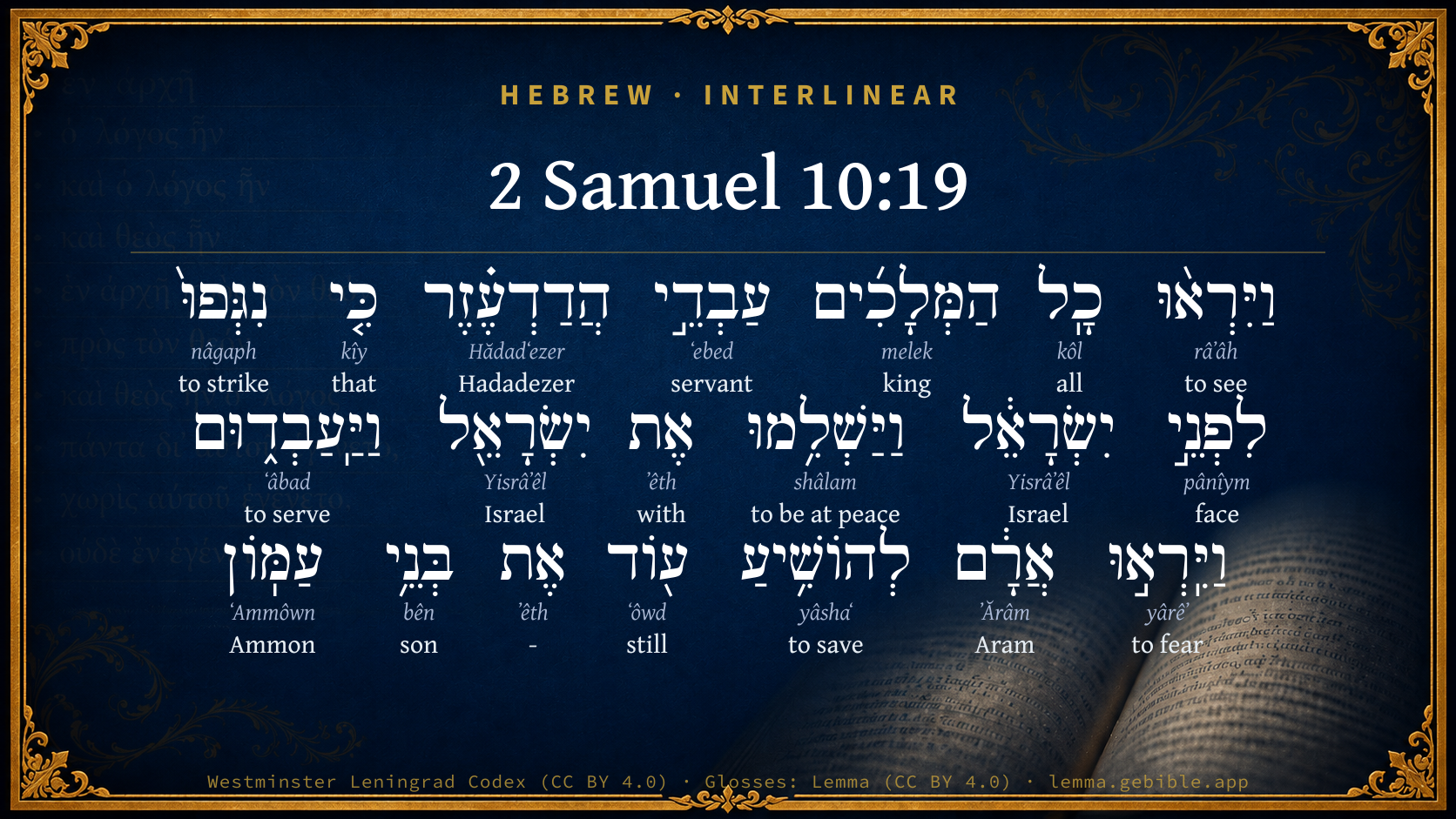
2 Samuel 10:19

Hebrew (Westminster Leningrad Codex) 2 Samuel 10:19 appears in the Hebrew Old Testament. The text above is from the Westminster Leningrad Codex. Each word links to its Strong’s number, a concise gloss, and parsing drawn from the Open Scriptures Hebrew Bible morphology. Click any word for its full Brown-Driver-Briggs (BDB) entry.
Download image
Cite this verse

2 Samuel 10:19 (World English Bible). Public Domain. Lemma interlinear Bible study tool, https://lemma.gebible.app/v/2-samuel/10/19.

Show BibTeX & RIS
BibTeX
RIS
English Translation
When all the kings who were servants to Hadarezer saw that they were put to the worse before Israel, they made peace with Israel, and served them. So the Syrians feared to help the children of Ammon any more.
World English Bible · Public Domain
Download a study sheet

One document with this verse’s original text, its word-by-word gloss line, the meaning frame, cross-references with their text, attributed commentary, and full source and license credits — printable, and it pastes into notes with its structure intact.

This verse Autodidact and up

Study sheet (.html) Plain text (.txt)

A passage Seminary Student

Up to 50 verses in one chapter. A passage sheet keeps up to 6 commentary sources and 12 cross-references per verse, in the order this page ranks them, and says so on the sheet whenever that leaves anything out. Ask for a single verse and you get the Autodidact verse sheet above.

Everything on this page stays free to read, with no account — the sheet is a download of what is already on screen, not access to it.

Want to remove ads? Support Godless Engineer
Compare translations 3

The same verse in 3 English versions, stacked beneath the original-language interlinear above. Click any original word for its lexicon entry.

Each is an independent rendering of the whole verse — the interlinear is not word-aligned to these translations.

Highlighted words mark where these versions differ — a whole-verse word diff, not a word-by-word alignment.

  • World English Bible Public Domain
    When all the kings who were servants to Hadarezer saw that they were put to the worse before Israel, they made peace with Israel, and served them. So the Syrians feared to help the children of Ammon any more.
  • King James Version Public Domain
    And when all the kings that were servants to Hadarezer saw that they were smitten before Israel, they made peace with Israel, and served them. So the Syrians feared to help the children of Ammon any more.
  • unfoldingWord Literal Text CC BY-SA 4.0
    And all of the kings, servants of Hadadezer, saw that they had been struck to the face of Israel, and they made peace with Israel, and they served them. And Aram feared to save the sons of Ammon anymore.

unfoldingWord Literal Text — © unfoldingWord, licensed CC BY-SA 4.0. Word-aligned USFM3 via Door43 (git.door43.org/unfoldingWord/en_ult).

Versions to compare (up to 4)

3 of 4 selected

Show all 18 translations

Every available English version of this verse, each an independent rendering of the whole verse.

  • World English Bible Public Domain
    When all the kings who were servants to Hadarezer saw that they were put to the worse before Israel, they made peace with Israel, and served them. So the Syrians feared to help the children of Ammon any more.
  • Berean Standard Bible Public Domain
    When all the kings who were subject to Hadadezer saw that they had been defeated by Israel, they made peace with Israel and became subject to them. So the Arameans were afraid to help the Ammonites anymore.
  • Majority Standard Bible Public Domain
    When all the kings who were subject to Hadadezer saw that they had been defeated by Israel, they made peace with Israel and became subject to them. So the Arameans were afraid to help the Ammonites anymore.
  • King James Version Public Domain
    And when all the kings that were servants to Hadarezer saw that they were smitten before Israel, they made peace with Israel, and served them. So the Syrians feared to help the children of Ammon any more.
  • American Standard Version (1901) Public Domain
    And when all the kings that were servants to Hadarezer saw that they were put to the worse before Israel, they made peace with Israel, and served them. So the Syrians feared to help the children of Ammon any more.
  • Revised Version (1885) Public Domain
    And when all the kings that were servants to Hadarezer saw that they were put to the worse before Israel, they made peace with Israel, and served them. So the Syrians feared to help the children of Ammon any more.
  • Geneva Bible (1599) Public Domain
    And when all the Kings, that were seruants to Hadarezer, saw that they fell before Israel, they made peace with Israel, and serued them. and the Aramites feared to helpe the children of Ammon any more.
  • Douay-Rheims (1899) Public Domain
    And all the kings that were auxiliaries of Adarezer, seeing themselves overcome by Israel, were afraid and fled away, eight and fifty thousand men before Israel. And they made peace with Israel: and served them, and all the Syrians were afraid to help the children of Ammon any more.
  • Young's Literal Translation Public Domain
    And all the kings -- servants of Hadadezer -- see that they have been smitten before Israel, and make peace with Israel, and serve them; and Aram is afraid to help any more the Bene-Ammon.
  • Literal Standard Version CC BY-SA 4.0
    And all the kings—servants of Hadadezer—see that they have been struck before Israel, and make peace with Israel, and serve them; and Aram is afraid to help the sons of Ammon anymore.
  • Unlocked Literal Bible CC BY-SA 4.0
    When all the kings who were servants of Hadarezer saw that they were defeated by Israel, they made peace with Israel and became their subjects. So the Arameans were afraid to help the people of Ammon anymore.
  • unfoldingWord Literal Text CC BY-SA 4.0
    And all of the kings, servants of Hadadezer, saw that they had been struck to the face of Israel, and they made peace with Israel, and they served them. And Aram feared to save the sons of Ammon anymore.
  • Darby Bible Public Domain
    And all the kings that were servants to Hadarezer saw that they were routed before Israel, and they made peace with Israel, and served them. And the Syrians feared to help the children of Ammon any more.
  • World Messianic Bible Public Domain
    When all the kings who were servants to Hadadezer saw that they were defeated before Israel, they made peace with Israel and served them. So the Syrians were afraid to help the children of Ammon any more.
  • Webster's Bible Public Domain
    And when all the kings that were servants to Hadarezer saw that they were smitten before Israel, they made peace with Israel, and served them. So the Syrians feared to help the children of Ammon any more.
  • Free Bible Version CC BY-SA 4.0
    When all the kings allied with Hadadezer realized that they had been defeated by Israel, they made peace with David and became subject to him. As a result, the Arameans were afraid to help the Ammonites any more.
  • Bible in Basic English Public Domain
    And when all the kings who were servants of Hadadezer saw that they were overcome by Israel, they made peace with Israel and became their servants. So the Aramaeans, in fear, gave no more help to the children of Ammon.
  • JPS Tanakh (1917) Public Domain
    And when all the kings that were servants to Hadadezer saw that they were put to the worse before Israel, they made peace with Israel, and served them. So the Arameans feared to help the children of Ammon any more.

Literal Standard Version (2020), Covenant Press — licensed CC BY-SA 4.0. Text via the HelloAO Bible API (eBible.org). Unlocked Literal Bible (unfoldingWord) — licensed CC BY-SA 4.0. Text via the HelloAO Bible API (eBible.org). unfoldingWord Literal Text — © unfoldingWord, licensed CC BY-SA 4.0. Word-aligned USFM3 via Door43 (git.door43.org/unfoldingWord/en_ult). Free Bible Version, Dr. Jonathan Gallagher — licensed CC BY-SA 4.0. Text via the HelloAO Bible API (eBible.org).

Word by word

More ways to search: Search by grammar → Find every occurrence → Compare this word →

Practice this passage: Drill this verse → Learn its vocabulary →

הֲדַדְעֶ֗זֶר
Hădadʻezer
H1909
“Hadadezer”
Noun, Proper
Part of Speech
Noun
Type
Proper
Full BDB Definition

Origin: from H1908 and H5828

TWOT: None

Hadadezer = "Hadad is help" - son of Rehob, a king of Syria-Zobah defeated by David's army
  1. וַיִּרְא֨וּ râʼâh H7200 “and · to see” Conjunction + Verb, Qal, Sequential Imperfect, 3rd Person, Masculine, Plural
  2. כָֽל kôl H3605 “all of” Noun, Common, Masculine, Singular, Construct
  3. הַמְּלָכִ֜ים melek H4428 “the · kings” Particle, Definite Article + Noun, Common, Masculine, Plural, Absolute
  4. עַבְדֵ֣י ʻebed H5650 “servants of” Noun, Common, Masculine, Plural, Construct
  5. כִּ֤י kîy H3588 “that” Conjunction
  6. נִגְּפוּ֙ nâgaph H5062 “to strike” Verb, Niphal, Perfect, 3rd Person, Common, Plural
  7. לִפְנֵ֣י pânîym H6440 “to/for · face(s) of” Preposition + Noun, Common, Both, Plural, Construct
  8. יִשְׂרָאֵ֔ל Yisrâʼêl H3478 “Israel” Noun, Proper
  9. וַיַּשְׁלִ֥מוּ shâlam H7999 “and · to be at peace” Conjunction + Verb, Hiphil, Sequential Imperfect, 3rd Person, Masculine, Plural
  10. אֶת ʼêth H854 “with” Preposition
  11. יִשְׂרָאֵ֖ל Yisrâʼêl H3478 “Israel” Noun, Proper
  12. וַיַּֽעַבְד֑וּם ʻâbad H5647 “and · to serve · them” Conjunction + Verb, Qal, Sequential Imperfect, 3rd Person, Masculine, Plural + Suffix, Personal, 3rd Person, Masculine, Plural
  13. וַיִּֽרְא֣וּ yârêʼ H3372 “and · to fear” Conjunction + Verb, Qal, Sequential Imperfect, 3rd Person, Masculine, Plural
  14. אֲרָ֔ם ʼĂrâm H758 “Aram” Noun, Proper
  15. לְהוֹשִׁ֥יעַ yâshaʻ H3467 “to save” Preposition + Verb, Hiphil, Infinitive Construct
  16. ע֖וֹד ʻôwd H5750 “still” Adverb
  17. אֶת ʼêth H853 “-” Particle, Direct Object
  18. בְּנֵ֥י bên H1121 “sons of” Noun, Common, Masculine, Plural, Construct
  19. עַמּֽוֹן ʻAmmôwn H5983 “Ammon” Noun, Proper

About this verse

These counts appear in no published source. They are computed here, from the morphology-tagged text and Lemma’s own curated glosses. What Lemma adds →

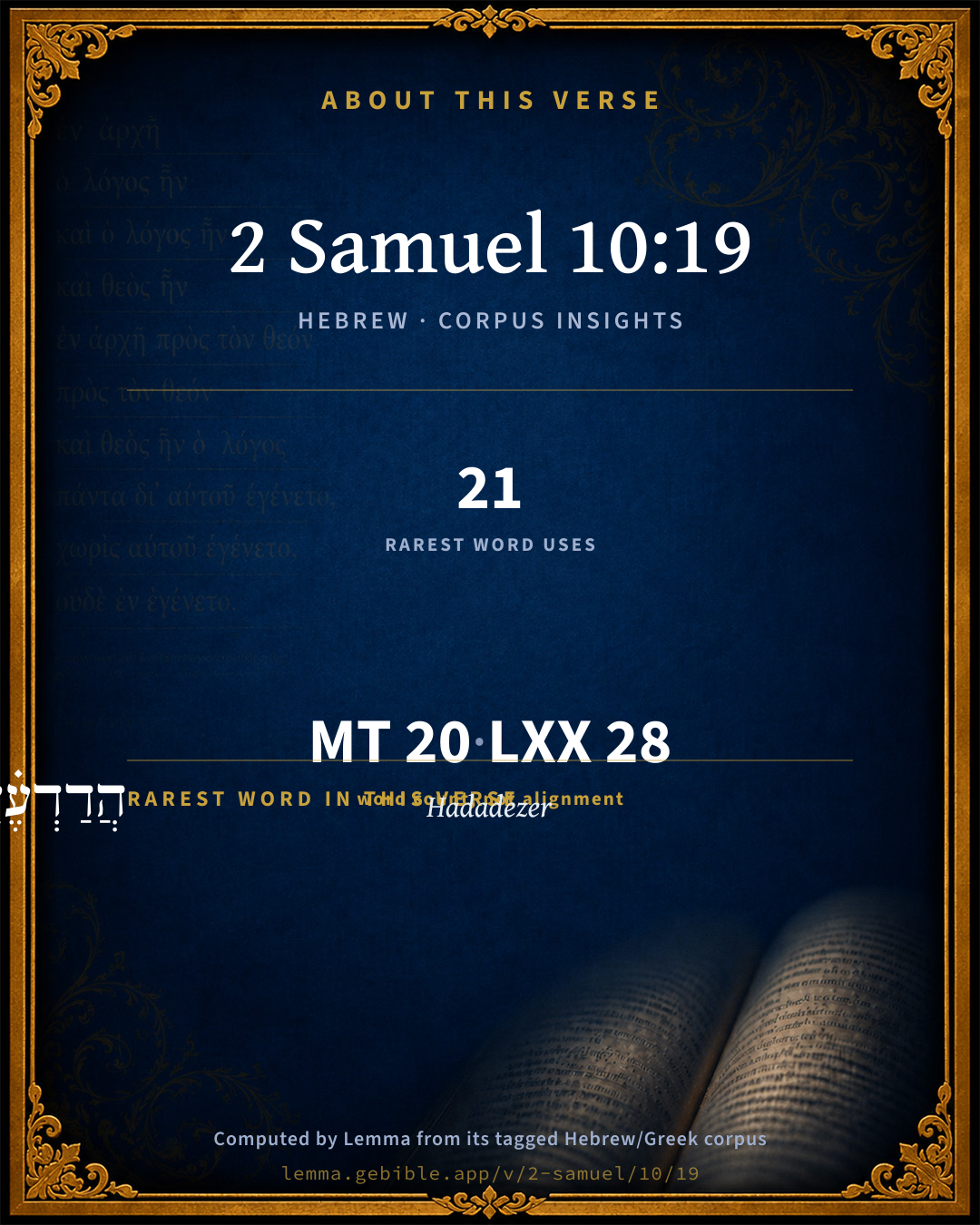
20
words
19
distinct lemmas
Historical
section

Notable vocabulary

The rarest word here is הֲדַדְעֶ֗זֶר Hadadezer H1909 — appearing just 21 times in the whole Hebrew Bible.

Shared distinctive vocabulary

הֲדַדְעֶ֗זֶר Hadadezer H1909 occurs in 18 verses of the Hebrew Bible. Also found in:

Grammatical profile

  • 6 verbs
  • 10 nouns
  • 1 preposition
  • 1 conjunction
  • 1 adverb
  • 1 particle

Verb forms

  • וַיִּרְא֨וּ Qal · Sequential Imperfect
  • נִגְּפוּ֙ Niphal · Perfect
  • וַיַּשְׁלִ֥מוּ Hiphil · Sequential Imperfect
  • וַיַּֽעַבְד֑וּם Qal · Sequential Imperfect
  • וַיִּֽרְא֣וּ Qal · Sequential Imperfect
  • לְהוֹשִׁ֥יעַ Hiphil · Infinitive Construct

Repetition

A word recurs within this verse — often emphatic in Hebrew:

  • יִשְׂרָאֵ֔ל Israel H3478 ×2

Hebrew & Septuagint length

In English translation the verse runs 39 words from the Hebrew and 39 from the Septuagint (LXX English) — the same length.

A rough comparison of the two English renderings, which tokenize alike — not a word-level alignment.

Word counts can differ between the Hebrew and the Greek without any difference in meaning — e.g. the Hebrew direct-object marker אֵת has no separate Greek word, and Greek often adds the article ὁ.

In the original languages it is 20 Hebrew tokens and 28 Greek tokens — but the two are counted differently (Hebrew bundles its prefixes and suffixes into one token; the Greek is in lemma form), so that isn’t a like-for-like length.

Cross-references

11

Topical passages linked to 2 Samuel 10:19 in the Treasury of Scripture Knowledge — connected by theme and wording, ordered by reader-vote popularity; previews shown in the World English Bible.

  • 2 Samuel 8:6 Then David put garrisons in Syria of Damascus; and the Syrians became servants to David, and brought tribute. Yahweh gave victory to David wherever he went.
  • Revelation 18:10 standing far away for the fear of her torment, saying, 'Woe, woe, the great city, Babylon, the strong city! For your judgment has come in one hour.'
  • Genesis 14:1–5 It happened in the days of Amraphel, king of Shinar, Arioch, king of Ellasar, Chedorlaomer, king of Elam, and Tidal, king of Goiim,
  • Joshua 11:10 Joshua turned back at that time, and took Hazor, and struck the king of it with the sword: for Hazor before was the head of all those kingdoms.
  • Judges 1:7 Adoni-bezek said, "Seventy kings, having their thumbs and their great toes cut off, gathered [their food] under my table: as I have done, so God has requited me." They brought him to Jerusalem, and he died there.
  • 1 Kings 20:1 Ben Hadad the king of Syria gathered all his host together; and there were thirty-two kings with him, and horses and chariots: and he went up and besieged Samaria, and fought against it.
  • 1 Chronicles 19:19 When the servants of Hadarezer saw that they were put to the worse before Israel, they made peace with David, and served him: neither would the Syrians help the children of Ammon any more.
  • Psalms 18:37–38 I will pursue my enemies, and overtake them. Neither will I turn again until they are consumed.
  • Isaiah 26:11 Yahweh, your hand is lifted up, yet they don't see: but they shall see [your] zeal for the people, and be disappointed; yes, fire shall devour your adversaries.
  • Daniel 2:37 You, O king, are king of kings, to whom the God of heaven has given the kingdom, the power, and the strength, and the glory;
  • Psalms 48:4–5 For, behold, the kings assembled themselves, They passed by together.

Cross-references courtesy of OpenBible.info (CC BY 4.0).

Hebrew and Greek witnesses Masoretic Hebrew ↔ Greek Septuagint

The same verse in the two great witnesses to the Old Testament, shown verse-for-verse.

These are two independent witnesses, not word-aligned to each other, and the Septuagint is shown in lemma (dictionary) form.

Hebrew 2 Samuel 10:19 Masoretic · Westminster Leningrad Codex

וַיִּרְא֨וּ כָֽל הַמְּלָכִ֜ים עַבְדֵ֣י הֲדַדְעֶ֗זֶר כִּ֤י נִגְּפוּ֙ לִפְנֵ֣י יִשְׂרָאֵ֔ל וַיַּשְׁלִ֥מוּ אֶת יִשְׂרָאֵ֖ל וַיַּֽעַבְד֑וּם וַיִּֽרְא֣וּ אֲרָ֔ם לְהוֹשִׁ֥יעַ ע֖וֹד אֶת בְּנֵ֥י עַמּֽוֹן

When all the kings who were servants to Hadarezer saw that they were put to the worse before Israel, they made peace with Israel, and served them. So the Syrians feared to help the children of Ammon any more.

World English Bible · Public Domain

Greek LXX 2 Samuel 10:19 Septuagint · lemma form

καί ὁράω πᾶς ὁ βασιλεύς ὁ δοῦλος αδρααζαρ ὅτι πταίω ἔμπροσθεν ἰσραήλ καί αὐτομολέω μετά ἰσραήλ καί δουλεύω αὐτός καί φοβέω συρία ὁ σώζω ἔτι ὁ υἱός αμμων

And all the kings the servants of Adraazar saw that they were put to the worse before Israel, and they went over to Israel, and served them: and Syria was afraid to help the children of Ammon any more.

LXX2012 (modern English Septuagint) · Public Domain

On this verse, Haydock's Catholic Bible Commentary discusses the Septuagint’s reading. Read the note in Commentary ↓

Hebrew: Westminster Leningrad Codex (CC BY 4.0). Greek: Septuagint (public domain); English from LXX2012 (modern English Septuagint) (Public Domain). How the Septuagint differs from the Hebrew →

Targum (Aramaic paraphrase)

1

The Targum is the ancient Jewish Aramaic paraphrase of the Hebrew Scriptures — an interpretive translation, not the Hebrew text itself. Onkelos (literal) and Pseudo-Jonathan (expansive) render the Torah, and Jonathan the Prophets. Coverage is partial: where no permissively-licensed English translation exists for a verse, only the Aramaic is shown. This is verse-level text, not a word-by-word alignment to the Hebrew.

  1. Targum Jonathan Prophets (Joshua–Malachi)
    וַחֲזוֹ כָל מַלְכַיָא עַבְדֵי הֲדַדְעֶזֶר אֲרֵי אִתְבָּרוּ קֳדָם יִשְׂרָאֵל וְאַשְׁלִימוּ עִם יִשְׂרָאֵל וּפַלְחוּנוּן וּדְחִילוּ אֱנַשׁ אֲרָם לְמִפְרַק עוֹד יַת בְּנֵי עַמוֹן:

    (no public-domain English translation for this verse)

    Targum Jonathan — Aramaic: “Mikraot Gedolot” (public domain). English: “Sefaria Community Translation” (CC0 1.0 (public-domain dedication)); “London "Chaldee Paraphrase," 1871” (public domain). Text via Sefaria.

Commentary

Notes on 2 Samuel 10:19 from classic Christian and Jewish commentators (each source and its license shown beneath its notes). The classic Christian expositions comment on the surrounding passage and are grouped to its opening verse, so a note may address several verses; the Jewish commentaries on the Tanakh (Rashi and others) are per-verse, so they appear only where the commentator wrote on this verse.

Lemma curates 59 commentaries, every one of them public domain or Creative Commons licensed, each selected and text-cleaned for this edition rather than reprinted as found. About our sources →

Trapp's Complete Commentary

John Trapp

2Sa 10:19 And when all the kings [that were] servants to Hadarezer saw that they were smitten before Israel, they made peace with Israel, and served them. So the Syrians feared to help the children of Ammon any more.

Ver. 19. So the Syrians feared.] And perhaps engaged to fight no more in haste against Israel, as the beaten Parthians swore that they would fight no more against the Romans for ever. Vexatio dat intellectum.

John Trapp, A Commentary or Exposition upon All the Books of the Old and New Testament (1647–1656) — public domain. Text from a community e-Sword module.

Joseph Benson's Commentary

2Sa 10:19. The kings that were servants to Hadarezer — He being the most powerful prince in those parts, it appears there were several petty kings that were subject to him. They made peace with Israel, and served them — As it is likely Hadarezer himself also did: whereby God fulfilled his promise to Abraham, (which was renewed to Joshua,) of enlarging the dominion of his posterity as far as Euphrates. See Gen 15:18; Jos 1:2-4. Wonderful to reflect on! kingdoms and vast tracts of country, which were promised by God, ages before, to the posterity of a man who had not one foot of property in them, we see here all falling, with a very particular exactness, under the dominion of one of the posterity of him to whom they had been promised! So faithful is God, and all his purposes will be fulfilled! Thus, in the space of nineteen or twenty years, David had the happiness of finishing gloriously eight wars, all righteously undertaken, and all honourably terminated; namely, 1st, The civil war with Ish-bosheth: 2d, The war against the Jebusites: 3d, Against the Philistines and their allies: 4th, Against the Philistines alone: 5th, Against the Moabites: 6th, Against Hadadezer: 7th, Against the Idumeans: 8th, Against the Ammonites and Syrians. We shall soon see this last entirely completed, by the conquest of the kingdom of the Ammonites, abandoned by their allies. What glory for the monarch of Israel, had not the splendour of this illustrious epocha been obscured by a complication of crimes, of which one could never have even suspected him! See Delaney.

Joseph Benson's Commentary on the Old and New Testaments (1811–1818) — public domain. Text from a community e-Sword module.

Adam Clarke's Commentary

Verse 19. Made peace with Israel] They made this peace separately, and were obliged to pay tribute to the Israelites. Some copies of the Vulgate add here after the word Israel, Expaverunt et fugerunt quinquaginta et octo millia coram Israel; "and they were panic-struck, and fled fifty-eight thousand of them before Israel." This reading is nowhere else to be found. "Thus," observes Dr. Delaney, "the arms of David were blessed; and God accomplished the promises which he had made to Abraham, Ge 15:18, and renewed to Joshua, Jos 1:2; Jos 1:4." And thus, in the space of nineteen or twenty years, David had the good fortune to finish gloriously eight wars, all righteously undertaken, and all honourably terminated; viz.

1. The civil war with Ish-bosheth.

2. The war against the Jebusites.

3. The war against the Philistines and their allies.

4. The war against the Philistines alone.

5. The war against the Moabites.

6. The war against Hadadezer.

7. The war against the Idumeans.

8. The war against the Ammonites and Syrians.

This last victory was soon followed by the complete conquest of the kingdom of the Ammonites, abandoned by their allies. What glory to the monarch of Israel, had not the splendour of this illustrious epoch been obscured by a complication of crimes, of which one could never have even suspected him capable!

WE have now done with the first part of this book, in which we find David great, glorious, and pious: we come to the second part, in which we shall have the pain to observe him fallen from God, and his horn defiled in the dust by crimes of the most flagitious nature. Let him that most assuredly standeth take heed lest he fall.

Adam Clarke's Commentary on the Bible (1810–1826) — public domain. Text from a community e-Sword/MySword module.

Ellicott's Commentary for English Readers

(19) Servants to Hadarezer.—The vassal kings, who had been tributary to Hadarezer, now transferred their allegiance to David; but it is not said that Hadarezer himself became a tributary, though it is plain from 2Sa_8:3-7, that he was greatly weakened and suffered the loss of large booty. From 1Ki_11:23-24, it is plain that an escaped dependent of Hadarezer maintained himself in the territory of Damascus as an enemy of Israel; it is also stated in 1Ki_4:21, that Solomon “reigned over all kingdoms” from the Euphrates to the border of Egypt. It is therefore probable that Hadarezer also acknowledged the suzerainty of David and Solomon.

A Bible Commentary for English Readers, edited by Charles John Ellicott (1878–1897) — public domain. Text from a community e-Sword module.

The Cambridge Bible for Schools and Colleges

gen. ed. J. J. S. Perowne

19. the kings that were servants to Hadarezer] His vassals and tributaries transferred their allegiance to David. According to ch. 2Sa_8:6 (assuming it to refer to the same war), the kingdom of Damascus was completely subjugated and secured by military stations. Both there and here it is implied that Hadadezer himself still maintained his independence in Zobah.

The Cambridge Bible for Schools and Colleges (gen. ed. J. J. S. Perowne; Cambridge University Press, 1878–1918) — public domain. Text from a community e-Sword module.

John Gill's Exposition

And when all the kings that were servants to Hadarezer,.... That were subject to him, and at his beck and command, at least were hired by him into his service:

saw that they were smitten before Israel; could not stand their ground against them, being too powerful for them:

they made peace with Israel, and served them; became tributaries to them, whereby the promise of the land of Canaan made to Abraham and his seed, as reaching to the river Euphrates, had its accomplishment, Gen 15:18,

so the Syrians feared to help the children of Ammon any more; who standing by themselves, they were soon and easily conquered by David's forces, as recorded in the following chapters.

Next: 2 Samuel Chapter 11

John Gill's Exposition of the Whole Bible (1746–1763) — public domain (CC PDM 1.0). Text via the HelloAO Bible API.

Albert Barnes' Notes on the Bible

Servants to Hadarezer - This gives us an idea of the great power of Hadarezer, and consequently of the strength of Israel in David’s victorious reign.

Albert Barnes' Notes on the Bible (1834–1885) — public domain. Text from a community e-Sword/MySword module.

Haydock's Catholic Bible Commentary

Before Israel. Hebrew and Septuagint only read, "And when all the kings, servants of Adarezer, saw that they were smitten before Israel, they made peace with Israel, and served them," &c. (Haydock) --- The addition is not found in the ancient version of St. Jerome. These tributary kings lived in Syria, and some perhaps beyond the Euphrates. See Psalm lix. (Calmet) --- The army had consisted of 145,000 men. After the loss of 87,000, the servants of Adarezer went over to David, and served him, Paralipomenon. (Menochius)

George Leo Haydock (1774–1849), Haydock's Catholic Family Bible and Commentary, 1859 edition — public domain. Excludes Psalms (Douay-Rheims chapter numbering differs from Protestant) and Deuterocanonical books (Catholic canon only).

Matthew Poole's English Annotations

The kings that were servants to Hadarezer, to wit, for that time, or in that expedition to which he hired them.

Matthew Poole's English Annotations on the Holy Bible (1683–1685) — public domain. Text from a community e-Sword/MySword module.

Whedon's Commentary on the Bible

Daniel D. Whedon

19. They made peace — The kings or chieftains under Hadarezer made peace. It seems that Hadarezer himself was not present at this war, so that in this treaty with Israel his officers acted for him.

The Syrians feared to help… Ammon any more — They had now suffered two disastrous defeats in attempting to help the Ammonites, the first in the field before Medeba, (2Sa_10:8; comp. 1 Chronicles 19,) and the second at Helam. But, as we have argued in the notes on 2Sa_10:6, and 2Sa_8:3, there was yet another engagement subsequent to these, but probably intimately connected with them, and not long after. Hadarezer went to recover his border along the Euphrates, and this act was too much like violation of the peace David had just made with his subject-kings, and hence the war with Hadarezer, the interference of the Syrians of Damascus, and the consequent subjection of all Syria to the kingdom of Israel, recorded in chapter 8.

Daniel D. Whedon (gen. ed.), Commentary on the Old and New Testaments (1874–1909) — public domain. Text from a community e-Sword module.

The Pulpit Commentary

The kings... served them. It is evident from this that the petty kings of Rehob, Tob, and Maacah had been subject to Hadarezer; they now acknowledged the supremacy of David, and paid to him the tribute which they had previously paid to Zobah, and would be bound to supply him with a contingent of men in case of a war in their neighbourhood. The wars with Damascus and Edom, mentioned in 2Sa_8:5, 2Sa_8:13, probably followed immediately upon Hadarezer"s defeat, but are not referred to here, as the interest now centres in David"s personal conduct.

The Pulpit Commentary (1880–1919), ed. H.D.M. Spence-Jones & Joseph S. Exell — public domain. Text from a community e-Sword module.

John Wesley's Explanatory Notes

And served them - And thus at length was fulfilled the promise made to Abraham, and repeated to Joshua, that the borders of Israel should extend as far as the river Euphrates. The son of David sent his ambassadors, his apostles and ministers, to the Jewish church and nation. But they intreated them shamefully, as Hanun did David's, mocked them, abused them, slew them. And this it was that filled the measure of their iniquity, and brought upon them ruin without remedy.

John Wesley, Explanatory Notes Upon the Whole Bible (1754–1765) — public domain. Text via the GEBible commentary corpus.

Keil & Delitzsch

C. F. Keil & F. Delitzsch

"And when all the kings, the vassals of Hadarezer, saw that they were smitten before Israel, they made peace with Israel, and became subject to them; and Aram was afraid to render any further help to the Ammonites." It might appear from the first half of this verse, that it was only the vassals of Hadarezer who made peace with Israel, and became subject to it, and that Hadarezer himself did not. But the last clause, "and the Aramaeans were afraid," etc., shows very clearly that Hadarezer also made peace with the Israelites, and submitted to their rule; so that the expression in the first half of the verse is not a very exact one.

Keil & Delitzsch — Biblical Commentary on the Old Testament (1861–1891) — public domain (CC PDM 1.0). Text via the HelloAO Bible API. (Old Testament only.)

Lesson kit

Teaching starters — assembled from the data on this page, not authored interpretation. Every prompt links to the verse data it draws on. Edit before teaching.

2 Samuel, in the Historical, opens this verse with 20 words (19 distinct Hebrew lemmas). Its most distinctive word is Hădadʻezer (“Hadadezer”). A historical commentator’s framing appears above. Read the whole chapter for the surrounding context.

Discussion questions

  1. What does “Hadadezer” (Hădadʻezer) contribute to the verse as a whole?
  2. 2 Samuel 8:3 shares the word «Hadadezer» with this verse. How do the two illuminate each other?
  3. “Israel” occurs 2× in this one verse. What is the effect of the repetition?
  4. These translations render this verse differently. What is at stake in choosing one wording over another?
  5. The verb «וַיִּרְא֨וּ» is Qal Sequential Imperfect. How does its form color the action?
  6. Reading how Trapp's Complete Commentary and Joseph Benson's Commentary read this verse, where do the two commentators agree and where do they part?

Things to notice

Reading settings

Reading text

Shown beneath each verse's original-language words.

Old Testament
Old Testament edition

Read the OT as the Masoretic Hebrew (MT) or the Greek Septuagint (LXX).

English shown for the Greek Septuagint (in the Hebrew ↔ Greek comparison).

Comparing translations? Open the Compare panel on any verse page to stack up to four side by side.