
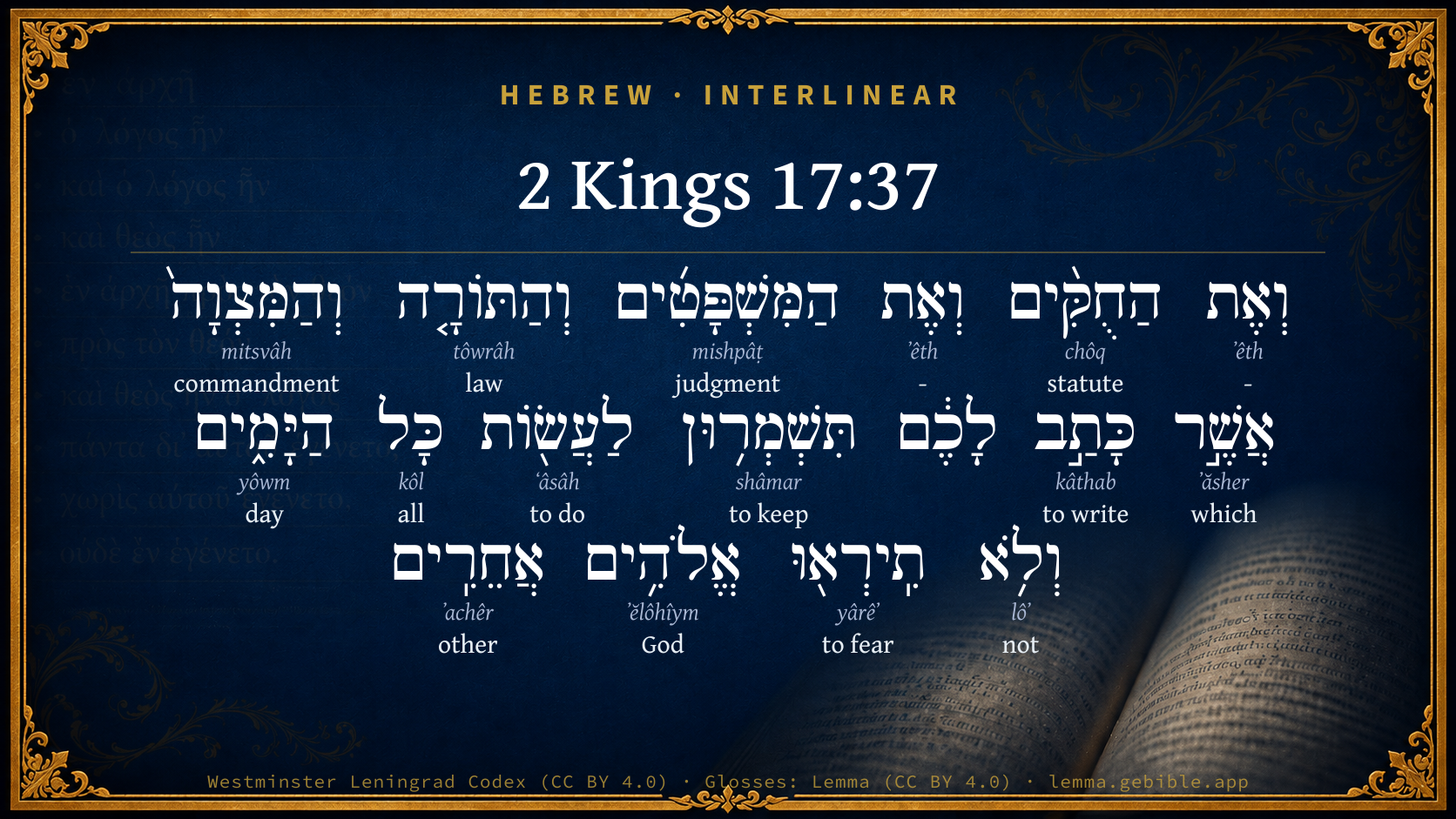
2 Kings 17:37

Hebrew (Westminster Leningrad Codex) 2 Kings 17:37 appears in the Hebrew Old Testament. The text above is from the Westminster Leningrad Codex. Each word links to its Strong’s number, a concise gloss, and parsing drawn from the Open Scriptures Hebrew Bible morphology. Click any word for its full Brown-Driver-Briggs (BDB) entry.
Download image
Cite this verse

2 Kings 17:37 (World English Bible). Public Domain. Lemma interlinear Bible study tool, https://lemma.gebible.app/v/2-kings/17/37.

Show BibTeX & RIS
BibTeX
RIS
English Translation
and the statutes and the ordinances, and the law and the commandment, which he wrote for you, you shall observe to do forevermore; and you shall not fear other gods:
World English Bible · Public Domain
Download a study sheet

One document with this verse’s original text, its word-by-word gloss line, the meaning frame, cross-references with their text, attributed commentary, and full source and license credits — printable, and it pastes into notes with its structure intact.

This verse Autodidact and up

Study sheet (.html) Plain text (.txt)

A passage Seminary Student

Up to 50 verses in one chapter. A passage sheet keeps up to 6 commentary sources and 12 cross-references per verse, in the order this page ranks them, and says so on the sheet whenever that leaves anything out. Ask for a single verse and you get the Autodidact verse sheet above.

Everything on this page stays free to read, with no account — the sheet is a download of what is already on screen, not access to it.

Want to remove ads? Support Godless Engineer
Compare translations 3

The same verse in 3 English versions, stacked beneath the original-language interlinear above. Click any original word for its lexicon entry.

Each is an independent rendering of the whole verse — the interlinear is not word-aligned to these translations.

Highlighted words mark where these versions differ — a whole-verse word diff, not a word-by-word alignment.

  • World English Bible Public Domain
    and the statutes and the ordinances, and the law and the commandment, which he wrote for you, you shall observe to do forevermore; and you shall not fear other gods:
  • King James Version Public Domain
    And the statutes, and the ordinances, and the law, and the commandment, which he wrote for you, ye shall observe to do for evermore; and ye shall not fear other gods.
  • unfoldingWord Literal Text CC BY-SA 4.0
    And the statutes and the judgments and the law and the commandment that he wrote for you, you shall be careful to do all of the days, and you shall not fear other gods.

unfoldingWord Literal Text — © unfoldingWord, licensed CC BY-SA 4.0. Word-aligned USFM3 via Door43 (git.door43.org/unfoldingWord/en_ult).

Versions to compare (up to 4)

3 of 4 selected

Show all 18 translations

Every available English version of this verse, each an independent rendering of the whole verse.

  • World English Bible Public Domain
    and the statutes and the ordinances, and the law and the commandment, which he wrote for you, you shall observe to do forevermore; and you shall not fear other gods:
  • Berean Standard Bible Public Domain
    And you must always be careful to observe the statutes, ordinances, laws, and commandments He wrote for you. Do not worship other gods.
  • Majority Standard Bible Public Domain
    And you must always be careful to observe the statutes, ordinances, laws, and commandments He wrote for you. Do not worship other gods.
  • King James Version Public Domain
    And the statutes, and the ordinances, and the law, and the commandment, which he wrote for you, ye shall observe to do for evermore; and ye shall not fear other gods.
  • American Standard Version (1901) Public Domain
    and the statutes and the ordinances, and the law and the commandment, which he wrote for you, ye shall observe to do for evermore; and ye shall not fear other gods:
  • Revised Version (1885) Public Domain
    and the statutes and the ordinances, and the law and the commandment, which he wrote for you, ye shall observe to do for evermore; and ye shall not fear other gods:
  • Geneva Bible (1599) Public Domain
    Also keepe ye diligently the statutes and the ordinances, and the Lawe, and the commandement, which he wrote for you, that ye do them continually, and feare not other gods.
  • Douay-Rheims (1899) Public Domain
    And the ceremonies, and judgments, and law, and the commandment, which he wrote for you, you shall observe to do them always: and you shall not fear strange gods.
  • Young's Literal Translation Public Domain
    and the statutes, and the judgments, and the law, and the command, that He wrote for you, ye observe to do all the days, and ye do not fear other gods;
  • Literal Standard Version CC BY-SA 4.0
    and the statutes, and the judgments, and the Law, and the command, that He wrote for you, you observe to do all the days, and you do not fear other gods;
  • Unlocked Literal Bible CC BY-SA 4.0
    The statutes and the decrees, the law and the commandments that he wrote for you, you will keep them forever. So you must not fear other gods,
  • unfoldingWord Literal Text CC BY-SA 4.0
    And the statutes and the judgments and the law and the commandment that he wrote for you, you shall be careful to do all of the days, and you shall not fear other gods.
  • Darby Bible Public Domain
    And the statutes and the ordinances and the law, and the commandment which he wrote for you, ye shall observe to do for evermore; and ye shall not fear other gods.
  • World Messianic Bible Public Domain
    The statutes and the ordinances, and the law and the commandment which he wrote for you, you shall observe to do forever more. You shall not fear other gods.
  • Webster's Bible Public Domain
    And the statutes, and the ordinances, and the law, and the commandment which he wrote for you, ye shall observe to do for evermore; and ye shall not fear other gods.
  • Free Bible Version CC BY-SA 4.0
    Always pay attention to observe the regulations, requirements, laws, and commandments he gave you in writing, and don't worship other gods.
  • Bible in Basic English Public Domain
    And the rules and the orders and the law which he put in writing for you, you are to keep and do for ever; you are to have no other gods.
  • JPS Tanakh (1917) Public Domain
    and the statutes and the ordinances, and the law and the commandment, which He wrote for you, ye shall observe to do for evermore; and ye shall not fear other gods;

Literal Standard Version (2020), Covenant Press — licensed CC BY-SA 4.0. Text via the HelloAO Bible API (eBible.org). Unlocked Literal Bible (unfoldingWord) — licensed CC BY-SA 4.0. Text via the HelloAO Bible API (eBible.org). unfoldingWord Literal Text — © unfoldingWord, licensed CC BY-SA 4.0. Word-aligned USFM3 via Door43 (git.door43.org/unfoldingWord/en_ult). Free Bible Version, Dr. Jonathan Gallagher — licensed CC BY-SA 4.0. Text via the HelloAO Bible API (eBible.org).

Word by word

More ways to search: Search by grammar → Find every occurrence → Compare this word →

Practice this passage: Drill this verse → Learn its vocabulary →

הַחֻקִּ֨ים
chôq
H2706
“the · statutes”
Particle, Definite Article + Noun, Common, Masculine, Plural, Absolute
Part of Speech
Particle + Noun
Type
Common
Gender
Masculine
Number
Plural
State
Absolute
Full BDB Definition

Origin: from H2710

TWOT: 728a

statute, ordinance, limit, something prescribed, due - prescribed task - prescribed portion - action prescribed (for oneself), resolve - prescribed due - prescribed limit, boundary - enactment, decree, ordinance - specific decree - law in general - enactments, statutes - conditions - enactments - decrees - civil enactments prescribed by God
  1. וְאֶת ʼêth H853 “and · -” Conjunction + Particle, Direct Object
  2. וְאֶת ʼêth H853 “and · -” Conjunction + Particle, Direct Object
  3. הַמִּשְׁפָּטִ֜ים mishpâṭ H4941 “the · judgments” Particle, Definite Article + Noun, Common, Masculine, Plural, Absolute
  4. וְהַתּוֹרָ֤ה tôwrâh H8451 “and · the · law” Conjunction + Particle, Definite Article + Noun, Common, Feminine, Singular, Absolute
  5. וְהַמִּצְוָה֙ mitsvâh H4687 “and · the · commandment” Conjunction + Particle, Definite Article + Noun, Common, Feminine, Singular, Absolute
  6. אֲשֶׁ֣ר ʼăsher H834 “which” Particle, Relative
  7. כָּתַ֣ב kâthab H3789 “to write” Verb, Qal, Perfect, 3rd Person, Masculine, Singular
  8. תִּשְׁמְר֥וּן shâmar H8104 “to keep” Verb, Qal, Imperfect, 2nd Person, Masculine, Plural + Suffix, n
  9. לַעֲשׂ֖וֹת ʻâsâh H6213 “to do” Preposition + Verb, Qal, Infinitive Construct
  10. כָּל kôl H3605 “all of” Noun, Common, Masculine, Singular, Construct
  11. הַיָּמִ֑ים yôwm H3117 “the · days” Particle, Definite Article + Noun, Common, Masculine, Plural, Absolute
  12. וְלֹ֥א lôʼ H3808 “and · not” Conjunction + Particle, Negative
  13. תִֽירְא֖וּ yârêʼ H3372 “to fear” Verb, Qal, Imperfect, 2nd Person, Masculine, Plural
  14. אֱלֹהִ֥ים ʼĕlôhîym H430 “God(s)” Noun, Common, Masculine, Plural, Absolute
  15. אֲחֵרִֽים ʼachêr H312 “other” Adjective, Adjective, Masculine, Plural, Absolute

About this verse

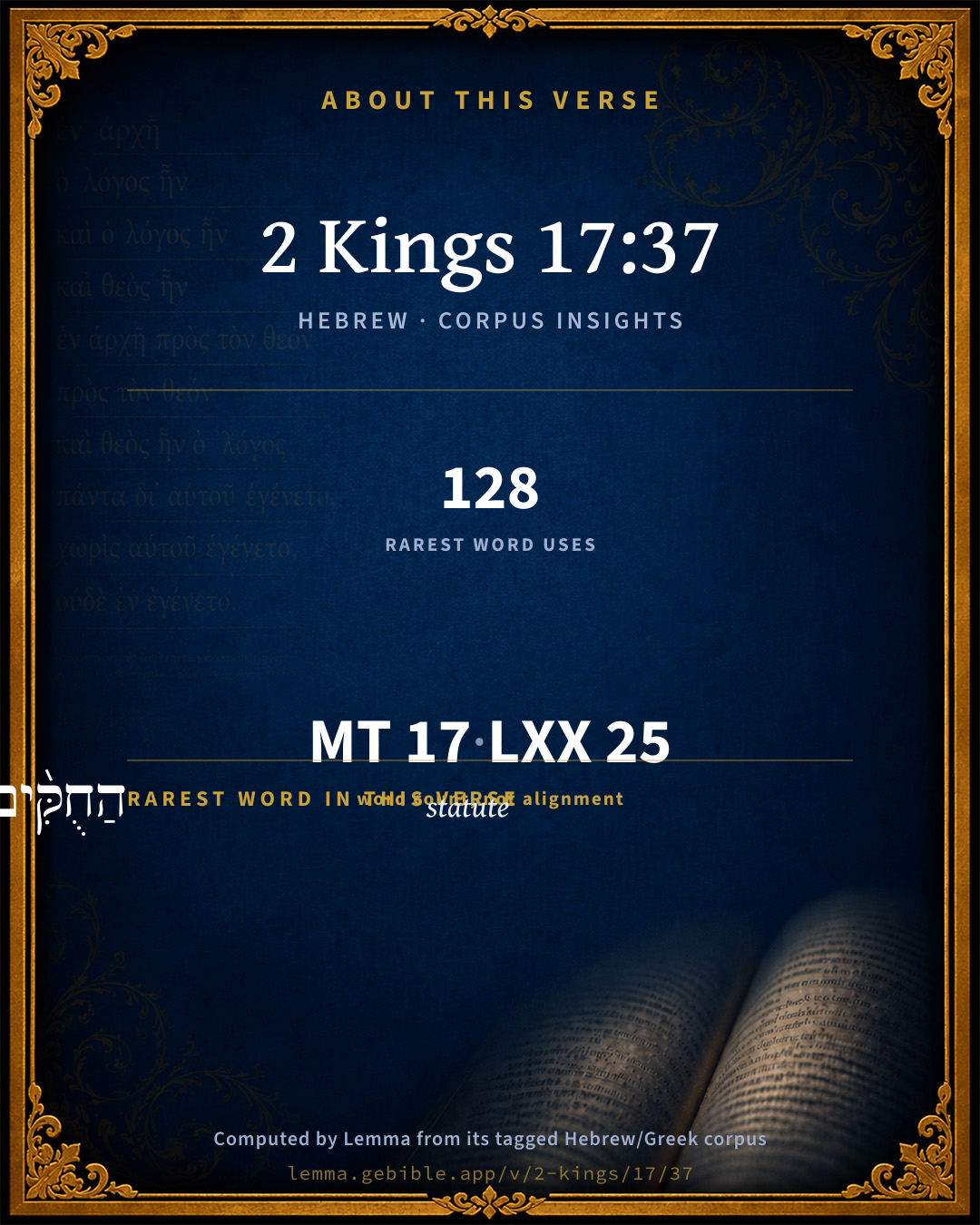
These counts appear in no published source. They are computed here, from the morphology-tagged text and Lemma’s own curated glosses. What Lemma adds →

17
words
15
distinct lemmas
Historical
section

Grammatical profile

  • 4 verbs
  • 7 nouns
  • 1 adjective
  • 1 preposition
  • 4 particles

Verb forms

  • כָּתַ֣ב Qal · Perfect
  • תִּשְׁמְר֥וּן Qal · Imperfect
  • לַעֲשׂ֖וֹת Qal · Infinitive Construct
  • תִֽירְא֖וּ Qal · Imperfect

Hebrew & Septuagint length

In English translation the verse runs 30 words from the Hebrew and 29 from the Septuagint (LXX English) — closely comparable.

A rough comparison of the two English renderings, which tokenize alike — not a word-level alignment.

Word counts can differ between the Hebrew and the Greek without any difference in meaning — e.g. the Hebrew direct-object marker אֵת has no separate Greek word, and Greek often adds the article ὁ.

In the original languages it is 17 Hebrew tokens and 25 Greek tokens — but the two are counted differently (Hebrew bundles its prefixes and suffixes into one token; the Greek is in lemma form), so that isn’t a like-for-like length.

Cross-references

10

Topical passages linked to 2 Kings 17:37 in the Treasury of Scripture Knowledge — connected by theme and wording, ordered by reader-vote popularity; previews shown in the World English Bible.

  • Leviticus 19:37 You shall observe all my statutes, and all my ordinances, and do them. I am Yahweh.'"
  • Deuteronomy 4:44–45 This is the law which Moses set before the children of Israel:
  • Deuteronomy 5:31–6:2 But as for you, stand you here by me, and I will speak to you all the commandment, and the statutes, and the ordinances, which you shall teach them, that they may do them in the land which I give them to possess it.
  • Deuteronomy 12:32 Whatever thing I command you, that shall you observe to do: you shall not add thereto, nor diminish from it.
  • Nehemiah 9:13–14 You came down also on Mount Sinai, and spoke with them from heaven, and gave them right ordinances and true laws, good statutes and commandments,
  • Deuteronomy 31:9 Moses wrote this law, and delivered it to the priests the sons of Levi, who bore the ark of the covenant of Yahweh, and to all the elders of Israel.
  • Psalms 105:44–45 He gave them the lands of the nations. They took the labor of the peoples in possession,
  • Deuteronomy 31:11 when all Israel is come to appear before Yahweh your God in the place which he shall choose, you shall read this law before all Israel in their hearing.
  • 1 Chronicles 29:19 and give to Solomon my son a perfect heart, to keep your commandments, your testimonies, and your statutes, and to do all these things, and to build the palace, for which I have made provision.
  • Psalms 19:8–11 Yahweh's precepts are right, rejoicing the heart. Yahweh's commandment is pure, enlightening the eyes.

Cross-references courtesy of OpenBible.info (CC BY 4.0).

Hebrew and Greek witnesses Masoretic Hebrew ↔ Greek Septuagint

The same verse in the two great witnesses to the Old Testament, shown verse-for-verse.

These are two independent witnesses, not word-aligned to each other, and the Septuagint is shown in lemma (dictionary) form.

Hebrew 2 Kings 17:37 Masoretic · Westminster Leningrad Codex

וְאֶת הַחֻקִּ֨ים וְאֶת הַמִּשְׁפָּטִ֜ים וְהַתּוֹרָ֤ה וְהַמִּצְוָה֙ אֲשֶׁ֣ר כָּתַ֣ב לָכֶ֔ם תִּשְׁמְר֥וּן לַעֲשׂ֖וֹת כָּל הַיָּמִ֑ים וְלֹ֥א תִֽירְא֖וּ אֱלֹהִ֥ים אֲחֵרִֽים

and the statutes and the ordinances, and the law and the commandment, which he wrote for you, you shall observe to do forevermore; and you shall not fear other gods:

World English Bible · Public Domain

Greek LXX 2 Kings 17:37 Septuagint · lemma form

καί ὁ δικαίωμα καί ὁ κρίμα καί ὁ νόμος καί ὁ ἐντολή ὅς γράφω σύ φυλάσσω ποιέω πᾶς ὁ ἡμέρα καί οὐ φοβέω θεός ἕτερος

You⌃ shall observe continually the ordinances, and the judgments, and the law, and the commandments which he wrote for you to do; and you⌃ shall not fear other gods.

LXX2012 (modern English Septuagint) · Public Domain

Hebrew: Westminster Leningrad Codex (CC BY 4.0). Greek: Septuagint (public domain); English from LXX2012 (modern English Septuagint) (Public Domain). How the Septuagint differs from the Hebrew →

Targum (Aramaic paraphrase)

1

The Targum is the ancient Jewish Aramaic paraphrase of the Hebrew Scriptures — an interpretive translation, not the Hebrew text itself. Onkelos (literal) and Pseudo-Jonathan (expansive) render the Torah, and Jonathan the Prophets. Coverage is partial: where no permissively-licensed English translation exists for a verse, only the Aramaic is shown. This is verse-level text, not a word-by-word alignment to the Hebrew.

  1. Targum Jonathan Prophets (Joshua–Malachi)
    וְיַת קְיָמַיָא וְיַת דִינַיָא וְאוֹרַיְתָא וְתַפְקֵידְתָּא דִכְתַב לְכוֹן תִּטְרוֹן לְמֶעְבַּד כָּל יוֹמַיָא וְלָא תִדְחֲלוּן לְטַעֲוַת עַמְמַיָא:

    (no public-domain English translation for this verse)

    Targum Jonathan — Aramaic: “Mikraot Gedolot” (public domain). English: “Sefaria Community Translation” (CC0 1.0 (public-domain dedication)); “London "Chaldee Paraphrase," 1871” (public domain). Text via Sefaria.

Commentary

Notes on 2 Kings 17:37 from classic Christian and Jewish commentators (each source and its license shown beneath its notes). The classic Christian expositions comment on the surrounding passage and are grouped to its opening verse, so a note may address several verses; the Jewish commentaries on the Tanakh (Rashi and others) are per-verse, so they appear only where the commentator wrote on this verse.

Lemma curates 59 commentaries, every one of them public domain or Creative Commons licensed, each selected and text-cleaned for this edition rather than reprinted as found. About our sources →

The Cambridge Bible for Schools and Colleges

gen. ed. J. J. S. Perowne

37. which he wrote for you] The compiler of Kings considered, as we can gather from this expression, that ‘the statutes and ordinances’, even the whole Law, was written down for the Israelites, and was of divine origin. The quotations made above are found in Deuteronomy chapters 4, 5. and 6 If the compiler be, in this passage, drawing, as he assuredly does in a large part of his work, from a record nearly contemporary with the events, we have here, from some writer of the days of Hezekiah and Isaiah, a number of quotations which shew that, in some form, the fifth book of Moses belongs to a time anterior to the date which recent criticism has assigned to it. If he be here but recording his own ideas, it is manifest that he himself had no doubt about the early origin of the Book.

The Cambridge Bible for Schools and Colleges (gen. ed. J. J. S. Perowne; Cambridge University Press, 1878–1918) — public domain. Text from a community e-Sword module.

John Gill's Exposition

And the covenant that I have made with you, ye shall not forget,.... The law given at Mount Sinai; the first table of which chiefly concerned the worship of the one true and living God, and forbid the worship of any other, as follows:

neither shall ye fear other gods; or make them the object of worship.

John Gill's Exposition of the Whole Bible (1746–1763) — public domain (CC PDM 1.0). Text via the HelloAO Bible API.

Albert Barnes' Notes on the Bible

Which he wrote for you - It is worth observing here, first, that the author regards the whole Law as given to the Israelites in a written form; and secondly, that he looks on the real writer as God.

Albert Barnes' Notes on the Bible (1834–1885) — public domain. Text from a community e-Sword/MySword module.

The Pulpit Commentary

And the statutes, and the ordinances, and the Law, and the commandment, which he wrote for youi.e. , which, by his Providence, were given you in a written form. (comp. Exo_24:4; Deu_31:9; Jos_8:34) ye shall observe to do forevermore. (comp. Lev_18:4, 5 19:37; Deu_4:6 Deu_5:1 Deu_6:24, Deu_6:25, etc.) and ye shall not fear other gods (see the comment on ver. 35).

The Pulpit Commentary (1880–1919), ed. H.D.M. Spence-Jones & Joseph S. Exell — public domain. Text from a community e-Sword module.

Lesson kit

Teaching starters — assembled from the data on this page, not authored interpretation. Every prompt links to the verse data it draws on. Edit before teaching.

2 Kings, in the Historical, opens this verse with 17 words (15 distinct Hebrew lemmas). Its most distinctive word is chôq (“statute”). A historical commentator’s framing appears above. Read the whole chapter for the surrounding context.

Discussion questions

  1. How does “statute” (chôq) shape what this verse is saying?
  2. Leviticus 19:37 shares this passage’s theme. How do the two illuminate each other?
  3. These translations render this verse differently. What is at stake in choosing one wording over another?
  4. The verb «כָּתַ֣ב» is Qal Perfect. How does its form color the action?
  5. Reading how The Cambridge Bible for Schools and Colleges and John Gill's Exposition read this verse, where do the two commentators agree and where do they part?

Things to notice

Reading settings

Reading text

Shown beneath each verse's original-language words.

Old Testament
Old Testament edition

Read the OT as the Masoretic Hebrew (MT) or the Greek Septuagint (LXX).

English shown for the Greek Septuagint (in the Hebrew ↔ Greek comparison).

Comparing translations? Open the Compare panel on any verse page to stack up to four side by side.