Exodus 34:30

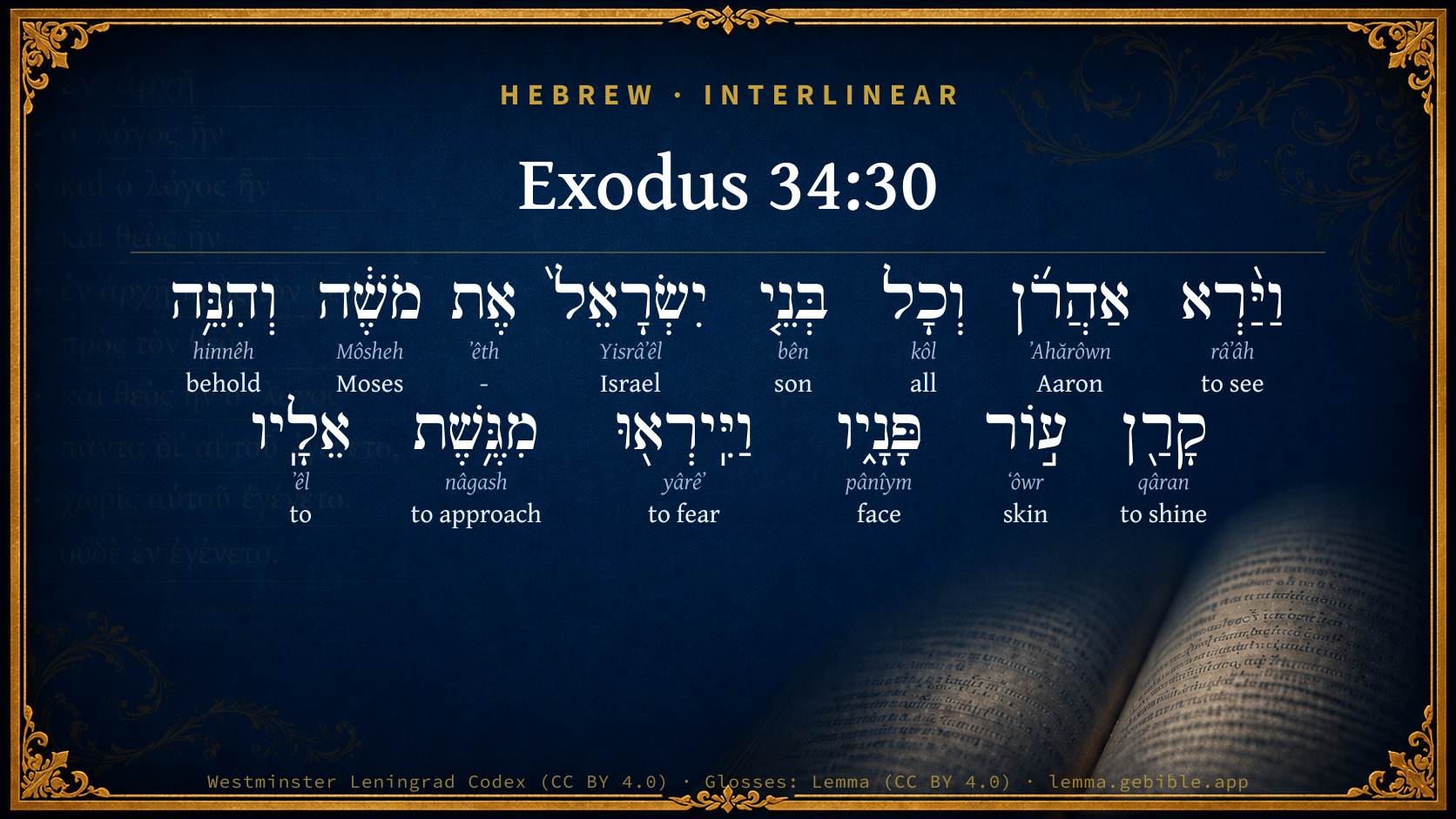
Hebrew (Westminster Leningrad Codex) Exodus 34:30 appears in the Hebrew Old Testament. The text above is from the Westminster Leningrad Codex. Each word links to its Strong’s number, a concise gloss, and parsing drawn from the Open Scriptures Hebrew Bible morphology. Click any word for its full Brown-Driver-Briggs (BDB) entry.
Download image
Cite this verse

Exodus 34:30 (World English Bible). Public Domain. Lemma interlinear Bible study tool, https://lemma.gebible.app/v/exodus/34/30.

Show BibTeX & RIS
BibTeX
RIS
English Translation
When Aaron and all the children of Israel saw Moses, behold, the skin of his face shone; and they were afraid to come near him.
World English Bible · Public Domain
Download a study sheet

One document with this verse’s original text, its word-by-word gloss line, the meaning frame, cross-references with their text, attributed commentary, and full source and license credits — printable, and it pastes into notes with its structure intact.

This verse Autodidact and up

Study sheet (.html) Plain text (.txt)

A passage Seminary Student

Up to 50 verses in one chapter. A passage sheet keeps up to 6 commentary sources and 12 cross-references per verse, in the order this page ranks them, and says so on the sheet whenever that leaves anything out. Ask for a single verse and you get the Autodidact verse sheet above.

Everything on this page stays free to read, with no account — the sheet is a download of what is already on screen, not access to it.

Want to remove ads? Support Godless Engineer
Compare translations 3

The same verse in 3 English versions, stacked beneath the original-language interlinear above. Click any original word for its lexicon entry.

Each is an independent rendering of the whole verse — the interlinear is not word-aligned to these translations.

Highlighted words mark where these versions differ — a whole-verse word diff, not a word-by-word alignment.

  • World English Bible Public Domain
    When Aaron and all the children of Israel saw Moses, behold, the skin of his face shone; and they were afraid to come near him.
  • King James Version Public Domain
    And when Aaron and all the children of Israel saw Moses, behold, the skin of his face shone; and they were afraid to come nigh him.
  • unfoldingWord Literal Text CC BY-SA 4.0
    And Aaron and all of the sons of Israel saw Moses, and behold, the skin of his face shone! And they were afraid to come near to him.

unfoldingWord Literal Text — © unfoldingWord, licensed CC BY-SA 4.0. Word-aligned USFM3 via Door43 (git.door43.org/unfoldingWord/en_ult).

Versions to compare (up to 4)

3 of 4 selected

Show all 18 translations

Every available English version of this verse, each an independent rendering of the whole verse.

  • World English Bible Public Domain
    When Aaron and all the children of Israel saw Moses, behold, the skin of his face shone; and they were afraid to come near him.
  • Berean Standard Bible Public Domain
    Aaron and all the Israelites looked at Moses, and behold, his face was radiant. And they were afraid to approach him.
  • Majority Standard Bible Public Domain
    Aaron and all the Israelites looked at Moses, and behold, his face was radiant. And they were afraid to approach him.
  • King James Version Public Domain
    And when Aaron and all the children of Israel saw Moses, behold, the skin of his face shone; and they were afraid to come nigh him.
  • American Standard Version (1901) Public Domain
    And when Aaron and all the children of Israel saw Moses, behold, the skin of his face shone; and they were afraid to come nigh him.
  • Revised Version (1885) Public Domain
    And when Aaron and all the children of Israel saw Moses, behold, the skin of his face shone; and they were afraid to come nigh him.
  • Geneva Bible (1599) Public Domain
    And Aaron and all the children of Israel looked vpon Moses, and beholde, the skin of his face shone bright, and they were afraid to come neere him)
  • Douay-Rheims (1899) Public Domain
    And Aaron and the children of Israel seeing the face of Moses horned, were afraid to come near.
  • Young's Literal Translation Public Domain
    and Aaron seeth -- all the sons of Israel also -- Moses, and lo, the skin of his face hath shone, and they are afraid of coming nigh unto him.
  • Literal Standard Version CC BY-SA 4.0
    and Aaron sees—all the sons of Israel also—Moses, and behold, the skin of his face has shone, and they are afraid of coming near to him.
  • Unlocked Literal Bible CC BY-SA 4.0
    When Aaron and the Israelites saw Moses, the skin of his face was shining, and they were afraid to come near him.
  • unfoldingWord Literal Text CC BY-SA 4.0
    And Aaron and all of the sons of Israel saw Moses, and behold, the skin of his face shone! And they were afraid to come near to him.
  • Darby Bible Public Domain
    And Aaron and all the children of Israel saw Moses, and behold, the skin of his face shone; and they were afraid to come near him.
  • World Messianic Bible Public Domain
    When Aaron and all the children of Israel saw Moses, behold, the skin of his face shone; and they were afraid to come near him.
  • Webster's Bible Public Domain
    And when Aaron and all the children of Israel saw Moses, behold, the skin of his face shone, and they were afraid to come nigh him.
  • Free Bible Version CC BY-SA 4.0
    When Aaron and the Israelites saw Moses with his face shining so brightly they were frightened to approach him.
  • Bible in Basic English Public Domain
    But when Aaron and all the children of Israel saw Moses, and the shining of his face, they would not come near him for fear.
  • JPS Tanakh (1917) Public Domain
    And when Aaron and all the children of Israel saw Moses, behold, the skin of his face sent forth beams; and they were afraid to come nigh him.

Literal Standard Version (2020), Covenant Press — licensed CC BY-SA 4.0. Text via the HelloAO Bible API (eBible.org). Unlocked Literal Bible (unfoldingWord) — licensed CC BY-SA 4.0. Text via the HelloAO Bible API (eBible.org). unfoldingWord Literal Text — © unfoldingWord, licensed CC BY-SA 4.0. Word-aligned USFM3 via Door43 (git.door43.org/unfoldingWord/en_ult). Free Bible Version, Dr. Jonathan Gallagher — licensed CC BY-SA 4.0. Text via the HelloAO Bible API (eBible.org).

Word by word

More ways to search: Search by grammar → Find every occurrence → Compare this word →

Practice this passage: Drill this verse → Learn its vocabulary →

קָרַ֖ן
qâran
H7160
“to shine”
Verb, Qal, Perfect, 3rd Person, Masculine, Singular
Part of Speech
Verb
Stem
Qal
Form
Perfect
Person
3rd Person
Gender
Masculine
Number
Singular
Full BDB Definition

Origin: a primitive root

TWOT: 2072

to shine - (Qal) to send out rays - (Hiphil) to display or grow horns, be horned
  1. וַיַּ֨רְא râʼâh H7200 “and · to see” Conjunction + Verb, Qal, Sequential Imperfect, 3rd Person, Masculine, Singular
  2. אַהֲרֹ֜ן ʼAhărôwn H175 “Aaron” Noun, Proper
  3. וְכָל kôl H3605 “and · all of” Conjunction + Noun, Common, Masculine, Singular, Construct
  4. בְּנֵ֤י bên H1121 “sons of” Noun, Common, Masculine, Plural, Construct
  5. יִשְׂרָאֵל֙ Yisrâʼêl H3478 “Israel” Noun, Proper
  6. אֶת ʼêth H853 “-” Particle, Direct Object
  7. מֹשֶׁ֔ה Môsheh H4872 “Moses” Noun, Proper
  8. וְהִנֵּ֥ה hinnêh H2009 “and · behold” Conjunction + Particle, Demonstrative
  9. ע֣וֹר ʻôwr H5785 “skin of” Noun, Common, Masculine, Singular, Construct
  10. פָּנָ֑יו pânîym H6440 “face(s) · his” Noun, Common, Both, Plural, Construct + Suffix, Personal, 3rd Person, Masculine, Singular
  11. וַיִּֽירְא֖וּ yârêʼ H3372 “and · to fear” Conjunction + Verb, Qal, Sequential Imperfect, 3rd Person, Masculine, Plural
  12. מִגֶּ֥שֶׁת nâgash H5066 “from · to approach” Preposition + Verb, Qal, Infinitive Construct
  13. אֵלָֽיו ʼêl H413 “to · him” Preposition + Suffix, Personal, 3rd Person, Masculine, Singular

About this verse

These counts appear in no published source. They are computed here, from the morphology-tagged text and Lemma’s own curated glosses. What Lemma adds →

14
words
14
distinct lemmas
Pentateuch
section

Notable vocabulary

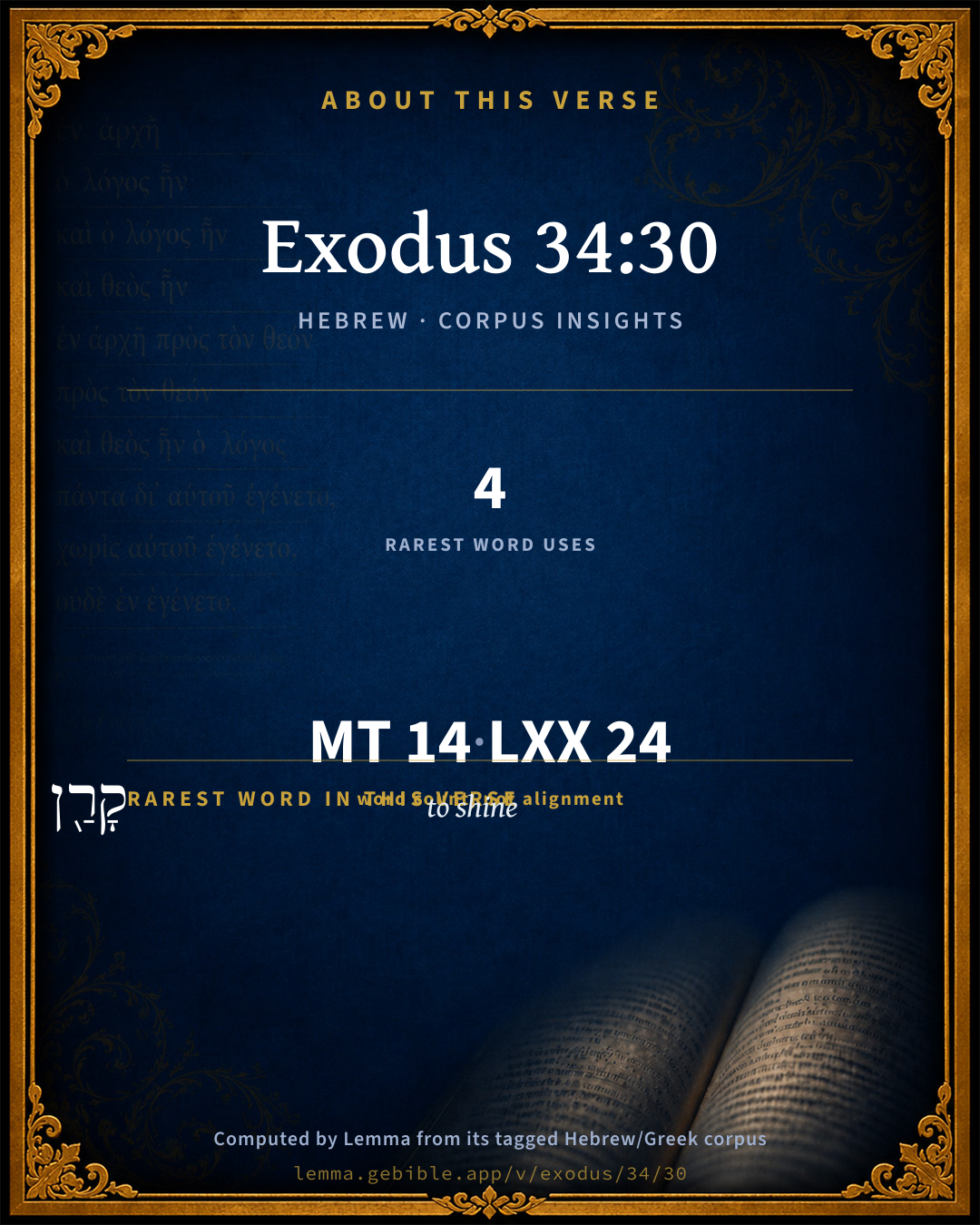
The rarest word here is קָרַ֖ן to shine H7160 — appearing just 4 times in the whole Hebrew Bible.

Shared distinctive vocabulary

קָרַ֖ן to shine H7160 occurs in 4 verses of the Hebrew Bible. Also found in:

Grammatical profile

  • 4 verbs
  • 7 nouns
  • 1 preposition
  • 2 particles

Verb forms

  • וַיַּ֨רְא Qal · Sequential Imperfect
  • קָרַ֖ן Qal · Perfect
  • וַיִּֽירְא֖וּ Qal · Sequential Imperfect
  • מִגֶּ֥שֶׁת Qal · Infinitive Construct

Hebrew & Septuagint length

In English translation the verse runs 25 words from the Hebrew and 28 from the Septuagint (LXX English) — closely comparable.

A rough comparison of the two English renderings, which tokenize alike — not a word-level alignment.

Word counts can differ between the Hebrew and the Greek without any difference in meaning — e.g. the Hebrew direct-object marker אֵת has no separate Greek word, and Greek often adds the article ὁ.

In the original languages it is 14 Hebrew tokens and 24 Greek tokens — but the two are counted differently (Hebrew bundles its prefixes and suffixes into one token; the Greek is in lemma form), so that isn’t a like-for-like length.

Cross-references

4

Topical passages linked to Exodus 34:30 in the Treasury of Scripture Knowledge — connected by theme and wording, ordered by reader-vote popularity; previews shown in the World English Bible.

  • Mark 9:3 His clothing became glistening, exceedingly white, like snow, such as no launderer on earth can whiten them.
  • Luke 5:8 But Simon Peter, when he saw it, fell down at Jesus' knees, saying, "Depart from me, for I am a sinful man, Lord."
  • Numbers 12:8 with him will I speak mouth to mouth, even manifestly, and not in dark speeches; and the form of Yahweh shall he see: why then were you not afraid to speak against my servant, against Moses?
  • Mark 9:15 Immediately all the multitude, when they saw him, were greatly amazed, and running to him greeted him.

Cross-references courtesy of OpenBible.info (CC BY 4.0).

Hebrew and Greek witnesses Masoretic Hebrew ↔ Greek Septuagint

The same verse in the two great witnesses to the Old Testament, shown verse-for-verse.

These are two independent witnesses, not word-aligned to each other, and the Septuagint is shown in lemma (dictionary) form.

Hebrew Exodus 34:30 Masoretic · Westminster Leningrad Codex

וַיַּ֨רְא אַהֲרֹ֜ן וְכָל בְּנֵ֤י יִשְׂרָאֵל֙ אֶת מֹשֶׁ֔ה וְהִנֵּ֥ה קָרַ֖ן ע֣וֹר פָּנָ֑יו וַיִּֽירְא֖וּ מִגֶּ֥שֶׁת אֵלָֽיו

When Aaron and all the children of Israel saw Moses, behold, the skin of his face shone; and they were afraid to come near him.

World English Bible · Public Domain

Greek LXX Exodus 34:30 Septuagint · lemma form

καί ὁράω ααρων καί πᾶς ὁ πρεσβύτερος ἰσραήλ ὁ μωυσῆς καί εἰμί δοξάζω ὁ ὄψις ὁ χρῶμα ὁ πρόσωπον αὐτός καί φοβέω ἐγγίζω αὐτός

And Aaron and all the elders of Israel saw Moses, and the appearance of the skin of his face was made glorious, and they feared to approach him.

LXX2012 (modern English Septuagint) · Public Domain

On this verse, John Gill's Exposition discusses the Septuagint’s reading. Read the note in Commentary ↓

Hebrew: Westminster Leningrad Codex (CC BY 4.0). Greek: Septuagint (public domain); English from LXX2012 (modern English Septuagint) (Public Domain). How the Septuagint differs from the Hebrew →

Targum (Aramaic paraphrase)

2

The Targum is the ancient Jewish Aramaic paraphrase of the Hebrew Scriptures — an interpretive translation, not the Hebrew text itself. Onkelos (literal) and Pseudo-Jonathan (expansive) render the Torah, and Jonathan the Prophets. Coverage is partial: where no permissively-licensed English translation exists for a verse, only the Aramaic is shown. This is verse-level text, not a word-by-word alignment to the Hebrew.

  1. Targum Onkelos Torah (Genesis–Deuteronomy)
    וַחֲזָא אַהֲרֹן וְכָל בְּנֵי יִשְׂרָאֵל יָת משֶׁה וְהָא סְגֵי זִיו יְקָרָא דְאַפּוֹהִי וּדְחִילוּ מִלְאִתְקְרְבָא לְוָתֵהּ:

    (no public-domain English translation for this verse)

    Targum Onkelos — Aramaic: “Onkelos Genesis” (public domain); “Onkelos Exodus” (public domain); “Onkelos Leviticus” (public domain); “Onkelos Numbers” (public domain); “Onkelos Deuteronomy” (public domain). English: “Sefaria Community Translation” (CC0 1.0 (public-domain dedication)); “J.W. Etheridge. The Targums of Onkelos and Jonathan Ben Uzziel on the Pentateuch. London: Longmans, Green, 1862” (public domain). Text via Sefaria.

  2. Targum Pseudo-Jonathan Torah (Genesis–Deuteronomy)
    וַחֲמָא אַהֲרן וְכָל בְּנֵי יִשְרָאֵל יַת משֶׁה וְהָא אִשְׁתַּבְהַר זִיו אִקּוּנִין דְּאַנְפּוֹי וּדְחִילוּ מִן לְמִקְרְבָא לְוָותֵיהּ

    And Aharon and all the sons of Israel saw Mosheh, and, behold, the glory of the form of his face shined, and they were afraid to come near to him.

    Targum Pseudo-Jonathan — Aramaic: “Targum Jonathan on Genesis” (public domain); “Targum Jonathan on Exodus” (public domain); “Targum Jonathan on Leviticus” (public domain); “Targum Jonathan on Numbers” (public domain); “Targum Jonathan on Deuteronomy” (public domain). English: “The Targum of Jonathan ben Uzziel, trans. J. W. Etheridge, London, 1862” (public domain). Text via Sefaria.

Commentary

Notes on Exodus 34:30 from classic Christian and Jewish commentators (each source and its license shown beneath its notes). The classic Christian expositions comment on the surrounding passage and are grouped to its opening verse, so a note may address several verses; the Jewish commentaries on the Tanakh (Rashi and others) are per-verse, so they appear only where the commentator wrote on this verse.

Lemma curates 59 commentaries, every one of them public domain or Creative Commons licensed, each selected and text-cleaned for this edition rather than reprinted as found. About our sources →

Trapp's Complete Commentary

John Trapp

Exo 34:30 And when Aaron and all the children of Israel saw Moses, behold, the skin of his face shone; and they were afraid to come nigh him.

Ver. 30. And they were afraid.] This was another manner of brightness and majesty than that which piercing gaze from the eyes of Augustus and Tamerlane; whose eyes so shone, as that a man could hardly endure to behold them without closing of his own: and many in talking with them, and often beholding of them, became dumb: which caused them ofttimes with a comely modesty to abstain from looking too earnestly upon such as spake unto them, or discoursed with them. {a}

{a} Turk. Hist., fol. 236.

John Trapp, A Commentary or Exposition upon All the Books of the Old and New Testament (1647–1656) — public domain. Text from a community e-Sword module.

Joseph Benson's Commentary

Exo 34:30. And Aaron and the children of Israel saw it, and were afraid — It not only dazzled their eyes, but struck such an awe upon them as obliged them to retire. Probably they doubted whether it was a token of God’s favour, or of his displeasure.

Joseph Benson's Commentary on the Old and New Testaments (1811–1818) — public domain. Text from a community e-Sword module.

Geneva Bible (1599)

Geneva Bible translators

Read 2 Cor. 3:7.

Geneva Bible (1599) marginal notes — public domain. Text via Bolls.life.

Jamieson, Fausset & Brown

Robert Jamieson, A. R. Fausset & David Brown

they were afraid to come nigh him--Their fear arose from a sense of guilt--the beaming radiance of his countenance made him appear to their awe-struck consciences a flaming minister of heaven.

Jamieson, Fausset & Brown — Commentary Critical and Explanatory on the Whole Bible (1871) — public domain (CC PDM 1.0). Text via the HelloAO Bible API.

Adam Clarke's Commentary

Verse 30. They were afraid to come nigh him.] A sight of his face alarmed them; their consciences were still guilty from their late transgression, and they had not yet received the atonement. The very appearance of superior sanctity often awes the guilty into respect.

Adam Clarke's Commentary on the Bible (1810–1826) — public domain. Text from a community e-Sword/MySword module.

Ellicott's Commentary for English Readers

(30) They were afraid.—The supernatural appearance terrified them. Compare the feelings of Ezekiel (Eze_1:18) and St. John (Rev_1:17).

A Bible Commentary for English Readers, edited by Charles John Ellicott (1878–1897) — public domain. Text from a community e-Sword module.

John Gill's Exposition

And till Moses had done speaking with them,.... Not when he had done, as the Septuagint version, for then there would have been no occasion for it; but when he first began to speak to Aaron and the "rulers", and continued to speak to the congregation until he had finished what he had to say; even he did what follows, as soon as he perceived there was a glory on his face, which they could not bear to look at:

he put a vail on his face; something that covered it in a good measure, a mask, or linen cloth, or some such thing. The obscurity of the law may be signified by this vail, both of the moral and ceremonial law; the moral law, which though it makes known the mind and will of God, with respect to what is to be done, or not done, yet not with respect to the affair of life and salvation: it makes known the one God as the object of worship, but gives no account of a trinity of persons in the Godhead; no hint of God in Christ, nor revelation of the Son of God; no view of a Saviour, no notion of pardon; nor does it point out the righteousness of Christ unto us; nor do we from it hear anything of the Spirit of God, and his grace, nor of eternal life and glory: the ceremonial law, and its ordinances, did give some light into evangelical things, and did point out Christ, and the blessings of his grace, yet but darkly and obscurely; they were shadows of good things to come, and gave some dark and distant views of them, but were not so much as the image of the things, and did not bring them near, and set them in a clear light: likewise this vail may be an emblem of the darkness of the minds of men, with respect to the law, and the knowledge of divine things; especially of the Jews, who, as the apostle says, "could not steadfastly look at the end of that which is abolished": of the ceremonial law, which is disannulled, the end of which was Christ; he is the end for which it was made, the scope or mark at which it aimed, the term in which it issued, and in whom it had its complete fulfilment; but this they had not a perfect view of, and could not steadfastly behold: the moral law also is in some sense abolished by Christ, as the ministration of Moses, as a covenant of works, and as to the curse and condemnation of it to those that believe; and Christ he is the end of this, the fulfilling end of it, by conformity of nature, and obedience of life unto it, and by suffering the penalty of it; but such was the blindness of the Jews, that they were ignorant of the nature of this law, of the spirituality and perfection of it, of its use to convince men of sin, to condemn for it, but not to justify from it; were ignorant of the righteousness of God which the law required, and of Christ, and of the way of life and righteousness by him; and so of the Spirit of God, and his work, and of the mysteries of the Gospel, and of the books of the Old Testament; see Co2 3:14.

John Gill's Exposition of the Whole Bible (1746–1763) — public domain (CC PDM 1.0). Text via the HelloAO Bible API.

Whedon's Commentary on the Bible

Daniel D. Whedon

30. They were afraid — At a former time (Exo_20:19) they had said to Moses, “Speak thou with us, and we will hear; but let not God speak with us, lest we die.” Now Moses bears upon his face so much of the divine glory that they fear to talk even with him.

Daniel D. Whedon (gen. ed.), Commentary on the Old and New Testaments (1874–1909) — public domain. Text from a community e-Sword module.

The Pulpit Commentary

They were afraid. They shrank from Moses, as if he were more than man. (Compare Eze_1:28; Rev_1:17) Perhaps they thought that what they saw was his spirit.

The Pulpit Commentary (1880–1919), ed. H.D.M. Spence-Jones & Joseph S. Exell — public domain. Text from a community e-Sword module.

John Wesley's Explanatory Notes

And Aaron and the children of Israel saw it, and were afraid - It not only dazzled their eyes, but struck such an awe upon them as obliged them to retire. Probably they doubted whether it was a token of God's favour, or of his displeasure.

John Wesley, Explanatory Notes Upon the Whole Bible (1754–1765) — public domain. Text via the GEBible commentary corpus.

Rashi

Rabbi Shlomo Yitzchaki (Rashi)

וייראו מגשת אליו AND THEY WERE AFRAID TO STEP NIGH UNTO HIM — Come and see how great is the power (influence) of sin! For before they streched forth their hand to sin what does Scripture say? (Exodus 24:17) “And the sight of the glory of the Lord was like devouring fire on the top of the mountain in the eyes of the children of Israel”, — and yet they were not afraid and did not tremble! But after they made the golden calf they recoiled and trembled even at the sight of the rays of glory of Moses! (Sifrei Bamidbar 1:8)

Rashi on the Tanakh — English translations: “The Judaica Press complete Tanach with Rashi, translated by A. J. Rosenberg” (CC BY 4.0); “Pentateuch with Rashi's commentary by M. Rosenbaum and A.M. Silbermann, 1929-1934” (public domain); “The Metsudah Tanach series, Lakewood, N.J” (CC BY 4.0); and “The Book of Joshua, Metsudah Publications, 1997” (CC BY 4.0). Text via Sefaria.

Lesson kit

Teaching starters — assembled from the data on this page, not authored interpretation. Every prompt links to the verse data it draws on. Edit before teaching.

Exodus, in the Pentateuch, opens this verse with 14 words (14 distinct Hebrew lemmas). Its most distinctive word is qâran (“to shine”). A historical commentator’s framing appears above. Read the whole chapter for the surrounding context.

Discussion questions

  1. The word qâran carries the sense “to shine.” How does it shape the verse?
  2. Exodus 34:29 shares the word «to shine» with this verse. How do the two illuminate each other?
  3. The translations on this page render this verse differently — a whole-verse word diff, not a word-by-word alignment. What might account for the different wordings?
  4. The verb «וַיַּ֨רְא» is Qal Sequential Imperfect. How does its form color the action?
  5. Reading how Trapp's Complete Commentary and Joseph Benson's Commentary read this verse, where do the two commentators agree and where do they part?

Things to notice

Reading settings

Reading text

Shown beneath each verse's original-language words.

Old Testament
Old Testament edition

Read the OT as the Masoretic Hebrew (MT) or the Greek Septuagint (LXX).

English shown for the Greek Septuagint (in the Hebrew ↔ Greek comparison).

Comparing translations? Open the Compare panel on any verse page to stack up to four side by side.