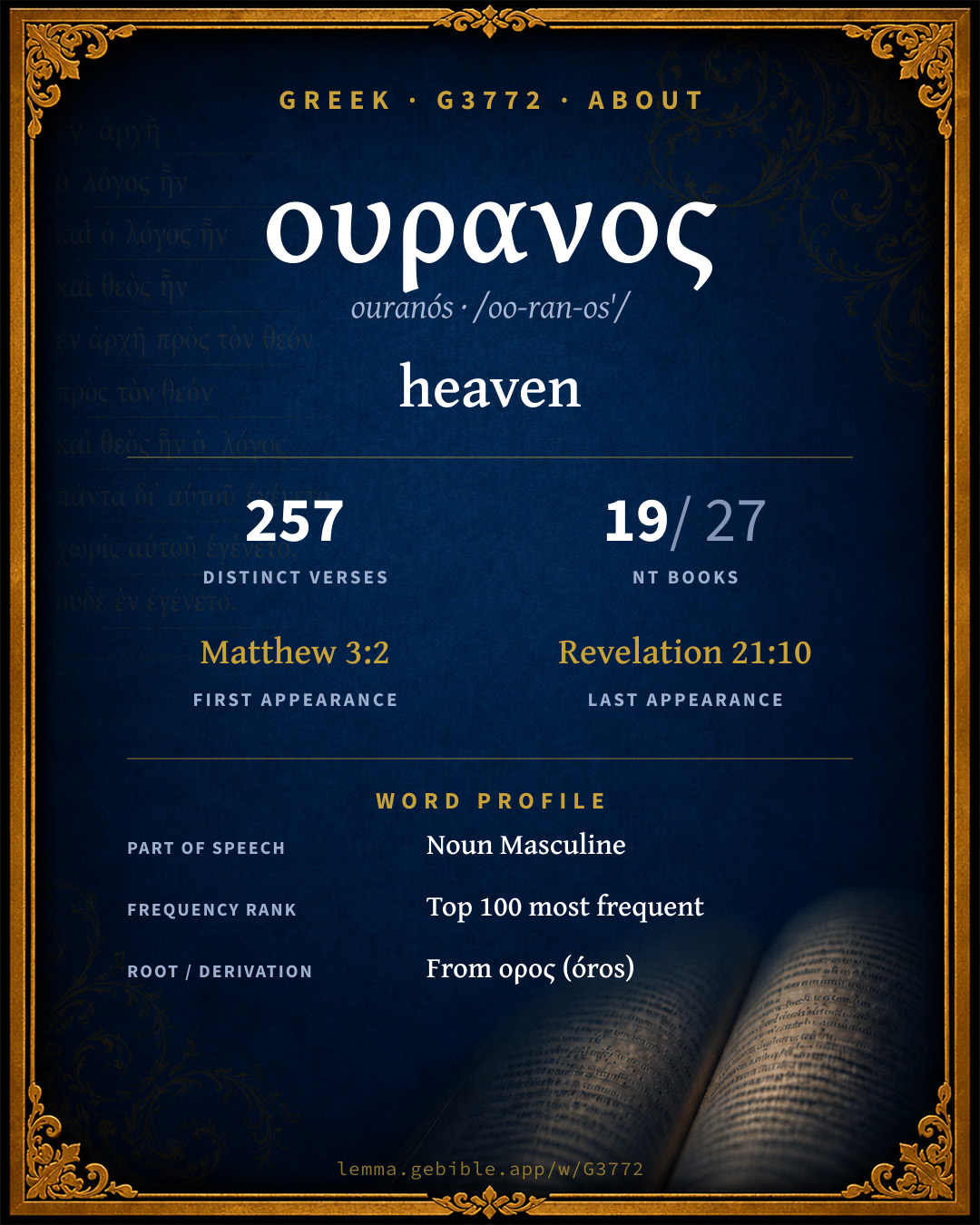
οὐρανός
heaven
‘heaven’ is one of 2 main senses fuller range ↓
Full lexicon entry — Thayer's Greek Lexicon
From Thayer's Greek Lexicon
Where this word appears
See every Genitive-case word in the Greek New Testament →
Grammar key — what these labels mean
Part of speech
- Noun
- A naming word — a person, place, thing, or idea.
Case
- Genitive
- The case of source, possession, or “of” — answers “whose / from what.”
- Accusative
- The case of the direct object and of extent.
- Dative
- The case of the indirect object, means, or location — “to / for / with / in.”
- Nominative
- The case of the subject (and the predicate nominative).
- Vocative
- The case of direct address (“O Lord”).
Gender
- Masculine
- Grammatically masculine.
Number
- Singular
- One.
- Plural
- More than one.
Grammatical forms 9 distinct
- Noun, Genitive, Singular, Masculine 92 times (33%)
- Noun, Genitive, Plural, Masculine 44 times (16%)
- Noun, Accusative, Singular, Masculine 42 times (15%)
- Noun, Dative, Plural, Masculine 36 times (13%)
- Noun, Dative, Singular, Masculine 36 times (13%)
- Noun, Nominative, Singular, Masculine 12 times (4%)
- Noun, Nominative, Plural, Masculine 7 times (3%)
- Noun, Accusative, Plural, Masculine 5 times (2%)
+1 more form (1 occurrence)
Parsed forms decoded from the imported morphology (Robinson–Tischendorf, public domain), counted across 275 parsed occurrences — not distinct verses.
Page 1 of 2 — showing verses 1–200 of 257 distinct verses where G3772 appears, across 19 books. Click any verse to open its interlinear word-by-word view. Verse text shown in the World English Bible for context — . Each verse’s Greek form is shown with its reference; the English is not keyword-highlighted, since the data carries no word-level English alignment. Use “Compare translations” on any verse to read it across multiple English versions. This concordance covers the Greek New Testament; Septuagint (Greek Old Testament) occurrences of this word are not indexed here.
Matthew 74 verses
- Matthew 3:2 οὐρανῶν n gen pl masc "Repent, for the Kingdom of Heaven is at hand!"
- Matthew 3:16 οὐρανοί n nom pl masc Jesus, when he was baptized, went up directly from the water: and behold, the heavens were opened to him. He saw the Spirit of God descending as a dove, and coming on him.
- Matthew 3:17 οὐρανῶν n gen pl masc Behold, a voice out of the heavens said, "This is my beloved Son, with whom I am well pleased."
- Matthew 4:17 οὐρανῶν n gen pl masc From that time, Jesus began to preach, and to say, "Repent! For the Kingdom of Heaven is at hand."
- Matthew 5:3 οὐρανῶν n gen pl masc "Blessed are the poor in spirit, For theirs is the Kingdom of Heaven.
- Matthew 5:10 οὐρανῶν n gen pl masc Blessed are those who have been persecuted for righteousness' sake, For theirs is the Kingdom of Heaven.
- Matthew 5:12 οὐρανοῖς n dat pl masc Rejoice, and be exceedingly glad, for great is your reward in heaven. For that is how they persecuted the prophets who were before you.
- Matthew 5:16 οὐρανοῖς n dat pl masc Even so, let your light shine before men; that they may see your good works, and glorify your Father who is in heaven.
- Matthew 5:18 οὐρανὸς n nom sg masc For most assuredly, I tell you, until heaven and earth pass away, not even one smallest letter or one tiny pen stroke shall in any way pass away from the law, until all things are accomplished.
- Matthew 5:19 οὐρανῶν οὐρανῶν n gen pl masc n gen pl masc Whoever, therefore, shall break one of these least commandments, and teach others to do so, shall be called least in the Kingdom of Heaven; but whoever shall do and teach them shall be called great in the Kingdom of Heaven.
- Matthew 5:20 οὐρανῶν n gen pl masc For I tell you that unless your righteousness exceeds that of the scribes and Pharisees, there is no way you will enter into the Kingdom of Heaven.
- Matthew 5:34 οὐρανῷ n dat sg masc but I tell you, don't swear at all: neither by heaven, for it is the throne of God;
- Matthew 5:45 οὐρανοῖς n dat pl masc that you may be children of your Father who is in heaven. For he makes his sun to rise on the evil and the good, and sends rain on the just and the unjust.
- Matthew 6:1 οὐρανοῖς n dat pl masc "Be careful that you don't do your charitable giving before men, to be seen by them, or else you have no reward from your Father who is in heaven.
- Matthew 6:9 οὐρανοῖς n dat pl masc Pray like this: 'Our Father in heaven, may your name be kept holy.
- Matthew 6:10 οὐρανῷ n dat sg masc Let your Kingdom come. Let your will be done, as in heaven, so on earth.
- Matthew 6:20 οὐρανῷ n dat sg masc but lay up for yourselves treasures in heaven, where neither moth nor rust consume, and where thieves don't break through and steal;
- Matthew 6:26 οὐρανοῦ n gen sg masc See the birds of the sky, that they don't sow, neither do they reap, nor gather into barns. Your heavenly Father feeds them. Aren't you of much more value than they?
- Matthew 7:11 οὐρανοῖς n dat pl masc If you then, being evil, know how to give good gifts to your children, how much more will your Father who is in heaven give good things to those who ask him!
- Matthew 7:21 οὐρανῶν οὐρανοῖς n gen pl masc n dat pl masc Not everyone who says to me, 'Lord, Lord,' will enter into the Kingdom of Heaven; but he who does the will of my Father who is in heaven.
- Matthew 8:11 οὐρανῶν n gen pl masc I tell you that many will come from the east and the west, and will sit down with Abraham, Isaac, and Jacob in the Kingdom of Heaven,
- Matthew 8:20 οὐρανοῦ n gen sg masc Jesus said to him, "The foxes have holes, and the birds of the sky have nests, but the Son of Man has nowhere to lay his head."
- Matthew 10:7 οὐρανῶν n gen pl masc As you go, preach, saying, 'The Kingdom of Heaven is at hand!'
- Matthew 10:32 οὐρανοῖς n dat pl masc Everyone therefore who confesses me before men, him I will also confess before my Father who is in heaven.
- Matthew 10:33 οὐρανοῖς n dat pl masc But whoever denies me before men, him I will also deny before my Father who is in heaven.
- Matthew 11:11 οὐρανῶν n gen pl masc Most assuredly I tell you, among those who are born of women there has not arisen anyone greater than John the Baptizer; yet he who is least in the Kingdom of Heaven is greater than he.
- Matthew 11:12 οὐρανῶν n gen pl masc From the days of John the Baptizer until now, the Kingdom of Heaven suffers violence, and the violent take it by force.
- Matthew 11:23 οὐρανοῦ n gen sg masc You, Capernaum, who are exalted to Heaven, you will go down to Hades. For if the mighty works had been done in Sodom which were done in you, it would have remained until this day.
- Matthew 11:25 οὐρανοῦ n gen sg masc At that time, Jesus answered, "I thank you, Father, Lord of heaven and earth, that you hid these things from the wise and understanding, and revealed them to infants.
- Matthew 12:50 οὐρανοῖς n dat pl masc For whoever does the will of my Father who is in heaven, he is my brother, and sister, and mother."
- Matthew 13:11 οὐρανῶν n gen pl masc He answered them, "To you it is given to know the mysteries of the Kingdom of Heaven, but it is not given to them.
- Matthew 13:24 οὐρανῶν n gen pl masc He set another parable before them, saying, "The Kingdom of Heaven is like a man who sowed good seed in his field,
- Matthew 13:31 οὐρανῶν n gen pl masc He set another parable before them, saying, "The Kingdom of Heaven is like a grain of mustard seed, which a man took, and sowed in his field;
- Matthew 13:32 οὐρανοῦ n gen sg masc which indeed is smaller than all seeds. But when it is grown, it is greater than the herbs, and becomes a tree, so that the birds of the air come and lodge in its branches."
- Matthew 13:33 οὐρανῶν n gen pl masc He spoke another parable to them. "The Kingdom of Heaven is like yeast, which a woman took, and hid in three measures of meal, until it was all leavened."
- Matthew 13:44 οὐρανῶν n gen pl masc "Again, the Kingdom of Heaven is like a treasure hidden in the field, which a man found, and hid. In his joy, he goes and sells all that he has, and buys that field.
- Matthew 13:45 οὐρανῶν n gen pl masc "Again, the Kingdom of Heaven is like a man who is a merchant seeking fine pearls,
- Matthew 13:47 οὐρανῶν n gen pl masc "Again, the Kingdom of Heaven is like a dragnet, that was cast into the sea, and gathered some fish of every kind,
- Matthew 13:52 οὐρανῶν n gen pl masc He said to them, "Therefore, every scribe who has been made a disciple in the Kingdom of Heaven is like a man who is a householder, who brings out of his treasure new and old things."
- Matthew 14:19 οὐρανὸν n acc sg masc He commanded the multitudes to sit down on the grass; and he took the five loaves and the two fish, and looking up to heaven, he blessed, broke and gave the loaves to the disciples, and the disciples gave to the multitudes.
- Matthew 16:1 οὐρανοῦ n gen sg masc The Pharisees and Sadducees came, and testing him, asked him to show them a sign from heaven.
- Matthew 16:2 οὐρανός n nom sg masc But he answered them, "When it is evening, you say, 'It will be fair weather, for the sky is red.'
- Matthew 16:3 οὐρανός οὐρανοῦ n nom sg masc n gen sg masc In the morning, 'It will be foul weather today, for the sky is red and threatening.' Hypocrites! You know how to discern the appearance of the sky, but you can't discern the signs of the times!
- Matthew 16:17 οὐρανοῖς n dat pl masc Jesus answered him, "Blessed are you, Simon Bar Jonah, for flesh and blood has not revealed this to you, but my Father who is in heaven.
- Matthew 16:19 οὐρανῶν οὐρανοῖς οὐρανοῖς n gen pl masc n dat pl masc n dat pl masc I will give to you the keys of the Kingdom of Heaven, and whatever you bind on earth will be bound in heaven; and whatever you release on earth will be released in heaven."
- Matthew 18:1 οὐρανῶν n gen pl masc In that hour the disciples came to Jesus, saying, "Who then is greatest in the Kingdom of Heaven?"
- Matthew 18:3 οὐρανῶν n gen pl masc and said, "Most assuredly I tell you, unless you turn, and become as little children, you will in no way enter into the Kingdom of Heaven.
- Matthew 18:4 οὐρανῶν n gen pl masc Whoever therefore humbles himself as this little child, the same is the greatest in the Kingdom of Heaven.
- Matthew 18:10 οὐρανοῖς οὐρανοῖς n dat pl masc n dat pl masc See that you don't despise one of these little ones, for I tell you that in heaven their angels always see the face of my Father who is in heaven.
- Matthew 18:14 οὐρανοῖς n dat pl masc Even so it is not the will of your Father who is in heaven that one of these little ones should perish.
- Matthew 18:18 οὐρανῷ οὐρανῷ n dat sg masc n dat sg masc Most assuredly I tell you, whatever things you will bind on earth will be bound in heaven, and whatever things you will release on earth will be released in heaven.
- Matthew 18:19 οὐρανοῖς n dat pl masc Again, assuredly I tell you, that if two of you will agree on earth concerning anything that they will ask, it will be done for them by my Father who is in heaven.
- Matthew 18:23 οὐρανῶν n gen pl masc Therefore the Kingdom of Heaven is like a certain king, who wanted to reconcile accounts with his servants.
- Matthew 19:12 οὐρανῶν n gen pl masc For there are eunuchs who were born that way from their mother's womb, and there are eunuchs who were made eunuchs by men; and there are eunuchs who made themselves eunuchs for the Kingdom of Heaven's sake. He who is able to receive it, let him receive it."
- Matthew 19:14 οὐρανῶν n gen pl masc But Jesus said, "Allow the little children, and don't forbid them to come to me; for to such belongs the Kingdom of Heaven."
- Matthew 19:21 οὐρανοῖς n dat pl masc Jesus said to him, "If you want to be perfect, go, sell what you have, and give to the poor, and you will have treasure in heaven; and come, follow me."
- Matthew 19:23 οὐρανῶν n gen pl masc Jesus said to his disciples, "Most assuredly I say to you, a rich man will enter into the Kingdom of Heaven with difficulty.
- Matthew 19:24 οὐρανῶν n gen pl masc Again I tell you, it is easier for a camel to go through a needle's eye, than for a rich man to enter into the Kingdom of God."
- Matthew 20:1 οὐρανῶν n gen pl masc "For the Kingdom of Heaven is like a man who was the master of a household, who went out early in the morning to hire laborers for his vineyard.
- Matthew 21:25 οὐρανοῦ n gen sg masc The baptism of John, where was it from? From heaven or from men?" They reasoned with themselves, saying, "If we say, 'From heaven,' he will ask us, 'Why then did you not believe him?'
- Matthew 21:26 οὐρανοῦ n gen sg masc But if we say, 'From men,' we fear the multitude, for all hold John as a prophet."
- Matthew 22:2 οὐρανῶν n gen pl masc "The Kingdom of Heaven is like a certain king, who made a marriage feast for his son,
- Matthew 22:30 οὐρανῷ n dat sg masc For in the resurrection they neither marry, nor are given in marriage, but are like God's angels in heaven.
- Matthew 23:13 οὐρανῶν n gen pl masc "Woe to you, scribes and Pharisees, hypocrites! For you devour widows' houses, and as a pretense you make long prayers. Therefore you will receive greater condemnation.
- Matthew 23:22 οὐρανῷ n dat sg masc He who swears by heaven, swears by the throne of God, and by him who sits on it.
- Matthew 24:29 οὐρανοῦ οὐρανῶν n gen sg masc n gen pl masc But immediately after the oppression of those days, the sun will be darkened, the moon will not give its light, the stars will fall from the sky, and the powers of the heavens will be shaken;
- Matthew 24:30 οὐρανῷ οὐρανοῦ n dat sg masc n gen sg masc and then the sign of the Son of Man will appear in the sky. Then all the tribes of the earth will mourn, and they will see the Son of Man coming on the clouds of the sky with power and great glory.
- Matthew 24:31 οὐρανῶν n gen pl masc He will send out his angels with a great sound of a trumpet, and they will gather together his chosen ones from the four winds, from one end of the sky to the other.
- Matthew 24:35 οὐρανὸς n nom sg masc Heaven and earth will pass away, but my words will not pass away.
- Matthew 24:36 οὐρανῶν n gen pl masc But no one knows of that day and hour, not even the angels of heaven, but my Father only.
- Matthew 25:1 οὐρανῶν n gen pl masc "Then the Kingdom of Heaven will be like ten virgins, who took their lamps, and went out to meet the bridegroom.
- Matthew 26:64 οὐρανοῦ n gen sg masc Jesus said to him, "You have said it. Nevertheless, I tell you, henceforth you will see the Son of Man sitting at the right hand of Power, and coming on the clouds of the sky."
- Matthew 28:2 οὐρανοῦ n gen sg masc Behold, there was a great earthquake, for an angel of the Lord descended from the sky, and came and rolled away the stone from the door, and sat on it.
- Matthew 28:18 οὐρανῷ n dat sg masc Jesus came to them and spoke to them, saying, "All authority has been given to me in heaven and on earth.
Mark 17 verses
- Mark 1:10 οὐρανοὺς n acc pl masc Immediately coming up from the water, he saw the heavens parting, and the Spirit descending on him like a dove.
- Mark 1:11 οὐρανῶν n gen pl masc A voice came out of the sky, "You are my beloved Son, in whom I am well pleased."
- Mark 4:32 οὐρανοῦ n gen sg masc yet when it is sown, grows up, and becomes greater than all the herbs, and puts out great branches, so that the birds of the sky can lodge under its shadow."
- Mark 6:41 οὐρανὸν n acc sg masc He took the five loaves and the two fish, and looking up to heaven, he blessed and broke the loaves, and he gave to his disciples to set before them, and he divided the two fish among them all.
- Mark 7:34 οὐρανὸν n acc sg masc Looking up to heaven, he sighed, and said to him, "Ephphatha!" that is, "Be opened!"
- Mark 8:11 οὐρανοῦ n gen sg masc The Pharisees came out and began to question him, seeking from him a sign from heaven, and testing him.
- Mark 10:21 οὐρανῷ n dat sg masc Jesus looking at him loved him, and said to him, "One thing you lack. Go, sell whatever you have, and give to the poor, and you will have treasure in heaven; and come, follow me, taking up the cross."
- Mark 11:25 οὐρανοῖς n dat pl masc Whenever you stand praying, forgive, if you have anything against anyone; so that your Father, who is in heaven, may also forgive you your transgressions.
- Mark 11:30 οὐρανοῦ n gen sg masc The baptism of John -- was it from heaven, or from men? Answer me."
- Mark 11:31 οὐρανοῦ n gen sg masc They reasoned with themselves, saying, "If we should say, 'From heaven;' he will say, 'Why then did you not believe him?'
- Mark 12:25 οὐρανοῖς n dat pl masc For when they will rise from the dead, they neither marry, nor are given in marriage, but are like angels in heaven.
- Mark 13:25 οὐρανοῦ οὐρανοῖς n gen sg masc n dat pl masc the stars will be falling from the sky, and the powers that are in the heavens will be shaken.
- Mark 13:27 οὐρανοῦ n gen sg masc Then he will send out his angels, and will gather together his chosen ones from the four winds, from the ends of the earth to the ends of the sky.
- Mark 13:31 οὐρανὸς n nom sg masc Heaven and earth will pass away, but my words will not pass away.
- Mark 13:32 οὐρανῷ n dat sg masc But of that day or that hour no one knows, not even the angels in heaven, nor the Son, but only the Father.
- Mark 14:62 οὐρανοῦ n gen sg masc Jesus said, "I AM. You will see the Son of Man sitting at the right hand of Power, and coming with the clouds of the sky."
- Mark 16:19 οὐρανὸν n acc sg masc So then the Lord Jesus, after he had spoken to them, was received up into heaven, and sat down at the right hand of God.
Luke 33 verses
- Luke 2:15 οὐρανὸν n acc sg masc It happened, when the angels went away from them into the sky, that the shepherds said one to another, "Let's go to Bethlehem, now, and see this thing that has happened, which the Lord has made known to us."
- Luke 3:21 οὐρανόν n acc sg masc Now it happened, when all the people were baptized, Jesus also had been baptized, and was praying. The sky was opened,
- Luke 3:22 οὐρανοῦ n gen sg masc and the Holy Spirit descended in a bodily form as a dove on him; and a voice came out of the sky, saying "You are my beloved Son. In you I am well pleased."
- Luke 4:25 οὐρανὸς n nom sg masc But truly I tell you, there were many widows in Israel in the days of Elijah, when the sky was shut up three years and six months, when a great famine came over all the land.
- Luke 6:23 οὐρανῷ n dat sg masc Rejoice in that day, and leap for joy, for behold, your reward is great in heaven, for their fathers did the same thing to the prophets.
- Luke 8:5 οὐρανοῦ n gen sg masc "The farmer went out to sow his seed. As he sowed, some fell along the road, and it was trampled under foot, and the birds of the sky devoured it.
- Luke 9:16 οὐρανὸν n acc sg masc He took the five loaves and the two fish, and looking up to the sky, he blessed them, and broke them, and gave them to the disciples to set before the multitude.
- Luke 9:54 οὐρανοῦ n gen sg masc When his disciples, James and John, saw this, they said, "Lord, do you want us to command fire to come down from the sky, and destroy them, just as Elijah did?"
- Luke 9:58 οὐρανοῦ n gen sg masc Jesus said to him, "The foxes have holes, and the birds of the sky have nests, but the Son of Man has no place to lay his head."
- Luke 10:15 οὐρανοῦ n gen sg masc You, Capernaum, who are exalted to heaven, will be brought down to Hades.
- Luke 10:18 οὐρανοῦ n gen sg masc He said to them, "I saw Satan having fallen like lightning from heaven.
- Luke 10:20 οὐρανοῖς n dat pl masc Nevertheless, don't rejoice in this, that the spirits are subject to you, but rejoice that your names are written in heaven."
- Luke 10:21 οὐρανοῦ n gen sg masc In that same hour Jesus rejoiced in the Holy Spirit, and said, "I thank you, O Father, Lord of heaven and earth, that you have hidden these things from the wise and understanding, and revealed them to little children. Yes, Father, for so it was well-pleasing in your sight."
- Luke 11:13 οὐρανοῦ n gen sg masc If you then, being evil, know how to give good gifts to your children, how much more will your heavenly Father give the Holy Spirit to those who ask him?"
- Luke 11:16 οὐρανοῦ n gen sg masc Others, testing him, sought from him a sign from heaven.
- Luke 12:33 οὐρανοῖς n dat pl masc Sell that which you have, and give gifts to the needy. Make for yourselves purses which don't grow old, a treasure in the heavens that doesn't fail, where no thief approaches, neither moth destroys.
- Luke 12:56 οὐρανοῦ n gen sg masc You hypocrites! You know how to interpret the appearance of the earth and the sky, but how is it that you don't interpret this time?
- Luke 13:19 οὐρανοῦ n gen sg masc It is like a grain of mustard seed, which a man took, and put in his own garden. It grew, and became a large tree, and the birds of the sky lodged in its branches."
- Luke 15:7 οὐρανῷ n dat sg masc I tell you that even so there will be more joy in heaven over one sinner who repents, than over ninety-nine righteous people who need no repentance.
- Luke 15:18 οὐρανὸν n acc sg masc I will get up and go to my father, and will tell him, "Father, I have sinned against heaven, and in your sight.
- Luke 15:21 οὐρανὸν n acc sg masc The son said to him, 'Father, I have sinned against heaven, and in your sight. I am no longer worthy to be called your son.'
- Luke 16:17 οὐρανὸν n acc sg masc But it is easier for heaven and earth to pass away, than for one tiny stroke of a pen in the law to fall.
- Luke 17:24 οὐρανὸν οὐρανὸν n acc sg masc n acc sg masc for as the lightning, when it flashes out of the one part under the sky, shines to the other part under the sky; so will the Son of Man be in his day.
- Luke 17:29 οὐρανοῦ n gen sg masc but in the day that Lot went out from Sodom, it rained fire and sulfur from the sky, and destroyed them all.
- Luke 18:13 οὐρανόν n acc sg masc But the tax collector, standing far away, wouldn't even lift up his eyes to heaven, but beat his breast, saying, 'God, be merciful to me, a sinner!'
- Luke 18:22 οὐρανοῖς n dat pl masc When Jesus heard these things, he said to him, "You still lack one thing. Sell all that you have, and distribute it to the poor. You will have treasure in heaven. Come, follow me."
- Luke 19:38 οὐρανῷ n dat sg masc saying, "Blessed is the King who comes in the name of the Lord! Peace in heaven, and glory in the highest!"
- Luke 20:4 οὐρανοῦ n gen sg masc the baptism of John, was it from heaven, or from men?"
- Luke 20:5 οὐρανοῦ n gen sg masc They reasoned with themselves, saying, "If we say, 'From heaven,' he will say, 'Why didn't you believe him?'
- Luke 21:11 οὐρανοῦ n gen sg masc There will be great earthquakes, famines, and plagues in various places. There will be terrors and great signs from heaven.
- Luke 21:26 οὐρανῶν n gen pl masc men fainting for fear, and for expectation of the things which are coming on the world: for the powers of the heavens will be shaken.
- Luke 21:33 οὐρανὸς n nom sg masc Heaven and earth will pass away, but my words will by no means pass away.
- Luke 22:43 οὐρανοῦ n gen sg masc An angel from heaven appeared to him, strengthening him.
John 17 verses
- John 1:32 οὐρανοῦ n gen sg masc John testified, saying, "I have seen the Spirit descending like a dove out of heaven, and it remained on him.
- John 1:52 οὐρανὸν n acc sg masc
- John 3:5 οὐρανῶν n gen pl masc Jesus answered, "Most assuredly I tell you, unless one is born of water and spirit, he can't enter into the Kingdom of God!
- John 3:13 οὐρανὸν οὐρανοῦ οὐρανῷ n acc sg masc n gen sg masc n dat sg masc No one has ascended into heaven, but he who descended out of heaven, the Son of Man, who is in heaven.
- John 3:27 οὐρανοῦ n gen sg masc John answered, "A man can receive nothing, unless it has been given him from heaven.
- John 3:31 οὐρανοῦ n gen sg masc He who comes from above is above all. He who is from the Earth belongs to the Earth, and speaks of the Earth. He who comes from heaven is above all.
- John 6:31 οὐρανοῦ n gen sg masc Our fathers ate the manna in the wilderness. As it is written, 'He gave them bread out of heaven to eat.'"
- John 6:32 οὐρανοῦ οὐρανοῦ n gen sg masc n gen sg masc Jesus therefore said to them, "Most assuredly, I tell you, it wasn't Moses who gave you the bread out of heaven, but my Father gives you the true bread out of heaven.
- John 6:33 οὐρανοῦ n gen sg masc For the bread of God is that which comes down out of heaven, and gives life to the world."
- John 6:38 οὐρανοῦ n gen sg masc For I have come down from heaven, not to do my own will, but the will of him who sent me.
- John 6:41 οὐρανοῦ n gen sg masc The Jews therefore murmured concerning him, because he said, "I am the bread which came down out of heaven."
- John 6:42 οὐρανοῦ n gen sg masc They said, "Isn't this Jesus, the son of Joseph, whose father and mother we know? How then does he say, 'I have come down out of heaven?'"
- John 6:50 οὐρανοῦ n gen sg masc This is the bread which comes down out of heaven, that anyone may eat of it and not die.
- John 6:51 οὐρανοῦ n gen sg masc I am the living bread which came down out of heaven. If anyone eats of this bread, he will live forever. Yes, the bread which I will give for the life of the world is my flesh."
- John 6:58 οὐρανοῦ n gen sg masc This is the bread which came down out of heaven-- not as our fathers ate the manna, and died. He who eats this bread will live forever."
- John 12:28 οὐρανοῦ n gen sg masc Father, glorify your name!" Then there came a voice out of the sky, saying, "I have both glorified it, and will glorify it again."
- John 17:1 οὐρανὸν n acc sg masc Jesus said these things, and lifting up his eyes to heaven, he said, "Father, the time has come. Glorify your Son, that your Son may also glorify you;
Acts 24 verses
- Acts 1:10 οὐρανὸν n acc sg masc While they were looking steadfastly into the sky as he went, behold, two men stood by them in white clothing,
- Acts 1:11 οὐρανόν οὐρανὸν οὐρανόν n acc sg masc n acc sg masc n acc sg masc who also said, "You men of Galilee, why do you stand looking into the sky? This Jesus, who was received up from you into the sky will come back in the same way as you saw him going into the sky."
- Acts 2:2 οὐρανοῦ n gen sg masc Suddenly there came from the sky a sound like the rushing of a mighty wind, and it filled all the house where they were sitting.
- Acts 2:5 οὐρανόν n acc sg masc Now there were dwelling in Jerusalem Jews, devout men, from every nation under the sky.
- Acts 2:19 οὐρανῷ n dat sg masc I will show wonders in the sky above, And signs on the earth beneath; Blood, and fire, and billows of smoke.
- Acts 2:34 οὐρανούς n acc pl masc For David didn't ascend into the heavens, but he says himself, 'The Lord said to my Lord, "Sit by my right hand,
- Acts 3:21 οὐρανὸν n acc sg masc whom heaven must receive until the times of restoration of all things, which God spoke long ago by the mouth of his holy prophets.
- Acts 4:12 οὐρανὸν n acc sg masc There is salvation in none other, for neither is there any other name under heaven, that is given among men, by which we must be saved!"
- Acts 4:24 οὐρανὸν n acc sg masc When they heard it, they lifted up their voice to God with one accord, and said, "O Lord, you are God, who made the heaven, the earth, the sea, and all that is in them;
- Acts 7:42 οὐρανοῦ n gen sg masc But God turned, and gave them up to serve the host of the sky, as it is written in the book of the prophets, 'Did you offer to me slain animals and sacrifices Forty years in the wilderness, O house of Israel?
- Acts 7:49 οὐρανός n nom sg masc 'heaven is my throne, And the earth a footstool for my feet. What kind of house will you build me?' says the Lord; 'Or what is the place of my rest?
- Acts 7:55 οὐρανὸν n acc sg masc But he, being full of the Holy Spirit, looked up steadfastly into heaven, and saw the glory of God, and Jesus standing on the right hand of God,
- Acts 7:56 οὐρανοὺς n acc pl masc and said, "Behold, I see the heavens opened, and the Son of Man standing at the right hand of God!"
- Acts 9:3 οὐρανοῦ n gen sg masc As he traveled, it happened that he got close to Damascus, and suddenly a light from the sky shone around him.
- Acts 10:11 οὐρανὸν n acc sg masc He saw heaven opened and a certain container descending to him, like a great sheet let down by four corners on the earth,
- Acts 10:12 οὐρανοῦ n gen sg masc in which were all kinds of four-footed animals of the earth, wild animals, reptiles, and birds of the sky.
- Acts 10:16 οὐρανόν n acc sg masc This was done three times, and immediately the vessel was received up into heaven.
- Acts 11:5 οὐρανοῦ n gen sg masc "I was in the city of Joppa praying, and in a trance I saw a vision: a certain container descending, like it was a great sheet let down from heaven by four corners. It came as far as me.
- Acts 11:6 οὐρανοῦ n gen sg masc When I had looked intently at it, I considered, and saw the four-footed animals of the earth, wild animals, creeping things, and birds of the sky.
- Acts 11:9 οὐρανοῦ n gen sg masc But a voice answered me the second time out of heaven, 'What God has cleansed, don't you call unclean.'
- Acts 11:10 οὐρανόν n acc sg masc This was done three times, and all were drawn up again into heaven.
- Acts 14:15 οὐρανὸν n acc sg masc "Men, why are you doing these things? We also are men of like passions with you, and bring you good news, that you should turn from these vain things to the living God, who made the sky and the earth and the sea, and all that is in them;
- Acts 17:24 οὐρανοῦ n gen sg masc The God who made the world and all things in it, he, being Lord of heaven and earth, doesn't dwell in temples made with hands,
- Acts 22:6 οὐρανοῦ n gen sg masc It happened that, as I made my journey, and came close to Damascus, about noon, suddenly there shone from the sky a great light around me.
Romans 2 verses
- Romans 1:18 οὐρανοῦ n gen sg masc For the wrath of God is revealed from heaven against all ungodliness and unrighteousness of men, who suppress the truth in unrighteousness,
- Romans 10:6 οὐρανόν n acc sg masc But the righteousness which is of faith says this, "Don't say in your heart, 'Who will ascend into heaven?' (that is, to bring Christ down);
1 Corinthians 2 verses
2 Corinthians 3 verses
- 2 Corinthians 5:1 οὐρανοῖς n dat pl masc For we know that if the earthly house of our tent is dissolved, we have a building from God, a house not made with hands, eternal, in the heavens.
- 2 Corinthians 5:2 οὐρανοῦ n gen sg masc For most assuredly in this we groan, longing to be clothed with our habitation which is from heaven;
- 2 Corinthians 12:2 οὐρανοῦ n gen sg masc I know a man in Christ, fourteen years ago (whether in the body, I don't know, or whether out of the body, I don't know; God knows), such a one caught up into the third heaven.
Galatians 1 verse
Ephesians 4 verses
- Ephesians 1:10 οὐρανοῖς n dat pl masc to an administration of the fullness of the times, to sum up all things in Christ, the things in the heavens, and the things on the earth, in him;
- Ephesians 3:15 οὐρανοῖς n dat pl masc from whom every family in heaven and on earth is named,
- Ephesians 4:10 οὐρανῶν n gen pl masc He who descended is the one who also ascended far above all the heavens, that he might fill all things.
- Ephesians 6:9 οὐρανοῖς n dat pl masc You masters, do the same things to them, and give up threatening, knowing that he who is both their Master and yours is in heaven, and there is no partiality with him.
Philippians 1 verse
Colossians 5 verses
- Colossians 1:5 οὐρανοῖς n dat pl masc because of the hope which is laid up for you in the heavens, of which you heard before in the word of the truth of the Gospel,
- Colossians 1:16 οὐρανοῖς n dat pl masc For by him were all things created, in the heavens and on the earth, things visible and things invisible, whether thrones or dominions or principalities or powers; all things have been created through him, and for him.
- Colossians 1:20 οὐρανοῖς n dat pl masc and through him to reconcile all things to himself, by him, whether things on the earth, or things in the heavens, having made peace through the blood of his cross.
- Colossians 1:23 οὐρανόν n acc sg masc if it is so that you continue in the faith, grounded and steadfast, and not moved away from the hope of the Gospel which you heard, which is being proclaimed in all creation under heaven; of which I, Paul, was made a servant.
- Colossians 4:1 οὐρανῷ n dat sg masc Masters, give to your servants that which is just and equal, knowing that you also have a Master in heaven.
1 Thessalonians 2 verses
- 1 Thessalonians 1:10 οὐρανῶν n gen pl masc and to wait for his Son from heaven, whom he raised from the dead-- Jesus, who delivers us from the wrath to come.
- 1 Thessalonians 4:16 οὐρανοῦ n gen sg masc For the Lord himself will descend from heaven with a shout, with the voice of the archangel, and with God's trumpet. The dead in Christ will rise first,
2 Thessalonians 1 verse
Hebrews 10 verses
- Hebrews 1:10 οὐρανοί n nom pl masc And, "You, Lord, in the beginning, laid the foundation of the earth. The heavens are the works of your hands.
- Hebrews 4:14 οὐρανούς n acc pl masc Having then a great high priest, who has passed through the heavens, Jesus, the Son of God, let us hold tightly to our confession.
- Hebrews 7:26 οὐρανῶν n gen pl masc For such a high priest was fitting for us: holy, guiltless, undefiled, separated from sinners, and made higher than the heavens;
- Hebrews 8:1 οὐρανοῖς n dat pl masc Now in the things which we are saying, the main point is this. We have such a high priest, who sat down on the right hand of the throne of the Majesty in the heavens,
- Hebrews 9:23 οὐρανοῖς n dat pl masc It was necessary therefore that the copies of the things in the heavens should be cleansed with these; but the heavenly things themselves with better sacrifices than these.
- Hebrews 9:24 οὐρανόν n acc sg masc For Christ hasn't entered into holy places made with hands, which are representations of the true, but into heaven itself, now to appear in the presence of God for us;
- Hebrews 11:12 οὐρανοῦ n gen sg masc Therefore as many as the stars of the sky in multitude, and as innumerable as the sand which is by the sea shore, were fathered by one man, and him as good as dead.
- Hebrews 12:23 οὐρανοῖς n dat pl masc to the general assembly and assembly of the firstborn who are enrolled in heaven, to God the Judge of all, to the spirits of just men made perfect,
- Hebrews 12:25 οὐρανῶν n gen pl masc See that you don't refuse him who speaks. For if they didn't escape when they refused him who warned on the Earth, how much more will we not escape who turn away from him who warns from heaven,
- Hebrews 12:26 οὐρανόν n acc sg masc whose voice shook the earth, then, but now he has promised, saying, "Yet once more I will shake not only the earth, but also the heavens."
James 2 verses
- James 5:12 οὐρανὸν n acc sg masc But above all things, my brothers, don't swear, neither by heaven, nor by the earth, nor by any other oath; but let your "yes" be "yes," and your "no," "no;" so that you don't fall into hypocrisy.
- James 5:18 οὐρανὸς n nom sg masc He prayed again, and the sky gave rain, and the earth brought forth its fruit.
1 Peter 3 verses
- 1 Peter 1:4 οὐρανοῖς n dat pl masc to an incorruptible and undefiled inheritance that doesn't fade away, reserved in heaven for you,
- 1 Peter 1:12 οὐρανοῦ n gen sg masc To them it was revealed, that not to themselves, but to you, did they minister these things, which now have been announced to you through those who preached the Gospel to you by the Holy Spirit sent out from heaven; which things angels desire to look into.
About this entry
At a glance — auto-summarized from this page’s data, not written by a person. Every figure links to its source below. This summary describes the numbers; it doesn’t interpret them.
ουρανος (ouranós) is a Greek noun most often rendered “heaven.” Debuting at Matthew 3:2, it then recurs through the corpus. The Greek New Testament uses it across 257 verses — common. Matthew dominates its distribution — 74 of 257 verses. Its lexical range runs to 2 senses. The sections below give every sense, occurrence, and version rendering.
Gloss history
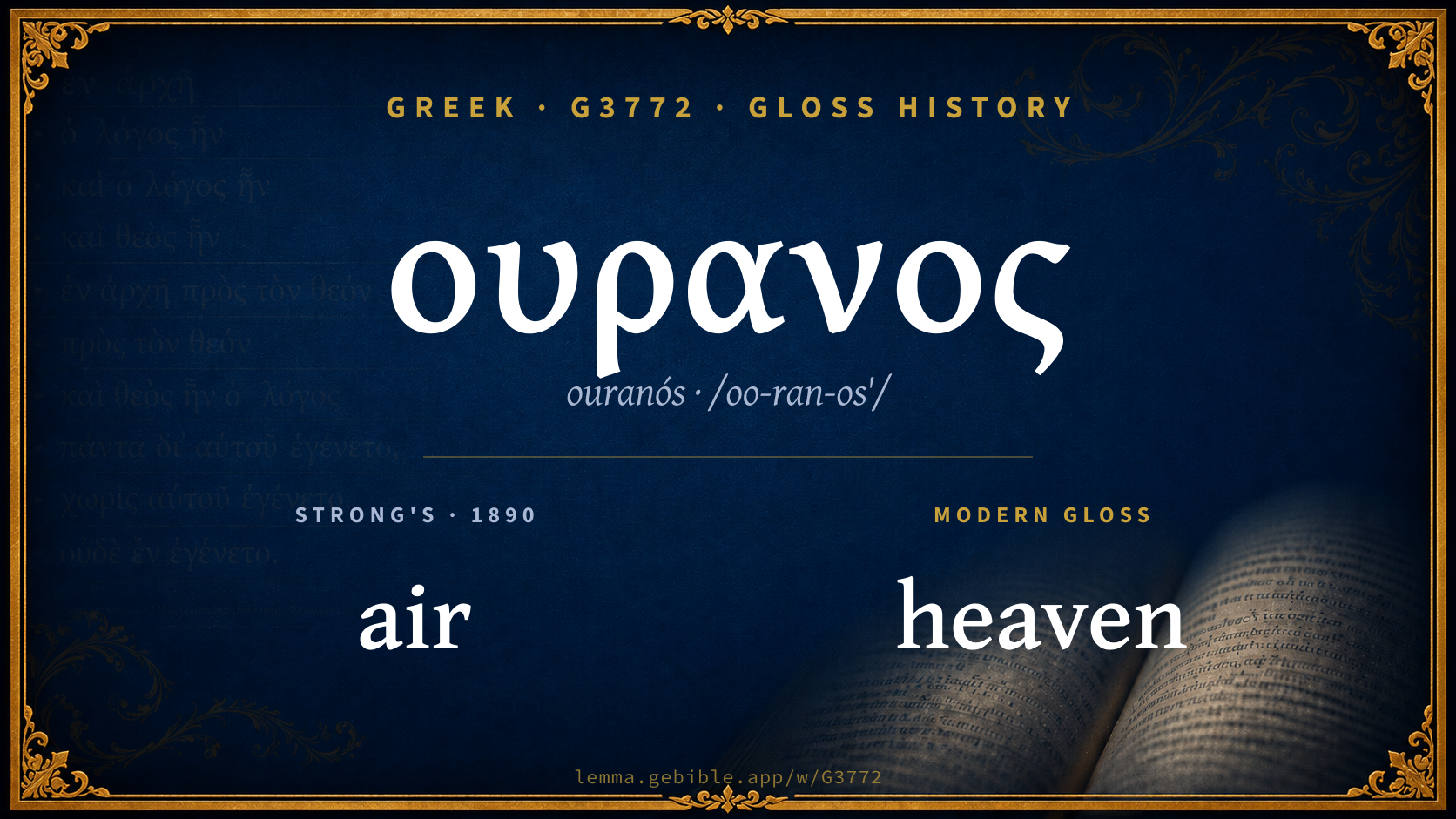
Strong's 1890 vs modern scholarship
About this word
Strong's G3772 catalogs a Greek word from the Greek New Testament.
These counts are not copied from any lexicon or concordance. They are computed here, from the morphology-tagged Greek New Testament. What Lemma adds →
- 257
- distinct verses
- The word appears in 257 distinct verses.
- 19 / 27
- NT books
- The word appears in 19 of 27 New Testament books.
- #60
- by frequency
- Top 100 most frequent Greek words (rank 60 of 5,347 Greek words by occurrence).
View all 257 occurrences in the concordance →
Most concentrated in
- Matthew 74 verses 29%
- Revelation 50 verses 19%
- Luke 33 verses 13%
By section of the New Testament
By traditional corpus
Conventional, traditional groupings — biblical authorship is debated, so this is a traditional corpus grouping, not an authorship claim. Some books belong to more than one corpus (Luke is in both the Gospels and the Lukan corpus, and so on), so these shares overlap and need not total 100%. Each figure is a share of the word’s 257 distinct verses.
- Gospels 141 verses · 55%
- Johannine 67 verses · 26%
- Lukan (Luke–Acts) 57 verses · 22%
- Revelation 50 verses · 19%
- Pauline corpus 21 verses · 8%
- General (Catholic) Epistles 11 verses · 4%
- Hebrews 10 verses · 4%
How translations render this word
Counts come from each version’s own published word-to-Strong’s tagging or interlinear alignment — an approximate guide to how each version renders this word, not a word-level alignment the data otherwise carries. Because each total is that version’s own tagged count, the per-version totals vary from one another and need not match the appearance or distinct-verse counts above. These counts may also differ from a printed concordance because Lemma counts each distinctly tagged rendering and does not collapse phrase taggings into a single head-word total. This is a fixed set of word-tagged versions (KJV, ASV, BSB, ULT) and does not change with the reading translation you choose elsewhere. Each version’s license is shown beside its name below (and on Sources).
- King James Version: Heaven 247×, Heavens 18×, Air 10×
- American Standard Version: Heaven 242×, Heavens 25×, Heavenly 2×
- Berean Standard Bible: Heaven 227×, Heavens 18×, Sky 15×
- unfoldingWord Literal Text: Heaven 163×, Heavens 85×, Sky 26×
King James Version Public Domain
Renders G3772 across 284 tagged occurrences — most commonly:
Plus 4 renderings that appear only once — usually multi-word phrases or single function words the recovered tagging swept in, not distinct renderings.
American Standard Version Public Domain
Renders G3772 across 272 tagged occurrences — most commonly:
Plus 3 renderings that appear only once — usually multi-word phrases or single function words the recovered tagging swept in, not distinct renderings. Not rendered by a distinct English word in 1 further occurrence.
Berean Standard Bible Public Domain
Renders G3772 across 272 tagged occurrences — most commonly:
Plus 1 rendering that appears only once — usually multi-word phrases or single function words the recovered tagging swept in, not distinct renderings. Not rendered by a distinct English word in 1 further occurrence.
unfoldingWord Literal Text CC BY-SA 4.0
Renders G3772 across 279 tagged occurrences — most commonly:
Plus 3 renderings that appear only once — usually multi-word phrases or single function words the recovered tagging swept in, not distinct renderings.
Senses in Thayer's
The 2 senses Thayer's distinguishes for this word, in lexicon order (not ranked by frequency or importance). The full entry — with sub-senses — is in the Lexicon Entry tab.
- the vaulted expanse of the sky with all things visible in it
- the region above the sidereal heavens…
Word origin
Derived from ορος (óros) (G3735) — mountain.
Perhaps from the same as G3735 (through the idea of elevation ); the sky ; by extension heaven (as the abode of God); by implication happiness power eternity ; specifically the Gospel ( Christianity ): - air heaven ([-ly]) sky.
— Strong’s Exhaustive Concordance (1890), public domain.
Forms in the corpus
The 13 distinct written forms G3772 takes in the Greek New Testament, most frequent first — each parse links to that case’s occurrences in the concordance.
| Form | Parsing | Example | Uses |
|---|---|---|---|
| οὐρανοῦ ouranoû | Noun, Genitive, Singular, Masculine | Matthew 6:26 | 92 |
| οὐρανῶν ouranō̂n | Noun, Genitive, Plural, Masculine | Matthew 3:2 | 44 |
| οὐρανοῖς ouranoîs | Noun, Dative, Plural, Masculine | Matthew 5:12 | 36 |
| οὐρανῷ ouranō̂ | Noun, Dative, Singular, Masculine | Matthew 5:34 | 36 |
| οὐρανὸν ouranòn | Noun, Accusative, Singular, Masculine | Matthew 14:19 | 29 |
| οὐρανόν ouranón | Noun, Accusative, Singular, Masculine | Luke 3:21 | 13 |
| οὐρανὸς ouranòs | Noun, Nominative, Singular, Masculine | Matthew 5:18 | 8 |
| οὐρανοὶ ouranoì | Noun, Nominative, Plural, Masculine | 2 Peter 3:5 | 5 |
| οὐρανός ouranós | Noun, Nominative, Singular, Masculine | Matthew 16:2 | 4 |
| οὐρανοὺς ouranoùs | Noun, Accusative, Plural, Masculine | Mark 1:10 | 3 |
| οὐρανοί ouranoí | Noun, Nominative, Plural, Masculine | Matthew 3:16 | 2 |
| οὐρανούς ouranoús | Noun, Accusative, Plural, Masculine | Acts 2:34 | 2 |
| οὐρανέ ourané | Noun, Vocative, Singular, Masculine | Revelation 18:20 | 1 |
Same root — word family
Other Thayer's entries built from the same root as G3772, grouped by Strong’s listed origin. These share a root / origin per the lexicon — not necessarily a shared meaning. Each links to that word’s own entry.
Derives from
Shares the same root
- ορεγομαι orégomai G3713 to stretch out
- ορεινος oreinós G3714 mountainous
- ορθος orthós G3717 straight
- ορθρος órthros G3722 dawn
- ορνις órnis G3733 bird
Derived from this word
Compare all same-root words → Showing 4 of 9 — not the complete family. They share a root, not necessarily a meaning.
Septuagint usage
The same Greek word ουρανος appears 500 times in the Greek Old Testament (Septuagint), across 454 verses in 32 books.
- 500
- LXX occurrences
- Tagged occurrences of this Greek word in the Septuagint.
- 454
- verses
- Distinct Septuagint verses containing this word.
- 32 / 39
- OT books
- The word appears in 32 of the 39 Old Testament books.
Sample Septuagint occurrences
- Genesis 1:1 οὐρανός
- Exodus 9:8 οὐρανός
- Leviticus 26:19 οὐρανός
- Deuteronomy 1:10 οὐρανός
- Joshua 2:11 οὐρανός
- Judges 5:4 οὐρανός
- 1 Samuel 2:10 οὐρανός
- 2 Samuel 18:9 οὐρανός
- 1 Kings 8:22 οὐρανός
- 2 Kings 1:10 οὐρανός
- 1 Chronicles 16:26 οὐρανός
- 2 Chronicles 2:5 οὐρανός
Septuagint occurrences (same lexeme)
Every verse where the same Strong’s number (G3772) appears in the Greek Septuagint — showing the first 50 of 454. Verse text shown in the World English Bible for context; the Greek form is the matched word — the English is not keyword-highlighted.
- Genesis 1:1 οὐρανός In the beginning God created the heavens and the earth.
- Genesis 1:8 οὐρανός God called the expanse sky. There was evening and there was morning, a second day.
- Genesis 1:9 οὐρανός God said, "Let the waters under the sky be gathered together to one place, and let the dry land appear," and it was so.
- Genesis 1:14 οὐρανός God said, "Let there be lights in the expanse of sky to divide the day from the night; and let them be for signs, and for seasons, and for days and years;
- Genesis 1:15 οὐρανός and let them be for lights in the expanse of sky to give light on the earth," and it was so.
- Genesis 1:17 οὐρανός God set them in the expanse of sky to give light to the earth,
- Genesis 1:20 οὐρανός God said, "Let the waters swarm with swarms of living creatures, and let birds fly above the earth in the open expanse of sky."
- Genesis 1:26 οὐρανός God said, "Let us make man in our image, after our likeness: and let them have dominion over the fish of the sea, and over the birds of the sky, and over the cattle, and over all the earth, and over every creeping thing that creeps on the earth."
- Genesis 1:28 οὐρανός God blessed them. God said to them, "Be fruitful, multiply, fill the earth, and subdue it. Have dominion over the fish of the sea, over the birds of the sky, and over every living thing that moves on the earth."
- Genesis 1:30 οὐρανός To every animal of the earth, and to every bird of the sky, and to everything that creeps on the earth, in which there is life, I have given every green herb for food." And it was so.
- Genesis 2:1 οὐρανός The heavens and the earth were finished, and all the host of them.
- Genesis 2:4 οὐρανός This is the history of the generations of the heavens and of the earth when they were created, in the day that Yahweh God made earth and the heavens.
- Genesis 2:19 οὐρανός Out of the ground Yahweh God formed every animal of the field, and every bird of the sky, and brought them to the man to see what he would call them. Whatever the man called every living creature, that was its name.
- Genesis 2:20 οὐρανός The man gave names to all cattle, and to the birds of the sky, and to every animal of the field; but for man there was not found a helper suitable for him.
- Genesis 6:7 οὐρανός Yahweh said, "I will destroy man whom I have created from the surface of the ground; man, along with animals, creeping things, and birds of the sky; for I am sorry that I have made them."
- Genesis 6:17 οὐρανός I, even, I do bring the flood of waters on this earth, to destroy all flesh having the breath of life from under the sky. Everything that is in the earth will die.
- Genesis 7:3 οὐρανός Also of the birds of the sky, seven and seven, male and female, to keep seed alive on the surface of all the earth.
- Genesis 7:11 οὐρανός In the six hundredth year of Noah's life, in the second month, on the seventeenth day of the month, on the same day all the fountains of the great deep were burst open, and the sky's windows were opened.
- Genesis 7:19 οὐρανός The waters prevailed exceedingly on the earth. All the high mountains that were under the whole sky were covered.
- Genesis 7:23 οὐρανός Every living thing was destroyed that was on the surface of the ground, including man, cattle, creeping things, and birds of the sky. They were destroyed from the earth. Only Noah was left, and those who were with him in the ark.
- Genesis 8:2 οὐρανός The deep's fountains and the sky's windows were also stopped, and the rain from the sky was restrained.
- Genesis 9:2 οὐρανός The fear of you and the dread of you will be on every animal of the earth, and on every bird of the sky. Everything that the ground teems with, and all the fish of the sea are delivered into your hand.
- Genesis 11:4 οὐρανός They said, "Come, let's build us a city, and a tower, whose top reaches to the sky, and let's make us a name; lest we be scattered abroad on the surface of the whole earth."
- Genesis 14:19 οὐρανός He blessed him, and said, "Blessed be Abram of God Most High, possessor of heaven and earth:
- Genesis 14:22 οὐρανός Abram said to the king of Sodom, "I have lifted up my hand to Yahweh, God Most High, possessor of heaven and earth,
- Genesis 15:5 οὐρανός Yahweh brought him outside, and said, "Look now toward the sky, and count the stars, if you are able to count them." He said to Abram, "So shall your seed be."
- Genesis 19:24 οὐρανός Then Yahweh rained on Sodom and on Gomorrah sulfur and fire from Yahweh out of the sky.
- Genesis 21:17 οὐρανός God heard the voice of the boy. The angel of God called to Hagar out of the sky, and said to her, "What ails you, Hagar? Don't be afraid. For God has heard the voice of the boy where he is.
- Genesis 22:11 οὐρανός The angel of Yahweh called to him out of the sky, and said, "Abraham, Abraham!" He said, "Here I am."
- Genesis 22:15 οὐρανός The angel of Yahweh called to Abraham a second time out of the sky,
- Genesis 22:17 οὐρανός that in blessing I will bless you, and in multiplying I will multiply your seed as the stars of the heavens, and as the sand which is on the seashore. Your seed will possess the gate of his enemies.
- Genesis 24:3 οὐρανός I will make you swear by Yahweh, the God of heaven and the God of the earth, that you shall not take a wife for my son of the daughters of the Canaanites, among whom I live.
- Genesis 24:7 οὐρανός Yahweh, the God of heaven, who took me from my father's house, and from the land of my birth, who spoke to me, and who swore to me, saying, 'I will give this land to your seed.' He will send his angel before you, and you shall take a wife for my son from there.
- Genesis 26:4 οὐρανός I will multiply your seed as the stars of the sky, and will give to your seed all these lands. In your seed will all the nations of the earth be blessed,
- Genesis 27:28 οὐρανός God give you of the dew of the sky, of the fatness of the earth, and plenty of grain and new wine.
- Genesis 27:39 οὐρανός Isaac his father answered him, "Behold, of the fatness of the earth will be your dwelling, and of the dew of the sky from above.
- Genesis 28:12 οὐρανός He dreamed. Behold, a stairway set up on the earth, and the top of it reached to heaven. Behold, the angels of God ascending and descending on it.
- Genesis 28:17 οὐρανός He was afraid, and said, "How dreadful is this place! This is none other than God's house, and this is the gate of heaven."
- Genesis 40:17 οὐρανός In the uppermost basket there was all kinds of baked food for Pharaoh, and the birds ate them out of the basket on my head."
- Genesis 40:19 οὐρανός Within three more days, Pharaoh will lift up your head from off you, and will hang you on a tree; and the birds will eat your flesh from off you."
- Genesis 49:25 οὐρανός Even by the God of your father, who will help you, By the Almighty, who will bless you, With blessings of heaven above, Blessings of the deep that lies below, Blessings of the breasts, and of the womb.
- Exodus 9:8 οὐρανός Yahweh said to Moses and to Aaron, "Take to you handfuls of ashes of the furnace, and let Moses sprinkle it toward the sky in the sight of Pharaoh.
- Exodus 9:10 οὐρανός They took ashes of the furnace, and stood before Pharaoh; and Moses sprinkled it up toward the sky; and it became a boil breaking forth with boils on man and on animal.
- Exodus 9:22 οὐρανός Yahweh said to Moses, "Stretch forth your hand toward the sky, that there may be hail in all the land of Egypt, on man, and on animal, and on every herb of the field, throughout the land of Egypt."
- Exodus 9:23 οὐρανός Moses stretched forth his rod toward the heavens, and Yahweh sent thunder, hail, and lightning flashed down to the earth. Yahweh rained hail on the land of Egypt.
- Exodus 10:13 οὐρανός Moses stretched forth his rod over the land of Egypt, and Yahweh brought an east wind on the land all that day, and all the night; and when it was morning, the east wind brought the locusts.
- Exodus 10:21 οὐρανός Yahweh said to Moses, "Stretch out your hand toward the sky, that there may be darkness over the land of Egypt, even darkness which may be felt."
- Exodus 10:22 οὐρανός Moses stretched forth his hand toward the sky, and there was a thick darkness in all the land of Egypt three days.
- Exodus 16:4 οὐρανός Then said Yahweh to Moses, "Behold, I will rain bread from the sky for you, and the people shall go out and gather a day's portion every day, that I may test them, whether they will walk in my law, or not.
- Exodus 17:14 οὐρανός Yahweh said to Moses, "Write this for a memorial in a book, and rehearse it in the ears of Joshua: that I will utterly blot out the memory of Amalek from under the sky."
These are occurrences of the same Greek lexeme (G3772) in the Septuagint — not a translation of any one Hebrew word. The store carries no word-level Hebrew↔Greek alignment, so no Hebrew original is asserted here. Counts come from the recovered LXX Strong's tagging — high-frequency vocabulary is well covered, while rare or late forms may be untagged — so they reflect tagged occurrences and may slightly undercount.