
Acts 1:10

Greek (Tischendorf 8th ed.) Acts 1:10 appears in the Greek New Testament. The text above is from the Tischendorf 8th edition. Each word links to its Strong’s number and a concise gloss. Click any word for its full Thayer’s Greek Lexicon entry.
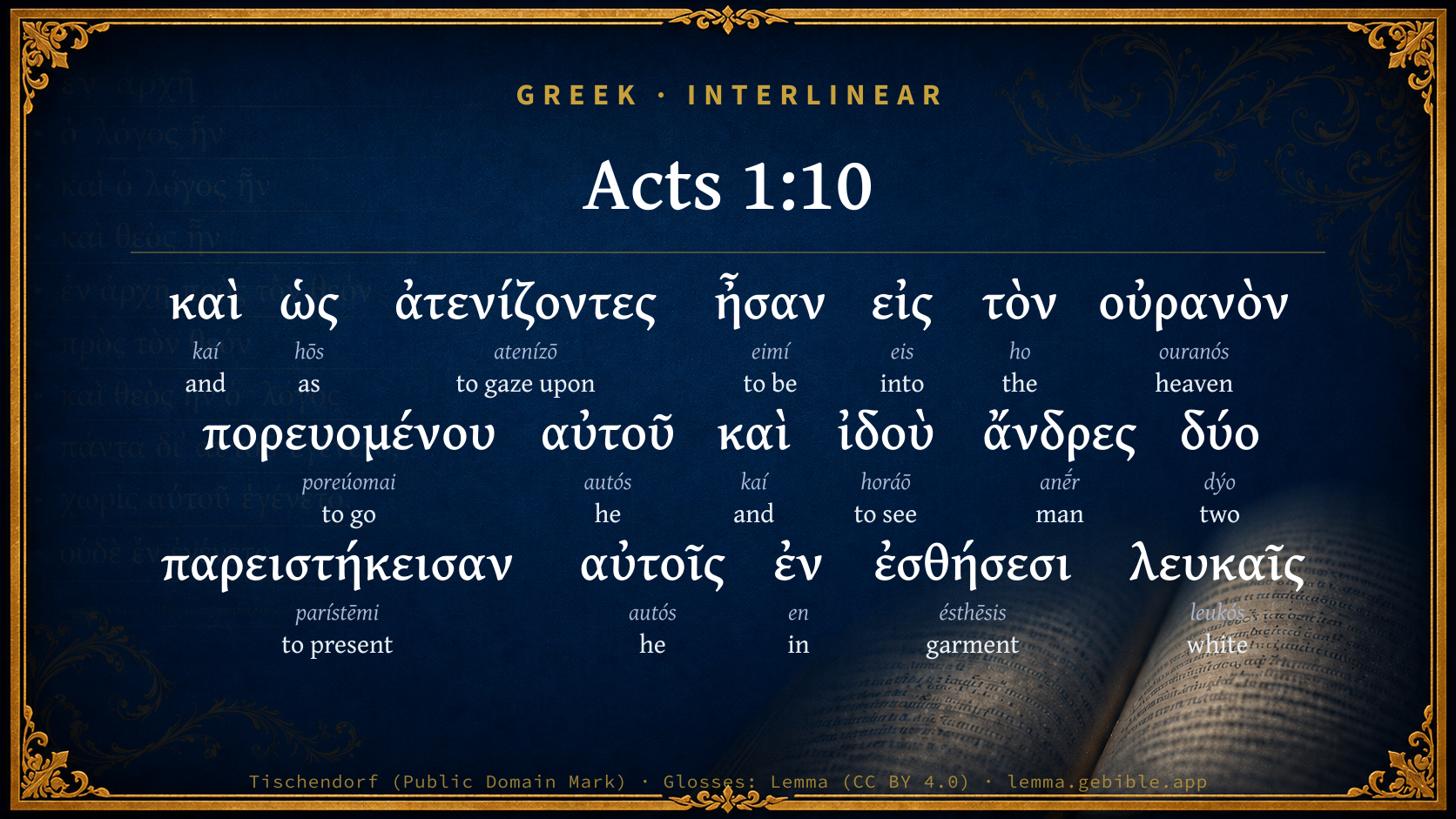
Download image
Cite this verse

Acts 1:10 (World English Bible). Public Domain. Lemma interlinear Bible study tool, https://lemma.gebible.app/v/acts/1/10.

Show BibTeX & RIS
BibTeX
RIS
English Translation
While they were looking steadfastly into the sky as he went, behold, two men stood by them in white clothing,
World English Bible · Public Domain
Highlights
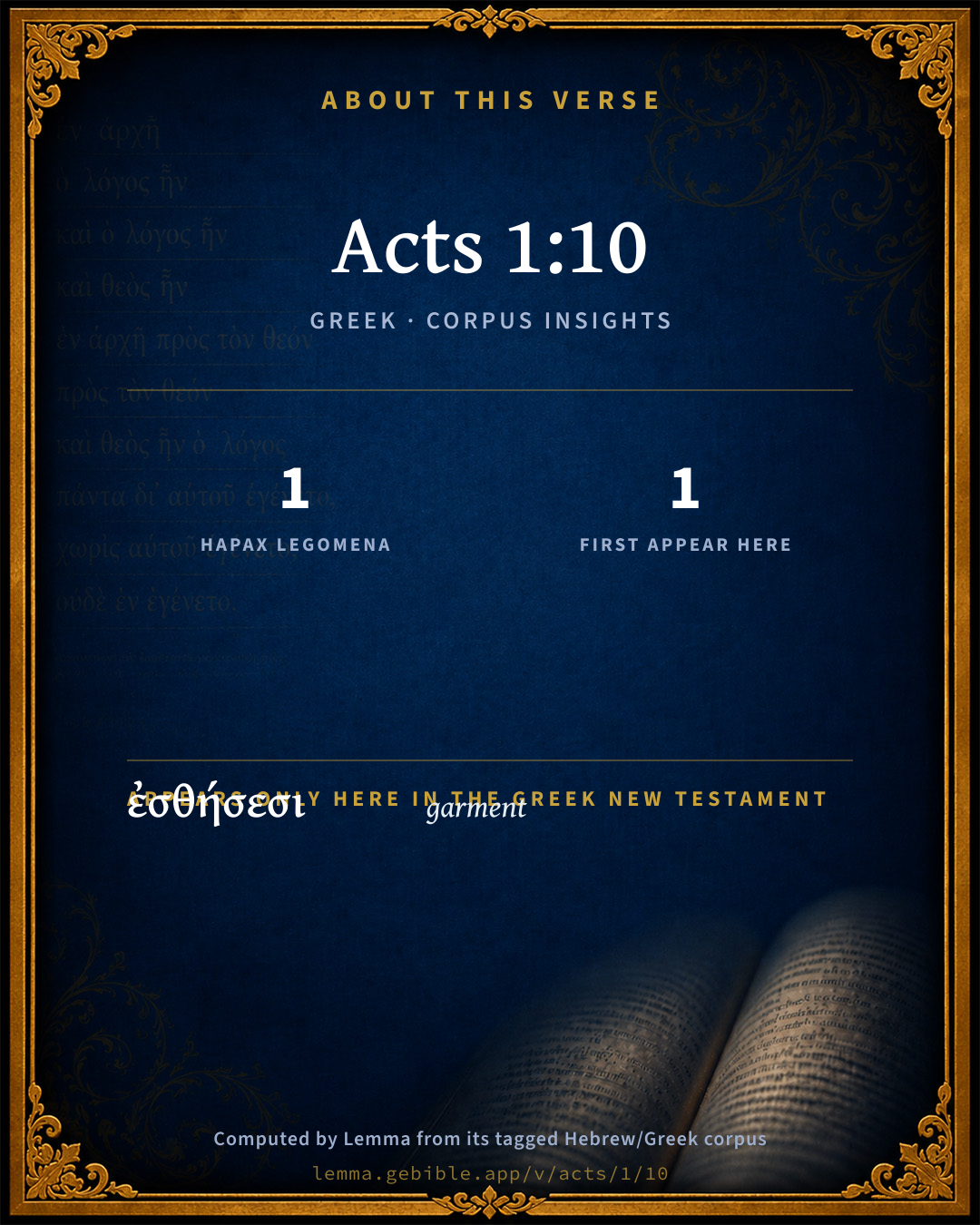
  • 1 hapax legomenon — only here in the Greek New Testament
  • 1 first appearance in the Greek New Testament
Full analysis ↓
Download a study sheet

One document with this verse’s original text, its word-by-word gloss line, the meaning frame, cross-references with their text, attributed commentary, and full source and license credits — printable, and it pastes into notes with its structure intact.

This verse Autodidact and up

Study sheet (.html) Plain text (.txt)

A passage Seminary Student

Up to 50 verses in one chapter. A passage sheet keeps up to 6 commentary sources and 12 cross-references per verse, in the order this page ranks them, and says so on the sheet whenever that leaves anything out. Ask for a single verse and you get the Autodidact verse sheet above.

Everything on this page stays free to read, with no account — the sheet is a download of what is already on screen, not access to it.

Want to remove ads? Support Godless Engineer
Compare translations 3

The same verse in 3 English versions, stacked beneath the original-language interlinear above. Click any original word for its lexicon entry.

Each is an independent rendering of the whole verse — the interlinear is not word-aligned to these translations.

Highlighted words mark where these versions differ — a whole-verse word diff, not a word-by-word alignment.

  • World English Bible Public Domain
    While they were looking steadfastly into the sky as he went, behold, two men stood by them in white clothing,
  • King James Version Public Domain
    And while they looked stedfastly toward heaven as he went up, behold, two men stood by them in white apparel;
  • unfoldingWord Literal Text CC BY-SA 4.0
    And while they were looking intently into heaven as he was going up, and behold, two men stood by them in white clothes.

unfoldingWord Literal Text — © unfoldingWord, licensed CC BY-SA 4.0. Word-aligned USFM3 via Door43 (git.door43.org/unfoldingWord/en_ult).

Versions to compare (up to 4)

3 of 4 selected

Show all 19 translations

Every available English version of this verse, each an independent rendering of the whole verse.

  • World English Bible Public Domain
    While they were looking steadfastly into the sky as he went, behold, two men stood by them in white clothing,
  • Berean Standard Bible Public Domain
    They were looking intently into the sky as He was going, when suddenly two men dressed in white stood beside them.
  • Majority Standard Bible Public Domain
    They were looking intently into the sky as He was going, when suddenly two men dressed in white stood beside them.
  • King James Version Public Domain
    And while they looked stedfastly toward heaven as he went up, behold, two men stood by them in white apparel;
  • American Standard Version (1901) Public Domain
    And while they were looking stedfastly into heaven as he went, behold, two men stood by them in white apparel;
  • Revised Version (1885) Public Domain
    And while they were looking stedfastly into heaven as he went, behold, two men stood by them in white apparel;
  • Geneva Bible (1599) Public Domain
    And while they looked stedfastly towarde heauen, as hee went, beholde, two men stoode by them in white apparell,
  • Douay-Rheims (1899) Public Domain
    And while they were beholding him going up to heaven, behold two men stood by them in white garments.
  • Young's Literal Translation Public Domain
    and as they were looking stedfastly to the heaven in his going on, then, lo, two men stood by them in white apparel,
  • Literal Standard Version CC BY-SA 4.0
    and as they were looking steadfastly to the sky in His going on, then, behold, two men stood by them in white clothing,
  • Unlocked Literal Bible CC BY-SA 4.0
    While they were looking intensely to heaven as he went, suddenly, two men stood by them in white clothing.
  • unfoldingWord Literal Text CC BY-SA 4.0
    And while they were looking intently into heaven as he was going up, and behold, two men stood by them in white clothes.
  • Darby Bible Public Domain
    And as they were gazing into heaven, as he was going, behold, also two men stood by them in white clothing,
  • World Messianic Bible Public Domain
    While they were looking steadfastly into the sky as he went, behold, two men stood by them in white clothing,
  • Webster's Bible Public Domain
    And while they looked steadfastly towards heaven as he went up, behold, two men stood by them in white apparel;
  • Free Bible Version CC BY-SA 4.0
    While they were staring intently at the sky as he ascended, two men dressed in white were suddenly standing beside them.
  • Bible in Basic English Public Domain
    And while they were looking up to heaven with great attention, two men came to them, in white clothing,
  • Text-Critical English NT CC BY 4.0
    As he went, they were gazing up into the sky, when behold, two men in white clothing stood beside them.
  • Tyndale New Testament (1534) Public Domain
    And while they looked stedfastly vp to heaven as he went beholde two men stode by them in white apparell

Literal Standard Version (2020), Covenant Press — licensed CC BY-SA 4.0. Text via the HelloAO Bible API (eBible.org). Unlocked Literal Bible (unfoldingWord) — licensed CC BY-SA 4.0. Text via the HelloAO Bible API (eBible.org). unfoldingWord Literal Text — © unfoldingWord, licensed CC BY-SA 4.0. Word-aligned USFM3 via Door43 (git.door43.org/unfoldingWord/en_ult). Free Bible Version, Dr. Jonathan Gallagher — licensed CC BY-SA 4.0. Text via the HelloAO Bible API (eBible.org).

Word by word

More ways to search: Search by grammar → Find every occurrence → Compare this word →

Practice this passage: Drill this verse → Learn its vocabulary →

ἐσθήσεσι
ésthēsis
G2067
“garment”
Noun, Dative, Plural, Feminine
Part of Speech
Noun
Case
Dative
Number
Plural
Gender
Feminine
Full Thayer's Definition

Origin: from a derivative of G2066

TDNT: None

1. clothing, apparel
  1. καὶ kaí G2532 “and” Conjunction
  2. ὡς hōs G5613 “as” Adverb
  3. ἀτενίζοντες atenízō G816 “to gaze upon” Verb, Present, Active, Participle, Nominative, Plural, Masculine
  4. ἦσαν eimí G1510 “to be” Verb, Imperfect, Active, Indicative, 3rd person, Plural
  5. εἰς eis G1519 “into” Preposition
  6. τὸν ho G3588 “the” Article, Accusative, Singular, Masculine
  7. οὐρανὸν ouranós G3772 “heaven” Noun, Accusative, Singular, Masculine
  8. πορευομένου poreúomai G4198 “to go” Verb, Present, Middle or Passive deponent, Participle, Genitive, Singular, Masculine
  9. αὐτοῦ autós G846 “he” Personal pronoun, Genitive, Singular, Masculine
  10. καὶ kaí G2532 “and” Conjunction
  11. ἰδοὺ horáō G3708 “to see” Verb, Aorist, Middle, Imperative, 2nd person, Singular
  12. ἄνδρες anḗr G435 “man” Noun, Nominative, Plural, Masculine
  13. δύο dýo G1417 “two” Adjective, Numeral (indeclinable)
  14. παρειστήκεισαν parístēmi G3936 “to present” Verb, Pluperfect, Active, Indicative, 3rd person, Plural
  15. αὐτοῖς autós G846 “he” Personal pronoun, Dative, Plural, Masculine
  16. ἐν en G1722 “in” Preposition
  17. λευκαῖς leukós G3022 “white” Adjective, Dative, Plural, Feminine

About this verse

These counts appear in no published source. They are computed here, from the morphology-tagged text and Lemma’s own curated glosses. What Lemma adds →

18
words
16
distinct lemmas
Acts
section

Notable vocabulary

1 hapax legomenon — a word that appears only here in the entire Greek New Testament:

  • ἐσθήσεσι garment G2067

First appearance in Scripture

This word makes its first canonical appearance in the Greek New Testament here:

  • ἐσθήσεσι garment G2067

Shared distinctive vocabulary

ἀτενίζοντες to gaze upon G816 occurs in 14 verses of the Greek New Testament. Also found in:
Repetition

Words recur within this verse:

  • καὶ and G2532 ×2
  • αὐτοῦ he G846 ×2

Cross-references

11

Topical passages linked to Acts 1:10 in the Treasury of Scripture Knowledge — connected by theme and wording, ordered by reader-vote popularity; previews shown in the World English Bible.

  • Luke 24:4 It happened, while they were greatly perplexed about this, behold, two men stood by them in dazzling clothing.
  • John 20:12 and she saw two angels in white sitting, one at the head, and one at the feet, where the body of Jesus had lain.
  • Mark 16:5 Entering into the tomb, they saw a young man sitting on the right side, dressed in a white robe, and they were amazed.
  • Revelation 7:14 I told him, "My lord, you know." He said to me, "These are those who came out of the great tribulation. They washed their robes, and made them white in the Lamb's blood.
  • Daniel 7:9 I saw until thrones were placed, and one who was ancient of days sat: his clothing was white as snow, and the hair of his head like pure wool; his throne was fiery flames, [and] the wheels of it burning fire.
  • Matthew 17:2 He was transfigured before them. His face shone like the sun, and his garments became as white as the light.
  • Matthew 28:3 His appearance was like lightning, and his clothing white as snow.
  • Acts 10:30 Cornelius said, "Four days ago, I was fasting until this hour, and at the ninth hour, I prayed in my house, and behold, a man stood before me in bright clothing,
  • 2 Kings 2:11–12 It happened, as they still went on, and talked, that behold, [there appeared] a chariot of fire, and horses of fire, which parted them both apart; and Elijah went up by a whirlwind into heaven.
  • Acts 10:3 At about the ninth hour of the day, he clearly saw in a vision an angel of God coming to him, and saying to him, "Cornelius!"
  • Revelation 3:4 Nevertheless you have a few names in Sardis that did not defile their garments. They will walk with me in white, for they are worthy.

Cross-references courtesy of OpenBible.info (CC BY 4.0).

Commentary

Notes on Acts 1:10 from classic Christian and Jewish commentators (each source and its license shown beneath its notes). The classic Christian expositions comment on the surrounding passage and are grouped to its opening verse, so a note may address several verses; the Jewish commentaries on the Tanakh (Rashi and others) are per-verse, so they appear only where the commentator wrote on this verse.

Lemma curates 59 commentaries, every one of them public domain or Creative Commons licensed, each selected and text-cleaned for this edition rather than reprinted as found. About our sources →

The Biblical Illustrator

Joseph S. Exell

Act_1:10-11

And while they looked steadfastly toward heaven as He went up.

Too much mere sentiment in religion

It may be that the same two angels who rolled away the stone, and appeared at His open sepulchre, were present now. Or were they the two men, Moses and Elijah, who had appeared at the Transfiguration? Whoever they were, they were glorified beings, sent to do honour to Christ. The words may be taken as a rebuke for the indulgence of too much sentiment in connection with religion. Sentiment in religion is not only good, but essential; without the sentiments of love, hope, gratitude, adoration, there could be no religion. But if it continue merely as sentiment, and takes no practical form, sways not the actions and shapes not the life, it is rather pernicious than useful.

I. That too much sentimental interest in the marvellous in religion is not good. Religion has its marvels, supernatural events crowd the Word of God; but to yield our minds too much to the influence of the wonderful, is not good. The sentiment of wonder has its beneficent mission; it tends to take us out of ourselves, to break the monotony of our experience, and to give a passing freshness to life. But the indulgence of this sentiment of wonder, apart from religion, is a great evil. The religionists who are always gazing after signs and wonders become dreamy mystics and the dupes of priestly imposture. The wonder which the marvellous in religion excites, becomes only useful as it lifts us to a higher plane of practical life, only as it tends to make our lives sublime.

II. That too much sentimental interest in the objective in religion is not good. The disciples were looking outside of themselves, fixing their gaze on the heavens. We do well so to gaze upon the outward, as to reduce the whole into a science that shall become the richest inheritance of the intellect. In religion, too, we must be interested in the outward. The soul is neither self-sustaining nor self-directing; its elements of life must be derived from without; its lessons of direction must come from without. But to have all our interests absorbed in the externals of religion is a terrible evil, and, alas I a prevalent one. The kingdom of God is not meat and drink, but righteousness and joy and peace in the Holy Ghost.

III. That too much sentimental interest in the temporary in religion is not good. There is a natural tendency in these souls of ours to linger with interest over departed objects that were once dear to the heart. We cling, says one, to the shell, the husks, the garments, after the kernel, the essence, and the life have gone. To indulge in this sentiment in natural things, is not good; the mourner whose sentiments are always absorbed in the dear ones that are gone, grows moody and diseased. The permanent was with them--the eternal principles of truth and the spirit of Christ, these did not depart; it was a mere temporary manifestation that went; and to have their sentiments engrossed in that, was not good. There are those around us in all directions whose sympathies are taken up with the mere temporary forms of religion. (Homilist.)

Words to the spectators of the ascension

I. The chiding element. Why stand ye gazing? There is undoubtedly reproof in these words.

1. Why stand ye?--you need not lament that which is a blessing. All that is necessary on earth for your spiritual culture and well-being He has accomplished, and now He enters heaven in order to give efficiency to all the spiritual instrumentalities which He has set in operation amongst you. You should rejoice, rather than lament--rejoice at what He has done for you, rejoice that He has triumphed over His enemies, rejoice that He is leaving His degradation, sorrows, and enemies for scenes of dignity, blessedness, and love. Ah, how often, through our ignorance, we lament over events which should fill us with rejoicing.

2. Why stand ye--you gain much by His departure. It is expedient for you that He goes away, for if He goes not away the Comforter will not come. When He is gone you will be thrown back upon yourselves and be made self-reliant.

3. Why stand ye--He has given you a commission to work. Go into all the world and preach the gospel to every creature, beginning at Jerusalem.

II. The cheering element. This same Jesus which is taken from you into heaven, shall so come in like manner as ye have seen Him go into heaven.

1. He will return to you in like manner. How unexpectedly He went away. It is said, while they looked He went. In like manner He will come: unexpectedly.

2. He will return to you identical in personality. This same Jesus. Same loving Brother, tried Friend, mighty Lord, etc. Whatever changes take place in the universe, they will not touch Him.

3. He will return to you in great glory. He went up in great glory, a cloud received Him out of their sight. What cloud was that? It was that luminous, mystic flame which was ever regarded as the symbol of the Divine Presence. That which gleamed in the bush to Moses, in the pillar that conducted the Children of Israel through the wilderness, over the mercy-seat in the holy of holies, which glided through the heavens like a star and conducted the wise men to the place where Jesus was born; that which spread over the Mount of Transfiguration and made the scene so transporting. In like manner He will come. I beheld a great white throne, and Him that sat thereon, etc.

Conclusion: Such is what seems implied in this angelic language and from it three general truths may be drawn.

1. That what we deem our greatest losses are often our greatest gain.

2. That we indulge too much in the sentiments of religion when they detain us from earnest work.

3. That the destinies of men in all worlds and ages are bound up in Christ. This same Jesus. (Homilist.)

Why stand ye gazing

There is reproof in the question. We might have thought that the question answered itself. Would it not have been strange if they had not stood gazing? Less wonderful spectacles than that have drawn together a crowd of gazers, and no one thinks of arguing with them. Curiosity alone will account for gazing upon this spectacle; ascent into heaven by one in human form, unaided by any visible appliance. Who, I say, would not gaze up into heaven to watch this? But how much more, if the person thus ascending was a friend--a friend closer than a brother. The disciples gazed as though they were looking their last upon the departed form. To be reminded, then, that this was by no means their last sight of Him was to be recalled at once to thoughts of peace, and hope, and blessedness; to be reproved for this gazing by the assurance which followed, that this same Jesus shall come again in like manner as ye now see Him go, had healing in the very wound. Interpreted by the teaching of the Last Supper, the reproof said this to them: Remember how He said to you while He was yet with you, A little while, and ye shall not see Me; and again a little while and ye shall see Me. One fulfilment of that saying you have already witnessed: He went from you by death, and He came back to you by resurrection. Another fulfilment of the same saying is now in development: He goes from you by ascension, and He shall come back to you in the Advent. This, then, was the meaning for the first disciples of the Why stand ye gazing? which is our text. Within tea days they understood it. On the instant it comforted them, for St. Luke expressly says, that they returned to Jerusalem that very hour with great joy. The idea of parting was swallowed up for them in the idea of meeting. But now, let us hear this question addressed to ourselves: Why stand ye here gazing? What mean ye by this silence? and let us think what we shall answer. Why stand ye to-night in this church gazing on the ascension? We take an onward step when we reply.

I. Because it helps us to realise a world beyond this world, a life above this life, a substantial rock that is higher than we, on which we would firmly stand our feet amidst the billows and storms of the temporal and the transient. To fix a steadfast gaze upon the ascending Lord, till a cloud comes between and intercepts the view, to which flesh and blood are unequal, of that glorious, that mysterious transition from the material into the immaterial universe--we find it helpful, we find it comforting, under the heavy pressure of sense and time, whether our circumstances at this present are joyous or grievous, weighted with care and sorrow, or but too jubilant with pleasure and prosperity. It is not easy to believe in a world out of sight. We want every help that a religious life can give to it, we want the aid of prayer, we want the discipline of providence, we want the experience of years, we want, first and above all, a revelation such as God gives in His Son, commending itself to mans conscience and resting upon a basis of impregnable fact. I know not what would become of us in days such as these--days of unrest and disquietude, days of anxiety bursting sometimes into horror, days of failing hearts and almost despairing hopes, for the future of our own and other lands, if we could not gaze upward after the ascended Saviour and infer the certainty of a better country, that is a heavenly.

II. The desire to realise the life of Christ Himself as gone into heaven for us men and for our salvation.

III. That we are all learning in heart and mind to ascend after Him, and there with Him continually to dwell. There are many counterfeits of this grace, there are also some substitutes for it, counted as good or better, sometimes even by the Church of this age. It is an age which makes activity everything; measures religion by its tangible effects; leaves itself no inner life, as it were; itself depends on the outward, and thinks little even of the industry which has nothing to show for itself. The Church too much humours and pampers this temper of the times. Now, the ascent of our Lord is the protest against this whole system. They who would witness for Him must find time to track His ascending; they who would reproduce Him in. His reality to this nineteenth age must first have gazed steadfastly up; there must be leisure found or made for this, leisure for meditation, leisure for study, leisure for communing. Let each one fix his gaze upon the ascending Lord, that he may follow Him where the Ascended rests in that calm heaven, the heaven of holiness and the heaven of love. Let him dwell with the Ascended, having boldness to enter into the Holiest. Let us draw nigh; let it be a purified entering, and let it be a purified return also. That is the spiritual mind whose home is heaven. Why stand ye gazing up into heaven? Because we would follow where He has led, live the life of heaven here, and at last be with Him for ever where He is. (Dean Vaughan.)

The disciples at the Ascension

I. Men overpowered and dispossessed of self-control in the presence of a wondrous revelation. There are moments in which men are not themselves. Great events suddenly happen and the spectators lose all presence of mind, however sagacious they may ordinarily be. Sometimes they cannot speak for joy, sometimes for terror, sometimes for simple amazement. This is the case sometimes with children, and often with men when, e.g., a letter is received containing unexpected news. The thing to be remembered here is that this is the natural effect of Christian revelation. When the angels came to Bethlehem the shepherds were afraid, so were the women to whom the angels spake at the sepulchre. And no man ought to receive Divine communications or see Divine effects without sensibility. Nor ought we to look on the sublimities of nature or the wonders of art as if they were nothing. This is one of the perils of familiarity. A rustic thinks little of the mountain under whose shadow he was born, but is struck dumb when he gazes on St. Pauls. A Londoner passes the cathedral without knowing that it is there, but looks at Snowdon for hours during his summer holiday.

II. Men recalled from enfeebling reverie. It was good for them to look upward, but there was something more to be done. We can waste time in the sublimest contemplation. When a man is naturally inclined to ecstasy he ought to fight against his inclination so as to bring it into harmony with other powers. There are persons to whom Christianity is so sublime a thing that they fail to see it in practical life. It is right to have hours of rapture, but a man cannot live so always. So the disciples were interrogated by the two men in white apparel--Moses and Elias, I think; for there is something Mosaic in the inquiry, and something of the power and passion of Elijah. We too are matched by the old master-workers of the world. Seeing then we are encompassed by so great a cloud of witnesses, why should our life be a gazing when we are called to work? When the women looked down into the sepulchre, the angel said, Why seek ye the living among the dead? So we are not always to be looking down. The lesson of the text is that we must not always be looking up. What then is to be our attitude? Look about you; and look up only to gain inspiration for the work nearest to hand.

III. Men instructed and comported by a promise. This same Jesus. Who wants an amended Christ? This same Jesus who knows, has taught, has died to save you shall come again. One would like to see Jesus; but one would not like Him to be so changed that those who knew Him first know Him no longer. We want such elements of identity as shall enable the disciples to gladly recognise Him as the same Christ. He is promised to come again in the same sublime fashion, sovereign in will, gentle in spirit, pure as God, tenderer than woman. The world cannot live without that promise. (J. Parker, D. D.)

Gazing into heaven

There is here--

I. An affectionate expostulation with those who are under personal bereavement. When Jesus had kept telling these friends of His that He purposed to leave them before long, they received no settled impression from it. It is of no use to attempt to become prepared for the loss of one whom we love. Now they looked after their ascending Lord with unutterable dismay. When any one has parted with some precious object of affection, the wounded spirit remains just broken, gazing up into vacancy, sometimes even wishing it might fly away and be at rest. But this cannot be indulged. These disciples are told to report immediately for duty. The mourners eyes should be fixed upon work, and not upon loss. See the promise (Psa_126:5-6.).

II. An earnest incitement to the laggard or listless. The great world needed the gospel without delay. Christ was gone, but the Comforter was coming. Just as soon as they advanced to duty the day of Pentecost dawned. There are men who stand gazing up into heaven after a revival. Now, nowhere does Gods Word bid us wait for any special outpouring of spiritual influence. The Holy Spirit is in the Church.

III. A clear counsel for those in earnest in the seeking of Christ for their souls. It is possible for a man to stand gazing up into heaven for a course of years, and then suddenly discover that what he has been looking for was an experience, and not a Saviour. Salvation is not a thing to be vacantly gazed after. Repent of your sins now. Put your trust in Christ now. The entire work of turning unto a new life usually begins with some commonplace step of commitment of ones self before others. A public word in a prayer-meeting, the asking of a blessing at the table, a checking admonition to a comrade, a mere refusal to do a wrong or worldly act, will never make a man a Christian, but it may show he has become one.

IV. A comfort for such Christians as are in bondage through fear of death. Let us think of our departure as an ascension like Christs. One may habituate himself to melancholy foreboding until all looks dark and frightful on ahead. Or he may accustom his mind to regarding a change of worlds as only a sweet, bright journey along the path the Saviour went from the Mount of Olives. (C. S. Robinson, D. D.)

Indolence

Nothing is more dangerous than idleness. He who has nothing to do will soon be doing something wrong. Our idle, says an eminent divine, are Satans busy days. If the mind is properly engaged, there is little room for the entrance of temptation; but when the mind is empty and open, the enemy can throw in what he pleases. Stagnant waters produce thousands of noxious insects that are unknown in flowing streams.

Looking after it is useless

How true to nature is that gazing steadfastly into heaven after gazing was useless! So we look at the spot on the horizon where the last gleam of a sail that bears away dear ones has faded. (A. Maclaren, D. D)

Unprofitable gazing

The two men in white apparel make a part of the grand supernatural array which the common scenery of the earth put on as the Lord was leaving it. From the entrance of the Saviour into the garden, on through the following forty-three days, the spiritual world and the material seemed to have the doors between them swung open, and to become one. If we believe the history, or credit the incarnation, at all, is not this just as we should expect? He in whom the realities of both heaven and earth were united; He who could say--The Son of Man is now in heaven, He is passing back personally into the unseen communion, where all His friends are to follow Him. I believe in miracles because I see the greater miracle--Christ--grander than all this worlds men, and yet lowlier, saying that He comes forth from God, and goes to God, as simply as my child shows me the flower found in the garden-yet so saying it that all the philosophers and critics of eighteen hundred years have not been able to break the authority or explain the secret. The question is--

I. A call from contemplation to action. Only a little breathing space was to be given them first to gather up their energies; and even that was not to be an interval of idleness. They were to go at once to Jerusalem, and their waiting there was to be like the waiting of the still midsummer elements, before the mountain winds sweep down and the tongues of fire leap out--a busy waiting--a preparation for this long campaign of many ages. They were to be earnest and constant in prayer and praise; to settle in their minds the doctrines and directions of their Master, pertaining to the kingdom; to fasten and cement the bonds of unity with one accord, and to fill up the vacant place in the apostolate. Thus their business had been marked out as every Christians is. But the apostles are not turning to that business; they are still resting in a kind of sentimental trance between their commission and their ministry. They were living as some Christians do nowadays-in their feelings, more than in their convictions and their will, in fruitless memories, not in daring hopes. Indulged any longer, this would become a mere life of religious sentiment, not a life of religious service--and so not a healthy life at all. If those men that had companied so long with Christ needed to be startled out of a false indulgence in the mere idle luxury of feeling, most of us need it much more. I hear a man say it makes him feel better to say his prayers; so far so good; but how far does the feeling go, and the power of the prayer keep him company, as a law of regulation to his lips and a purifier of his conduct? Lacordaire says, I desire to be remembered only as one who believed, who loved, and who prayed. But why only these? Ought there not to be an equal desire to honour the Lord in an active following of His steps and proclaiming Him in life?

II. A summons to walk, henceforth, not by the light of an outward leader, but by a secret and steadfast trust in Him who is for ever with us by an inward possession. If, then, the question of the heavenly men be put into some paraphrase for ourselves here, this would be its import. Reduce your privileges to Christian practice, and your faith to action. Life is not given us for speculation, or gazing, or mere delight, even though the relish be religious--not for reverie and dreaming, even though it were the reverie of devotion, or a dream of Paradise. This world, our own little corner of it, wants sacrifice and labour, running feet and open hands, busy thoughts and gentle tongues.

III. A demand that our Christian life should be independent of external support, so that it may be only dependent on God. Not that we are to cast away any outward prop so long as Gods providence holds it in its place and comforts us by letting us lean upon it; but that we should not be perplexed or disheartened when any such help is taken away by Him, or enfeeble ourselves by letting our integrity, or our purity, or our prayers depend on it instead of depending directly on Him. There is no danger that our eyes or our hearts will he turned too much upwards, heavenwards--provided we look there, in faith and prayer, for the light and the strength to do our Christian service here. At present this is our place; and the judgment before us is a judgment for deeds done in the body. These men, when they were bidden to stop gazing into heaven and go to their work were not turned away from heavenly things to earthly things, but the opposite. They were to stop looking into the air, that by a truer and God-appointee road they might travel, in Gods time, higher up into the Christian heaven. They were to rouse themselves from a dream, that they might work out their salvation and the salvation of the world. To that end, the present line of living, however agreeable and prosperous, the present residence or occupation, however delightful, or the present apparent helps, however prized, as soon as they become tempters to sluggishness, must be given up--a sacrifice to Him whose sacrifice to us is the only assurance of life. Hence Gods providence is continually pushing us on, displacing one or another scheme, or vision, or staff, or companion. He does it for what he would make of us--better men. (Bp. Huntington.)

Idle emotion useless

Love to God is no idle emotion or lazy rapture, no vague sentiment, but the root of all practical goodness, of all strenuous efforts, of all virtue, and of all praise. That strong tide is meant to drive the busy wheels of life and to bear precious freightage on its bosom; not to flow away in profitless foam. (A. Maclaren, D. D)

Go about your business

Some years ago, a new clock was made to be placed in the Temple Hall. When finished the clockmaker was desired to wait upon the Benchers of the Temple, who would think of a suitable motto to be put under the clock. He applied several times, but without getting the desired information, as they had not determined on the inscription. Continuing to importune them, he at last came when the old Benchers were met in the Temple Hall, and had just sat down to dinner. The workman again requested to be informed of the motto. One of the Benchers who thought the application ill-timed, and who was fender of eating and drinking than inventing mottoes, testily replied, Go about your business! The mechanic taking this for an answer to his question, went home and inserted at the bottom of the clock, Go about your business! and placed it in the Temple Hall, to the great surprise of the Benchers, who, considering the circumstances, argued that accident had produced a better motto than they could think of, and ever since the Temple clock has continued to remind the lawyer and the public to go about their business. (Christian Herald.)

This same Jesus … shall so come in like manner as ye have seen Him go.--

Christs second coming

I. Its Time.

1. Unknown (Mat_24:36; Mar_13:32).

2. The times of restoration (Act_3:19).

3. The latter day (Job_19:25).

4. Such an hour as ye think not (Mat_24:44).

5. After that tribulation, etc. (Mar_13:24-26).

6. A falling away first (2Th_2:3).

II. How characterised.

1. The times of restoration (Act_3:19).

2. The day of God (2Pe_3:12).

3. The last time (1Pe_1:5).

4. The revelation of Jesus Christ (1Pe_1:7; 1Pe_1:13).

5. Appearing of the glory of our great God and Saviour (Tit_2:13).

6. The day of our Lord Jesus Christ (1Co_1:8).

7. The day of Jesus Christ (Php_1:6).

8. The appearing of the chief Shepherd (1Pe_5:4).

III. Its manner.

1. Suddenly and unexpectedly (Mat_24:44; Mar_13:36; Luk_12:40).

2. As a thief in the night (1Th_5:2; 2Pe_3:10; Rev_16:15).

3. As the lightning (Mat_24:27).

4. As the flood (Mat_24:37-39).

5. As He ascended (verse 11).

6. In clouds (Mat_24:30; Mat_26:64; Rev_1:7).

7. With a shout and the voice of the archangel (1Th_4:16).

8. With angels (Mat_16:27; Mat_25:31; Mar_8:38; 2Th_1:7).

9. With His saints (1Th_3:13; Jud_1:14).

10. In the glory of His Father (Mat_16:27).

11. In His own glory (Mat_25:31; Luk_9:26).

12. In flaming fire (2Th_1:8).

13. With power and great glory (Mat_24:30.)

IV. Its purposes.

1. To be glorified in His saints (2Th_1:10).

2. To bring to light the hidden things of darkness (1Co_4:5).

3. To reign (Isa_24:23; Dan_7:14; Rev_11:15).

4. Gather His elect (Mat_24:31; 1Th_4:15-17).

5. To judge (Mat_25:31).

6. To reward (Rev_22:12).

V. Duties relative to it.

1. Should consider as at hand (Rom_13:12; Php_4:5; 1Pe_4:7).

2. Be prepared for (Mat_24:44; Mat_24:46; Luk_12:37-38; Luk_12:40).

3. Should love (2Ti_4:8).

4. Look for (Php_3:20; Tit_2:13).

5. Wait for (1Co_1:7; 1Th_1:10).

6. Watch for (Mat_24:42; Mar_13:35-37; Luk_21:36).

7. Be patient unto (2Th_3:5; Jam_5:7-8). (S. S. Times.)

Christs coming

Love makes the tears of farewells sparkle into welcomes, and if we could retain the came impression of Christs loss, His return would be as nigh. It is, moreover, in the New Testament the great event which towers above every other. The heaven that gives back Christ gives back all we have loved and lost, solves all doubts and ends all sorrows. His coming looks in upon the whole life of His Church, as a lofty mountain peak looks in upon every little valley and sequestered home around its base, and belongs to them alike. Every generation lies under the shadow of it, for whatever is transcendently great is constantly near, and in moments of conviction it absorbs petty interests and annihilates intervals. (J. Ker, D. D.)

Waiting for Christs return

The Rev. T. Brown, in The Watchword, tells of a gentleman, accompanied by his little son, having an errand at the East India House, who left the boy upon the steps, telling him to wait till he returned. Shortly afterwards, being much engrossed, with the business which he had in hand, he left the building by another door, and went home, entirely forgetting his son. When the family assembled at dinner the mother noticed the childs absence, and made anxious inquiry for him. Then the incident of the morning flashed upon the fathers mind. He hurried back to the East India House, and there he found the little boy, tired and hungry, waiting, as he had been told to, at the door. He had been there four hours. I knew you would come, father, said he; you said you would. Such secure and childlike trust is the faith of all who die in Christ. All who fall asleep in Jesus, know that Jesus will come for them again, for He said He would, and He never forgets. In like manner the living believer should anticipate His second coming.

The Second Advent

Note here--

I. Our Lords unchanged identity. After having been separated by years of time and leagues of space from a familiar friend, if a reunion is anticipated each will probably speculate on the change which the interval has wrought in the other. He will have formed new friendships and contracted fresh habits; another generation has sprung up since we were companions, and the old links no longer exist; he can hardly feel for me as he once did. But no such surmises can mingle with our thoughts of Jesus. There is one Lord Jesus Christ, and but one. The ascended and coming Saviour is the same who came and suffered (Eph_4:9). A native Indian preacher was met on his way to Church by two young English officers bent on sport. They asked him, How is Jesus Christ to-day? Astonished that two young men from the country who sent the Bible should take the sacred name in vain, he gently rebuked them, but added, If you really want to know how Jesus Christ is, He is the same yesterday, to-day, and for ever--a word fitly spoken which led the young men to the Saviour.

1. Jesus Christ is the same in--

(1) The perfections of His nature.

(2) The tenderness of His sympathy.

(3) The plenteousness of His grace.

(4) The extent and perpetuity of His rule.

Since His ascension those who have seen Him declare that He retains His identity--Stephen, Paul (1Co_9:1), John at Patmos. As He still bears the marks of His suffering, so He retains sympathy for every member of His body. Although by seraph hosts adored, He to earths lowest cares is still awake.

2. So it is with our friends who have gone homo. They have not lost their individuality--only their mortality and sin. They have not melted into the infinite azure. Moses and Elias on the Mount of Transfiguration were the same as in Hebrew story.

II. The certainty and manner of His return.

1. He continually revisits His people.

(1) Spiritually. The King Himself draws near and feasts His saints.

(2) Representatively. The angel of death is His messenger calling His people home.

2. He is coming.

(1) Personally.

(2) Visibly.

(3) Gloriously.

Not as first He came, a helpless infant, but a glorious conqueror (Dan_7:13; Rev_1:7; Rev_14:14). (R. Lewis.)

The Second Advent

These words cannot refer to Pentecost, nor to Christs spiritual communion with His people, because other references point to the Second Advent as in the future, and far more glorious than any manifestations in the past.

I. Christ will come again. In the Early Church the expectation of soon seeing Christ was strong. But when this was disappointed the thought fell into the background. Yet error as to time does not affect the fact. The world waited many ages for the First Advent, but in the fulness of time God sent forth His Son. Why, then, should the Church despair if she must wait ages for the second?

II. Christ will come in glory. He ascended in triumph; He will return in triumph. In the prophets we have visions of glory and humiliation associated with the Messiah, and the Rabbis expected two Messiahs, one suffering and the other conquering. We now see that one man can be both in successive periods. Christ fulfils prophecy by degrees. Had the whole of Christs career fallen in the days of Tiberius the Jews might properly have rejected Him. We look for the final fulfilment of prophecy to the future glory of Christ.

III. Christ will come to reign. His glory will not be an empty pageant. They who look for a visible throne and a secular government fall into the error of the Jews. How He will appear we know not, but we know that His kingdom will be always spiritual, and when it comes all men shall know the Lord from the least to the greatest. This hope should stimulate the Churchs diligence. As she carries out her mission His full reign draws nearer. (Wf. Adeney, M. A.)

The Second Advent: the different feelings awakened by it

Did you ever hear the sound of the trumpets which are blown before the judges as they come into the city to open the assizes? Did you ever reflect how different are the feelings which those trumpets awaken in the minds of different men? The innocent man, who has no cause to be tried, hears them unmoved. They proclaim no terrors to him. He listens and looks on quietly, and is not afraid. But often there is some poor wretch waiting his trial, in a silent ceil, to whom those trumpets are a knell of despair. They tell him that the day of trial is at hand. Yet a little time, and he will stand at the bar of justice, and hear witness after witness telling the story of his misdeeds. Yet a little time and all will be over--the trial, the verdict, the sentence; and there will remain nothing for him but punishment and disgrace. No wonder the prisoners heart beats when he hears the trumpets sound! So shall the sound be of the archangels trump. (Bishop Ryle.)

The Second Advent: the uncertainty of its date

The cloud that enveloped our Saviour still shrouds His expected presence on the throne of judgment. It is a purposed obscurity, a wise and merciful denial of knowledge. In this matter it is His gracious will to be the perpetual subject of watchfulness, expectation, fear, desire, but no more. To cherish anticipation He has permitted gleams of light to cross the darkness; to baffle presumption He has made them only gleams. He has harmonised with consummate skill every part of His revelation to produce this general result--now speaking as if a few seasons more were to herald the new heaven and the new earth, now as if His days were as thousands of years; at one moment whispering into the ear of His disciple, at another retreating into the depth of infinite ages. It is His purpose thus to live in our faith and hope, remote yet near, pledged to no moment, possible at any; worshipped not with the consternation of a near, nor the indifference of a distant certainty, but with the anxious vigilance that awaits a contingency ever at hand. This, the deep devotion of watchfulness, humility, and awe, He who knows us best knows to be the fittest posture for our spirits; therefore does He preserve the salutary suspense which ensures it, and therefore will He determine His advent to no definite day in the calender of eternity. And yet this uncertainty is abused to security; and exactly as the invisibility of the Creator, which is His perfection, produces the miserable creed of the atheist, the obscurity that veils the hour of judgment, though meant in merciful warning, persuades the ungodly heart that none is ever to arrive. (W. Archer Butler, M. A.)

The two Advents: contrast between them

Christ came the first time in the guise of humanity; He is to come the second time in brightness, as a light to the godly, a terror to the wicked. He came the first time in weakness, He is to come the second time in might; the first time in our littleness, the second time in His own majesty; the first time in mercy, the second in judgment; the first time to redeem, the second to recompense, and that all the more terribly because of the long-suffering and delay. (A. Hildebert.)

The two Advents: the humiliation of the first, the glory of the second

The stable of Bethlehem disappears, and behold the clouds are His chariot. That lonely wanderer amid the hills of Palestine, who was forsaken by all, persecuted by many, is now attended by thousands of angels. The hand which held the reed now sways the sceptre of universal dominion. He has ]eft the Cross and ascended the great white throne; and many crowns now sparkle on the head around which thorns were wreathed. He was crucified then amid the execrations of the mob; now He comes amid the hallelujahs of the skies to be glorified in His saints, and to be admired in all them that believe. (W. Landels, D. D.)

The Biblical Illustrator, edited by Joseph S. Exell (c. 1880s–1900s) — public domain. Text from a community e-Sword module.

The Pulpit Commentary

Were looking for looked, A.V; into for toward, A.V; went for went up, A.V Two men. St. Luke describes them according to their appearance. They were really angels. In like manner, in Jos_5:13 weread, "There stood a man over against him;" and in Gen_18:2, 16 19:10, 12, 16, we read of "the men;" and in Jud_1:13:6, 8, 10, 11, of "the man of God;" the persons spoken of in all these cases being angels (Dan_3:25 Dan_8:15, 16 9:21, etc.; Zec_1:8, Zec_1:10; Luk_24:4) Gabriel, too, means "man of God." In white apparel, typical of perfect holiness, and of the glory which belongs to the inhabitants of heaven. (comp. Dan_10:5, Dan_10:6; Mat_17:2 Mat_28:3; Mar_9:3 16:5; Luk_24:4; Rev_7:9, 13 3:5, 18 4:4 6:11 19:8, etc.)

Vers. 10, 11. The angels" message.

I A REMONSTRANCE. "Why stand ye looking into heaven?

1. Against the misuse of signs and appearances. Get at the substance of the fact, and waste no time and strength on the mere form.

2. Against prying into forbidden secrets. Indulgence of fancy in religion. Following the track of sense beyond its reach.

3. Spiritual depression and reaction. Christ is still the same. Be not afraid or perplexed, but set to work and prepare for his return.

II AN ANNOUNCEMENT. "This Jesus shall so come.

1. A personal advent, but not necessarily pro-millennial. The chief meaning of the promise is that this world is to be prepared for the return of Christ, therefore is to be made his kingdom, so the expectation is practical.

2. The similarity of circumstances is helpful to faith. Out of sight," a cloud," taken up, such terms remind us that we must not look for mere sensible indications of the Savior"s descent from heaven; but in like manner as he went away, so mysteriously that his disciples scarcely knew whether he was gone and still gazed after him, so he will appear again with clouds," and only imperfectly seen, until his presence shall be hailed with the shout of the archangel and the trump of God.

3. The assurance of the second advent of the Lord should be the summons to work, and the comfort of all that feel their loneliness and want in this scene of separation from their Savior"s visible presence. "Till Jesus comes." The promise speaks peace to us. R.

Vers. 10, 11. Christ"s coming again.

The scene needs sympathetic description. Effort should be made to realize the state of mind of the disciples on thus a second time losing their Master, and this time losing him in so strange and surprising a manner. It would seem that they had been prepared for the Ascension by the singularity of our Lord"s movements during the forty days. Again and again he seems to have closed a time of communion with them by "vanishing out of their sight." On this occasion he not only" vanished," but" ascended," went up from them heavenward. As the disciples gazed upwards they may have expected an immediate reappearance out of the cloud; it seemed to them some surprising display of their Lord"s power and glory. And so the truth must be gently broken to them, that they had now finally lost their Lord out of visible and sensible apprehension. This was the mission of the angels, who may be identified with the two who attended our Lord on his resurrection morning. (Luk_24:4-7) The point of their message is, "Your Lord will come again some day, but not now. He will come in suddenness and in unexpected ways, "in like manner as ye have seen him go away; and, until he comes, your duty is not "gazing," but carrying out, in simple and loving obedience, the commands he has left." Evidently the angels, while assuring the fact of Christ"s "coming again," design to correct the mistaken thought of that coming which was in the minds of the disciples. The parts of their message may be thus set forth.

I THE SAVIOR WAS, FOR THE PRESENT, GONE OUT OF THE SPHERE OF THE SENSES.

For three years the disciples had enjoyed sensible fellowship with their Lord. All that time he had been trying to teach them the deeper truth concerning himself and his relations with them. For forty days after his resurrection the sensible fellowship had been renewed, hut under conditions which should have prepared the disciples for their Lord"s spiritual presence without the aid of sensible manifestations. At the Ascension they were plainly taught that the sensible helps were removed; for them there was no more "Christ in the flesh." Show how this bore on the culture and training of the disciples; and how it recalled the Savior"s own words, "It is expedient for you that I go away." In all training, and not least in religious training, it is well for crutches and helps to be presently removed, that we may try our own feet. Illustrate how this is still done for us in the ordering of Providence, as for the disciples in the Ascension. "Looking," "gazing," "expecting" visible appearances of Christ out of the clouds, is declared by the angels not to be the appropriate duty of the hour.

II THE SAVIOR HAD MADE EVERY PROVISION FOR THEM IN HIS BODILY ABSENCE.

They are recalled to consider the commands he had left. An immediate duty was before them to wait together at Jerusalem for the gift of the Spirit. A great work was entrusted to their charge: they were to be Christ"s witnesses through the whole world. An all-sufficing promise had been made them they should "receive power" for the efficient carrying out of their work, in the energy of the Holy Ghost.

III THE SAVIOR WOULD NOW COME TO THEM, BUT IN X TRANSCENDENT AND SPIRITUAL WAY. This is really the meaning of the angels" words "in like manner," "in a like glorious and surprising manner," not "in a like bodily manner." And, according to Christ"s own promise, he did at once come again spiritually, to abide in his people; to be "with them always." No conceptions of future sensible manifestations of the Son of God should be permitted to weaken our conviction that Christ is now with us. He has come, he "makes his abode with us." And the present spiritual Christ is a present sanctifying power. The coming of Christ again to his Church in some sensible form is intended to be a secondary thought; bearing relation to Christian culture as holding out before us a high and ennobling object of hope. But it is properly to be regarded as "the sweet light away yonder" which cheers us while we set heartily to the doing of Christ"s work in the world, under the daily inspirations and leadings of Christ"s spiritual presence. R.T.

The Pulpit Commentary (1880–1919), ed. H.D.M. Spence-Jones & Joseph S. Exell — public domain. Text from a community e-Sword module.

Tyndale Open Study Notes

Tyndale Open Resources

1:10 Christ’s rising into heaven indicates his elevation to a place of ultimate authority (see Eph 1:19-23; Phil 2:9-11).

Tyndale Open Study Notes — © Tyndale Open Resources, licensed CC BY-SA 4.0. Text via the HelloAO Bible API.

Bengel's Gnomon

Johann Albrecht Bengel

Act 1:10. Ἄνδρες—λευκῇ, men—white) Comp. note on Mat 28:3 [Angels had not before the resurrection appeared in this garb]. A man put for an angel: ch. Act 10:30; Act 10:3; Act 10:22; Luk 24:4, note. But comp. also Luk 9:30. note [Moses and Elias, who were men, appeared like angels at the transfiguration]. [Therefore they were either angels or men.—V. g.]

Bengel's Gnomon of the New Testament — English translation (T&T Clark, Edinburgh, 1860) — public domain. Text from a community e-Sword module.

Meyer's Critical & Exegetical Commentary

Heinrich August Wilhelm Meyer

Act_1:10-11. Ἀτενίζοντες ἦσαν] expresses continuance: they were in fixed gazing. To this (not to πορευομ. αὐτ.) εἰς τὸν οὐρανόν belongs. Comp. Act_3:4, Act_6:15, Act_7:55, Act_11:6, Act_13:9; 2Co_3:7; 2Co_3:13. τῷ οὐρανῷ might also have stood, Luk_4:20; Luk_22:56; Act_3:12; Act_10:4; Act_13:1. See generally, Valck. Schol. p. 309 ff. Comp. Polyb. 6:11. 7. Strangely erroneous is the view of Lange, Apost. Zeitalt. II. p. 12 : that ὥς is not temporal, but as if: they wished to fix the blue (?) heaven, which one cannot fix.

πορευομένου αὐτοῦ] whilst He, enveloped by the cloud, was departing (into heaven).

καὶ ἰδού] as in Luk_7:12, Act_10:17; not as an anacoluthon, but: behold also there! See Nägelsbach, z. Ilias, p. 164, ed. 3.

The men are characterized as inhabitants of the heavenly world, angels,[99] who are therefore clothed in white (see on Joh_20:12).

οἳ καὶ εἶπον] who (not only stood, but) also said: comp. Act_1:3.

τί ἑστήκατε κ.τ.λ.] The meaning is: Remain now no longer sunk in aimless gazing after Him; for ye are not for ever separated from this Jesus, who will so come even as ye have seen Him go away into heaven.

οὕτως] i.e. in the same manner come down from heaven in a cloud as He was borne up. Comp. Mat_24:30.

On the emphasis οὕτως, ὃν τρόπον, comp. Act_27:25; 2Ti_3:8.

[99] According to Ewald, we are to think on Moses and Elias, as at the transfiguration. But if the tradition had meant these,and in that case it would certainly have named them,Luke would hardly have left them unnamed. Comp. rather Luk_24:4; Act_10:30.

Meyer — Critical and Exegetical Commentary on the New Testament — English translation by Peter Christie, edited by Frederick Crombie (T&T Clark, 1880) — public domain. Text from a community e-Sword module.

Expositor's Greek Testament

ed. W. Robertson Nicoll

Act 1:10 . ἀτενίζοντες ἦσαν : this periphrasis of ἦν or ἦσαν with a present or perfect participle is very frequently found in St. Luke’s writings (Friedrich, pp. 12 and 89, and compare the list in Simcox, u. s. , pp. 130 134). The verb is peculiar to St. Luke and St. Paul, and is found ten times in Acts, twice in St. Luke’s Gospel, and twice in 2 Cor.; it denotes a fixed, steadfast, protracted gaze: “and while they were looking steadfastly into heaven as he went,” R.V., thus expressing more clearly the longing gaze of the disciples watching the Lord as He was going ( πορευομένου αὐτοῦ , the present participle denoting that the cloud was still visible for a considerable time), as if carrying their eyes and hearts with Him to heaven: “Ipse enim est amor noster; ubi autem amor, ibi est oculus et cor” (Corn, à Lapide). The word is also found in LXX 1Es 6:28 and 3Ma 2:26 ( cf. Aquila, Job 7:8 ), and also in Josephus, B. J. , v., 12, 3, and Polybius. Ramsay, St. Paul , 38, 39, gives a most valuable account of the use of the word in St. Luke, and concludes that the action implied by it is quite inconsistent with weakness of vision, and that the theory which makes Paul a permanent sufferer in the eyes, as if he could not distinctly see the persons near him, is hopelessly at variance with St. Luke; cf. too the meaning of the word as used by St. Paul himself in 2Co 3:7 ; 2Co 3:13 , where not weak but strong sight is implied in the word. The verb thus common in St. Luke is frequently employed by medical writers to denote a peculiar fixed look (Zahn); so in Luk 22:56 , where it is used for the servant-maid’s earnest gaze at St. Peter, a gaze not mentioned at all by St. Matthew, and expressed by a different word in St. Mar 14:67 ; Hobart, Medical Language of St. Luke , p. 76. In LXX, as above, it is employed in a secondary sense, but by Aquila, u. s. , in its primary meaning of gazing, beholding. καὶ ἰδοὺ : καὶ at the commencement of the apodosis is explained as Hebraistic, but instances are not wanting in classical Greek; cf. Blass, Grammatik des N. G. , p. 257, and see also Simcox, ubi supra , p. 160 ff. For the formula καὶ ἰδοὺ cf. the Hebrew וְהִנֵּה , and on St. Luke’s employment of it in sudden interpositions, see Hort, Ecclesia , p. 179. The use of καί (which in the most Hebraic books of the N.T. is employed much more extensively than in classical Greek) is most frequent in Luke, who also uses more frequently than other writers the formula καὶ ἰδού to introduce an apodosis; cf. Friedrich, ubi supra , p. 33. παρειστήκεισαν αὐτοῖς : in the appearance of angels which St. Luke often narrates there is a striking similarity between the phraseology of his Gospel and the Acts; cf. with the present passage Act 10:30 ; Act 12:7 , and Luk 24:4 ; Luk 2:9 . The description in the angels’ disappearances is not so similar, cf. Act 10:7 and Luk 2:15 , but it must be remembered that there is only one other passage in which the departure of the angels is mentioned, Rev 16:2 ; Friedrich, ubi supra , pp. 45, 52, and Zeller, Acts ii., p. 224 (E. T.). For the verb cf. Luk 1:19 ; Luk 19:24 , Act 23:2 ; Act 23:4 , and especially Act 27:23 . ἐν ἐσθῆτι λευκῇ : in R.V. in the plural, see critical notes and also Deissmann, Neue Bibelstudien , p. 90.

The Expositor's Greek Testament, edited by W. Robertson Nicoll (1897–1910) — public domain. Text from a community e-Sword module.

Jamieson, Fausset & Brown

Robert Jamieson, A. R. Fausset & David Brown

while they looked steadfastly toward heaven--following Him with their eager eyes, in rapt amazement. Not, however, as a mere fact is this recorded, but as a part of that resistless evidence of their senses on which their whole subsequent testimony was to be borne.

two men in white apparel--angels in human form, as in Luk 24:4.

Jamieson, Fausset & Brown — Commentary Critical and Explanatory on the Whole Bible (1871) — public domain (CC PDM 1.0). Text via the HelloAO Bible API.

Adam Clarke's Commentary

Verse 10. Looked steadfastly] Keeping their eyes intensely fixed on their ascending Lord; continuing to look even after he had ascended above the region of the inferior clouds.

Two men stood by them] Doubtless, angels in human shape.

In white apparel] As emblematical of their purity, happiness, and glory.

Adam Clarke's Commentary on the Bible (1810–1826) — public domain. Text from a community e-Sword/MySword module.

John Calvin's Commentaries

10. Two men He calleth them so by reason of their form. For although it might be that they had the bodies of men in deed, concerning which thing I will not greatly stand in defense of either part, yet certain it is they were not men; but because this metonymia is commonly used in the Scriptures, especially in the First Book of Moses, I will not greatly stand thereupon. Their white garments were a token of rare and excellent dignity. For God meant by this, as by an evident token to distinguish them from the common sort of people, that the disciples might give better ear unto them; and that at this day we also may know that this vision was showed them of God.

John Calvin's Commentaries (1540-1563) — public domain. Text from the Calvin Translation Society English edition (1840s-50s) via the Christian Classics Ethereal Library (ccel.org). Calvin's coverage is partial (roughly two-thirds of the Bible); uncommented books and verses are honest gaps, never fabricated. The 19th-century editor's footnotes and remarks are omitted so the notes are faithfully Calvin's own voice.

Ellicott's Commentary for English Readers

(10) Two men stood by them in white apparel.—Better, were standing, the appearance being sudden, and their approach unnoticed. The forms were such as those as had been seen at the portals of the empty sepulchre, bright and fair to look upon, and clad in white garments, like the young priests in the Temple. (See Note on Luk_1:12.)

A Bible Commentary for English Readers, edited by Charles John Ellicott (1878–1897) — public domain. Text from a community e-Sword module.

The Cambridge Bible for Schools and Colleges

gen. ed. J. J. S. Perowne

10. as he went up] The preposition is not in the Greek, which has simply, as he went.

in white apparel] They are called men, but they are evidently angels. So the two angels are clothed in white (Joh_20:12) whom Mary saw in the sepulchre after the Resurrection, and one of these is called by St Mark (Mar_16:5) “a young man clothed in a long white garment.” St Luke in the Gospel calls them “two men in shining garments” (Act_24:4). So the “man in bright clothing,” Act_10:30, is described in Act_11:13 as “an angel.” This was a common Jewish expression to signify angelic or divine messengers. Cf. Talm. Jer. Joma Act_1:2, ad fin.

“Shimeon ha-Tsaddik (i.e. the righteous) served Israel forty years in the High-priesthood, and in the last year he said to the people, ‘In this year I shall die.’ They said to him: ‘How dost thou know this?’ He said to them: ‘Every year when I was going into the Holy of Holies there was an Ancient one, clad in white garments and with a white vail, who went in with me and came out with me; but this year he went in with me and did not come out with me.’ [On this matter] they asked of Rabbi Abuhu, ‘But surely it is written: ‘Nothing of mankind shall be in the tent of meeting when he [the High-priest] goes in to make atonement until his coming out again,’ not even those concerning whom it is written [Eze_1:5] ‘They had the likeness of a man,’ even they shall not be in the tent of meeting.’ He said to them: ‘What is there [in this language of Shimeon] to tell me that it was a human being at all? I say it was the Holy One.”

The Cambridge Bible for Schools and Colleges (gen. ed. J. J. S. Perowne; Cambridge University Press, 1878–1918) — public domain. Text from a community e-Sword module.

John Gill's Exposition

And while they looked steadfastly toward heaven,.... For though he was taken out of their sight by the cloud, they kept looking upwards, and after him, if they could see him again, or any more of him:

as he went up; they looked up to heaven after him, as he went up from the earth, before the cloud took him out of their sight; and still they continued looking, as the cloud carried him up, until it was out of the reach of their sight, being willing to see the last of him in this way:

behold, two men stood by them in white apparel; that is, two angels in the form of men; it being usual with them to appear in human form: these on a sudden appeared and stood on the earth just by them; though the Ethiopic version renders it, "they stood above them", as if they were in the air over their heads; and they appeared in white apparel, as the angel at the sepulchre in Mat 28:2 which was a symbol both of their purity and holiness, and of their lustre and glory. The Ethiopic version renders it, "they were clothed with lightning"; they appeared in such a dazzling form, that it looked as if they were covered with lightning; as the angel that appeared at Christ's resurrection, his countenance is said to be as lightning; which must at once fix the attention of the disciples to them, and strike them with surprise: hence a "behold" is prefixed to this: and hereby they knew that they were not common and ordinary men, or mere men, but angels in such a form.

John Gill's Exposition of the Whole Bible (1746–1763) — public domain (CC PDM 1.0). Text via the HelloAO Bible API.

Trapp's Complete Commentary

John Trapp

10 And while they looked stedfastly toward heaven as he went up, behold, two men stood by them in white apparel;

Ver. 10. Looked stedfastly] Or intently, ατενιζοντες: wistly, as taken with that sweet sight. {See Trapp on "Mat 28:7"}

John Trapp, A Commentary or Exposition upon All the Books of the Old and New Testament (1647–1656) — public domain. Text from a community e-Sword module.

Albert Barnes' Notes on the Bible

Looked stedfastly - They fixed their eyes, or gazed intently toward heaven. Luk 4:20, “and the eyes of all them in the synagogue were fastened (Greek: the same word as here) on him.” It denotes the intense gaze when we are deeply interested, and wish to see clearly and distinctly. They were amazed and confounded; what had occurred was unlocked for; for they had just been inquiring whether he would not, at that time, restore the kingdom to Israel. With this mingled amazement, disappointment, and curiosity, and with an earnest desire to catch the last glimpse of their beloved master, they naturally continued to gaze on the distant clouds where he had mysteriously disappeared from their view. Never was a scene more impressive, grand, and solemn than this.

Toward heaven - Toward the distant clouds or sky which had received him.

As he went up - Literally, upon him going up; that is, they gazed on him as he ascended, and doubtless they continued to gaze after he had disappeared from their view.

Two men - From the raiment of these “men,” and the nature of their message, it seems clear that they were angelic beings, who were sent to meet and comfort the disciples on this occasion. They appeared in human form, and Luke describes them as they appeared. Angels are not infrequently called people. Luk 24:4, “two men stood by them in shining garments,” etc. Compare Joh 20:12; Mat 28:5. As two angels are mentioned only as addressing the apostles after the resurrection of Jesus Joh 20:12; Luk 24:4, it is no unnatural supposition that these were the same who had been designated to the honorable office of bearing witness to his resurrection, and of giving them all the information about that resurrection, and of his ascension, which their circumstances needed.

In white apparel - Angels are commonly represented as clothed in white. See the Joh 20:12 note; Mat 28:3 note; Mar 16:5 note. It is an emblem of purity; and the worshippers of heaven are represented as clothed in this manner. Rev 3:4, “they shall walk with me in white”; Rev 3:5, “He that overcometh shall be clothed in white raiment”; Rev 4:4; Rev 7:9, Rev 7:13-14.

Albert Barnes' Notes on the Bible (1834–1885) — public domain. Text from a community e-Sword/MySword module.

Haydock's Catholic Bible Commentary

Behold two men, that is, two angels, stood by them in white apparel. (Witham)

George Leo Haydock (1774–1849), Haydock's Catholic Family Bible and Commentary, 1859 edition — public domain. Excludes Psalms (Douay-Rheims chapter numbering differs from Protestant) and Deuterocanonical books (Catholic canon only).

Matthew Poole's English Annotations

Christ’s ascent was the more leisurely, that he might delight their eyes and mind; but especially confirm their faith the more.

Behold, two men stood by them, angels in the shape of men, in white apparel; which angels ordinarily appeared in, to show they retained their native purity, as also to represent the joyfulness of the errand they were usually sent upon.

Matthew Poole's English Annotations on the Holy Bible (1683–1685) — public domain. Text from a community e-Sword/MySword module.

Whedon's Commentary on the Bible

Daniel D. Whedon

10. Two men—Men in form, angels in nature, or at least in office. So Luk_24:4, calls the two angels at the sepulchre men, which were perhaps identical with these. May they not have been the two men who were with Christ upon the Mount of Transfiguration, Moses and Elias?

Stood by them—Without having visibly come there.

White apparel— Their unseen approach, their white raiment, and their heavenly words, attested their supernatural character.

Daniel D. Whedon (gen. ed.), Commentary on the Old and New Testaments (1874–1909) — public domain. Text from a community e-Sword module.

Burkitt's Expository Notes on the New Testament

William Burkitt

Observe here, How the spectators of our Lord’s ascension were justly transported into an extacy of wonder and admiration. Christ ascended gradually and leisurely, that he might at once confirm the faith, and delight the eyes and minds of his beholders. Whilst they thus stood admiring, two angels, in the shape of men, appear in white, (a colour which they oft appeared in, to shew both that they retained their native purity, and also to represent the joyfulness of their errand which they went upon) and call to the apostles, who were some of them men of Galilee, to take notice that this Jesus whom they now beheld ascending up into heaven, should come again to judge the world, and so come again in like manner, that is, visible, in a cloud, by his own power, with the like majesty, and with the same soul and body. But not one word of the time when; that, not knowing the hour, we may be upon our watch every hour; Ideo latet unus dies ut observentur onmes.

William Burkitt's Expository Notes on the New Testament (1700–1703) — public domain. Text from a community e-Sword module.

McGarvey & Pendleton's Commentaries

J. W. McGarvey

10, 11. Not only the ascension of Jesus to heaven, but his future coming to judgment, is to be a prominent topic in the coming narrative, hence the introduction here of another fact, which not even Luke had mentioned before. (10) " And while they were gazing into heaven, as he went away, behold, two men stood by them in white apparel, (11) who also said, Men of Galilee, why stand ye gazing up into heaven? This same Jesus, who was taken up from you into heaven, shall so come, in the same manner that you have seen him going into heaven. " These "two men in white apparel" were, undoubtedly, angels in human form. This is the natural conclusion from the words they utter, and is confirmed by the fact that two others who appeared at the sepulcher, and are called "men in shining garments" by Luke, are called "two angels in white" by John. Luke speaks of them according to their appearance; John, according to the reality.

It should be observed that the angels stated not merely that Jesus would come again, but that he would come in like manner as they had seen him go; that is, visibly and in his glorified humanity. It is a positive announcement of a literal and visible second coming.

J. W. McGarvey (with Philip Y. Pendleton), Commentaries on the New Testament (The Fourfold Gospel, 1914; Acts; and the epistles) — public domain. Text from a community e-Sword/MySword module.

Cambridge Greek Testament for Schools and Colleges

10. ἐσθήσεσι λευκαῖς. This is the reading of אABC. The Vulgate has ‘in vestibus albis.’ The Text. recept. has conformed to the ordinary expression.

10. πορευομένου αὐτοῦ, as He went. The ‘up’ of A.V. is not represented in the Gk.

καὶ ἰδού. The καὶ with the apodosis after expressions signifying time is very common in N.T. Greek and is to be classed with those where a similar untranslatable καὶ follows ἐγένετο δέ and like expressions. See Winer-Moulton, p. 756 n.

ἐν ἐσθήσεσι λευκαῖς. The plural rendering given by the Vulgate is strong evidence in favour of the reading of the older MSS., for the unusual Greek is not likely to have been put into the place of the more usual form. The two persons are called men, but were evidently angels. So one of the two angels which Mary saw in the sepulchre after the Resurrection is called (Mar 16:5), a young man, clothed in a long white garment. The Jews use the expression ‘clad in white garments’ in describing angelic or divine messengers. Cf. Luk 24:4; Act 10:30; Act 11:13.

Cambridge Greek Testament for Schools and Colleges (Cambridge University Press, 1896; 21 vols, various authors incl. Carr, Maclear, Plummer, Farrar, Lumby, Moule, M. R. James, Simcox) — public domain. Text from a community e-Sword module.

Alford’s Greek Testament

Henry Alford

10. ἀτενίζ. ἦσαν] they were gazing, stood gazing.

εἰς τ. οὐρ. belongs to ἀτενίζ., not to πορευομ., see reff.

πορευομένου, not πορευθέντος: implying that the cloud remained visible for some time, probably ascending with Him.

παρειστήκεισαν, imperf. in sense, as the perf. is present: were standing by them.

ἄνδρες] evidently angels. See Luk 24:4; Joh 20:12.

Henry Alford, The Greek Testament (1849–1861) — public domain. Text from a community e-Sword module.

Vincent's Word Studies in the New Testament

Marvin R. Vincent

Looked steadfastly [ατενιζοντες ησαν] . See on Luk 4:20.

Marvin R. Vincent, Word Studies in the New Testament (1887–1900) — public domain. Text from a community e-Sword/MySword module.

Lesson kit

Teaching starters — assembled from the data on this page, not authored interpretation. Every prompt links to the verse data it draws on. Edit before teaching.

Acts, in the Acts, opens this verse with 18 words (16 distinct Greek lemmas). Its most distinctive word is ésthēsis (“garment”). A historical commentator’s framing appears above. Read the whole chapter for the surrounding context.

Discussion questions

  1. How does “garment” (ésthēsis) shape what this verse is saying?
  2. 1 word here appears nowhere else in the Greek New Testament. Why might the author reach for such rare wording?
  3. This is the first place “garment” appears in Scripture (first appears here). What does its debut here establish?
  4. How does Luke 4:20, which shares the word «to gaze upon», read alongside this verse?
  5. What does the repetition of “and” (2× in this one verse) do in this verse?
  6. These translations render this verse differently; the difference is in the English rendering, not the original. What questions does that raise?
  7. Compare how The Biblical Illustrator and The Pulpit Commentary read this verse. Where do they agree or differ?

Things to notice

  • 1 word in this verse appears nowhere else in the Greek New Testament.
  • 1 word makes its first canonical appearance in Scripture here.
  • These translations choose different wording for 15 words in this verse.
  • “and” occurs 2× in this single verse.
  • 16 distinct Greek lemmas span 18 words in this verse.

Reading settings

Reading text

Shown beneath each verse's original-language words.

Old Testament
Old Testament edition

Read the OT as the Masoretic Hebrew (MT) or the Greek Septuagint (LXX).

English shown for the Greek Septuagint (in the Hebrew ↔ Greek comparison).

Comparing translations? Open the Compare panel on any verse page to stack up to four side by side.