Luke 22:43

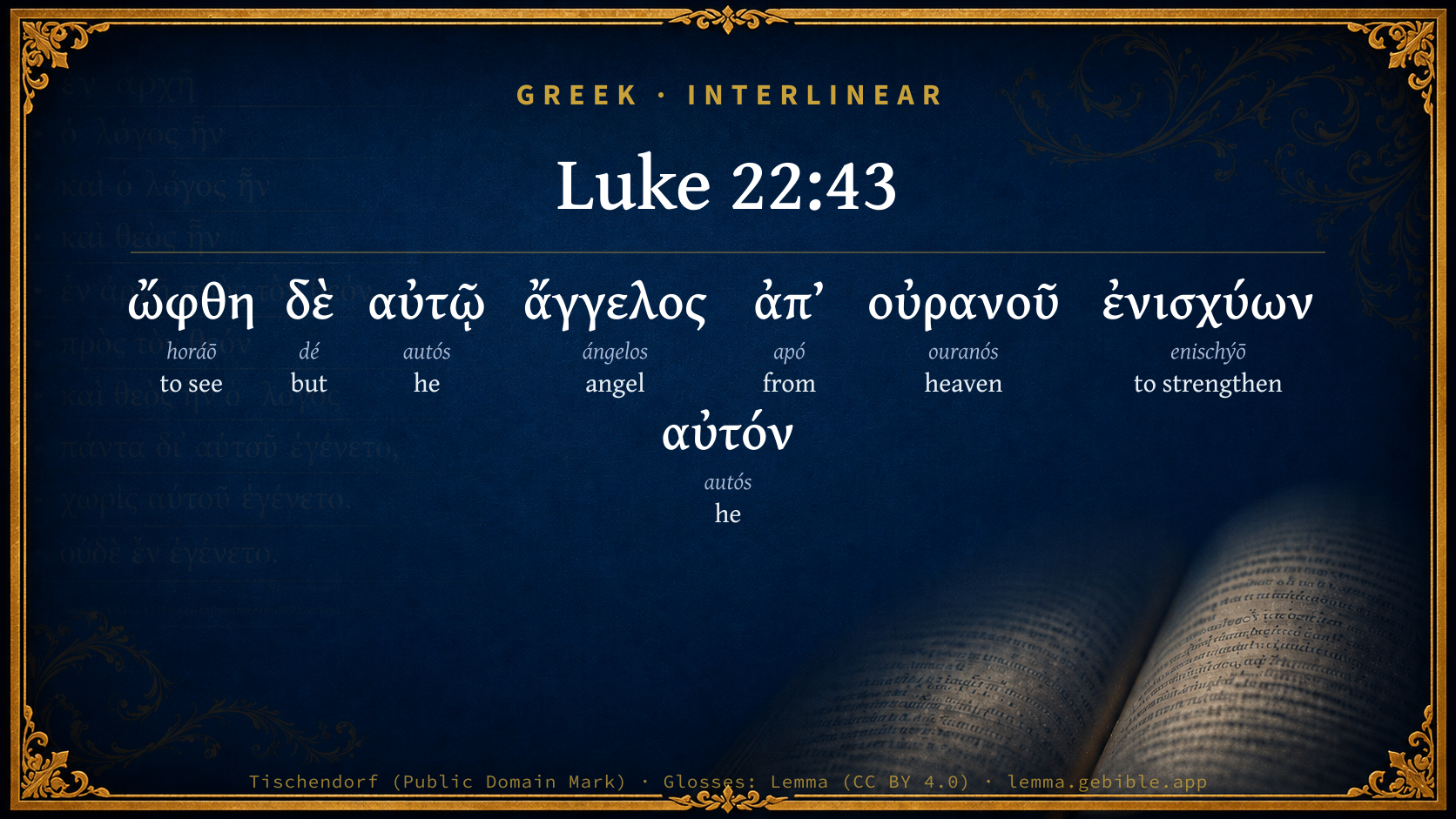
Greek (Tischendorf 8th ed.) Luke 22:43 appears in the Greek New Testament. The text above is from the Tischendorf 8th edition. Each word links to its Strong’s number and a concise gloss. Click any word for its full Thayer’s Greek Lexicon entry.
Download image
Cite this verse

Luke 22:43 (World English Bible). Public Domain. Lemma interlinear Bible study tool, https://lemma.gebible.app/v/luke/22/43.

Show BibTeX & RIS
BibTeX
RIS
English Translation
An angel from heaven appeared to him, strengthening him.
World English Bible · Public Domain
Highlights
  • 1 first appearance in the Greek New Testament
Full analysis ↓
Download a study sheet

One document with this verse’s original text, its word-by-word gloss line, the meaning frame, cross-references with their text, attributed commentary, and full source and license credits — printable, and it pastes into notes with its structure intact.

This verse Autodidact and up

Study sheet (.html) Plain text (.txt)

A passage Seminary Student

Up to 50 verses in one chapter. A passage sheet keeps up to 6 commentary sources and 12 cross-references per verse, in the order this page ranks them, and says so on the sheet whenever that leaves anything out. Ask for a single verse and you get the Autodidact verse sheet above.

Everything on this page stays free to read, with no account — the sheet is a download of what is already on screen, not access to it.

Want to remove ads? Support Godless Engineer
Compare translations 3

The same verse in 3 English versions, stacked beneath the original-language interlinear above. Click any original word for its lexicon entry.

Each is an independent rendering of the whole verse — the interlinear is not word-aligned to these translations.

Highlighted words mark where these versions differ — a whole-verse word diff, not a word-by-word alignment.

  • World English Bible Public Domain
    An angel from heaven appeared to him, strengthening him.
  • King James Version Public Domain
    And there appeared an angel unto him from heaven, strengthening him.
  • unfoldingWord Literal Text CC BY-SA 4.0
    [And an angel from heaven appeared to him, strengthening him.

unfoldingWord Literal Text — © unfoldingWord, licensed CC BY-SA 4.0. Word-aligned USFM3 via Door43 (git.door43.org/unfoldingWord/en_ult).

Versions to compare (up to 4)

3 of 4 selected

Show all 19 translations

Every available English version of this verse, each an independent rendering of the whole verse.

  • World English Bible Public Domain
    An angel from heaven appeared to him, strengthening him.
  • Berean Standard Bible Public Domain
    Then an angel from heaven appeared to Him and strengthened Him.
  • Majority Standard Bible Public Domain
    Then an angel from heaven appeared to Him and strengthened Him.
  • King James Version Public Domain
    And there appeared an angel unto him from heaven, strengthening him.
  • American Standard Version (1901) Public Domain
    And there appeared unto him an angel from heaven, strengthening him.
  • Revised Version (1885) Public Domain
    And there appeared unto him an angel from heaven, strengthening him.
  • Geneva Bible (1599) Public Domain
    And there appeared an Angell vnto him from heauen, comforting him.
  • Douay-Rheims (1899) Public Domain
    And there appeared to him an angel from heaven, strengthening him. And being in an agony, he prayed the longer.
  • Young's Literal Translation Public Domain
    And there appeared to him a messenger from heaven strengthening him;
  • Literal Standard Version CC BY-SA 4.0
    And there appeared to Him a messenger from Heaven strengthening Him;
  • Unlocked Literal Bible CC BY-SA 4.0
    Then an angel from heaven appeared to him, strengthening him.
  • unfoldingWord Literal Text CC BY-SA 4.0
    [And an angel from heaven appeared to him, strengthening him.
  • Darby Bible Public Domain
    And an angel appeared to him from heaven strengthening him.
  • World Messianic Bible Public Domain
    An angel from heaven appeared to him, strengthening him.
  • Webster's Bible Public Domain
    And there appeared to him an angel from heaven, strengthening him.
  • Free Bible Version CC BY-SA 4.0
    Then an angel appeared from heaven to strengthen him.
  • Bible in Basic English Public Domain
    And an angel from heaven came to him, to give him strength.
  • Text-Critical English NT CC BY 4.0
    Then an angel from heaven appeared to him and strengthened him.
  • Tyndale New Testament (1534) Public Domain
    And ther appered an angell vnto him from heaven confortinge him.

Literal Standard Version (2020), Covenant Press — licensed CC BY-SA 4.0. Text via the HelloAO Bible API (eBible.org). Unlocked Literal Bible (unfoldingWord) — licensed CC BY-SA 4.0. Text via the HelloAO Bible API (eBible.org). unfoldingWord Literal Text — © unfoldingWord, licensed CC BY-SA 4.0. Word-aligned USFM3 via Door43 (git.door43.org/unfoldingWord/en_ult). Free Bible Version, Dr. Jonathan Gallagher — licensed CC BY-SA 4.0. Text via the HelloAO Bible API (eBible.org).

Word by word

More ways to search: Search by grammar → Find every occurrence → Compare this word →

Practice this passage: Drill this verse → Learn its vocabulary →

About this verse

These counts appear in no published source. They are computed here, from the morphology-tagged text and Lemma’s own curated glosses. What Lemma adds →

8
words
7
distinct lemmas
Gospels
section

Notable vocabulary

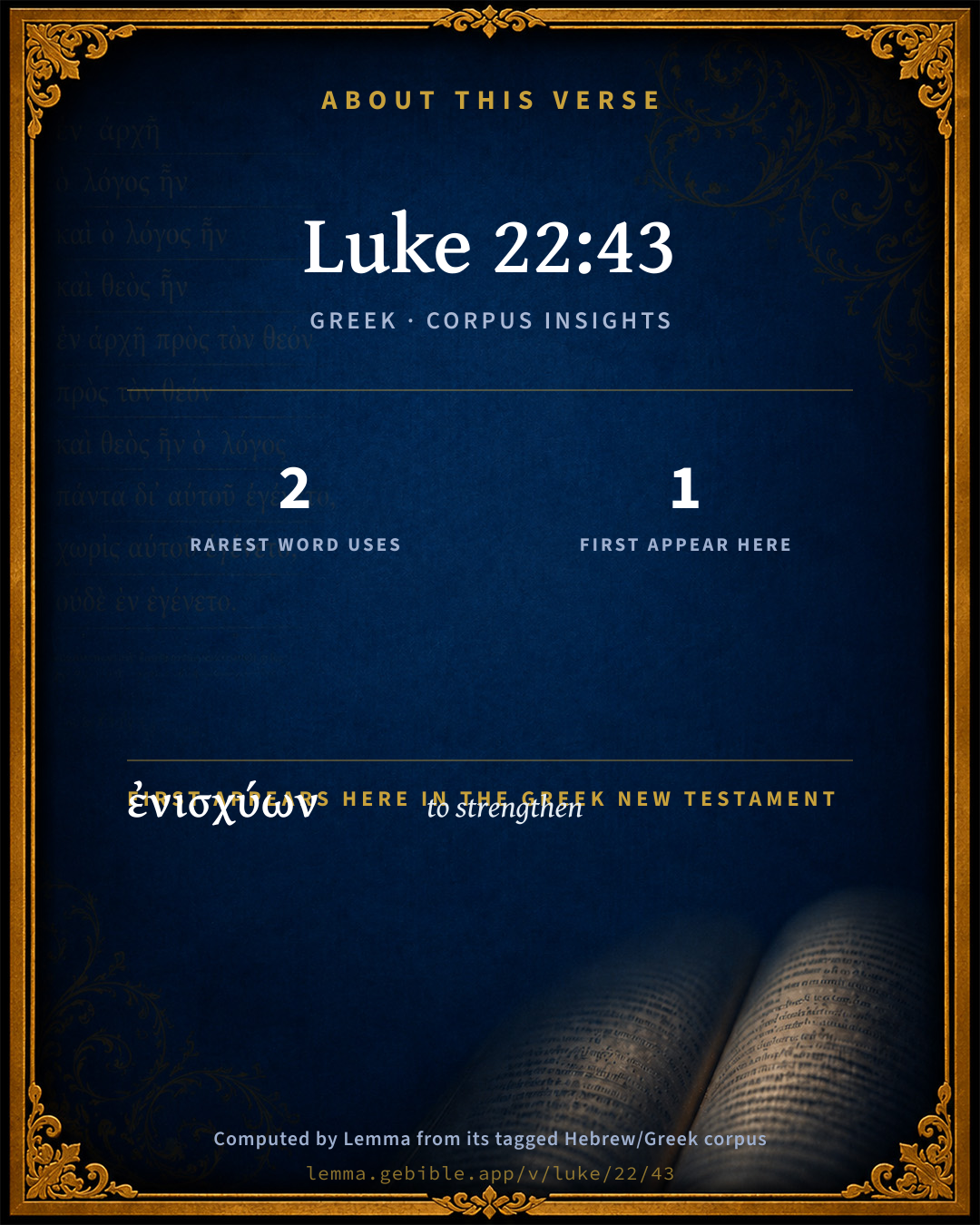
The rarest word here is ἐνισχύων to strengthen G1765 — appearing just 2 times in the whole Greek New Testament.

First appearance in Scripture

This word makes its first canonical appearance in the Greek New Testament here:

  • ἐνισχύων to strengthen G1765

Shared distinctive vocabulary

ἐνισχύων to strengthen G1765 occurs in 2 verses of the Greek New Testament. Also found in:

Repetition

A word recurs within this verse:

  • αὐτῷ he G846 ×2

Cross-references

15

Topical passages linked to Luke 22:43 in the Treasury of Scripture Knowledge — connected by theme and wording, ordered by reader-vote popularity; previews shown in the World English Bible.

  • Matthew 4:11 Then the devil left him, and behold, angels came and ministered to him.
  • Matthew 26:53 Or do you think that I couldn't ask my Father, and he would even now send me more than twelve legions of angels?
  • Psalms 91:11–12 For he will give his angels charge over you, To guard you in all your ways.
  • Hebrews 1:14 Aren't they all ministering spirits, sent out to do service for the sake of those who will inherit salvation?
  • 1 Timothy 3:16 Without controversy, the mystery of godliness is great: God was revealed in the flesh, Justified in the spirit, Seen by angels, Preached among the nations, Believed on in the world, And received up in glory.
  • Hebrews 1:6 Again, when he brings in the firstborn into the world he says, "Let all the angels of God worship him."
  • Job 4:3–4 Behold, you have instructed many, You have strengthened the weak hands.
  • Matthew 4:6 and said to him, "If you are the Son of God, throw yourself down, for it is written, 'He will give his angels charge concerning you.' and, 'On their hands they will bear you up, So that you don't dash your foot against a stone.'"
  • Luke 4:10–11 for it is written, 'He will give his angels charge concerning you, to guard you;'
  • Luke 22:32 but I prayed for you, that your faith wouldn't fail. You, when once you have turned again, establish your brothers."
  • Deuteronomy 3:28 But charge Joshua, and encourage him, and strengthen him; for he shall go over before this people, and he shall cause them to inherit the land which you shall see.
  • Daniel 10:16–19 Behold, one in the likeness of the sons of men touched my lips: then I opened my mouth, and spoke and said to him who stood before me, my lord, by reason of the vision my sorrows are turned on me, and I retain no strength.
  • Daniel 11:1 "As for me, in the first year of Darius the Mede, I stood up to confirm and strengthen him.
  • Acts 18:23 Having spent some time there, he departed, and went through the region of Galatia, and Phrygia, in order, establishing all the disciples.
  • Hebrews 2:17 Therefore he was obligated in all things to be made like his brothers, that he might become a merciful and faithful high priest in things pertaining to God, to make atonement for the sins of the people.

Cross-references courtesy of OpenBible.info (CC BY 4.0).

Commentary

Notes on Luke 22:43 from classic Christian and Jewish commentators (each source and its license shown beneath its notes). The classic Christian expositions comment on the surrounding passage and are grouped to its opening verse, so a note may address several verses; the Jewish commentaries on the Tanakh (Rashi and others) are per-verse, so they appear only where the commentator wrote on this verse.

Lemma curates 59 commentaries, every one of them public domain or Creative Commons licensed, each selected and text-cleaned for this edition rather than reprinted as found. About our sources →

Tyndale Open Study Notes

Tyndale Open Resources

22:43 an angel from heaven: Angels often help and encourage human beings (see Heb 1:14; cp. 1 Kgs 19:5-8; Ps 91:11-12; Dan 3:28; 10:16-19).

Tyndale Open Study Notes — © Tyndale Open Resources, licensed CC BY-SA 4.0. Text via the HelloAO Bible API.

Bengel's Gnomon

Johann Albrecht Bengel

Luk 22:43. Δὲ, but now [and at this moment!) The very appearance of the angel was a sign of His actually then drinking the cup, and of His prayer being granted [Heb 5:7], So utterly incapable is human reason of comprehending the profound depths of His agony in the garden, that some have in former times omitted this whole paragraph. See the Apparat.[247] When His baptism is mentioned along with the cup, the cup means His internal passion [suffering], as, for instance, His desertion by the Father on the cross; the baptism means His external suffering: comp. Mar 10:38, note. Where the ‘cup’ is mentioned alone, His whole passion generally is understood, at least in such a way as that, under the internal, there is also included the external suffering.—ἐνισχύων, strengthening) not by exhortation, but by invigoration. The same verb occurs, Act 9:19 [Paul, “when he had received meat, was strengthened”].

[247] AB 1 MS. of Memph. Theb. omit from ὤφθη to γῆν, Luk 22:43-44. Hilary 1062, writes, “Nec sane ignorandum a nobis est, et in Græcis et in Latinis codicibus complurimis vel de adveniente angelo, vel de sudore sanguinis, nil scriptum reperiri.” But Hilary, 1061, “(Lucas) angelum astitisse comfortantem eum, quo assistante orare prolixius cæperit ita ut guttis sanguinum corporis sudor efflueret (non Matt. et Marc.)” The Syrians are charged by Photius, the Armenians by Nicon, with having erased the passage in question. DQLXabc Vulg. and Euseb. Canons have it. Iren. 219, writes, “Nec (si veram carnem non habuisset) sudasset globos sanguinis.” Just, cum Tryph. p. 331 (Ed. Col.), also supports it.—E. and T.

Bengel's Gnomon of the New Testament — English translation (T&T Clark, Edinburgh, 1860) — public domain. Text from a community e-Sword module.

Vincent's Word Studies in the New Testament

Marvin R. Vincent

There appeared [ωφθη] . The word most commonly used in the New Testament of seeing visions. See Mt 17:3; Mr 9:4; Luk 1:11; Luk 22:43; Act 2:17; Act 7:35. The kindred noun ojptasia, wherever it occurs in the New Testament, means a vision. See Luk 1:22; Luk 24:23, etc.

Strengthening [ενισχυων] . Only here and Act 9:19. See on was not able, ch. 14 30; and cannot, ch. 16 3. Commonly intransitive; to prevail in or among. Used transitively only by Hippocrates and Luke.

Marvin R. Vincent, Word Studies in the New Testament (1887–1900) — public domain. Text from a community e-Sword/MySword module.

Adam Clarke's Commentary

Verse 43. There appeared an angel - from heaven] It was as necessary that the fullest evidence should be given, not only of our Lord's Divinity, but also of his humanity: his miracles sufficiently attested the former; his hunger, weariness, and agony in the garden, as well as his death and burial, were proofs of the latter. As man, he needs the assistance of an angel to support his body, worn down by fatigue and suffering. See Clarke on Lu 22:44.

Adam Clarke's Commentary on the Bible (1810–1826) — public domain. Text from a community e-Sword/MySword module.

Ellicott's Commentary for English Readers

(43) There appeared an angel unto him from heaven.—This and the following verses are omitted by not a few of the best MSS., but the balance of evidence is, on the whole, in their favour. Assuming their truth as part of the Gospel, we ask—(1) How came the fact to be known to St. Luke, when St. Matthew and St. Mark had made no mention of it? and (2) What is the precise nature of the fact narrated? As regards (2), it may be noted that the angel is said to have “appeared to him,” to our Lord only, and not to the disciples. He was conscious of a new strength to endure even to the end. And that strength would show itself to others, to disciples who watched Him afar off, in a new expression and look, flashes of victorious strength and joy alternating with throbs and spasms of anguish. Whence could that strength come but from the messengers of His Father, in Whose presence, and in communion with Whom He habitually lived (Mat_4:11; Joh_1:51). The ministrations which had been with Him in His first temptation were now with Him in the last (Mat_4:11). As to (1) we may think of one of the disciples who were present having reported to the “devout women,” from whom St. Luke probably, as we have seen, derived so much of the materials for his Gospel (see Introduction), that he had thus seen what seemed to him to admit of no other explanation.

A Bible Commentary for English Readers, edited by Charles John Ellicott (1878–1897) — public domain. Text from a community e-Sword module.

The Cambridge Bible for Schools and Colleges

gen. ed. J. J. S. Perowne

43. there appeared an angel] As after His temptation, Mat_4:11. This and the next verse are not of absolutely certain authenticity, since they are omitted in A, B, and by the first corrector of א; and Jerome and Hilary say that they were omitted in “very many” Greek and Latin MSS. Their omission may have been due to mistaken reverence; or their insertion may have been made by the Evangelist himself in a later recension.

The Cambridge Bible for Schools and Colleges (gen. ed. J. J. S. Perowne; Cambridge University Press, 1878–1918) — public domain. Text from a community e-Sword module.

John Gill's Exposition

And being in an agony,.... Or in a conflict, and combat; that is, with thee devil, who now appeared visibly to him, in an horrible form: after his temptations in the wilderness Satan left him for a season, till another opportunity should offer; and now it did; now the prince of this world came to him; see Luk 4:13 and attacked him in a garden, where the first onset on human nature was made: and now began the battle between the two combatants, the serpent, and the seed of the woman; which issued in the destruction of Satan, and thee recovery of mankind. The Arabic version leaves out this clause; and the Syriac version renders it, "being in fear"; and to the same purpose are the Persic and Ethiopic versions; that is, of death; and must be understood of a sinless fear of death in his human nature, to which death, being a dissolution of it, must be disagreeable; though not death, barely considered, was the cause of this fear, distress, and agony he was in; but as it was to be inflicted on him for the sins of his people, which he bore, and as it was the curse of the law, and the effect of divine wrath and displeasure:

he prayed more earnestly; repeating the words he had said before with great eagerness and importunity, with intenseness of mind, and fervour of Spirit, with strong crying, and tears to him that was able to save him from death, Heb 5:7

and his sweat was, as it were, great drops of blood falling to the ground. This account of Christ's bloody sweat is only given by Luke, who being a physician, as is thought, more diligently recorded things which belonged to his profession to take cognizance of; nor should it be any objection to the truth and credibility of this fact, that it is not mentioned by the other evangelists, since it is no unusual thing with them for one to record that which is omitted by another; nor that this is wanting in some Greek and Latin copies, as Jerom (w) and Hilary (x) observe; since it was expunged, as is supposed, either by some orthodox persons, who weakly thought it might seem to favour the Arians, who denied that Christ was of the same impassible nature with the Father; or rather by the Armenians, or by a set of men called "Aphthartodocetae", who asserted the human nature of Christ to be incorruptible: but certain it is, that it is in the most ancient and approved copies, and in all the Oriental versions, and therefore to be retained; to which may be added, that it is taken notice of, not to mention others, by those two early writers, Justin Martyr (y), and Irenaeus (z); nor should its being so strange and unusual a sweat at all discredit the history of it, since there have been instances of this kind arising from various causes; and if there had been none, since the case of our Lord was singular, it ought to be credited. This bloody sweat did not arise from a cachexy, or ill state of body, which has sometimes been the cause of it, as Aristotle observes, who says (a), that the blood sometimes becomes sanious, and so serous, insomuch that some have been covered with a "bloody sweat": and in another place he says (b), that through an ill habit of body it has happened to some, that they have sweat a bloody excrement. Bartholinus produces instances in plagues and fevers (c); but nothing of this kind appears in Christ, whose body was hale and robust, free from distempers and diseases, as it was proper it should, in order to do the work, and endure the sufferings he did; nor did it arise from any external heat, or a fatiguing journey. The above writer (d) a relates, from Actuarius, a story of a young man that had little globes of blood upon his skin, by sweat, through the heat of the sun, and a laborious journey. Christ's walk from Jerusalem to the garden was but a short one; and it was in the night when he had this sweat, and a cold night too; see Joh 18:18, it rather arose from the agony in which he was, before related: persons in an agony, or fit of trembling, sweat much, as Aristotle observes (e); but to sweat blood is unusual. This might be occasioned by his vehement striving and wrestling with God in prayer, since the account follows immediately upon that; and might be owing to his strong cries, to the intenseness and fervour of his mind, and the commotion of the animal spirits, which was now very great, as some have thought; or, as others, to the fear of death, as it was set before him in so dreadful a view, and attended with such horrible circumstances. Thuanus (f), a very grave and credible historian, reports of a governor of a certain garrison, who being, by a stratagem, decoyed from thence, and taken captive, and threatened with an ignominious death, was so affected with it, that he sweat a "bloody sweat" all over his body. And the same author (g) relates of a young man of Florence, who being, by the order of Pope Sixtus the Fifth, condemned, as he was led along to be executed, through the vehemence of his grief discharged blood instead of sweat, all over his body: and Maldonate, upon this passage, reports, that he had heard it from some who saw, or knew it, that at Paris, a man, robust, and in good health, hearing that a capital sentence was pronounced upon him, was, at once, all over in a bloody sweat: which instances show, that grief, surprise, and fear, have sometimes had such an effect on men; but it was not mere fear of death, and trouble of mind, concerning that, which thus wrought on our Lord, but the sense he had of the sins of his people, which were imputed to him, and the curse of the righteous law of God, which he endured, and especially the wrath of God, which was let into his soul: though some have thought this was owing to the conflict Christ had with the old serpent the devil; who, as before observed, now appeared to him in a frightful forth: and very remarkable is the passage which Dr. Lightfoot, and others, have cited from Diodorus Siculus, who reports of a certain country, that there are serpents in it, by whose bites are procured very painful deaths; and that grievous pains seize the person bitten, and also "a flow of sweat like blood". And other writers (h) make mention of a kind of asp, or serpent, called "Haemorrhois"; which, when it bites a man, causes him to sweat blood: and such a bloody sweat it should seem was occasioned by the bite of the old serpent Satan, now nibbling at Christ's heel, which was to be bruised by him: but of all the reasons and causes of this uncommon sweat, that of Clotzius is the most strange, that it should arise from the angels comforting and strengthening him, and from the cheerfulness and fortitude of his mind. This writer observes, that as fear and sorrow congeal the blood, alacrity and fortitude move it; and being moved, heat it, and drive it to the outward parts, and open a way for it through the pores: and this he thinks may be confirmed from the fruit and effect of Christ's prayer, which was very earnest, and was heard, as is said in Heb 5:7 when he was delivered from fear; which deliverance produced joy, and this joy issued in the bloody sweat. Some think the words do not necessarily imply, that this sweat was blood, or that there was blood in it; only that his sweat, as it came out of his body, and fell on the ground, was so large, and thick, and viscous, that it looked like drops, or clots of blood; but the case rather seems to be this, that the pores of Christ's body were so opened, that along with sweat came out blood, which flowed from him very largely; and as it fell on the ground, he being fallen on his face to the earth, it was so congealed by the cold in the night season, that it became really, as the word signifies, clots of blood upon the earth. The Persic version, different from all others, reads, "his tears, like blood, fell by drops upon the ground". This agony, and bloody sweat of Christ, prove the truth of his human nature; the sweat shows that he had a true and real body, as other men; the anxiety of his mind, that he had a reasonable soul capable of grief and sorrow, as human souls are; and they also prove his being made sin and a curse for us, and his sustaining our sins, and the wrath of God: nor could it be at all unsuitable to him, and unworthy of him, to sweat in this manner, whose blood was to be shed for the sins of his people, and who came by blood and water, and from whom both were to flow; signifying, that both sanctification and justification are from him.

(w) Advers. Pelag. l. 2. fol. 96. F. (x) De Trinitate, l. 10. p. 155. (y) Dialog. cum Tryph. p. 331. (z) Adv. Haeres. l. 3. c. 32. (a) De Hist. Animal. l. 3. c. 19. (b) De Part. Animal. l. 3. c. 5. (c) De Cruce Hypomnem. 4. p. 185, 186. (d) lb. p. 184. (e) Problem, sect. 2. c. 26, 31. (f) Hist. sui Temporis, par. 1. l. 8. p. 804, 805. (g) lb. par. 4. l. 82. p. 69. (h) Solin, Polyhistor, c. 40, Isidor. Hispalens. Etymolog. l. 12. c. 4.

John Gill's Exposition of the Whole Bible (1746–1763) — public domain (CC PDM 1.0). Text via the HelloAO Bible API.

Trapp's Complete Commentary

John Trapp

43 And there appeared an angel unto him from heaven, strengthening him.

Ver. 43. And there appeared] To show that he had made himself lower than the angels, Heb 2:7, he received comfort from an angel that was his servant. So in his agony he was glad of his apostles’ company, and the help of their poor prayers.

John Trapp, A Commentary or Exposition upon All the Books of the Old and New Testament (1647–1656) — public domain. Text from a community e-Sword module.

Haydock's Catholic Bible Commentary

An angel ... strengthening him. Christ, our Redeemer, was truly God and truly man. And being made man by a real union of his divine person and nature, to our weak and infirm human nature, he likewise took upon him our infirmities, sin excepted. We must consider him as man, when we read of his being tempted in the wilderness, (Matthew iv.) when he wept at the raising of Lazarus out of the grave, (John xi.) as often as we read of his praying; and here, when we read of his praying, and redoubling his prayer in the garden, when we find him seized with fear, sadness, and grief: for though, as God, he could prevent and hinder these passions and affections natural to man, yet he could also permit them to affect his human nature; as he permitted himself to be seized with hunger, after fasting forty days; and so he permitted his human nature to be seized with fear and grief in this garden of Gethsemani. As angels came and ministered to him after his fast in the wilderness, so an angel came as it were to propose to him the divine decree, that he was to suffer and die for the redemption of mankind; and as man, he is said to be strengthened and comforted by the angel: he, who as God, was Lord and maker of the angels, and so needed not to be strengthened by his creatures. Besides what happened to Christ as man, were ordained as instructions for us. We are taught by angels appearing, that they were not only ready to assist and wait upon Christ, but that, by the order of divine Providence, they are also ready to assist us in our temptations and afflictions. --- In an agony. This Greek word signifies, a strife, or combat; not that there could be any opposition or contrariety in the interior of Christ, whose human will was always perfectly subject to his divine will, and the sensitive part to reason: yet, inasmuch as he was truly man, his human nature dreaded all those sufferings which at that time were represented to his soul, and which in a few hours he was to undergo. (Witham)

George Leo Haydock (1774–1849), Haydock's Catholic Family Bible and Commentary, 1859 edition — public domain. Excludes Psalms (Douay-Rheims chapter numbering differs from Protestant) and Deuterocanonical books (Catholic canon only).

Matthew Poole's English Annotations

We have formerly opened these verses in Mat 26:44-46, where we took them in, as being a part of the history of our Saviour’s praying before his passion.

Matthew Poole's English Annotations on the Holy Bible (1683–1685) — public domain. Text from a community e-Sword/MySword module.

Whedon's Commentary on the Bible

Daniel D. Whedon

43. An angel—The angel appeared

to him. Strengthening him—So that, as appears in the following verse, he encountered a still greater agony, and prayed even a more earnest prayer, accompanied by the bloody sweat.

Daniel D. Whedon (gen. ed.), Commentary on the Old and New Testaments (1874–1909) — public domain. Text from a community e-Sword module.

The Pulpit Commentary

And there appeared an angel unto him from heaven, strengthening him. The Lord"s words reported by St. Matthew were no mere figure of rhetoric. "My soul is exceeding sorrowful, even unto death." The anguish and horror were so great that he himself, according to his humanity, must have before the time become the victim of death had he not been specially strengthened from above. This is the deep significance and necessity of the angel"s appearance. So Stier and Godet, the latter of whom writes, "As when in the wilderness under the pressure of famine he felt himself dying, the presence of this heavenly being sends a vivifying breath over him, a Divine refreshing pervades him, body and soul, and it is thus he receives strength to continue to the last the struggle."

The Pulpit Commentary (1880–1919), ed. H.D.M. Spence-Jones & Joseph S. Exell — public domain. Text from a community e-Sword module.

John Wesley's Explanatory Notes

Strengthening him - Lest his body should sink and die before the time.

John Wesley, Explanatory Notes Upon the Whole Bible (1754–1765) — public domain. Text via the GEBible commentary corpus.

Scofield Reference Notes

C. I. Scofield

angel

(See Scofield "Heb 1:4").

The Scofield Reference Bible (1917 edition), notes by C. I. Scofield — public domain. Text from a community e-Sword module.

unfoldingWord translationNotes

Door43 World Missions Community

appeared to him

"appeared to Jesus"

strengthening him

"encouraging him"

Being in agony, he prayed

"He was suffering greatly, and so he prayed"

he prayed more earnestly

"he prayed more intensely"

his sweat became like great drops of blood falling down upon the ground

"his sweat was falling to the ground like large drops of blood"

translationWords

angel

heaven

pray

blood

unfoldingWord translationNotes — © Distant Shores Media and the Door43 World Missions Community, licensed CC BY-SA 4.0. Source: git.door43.org/Door43/en_tn.

Cambridge Greek Testament for Schools and Colleges

43, 44. These verses are omitted in AB Sab. and some cursives, and in some MSS. are obelised and marked with asterisks. Their occasional omission is noticed as early as Epiphanius, Hilary, and Jerome.

43. ὤφθη δὲ αὐτῷ ἄγγελος. As after His temptation, Mat 4:11. This and the next verse are omitted in AB, and by the first corrector of א; and Jerome and Hilary say that they were omitted in “very many” Greek and Latin MSS. They are not found in the Itala or Peshito.

Cambridge Greek Testament for Schools and Colleges (Cambridge University Press, 1896; 21 vols, various authors incl. Carr, Maclear, Plummer, Farrar, Lumby, Moule, M. R. James, Simcox) — public domain. Text from a community e-Sword module.

Alford’s Greek Testament

Henry Alford

43.] The principal testimonies of the Fathers, &c. against and for vv. 43, 44, are collected in the digest. With the early and weighty evidence there cited in favour of the passage, it is impossible that it should have been an apocryphal insertion. It was perhaps, as states of ἔκλαυσε, expunged by the orthodox, who imagined they found in it an inconsistency with the divine nature of our Lord. We have reason to be thankful, that orthodoxy has been better understood since. The strengthening by means of the angel is physical—and the appearance likewise. See an interesting reply to the scoffs of Julian on this point, in Theodore of Mopsuestia, in loc. ed. Migne, p. 723. It is strange how Olshausen can have so far deceived himself as to imagine that ὤφθη αὐτῷ can imply a merely inward and spiritual accession of strength from above. It is strange likewise that the analogy of the ministration of angels in the Lord’s former temptation should not have occurred to those modern Commentators who have objected to this circumstance as improbable.

This strengthening probably took place between the first and the second prayer;—and the effect of it is the ἐκτενέστερον προσηύχετο of ver. 44, and the entire resignation expressed in the second and third prayer of Matthew’s narrative.

Henry Alford, The Greek Testament (1849–1861) — public domain. Text from a community e-Sword module.

International Critical Commentary

43, 44. As in the case of vv. 19, 20, we have to consider whether this passage is part of the original text. For be evidence see be additional note at the end of ch. 23. One thing is certain. “It would be impossible to regard these verses as a product of the inventiveness of the scribes. They can only be a fragment from the traditions, written or oral, which were, for a time at least, locally current beside the canonical Gospels, and which doubtless included matter of every degree of authenticity and intrinsic value. These verses and the first sentence of 22:34 may be safely called the most precious among the remains of this evangelic tradition which were rescued from oblivion by the scribes of the second century” (WH. 2. App. p. 67). It matters little whether Lk. included them in his narrative, so long as their authenticity as evangelic tradition is acknowledged. In this respect the passage is like that respecting the Woman taken in Adultery.

43. ὤφθη. “Was visible” to the bodily eye is obviously meant. It is against the context and the use of the expression in other places to suppose that internal perception of an invisible spiritual presence is intended. Lk. is fond of the expression (1:11, 9:31, 24:34; Act 2:3, Act 2:7:2, Act 2:26, Act 2:30, Act 2:35, Act 2:9:17, Act 2:13:31, Act 2:16:9, Act 2:26:16; comp. 1Co 15:5-8), which Mt. and Mk. use once each (17:3. 9:4), and Jn. thrice (Rev 11:19, Rev 11:12:1, Rev 11:3), but not in his Gospel. The ἀπʼ οὐρανοῦ would not have been added if the presence of the Angel was invisible.

ἐνισχύων. Elsewhere in N.T. only Act 9:19, of bodily strengthening: comp. 2Sa 22:40; Ecclus. 50:4; and this may well be the meaning here, but without excluding the strengthening of soul and spirit. Either would tend to produce the other; and the sight of His Father’s messenger would strengthen both body and spirit. Commentators have speculated as to what the Angel said (see Corn. à Lap. ad l.). There is nothing to indicate that he spoke. Hobart remarks of ἐνισχύειν that, outside the LXX “its use in the transitive sense, ‘to strengthen,’ is confined to Hippocrates and St. Luke” (p. 80). In Act 9:19 the true reading is probably ἐνισχύθη.1

ἐν ἀγωνίᾳ. Here only in N.T. Field contends that fear is the radical notion of the word. The passages in which it occurs in LXX confirm this view: 2 Mal 3:14, Mal 3:16, Mal 3:15:19; comp. ἀγωνιᾷν Esth. 15:8 [5:1]; Dan 1:10; Dan_2 Mac. 3:21. It is frequently coupled with such words as φόβος, δέος, φρίκη, etc. For examples see Field, Ot. Norv. 3. p. 56. It is, therefore, an agony of fear that is apparently to be understood. Mk. has ἀδημονεῖν with ἐκθαμβεῖσθαι, Mt. with λυπεῖσθαι.—ἐκτενέστερον. “More extendedly,” and hence “more persistently.” This seems to be parallel to the πίπτειν ἐπὶ πρόσωπον αὐτοῦ (Mt.) and ἐπὶ τῆς γῆς (Mk.). Heb. v. 7 probably refers specially to this. Comp. ἐκτενῶς of prayer, and ἐκτένεια of worship and service. Act 12:5, Act 26:7.

International Critical Commentary — older volumes (1896–1929), various authors — public domain. Text from a community e-Sword module.

Lesson kit

Teaching starters — assembled from the data on this page, not authored interpretation. Every prompt links to the verse data it draws on. Edit before teaching.

Luke, in the Gospels, opens this verse with 8 words (7 distinct Greek lemmas). Its most distinctive word is enischýō (“to strengthen”). A historical commentator’s framing appears above. Read the whole chapter for the surrounding context.

Discussion questions

  1. The word enischýō carries the sense “to strengthen.” How does it shape the verse?
  2. The word “to strengthen” first appears here in Scripture. What is being introduced at this debut?
  3. Acts 9:19 shares the word «to strengthen» with this verse. How do the two illuminate each other?
  4. “he” occurs 2× in this one verse. What is the effect of the repetition?
  5. These translations render this verse differently; the difference is in the English rendering, not the original. What questions does that raise?
  6. Reading how Tyndale Open Study Notes and Bengel's Gnomon read this verse, where do the two commentators agree and where do they part?

Things to notice

  • 1 word makes its first canonical appearance in Scripture here.
  • These translations choose different wording for 1 word in this verse.
  • “he” occurs 2× in this single verse.
  • 7 distinct Greek lemmas span 8 words in this verse.

Reading settings

Reading text

Shown beneath each verse's original-language words.

Old Testament
Old Testament edition

Read the OT as the Masoretic Hebrew (MT) or the Greek Septuagint (LXX).

English shown for the Greek Septuagint (in the Hebrew ↔ Greek comparison).

Comparing translations? Open the Compare panel on any verse page to stack up to four side by side.