Matthew 4:17

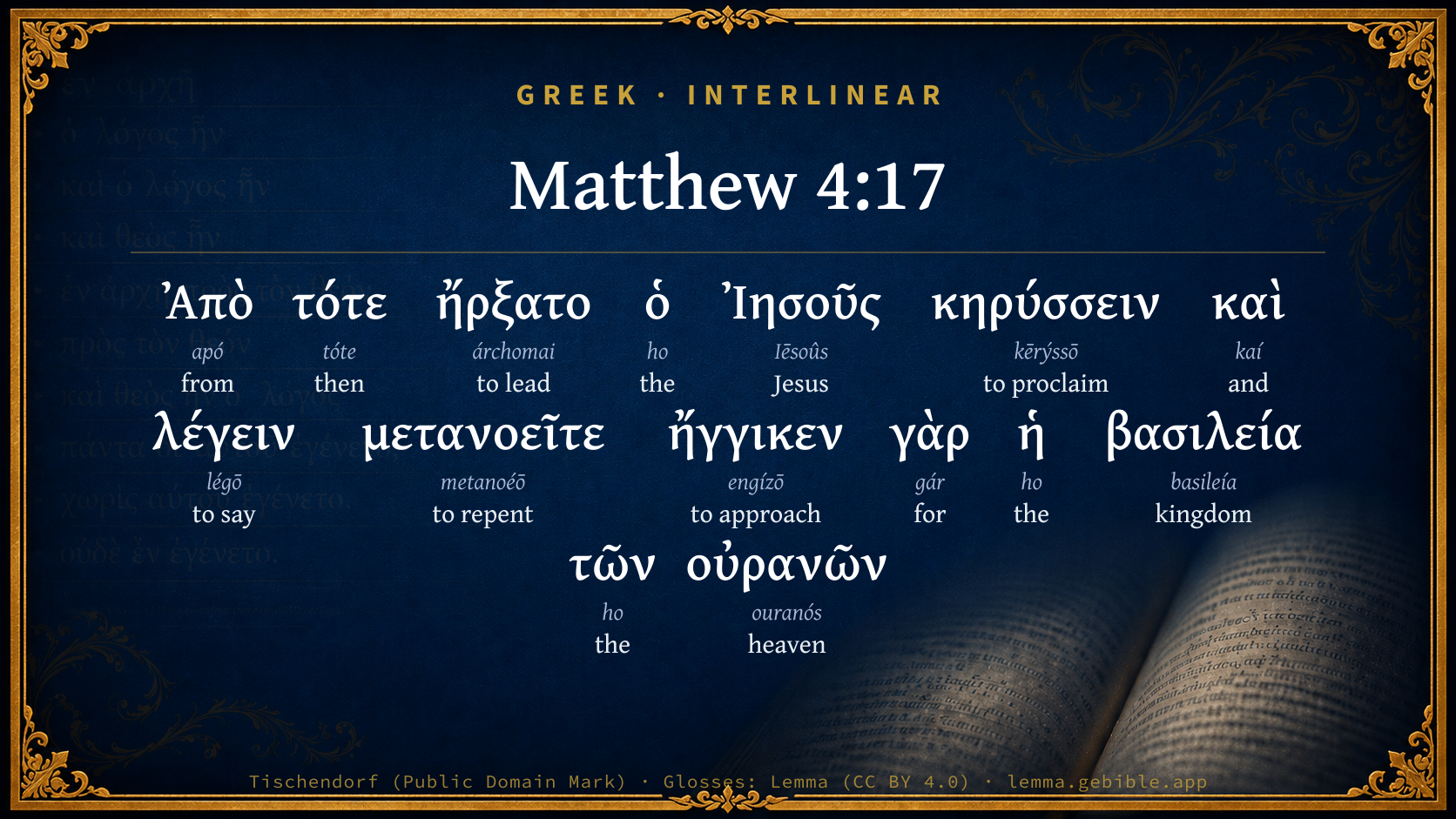
Greek (Tischendorf 8th ed.) Matthew 4:17 appears in the Greek New Testament. The text above is from the Tischendorf 8th edition. Each word links to its Strong’s number and a concise gloss. Click any word for its full Thayer’s Greek Lexicon entry.
Download image
Cite this verse

Matthew 4:17 (World English Bible). Public Domain. Lemma interlinear Bible study tool, https://lemma.gebible.app/v/matthew/4/17.

Show BibTeX & RIS
BibTeX
RIS
English Translation
From that time, Jesus began to preach, and to say, "Repent! For the Kingdom of Heaven is at hand."
World English Bible · Public Domain
Highlights
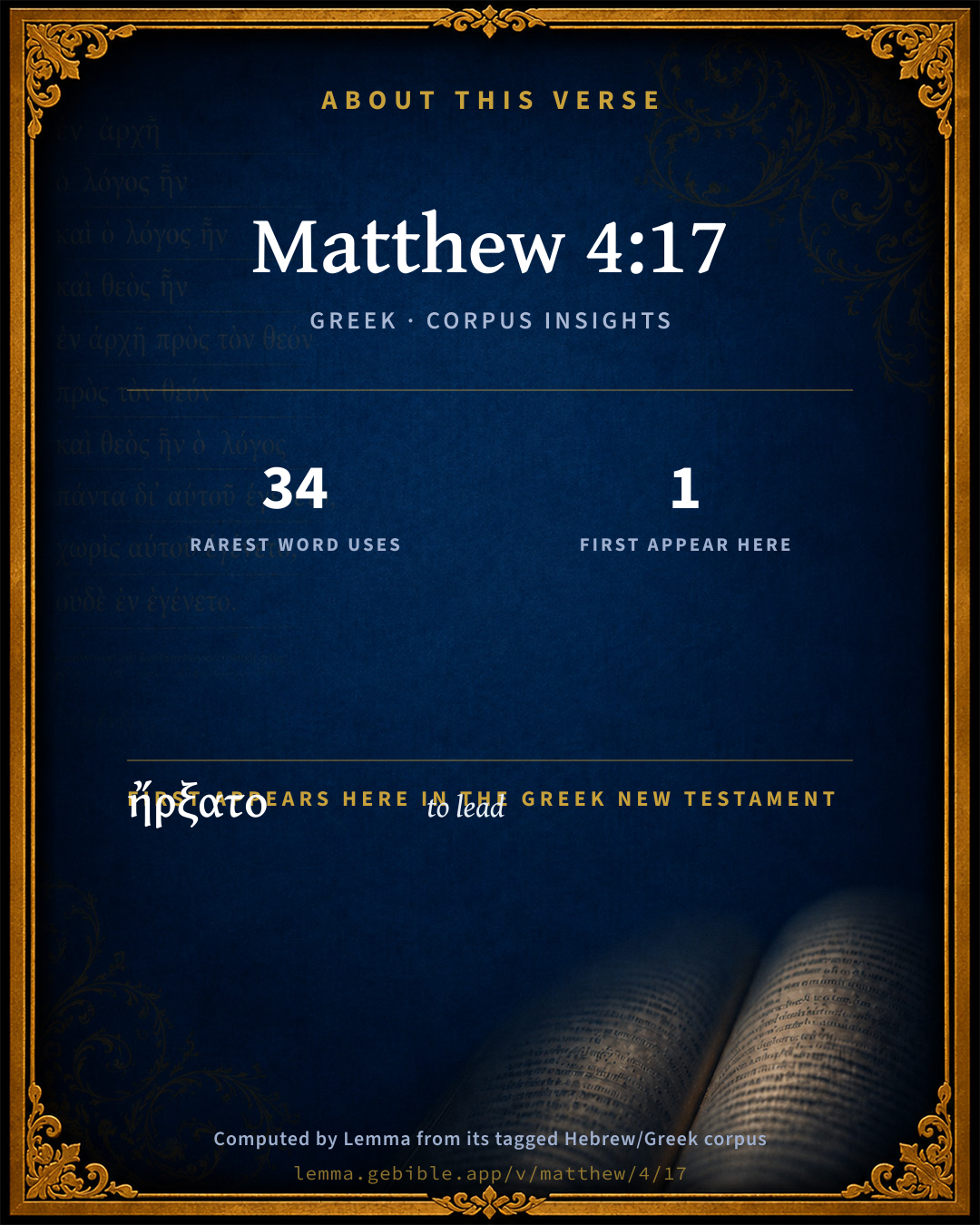
  • 1 first appearance in the Greek New Testament
Full analysis ↓
Download a study sheet

One document with this verse’s original text, its word-by-word gloss line, the meaning frame, cross-references with their text, attributed commentary, and full source and license credits — printable, and it pastes into notes with its structure intact.

This verse Autodidact and up

Study sheet (.html) Plain text (.txt)

A passage Seminary Student

Up to 50 verses in one chapter. A passage sheet keeps up to 6 commentary sources and 12 cross-references per verse, in the order this page ranks them, and says so on the sheet whenever that leaves anything out. Ask for a single verse and you get the Autodidact verse sheet above.

Everything on this page stays free to read, with no account — the sheet is a download of what is already on screen, not access to it.

Want to remove ads? Support Godless Engineer
Compare translations 3

The same verse in 3 English versions, stacked beneath the original-language interlinear above. Click any original word for its lexicon entry.

Each is an independent rendering of the whole verse — the interlinear is not word-aligned to these translations.

Highlighted words mark where these versions differ — a whole-verse word diff, not a word-by-word alignment.

  • World English Bible Public Domain
    From that time, Jesus began to preach, and to say, "Repent! For the Kingdom of Heaven is at hand."
  • King James Version Public Domain
    From that time Jesus began to preach, and to say, Repent: for the kingdom of heaven is at hand.
  • unfoldingWord Literal Text CC BY-SA 4.0
    From that time Jesus began to preach and to say, “Repent, for the kingdom of the heavens has come near.”

unfoldingWord Literal Text — © unfoldingWord, licensed CC BY-SA 4.0. Word-aligned USFM3 via Door43 (git.door43.org/unfoldingWord/en_ult).

Versions to compare (up to 4)

3 of 4 selected

Show all 19 translations

Every available English version of this verse, each an independent rendering of the whole verse.

  • World English Bible Public Domain
    From that time, Jesus began to preach, and to say, "Repent! For the Kingdom of Heaven is at hand."
  • Berean Standard Bible Public Domain
    From that time on Jesus began to preach, “Repent, for the kingdom of heaven is near.”
  • Majority Standard Bible Public Domain
    From that time on Jesus began to preach, “Repent, for the kingdom of heaven is near.”
  • King James Version Public Domain
    From that time Jesus began to preach, and to say, Repent: for the kingdom of heaven is at hand.
  • American Standard Version (1901) Public Domain
    From that time began Jesus to preach, and to say, Repent ye; for the kingdom of heaven is at hand.
  • Revised Version (1885) Public Domain
    From that time began Jesus to preach, and to say, Repent ye; for the kingdom of heaven is at hand.
  • Geneva Bible (1599) Public Domain
    From that time Iesus began to preach, and to say, Amende your liues: for the kingdome of heauen is at hand.
  • Douay-Rheims (1899) Public Domain
    From that time Jesus began to preach, and to say: Do penance, for the kingdom of heaven is at hand.
  • Young's Literal Translation Public Domain
    From that time began Jesus to proclaim and to say, `Reform ye, for come nigh hath the reign of the heavens.'
  • Literal Standard Version CC BY-SA 4.0
    From that time Jesus began to proclaim and to say, “Convert, for the kingdom of the heavens has come near.”
  • Unlocked Literal Bible CC BY-SA 4.0
    From that time Jesus began to preach and say, “Repent, for the kingdom of heaven has come near.”
  • unfoldingWord Literal Text CC BY-SA 4.0
    From that time Jesus began to preach and to say, “Repent, for the kingdom of the heavens has come near.”
  • Darby Bible Public Domain
    From that time began Jesus to preach and to say, Repent, for the kingdom of the heavens has drawn nigh.
  • World Messianic Bible Public Domain
    From that time, Yeshua began to proclaim, and to say, “Repent! For the Kingdom of Heaven is at hand.”
  • Webster's Bible Public Domain
    From that time Jesus began to preach, and to say, Repent: for the kingdom of heaven is at hand.
  • Free Bible Version CC BY-SA 4.0
    From that time on Jesus began declaring his message, saying, “Repent, for the kingdom of heaven has arrived!”
  • Bible in Basic English Public Domain
    From that time Jesus went about preaching and saying, Let your hearts be turned from sin, for the kingdom of heaven is near.
  • Text-Critical English NT CC BY 4.0
    From that time Jesus began to preach, “Repent, for the kingdom of heaven has drawn near.”
  • Tyndale New Testament (1534) Public Domain
    From that tyme Iesus begane to preache and to saye: repet for ye kigdome of heven is at honed.

Literal Standard Version (2020), Covenant Press — licensed CC BY-SA 4.0. Text via the HelloAO Bible API (eBible.org). Unlocked Literal Bible (unfoldingWord) — licensed CC BY-SA 4.0. Text via the HelloAO Bible API (eBible.org). unfoldingWord Literal Text — © unfoldingWord, licensed CC BY-SA 4.0. Word-aligned USFM3 via Door43 (git.door43.org/unfoldingWord/en_ult). Free Bible Version, Dr. Jonathan Gallagher — licensed CC BY-SA 4.0. Text via the HelloAO Bible API (eBible.org).

Word by word

More ways to search: Search by grammar → Find every occurrence → Compare this word →

Practice this passage: Drill this verse → Learn its vocabulary →

μετανοεῖτε
metanoéō
G3340
“to repent”
Verb, Present, Active, Imperative, 2nd person, Plural
Part of Speech
Verb
Tense
Present
Voice
Active
Mood
Imperative
Person
2nd person
Number
Plural
Full Thayer's Definition

Origin: from G3326 and G3539

TDNT: 20:15,6

1. to change one's mind, i.e. to repent 2. to change one's mind for better, heartily to amend with abhorrence of one's past sins
  1. Ἀπὸ apó G575 “from” Preposition
  2. τότε tóte G5119 “then” Adverb
  3. ἤρξατο árchomai G756 “to lead” Verb, Aorist, Middle deponent, Indicative, 3rd person, Singular
  4. ὁ ho G3588 “the” Article, Nominative, Singular, Masculine
  5. Ἰησοῦς Iēsoûs G2424 “Jesus” Noun, Nominative, Singular, Masculine
  6. κηρύσσειν kērýssō G2784 “to proclaim” Verb, Present, Active, Infinitive
  7. καὶ kaí G2532 “and” Conjunction
  8. λέγειν légō G3004 “to say” Verb, Present, Active, Infinitive
  9. ἤγγικεν engízō G1448 “to approach” Verb, Perfect, Active, Indicative, 3rd person, Singular
  10. γὰρ gár G1063 “for” Conjunction
  11. ἡ ho G3588 “the” Article, Nominative, Singular, Feminine
  12. βασιλεία basileía G932 “kingdom” Noun, Nominative, Singular, Feminine
  13. τῶν ho G3588 “the” Article, Genitive, Plural, Masculine
  14. οὐρανῶν ouranós G3772 “heaven” Noun, Genitive, Plural, Masculine

About this verse

These counts appear in no published source. They are computed here, from the morphology-tagged text and Lemma’s own curated glosses. What Lemma adds →

15
words
13
distinct lemmas
Gospels
section

First appearance in Scripture

This word makes its first canonical appearance in the Greek New Testament here:

  • ἤρξατο to lead G756

Shared distinctive vocabulary

μετανοεῖτε to repent G3340 occurs in 32 verses of the Greek New Testament. Also found in:

Repetition

A word recurs within this verse:

Cross-references

24

Topical passages linked to Matthew 4:17 in the Treasury of Scripture Knowledge — connected by theme and wording, ordered by reader-vote popularity; previews shown in the World English Bible.

  • Matthew 3:2 "Repent, for the Kingdom of Heaven is at hand!"
  • Mark 1:14–15 Now after John was taken into custody, Jesus came into Galilee, preaching the Gospel of the Kingdom of God,
  • Acts 2:38 Peter said to them, "Repent, and be baptized, everyone of you, in the name of Jesus Christ for the forgiveness of sins, and you will receive the gift of the Holy Spirit.
  • Luke 5:32 I have not come to call the righteous, but sinners to repentance."
  • Luke 24:47 and that repentance and remission of sins should be preached in his name to all the nations, beginning at Jerusalem.
  • Acts 17:30 The times of ignorance therefore God overlooked. But now he commands that all people everywhere should repent,
  • Matthew 9:13 But you go and learn what this means: 'I desire mercy, and not sacrifice,' for I came not to call the righteous, but sinners to repentance."
  • Luke 15:7 I tell you that even so there will be more joy in heaven over one sinner who repents, than over ninety-nine righteous people who need no repentance.
  • Acts 26:20 but declared first to them of Damascus, at Jerusalem, and throughout all the country of Judea, and also to the Gentiles, that they should repent and turn to God, doing works worthy of repentance.
  • Luke 15:10 Even so, I tell you, there is joy in the presence of the angels of God over one sinner repenting."
  • Acts 3:19 "Repent therefore, and turn again, that your sins may be blotted out, so that there may come times of refreshing from the presence of the Lord,
  • 2 Timothy 2:25–26 in gentleness correcting those who oppose him: perhaps God may give them repentance leading to a full knowledge of the truth,
  • Matthew 13:47 "Again, the Kingdom of Heaven is like a dragnet, that was cast into the sea, and gathered some fish of every kind,
  • Matthew 25:1 "Then the Kingdom of Heaven will be like ten virgins, who took their lamps, and went out to meet the bridegroom.
  • Acts 11:18 When they heard these things, they held their peace, and glorified God, saying, "Then God has also granted to the Gentiles repentance to life!"
  • Acts 20:21 testifying both to Jews and to Greeks repentance toward God, and faith toward our Lord Jesus.
  • Matthew 10:7 As you go, preach, saying, 'The Kingdom of Heaven is at hand!'
  • Hebrews 6:1 Therefore leaving the doctrine of the first principles of Christ, let us press on to perfection--not laying again a foundation of repentance from dead works, of faith toward God,
  • Luke 10:11–14 'Even the dust from your city that clings to us, we wipe off against you. Nevertheless know this, that the Kingdom of God has come near to you.'
  • Matthew 11:12 From the days of John the Baptizer until now, the Kingdom of Heaven suffers violence, and the violent take it by force.
  • Luke 9:2 He sent them forth to preach the Kingdom of God, and to heal the sick.
  • Matthew 13:9 He who has ears to hear, let him hear."
  • Matthew 13:24 He set another parable before them, saying, "The Kingdom of Heaven is like a man who sowed good seed in his field,
  • Matthew 13:11 He answered them, "To you it is given to know the mysteries of the Kingdom of Heaven, but it is not given to them.

Cross-references courtesy of OpenBible.info (CC BY 4.0).

Commentary

Notes on Matthew 4:17 from classic Christian and Jewish commentators (each source and its license shown beneath its notes). The classic Christian expositions comment on the surrounding passage and are grouped to its opening verse, so a note may address several verses; the Jewish commentaries on the Tanakh (Rashi and others) are per-verse, so they appear only where the commentator wrote on this verse.

Lemma curates 59 commentaries, every one of them public domain or Creative Commons licensed, each selected and text-cleaned for this edition rather than reprinted as found. About our sources →

Ellicott's Commentary for English Readers

(17) From that time Jesus began to preach.—We have in these words St. Matthew’s record of the commencement of our Lord’s Galilean ministry. It is important to remember that it had been preceded by a ministry of some months in Judæa; that that ministry had been outwardly like that of the Baptist (Joh_4:1); and that He had withdrawn from it upon John’s imprisonment because He knew that His own growing fame had attracted the notice of the Pharisees. Taking the data given by Joh_2:13; Joh_2:23; Joh_5:1; and Joh_6:4, we are able to fix the time of His first appearance as a prophet in His own country in the autumn or winter of the interval between the Passover of A.D. 26 and that of A.D. 27.

Of the usual method of our Lord’s synagogue-preaching, Luk_4:17-21 gives us a representative example. To read the prophetic lesson for the day, to make that His text, to proclaim the necessity of repentance and the good news of forgiveness following on repentance, to bear His witness that “the kingdom of heaven” was not in the far-off future, but nigh at hand, in the midst of them—this we must believe was, at this time, as ever, the substance of His teaching and preaching. (See Notes on Mat_4:23.)

A Bible Commentary for English Readers, edited by Charles John Ellicott (1878–1897) — public domain. Text from a community e-Sword module.

The Biblical Illustrator

Joseph S. Exell

Mat_4:17

Jesus began to preach.

The scientific art of preaching

I. I would insist upon the prominence given to preaching in the Church of God: the text marks the introduction of A new science.

1. Our Lord might have instituted this agency without preaching Himself. He might have sent an angel; but He set us the copy of this new science Himself. Three Greek words are used in the New Testament, and translated preach in connection with our Lords ministry. One is evangelize, which means to declare good tidings; the next word means to declare as a herald; a third word implies argumentation. Here, then, we have the science of preaching defined.

2. From these historical facts, in the description of which we gain these words, it will not be difficult to deduce the underlying principles of this Divine science of preaching, that it is the announcement of glad tidings, the presence of an ambassador as the one announcing and pressing upon men by arguments which address the conscience, will, affections, and understanding.

II. The text gives us the inauguration of A new art. Preaching was original with Jesus Christ.

1. Show that this is a new science. Preaching did not exist in patriarchal times: it was not a Jewish institution: it was not practised among the Gentiles.

2. It was original, because until Jesus lived and died there was no good news to be told.

III. This was a new responsibility.

1. That preaching is the sole agency for mans salvation.

2. It is the unlimited privilege of all believers. (S. H. Tyng.)

Repent.

Repentance

I. Its origin.

1. It is of gospel parentage.

2. It is of gracious origin.

II. Its essentials.

1. Illumination.

2. Humiliation.

3. Detestation.

4. Transformations.

III. Its companions.

1. Faith.

2. Confession.

3. Holiness.

4. Peace.

IV. Its excellencies.

1. Pleasantness.

2. It is sweet to God as well as to men. (C. H. Spurgeon.)

Repentance and the kingdom of God

I. Repentance signifies a change of mind.

1. There is conviction of sin.

2. Sorrow for sin.

3. Confession of sin.

4. Amendment of life.

II. Repent, for the kingdom of heaven is at hand. The phrase, kingdom of heaven, is used only by St. Matthew. Jews did not want a spiritual kingdom. National quiet brings ruin. Our Lord gave Jews an opportunity to repent. (A. Jones.)

Repentance

I. The meaning of repentance.

1. The commencement of repentance is a deep sorrow for sin.

2. The utter forsaking of sin.

3. A continuation of the good work begun.

4. The adding on to the whole train of Christian virtues.

II. What is meant by the kingdom of heaven. The glorious gospel was to be preached.

III. The necessity of repenting. (E. Thompsom, M. A.)

Repent

I. Repentance is a necessary qualification to fit us for glory.

1. Be it never so troublesome and painful a work, it is richly worth our while.

2. Reward is the life of action.

3. The encouragement of industry.

II. Repentance does not only give us a future evidence for heaven, but puts us into actual possession.

1. It instates us into our happiness.

2. Is an earnest of future glory. Thus grace is the incohation of glory, and glory is the consummation of grace.

III. What content must this needs be, to enjoy the morning of our eternity, even in this life; and through the crannies of our mortality to have a glimpse of that broad day of glory, which, unlike our longest days, will never have an end.

IV. If every penitential tear were a diamond, and thou didst nothing all thy lifetime but shed tears of liquid pearl, the kingdom of heaven would still be a cheap practise. Thou shouldst never have cause to complain of thy bargain. (Adam Littleton, D. D.)

Repentance

This definition may be divided into three parts.

I. A sorrowing for our sins.

1. This only is the penance whereto all the Scripture calleth us.

2. This penance do I now call you all unto.

3. This must be continually in us, and not merely for a Lent-season.

4. This must increase daily more and more in us.

5. Without this we cannot be saved.

II. Examining our sins.

1. Outward evil springs out of inward corruption. This must be perfectly and spiritually understood if we will come to the true knowledge of our sins.

2. Therefore let us get Gods law as a glass to look in, and that not only literally, outwardly, or partly, but also spiritually, inwardly, and thoroughly. For, as St. Austin saith, it is a, glass which feareth nobody; but even look what a one thou art, so it painteth thee out.

III. A trust of pardon.

IV. A purpose to amend, or a conversion to a new life. Let your sorrowing for your evils demonstrate itself by departing from the evils you have used. Let your certainty of pardon of your sins through Christ, and your joy in Him, be demonstrated by pursuing the good things which Gods Word teacheth you.

1. Repent your sins.

2. Believe in Gods mercy for pardon.

3. Earnestly pursue a new life, bringing forth worthy and true fruits of repentance. (John Bradford.)

All who sincerely obey, and do what He hath commanded, may be properly said to serve Him

(1) By acknowledging the justice and goodness of His laws, and

(2) His power and authority over them;

(3) By loving, fearing, trusting, and believing on Him;

(4) By being sober, temperate, for the honour of His image enstamped on you;

(5) By being meek, patient, and thankful in all conditions, in whatsoever happens to you;

(6) By being humble and lowly in your own eyes;

(7) By being bountiful, kind, and merciful to others;

(8) By being just and righteous in all your dealings. (William Beveridge, D. D.)

Kingdom of heaven is at hand.-

The kingdom of heaven is at hand

1. Daily. Somebody dies every day; folks are travelling in and out of this great Inn, the world, continually.

2. Death may suddenly come to your door. Though he hath passed by often without calling, he will knock at last, and when he summons, thou must away. As the angels did with Lot, while thou lingerest he will lay hold upon thy hand, and hasten thee away even against thy will. Therefore-L Think often of thy own end, which is to thee the end of all things. When thou art gone, all is gone.

II. Then it will be found that the best pillow to lay a dying head on will be a good conscience.

III. Thou must then bid adieu to earths spangled glories. Honours and estates will prove but weak cordials.

IV. A thousand worlds will then be bid for one hours respite; and it cannot be bought so, if thou hadst them to give. (Adam Littleton, D. D.)

The Biblical Illustrator, edited by Joseph S. Exell (c. 1880s–1900s) — public domain. Text from a community e-Sword module.

Joseph Benson's Commentary

Mat 4:17. From that time Jesus began to preach — He had preached before, both to Jews and Samaritans, Joh 4:41; Joh 4:45, but from this time he began to preach publicly and statedly, and to insist on the same doctrine that John had done: and with good reason, for the repentance which John taught, still was and ever will be, the necessary preparation for that inward kingdom of heaven, or, of God, which is righteousness, peace, and joy in the Holy Ghost. The phrase, however, is not only used with regard to individuals, in whom that kingdom is to be established, but also with regard to the Christian Church, the whole body of believers. In the former sense, it is opposed to repentance, by which it is preceded; in the latter, to the Mosaic dispensation. Our Lord now properly and fully entered upon his prophetic office; which consisted of three things: preaching, or making known the will of God; gathering disciples; and working miracles. The first of these he does here, and more largely chap. 5., 6., 7., and in his many parables and other discourses. The second, Mat 4:18-22. The third, as being necessary to confirm his doctrine, on all occasions, from time to time, till his departure hence.

Joseph Benson's Commentary on the Old and New Testaments (1811–1818) — public domain. Text from a community e-Sword module.

Godbey's Commentary on the New Testament

William B. Godbey

CHAPTER 11

JESUS PREACHING IN GALILEE

Joh 4:43-45; Mat 4:17; Mar 1:14-15; & Luk 4:14-15. “And after two days He went out from thence, and departed into Galilee. For Jesus Himself witnessed that a prophet has no honor in his own country.” Now what is the force of this affirmation of Jesus? You must remember that Nazareth, where He was brought up and spent the first thirty years of His life, is in Galilee. So He was denominated a “Galilean.” Having entered upon His ministry in Jerusalem by purifying the temple, and spent the eight days of the Passover preaching to the thronging multitudes, and perhaps a month following in the populous regions of Judea, His fame spreading abroad, and attracting vast multitudes to His ministry; John the Baptist, who had been the sensation about eight months, somewhat waning, while the trend of the multitude is to Jesus. The tendency of His rapidly increasing popularity is to arouse the Jews to crown Him King, which would have interfered with His ministry; whereas it was transcendently important that He should be permitted to finish His work. Consequently He leaves the populous regions of Judea, and goes away into the comparatively thinly populated country of Galilee, where they will not make so much ado over His ministry, nor be so likely to interrupt His work by precipitating His royal coronation. In addition to this fact, His nativity and residence in Galilee had conduced somewhat to render Him common, and would militate against the probability of that great popular excitement which would be likely to result in crowning Him King.

Mark: “He was preaching the gospel of the kingdom of God, and saying, That the time is fulfilled, and the kingdom of God draweth nigh; repent and believe in the gospel.” Luke: “The fame went throughout all the surrounding country concerning Him, and He was teaching in their synagogues, being glorified by all.” The seventy weeks of Daniel — i.e., the four hundred and ninety years, according to the year-day system peculiar to prophetical interpretation — had already expired. The scepter had already departed from Judah; besides, there was a general fulfillment of the prophecies pointing to the coming Messiah about that time, John the Baptist, the greatest of the prophets, having not only preached Him, but pointed Him out, introducing Him to the people by baptism; while the Holy Ghost from heaven had descended on Him, and the Divine voice, from God the Father, had rung in the ears of the multitude, “This is My beloved Son, in whom I am well pleased.” Of course, the kingdom of heaven (Matthew all the time says, “Kingdom of heaven,” and Mark, “Kingdom of God,” they being precisely synonymous) is at hand in very truth, because the King is here, and of course having the kingdom with Him; as a kingdom means a government. Hence, all the true disciples of Jesus come under His government, and become citizens of the kingdom.

While repentance was the constant, burning appeal of John the Baptist, we see that when Jesus comes, preaching the gospel, He not only preaches repentance, thus fully endorsing and corroborating John, but He preaches faith, commanding all to repent and believe the gospel. Repentance breaks the yoke of Satan, an indispensable prerequisite to their reception of Christ, as they could not serve two masters. As Luke says, “Glorified by all.” Hence we see that, as His fame went abroad into all lands, a wonderful tide of popular excitement immediately sprang up in all directions, concentrating on this wonderful Prophet of Galilee.

Joh 4:45. “Then, when He came into Galilee, the Galileans received Him, having seen all things which He did in Jerusalem during the feast; for they also came to the feast.” The Jews, from all parts of the world, were accustomed to gather at Jerusalem at the time of the great national festivals; e.g., the Passover in April, Pentecost fifty days afterward, and the Feast of Tabernacles in September. These Galileans, who had witnessed His miracles during the Passover (of which there is no record, this being the only allusion to them), and heard His preaching, now rally to Him from all parts of the country, stirring all the people, telling them that a wonderful Prophet, like unto Elijah and Elisha, had risen in Israel.

William B. Godbey, Commentary on the New Testament (1896–1900) — public domain. Text from a community e-Sword module.

Tyndale Open Study Notes

Tyndale Open Resources

4:17 Jesus’ message centered on the imminent arrival of the Kingdom of Heaven and the repentance that it necessitates (see Matt 3:2; 10:7).

Tyndale Open Study Notes — © Tyndale Open Resources, licensed CC BY-SA 4.0. Text via the HelloAO Bible API.

Bengel's Gnomon

Johann Albrecht Bengel

Mat 4:17. Ἤρξατο, began)[157] A word of frequent occurrence. It indicates the commencement of an action to be often repeated, or of one deliberate and ample, or even of long continuance.—ἡ βασιλεία, the kingdom) It is an example of elegance in the Divine style, that first the kingdom should be said to have come in the abstract, then the King or Messiah in the concrete. The former mode of expression suits the hidden beginnings, the latter the triumphant consummation, [of the Gospel Dispensation].—Cf. Gnomon on Luk 1:35, and 2Th 2:3.—ἡ βασιλεία τῶν οὐρανῶν, the kingdom of the Heavens) i.e., the kingdom of God (cf. ch. Mat 5:3, with Luk 6:20); for it is called also thus by St Matthew, sometimes, as his book proceeds, and is always thus denominated in the other books of the New Testament,[158] e.g. Act 1:3; Act 28:31, and Rom 14:17. The Metonomy by which Heaven is substituted for God, is of frequent occurrence, and very suitable to the first times of the Gospel.—See ch. Mat 3:2. By the expression, “The Kingdom of the Heavens,” which is almost peculiar to the books of the New Testament, the hope of an earthly kingdom was cut away,[159] and all were invited to Heavenly things. It is thus called with a regard to its final consummation.—See Luk 21:31, and Act 1:3.

[157] “Jesus had indeed begun to teach in the schools at Nazareth before He had come thence to Capernaum (see Luk 4:16), but now raising His voice, He betook Himself to κήρυγμα also, or proclaiming the kingdom of GOD. The King Himself acted as His own herald.”—B. H. E., p. 190.

[158] The Kingdom of the heavens, Repentance, and the Gospel, are three terms which are found most frequently, not only in St Matthew, but also in SS. Mark and Luke; but never in the Gospel of John. But the latter propounds the same truths substantially by very graceful modes of expression. He no doubt uses the phrase, the Kingdom of God, in accordance with the custom of the rest of the Evangelists, but only in the conference with Nicodemus; indicating that same truth by implication, when Jesus is described as the Son of God. as the Life, as the Light, as the Bridegroom, as He into whose hands the Father hath given all things, to whom He hath committed power over all flesh, as also all judgment; who, in fine, is to draw all men to Himself, and such like declarations. John intimates Repentance, when he urges on us the birth from above, the need of coming to Jesus, and having faith in Him, etc. That which he delights in terming the Testimony, is the same thing as the Gospel. These his variations of phraseology are calculated to edify the attentive reader, provided only that we do not fasten wholly on the mere words, but admit their power to pervade the inmost recesses of the heart.—Harm., p. 190, 191.

[159] “Præcidebatur.”—(I. B.)

Bengel's Gnomon of the New Testament — English translation (T&T Clark, Edinburgh, 1860) — public domain. Text from a community e-Sword module.

Meyer's Critical & Exegetical Commentary

Heinrich August Wilhelm Meyer

Mat_4:17. Ἀμὸ τότε] from that time onwardsthat is, after this return to Nazareth and Capernaum. It determines the commencement of the preaching not merely from Capernaum onwards. In the N. T. ἀπὸ τότε stands only here, Mat_16:21, Mat_26:16; Luk_16:16. More frequently in the writers of the κοινή, LXX. Psa_93:2; Wetstein in loc. Not in classical writers. Phrynichus, ed. Lobeck, p. 461.

βας. τῶν οὐρανῶν] See on Mat_3:2. Jesus in the presence of the people does not yet designate Himself as the Messiah, but announces in quite a general way the nearness of the Messianic kingdom, the divinely-ordained bearer of which He knew Himself to be; this is quite in keeping with the humility and wisdom of His first appearance, when He resumed the preaching of John. The view, that at the beginning He did not regard Himself as the Messiah, but only as a forerunner like John, and only at a later time appropriated to Himself the Messianic idea (Strauss, Schenkel), is in contradiction to all the four Gospels. But in His self-attestation as the Messiah He proceeded to work, according to the Synoptics, in a more gradual manner than He did according to John. Comp. Gess, Christi Person u. Werk, I. p. 247 ff.

Meyer — Critical and Exegetical Commentary on the New Testament — English translation by Peter Christie, edited by Frederick Crombie (T&T Clark, 1880) — public domain. Text from a community e-Sword module.

Expositor's Greek Testament

ed. W. Robertson Nicoll

Mat 4:17 . ἀπὸ τότε … κηρύσσειν . After settling in Capernaum Jesus began to preach. The phrase ἀπὸ τότε offends in two ways, first as redundant, being implied in ἤρξατο (De Wette); next as not classic, being one of the degeneracies of the κοινή . Phrynichus forbids ἐκ τότε , and instructs to say rather ἐξ ἐκείνου (Lobeck’s ed., p. 45). κηρύσσειν , the same word as in describing the ministry of the Baptist (Mat 3:1 ). And the message is the same Μετανοεῖτε , etc. “Repent, for the kingdom of heaven is at hand.” The same in word but not in thought , as will appear soon. It may seem as if the evangelist meant to represent Jesus as simply taking up and continuing the arrested ministry of the Baptist. So He was in form and to outward appearance, but not in spirit. From the very first, as has been seen even in connection with the baptism, there was a deep-seated difference between the two preachers. Even Euthy. Zig. understood this, monk though he was. Repent, he says, with John meant “in so far as ye have erred” = amendment; with Jesus, “from the old to the new” ( ἀπὸ τῆς παλαιᾶς ἐπὶ τὴν καινήν ) =a change from within. For the evangelist this was the absolute beginning of Christ’s ministry. He knows nothing of an earlier activity.

The Expositor's Greek Testament, edited by W. Robertson Nicoll (1897–1910) — public domain. Text from a community e-Sword module.

Geneva Bible (1599)

Geneva Bible translators

Is come to you.

Geneva Bible (1599) marginal notes — public domain. Text via Bolls.life.

Jamieson, Fausset & Brown

Robert Jamieson, A. R. Fausset & David Brown

From that time Jesus began to preach, and to say, Repent; for the kingdom of heaven is at hand--Thus did our Lord not only take up the strain, but give forth the identical summons of His honored forerunner. Our Lord sometimes speaks of the new kingdom as already come--in His own Person and ministry; but the economy of it was only "at hand" until the blood of the cross was shed, and the Spirit on the day of Pentecost opened the fountain for sin and for uncleanness to the world at large.

Calling of Peter and Andrew James and John (Mat 4:18-22).

Jamieson, Fausset & Brown — Commentary Critical and Explanatory on the Whole Bible (1871) — public domain (CC PDM 1.0). Text via the HelloAO Bible API.

Adam Clarke's Commentary

Verse 17. Jesus began to preach, and to say, Repent] See on Mt 3:1; Mt 3:2. Every preacher commissioned by God to proclaim salvation to a lost world, begins his work with preaching the doctrine of repentance. This was the case with all the prophets, John the Baptist, Jesus Christ, all the apostles, and all their genuine successors in the Christian ministry. The reasons are evident in the notes already referred to; and for the explanation of the word κηρυσσειν, preaching or proclaiming as a herald, see at the end of chap. 3.

Adam Clarke's Commentary on the Bible (1810–1826) — public domain. Text from a community e-Sword/MySword module.

The Cambridge Bible for Schools and Colleges

gen. ed. J. J. S. Perowne

17. For Metanoia (Repentance) and the Basileia (Kingdom), which are the key-notes of our Saviour’s preaching, see note, ch. Mat_3:2.

17–22. The Call of Peter and Andrew and of the sons of Zebedee. See Mar_1:16-20

In Luke Simon is mentioned without any introduction, ch. Luk_4:38. The narrative of Luk_5:3-11 must be referred to a different occasion, though Luk_5:11 corresponds with Mat_4:22 of this chapter. St Luke adds that the sons of Zebedee were partners with Simon. John, Luk_1:35-42, refers to a previous summons. We learn there that Andrew was a disciple of John the Baptist, and that Bethsaida was the city of Andrew and Peter.

The Cambridge Bible for Schools and Colleges (gen. ed. J. J. S. Perowne; Cambridge University Press, 1878–1918) — public domain. Text from a community e-Sword module.

John Gill's Exposition

And he saith unto them, follow me,.... These two brethren had been the disciples of John, as Theophylact thinks, and which seems agreeable to Joh 1:35 and though through John's pointing out Christ unto them, they had some knowledge of him, and conversation with him, yet they abode with him but for that day, Joh 1:37 and afterwards returned to their master; and upon his imprisonment, betook themselves to their former employment: from whence Christ now calls them to be his disciples, saying "follow me", or "come after me": that is, be a disciple of mine; see Luk 14:27. And to encourage them to it, makes use of this argument; "and", or "for", I "will make you fishers of men": you shall be fishers still, but in a higher sense; and in a far more noble employment, and to much better purpose. The net they were to spread and cast was the Gospel, see Mat 13:47 for Christ made them not , "fishers of the law", to use the words of Maimonides (g), but fishers of the Gospel. The sea into which they were to cast the net was first Judea, and then the whole world; the fish they were to catch were the souls of men, both among Jews and Gentiles; of whose conversion and faith they were to be the happy instruments: now none could make them fishers in this sense, or fit them for such service, and succeed them in it, but Christ; and who here promises it unto them.

(g) Hilcot. Talmud. Torah, c. 1. sect. 12. so Dr. Lightfoot cites the phrase, but in Ed. Amsterd. it is , "the judgments of the law".

John Gill's Exposition of the Whole Bible (1746–1763) — public domain (CC PDM 1.0). Text via the HelloAO Bible API.

Trapp's Complete Commentary

John Trapp

17 From that time Jesus began to preach, and to say, Repent: for the kingdom of heaven is at hand.

Ver. 17. From that time Jesus began to preach] So he had done before John was imprisoned, Joh 2:13-25; Joh 3:1; Joh 3:22-24, but now more freely, and frequently more manifestly, and all abroad, as when the daystar hath done his devoir, the sun shines out to the perfect day, Pro 4:18.

And to say, Repent] Both for sin by contrition, and from sin by conversion. Change your minds and manners, your constitution and conversation, from worse to better (μεταναειτε); recover your lost wits with the prodigal (who repenting is said to come to himself), and become wiser after your folly (from ανοια, dementia, and μετα, after Luk 15:17) Pull down the very frame of the old man, unmake yourselves, as St Peter hath it, ταις αμαρτιαις απογενομενοι, 1Pe 2:24. Undo what you had done before, and be ye transmentated and metamorphosed "by the renewing of your minds," Rom 12:2; for, "except a man be born again," not desuper only, but denuo, from above, but a second time, {’ Ανωθεν, Joh 3:3, as Nicodemus understood our Saviour} except he go over all again that is past, rejecting it as unprofitable, and begin anew, he cannot see the kingdom of God: where old things are past, all things are become new, 2Co 5:17, a whole new creation.

For the kingdom of heaven is at hand] See what is said of this whole verse, Mat 3:2. For this was the sum and substance of the Baptist’s, our Saviour’s, and his apostles’ sermons; and had need to be daily pressed and preached, since it is our pensum diurnum, the first and continual work of God’s Spirit in the faithful, who because they cannot wash their hands in innocence, wash them in tears; and by renewing their repentance, work and wear out all brackish and sinful dispositions, as sweet water will do the salt sea coming into it; as wine or honey casteth out the scum, as fast as it ariseth. Christ biddeth us as often to pray, "Forgive us our trespasses," as we pray, "Give us this day our daily bread." He not only waits for repentance from the wicked, 2Pe 3:9, but would also have his dearest children daily meet him, condemning themselves, Luk 13:5; "If ye repent not" also more and more, when ye see the examples of God’s wrath upon others, "ye shall likewise perish." Besides, some sins are past in time that are not past in deed, if we dwell not in the undoing and reversing of them, Ezr 10:11-12; Ezr 9:15. They were to begin anew their repentance, because they had not considered their marrying of strange wives.

John Trapp, A Commentary or Exposition upon All the Books of the Old and New Testament (1647–1656) — public domain. Text from a community e-Sword module.

Albert Barnes' Notes on the Bible

See the notes at Mat 3:2.

Albert Barnes' Notes on the Bible (1834–1885) — public domain. Text from a community e-Sword/MySword module.

Haydock's Catholic Bible Commentary

Jesus began not to preach till St. John had announced his coming to the world, that the dignity of his sacred person might thus be manifested, and the incredulous Jews be without excuse. If after the preaching of St. John, and his express testimony of the divinity of our Redeemer, they could still say: thou givest testimony of thyself; thy testimony is not true: what would they not have said, if, without any precursor, he had, all on a sudden, appeared amongst them. He did not begin to preach till St. John was cast into prison, that the people might not be divided. On this account also St. John wrought no miracle, that the people might be struck with the miracles of our Saviour, and yield their assent to him. (St. John Chrysostom, hom. 14.) --- It may here be remarked, how different were the motives of the prophets from those which the baptist and Christ made use of to exhort to repentance. The former menaced evil, and held out a promise of good, but the good or evil was temporal. St. John begins his exhortations with the threat of eternal punishment --- but Christ sweetens the hardships of penance by reminding us of the reward. "The kingdom of heaven is at hand." (Jansenius)

George Leo Haydock (1774–1849), Haydock's Catholic Family Bible and Commentary, 1859 edition — public domain. Excludes Psalms (Douay-Rheims chapter numbering differs from Protestant) and Deuterocanonical books (Catholic canon only).

Matthew Poole's English Annotations

From the time of Christ’s baptism, or from the time that he heard that John was committed to prison, he, who before had preached and taught privately, and more rarely, began to preach more ordinarily and publicly, and the sum of his doctrine was the same with that of John the Baptist, confirming his doctrine, Repent, for the kingdom of heaven is at hand. See the sense of those words, Mat 3:2; Mar 1:15.

Matthew Poole's English Annotations on the Holy Bible (1683–1685) — public domain. Text from a community e-Sword/MySword module.

Whedon's Commentary on the Bible

Daniel D. Whedon

17. From that time — From the time of John’s imprisonment and the Saviour’s settlement in Capernaum.

Began… to say, Repent — As the preaching of the Baptist had ceased, the Saviour took up the Baptist’s theme. That theme was repentance, as preparatory to the founding of Messiah’s kingdom. Repent — Repentance includes two elements, renunciation of our past sin, and the adoption of a future better course. This renunciation is founded upon a sorrow more or less emotional, and an abhorrence, more or less earnest, of our past misdoing. But the genuineness of our repentance depends less upon the emotional excitement, than upon the strength of the volition by which we have renounced the past, and the reality of the reformation in the future. The repentance that produces no reformation may have some sincerity, but little soundness, and no happy result.

Kingdom of heaven — See note on Mat_3:2.

Daniel D. Whedon (gen. ed.), Commentary on the Old and New Testaments (1874–1909) — public domain. Text from a community e-Sword module.

The Pulpit Commentary

Ver. Mat_16:21 Mat_26:16 Luk_16:16) i.e. from the time of his residence in Capernaum (ver. 13). Apparently our Lord, after the baptism, went to John (vide supra, ver. 1), then retired to Galilee, going first to Nazareth, then finally leaving it as his home for Capernaum. At Capernaum his public activity begins. From that time ; the phrase expresses not merely "at that time," but "from that time," as the starting-point. Henceforth this was to be his message, even though its form might be altered. The phrase marks, as in Mat_16:21, the commencement of a new stage in his life. His earlier work with John the Baptist is not included in the oral Gospel, probably because the twelve were not yet joined to him in formal and continuous adhesion. Repent, etc. His words are exactly the same as the Baptist"s, (Mat_3:2) with whom, indeed, he had been very lately associated. There is no evidence that he meant by them anything else than the Baptist meant (cf. Introduction, p. 24). It is very intelligible that quite early (Old Syriac) an attempt should be made to harmonize this summary of his preaching rather with that of his disciples. (Mat_10:7)

The summons to repent!

It would appear that while first John the Baptist uttered the summons, "Repent ye," when announcing the advent of "the kingdom of heaven", (Mat_3:1) and while now Jesus himself does the same, the charge to utter it was not committed to "the twelve", (Mat_10:7) nor to "the seventy". (Luk_10:9) The reason, perhaps, is this, that the work of these disciples was intentionally didactic rather than dogmatic for the present, while all the weight of the solemn responsibility of appealing to men"s souls and awakening them would strictly attach to the prophet John the Baptist, and to that "greater Prophet" "like unto him," Jesus. The text informs us, now at all events, that Jesus does not only teach but preach, does not only work mighty works, but demand a hearing for mighty appeals of a direct and personal nature, and practical results from them. Remark

I THE UNIQUE NOVELTY ONCE OF THIS SHORT, SHARP SUMMONS FROM THE SPEAKER"S STANDPOINT. The world knew many a "cry " before this perhaps never before one like this, except in the case of the older prophet-appeals, and those almost exclusively addressed to their own people. Nevertheless, Noah"s preaching to the old world, and Jonah"s preaching to Nineveh, are fair samples of the real summons to men, on the rights of things, on eternal rights, to "repent." However, the present appeals of John the Baptist and of Jesus began the sound that was to travel the world round, to penetrate the densest Gentile masses, and never cease its reverberatings in human ear. We may remark distinctly

(1) upon the peculiar attitude of the man who thus addresses a fellow-man;

(2) upon the ground and warrant that he must claim for holding this attitude, if he does so rightly;

(3) upon the very serious responsibility that he ought to feel, and the "constraint laid upon him" lest he but usurp what does not belong to him;

(4) upon the unfeigned and deep dependence on unseen force he should feel and acknowledge. For in regard of all of these points it may be said that there is no assumption so great as that which is manifested when one man, facing his fellow-men, speaking into their ear, presumes to penetrate to all that is highest, deepest, most solemn, most enduring, in them and their soul, and commands them to "repent.

II THE STRANGE SURPRISE OF IT ON THE EAR OF THE HEARER. The command itself is to altered thought, altered love, altered life and works. For:

1. It is the typical, the grandest interference with the individual"s love, nature"s instinct, habit"s easy and determined leaning, and the universal world"s pronounced preference, manifested all unequivocally in favour of the doctrine of laissez-faire.

2. It is all this, where it must needs be felt

(1) most penetratingly, for each individual man is called on to set his own house in order;

(2) most sensitively, for the house is that wherein his innermost self has its haunt;

(3) most comprehensively, for outside and inside, what is most seen and most withdrawn from sight, have to be set in order; nay, diligent search and inquisition of self have to be made with pain, smart, sacrifice, self"s denying, if the contemplated alteration, reformation, repentance, are really wrought.

3. It is all this, from a personal presence unambitious in its outer appearance, unimposing, untempting, and certainly unwinning.

III A CERTAIN OSTENSIBLE GROUND UPON WHICH THE SUMMONS IS URGED. The ground may be called ostensible, but only for one reason that by the vast majority it would be counted more ostensible than real. The eye that should see furthest, the thought that should pierce deepest and comprehend most, would well understand the genuineness, force, tellingness, of the plea, "For the kingdom of heaven is at hand." This announcement purported to describe in brief the more light, the purer light of knowledge now coming to earth; the clearer and the much more catholic revealing of the Father and his love to men, now to dawn on earth; and the more spiritual and inner methods by which justice, holiness, goodness, were to become the familiar study and search and possessions of humanity. The plea, therefore, is of the nature of inducement, The inducement is that which comes

(1) of new opportunity;

(2) of great encouragement in the fresh suggestions of the almighty Father"s persevering watchfulness over his children on earth;

(3) of splendid prospect, when the methods that now should be were compared with past methods;

(4) of the suggestion of solemn added responsibilities, if vast increase of privilege were not responded to by increase of effort. B.

The common message of John and Jesus.

Here is a fact of the records to which sufficient attention has not been given. Our Lord did not realize at once the individuality of his Messianic message. He began public labour by doing John"s work and repeating"s John"s message. Both had this for their gospel, "Repent: for the kingdom of heaven is at hand." Another remarkable fact needs to be noticed in this connection. When our Lord sent out his apostles on their trial-mission a beginning of gospel-preaching for them, in which we expect them to deal with first principles we find that he gave them John"s message, "Repent: for the kingdom of heaven is at hand.

I THE HONOUR THUS PUT ON JOHN. It is usual to represent John"s work as superseded by Christ"s. It is not so. His work was carried on by Christ. The "repentance" he demanded was shown by Christ to be the permanent demand which must be made of every man in all the ages. John never dies; his voice is never silenced; he reappears at Pentecost. "Repent and be converted." John is no mere passing voice. He speaks to the world to-day. His message is. seen to be God"s message for humanity when it gains repetition from the lips of the Lord Jesus. "Of those born of women there hath not risen a greater than John the Baptist.

II THE HONOUR THUS PUT ON REPENTANCE. It is seen to stand permanently in the very forefront of the Divine requirements. It is the strait gate at the very head of the Christian way. When the way of salvation is represented as easy, as a weak yielding of the Divine love, it is well to remember that door of repentance which blocks the entrance. So many now take up Christian profession on the persuasion of mere passing emotion, without any soul-humblings through repentance. John and the Lord Jesus gave the first place to repentance. No man can ever apprehend what Jesus is, as the Forgiver of sin, who has not learned of John what is repentance of sin. The weakness of so-called gospel-preaching nowadays is the absence, of Johannine demands of repentance, which both the Lord Jesus and his apostles made. R.T.

The Pulpit Commentary (1880–1919), ed. H.D.M. Spence-Jones & Joseph S. Exell — public domain. Text from a community e-Sword module.

John Wesley's Explanatory Notes

From that time Jesus began to preach - He had preached before, both to Jews and Samaritans, John iv, 41, 45. But from this time begin his solemn stated preaching. Repent, for the kingdom of heaven is at hand - Although it is the peculiar business of Christ to establish the kingdom of heaven in the hearts of men, yet it is observable, he begins his preaching in the same words with John the Baptist: because the repentance which John taught still was, and ever will be, the necessary preparation for that inward kingdom. But that phrase is not only used with regard to individuals in whom it is to be established, but also with regard to the Christian Church, the whole body of believers. In the former sense it is opposed to repentance; in the latter the Mosaic dispensation.

John Wesley, Explanatory Notes Upon the Whole Bible (1754–1765) — public domain. Text via the GEBible commentary corpus.

Scofield Reference Notes

C. I. Scofield

at hand

"At hand" is never a positive affirmation that the person or thing said to be "at hand" will immediately appear, but only that no known or predicted event must intervene. When Christ appeared to the Jewish people, the next thing in the order of revelation as it then stood, should have been the setting up of the Davidic kingdom. In the knowledge of God, not yet disclosed, lay the rejection of the kingdom (and King), the long period of the mystery-form of the kingdom, the world-wide preaching of the cross, and the out-calling of the Church. But this was as yet locked up in the secret counsels of God. Mat 13:11; Mat 13:17; Eph 3:3-10.

kingdom See note 2, (See Scofield "Mat 5:2").

is at hand (See Scofield "Mat 3:2"). For Another Point of View: See Topic 301207

The Scofield Reference Bible (1917 edition), notes by C. I. Scofield — public domain. Text from a community e-Sword module.

Kretzmann's Popular Commentary

Paul E. Kretzmann

The form of Christ’s message was familiar to the people:

v. 17. From that time Jesus began to preach and to say, Repent; for the kingdom of heaven is at hand.

It had been uttered by John the Baptist in his urgent appeal for a change of heart. But with Jesus it had a greater significance. He must needs preach repentance in order to prepare the way for the proclamation of salvation. He acted, not as a guide to a distant and coming salvation, but as the herald of the kingdom of grace now at hand in Himself. His plea was for a change from the old to the new, from the prophecy and type to the fulfillment. In this way the day-star arose in Christ and His Gospel, and had now begun to shine upon those that were covered with darkness, in order that they might see this light and rejoice in its merciful illumination and warmth.

Paul E. Kretzmann, Popular Commentary of the Bible (1921–1924) — public domain. Text from a community e-Sword module.

Burkitt's Expository Notes on the New Testament

William Burkitt

Here our Savior begins to enter upon his prophetic office, and by preaching to make known the will of God to mankind; and observe, the doctrine which he preached is the same that John the Baptist did preach, namely, the doctrine of repentance, Repent ye: and the argument is the same also, for the kingdom of heaven is at hand: that is, now is the so much expected time of the appearing of the promised Messiah.

Learn hence, That the doctrine of Christ and his ambassadors is alike, and the same in substance: they both teach the doctrine of repentance to a lost world, as most suitable to the time and dispensation of the gospel.

William Burkitt's Expository Notes on the New Testament (1700–1703) — public domain. Text from a community e-Sword module.

McGarvey & Pendleton's Commentaries

J. W. McGarvey

J. W. McGarvey's The Fourfold Gospel [XXVII. Account of Jesus' Teaching].

XXVII. GENERAL ACCOUNT OF JESUS' TEACHING. aMATT. IV. 17; bMARK I. 14, 15; cLUKE IV. 14, 15.

a17 From that time Jesus began to preach [The time here indicated is that of John the Baptist's imprisonment and Jesus' return to Galilee. This time marked a new period in the public ministry of Jesus. Hitherto he had taught, but he now began to preach. When the voice of his messenger, John, was silenced, the King became his own herald. Paul quoted the Greeks as saying that preaching was "foolishness," but following the example here set by Christ, he used it as the appointed means for saving souls. While Matthew gives us many of the earlier incidents of Christ's life, he enters upon the account of his ministry at the time when Jesus returned to Galilee. From that time forward he was probably an eye-witness of the events which he records], bpreaching the gospel of God, 15 And saying, aand to say, Repent ye; for bthe time is fulfilled, and the kingdom of God aof Heaven bis at hand. [Jesus preached the gospel or good news of his own advent and of the setting up of the unending kingdom which should convert the world to righteousness and save the souls of men. We should note that Jesus himself declares that the prophesied time for the setting up of his kingdom was at hand. There were many general prophecies as to this kingdom, but one which especially fixed the time of its coming; viz.: Dan_9:24-27. This prophecy tells of seventy weeks in which each day is reckoned as a year, so that the seventy weeks equal four hundred and ninety years. They are to be counted from the date of the decree which ordered the rebuilding of Jerusalem. The Messiah, or Prince, was to come at the beginning of the seventieth week, or four hundred and eighty-three years from the date of the decree. Some take the decree referred to as to be that mentioned in Neh_2:7, Neh_2:8. Jahn and Hales fix the date [155] of this decree in the year 444 B. C. According to this, Jesus would have begun his ministry in the year A. D. 39. Others take the decree to be mentioned in Ezr_7:12-26., which was thirteen years earlier, and which would bring the beginning of the ministry of Jesus to the year A. D. 26. But there is much uncertainty about all ancient chronology. Suffice it to say that Daniel told in round numbers how long it would be until Messiah should come, and that Jesus said that this time had been fulfilled. It would have been easy to ascertain the correct chronology at the time when Jesus spoke, and we have no record that any presumed to dispute his statement. Jesus announced the coming of a new dispensation. The King had already come, but the kingdom in its organization and administration was as yet only "at hand." Until the crucifixion of Christ and the descent of the Holy Spirit at Pentecost the kingdom could not be fully organized, for the blood shed upon the cross furnished the means for purification which precedes a proper entrance into the kingdom, and the coming of the Holy Spirit afforded that indwelling strength by which those entering are enabled to abide therein]: repent ye, and believe in the gospel. [That is, prepare for the kingdom by repenting of sin, and by believing the glad news that the kingdom was approaching, for the King had come ( Joh_1:49). The preaching of Jesus at this time did not differ materially from that of John the Baptist, for John preached repentance and the approaching kingdom ( Mat_3:2), and the gospel ( Luk_3:18), and belief in the King ( Joh_1:29, Joh_1:36, Joh_3:36). The fact that repentance comes before belief in this passage is by some taken as an indication that repentance precedes faith in the process of conversion, but it should be remembered that the preaching here is addressed to the Jewish people, who already believed in God, and in the Scripture as the revelation of God. They were, therefore, required to bring forth fruit worthy of the old faith and the old revelation as preparatory to their reception of the new faith and the new revelation. Thus repentance and faith appears to be the established order for Hebrews ( Heb_6:1), and their [156] proselytes ( Act_20:21), because of the spiritual standpoint or condition in which the gospel found them. But those who have no faith in God can surely have no repentance toward him, for belief precedes every call upon God, whether for mercy, pardon, or any other blessing-- Rom_10:13, Rom_10:14], cand a fame went out concerning him through all the region round about. [The miracles of Jesus and the manner in which he taught caused the people to glorify his name.] 15 And he taught in their synagogues, being glorified of all. [If we may trust later tradition (and the New Testament corroborates it), synagogues were very plentiful in that day, there being at least one in each town. In the synagogue the people met on Sabbath and feast days. The temple at Jerusalem was used for ceremonial worship, but the services in the synagogue were of far different order, the study and application of the Scripture being the principal feature.]

[FFG 155-157]

J. W. McGarvey (with Philip Y. Pendleton), Commentaries on the New Testament (The Fourfold Gospel, 1914; Acts; and the epistles) — public domain. Text from a community e-Sword/MySword module.

The People's New Testament

B. W. Johnson

17. From that time. Probably from the time of the settlement of Jesus in Capernaum. Jesus began to preach. This is the beginning of the Galilean ministry. And to say, Repent, etc. The message that Jesus now preaches is identical with that of John the Baptist. See Matt. 3:2. He commands repentance, and declares the kingdom of heaven is at hand, not yet come, but near. All is still preparatory. Jesus had not yet declared himself as the Messiah.

B. W. Johnson's The People's New Testament with Notes (1889–1891) — public domain. Electronic text from the Christian Classics Ethereal Library (CCEL) ThML edition.

unfoldingWord translationNotes

Door43 World Missions Community

the kingdom of heaven has come near

The phrase "the kingdom of heaven" refers to God ruling as king. This phrase is only in the book of Matthew. If possible, include a word that means "heaven" in your translation. See how you translated this in Matthew 3:2. AT: "our God in heaven will soon show himself to be king" (See: Metonymy)

translationWords

Jesus

preach

repent

kingdom of God

unfoldingWord translationNotes — © Distant Shores Media and the Door43 World Missions Community, licensed CC BY-SA 4.0. Source: git.door43.org/Door43/en_tn.

Cambridge Greek Testament for Schools and Colleges

17–22. THE CALL OF PETER AND ANDREW AND OF THE SONS OF ZEBEDEE

See Mar 1:16-20.

In Luke, Simon is mentioned without any introduction, ch. Luk 4:38. The narrative of Luk 5:3-11 must be referred to a different occasion, though Luk 5:11 corresponds with Mat 4:22 of this chapter. St Luke adds that the sons of Zebedee were partners with Simon. Joh 1:35-42 refers to a previous summons. We learn there that Andrew was a disciple of John the Baptist, and that Bethsaida was the city of Andrew and Peter.

17. ἀπὸ τότε, for classical ἐξ ἐκείνου [χρόνου].

For μετάνοια and βασιλεία, which are the key-notes of our Saviour’s preaching, see note, ch. Mat 3:2.

Cambridge Greek Testament for Schools and Colleges (Cambridge University Press, 1896; 21 vols, various authors incl. Carr, Maclear, Plummer, Farrar, Lumby, Moule, M. R. James, Simcox) — public domain. Text from a community e-Sword module.

Alford’s Greek Testament

Henry Alford

17. ἀπὸ τότε] That is, began His ministry in Galilee. The account of Matthew, being that of an eye-witness, begins where his own experience began. It is not correct to suppose, as some of the German Commentators have done, (De Wette, Strauss,) that this preaching of repentance was of a different character from the after-teaching of our Lord; we recognize the same formula, though only partly cited, in ch. 10:7: Luk 10:10, and find our Lord still preaching repentance, Luk 13:3, after repeated declarations of His Messiahship.

Henry Alford, The Greek Testament (1849–1861) — public domain. Text from a community e-Sword module.

International Critical Commentary

17. From that time Jesus began to preach, and to say, Regent: for the kingdom of the heavens is at hand.] Mk. has κηρύσσων τὸ εὐαγγέλιον τοῦ θεοῦ, καὶ λέγων ὅτι Πεπλήρωται ὁ καιρὸς καὶ ἤγγικεν ἡ βασιλεία τοῦ θεοῦ Μετανοεῖτε καὶ πιστεύετε ἐν τῷ εὐαγγελίῳ—ἀπὸ τότε] The editor contrasts this early period of the preaching of the kingdom with a later preaching of His death and resurrection; cf. 16:21, and abbreviates the statement of the contents of Christ’s preaching. For his habit of retaining only one of Mk.’s many double expressions of an idea or fact, see Introduction, p. xxiv. He has already assimilated the statement of the contents of the Baptist’s preaching to this verse, cf. 3:2.

17.μετανοεῖτε] Om. S1 S2 k Blass.

(2) 18-22. The calling of four disciples. From Mar 1:16-20Mar 1:16-20

(M)

International Critical Commentary — older volumes (1896–1929), various authors — public domain. Text from a community e-Sword module.

Vincent's Word Studies in the New Testament

Marvin R. Vincent

To preach [κηρυσσειν] . Originally, to dischard the duty of a herald [κηρυξ] ; hence to cry out, proclaim (see on 2Pe 2:5). The standing expression in the New Testament for the proclamation of the Gospel; but confined to the primary announcement of the message and facts of salvation, and not including continuous instruction in the contents and connections of the message, which is expressed by didaskein (to teach). (Both words are used in Mt 4:23; Mt 9:35; Mt 11:1).

Marvin R. Vincent, Word Studies in the New Testament (1887–1900) — public domain. Text from a community e-Sword/MySword module.

Lesson kit

Teaching starters — assembled from the data on this page, not authored interpretation. Every prompt links to the verse data it draws on. Edit before teaching.

Matthew, in the Gospels, opens this verse with 15 words (13 distinct Greek lemmas). Its most distinctive word is metanoéō (“to repent”). A historical commentator’s framing appears above. Read the whole chapter for the surrounding context.

Discussion questions

  1. The word metanoéō carries the sense “to repent.” How does it shape the verse?
  2. The word “to lead” first appears here in Scripture. What is being introduced at this debut?
  3. Matthew 3:2 shares the word «to repent» with this verse. How do the two illuminate each other?
  4. “the” occurs 3× in this one verse. What is the effect of the repetition?
  5. The translations on this page render this verse differently — a whole-verse word diff, not a word-by-word alignment. What might account for the different wordings?
  6. Reading how Ellicott's Commentary for English Readers and The Biblical Illustrator read this verse, where do the two commentators agree and where do they part?

Things to notice

  • 1 word makes its first canonical appearance in Scripture here.
  • These translations choose different wording for 6 words in this verse.
  • “the” occurs 3× in this single verse.
  • 13 distinct Greek lemmas span 15 words in this verse.

Reading settings

Reading text

Shown beneath each verse's original-language words.

Old Testament
Old Testament edition

Read the OT as the Masoretic Hebrew (MT) or the Greek Septuagint (LXX).

English shown for the Greek Septuagint (in the Hebrew ↔ Greek comparison).

Comparing translations? Open the Compare panel on any verse page to stack up to four side by side.