Matthew 11:12

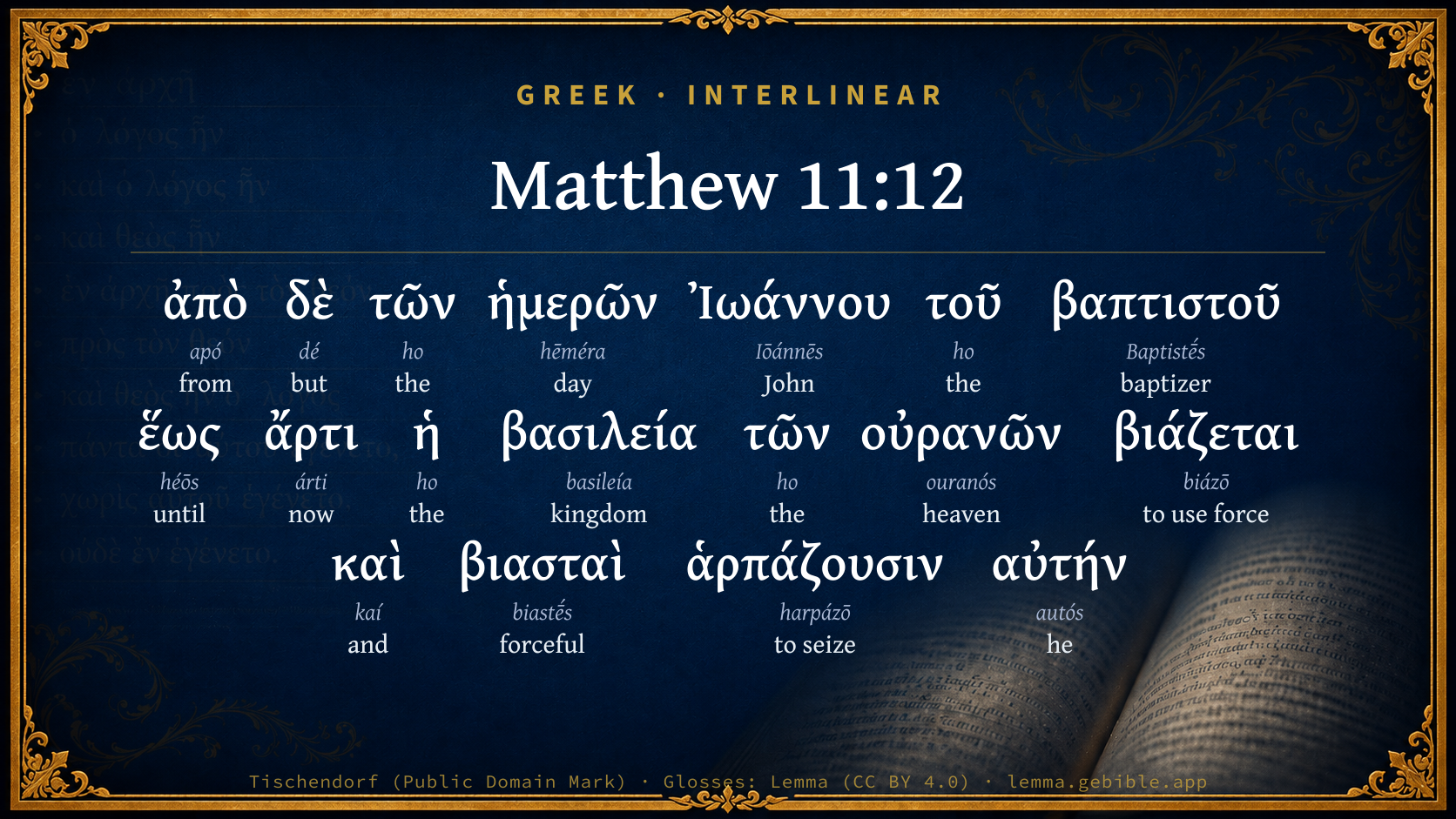
Greek (Tischendorf 8th ed.) Matthew 11:12 appears in the Greek New Testament. The text above is from the Tischendorf 8th edition. Each word links to its Strong’s number and a concise gloss. Click any word for its full Thayer’s Greek Lexicon entry.
Download image
Cite this verse

Matthew 11:12 (World English Bible). Public Domain. Lemma interlinear Bible study tool, https://lemma.gebible.app/v/matthew/11/12.

Show BibTeX & RIS
BibTeX
RIS
English Translation
From the days of John the Baptizer until now, the Kingdom of Heaven suffers violence, and the violent take it by force.
World English Bible · Public Domain
Highlights
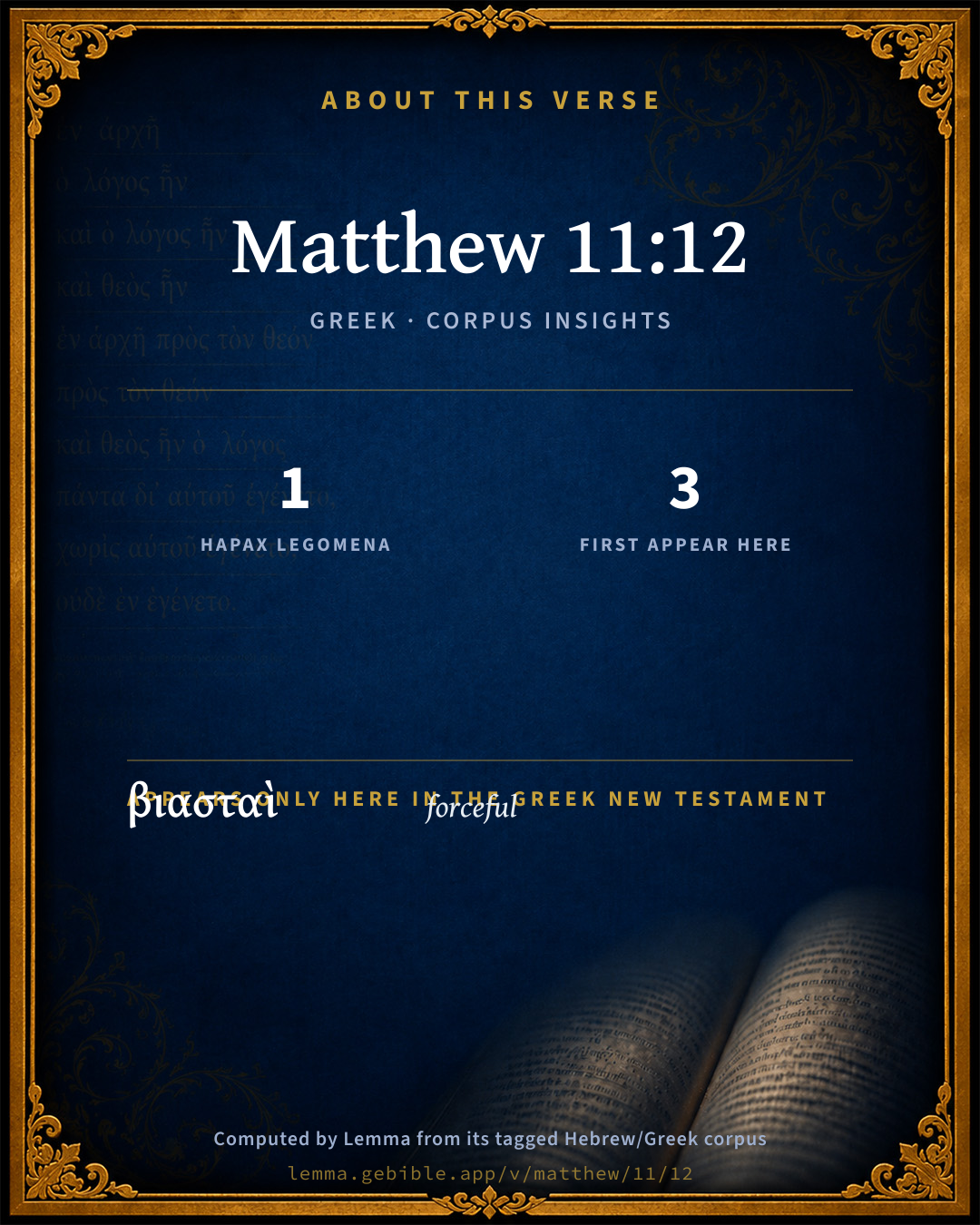
  • 1 hapax legomenon — only here in the Greek New Testament
  • 3 first appearances in the Greek New Testament
Full analysis ↓
Download a study sheet

One document with this verse’s original text, its word-by-word gloss line, the meaning frame, cross-references with their text, attributed commentary, and full source and license credits — printable, and it pastes into notes with its structure intact.

This verse Autodidact and up

Study sheet (.html) Plain text (.txt)

A passage Seminary Student

Up to 50 verses in one chapter. A passage sheet keeps up to 6 commentary sources and 12 cross-references per verse, in the order this page ranks them, and says so on the sheet whenever that leaves anything out. Ask for a single verse and you get the Autodidact verse sheet above.

Everything on this page stays free to read, with no account — the sheet is a download of what is already on screen, not access to it.

Want to remove ads? Support Godless Engineer
Compare translations 3

The same verse in 3 English versions, stacked beneath the original-language interlinear above. Click any original word for its lexicon entry.

Each is an independent rendering of the whole verse — the interlinear is not word-aligned to these translations.

Highlighted words mark where these versions differ — a whole-verse word diff, not a word-by-word alignment.

  • World English Bible Public Domain
    From the days of John the Baptizer until now, the Kingdom of Heaven suffers violence, and the violent take it by force.
  • King James Version Public Domain
    And from the days of John the Baptist until now the kingdom of heaven suffereth violence, and the violent take it by force.
  • unfoldingWord Literal Text CC BY-SA 4.0
    But from the days of John the Baptist until now, the kingdom of the heavens suffers violence, and violent men take it by force.

unfoldingWord Literal Text — © unfoldingWord, licensed CC BY-SA 4.0. Word-aligned USFM3 via Door43 (git.door43.org/unfoldingWord/en_ult).

Versions to compare (up to 4)

3 of 4 selected

Show all 19 translations

Every available English version of this verse, each an independent rendering of the whole verse.

  • World English Bible Public Domain
    From the days of John the Baptizer until now, the Kingdom of Heaven suffers violence, and the violent take it by force.
  • Berean Standard Bible Public Domain
    From the days of John the Baptist until now, the kingdom of heaven has been subject to violence, and the violent lay claim to it.
  • Majority Standard Bible Public Domain
    From the days of John the Baptist until now, the kingdom of heaven has been subject to violence, and the violent lay claim to it.
  • King James Version Public Domain
    And from the days of John the Baptist until now the kingdom of heaven suffereth violence, and the violent take it by force.
  • American Standard Version (1901) Public Domain
    And from the days of John the Baptist until now the kingdom of heaven suffereth violence, and men of violence take it by force.
  • Revised Version (1885) Public Domain
    And from the days of John the Baptist until now the kingdom of heaven suffereth violence, and men of violence take it by force.
  • Geneva Bible (1599) Public Domain
    And from the time of Iohn Baptist hitherto, the kingdome of heauen suffereth violence, and the violent take it by force.
  • Douay-Rheims (1899) Public Domain
    And from the days of John the Baptist until now, the kingdom of heaven suffereth violence, and the violent bear it away.
  • Young's Literal Translation Public Domain
    `And, from the days of John the Baptist till now, the reign of the heavens doth suffer violence, and violent men do take it by force,
  • Literal Standard Version CC BY-SA 4.0
    And from the days of John the Immerser until now, the kingdom of the heavens suffers violence, and violent men seize it by force,
  • Unlocked Literal Bible CC BY-SA 4.0
    From the days of John the Baptist until now, the kingdom of heaven suffers violence, and men of violence take it by force.
  • unfoldingWord Literal Text CC BY-SA 4.0
    But from the days of John the Baptist until now, the kingdom of the heavens suffers violence, and violent men take it by force.
  • Darby Bible Public Domain
    But from the days of John the baptist until now, the kingdom of the heavens is taken by violence, and [the] violent seize on it.
  • World Messianic Bible Public Domain
    From the days of Yochanan the Immerser until now, the Kingdom of Heaven suffers violence, and the violent take it by force.
  • Webster's Bible Public Domain
    And from the days of John the Baptist, until now, the kingdom of heaven suffereth violence, and the violent take it by force.
  • Free Bible Version CC BY-SA 4.0
    From the time of John the Baptist up till now the kingdom of heaven continues to be under attack, and violent people are trying to seize it by force.
  • Bible in Basic English Public Domain
    And from the days of John the Baptist till now, the kingdom of heaven is forcing its way in, and men of force take it.
  • Text-Critical English NT CC BY 4.0
    From the days of John the Baptist until now the kingdom of heaven has been suffering violence, and the violent try to take it by force.
  • Tyndale New Testament (1534) Public Domain
    From the tyme of Ihon Baptist hytherto the kyngdome of heven suffreth violence and they that go to it with violence pluck it vnto them.

Literal Standard Version (2020), Covenant Press — licensed CC BY-SA 4.0. Text via the HelloAO Bible API (eBible.org). Unlocked Literal Bible (unfoldingWord) — licensed CC BY-SA 4.0. Text via the HelloAO Bible API (eBible.org). unfoldingWord Literal Text — © unfoldingWord, licensed CC BY-SA 4.0. Word-aligned USFM3 via Door43 (git.door43.org/unfoldingWord/en_ult). Free Bible Version, Dr. Jonathan Gallagher — licensed CC BY-SA 4.0. Text via the HelloAO Bible API (eBible.org).

Word by word

More ways to search: Search by grammar → Find every occurrence → Compare this word →

Practice this passage: Drill this verse → Learn its vocabulary →

βιασταὶ
biastḗs
G973
“forceful”
Noun, Nominative, Plural, Masculine
Part of Speech
Noun
Case
Nominative
Number
Plural
Gender
Masculine
Full Thayer's Definition

Origin: from G971

TDNT: 11:13,1

1. strong, forceful 2. using force, violent
  1. ἀπὸ apó G575 “from” Preposition
  2. δὲ dé G1161 “but” Conjunction
  3. τῶν ho G3588 “the” Article, Genitive, Plural, Feminine
  4. ἡμερῶν hēméra G2250 “day” Noun, Genitive, Plural, Feminine
  5. Ἰωάννου Iōánnēs G2491 “John” Noun, Genitive, Singular, Masculine
  6. τοῦ ho G3588 “the” Article, Genitive, Singular, Masculine
  7. βαπτιστοῦ Baptistḗs G910 “baptizer” Noun, Genitive, Singular, Masculine
  8. ἕως héōs G2193 “until” Adverb
  9. ἄρτι árti G737 “now” Adverb
  10. ἡ ho G3588 “the” Article, Nominative, Singular, Feminine
  11. βασιλεία basileía G932 “kingdom” Noun, Nominative, Singular, Feminine
  12. τῶν ho G3588 “the” Article, Genitive, Plural, Masculine
  13. οὐρανῶν ouranós G3772 “heaven” Noun, Genitive, Plural, Masculine
  14. βιάζεται biázō G971 “to use force” Verb, Present, Passive, Indicative, 3rd person, Singular
  15. καὶ kaí G2532 “and” Conjunction
  16. ἁρπάζουσιν harpázō G726 “to seize” Verb, Present, Active, Indicative, 3rd person, Plural
  17. αὐτήν autós G846 “he” Personal pronoun, Accusative, Singular, Feminine

About this verse

These counts appear in no published source. They are computed here, from the morphology-tagged text and Lemma’s own curated glosses. What Lemma adds →

18
words
15
distinct lemmas
Gospels
section

Notable vocabulary

1 hapax legomenon — a word that appears only here in the entire Greek New Testament:

  • βιασταὶ forceful G973

First appearance in Scripture

These words make their first canonical appearance in the Greek New Testament here:

  • βιάζεται to use force G971
  • βιασταὶ forceful G973
  • ἁρπάζουσιν to seize G726

Shared distinctive vocabulary

βιάζεται to use force G971 occurs in 2 verses of the Greek New Testament. Also found in:

Repetition

A word recurs within this verse:

Cross-references

7

Topical passages linked to Matthew 11:12 in the Treasury of Scripture Knowledge — connected by theme and wording, ordered by reader-vote popularity; previews shown in the World English Bible.

  • Luke 16:16 The law and the prophets were until John. From that time the Gospel of the Kingdom of God is preached, and everyone is forcing his way into it.
  • Luke 13:24 "Strive to enter in by the narrow door, for many, I tell you, will seek to enter in, and will not be able.
  • Ephesians 6:11–13 Put on the whole armor of God, that you may be able to stand against the wiles of the devil.
  • Philippians 2:12 So then, my beloved, even as you have always obeyed, not only in my presence, but now much more in my absence, work out your own salvation with fear and trembling.
  • John 6:27 Don't work for the food which perishes, but for the food which remains to eternal life, which the Son of Man will give to you. For God the Father has sealed him."
  • Matthew 21:23–32 When he had come into the temple, the chief priests and the elders of the people came to him as he was teaching, and said, "By what authority do you do these things? Who gave you this authority?"
  • Luke 7:29–30 When all the people and the tax collectors heard this, they declared God to be just, having been baptized with John's baptism.

Cross-references courtesy of OpenBible.info (CC BY 4.0).

Commentary

Notes on Matthew 11:12 from classic Christian and Jewish commentators (each source and its license shown beneath its notes). The classic Christian expositions comment on the surrounding passage and are grouped to its opening verse, so a note may address several verses; the Jewish commentaries on the Tanakh (Rashi and others) are per-verse, so they appear only where the commentator wrote on this verse.

Lemma curates 59 commentaries, every one of them public domain or Creative Commons licensed, each selected and text-cleaned for this edition rather than reprinted as found. About our sources →

The Biblical Illustrator

Joseph S. Exell

Mat_11:12

The kingdom of heaven suffereth violence.

Earnestness in religion

1. Earnestness is a distinguishing mark of race-elevation.

2. Earnestness is characteristic of great epochs.

3. Earnestness is a criterion of individual character, men weight according to earnestness; it is more than ability.

4. Of all places for earnestness, religion is the most important and natural. Reasons for earnestness in religion:-

I. It is demanded by the nature of religion itself. It is an earnest thing, demands our best power

(1) as a scheme of worship;

(2) as a series of works;

(3) as a system of duty;

(4) as a revelation of future rewards and punishments.

II. Earnestness in religion is demanded by earnestness in the God whom religion reveals. NO epicurean deity, careless of men.

1. Gods earnestness visible in nature. It is a whirl of terrible forces.

2. It is visible in things permitted and accomplished in Providence.

3. Earnestness visible in Gods self-revelation. God comes nearer to man at every step up to incarnation.

4. The language of scripture as revealing earnestness in God. It contains tender pleading, strong remonstrance. The only thing that can answer God is earnestness in us.

III. Earnestness is demanded by the difficulties in being religious,

1. These are real-Many are called; few chosen. The promises are to him that over-cometh.

2. They are not difficulties in religion itself. Abundant grace is supplied.

3. They are in us.

(1) Our unbelief.

(2) Love of the world.

(3) Spiritual indolence.

4. These are complicated by our surroundings.

5. And there is no accommodation of conditions. Religion no respecter of persons.

IV. Earnestness in religion is demanded by our actual dangers and needs.

1. Religion is a scheme of pardon as well as a system of truth. Our exposure is imminent.

2. Here is the supreme reason for earnestness in seeking the kingdom of heaven. It is your life.

V. Now contrast the earnestness so evidently demanded by our situation and the lightness wits which some threat the whole matter.

1. Contentment with slight grounds for unbelief.

2. Then see the lightness with which some turn away to business.

3. Lack of earnestness shown in deferred prayers and broken promises.

4. The feeble beginnings speedily abandoned.

Application:-

1. Remember the religious earnestness to which Christ exhorts is no fanatical excitement.

2. Remember how soon difficulties melt away before earnestness.

3. Examine the reasons why indifference replaces earnestess.

4. Earnestness is demanded by sour conduct in anything else which you believe will be to your advantage.

5. Appeal for immediate decision. These, the best things for earnestness; will please God; come to them as they come to you. (S. F. Scovel.)

The kingdom of heaven taken by violence

I. From the fact that the Scribes and Pharisees lost the kingdom with everything in their favour, whilst the violent won it with everything against them, we gather that every natural advantage may be forfeited a non-improvement, and that its want may be compensated by strenuousness of exertion.

II. He who would be saved must de saved by violence, and, nevertheless, he can be saved only by grace. Many charge the doctrine of justification by faith with a tendency to undermine exertion. But there is more effort necessary to be saved by grace than by works. Mans strongest inclinations are on the side of meriting heaven by works; hence the need of violence to resist this. And the violence done to nature by the act of believing, faith, as working by love, will keep men in perpetual activity. A life of faith is a life of self-denial. It is not easy, though Gods grace will prevent it being too difficult.

III. With this proof that they who would be saved must use violence there is given A demonstration that, nevertheless, they can be saved only by grace. The faith which prompts and enables the violence is no human principle, but is of celestial gift. Faith, and all its results, must be attributed to grace. (H. Melvill, B. D.)

The Christian must use force

If the wrestler must use force when the athletic arm is raised against him, then must we for we wrestle with principalities and powers. If the warrior must use force when the army cometh against him, then must we use force, for there are squadrons between us and everlasting rest. If the captive must use force when he would wrench off his chains, then must we use force, for the fetters of an evil nature bind us to the earth. If the traveller must use force when there are mountains to be scaled, then must we use force, for a rugged land is before us, and the rocks and the torrents block up our path. Or if the suppliant use force-the force of earnest entreaty, unwearied solicitation, burning tears, and passionate cries, when he would gain a favour from a great one of the earth; then must we use force; we must pray always and not faint; we must besiege the mercy-seat, seeing that all we need must come from God; and earnest supplication is the condition on which God bestows. (H. Melvill, B. D.)

The kingdom of heaven taken by force

I. The nature of the force here spoken of.

1. A resolution of mind to receive the doctrine and precepts of strict holiness and virtue, though contrary to the ordinary bias of mens appetites and inclinations.

2. The quitting favourite notions and prejudices, upon sufficient evidence, and with mature, serious, and diligent consideration.

3. Quitting some present worldly advantages for the sake of the gospel, and making a profession of the truths of religion, against much opposition, and notwithstanding difficulties and discouragements.

II. There is also intended A reference to the willing forwardness and resolute zeal of many in embracing the principles of true religion, who, to outward appearance, were the most unlikely of any to have a share in the blessings and privileges of the gospel: such as men of mean rank and low education, men of unreputable character, and Gentiles. (Nathanael Lardner.)

Taking the kingdom by violence

I. The necessity for these strong exertions arises from the immense difficulties in the way:-

1. The world, as comprehending both objects of attention and objects of attachment.

2. The devil and his angels.

3. The flesh with all its passions and lusts.

4. The difficulty of dissolving long-connected associations, of breaking up long-established habits, and of issuing forth into new courses of action.

II. The nature of the violence intended.

1. It must be accompanied with supreme desire, and with corresponding earnestness and diligence.

2. It must be accompanied with true repentance.

3. It must be marked with submission.

4. You must offer the prayer of the destitute.

Apply:

1. To those who are opposed to any great earnestness or any uncommon movement in religion.

2. To awakened sinners.

3. Where will the prayerless sinner appear? (E. Griffin, D. D.)

Religious earnestness

I. The characteristic earnestness of the gospel dispensation.

1. These are the provisions of the gospel, complete and full.

2. Its early history.

3. Its work and mission.

4. Its finality.

II. Its effects among men; their treatment of it.

1. Many enter the kingdom violently.

(1) Violence exhibited in their repentance.

(2) In their efforts to believe and acquire holiness.

(3) In the difficulties they are called to overcome.

2. Enemies. (Anon.)

A visitation of strong religious desire

Not one or other among us, but probably every man who hears me, either has already had, or will have, at some time of his life, a strong desire to obey God. One man is checked or is favoured in this respect in one way, another in another. We cannot avoid seeing that some men have, almost by nature, religious feelings which are not given in equal measure to others. But still it is with respect to religion as it is with regard to our own prosperity in life. It is said there is no man who has not once or twice in life a lucky chance, and it depends on the skill with which he uses it whether he turns out a prosperous man or not. So it is with our religious character. However unfavourable his position, however strongly a character may have taken a cold or irreligious tone, still there is scarcely a man who is not now and then awakened by some of what we call the accidents of life, but which are in reality calls from God, and who does not often see Him and His will distinctly-as it was said of Balaam, having his eyes open. But did Balaam, when his eyes were open, obey? Did he to whom, more than to Gods own servants, it was given to know Gods will, follow it? No! He was contented to know about God, and made his knowledge of Him a substitute for the obedience he ought to have rendered. So it is with us all, if we forget that the wish to press-nay, the very pressing itself into Gods kingdom, is but the first step towards winning it. It may be a great step; it may change the direction of a mans whole life; it may realize the proverb, that well begun is half done; while it may also be the mere turning away for a few weeks, or even days, from vice. Gods kingdom can be really won by nothing but steady, manly perseverance; it is a matter which demands a lifelong energy of prayer and watching, lest at any time we let it slip. (Dean Lake.)

The most religious, the most energetic

Whosoever shall do most violence to Christ shall be accounted most religious by Him. We desire to take His kingdom, His riches, and His life. And He is so rich and so liberal that He does not resist. He does not deny, and after He has given all, He still possesses all. We attack Him, not with swords, nor staves, nor stones; but with meekness, good works, chastity. These are the weapons of our faith, by which we strive in the contest. But, in order that we may be able to make use of these arms in doing violence, let us first use a certain violence to our own bodies, let us carry by storm the vices of our members, that we may obtain the rewards of valour. For, to seize the Saviours kingdom, we must first reign in ourselves. (St. Ambrose.)

A struggle to reach heaven

In the life of Perpetua and her fellow-martyrs, we read that in a dream she beheld a golden ladder reaching from earth to heaven, which was hedged in and surrounded on all sides by knives and sharp swords. By this ladder they had to climb up to heaven. At its foot lay a horrible dragon, who sought to hinder the climbers. She saw, moreover, one of her companions, Satyrus by name, bravely mounting the ladder, and inviting his companions to follow him. When she had related her vision, they all understood that they were to suffer martyrdom. And so it happened. Thus let each believer consider that with his utmost energy he must struggle up to heaven, by means of a ladder hedged about with knives.

Heaven taken by storm

The claim for admission into the covenant had hitherto, from Abraham to John the Baptist, been a national one; it now became a solely moral one.

1. We lay down as our first principle that indomitable earnestness is the soul of our religion and the key to all progress.

2. Let no man suppose that this will clash with the doctrines of Divine grace.

3. It is easy to see that there are two ways of taking the kingdom, a weak way and a violent way. Faith may be merely of an educational kind, or strong and personal; the inner life of man may go on easily from (lay to day, or it may contend with evil influences; prayer may consist in empty cries.

4. The promise of success is to the violent.

(1) Not because God is unwilling, but because it is His way to exercise grace that He may increase it. (J. Vaughan, M. A.)

Fighting a way into the kingdom

The Interpreter took the pilgrim again by the hand, and led him into a pleasant place, where was built a stately palace, beautiful to behold; at the sight of which Christian was greatly delighted. He saw also upon the top thereof certain persons walking, who were clothed all in gold. Then said Christian, May we go in thither? Then the Interpreter took him, and led him up toward the door of the palace; and behold, at the door stood a great company of men, as desirous to go in, but durst not. There also sat a man at a little distance from the door, at a table-side, with a book and his ink-horn before him, to take the name of him that should enter therein; he saw also that in the doorway stood many men in armour to keep it, being resolved to do to the men that would enter what hurt and mischief they could. Now was Christian somewhat in amaze. At last, when every man started back for fear of the armed men, Christian saw a man of a very stout countenance, come up to the man that sat there to write, saying, Set down my name, sir; the which when he had done, he saw the man draw his sword, and put a helmet upon his head, and rush toward the door upon the armed men, who laid upon him with deadly force; but the man, not at all discouraged, fell to cutting and hacking most fiercely. So that, after he had received and given many wounds to those that attempted to keep him out, he cut his way through them all, and pressed forward into the palace; at which there was a pleasant voice heard from those that were within, even of those that walked upon the top of the palace, saying,

Come in, Come in,

Eternal glory thou shalt win.

So he went in, and was clothed with such garments as they. (John Bunyan.)

Practical religion requires energy

When we look at towns on a map we think the way to them easy, as if our foot were as nimble as our thoughts; but we are soon discouraged and tired, when we meet with dangerous and craggy passages, and come to learn the difference between glancing at the way and serious endea-yours to traverse it. So in matters of religion, he that endeavours to bring Christ and his soul together, before he hath done, will be forced to sit down and cry, Lord, help me! (T. Manton.)

Earliest prayer

Prayer pulls the rope below and the great bell rings above in the ears of God. Some scarcely stir the bell, for they pray so languidly; others give but an occasional pluck at the rope; but he who wins with heaven is the man who grasps the rope boldly and pulls continuously, with all his might. (C. H. Spurgeon.)

Need inspires energy

After Sir Colin Campbells silent retreat from Lucknow in the last Indian war, Captain Waterman was left behind. He had gone to his bed in a retired corner of the brigade mess-house, and having overslept himself was forgotten. At two oclock in the morning, to his great horror, he found all was deserted and silent, and that he was alone in an open entrenchment with 15,000 furious barbarians just outside. Frightened, he took to his heels and ran himself nearly out of breath, till he overtook the retiring rear-guard, mad with excitement, and breathless with fatigue. But was not his earnestness reasonable, seeing that he realized his danger? And if unconverted sinners realized their danger, would they not be desperately in earnest?

The Biblical Illustrator, edited by Joseph S. Exell (c. 1880s–1900s) — public domain. Text from a community e-Sword module.

Joseph Benson's Commentary

Mat 11:12. And from the days of John the Baptist — That is, from the time he had borne his public testimony to the approach of the Messiah, or from the time when he had fulfilled his ministry, the kingdom of heaven — The dispensation which admits all persons equally, upon their repentance and faith, suffereth violence, and the violent take it by force — The spirits of men are so excited and animated by a desire after this kingdom, that it is, as it were, attacked like a besieged city, men of all sorts pressing to get into it, with a violence like that of men who are taking a place by storm. As if he had said, “Multitudes are flocking around me, to be instructed in the nature of my kingdom; and some, who were formerly of most licentious characters, and looked upon as utterly unfit to be subjects of the Messiah’s kingdom, are resolutely set on enjoying the blessings of it.” He that hath ears to hear, let him hear — A kind of proverbial expression, requiring the deepest attention to what is spoken.

Joseph Benson's Commentary on the Old and New Testaments (1811–1818) — public domain. Text from a community e-Sword module.

Godbey's Commentary on the New Testament

William B. Godbey

THE GREATEST REVIVAL OF THE AGES

Mat 11:12. “From the days of John the Baptist until now, the kingdom of the heavens suffereth violence, and the violent take it by force;” i.e., strong, vigorous, muscular, nervous men and women, from Dan to Beersheba, from the great sea to the Arabian desert, are rising up, leaving their homes, dropping everything in their enthusiasm for personal salvation. Four hundred years had rolled away since an inspired prophet had preached in Israel. The ministry of John the Baptist was like an effulgent noonday, suddenly breaking the black darkness of midnight. Never had Israel seen or known such a revival as swept the country, like a cyclone, under the ministry of the eloquent Baptist. Before John’s revival was arrested by his imprisonment and martyrdom, he enjoyed the honor of administering the inaugural baptism to the Son of God, thus introducing Him into His official Messiahship, who immediately began to preach and perform the most stupendous miracles, not only healing the people by hundreds and thousands, administering infallible cures to lepers, cripples, and all sorts of invalids, well known to be hopeless by human agency, but, under the ministry of Jesus, not only was all Israel aroused from the slumber of bygone ages, and thrilled with an electric-shock which emptied their cities and depopulated their towns, to run away and see the mighty works and hear the paradoxical preaching of the Galilean Prophet, but heathen nations from all parts of the country rise up, and come in multitudes, pressing pell-mell, precipitately, shouting as they come, “Only let me into the kingdom!”

William B. Godbey, Commentary on the New Testament (1896–1900) — public domain. Text from a community e-Sword module.

Tyndale Open Study Notes

Tyndale Open Resources

11:12 the Kingdom of Heaven has been forcefully advancing: Or the Kingdom of Heaven has suffered from violence. These alternatives reflect either a positive or negative nuance of the Greek verb. In Luke 16:16, a different verb (“preached”) makes it a clearly positive statement. • violent people are attacking it: This phrase may also have a positive or negative sense. If negative, it might refer to those who imprisoned John (see Matt 11:2; 14:1-12), and attacking might mean either that they were trying to attack the Kingdom but were unable to thwart God’s sovereign plans, or that they were attacking it by persecuting its members. In Luke 16:16 this statement has the positive sense that they were “eager to get in” and were forcefully laying claim to the Kingdom through radical trust and obedience.

Tyndale Open Study Notes — © Tyndale Open Resources, licensed CC BY-SA 4.0. Text via the HelloAO Bible API.

Bengel's Gnomon

Johann Albrecht Bengel

Mat 11:12. Δὲ, but) Used antithetically in this sense—viz., although John is less than the least in the kingdom of heaven, yet even from the beginning of the days of John the Baptist, the kingdom of heaven exercises force. The kingdom of heaven came not in John, but immediately after John.—βιάζεται, pushes itself forward as it were by violence) Consider attentively ch. Mat 13:32-33, and Luk 14:23. The LXX. frequently use βιάζομαι, to signify, to employ force. John calls in a mournful, Jesus in a joyful strain.[522] And there is a metonymy of kingdom for King, i.e. the Messiah. See Gnomon on ch. Mat 4:17.—βιασταὶ, they who employ force) See Luk 13:24. There is no complaint here of hostile force, for the complaint begins at Mat 11:16. βιάζεται and ΒΙΑΣΤΑῚ are correlative.[523]—ἉΡΠΆΖΟΥΣΙΝ, seize) in order that by seizing it with swift force, all obstacles having been broken through, they may obtain the blessing which is offered them.[524] See Luk 7:29.

[522] In the original, “Johannes lamentatur; Jesus canit,”—lit. “John laments; Jesus sings.”—(I. B.)

[523] It is in this way that the work goes on briskly, and advances as successfully as one could wish.—V. g.

[524] Just as happens in the case of wares exposed for sale in public.—V. g.

Bengel's Gnomon of the New Testament — English translation (T&T Clark, Edinburgh, 1860) — public domain. Text from a community e-Sword module.

Meyer's Critical & Exegetical Commentary

Heinrich August Wilhelm Meyer

Mat_11:12. After the remark in passing that ὁ δὲ μικρότερος, etc., Jesus now continues His testimony regarding John, and, in order to prove what He had just said of him in Mat_11:10-11, He calls attention to the powerful movement in favour of the Messiahs kingdom which had taken place since the commencement of the Baptists ministry.

ἀπὸ τῶν ἡμερ. Ἰωάνν.] This is not the language of one belonging to a later period, but only such as Jesus could have used at this juncture; for the days when John laboured and flourished were gone by! This in answer to Gfrörer, heil. Sage, II. p. 92, and Hilgenfeld.

βιάζεται] Hesychius: βιαίως κρατεῖταιit is taken possession of by force, is conquered (not magna vi praedicatur, according to the idea imported into the words by Loesner and Fritzsche); Xen. H. G. v. 2. 15 : πόλεις … τὰς βεβιασμένας; Thuc. iv. 10. 5 : βιάζοιτο, it would be forced; Dem. 84. 24; Zosimus, v. 29; 2Ma_14:41; Elwert, Quaestion. ad philol. sacr. N. T., 1860, p. 19, who, however, would take the present indicative as meaning vult expugnari, which is not required by the context. In this way is described that eager, irresistible striving and struggling after the approaching Messianic kingdom (Chrysostom: πάντες οἱ μετὰ σπουδῆς προσιόντες) which has prevailed since the Baptist began to preach; it is as though it were being taken by storm. Comp. the neuter usage in Luk_16:16 : πᾶς εἰς αὐτὴν βιάζεται; and further, Xen. Cyr. iii. 3. 69: βιάσαιντο εἴσω; likewise Thuc. i. 63, vii. 69; Ael. V. H. xiii. 32; Herodian, vii. 10. 13; Polyb. i. 74. 5, ii. 67. 2, iv. 71. 5. If others have adopted the idea of a hostile violence with which the Messianic kingdom is persecuted (Lightfoot, Schneckenburger, Beitr. p. 49), or violently (Hilgenfeld) crushed and arrested (by the Pharisees and scribes), their view is partly an anachronism, and partly forbidden by the connection with Mat_11:13 and with what goes before. Finally, to take the verb in a middle sense, and as describing the breaking in of the kingdom which makes its way in spite of all resistance (Melanchthon, Bengel, Baur, Zyro in the Stud. u. Krit. 1860, p. 401), is certainly not contrary to usage (Dem. 779. 2; Lucian, Herm. 70), but inconsistent with the context in which βιασταί follows.

καὶ βιασταὶ ἁρπάζουσιν αὐτήν] and those who use violent efforts drag it to themselves. The anarthrous βιασταί is not intended to be emphatic; such is now the character of the times, that those of whom the βιάζεται holds true achieve a speedy success, in that, while they press forward to join the ranks of my followers, they clutch at the approaching kingdom as though they were seizing spoils, and make it their own. So eager and energetic (no longer calm and expectant) is the interest in regard to the kingdom. The βιασταί are, accordingly, believers struggling hard for its possession. Jesus Himself (this in answer to Zyro) cannot be included among those who are here in view. Those who interpret βιάζεται in a hostile sense, render ἁρπάζουσιν: they snatch it away from men (according to Schneckenburger, they bar the way to it), in allusion to the conduct of the scribes and Pharisees. For βιαστής, comp. Pind. Ol. ix. 114; Pyth. i. 18. 82, iv. 420, vi. 28; Nem. ix. 122; Duncan, Lex., ed. Rost, p. 209. In Pindar also it is always used in a good sense. For ἁρπάζ., comp. Xen. Anab. iv. 6. 11, vi. 5. 18; Herodian, ii. 6. 10, ii. 3. 23.

Meyer — Critical and Exegetical Commentary on the New Testament — English translation by Peter Christie, edited by Frederick Crombie (T&T Clark, 1880) — public domain. Text from a community e-Sword module.

Expositor's Greek Testament

ed. W. Robertson Nicoll

Mat 11:12 . The statement just commented on had to be made in the interests of truth and the Kingdom of God, but having made it Jesus reverts with pleasure to a tone of eulogy. This verse has created much diversity of opinion, which it would take long to recount. I find in it two thoughts: one expressed, the other implied. (1) There has been a powerful movement since John’s time towards the Kingdom of God. (2) The movement derived its initial impetus from John. The latter thought is latent in ἀπὸ δὲ τῶν ἡμ . Ιωάν . The movement dates from John; he has the credit of starting it. This thought is essential to the connection. It is the ultimate justification of the περισσότερον (Mat 11:9 ). The apostle Paul adduced as one argument for his apostleship, called in question by Judaists, success , which in his view was not an accident but God-given, and due to fitness for the work (2Co 2:14 ; 2Co 3:1-18 ). So Christ here in effect proves John’s fitness for the position of forerunner by the success of his ministry. He had actually made the kingdom come. That was the true basis of his title to the honourable appellation, “preparer of the way”; without that it had been an empty title, though based on any number of prophecies. That success proved fitness, adequate endowment with moral force, and power to impress and move men. This being seen to be Christ’s meaning, there is no room for doubt as to the animus of the words βιάζεται , βιασταὶ . They contain a favourable, benignant estimate of the movement going on not an unfavourable, as, among others, Weiss thinks, taking the words to point to a premature attempt to bring in the kingdom by a false way as a political creation (Weiss-Meyer). Of course there were many defects, obvious, glaring, in the movement, as there always are. Jesus knew them well, but He was not in the mood just then to remark on them, but rather, taking a broad, generous view, to point to the movement as a whole as convincing proof of John’s moral force and high prophetic endowment. The two words βιαζ ., βιασ . signalise the vigour of the movement. The kingdom was being seized, captured by a storming party. The verb might be middle voice, and is so taken by Beng., “sese vi quasi obtrudit,” true to fact, but the passive is demanded by the noun following. The kingdom is forcefully taken ( βιαίως κρατεῖται , Hesychius) by the βιασταὶ . There is probably a tacit reference to the kind of people who were storming the kingdom, from the point of view, not so much of Jesus, as of those who deemed themselves the rightful citizens of the kingdom. “Publicans and sinners” (Mat 9:9-12 ), the ignorant (Mat 11:25 ). What a rabble! thought Scribes and Pharisees. Cause of profound satisfaction to Jesus (Mat 11:25 ).

The Expositor's Greek Testament, edited by W. Robertson Nicoll (1897–1910) — public domain. Text from a community e-Sword module.

Adam Clarke's Commentary

Verse 12. The kingdom of heaven suffereth violence] The tax-gatherers and heathens, whom the scribes and Pharisees think have no right to the kingdom of the Messiah, filled with holy zeal and earnestness, seize at once on the proffered mercy of the Gospel, and so take the kingdom as by force from those learned doctors who claimed for themselves the chiefest places in that kingdom. Christ himself said, The tax-gatherers and harlots go before you into the kingdom of God. See the parallel place, Lu 7:28-30. He that will take, get possession of the kingdom of righteousness, peace, and spiritual joy, must be in earnest: all hell will oppose him in every step he takes; and if a man be not absolutely determined to give up his sins and evil companions, and have his soul saved at all hazards, and at every expense, he will surely perish everlastingly. This requires a violent earnestness.

Adam Clarke's Commentary on the Bible (1810–1826) — public domain. Text from a community e-Sword/MySword module.

Ellicott's Commentary for English Readers

(12) The kingdom of heaven suffereth violence.—The Greek verb may be either in the middle voice, “forces its way violently,” or passive, as in the English version, but there is little doubt that the latter is the right rendering. The words describe the eager rush of the crowds of Galilee and Judæa, first to the preaching of the Baptist, and then to that of Jesus. It was, as it were, a city attacked on all sides by those who were eager to take possession of it.

The violent take it by force.—The Greek noun is without the article, “men who are violent or use force.” The meaning is determined by the preceding clause. The “violent” are men of eager, impetuous zeal, who grasp the kingdom of heaven—i.e., its peace, and pardon, and blessedness—with as much eagerness as men would snatch and carry off as their own the spoil of a conquered city. Their new life is, in the prophet’s language, “given them as a prey” (Jer_21:9; Jer_45:5). There is no thought of hostile purpose in the words.

A Bible Commentary for English Readers, edited by Charles John Ellicott (1878–1897) — public domain. Text from a community e-Sword module.

The Cambridge Bible for Schools and Colleges

gen. ed. J. J. S. Perowne

12. And from] Translate but from: another point shewing the greatness of John, and also the beginning of the Kingdom: it was from the time of John’s preaching that men began to press into the kingdom, and the earnest won their way in. For the preaching of John was the epoch to which all prophecy tended.

suffereth violence] is forced, broken into, as a ship enters a harbour by breaking the boom stretched across the harbour’s mouth. John’s preaching was the signal for men to press into the kingdom—to adopt eagerly the new rule and life heralded by John and set forth by Christ.

the violent take it by force] The eager and enthusiastic followers of Christ seize the kingdom—win it as a prize of war.

The Cambridge Bible for Schools and Colleges (gen. ed. J. J. S. Perowne; Cambridge University Press, 1878–1918) — public domain. Text from a community e-Sword module.

John Gill's Exposition

For all the prophets and the law prophesied until John. These words are to be considered in connection with Mat 11:11 and are a further proof of John's being greater than any of the prophets; because all the inspired writers and prophets, who were before him, prophesied of the Messiah as to come; and either spoke of him in obscure terms, or represented him under dark shadows and figures: whereas John spake of him as already come, and in plain terms, and directed to his very person; and since his time, there have been no prophecies concerning the Messiah and his kingdom; vision and prophecy are now sealed up; all which are acknowledged by the Jews themselves, who (b) say, , "all the prophets did not prophesy but to, or of the days of the Messiah". This was the subject, and these the limits of their prophecies; for they own (c), that

"from the day that the temple was destroyed, , "prophecy was taken away from the prophets".''

Since that time, they confess they have had no prophet (d), and that they are not able to observe their signs.

(b) T. Bab. Beracot, fol. 34. 2. Sabbat, fol. 63. 1. Sanhedrim, fol. 99. 1. (c) T. Bava Bathra, fol. 12. 1. (d) Abarbinel in Dan. fol. 63. 4.

John Gill's Exposition of the Whole Bible (1746–1763) — public domain (CC PDM 1.0). Text via the HelloAO Bible API.

Trapp's Complete Commentary

John Trapp

12 And from the days of John the Baptist until now the kingdom of heaven suffereth violence, and the violent take it by force.

Ver. 12. And from the days of John, &c.] The Baptist is further commended from the good success of his ministry, a sweet seal, but no sure sign of a sanctified preacher; since many causes give that to others, that which themselves have not. Thus the lifeless heaven gives life to various creatures, the dull whetstone sharpens iron. A stinking breath may sound a trumpet with great commendation, &c. Howbeit the fruitfulness of the people is the preacher’s testimonial, 2Co 3:2; and God delights to honour those of most sincerity with most success, as 1Co 15:10.

The kingdom of heaven suffereth violence] Men are resolved to have it, whatever pains or peril they pass through. As God’s Israel violently invaded and overran the promised land, so do his elect lay hold on the promised inheritance. This true treasure, hitherto hidden, Rom 16:26, is now discovered and exposed to all that have a mind to it. Now therefore they are carried with all strength of affection after Christ; him they must have, whatever else they go without; towards him they fly as a cloud; and as a flock of doves they scour into the columbary, and rush into the windows, Isa 60:8.

And the violent, &c.] The valiant, Isaiah calleth them, that break through all difficulties, as did David’s worthies, and walk about the world as so many conquerors: yea, more than conquerors they are, Rom 8:37, and what can that be but triumphers? 2Co 2:14.

Take it by force] Make a prey or a prize of it. Diripiunt, as Hilary rendereth it, making it a metaphor, from a tower or town sacked and ransacked by the enemy. Cyprus is an island so fruitful and pleasant, that it was anciently called Macaria, that is, blessed. And of it Sextus Rufus writeth, that being famous for riches, it thereby solicited the poverty of the people of Rome to seize upon it. {a} This may be more fitly said of heaven, that habitation of the happy ones, so eagerly and earnestly sought for by the saints, that nothing else will satisfy them. Valde protestatus sum me nolle sic a Deo satiari, said Luther, when great gifts were sent unto him, and a cardinalship offered him by the pope: God, he said, should not put him off with those petty things, he breathed after better. Heaven is had by the violent, earth inherited by those that are meek, Mat 5:6. Where, though God would have his servants content with the least mercies (as being less than the very least), yet not satisfied with the greatest things in the world for their portion, since they are born to better. If they be, as most are, slothful in seeking to possess themselves of heaven, he chides them, as Joshua did the seven tribes for their negligence, Jos 18:2.

{a} Cyprus famosa divitiis paupertatem populi Rom. ut occuparetur, sollicitacit.

John Trapp, A Commentary or Exposition upon All the Books of the Old and New Testament (1647–1656) — public domain. Text from a community e-Sword module.

Albert Barnes' Notes on the Bible

And from the days of John ... - That is, from the days when John began to preach. It is not known how long this was, but it was not probably more than a year. Our Saviour here simply states a fact. He says there was a great rush or a crowd pressing to hear John. Multitudes went out to hear him, as if they were about to take the kingdom of heaven by force. See Mat 3:5. So, he says, it has continued. Since “the kingdom of heaven,” or “the gospel,” has been preached, there has been a “rush” to it. People have been “earnest” about it; they have come “pressing” to obtain the blessing, as if they would take it by violence. There is allusion here to the manner in which cities were taken. Besiegers “pressed” upon them with violence and demolished the walls. With such “earnestness” and “violence,” he says, people had pressed around him and John since they began to preach. There is no allusion here to the manner in which individual sinners seek salvation, but it is a simple record of the fact that multitudes had thronged around him and John to hear the gospel.

Albert Barnes' Notes on the Bible (1834–1885) — public domain. Text from a community e-Sword/MySword module.

Haydock's Catholic Bible Commentary

Suffereth violence, &c. It is not to be obtained but by main force, by using violence upon ourselves, by mortification and penance, and resisting our perverse inclinations. (Challoner) --- Certainly it is great violence for a man to look for a seat in heaven, and to obtain that by his virtue which was refused him by his nature. (St. Jerome in St. Thomas Aquinas) --- The kingdom of heaven, &c. That is, the kingdom of heaven is to be obtained by mortification, penance, poverty, and those practices of austerity which John, both by word and example, pointed out. According to this interpretation, the kingdom of heaven means eternal life. Or the meaning may be, the kingdom of heaven is taken by the violent, because it is not now confined, as in the old law, to one people, but open to all, that whoever will may enter in and take possession of it. The kingdom of heaven, in this interpretation, is taken for the Church of Christ, for the gospel, and also for eternal life. (Menochius)

George Leo Haydock (1774–1849), Haydock's Catholic Family Bible and Commentary, 1859 edition — public domain. Excludes Psalms (Douay-Rheims chapter numbering differs from Protestant) and Deuterocanonical books (Catholic canon only).

Matthew Poole's English Annotations

As John Baptist was a great man, so the Lord hath owned him as such, giving such a success to his ministry, that ever since he began the course of it, men have been carried on with a great ardour and heat, in hearing and receiving the gospel, which is the gospel of the kingdom, and bringeth men into the kingdom of Christ amongst men, and at last to the kingdom of glory. The hearts of men and women have been inflamed with a desire after the knowledge and obtaining of heaven, and heavenly things. They are great persons whom God thus owneth; and those whom the Lord thus owneth, are ordinarily such as have some measures of the spirit of this first gospel ministry, making the great things of God the matter of their discourse, and doing their work with a seriousness, zeal, and fervour fitted to it.

The violent take it by force: they are not lazy wishes or cold endeavours that will bring men to heaven.

Matthew Poole's English Annotations on the Holy Bible (1683–1685) — public domain. Text from a community e-Sword/MySword module.

Whedon's Commentary on the Bible

Daniel D. Whedon

12. Suffereth violence — Our Lord here shows that John is not alone in his mistake. It is the error of the day. From the time of John’s first appearing to the moment of our Lord’s speaking, men have been disposed violently to hurry the kingdom into a premature existence. They will have it now.

They will take it by storm.

The kingdom of heaven, as all admit, is here the kingdom of God on earth, the Christian dispensation. It is compared to a city under siege, or rather under assault by storm. Those who, like John, are impatient for its arrival, wondering why it does not come, and demanding of Christ whether he is really going to come out and be its king, are its captors, or rather ravishers. The kingdom suffers violence from them; and these violent captors are taking it, forsooth, with an onset.

Mr. Watson’s explication, (which is the popular one,) in which the “violent” are zealous Christians who conquer and win heaven by their holy warfare, is wrought out by him with much eloquence. But it does not occur to him to show what relevancy such an idea has to the current of thought or the subject in hand. Our interpretation makes Jesus explain the temper of John’s impatient inquiry. That other interpretation makes a very good idea, but nothing to the purpose.

Until now — Even unto the present stage of its development.

Daniel D. Whedon (gen. ed.), Commentary on the Old and New Testaments (1874–1909) — public domain. Text from a community e-Sword module.

The Pulpit Commentary

It is curious that in St. Luke"s account of this speech of our Lord"s he should omit our vers. 12-14 (on ver. 15, see note there), thus leaving out all Christ"s plainer and more direct teaching about the relation of John to himself. St. Luke places (Luk_16:16) our vers. 12 and 13 in what appears to be merely a cento of sayings. Possibly the original occasion has been recorded by neither evangelist, but in Matthew the passage certainly brings out the thought upon which our Lord was insisting on this occasion. And. Slightly adversative (de), for there is a change of subject. Christ urges his hearers to more definitely range themselves under his banner. From the days of John the Baptist until now. Yet this was not more than a few months! Possibly the sentence had become modified in oral teaching, so as to include many years, say up to A.D. 50 or 60. St. Luke"s apo tote is easy enough. Observe the implied success of John"s work as herald. He so prepared the way that men were eager to enter the kingdom which he had said was at hand. The kingdom of heaven. The realm ruled over by Messiah, of which the then community of believers was the earnest (vide Introduction, p. 25). Suffereth violence (biazetai). In Luke it is middle, "Every man entereth violently into it;" and though it is certainly passive here, St. Luke"s phrase compels us to understand the reason of the violence to be entrance into the kingdom. The kingdom is not ill treated, but it is as it were taken by storm (Meyer). Nosgen strangely understands the phrase to mean that the kingdom is set forward with power, and he would apparently see in "the violent" a special reference to our Lord and John. And the violent; and men of violence (Revised Version); kai biastai : only they; men whose mind is made up and who care not what force and power they employ to attain their object. Take it by force; arpazzousin authn , "grasp it for themselves," like rough and violent bandits seizing their prey. Weiss sees in this verse blame of the politico-Messianic endeavours to hasten the completion of the kingdom. This explanation is good in itself, (cf. Joh_6:15) but disconnects the verse from its context. Our Lord is describing the energy with which some souls are pressing in, and urging the need of such energy if salvation is to be obtained.

Violent entrance into the kingdom.

"The kingdom of heaven suffereth violence, and the violent take it by force." It is difficult to accept restfully any of the explanations offered of this very bold figure. We cannot think who had been showing such "violence" in pushing into Christ"s new kingdom. Evidently our Lord is dealing with John"s mistake. He was filled with doubts because Christ"s ways were so gentle. If Jesus meant to establish the Messianic kingdom, John felt that he would have to put more force into it. So Jesus, thinking of this idea of John"s, says, "It is the common mistake men have made ever since that vigorous ministry of John"s. Everybody seems to think the Messianic kingdom is to be established by violence. They are all tempting me to use force." Men were disposed violently to hurry the kingdom into premature existence. They will have it now. They will take it by storm.

I MEN"S WAY OF GETTING THE KINGDOM. Because the only kingdom they could realize was an outward one, some good they could possess, some liberty, some position, some rights and privileges, some wealth which they could gain and hold, therefore they thought they must grasp, and push, and strive, and fight. These are men"s ways of getting all kinds of outside good. Illustrate by the crowding and pushing to get the benefits of our Lord"s healings. To get something men can be violent; each striving to be first, and the violent taking by force.

II CHRIST"S WAY OF GETTING MEN INTO THE KINGDOM. He evidently trusted to first getting the kingdom into them; for to him the kingdom was inward, a state of mind and heart, a gracious relation with God, character moulded to the Divine image, and then conduct ruled by the Divine will. From our Lord"s point of view there was no room for physical force, though plenty of room for moral energy. Violence was altogether unsuitable; indeed, as he taught in the sermon on the mount, the gentle and submissive elements of character, rather than the strong and forceful, made ways into his kingdom. The best comment on our Lord"s words here a comment which brings out clearly enough that he is rebuking the violence of those who use force, and in no way praising it is found in the familiar but most gentle and gracious words of vers. 28-30. R.T.

The Pulpit Commentary (1880–1919), ed. H.D.M. Spence-Jones & Joseph S. Exell — public domain. Text from a community e-Sword module.

John Wesley's Explanatory Notes

And from the days of John - That is, from the time that John had fulfilled his ministry, men rush into my kingdom with a violence like that of those who are taking a city by storm.

John Wesley, Explanatory Notes Upon the Whole Bible (1754–1765) — public domain. Text via the GEBible commentary corpus.

Scofield Reference Notes

C. I. Scofield

suffereth violence

It has been much disputed whether the "violence" here is external, as against the kingdom in the persons of John the Baptist and Jesus; or that, considering the opposition of the scribes and Pharisees, only the violently resolute would press into it. Both things are true. The King and His herald suffered violence, and this is the primary and greater meaning, but also, some were resolutely becoming disciples. CF Luk 16:16.

The Scofield Reference Bible (1917 edition), notes by C. I. Scofield — public domain. Text from a community e-Sword module.

Kretzmann's Popular Commentary

Paul E. Kretzmann

The conclusion:

v. 12. And from the days of John the Baptist until now the kingdom of heaven suffereth violence, and the violent take it by force.

v. 13. For all the prophets and the Law prophesied until John.

v. 14. And if ye will receive it, this is Elias which was for to come.

v. 15. He that hath ears to hear, let him hear.

Since the time that John preached his message of preparation, it is possible to get possession of the kingdom of heaven; yea, and the violent actually take hold of it with a stormy hand, with a sure grip. The whole movement was a convincing argument for the earnestness and power of John’s message. "The tax-gatherers and heathens, whom the scribes and Pharisees think have no right to the kingdom of the Messiah, filled with holy zeal and earnestness, seize at once the proffered mercy of the Gospel, and so take the kingdom as by force from those learned doctors who claimed for themselves the chiefest places in that kingdom. " The fact that the new era has actually begun with John the Baptist is set forth once more. The prophecy preached of a kingdom which was to come, John’s preaching referred to a kingdom realized in the coming of Jesus. Here was no more prophecy, but fulfillment: The Christ now stood revealed, all predictions and types are found in the life of Jesus, Luk 16:16. Up till John the Law ruled; he stands on the threshold between the old and the new. Since John the Gospel is in power; he is the antitype of Elijah. This fact may seem rather hard to understand, but they should make an attempt, nevertheless, to receive it. For it is a truth demanding intelligent and attentive ears, such as are ready to learn and to believe as well as to hear.

Paul E. Kretzmann, Popular Commentary of the Bible (1921–1924) — public domain. Text from a community e-Sword module.

Burkitt's Expository Notes on the New Testament

William Burkitt

Our Saviour goes on commending John’s ministry from the great success of it: it had that powerful influence upon the consciences of men, that no soldiers were ever more violent and eager in the storming and taking a strong hold, than John’s hearers were in pursuing the kingdom of heaven. Never any minister (before) discovered the Messiah and his kingdom so clearly as John did; and therefore never was there such zeal to press into the kingdom amongst any as the hearers of John had.

Learn hence, 1. That the clearer knowledge any people have of the worth and excellency of heaven the more will their zeal be inflamed in the pursuit of heaven.

2. That all that do intend and resolve for heaven must offer violence in the taking of it; none but the violent are victorious; they take it by force. Which words are both restrictive and promisive. They are the violent, and none other that take it; and all the violent shall take it. Though careless endeavours may prove abortive, vigorous prosecution shall not miscarry.

There is also another exposition of those words; The violent take the kingdom of heaven by force: that is, the publicans and sinners, and poorer sorts of people, who were looked upon by the scribes and pharisees as persons who had no right to the blessings of the Messiah; these, as violent invaders and bold intruders, embrace the gospel, and do as it were take it by force from the learned rabbies, who challenged the chiefest place in this kingdom: and accordingly our Saviour tells them Mat 21:31.

The publicans and harlots go into the kingdom of God before you; for you believe not John coming to you in the way of righteousness, but the publicans and harlots believed him, when at the same time the Pharisees and lawyers rejected, &c. being not baptized of him.

William Burkitt's Expository Notes on the New Testament (1700–1703) — public domain. Text from a community e-Sword module.

The People's New Testament

B. W. Johnson

12. From the days of John the Baptist until now the kingdom of God suffereth violence. The idea is, that from the time when John began preaching, men of violence were trying to force their way into the kingdom. It is compared to a walled city that men try to storm and enter. They tried a little later to make Jesus a king by force.

B. W. Johnson's The People's New Testament with Notes (1889–1891) — public domain. Electronic text from the Christian Classics Ethereal Library (CCEL) ThML edition.

Cambridge Greek Testament for Schools and Colleges

12. ἀπὸ δὲ τῶν ἡμερῶν κ.τ.λ. Another point shewing the greatness of John, and also the beginning of the Kingdom: it was from the time of John’s preaching that men began to press into the kingdom, and the earnest won their way in. For the preaching of John was the epoch to which all prophecy tended.

βιάζεται. Is forced, broken into, as a ship enters a harbour by breaking the boom stretched across the harbour’s mouth. Cp. βιάσασθαι τὸν ἐκπλοῦν (Thuc. VII. 72) of the Athenian fleet forcing its way out of the harbour at Syracuse. John’s preaching was the signal for men to press into the kingdom—to adopt eagerly the new rule and life heralded by John and set forth by Christ.

καὶ βιασταὶ ἁρπάζουσιν. The invaders, those who force their way in—the eager and enthusiastic followers of Christ seize the kingdom—win it as a prize of war.

βιασταί. Here only in N.T. one other instance of its occurrence is quoted (Philo, de Agricultura, p. 314, A.D. 40). Cp. the Pindaric βιατάς.

Cambridge Greek Testament for Schools and Colleges (Cambridge University Press, 1896; 21 vols, various authors incl. Carr, Maclear, Plummer, Farrar, Lumby, Moule, M. R. James, Simcox) — public domain. Text from a community e-Sword module.

Alford’s Greek Testament

Henry Alford

12.] The sense of this verse has been much disputed. (1) βιάζεται has been taken in a middle sense; ‘forcibly introduces itself,’ ‘breaks in with violence,’ as in the similar passage Luk 16:16, πᾶς εἰς αὐτὴν βιάζεται. Certainly such a sense agrees better with εὐαγγελίζεται, which we find in Luke, than the passive explanation of βιάζεται: but it seems inconsistent with the latter half of the verse to say that it breaks in by force, and then that others break by force into it. (2) βιάζεται is taken passively; so πόλεις … τὰς βεβιασμένας, Xen. Hell. v. 2. 15 (Meyer;—which is however, like many of his citations, incorrect): ‘suffereth violence,’ E. V. And thus the construction of the verse is consistent: ‘and the violent take it by force.’ Believing this latter interpretation to be right, we now come to the question, in what sense are these words spoken? Is βιάζεται in a good or a bad sense? Does it mean, ‘is taken by force,’ and the following, ‘and men violently press in for their share of it, as for plunder;’—or does it mean, ‘is violently resisted, and violent men (viz. its opponents, the Scribes and Pharisees) tear it to pieces?’ This latter meaning bears no sense as connected with the discourse before us. The subject is not the resistance made to the kingdom of heaven, but the difference between a prophesied and a present kingdom of heaven. The fifteenth verse closes this subject, and the complaints of the arbitrary prejudices of ‘this generation’ begin with ver. 16. We conclude then that these words imply From the days of John the Baptist until now (i.e. inclusively, from the beginning of his preaching), the kingdom of heaven is pressed into, and violent persons—eager, ardent multitudes—seize on it. Of the truth of this, notwithstanding our Lord’s subsequent reproaches for unbelief, we have abundant proof from the multitudes who followed, and outwent Him, and thronged the doors where He was, and would (Joh 6:15) take Him by force (the very word ἁρπάζω being used) to make Him a king. But our Lord does not mention this so much to commend the βιασταί, as to shew the undoubted fact that ὁ ἐρχόμενος was come:—that the kingdom of heaven, which before had been the subject of distant prophecy, a closed fortress, a treasure hid, was now undoubtedly upon earth (Luk 17:21 and note), laid open to the entrance of men, spread out that all might take. Thus this verse connects with ver. 28, δεῦτε πρός με πάντες, and with Luk 16:16, πᾶς εἰς αὐτὴν βιάζεται. Compare also with this throwing open of the kingdom of heaven for all to press into, the stern prohibition in Exo 19:12, Exo 19:13, and the comment on it in Heb 12:18-24.

13,

Henry Alford, The Greek Testament (1849–1861) — public domain. Text from a community e-Sword module.

Vincent's Word Studies in the New Testament

Marvin R. Vincent

Suffereth violence [βιαζεται] . Lit., is forced, overpowered, taken by storm. Christ thus graphically portrays the intense excitement which followed John's ministry; the eager waiting, striving, and struggling of the multitude for the promised king.

The violent take it by force [βιασται αρπαζουσιν αυτην] . This was proved by the multitudes who followed Christ and thronged the doors where he was, and would have taken him by force (the same word) and made him a king (Joh 6:15). The word take by force means literally to snatch away, carry off. It is often used in the classics of plundering. Meyer renders, Those who use violent efforts, drag it to themselves. So Tynd., They that make violence pull it into them. Christ speaks of believers. They seize upon the kingdom and make it their own. The Rev., men of violence, is too strong, since it describes a class of habitually and characteristically violent men; whereas the violence in this case is the result of a special and exceptional impulse. The passage recalls the old Greek proverb quoted by Plato against the Sophists, who had corrupted the Athenian youth by promising the easy attainment of wisdom : Good things are hard. Dante has seized the idea :

Regnum coelorum (the kingdom of heaven) suffereth violence

From fervent love, and from that living hope That overcometh the divine volition; Not in the guise that man o'ercometh man, But conquers it because it will be conquered, And conquered, conquers by benignity. " Parad., 20, 94 - 99.

Marvin R. Vincent, Word Studies in the New Testament (1887–1900) — public domain. Text from a community e-Sword/MySword module.

Lesson kit

Teaching starters — assembled from the data on this page, not authored interpretation. Every prompt links to the verse data it draws on. Edit before teaching.

Matthew, in the Gospels, opens this verse with 18 words (15 distinct Greek lemmas). Its most distinctive word is biastḗs (“forceful”). A historical commentator’s framing appears above. Read the whole chapter for the surrounding context.

Discussion questions

  1. The word biastḗs carries the sense “forceful.” How does it shape the verse?
  2. 1 word here appears nowhere else in the Greek New Testament. Why might the author reach for such rare wording?
  3. 3 words make their first appearance in Scripture here. What does this debut establish?
  4. How does Luke 16:16, which shares the word «to use force», read alongside this verse?
  5. What does the repetition of “the” (4× in this one verse) do in this verse?
  6. These translations render this verse differently; the difference is in the English rendering, not the original. What questions does that raise?
  7. Compare how The Biblical Illustrator and Joseph Benson's Commentary read this verse. Where do they agree or differ?

Things to notice

  • 1 word in this verse appears nowhere else in the Greek New Testament.
  • 3 words make their first canonical appearance in Scripture here.
  • These translations choose different wording for 7 words in this verse.
  • “the” occurs 4× in this single verse.
  • 15 distinct Greek lemmas span 18 words in this verse.

Reading settings

Reading text

Shown beneath each verse's original-language words.

Old Testament
Old Testament edition

Read the OT as the Masoretic Hebrew (MT) or the Greek Septuagint (LXX).

English shown for the Greek Septuagint (in the Hebrew ↔ Greek comparison).

Comparing translations? Open the Compare panel on any verse page to stack up to four side by side.