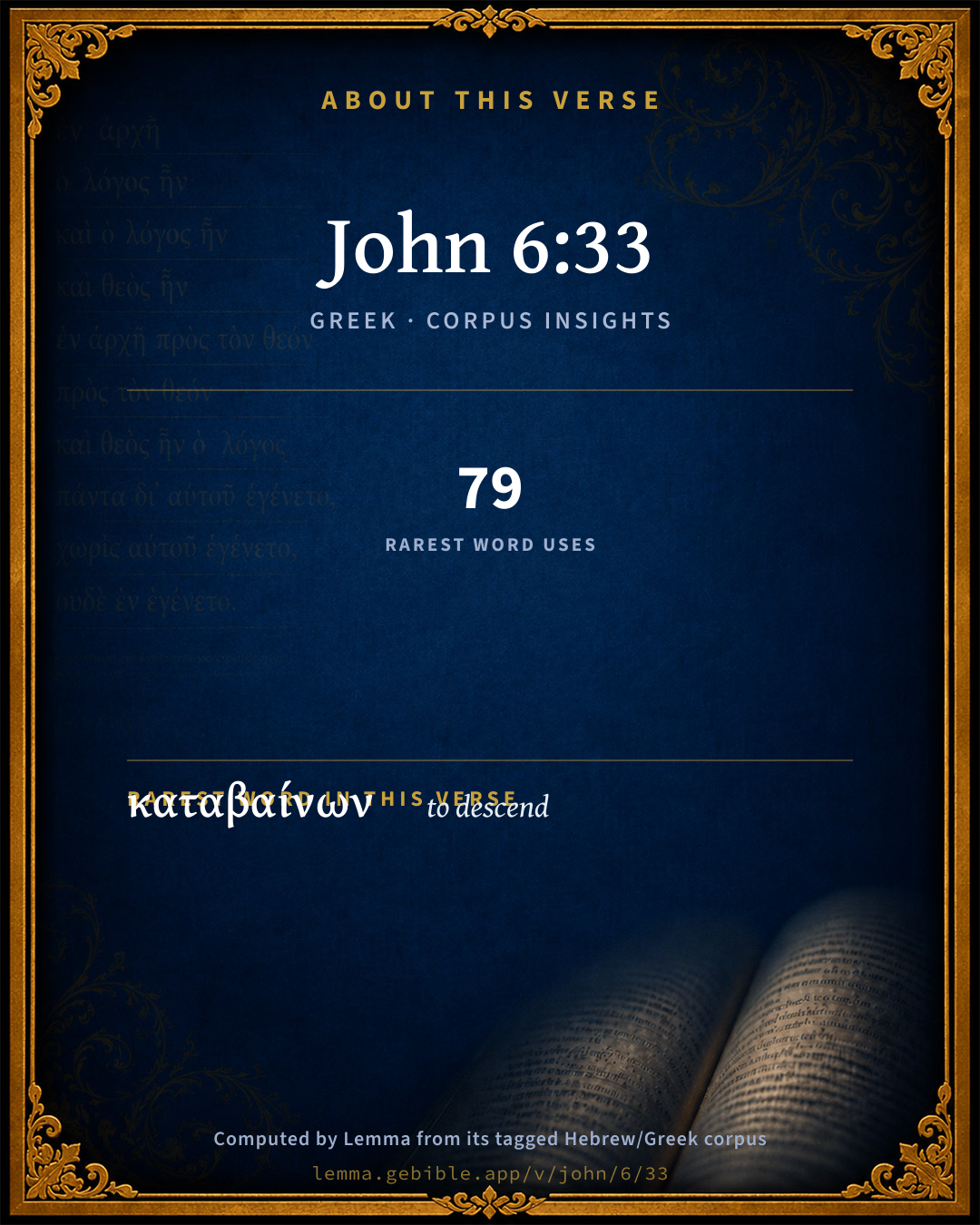
John 6:33

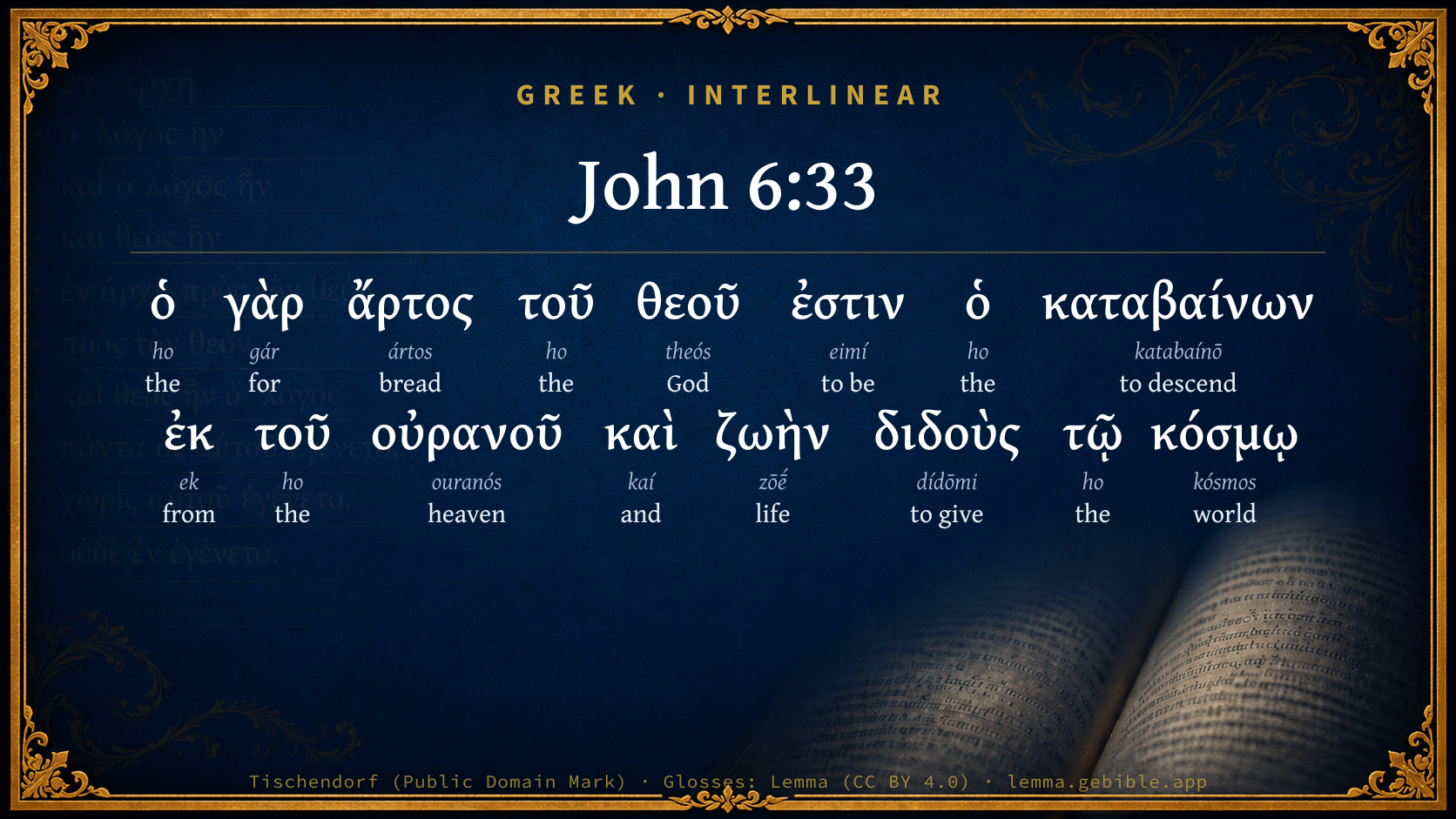
Greek (Tischendorf 8th ed.) John 6:33 appears in the Greek New Testament. The text above is from the Tischendorf 8th edition. Each word links to its Strong’s number and a concise gloss. Click any word for its full Thayer’s Greek Lexicon entry.
Download image
Cite this verse

John 6:33 (World English Bible). Public Domain. Lemma interlinear Bible study tool, https://lemma.gebible.app/v/john/6/33.

Show BibTeX & RIS
BibTeX
RIS
English Translation
For the bread of God is that which comes down out of heaven, and gives life to the world."
World English Bible · Public Domain
Download a study sheet

One document with this verse’s original text, its word-by-word gloss line, the meaning frame, cross-references with their text, attributed commentary, and full source and license credits — printable, and it pastes into notes with its structure intact.

This verse Autodidact and up

Study sheet (.html) Plain text (.txt)

A passage Seminary Student

Up to 50 verses in one chapter. A passage sheet keeps up to 6 commentary sources and 12 cross-references per verse, in the order this page ranks them, and says so on the sheet whenever that leaves anything out. Ask for a single verse and you get the Autodidact verse sheet above.

Everything on this page stays free to read, with no account — the sheet is a download of what is already on screen, not access to it.

Want to remove ads? Support Godless Engineer
Compare translations 3

The same verse in 3 English versions, stacked beneath the original-language interlinear above. Click any original word for its lexicon entry.

Each is an independent rendering of the whole verse — the interlinear is not word-aligned to these translations.

Highlighted words mark where these versions differ — a whole-verse word diff, not a word-by-word alignment.

  • World English Bible Public Domain
    For the bread of God is that which comes down out of heaven, and gives life to the world."
  • King James Version Public Domain
    For the bread of God is he which cometh down from heaven, and giveth life unto the world.
  • unfoldingWord Literal Text CC BY-SA 4.0
    For the bread of God is the one coming down from heaven and giving life to the world.”

unfoldingWord Literal Text — © unfoldingWord, licensed CC BY-SA 4.0. Word-aligned USFM3 via Door43 (git.door43.org/unfoldingWord/en_ult).

Versions to compare (up to 4)

3 of 4 selected

Show all 19 translations

Every available English version of this verse, each an independent rendering of the whole verse.

  • World English Bible Public Domain
    For the bread of God is that which comes down out of heaven, and gives life to the world."
  • Berean Standard Bible Public Domain
    For the bread of God is He who comes down from heaven and gives life to the world.”
  • Majority Standard Bible Public Domain
    For the bread of God is He who comes down from heaven and gives life to the world.”
  • King James Version Public Domain
    For the bread of God is he which cometh down from heaven, and giveth life unto the world.
  • American Standard Version (1901) Public Domain
    For the bread of God is that which cometh down out of heaven, and giveth life unto the world.
  • Revised Version (1885) Public Domain
    For the bread of God is that which cometh down out of heaven, and giveth life unto the world.
  • Geneva Bible (1599) Public Domain
    For the breade of God is hee which commeth downe from heauen, and giueth life vnto the world.
  • Douay-Rheims (1899) Public Domain
    For the bread of God is that which cometh down from heaven, and giveth life to the world.
  • Young's Literal Translation Public Domain
    for the bread of God is that which is coming down out of the heaven, and giving life to the world.'
  • Literal Standard Version CC BY-SA 4.0
    for the bread of God is Him coming down out of Heaven, and giving life to the world.”
  • Unlocked Literal Bible CC BY-SA 4.0
    For the bread of God is that which comes down from heaven and gives life to the world.”
  • unfoldingWord Literal Text CC BY-SA 4.0
    For the bread of God is the one coming down from heaven and giving life to the world.”
  • Darby Bible Public Domain
    For the bread of God is he who comes down out of heaven and gives life to the world.
  • World Messianic Bible Public Domain
    For the bread of God is that which comes down out of heaven and gives life to the world.”
  • Webster's Bible Public Domain
    For the bread of God is he who cometh down from heaven, and giveth life to the world.
  • Free Bible Version CC BY-SA 4.0
    For the bread of God is the one who comes from heaven and gives life to the world.”
  • Bible in Basic English Public Domain
    The bread of God is the bread which comes down out of heaven and gives life to the world.
  • Text-Critical English NT CC BY 4.0
    For the bread of God is that which comes down from heaven and gives life to the world.”
  • Tyndale New Testament (1534) Public Domain
    For the breed of God is he which cometh doune from heaven and geveth lyfe vnto the worlde.

Literal Standard Version (2020), Covenant Press — licensed CC BY-SA 4.0. Text via the HelloAO Bible API (eBible.org). Unlocked Literal Bible (unfoldingWord) — licensed CC BY-SA 4.0. Text via the HelloAO Bible API (eBible.org). unfoldingWord Literal Text — © unfoldingWord, licensed CC BY-SA 4.0. Word-aligned USFM3 via Door43 (git.door43.org/unfoldingWord/en_ult). Free Bible Version, Dr. Jonathan Gallagher — licensed CC BY-SA 4.0. Text via the HelloAO Bible API (eBible.org).

Word by word

More ways to search: Search by grammar → Find every occurrence → Compare this word →

Practice this passage: Drill this verse → Learn its vocabulary →

καταβαίνων
katabaínō
G2597
“to descend”
Verb, Present, Active, Participle, Nominative, Singular, Masculine
Part of Speech
Verb
Tense
Present
Voice
Active
Mood
Participle
Case
Nominative
Number
Singular
Gender
Masculine
Full Thayer's Definition

Origin: from G2596 and the base of G939

TDNT: 09:42,9

1. to go down, come down, descend a. the place from which one has come down from b. to come down 1. as from the temple at Jerusalem, from the city of Jerusalem 2. of celestial beings coming down to earth c. to be cast down 2. of things a. to come (i.e. be sent) down b. to come (i.e. fall) down 1. from the upper regions of the air 3. metaph. to (go i.e.) be cast down to the lowest state of wretchedness and shame
  1. ὁ ho G3588 “the” Article, Nominative, Singular, Masculine
  2. γὰρ gár G1063 “for” Conjunction
  3. ἄρτος ártos G740 “bread” Noun, Nominative, Singular, Masculine
  4. τοῦ ho G3588 “the” Article, Genitive, Singular, Masculine
  5. θεοῦ theós G2316 “God” Noun, Genitive, Singular, Masculine
  6. ἐστιν eimí G1510 “to be” Verb, Present, Active, Indicative, 3rd person, Singular
  7. ὁ ho G3588 “the” Article, Nominative, Singular, Masculine
  8. ἐκ ek G1537 “from” Preposition
  9. τοῦ ho G3588 “the” Article, Genitive, Singular, Masculine
  10. οὐρανοῦ ouranós G3772 “heaven” Noun, Genitive, Singular, Masculine
  11. καὶ kaí G2532 “and” Conjunction
  12. ζωὴν zōḗ G2222 “life” Noun, Accusative, Singular, Feminine
  13. διδοὺς dídōmi G1325 “to give” Verb, Present, Active, Participle, Nominative, Singular, Masculine
  14. τῷ ho G3588 “the” Article, Dative, Singular, Masculine
  15. κόσμῳ kósmos G2889 “world” Noun, Dative, Singular, Masculine

About this verse

These counts appear in no published source. They are computed here, from the morphology-tagged text and Lemma’s own curated glosses. What Lemma adds →

16
words
12
distinct lemmas
Gospels
section

Repetition

A word recurs within this verse:

Cross-references

10

Topical passages linked to John 6:33 in the Treasury of Scripture Knowledge — connected by theme and wording, ordered by reader-vote popularity; previews shown in the World English Bible.

  • John 8:42 Therefore Jesus said to them, "If God were your Father, you would love me, for I came out and have come from God. For I haven't come of myself, but he sent me.
  • John 17:8 for the words which you have given me I have given to them, and they received them, and knew for sure that I came forth from you, and they have believed that you sent me.
  • John 3:13 No one has ascended into heaven, but he who descended out of heaven, the Son of Man, who is in heaven.
  • John 6:50 This is the bread which comes down out of heaven, that anyone may eat of it and not die.
  • 1 John 1:1–2 That which was from the beginning, that which we have heard, that which we have seen with our eyes, that which we saw, and our hands touched, concerning the Word of life
  • John 6:38 For I have come down from heaven, not to do my own will, but the will of him who sent me.
  • John 6:48 I am the bread of life.
  • John 13:3 Jesus, knowing that the Father had given all things into his hands, and that he came forth from God, and was going to God,
  • John 16:28 I came out from the Father, and have come into the world. Again, I leave the world, and go to the Father."
  • 1 Timothy 1:15 The saying is faithful and worthy of all acceptance, that Christ Jesus came into the world to save sinners; of whom I am chief.

Cross-references courtesy of OpenBible.info (CC BY 4.0).

Commentary

Notes on John 6:33 from classic Christian and Jewish commentators (each source and its license shown beneath its notes). The classic Christian expositions comment on the surrounding passage and are grouped to its opening verse, so a note may address several verses; the Jewish commentaries on the Tanakh (Rashi and others) are per-verse, so they appear only where the commentator wrote on this verse.

Lemma curates 59 commentaries, every one of them public domain or Creative Commons licensed, each selected and text-cleaned for this edition rather than reprinted as found. About our sources →

Bengel's Gnomon

Johann Albrecht Bengel

Joh 6:33. Ὁ καταβαίνων, which cometh down) Repeat, ἄρτος, the bread: comp. Joh 6:41, “I am the bread which came down from heaven,” 58.—τῷ κόσμῳ, unto the world) not merely to one people, or to one age, as the manna fed one people of one age: Joh 6:51, “I am the living bread which came down from heaven. If any man eat of this bread, he shall live for ever: and the bread that I will give is My flesh, which I will give for the life of the world.”

Bengel's Gnomon of the New Testament — English translation (T&T Clark, Edinburgh, 1860) — public domain. Text from a community e-Sword module.

Expositor's Greek Testament

ed. W. Robertson Nicoll

Joh 6:33 . Moses therefore could not give this bread, since it comes down out of heaven. It is characterised by two attributes: (1) it is ὁ καταβαίνων ἐκ τοῦ οὐρανοῦ , that which cometh down out of heaven not, as Godet renders, “He who cometh down from heaven”; at least the request of Joh 6:34 shows that those who heard the words did not take them in this sense; (2) the other characteristic of the bread of God is that it giveth life to the world; a fuller life-giving power than that of the manna is implied; and it is of universal application and not merely to their fathers. Hearing this description of “the bread of God” the crowd exclaim (Joh 6:34 ) Κύριε , πάντοτε δὸς ἡμῖν τὸν ἄρτον τοῦτον , precisely as the woman of Samaria had exclaimed Κύριε δός μοι τοῦτο τὸ ὕδωρ , when Jesus had disclosed to her the properties of the living water. And as in her case the direct request brought the conversation to a crisis, so here it elicits the central declaration of all His exposition of the bearing of the miracle: Ἐγὼ εἰμι ὁ ἄρτος τῆς ζωῆς . [It is not impossible that some of them may have had a glimmering of what He meant and uttered their request with some tincture of spiritual desire; for among the Rabbis there was a saying, “In seculo venturo neque edunt neque bibunt, sed justi sedent cum coronis suis in capitibus et aluntur splendore majestatis divinae”.] “I am the bread of life,” “I am the living bread” (Joh 6:51 , in a somewhat different sense), “I am the bread which came down from heaven” (Joh 6:41 ), or, “the true bread from heaven” all these designations our Lord uses, and that the people may quite understand what is meant, He adds ὁ ἐρχόμενος … πώποτε . The repetition of the required action ὁ ἐρχόμενος , and ὁ πιστεύων , and of the result οὐ μὴ πεινάσῃ , and οὐ μὴ διψήσῃ , is for clearness and emphasis, not for addition to the meaning. The “believing” explains the “coming”; and the “quenching of thirst” more explicitly conveys the meaning of “never hungering,” that all innocent and righteous cravings and aspirations shall be gratified. The “coming” was not that physical approach which they had adopted in pursuing Him to Capernaum, but such a coming as might equally well be called “believing,” a spiritual approach, implying the conviction that He was what He claimed to be, the medium through which God comes to man, and man to God.

The Expositor's Greek Testament, edited by W. Robertson Nicoll (1897–1910) — public domain. Text from a community e-Sword module.

Jamieson, Fausset & Brown

Robert Jamieson, A. R. Fausset & David Brown

For the bread of God is he, &c.--This verse is perhaps best left in its own transparent grandeur--holding up the Bread Itself as divine, spiritual, and eternal; its ordained Fountain and essential Substance, "Him who came down from heaven to give it" (that Eternal Life which was with the Father and was manifested unto us, Jo1 1:2); and its designed objects, "the world."

Jamieson, Fausset & Brown — Commentary Critical and Explanatory on the Whole Bible (1871) — public domain (CC PDM 1.0). Text via the HelloAO Bible API.

John Calvin's Commentaries

33. For the bread of God. Christ reasons negatively from the definition to the thing defined, in this manner: “The heavenly bread is that which hath come down from heaven to give life to the world In the manna there was nothing of this sort; and, therefore, the manna was not the heavenly bread.” But, at the same time, he confirms what he formerly said, namely, that he is sent by the Father, in order that he may feed men in a manner far more excellent than Moses. True, the manna came down from the visible heaven, that is, from the clouds; but not from the eternal kingdom of God, from which life flows to us. And the Jews, whom Christ addresses, looked no higher than that the bellies of their fathers were well stuffed and fattened in the wilderness.

What he formerly called the bread of heaven, he now calls the bread of God; not that the bread which supports us in the present life comes from any other than God, but because that alone can be reckoned the bread of God which quickens souls to a blessed immortality. This passage teaches that the whole world is dead to God, except so far as Christ quickens it, because life will be found nowhere else than in him.

Which hath come down from heaven. In the coming down from heaven two things are worthy of observation; first, that we have a Divine life in Christ, because he has come from God to be the Author of life to us; secondly, that the heavenly life is near us,

so that we do not need to fly above the clouds or to cross the sea, (Deuteronomy 30:12, 13; Romans 10:6-8;)

for the reason why Christ descended to us was, that no man could ascend above.

John Calvin's Commentaries (1540-1563) — public domain. Text from the Calvin Translation Society English edition (1840s-50s) via the Christian Classics Ethereal Library (ccel.org). Calvin's coverage is partial (roughly two-thirds of the Bible); uncommented books and verses are honest gaps, never fabricated. The 19th-century editor's footnotes and remarks are omitted so the notes are faithfully Calvin's own voice.

Ellicott's Commentary for English Readers

(33) He which.—Better, that which. The identification with Himself does not occur before Joh_6:35. This verse is a fuller expression of the last clause of Joh_6:32, to which each term answers.

“My Father giveth” . . . . . “the bread of God.”

“The (ideally) true bread” . . . . . “giveth life unto the world.”

“From heaven” . . . . . “which cometh down from heaven.”

The tenses are present. (Comp. Notes on Joh_6:50-51.) The manna in the wilderness was but one instance of that which is constant. The Jewish nation was but an unit in the Father’s family. The bread of God ever cometh and ever giveth life, and the life which it giveth is for the world. Every word proceeding from the mouth of God, spoken in many portions and in many ways, was part of the true food for the true life of man.

A Bible Commentary for English Readers, edited by Charles John Ellicott (1878–1897) — public domain. Text from a community e-Sword module.

The Cambridge Bible for Schools and Colleges

gen. ed. J. J. S. Perowne

33. the bread of God is he which] Better, the bread of God is that which. Christ has not yet identified Himself with the Bread; it is still impersonal, and hence the present participle in the Greek. Contrast Joh_6:41. There is a clear reference to this passage in the Ignatian Epistles, Romans VII. The whole chapter is impregnated with the Fourth Gospel. See on Joh_4:10.

giveth life unto the world] Without this Bread mankind is spiritually dead; and this is the point of the argument (the introductory ‘for’ shews that the verse is argumentative): we have proof that it is the Father who gives the really heavenly Bread, for it is His Bread that quickens the whole human race.

The Cambridge Bible for Schools and Colleges (gen. ed. J. J. S. Perowne; Cambridge University Press, 1878–1918) — public domain. Text from a community e-Sword module.

John Gill's Exposition

Then said they unto him,.... At least some of them:

Lord, evermore give us this bread; that is so divine and heavenly, and has such a quickening virtue in it: these words are said by them either seriously, and to be understood of bread for their bodies, of which they imagined Christ was speaking; and so sprung from ignorance of his sense; and from sensuality in them who followed him for the loaves; and from a covetous disposition, being desirous of being supplied with such excellent food without charge; and from idleness, to save labour and pains in working for it; and from a vain desire of the continuance of this earthly life, being willing to live for ever, and therefore would have this bread evermore; and from a gross opinion of plenty and delicacy of corporeal food in the times of the Messiah; See Gill on Luk 14:15; or else these words are spoken ironically, by way of derision, as if there was no such bread; and if there was, that Christ could not give it. However, the words may be improved, when considered as a petition coming from, and suitable to, a sensible and enlightened soul: for such who are sensible of their famishing condition by nature, and of their need of Christ, the bread of life, and whose taste is changed, and have tasted how good this bread is, will earnestly desire always to be supplied with it, and to live upon it; for nothing is more grateful to them, and more nourishing and satisfying to their souls; they are never weary of it; it is always new and delightful to them, and they always stand in need of it, and wait in the use of means and ordinances for it; and this has always an abiding, lasting, virtue in it, to feed their souls, and nourish them up to everlasting life. Josephus (i) says of the "manna", which was a type of this bread, that there was such a divine quality in it, that whoever tasted of it needed nothing else: and the Jews also say (k), that

"in the manna were all kinds of tastes, and everyone of the Israelites tasted all that he desired; for so it is written in Deu 2:7, "these forty years the Lord thy God hath been with thee, thou hast lacked nothing", or "not wanted anything"; what is anything? when he desired to eat anything, and said with his mouth, O that I had fat to eat, immediately there was in his mouth the taste of fat.--Young men tasted the taste of bread, old men the taste of honey, and children the taste of oil.''

Yea, they say (l),

"whoever desired flesh, he tasted it, and whoever desired fish, he tasted it, and whoever desired fowl, chicken, pheasant, or pea hen, so he tasted whatever he desired.''

And to this agrees what is said in the apocryphal book of Wisdom, 16:20,21:

"Thou feddest thine own people with angels' food, and didst send them from heaven bread, prepared without their labour, able to content every man's delight, and agreeing to every taste; for thy sustenance (or manna) declared thy sweetness unto thy children, and serving to the appetite of the eater, tempered itself to every man's liking.''

All which must be understood of that pleasure, satisfaction, and contentment which they had in it; for it was a very uncommon case to eat it, and live upon it as their common food for forty years together: and no doubt but that there was something remarkable in suiting it to their appetites, or giving them appetites suitable to that, to feed upon it, and relish it for so long a time: twice indeed in that length of time we read they complained of it, saying, that they had nothing but this manna before their eyes, and their souls loathed it as light bread, Num 11:6, and lusted after the flesh, and the fish they had eaten in Egypt. And so it is with some professors of Christ, and his Gospel; for there is a mixed multitude among them, as there was among the Israelites, who disrelish the preaching of Christ, and the truths of the Gospel respecting his person, blood, and righteousness, and salvation by him; they cannot bear to have these things frequently inculcated and insisted upon; their souls are ready to loath them as light bread, and want to have something else set before them, more suitable to their carnal appetites: but to such who are true believers in Christ, who have tasted that the Lord is gracious, Christ, the true manna, and bread of God, is all things to them; nor do they desire any other: they taste everything that is delightful, and find everything that is nourishing in him.

(i) Antiqu. l. 3. c. 1. sect. 6. (k) Shemot Rabba, sect. 25. fol. 108. 4. (l) Bemidbar Rabba, sect. 7. fol. 188. 1.

John Gill's Exposition of the Whole Bible (1746–1763) — public domain (CC PDM 1.0). Text via the HelloAO Bible API.

Trapp's Complete Commentary

John Trapp

33 For the bread of God is he which cometh down from heaven, and giveth life unto the world.

Ver. 33. Which came down from heaven] From the highest heaven (not out of the middle region of the air only, as manna), and is the true ambrosia.

John Trapp, A Commentary or Exposition upon All the Books of the Old and New Testament (1647–1656) — public domain. Text from a community e-Sword module.

Albert Barnes' Notes on the Bible

The bread of God - The means of support which God furnishes. That which, in his view, is needful for man.

Is he ... - Is the Messiah who has come from heaven.

And giveth life ... - See the notes at Joh 1:4.

Albert Barnes' Notes on the Bible (1834–1885) — public domain. Text from a community e-Sword/MySword module.

Haydock's Catholic Bible Commentary

A life of immortality and eternal happiness to all who worthily receive it.

George Leo Haydock (1774–1849), Haydock's Catholic Family Bible and Commentary, 1859 edition — public domain. Excludes Psalms (Douay-Rheims chapter numbering differs from Protestant) and Deuterocanonical books (Catholic canon only).

Matthew Poole's English Annotations

Moses gave you spiritual, heavenly bread; but that was only spiritual as it was typical and prefigured me; heavenly, as it came from the lower heavens, was mined down from thence, not made upon the earth by the art of man; and was therefore called the bread of angels; but I am the true bread of God, signified by that type, who came not down from the lower, but from the highest heavens; and who do not only maintain and uphold life in men, (as that did), but give life to men; and that not a mere natural life, but a spiritual and eternal life; and that not to the Jews only, for whose use alone manna was, but to the world.

Matthew Poole's English Annotations on the Holy Bible (1683–1685) — public domain. Text from a community e-Sword/MySword module.

Whedon's Commentary on the Bible

Daniel D. Whedon

33. Is he—The modest third person for himself. He comes in the full power of the first person in his next response. Joh_6:35. And in these two verses the Lord uses restrained language; terms which could be applied to either the physical heaven-descended manna sustaining temporal life, or the true bread of eternal life.

Daniel D. Whedon (gen. ed.), Commentary on the Old and New Testaments (1874–1909) — public domain. Text from a community e-Sword module.

The Pulpit Commentary

For the bread of God is that which cometh down out of heaven, and giveth life to the world. It is debated whether the o katabainwn is "he who cometh down," or "that (bread) which cometh," etc. whether in this verse the Lord passes at once to the identification of himself with the bread, or for a moment longer is delaying the announcement, and broadly asserting the qualities of that "bread of God," viz. that whoever and whatever it is, IT comes from heaven, and gives life, not merely to the theocratic people, but to the whole world. (The latter is the view of Hengstenberg, Lange, Meyer, Westcott, Moulton; the former translation is partially urged by Godet, who thinks our Lord here spoke amphibologically, meaning both ideas, but by the form of the expression reserving the solution of the problem.) It certainly does not follow that, if he was speaking of himself, the expression o katabav would have been used, because, in ver. 50, after he has removed all ambiguity, he still uses the present tense, o katabainwn . The present tense is that of quality rather than of time. These characteristics of the veritable bread of God must hold good. It must have a heavenly origin, life-giving power, and universality of application to human need. Joh_3:16 is here repeated. The whole world is the object of the Divine grace and love. The bread of God must be a Divine gift, mysterious and heavenly in its origin, and must at once demonstrate its vitality, its Source, and its Giver.

The Pulpit Commentary (1880–1919), ed. H.D.M. Spence-Jones & Joseph S. Exell — public domain. Text from a community e-Sword module.

John Wesley's Explanatory Notes

He that - giveth life to the world - Not (like the manna) to one people only: and that from generation to generation. Our Lord does not yet say, I am that bread; else the Jews would not have given him so respectful an answer, ver. 34.

John Wesley, Explanatory Notes Upon the Whole Bible (1754–1765) — public domain. Text via the GEBible commentary corpus.

Scofield Reference Notes

C. I. Scofield

world

kosmos = mankind. (See Scofield "Mat 4:8").

The Scofield Reference Bible (1917 edition), notes by C. I. Scofield — public domain. Text from a community e-Sword module.

The People's New Testament

B. W. Johnson

33. The bread of God is he which cometh down from heaven. He here defines the marks of the true bread: (1) It comes from heaven; (2) It bestows life upon the soul and sustains it; (3) It is for the world, not for a single race.

B. W. Johnson's The People's New Testament with Notes (1889–1891) — public domain. Electronic text from the Christian Classics Ethereal Library (CCEL) ThML edition.

Cambridge Greek Testament for Schools and Colleges

33. ὁ καταβαίνων. That which cometh down. Jesus has not yet identified Himself with the Bread, which is still impersonal, and hence the present participle: contrast Joh 6:41. There is a clear reference to this passage in the Ignatian Epistles, Romans 7; the whole chapter is impregnated with the Fourth Gospel. see on Joh 4:10, Joh 3:8, Joh 10:9.

τῷ κόσμῳ. See on Joh 1:10. Not to the Jews only, but to all. We have evidence (the γάρ introduces an argument) that it is the Father who gives the really heavenly Bread, for it is His Bread that quickens the whole human race.

Cambridge Greek Testament for Schools and Colleges (Cambridge University Press, 1896; 21 vols, various authors incl. Carr, Maclear, Plummer, Farrar, Lumby, Moule, M. R. James, Simcox) — public domain. Text from a community e-Sword module.

Alford’s Greek Testament

Henry Alford

33.] ὁ ἄρτος τοῦ θεοῦ = ὁ ἄρτος ὃν δίδωσιν ὁ πατήρ μου. The words ὁ καταβ … are the predicate of ὁ ἄρτος, and do not apply, in the construction of this verse, to Christ personally, however truly they apply to Him in fact. The E. V. is here wrong: it should be, The bread of God is that (not He) which cometh, &c. Not till ver. 35 does Jesus first say, ‘I am the bread of life.’ The manna is still kept in view—ὅταν κατέβη ἡ δρόσος … κατέβαινεν τὸ μάννα ἐπʼ αὐτῆς, Num 11:9. And the present participle, here used in reference to the manna, is dropped when the Lord Himself is spoken of: see vv. 38, 41, 58, and especially the distinction between ver. 50 and ver. 51 (so Lücke, De Wette, Stier, Bengel).

Henry Alford, The Greek Testament (1849–1861) — public domain. Text from a community e-Sword module.

International Critical Commentary

33. ὁ γὰρ ἄρτος τοῦ θεοῦ.1 All bread is the gift of God (Mat 6:11), but the Bread which can be described as peculiarly ὁ ἄρτος τοῦ θεοῦ is not only such as “comes down from heaven,” for that was said of the manna (κατέβαινεν, Num 11:9), but such as coming down imparts life and not merely bodily nourishment. Chrysostom notes that the manna supplied τροφή but not ζωή. But the first characteristic of the Bread of God is that it brings life (see on v. 27). And the second is that it is offered to all men, and not only to a particular nation; ζωὴν διδούς, “giving life” (in the present tense, that is, continually giving life) τῷ κόσμῳ. See on 1:29 for κόσμος, which is one of the master words of Jn.; and also on v. 51 below. Cf. 1:4.

ὁ ψὰρ ἄρτ. τ. θε. ἐστιν ὁ καταβαίνων ἐκ τοῦ οὐρανοῦ, i.e. “the Bread of God is that which is ever descending [not He who descends] from heaven.” It is not until v. 35 that Jesus says that He is the Bread of Life. This expression, “who came down from heaven,” or “which comes down from heaven,” is repeated seven times in this discourse (vv. 33, 38, 41, 42, 50, 51, 58), recurring like a solemn refrain. It was afterwards incorporated in the Nicene Creed. See on 3:13 above.

International Critical Commentary — older volumes (1896–1929), various authors — public domain. Text from a community e-Sword module.

Vincent's Word Studies in the New Testament

Marvin R. Vincent

He which cometh down [ο καταβαινων] . So it may be rendered; but also that which, referring to artov, bread : and so, better, as Rev., since Jesus does not identify Himself with the bread until ver. 35.

Marvin R. Vincent, Word Studies in the New Testament (1887–1900) — public domain. Text from a community e-Sword/MySword module.

Godet's Commentaries

Frédéric Louis Godet

Vv. 33 applies this idea of true bread from heaven, to Jesus, but for the moment in obscure words. The difficulty of this verse is that the words descending from heaven, which are the paraphrase of the term bread from heaven, should be logically joined to the subject which is to be defined, and not to the attribute which contains the definition. It seems that it should be: “For the true bread from heaven is that which descends from God, from God Himself.” I formerly tried to resolve this difficulty by applying the participle ὁ καταβαίνων, the descending, not to the bread, but to Jesus himself: “He who descends.” Meyer and Weiss object that in that case ὁ καταβάς, “He who descended,” would be necessary. Joh 6:50 answers this objection.

Nevertheless, I acknowledge that the ellipsis of ὁ ἄρτος (the bread) is more natural, although the idea of descending applies more easily to a person than to a thing (comp. Joh 6:38). Weiss himself has recourse to a very far-fetched explanation: it is to make ὁ ἄρτος τοῦ θεοῦ, the bread of God, the predicate of the two following participles: “The bread which descends from heaven and gives life to the world, is that which is the true bread of God.” What seems more simple is to understand with Keil: “For the bread which God Himself gives (Joh 6:32) is the only bread which truly descends from heaven and can give life.” Jesus thus opposes the true heaven, that is, the glorious life of God, to the local heaven from which, according to the opinion of His hearers, the manna descended. The expression τῷ κόσμῳ, to the world, is opposed to the theocratic particularism which boasted itself especially in the great national miracle—that of the manna. The greatness of the heavenly gift, as Jesus presents it here, no longer allows a national and particular destination. In proportion as Jesus sees the people refusing to follow Him in the spiritual sphere into which He wished to elevate them, He is led to turn his eyes towards mankind for whom He has come. The fourth part of the conversation (Joh 6:34-40) reveals completely the rupture which has just taken place between the thought of the people and that of Jesus.

Frédéric Louis Godet — Commentaries on Luke, John, Romans, and 1 Corinthians — English translation (T&T Clark, Edinburgh, 1870s–1890s) — public domain. Text from a community e-Sword module.

Lesson kit

Teaching starters — assembled from the data on this page, not authored interpretation. Every prompt links to the verse data it draws on. Edit before teaching.

John, in the Gospels, opens this verse with 16 words (12 distinct Greek lemmas). Its most distinctive word is katabaínō (“to descend”). A historical commentator’s framing appears above. Read the whole chapter for the surrounding context.

Discussion questions

  1. What does “to descend” (katabaínō) contribute to the verse as a whole?
  2. How does John 8:42, which shares this passage’s theme, read alongside this verse?
  3. What does the repetition of “the” (5× in this one verse) do in this verse?
  4. The translations on this page render this verse differently — a whole-verse word diff, not a word-by-word alignment. What might account for the different wordings?
  5. Compare how Bengel's Gnomon and Expositor's Greek Testament read this verse. Where do they agree or differ?

Things to notice

Reading settings

Reading text

Shown beneath each verse's original-language words.

Old Testament
Old Testament edition

Read the OT as the Masoretic Hebrew (MT) or the Greek Septuagint (LXX).

English shown for the Greek Septuagint (in the Hebrew ↔ Greek comparison).

Comparing translations? Open the Compare panel on any verse page to stack up to four side by side.