Matthew 3:17

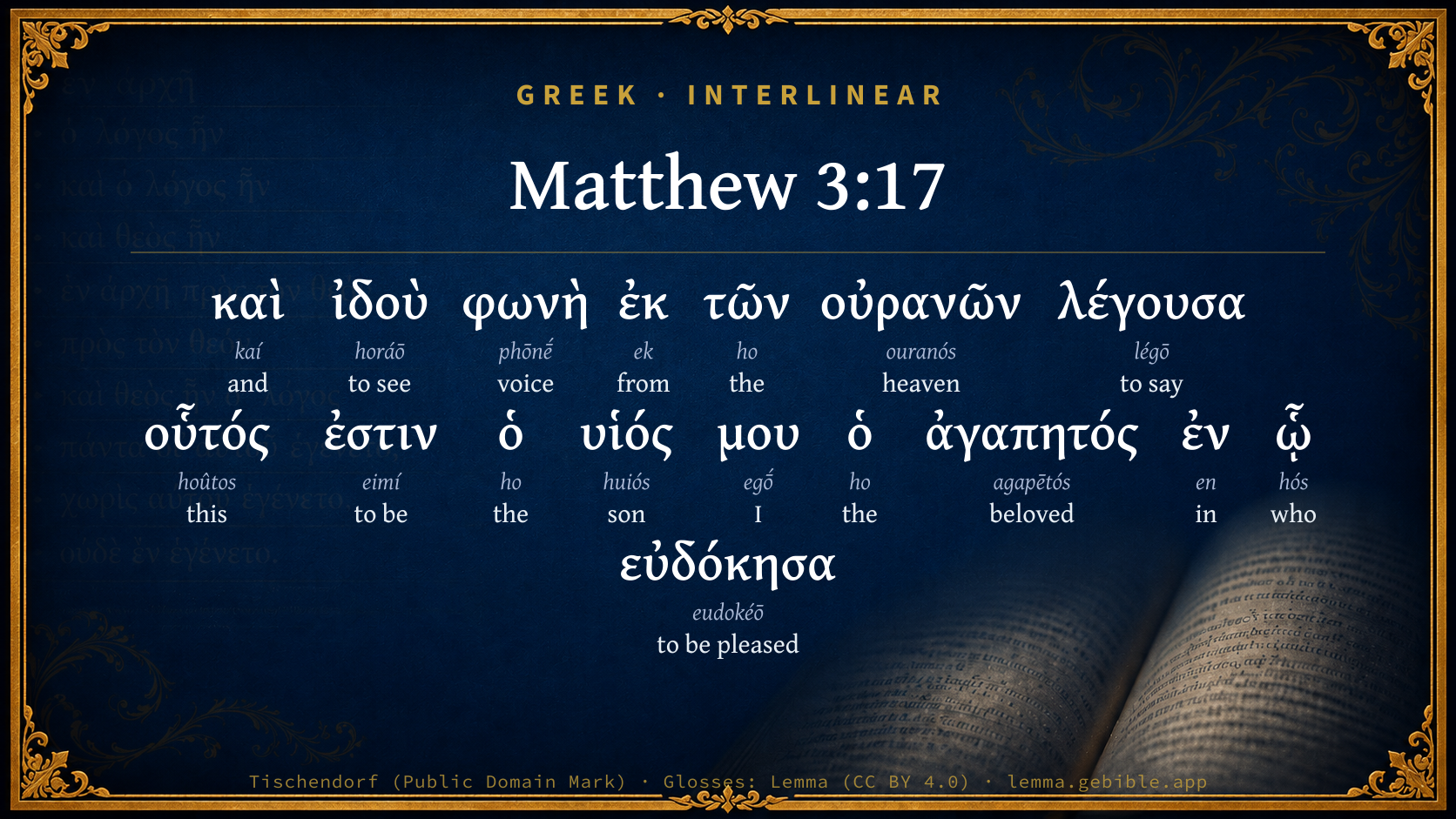
Greek (Tischendorf 8th ed.) Matthew 3:17 appears in the Greek New Testament. The text above is from the Tischendorf 8th edition. Each word links to its Strong’s number and a concise gloss. Click any word for its full Thayer’s Greek Lexicon entry.
Download image
Cite this verse

Matthew 3:17 (World English Bible). Public Domain. Lemma interlinear Bible study tool, https://lemma.gebible.app/v/matthew/3/17.

Show BibTeX & RIS
BibTeX
RIS
English Translation
Behold, a voice out of the heavens said, "This is my beloved Son, with whom I am well pleased."
World English Bible · Public Domain
Highlights
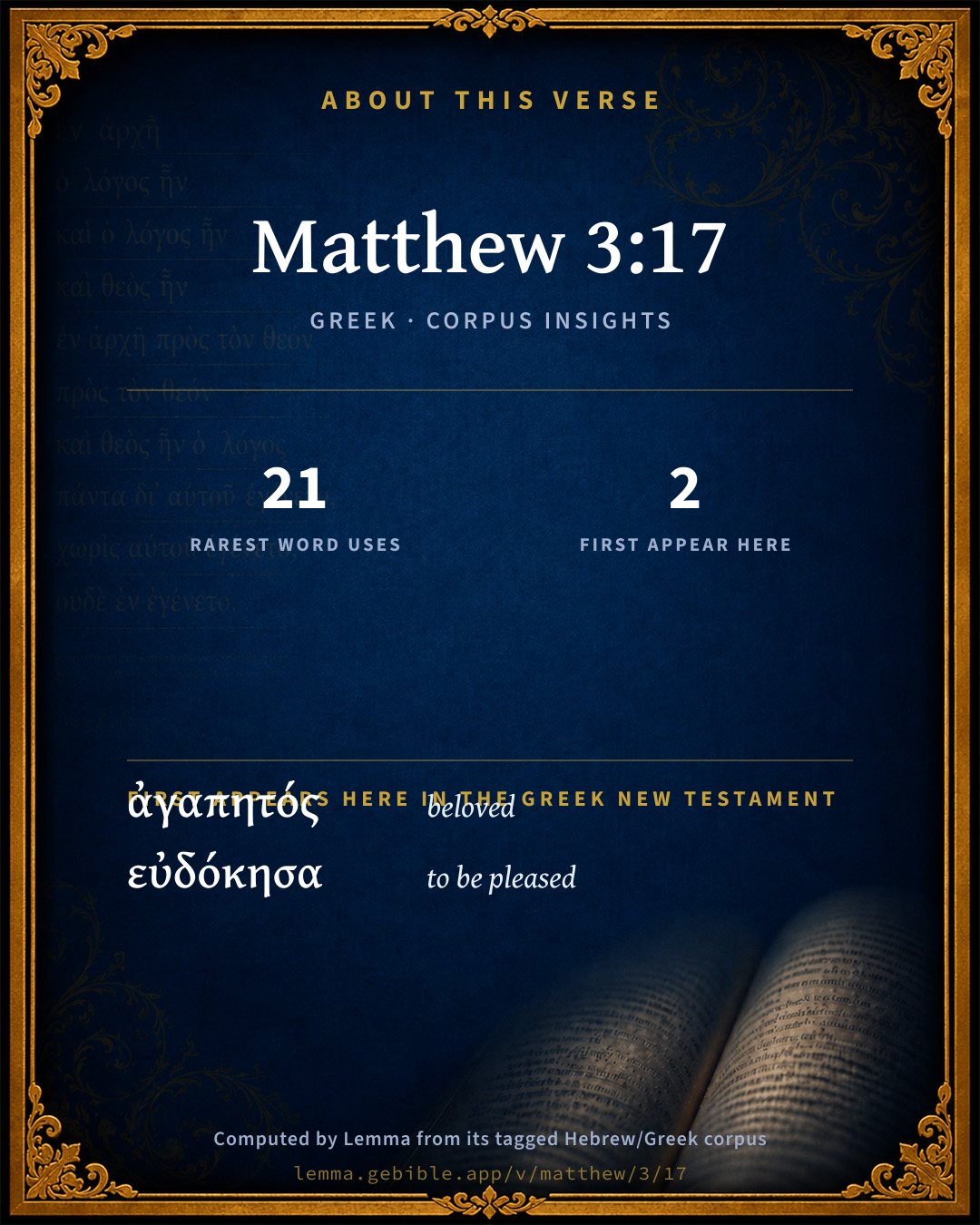
  • 2 first appearances in the Greek New Testament
Full analysis ↓
Download a study sheet

One document with this verse’s original text, its word-by-word gloss line, the meaning frame, cross-references with their text, attributed commentary, and full source and license credits — printable, and it pastes into notes with its structure intact.

This verse Autodidact and up

Study sheet (.html) Plain text (.txt)

A passage Seminary Student

Up to 50 verses in one chapter. A passage sheet keeps up to 6 commentary sources and 12 cross-references per verse, in the order this page ranks them, and says so on the sheet whenever that leaves anything out. Ask for a single verse and you get the Autodidact verse sheet above.

Everything on this page stays free to read, with no account — the sheet is a download of what is already on screen, not access to it.

Want to remove ads? Support Godless Engineer
Compare translations 3

The same verse in 3 English versions, stacked beneath the original-language interlinear above. Click any original word for its lexicon entry.

Each is an independent rendering of the whole verse — the interlinear is not word-aligned to these translations.

Highlighted words mark where these versions differ — a whole-verse word diff, not a word-by-word alignment.

  • World English Bible Public Domain
    Behold, a voice out of the heavens said, "This is my beloved Son, with whom I am well pleased."
  • King James Version Public Domain
    And lo a voice from heaven, saying, This is my beloved Son, in whom I am well pleased.
  • unfoldingWord Literal Text CC BY-SA 4.0
    and behold, a voice from the heavens, saying, “This is my beloved Son with whom I am well pleased.”

unfoldingWord Literal Text — © unfoldingWord, licensed CC BY-SA 4.0. Word-aligned USFM3 via Door43 (git.door43.org/unfoldingWord/en_ult).

Versions to compare (up to 4)

3 of 4 selected

Show all 19 translations

Every available English version of this verse, each an independent rendering of the whole verse.

  • World English Bible Public Domain
    Behold, a voice out of the heavens said, "This is my beloved Son, with whom I am well pleased."
  • Berean Standard Bible Public Domain
    And a voice from heaven said, “This is My beloved Son, in whom I am well pleased!”
  • Majority Standard Bible Public Domain
    And a voice from heaven said, “This is My beloved Son, in whom I am well pleased!”
  • King James Version Public Domain
    And lo a voice from heaven, saying, This is my beloved Son, in whom I am well pleased.
  • American Standard Version (1901) Public Domain
    and lo, a voice out of the heavens, saying, This is my beloved Son, in whom I am well pleased.
  • Revised Version (1885) Public Domain
    and lo, a voice out of the heavens, saying, This is my beloved Son, in whom I am well pleased.
  • Geneva Bible (1599) Public Domain
    And loe, a voyce came from heauen, saying, This is my beloued Sonne, in whome I am well pleased.
  • Douay-Rheims (1899) Public Domain
    And behold a voice from heaven, saying: This is my beloved Son, in whom I am well pleased.
  • Young's Literal Translation Public Domain
    and lo, a voice out of the heavens, saying, `This is My Son -- the Beloved, in whom I did delight.'
  • Literal Standard Version CC BY-SA 4.0
    and behold, a voice out of the heavens, saying, “This is My Son, the Beloved, in whom I delighted.”
  • Unlocked Literal Bible CC BY-SA 4.0
    Behold, a voice came out of the heavens saying, “This is my beloved Son. I am very pleased with him.”
  • unfoldingWord Literal Text CC BY-SA 4.0
    and behold, a voice from the heavens, saying, “This is my beloved Son with whom I am well pleased.”
  • Darby Bible Public Domain
    and behold, a voice out of the heavens saying, This is my beloved Son, in whom I have found my delight.
  • World Messianic Bible Public Domain
    Behold, a voice out of the heavens said, “This is my beloved Son, with whom I am well pleased.”
  • Webster's Bible Public Domain
    And lo, a voice from heaven, saying, This is my beloved Son, in whom I am well pleased.
  • Free Bible Version CC BY-SA 4.0
    A voice from heaven said, “This is my son whom I love, who pleases me.”
  • Bible in Basic English Public Domain
    And a voice came out of heaven, saying, This is my dearly loved Son, with whom I am well pleased.
  • Text-Critical English NT CC BY 4.0
    And behold, a voice from heaven said, “This is my beloved Son, in whom I am well pleased.”
  • Tyndale New Testament (1534) Public Domain
    And lo there came a voyce from heven sayng: Thys ys that my beloved sonne in whom is my delyte.

Literal Standard Version (2020), Covenant Press — licensed CC BY-SA 4.0. Text via the HelloAO Bible API (eBible.org). Unlocked Literal Bible (unfoldingWord) — licensed CC BY-SA 4.0. Text via the HelloAO Bible API (eBible.org). unfoldingWord Literal Text — © unfoldingWord, licensed CC BY-SA 4.0. Word-aligned USFM3 via Door43 (git.door43.org/unfoldingWord/en_ult). Free Bible Version, Dr. Jonathan Gallagher — licensed CC BY-SA 4.0. Text via the HelloAO Bible API (eBible.org).

Word by word

More ways to search: Search by grammar → Find every occurrence → Compare this word →

Practice this passage: Drill this verse → Learn its vocabulary →

εὐδόκησα
eudokéō
G2106
“to be pleased”
Verb, Aorist, Active, Indicative, 1st person, Singular
Part of Speech
Verb
Tense
Aorist
Voice
Active
Mood
Indicative
Person
1st person
Number
Singular
Full Thayer's Definition

Origin: from G2095 and G1380

TDNT: 14:18,3

1. it seems good to one, is one's good pleasure a. think it good, choose, determine, decide b. to do willingly c. to be ready to, to prefer, choose rather 2. to be well pleased with, take pleasure in, to be favourably inclined towards one
  1. καὶ kaí G2532 “and” Conjunction
  2. ἰδοὺ horáō G3708 “to see” Verb, Aorist, Middle, Imperative, 2nd person, Singular
  3. φωνὴ phōnḗ G5456 “voice” Noun, Nominative, Singular, Feminine
  4. ἐκ ek G1537 “from” Preposition
  5. τῶν ho G3588 “the” Article, Genitive, Plural, Masculine
  6. οὐρανῶν ouranós G3772 “heaven” Noun, Genitive, Plural, Masculine
  7. λέγουσα légō G3004 “to say” Verb, Present, Active, Participle, Nominative, Singular, Feminine
  8. οὗτός hoûtos G3778 “this” Demonstrative pronoun, Nominative, Singular, Masculine
  9. ἐστιν eimí G1510 “to be” Verb, Present, Active, Indicative, 3rd person, Singular
  10. ὁ ho G3588 “the” Article, Nominative, Singular, Masculine
  11. υἱός huiós G5207 “son” Noun, Nominative, Singular, Masculine
  12. μου egṓ G1473 “I” Personal pronoun, 1st person, Genitive, Singular
  13. ὁ ho G3588 “the” Article, Nominative, Singular, Masculine
  14. ἀγαπητός agapētós G27 “beloved” Adjective, Nominative, Singular, Masculine
  15. ἐν en G1722 “in” Preposition
  16. ᾧ hós G3739 “who” Relative pronoun, Dative, Singular, Masculine

About this verse

These counts appear in no published source. They are computed here, from the morphology-tagged text and Lemma’s own curated glosses. What Lemma adds →

17
words
15
distinct lemmas
Gospels
section

Notable vocabulary

The rarest word here is εὐδόκησα to be pleased G2106 — appearing just 21 times in the whole Greek New Testament.

First appearance in Scripture

These words make their first canonical appearance in the Greek New Testament here:

  • ἀγαπητός beloved G27
  • εὐδόκησα to be pleased G2106

Shared distinctive vocabulary

εὐδόκησα to be pleased G2106 occurs in 21 verses of the Greek New Testament. Also found in:

Repetition

A word recurs within this verse:

Cross-references

14

Topical passages linked to Matthew 3:17 in the Treasury of Scripture Knowledge — connected by theme and wording, ordered by reader-vote popularity; previews shown in the World English Bible.

  • Isaiah 42:1 Behold, my servant, whom I uphold; my chosen, in whom my soul delights: I have put my Spirit on him; he will bring forth justice to the Gentiles.
  • Matthew 17:5 While he was still speaking, behold, a bright cloud overshadowed them. Behold, a voice came out of the cloud, saying, "This is my beloved Son, in whom I am well pleased. Listen to him."
  • Psalms 2:7 I will tell of the decree. Yahweh said to me, "You are my son. Today I have become your father.
  • Luke 9:35 A voice came out of the cloud, saying, "This is my beloved Son. Listen to him!"
  • Matthew 12:18 "Behold, my servant whom I have chosen; My beloved in whom my soul is well pleased: I will put my Spirit on him. He will proclaim justice to the Gentiles.
  • Mark 9:7 A cloud came, overshadowing them, and a voice came out of the cloud, "This is my beloved Son. Listen to him."
  • 2 Peter 1:17 For he received from God the Father honor and glory, when the voice came to him from the Majestic Glory, "This is my beloved Son, in whom I am well pleased."
  • Mark 1:11 A voice came out of the sky, "You are my beloved Son, in whom I am well pleased."
  • Luke 3:22 and the Holy Spirit descended in a bodily form as a dove on him; and a voice came out of the sky, saying "You are my beloved Son. In you I am well pleased."
  • John 12:28–30 Father, glorify your name!" Then there came a voice out of the sky, saying, "I have both glorified it, and will glorify it again."
  • Colossians 1:13 who delivered us out of the power of darkness, and translated us into the Kingdom of the Son of his love;
  • Ephesians 1:6 to the praise of the glory of his grace, by which he freely bestowed favor on us in the Beloved,
  • Isaiah 42:21 It pleased Yahweh, for his righteousness' sake, to magnify the law, and make it honorable.
  • John 5:37 The Father himself, who sent me, has testified about me. You have neither heard his voice at any time, nor seen his form.

Cross-references courtesy of OpenBible.info (CC BY 4.0).

Commentary

Notes on Matthew 3:17 from classic Christian and Jewish commentators (each source and its license shown beneath its notes). The classic Christian expositions comment on the surrounding passage and are grouped to its opening verse, so a note may address several verses; the Jewish commentaries on the Tanakh (Rashi and others) are per-verse, so they appear only where the commentator wrote on this verse.

Lemma curates 59 commentaries, every one of them public domain or Creative Commons licensed, each selected and text-cleaned for this edition rather than reprinted as found. About our sources →

Trapp's Complete Commentary

John Trapp

17 And lo a voice from heaven, saying, This is my beloved Son, in whom I am well pleased.

Ver. 17. And, lo, a voice from heaven] Whereupon St Peter foundeth the certainty of Christian faith and doctrine, 2Pe 1:17, especially since we have a more sure word of prophecy; for that former might have been slandered, or suspected for an imposture.

Saying, This is my beloved] My darling, he on whom my love resteth; {a} so that I will seek no further. Zep 3:17. When the earth was founded, Christ was with his Father as his daily delight, sporting or laughing, always before him, risum captans ac consilium, Pro 8:30. Jerome.

In whom I am well pleased] The beloved, in whom he hath made us accepted, Eph 1:6. God’s Hephzibah, so the Church is called, Isa 62:4; the dearly beloved of his soul, Jer 12:7; or, as the Septuagint render it, {b} his beloved soul, over whom he rejoiceth as the bridegroom over his bride, Isa 62:5. Yea, "he will rest in his love," as abundantly well pleased, "he will joy therein with singing," Zep 3:17. So well thinketh God of his Son Christ, and of us through him, as some of the ancients rendered this word, ευδοκησα, In quo bene sensi. So (after Irenaeus) Tertullian, Cyprian, and Augustine interpret it. {c} And yet, as well as he thought of his only Son, he spared him not, but "delivered him up for us all," Rom 8:32, whereupon St Bernard thus cries out, O quantum dilecte, prae quo filius ipse aut non dilectus, aut saltem neglectus? God so loved his Son, that he gave him all the world for his possession, Psa 2:6-8; but he so loved the world, that he gave Son and all for its redemption. One calls this a hyperbole, an excess of love, a miracle of mercy, a sic so, without a sicut. just as, God so loved the loved, so infinitely, so incomparably, so incomprehensibly, as that there is no similitude in nature whereby to express it. Joh 3:16; Eph 3:18-19. Abraham (God’s friend) showed his love to him in not withholding his only son Isaac: but what was Isaac to Christ? or what was Abraham’s love to God’s? He did that freely and voluntarily, that Abraham would never have done but upon a command: besides, Isaac was to be offered up after the manner of holy sacrifices, but Christ suffered after the manner of malefactors. And yet further, Isaac was in the hand of a tender and compassionate father; but Christ died by the wicked hands of barbarous and blood thirsty enemies, that thereby he might slay the enmity and reconcile us to God, Eph 2:15-16; so making peace, {d} and paving us "a new and living way," with his blood, to the throne of grace, "wherein he hath made us accepted in the beloved," Eph 1:6. David saw the features of his friend Jonathan in lame Mephibosheth, and therefore loved him. He forgave Nabal at Abigail’s intercession; and was pacified toward Absalom at Joab’s. Pharaoh favoured Jacob’s house for Joseph’s sake. Shall not God do as much more for Jesus’ sake? Joseph was well pleased with his brethren when they brought Benjamin; bring but the child Jesus in our arms (as Simeon did, and as Themistocles did the king of Persia’s child) and he cannot but smile upon us. Were he never so much displeased before, yet upon the sight of this his well beloved Son, in whom he is well pleased, all shall be calm and quiet, as when Jonah was cast into the sea.

{a} αγαπαν, quasi αγαν παυειν, Αγαπρτος.

{b} εδωκα την ηγαπημενην ψυχην μου. Dedi dilectam animam meam.

{c} ευδοκιμοι Graecis dicuntur celebres, et de quibus magnifica est opinio. Erasm.

{d} ειρηνη απο του εις εν ειρειν.

Mat 4:1-25

John Trapp, A Commentary or Exposition upon All the Books of the Old and New Testament (1647–1656) — public domain. Text from a community e-Sword module.

Joseph Benson's Commentary

Mat 3:17. And lo! — As a further token of the divine regard to Christ, and of the glorious dignity of his person, a voice from heaven, saying, to John, concerning Christ, This is my beloved Son, and to Christ himself, Thou art my beloved Son, Luk 3:22. For it is not improbable that both sentences were pronounced; the voice uttering the words, Thou art my beloved Son, &c. while the Spirit was descending, as if they had been directed to Jesus alone, in answer to his prayer; and, after the Spirit rested on Jesus, the voice, speaking to the Baptist and the multitude, said, This is my beloved Son, &c. St. Luke informs us, that he was praying when this happened, and it is observable that all the voices from heaven, by which the Father bore witness to Christ, were pronounced while he was praying, or quickly after. Luk 9:29; Luk 9:35; Joh 12:28. In whom I am well pleased — Or, in whom I delight, That is, whose character I perfectly approve, and in whom I acquiesce as the great Mediator, through whom will I show myself favourable unto sinful creatures. See Isa 42:1. The original word properly signifies an entire acquiescence, or a special and singular complacency and satisfaction. This the Father took, in the person and undertaking of Christ; and this, through him, he takes in all true believers, who, by faith, are united to him, and made members of his body. And O, how poor, in comparison of this, are all other kinds of praise, yea, and all other pleasures! To have the approbation, and be the delight of God; this is praise, this is pleasure indeed! This is, at once, true glory and true happiness, and is the highest and brightest light that virtue can appear in.

Joseph Benson's Commentary on the Old and New Testaments (1811–1818) — public domain. Text from a community e-Sword module.

Tyndale Open Study Notes

Tyndale Open Resources

3:17 my dearly loved Son (see Ps 2:7): The title “Son of God” reveals and clarifies Jesus’ nature and role (see Matt 4:3, 6; 14:33; 16:16; 17:5; 26:63; 27:54; 28:19). In his unique relationship to the Father, Jesus accomplishes salvation as the trusting and obedient Son. • who brings me great joy: God the Father confirmed his Son’s ministry with language from Isaiah (Isa 42:1) and so prepared Israel for his ministry.

Tyndale Open Study Notes — © Tyndale Open Resources, licensed CC BY-SA 4.0. Text via the HelloAO Bible API.

Bengel's Gnomon

Johann Albrecht Bengel

Mat 3:17. φωνὴ, κ.τ.λ., a voice, etc.) A most open manifestation of God, such as those recorded in Act 2:2-3; Exo 19:4; Exo 19:9; Exo 19:16; Exo 40:34-35; Num 16:31; Num 16:42; 1Ki 8:10-11; 1Ki 18:38.—οὗτός ἐστιν, This is) St Mark and St Luke record that it was said, Σὺ εἶ,” “Thou art.” St Matthew has expressed the meaning. The words, οὗτός—εὐδόκησα,” occur again in Mat 17:5. Faith assents, declaring, “Thou art the Son of God,” as in Mat 16:16.—ὁ, the) The article introduced twice has great emphasis.—Υἱὸς, Son) See Joh 1:18; Joh 3:16—ἀγαπητὸς, beloved) This might appear to be a proper name (cf. ch. Mat 12:18), so as to produce these two predications: (1.) This is My Son; (2.) He is the Beloved, in whom I am well pleased. It is clear, however, from Luk 3:22, that Beloved is an epithet. Love is something natural, because This is the Son; good-pleasure, something, as it were, additional, because He does the things which please the Father. He is the Beloved, the only one; He shares not the Father’s love with another.—ἐν ᾧ, in whom) The preposition ἐν, in, indicates especially the object, and then also the cause of the Father’s good-pleasure. The Son is of Himself the object of the Father’s good-pleasure, and in the Son, all persons and all things. A phrase of the LXX.; cf. Gnomon on Col 2:18.—εὐδόκησα, I am well pleased) The verb εὐδοκῶ, to be well pleased, and the noun εὐδοκὶα, good-pleasure, are employed when one is pleased either by what one has, or does ones’s self, or by that which another has or does. Both parts of this notion agree with the present passage concerning the good-pleasure of the Father in the Son; for there is an eternal στοργὴ (natural affection) towards the only-begotten, a perpetual graciousness towards the Mediator, and in Him towards us, the sons of reconciliation. In ch. Mat 27:5, are added the words, Αὐτοῦ ἀκούετε,” “Hear Him;” for then He was about to speak of His passion: now they are not added; for, at the commencement of His ministry, He only taught that which the Father spake, “This is My Son.”

Bengel's Gnomon of the New Testament — English translation (T&T Clark, Edinburgh, 1860) — public domain. Text from a community e-Sword module.

Meyer's Critical & Exegetical Commentary

Heinrich August Wilhelm Meyer

Mat_3:17. Φω νὴ … λέγουσα] Here neither is ἐγένετο to be supplied, after Luk_3:22; nor does the participle stand for the finite tense. See on Mat_2:18. But literally: and lo, there, a voice from heaven which spoke. Comp. Mat_17:5; Luk_5:12; Luk_19:20; Act_8:27; Rev_4:1; Rev_6:2; Rev_7:9.

ὁ ἀγαπητός] dilectus, not unicus (Loesner, Fischer, Michaelis, and others). The article, however, does not express the strengthened conception (dilectissimus), as Wetstein and Rosenmüller assert, but is required by grammar; for the emphasis lies on ὁ υἱός μου, to which the characteristic attribute is added by way of distinction. Comp. Kühner, II. 1, p. 529 f. Exactly so in the same voice from heaven, Mat_17:5.

ἐν ᾧ εὐδόκησα] Hebraistic construction imitative of חָפֵץ כְ. See Winer, p. 218 [E. T. 291]. Fritzsche, ad Rom. II. p. 371 (Polybius ii. 12. 13 does not apply here); frequently in LXX. and Apocrypha.

The aorist denotes: in whom I have had good pleasure (Eph_1:4; Joh_17:24), who has become the object of my good pleasure. See Hermann, ad Viger. p. 746; Bernhardy, p. 381 f.; Kühner, II. 1, p. 134 f. The opposite is ἐμίσησα, Rom_9:13; ἤχθηρε κρονίων, Hom. Il. xx. 306.

The divine voice solemnly proclaims Jesus to be the Messiah, ὁ υἱός μου; which designation, derived from Psa_2:7,[386] is in the divine and also in the Christian consciousness not merely the name of an office, but has at the same time a metaphysical meaning, having come forth from the Fathers being, κατὰ πνεῦμα, Rom_1:4, containing the Johannine idea, Ὁ ΛΌΓΟς ΣᾺΡΞ ἘΓΈΝΕΤΟ (according to Mat_1:20, Luk_1:35, also the origin of the corporeity). That the passage in Isa_62:1 (comp. Mat_12:18) lies at the basis of the expression of that voice, either alone (Hilgenfeld) or with others (Keim), has this against it, that Ὁ ΥἹΌς ΜΟΥ is the characteristic point, which is wanting in Isaiah l.c., and that, moreover, the other words in the passage do not specifically correspond with those in Isaiah.

[386] In the Gospel according to the Hebrews the words of the voice ran, according to Epiphanius, Haer. xxx. 13 : σύ μου εἶ ὁ υἱὸς ἀγαπητός, ἐν σοὶ εὐδόκησα· καὶ πάλιν· ἐγὼ σήμερον γεγέννηκά σε. So also substantially in Justin, c. Tr. 88. Manifestly an addition from later tradition, which had become current from the well-known passage in Psalms 2. Nevertheless, Hilgenfeld regards that form of the heavenly voice as the more original. See on the opposite side, Weisse, Evangelienfrage, p. 190 ff.

REMARK.

The fact of itself that Jesus was baptized by John, although left doubtful by Fritzsche, admitted only as possible by Weisse, who makes it rather to be a baptism of the Spirit, while relegated by Bruno Bauer to the workshop of later religious reflection, stands so firmly established by the testimony of the Gospels that it has been recognised even by Strauss, although more on à priori grounds (L. J. I. p. 418). He rejects, however, the more minute points as unhistorical, while Keim sees in it powerful and speaking figures of spiritual occurrences which then took place on the Jordan; Schenkel again introduces thoughts which are very remote; and Weizsäcker recognises in it the representation of the installation of Jesus into His vocation as Ruler, and that by the transformation of a vision of Jesus into an external fact, and refers the narrative to later communications probably made by the Lord to His disciples. The historical reality of the more minute details is to be distinguished from the legendary embellishments of them. The first is to be derived from Joh_1:32-34, according to which the Baptist, after an address vouchsafed to him by God, in which was announced to him the descent of the Spirit as the Messianic σημεῖον of the person in question, saw the Holy Spirit in the form of a dove descend upon Jesus, and abide upon Him, and, in accordance with this, delivered the testimony that Jesus was the Son of God. The seeing of the Baptist, and the testimony which he delivered regarding it, is accordingly to be considered as based on Joh_1:32-34, as the source of the tradition preserved in the Synoptics, in the simplest form in Mark. According to Ewald, it was in spirit that Jesus saw (namely, the Spirit, like a dove, consequently in all its liveliness and fulness, according to Isa_11:2) and heard what He Himself probably related at a later time, and that the Baptist himself also observed in Jesus, as He rose up out of the water, something quite different from what he noticed in other men, and distinguished Him at once by the utterance of some extraordinary words. But, considering the deviation of Johns narrative from that of the Synoptics, and the connection in which John stood to Jesus and the Baptist, there exists no reason why we should not find the original fact in John. Comp. Neander, L. J. p. 83 f.; Schleiermacher, p. 144 ff.; Ewald, Gesch. Chr. p. 230 f. Moreover, that seeing of the Spirit in the form of a dove is a spiritual act, taking place in a vision (Act_7:55; Act_10:10 ff.), but which was transformed by the tradition of the apostolic age into an external manifestation, as the testimony of John (Joh_1:34), which was delivered on the basis of this seeing of his, was changed into a heavenly voice (which therefore is not to be taken as Bath Kol, least of all as in the still reverberation of the thunder and in the gentle echo of the air, as Ammon maintains, L. J. p. 273 f.). The more minute contents of the heavenly voice were suggested from Psa_2:7, to which also the old extension of the legend in Justin, c. Tryph. 88, and in the Ev. sec. Hebr. in Epiph. Haer. xxx. 13, points. Consequently the appearance of the dove remains as an actual occurrence, but as taking place in vision (Orig. c. Cels. i. 4348. Theodore of Mopsuestia: ἐν εἴδει περιστερᾶς γενομένη ἡ τοῦ πνεύματος κάθοδος οὐ πᾶσιν ὤφθη τοῖς παροῦσιν, ἀλλὰ κατά τινα πνευματικὴν θεωρίαν ὤφθη μόνῳ τῷ Ἰωάννῃ, καθὼς ἔθος ἦν τοῖς προφήταις ἐν μέσῳ πολλῶν τὰ πᾶσιν ἀθεώρητα βλέπειν … ὀπτασία γὰρ ἦν, οὐ φύσις τὸ φαινόμενον),as also the opening of the heavens (Jerome: Non reseratione elementorum, sed spiritualibus oculis). Origen designates the thing as θεωρία νοητική. Comp. Grotius, Neander, Krabbe, de Wette, Bleek, Weizsäcker, Wittichen. Finally, the question[387] whether before the time of Christ the Jews already regarded the dove as a symbol of the Divine Spirit, is so far a matter of perfect indifference, as the Baptist could have no doubt, after the divine address vouchsafed to him, that the seeing the form of a dove descending from heaven was a symbolical manifestation of the Holy Spirit; yet it is probable, from the very circumstance that the ὀπτασία took place precisely in the form of a dove, that this form of representation had its point of connection in an already existing emblematic mode of regarding the Spirit, and that consequently the Rabbinical traditions relating thereto reach back in their origin to the pre-Christian age, without, however (in answer to Lücke on John), having to drag in the very remote figure of the dove descending down in order to brood, according to Gen_1:2. Here it remains undetermined in what properties of the dove (innocence, mildness, and the like; Theodore of Mopsuestia: φιλόστοργον κ. φιλάνθρωπον ζῶον) the point of comparison was originally based. Moreover, according to Joh_1:32 ff., the purpose of what took place in vision does not appear to have been the communication of the Holy Spirit to Jesus (misinterpreted by the Gnostics as the reception of the λόγος), but the making known of Jesus as the Messiah to the Baptist on the part of God, through a ΣΗΜΕῖΟΝ of the Holy Spirit. In this the difficulty disappears which is derived from the divine nature of Jesus, according to which He could not need the bestowal of the Spirit, whether we understand the Spirit in itself, or as the communicator of a nova virtus (Calvin), or as πνεῦμα προφητικόν (Thomasius), or as the Spirit of the divine ἘΞΟΥΣΊΑ for the work of the Messiah (Hofmann), as the spirit of office (Kahnis), which definite views are not to be separated from the already existing possession of the Spirit. The later doubts of the Baptist, Mat_11:2 ff. (in answer to Hilgenfeld, Weizsäcker, Keim), as a momentary darkening of his higher consciousness in human weakness amid all his prophetic greatness, are to be regarded neither as a psychological riddle nor as evidence against his recognition of Jesus as the Messiah, which was brought about in a miraculous manner; and this is the more conceivable when we take into consideration the political element in the idea of the Messiah entertained by the imprisoned John (comp. Joh_1:29, Remark). If, however, after the baptism of Jesus, His Messianic appearance did not take place in the way in which the Baptist had conceived it, yet the continuous working of the latter, which was not given up after the baptism, can carry with it no well-founded objection to the revelation of Jesus as the Messiah, which is related in the passage before us. Comp. on Joh_3:23.

[387] Talmudic and Rabbinical witnesses, but no pre-Christian ones, are in existence for the Jewish manner of regarding it (amongst the Syrians the dove was held sacred as the symbol of the brooding power of nature; see Creuzer, Symbol. II. p. 80). See Chagig. ii., according to which the Spirit of God, like a dove, brooded over the waters (comp. Bereshith rabba, f. iv. 4; Sohar, f. xix. 3, on Gen_1:2, according to which the Spirit brooding on the water is the Spirit of the Messiah). Targum on Son_2:12 : Vox turturis, vox Spirituss. Ir. Gibborim, ad Gen_1:2; Bemidb. rab. f. 250. 1. See also Sohar, Num. f. 68, 271 f., where the dove of Noah is placed in typical connection with the Messiah; in Schoettgen, II. p. 537 f. Comp. besides, Lutterbeck, neutest. Lehrbegr. I. p. 259 f.; Keim, Gesch. J. I. p. 539. The dove was also regarded as a sacred bird in many forms of worship amongst the Greeks.

Meyer — Critical and Exegetical Commentary on the New Testament — English translation by Peter Christie, edited by Frederick Crombie (T&T Clark, 1880) — public domain. Text from a community e-Sword module.

International Critical Commentary

17. And behold a voice from the heavens, saying, This is My Son, the Beloved, in whom I was well pleased.] Mk. has: “And there came a voice from the heavens, Thou art My Son, the Beloved, in whom I was well pleased.”—καὶ ἰδοὺ φωνή] Mk. has καὶ φωνὴ ἐγένετο. For καὶ ἰδού, see on 1:20. In Mk. it would seem that the voice was heard by Jesus alone. Mt. alters σὺ εἶ into οὗτός ἐστιν to make it clear that the proclamation was a public one. The passage is modelled on Isa 42:1 as quoted in Mat 12:18-21 Ἰδού, ὁ παῖς μου, ὀ͂ν ᾑρέτισα· ὁ ἀγαπηπός μου, ὅν εὐδόκησεν ἡ ψυχή μου· θήσω τὸ πνε͂μά μου ἐπʼ αὐτόν. The Messiah is in a higher sense than Israel the Son and the Beloved of God. The aor. εὐδόκησα is modelled on the aorists of the LXX. in this passage, which were probably interpreted as implying the divine election of Israel, and so here the divine election of the Messiah. Cf. the aorist ἐδόθη, 28:18; παρεδόθη, 11:26. ὁ ἀγαπητός is not an attribute of ὁ υἱός μου, but an independent title = “the Beloved”= the Messiah. Cf. Armitage Robinson, Ephesians, pp. 229 ff.; Dict. Bib. art. “Isaiah, Ascension of.”

15,

17. οὑτός ὲστιν] D a S1 S2 Iren. have σὺ εἶ as in Mar_1:ll. The fact that Mt. in 17:5 assimilates to 3:17 by adding ἰδού, λέγουσα, and ἐν ῷ εὐδόκησα, makes it probable that οὖτός ὲστιν of 17:5 occurred also in 3:17. If σὺ εἶ had stood there, we should probably also have found it in 17:5.

ὁ υἰός μου ὸ ἀγαπητός] S1 S2 have “My Son and My beloved.”

International Critical Commentary — older volumes (1896–1929), various authors — public domain. Text from a community e-Sword module.

Geneva Bible (1599)

Geneva Bible translators

Christ’s full consecration and authorizing to the office of mediatorship, is showed by the father’s own voice, and a visible sign of the holy Ghost.

The Greek word betokeneth a thing of great account, and such as highly pleaseth a man. So then the Father saith, that Christ only is the man whom when he beholdeth, look what opinion he had conceived of us, he layeth it clean aside.

Geneva Bible (1599) marginal notes — public domain. Text via Bolls.life.

Jamieson, Fausset & Brown

Robert Jamieson, A. R. Fausset & David Brown

And lo a voice from heaven, saying, This is--Mark and Luke give it in the direct form, "Thou art." (Mar 1:11; Luk 3:22).

my beloved Son, in whom I am well pleased--The verb is put in the aorist to express absolute complacency, once and for ever felt towards Him. The English here, at least to modern ears, is scarcely strong enough. "I delight" comes the nearest, perhaps, to that ineffable complacency which is manifestly intended; and this is the rather to be preferred, as it would immediately carry the thoughts back to that august Messianic prophecy to which the voice from heaven plainly alluded (Isa 42:1), "Behold My Servant, whom I uphold; Mine Elect, IN WHOM MY SOUL DELIGHTETH." Nor are the words which follow to be overlooked, "I have put My Spirit upon Him; He shall bring forth judgment to the Gentiles." (The Septuagint perverts this, as it does most of the Messianic predictions, interpolating the word "Jacob," and applying it to the Jews). Was this voice heard by the by-standers? From Matthew's form of it, one might suppose it so designed; but it would appear that it was not, and probably John only heard and saw anything peculiar about that great baptism. Accordingly, the words, "Hear ye Him," are not added, as at the Transfiguration.

Next: Matthew Chapter 4

Jamieson, Fausset & Brown — Commentary Critical and Explanatory on the Whole Bible (1871) — public domain (CC PDM 1.0). Text via the HelloAO Bible API.

Adam Clarke's Commentary

Verse 17. In whom I am well pleased.] εν ω ενδακησα in whom I have delighted - though it is supposed that the past tense is here used for the present: but See Clarke on Mt 17:5. By this voice, and overshadowing of the Spirit, the mission of the Lord Jesus was publicly and solemnly accredited; God intimating that he had before delighted in him: the law, in all its ordinances, having pointed him out, for they could not be pleasing to God, but as they were fulfilled in, and showed forth, the Son of man, till, he came.

As the office of a herald is frequently alluded to in this chapter, and also in various other parts of the New Testament, I think it best to give a full account of it here, especially as the office of the ministers of the Gospel is represented by it. Such persons can best apply the different correspondences between their own and the herald's office.

At the Olympic and Isthmian games, heralds were persons of the utmost consequence and importance. Their office was: -

1. To proclaim from a scaffold, or elevated place, the combat that was to be entered on.

2. To summon the Agonistae, or contenders, to make their appearance, and to announce their names.

3. To specify the prize for which they were to contend.

4. To admonish and animate, with appropriate discourses, the athletae, or combatants.

5. To set before them, and explain, the laws of the agones, or contenders; that they might see that even the conqueror could not receive the crown or prize, unless he had strove lawfully.

6. After the conflict was ended, to bring the business before the judges, and, according to their determination, to proclaim the victor.

7. To deliver the prize to the conqueror, and to put the crown on his head, in the presence of the assembly.

8. They were the persons who convoked all solemn and religious assemblies, and brought forth, and often slew, the sacrifices offered on those occasions.

9. They frequently called the attention of the people, during the sacrifices, to the subject of devotion, with hoc age! τουτο πραττε: mind what you are about, don't be idle; think of nothing else. See PLUTARCH in Coriolanus.

The office, and nearly the word itself, was in use among the ancient Babylonians, as appears from Da 3:4, where the Chaldee word כרוזא caroza, is rendered by the Septuagint κηρυξ kerux, and by our translation, very properly, herald. His business in the above place was to call an assembly of the people, for the purpose of public worship; to describe the object and nature of that worship, and the punishment to be inflicted on those who did not join in the worship, and properly assist in the solemnities of the occasion.

Da 3:4, is the only place in our translation, in which the word herald is used: but the word κηρυξ, used by St. Paul, 1Ti 2:7; 2Ti 1:11, and by St. Peter, 2Pe 3:5, is found in the Septuagint, Ge 41:43, as well as in Da 3:4, and the verb κηρυσσω is found in different places of that version, and in a great number of places in the New Testament.

It is worthy of remark, that the office of the κηρυξ, kerux, or herald, must have been anciently known, and indeed established, among the Egyptians: for in Ge 41:43, where an account is given of the promotion of Joseph to the second place in the kingdom, where we say, And they cried before him, saying, Bow the knee; the Septuagint has και εκηρυξεν εμπροσθεν αυτου κηρυξ. And a HERALD made proclamation before him. As the Septuagint translated this for Ptolemy Philadelphus, the Egyptian king, and were in Egypt when they translated the law, we may safely infer that the office was not only known, but in use among the Egyptians, being denominated in their language אברק abrek, which our translators, following the Vulgate, have rendered, Bow the knee; but which the Septuagint understood to be the title of an officer, who was the same among the Egyptians as the κηρυξ among the Greeks. This is a probable meaning of the word, which escaped me when I wrote the note on Ge 41:43.

As every kind of office had some peculiar badge, or ensign, by which it was known among the ancients, so the heralds were known by generally carrying a caduceus. This was a rod with two spread wings at the top, and about which two serpents were entwined. The poets fabled that this rod was given by Apollo, the god of wisdom and music, to Mercury, the god of eloquence, and the messenger of the gods. To it wonderful properties are ascribed - especially that it produces sleep, and that it raises the dead. Who does not at once see, that the caduceus and its properties clearly point out the office, honour, and influence of the herald? As persons of strong voice, and ready speech, and copious eloquence, were always chosen for heralds, they were represented as endued with wisdom and eloquence from above. They lulled men to sleep, i.e. by their persuasive powers of speech, they calmed the turbulent dispositions of an inflamed populace, when proceeding to acts of rebellion and anarchy; or they roused the dormant zeal of the community, who, through long oppression, despairing of succour or relief, seemed careless about their best interests being stupidly resolved to sink under their burdens, and expect release only in death.

As to the caduceus itself, it was ever the emblem of peace among the ancients: the rod was the emblem of power; the two serpents, of wisdom and prudence; and the two wings, of diligence and despatch. The first idea of this wonderful rod seems to have been borrowed from the rod of Moses. See Clarke on Ex 4:17.

The word κηρυξ kerux, or herald, here used, is evidently derived from κηρυσσειν, to proclaim, call aloud; and this from γηρυς, the voice; because these persons were never employed in any business, but such only as could not be transacted but by the powers of speech, and the energy of ratiocination.

For the derivation of the word herald, we must look to the northern languages. Its meaning in Junius, Skinner, and Minshieu, are various, but not essentially different; they all seem to point out different parts of the herald's office.

1. In the Belgic, heer signifies army. Hence heer-alt, a senior officer, or general, in the army.

2. Or heer-held, the hero of the army: he who had distinguished himself most in his country's behalf.

3. Or from the Gallo-teutonic herr-haut, the high lord, because their persons were so universally respected, as we have already seen.

4. Or from the simple Teutonic herr-hold, he who is faithful to his lord.

5. And, lastly, according to Minshieu, from the verb hier-holden, stop here; because, in proclaiming peace, they arrested bloodshed and death, and prevented the farther progress of war.

These officers act an important part in all heroic history, and particularly in the Iliad and Odyssey, from which, as the subject is of so much importance, I shall make a few extracts.

I. Their character was sacred. Homer gives them the epithet of divine, θειοι.

----------δολων, ευμηδεος υιος,

κηρυκος θειοι.

Iliad x. 315.

"Dolon, son of Eumedes, the divine herald."

They were also termed inviolable, ασυλοι; also, great, admirable, c. In the first book of the Iliad, we have a proof of the respect paid to heralds, and the inviolability of their persons. Agamemnon commands the heralds, Talthybius and Eurybates, his faithful ministers, to go to the tent of Achilles, seize the young Briseis, and bring her to him. They reluctantly obey but, when they come into the presence of Achilles, knowing the injustice of their master's cause, they are afraid to announce their mission. Achilles, guessing their errand, thus addresses them:-

Χαιρετε, κηρυκες, Διος αγγελοι, ηδε και ανδρων. κ. τ. λ.

"Hail, O ye heralds, messengers of God and of men! come forward. I cannot blame you-Agamemnon only is culpable, who has sent you for the beautiful Briseis. But come, O godlike Patroclus, bring forth the damsel, and deliver her to them, that they may lead her away," c., Iliad i. 334, c.

II. Their functions were numerous they might enter without danger into besieged cities, or even into battles.

III. They convoked the assemblies of the leaders, according to the orders they received from the general or king.

IV. They commanded silence, when kings were to address the assembly, (Iliad xviii. 503. Κηρυκες δ' αρα λαων ερητυον. See also Iliad ii. 280,) and delivered the sceptre into their hands, before they began their harangue.

Ην δ' απα κηρυξ

Χερσι σκηπτρον εθηκε, σιωπησαι τ' εκελευσεν.

Iliad xxiii. 567.

V. They were the carriers and executors of the royal commands, (Iliad i. 320,) and went in search of those who were summoned to appear, or whose presence was desired.

VI. They were entrusted with the most important missions and accompanied princes in the most difficult circumstances. Priam, when he went to Achilles, took no person besides a herald with him. (Iliad xxiv. 674, 689.) When Ulysses sent two of his companions to treat with the Lestrygons, he sent a herald at the same time. (Odys. x. 102.) Agamemnon, when he wished to soften Achilles, joined Eurybates and Hodius, his heralds, to the deputation of the princes. (Iliad ix. 170.)

VII. Heralds were employed to proclaim and publish whatever was to be known by the people. (Odys. xx. 276.)

VIII. They declared war and proclaimed peace. (Odys. xviii. 334.)

IX. They took part in all sacred ceremonies: they mingled the wine and water in the large bowls for the libations, which were made at the conclusion of treaties. They were the priests of the people in many cases; they led forth the victims, cut them in pieces, and divided them among those engaged in the sacrifices. (Odys. i. 109, c.)

X. In Odyssey lib. xvii., a herald presents a piece of flesh to Telemachus, and pours out his wine.

XI. They sometimes waited on princes at table, and rendered them many other personal services. (Iliad ii. 280 Odys. i. 143, c., 146, 153 ii. 6,38.) In the Iliad, lib. x. 3, Eurybates carries the clothes to Ulysses. And a herald of Alcinous conducts Demodocus, the singer, into the festive hall. (Odys. viii. 470.) Many others of their functions, services, and privileges, the reader may see, by consulting DAMM'S Homeric Lexicon, under κρω.

Adam Clarke's Commentary on the Bible (1810–1826) — public domain. Text from a community e-Sword/MySword module.

Ellicott's Commentary for English Readers

(17) A voice from heaven.—The words were heard, so far as the record goes, as the sign was seen, by our Lord and the Baptist only. It was a testimony to them, and not to the multitude. The precise force of the latter clause, in whom I was well pleased, points (to speak after the manner of men) rather to a definite divine act or thought, than to a continued ever-present acceptance. He who stood there was the beloved Son, in whom, “in the beginning,” the Father was well-pleased. To the Baptist this came as the answer to all questionings. This was none other than the King to whom had been spoken the words, “Thou art my Son” (Psa_2:7), who was to the Eternal Father what Isaac was to Abraham (the very term “beloved son” is used in the Greek of Gen_22:2, where the English version has “only”), upon whom the mind of the Father rested with infinite content. And we may venture to believe that the “voice” came as an attestation also to the human consciousness of the Son of Man. There had been before, as in Luk_2:49, the sense that God was His Father. Now, with an intensity before unfelt, and followed, as the sequel shows, with entire change in life and action, there is, in His human soul, the conviction that He is “the Son, the beloved.”

Here, as before, it is instructive to note the legendary accretions that have gathered round the simple narrative of the Gospels. Justin (Dial. c., Tryph. p. 316) adds that “a fire was kindled in Jordan.” An Ebionite Gospel added to the words from heaven, “This day have I begotten thee,” and further adds, “a great light shone around the place, and John saw it, and said, ‘Who art thou, Lord?’ and again a voice from heaven, saying. ‘This is my beloved Son, in whom I am well pleased.’ And then John fell down, and said, ‘I beseech Thee, O Lord, baptise Thou me.’ But He forbade him, saying, ‘Suffer it, for thus it is meet that all things should be accomplished.’

More important and more difficult is the question, What change was actually wrought in our Lord’s human nature by this descent of the Spirit? The words of the Baptist, “He giveth not the Spirit by measure unto Him” (Joh_3:34) imply the bestowal of a real gift. The words that follow here, “He was led by the Spirit” (Mat_4:1), “The Spirit driveth Him” (Mar_1:12), show, in part, the nature of the change. We may venture to think even there of new gifts, new powers, a new intuition (comp. Joh_3:11), a new constraint, as it were, bringing the human will that was before in harmony with the divine into a fuller consciousness of that harmony, and into more intense activity; above all, a new intensity of prayer, uttering itself in Him, as afterwards in His people, in the cry, “Abba, Father” (Mar_14:36; Rom_8:15; Gal_4:6). There also we may think of the Spirit as “making intercession with groanings that cannot be uttered.”

A Bible Commentary for English Readers, edited by Charles John Ellicott (1878–1897) — public domain. Text from a community e-Sword module.

The Cambridge Bible for Schools and Colleges

gen. ed. J. J. S. Perowne

17. a voice from heaven] Thrice during our Lord’s ministry it is recorded that a voice from heaven came to Him. The two other occasions were at the Transfiguration and in the week of the Passion (Joh_12:28).

heaven] lit. as above heavens.

beloved] The original word is used specially and only of the Saviour in the Gospels, Mar_12:6 and Luk_20:13 cannot be called exceptions. In late Greek it is nearly interchangeable with “only-begotten.”

The Cambridge Bible for Schools and Colleges (gen. ed. J. J. S. Perowne; Cambridge University Press, 1878–1918) — public domain. Text from a community e-Sword module.

John Gill's Exposition

And lo, a voice from heaven, saying,.... At the same time the heavens were opened, and the Spirit of God descended as a dove, and lighted on Christ, and whilst it abode upon him, an extraordinary voice was heard; hence the note of attention and admiration, "lo", is prefixed unto it, as before, to the opening of the heavens; being what was unusual and surprising; and as denoting something to be expressed of great moment and importance. The Jews, in order to render this circumstance less considerable, and to have it believed, that these voices from heaven heard in the time of Jesus, and in relation to him were common things, have invented a great many stories concerning , "the voice", or "the daughter of the voice from heaven"; which they pretend came in the room of prophecy: their (t) words are,

"after the death of the latter prophets, Haggai, Zechariah and Malachi, the holy Spirit departed from Israel, and thenceforwards they used "Bath Kol", the "voice". One time they were sitting in the chamber of the house of Guria in Jericho, and there came to them , "the voice from heaven", (saying;) there is one here, who is fit to have the Shekinah (or divine majesty) abide on him, as Moses our master; but because his generation was not worthy, therefore the wise men set their eyes on Hillell, the elder; and when he died, they said concerning him, this was a holy man, a meek man, a disciple of Ezra. Again, another time they were sitting in a chamber in Jabneh, and there came to them "the voice from heaven", (saying;) there is one here, who is fit to have the Shekinah dwell on him; but because his generation was not worthy, therefore the wise men set their eyes on Samuel the little.''

I have cited this passage at large, partly because, according to them, it fixes the date and use of "the voice"; and partly, because it affords instances of it, wherefore more need not be mentioned; for, it would be endless to repeat the several things spoken by it; such as encouraging Herod to rebel, and seize his master's kingdom (u); forbidding Ben Uzziel to go on with his paraphrase on the Hagiographa, or holy books, when he had finished his Targum on the prophets (w); declaring the words of Hillell and Shammai to be the words of the living God (x); signifying the conception, birth, and death of (y) persons, and the like; all which seem to be mere fiction and imagination, diabolical delusions, or satanical imitations of this voice, that was now heard, in order to lessen the credit of it. But, to proceed; this extraordinary voice from heaven, which was formed in articulate sounds for the sake of John; and, according to the other Evangelists, was directed to Christ, Mar 1:11 expressed the following words, "this is my beloved Son". "This" person, who had been baptized in water, on whom the holy Spirit now rested, is no other than the Son of God in human nature; which he assumed, in order to be obedient to this, and the whole of his Father's will: he is his own proper "son", not by creation, as angels, and men; nor by adoption, as saints; nor by office, as magistrates; but in such a way of filiation as no other is: he is the natural, essential, and only begotten Son of God; his beloved Son, whom the Father loved from everlasting, as his own Son; the image of himself, of the same nature with him, and possessed of the same perfections; whom he loved, and continued to love in time, though clothed with human nature, and the infirmities of it; appearing in the likeness of sinful flesh; being in his state of humiliation, he loved him through it, and all sorrows and sufferings that attended it. Christ always was, and ever will be considered, both in his person as the Son of God, and in his office as mediator, the object of his love and delight; wherefore he adds,

in whom I am well pleased. Jehovah the Father took infinite delight and pleasure in him as his own Son, who lay in his bosom before all worlds; and was well pleased with him in his office relation, and capacity: he was both well pleased in him as his Son, and delighted in him as his servant, Isa 42:1 he was pleased with his assumption of human nature; with his whole obedience to the law; and with his bearing the penalty and curse of it, in the room and stead of his people: he was well pleased with and for his righteousness, sacrifice and atonement; whereby his law was fulfilled, and his justice satisfied. God is not only well pleased in, and with his Son, but with all his people, as considered in him; in him he loves them, takes delight in them, is pacified towards them, and graciously accepts of them. It would be almost unpardonable, not to take notice of the testimony here given to the doctrine of the Trinity; since a voice was heard from the "father" in heaven, bearing witness to "the Son" in human nature on earth, on whom "the Spirit" had descended and now abode. The ancients looked upon this as so clear and full a proof of this truth, that they were wont to say; Go to Jordan, and there learn the doctrine of the Trinity. Add to all this, that since this declaration was immediately upon the baptism of Christ, it shows that his Father highly approved of, and was well pleased with his submission to that ordinance; and which should be an encouraging motive to all believers to follow him in it.

(t) T. Bab. Sanhedrim, fol. 11. 1. Sota, fol. 48. 2. Yoma. fol. 9. 2. (u) T. Bab. Bava Bathra, fol. 3. 2. (w) Megilla, fol. 3. 1. (x) T. Hieros. Beracot, fol. 3. 2. (y) T. Bab. Sanhedrim, fol. 22. 1. T. Hieros. Sabbat. fol. 8. 3.

Next: Matthew Chapter 4

John Gill's Exposition of the Whole Bible (1746–1763) — public domain (CC PDM 1.0). Text via the HelloAO Bible API.

Albert Barnes' Notes on the Bible

A voice from heaven - A voice from God. This was probably heard by all who were present. This voice, or sound, was repeated on the mount of transfiguration, Mat 17:5; Luk 9:35-36; 2Pe 1:17. It was also heard just before his death, and was then supposed by many to be thunder, Joh 12:25-30. It was a public declaration that Jesus was the Messiah.

My beloved Son - This is the title which God himself gave to Jesus. It denotes the nearness of his relation to God, and the love of God for him, Heb 1:2. It implies that he was equal with God, Heb 1:5-8; Joh 10:29-33; Joh 19:7. The term “Son” is expressive of love of the nearness of his relation to God, and of his dignity and equality with God.

I am well pleased - or, I am ever delighted. The language implies that he was constantly or uniformly well pleased with him; and in this solemn and public manner he expressed his approbation of him as the Redeemer of the world.

The baptism of Jesus has usually been regarded as a striking manifestation of the doctrine of the Trinity, or the doctrine that there are three Persons in the divine nature:

(1) There is the Person of “Jesus Christ,” the Son of God, baptized in Jordan, elsewhere declared to be equal with God, Joh 10:30.

(2) The Holy Spirit descending in a bodily form upon the Saviour. The Holy Spirit is also equal with the Father, or is also God, Act 5:3-4.

(3) The Father, addressing the Son, and declaring that He was well pleased with him.

It is impossible to explain this transaction consistently in any other way than by supposing that there are three equal Persons in the divine nature or essence, and that each of these sustains an important part in the work of redeeming people.

In the preaching of John the Baptist we are presented with an example of a faithful minister of God. Neither the wealth, the dignity, nor the power of his auditors deterred him from fearlessly declaring the truth respecting their character. He called things by their right names. He did not apologize for their sins. He set their transgressions fairly before them, and showed them faithfully and fearlessly what must be the consequence of a life of sin. So should all ministers of the Gospel preach. Rank, riches, and power should have nothing to do in shaping and gauging their ministry. In respectful terms, but without shrinking, all the truth of the Gospel must be spoken, or woe will follow the ambassador of Christ, 1Co 9:16.

In John we also have an example of humility. Blessed with great success, attended by the great and noble, and with nothing but principle to keep him from turning it to his advantage, he still kept himself out of view, and pointed to a far greater Personage at hand. So should every minister of Jesus, however successful, keep the Lamb of God in his eye, and be willing - nay, rejoice - to lay all his success and honors at Jesus’ feet.

Everything about the work of Jesus was wonderful. No person had before come into the world under such circumstances. God would not have attended the commencement of his life with such wonderful events if it had not been of the greatest moment to our race, and if he had not possessed a dignity above all prophets, kings, and priests. His “name” was to be called “Wonderful, Councillor, The mighty God, The everlasting Father, The Prince of Peace;” “of the increase of his government and peace” there was to be “no end;” “upon the throne of David and of his kingdom, to order it, and to establish it with judgment and with justice forever” Isa 9:6-7; and it was proper that a voice from heaven should declare that he was the long-promised prince and Saviour; that the angels should attend him, and the Holy Spirit signalize his baptism by his personal presence. And it is proper that we, for whom he came, should give to him our undivided affections, our time, our influence, our hearts, and our lives.

Albert Barnes' Notes on the Bible (1834–1885) — public domain. Text from a community e-Sword/MySword module.

Haydock's Catholic Bible Commentary

This most solemn testimony of God the Father, relative to his own beloved Son, is repeated below in chap. xvii; and is of such great moment, that the Holy Ghost would have it repeated not only by three evangelists, Matthew, Mark and Luke, but also by St. Peter, as a fourth evangelist, 2nd epistle chap. i. (Tirinus) --- In Greek, the emphatic article Greek: o uios mou o agapetos, strengthens the proof that Jesus Christ, upon whom the Spirit of God descended in the shape of a dove, was not the adoptive, but natural Son of God, born of Him before all ages, and should silence every blasphemous tongue and pen that can attempt to rob Jesus Christ of his divinity, and poor man of all hopes of salvation, through this God-man, Christ the Lord. But if it here be asked, why Jesus Christ, who was innocence itself, yes, and the very essence of sanctity, condescended so far as to be baptized with sinners, we answer, with the Holy Fathers, that it was, 1. to sanction the baptism and ministry of his precursor; 2. not to lose this opportunity of teaching humility, by placing himself among sinners, as if he had stood in need of the baptism of penance for the remission of sins; and lastly, with St. Ambrose, that it was to sanctify the waters, and to give to them the virtue of cleansing men from their sins by the laver of baptism. (Haydock)

George Leo Haydock (1774–1849), Haydock's Catholic Family Bible and Commentary, 1859 edition — public domain. Excludes Psalms (Douay-Rheims chapter numbering differs from Protestant) and Deuterocanonical books (Catholic canon only).

Whedon's Commentary on the Bible

Daniel D. Whedon

17. Voice from heaven — Proceeding as from the firmament, just as the dove-like form came from what, in optical language, all men would call the opening firmament or sky. My beloved Son — Here the whole Trinity united at the scene. The Son is consecrated by the Spirit, and proclaimed by the Father. So John passed through the three stages of ignorance, faith, and knowledge: ignorance, when he knew him not; faith, when first he saw him; knowledge, when God the Father acknowledged him from heaven. Now he could safely identify him to the world as Lamb of God.

Daniel D. Whedon (gen. ed.), Commentary on the Old and New Testaments (1874–1909) — public domain. Text from a community e-Sword module.

The Pulpit Commentary

Lo; peculiar to St. Matthew a reminiscence of Aramaic diction. A voice. Similarly in Mat_17:5; (Transfiguration, cf. 2Pe_1:17, 2Pe_1:18) on Joh_12:28 (like thunder); (possibly Act_2:6, Pentecost) Act_9:4 (Paul"s conversion); Act_10:13, 15 (Peter). Talmudic and rabbinic writings often mention the Bath-Qol as speaking from heaven. The character of the occasions on which the voice is heard in the New Testament on the one hand, and in the Jewish writings on the other, shows the complete difference in the moral aspect of the two voices. The latter is at best little more than a parody of the former. (For the meaning of the expression Bath-Qol vide especially Weber, p. 188; Edersheim, "Life," 1:285) From heaven; out of the heavens (Revised Version), pointing to the phrase in ver. 16. Saying. Western authorities add, "unto him," mostly reading the following words in the second person (cf. Mark and Luke). This is my beloved Son. Very similar if not identical words were spoken at the Transfiguration, (Mat_17:5) Matthew giving precisely the same, Mark and Luke only omitting "in whom I am well pleased," and Luke also reading "chosen" instead of "beloved." It would seem more natural to suppose that the words spoken on the two occasions were really slightly different, and that therefore Matthew is the less accurate. My .... Son. (cf. Psa_2:7) My beloved Son. The expression is probably based Isa_42:1 (cf. infra, Mat_12:18, note); but this does not necessitate the punctuation of the Revised Version margin, and Westcott and Herr margin: "My Son; my beloved in whom," etc. (For the expression, comp. also Mar_12:6 (not in the parallel passage, Mat_21:37 Eph_1:6) In whom I am well pleased; rather, in whom I have delight. (cf. Isa_62:4, Authorized Version) The tense (eudokhsa) is equivalent to "my delight" fell on him, he became the object of my love" (Winer, 40:5, b, 2). The Spirit came, the Father bore witness. "Thus the Baptist receives through a revelation the certainty of the Messiahship of Jesus, and thus the reader learns that the Son of David, who through his birth (ch. 1) and the fortunes of his childhood (ch. 2) was certified as the Messiah, now also is announced to the last of the prophets as the Son of God, to whom Jehovah, in Psa_2:7, etc., had promised the Messianic dominion of the world" (Weiss, "Matthaus-Evang."). Yet not only so; the words probably revealed to the Lord Jesus himself more of his exact relationship to the Father than he had before as Man realized. Such an assurance of his true nature, and of the Father"s delight in him, would be of essential service in strengthening him for his work. (cf. Mat_17:5) There are two other matters connected with our Lord"s baptism recorded by tradition (cf. especially Resch, "Agrapha,"pp. 346-367) additional words spoken, and an additional sign given. The words spoken are found in "Western" authorities of Luk_3:22, "Thou art my Son; this day have I begotten thee," evidently with a desire to emphasize the application of the second psalm. The additional sign is the light or fire. The simplest form of this is (Tatian"s "Diatessaron," edit. Zahn), "A light rose upon the waters;" and in the Ebionite Gospel apud Epiph., "Immediately a great light shone round about the place;" more fully in Justin Martyr ("Trypho," "When Jesus had gone down into the water, fire was kindled in the Jordan;" also in a now lost "Pred. Paul," "When he was being baptized, fire was seen upon the water;" and in the Cod. Vercellensis of the Old Latin, "When he was being baptized, an immense light shone round from the water, so that all who had come thither were afraid." Although there is no intrinsic objection to this symbol having taken place, it is very improbable that in this case the evangelists would not have recorded it. The legend may have arisen from ver. 11, or, and more probably, from an endeavour to make the baptism parallel to the Transfiguration; (Mat_17:2) cf. Ephraem, in Resch ("Agrapha," p. 358), "John drew near and worshipped the Son, whose form an unwonted lustre surrounded.

Christ the beloved Son of God.

This declaration at the baptism of Christ was repeated later on in his ministry at the Transfiguration. (Mat_17:5) Thus God owns his Son and bears witness to him. Let us consider what the heavenly voice teaches us about him.

I THE NATURE OF CHRIST AS THE SON OF GOD. It will not profit us much to plunge into the fourth-century speculations concerning the Divine Sonship of Christ in order that we may know him in so far as he has been revealed to us. In metaphysical considerations about the mystery of the being of the Son of God we may lose all living perception of what he is really in his life among us. The broad fact is what is most important to us. Christ is the Son of God. He is not one of God"s sons as we may be through him, as in a natural sense we all are because "we are also his offspring". (Act_17:28) He is the Son of God in a supreme and unique sense. Now, this is not merely a sublime truth of theology. It has important bearings on religion.

1. To know the Son is to know the Father, of whom he is the Image. (Joh_14:7)

2. If the Son is our Friend, the Father cannot be our Enemy; for they are "One". (Joh_10:30) Therefore our fellowship with Christ carries with it our reconciliation to God.

3. Christ is able to save the world. The Divinity of Christ implies his unlimited power. So great a Saviour is equal to the tremendous task of redeeming a whole fallen world.

II THE HAPPY RELATIONS BETWEEN CHRIST AND HIS FATHER.

1. He is God"s beloved Son. This truth seems to belong to the very nature of Christ. It throws light on his permanent relations with God. God is love, and Christ is good and worthy of love. Through all eternity the love of the Father is directed to the Son. But now we see Christ on earth, incarnate, a Man, and in lowly estate. Yet God does not fail to own or cease to love him. He is known to his Father, though he may be despised by men. Surely this must have been a cheering and sustaining influence for Christ in the midst of his hard and toilsome life. In a lower way may not the same be true of us? God recognizes his human family; he owns all his earthly children. The shame of outward conditions does not blind his eye. Rejected by men, his children are still owned and loved by God; and it is better to be loved by God than to be praised by the world.

2. God is well pleased with him. This further truth seems to refer to the immediate condition, to the recent action, of Christ. Jesus has just been baptized; he had persevered in spite of the flattering resistance of the Baptist; he had felt that he must fulfil all righteousness; he had consecrated himself to his great work. God is well pleased with Christ for this.

(1) The obedience of the Son pleases the Father. If, like Christ, we delight to do God"s will, he will delight in us.

(2) The good pleasure of God signifies his approval of Christ s work. This mission of saving the world that Christ has just consecrated himself to is well-pleasing to God. Thus God accepts the redeeming work from the first. Now the sacrifice of Christ, being acceptable to God, must be efficacious for man. W.F.A.

The Pulpit Commentary (1880–1919), ed. H.D.M. Spence-Jones & Joseph S. Exell — public domain. Text from a community e-Sword module.

John Wesley's Explanatory Notes

And lo, a voice - We have here a glorious manifestation of the ever - blessed Trinity: the Father speaking from heaven, the Son spoken to, the Holy Ghost descending upon him. In whom I delight - What an encomium is this! How poor to this are all other kinds of praise! To be the pleasure, the delight of God, this is praise indeed: this is true glory: this is the highest, the brightest light, that virtue can appear in.

John Wesley, Explanatory Notes Upon the Whole Bible (1754–1765) — public domain. Text via the GEBible commentary corpus.

The People's New Testament

B. W. Johnson

17. A voice from heaven. Three times God speaks from heaven in connection with the ministry of Christ—at his baptism, his transfiguration, and in the temple just before his suffering. Thou art my beloved Son. The very words addressed to the Messiah in Psalm 2:7; and from which the Son of God became one of his standing appellations. Thus the baptism of Christ was the occasion of his public recognition. No reader should fail to observe the significance of the time chosen by God for the acknowledgment of the Son. It is just after he has humbled himself in an act of obedience, in baptism, that the Holy Spirit anoints him as the Christ, and God formally acknowledges him as his Son. No more forcible expression of the estimate set by God on this institution could be given. This example and the New Testament harmonizes in teaching—1. That we must be baptized if we would follow Christ. 2. That it is when we repent and are baptized that we receive the Holy Spirit (Acts 2:38). 3. That when we have obeyed the Lord he will recognize us as his children.

B. W. Johnson's The People's New Testament with Notes (1889–1891) — public domain. Electronic text from the Christian Classics Ethereal Library (CCEL) ThML edition.

Cambridge Greek Testament for Schools and Colleges

17. φωνὴ ἐκ τῶν οὐρανῶν. Thrice during our Lord’s ministry it is recorded that a voice from heaven came to Him. The two other occasions were at the Transfiguration and in the week of the Passion (Joh 12:28).

ἀγαπητός, in the Gospels always in reference to Christ the beloved Son of God, (Mar 12:6 and Luk 20:13 cannot be regarded as exceptions). In this connection it is closely related to μονογενής, cp. Joh 1:14-18; Joh 3:16-18. (ἀγαπητὸς does not occur in the fourth Gospel.) Gen 22:2, λάβε τὸν υἱόν σου τὸν ἀγαπητόν. The Scholiast on Il. VI. 401, Ἑκτορίδην ἀγαπητόν, notes the same connection. See Bp Lightfoot on Col 1:13.

In the Epistles the word is applied to the Christian brotherhood united by the common bond of ἀγάπη.

εὐδοκεῖν. A late word (see Sturz. de dial. Mac. 168) not found in the Attic writers, constructed (1) with the infinitive in the sense of ‘to be pleased,’ i.e. ‘to resolve,’ εὐδοκοῦμεν μᾶλλον ἐκδημῆσαι, 2Co 5:8; (2) with accusative (see ch. Mat 12:18), ‘to be pleased with,’ ‘take delight in:’ ὁλοκαυτώματα οὐκ εὐδόκησας, Heb 10:8; εὐδόκησας, κύριε, τὴν γῆν σου, Psa 84:1; (3) with εἰς and ἐν with the same meaning as (2) or ‘to be pleased in,’ i.e. to place one’s purpose, decision, or resolution in a thing or person. Here the sense is: My Son, the Beloved in whom my pleasure rests, in whom my plan for the salvation of mankind is centred. Cp. Eph 1:9, γνωρίσας ἡμῖν τὸ μυστήριον τοῦ θελήματος αὐτοῦ κατὰ τὴν εὐδοκίαν αὐτοῦ ἣν προέθετο ἐν αὐτῷ. εὐδοκεῖν answers to εὐδοκίαν προθέσθαι.

Cambridge Greek Testament for Schools and Colleges (Cambridge University Press, 1896; 21 vols, various authors incl. Carr, Maclear, Plummer, Farrar, Lumby, Moule, M. R. James, Simcox) — public domain. Text from a community e-Sword module.

Alford’s Greek Testament

Henry Alford

17.] Φων. λ. does not require ἐγένετο or any word to be supplied, nor the participle to be understood as a past tense. Lo, a voice from heaven, saying. See similar constructions, Luk 5:12; Luk 19:20 al. fr.

εὐδόκησα] not the usitative aorist, but declarative of the definite past εὐδοκία of the Father in Him, Eph 1:4:—see above. On the solemn import, as regards us, of our Blessed Lord’s baptism, cf. Athanas. Or. i., contra Arianos 47, vol. i. (ii. Migne) p. 355 f.: εἰ δὲ ἡμῶν χάριν ἑαυτὸν ἁγιάζει (Joh 17:18, Joh 17:19), καὶ τοῦτο ποιεῖ ὅτε γέγονεν ἄνθρωπος, εὔδηλον ὅτι καὶ ἡ εἰς αὐτὸν ἐν τῷ Ἰορδάνῃ τοῦ πνεύματος γενομένη κάθοδος, εἰς ἡμᾶς ἦν γενομένη διὰ τὸ φορεῖν αὐτὸν τὸ ἡμέτερον σῶμα. καὶ οὐκ ἐπὶ τῇ βελτιώσει τοῦ Λόγου γέγονεν, ἀλλʼ εἰς ἡμῶν πάλιν ἁγιασμόν, ἵνα τοῦ χρίσματος αὐτοῦ μεταλάβωμεν … τοῦ γὰρ κυρίου ὡς ἀνθρώπου λουομένου εἰς τὸν Ἰορδάνην, ἡμεῖς ἦμεν οἱ ἐν αὐτῷ καὶ παρʼ αὐτοῦ λουόμενοι· καὶ δεχομένου δὲ αὐτοῦ τὸ πνεῦμα, ἡμεῖς ἦμεν οἱ παρʼ αὐτοῦ γενόμενοι τούτου δεικτικοί. What follows is well worth reading, shewing the pre-eminence of our Lord’s anointing over that of all others, Psa 45:7: Isa 61:1: Act 10:38.

Henry Alford, The Greek Testament (1849–1861) — public domain. Text from a community e-Sword module.

Lesson kit

Teaching starters — assembled from the data on this page, not authored interpretation. Every prompt links to the verse data it draws on. Edit before teaching.

Matthew, in the Gospels, opens this verse with 17 words (15 distinct Greek lemmas). Its most distinctive word is eudokéō (“to be pleased”). A historical commentator’s framing appears above. Read the whole chapter for the surrounding context.

Discussion questions

  1. The word eudokéō carries the sense “to be pleased.” How does it shape the verse?
  2. 2 words make their first appearance in Scripture here. What does this debut establish?
  3. How does Matthew 12:18, which shares the word «to be pleased», read alongside this verse?
  4. What does the repetition of “the” (3× in this one verse) do in this verse?
  5. These translations render this verse differently; the difference is in the English rendering, not the original. What questions does that raise?
  6. Compare how Trapp's Complete Commentary and Joseph Benson's Commentary read this verse. Where do they agree or differ?

Things to notice

  • 2 words make their first canonical appearance in Scripture here.
  • These translations choose different wording for 7 words in this verse.
  • “the” occurs 3× in this single verse.
  • 15 distinct Greek lemmas span 17 words in this verse.

Reading settings

Reading text

Shown beneath each verse's original-language words.

Old Testament
Old Testament edition

Read the OT as the Masoretic Hebrew (MT) or the Greek Septuagint (LXX).

English shown for the Greek Septuagint (in the Hebrew ↔ Greek comparison).

Comparing translations? Open the Compare panel on any verse page to stack up to four side by side.