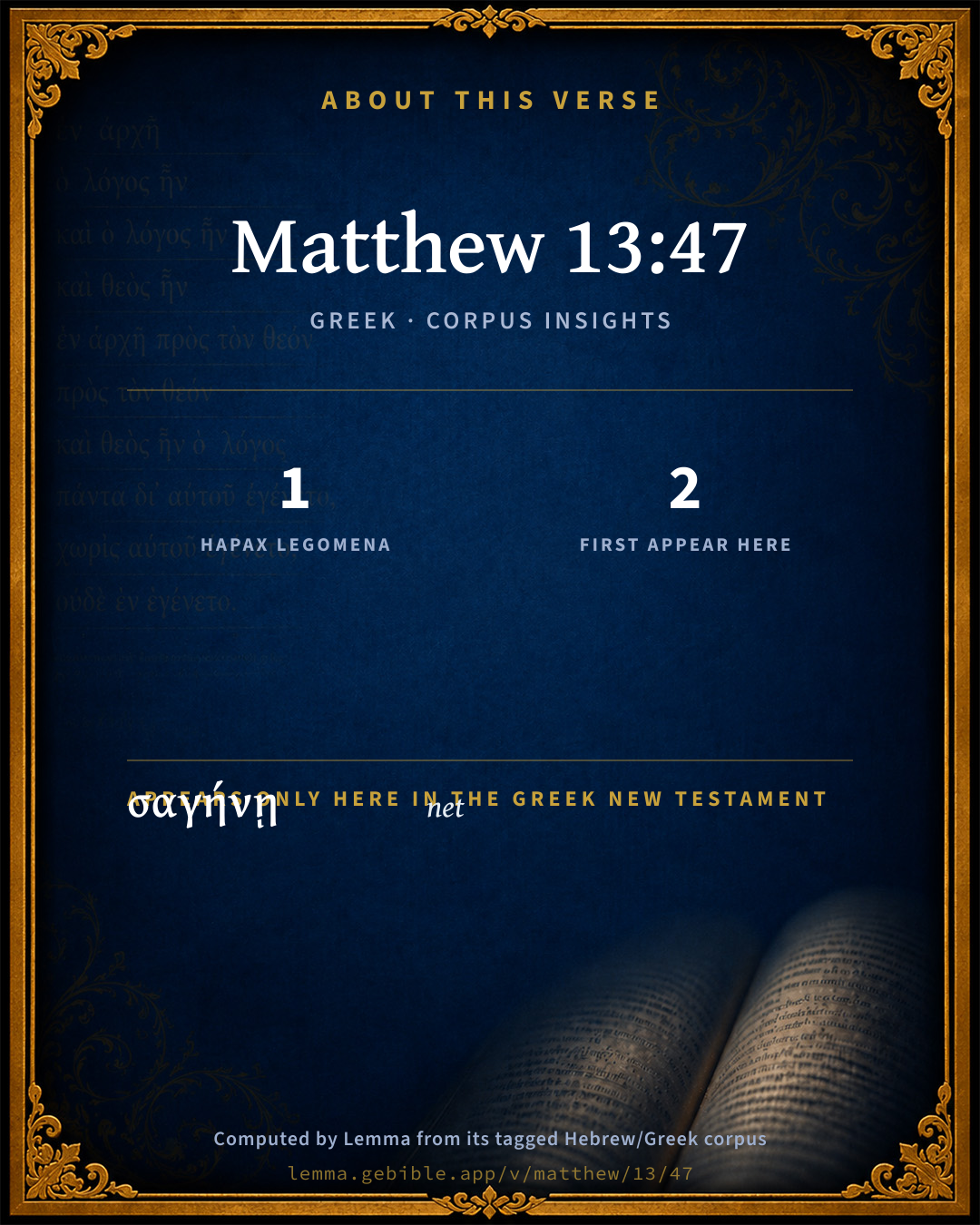
Matthew 13:47

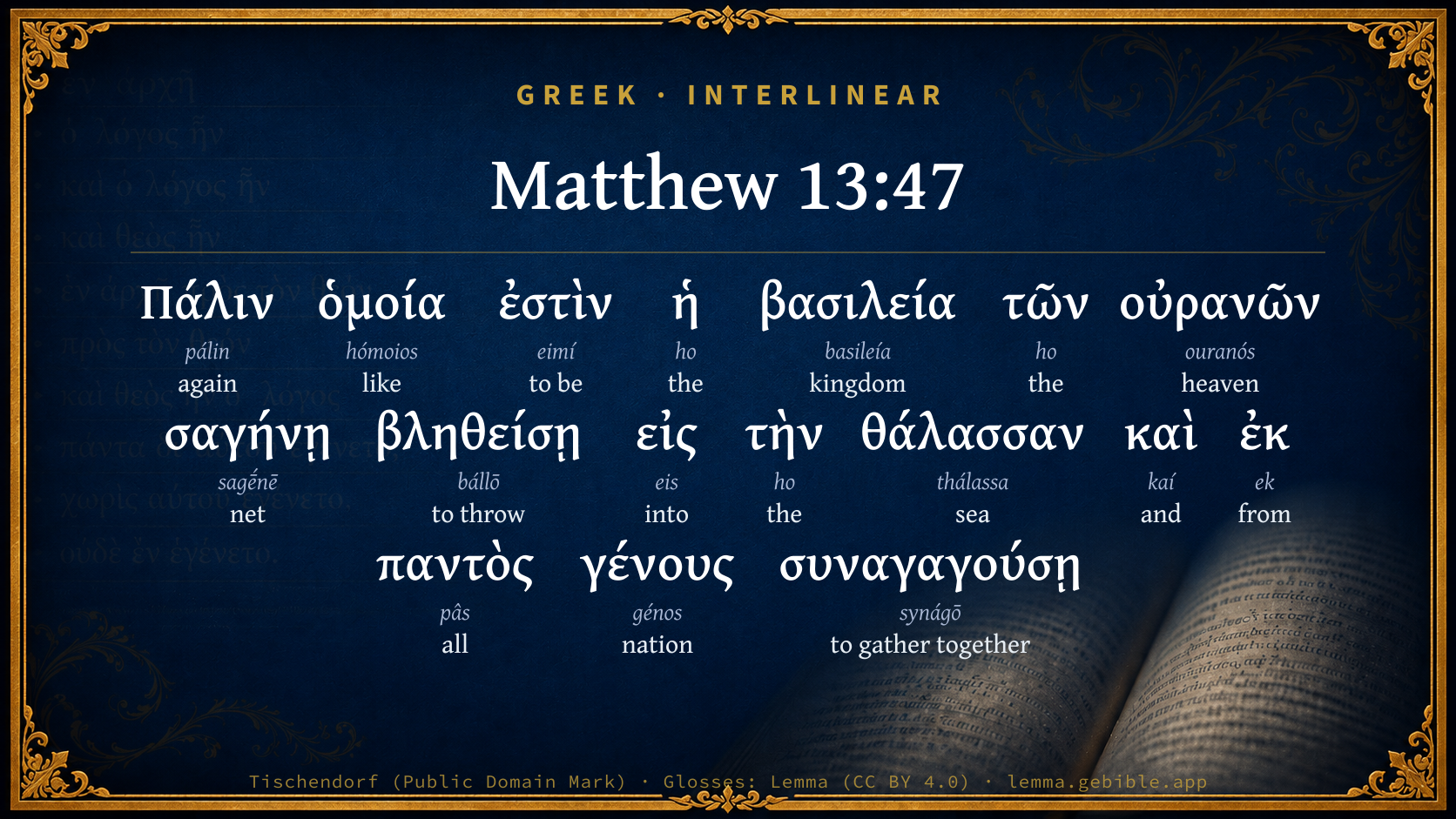
Greek (Tischendorf 8th ed.) Matthew 13:47 appears in the Greek New Testament. The text above is from the Tischendorf 8th edition. Each word links to its Strong’s number and a concise gloss. Click any word for its full Thayer’s Greek Lexicon entry.
Download image
Cite this verse

Matthew 13:47 (World English Bible). Public Domain. Lemma interlinear Bible study tool, https://lemma.gebible.app/v/matthew/13/47.

Show BibTeX & RIS
BibTeX
RIS
English Translation
"Again, the Kingdom of Heaven is like a dragnet, that was cast into the sea, and gathered some fish of every kind,
World English Bible · Public Domain
Highlights
  • 1 hapax legomenon — only here in the Greek New Testament
  • 2 first appearances in the Greek New Testament
Full analysis ↓
Download a study sheet

One document with this verse’s original text, its word-by-word gloss line, the meaning frame, cross-references with their text, attributed commentary, and full source and license credits — printable, and it pastes into notes with its structure intact.

This verse Autodidact and up

Study sheet (.html) Plain text (.txt)

A passage Seminary Student

Up to 50 verses in one chapter. A passage sheet keeps up to 6 commentary sources and 12 cross-references per verse, in the order this page ranks them, and says so on the sheet whenever that leaves anything out. Ask for a single verse and you get the Autodidact verse sheet above.

Everything on this page stays free to read, with no account — the sheet is a download of what is already on screen, not access to it.

Want to remove ads? Support Godless Engineer
Compare translations 3

The same verse in 3 English versions, stacked beneath the original-language interlinear above. Click any original word for its lexicon entry.

Each is an independent rendering of the whole verse — the interlinear is not word-aligned to these translations.

Highlighted words mark where these versions differ — a whole-verse word diff, not a word-by-word alignment.

  • World English Bible Public Domain
    "Again, the Kingdom of Heaven is like a dragnet, that was cast into the sea, and gathered some fish of every kind,
  • King James Version Public Domain
    Again, the kingdom of heaven is like unto a net, that was cast into the sea, and gathered of every kind:
  • unfoldingWord Literal Text CC BY-SA 4.0
    Again, the kingdom of the heavens is like a net having been cast into the sea, and having gathered from every kind,

unfoldingWord Literal Text — © unfoldingWord, licensed CC BY-SA 4.0. Word-aligned USFM3 via Door43 (git.door43.org/unfoldingWord/en_ult).

Versions to compare (up to 4)

3 of 4 selected

Show all 19 translations

Every available English version of this verse, each an independent rendering of the whole verse.

  • World English Bible Public Domain
    "Again, the Kingdom of Heaven is like a dragnet, that was cast into the sea, and gathered some fish of every kind,
  • Berean Standard Bible Public Domain
    Once again, the kingdom of heaven is like a net that was cast into the sea and caught all kinds of fish.
  • Majority Standard Bible Public Domain
    Once again, the kingdom of heaven is like a net that was cast into the sea and caught all kinds of fish.
  • King James Version Public Domain
    Again, the kingdom of heaven is like unto a net, that was cast into the sea, and gathered of every kind:
  • American Standard Version (1901) Public Domain
    Again, the kingdom of heaven is like unto a net, that was cast into the sea, and gathered of every kind:
  • Revised Version (1885) Public Domain
    Again, the kingdom of heaven is like unto a net, that was cast into the sea, and gathered of every kind:
  • Geneva Bible (1599) Public Domain
    Againe, the kingdom of heauen is like vnto a drawe net cast into the sea, that gathereth of all kindes of things.
  • Douay-Rheims (1899) Public Domain
    Again the kingdom of heaven is like to a net cast into the sea, and gathering together of all kind of fishes.
  • Young's Literal Translation Public Domain
    `Again, the reign of the heavens is like to a net that was cast into the sea, and did gather together of every kind,
  • Literal Standard Version CC BY-SA 4.0
    Again, the kingdom of the heavens is like to a net that was cast into the sea, and gathered together of every kind,
  • Unlocked Literal Bible CC BY-SA 4.0
    Again, the kingdom of heaven is like a net that was cast into the sea, and that gathered creatures of every kind.
  • unfoldingWord Literal Text CC BY-SA 4.0
    Again, the kingdom of the heavens is like a net having been cast into the sea, and having gathered from every kind,
  • Darby Bible Public Domain
    Again, the kingdom of the heavens is like a seine which has been cast into the sea, and which has gathered together of every kind,
  • World Messianic Bible Public Domain
    “Again, the Kingdom of Heaven is like a dragnet that was cast into the sea and gathered some fish of every kind,
  • Webster's Bible Public Domain
    Again, the kingdom of heaven is like a net, that was cast into the sea, and gathered of every kind:
  • Free Bible Version CC BY-SA 4.0
    Or again, the kingdom of heaven is like a fishing net thrown into the sea that caught all kinds of fish.
  • Bible in Basic English Public Domain
    Again, the kingdom of heaven is like a net, which was put into the sea and took in every sort of fish:
  • Text-Critical English NT CC BY 4.0
    “Again, the kingdom of heaven is like a dragnet that was cast into the sea, catching all kinds of fish.
  • Tyndale New Testament (1534) Public Domain
    Agayne the kyngdome of heven is lyke vnto a neet cast into the see that gadereth of all kyndes of fysshes:

Literal Standard Version (2020), Covenant Press — licensed CC BY-SA 4.0. Text via the HelloAO Bible API (eBible.org). Unlocked Literal Bible (unfoldingWord) — licensed CC BY-SA 4.0. Text via the HelloAO Bible API (eBible.org). unfoldingWord Literal Text — © unfoldingWord, licensed CC BY-SA 4.0. Word-aligned USFM3 via Door43 (git.door43.org/unfoldingWord/en_ult). Free Bible Version, Dr. Jonathan Gallagher — licensed CC BY-SA 4.0. Text via the HelloAO Bible API (eBible.org).

Word by word

More ways to search: Search by grammar → Find every occurrence → Compare this word →

Practice this passage: Drill this verse → Learn its vocabulary →

σαγήνῃ
sagḗnē
G4522
“net”
Noun, Dative, Singular, Feminine
Part of Speech
Noun
Case
Dative
Number
Singular
Gender
Feminine
Full Thayer's Definition

Origin: from a derivative of satto (to equip) meaning furniture, especially a pack-saddle (which in the East is merely a bag of netted rope)

TDNT: None

1. a large fishing net, a drag net
  1. Πάλιν pálin G3825 “again” Adverb
  2. ὁμοία hómoios G3664 “like” Adjective, Nominative, Singular, Feminine
  3. ἐστὶν eimí G1510 “to be” Verb, Present, Active, Indicative, 3rd person, Singular
  4. ἡ ho G3588 “the” Article, Nominative, Singular, Feminine
  5. βασιλεία basileía G932 “kingdom” Noun, Nominative, Singular, Feminine
  6. τῶν ho G3588 “the” Article, Genitive, Plural, Masculine
  7. οὐρανῶν ouranós G3772 “heaven” Noun, Genitive, Plural, Masculine
  8. βληθείσῃ bállō G906 “to throw” Verb, Aorist, Passive, Participle, Dative, Singular, Feminine
  9. εἰς eis G1519 “into” Preposition
  10. τὴν ho G3588 “the” Article, Accusative, Singular, Feminine
  11. θάλασσαν thálassa G2281 “sea” Noun, Accusative, Singular, Feminine
  12. καὶ kaí G2532 “and” Conjunction
  13. ἐκ ek G1537 “from” Preposition
  14. παντὸς pâs G3956 “all” Adjective, Genitive, Singular, Neuter
  15. γένους génos G1085 “nation” Noun, Genitive, Singular, Neuter
  16. συναγαγούσῃ synágō G4863 “to gather together” Verb, Aorist, Active, Participle, Dative, Singular, Feminine

About this verse

These counts appear in no published source. They are computed here, from the morphology-tagged text and Lemma’s own curated glosses. What Lemma adds →

17
words
15
distinct lemmas
Gospels
section

Notable vocabulary

1 hapax legomenon — a word that appears only here in the entire Greek New Testament:

  • σαγήνῃ net G4522

First appearance in Scripture

These words make their first canonical appearance in the Greek New Testament here:

  • σαγήνῃ net G4522
  • γένους nation G1085

Shared distinctive vocabulary

γένους nation G1085 occurs in 20 verses of the Greek New Testament. Also found in:

Repetition

A word recurs within this verse:

Cross-references

29

Topical passages linked to Matthew 13:47 in the Treasury of Scripture Knowledge — connected by theme and wording, ordered by reader-vote popularity; previews shown in the World English Bible.

  • John 15:6 If a man doesn't remain in me, he is thrown out as a branch, and is withered; and they gather them, throw them into the fire, and they are burned.
  • 2 Timothy 3:2–5 For men will be lovers of self, lovers of money, boastful, arrogant, blasphemers, disobedient to parents, unthankful, unholy,
  • Matthew 22:9–10 Go therefore to the intersections of the highways, and as many as you may find, invite to the marriage feast.'
  • Mark 1:17 Jesus said to them, "Come after me, and I will make you into fishers for men."
  • 2 Timothy 4:3–4 For the time will come when they will not listen to the sound doctrine, but, having itching ears, will heap up for themselves teachers after their own lusts;
  • 1 John 4:1–6 Beloved, don't believe every spirit, but test the spirits, whether they are of God, because many false prophets have gone out into the world.
  • Matthew 13:26–30 But when the blade sprang up and brought forth fruit, then the darnel appeared also.
  • 1 Corinthians 10:1–12 Now I would not have you ignorant, brothers, that our fathers were all under the cloud, and all passed through the sea;
  • 2 Corinthians 12:20–21 For I am afraid that by any means, when I come, I might find you not the way I want to, and that I might be found by you as you don't desire; that by any means there would be strife, jealousy, outbursts of anger, factions, slander, whisperings, proud thoughts, riots;
  • Titus 1:9–11 holding to the faithful word which is according to the teaching, that he may be able to exhort in the sound doctrine, and to convict those who contradict him.
  • 2 Peter 2:13–22 receiving the wages of unrighteousness; people who count it pleasure to revel in the day-time, spots and blemishes, reveling in their deceit while they feast with you;
  • Matthew 4:19 He said to them, "Come after me, and I will make you fishers for men."
  • Matthew 25:1–4 "Then the Kingdom of Heaven will be like ten virgins, who took their lamps, and went out to meet the bridegroom.
  • Luke 5:10 and so also were James and John, sons of Zebedee, who were partners with Simon. Jesus said to Simon, "Don't be afraid. From now on you will be catching people alive."
  • Luke 14:21–23 "That servant came, and told his lord these things. Then the master of the house, being angry, said to his servant, 'Go out quickly into the streets and lanes of the city, and bring in the poor, maimed, blind, and lame.'
  • Acts 5:1–10 But a certain man named Ananias, with Sapphira, his wife, sold a possession,
  • Acts 8:18–22 Now when Simon saw that the Holy Spirit was given through the laying on of the apostles' hands, he offered them money,
  • Acts 20:30 Men will arise from among your own selves, speaking perverse things, to draw away the disciples after them.
  • 1 Corinthians 5:1–6 It is actually reported that there is sexual immorality among you, and such sexual immorality as is not even named among the Gentiles, that one has his father's wife.
  • 2 Corinthians 11:13–15 For such men are false apostles, deceitful workers, masquerading as Christ's apostles.
  • 2 Corinthians 11:26 I have been in travels often, perils of rivers, perils of robbers, perils from my countrymen, perils from the Gentiles, perils in the city, perils in the wilderness, perils in the sea, perils among false brothers;
  • Galatians 2:4 This was because of the false brothers secretly brought in, who stole in to spy out our liberty which we have in Christ Jesus, that they might bring us into bondage;
  • 2 Peter 2:1–3 But there also arose false prophets among the people, as among you also there will be false teachers, who will secretly bring in destructive heresies, denying even the Master who bought them, bringing on themselves swift destruction.
  • 1 John 2:18–19 Little children, these are the end times, and as you heard that the Antichrist is coming, even now many antichrists have arisen. By this we know that it is the end times.
  • Revelation 3:1 "And to the angel of the assembly in Sardis write: He who has the seven Spirits of God, and the seven stars says these things: "I know your works, that you have a reputation of being alive, but you are dead.
  • Revelation 3:15–17 "I know your works, that you are neither cold nor hot. I wish you were cold or hot.
  • 1 Corinthians 11:19 For there also must be factions among you, that those who are approved may be revealed among you.
  • Jude 1:4–5 For there are certain men who crept in secretly, even those who were long ago written about for this condemnation: ungodly men, turning the grace of our God into lasciviousness, and denying our only Master, God, and Lord, Jesus Christ.
  • John 15:2 Every branch in me that doesn't bear fruit, he takes away. Every branch that bears fruit, he prunes, that it may bear more fruit.

Cross-references courtesy of OpenBible.info (CC BY 4.0).

Commentary

Notes on Matthew 13:47 from classic Christian and Jewish commentators (each source and its license shown beneath its notes). The classic Christian expositions comment on the surrounding passage and are grouped to its opening verse, so a note may address several verses; the Jewish commentaries on the Tanakh (Rashi and others) are per-verse, so they appear only where the commentator wrote on this verse.

Lemma curates 59 commentaries, every one of them public domain or Creative Commons licensed, each selected and text-cleaned for this edition rather than reprinted as found. About our sources →

The Biblical Illustrator

Joseph S. Exell

Mat_13:47-50

The kingdom of heaven is like unto a net that was cast into the sea.

The drawnet

1. We of this generation, a miscellaneous multitude of old and young, good and evil, move about at liberty in the wide expanse of life, as fishes move about in the deep broad sea; but certain mysterious, invisible lines, have been let down into the water, and are silently, slowly creeping near, and winding round us.

2. Good and bad alike are drawn in company towards the shore, but the good and bad are separated when they reach it. (W. Arnot.)

Separating good and bad

There is a machine in the Bank of England which receives sovereigns, as a mill receives grain, for the purpose of determining wholesale whether all are of full weight. As they pass through, the machinery, by unerring laws, throws all that axe light to one side, and all that are of full weight to another. That process is a silent but solemn parable for me. Founded as it is upon the laws of nature, it affords the most vivid similitude of the certainty which characterizes the judgment of the great day. (W. Arnot.)

The net

Here the mixture of good and bad is not attributed to an enemy, but is exhibited as resulting from the nature of the case. In fishing no selection is possible. We are here reminded that we are all advancing through life towards its final issue. This suggests-

1. Enclosure.

2. Enlargement. But the main points of the parable are-

I. The truth that the net gathers of every kind. The Church embraces every variety. This mixture arises from the manner in which the kingdom of heaven is proclaimed among men; publicly to all. But this mixture is at length to give place. On the shore a real and final distinction will be made and acted on. The test will be our value to God. (M. Dods, D. D.)

The drag-net

I. The occupation implied. Ministers of the gospel are set forth under various similitudes.

II. The result declared. The kingdom of heaven is like unto a net that … gathered of every kind; so the Christian Church is at present in a mixed condition. There are two important uses to which this truth may be applied.

1. To refute a common objection. When religious professors bring scandal on the cause with which they are identified, the enemies of Christianity should remember that in this respect things turn out just as the great Founder of our religion foretold.

2. Inasmuch as the visible Church is thus mixed, all who name the name of Christ should be jealous over themselves with a godly jealousy, and not rest without seeking to ascertain what is their true character.

III. The explanation given-So shall it be at the end of the world. Notice.

1. The period when the separation will take place.

2. The agents by whom it will be accomplished.

3. The solemn issue in which it will terminate. (Expository Outlines.)

The parable of the net cast into the sea

The gospel preached may fully be compared to a net.

1. A net is a proper engine or instrument to catch or gather fish; so the gospel, or the Word of God preached, is a proper instrument to gather sinners out of the world into the Church, both visible and invisible (1Co_1:2).

2. A net is cast into the river or sea before it can take fish, so the word of the gospel must be preached that sinners may be converted.

3. A net takes fish (when they are caught) out of their proper element, and they die immediately; so those sinners who are indeed taken, or spiritually and savingly wrought upon by preaching the Word, are taken out of that element where they lived, and loved to live before-i.e., out of a course of sin and wickedness; and such die presently to sin and to all the vanities of the sea of this world.

4. A net must be cast into the sea or river with judgment by a skilful fisherman; it requires wisdom to use it to answer the end appointed. So ministers, Christs spiritual fishermen, ought to be men of great skill, knowledge, wisdom, and experience (2Co_12:16).

5. A net is cast where a fisherman hath ground to hope he may take store of fish; so a minister should preach where multitudes of people are gathered together, when an opportunity doth present; thus did our Lord (Mat_5:1).

6. Sometimes fishermen labour all night (as Peter and John did) and take nothing; it is God that blesses their labour when they succeed well.

7. A net takes fish of every kind, some great ones, some small ones; some good, and some bad. So the gospel net gathers of every sort, some rich, some poor, some great ones (but not many of that kind), some little ones, who are despised in the eyes of the world.

8. A fishermans work is very hard, and he is exposed oftentimes to be tossed on the tempestuous sea; so is the work of Christs ministers. (B. Keach.)

The Biblical Illustrator, edited by Joseph S. Exell (c. 1880s–1900s) — public domain. Text from a community e-Sword module.

Joseph Benson's Commentary

Mat 13:47-50. The kingdom of heaven is like unto a net, &c. — The gospel preached to the world may be compared to a net cast into the sea, and gathering fishes of all kinds. For by the preaching of it congregations are gathered, and a visible church is formed, and both good and bad men are brought to profess themselves members of it, and are mingled together in such a manner, that it would be difficult, if not impossible, to make a proper distinction between them: Christian discipline, however, and strong, close exhortation, in all well-regulated churches, or properly-constituted Christian societies, begin that separation in this world which shall be accomplished by the angels of God in the world to come. “This parable will appear peculiarly proper, if we consider that it was spoken to fishermen, who had been called from their employments, with a promise that they should catch men, Mat 4:19. It differs from the parable of the tares in its extent, representing the gathering of wicked men in general into the visible church along with the good, by means of the preaching of the gospel, together with the final judgment and state of the wicked; whereas the parable of the tares represents the introduction and punishment of hypocrites in particular.” — Macknight.

Joseph Benson's Commentary on the Old and New Testaments (1811–1818) — public domain. Text from a community e-Sword module.

The Pulpit Commentary

Vers. 47-50. The parable of the dragnet. This parable at once recalls that of the tares, but it will be noticed that there our Lord"s aim is to inculcate patience and hopefulness on tile part of his servants when they realize the close proximity of the ungodly even in districts won over to the faith, while here his aim is rather to warn. To be in the kingdom is not enough; some of those now within it may nevertheless be cast out. It thus greatly resembles the parable of the ten virgins; save that in that parable greater stress is laid on personal preparation and continued watchfulness; in this, on personal worth.

Again, the kingdom of heaven is like unto a net, (saghnh : Mat_4:18, note) that was cast into the sea, and gathered of every kind. (For the thought, cf. Mat_22:10; and for the word, sunagein , ver. 30, note)

Vers. 47-50. The dragnet.

This parable may be compared with the parables of the soils and the tares. All three show different results following the teaching of Christ according to the characters of those whom he teaches. The parable of the soils draws attention to the varying degrees of success or failure dependent on the condition of the hearers; the tares illustrate evil influences side by side with the work of Christ; the dragnet disregards these two causes of failure, and deals only with results it carries us on to the final judgment. Nevertheless, we should bear the lessons of the earlier parables in mind, in order to avoid drawing conclusions of fatalism and injustice from this one.

I THE GOSPEL NET. Our Lord compares his method to the casting of a great net and the drawing it through the waters.

1. Christ seeks men. He spoke to fishers, who knew the sea and its commerce, and he compared his work to theirs. While the parable of the pearl of great price shows us a man seeking the kingdom, this parable presents to us the sight of the kingdom seeking men. Here is the grace of the gospel. It is further suggested by the woman sweeping for her lost coin, and the shepherd going after his wandering sheep. (Lu 15)

2. Christ uses means to gather disciples. The net may represent the preaching of the gospel, or all the agencies, first of Christ and his apostles, then of his missionary Church. We are not to wait till the world comes to Christ. We must mend our nets lest any slip through the broken meshes, and cast and drag them, using all means to gain some.

3. Christ aims at a large gathering of souls. The fisher does not angle with a line; he casts a net, and that net, the dragnet, is of the largest kind. Plainly his aim is large. Christ does not seek one here and there. He is the Saviour of the world. His love embraces all; his work is for the people.

II THE GREAT DRAUGHT OF FISHES.

1. The net gathers in many fishes. At first the popularity of Christ won a multitude of adherents. Most of these fell away; but after Pentecost a larger host was brought in. Subsequently great numbers pressed in, till the balance of policy in the Roman empire swayed from heathenism to Christianity. "Like a sunbeam," says Eusebius, "it streamed over the face of the earth.

2. The fishes are of various kinds. The members of the Christian Church are not all of one class or type. Socially they differ, belonging to all grades and ranks; intellectually they differ, from a Newton to a simple ploughboy. But these differences are slight compared to the moral distinctions that are seen throughout Christendom. The Church includes a St. Francis and a Caesar Borgia. Church membership is no proof of Christianity.

III THE SIFTING AND SORTING. Christ calls all kinds of people; but he does not accept all. "Many are called, but few are chosen." It is even possible to be a guest seated at the king"s banquet, and yet to be cast out, if the wedding garment is not worn. Nevertheless, there is no unfairness or partiality; much less is there fickleness or unfaithfulness in Christ. He desires to accept all. If he must reject any, it is against his will, a pain to him. The rejection is not because of his caprice, but wholly because of the characters of those whom he cannot receive. But how are we to reconcile this with Christ"s express declaration that he came not to call the righteous, but sinners? (Mat_9:13) The explanation is that the fish are found to be worthless when they are brought to land. If men remain sinners after entering the Church, they must be rejected by Christ. But Christ can change the sinner into a holy man, and he will do this with the truly penitent who trust him. Then they will not be like the worthless fish. W.F.A.

Vers. 47-50. The gathering together in order to the separating.

Note, in introduction, that this parable is by no means merely another version of that of the tares. As a priori we should feel certain it could not be so, it needs neither long nor deep search to see that it certainly is not so. The resemblance between the two parables lies only on the surface, and not less true is it that on the very surface also lies sufficient conviction of the real difference between the two. The illustration of the kingdom of heaven furnished by this parable sets it forth

I AS A LARGE GATHERING OF PERSONS OF VERY VARIOUS CHARACTER, WHO HAVE ENTERED FROM THE RESTLESS WAVES OF THIS TROUBLESOME WORLD WITHIN AN ENCLOSURE, NOT OF THEIR OWN MAKING, NOT OF THEIR OWN DESIGNING, AND NOT OF THEIR OWN PLACING, AND THERE FOR A TIME KEPT TOGETHER.

II AS A GATHERING OF DIFFERENT PERSONS, WHO, THOUGH LONG FOUND TOGETHER WITHIN THAT ENCLOSURE, WOULD AT LENGTH BE SEPARATED; BE CALLED THE GOOD OR THE BAD, THE "WICKED" OR THE "JUST;" AND BE DEALT WITH ACCORDINGLY.

III AS A GATHERING OF SUCH AS ABOVE DESCRIBED, THE SEPARATION AMONG WHOM AT LAST WOULD BE MADE BY SOVEREIGN AND IRRESISTIBLE AND SUPREME AUTHORITY.

Vers. 47-50. The parable of the net.

This parable, the last of the series, directs our thoughts to the completion of the kingdom. "So shall it be in the end of the world;" this is the starting point of the interpretation. We are to consider what part the kingdom of heaven is to play then; when other kingdoms have played their parts; when things are being settled for eternity according to their value to God. It makes no practical difference in the application of the parable whether you make the net the Church, or simply the progress of all things towards eternity. Our Lord would have us consider the consummation of all things, when the great net shall at last be drawn to shore, when there shall be no more sea, no ebb and flow, especially no mingling of bad and good in an obscure and confusing element; but decision and separation, a deliberate sitting down to see what has been made of this world by us all, and a summing up on that eternal shore of all gains and results, and every man"s aim made manifest by his end.

I THIS PARABLE SUGGESTS THAT WE ARE ALL INEVITABLY ADVANCING. Our condition in this respect bears a close resemblance to fish enclosed in a net. At first, while the net is wide, they frisk and leap and seem free, but soon they discover that their advance is but in one direction, and when they halt they feel the pressure of the net. So it is with ourselves. We must go on; we cannot break through into the past; we cannot make time stand still till we resolve how to spend it. The years spent in indecision, in doubt, in self-seclusion, cannot now be filled with service of God and profit to our fellows.

II THE NET SUGGESTS THE IDEA OF ENTANGLEMENT. Looking at fish in a net, you see many that are not swimming freely, but caught in the meshes and dragged on. Many have this interpreted by their own experience. They feel daily the pressure of the net; their position is not altogether of their own choosing, and now they discharge its duties because they must, not because they would. Such a condition may be sinful or sinless. If the duties required of you be sinful, then have you not recognized the detriment to your own soul? Do you not reflect that what was good when first entangled may be landed broken, bruised, and useless? But if the duties required of you are not violations of God"s Law or offences to your own conscience, then rest satisfied with them, till God shows you a way of escape. Do not toss and struggle in the net, but quietly set yourself to make the most of the condition you have unfortunately fallen into. It may be your duty to continue in a position it was not originally your duty to enter. Just because it seems in many points unsuitable, it may call out deeper qualities within you a patience that would otherwise have been undeveloped in you, a knowledge of man and of God that enlarges and matures your spirit. By very strange influences and means are we passing onwards, and we would often fain escape from the gentle compulsion by which God draws us to our end and bliss; and therefore must we bear in mind that however entangled and tied up we are and prevented. from our own ways and directions, this present is, after all, only the drawing of the net, and not the time of our use. We are pressing to a shore where there is room and time enough for the fulfilment of every human purpose and exercise of every faculty.

III Again, a third thing the net shows us is THE MIXTURE IN IT. "It gathers of every kind." And until it is fairly landed it is impossible to say whether the weight is to be rejoiced in or no. It is the glory of the kingdom of heaven that there is no man to whom it is not appropriate. It does not only gather those in whom it finds something congenial, a natural susceptibility of temperament inclining them to devotion; but it gathers in of every kind because it is suited to that moral condition in respect of which there is no difference of importance between one man and another. But this mixture has its chief importance in connection with the ultimate separation. There are two great classes in which are to be forever included all other distinctions and diversities. All must pass through the hands of the Judge. By keeping God out of your thoughts now, you do not secure that you shall never think of him, and that he shall never think of you. And this is specially a parable of warning. The figure is carried out and applied only so far as it concerns the fate of the wicked. The angels sever the wicked from among the just, so that the just alone are left in the net. The fishermen have thrown the net for a purpose, and whatever is not suitable for this purpose is refuse and rubbish to them. And so it shall be in the end of the world. Men will then understand what now scarcely one can constantly believe, that it is God"s purpose that is silently being accomplished, and that it is usefulness to him that is the final standard of value. This will make a rapid separation among men. Have you those qualities which would serve to carry out such purposes as you know God"s to be? Do you find now so much delight in doing his commandments, in living under his eye, that you can believe that in the end he can make some use of you? Do not say, "I will not alarm myself by judging of my own qualities; I am trusting to Christ;" for precisely in so far as you are trusting to Christ you have those qualities which God will require you to show. One other thing must be observed. The fish taken in the net are disposed of by the fishermen; are in their hands as mere dead matter without choice or motion. This handling and disposing of by others is not more new to the fishes than it will be to us. Here in this world we are conscious of a power to choose and regulate our own destiny a power to change and become something quite different from what we are. But there comes a time when whatever you are that you shall forever be; when you must abide by your choice and take all its consequences. This parable, therefore, has a most significant hint for those who decline to accept Christ on these two grounds.

1. That they do not practically need his help; that they can do all that is required of them very well without him.

2. That they do not see in the lives of those who do believe in him any such superiority as to induce them to follow their example and believe. But the difficulty now is for any serious and right-minded person to avoid accepting Christ"s help. In order to do so a man would need to have been born outside of Christendom altogether. Besides, as regards conduct, can a man satisfy his conscience without Christ"s help? He holds a relation to God as well as to man, and it is no apology for an unfilial attitude towards God to affirm that we fulfil all our duties to men. This parable reminds us that it is serviceableness which must determine our destiny in the future life; or, as God does not desire mere service, but the delighted cooperation of sons, it is sonship which determines our destiny. And who but Christ enables us to see what sonship is, and to become sons? As to the second reason, this parable not only admits, but makes much of the fact, that all that is within the net is by no means approved by God. But is not the kingdom as it ought to be worth striving for? Was the life of Christ misspent? and would it be a lamentable state of affairs on earth if his rule and spirit everywhere prevailed? The eternity that some are advancing towards, our Lord does not hesitate to describe as "a furnace of fire, where shall be wailing and gnashing of teeth." Surely the condition that is so sad as to occupy the souls of those who are in it with eternal lamentation ought to occupy with some feelings the hearts of those who can give no reason why they shall not be there. It is not by some other and extraordinary way that you will evade what God warns you of, but only by the timeous use of what he has long ago told you, and what you ought long ago to have used. D.

Vers. 47-50. The dragnet.

The import of this parable is similar to that of the tares, though perhaps of wider application. The theatre of the earlier parable is the land, which in prophecy designates the Hebrew people, while the sea, in the latter, points to the Gentile nations. (cf. Isa_5:30 Dan_7:2, 3 Rev_13:1 Rev_17:1, Rev_17:15) The kingdom of heaven was first offered to the Jews, and when they rejected it, it was then carried to the Gentiles. (cf. Mat_21:43 Act_13:46, Act_13:47) Note

I THE DISCIPLES OF JESUS ARE FISHERS OF MEN.

1. To this service they are called.

(1) Some of the first disciples were literally fishermen. (Mat_4:17-22) The distinction of Christ"s servants is spiritual rather than social.

(2) From the lower they were promoted to the higher fishing grounds. In calling them to become fishers of men Jesus said practically, "The kingdom of heaven is like unto a net." Their call was a parable, a prophecy, and a sermon.

(3) Jesus found the fishermen diligent in their humble calling and promoted them. It is a dishonour to the gospel to send the weaklings of a family into the Church.

2. For this service they were equipped.

(1) Christ gave them his dragnet. This is the "Word of the kingdom." This is a dragnet that sweeps all before it.

(2) He taught them how to use it. They heard his preaching. They went forth under his commission and preached.

(3) His almighty energy went with them. The physical miracles they wrought exemplified the corresponding moral power of the truth they preached.

(4) He gave them remarkable pledges of future success. Conspicuous amongst these was the miraculous draught of fishes. That was a prophetic anticipation of the work on the Day of Pentecost.

II THE MEN THEY GATHER ARE "OF EVERY KIND.

1. The good are enclosed in the Church.

(1) These were the fish recognized as clean according to the Law, Viz. such as have both "fins and scales". (see Lev_11:9, Lev_11:10) By means of their fins they rise to the surface and swim in the purer water and under the clearer light of the heavens. The metallic lustre of their scales suggests the "armour of light.

(2) Anciently, the clean creatures represented the Hebrew people, who were the people of the covenant, in contradistinction to the unclean Gentiles, who were "aliens from the commonwealth of Israel, and strangers from the covenant of promise, being without hope and atheists in the world.

(3) Now they stand for the morally good as opposed to the wicked. "For in every nation he that feareth God and worketh righteousness is accepted of him.

(4) Of the good among men, as among fishes, there are many varieties. Religion does not destroy individuality. But they have the common marks of Christian discipleship.

2. The bad also are included.

(1) these are represented by the unclean fish; those without fins or scales, as the eel, whose habits are foul, writhing in the mud. We say of cunning men that they "wriggle like eels." They may have fins like the shark, but if they have not also scales they are unclean. Men of rapacious dispositions we still call "sharks.

(2) Anciently, the unclean creatures denoted the "sinners of the Gentiles," as opposed to the "saints" or "holy people" of Israel.

(3) Now, since national distinctions in religion are abolished, the unclean are the unbelievers of every nation, Jew as well as Gentile.

3. The visible Church is therefore imperfect.

(1) The world is a vast sea, and the sons of men are "in it things creeping innumerable both small and great". (Psa_104:25) Men in their natural state are "like fishes in the sea, and moving things that have no ruler over them". (Hab_1:14)

(2) From this mass multitudes are gathered into the net of the Church. Some of the evil becomes transformed by true conversion. Others are converted only in semblance.

(3) This mixed state of things is evident in wide Christendom. It is no less real, though not equally evident, amongst communicants.

III THE GOOD AND THE WICKED ARE DESTINED TO A FINAL SEPARATION.

1. The wicked will be separated to destruction.

(1) They are "severed," separated with violence, as by cutting or rending. They will with reluctance yield to this final separation from the good and from their hopes.

(2) They will be severed by the "angels." The angels of heaven can distinguish between the hypocrite and the true man, which the angels of the Church cannot do. As the tares among the wheat in the Jewish field, so are the bad fish among the good in the Gentile net (cf. vers. 28-30, 41).

(3) "And shall cast them into the furnace of fire." This is in allusion to the Eastern punishment of burning alive. If figures do not come up to the reality, the punishment of the sinner must be fearful in the extreme. Note: The furnace of fire is reserved for unworthy members of Churches.

(4) "There shall be weeping and gnashing of teeth." The agony of despair. The distress of impotent resentment. This, after the burning, shows that the burning of the wicked is not their consumption. Destruction, in Scripture, differs from annihilation.

2. The good will be separated to salvation.

(1) Salvation from the associations of the wicked. Those associations are now uncongenial. They are contaminating. They are damaging to the better reputation. In the new earth there will be "no more sea". (Rev_21:1) There will be no more Gentiles in wickedness; all will be Israelites in goodness.

(2) The good will be "gathered into vessels." Are not these the antitheses of the "bundles" into which the wicked are gathered, as in the corresponding parable of the tares? Does not this suggest order and class in heavenly society?

(3) The time of this separation is when the net shall be "filled." The gospel must first fulfil its commission in witnessing to all the world. J.A.M. (cf. Isa_55:10, 11 Mat_24:14)

The Pulpit Commentary (1880–1919), ed. H.D.M. Spence-Jones & Joseph S. Exell — public domain. Text from a community e-Sword module.

Tyndale Open Study Notes

Tyndale Open Resources

13:47-50 This parable refers to God’s judgment at the last day (25:31-46), which will eternally separate the wicked from the righteous. This note of warning reinforces the urgency of the previous two calls to decision.

Tyndale Open Study Notes — © Tyndale Open Resources, licensed CC BY-SA 4.0. Text via the HelloAO Bible API.

Bengel's Gnomon

Johann Albrecht Bengel

Mat 13:47. Ἐκ παντὸς γένους, of every hind) See Joh 21:11, and Gnomon thereon.

Bengel's Gnomon of the New Testament — English translation (T&T Clark, Edinburgh, 1860) — public domain. Text from a community e-Sword module.

Meyer's Critical & Exegetical Commentary

Heinrich August Wilhelm Meyer

Mat_13:47 ff. For αἰγιαλός, see note on Act_27:39.

τὰ καλά and σαπρά] the good, i.e. the good fish, such as were fit for use, and the putrid ones (comp. note on Mat_7:17), which, already dead and putrefying, are yet enclosed in the σαγήνη (large drag-net, Luc. Pisc. 51, Tim. 22; Plut. de solert. an. p. 977 F) along with the others. The men took them out of the net (ἔξω) and cast them away.

The aorists in Mat_13:47-48 are to be understood in a historical sense, not as expressing what was the practice, but merely as narrating what took place on the occasion, just as in Mat_13:44-46.

Observe further, that the net encloses fish of every γένος, i.e. of every species (that is, according to the literal meaning, out of every nation); yet no γένος, as such, is cast away, but only the putrid fish belonging to each γένος, and that not before the end of the world (in answer to the whole Donatist view).

Mat_13:50. Closing refrain, as in Mat_13:42.

Meyer — Critical and Exegetical Commentary on the New Testament — English translation by Peter Christie, edited by Frederick Crombie (T&T Clark, 1880) — public domain. Text from a community e-Sword module.

Expositor's Greek Testament

ed. W. Robertson Nicoll

Mat 13:47-50 . The Net . σαγήνῃ , vide on Mat 4:21 . ἐκ παντὸς γένους συν .: a matter of course, not intended but inevitable; large movements influence all sorts of people.

The Expositor's Greek Testament, edited by W. Robertson Nicoll (1897–1910) — public domain. Text from a community e-Sword module.

Geneva Bible (1599)

Geneva Bible translators

There are many in the Church, which notwithstanding are not of the Church, and therefore at length shall be cast out: but the full and perfect cleansing of them is deferred to the last day.

Geneva Bible (1599) marginal notes — public domain. Text via Bolls.life.

Jamieson, Fausset & Brown

Robert Jamieson, A. R. Fausset & David Brown

Again, the kingdom of heaven is like unto a net, that was cast into the sea, and gathered of every kind--The word here rendered "net" signifies a large drag-net, which draws everything after it, suffering nothing to escape, as distinguished from a casting-net (Mar 1:16, Mar 1:18). The far-reaching efficacy of the Gospel is thus denoted. This Gospel net "gathered of every kind," meaning every variety of character.

Jamieson, Fausset & Brown — Commentary Critical and Explanatory on the Whole Bible (1871) — public domain (CC PDM 1.0). Text via the HelloAO Bible API.

Adam Clarke's Commentary

Verse 47. Is like unto a net] A drag-net. This is the proper meaning of σαγηνη, which the Latins translate verriculum, a sweep net; Quod in aquam jacitur ad pisces comprehendendos; imprimis, cujus usus est extrahendis iis a fundo. MARTINIUS. "Which is cast into the water to catch fish, and the particular use of which is to drag them up from the bottom." As this is dragged along it keeps gathering all in its way, both good and bad, small and great; and, when it is brought to the shore, those which are proper for use are preserved, and those which are not are either destroyed or thrown back into the water.

By the net may be understood the preaching of the Gospel of the kingdom, which keeps drawing men into the profession of Christianity, and into the fellowship of the visible Church of Christ. By the sea may be represented that abyss of sin, error, ignorance, and wickedness in which men live, and out of which they are drawn, by the truth and Spirit of God, who cordially close in with the offers of salvation made to them in the preaching of the Gospel.

By drawing to shore, may be represented the consummation of all things, see Mt 13:49, when a proper distinction shall be made between those who served God, and those who served him not; for many shall doubtless be found who shall bear the name without the nature of Christ. By picking out the good, and throwing away the bad, Mt 13:48, is meant that separation which God shall make between false and true professors, casting the former into hell, and bringing the latter to heaven.

Instead of τα καλα the good, the Cod. Bezae, and five copies of the old Antehieronymian, or Itala version, read τα καλλιστα, the best, the very best. Every reader would naturally hope that this is not the true reading, or that it is not to be understood literally, as it seems to intimate that only the very best shall be at last saved.

It is probable that this parable also refers, in its primary meaning, to the Jewish state, and that, when Christ should come to judge and destroy them by the Roman power, the genuine followers of Christ only should escape, and the rest be overwhelmed by the general destruction. See Mt 24:30, &c.

Adam Clarke's Commentary on the Bible (1810–1826) — public domain. Text from a community e-Sword/MySword module.

Ellicott's Commentary for English Readers

(47) The kingdom of heaven is like unto a net.—The net in this case is not the hand-net of Mat_4:18, but the sagenè, or great drag-net, which drew in a larger haul of fishes. The day’s teaching in the method of parables ends, as it were, in an easy lesson, which the former experience of the disciples would enable them to understand. Still, as in the parable of the Tares, the main thoughts are, (1) the mingling of the evil with the good in the visible kingdom of Christ on earth, and (2) the ultimate separation of the two, that each may receive according to the divine law of retribution. Here, as there, the parable perforce passes over the fact that in the actual work of the kingdom the very casting of the net may change, and is meant to change, the nature of the fish that are taken in its meshes, and, therefore, that those that remain “bad” are so in the end by the result of their own will.

A Bible Commentary for English Readers, edited by Charles John Ellicott (1878–1897) — public domain. Text from a community e-Sword module.

The Cambridge Bible for Schools and Colleges

gen. ed. J. J. S. Perowne

47–50. The Parable of the Net, in St Matthew only

47. a net, that was cast into the sea] The reference is to the large drag-net or seine [Greek σαγήνη—the word in the text—hence sagena (Vulgate) and English sean or seine]. One end of the seine is held on the shore, the other is hauled off by a boat and then returned to the land. In this way a large number of fishes of all kinds is enclosed. Seine-fishing is still practised on the coasts of Devonshire and Cornwall.

The teaching of this parable partly coincides with that of the parable of the Tares (Mat_13:24-30). In both are exhibited the mixture of good and evil in the visible Church, and the final separation of them. But here the thought is specially directed to the ingathering of the Church. The ministers of Christ will of necessity draw converts of diverse character, good and evil, and actuated by different motives. From the parable of the Tares we learn not to reject any from within the Church, in the hope of expelling the element of evil. It is a parable of the settled Church. This is a missionary parable. It teaches that as a matter of history or of fact, no barrier or external test will serve to exclude the unworthy convert.

The Cambridge Bible for Schools and Colleges (gen. ed. J. J. S. Perowne; Cambridge University Press, 1878–1918) — public domain. Text from a community e-Sword module.

John Gill's Exposition

So shall it be at the end of the world,.... As the fisherman, when he has drawn his net to shore, picks out the good fish, and puts them into proper vessels, and casts the dead, putrid, and useless fish away; so, at the close of time, in the last day,

the angels shall come forth out of heaven, from the presence of God and Christ, and by his orders, as the judge of all the earth,

and sever the wicked from the just; with whom they have had not only civil conversation, but have been joined in a Gospel church state; but now these ungodly shall not stand in judgment with them; nor these sinners, these hypocrites, in the congregation of the righteous: the one will be set at Christ's right hand, the other at his left; the one will go into life eternal, and the other into everlasting punishment; and their separation from one another will be for ever.

John Gill's Exposition of the Whole Bible (1746–1763) — public domain (CC PDM 1.0). Text via the HelloAO Bible API.

Trapp's Complete Commentary

John Trapp

47 Again, the kingdom of heaven is like unto a net, that was cast into the sea, and gathered of every kind:

Ver. 47. Again the kingdom, &c.] Christ is an incessant teacher: learn then, for shame, lest he turn us off for non-proficients. Let one sermon peg in another; and every second potion set the first to work.

Is like unto a net, &c.] An elegant comparison, wherein the fishers are the ministers, the sea the world, the net the word, the ship the church the fishes the hearers. Basil, comparing the gospel to a net, makes fear to be the lead that sinketh it, and keeps it steady; and hope to be the cork, which keepeth it always above water. Without the lead of fear, saith he, it would be carried hither and thither; as without the cork of hope, it would utterly sink down.

John Trapp, A Commentary or Exposition upon All the Books of the Old and New Testament (1647–1656) — public domain. Text from a community e-Sword module.

Albert Barnes' Notes on the Bible

The kingdom of heaven is like unto a net ... - This parable does not differ in meaning from that of the tares. The gospel is compared to a net dragging along on the bottom of a lake, and collecting all - good and bad. The gospel may be expected to do the same; but in the end of the world, when the net “is drawn in,” the bad will be separated from the good; the one will be cast away, and the other saved. Our Saviour never fails to keep before our minds the great truth that there is to be a day of judgment, and that there will be a separation of the good and the evil. He came to preach salvation; and it is a remarkable fact, also, that the most fearful accounts of hell and of the sufferings of the damned, in the Scriptures, are from his lips. How does this agree with the representations of those who say that all will be saved?

Albert Barnes' Notes on the Bible (1834–1885) — public domain. Text from a community e-Sword/MySword module.

Matthew Poole's English Annotations

The scope of this parable is much the same with that of the tares, to teach us, that while the church is in this world there will be in it a mixture of good and bad, a perfect separation of which one from another is not to be expected until the day of judgment.

Again, the kingdom of heaven. This term signifieth the whole dispensation and administration of the gospel, both the grace dispensed in it, and the means of that grace which is administered under it. I should here interpret it of the preaching of the gospel, which is called

the word of the kingdom, being the means by which men are gathered in both to the church visible and invisible. This our Lord here compares to

a net, thrown

into the sea of the world, and gathering in of every kind, bringing in many to an outward profession, all of which shall not come to the kingdom of glory, nor are indeed true members of Christ; not members of the church invisible, though they be members of the church visible. When the end of the world shall come, and Christ shall have accomplished his design in the world, then a day of judgment shall come, and there shall be a perfect separation between such as received the gospel in truth, and in the love of it, and others: the former shall be taken to heaven, and the latter thrown into hell; which he expresses by the like phrases which he had before used in the parable of the tares, which need no further explication.

Matthew Poole's English Annotations on the Holy Bible (1683–1685) — public domain. Text from a community e-Sword/MySword module.

Whedon's Commentary on the Bible

Daniel D. Whedon

SEVENTH PARABLE — The Fish Net, 47-49.

The net is the Gospel dispensation. The fish are the members of the Church; the fishermen are the divine agencies. The good fish are the true; the bad, the false professors of Christianity.

47. Net — The drag net, which sweeps the bottom of the fish pool. It is extended far into the sea, corked at the upper edge and loaded at the bottom, so as to intercept the fishes at the entire depth. The ends are then brought together so as to encompass them, and the whole are drawn in. Every kind — Men of every rank, class, nation, and colour obtain places in the comprehension of the Gospel.

Daniel D. Whedon (gen. ed.), Commentary on the Old and New Testaments (1874–1909) — public domain. Text from a community e-Sword module.

Scofield Reference Notes

C. I. Scofield

the kingdom of heaven

The parable of the Net (Greek - δαιμονίζομαι-net) presents another view from that of the wheat and tares of the mysteries of the kingdom as the sphere of profession, but with this difference: there Satan was the active agent; here the admixture is more the result of the tendency of a movement to gather to itself that which is not really of it). The kingdom of heaven is like a net which, cast into the sea of humanity, gathers of every kind, good and bad, and these remain together in the net (Mat 13:49) and not merely in the sea, until the end of the age. It is not even a converted net, much less a converted sea. Infinite violence has been done to sound exegesis by the notion that the world is to be converted in this age. Against that notion stands our Lord’s own interpretation of the parables of the Sower, the Wheat and Tares, and the Net.

Such, then, is the mystery form of the kingdom. (See Scofield "Mat 3:2"). See Scofield "Mat 6:33". It is the sphere of Christian profession during this age. It is a mingled body of true and false, wheat and tares, good and bad. It is defiled by formalism, doubt, and worldliness. But within it Christ sees the true children of the true kingdom who, at the end, are to "shine forth as the sun." In the great field, the world, He sees the redeemed of all ages, but especially His hidden Israel, yet to be restored and blessed, Also, in this form of the kingdom, so unlike that which is to be, He sees the Church, His body and bride, and for joy He sells all that He has 2Co 8:9 and buys the field, the treasure, and the pearl.

heaven (See Scofield "Mat 3:2")

The Scofield Reference Bible (1917 edition), notes by C. I. Scofield — public domain. Text from a community e-Sword module.

Kretzmann's Popular Commentary

Paul E. Kretzmann

Parable of the net:

v. 47. Again, the kingdom of heaven is like unto a net that was cast into the sea, and gathered of every kind;

v. 48. which, when it was full, they drew to shore, and sat down, and gathered the good into vessels, but cast the bad away.

v. 49. So shall it be at the end of the world: The angels shall come forth and sever the wicked from among the just,

v. 50. and shall cast them into the furnace of fire; there shall be wailing and gnashing of teeth.

This parable offers a picture with which the disciples were very familiar. A large net, as used for deep-sea fishing, is cast into the sea and compasses a great number of fish of various kinds, good and bad, edible and unwholesome. Although the entire net full is drawn to the shore, the value of the catch is in the good fish, the rest being separated by a careful sorting and thrown away. They are not really counted as belonging to the catch. The kingdom of heaven, in the form in which it appears here on earth, is like such a net. The working of the Gospel-preaching results in an outward collection of such as are really members of the Kingdom and such as merely bear the semblance of such membership, but have not accepted the Gospel. The latter add to the bulk, but do not belong to the essence. On the last day the separation will take place, and the sorting will result in the eternal condemnation of those that were merely feigning membership, who care nothing for faith and salvation.

Paul E. Kretzmann, Popular Commentary of the Bible (1921–1924) — public domain. Text from a community e-Sword module.

Burkitt's Expository Notes on the New Testament

William Burkitt

The design and scope of this parable also is to set forth the state of the gospel church, which is like a floor, where chaff is mixed with wheat; a field, where tares are mixed with good corn; a net, where bad fishes are involved with the good. As the wheat must not be removed out of the floor before the time of winnowing; nor the tares gathered out of the field before the time of reaping; nor the good fishes break through the net to get from the bad before the time of separation; so must not Christians forsake a church’s communion, because of the present mixture of good and bad in the church. For a mixed communion, in the church, and the good Christians communicating with the bad, do neither defile the ordinances of Christ, nor pollute those that sincerely join in them.

William Burkitt's Expository Notes on the New Testament (1700–1703) — public domain. Text from a community e-Sword module.

The People's New Testament

B. W. Johnson

47. The kingdom of heaven is like a net. The Savior's illustrations all come home to his audience. Many were husbandmen; many were women familiar with the culinary art; some were merchants; many were fishermen. A drag net or seine is meant. Gathered every kind. Here again, as in the parable of the Tares, it is taught that, at the end of the world, the angels shall sever the wicked from the just.

B. W. Johnson's The People's New Testament with Notes (1889–1891) — public domain. Electronic text from the Christian Classics Ethereal Library (CCEL) ThML edition.

unfoldingWord translationNotes

Door43 World Missions Community

Connecting Statement:

Jesus describes the kingdom of heaven by telling a parable about fishermen who use a large net to catch fish. (See: Parables)

the kingdom of heaven is like a net

The kingdom is not like the net, but the kingdom draws all kinds of people like a net catches all kinds of fish. (See: Simile)

the kingdom of heaven is like

Here "kingdom of heaven" refers to God's rule as king. The phrase "kingdom of heaven" is used only in Matthew. If possible, use "heaven" in your translation. See how you translated this in Matthew 13:24. AT: "When our God in heaven shows himself to be king, it will be like" (See: Metonymy)

like a net that was cast into the sea

This can be stated in active form. AT: "like a net that some fishermen cast into the sea" (See: Active or Passive)

was cast into the sea

"was thrown into the sea"

gathered creatures of every kind

"caught all kinds of fish"

drew it up on the beach

"pulled the net up onto the beach" or "pulled the net ashore"

the good things

"the good ones"

the worthless things

"the bad fish" or "the inedible fish"

threw away

"did not keep"

translationWords

kingdom of God

kind

fishermen

worthy

unfoldingWord translationNotes — © Distant Shores Media and the Door43 World Missions Community, licensed CC BY-SA 4.0. Source: git.door43.org/Door43/en_tn.

Cambridge Greek Testament for Schools and Colleges

47–50. THE PARABLE OF THE NET,

in St Matthew only.

Cambridge Greek Testament for Schools and Colleges (Cambridge University Press, 1896; 21 vols, various authors incl. Carr, Maclear, Plummer, Farrar, Lumby, Moule, M. R. James, Simcox) — public domain. Text from a community e-Sword module.

Alford’s Greek Testament

Henry Alford

47-52.] Seventh parable. The draw-net. Peculiar to Matthew.

47.] σαγήνη is a drag, or draw-net, drawn over the bottom of the water, and permitting nothing to escape it. The leading idea of this parable is the ultimate separation of the holy and unholy in the Church, with a view to the selection of the former for the master’s use. We may notice that the fishermen are kept out of view and never mentioned: the comparison not extending to them. A net is cast into the sea and gathers of every kind (of fish: not of things, as mud, weeds, &c., as Stier supposes); when this is full, it is drawn to shore, and the good collected into vessels, while the bad (the legally unclean, those out of season, those putrid or maimed) are cast away. This net is the Church gathering from the sea (a common Scripture similitude for nations: see Rev 17:15: Isa 8:7: Psa 65:7) of the world, all kinds (see Rev 7:9); and when it is full, it is drawn to the bank (the limit of the ocean, as the συντέλεια is the limit of the αἰών), and the angels (not the same as the fishers, as Olshausen maintains; for in the parable of the tares the servants and reapers are clearly distinguished) shall gather out the wicked from among the just, and cast them into everlasting punishment. It is plain that the comparison must not be strained beyond its limits, as our Lord shews us that the earthly here gives but a faint outline of the heavenly. Compare the mere ἔξω ἔβαλον of the one, with the fearful antitype of vv. 49, 50. On ὁ κλ. κ. ὁ βρ. see note on ch. 8:12.

51,

Henry Alford, The Greek Testament (1849–1861) — public domain. Text from a community e-Sword module.

International Critical Commentary

(L) 47. Again, the kingdom of the heavens is like a net, cast into the sea, and gathering of every kind.]

International Critical Commentary — older volumes (1896–1929), various authors — public domain. Text from a community e-Sword module.

Vincent's Word Studies in the New Testament

Marvin R. Vincent

Net [σαγηνη] . See on Mt 4:18. The only occurrence of the word in the New Testament. A long draw - net, the ends of which are carried out and drawn together. Through the transcription of the word into the Latin sagena comes seine. From the fact of its making a great sweep, the Greeks formed a verb from it, saghneuw, to surround and take with a drag - net. Thus Herodotus (iii. 149) says : "The Persians netted Samos." And again (iv. 31), "Whenever they became master of an island, the barbarians, in every single instance, netted the inhabitants. Now, the mode in which they practice this netting if the following : Men join hands, so as to firm a line across from the north coast to the south, and then march through the island from end to end, and hunt out the inhabitants." Compare Isa 19:8 : "Those who spread nets on the face of the waters shall languish." Also Hab 1:15 - 17, where the Chaldaean conquests are described under this figure.

Gathered of every kind. Compare the graphic passage in Homer (" Odyssey, ", 22 384 - 389) of the slain suitors in the halls of Ulysses.

"He saw that all had fallen in blood and dust, Many as fishes on the shelving beach, Drawn from the hoary deep by those who tend The nets with myriad meshes. Poured abroad Upon the sand, while panting to return To the salt sea, they lie till the hot sun Takes their life from them."

Marvin R. Vincent, Word Studies in the New Testament (1887–1900) — public domain. Text from a community e-Sword/MySword module.

Lesson kit

Teaching starters — assembled from the data on this page, not authored interpretation. Every prompt links to the verse data it draws on. Edit before teaching.

Matthew, in the Gospels, opens this verse with 17 words (15 distinct Greek lemmas). Its most distinctive word is sagḗnē (“net”). A historical commentator’s framing appears above. Read the whole chapter for the surrounding context.

Discussion questions

  1. The word sagḗnē carries the sense “net.” How does it shape the verse?
  2. 1 word here appears nowhere else in the Greek New Testament. Why might the author reach for such rare wording?
  3. 2 words make their first appearance in Scripture here. What does this debut establish?
  4. How does Mark 7:26, which shares the word «nation», read alongside this verse?
  5. What does the repetition of “the” (3× in this one verse) do in this verse?
  6. The translations on this page render this verse differently — a whole-verse word diff, not a word-by-word alignment. What might account for the different wordings?
  7. Compare how The Biblical Illustrator and Joseph Benson's Commentary read this verse. Where do they agree or differ?

Things to notice

  • 1 word in this verse appears nowhere else in the Greek New Testament.
  • 2 words make their first canonical appearance in Scripture here.
  • These translations choose different wording for 8 words in this verse.
  • “the” occurs 3× in this single verse.
  • 15 distinct Greek lemmas span 17 words in this verse.

Reading settings

Reading text

Shown beneath each verse's original-language words.

Old Testament
Old Testament edition

Read the OT as the Masoretic Hebrew (MT) or the Greek Septuagint (LXX).

English shown for the Greek Septuagint (in the Hebrew ↔ Greek comparison).

Comparing translations? Open the Compare panel on any verse page to stack up to four side by side.