Leviticus 26:19

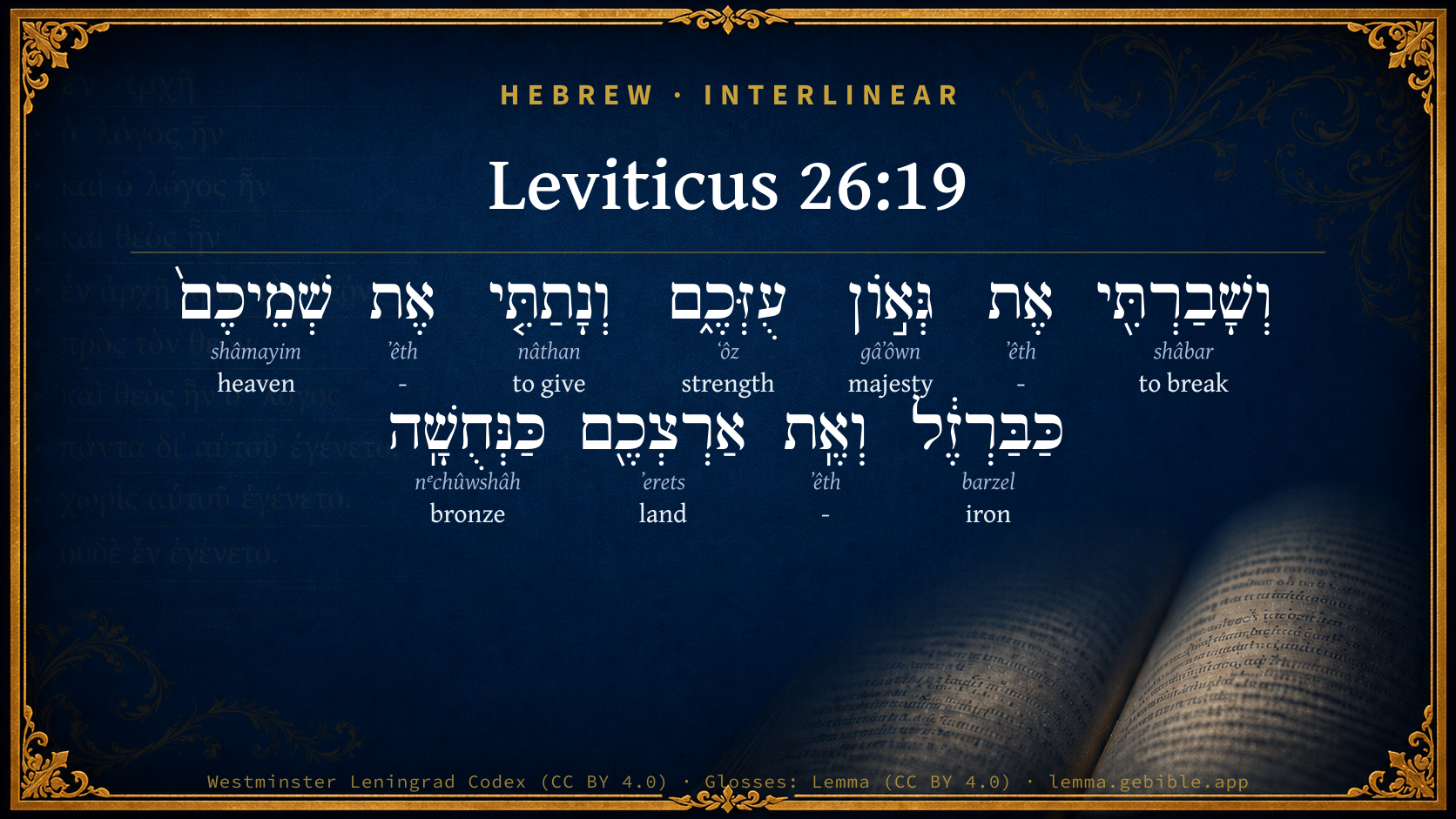
Hebrew (Westminster Leningrad Codex) Leviticus 26:19 appears in the Hebrew Old Testament. The text above is from the Westminster Leningrad Codex. Each word links to its Strong’s number, a concise gloss, and parsing drawn from the Open Scriptures Hebrew Bible morphology. Click any word for its full Brown-Driver-Briggs (BDB) entry.
Download image
Cite this verse

Leviticus 26:19 (World English Bible). Public Domain. Lemma interlinear Bible study tool, https://lemma.gebible.app/v/leviticus/26/19.

Show BibTeX & RIS
BibTeX
RIS
English Translation
I will break the pride of your power, and I will make your sky like iron, and your soil like brass;
World English Bible · Public Domain
Highlights
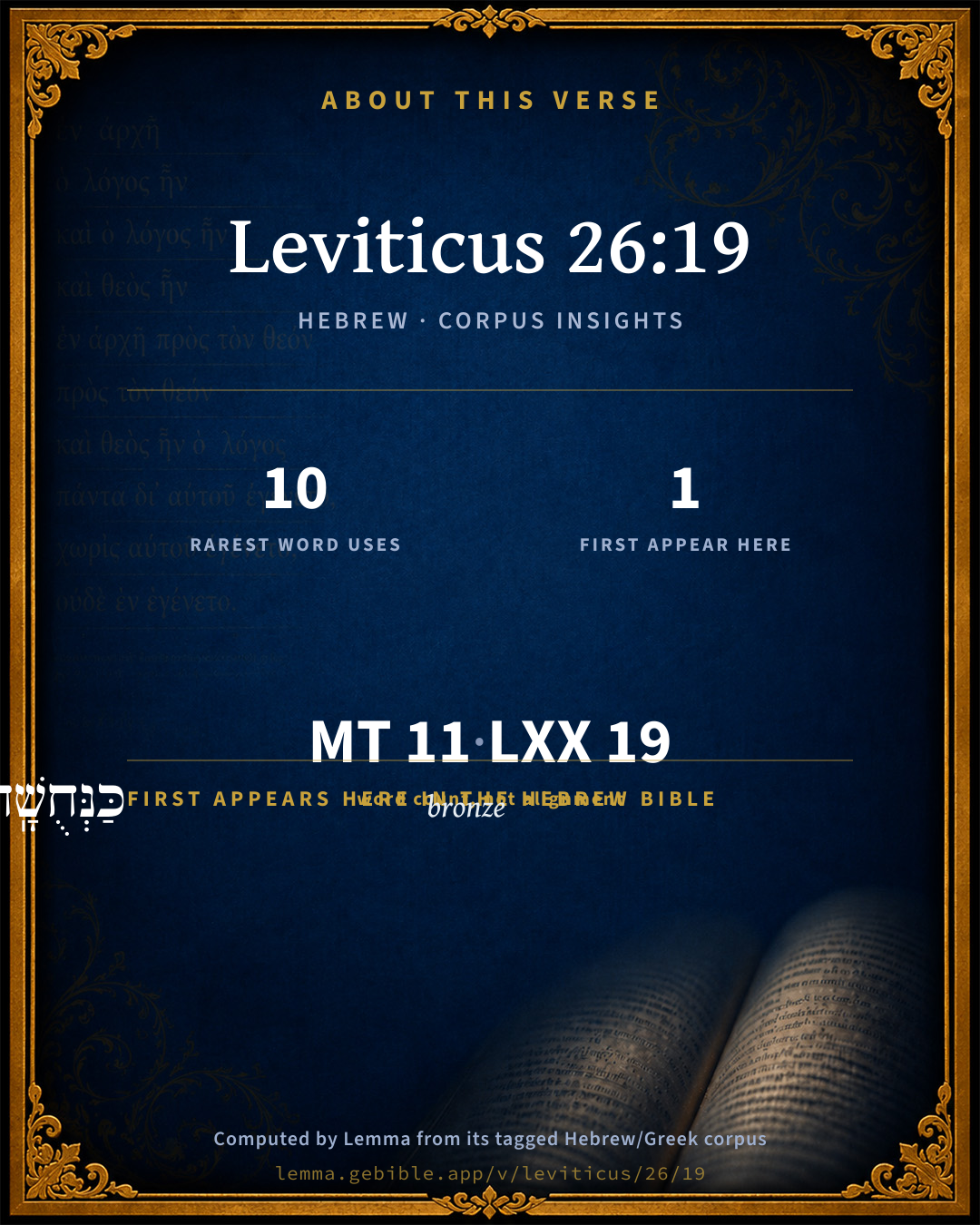
  • 1 first appearance in the Hebrew Bible
Full analysis ↓
Download a study sheet

One document with this verse’s original text, its word-by-word gloss line, the meaning frame, cross-references with their text, attributed commentary, and full source and license credits — printable, and it pastes into notes with its structure intact.

This verse Autodidact and up

Study sheet (.html) Plain text (.txt)

A passage Seminary Student

Up to 50 verses in one chapter. A passage sheet keeps up to 6 commentary sources and 12 cross-references per verse, in the order this page ranks them, and says so on the sheet whenever that leaves anything out. Ask for a single verse and you get the Autodidact verse sheet above.

Everything on this page stays free to read, with no account — the sheet is a download of what is already on screen, not access to it.

Want to remove ads? Support Godless Engineer
Compare translations 3

The same verse in 3 English versions, stacked beneath the original-language interlinear above. Click any original word for its lexicon entry.

Each is an independent rendering of the whole verse — the interlinear is not word-aligned to these translations.

Highlighted words mark where these versions differ — a whole-verse word diff, not a word-by-word alignment.

  • World English Bible Public Domain
    I will break the pride of your power, and I will make your sky like iron, and your soil like brass;
  • King James Version Public Domain
    And I will break the pride of your power; and I will make your heaven as iron, and your earth as brass:
  • unfoldingWord Literal Text CC BY-SA 4.0
    Then I will break the pride of your strength, and I will make your heavens like iron and your land like bronze.

unfoldingWord Literal Text — © unfoldingWord, licensed CC BY-SA 4.0. Word-aligned USFM3 via Door43 (git.door43.org/unfoldingWord/en_ult).

Versions to compare (up to 4)

3 of 4 selected

Show all 18 translations

Every available English version of this verse, each an independent rendering of the whole verse.

  • World English Bible Public Domain
    I will break the pride of your power, and I will make your sky like iron, and your soil like brass;
  • Berean Standard Bible Public Domain
    I will break down your stubborn pride and make your sky like iron and your land like bronze,
  • Majority Standard Bible Public Domain
    I will break down your stubborn pride and make your sky like iron and your land like bronze,
  • King James Version Public Domain
    And I will break the pride of your power; and I will make your heaven as iron, and your earth as brass:
  • American Standard Version (1901) Public Domain
    And I will break the pride of your power: and I will make your heaven as iron, and your earth as brass;
  • Revised Version (1885) Public Domain
    And I will break the pride of your power; and I will make your heaven as iron, and your earth as brass:
  • Geneva Bible (1599) Public Domain
    And I wil breake the pride of your power, and I will make your heauen as yron, and your earth as brasse:
  • Douay-Rheims (1899) Public Domain
    And I will break the pride of your stubbornness, and I will make to you the heaven above as iron, and the earth as brass:
  • Young's Literal Translation Public Domain
    and I have broken the pride of your strength, and have made your heavens as iron, and your earth as brass;
  • Literal Standard Version CC BY-SA 4.0
    and I have broken the pride of your strength, and have made your heavens as iron, and your earth as bronze;
  • Unlocked Literal Bible CC BY-SA 4.0
    I will break your pride in your power. I will make the sky over you like iron and your land like bronze.
  • unfoldingWord Literal Text CC BY-SA 4.0
    Then I will break the pride of your strength, and I will make your heavens like iron and your land like bronze.
  • Darby Bible Public Domain
    and I will break the arrogance of your power; and I will make your heaven as iron, and your earth as bronze,
  • World Messianic Bible Public Domain
    I will break the pride of your power, and I will make your sky like iron, and your soil like bronze.
  • Webster's Bible Public Domain
    And I will break the pride of your power; and I will make your heaven as iron, and your earth as brass:
  • Free Bible Version CC BY-SA 4.0
    I will break your self-reliant strength you're so proud of, and make your sky hard as iron and your land hard as bronze.
  • Bible in Basic English Public Domain
    And the pride of your strength will be broken, and I will make your heaven as iron and your earth as brass;
  • JPS Tanakh (1917) Public Domain
    And I will break the pride of your power; and I will make your heaven as iron, and your earth as brass.

Literal Standard Version (2020), Covenant Press — licensed CC BY-SA 4.0. Text via the HelloAO Bible API (eBible.org). Unlocked Literal Bible (unfoldingWord) — licensed CC BY-SA 4.0. Text via the HelloAO Bible API (eBible.org). unfoldingWord Literal Text — © unfoldingWord, licensed CC BY-SA 4.0. Word-aligned USFM3 via Door43 (git.door43.org/unfoldingWord/en_ult). Free Bible Version, Dr. Jonathan Gallagher — licensed CC BY-SA 4.0. Text via the HelloAO Bible API (eBible.org).

Word by word

More ways to search: Search by grammar → Find every occurrence → Compare this word →

Practice this passage: Drill this verse → Learn its vocabulary →

כַּנְּחֻשָֽׁה
nᵉchûwshâh
H5154
“like/as the · bronze”
Preposition, Determined + Noun, Common, Feminine, Singular, Absolute
Part of Speech
Preposition + Noun
Type
Common
Gender
Feminine
Number
Singular
State
Absolute
Full BDB Definition

Origin: from H5153

TWOT: 1349b

copper, bronze - copper (made from melting copper ore) - bronze (made from copper and alloy)
  1. וְשָׁבַרְתִּ֖י shâbar H7665 “and · to break” Conjunction + Verb, Qal, Sequential Perfect, 1st Person, Common, Singular
  2. אֶת ʼêth H853 “-” Particle, Direct Object
  3. גְּא֣וֹן gâʼôwn H1347 “majesty of” Noun, Common, Masculine, Singular, Construct
  4. עֻזְּכֶ֑ם ʻôz H5797 “strength · your” Noun, Common, Masculine, Singular, Construct + Suffix, Personal, 2nd Person, Masculine, Plural
  5. וְנָתַתִּ֤י nâthan H5414 “and · to give” Conjunction + Verb, Qal, Sequential Perfect, 1st Person, Common, Singular
  6. אֶת ʼêth H853 “-” Particle, Direct Object
  7. שְׁמֵיכֶם֙ shâmayim H8064 “heaven(s) · your” Noun, Common, Masculine, Plural, Construct + Suffix, Personal, 2nd Person, Masculine, Plural
  8. כַּבַּרְזֶ֔ל barzel H1270 “like/as the · iron” Preposition, Determined + Noun, Common, Masculine, Singular, Absolute
  9. וְאֶֽת ʼêth H853 “and · -” Conjunction + Particle, Direct Object
  10. אַרְצְכֶ֖ם ʼerets H776 “land · your” Noun, Common, Both, Singular, Construct + Suffix, Personal, 2nd Person, Masculine, Plural

About this verse

These counts appear in no published source. They are computed here, from the morphology-tagged text and Lemma’s own curated glosses. What Lemma adds →

11
words
9
distinct lemmas
Pentateuch
section

Notable vocabulary

The rarest word here is כַּנְּחֻשָֽׁה bronze H5154 — appearing just 10 times in the whole Hebrew Bible.

First appearance in Scripture

This word makes its first canonical appearance in the Hebrew Bible here:

  • כַּנְּחֻשָֽׁה bronze H5154

Shared distinctive vocabulary

כַּנְּחֻשָֽׁה bronze H5154 occurs in 10 verses of the Hebrew Bible. Also found in:

Grammatical profile

  • 2 verbs
  • 6 nouns
  • 3 particles

Verb forms

  • וְשָׁבַרְתִּ֖י Qal · Sequential Perfect
  • וְנָתַתִּ֤י Qal · Sequential Perfect

Hebrew & Septuagint length

In English translation the verse runs 21 words from the Hebrew and 24 from the Septuagint (LXX English) — closely comparable.

A rough comparison of the two English renderings, which tokenize alike — not a word-level alignment.

Word counts can differ between the Hebrew and the Greek without any difference in meaning — e.g. the Hebrew direct-object marker אֵת has no separate Greek word, and Greek often adds the article ὁ.

In the original languages it is 11 Hebrew tokens and 19 Greek tokens — but the two are counted differently (Hebrew bundles its prefixes and suffixes into one token; the Greek is in lemma form), so that isn’t a like-for-like length.

Cross-references

14

Topical passages linked to Leviticus 26:19 in the Treasury of Scripture Knowledge — connected by theme and wording, ordered by reader-vote popularity; previews shown in the World English Bible.

  • Deuteronomy 28:23 Your sky that is over your head shall be brass, and the earth that is under you shall be iron.
  • 1 Kings 17:1 Elijah the Tishbite, who was of the foreigners of Gilead, said to Ahab, As Yahweh, the God of Israel, lives, before whom I stand, there shall not be dew nor rain these years, but according to my word.
  • 1 Samuel 4:11 The ark of God was taken; and the two sons of Eli, Hophni and Phinehas, were slain.
  • Isaiah 25:11 He shall spread forth his hands in the midst of it, as he who swims spreads forth [his hands] to swim; but [Yahweh] will lay low his pride together with the craft of his hands.
  • Jeremiah 13:9 Thus says Yahweh, After this manner will I mar the pride of Judah, and the great pride of Jerusalem.
  • Jeremiah 14:1–6 The word of Yahweh that came to Jeremiah concerning the drought.
  • Ezekiel 30:6 Thus says Yahweh: They also who uphold Egypt shall fall; and the pride of her power shall come down: from the tower of Seveneh shall they fall in it by the sword, says the Lord Yahweh.
  • Daniel 4:37 Now I, Nebuchadnezzar, praise and extol and honor the King of heaven; for all his works are truth, and his ways justice; and those who walk in pride he is able to abase.
  • Zephaniah 3:11 In that day you will not be disappointed for all your doings, in which you have transgressed against me; for then I will take away out of the midst of you your proudly exulting ones, and you will no more be haughty in my holy mountain.
  • Luke 4:25 But truly I tell you, there were many widows in Israel in the days of Elijah, when the sky was shut up three years and six months, when a great famine came over all the land.
  • 1 Samuel 4:3 When the people were come into the camp, the elders of Israel said, Why has Yahweh struck us today before the Philistines? Let us get the ark of the covenant of Yahweh out of Shiloh to us, that it may come among us, and save us out of the hand of our enemies.
  • Isaiah 2:12 For there will be a day of Yahweh of Hosts for all that is proud and haughty, And for all that is lifted up; And it shall be brought low:
  • Isaiah 26:5 For he has brought down those who dwell on high, the lofty city: he lays it low, he lays it low even to the ground; he brings it even to the dust.
  • Ezekiel 7:24 Therefore I will bring the worst of the nations, and they shall possess their houses: I will also make the pride of the strong to cease; and their holy places shall be profaned.

Cross-references courtesy of OpenBible.info (CC BY 4.0).

Hebrew and Greek witnesses Masoretic Hebrew ↔ Greek Septuagint

The same verse in the two great witnesses to the Old Testament, shown verse-for-verse.

These are two independent witnesses, not word-aligned to each other, and the Septuagint is shown in lemma (dictionary) form.

Hebrew Leviticus 26:19 Masoretic · Westminster Leningrad Codex

וְשָׁבַרְתִּ֖י אֶת גְּא֣וֹן עֻזְּכֶ֑ם וְנָתַתִּ֤י אֶת שְׁמֵיכֶם֙ כַּבַּרְזֶ֔ל וְאֶֽת אַרְצְכֶ֖ם כַּנְּחֻשָֽׁה

I will break the pride of your power, and I will make your sky like iron, and your soil like brass;

World English Bible · Public Domain

Greek LXX Leviticus 26:19 Septuagint · lemma form

καί συντρίβω ὁ ὕβρις ὁ ὑπερηφανία σύ καί τίθημι ὁ οὐρανός σύ σιδηροῦς καί ὁ γῆ σύ ὡσεί χαλκοῦς

And I will break down the haughtiness of your pride; and I will make your heaven iron, and your earth as it were brass.

LXX2012 (modern English Septuagint) · Public Domain

On this verse, The Cambridge Bible for Schools and Colleges discusses the Septuagint’s reading. Read the note in Commentary ↓

Hebrew: Westminster Leningrad Codex (CC BY 4.0). Greek: Septuagint (public domain); English from LXX2012 (modern English Septuagint) (Public Domain). How the Septuagint differs from the Hebrew →

Targum (Aramaic paraphrase)

2

The Targum is the ancient Jewish Aramaic paraphrase of the Hebrew Scriptures — an interpretive translation, not the Hebrew text itself. Onkelos (literal) and Pseudo-Jonathan (expansive) render the Torah, and Jonathan the Prophets. Coverage is partial: where no permissively-licensed English translation exists for a verse, only the Aramaic is shown. This is verse-level text, not a word-by-word alignment to the Hebrew.

  1. Targum Onkelos Torah (Genesis–Deuteronomy)
    וְאֶתְבַּר יָת יְקַר תָּקְפְּכוֹן וְאֶתֵּן יָת שְׁמַיָא דִי עִלָוֵיכוֹן תַּקִיפִין כְּפַרְזְלָא מִלַאֲחָתָא מִטְרָא וְאַרְעָא דִתְחוֹתֵיכוֹן חֲסִינָא כִּנְחָשָׁא מִלְמֶעְבַּד פֵּירִין

    (no public-domain English translation for this verse)

    Targum Onkelos — Aramaic: “Onkelos Genesis” (public domain); “Onkelos Exodus” (public domain); “Onkelos Leviticus” (public domain); “Onkelos Numbers” (public domain); “Onkelos Deuteronomy” (public domain). English: “Sefaria Community Translation” (CC0 1.0 (public-domain dedication)); “J.W. Etheridge. The Targums of Onkelos and Jonathan Ben Uzziel on the Pentateuch. London: Longmans, Green, 1862” (public domain). Text via Sefaria.

  2. Targum Pseudo-Jonathan Torah (Genesis–Deuteronomy)
    וְאִיתְבַּר יַת אִיקַר תְּקוֹף מִקְדָשֵׁיכוֹן וְאֶתֵּן יַת שְׁמַיָא דְעִילַוֵיכוֹן בְּרִידַן הֵי כְפַרְזְלָא דְלָא מְזִיעַ מִן דְלָא לְמַחְתָא לְכוֹן טַלִין וּמִיטְרִין וְאַרְעָא דִתְחוֹתֵיכוֹן הֵי כִנְחָשָׁא דִמְזִיעַ לְמוֹבְדָא פֵּירָהָא

    And I will break down the glory of the strength of your sanctuary, and will make the heavens above you obdurate as iron, to yield no moisture, nor send you dew or rain, and the ground beneath you to be like brass to put forth (only) to destroy its fruit.

    Targum Pseudo-Jonathan — Aramaic: “Targum Jonathan on Genesis” (public domain); “Targum Jonathan on Exodus” (public domain); “Targum Jonathan on Leviticus” (public domain); “Targum Jonathan on Numbers” (public domain); “Targum Jonathan on Deuteronomy” (public domain). English: “The Targum of Jonathan ben Uzziel, trans. J. W. Etheridge, London, 1862” (public domain). Text via Sefaria.

Commentary

Notes on Leviticus 26:19 from classic Christian and Jewish commentators (each source and its license shown beneath its notes). The classic Christian expositions comment on the surrounding passage and are grouped to its opening verse, so a note may address several verses; the Jewish commentaries on the Tanakh (Rashi and others) are per-verse, so they appear only where the commentator wrote on this verse.

Lemma curates 59 commentaries, every one of them public domain or Creative Commons licensed, each selected and text-cleaned for this edition rather than reprinted as found. About our sources →

Trapp's Complete Commentary

John Trapp

Lev 26:19 And I will break the pride of your power; and I will make your heaven as iron, and your earth as brass:

Ver. 19. Your heaven as iron.] Hard hearts make hard times.

“ En quia iam nobis sint ferrea pectora, reddit

Coelum etiam nobis durius aere Deus.

Et quia iam nummos gignant pro faenore nummi:

Ante ferax tellus desinit esse ferax. ”{ a}

{a} Bill. Anthol., lib. ii.

John Trapp, A Commentary or Exposition upon All the Books of the Old and New Testament (1647–1656) — public domain. Text from a community e-Sword module.

Joseph Benson's Commentary

Lev 26:19-20. The pride of your power — That is, your strength, of which you are proud, your numerous and united forces, your kingdom, yea, your ark and sanctuary. I will make your heaven as iron — The heavens shall yield you no rain, nor the earth, fruits. Your strength shall be spent in vain — In ploughing, and sowing, and tilling the ground.

Joseph Benson's Commentary on the Old and New Testaments (1811–1818) — public domain. Text from a community e-Sword module.

Tyndale Open Study Notes

Tyndale Open Resources

26:19-20 If God withholds rain, the ground will be hard and unproductive.

Tyndale Open Study Notes — © Tyndale Open Resources, licensed CC BY-SA 4.0. Text via the HelloAO Bible API.

Geneva Bible (1599)

Geneva Bible translators

Ye shall have drought and barrenness, Hag. 1:10.

Geneva Bible (1599) marginal notes — public domain. Text via Bolls.life.

Jamieson, Fausset & Brown

Robert Jamieson, A. R. Fausset & David Brown

I will make your heaven as iron, and your earth as brass--No figures could have been employed to convey a better idea of severe and long-continued famine.

Jamieson, Fausset & Brown — Commentary Critical and Explanatory on the Whole Bible (1871) — public domain (CC PDM 1.0). Text via the HelloAO Bible API.

Ellicott's Commentary for English Readers

(19) And I will break the pride of your power.—That is, the strength which is the cause of your pride, the wealth which they derive from the abundant harvests mentioned in Lev_26:4-5, as is evident from what follows immediately, where the punishment is threatened against the resources of this power or wealth. Comp. Eze_30:6; Eze_33:28.) The authorities during the second Temple, however, took the phrase “the pride of your power” to denote the sanctuary, which is called “the pride of your power” in Eze_24:21. the expression used here, but the identity of which is obliterated in the Authorised Version by rendering the phrase “the excellency of your strength.” Hence the Chaldee Versions paraphrase it, “And I will break down the glory of the strength of your sanctuary.”

I will make your heaven as iron.—That is, the heaven which is over them shall yield no more rain than if it were of metal. In Deu_28:23, where the same punishment is threatened, and the same figure is used, the metals are reversed, the heaven is brass, and the earth iron.

A Bible Commentary for English Readers, edited by Charles John Ellicott (1878–1897) — public domain. Text from a community e-Sword module.

The Cambridge Bible for Schools and Colleges

gen. ed. J. J. S. Perowne

19. the pride of your power] the pride with which ye rely upon your prosperity and the fruitfulness of your land. The expression is found elsewhere only in Ezekiel, where in Eze_7:24 LXX., Eze_24:21, Eze_33:28 it refers to the fall of the nation and the destruction of Jerusalem; in Eze_30:6; Eze_30:18, the phrase is applied to Egypt.

The Cambridge Bible for Schools and Colleges (gen. ed. J. J. S. Perowne; Cambridge University Press, 1878–1918) — public domain. Text from a community e-Sword module.

John Gill's Exposition

And your strength shall be spent in vain,.... In endeavouring to till the ground, to plough, or sow, or to dig about the vines or olives, and prune them:

for your land shall not yield its increase; produce corn, and bring forth grass, the one for the use of men, the other for the use of the cattle, and therefore both must starve:

neither shall the trees of the land yield their fruits; such as vines, olives, figs, pomegranates, &c. which were very plentiful in the land of Judea, and on which they much lived, and on which their more comfortable subsistence at least depended, see Hab 3:17; all this is the reverse of Lev 26:4.

John Gill's Exposition of the Whole Bible (1746–1763) — public domain (CC PDM 1.0). Text via the HelloAO Bible API.

Haydock's Catholic Bible Commentary

As brass (æneam). "Brazen," without moisture, and barren. (Onkelos)

George Leo Haydock (1774–1849), Haydock's Catholic Family Bible and Commentary, 1859 edition — public domain. Excludes Psalms (Douay-Rheims chapter numbering differs from Protestant) and Deuterocanonical books (Catholic canon only).

Matthew Poole's English Annotations

The pride of your power, i.e. your strength, of which you are proud, your numerous and united forces, your kingdom, yea, your ark and sanctuary.

Your earth as brass; the heavens shall yield you no rain, nor the earth fruits.

Matthew Poole's English Annotations on the Holy Bible (1683–1685) — public domain. Text from a community e-Sword/MySword module.

Whedon's Commentary on the Bible

Daniel D. Whedon

19, 20. Pride of… power — The conceit of national puissance, which is so unlike the spirit of dependence and humility, must be eradicated by painful methods.

Heaven as iron — The rain promised to the obedient shall be withheld from the disobedient. See Lev_26:4, note.

Earth as brass — Through lack of water the fields will be as void of herbage as if metallic.

They shall yield no increase under the divine curse, in amazing contrast to the plethoric garners promised in Lev_26:4-5. In respect to spiritual good, the same contrast exists now between those who distrust and those who fully believe the promise of the Father respecting the gift of the Holy Ghost.

Daniel D. Whedon (gen. ed.), Commentary on the Old and New Testaments (1874–1909) — public domain. Text from a community e-Sword module.

Rashi

Rabbi Shlomo Yitzchaki (Rashi)

ושברתי את גאון עזכם AND I WILL BREAK THE EXCELLENCY OF YOUR STRENGTH — This is a reference to the Temple; for thus does it state, (Ezekiel 24:21) “Behold I will profane my sanctuary, the excellency of your strength”.

ונתתי את שמיכם כברזל ואת ארצכם כנחשה AND I WILL MAKE YOUR HEAVEN AS IRON AND YOUR EARTH AS COPPER — This threat is even severer than that of Moses, because there it says, (Deuteronomy 28:23) “And thy heaven that is over thy head shall be copper, [and the earth that is under thee shall be iron]” which implies that the heaven will at least exude moisture (will give some humidity) just as the copper exudes moisture, whilst the earth will not exude just as iron does not exude, and so it will keep its fruit in good condition, since it will not be too humid. Here, however, Scripture threatens that the heaven will not exude moisture, just as iron does not exude, and there will therefore be draught in the world, whilst the earth will exude (be too humid) just as copper sweats, and it will consequently make its fruits perish (Sifra, Bechukotai, Chapter 5 3).

Rashi on the Tanakh — English translations: “The Judaica Press complete Tanach with Rashi, translated by A. J. Rosenberg” (CC BY 4.0); “Pentateuch with Rashi's commentary by M. Rosenbaum and A.M. Silbermann, 1929-1934” (public domain); “The Metsudah Tanach series, Lakewood, N.J” (CC BY 4.0); and “The Book of Joshua, Metsudah Publications, 1997” (CC BY 4.0). Text via Sefaria.

Lesson kit

Teaching starters — assembled from the data on this page, not authored interpretation. Every prompt links to the verse data it draws on. Edit before teaching.

Leviticus, in the Pentateuch, opens this verse with 11 words (9 distinct Hebrew lemmas). Its most distinctive word is nᵉchûwshâh (“bronze”). A historical commentator’s framing appears above. Read the whole chapter for the surrounding context.

Discussion questions

  1. What does “bronze” (nᵉchûwshâh) contribute to the verse as a whole?
  2. The word “bronze” first appears here in Scripture. What is being introduced at this debut?
  3. 2 Samuel 22:35 shares the word «bronze» with this verse. How do the two illuminate each other?
  4. These translations render this verse differently; the difference is in the English rendering, not the original. What questions does that raise?
  5. The verb «וְשָׁבַרְתִּ֖י» is Qal Sequential Perfect. How does its form color the action?
  6. Reading how Trapp's Complete Commentary and Joseph Benson's Commentary read this verse, where do the two commentators agree and where do they part?

Things to notice

Reading settings

Reading text

Shown beneath each verse's original-language words.

Old Testament
Old Testament edition

Read the OT as the Masoretic Hebrew (MT) or the Greek Septuagint (LXX).

English shown for the Greek Septuagint (in the Hebrew ↔ Greek comparison).

Comparing translations? Open the Compare panel on any verse page to stack up to four side by side.