
Genesis 1:30

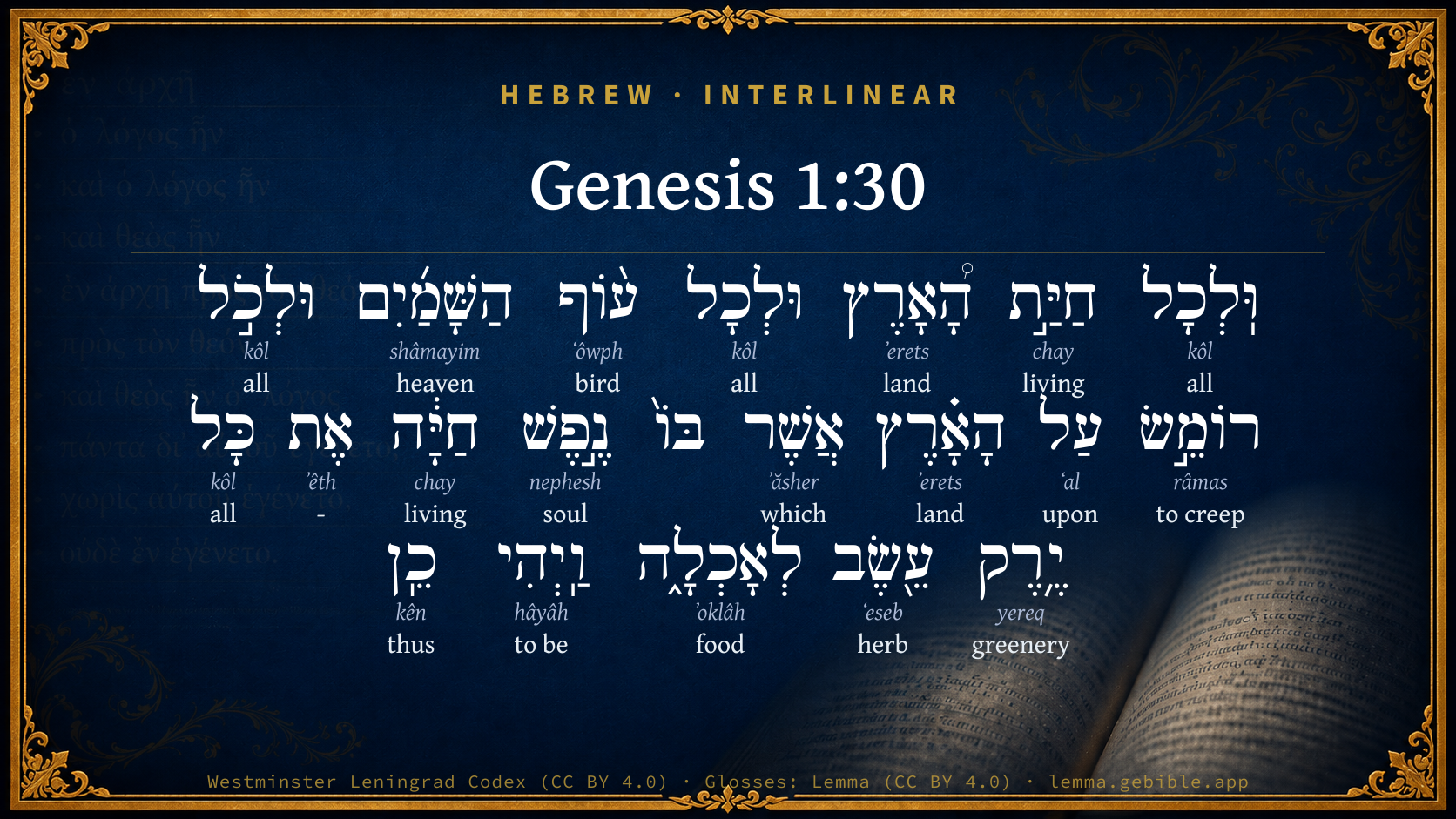
Hebrew (Westminster Leningrad Codex) Genesis 1:30 appears in the Hebrew Old Testament. The text above is from the Westminster Leningrad Codex. Each word links to its Strong’s number, a concise gloss, and parsing drawn from the Open Scriptures Hebrew Bible morphology. Click any word for its full Brown-Driver-Briggs (BDB) entry.
Download image
Cite this verse

Genesis 1:30 (World English Bible). Public Domain. Lemma interlinear Bible study tool, https://lemma.gebible.app/v/genesis/1/30.

Show BibTeX & RIS
BibTeX
RIS
English Translation
To every animal of the earth, and to every bird of the sky, and to everything that creeps on the earth, in which there is life, I have given every green herb for food." And it was so.
World English Bible · Public Domain
Highlights
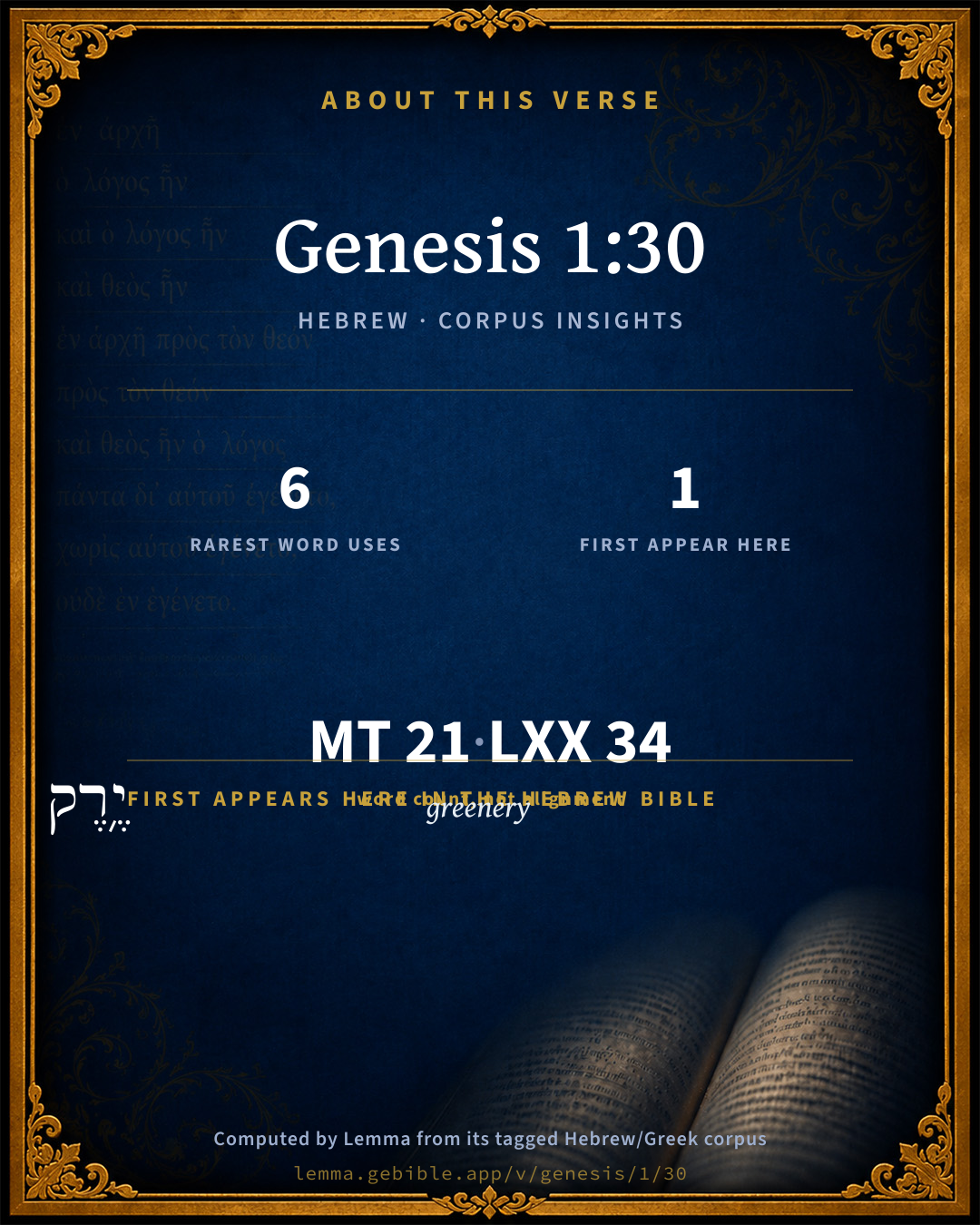
  • 1 first appearance in the Hebrew Bible
Full analysis ↓
Download a study sheet

One document with this verse’s original text, its word-by-word gloss line, the meaning frame, cross-references with their text, attributed commentary, and full source and license credits — printable, and it pastes into notes with its structure intact.

This verse Autodidact and up

Study sheet (.html) Plain text (.txt)

A passage Seminary Student

Up to 50 verses in one chapter. A passage sheet keeps up to 6 commentary sources and 12 cross-references per verse, in the order this page ranks them, and says so on the sheet whenever that leaves anything out. Ask for a single verse and you get the Autodidact verse sheet above.

Everything on this page stays free to read, with no account — the sheet is a download of what is already on screen, not access to it.

Want to remove ads? Support Godless Engineer
Compare translations 3

The same verse in 3 English versions, stacked beneath the original-language interlinear above. Click any original word for its lexicon entry.

Each is an independent rendering of the whole verse — the interlinear is not word-aligned to these translations.

Highlighted words mark where these versions differ — a whole-verse word diff, not a word-by-word alignment.

  • World English Bible Public Domain
    To every animal of the earth, and to every bird of the sky, and to everything that creeps on the earth, in which there is life, I have given every green herb for food." And it was so.
  • King James Version Public Domain
    And to every beast of the earth, and to every fowl of the air, and to every thing that creepeth upon the earth, wherein there is life, I have given every green herb for meat: and it was so.
  • unfoldingWord Literal Text CC BY-SA 4.0
    And to every living thing of the earth, and to every bird of the sky, and to every moving on the earth that living breath in it, every green plant for food.” And it was so.

unfoldingWord Literal Text — © unfoldingWord, licensed CC BY-SA 4.0. Word-aligned USFM3 via Door43 (git.door43.org/unfoldingWord/en_ult).

Versions to compare (up to 4)

3 of 4 selected

Show all 18 translations

Every available English version of this verse, each an independent rendering of the whole verse.

  • World English Bible Public Domain
    To every animal of the earth, and to every bird of the sky, and to everything that creeps on the earth, in which there is life, I have given every green herb for food." And it was so.
  • Berean Standard Bible Public Domain
    And to every beast of the earth and every bird of the air and every creature that crawls upon the earth—everything that has the breath of life in it—I have given every green plant for food.” And it was so.
  • Majority Standard Bible Public Domain
    And to every beast of the earth and every bird of the air and every creature that crawls upon the earth—everything that has the breath of life in it—I have given every green plant for food.” And it was so.
  • King James Version Public Domain
    And to every beast of the earth, and to every fowl of the air, and to every thing that creepeth upon the earth, wherein there is life, I have given every green herb for meat: and it was so.
  • American Standard Version (1901) Public Domain
    and to every beast of the earth, and to every bird of the heavens, and to everything that creepeth upon the earth, wherein there is life, `I have given' every green herb for food: and it was so.
  • Revised Version (1885) Public Domain
    and to every beast of the earth, and to every fowl of the air, and to every thing that creepeth upon the earth, wherein there is life, I have given every green herb for meat: and it was so.
  • Geneva Bible (1599) Public Domain
    Likewise to euery beast of the earth, and to euery foule of the heauen, and to euery thing that moueth vpon the earth, which hath life in it selfe, euery greene herbe shall be for meate. and it was so.
  • Douay-Rheims (1899) Public Domain
    And to all the beasts of the earth, and to every fowl of the air, and to all that move upon the earth, and wherein there is life, that they may have to feed upon. And it was so done.
  • Young's Literal Translation Public Domain
    and to every beast of the earth, and to every fowl of the heavens, and to every creeping thing on the earth, in which `is' breath of life, every green herb `is' for food:' and it is so.
  • Literal Standard Version CC BY-SA 4.0
    and to every beast of the earth, and to every bird of the heavens, and to every creeping thing on the earth, in which [is] breath of life, every green herb [is] for food”: and it is so.
  • Unlocked Literal Bible CC BY-SA 4.0
    To every beast of the earth, to every bird of the heavens, and to everything that creeps upon the earth, and to every creature that has the breath of life I have given every green plant for food.” It was so.
  • unfoldingWord Literal Text CC BY-SA 4.0
    And to every living thing of the earth, and to every bird of the sky, and to every moving on the earth that living breath in it, every green plant for food.” And it was so.
  • Darby Bible Public Domain
    and to every animal of the earth, and to every fowl of the heavens, and to everything that creepeth on the earth, in which is a living soul, every green herb for food. And it was so.
  • World Messianic Bible Public Domain
    To every animal of the earth, and to every bird of the sky, and to everything that creeps on the earth, in which there is life, I have given every green herb for food;” and it was so.
  • Webster's Bible Public Domain
    And to every beast of the earth, and to every fowl of the air, and to every animal that creepeth upon the earth, in which is life, I have given every green herb for food: and it was so.
  • Free Bible Version CC BY-SA 4.0
    I'm giving all the green plants to all the land animals, to the birds, and to every creature that moves on the earth—to every living thing.” And that's what happened.
  • Bible in Basic English Public Domain
    And to every beast of the earth and to every bird of the air and every living thing moving on the face of the earth I have given every green plant for food: and it was so.
  • JPS Tanakh (1917) Public Domain
    and to every beast of the earth, and to every fowl of the air, and to every thing that creepeth upon the earth, wherein there is a living soul, I have given every green herb for food.' And it was so.

Literal Standard Version (2020), Covenant Press — licensed CC BY-SA 4.0. Text via the HelloAO Bible API (eBible.org). Unlocked Literal Bible (unfoldingWord) — licensed CC BY-SA 4.0. Text via the HelloAO Bible API (eBible.org). unfoldingWord Literal Text — © unfoldingWord, licensed CC BY-SA 4.0. Word-aligned USFM3 via Door43 (git.door43.org/unfoldingWord/en_ult). Free Bible Version, Dr. Jonathan Gallagher — licensed CC BY-SA 4.0. Text via the HelloAO Bible API (eBible.org).

Word by word

More ways to search: Search by grammar → Find every occurrence → Compare this word →

Practice this passage: Drill this verse → Learn its vocabulary →

יֶ֥רֶק
yereq
H3418
“greenery”
Noun, Common, Masculine, Singular, Absolute
Part of Speech
Noun
Type
Common
Gender
Masculine
Number
Singular
State
Absolute
Full BDB Definition

Origin: from H3417 (in the sense of vacuity of colour)

TWOT: 918a

green, greenness, green plants, greenery
  1. וּֽלְכָל kôl H3605 “and · to/for · all of” Conjunction + Preposition + Noun, Common, Masculine, Singular, Construct
  2. חַיַּ֣ת chay H2416 “living of” Noun, Common, Feminine, Singular, Construct
  3. הָ֠אָרֶץ ʼerets H776 “the · land” Particle, Definite Article + Noun, Common, Both, Singular, Absolute
  4. וּלְכָל kôl H3605 “and · to/for · all of” Conjunction + Preposition + Noun, Common, Masculine, Singular, Construct
  5. ע֨וֹף ʻôwph H5775 “bird of” Noun, Common, Masculine, Singular, Construct
  6. הַשָּׁמַ֜יִם shâmayim H8064 “the · heaven(s)” Particle, Definite Article + Noun, Common, Masculine, Plural, Absolute
  7. וּלְכֹ֣ל kôl H3605 “and · to/for · all of” Conjunction + Preposition + Noun, Common, Masculine, Singular, Construct
  8. רוֹמֵ֣שׂ râmas H7430 “creeping” Verb, Qal, Participle Active, Masculine, Singular, Absolute
  9. עַל ʻal H5921 “upon” Preposition
  10. הָאָ֗רֶץ ʼerets H776 “the · land” Particle, Definite Article + Noun, Common, Both, Singular, Absolute
  11. אֲשֶׁר ʼăsher H834 “which” Particle, Relative
  12. נֶ֣פֶשׁ nephesh H5315 “soul” Noun, Common, Both, Singular, Absolute
  13. חַיָּ֔ה chay H2416 “living” Adjective, Adjective, Feminine, Singular, Absolute
  14. אֶת ʼêth H853 “-” Particle, Direct Object
  15. כָּל kôl H3605 “all of” Noun, Common, Masculine, Singular, Construct
  16. עֵ֖שֶׂב ʻeseb H6212 “herb” Noun, Common, Masculine, Singular, Absolute
  17. לְאָכְלָ֑ה ʼoklâh H402 “to/for · food” Preposition + Noun, Common, Feminine, Singular, Absolute
  18. וַֽיְהִי hâyâh H1961 “and · to be” Conjunction + Verb, Qal, Sequential Imperfect, 3rd Person, Masculine, Singular
  19. כֵֽן kên H3651 “thus” Adverb

About this verse

These counts appear in no published source. They are computed here, from the morphology-tagged text and Lemma’s own curated glosses. What Lemma adds →

21
words
15
distinct lemmas
Pentateuch
section

Notable vocabulary

The rarest word here is יֶ֥רֶק greenery H3418 — appearing just 6 times in the whole Hebrew Bible.

First appearance in Scripture

This word makes its first canonical appearance in the Hebrew Bible here:

  • יֶ֥רֶק greenery H3418

Shared distinctive vocabulary

יֶ֥רֶק greenery H3418 occurs in 6 verses of the Hebrew Bible. Also found in:

Grammatical profile

  • 2 verbs
  • 13 nouns
  • 1 adjective
  • 2 prepositions
  • 1 adverb
  • 2 particles

Verb forms

  • רוֹמֵ֣שׂ Qal · Participle Active
  • וַֽיְהִי Qal · Sequential Imperfect

Repetition

Words recur within this verse — often emphatic in Hebrew:

  • וּֽלְכָל all H3605 ×4
  • חַיַּ֣ת living H2416 ×2
  • הָ֠אָרֶץ land H776 ×2

Hebrew & Septuagint length

In English translation the verse runs 38 words from the Hebrew and 43 from the Septuagint (LXX English) — closely comparable.

A rough comparison of the two English renderings, which tokenize alike — not a word-level alignment.

Word counts can differ between the Hebrew and the Greek without any difference in meaning — e.g. the Hebrew direct-object marker אֵת has no separate Greek word, and Greek often adds the article ὁ.

In the original languages it is 21 Hebrew tokens and 34 Greek tokens — but the two are counted differently (Hebrew bundles its prefixes and suffixes into one token; the Greek is in lemma form), so that isn’t a like-for-like length.

Cross-references

10

Topical passages linked to Genesis 1:30 in the Treasury of Scripture Knowledge — connected by theme and wording, ordered by reader-vote popularity; previews shown in the World English Bible.

  • Psalms 104:14 He causes the grass to grow for the cattle, And plants for man to cultivate, That he may bring forth food out of the earth:
  • Psalms 145:15–16 The eyes of all wait for you. You give them their food in due season.
  • Psalms 147:9 He provides food for the cattle, And for the young ravens when they call.
  • Job 38:39–41 "Can you hunt the prey for the lioness, Or satisfy the appetite of the young lions,
  • Job 40:15 "See now, behemoth, which I made as well as you. He eats grass as an ox.
  • Job 40:20 Surely the mountains bring him forth food, Where all the animals of the field do play.
  • Genesis 9:3 Every moving thing that lives will be food for you. As the green herb, I have given everything to you.
  • Job 39:4 Their young ones become strong. They grow up in the open field. They go forth, and don't return again.
  • Job 39:8 The range of the mountains is his pasture, He searches after every green thing.
  • Job 39:30 His young ones also suck up blood. Where the slain are, there he is."

Cross-references courtesy of OpenBible.info (CC BY 4.0).

Hebrew and Greek witnesses Masoretic Hebrew ↔ Greek Septuagint

The same verse in the two great witnesses to the Old Testament, shown verse-for-verse.

These are two independent witnesses, not word-aligned to each other, and the Septuagint is shown in lemma (dictionary) form.

Hebrew Genesis 1:30 Masoretic · Westminster Leningrad Codex

וּֽלְכָל חַיַּ֣ת הָ֠אָרֶץ וּלְכָל ע֨וֹף הַשָּׁמַ֜יִם וּלְכֹ֣ל רוֹמֵ֣שׂ עַל הָאָ֗רֶץ אֲשֶׁר בּוֹ֙ נֶ֣פֶשׁ חַיָּ֔ה אֶת כָּל יֶ֥רֶק עֵ֖שֶׂב לְאָכְלָ֑ה וַֽיְהִי כֵֽן

To every animal of the earth, and to every bird of the sky, and to everything that creeps on the earth, in which there is life, I have given every green herb for food." And it was so.

World English Bible · Public Domain

Greek LXX Genesis 1:30 Septuagint · lemma form

καί πᾶς ὁ θηρίον ὁ γῆ καί πᾶς ὁ πετεινόν ὁ οὐρανός καί πᾶς ἑρπετόν ὁ ἕρπω ἐπί ὁ γῆ ὅς ἔχω ἐν ἑαυτοῦ ψυχή ζωή πᾶς χόρτος χλωρός εἰς βρῶσις καί γίγνομαι οὕτως

And to all the wild beasts of the earth, and to all the flying creatures of heaven, and to every reptile creeping on the earth, which has in itself the breath of life, even every green plant for food; and it was so.

LXX2012 (modern English Septuagint) · Public Domain

Hebrew: Westminster Leningrad Codex (CC BY 4.0). Greek: Septuagint (public domain); English from LXX2012 (modern English Septuagint) (Public Domain). How the Septuagint differs from the Hebrew →

Targum (Aramaic paraphrase)

2

The Targum is the ancient Jewish Aramaic paraphrase of the Hebrew Scriptures — an interpretive translation, not the Hebrew text itself. Onkelos (literal) and Pseudo-Jonathan (expansive) render the Torah, and Jonathan the Prophets. Coverage is partial: where no permissively-licensed English translation exists for a verse, only the Aramaic is shown. This is verse-level text, not a word-by-word alignment to the Hebrew.

  1. Targum Onkelos Torah (Genesis–Deuteronomy)
    וּלְכָל חֵוַת אַרְעָא וּלְכָל עוֹפָא דִּשְׁמַיָּא וּלְכֹל דְּרָחֵשׁ עַל אַרְעָא דִּי בֵהּ נַפְשָׁא חַיְתָא יָת כָּל יְרוֹק עִסְבָּא לְמֵיכָל וַהֲוָה כֵן

    (no public-domain English translation for this verse)

    Targum Onkelos — Aramaic: “Onkelos Genesis” (public domain); “Onkelos Exodus” (public domain); “Onkelos Leviticus” (public domain); “Onkelos Numbers” (public domain); “Onkelos Deuteronomy” (public domain). English: “Sefaria Community Translation” (CC0 1.0 (public-domain dedication)); “J.W. Etheridge. The Targums of Onkelos and Jonathan Ben Uzziel on the Pentateuch. London: Longmans, Green, 1862” (public domain). Text via Sefaria.

  2. Targum Pseudo-Jonathan Torah (Genesis–Deuteronomy)
    וּלְכָל חֵיוַת אַרְעָא וּלְכָל עוֹפָא דִשְׁמַיָא וּלְכָל דְרָחִישׁ עַל אַרְעָא דְבֵיהּ נַפְשָׁא חַיְיתָא יַת כָּל יְרוֹקֵי עִסְבִּין וַהֲוָה כֵן

    But to every beast of the earth, and to every fowl of the heavens, and to every reptile upon the earth in which is the living soul, (I have given) all green herbs. And it was so.

    Targum Pseudo-Jonathan — Aramaic: “Targum Jonathan on Genesis” (public domain); “Targum Jonathan on Exodus” (public domain); “Targum Jonathan on Leviticus” (public domain); “Targum Jonathan on Numbers” (public domain); “Targum Jonathan on Deuteronomy” (public domain). English: “The Targum of Jonathan ben Uzziel, trans. J. W. Etheridge, London, 1862” (public domain). Text via Sefaria.

Commentary

Notes on Genesis 1:30 from classic Christian and Jewish commentators (each source and its license shown beneath its notes). The classic Christian expositions comment on the surrounding passage and are grouped to its opening verse, so a note may address several verses; the Jewish commentaries on the Tanakh (Rashi and others) are per-verse, so they appear only where the commentator wrote on this verse.

Lemma curates 59 commentaries, every one of them public domain or Creative Commons licensed, each selected and text-cleaned for this edition rather than reprinted as found. About our sources →

Trapp's Complete Commentary

John Trapp

Gen 1:30 And to every beast of the earth, and to every fowl of the air, and to every thing that creepeth upon the earth, wherein [there is] life, [I have given] every green herb for meat: and it was so.

Ver. 30. And it was so.] Both man and beast were well paid of God’s appointment, as good cause they had; for he is no penny father, but openeth his hand, and filleth with his blessing every thing living. {Psa 145:16} "And it was so"; an undoubted argument surely of God’s infinite goodness, thus to have provided for so divers natures and appetites, divers food, remedies, and armour; {Psa 104:1-35} for men, especially, "filling their hearts with food and gladness" {Act 14:17}

John Trapp, A Commentary or Exposition upon All the Books of the Old and New Testament (1647–1656) — public domain. Text from a community e-Sword module.

The Cambridge Bible for Schools and Colleges

gen. ed. J. J. S. Perowne

30. to every beast of the earth] God ordains that the wild beasts, the birds, and all living creatures, shall have the leaves for their food. The words, “every green herb,” would be more literally “all the green, or verdure, of the herbs.” A distinction is, therefore, drawn between the food ordained for mankind and the food ordained for the animals. Man is to have the herb bearing seed and the fruit of the trees (Gen_1:29): the animals are to feed on the grass and the leaves.

for meat] This expression, here and in the previous verse, is liable to be misunderstood by English readers. The Hebrew means “for food.” The word “meat” is an old English term for “food.” Cf. St Luk_24:41 A.V. “He said unto them, Have ye here any meat?” R.V. “Have ye here anything to eat?”

It may be asked whether we are to understand that, according to Genesis 1, the nature of animals was different at the first from what it became afterwards, and that they did not prey upon one another. The reply is that this was evidently the belief of the Israelite, as represented in this chapter. Like other features of the picture, it is childlike and idealized. Palaeontology has demonstrated, that, from the earliest geological period at which animal life can be shewn to have existed, the animals preyed upon one another. From the earliest days of animal life nature has been “red in tooth and claw.”

The Cambridge Bible for Schools and Colleges (gen. ed. J. J. S. Perowne; Cambridge University Press, 1878–1918) — public domain. Text from a community e-Sword module.

John Gill's Exposition

And to every beast of the earth,.... Wild or tame, the cattle on a thousand hills; God took care and provided for these, being all his creatures, and designed to answer some end or other by their creation:

and to every fowl of the air; that flies in it,

and to every creeping thing upon the earth; even the meanest and lowest insect:

wherein there is life; or "a living soul"; that has an animal life, which is to be supported by food:

I have given every green herb for meat; the leaves for some, and seed for others; and here is no mention made of flesh; and perhaps those creatures which are now carnivorous were not so at their first creation:

and it was so; every creature, both man and beast, had food suitable to their nature and appetite, and a sufficiency of it. (From Rom 5:12, it is certain that up until the fall no animal ate other animals, otherwise there would have been death before Adam's first sin, which is said to be the cause of death. Ed.)

John Gill's Exposition of the Whole Bible (1746–1763) — public domain (CC PDM 1.0). Text via the HelloAO Bible API.

The Pulpit Commentary

And to every beast of the earth, and to every fowl of the air, and to every thing that creepeth upon the earth, wherein there is life, I have given every green herb for meat. The first of the three classes of plants, grass, was assigned to the animals for food. From this Delitzsch infers that prior to the introduction of sin the animals were not predaceous. The geological evidence of the existence of death in prehistoric times is, however, too powerful to be resisted; and the Biblical record itself enumerates among the pre-adamic animals the chayyah of the field, which clearly belonged to the carnivora. Perhaps the most that can be safely concluded from the language is "that it indicates merely the general fact that the support of the whole animal kingdom is based on vegetation" (Dawson).

The Pulpit Commentary (1880–1919), ed. H.D.M. Spence-Jones & Joseph S. Exell — public domain. Text from a community e-Sword module.

unfoldingWord translationNotes

Door43 World Missions Community

General Information:

God continues speaking.

every bird of the heavens

"all the birds that fly in the sky"

that has the breath of life

"that breathes." This phrase emphasizes that these animals had a different kind of life than the plants. Plants do not breathe, and were to be used as food for the animals. Here "life" means physical life.

It was so

"It happened like that" or "That is what happened." What God commanded happened just as he said it should. This phrase appears throughout the chapter and has the same meaning. See how you translated it in Genesis 1:7.

Behold, it

"This is true and important: it"

it was very good

Now when God looked at everything he had made, it was "very good. "See how you translated "it was good" in Genesis 1:10.

evening and morning

This refers to the whole day. The writer speaks of the whole day as if it were these two parts. In the Jewish culture, a day begins when the sun sets. See how you translated this in Genesis 1:5. (See: Merism)

the sixth day

This refers to the sixth day that the universe existed. See how you translated "the first day" in Genesis 1:5 and decide if you should translate this the same way.

translationWords

life

God

good

unfoldingWord translationNotes — © Distant Shores Media and the Door43 World Missions Community, licensed CC BY-SA 4.0. Source: git.door43.org/Door43/en_tn.

Radak

Rabbi David Kimhi (Radak)

ולכל..אשר בו נפש חיה, seeing that any creature possessing a life-force called nefesh chayah is superior to even the most advanced form of vegetation. It is a rule within this universe that inferior beings have been created to be made use of by more advanced types of beings.

ירק עשב, the word ירק has been placed in the construct mode to the word עשב because generally עשב is not consumed totally, only the green part, ירק, is generally considered as attractive enough to serve as food as long as it is fresh.

ויהי כן, each of the species G’d had created ate the kind of plant allocated to it as food by the Creator.

Radak on the Tanakh — English translations: “Sefaria Community Translation” (CC0 1.0 (public-domain dedication)); “Eliyahu Munk, HaChut Hameshulash” (CC BY 4.0); “Rabbi Mike Feuer, Jerusalem Anthology” (CC BY 4.0); and “R. David Kimhi on the first book of Psalms, Translated by R.G. Finch, London, 1919” (public domain). Text via Sefaria.

Lesson kit

Teaching starters — assembled from the data on this page, not authored interpretation. Every prompt links to the verse data it draws on. Edit before teaching.

Genesis, in the Pentateuch, opens this verse with 21 words (15 distinct Hebrew lemmas). Its most distinctive word is yereq (“greenery”). A historical commentator’s framing appears above. Read the whole chapter for the surrounding context.

Discussion questions

  1. The word yereq carries the sense “greenery.” How does it shape the verse?
  2. The word “greenery” first appears here in Scripture. What is being introduced at this debut?
  3. Genesis 9:3 shares the word «greenery» with this verse. How do the two illuminate each other?
  4. “all” occurs 4× in this one verse. What is the effect of the repetition?
  5. These translations render this verse differently. What is at stake in choosing one wording over another?
  6. The verb «רוֹמֵ֣שׂ» is Qal Participle Active. How does its form color the action?
  7. Reading how Trapp's Complete Commentary and The Cambridge Bible for Schools and Colleges read this verse, where do the two commentators agree and where do they part?

Things to notice

Reading settings

Reading text

Shown beneath each verse's original-language words.

Old Testament
Old Testament edition

Read the OT as the Masoretic Hebrew (MT) or the Greek Septuagint (LXX).

English shown for the Greek Septuagint (in the Hebrew ↔ Greek comparison).

Comparing translations? Open the Compare panel on any verse page to stack up to four side by side.