Genesis 1:20

Hebrew (Westminster Leningrad Codex) Genesis 1:20 appears in the Hebrew Old Testament. The text above is from the Westminster Leningrad Codex. Each word links to its Strong’s number, a concise gloss, and parsing drawn from the Open Scriptures Hebrew Bible morphology. Click any word for its full Brown-Driver-Briggs (BDB) entry.
Download image
Cite this verse

Genesis 1:20 (World English Bible). Public Domain. Lemma interlinear Bible study tool, https://lemma.gebible.app/v/genesis/1/20.

Show BibTeX & RIS
BibTeX
RIS
English Translation
God said, "Let the waters swarm with swarms of living creatures, and let birds fly above the earth in the open expanse of sky."
World English Bible · Public Domain
Highlights
  • 6 first appearances in the Hebrew Bible
Full analysis ↓
Download a study sheet

One document with this verse’s original text, its word-by-word gloss line, the meaning frame, cross-references with their text, attributed commentary, and full source and license credits — printable, and it pastes into notes with its structure intact.

This verse Autodidact and up

Study sheet (.html) Plain text (.txt)

A passage Seminary Student

Up to 50 verses in one chapter. A passage sheet keeps up to 6 commentary sources and 12 cross-references per verse, in the order this page ranks them, and says so on the sheet whenever that leaves anything out. Ask for a single verse and you get the Autodidact verse sheet above.

Everything on this page stays free to read, with no account — the sheet is a download of what is already on screen, not access to it.

Want to remove ads? Support Godless Engineer
Compare translations 3

The same verse in 3 English versions, stacked beneath the original-language interlinear above. Click any original word for its lexicon entry.

Each is an independent rendering of the whole verse — the interlinear is not word-aligned to these translations.

Highlighted words mark where these versions differ — a whole-verse word diff, not a word-by-word alignment.

  • World English Bible Public Domain
    God said, "Let the waters swarm with swarms of living creatures, and let birds fly above the earth in the open expanse of sky."
  • King James Version Public Domain
    And God said, Let the waters bring forth abundantly the moving creature that hath life, and fowl that may fly above the earth in the open firmament of heaven.
  • unfoldingWord Literal Text CC BY-SA 4.0
    Then God said, “Let the waters swarm swarm of living creature, and let bird fly above the earth across the face of the expanse of the sky.”

unfoldingWord Literal Text — © unfoldingWord, licensed CC BY-SA 4.0. Word-aligned USFM3 via Door43 (git.door43.org/unfoldingWord/en_ult).

Versions to compare (up to 4)

3 of 4 selected

Show all 18 translations

Every available English version of this verse, each an independent rendering of the whole verse.

  • World English Bible Public Domain
    God said, "Let the waters swarm with swarms of living creatures, and let birds fly above the earth in the open expanse of sky."
  • Berean Standard Bible Public Domain
    And God said, “Let the waters teem with living creatures, and let birds fly above the earth in the open expanse of the sky.”
  • Majority Standard Bible Public Domain
    And God said, “Let the waters teem with living creatures, and let birds fly above the earth in the open expanse of the sky.”
  • King James Version Public Domain
    And God said, Let the waters bring forth abundantly the moving creature that hath life, and fowl that may fly above the earth in the open firmament of heaven.
  • American Standard Version (1901) Public Domain
    And God said, Let the waters swarm with swarms of living creatures, and let birds fly above the earth in the open firmament of heaven.
  • Revised Version (1885) Public Domain
    And God said, Let the waters bring forth abundantly the moving creature that hath life, and let fowl fly above the earth in the open firmament of heaven.
  • Geneva Bible (1599) Public Domain
    Afterward God said, Let the waters bring foorth in abundance euery creeping thing that hath life: and let the foule flie vpon the earth in the open firmament of the heauen.
  • Douay-Rheims (1899) Public Domain
    God also said: Let the waters bring forth the creeping creature having life, and the fowl that may fly over the earth under the firmament of heaven.
  • Young's Literal Translation Public Domain
    And God saith, `Let the waters teem with the teeming living creature, and fowl let fly on the earth on the face of the expanse of the heavens.'
  • Literal Standard Version CC BY-SA 4.0
    And God says, “Let the waters teem with the teeming living creature, and let [the] bird fly above the earth on the face of the expanse of the heavens.”
  • Unlocked Literal Bible CC BY-SA 4.0
    God said, “Let the waters be filled with great numbers of living creatures, and let birds fly above the earth in the expanse of the sky.”
  • unfoldingWord Literal Text CC BY-SA 4.0
    Then God said, “Let the waters swarm swarm of living creature, and let bird fly above the earth across the face of the expanse of the sky.”
  • Darby Bible Public Domain
    And God said, Let the waters swarm with swarms of living souls, and let fowl fly above the earth in the expanse of the heavens.
  • World Messianic Bible Public Domain
    God said, “Let the waters abound with living creatures, and let birds fly above the earth in the open expanse of the sky.”
  • Webster's Bible Public Domain
    And God said, Let the waters bring forth abundantly the moving creature that hath life, and fowl that may fly above the earth in the open firmament of heaven.
  • Free Bible Version CC BY-SA 4.0
    God said, “Let the waters be full of living creatures, and let birds fly above the earth in the sky.”
  • Bible in Basic English Public Domain
    And God said, Let the waters be full of living things, and let birds be in flight over the earth under the arch of heaven.
  • JPS Tanakh (1917) Public Domain
    And God said: 'Let the waters swarm with swarms of living creatures, and let fowl fly above the earth in the open firmament of heaven.'

Literal Standard Version (2020), Covenant Press — licensed CC BY-SA 4.0. Text via the HelloAO Bible API (eBible.org). Unlocked Literal Bible (unfoldingWord) — licensed CC BY-SA 4.0. Text via the HelloAO Bible API (eBible.org). unfoldingWord Literal Text — © unfoldingWord, licensed CC BY-SA 4.0. Word-aligned USFM3 via Door43 (git.door43.org/unfoldingWord/en_ult). Free Bible Version, Dr. Jonathan Gallagher — licensed CC BY-SA 4.0. Text via the HelloAO Bible API (eBible.org).

Word by word

More ways to search: Search by grammar → Find every occurrence → Compare this word →

Practice this passage: Drill this verse → Learn its vocabulary →

יִשְׁרְצ֣וּ
shârats
H8317
“to swarm”
Verb, Qal, Imperfect, 3rd Person, Masculine, Plural
Part of Speech
Verb
Stem
Qal
Form
Imperfect
Person
3rd Person
Gender
Masculine
Number
Plural
Full BDB Definition

Origin: a primitive root

TWOT: 2467

(Qal) to teem, swarm, multiply - to swarm, teem - to swarm
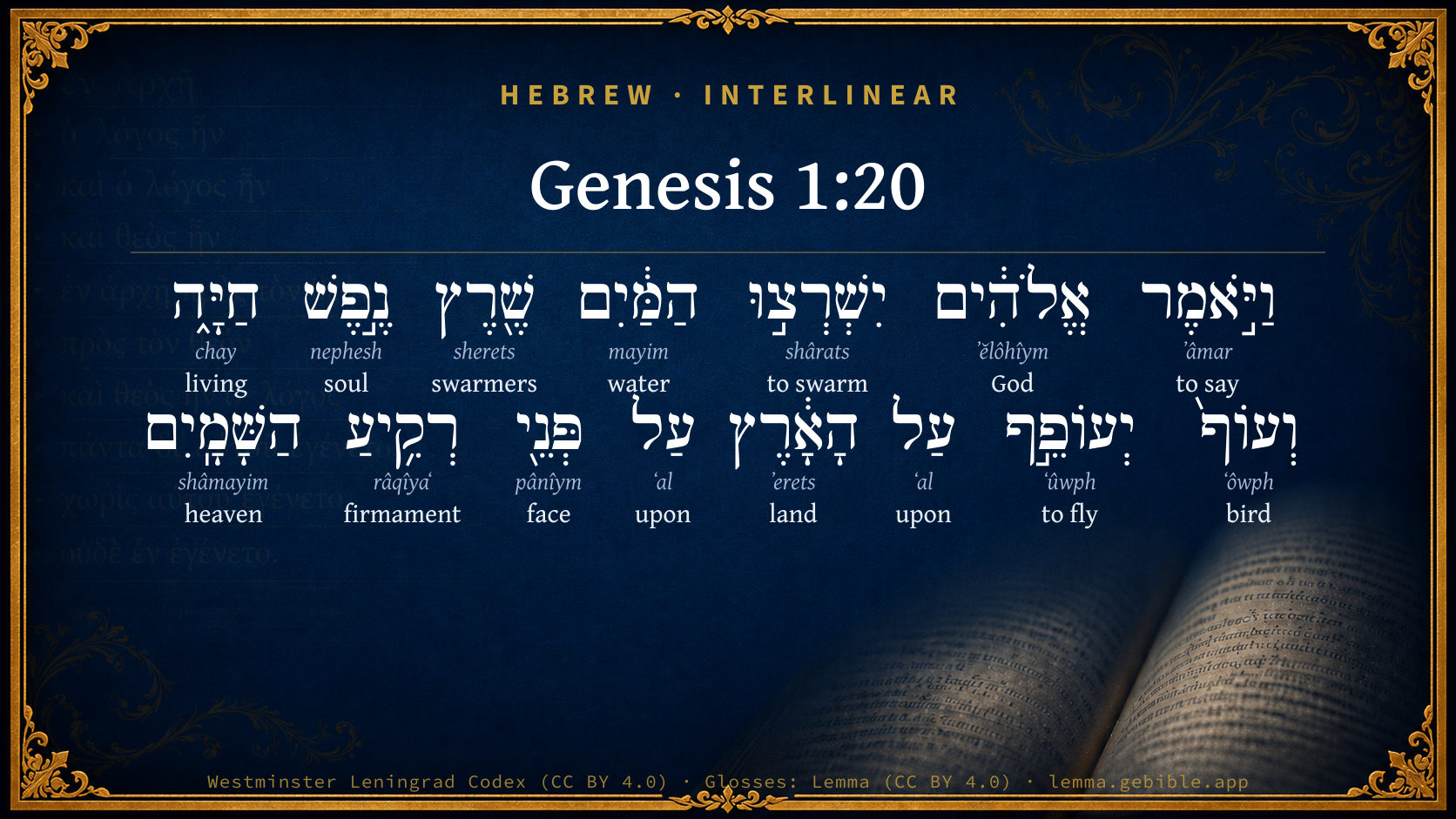
  1. וַיֹּ֣אמֶר ʼâmar H559 “and · to say” Conjunction + Verb, Qal, Sequential Imperfect, 3rd Person, Masculine, Singular
  2. אֱלֹהִ֔ים ʼĕlôhîym H430 “God(s)” Noun, Common, Masculine, Plural, Absolute
  3. הַמַּ֔יִם mayim H4325 “the · water(s)” Particle, Definite Article + Noun, Common, Masculine, Plural, Absolute
  4. שֶׁ֖רֶץ sherets H8318 “swarmers of” Noun, Common, Masculine, Singular, Construct
  5. נֶ֣פֶשׁ nephesh H5315 “soul” Noun, Common, Both, Singular, Absolute
  6. חַיָּ֑ה chay H2416 “living” Adjective, Adjective, Feminine, Singular, Absolute
  7. וְעוֹף֙ ʻôwph H5775 “and · bird” Conjunction + Noun, Common, Masculine, Singular, Absolute
  8. יְעוֹפֵ֣ף ʻûwph H5774 “to fly” Verb, Polel, Imperfect, 3rd Person, Masculine, Singular
  9. עַל ʻal H5921 “upon” Preposition
  10. הָאָ֔רֶץ ʼerets H776 “the · land” Particle, Definite Article + Noun, Common, Both, Singular, Absolute
  11. עַל ʻal H5921 “upon” Preposition
  12. פְּנֵ֖י pânîym H6440 “face(s) of” Noun, Common, Both, Plural, Construct
  13. רְקִ֥יעַ râqîyaʻ H7549 “firmament of” Noun, Common, Masculine, Singular, Construct
  14. הַשָּׁמָֽיִם shâmayim H8064 “the · heaven(s)” Particle, Definite Article + Noun, Common, Masculine, Plural, Absolute

About this verse

These counts appear in no published source. They are computed here, from the morphology-tagged text and Lemma’s own curated glosses. What Lemma adds →

15
words
14
distinct lemmas
Pentateuch
section

Notable vocabulary

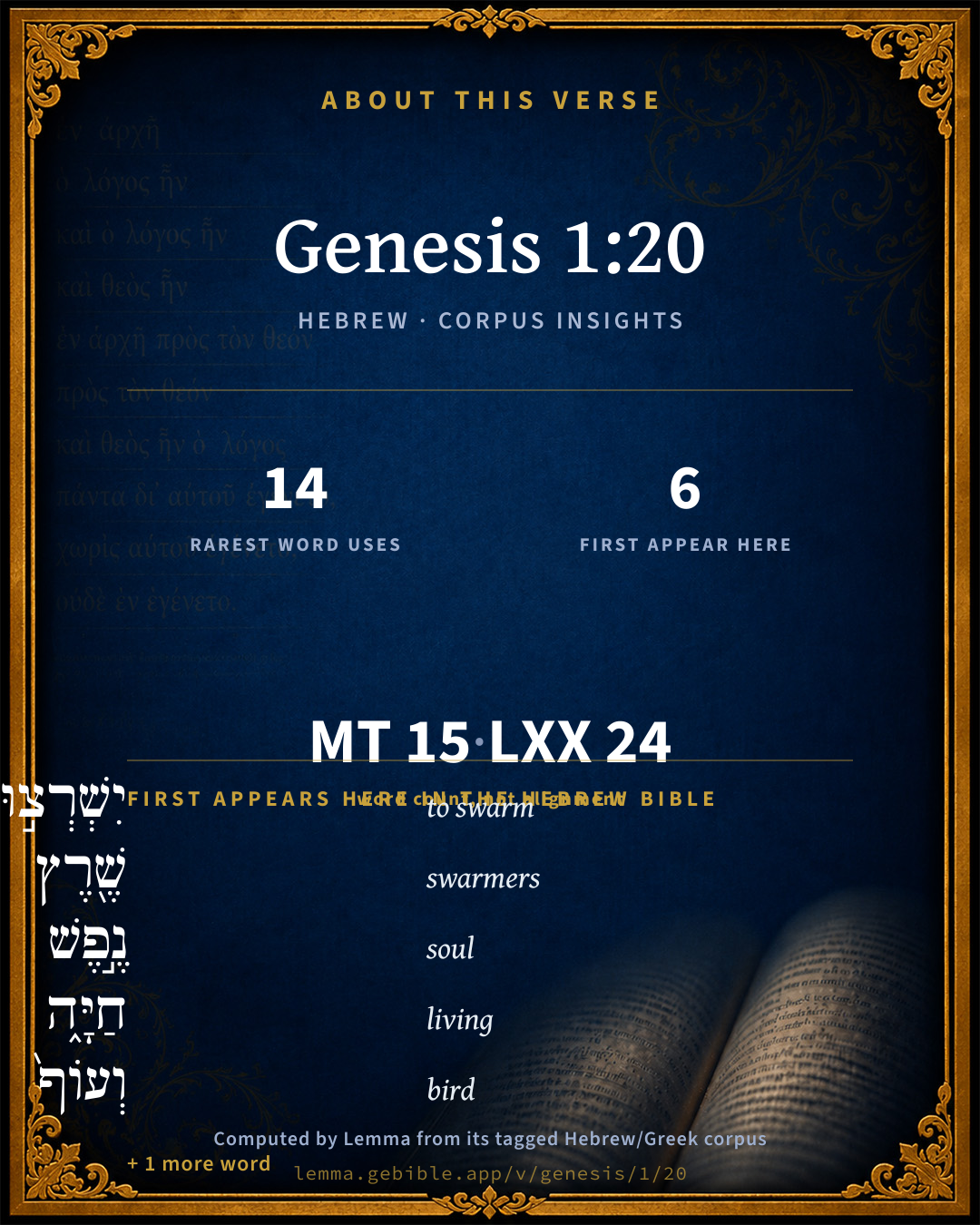
The rarest word here is יִשְׁרְצ֣וּ to swarm H8317 — appearing just 14 times in the whole Hebrew Bible.

First appearance in Scripture

These words make their first canonical appearance in the Hebrew Bible here:

  • יִשְׁרְצ֣וּ to swarm H8317
  • שֶׁ֖רֶץ swarmers H8318
  • נֶ֣פֶשׁ soul H5315
  • חַיָּ֑ה living H2416
  • וְעוֹף֙ bird H5775
  • יְעוֹפֵ֣ף to fly H5774

Shared distinctive vocabulary

יִשְׁרְצ֣וּ to swarm H8317 occurs in 14 verses of the Hebrew Bible. Also found in:

Grammatical profile

  • 3 verbs
  • 9 nouns
  • 1 adjective
  • 2 prepositions

Verb forms

  • וַיֹּ֣אמֶר Qal · Sequential Imperfect
  • יִשְׁרְצ֣וּ Qal · Imperfect
  • יְעוֹפֵ֣ף Polel · Imperfect

Repetition

A word recurs within this verse — often emphatic in Hebrew:

Hebrew & Septuagint length

In English translation the verse runs 24 words from the Hebrew and 27 from the Septuagint (LXX English) — closely comparable.

A rough comparison of the two English renderings, which tokenize alike — not a word-level alignment.

Word counts can differ between the Hebrew and the Greek without any difference in meaning — e.g. the Hebrew direct-object marker אֵת has no separate Greek word, and Greek often adds the article ὁ.

In the original languages it is 15 Hebrew tokens and 24 Greek tokens — but the two are counted differently (Hebrew bundles its prefixes and suffixes into one token; the Greek is in lemma form), so that isn’t a like-for-like length.

Cross-references

10

Topical passages linked to Genesis 1:20 in the Treasury of Scripture Knowledge — connected by theme and wording, ordered by reader-vote popularity; previews shown in the World English Bible.

  • Genesis 2:19 Out of the ground Yahweh God formed every animal of the field, and every bird of the sky, and brought them to the man to see what he would call them. Whatever the man called every living creature, that was its name.
  • Psalms 104:24–25 Yahweh, how many are your works! In wisdom have you made them all. The earth is full of your riches.
  • 1 Kings 4:33 He spoke of trees, from the cedar that is in Lebanon even to the hyssop that springs out of the wall; he spoke also of animals, and of birds, and of creeping things, and of fish.
  • Psalms 148:10 Wild animals and all cattle; Small creatures and flying birds;
  • Genesis 1:30 To every animal of the earth, and to every bird of the sky, and to everything that creeps on the earth, in which there is life, I have given every green herb for food." And it was so.
  • Genesis 1:7 God made the expanse, and divided the waters which were under the expanse from the waters which were above the expanse, and it was so.
  • Genesis 1:22 God blessed them, saying, "Be fruitful, and multiply, and fill the waters in the seas, and let birds multiply on the earth."
  • Genesis 8:17 Bring forth with you every living thing that is with you of all flesh, including birds, cattle, and every creeping thing that creeps on the earth; that they may breed abundantly in the earth, and be fruitful, and multiply on the earth."
  • Genesis 1:14 God said, "Let there be lights in the expanse of sky to divide the day from the night; and let them be for signs, and for seasons, and for days and years;
  • Acts 17:25 neither is he served by men's hands, as though he needed anything, seeing he himself gives to all life and breath, and all things.

Cross-references courtesy of OpenBible.info (CC BY 4.0).

Hebrew and Greek witnesses Masoretic Hebrew ↔ Greek Septuagint

The same verse in the two great witnesses to the Old Testament, shown verse-for-verse.

These are two independent witnesses, not word-aligned to each other, and the Septuagint is shown in lemma (dictionary) form.

Hebrew Genesis 1:20 Masoretic · Westminster Leningrad Codex

וַיֹּ֣אמֶר אֱלֹהִ֔ים יִשְׁרְצ֣וּ הַמַּ֔יִם שֶׁ֖רֶץ נֶ֣פֶשׁ חַיָּ֑ה וְעוֹף֙ יְעוֹפֵ֣ף עַל הָאָ֔רֶץ עַל פְּנֵ֖י רְקִ֥יעַ הַשָּׁמָֽיִם

God said, "Let the waters swarm with swarms of living creatures, and let birds fly above the earth in the open expanse of sky."

World English Bible · Public Domain

Greek LXX Genesis 1:20 Septuagint · lemma form

καί εἶπον ὁ θεός ἐκἄγω ὁ ὕδωρ ἑρπετόν ψυχή ζάω καί πετεινόν πέτομαι ἐπί ὁ γῆ κατά ὁ στερέωμα ὁ οὐρανός καί γίγνομαι οὕτως

And God said, Let the waters bring forth reptiles having life, and winged creatures flying above the earth in the firmament of heaven, and it was so.

LXX2012 (modern English Septuagint) · Public Domain

On this verse, The Cambridge Bible for Schools and Colleges discusses the Septuagint’s reading. Read the note in Commentary ↓

Hebrew: Westminster Leningrad Codex (CC BY 4.0). Greek: Septuagint (public domain); English from LXX2012 (modern English Septuagint) (Public Domain). How the Septuagint differs from the Hebrew →

Targum (Aramaic paraphrase)

2

The Targum is the ancient Jewish Aramaic paraphrase of the Hebrew Scriptures — an interpretive translation, not the Hebrew text itself. Onkelos (literal) and Pseudo-Jonathan (expansive) render the Torah, and Jonathan the Prophets. Coverage is partial: where no permissively-licensed English translation exists for a verse, only the Aramaic is shown. This is verse-level text, not a word-by-word alignment to the Hebrew.

  1. Targum Onkelos Torah (Genesis–Deuteronomy)
    וַאֲמַר יְיָ יִרְחֲשׁוּן מַיָּא רְחֵשׁ נַפְשָׁא חַיְתָא וְעוֹפָא יְפָרַח עַל אַרְעָא עַל אַפֵּי רְקִיעָא דִּשְׁמַיָּא

    (no public-domain English translation for this verse)

    Targum Onkelos — Aramaic: “Onkelos Genesis” (public domain); “Onkelos Exodus” (public domain); “Onkelos Leviticus” (public domain); “Onkelos Numbers” (public domain); “Onkelos Deuteronomy” (public domain). English: “Sefaria Community Translation” (CC0 1.0 (public-domain dedication)); “J.W. Etheridge. The Targums of Onkelos and Jonathan Ben Uzziel on the Pentateuch. London: Longmans, Green, 1862” (public domain). Text via Sefaria.

  2. Targum Pseudo-Jonathan Torah (Genesis–Deuteronomy)
    וַאֲמַר יְיָ יְרַחֲשׁוּן רְקָקֵי מוֹי רְחֵישׁ נַפְשָׁא חַיְיתָא וְעוֹפָא דְטַיֵיס וּשַׁרְכַּפְתֵּיהּ עַל אַרְעָא וּשְבִיל טַיְיסֵיהּ עַל אַוִיר רָקִיעַ שְׁמַיָא

    And the Lord said, Let the lakes of the waters swarm forth the reptile, the living animal, and the fowl which flieth, whose nest is upon the earth; and let the way of the bird be upon the air of the expanse of the heavens.

    Targum Pseudo-Jonathan — Aramaic: “Targum Jonathan on Genesis” (public domain); “Targum Jonathan on Exodus” (public domain); “Targum Jonathan on Leviticus” (public domain); “Targum Jonathan on Numbers” (public domain); “Targum Jonathan on Deuteronomy” (public domain). English: “The Targum of Jonathan ben Uzziel, trans. J. W. Etheridge, London, 1862” (public domain). Text via Sefaria.

Commentary

Notes on Genesis 1:20 from classic Christian and Jewish commentators (each source and its license shown beneath its notes). The classic Christian expositions comment on the surrounding passage and are grouped to its opening verse, so a note may address several verses; the Jewish commentaries on the Tanakh (Rashi and others) are per-verse, so they appear only where the commentator wrote on this verse.

Lemma curates 59 commentaries, every one of them public domain or Creative Commons licensed, each selected and text-cleaned for this edition rather than reprinted as found. About our sources →

Matthew Henry's Commentary

Each day, hitherto, has produced very noble and excellent beings, which we can never sufficiently admire; but we do not read of the creation of any living creature till the fifth day, of which these verses give us an account. The work of creation not only proceeded gradually from one thing to another, but rose and advanced gradually from that which was less excellent to that which was more so, teaching us to press towards perfection and endeavour that our last works may be our best works. It was on the fifth day that the fish and fowl were created, and both out of the waters. Though there is one kind of flesh of fishes, and another of birds, yet they were made together, and both out of the waters; for the power of the first Cause can produce very different effects from the same second causes. Observe, 1. The making of the fish and fowl, at first, Gen 1:20, Gen 1:21. God commanded them to be produced. He said, Let the waters bring forth abundantly; not as if the waters had any productive power of their own, but, "Let them be brought into being, the fish in the waters and the fowl out of them." This command he himself executed: God created great whales, etc. Insects, which perhaps are as various and as numerous as any species of animals, and their structure as curious, were part of this day's work, some of them being allied to the fish and others to the fowl. Mr. Boyle (I remember) says he admires the Creator's wisdom and power as much in an ant as in an elephant. Notice is here taken of the various sorts of fish and fowl, each after their kind, and of the great numbers of both that were produced, for the waters brought forth abundantly; and particular mention if made of great whales, the largest of fishes, whose bulk and strength, exceeding that of any other animal, are remarkable proofs of the power and greatness of the Creator. The express notice here taken of the whale, above all the rest, seems sufficient to determine what animal is meant by the Leviathan, Job 41:1. The curious formation of the bodies of animals, their different sizes, shapes, and natures, with the admirable powers of the sensitive life with which they are endued, when duly considered, serve, not only to silence and shame the objections of atheists and infidels, but to raise high thoughts and high praises of God in pious and devout souls, Psa 104:25, etc. 2. The blessing of them, in order to their continuance. Life is a wasting thing. Its strength is not the strength of stones. It is a candle that will burn out, if it be not first blown out; and therefore the wise Creator not only made the individuals, but provided for the propagation of the several kinds; God blessed them, saying, Be fruitful and multiply, Gen 1:22. God will bless his own works, and not forsake them; and what he does shall be for a perpetuity, Ecc 3:14. The power of God's providence preserves all things, as at first his creating power produced them. Fruitfulness is the effect of God's blessing and must be ascribed to it; the multiplying of the fish and fowl, from year to year, is still the fruit of this blessing. Well, let us give to God the glory of the continuance of these creatures to this day for the benefit of man. See Job 12:7, Job 12:9. It is a pity that fishing and fowling, recreations innocent in themselves, should ever be abused to divert any from God and their duty, while they are capable of being improved to lead us to the contemplation of the wisdom, power, and goodness, of him that made all these things, and to engage us to stand in awe of him, as the fish and fowl do of us.

Matthew Henry's Commentary on the Whole Bible (1708–1710) — public domain (CC PDM 1.0). Text via the HelloAO Bible API.

Jamieson, Fausset & Brown

Robert Jamieson, A. R. Fausset & David Brown

FIFTH DAY. The signs of animal life appeared in the waters and in the air. (Gen 1:20-23)

moving creature--all oviparous animals, both among the finny and the feathery tribes--remarkable for their rapid and prodigious increase.

fowl--means every flying thing: The word rendered "whales," includes also sharks, crocodiles, &c.; so that from the countless shoals of small fish to the great sea monsters, from the tiny insect to the king of birds, the waters and the air were suddenly made to swarm with creatures formed to live and sport in their respective elements.

Jamieson, Fausset & Brown — Commentary Critical and Explanatory on the Whole Bible (1871) — public domain (CC PDM 1.0). Text via the HelloAO Bible API.

Albert Barnes' Notes on the Bible

- VII. The Fifth Day

20. שׁרץ shārats, “crawl, teem, swarm, abound.” An intransitive verb, admitting, however, an objective noun of its own or a like signification.

נפשׁ nephesh, “breath, soul, self.” This noun is derived from a root signifying to breathe. Its concrete meaning is, therefore, “that which breathes,” and consequently has a body, without which there can be no breathing; hence, “a breathing body,” and even a body that once had breath Num 6:6. As breath is the accompaniment and sign of life, it comes to denote “life,” and hence, a living body, “an animal.” And as life properly signifies animal life, and is therefore essentially connected with feeling, appetite, thought, נפשׁ nephesh, denotes also these qualities, and what possesses them. It is obvious that it denotes the vital principle not only in man but in the brute. It is therefore a more comprehensive word than our soul, as commonly understood.

21. תנין tannı̂yn, “long creature,” a comprehensive genus, including vast fishes, serpents, dragons, crocodiles; “stretch.”

22. ברך bārak “break, kneel; bless.”

The solitude בהוּ bohû, the last and greatest defect in the state of the earth, is now to be removed by the creation of the various animals that are to inhabit it and partake of its vegetable productions.

On the second day the Creator was occupied with the task of reducing the air and water to a habitable state. And now on the corresponding day of the second three he calls into existence the inhabitants of these two elements. Accordingly, the animal kingdom is divided into three parts in reference to the regions to be inhabited - fishes, birds, and land animals. The fishes and birds are created on this day. The fishes seem to be regarded as the lowest type of living creatures.

They are here subdivided only into the monsters of the deep and the smaller species that swarm in the waters.

Gen 1:20

The crawler - שׁרץ sherets apparently includes all animals that have short legs or no legs, and are therefore unable to raise themselves above the soil. The aquatic and most amphibious animals come under this class. “The crawler of living breath,” having breath, motion, and sensation, the ordinary indications of animal life. “Abound with.” As in Gen 1:11 we have, “Let the earth grow grass,” (דשׁא תדשׁע tadshē‛ deshe', so here we have, “Let the waters crawl with the crawler,” שׁרץ ישׁרצוּ yı̂shretsû sherets; the verb and noun having the same root. The waters are here not the cause but the element of the fish, as the air of the fowl. Fowl, everything that has wings. “The face of the expanse.” The expanse is here proved to be aerial or spatial; not solid, as the fowl can fly on it.

Gen 1:21

Created. - Here the author uses this word for the second time. In the selection of different words to express the divine operation, two considerations seem to have guided the author’s pen - variety and propriety of diction. The diversity of words appears to indicate a diversity in the mode of exercising the divine power. On the first day Gen 1:3 a new admission of light into a darkened region, by the partial rarefaction of the intervening medium, is expressed by the word “be.” This may denote what already existed, but not in that place. On the second day Gen 1:6-7 a new disposition of the air and the water is described by the verbs “be” and “make.” These indicate a modification of what already existed. On the third day Gen 1:9, Gen 1:11 no verb is directly applied to the act of divine power. This agency is thus understood, while the natural changes following are expressly noticed. In the fourth Gen 1:14, Gen 1:16-17 the words “be,” “make,” and “give” occur, where the matter in hand is the manifestation of the heavenly bodies and their adaptation to the use of man. In these cases it is evident that the word “create” would have been only improperly or indirectly applicable to the action of the Eternal Being. Here it is employed with propriety; as the animal world is something new and distinct summoned into existence. It is manifest from this review that variety of expression has resulted from attention to propriety.

Great fishes. - Monstrous crawlers that wriggle through the water or scud along the banks.

Every living, breathing thing that creeps. - The smaller animals of the water and its banks.

Bird of wing. - Here the wing is made characteristic of the class, which extends beyond what we call birds. The Maker inspects and approves His work.

Gen 1:22

Blessed them. - We are brought into a new sphere of creation on this day, and we meet with a new act of the Almighty. To bless is to wish, and, in the case of God, to will some good to the object of the blessing. The blessing here pronounced upon the fish and the fowl is that of abundant increase.

Bear. - This refers to the propagation of the species.

Multiply. - This notifies the abundance of the offspring.

Fill the waters. - Let them be fully stocked.

In the seas. - The “sea” of Scripture includes the lake, and, by parity of reason, the rivers, which are the feeders of both. This blessing seems to indicate that, whereas in the case of some plants many individuals of the same species were simultaneously created, so as to produce a universal covering of verdure for the land and an abundant supply of aliment for the animals about to be created - in regard to these animals a single pair only, at all events of the larger kinds, was at first called into being, from which, by the potent blessing of the Creator, was propagated the multitude by which the waters and the air were peopled.

Albert Barnes' Notes on the Bible (1834–1885) — public domain. Text from a community e-Sword/MySword module.

The Biblical Illustrator

Joseph S. Exell

Gen_1:20-23

Let the waters bring forth abundantly

Fish and fowl

I.

THAT LIFE IS THE IMMEDIATE CREATION OF GOD.

1. Life was not an education.

2. It was not the result of combination.

3. It was a miraculous gift. There are two words in this sentence that should be remembered, and joined together most closely, they are God and life. This should be so in the soul of man, as God is the source of its true and higher life. If the Church were to remember the connection of these two great words, she would be much more powerful in her toil. Life was at first the miraculous gift of God. Its continuance is His gift.

II. THAT LIFE IS VARIED IN ITS MANIFESTATION AND CAPABILITY.

1. Life is varied in its manifestations. There were created on this day both fish and fowl. Thus life is not a monotony. It assumes different forms. It grows in different directions. It has several kingdoms. It has numerous conditions of growth.

2. Life is varied in its capability. The fish swim in the water. The fowls fly in the air; the abilities and endowments of each are distinct and varied. Each takes a part in the great ministry of the universe. The whole in harmony is the joy of man.

3. Life is abundant and rich in its source. The waters brought forth abundantly. There was no lack of life-giving energy on the part of God. The world is crowded with life. The universe will not soon become a grave, for even in death there is life, hidden but effective to a new harvest.

4. Life is good in its design.

III. THAT THE LOWER SPHERES OF LIFE ARE RICHLY ENDOWED WITH THE DIVINE BLESSING.

1. It was the blessing of increasing numbers.

2. It was the blessing of an extended occupation of the land and sea.

3. Let us always remember that the blessing of God rests upon the lower spheres of life. (J. S. Exell, M. A.)

Genesis of the animals

I. EXPLANATION OF THE PASSAGE.

1. Animals the issue of fifth and sixth days.

2. Panorama of the emerging animals. Lo! the nautilus spreads his sail, and the caterpillar winds his cocoon, and the spider weaves his web, and the salmon darts through the sea, and the lizard glides among the rocks, and the eagle soars the sky, and the lion roams the jungle, and the monkey chatters among the trees, and all animate creation waits the advent and lordship of man, Gods inspiration and therefore Gods image, Gods image and therefore Gods viceroy.

3. The animal succession a progress.

(1) Animals of the water.

(2) Animals of the air.

(3) Animals of the land.

(4) Man.

And with this Mosaic account of the origin of life, ascending from plant, by way of animal, to man, the geological records substantially agree: first, plants and fishes of the Palaeozoic period; secondly, birds and reptiles of the Mesozoic period; thirdly, mammals and man of the Neozoic period.

4. After their kind. Almost like a prophetic caveat against the modern hypothesis of the mutability of species.

5. The Creators blessing. The benediction of fertility.

6. The Divine delight.

II. MORAL MEANING OF THE STORY.

1. Animals have souls. What in man we call reason, in animals we call instinct. As that mysterious force which vitalizes and builds up the fabric of the human body is the same mysterious force which vitalizes and builds up the fabric of the animalcule, so that mysterious guide which teaches Newton how to establish the law of gravity, and Shakespeare how to write his Hamlet, and Stephenson how to bridge the St. Lawrence, seems substantially to be the same mysterious guide which teaches the beaver how to build his dam, and the spider how to weave his web, and the ant how to dig his spiral home. The difference does not seem to be so much a difference in nature or kind, as in degree or intensity. As the diamond is the same substance with charcoal--only under superior crystalline figure--so reason seems to be substantially the same with instinct--only in an intensely organized state. One thing is common to man and animals: it is that mysterious principle or force which, in want of a better name, and in distinction from the term spirit, we call soul.

2. Animals perhaps are immortal. I quote from that profound treatise by Louis Agassiz, entitled Essay on Classification: Most of the arguments of philosophy in favour of the immortality of man apply equally to the permanency of the immaterial principle in other living beings. May I not add that a future life in which man should be deprived of that great source of enjoyment and intellectual and moral improvement, which results from the contemplation of the harmonies of an organic world, would involve a lamentable loss? And may we not look to a spiritual concert of the combined worlds and all their inhabitants in presence of their Creator, as the highest conception of paradise? (See Rom_8:19-23.) (G. D.Boardman.)

The prolific character of the life of the ocean

The finny tribes are specially prolific. The eggs of fish, or spawn, produce vast multitudes. The row of a codfish contains nine millions of eggs, of a flounder, about a million and a half, and of a mackerel, half a million. The unchecked produce of one pair of herrings would in a very few years crowd the Atlantic. So is it also with birds. The passenger pigeon of North America has been seen in flocks a mile broad, and taking four hours in passing, at the rate of a mile a minute, and was calculated to contain 250 millions of Psa_104:24-25). The microscope also shows there are beings with perfect organs of nutrition and locomotion, a million of which would not exceed in bulk one grain of sand, and eight millions of which might be compressed within a grain of mustard seed. Others are so small that 500 millions of them could live in a dish of water. There are even animalcules so minute that a cubic inch could contain a million millions of them. (Jacobus.)

Shoals of animalculae

Some few years ago a newspaper correspondent, writing from the Gulf of Siam, said: We steamed forward at the rate of six or seven knots an hour, and a wonderful spectacle presented itself. Athwart the vessel, long white waves of light were seen rushing towards it, ever brighter and in swifter motion, till they seemed to flow together, and at length nothing could be seen on the water but a whirling white light. Looking stedfastly at it, the water, the air, and the horizon seemed blended in one; thick streamers of mist seemed to float by both sides of the ship with frantic speed. The appearances of colour resembled those which arise when one turns a black-and-white striped ball so quickly that the white stripes seem to run together. The spectacle lasted for five minutes, and was repeated once again for two minutes. No doubt it was caused by shoals of animalculae in the water.

Resemblances between fishes and birds

I must tell you of a discovery made by a very dear friend whom I have lost, the excellent Dr. Prevost, a learned anatomist of Geneva. He often mentioned it to me as affording a remarkable testimony to the Word of God. It helps to explain the words of the 20th verse. We may perhaps wonder that two such apparently different kinds of creatures as fishes and birds should be classed together. Who among us would have thought of such an arrangement? But, dear children, scientific men have discovered, on examination, that there are very close resemblances between them in their anatomical structure and in some other things. Both spring from eggs; and while the one class--the birds--swim in the air with wings, the other--the fishes--fly in the water with fins. And besides these points of resemblance, the discovery made by Dr. Prevost, which astonished himself and interested the learned world very much, was this, that the globules of the blood of fishes and birds are seen to be the same, when closely examined, and do not at all resemble the globules of the blood of those animals which sprang from the earth on the sixth day. (Prof. Gaussen.)

Some of the faculties and organs of fishes

Fishes appear to be endowed with the senses common to land animals. Those of touch and taste are supposed to be feeble, in general: though some are furnished with flexible feelers, or organs of touch. Their organs of smelling and hearing are more acute, and are in their structure happily adapted to the element in which they live. These latter senses have no external avenues, as in land animals; for immediate and perpetual contact with the dense element of water would soon prove ruinous to their delicate and sensitive nerves. Smelling is said to be the most acute of all their senses. The olfactory membrane and nerves in them are of remarkable extent; in a large shark they expand over a surface of no less than twelve or thirteen square feet. Hence, by this sense the finny tribes can discover their prey or their enemies at a great distance, and direct their course in the thickest darkness, and amid the most agitated waves. Possessing the foregoing faculties fishes are not without a degree of sagacity. They have been found even capable of instruction, and been taught to come when called by their names, and to assemble for their food at the sound of a whistle or bell. They are said to be among the most long-lived of all animals. The carp has been known to reach more than a hundred years of age. And Kirby relates that a pike was taken in 1754, at Kaiserslautern, which had a ring fastened to the gill covers, from which it appeared to have been put into the pond of that castle by order of Frederick II in 1487--a period of two hundred and sixty-seven years. Fishes excel in strength, and seem to be capable of prolonged exertion without apparent fatigue. Even the feathered tribe, in this, must yield the palm to the finny race. The shark will out travel the eagle, and the salmon will out strip the swallow in speed. The thunny will dart with the rapidity of an arrow, and the herring will travel for days and weeks at the rate of sixteen miles an hour, without respite or repose. Sharks have been observed to follow and play around a ship through its whole voyage across the Atlantic; and the same fish, when harpooned, has been known to drag a vessel of heavy tonnage at a high speed against wind and tide. (Prof. Gaussen.)

Fecundity of fishes

This blessing is to be regarded, not simply as a solemn word of command, but the imparting of reproducing energies to the varied tribes of the deep. And to see how effective this blessing was, we need but look at the results which followed. Nothing can exceed that abundance brought forth. If we attempt to estimate the number of eggs in the toes of various kinds of fish, we may be able to form some faint conception of it. The roe of the cod fish, according to Harmers estimate, contains 3,686,000 eggs; of the flounder, 225,000; of the mackerel, 500,000; of the tench, 350,000; of the carp, 203,000; of the roach, 100,000; of the sole, nearly 100,000; of the pike, 50,000; of the herring, the perch, and the smelt, from 20,000 to 30,000. Other species are equally prolific. Such numbers present an idea of fecundity that is truly overwhelming. It must be observed, however, that a large proportion of the eggs deposited are destroyed in various ways; they are eagerly sought after by other fishes, by aquatic birds, and by reptiles, as food; and in the young state, they are pursued and devoured by larger ones of their own species, as well as by those of others. Still the numbers which arrive at maturity surpass all comprehension, as appears from the countless myriads of those that are of gregarious and migratory habits. Impelled and guided by that mysterious power we call instinct, fishes, at certain seasons, migrate and travel in immense droves to seek a suitable place and temperature for the reproduction of their species. Vast migrations take place from the oceans into all the rivers of the earth; the salmon and others often ascend large streams in great numbers for hundreds and even thousands of miles. Vaster yet by far are the migrations that occur in the ocean from one region to another. The migratory tribes of the sea are very numerous; of these, among the best known is the cod; at spawning time these fish proceed northward, and frequent the shallows of the ocean, such as the banks of Newfoundland, where they are found in infinite multitudes. The haddock resorts, in like manner, to northern coasts, and has been found in immense shoals of more than twenty miles long and three miles broad. The mackerel also is a migratory tribe; these winter in the Arctic and Antarctic oceans, from whence in the spring they emerge from their hiding places in innumerable myriads, and proceed to more genial seas to deposit their eggs. The thunny travels for the same end in numbers without number. But the most notable of all the migratory species are the herrings; these, like many others, pass the winter in high northern latitudes, and at different times through the summer, proceed southward in search of food, and to deposit their spawn. Some idea of their numbers may be formed from the vast quantities that are taken. Many years since, when the business was prosecuted on a more limited scale than at present, it was reported that on the coast of Norway no less than 20,000,000 were frequently taken at a single fishing; and that the average capture of the season exceeded 400,000,000. At Gottenberg, 700,000,000 were annually caught. Yet all these millions were but a fraction of the numbers taken by the English, Dutch, and other nations. But all that are taken by all nations put together, are no more missed from the countless hosts of the ocean than a drop out of the full bucket. Their shoals, says Kirby, consist of millions of myriads, and are many leagues in width, many fathoms in depth, and so dense that the fishes touch each other; and this stream continues to move at a rapid rate past any particular point nearly all summer. If, then, these single groups of a few species that happen to fall under the observation of man be thus numerous, or rather innumerable, it is obvious that the aggregate of all the orders, genera, and species, making up the whole population of the deep, must infinitely transcend all the powers of human enumeration! (Prof. Gaussen.)

Birds

As in the beauteous creations of the vegetable world, and among the countless living tenants of the deep, so also among the birds of the air, we behold indubitable evidences and most impressive displays of the universal and constant agency of God. In all their doings and movements, the guiding finger of their Creator is clearly seen. Prior to all experience, and independent of all instruction, we see the little feathered tribes undertake and accomplish all the ingenious duties of their being; and accomplish them, too, with a certainty and perfection which no instruction could teach, and no experience improve. The sparrow performs and goes through with the whole process of building, laying, hatching, and rearing, as successfully the first time as the last. And whence is all this to the little bird of the air, if not from the omnipresent and infinite Spirit? Who or what leads the young female bird to prepare a nest, untaught and undirected, long before she has need of it? Who instructs each particular species in its own peculiar style of architecture? And when the first egg is brought forth, who teaches her what she must do with it? or that it is a thing to be taken care of, that it must be laid and preserved in the nest? And the germ of future life being wrapped in the egg, who teaches its little owner that heat will develop and mature that germ? Who acquaints her with the fact that her own body possesses the precise kind and degree of warmth required? And what is it that holds her so constantly and so long upon the nest, amid light and darkness, storm and sunshine, without the least knowledge or idea as to what the result or fruit of all this toil and self-denial is to be? Here, then, are operations carried on, and effects produced, which must constrain every candid mind to recognize in them the invisible band of God. Again, the migration of birds--how astonishing is all this! The stork in the heavens knoweth her appointed times; and the turtle and the crane and the swallow observe the time of their coming. So fixed are the dates of departing and returning with many tribes of the feathered race that, in certain eastern countries at the present day, almanacs are timed and bargains struck upon the data they supply. Now, who informs them that the day is come for them to take their leave? or announces to them that the time has arrived for their return? Without science, without a map, without a compass, without a waymark, who acquaints them with the direction they are to take? or measures out for them the length of the journey they have to perform? Who enables them to pursue undeviatingly their course over pathless oceans, and through the trackless voids of the atmosphere, alike in the day time and in the night season, and to arrive exactly at the same spot from year to year? To whom shall we ascribe this extraordinary power--to God, or to the little bird? It must be either to the one, or to the other. It is obvious that the little bird does not possess either the reasoning powers, or the geographical acquaintance, or the meteorological knowledge, which would enable it either to plan or to carry out such astonishing enterprises. Indeed, could man thus, amid all storms and darkness, infallibly steer his voyages over the main, it would render superfluous the use of his compass and sextant, and enable him at once to dispense with his trigonometry and logarithms. Whatever name, then, we may give this mysterious power, and in whatever light we may regard these astonishing facts, correct and sound reasoning as well as the Scripture, will lead us to the conviction and acknowledgment of the illustrious Newton, that all this is done through the immediate influence and guidance of Him, in whom all live and move and have their being, and without whom not a sparrow falleth to the ground. In the feathered population of our globe we also behold, not proofs only, but most interesting and delightful displays of the goodness of God. The very introduction of the winged race into the new-made world was, in itself, a demonstration of the benevolence of the Divine mind, as they constitute one of its most beautiful and lovely features. Birds are also living parables, and as such the Great Teacher often employed them. (Prof. Gaussen.)

Insects

On the fifth day were also produced the insect population of the new-made world, for these, as well as birds, must be included in the term winged thing. This department of animated nature presents to us a field of study all but illimitable, insects being by far the most numerous and diversified of all the living orders that occupy the dry land. Not less than 100,000 different species are already known, and many more doubtless remain to be discovered. A distinguished naturalist has made the statement, that there are probably six species of insects to every species of plants; this estimate, therefore, would make the entire number of insect species on the face of the globe considerably over half a million. The insect tribes are of all conceivable forms, habits, and instincts. (Prof. Gaussen.)

Reflections on the insect creation

Insects, like every other class of living creatures, have their place to occupy, and their office to fulfil in the Divine plan, and form an essential link in the great chain of animated nature. Small and insignificant as they appear, viewed singly, yet taken collectively, they make up armies far more potent and formidable than either Alexander, or Caesar, or Bonaparte ever mustered; and these being everywhere dispersed, and daily and hourly at work in their several departments, they constitute an agency of great power, and no doubt of great good, in the economy of the world. We may not be able to determine how, or what, each particular species contributes to the benefit of the great whole; but we may be sure that their great variety of organs, and their wonderful instinctive capacities, have been bestowed upon them for ends worthy of the wisdom that produced them. The works of the Lord are perfect, and nothing has been made in vain. Insects are an ornament to the earths scenery, and, no doubt, were designed by the munificent Creator to be objects of pleasurable observation and study to man. The insect creation teaches us that God is to be seen in the least as well as in the greatest of His works. He is in all and through all. The guidance of His finger is to be traced as distinctly in the circles of the spiders web as in the orbits of the planets; and the operation of His hand is as plainly seen in the lustre of an insects wing, as in the resplendent disk of the sun, which sheds light and life on surrounding globes. In the history of insects, we meet with the most beautiful illustration that all nature affords of the great and distinguishing doctrine of Christianity--the resurrection of the dead. (Prof. Gaussen.)

The Biblical Illustrator, edited by Joseph S. Exell (c. 1880s–1900s) — public domain. Text from a community e-Sword module.

Joseph Benson's Commentary

Gen 1:20. The moving creature that hath life — Endued with self-motion and animal life. — How much soever we may be astonished at the stupendous vastness and magnificence of inanimate matter, the least piece that is animated and has life, is still more admirable. But who can conceive the nature of life? We see it daily around us, but cannot comprehend it!

We observe that it enables millions and millions of creatures to act, as it were, of themselves, and to seek and obtain such enjoyments as give them a sensible pleasure; but how it does this surpasses all understanding: and we can reach no more of its nature, than that it is such an amazing property, as, if we think at all, must carry up our thoughts to that Almighty Being, who alone could bestow such a wonderful blessing, and who, in his exuberant goodness, has conferred it, not on one or a few merely, but on innumerable millions, and has inclined and enabled them to communicate it to millions and millions more of the same species with themselves, that shall succeed one another till time shall be no more! Thus in the work of creation, after the formation of light, air, water, and earth, the originals of all things, he proceeds from creatures less excellent to those that are more so: from vegetables to animals; and then from animals less perfect in their form to the more perfect. Such was the Creator’s progress in his work; and, in imitation of him, we should be continually advancing to greater excellence and perfection in our dispositions and actions. Fish and fowl were both formed out of the water: there being a nearer alliance and greater resemblance between the form of the bodies in general, and the motions of creatures that swim and of those that fly, than there is between either of these and such as creep or walk on the earth: and their bodies being intended to be lighter, and their motions swifter, the wise Creator saw fit to form them from a lighter and fluid element.

The waters are said to produce them abundantly; to signify the prodigious and rapid multiplication, especially of all the various species of fishes. The word in Hebrew, which generally stands for fish, also means multiplication; no creatures, it seems, multiplying so fast as they do.

Joseph Benson's Commentary on the Old and New Testaments (1811–1818) — public domain. Text from a community e-Sword module.

Whedon's Commentary on the Bible

Daniel D. Whedon

FIFTH DAY — FISH AND FOWLS, Gen_1:20-23.

20. Bring forth abundantly — Hebrews, Let the waters teem with creeping things, living beings. נפשׁ חיה, soul of life, or living soul, is in apposition with שׁרצ, creeping thing. These crawlers, or creeping things, are meant to include “whatsoever passeth through the paths of the seas.” ועוŠ יעופŠ, and let fowls fly. In Gen_2:19, the fowls are said to be formed out of the ground. All these creatures were first introduced by God’s word. They were creations, not evolutions. But their subsequent multiplication is conceived of as generations.

Daniel D. Whedon (gen. ed.), Commentary on the Old and New Testaments (1874–1909) — public domain. Text from a community e-Sword module.

The Pulpit Commentary

CHAPTER 1:20-23

Day five.

The waters and the air, separated on the second day, are on this filled with their respective inhabitants. And God said. Nature never makes an onward movement, in the sense of an absolutely new departure, unless under the impulse of the word of Elohim. These words distinctly claim that the creatures of the sea and of the air, even if evolved from material elements, were produced in obedience to Divine command, and not spontaneously generated by the potentia vitae of either land, sea, or sky. Let the waters bring forth abundantly the moving creature. Literally, swarm with swarmers, or crawl with crawlers. The fundamental signification of sharatz is to creep or swarm, and hence to multiply (Gesenius); or, vice versa, to multiply in masses, and hence to swarm or abound. (Furst; of. Genesis Exo_1:7 Exo_8:3) The sheretzim, though including small aquatic creatures that have short or no legs, are obviously all kinds of living creatures inhabiting either land or water which are oviparous and remarkable for fecundity" (Bush). We may, therefore, understand the creative fiat of the fifth day as summoning first into existence the insect creation, (in Lev_11:20-23 defined as flying sheretzim) the fishes of the sea (sheretzim of the waters, (Lev_11:9, Lev_11:10) and the reptiles and saurians of sea and land (sheretzim of the land,. (Lev_11:41, Lev_11:42) Dawson concludes that "the prolific animals of the fifth day"s creation belonged to the three Cuvierian sub-kingdoms of the radiata articulata, mollusca, and to the classes of fish and reptiles among the vertebrata. That hath life. Nephesh chayyah; literally, a living breath. Here the creatures of the sea are distinguished from all previous creations, and in particular from vegetation, as being possessed of a vital principle. This does not, of course, contradict the well-known truth that plants are living organisms. Only the life principle of the animal creation is different from that of the vegetable kingdom. It may be impossible by the most acute microscopic analysis to differentiate the protoplasmic cell of vegetable matter from that of animal organisms, and plants may appear to be possessed of functions that resemble those of animals, yet the two are generically different vegetable protoplasm never weaving animal texture, and plant fiber never issuing from the loom of animal protoplasm. That which constitutes an animal is the possession of respiratory organs, to which, doubtless. there is a reference in the term nephesh from naphash, to breathe. And fowl that may fly. Literally, let "winged creatures" fly. The fowls include all tribes covered with feathers that can raise themselves hate the air. The English version produces the impression that they were made from the waters, which is contrary to Gen_2:19. The correct rendering disposes of the difficulty. Above the earth in the open firmament of heaven. Not above the firmament like the clouds (Von Bohlen, Baumgarten) but in the concave vault (Tuch, Delitzsch), or before the surface of the expanse (Kalisch).

Vers. 20-22.

The mystery of life.

I ITS ORIGIN.

1. Not dead matter. Scripture, equally with science, represents life as having a physical basis; but, unlike modern evolutionists, never confounds vital force with the material mechanism in which it resides, and through which it operates. Advanced biologists account for life by molecular arrangement, chemical combination, spontaneous generation, or some such

2. equally insufficient hypothesis. The rigorous necessities of truth and logic, however, compel them to admit that neither the action of material forces nor the ingenuity of man has been able to produce a bioplasmic cell. "The chasm between the not living and the living the present state of knowledge cannot bridge" (Huxley). "Most naturalists of our time have given up the attempt to account for the origin of life by natural causes "(Haeckel). But

3. The living God. All existing life has proceeded from some antecedent life, is the latest verdict of biological science. Every bioplast has been produced by a previous bioplast: omnis cellula e cellula. Essentially that is the teaching of revelation. The Maker of the first bioplast was God. If the present narrative appears to recognize the doctrine of mediate creation by saying, "Let the waters bring forth," "Let the earth bring forth," it is careful to affirm that, in so far as material forces contributed to the production of life, they were directly impelled thereto, and energized therefore, by the creative word. The hypothesis that matter was originally possessed of, or endowed with, "the potency of life" (Tyndall) is expressly negative by Ver. 21, which represents life as the immediate creation of Elohim.

II ITS NATURE. Scripture vouchsafes no information as to what constitutes the vis viva of organized beings. Beyond characterizing the beings themselves as "living creatures." it leaves the subject wrapped in profoundest mystery. And the veil of that mystery science has not been able to penetrate. The microscope has indeed conclusively shown that living matter, or bioplasm, is that which weaves the endlessly varied structures of animal forms; but as to what that is which imparts to the transparent, structureless, albuminous fluid, called bioplasm, the power of self-multiplication and organization it is silent. "We fail to detect any organization in the bioplasmic mass, but there are movements in it and life" (Huxley). The utmost that science can give as its definition of life is, "that which originates and directs the movements of bioplasm" (cf. "Beale on Protoplasm;" Cook"s "Lectures on Biology"). Scripture advances a step beyond science, and affirms that life in its last analysis is the power of God (Psa_104:30; Isa_38:16)

III ITS MANIFESTATION.

1. Abundant. The creatures of the sea were produced in swarms, and probably the birds appeared in flocks. This was

(1) Predictive of their natures as gregarious animals. Though afterwards prolific, they might have been created in small numbers; but, as if to maintain a correspondence between the characteristic properties of the creatures and their first production, they were made, the fish in shoals, the fowl in breeds.

(2) Expressive of the Creator"s joy. God finds a part of His happiness in surrounding himself with living creatures. Had there been no other end to serve by the fish and fowl of the fifth day, this would have been cause sufficient for their creation.

(3) Anticipative of man"s arrival on the scene. Not only was it a step in advance on the work of the previous day, and as such preliminary to the advent of man, but the aquatic and aerial creatures were designed to be subservient to man"s needs and uses.

2. Varied.

(1) In its form. The living creatures of the fifth day were diverse in their physical structures. Though in the initial stages of their embryonic condition fish and fowl may not be widely dissimilar, yet their completed organisms are not the same. Each class, too, consists of an endlessly diversified array of species, and the variations among individual members of the same species are practically limitless.

(2) In its functions. Although all living creatures have certain essential characteristics in common, resembling one another in their chemical constituents, in their living by respiration, in their growth by intersusception of nutriment, in their capability of reproduction, yet the ordinary functions they are meant to perform through their respective organs are different in different kinds of animals. The fowls, e.g. were designed to fly through the atmosphere; the fish to swim in water. In its sphere. The different living creatures are differently located, the fish in the sea, the birds in the air, each one"s sphere being adapted to its nature.

3. Progressive. Science, no less than Scripture, attests that in the introduction of life to our globe there has been a regular and continuous gradation from lower to higher forms of organization, and has ventured to propose, as its solution of the problem of vital progression, external conditions, embryonic phases, use and disuse of organs, natural selection, &c. These theories, however, are declared by competent authorities to be insufficient (rid. Page"s "Philosophy of Geology," p. 108). The solution of Scripture ; special creation has at least the merit of being sufficient, and has not yet been disproved or displaced by modern research.

IV ITS EXCELLENCE. God saw that it was good

1. As the handiwork of God. Nothing that God makes can be otherwise than beautiful and good (Ecc_3:11; 1Ti_4:4)

2. As an ornament to nature. Without the vegetation of the third day the world would present an extremely uninteresting and uninviting appearance. Much more would it be devoid of attraction and cheerfulness if the myriads of sentient beings with which it is peopled were absent.

3. As the servant of man. From the first it was prepared with the express intention of being subjected to man"s dominion, and doubtless the Creator"s approbation had regard to this beneficent design.

V ITS PERPETUATION. "Of the causes which have led to the origination of living matter," says Huxley, "we know absolutely nothing; but, postulating the existence of living matter endowed with that power of hereditary transmission and with that tendency to vary which is found in all matter, Mr. Darwin has shown good reason for believing that the interaction between living matter and surrounding conditions, which results in the survival of the fittest, is sufficient to account for the gradual evolution of plants and animals from their simplest to their most complex forms" ("Ency. Brit.," art. Biology). Moses accounts for the origination of living creatures by a Divine creation, and for their continuance by the Divine benediction which made it the law of their being to propagate their kind and to multiply in masses. The remarkable fecundity which by the blessing of Elohim was conferred upon both fish and fowl is graphically portrayed by Milton ("Par. Lost," 7:387). That from neither the aquatic nor aerial creatures has this power of kind-multiplication departed naturalists attest. "All organized beings have enormous powers of multiplication. Even man, who increases slower than all other animals, could, under the most favorable circumstances, double his numbers every fifteen years, or a hundred-fold in a century. Many animals and plants could increase their numbers from ten to a thousand-fold every year" (Wallace "on Natural Selection," p. 265).

Lessons:

1. Adore him who is the Author and Preserver of all life in the creatures.

2. Respect the mystery of life; and what we cannot give let us be careful not to destroy.

3. Appreciate the value of the living creatures.

HOMILIES BY R.A. REDFORD Vers. 20-23.

The fifth day.

I LIVE UNDER THE BLESSING OF GOD.

1. Abundance. Swarming waters, swarming air? preparing for the swarming earth. "Be fruitful, and multiply." The absence of all restraint because as yet the absence of sin. God"s law is liberty. The law of life is the primary law. If there be in man"s world a contradiction between the multiplication of life and the happiness of life, it is a sign of departure from the original order.

2. Growth, improvement, advancement towards perfection. The fish, fowl, beast, man exist in a scheme of things; the type of animal life is carried up higher. The multiplication is not for its own sake, but for the future. Generations pass away, yet there is an abiding blessing. Death is not real, though seeming, destruction. There is a higher nature which is being matured.

3. Service of the lower for the higher. God blesses the animal races for the sake of man, the interpreter of creation, the voice of its praise. He blesses the lower part of human life for the sake of the soul.

II LIFE UNDER THE GOVERNMENT OF GOD. The immense productiveness of nature would become a curse, not a blessing, unless restrained by its own laws. The swarming seas and air represent at once unbounded activity and universal control by mutual dependence and interaction. So in the moral world. It is not life, existence, alone that betokens the blessing of God, but the disposition of life to fulfill its highest end. We should not desire abundance without the grace which orders its use and controls its enjoyment. R.

The Pulpit Commentary (1880–1919), ed. H.D.M. Spence-Jones & Joseph S. Exell — public domain. Text from a community e-Sword module.

The Preacher's Complete Homiletical Commentary

Joseph S. Exell (gen. ed.)

CRITICAL NOTES.—

Gen_1:20. Creature] Here, and in Gen_1:21; Gen_1:24, “creature” stands for Heb. nephesh (Sept. psychê), and in Gen_1:30 “wherein is life” is, more exactly, “wherein is a nephesh of life.” If our Eng. “soul” cannot be expanded so as to cover the biblical usage of nephesh and psyche, the next best thing might be to adopt “psyche,” “psychical,” at least in private and expository discourse. According to 1 Corinthians 15, Adam was a “psychical” man, and this death-doomed body is a “psychical” body. Cf. C. N. on ch. Gen_2:7.

Gen_1:21. Whales] Heb. tannin: prop. a long creature (Ges. Dav.) wh. winds or twists itself, or stretches itself along (Fürst). The use of this word in O.T. is remarkable: only in Job_7:12 is it elsewhere in C. V. rendered “whale:” in Exo_7:9-10; Exo_7:12, it is “serpent;” in Deu_32:33; Neh_2:13; Psa_74:13; Psa_91:13; Psa_148:7; Is. 27:1; 51:9; Jer_51:34, “dragon;” and in Lam_4:3, “sea-monster.” These are all its occurrences.

MAIN HOMILETICS OF THE PARAGRAPH.—Gen_1:20-23

FISH AND FOWL

I. That life is the immediate creation of God. “And God said, Let the waters bring forth abundantly the moving creatures that hath life.” &c. Here we get sublime teaching in reference to the origin of life.

1. It was not an education. It was not evoked from anything that had previously existed. It was not an emanation from some elementary principle or form of matter. It was not an unconscious development. Life bounded into existence at the call of God, and kindled its lights in the lower realms of nature, that ultimately it might shine resplendent, and find its highest perfection and beauty in the being and soul of man. Life as an education is the foolish conceit of a sceptical philosophy.

2. It was not the result of combination. Prior to the existence of fish and fowl; there had been created the land, the light, the water, and the heavenly bodies had received their commission to illumine the universe. But life was not awakened by the combined agency of any of these. They were without life. The light might fall upon the great world uninhabited, but its ray could not evoke one note of life, or give impulse to the smallest object on which it fell. Matter is capable of many pleasing and useful combinations, but has inherently no life-producing property.

3. It was a miraculous gift. “And God said, Let the waters bring forth abundantly the moving creature that hath life.” There are two words in this sentence that should be remembered, and joined together most closely, they are “God” and “life.” This should be so in the external universe, for if God were to withdraw from it, its whole frame would crumble into dust. This should be so in the soul of man, as God is the source of its true and higher life. If the church were to remember the connexion of these two great words, she would be much more powerful in her toil. Life was at first the miraculous gift of God. Its continuance is His gift. It is the product of His voice. This is true of all in whom the spark of life is kindled, whether seraph or brute.

II. That life is varied in its manifestation and capability.

1. Life is varied in its manifestations. There were created on this day both fish and fowl. “God created great whales, and every living creature that moveth, which the waters brought forth abundantly, after their kind, and every winged fowl after his kind.” Thus life is not a monotony. It assumes different forms. It gives varied impulses. It grows in different directions. It has several kingdoms. It has numerous conditions of growth.

2. Life is varied in its capability. As life is varied in its kind and growth, so is it in its capability. The fish swim in the water. The fowls fly in the air; the abilities and endowments of each are distinct and varied. They answer different purposes. Each takes a part in the great ministry of the universe. The whole in harmony is the joy of man. Envy is unknown in the lower region of life.

3. Life is abundant and rich in its source. The waters brought forth abundantly. There was no lack of life-giving energy on the part of God. Its source was smitten, and life streamed forth in rich abundance. The world is crowded with life. It will not soon become extinct. Its supplies will not soon be exhausted. The universe will not soon become a grave, for even in death there is life, hidden but effective to a new harvest.

4. Life is good in its design. God saw that it was good. All life is good in its original intention. It was good as the gift of God, and as the glory of its possessor.

III. That the lower spheres of life are richly endowed with the Divine Blessing. The blessing is from God. The truest source of benediction. The highest hope of man. The richest heritage of nature. It had its earnest in the life then commenced. The fish and fowl then created were prophetic of future blessing.

1. It was the blessing of increasing Numbers

2. It was the blessing of an extended occupation of the land and sea.

3. Let us always remember that the blessing of God rests upon the lower spheres of life.

SUGGESTIVE COMMENTS ON THE VERSES

Gen_1:20. The decree.

2. The order.

3. The manner.

4. The kinds.

5. The places.

6. The blessing.

God leaves nothing empty that he hath made, but furnisheth all with His store and riches. Thus when He had created the heavens, He furnished them with stars, the air with birds, the water with fishes, and the earth with herbs, and plants, and afterwards with beasts and men; so that the earth is full of His riches, and so is the wide sea.

1. Then will God leave His children empty, the vessels which He hath formed for Himself?

2. Let men be ashamed that delight in empty houses, or lands unpeopled, that they may dwell alone.

3. We cannot but admire the affluent power of God.

God disposeth all creatures, in such places, as are most convenient unto them. He fixes the stars in the heavens, carries the clouds in the air, appoints the waters for the fishes.

1. Let us seek places suited to our disposition and temper.

2. Let us comfort ourselves in reference to our heavenly home, in that it will be suited to our condition.

Life is the gift of God alone.

1. Because God only hath life.

2. That it may be at His disposal.

3. That He may be praised for it.

1. Let every man be careful to preserve in any creature so precious a gift

2. Let every man glorify God in whose hand his breath is.

3. Let it teach us to abase all man’s work in comparison with God’s. Men can make pictures and statutes, but cannot give them breath.

The variety and diversity of God’s works is infinite.

The motion as well as the being of every creature is ordered and limited by the will and decree of God.

All these creatures were at first produced in full strength for motion.

The water for fish, and the expanse over the earth for fowl, are places of sustentation.

Gen_1:21. The eminency of any creature ought especially to be observed for magnifying the work of the Creator.

1. The great lights.

2. The great whales.

3. After God’s image.

God furnisheth every creature with parts and abilities, needful for the nature of it, and use, to which He hath assigned it.

God respects and takes special notice of all, even the meanest of the works that He hath made.

1. Let the poorest and most neglected of men trust the providence of God.

2. Let the richest stoop to the poor.

Even the meanest of the creatures that God hath made are good.

(1.) As the effects of His power.

(2.) As they serve His glory.

(3.) As they are useful to man.

(4.) Let us do nothing but that which we can approve.

Gen_1:22-23. Fruitfulness is a blessing bestowed only by God Himself.

1. Seek it by prayer.

2. Expect it by faith.

3. Wait for it in obedience.

4. Receive it with praise.

There is nothing so vast or wide but God can easily furnish and fill it at His pleasure.

God’s blessing in creation makes these creatures abundant now.

Every fish and bird is a demonstration of God’s wisdom, and power and goodness.

SUGGESTIVE ILLUSTRATIONS

Animal Life! Gen_1:20. There is a meaning in these words which is seldom noticed: for innumerable millions of animalculæ are found in water. Eminent naturalists have discovered no less than 30,000 in a single drop. How inconceivably small, remarks Professor Green, must each be; and yet each a perfect animal—furnished with the whole apparatus of bones, muscles, nerves, lungs, etc. What a proof is this of the manifold wisdom of God! If we pluck a flower from the garden on which rests the glistening dewdrop; if we sink our finger in a pond, and then examine with a microscope, we shall find worlds living and moving in its drops; if we sail on the ocean at midnight, our vessel may be enveloped in a flame of bright phosphorescent light, and gleaming with a greenish lustre—attributable to the presence of innumerable multitudes of animals floating on the waves:—

“Flash’d the dipt oars, and, sparkling with the stroke,

Around the waves phosphoric brightness broke.”—Byron.

Mr. Charles Darwin paints in vivid colours the magnificent spectacle presented by the sea, while sailing in the latitudes of Cape Horn on a dark night. It is now no longer a matter of doubt that many of the inferior marine animals possess the faculty of secreting a luminous matter. And when we consider their countless numbers, we need not wonder at the magnificent effects produced by such tiny creatures, whose

“Vivid light

To the dark billows of the night,

A blooming splendour give.”—Scott.

Birds! Gen_1:21. A little bird alighted at sunset on the bough of a pear tree that grew in Luther’s garden. Luther looked upon it, and said, “That little bird covers its head with its wings, and will sleep there, so still and fearless, though over it are the infinite starry spaces, and the great blue depths of immensity; yet it fears not; it is at home; the God that made it, too, is there.”

“There sitteth a dove so white and fair,

All on the lily spray,

And she listeneth when to our Saviour dear

The little children pray.”—Bremer.

The Preacher's Complete Homiletical Commentary (gen. ed. Joseph S. Exell; Funk & Wagnalls, c. 1892) — public domain (pre-1929). A full-Bible homiletical/sermon-outline anthology covering 65 of 66 books (2 John is absent from the source module). Text from a community e-Sword module.

Geneva Bible (1599)

Geneva Bible translators

As fish and worms which slide, swim, or creep.

Hebrew, the soul of life.

Hebrew, face of the firmament.

Geneva Bible (1599) marginal notes — public domain. Text via Bolls.life.

Adam Clarke's Commentary

Verse 20. Let the waters bring forth abundantly] There is a meaning in these words which is seldom noticed. Innumerable millions of animalcula are found in water. Eminent naturalists have discovered not less than 30,000 in a single drop! How inconceivably small must each be, and yet each a perfect animal, furnished with the whole apparatus of bones, muscles, nerves, heart, arteries, veins, lungs, viscera in general, animal spirits, c., c. What a proof is this of the manifold wisdom of God! But the fecundity of fishes is another point intended in the text no creature's are so prolific as these. A TENCH lay 1,000 eggs, a CARP 20,000, and Leuwenhoek counted in a middling sized COD 9,384,000! Thus, according to the purpose of God, the waters bring forth abundantly. And what a merciful provision is this for the necessities of man! Many hundreds of thousands of the earth's inhabitants live for a great part of the year on fish only. Fish afford, not only a wholesome, but a very nutritive diet they are liable to few diseases, and generally come in vast quantities to our shores when in their greatest perfection. In this also we may see that the kind providence of God goes hand in hand with his creating energy. While he manifests his wisdom and his power, he is making a permanent provision for the sustenance of man through all his generations.

Adam Clarke's Commentary on the Bible (1810–1826) — public domain. Text from a community e-Sword/MySword module.

John Calvin's Commentaries

20. Let the waters bring forth... the moving creature On the fifth day the birds and fishes are created. The blessing of God is added, that they may of themselves produce offspring. Here is a different kind of propagation from that in herbs and trees: for there the power of fructifying is in the plants, and that of germinating is in the seed; but here generation takes place. It seems, however, but little consonant with reason, that he declares birds to have proceeded from the waters; and, therefore this is seized upon by captious men as an occasion of calumny. But although there should appear no other reason but that it so pleased God, would it not be becoming in us to acquiesce in his judgment? Why should it not be lawful for him, who created the world out of nothing, to bring forth the birds out of water? And what greater absurdity, I pray, has the origin of birds from the water, than that of the light from darkness? Therefore, let those who so arrogantly assail their Creator, look for the Judge who shall reduce them to nothing. Nevertheless if we must use physical reasoning in the contest, we know that the water has greater affinity with the air than the earth has. But Moses ought rather to be listened to as our teacher, who would transport us with admiration of God through the consideration of his works. And, truly, the Lord, although he is the Author of nature, yet by no means has followed nature as his guide in the creation of the world, but has rather chosen to put forth such demonstrations of his power as should constrain us to wonder.

John Calvin's Commentaries (1540-1563) — public domain. Text from the Calvin Translation Society English edition (1840s-50s) via the Christian Classics Ethereal Library (ccel.org). Calvin's coverage is partial (roughly two-thirds of the Bible); uncommented books and verses are honest gaps, never fabricated. The 19th-century editor's footnotes and remarks are omitted so the notes are faithfully Calvin's own voice.

Ellicott's Commentary for English Readers

(20) Let the waters . . . in the open firmament.—The days of the second creative triad correspond to those of the first. Light was created on the first day, and on the fourth it was gathered into light-bearers; on the second day air and water were called into being, and on the fifth day they were peopled with life; lastly, on the third day the dry land appeared, and on the sixth day it became the home of animals and man.

Bring forth abundantly the moving creature that hath life.—Literally, let the waters swarm a swarm of living soul. But the word soul properly signifies “breath,” and thus, after the long pause of the fourth day, during which vegetation was advancing under the ripening effects of solar heat, we now hasten onward to another creative act, by which God called into being creatures which live by breathing. And as vegetation began with a green tinge upon the rocks, so doubtless animal life began in the most rudimentary manner, and advanced through animalcules and insects up to fish and reptiles. The main point noticed in the text as to the living things produced on this day is their fecundity. They are all those creatures which multiply in masses. It does not, however, follow that the highest forms of fish and reptiles were reached before the lowest form of land animal was created. All that we are taught is that the Infusoria and Ovipara preceded the Mammalia. As the most perfect trees may not have been produced till the Garden of Eden was planted, so the peacock may not have spread his gaudy plumes till the time was approaching when there would be human eyes capable of admiring his beauty.

And fowl that may fly.—Heb., and let fowl, or winged creatures, fly above the earth. It does not say that they were formed out of the water (comp. Gen_2:19). Nor is it confined to birds, but includes all creatures that can wing their way in the air.

In the open firmament.—Literally, upon the face of the expanse of heaven—that is, in front of it, upon the lower surface of the atmosphere near to the earth.

A Bible Commentary for English Readers, edited by Charles John Ellicott (1878–1897) — public domain. Text from a community e-Sword module.

The Cambridge Bible for Schools and Colleges

gen. ed. J. J. S. Perowne

20–23. The Fifth Day. The Creation of Water Animals and Flying Animals

20. Let the waters … life] The rendering, “bring forth abundantly the moving creature that hath life,” fails to give the full meaning of the original. Literally, the words mean “let the waters swarm swarms, even living soul”: and the purpose of the command is that the waters are to teem with myriads of living animals. Hence the R.V. margin, “swarm with swarms of living creatures” is closer to the original; but it fails to reproduce the phrase “living soul,” in apposition to the word translated “swarms.” No translation is satisfactory which fails to give prominence to the thought, that the waters are to teem with things endowed with a wondrous new gift, the active principle of animal life, which the Hebrews called nephesh, and which is nearly represented by the Greek ψυχή. We might, therefore, translate “let the waters swarm with swarms of creatures, even with countless things which have life.”

That there should ever be any difficulty in deciding whether an organism belonged to the vegetable or to the animal “kingdom would never have occurred to an ancient writer.

The rendering “the moving creature” went wrong in following the ancient versions, which supposed that the word rendered in the margin “swarm,” denoted only “creeping things” or “reptiles.” LXX ἑρπετὰ ψυχῶν ζωσῶν. Lat. reptile animae viventis. This gives an entirely false impression. The command is for the creation of all sorts of water animals.

and let fowl fly] Rather, “and let winged things fly.” The command includes all creatures with wings, e.g. bats, butterflies, beetles, insects, as well as birds.

in the open firmament of heaven] This rendering scarcely reproduces the sense of the Hebrew words, which literally mean “in the face of,” or “over against, the firmament of heaven.” The idea is that winged things are to fly “above” the earth, and “in front of” the vault of heaven. The R.V. margin, on the face of the expanse of the heaven, is cumbrous and obscure. The meaning seems to be that the flight of winged things shall be in mid air, “in front,” as it were, of the solid “firmament of heaven,” which was not remote. The winged creatures would continually be visible against the sky.

The Cambridge Bible for Schools and Colleges (gen. ed. J. J. S. Perowne; Cambridge University Press, 1878–1918) — public domain. Text from a community e-Sword module.

Haydock's Catholic Bible Commentary

Creeping: destitute of feet like fishes, which move on their bellies. (Menochius) --- Fowl. Some assert that birds were formed of the earth, but they seem to have the same origin as fishes, namely, water; and still they must not be eaten on days of abstinence, which some of the ancients thought lawful, Socrates v. 20. To conciliate the two opinions, perhaps we might say, that the birds were formed of mud, (Calmet) or that some of the nature of fish, like barnacles, might be made of water and others of earth, chap. 11, 19. --- Under: Hebrew: on the face of the firmament, or in the open air. (Haydock)

George Leo Haydock (1774–1849), Haydock's Catholic Family Bible and Commentary, 1859 edition — public domain. Excludes Psalms (Douay-Rheims chapter numbering differs from Protestant) and Deuterocanonical books (Catholic canon only).

Matthew Poole's English Annotations

The moving creature, or, creeping thing. A word which belongs to all those living creatures who move with their bellies close to the element they move in. Hence it is used both of birds which fly in the air, Lev 11:20, and of things creeping upon the earth, as Gen 1:24, and of fishes that swim in the sea, as here.

And fowl that may fly above the earth. The particle that or

which is oft wanting, and to be understood in the Hebrew language, as Gen 39:4; Job 41:1; Isa 6:6; according to this translation the fowl have their matter from the water as well as the fishes; which seem most probable, as from this, so also from the following verses, in which they are both mentioned together, as made of the same materials, and as works of the same day, and both are blessed together, and both are distinguished and separated from the production of the earth, which were the works of the sixth day, Gen 1:24, &c. And whereas it is said, Gen 2:19, Out of the ground the Lord God formed every beast of the field, and every fowl of the air; it may be answered, That the word ground or earth may be there understood more largely, as it is confessedly in some other places of Scripture, for the lower part of the world, consisting of earth and water. For it is most reasonable to expound that short and general passage from the foregoing chapter, wherein the original both of beasts and fowls are largely and distinctly described. Moreover, the fowl seem to have been made of both these elements, viz. of soft and moist earth, possibly taken from the bottom of the water, in which case they were brought forth by the water, as is said here, and formed out of the ground, as there. As Eve is said to be made of Adam’s bone and rib, Gen 2:21; and of his flesh Gen 1:23. Which shows that with the rib flesh was taken from Adam, though it be not said so, Gen 1:21. So here, the fowl were made both of water and earth, as their temper and constitution shows, though but one of them be here expressed. But these words are by some translated thus,

and let the fowl fly. But according to that translation, the mention of the fowl, both here and in Gen 1:21, seems to be very improper and forced. For it is preposterous, and contrary to the method constantly used in this whole chapter, to speak of the motion of any living creature, and the place thereof, before its original and production be mentioned. Besides, either the original of the fowls is described here, or it is wholly omitted in this chapter, which is not credible.

Matthew Poole's English Annotations on the Holy Bible (1683–1685) — public domain. Text from a community e-Sword/MySword module.

John Wesley's Explanatory Notes

Each day hitherto hath produced very excellent beings, but we do not read of the creation of any living creature till the fifth day. The work of creation not only proceeded gradually from one thing to another, but advanced gradually from that which was less excellent, to that which was more so. 'Twas on the fifth day that the fish and fowl were created, and both out of the waters. Observe,

1. The making of the fish and fowl at first. ver. 20, 21 God commanded them to be produced, he said, Let the waters bring forth abundantly - The fish in the waters, and the fowl out of them. This command he himself executed, God created great whales, &c.-Insects which are as various as any species of animals, and their structure as curious, were part of this day's work, some of them being allied to the fish, and others to the fowl. Notice is here taken of the various species of fish and fowl, each after their kind; and of the great numbers of both that were produced, for the waters brought forth abundantly; and in particular of great whales the largest of fishes, whose bulk and strength, are remarkable proofs of the power and greatness of the Creator. Observe, 2, The blessing of them in order to their continuance. Life is a wasting thing, its strength is not the strength of stones; therefore the wise Creator not only made the individuals, but provided for the propagating of the several species, ver. 22. God blessed them, saying, Be fruitful, and multiply - Fruitfulness is the effect of God's blessing, and must be ascribed to it; the multiplying of the fish and fowl from year to year, is still the fruit of this blessing here. See note at "ver. 20"

John Wesley, Explanatory Notes Upon the Whole Bible (1754–1765) — public domain. Text via the GEBible commentary corpus.

Keil & Delitzsch

C. F. Keil & F. Delitzsch

The Fifth Day. - "God said: Let the waters swarm with swarms, with living beings, and let birds fly above the earth in the face (the front, i.e., the side turned towards the earth) of the firmament." ישׁרצוּ and יעופף are imperative. Earlier translators, on the contrary, have rendered the latter as a relative clause, after the πετεινὰ πετόμενα of the lxx, "and with birds that fly;" thus making the birds to spring out of the water, in opposition to Gen 2:19. Even with regard to the element out of which the water animals were created the text is silent; for the assertion that שׁרץ is to be understood "with a causative colouring" is erroneous, and is not sustained by Exo 8:3 or Psa 105:30. The construction with the accusative is common to all verbs of multitude. שׁרץ and שׁרץ, to creep and swarm, is applied, "without regard to size, to those animals which congregate together in great numbers, and move about among one another." חיּה גפשׁ, anima viva, living soul, animated beings (vid., Gen 2:7), is in apposition to שׁרץ, "swarms consisting of living beings." The expression applies not only to fishes, but to all water animals from the greatest to the least, including reptiles, etc. In carrying out His word, God created (Gen 1:21) the great "tanninim," - lit., the long-stretched, from תּנן, to stretch-whales, crocodiles, and other sea-monsters; and "all moving living beings with which the waters swarm after their kind, and all (every) winged fowl after its kind." That the water animals and birds of every kind were created on the same day, and before the land animals, cannot be explained on the ground assigned by early writers, that there is a similarity between the air and the water, and a consequent correspondence between the two classes of animals. For in the light of natural history the birds are at all events quite as near to the mammalia as to the fishes; and the supposed resemblance between the fins of fishes and the wings of birds, is counterbalanced by the no less striking resemblance between birds and land animals, viz., that both have feet. The real reason is rather this, that the creation proceeds throughout from the lower to the higher; and in this ascending scale the fishes occupy to a great extent a lower place in the animal economy than birds, and both water animals and birds a lower place than land animals, more especially the mammalia. Again, it is not stated that only a single pair was created of each kind; on the contrary, the words, "let the waters swarm with living beings," seem rather to indicate that the animals were created, not only in a rich variety of genera and species, but in large numbers of individuals. The fact that but one human being was created at first, by no means warrants the conclusion that the animals were created singly also; for the unity of the human race has a very different signification from that of the so-called animal species. - (Gen 1:22). As animated beings, the water animals and fowls are endowed, through the divine blessing, with the power to be fruitful and multiply. The word of blessing was the actual communication of the capacity to propagate and increase in numbers.

Keil & Delitzsch — Biblical Commentary on the Old Testament (1861–1891) — public domain (CC PDM 1.0). Text via the HelloAO Bible API. (Old Testament only.)

Kretzmann's Popular Commentary

Paul E. Kretzmann

The Creation of Marine Animals and Birds

v. 20. And God said, Let the waters bring forth abundantly the moving creature that hath life, and fowl that may fly above the earth in the open firmament of heaven. At God’s almighty word the waters were to swarm a swarm of living beings, of marine animals, and also of winged animals, characterized by the fact that they fly over the earth on the face of the firmament, that is, on the side which is turned toward the earth. These animals were created in great abundance and are conspicuous to this day by their unusually great number, as careful statistics have shown.

v. 21. And God created great whales, and every living creature that moveth, which the waters brought forth abundantly, after their kind, and every winged fowl after his kind. And God saw that it was good. Not only the fishes were made by God to inhabit the seas, but He also created long and huge whales, crocodiles, and other monsters of the oceans and rivers, and every form of marine animal, no matter of what form and nature, with which the waters swarm, and every kind of winged animal, chiefly birds, all of them perfect and exactly adapted to the element in which they found themselves.

v. 22. And God blessed them, saying, Be fruitful, and multiply, and fill the waters in the seas, and let fowl multiply in the earth. As animate beings both the marine animals and those that inhabit the air received a special blessing of the Lord, not in a mere friendly and fatherly greeting, but in the conveyance of the power to reproduce themselves in kind. The fishes were to multiply at such a rate as to fill up all the oceans, and the birds were to become many on the earth.

v. 23. And the evening and the morning were the fifth day.

Paul E. Kretzmann, Popular Commentary of the Bible (1921–1924) — public domain. Text from a community e-Sword module.

unfoldingWord translationNotes

Door43 World Missions Community

Let the waters be filled with great numbers of living creatures

This is a command. By commanding that living creatures should fill the waters, God made them exist. Some languages may have one word that refers to all kinds of fish and sea animals. AT: "Let the waters be full of many living things" or "Let many animals that swim live in the oceans" (See: Imperatives - Other Uses)

let birds fly

This is a command. By commanding that birds should fly, God made them fly. (See: Imperatives - Other Uses)

birds

"animals that fly" or "flying things"

the expanse of the sky

"the open space of the sky" or "the sky"

God created

"In this way God created"

great sea creatures

"large animals that live in the sea"

after its kind

Living things of the same "kind" are like the ones they came from. See how you translated "kind" in Genesis 1:11,12.

every winged bird

"every flying thing that has wings." If the word for birds is used, it may be more natural in some languages to simply say "every bird," since all birds have wings.

God saw that it was good

Here "it" refers to the birds and the fish. See how you translated this in Genesis 1:4.

translationWords

God

kind

unfoldingWord translationNotes — © Distant Shores Media and the Door43 World Missions Community, licensed CC BY-SA 4.0. Source: git.door43.org/Door43/en_tn.

Rashi

Rabbi Shlomo Yitzchaki (Rashi)

נפש חיה LIVING CREATURES — Creatures that shall have vitality.

שרץ Every living creature that does not rise much above the ground is called שרץ, e. g., of winged creatures — flies; of abominable creatures — ants, beetles and worms; of larger creatures — the mole, snail and others of the same kind, and all fishes.

Rashi on the Tanakh — English translations: “The Judaica Press complete Tanach with Rashi, translated by A. J. Rosenberg” (CC BY 4.0); “Pentateuch with Rashi's commentary by M. Rosenbaum and A.M. Silbermann, 1929-1934” (public domain); “The Metsudah Tanach series, Lakewood, N.J” (CC BY 4.0); and “The Book of Joshua, Metsudah Publications, 1997” (CC BY 4.0). Text via Sefaria.

Ramban (Nachmanides)

Rabbi Moshe ben Nachman (Ramban / Nachmanides)

LET THE WATERS SWARM WITH ‘SHERETZ’ (SWARMS) OF LIVING CREATURES. Rashi wrote: “Every living creature that does not rise much above the ground is called sheretz, [e.g., species] of winged creatures such as flies; of abominable creatures such as ants and worms; of larger creatures such as the mole and the mouse and others of the same kind, and all fishes.”But what will the Rabbi say of the verse, And you, be ye fruitful, and multiply; ‘shirtzu’ (swarm) in the earth and multiply therein, which was said to Noah and his sons? Likewise, the verse stating, which ‘hamayim’ (the waters) swarmed, should, according to this opinion of Rashi, read: “Which swarmed bamayim (in the waters).” the waters. Again there are many winged creatures that do not rise in height above the ground even as much as the mole and mouse, and the bat has very small legs, so why should it not be called sheretz ha’oph (a winged swarming thing)?Onkelos’ opinion is that the term shritzah (swarming) has an implication of movement. Thus he says of both sheretz and remes: richasha d’rachish (moving things that move)., which Onkelos translated, richasha d’rachish. Thus it is obvious that Onkelos understood both words (sheretz and remes) as conveying a sense of movement. He has explained it correctly. Shratzim are so called because of their constant movement. It is possible that it is a composite word: sheretz, shehu ratz (that which runs). Remes is so called because it creeps upon the earth and is never quiet or at rest.Know that every winged creature that has four legs is called sheretz ha’oph (a winged creeping thing) because it leans on its legs and moves like shratzim, and a winged creature which is not so is called oph kanaph (winged fowl) because its main method of movement is flying. The meaning of the verse, ‘Veshartzu’ in the earth and be fruitful, and multiply upon the earth is thus: that they may walk upon the entire earth, and be fruitful and multiply upon it. ‘Shirtzu’ in the earth and multiply therein means “move about the entire earth and multiply thereon.” This is the reason for the repetition of the word ur’vu (and ye multiply) in the verse. [9:7]. Thus the first expression and multiply establishes the commandment of procreation; the second refers to the duty of making the whole earth habitable for people. This being so, we will explain the expression, which the waters ‘shartzu,’ as meaning “which the waters have moved and brought forth.” Similarly, the expression, ‘Vesharatz’ the river with frogs [means that the river moved and brought forth frogs]. Also, And the children of Israel were fruitful ‘vayishr’tzu,’, 1:7. means that they were fruitful and they multiplied and moved about because of their multitude until the land was filled with them.Onkelos, however, interpreted the verse, ‘Shirtzu’ in the earth, as having reference to propagation. He thus translated, “Propagate in the land,” since he understood the word shirtzu — a verb — as being borrowed from the noun shratzim (reptiles). [The verse, according to Onkelos, thus states:] “And you, be ye fruitful and multiply, as the prolific creatures in the earth, and multiply therein.” Similarly, And the children of Israel were fruitful ‘vayishr’tzu’, 1:7. means they brought forth progeny abundantly as the prolific creatures.

AND LET FOWL FLY ABOVE THE EARTH. On this fifth day the command of creation was given to the waters, and on the sixth day it was given to the earth. If so, the expression, and let fowl fly above the earth, must be interpreted as being connected with [the beginning of the verse which has the following meaning]: “Let the waters swarm with swarms of living creatures and with fowl that will fly.” And the verse stating, And the Eternal G-d formed out of the ground every beast of the field, and every fowl of the air, [which seems to indicate that the fowl were created from the ground, not from the water, must be understood] as if it said: “And the Eternal G-d formed out of the earth every beast of the field, and He also formed every fowl of the air out of the water.” There are many verses like this. So also is the opinion of Rabbi Eliezer the Great in his Chapters, where he says: “On the fifth day he caused all winged fowl to swarm from the waters.” However, in the Gemara the Sages differ on this point. Some, agreeing with the previously mentioned interpretation, say that all winged fowl were created from the waters, and some say that they were created from both — in their words, “they were created from the swamps.” If so, since the fowl sprang from the waters, and the swamps are at the bottom of the ocean, this is why the command concerning their creation took place on the fifth day.Similarly He said, Let the waters swarm with swarms of living creatures, since both the body and soul of fish come from the waters by word of G-d Who brought upon them a spirit from the elements, unlike man, in whom He separated the body from his soul, as it is said, And the Eternal G-d formed man of the dust of the ground, and breathed into his nostrils the breath of life. On the third day of creation when the plants came into being, He mentioned nothing at all concerning a soul because the power of growth which resides in plants is not a “soul;” only in moving beings is it a “soul.” And in the opinion of the Greeks, who say that just as in moving beings the power of growth is only through the soul, so also in the case of plants is the power of growth through a soul. The difference between them will be that the one [the moving being] is a nefesh chayah (a living soul),. Same in Verse 24, in the creation of beasts, etc. that is, a soul in which there is life, for there is a soul which has no life and that is the soul of plants. Our Rabbis have mentioned “desire” in connection with date trees. Perhaps this is a force in growth, but it cannot be called “a soul.”

Ramban (Nachmanides) on the Tanakh — English translation: “Commentary on the Torah by Ramban (Nachmanides). Translated and annotated by Charles B. Chavel. New York, Shilo Pub. House, 1971-1976” (CC BY 4.0). Text via Sefaria.

Radak

Rabbi David Kimhi (Radak)

ויאמר אלוקים ישרצו המים, the expression שריצה refers to multiple births, meaning multiple eggs being deposited for hatching. Seeing that the waters and the dry land had been completely separated by now, G’d decreed that each region was to produce offspring to perpetuate the various species of its habitat. The waters were addressed first, seeing they occupy the upper part of the globe. Not only that, but they had been first in the order of creation. G’d’s directive that a rakia be inserted had also preceded His directives to what should happen on earth. When addressing the waters directing that its inhabitants should multiply, G’d employed the plural mode ישרצו instead of the singular mode seeing there are so many different species of creatures which inhabit the oceans. When addressing the earth, ordering that the earth do something parallel, G’d used the singular mode תוציא, to let the reader know how relatively few species of creatures were involved in that directive.

שרץ נפש חיה, the reason why the word שרץ is in the singular mode has already been explained in connection with the expression תדשא הארץ דשא in verse 11. Another reason why the singular mode was chosen by the Torah here, may be that the word שרץ describes any moving creature, as implied by the Targum, רחשא, as in רחושי מרחשן שפוותיה, (Sanhedrin 67) meaning “they are moving their lips.” The words השורץ על הארץ in Genesis 7,21 also are a description of a certain type of motion on earth. Nonetheless, the word does not lose its original meaning, i.e. that it describes multiple reproduction by a certain species.

נפש חיה, an expression for anything equipped with the means to move of its own accord. What the earth had produced on the third “day” did not have the ability to move from the spot from which it emerged from the earth. It isנפש צומחת, a living plant, as distinct from נפש חיה, a mobile form of life.

ועוף יעופף על הארץ, the directive to multiply by means of multiple births applied also to the birds which are flying above the earth. The birds are composed primarily of a combination of factors found either in the air or in the sea.

על פני רקיע השמים, a reference to the atmosphere as we explained already. The Torah omitted to report specifically that this directive had been carried out as למיניהם, according to their respective species, not because the birds crossbreed, but in the interest of brevity. The word למיניהם at the end of verse 21 sufficed to make this point.

Radak on the Tanakh — English translations: “Sefaria Community Translation” (CC0 1.0 (public-domain dedication)); “Eliyahu Munk, HaChut Hameshulash” (CC BY 4.0); “Rabbi Mike Feuer, Jerusalem Anthology” (CC BY 4.0); and “R. David Kimhi on the first book of Psalms, Translated by R.G. Finch, London, 1919” (public domain). Text via Sefaria.

Lesson kit

Teaching starters — assembled from the data on this page, not authored interpretation. Every prompt links to the verse data it draws on. Edit before teaching.

Genesis, in the Pentateuch, opens this verse with 15 words (14 distinct Hebrew lemmas). Its most distinctive word is shârats (“to swarm”). A historical commentator’s framing appears above. Read the whole chapter for the surrounding context.

Discussion questions

  1. The word shârats carries the sense “to swarm.” How does it shape the verse?
  2. 6 words make their first appearance in Scripture here. What does this debut establish?
  3. How does Genesis 1:21, which shares the word «to swarm», read alongside this verse?
  4. What does the repetition of “upon” (2× in this one verse) do in this verse?
  5. The translations on this page render this verse differently — a whole-verse word diff, not a word-by-word alignment. What might account for the different wordings?
  6. «וַיֹּ֣אמֶר» is a Qal Sequential Imperfect verb. How does that grammatical form shape the action described?
  7. Compare how Matthew Henry's Commentary and Jamieson, Fausset & Brown read this verse. Where do they agree or differ?

Things to notice

Reading settings

Reading text

Shown beneath each verse's original-language words.

Old Testament
Old Testament edition

Read the OT as the Masoretic Hebrew (MT) or the Greek Septuagint (LXX).

English shown for the Greek Septuagint (in the Hebrew ↔ Greek comparison).

Comparing translations? Open the Compare panel on any verse page to stack up to four side by side.