
Acts 2:19

Greek (Tischendorf 8th ed.) Acts 2:19 appears in the Greek New Testament. The text above is from the Tischendorf 8th edition. Each word links to its Strong’s number and a concise gloss. Click any word for its full Thayer’s Greek Lexicon entry.
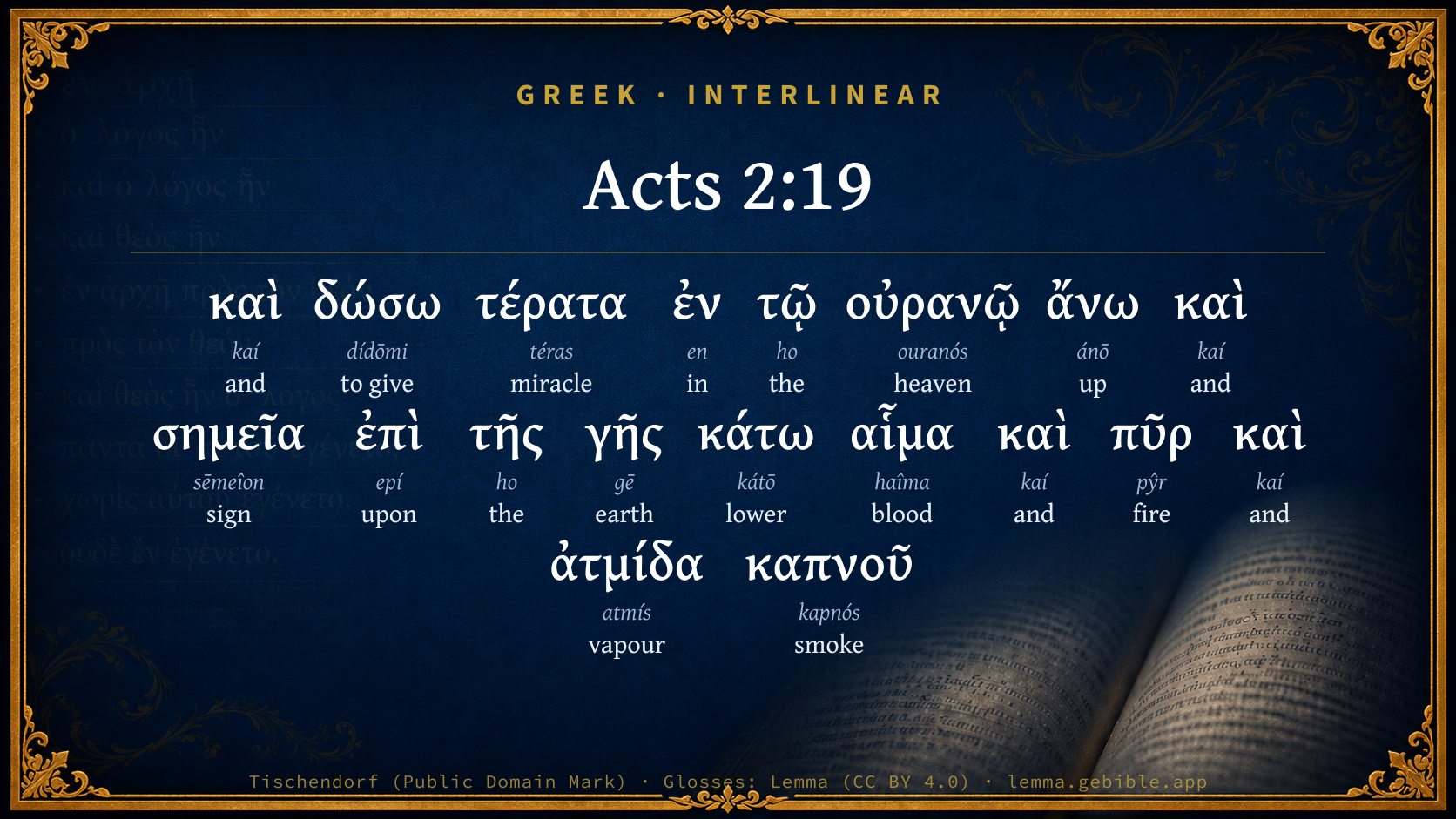
Download image
Cite this verse

Acts 2:19 (World English Bible). Public Domain. Lemma interlinear Bible study tool, https://lemma.gebible.app/v/acts/2/19.

Show BibTeX & RIS
BibTeX
RIS
English Translation
I will show wonders in the sky above, And signs on the earth beneath; Blood, and fire, and billows of smoke.
World English Bible · Public Domain
Highlights
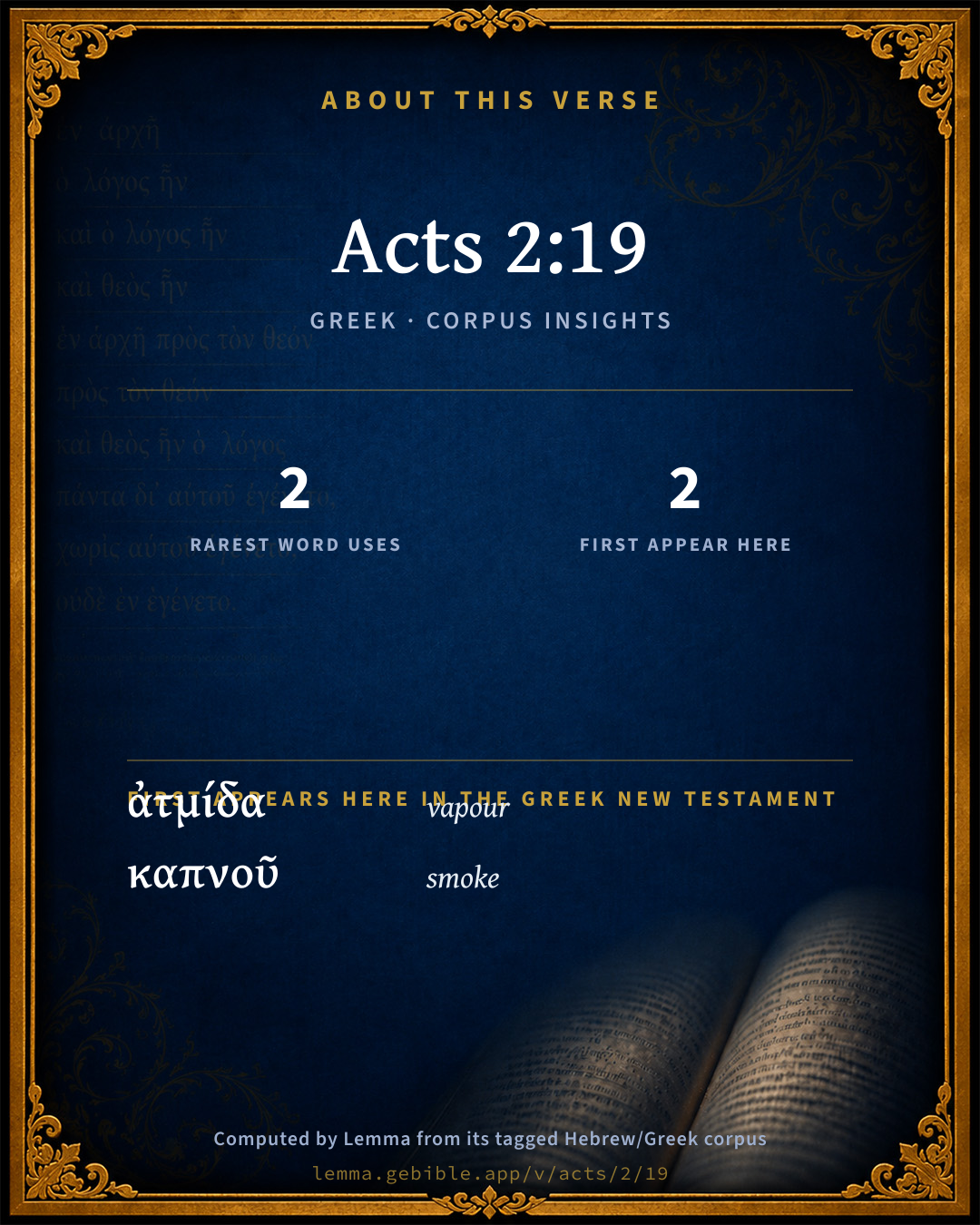
  • 2 first appearances in the Greek New Testament
Full analysis ↓
Download a study sheet

One document with this verse’s original text, its word-by-word gloss line, the meaning frame, cross-references with their text, attributed commentary, and full source and license credits — printable, and it pastes into notes with its structure intact.

This verse Autodidact and up

Study sheet (.html) Plain text (.txt)

A passage Seminary Student

Up to 50 verses in one chapter. A passage sheet keeps up to 6 commentary sources and 12 cross-references per verse, in the order this page ranks them, and says so on the sheet whenever that leaves anything out. Ask for a single verse and you get the Autodidact verse sheet above.

Everything on this page stays free to read, with no account — the sheet is a download of what is already on screen, not access to it.

Want to remove ads? Support Godless Engineer
Compare translations 3

The same verse in 3 English versions, stacked beneath the original-language interlinear above. Click any original word for its lexicon entry.

Each is an independent rendering of the whole verse — the interlinear is not word-aligned to these translations.

Highlighted words mark where these versions differ — a whole-verse word diff, not a word-by-word alignment.

  • World English Bible Public Domain
    I will show wonders in the sky above, And signs on the earth beneath; Blood, and fire, and billows of smoke.
  • King James Version Public Domain
    And I will shew wonders in heaven above, and signs in the earth beneath; blood, and fire, and vapour of smoke:
  • unfoldingWord Literal Text CC BY-SA 4.0
    And I will give wonders in the heaven above and signs on the earth below, blood and fire and vapor of smoke.

unfoldingWord Literal Text — © unfoldingWord, licensed CC BY-SA 4.0. Word-aligned USFM3 via Door43 (git.door43.org/unfoldingWord/en_ult).

Versions to compare (up to 4)

3 of 4 selected

Show all 19 translations

Every available English version of this verse, each an independent rendering of the whole verse.

  • World English Bible Public Domain
    I will show wonders in the sky above, And signs on the earth beneath; Blood, and fire, and billows of smoke.
  • Berean Standard Bible Public Domain
    I will show wonders in the heavens above and signs on the earth below, blood and fire and billows of smoke.
  • Majority Standard Bible Public Domain
    I will show wonders in the heavens above and signs on the earth below, blood and fire and billows of smoke.
  • King James Version Public Domain
    And I will shew wonders in heaven above, and signs in the earth beneath; blood, and fire, and vapour of smoke:
  • American Standard Version (1901) Public Domain
    And I will show wonders in the heaven above, And signs on the earth beneath; Blood, and fire, and vapor of smoke:
  • Revised Version (1885) Public Domain
    And I will shew wonders in the heaven above, And signs on the earth beneath; Blood, and fire, and vapour of smoke:
  • Geneva Bible (1599) Public Domain
    And I wil shew wonders in heauen aboue, and tokens in the earth beneath, blood, and fire, and the vapour of smoke.
  • Douay-Rheims (1899) Public Domain
    And I will shew wonders in the heaven above, and signs on the earth beneath: blood and fire, and vapour of smoke.
  • Young's Literal Translation Public Domain
    and I will give wonders in the heaven above, and signs upon the earth beneath -- blood, and fire, and vapour of smoke,
  • Literal Standard Version CC BY-SA 4.0
    And I will give wonders in the sky above, || And signs on the earth beneath—Blood, and fire, and vapor of smoke,
  • Unlocked Literal Bible CC BY-SA 4.0
    I will show wonders in the sky above and signs on the earth below, blood, fire, and vapor of smoke.
  • unfoldingWord Literal Text CC BY-SA 4.0
    And I will give wonders in the heaven above and signs on the earth below, blood and fire and vapor of smoke.
  • Darby Bible Public Domain
    And I will give wonders in the heaven above and signs on the earth below, blood, and fire, and vapour of smoke:
  • World Messianic Bible Public Domain
    I will show wonders in the sky above, and signs on the earth beneath: blood, and fire, and billows of smoke.
  • Webster's Bible Public Domain
    And I will show wonders in heaven above, and signs on the earth beneath; blood, and fire, and vapor of smoke.
  • Free Bible Version CC BY-SA 4.0
    I will also give you miraculous signs in the heavens above and on the earth below—blood, fire, and swirling smoke!
  • Bible in Basic English Public Domain
    And wonders will be seen in heaven, and signs on the earth, blood and fire and smoke:
  • Text-Critical English NT CC BY 4.0
    I will perform wonders in the heavens above and signs on the earth below: blood, fire, and mist of smoke.
  • Tyndale New Testament (1534) Public Domain
    And I will shewe wonders in heaven a bove and tokens in the erth benethe bloud and fyre and the vapour of smoke.

Literal Standard Version (2020), Covenant Press — licensed CC BY-SA 4.0. Text via the HelloAO Bible API (eBible.org). Unlocked Literal Bible (unfoldingWord) — licensed CC BY-SA 4.0. Text via the HelloAO Bible API (eBible.org). unfoldingWord Literal Text — © unfoldingWord, licensed CC BY-SA 4.0. Word-aligned USFM3 via Door43 (git.door43.org/unfoldingWord/en_ult). Free Bible Version, Dr. Jonathan Gallagher — licensed CC BY-SA 4.0. Text via the HelloAO Bible API (eBible.org).

Word by word

More ways to search: Search by grammar → Find every occurrence → Compare this word →

Practice this passage: Drill this verse → Learn its vocabulary →

ἀτμίδα
atmís
G822
“vapour”
Noun, Accusative, Singular, Feminine
Part of Speech
Noun
Case
Accusative
Number
Singular
Gender
Feminine
Full Thayer's Definition

Origin: from the same as G109

TDNT: None

1. vapour
  1. καὶ kaí G2532 “and” Conjunction
  2. δώσω dídōmi G1325 “to give” Verb, Future, Active, Indicative, 1st person, Singular
  3. τέρατα téras G5059 “miracle” Noun, Accusative, Plural, Neuter
  4. ἐν en G1722 “in” Preposition
  5. τῷ ho G3588 “the” Article, Dative, Singular, Masculine
  6. οὐρανῷ ouranós G3772 “heaven” Noun, Dative, Singular, Masculine
  7. ἄνω ánō G507 “up” Adverb
  8. καὶ kaí G2532 “and” Conjunction
  9. σημεῖα sēmeîon G4592 “sign” Noun, Accusative, Plural, Neuter
  10. ἐπὶ epí G1909 “upon” Preposition
  11. τῆς ho G3588 “the” Article, Genitive, Singular, Feminine
  12. γῆς gē G1093 “earth” Noun, Genitive, Singular, Feminine
  13. κάτω kátō G2736 “lower” Adverb
  14. αἷμα haîma G129 “blood” Noun, Accusative, Singular, Neuter
  15. καὶ kaí G2532 “and” Conjunction
  16. πῦρ pŷr G4442 “fire” Noun, Accusative, Singular, Neuter
  17. καὶ kaí G2532 “and” Conjunction
  18. καπνοῦ kapnós G2586 “smoke” Noun, Genitive, Singular, Masculine

About this verse

These counts appear in no published source. They are computed here, from the morphology-tagged text and Lemma’s own curated glosses. What Lemma adds →

19
words
15
distinct lemmas
Acts
section

Notable vocabulary

The rarest word here is ἀτμίδα vapour G822 — appearing just 2 times in the whole Greek New Testament.

First appearance in Scripture

These words make their first canonical appearance in the Greek New Testament here:

  • ἀτμίδα vapour G822
  • καπνοῦ smoke G2586

Shared distinctive vocabulary

ἀτμίδα vapour G822 occurs in 2 verses of the Greek New Testament. Also found in:
Repetition

Words recur within this verse:

Cross-references

3

Topical passages linked to Acts 2:19 in the Treasury of Scripture Knowledge — connected by theme and wording, ordered by reader-vote popularity; previews shown in the World English Bible.

  • Joel 2:30–31 I will show wonders in the heavens and in the earth: Blood, fire, and pillars of smoke.
  • Zephaniah 1:14–18 The great day of Yahweh is near. It is near, and hurries greatly, the voice of the day of Yahweh. The mighty man cries there bitterly.
  • Malachi 4:1–6 "For, behold, the day comes, it burns as a furnace; and all the proud, and all who work wickedness, will be stubble; and the day that comes will burn them up," says Yahweh of Hosts, "that it shall leave them neither root nor branch.

Cross-references courtesy of OpenBible.info (CC BY 4.0).

Commentary

Notes on Acts 2:19 from classic Christian and Jewish commentators (each source and its license shown beneath its notes). The classic Christian expositions comment on the surrounding passage and are grouped to its opening verse, so a note may address several verses; the Jewish commentaries on the Tanakh (Rashi and others) are per-verse, so they appear only where the commentator wrote on this verse.

Lemma curates 59 commentaries, every one of them public domain or Creative Commons licensed, each selected and text-cleaned for this edition rather than reprinted as found. About our sources →

Bengel's Gnomon

Johann Albrecht Bengel

Act 2:19. Τέρατα, prodigies [‘wonders’]) Judgments on the wicked accompany great revelations of grace: Num 14:20, etc. [Caleb and the unbelieving Israelites]; Jude Act 2:5, “The Lord having saved the people out of—Egypt, afterward destroyed them that believed not:” and the sure and immediate recompense of the wicked admonishes men to receive the proffered grace. [There is a continued effusion of the Holy Spirit, though it be accomplished in different ways.—V. g.]—ἐν τῷ οὐρανῷ, in the heaven) Concerning the prodigies in heaven, see Act 2:20.—ἐπὶ τῆς γῆς, upon the earth) Concerning the prodigies on the earth, there follows immediately the account in this verse, by Chiasmus. Such signs were exhibited before the passion of Christ, which are mentioned in Act 2:22: but they are so described as that there are included with them those signs which were shown at the actual time of His passion and resurrection, as also at the destruction of Jerusalem; but especially those signs which shall precede the last day: Mat 24:29, “Immediately after the tribulation of those days shall the sun be darkened, and the moon shall not give her light,” etc. Prophecy, however remote from the last times, comprises all things summarily and in one comprehensive glance. So altogether (evidently) the clause of Malachi (with which comp. Mat 11:13-14, note; Act 17:11-12, note) looks directly to the coming of John the Baptist, and the mention of the terrible day of the Lord, the last day, is incidentally subjoined and connected with that clause.—αἷμα, blood) slaughter and wars.—πῦρ, fire) Conflagrations.—ἀτμίδα καπνοῦ, vapour of smoke) Thick smoke ends in a subtle vapour.

Bengel's Gnomon of the New Testament — English translation (T&T Clark, Edinburgh, 1860) — public domain. Text from a community e-Sword module.

Meyer's Critical & Exegetical Commentary

Heinrich August Wilhelm Meyer

Act_2:19-20. After this effusion of the Spirit I shall bring about (δώσω, as at Mat_24:24) catastrophes in heaven and on earth (the latter are mentioned at once in Act_2:19, the former in Act_2:20) as immediate heralds of the Messianic day. Peter includes in his quotation this element of the prophecy, because its realization (Act_2:16), conditioned by the outpouring of the Spirit which necessarily preceded it, presented itself likewise essentially as belonging to the allotted portion of the ἔσχαται ἡμέραι. The dreadful events could not but nowseeing that the effusion of the Spirit preceding them had already commencedbe conceived as inevitable and very imminent; and this circumstance could not but mightily contribute to the alarming of souls and their being won to Christ. As to τέρατα and σημεῖα, see on Mat_24:24; Rom_15:19.

αἷμα … καπνοῦ contains the σημεῖα ἐπὶ τῆς γῆς, namely, bloodshed (war, revolt, murder) and conflagration. Similar devastations belonged, according to the later Jewish Christology also, to the dolores Messiae. See on Mat_24:6-7. Cum videris regna se invicem turbantia, tunc expectes vestigia Messiae; Beresh. rabb. sec. 41. The reference to blood-rain, fiery meteors, and pillars of smoke arising from the earth (de Wette, comp. Kuinoel), is neither certainly in keeping with the original text of the prophecy, nor does it satisfy the analogy of Matthew 24

ἀτμίδα καπνοῦ] vapour of smoke (ἀτμίς, Plat. Tim. p. 87 E, yet in classical writers more usually ἀτμός, is the more general idea). Comp. on such combinations, Lobeck, Paral. p. 534.

Act_2:20. Meaning: the sun will become dark, and the moon appear bloody. Comp. on Mat_24:29; also Isa_13:10; Eze_32:7.

πρὶν ἐλθεῖν] ere there shall have come. See Klotz, ad Devar. p. 728 f.

τὴν ἡμέραν κυρίου] i.e. according to the sense of the prophetic fulfilment of the words: the day of Christ, namely of His Parousia. Comp. on Rom_10:13. But this is not, with Grotius, Lightfoot, and Kuinoel, following the Fathers, to be considered as identical with the destruction of Jerusalem (which belongs to the σημεία of the Parousia, to the dolores Messiae). See on Mat_24:29.

τὴν μεγάλην κ. ἐπιφανῆ] the great (κατʼ ἐξοχήν, fraught with decision, comp. Rev_16:14) and manifest, i.e. which makes itself manifest before all the world as that which it is. Comp. the frequent use of ἐπιφάνεια for the Parousia (2Th_2:8, al.). The Vulgate aptly renders: manifestus. Instead of ἐπιφανῆ, the Hebrew has הַנּו̇רָא, terribilis, which the LXX., deriving from ראה, has incorrectly translated by ἐπιφανῆ, as also elsewhere; see Biel and Schleusn. Thes. s.v. But on this account the literal signification of ἐπιφαν. need not be altered here, where the text follows the LXX.

Meyer — Critical and Exegetical Commentary on the New Testament — English translation by Peter Christie, edited by Frederick Crombie (T&T Clark, 1880) — public domain. Text from a community e-Sword module.

Expositor's Greek Testament

ed. W. Robertson Nicoll

Act 2:19 . The word σημεῖα is wanting in the Hebrew and the LXX, but the co-ordination of the two words τέρας and σημεῖον is frequent in the N.T. (Joh 4:48 , Act 4:30 , Rom 15:19 , 2Co 12:12 ), and even more so in the LXX (Exo 7:3 ; Exo 7:9 , Deu 4:34 , Neh 9:10 , Dan 6:27 ), so also in Josephus, Philo, Plutarch, Polybius. For the distinction between the words in the N.T., see below on Act 2:22 . τέρας is often used of some startling portent, or of some strange appearance in the heavens, so here fitly used of the sun being turned into darkness, etc. But God’s τέρατα are always σημεῖα to those who have eyes to see, and significantly in the N.T. the former word is never found without the latter. It is no doubt true to say that St. Peter had already received a sign from heaven above in the ἦχος ἐκ τοῦ οὐρανοῦ , and a sign upon the earth below in the λαλεῖν ἑτέραις γλώσσαις (Nösgen), but the whole context, Act 2:19-21 , shows that St. Peter’s thoughts had passed from the day of Pentecost to a period of grace and warning which should precede the Parousia. No explanation, therefore, of the words which limits their fulfilment to the Pentecostal Feast (see Keil, in loco , and also his reference to the interpretation of the Rabbis) is satisfactory. σημεῖα is probably introduced into the text to emphasise the antithesis, as also are ἄνω and κάτω . αἷμα καὶ πῦρ : if we see in these words σημεῖα ἐπὶ τῆς γῆς κάτω , there is no need to refer them to such startling phenomena as rain of blood, or fiery meteors, or pillars of smoke rising from the earth (so De Wette, Overbeck), but rather to the bloodshed and devastation of war (so Holtzmann, Wendt, Felten); cf. our Lord’s words, Mat 24:6 ; Mat 24:29 . Dean Plumptre thinks of the imagery as drawn from one of the great thunderstorms of Palestine, and cf. Weber, Jüdische Theologie , pp. 350, 351 (1897).

The Expositor's Greek Testament, edited by W. Robertson Nicoll (1897–1910) — public domain. Text from a community e-Sword module.

Jamieson, Fausset & Brown

Robert Jamieson, A. R. Fausset & David Brown

I will show wonders, &c.--referring to the signs which were to precede the destruction of Jerusalem (see on Luk 21:25-28).

Jamieson, Fausset & Brown — Commentary Critical and Explanatory on the Whole Bible (1871) — public domain (CC PDM 1.0). Text via the HelloAO Bible API.

Adam Clarke's Commentary

Verse 19. I will show wonders] It is likely that both the prophet and the apostle refer to the calamities that fell upon the Jews at the destruction of Jerusalem, and the fearful signs and portents that preceded those calamities. See the notes on Mt 24:5-7, where these are distinctly related.

Blood, fire, and vapour of smoke] Skirmishes and assassinations over the land, and wasting the country with fire and sword.

Adam Clarke's Commentary on the Bible (1810–1826) — public domain. Text from a community e-Sword/MySword module.

John Calvin's Commentaries

19. And I will show wonders We must first see what is meant by this great day of the Lord. Some do expound it of the former coming of Christ in the flesh; and others refer it unto the last day of the resurrection, I do allow neither opinion. For, in my judgment, the prophet comprehendeth the whole kingdom of Christ. And so he calleth it the great day, after that the Son of God began to be revealed in the flesh, that he may lead us into the fulfilling of his kingdom. Therefore, he appointeth no certain day, but he beginneth this day at the first preaching of the gospel, and he extendeth the same unto the last resurrection. Those which restrain it unto the time of the apostles are moved with this reason, because the prophet joineth this member and that which goeth next before together. But in that there is no absurdity at all, because the prophet doth assign the time when these things began to come to pass, howsoever they have a continual going forward even until the end of the world. Furthermore, whereas he saith that the sun shall be turned to darkness, and the moon into blood, they are figurative speeches, whereby he doth give us to understand thus much, that the Lord will show tokens of his wrath through the whole frame of the world, which shall bring men even to their wit’s end, as if there should be some horrible and fearful change of nature wrought. For as the sun and moon are unto us witnesses of God’s fatherly favor towards us, whilst that by course they give light to the earth; so, on the other side, the prophet saith, that they shall be messengers to foreshow God’s wrath and displeasure. And this is the second member of the prophecy. For after that he had intreated of the spiritual grace which should be abundantly poured out upon all flesh, lest any man should imagine that all things should be quiet and prosperous together, therewithal he addeth that the estate of the world shall be troublesome, and full of great fear under Christ; as Christ himself doth more fully declare, Matthew 24 and Luke 21.

But this serveth greatly to the setting forth of grace, that whereas all things do threaten destruction, yet whosoever doth call upon the name of the Lord is sure to be saved. By the darkness of the sun, by the bloody streaming of the moon, by the black vapor of smoke, the prophet meant to declare, that whithersoever men turn their eyes, there shall many things appear, both upward and downward, which may make them amazed and afraid, as he hath already said. Therefore, this is as much as if he should have said, that the world was never in a more miserable case, that there were never so many and such cruel tokens of God’s wrath. Hence may we gather how inestimable the goodness of God is, who offereth a present remedy for so great evils; and again, how unthankful they are towards God, and how froward, which do not flee unto the sanctuary of salvation, which is nigh unto them, and doth meet them. Again, it is out of all doubt, that God meaneth by this so doleful a description, to stir up all godly men, that they may with a more fervent desire seek for salvation. And Peter citeth it to the same end, that the Jews may know that they shall be more miserable unless they receive that grace of the Spirit which is offered unto them. Yet here may a question be asked, how this can hang together, that when Christ is revealed, there should such a sea of miseries overflow and break out therewithal? For it may seem to be a thing very inconvenient, that he should be the only pledge of God’s love toward mankind, in whom the heavenly Father doth lay open all the treasure of his goodness, yea, he poureth out the bowels of his mercy upon us, and that yet, by the coming of the same, his Son, his wrath should be more hot than it was wont, so that it should, as it were, quite consume both heaven and earth at once.

But we must first mark, that because men are too slow to receive Christ, they must be constrained by divers afflictions, as it were with whips. Secondly, forasmuch as Christ doth call unto himself all those which are heavy laden and labor, (Matthew 11:28,) we must first be tamed by many miseries, that we may learn humility. For through great prosperity men do set up the horns of pride. And he cannot but despise Christ fiercely, whosoever he be, that seemeth to himself to be happy. Thirdly, because we are, more than we ought, set upon the seeking of the peace of the flesh, whereby it cometh to pass that many tie the grace of Christ unto the present life, it is expedient for us to be accustomed to think otherwise, that we may know that the kingdom of Christ is spiritual. Therefore, to the end God may teach us that the good things of Christ are heavenly, he doth exercise us, according to the flesh, with many miseries; whereby it cometh to pass that we do seek our felicity without the world. Moreover, men do bring miseries upon themselves through their unthankfulness; for the servant which knoweth his master’s will, and doth not obey, is worthy of greater and more stripes, (Luke 12:47.) The more familiarly that God doth communicate with us in Christ, the more doth our ungodliness grow and break out into open contumacy, so that it is no marvel if, when Christ is revealed, there appear many tokens of God’s vengeance on the other side, forasmuch as men do hereby more grievously provoke God against them, and kindle his wrath through wicked contempt. Surely, in that the day of Christ is fearful, it is an accidental thing; whether God will correct our slothfulness, to bring us under, which [who] are yet inapt to be taught, or whether he will punish our unthankfulness. For it bringeth with it of itself nothing but that which is pleasant; but the contempt of God’s grace doth provoke him to horrible anger not without cause.

John Calvin's Commentaries (1540-1563) — public domain. Text from the Calvin Translation Society English edition (1840s-50s) via the Christian Classics Ethereal Library (ccel.org). Calvin's coverage is partial (roughly two-thirds of the Bible); uncommented books and verses are honest gaps, never fabricated. The 19th-century editor's footnotes and remarks are omitted so the notes are faithfully Calvin's own voice.

Ellicott's Commentary for English Readers

(19) And I will shew wonders in heaven above.—St. Peter quotes the words of terror that follow, apparently, for the sake of the promise with which they end in Act_2:21. But as it was not given to him as yet to know the times and the seasons (Act_1:7), it may well have been that he looked for the “great and notable day” as about to come in his own time. The imagery is drawn as from one of the great thunder-storms of Palestine. There is the lurid blood-red hue of clouds and sky; there are the fiery flashes, the columns or pillars of smoke-like clouds boiling from the abyss. These, in their turn, were probably thought of as symbols of bloodshed, and fire and smoke, such as are involved in the capture and destruction of a city like Jerusalem.

A Bible Commentary for English Readers, edited by Charles John Ellicott (1878–1897) — public domain. Text from a community e-Sword module.

The Cambridge Bible for Schools and Colleges

gen. ed. J. J. S. Perowne

19. and I will shew wonders, &c.] By the figurative language of this verse the prophet teaches that even when the kingdom of Christ shall have come into the world, mighty troubles shall still prevail. Cp. Christ’s own words of like import (Mat_24:21-30).

The Cambridge Bible for Schools and Colleges (gen. ed. J. J. S. Perowne; Cambridge University Press, 1878–1918) — public domain. Text from a community e-Sword module.

John Gill's Exposition

And I will show wonders in heaven above,.... The word above is not in Joel, nor in the Syriac version here, as neither the word "beneath", in the next clause. This may refer either to the appearance of angels, and of an extraordinary star at the birth of Christ; or rather to comets and blazing stars, and particularly to that comet which, in the form of a flaming sword, hung over Jerusalem, and the forms of armies in the heavens engaged together, which were seen before, and portended the destruction of that city (t):

and signs in the earth beneath; meaning either the miracles done by Christ, and his apostles, on earth; or those surprising events in Judea and in Jerusalem, a flame was seen in the temple, the doors of it opened of themselves, and a voice was heard in it, saying, let us go hence; and an idiot went about several years together, saying, woe to the people, woe to the city, &c,

blood, and fire, and vapour of smoke: by blood is meant not the blood of Christ, either his bloody sweat in the garden, or what he shed on the cross, but the blood of the Jews, shed in war, and in internal seditions and murders: and by "fire" is designed not the Holy Ghost, who now appeared in cloven tongues, as of fire, but the conflagration of the city and temple of Jerusalem, and of many other towns and villages. And by "vapours of smoke"; or, as in the Hebrew text, "pillars of smoke", ascending in upright columns, like palm trees, are intended literally, the vast quantities of smoke that would arise from such burnings; so that the very heavens would be clouded and darkened with them, and sun and moon appear in the following form,

(t) Joseph. de Bello Jud. l. 6. c. 5. sect. 3.

John Gill's Exposition of the Whole Bible (1746–1763) — public domain (CC PDM 1.0). Text via the HelloAO Bible API.

Trapp's Complete Commentary

John Trapp

19 And I will shew wonders in heaven above, and signs in the earth beneath; blood, and fire, and vapour of smoke:

Ver. 19. Wonders in heaven] See Joe 3:15; Mat 24:29; Mar 13:24; Luk 21:25.

John Trapp, A Commentary or Exposition upon All the Books of the Old and New Testament (1647–1656) — public domain. Text from a community e-Sword module.

Albert Barnes' Notes on the Bible

I will show wonders - Literally, “I will give signs” - δώσω τέρατα dōsō terata. The word in the Hebrew, מופתים mowpatiym, means properly “prodigies; wonderful occurrences; miracles performed by God or his messengers,” Exo 4:21; Exo 7:3, Exo 7:9; Exo 11:9; Deu 4:34, etc. It is the common word to denote a miracle in the Old Testament. Here it means, however, a portentous appearance, a prodigy, a remarkable occurrence. It is commonly joined in the New Testament with the word “signs” - “signs and wonders,” Mat 24:24; Mar 13:22; Joh 4:48. In these places it does not of necessity mean miracles, but unusual and remarkable appearances. Here it is used to mean great and striking changes in the sky, the sun, moon, etc. The Hebrew is, “I will give signs in the heaven and upon the earth.” Peter has quoted it according to the sense, and not according to the letter. The Septuagint is here a literal translation of the Hebrew; and this is one of the instances where the New Testament writers did not quote from either.

Much of the difficulty of interpreting these verses consists in affixing the proper meaning to the expression “that great and notable day of the Lord.” If it be limited to the day of Pentecost, it is certain that no such events occurred at that time. But there is, it is believed, no propriety in confining it to that time. The description here pertains to “the last days” Act 2:17; that is, to the whole of that period of duration, however long, which was known by the prophets as “the last times.” That period might be extended through many centuries; and during that period all these events would take place. The day of the Lord is the day when God will manifest himself in a special manner; a day when he will so strikingly be seen in his wonders and his judgments that it may be called his day. Thus, it is applied to the day of judgment as the day of the Son of man; the day in which he will be the great attractive object, and will be signally glorified, Luk 17:24; 1Th 5:2; Phi 1:6; 2Pe 3:12. If, as I suppose, “that notable day of the Lord” here refers to that future time when God will manifest himself in judgment, then we are not to suppose that Peter meant to say that these “wonders” would take place on the day of Pentecost, or had their fulfillment then, “but would occur under that indefinite period called “the last days,” the days of the Messiah, and before that period Was closed by the great day of the Lord.” The gift of tongues was a partial fulfillment of the general prophecy pertaining to those times. And as the prophecy was thus partially fulfilled, it was a pledge that it would be entirely; and thus there was laid a foundation for the necessity of repentance, and for calling on the Lord in order to be saved.

Blood - Blood is commonly used as an emblem of slaughter or of battle.

Fire - Fire is also an image of war, or the conflagration of towns and dwellings in time of war.

Vapour of smoke - The word “vapor,” ἀτμίς atmis, means commonly an exhalation from the earth, etc., easily moved from one place to another. Here it means (Hebrew: Joel) rising columbus or pillars of smoke, and is another image of the calamities of war the smoke rising from burning towns. It has always been customary in war to burn the towns of an enemy, and to render him as helpless as possible. Hence, the calamities denoted here are those represented by such scenes. To what particular scenes there is reference here it is impossible now to say. It may be remarked, however, that scenes of this kind occurred before the destruction of Jerusalem, and there is a striking resemblance between the description in Joel and that by which our Saviour foretells the destruction of Jerusalem. See the notes on Mat 24:21-24. Dr. Thomson (Land and the Book, vol. 2, p. 311) supposes that the reference in Joel may have been to the usual appearances of the sirocco, or that they may have suggested the image used here. He says: “We have two kinds of sirocco, one accompanied with vehement wind, which fills the air with dust and fine sand. I have often seen the whole heavens veiled in gloom with this sort of sandcloud, through which the sun, shorn of his beams, looked like a globe of dull smouldering fire. It may have been this phenomenon which suggested that strong prophetic figure of Joel, quoted by Peter on the day of Pentecost. Wonders in the heaven and in the earth; blood, and fire, and pillars of smoke; the sun shall be turned into darkness, and the moon into blood. The pillars of smoke are probably those columns of sand and dust raised high in the air by local whirlwinds, which often accompany the sirocco. On the great desert of the Hauran I have seen a score of them marching with great rapidity over the plain, and they closely resemble ‘pillars of smoke.’”

Albert Barnes' Notes on the Bible (1834–1885) — public domain. Text from a community e-Sword/MySword module.

Haydock's Catholic Bible Commentary

I will shew wonders, &c. These prodigies are commonly expounded of those that shall forerun the last day; or of the prognostics of the destruction of Jerusalem, which was a figure of the destruction of the world. (Witham) --- Blood, fire, &c. These prodigies were accomplished at our Saviour’s death, or before the destruction of Jerusalem. We must not expect in these prophecies, where the descriptions are so grand, pathetic, and hyperbolical, to find that the accomplishment of them is literal, and precisely according to terms. The sun shall suffer an eclipse, the moon turn red, like blood, &c. (Calmet)

George Leo Haydock (1774–1849), Haydock's Catholic Family Bible and Commentary, 1859 edition — public domain. Excludes Psalms (Douay-Rheims chapter numbering differs from Protestant) and Deuterocanonical books (Catholic canon only).

Matthew Poole's English Annotations

As St Peter had declared the promises unto such as would be drawn by the cords of love; so here, on the other side, he useth threatenings, and declares the terrors of the Lord, if so that they will be persuaded. These wonders were such as did precede the destruction of Jerusalem, or shall forerun the destruction of the whole world.

Matthew Poole's English Annotations on the Holy Bible (1683–1685) — public domain. Text from a community e-Sword/MySword module.

Whedon's Commentary on the Bible

Daniel D. Whedon

19, 20. Before this notable inauguration day there should be a series of wonders, and after it should follow the offers of grace and mercy. By Act_2:22 it appears that these signs and wonders are attendant on the person of Jesus. They are the accessory wonders of that central wonder, the incarnation.

19. Wonders in heaven—The angels appearing in the sky to the shepherds; the descent of the Spirit, dove-like, from heaven at Jesus’ baptism; the voice from heaven, Joh_12:28; the Pentecostal mighty rushing as of wind from heaven.

In the earth—Birth and miracles of Christ and his apostles, and especially Christ’s resurrection.

Blood—The wonderful blood at the crucifixion.

Fire—The opening wonder of the Pentecost.

Vapour of smoke—At the darkness and earthquake of the crucifixion.

Daniel D. Whedon (gen. ed.), Commentary on the Old and New Testaments (1874–1909) — public domain. Text from a community e-Sword module.

The Pulpit Commentary

The heaven for heaven, A.V.; on for in, A.V. I will show. (dwsw, as in Mat_24:24) This follows the Hebrew and the Codex Alexandrinus. The Vatican Codex has, They will show or give (dwswsi). In the heavens above on the earth beneath. Above and beneath are not in the Hebrew or the LXX With these exceptions, the text of the LXX is followed.

The Pulpit Commentary (1880–1919), ed. H.D.M. Spence-Jones & Joseph S. Exell — public domain. Text from a community e-Sword module.

John Wesley's Explanatory Notes

And I will show prodigies in heaven above, and signs on earth beneath - Great Revelations of grace are usually attended with great judgments on those who reject it. In heaven - Treated of, ver. 20. On earth - Described in this verse. Such signs were those mentioned, ver. 22, before the passion of Christ; which are so mentioned as to include also those at the very time of the passion and resurrection, at the destruction of Jerusalem, and at the end of the world. Terrible indeed were those prodigies in particular which preceded the destruction of Jerusalem: such as the flaming sword hanging over the city, and the fiery comet pointing down upon it for a year; the light that shone upon the temple and the altar in the night, as if it had been noon-day; the opening of the great and heavy gate of the temple without hands; the voice heard from the most holy place, Let us depart hence; the admonition of Jesus the son of Ananus, crying for seven years together, Woe, woe, woe; the vision of contending armies in the air, and of entrenchments thrown up against a city there represented; the terrible thunders and lightnings, and dreadful earthquakes, which every one considered as portending some great evil: all which, through the singular providence of God, are particularly recorded by Josephus. Blood - War and slaughter. Fire - Burnings of houses and towns, involving all in clouds of smoke.

John Wesley, Explanatory Notes Upon the Whole Bible (1754–1765) — public domain. Text via the GEBible commentary corpus.

Godbey's Commentary on the New Testament

William B. Godbey

MIRACLES OF THE END

19, 20. These two verses describe the miracles of the end of the present age. You see how Peter couples them right on to the miracles of Pentecost; because he expected the Lord to return to the earth and set up His kingdom in his day.

Mat 16:28 : “There are some of those standing here who may not [not “shall not,” as E. V.] pass away until they see the Son of Man coming in his kingdom.”

Also,

Mat 24:34 : “This generation may not pass [not “shall not,” as E. V.] till all these things are fulfilled.”

From these and many other Scriptures we see the gracious possibility of our Lord’s return to the earth during the life-time of the apostles and their contemporaries. The Greek in these passages has the contingent tense.

There are no contingencies with God. The contingency was all on man’s side. As man always fails, so he failed in the Apostolic Age. There was a gracious possibility for man to preach the gospel to every nation during that generation; in which case our Lord would have returned on the throne of His millennial glory before that generation all passed away. All the apostles and saints expected to see the Lord return and “be caught up to meet him in the air,” which would have taken place if that generation had pushed to the ends of the earth and preached the gospel to every nation, as they could and should have done. These verses (19 and 20) describe the momentous miracles of the Tribulation. Luke Chapter 21), in his description of our Savior’s sermon on the judgments, preached on Mt. Olivet the day before He suffered, speaks of oceanic inundations during the Tribulation destroying multitudes. John describes the Armageddon wars deluging the world and heaping the battlefields with mountains of the dead. When the governments all fall (Dan 7:9) the rabble will rise, burn, rob and murder indiscriminately. Hence the bloody and fiery phenomena of the 19th verse. The smoke of conflagrations, gun powder and the vapor from the oceanic inundations and bloody battlefields will darken the sun and make the moon look red as blood. We have every reason to look out for these miracles immediately, as they are the next on the prophetic program.

William B. Godbey, Commentary on the New Testament (1896–1900) — public domain. Text from a community e-Sword module.

McGarvey & Pendleton's Commentaries

J. W. McGarvey

19-21. So much of Peter's quotation from Joel as we have now considered was in process of fulfillment at the time he was speaking, and is of quite easy interpretation; but not so with the remaining portion: (19) " And I will show wonders in heaven above, and signs on the earth below, blood, and fire, and smoky vapor. (20) The sun shall be turned into darkness, and the moon into blood, before that great and illustrious day of the Lord come. (21) And it shall come to pass that every one who will call on the name of the Lord shall be saved. "

It is quite evident that there was nothing transpiring at the time of Peter's speech to which the multitude could look as the fulfillment of these words; hence the remark with which he introduces the quotation, " This is that which was spoken by the prophet Joel," is to be understood only of the manifestation of the Holy Spirit. The remainder of the prediction must have still looked to the future for its fulfillment. How far in the future is not indicated, expect that the events mentioned were to take place, " before that great and illustrious day of the Lord." This day of the Lord is certainly spoken of as a day of terror and danger; and no doubt the salvation contemplated in the words, "every one who will call on the name of the Lord shall be saved," is salvation from the dangers of "that great and illustrious day." The interpretation of the whole passage, therefore, depends upon determining what is meant by that day. Is it the day of destruction of Jerusalem, or of the final judgment? The best way to settle this question is to examine the use of the phrase, "day of the Lord," in both Old Testament and New.

In the first eleven verses of the second chapter of Joel , the phrase "day of the Lord" occurs three times, and designates a time when the land should be desolated by locusts, insects, and drought. But with the passage now under consideration, in the latter part of the same chapter, the prophet begins a new theme, and therefore speaks of some other great and terrible day. Throughout the prophesies of Joel, and of all the Old Testament prophets, this phrase is used invariably to designate a day of disaster. Isaiah calls the time in which Babylon was to be destroyed, "the day of the Lord," and says of it, "The stars of heaven, and the constellations thereof, shall not give their light; the sun shall be darkened in its going forth, and the moon shall not cause her light to shine." Ezekiel, in like manner, foretelling the desolation of Egypt, says, "The day of the Lord is near; a cloudy day; it shall be the time of the heathen." Obadiah uses the same phrase in reference to the destruction of Edom; Amos, in reference to the captivity of Israel; and Zechariah, in reference to the final siege of Jerusalem. And induction of these passages establishes the conclusion that "the day of the Lord," with the prophets, is always a day of calamity, the precise nature of which is to be determined in each case by the context. In some cases the context is so obscure as not to determine the reference with certainty. The text before us possesses some of this obscurity, yet with the aid of the above remarks, and the use made of the passage by Peter, we may determine the reference with no small degree of certainty.

It is evident from Peter's application of the first part of the quotation to the the advent of the Spirit, that the latter part, which is contemplated as still future, was to be fulfilled after the scene then transpiring. Now, if the dangers of the day, as indicated by the words employed, were such as concerned the Jews alone, there would be good ground to suppose that reference was had to the destruction of Jerusalem. But the parties contemplated in the prophesy are " all flesh ;" therefore, all classes of men are embraced in the prophetic view, and the "day of the Lord" must, according to Old Testament usage, be a day of terror in which all are interested. But in the destruction of Jerusalem the Jews alone had any thing to dread; hence this can not be the reference. It must, then, be the day of judgment; for this is the only day of pre-eminent terror yet awaiting all mankind.

This conclusion is confirmed by the invariable usage of New Testament writers. The apostolic writings afford little ground indeed for the prominence that has been given to commentators to the destruction of Jerusalem, in their interpretations of prophesy. There was another and far different day, in their future, to which they gave the appellation, "the day of the Lord." Paul says, "Deliver such a one to Satan for the destruction of the flesh, that the spirit may be saved in the day of the Lord Jesus. " "We are your rejoicing, even as ye also are ours, in the day of the Lord Jesus. " "Yourselves know perfectly that the day of the Lord so comes as a thief in the night." "But the day of the Lord will comes as a thief in the night." These are all the occurrences of this expression in the New Testament, and they show conclusively that "the day of the Lord," with the apostles, was the day of judgment.

The great and illustrious day must not be confounded with the " signs and wonders " mentioned by the prophet; for these are to occur before that day. Whatever may be the exact symbolic meaning of the "blood and fire, and smoky vapor," and the darkening of the sun and moon, they represent events which are to take place before the day of judgment.

Having now determined the reference of the day in question, we can at once decide what salvation is contemplated in the declaration, "Every one who will call on the name of the Lord shall be saved." The only salvation connected with the day of judgment is the salvation from sin and death. The reference, therefore, is to this, and not to salvation from the destruction of Jerusalem.

This salvation is made to depend upon calling on the name of the Lord, an expression equivalent to prayer. It is, of course, acceptable prayer which is intended, and it therefore implies the existence of that disposition and conduct necessary to acceptable worship. Certainly no one calling upon the name of the Lord while persisting in disobedience can be included in this promise.

Thus far, in his discourse, Peter has directed his attention to the single object of proving the inspiration of himself and his associates. This was logically necessary previous to the utterance of a single word by authority, and most logically has he conducted his argument. The amazement of the people, upon beholding the miraculous scene, was a tacit acknowledgment of their inability to account for it. They were well prepared, therefore, to hear Peter's explanation. But if even he had attributed the effects which they witnessed to any less than divine power, they must have rejected his explanation as unsatisfactory. The question with them, indeed, was not, whether this was a divine or human manifestation, but, admitting its divinity, they asked one another, "What does this mean? " When, therefore, Peter simply declares, that this is a fulfillment of Joel's prophesy concerning the outpouring of the Spirit of God, they had no alternative but to receive his explanation, while the fact that it was a fulfillment of prophesy gave to it additional solemnity.

If Peter had closed his discourse at this point, the multitude would have gone away convinced of his inspiration, but not one of them would have been converted. All this has yet been said and done is preparatory; a necessary preparation for what is to follow. We are yet to search for the exact influence which turned their minds and hearts toward Jesus Christ.

J. W. McGarvey (with Philip Y. Pendleton), Commentaries on the New Testament (The Fourfold Gospel, 1914; Acts; and the epistles) — public domain. Text from a community e-Sword/MySword module.

The People's New Testament

B. W. Johnson

19. I will shew wonders in heaven. Peter not only quotes that part of the prophecy of Joel which was applicable to the events now transpiring, but he quotes that part also which pertains to the calamities coming on the Jewish nation, and to the final judgment. I understand verse 19 to apply directly to the overthrow of Judea and Jerusalem.

B. W. Johnson's The People's New Testament with Notes (1889–1891) — public domain. Electronic text from the Christian Classics Ethereal Library (CCEL) ThML edition.

Cambridge Greek Testament for Schools and Colleges

19. τέρατα. Even when the Kingdom of Christ shall have come mighty troubles will still prevail. Christ Himself gave the same lesson (Mat 24:21-30).

Cambridge Greek Testament for Schools and Colleges (Cambridge University Press, 1896; 21 vols, various authors incl. Carr, Maclear, Plummer, Farrar, Lumby, Moule, M. R. James, Simcox) — public domain. Text from a community e-Sword module.

Alford’s Greek Testament

Henry Alford

19.] καὶ δώσω τέρατα ἐν οὐρανῷ Ed-vat.: txt ABא.

ἄνω, σημεῖα, and κάτω are not in LXX nor Heb.

αἷμα κ. πῦρ.…] Not, ‘bloodshed and wasting by fire,’ as commonly interpreted:—not devastations, but prodigies, are foretold:—bloody and fiery appearances:—pillars of smoke, Heb.

Henry Alford, The Greek Testament (1849–1861) — public domain. Text from a community e-Sword module.

Vincent's Word Studies in the New Testament

Marvin R. Vincent

I will shew [δωσω] . Lit., I will give.

Wonders [τερατα] . Or portents. See on Mt 11:20.

Signs. See on Mt 11:20.

Marvin R. Vincent, Word Studies in the New Testament (1887–1900) — public domain. Text from a community e-Sword/MySword module.

Lesson kit

Teaching starters — assembled from the data on this page, not authored interpretation. Every prompt links to the verse data it draws on. Edit before teaching.

Acts, in the Acts, opens this verse with 19 words (15 distinct Greek lemmas). Its most distinctive word is atmís (“vapour”). A historical commentator’s framing appears above. Read the whole chapter for the surrounding context.

Discussion questions

  1. How does “vapour” (atmís) shape what this verse is saying?
  2. 2 words make their first appearance in Scripture here. What does this debut establish?
  3. How does James 4:14, which shares the word «vapour», read alongside this verse?
  4. What does the repetition of “and” (4× in this one verse) do in this verse?
  5. These translations render this verse differently; the difference is in the English rendering, not the original. What questions does that raise?
  6. Compare how Bengel's Gnomon and Meyer's Critical & Exegetical Commentary read this verse. Where do they agree or differ?

Things to notice

  • 2 words make their first canonical appearance in Scripture here.
  • These translations choose different wording for 10 words in this verse.
  • “and” occurs 4× in this single verse.
  • 15 distinct Greek lemmas span 19 words in this verse.

Reading settings

Reading text

Shown beneath each verse's original-language words.

Old Testament
Old Testament edition

Read the OT as the Masoretic Hebrew (MT) or the Greek Septuagint (LXX).

English shown for the Greek Septuagint (in the Hebrew ↔ Greek comparison).

Comparing translations? Open the Compare panel on any verse page to stack up to four side by side.