Revelation 18:20

Greek (Tischendorf 8th ed.) Revelation 18:20 appears in the Greek New Testament. The text above is from the Tischendorf 8th edition. Each word links to its Strong’s number and a concise gloss. Click any word for its full Thayer’s Greek Lexicon entry.
Download image
Cite this verse

Revelation 18:20 (World English Bible). Public Domain. Lemma interlinear Bible study tool, https://lemma.gebible.app/v/revelation/18/20.

Show BibTeX & RIS
BibTeX
RIS
English Translation
Rejoice over her, O heaven, you saints, apostles, and prophets; for God has judged your judgment on her."
World English Bible · Public Domain
Download a study sheet

One document with this verse’s original text, its word-by-word gloss line, the meaning frame, cross-references with their text, attributed commentary, and full source and license credits — printable, and it pastes into notes with its structure intact.

This verse Autodidact and up

Study sheet (.html) Plain text (.txt)

A passage Seminary Student

Up to 50 verses in one chapter. A passage sheet keeps up to 6 commentary sources and 12 cross-references per verse, in the order this page ranks them, and says so on the sheet whenever that leaves anything out. Ask for a single verse and you get the Autodidact verse sheet above.

Everything on this page stays free to read, with no account — the sheet is a download of what is already on screen, not access to it.

Want to remove ads? Support Godless Engineer
Compare translations 3

The same verse in 3 English versions, stacked beneath the original-language interlinear above. Click any original word for its lexicon entry.

Each is an independent rendering of the whole verse — the interlinear is not word-aligned to these translations.

Highlighted words mark where these versions differ — a whole-verse word diff, not a word-by-word alignment.

  • World English Bible Public Domain
    Rejoice over her, O heaven, you saints, apostles, and prophets; for God has judged your judgment on her."
  • King James Version Public Domain
    Rejoice over her, thou heaven, and ye holy apostles and prophets; for God hath avenged you on her.
  • unfoldingWord Literal Text CC BY-SA 4.0
    (“Rejoice over her, heaven, also you saints and apostles and prophets, for God has judged your judgment against her!”)

unfoldingWord Literal Text — © unfoldingWord, licensed CC BY-SA 4.0. Word-aligned USFM3 via Door43 (git.door43.org/unfoldingWord/en_ult).

Versions to compare (up to 4)

3 of 4 selected

Show all 19 translations

Every available English version of this verse, each an independent rendering of the whole verse.

  • World English Bible Public Domain
    Rejoice over her, O heaven, you saints, apostles, and prophets; for God has judged your judgment on her."
  • Berean Standard Bible Public Domain
    Rejoice over her, O heaven, O saints and apostles and prophets, because God has pronounced for you His judgment against her.
  • Majority Standard Bible Public Domain
    Rejoice over her, O heaven, and you saints and apostles and prophets, because God has pronounced for you His judgment against her.
  • King James Version Public Domain
    Rejoice over her, thou heaven, and ye holy apostles and prophets; for God hath avenged you on her.
  • American Standard Version (1901) Public Domain
    Rejoice over her, thou heaven, and ye saints, and ye apostles, and ye prophets; for God hath judged your judgment on her.
  • Revised Version (1885) Public Domain
    Rejoice over her, thou heaven, and ye saints, and ye apostles, and ye prophets; for God hath judged your judgment on her.
  • Geneva Bible (1599) Public Domain
    O heauen, reioyce of her, and ye holy Apostles and Prophets: for God hath punished her to be reuenged on her for your sakes.
  • Douay-Rheims (1899) Public Domain
    Rejoice over her, thou heaven, and ye holy apostles and prophets; for God hath judged your judgment on her.
  • Young's Literal Translation Public Domain
    `Be glad over her, O heaven, and ye holy apostles and prophets, because God did judge your judgment of her!'
  • Literal Standard Version CC BY-SA 4.0
    Be glad over her, O Heaven, and you holy apostles and prophets, because God judged your judgment of her!”
  • Unlocked Literal Bible CC BY-SA 4.0
    “Rejoice over her, heaven, you believers, apostles, and prophets, for God has brought your judgment on her!”
  • unfoldingWord Literal Text CC BY-SA 4.0
    (“Rejoice over her, heaven, also you saints and apostles and prophets, for God has judged your judgment against her!”)
  • Darby Bible Public Domain
    Rejoice over her, heaven, and [ye] saints and apostles and prophets; for God has judged your judgment upon her.
  • World Messianic Bible Public Domain
    “Rejoice over her, O heaven, you holy ones, emissaries, and prophets, for God has judged your judgment on her.”
  • Webster's Bible Public Domain
    Rejoice over her thou heaven, and ye holy apostles and prophets; for God hath avenged you on her.
  • Free Bible Version CC BY-SA 4.0
    Celebrate what's happened to her, heaven and believers and apostles and prophets, for God has condemned her as she condemned you.”
  • Bible in Basic English Public Domain
    Be glad over her, heaven, and you saints, and Apostles, and prophets; because she has been judged by God on your account.
  • Text-Critical English NT CC BY 4.0
    Rejoice over her, O heaven, and you saints, apostles, and prophets, for God has given judgment for you against her.”
  • Tyndale New Testament (1534) Public Domain
    Reioyce over her thou heven and the holy Apostles and prophetes: for god hath geven youre iudgment on her.

Literal Standard Version (2020), Covenant Press — licensed CC BY-SA 4.0. Text via the HelloAO Bible API (eBible.org). Unlocked Literal Bible (unfoldingWord) — licensed CC BY-SA 4.0. Text via the HelloAO Bible API (eBible.org). unfoldingWord Literal Text — © unfoldingWord, licensed CC BY-SA 4.0. Word-aligned USFM3 via Door43 (git.door43.org/unfoldingWord/en_ult). Free Bible Version, Dr. Jonathan Gallagher — licensed CC BY-SA 4.0. Text via the HelloAO Bible API (eBible.org).

Word by word

More ways to search: Search by grammar → Find every occurrence → Compare this word →

Practice this passage: Drill this verse → Learn its vocabulary →

εὐφραίνου
euphraínō
G2165
“to gladden”
Verb, Present, Passive, Imperative, 2nd person, Singular
Part of Speech
Verb
Tense
Present
Voice
Passive
Mood
Imperative
Person
2nd person
Number
Singular
Full Thayer's Definition

Origin: from G2095 and G5424

TDNT: 14:52,3

1. to gladden, make joyful a. to be glad, to be merry, to rejoice b. to rejoice in, be delighted with a thing
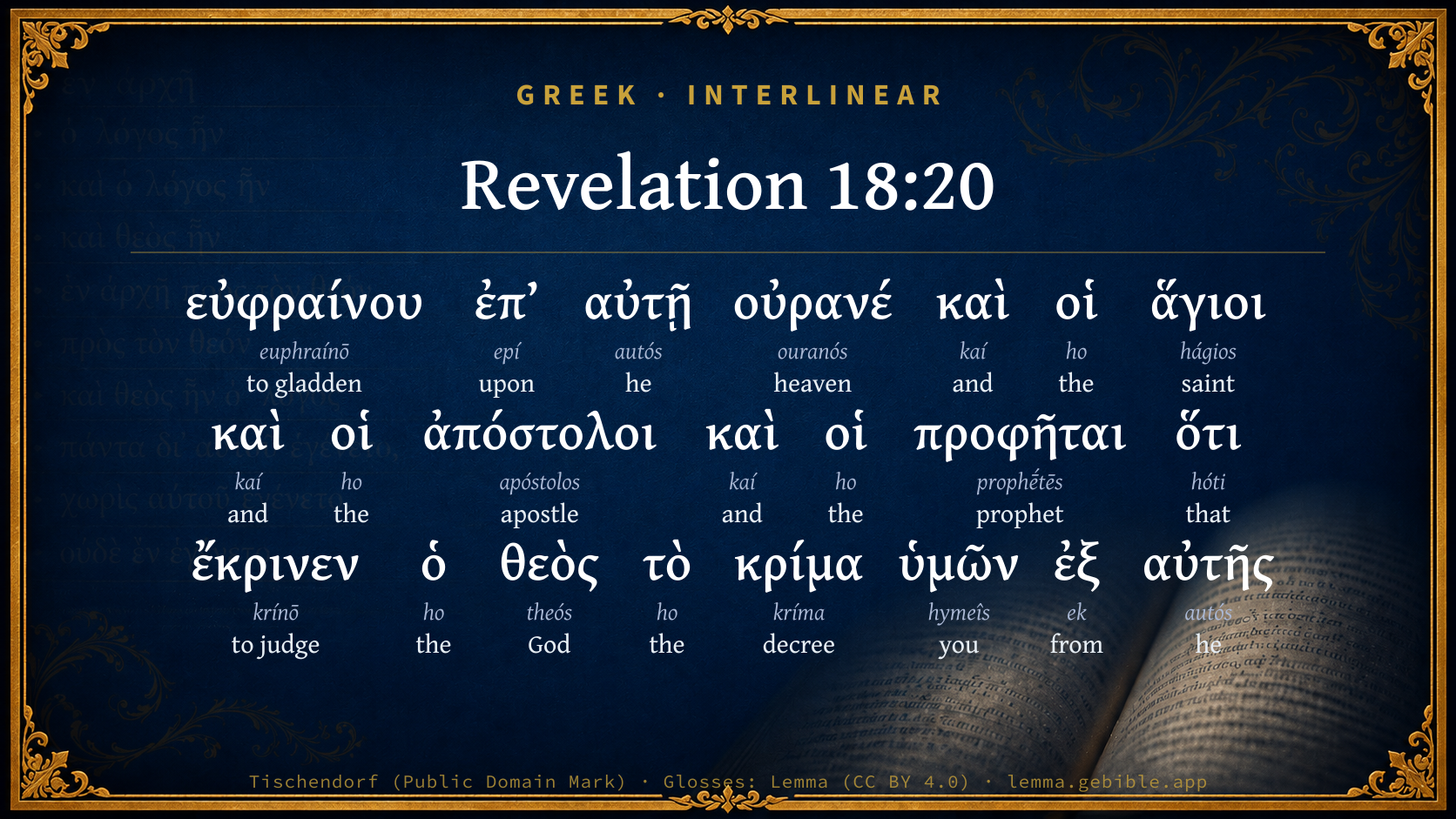
  1. ἐπ’ epí G1909 “upon” Preposition
  2. αὐτῇ autós G846 “he” Personal pronoun, Dative, Singular, Feminine
  3. οὐρανέ ouranós G3772 “heaven” Noun, Vocative, Singular, Masculine
  4. καὶ kaí G2532 “and” Conjunction
  5. οἱ ho G3588 “the” Article, Nominative, Plural, Masculine
  6. ἅγιοι hágios G40 “saint” Adjective, Nominative, Plural, Masculine
  7. καὶ kaí G2532 “and” Conjunction
  8. οἱ ho G3588 “the” Article, Nominative, Plural, Masculine
  9. ἀπόστολοι apóstolos G652 “apostle” Noun, Nominative, Plural, Masculine
  10. καὶ kaí G2532 “and” Conjunction
  11. οἱ ho G3588 “the” Article, Nominative, Plural, Masculine
  12. προφῆται prophḗtēs G4396 “prophet” Noun, Nominative, Plural, Masculine
  13. ὅτι hóti G3754 “that” Conjunction
  14. ἔκρινεν krínō G2919 “to judge” Verb, Aorist, Active, Indicative, 3rd person, Singular
  15. ὁ ho G3588 “the” Article, Nominative, Singular, Masculine
  16. θεὸς theós G2316 “God” Noun, Nominative, Singular, Masculine
  17. τὸ ho G3588 “the” Article, Accusative, Singular, Neuter
  18. κρίμα kríma G2917 “decree” Noun, Accusative, Singular, Neuter
  19. ὑμῶν hymeîs G5210 “you” Personal pronoun, 2nd person, Genitive, Plural
  20. ἐξ ek G1537 “from” Preposition
  21. αὐτῆς autós G846 “he” Personal pronoun, Genitive, Singular, Feminine

About this verse

These counts appear in no published source. They are computed here, from the morphology-tagged text and Lemma’s own curated glosses. What Lemma adds →

22
words
15
distinct lemmas
Revelation
section

Notable vocabulary

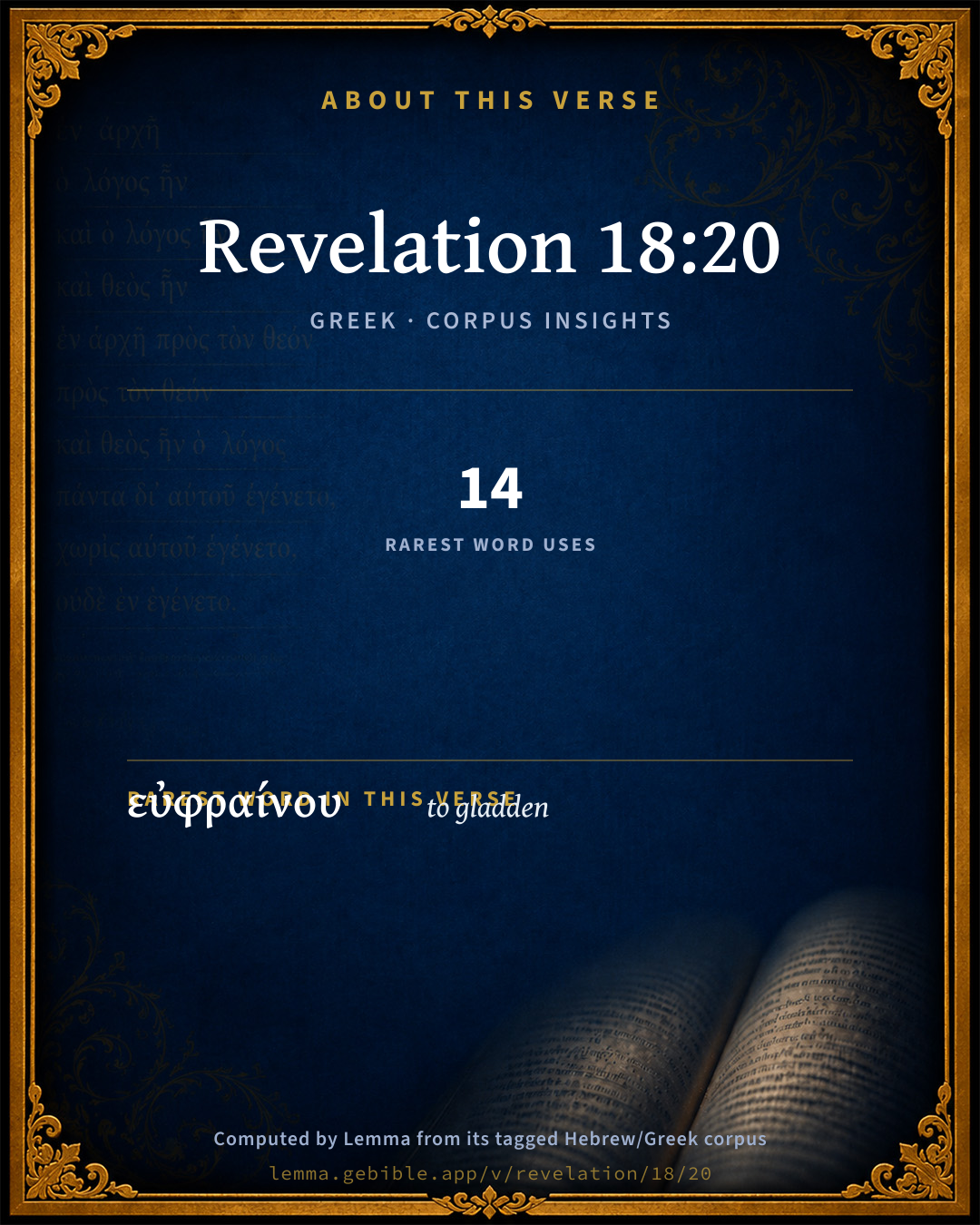
The rarest word here is εὐφραίνου to gladden G2165 — appearing just 14 times in the whole Greek New Testament.

Shared distinctive vocabulary

εὐφραίνου to gladden G2165 occurs in 14 verses of the Greek New Testament. Also found in:

Repetition

Words recur within this verse:

Cross-references

24

Topical passages linked to Revelation 18:20 in the Treasury of Scripture Knowledge — connected by theme and wording, ordered by reader-vote popularity; previews shown in the World English Bible.

  • Revelation 6:10 They cried with a loud voice, saying, "How long, Master, the holy and true, until you judge and avenge our blood on those who dwell on the earth?"
  • Luke 18:7–8 Won't God avenge his chosen ones, who are crying out to him day and night, and yet he exercises patience with them?
  • Revelation 12:12 Therefore rejoice, heavens, and you who dwell in them. Woe to the earth and to the sea, because the devil has gone down to you, having great wrath, knowing that he has but a short time."
  • Revelation 19:1–3 After these things I heard something like a loud voice of a great multitude in heaven, saying, "Hallelujah! Salvation, power, and glory belong to our God:
  • Isaiah 26:21 For, behold, Yahweh comes forth out of his place to punish the inhabitants of the earth for their iniquity: the earth also shall disclose her blood, and shall no more cover her slain.
  • Psalms 58:10 The righteous shall rejoice when he sees the vengeance. He shall wash his feet in the blood of the wicked;
  • Psalms 94:1 Yahweh, you God to whom vengeance belongs, You God to whom vengeance belongs, shine forth.
  • Psalms 109:28 They may curse, but you bless. When they arise, they will be shamed, But your servant shall rejoice.
  • Proverbs 11:10 When it goes well with the righteous, the city rejoices. When the wicked perish, there is shouting.
  • Isaiah 49:13 Sing, heavens; and be joyful, earth; and break forth into singing, mountains: for Yahweh has comforted his people, and will have compassion on his afflicted.
  • Jeremiah 51:47–48 Therefore, behold, the days come, that I will execute judgment on the engraved images of Babylon; and her whole land shall be confounded; and all her slain shall fall in the midst of her.
  • Luke 11:49–50 Therefore also the wisdom of God said, 'I will send to them prophets and apostles; and some of them they will kill and persecute,
  • Ephesians 2:20 being built on the foundation of the apostles and prophets, Christ Jesus himself being the chief cornerstone;
  • Ephesians 4:11 He gave some to be apostles; and some, prophets; and some, evangelists; and some, shepherds and teachers;
  • 2 Peter 3:2 that you should remember the words which were spoken before by the holy prophets, and the commandments of us, the apostles of the Lord and Savior:
  • Jude 1:17 But you, beloved, remember the words which have been spoken before by the apostles of our Lord Jesus Christ.
  • Deuteronomy 32:42 I will make my arrows drunk with blood, My sword shall devour flesh; With the blood of the slain and the captives, From the head of the leaders of the enemy.
  • Judges 5:31 So let all your enemies perish, Yahweh: But let those who love him be as the sun when he goes forth in his might. The land had rest forty years.
  • Psalms 18:47 Even the God who executes vengeance for me, And subdues peoples under me.
  • Psalms 48:11 Let Mount Zion be glad! Let the daughters of Judah rejoice, Because of your judgments.
  • Psalms 96:11–13 Let the heavens be glad, and let the earth rejoice. Let the sea roar, and it's fullness!
  • Psalms 107:42 The upright will see it, and be glad. All the wicked will shut their mouths.
  • Isaiah 44:23 Sing, you heavens, for Yahweh has done it; shout, you lower parts of the earth; break forth into singing, you mountains, O forest, and every tree therein: for Yahweh has redeemed Jacob, and will glorify himself in Israel.
  • Ephesians 3:5 which in other generations was not made known to the children of men, as it has now been revealed to his holy apostles and prophets in the Spirit;

Cross-references courtesy of OpenBible.info (CC BY 4.0).

Commentary

Notes on Revelation 18:20 from classic Christian and Jewish commentators (each source and its license shown beneath its notes). The classic Christian expositions comment on the surrounding passage and are grouped to its opening verse, so a note may address several verses; the Jewish commentaries on the Tanakh (Rashi and others) are per-verse, so they appear only where the commentator wrote on this verse.

Lemma curates 59 commentaries, every one of them public domain or Creative Commons licensed, each selected and text-cleaned for this edition rather than reprinted as found. About our sources →

The Cambridge Bible for Schools and Colleges

gen. ed. J. J. S. Perowne

The Rejoicing over them in Heaven, Rev_18:20-24

20. Rejoice over her] Rev_12:12. There may be a reminiscence of Jer_51:48. We cannot tell if the words are those of the angel of Rev_18:1, of the voice of Rev_18:4, or of the seer himself: perhaps the second is most likely.

holy apostles and prophets] Read, the saints and the apostles and the prophets.

avenged you] Lit., judged your judgement, condemned her for her condemnation of you. Notice the mention of “apostles” as well as other “saints,” as proving that apostles suffered in Rome; and so confirming the unanimous tradition as to the martyrdom there of SS. Peter and Paul. Notice also (in reference to the theory mentioned on Rev_2:2) St John’s recognition of the latter as an apostle. Whether he had himself been condemned to death at Rome cannot be determined: the tradition to that effect was ancient, but not demonstrably so ancient, nor so wide-spread or so confirmed by scriptural evidence (see on St John’s Gospel Joh_21:18-19).

The Cambridge Bible for Schools and Colleges (gen. ed. J. J. S. Perowne; Cambridge University Press, 1878–1918) — public domain. Text from a community e-Sword module.

Tyndale Open Study Notes

Tyndale Open Resources

18:20 The laments (18:9-19) stimulate a call for heaven to rejoice. The people of God are not to grieve, because the judgment was for their sakes; they had suffered persecution from the evil forces represented by the great city.

Tyndale Open Study Notes — © Tyndale Open Resources, licensed CC BY-SA 4.0. Text via the HelloAO Bible API.

Bengel's Gnomon

Johann Albrecht Bengel

Rev 18:20. Οἱ ἅγιοι, the holy) These are put before the apostles and prophets, either as it were a genus before the species, or as those, some of whom were slain before the apostles and prophets.

Bengel's Gnomon of the New Testament — English translation (T&T Clark, Edinburgh, 1860) — public domain. Text from a community e-Sword module.

Meyer's Critical & Exegetical Commentary

Heinrich August Wilhelm Meyer

Rev_18:20. The heavenly voicenot John,[3994] to whom this demand is not well adapted[3995]exhorts not only heaven (together with all who dwell therein, Rev_12:12), but also all who on earth belong to the Lord, to joy over the city thus perishing. Earthly believerswho are exhaustively enumerated by the three categories οἱ ἅγιοι, οἱ ἀπόστολοι, and οἱ προφῆται,[3996] in which the most general conception precedes, and then two particular classes are mentioned, because they, being first attacked by the hatred of the secular power,[3997] have an especial reason to rejoice over the vengeance inflicted by Gods judgmentare mentioned besides heaven, because it is intended to express that to the entire number of those who belong to the Lord,[3998] the destruction of the city is a joyful proof of the righteousness and glory of their God.

ὅτι ἔκρινεν, κ.τ.λ. This fact, upon which the lamentation of the inhabitants of the earth is based,[3999] is the foundation of the joy of all the saints. But also in the phraseology, this diversity of relation is marked; the judgment of God, which the city has incurred,[4000] has brought about a ΚΡΊΜΑ, i.e., an act fulfilled by the ΚΡΊΝΕΙΝ, which[4001] is called a judgment of believers (ΚΡ. ὙΜῶΝ), since this judgment executed in the city, taken upon her (ἘΞ ΑὐΤῆς),[4002] is the justification and satisfaction of those believers persecuted by the worldly city, but now avenged on it.

[3994] Züll.

[3995] Cf. Rev_12:12.

[3996] Cf. Rev_11:18.

[3997] Cf. Rev_18:24.

[3998] For critical inferences this passage is not adapted. With the same justice with which it would be inferred that John does not belong to the apostles, we may also conclude that he does not belong to the prophets.The state of the case is different, however, in Rev_21:14.

[3999] Rev_18:10; Rev_18:16; Rev_18:19.

[4000] Rev_18:8 : κρίνας αὐτήν; the aor., as in this passage, ἔκρινεν. Rev_18:10 : ἡ κρἰσις σου.

[4001] Cf., on the other hand, Rev_17:1, where the harlot was designated as the direct object.

[4002] Cf. Rev_6:10.

Meyer — Critical and Exegetical Commentary on the New Testament — English translation by Peter Christie, edited by Frederick Crombie (T&T Clark, 1880) — public domain. Text from a community e-Sword module.

Expositor's Greek Testament

ed. W. Robertson Nicoll

Rev 18:20 . This verse interrupts the sequence of 19 and 21 in which the ruin of Rome is illustrated by the dramatic action of the angel. The awkward shift from description to an apostrophe, and the evidently Christian tone of the cry, betray an editor’s hand. His object is to render explicit the moral reasons why Christians should delight in the downfall of the city. He writes in the same triple rhythm as the source, and his hand is to be seen in the whole verse not simply in καὶ οἱ ἀπόστολοι . The voice from heaven is thus made to pass into a closing apostrophe to heaven and its inhabitants ( cf. Rev 11:18 ), imitated from Jer 51:48 (Heb.). John seems to assume that all had a case against Rome as victims of her cruelty, probably in the main as martyrs and confessors. “Apostles,” omitted in Rev 18:24 , has here (as in Rev 2:2 ) its wider sense (otherwise Rev 21:14 ), but it must include Peter and Paul (Zahn, Einleit . § 39, n. 4). ὅτι κ . τ . λ . = “for God has judged her with your judgment,” i.e. , vindicated you (done you justice, given you your due) by lexacting vengeance upon her. She who once doomed you is now doomed herself ( cf. Rev 16:6 ). εὐφραίνου . Cf. En. lxii., where the kings and rulers condemned by messiah to eternal torment are to be “a spectacle for the righteous and his elect; they will rejoice over them because the wrath of the Lord of spirits resteth upon them, and his sword is drunk with their blood”; also Isa 30:29 , for the call to exult over a fallen oppressor. A Parisian workman, who was looking down at the corpse of Robespierre, was overheard to mutter, with relief, “Oui, il y a un Dieu”.

The Expositor's Greek Testament, edited by W. Robertson Nicoll (1897–1910) — public domain. Text from a community e-Sword module.

Geneva Bible (1599)

Geneva Bible translators

The other consequent unto the other ruin of Babylon, is the exultation or rejoicing of the godly in heaven and in earth, as was noted, verse 9.

Geneva Bible (1599) marginal notes — public domain. Text via Bolls.life.

Jamieson, Fausset & Brown

Robert Jamieson, A. R. Fausset & David Brown

holy apostles--So C reads. But A, B, Vulgate, Syriac, Coptic, and ANDREAS read, "Ye saints and ye apostles."

avenged you on her--Greek, "judged your judgment on (literally, exacting it from) her." "There is more joy in heaven at the harlot's downfall than at that of the two beasts. For the most heinous of all sin is the sin of those who know God's word of grace, and keep it not. The worldliness of the Church is the most worldly of all worldliness. Hence, Babylon, in Revelation, has not only Israel's sins, but also the sins of the heathen; and John dwells longer on the abominations and judgments of the harlot than on those of the beast. The term 'harlot' describes the false Church's essential character. She retains her human shape as the woman, does not become a beast: she has the form of godliness, but denies its power. Her rightful lord and husband, Jehovah-Christ, and the joys and goods of His house, are no longer her all in all, but she runs after the visible and vain things of the world, in its manifold forms. The fullest form of her whoredom is, where the Church wishes to be itself a worldly power, uses politics and diplomacy, makes flesh her arm, uses unholy means for holy ends, spreads her dominion by sword or money, fascinates men by sensual ritualism, becomes 'mistress of ceremonies' to the dignitaries of the world, flatters prince or people, and like Israel, seeks the help of one world power against the danger threatening from another" [AUBERLEN]. Judgment, therefore, begins with the harlot, as in privileges the house of God.

Jamieson, Fausset & Brown — Commentary Critical and Explanatory on the Whole Bible (1871) — public domain (CC PDM 1.0). Text via the HelloAO Bible API.

Adam Clarke's Commentary

Verse 20. Rejoice over her, thou heaven] This is grand and sublime; the fall of this bad city was cause of grief to bad men. But as this city was a persecutor of the godly, and an enemy to the works of God, angels, apostles, and prophets are called to rejoice over her fall.

Adam Clarke's Commentary on the Bible (1810–1826) — public domain. Text from a community e-Sword/MySword module.

Ellicott's Commentary for English Readers

THE CALL TO THE HOLY TO REJOICE.

(20) Rejoice over her. . . .—Better, Rejoice over her, O heaven, and the saints, and the apostles, and the prophets, because God has judged your judgment on (or, out of) her. The second portion of the chapter closes with this invitation to the saints to rejoice: they are summoned to rejoice because the law of retribution has worked on her. Your judgment (it is said to the saints) is judged on her. This does not mean a judgment which the saints have decreed, but the judgment which Babylon wrought on the holy is now exacted from her (comp. Rev_18:6, and Rev_6:10; Rev_13:10). Heaven, and every class of those whose citizenship has been in heaven, are bidden by the heavenly voice to rejoice The covetous and the worldly mourn; their minds were set upon a material glory, which has slipped away from their grasp. All saintly souls, whose affections have been towards righteousness and the righteous King, can rejoice; for the wealth of holiness is imperishable. and the fall of Babylon is the removal of one vast hindrance to holiness. It has been argued that the verse represents the Apostles to be in heaven, and from this it has been inferred that the twelve must have all died before the Apocalypse was written, and, if so, St. John was not the writer. The verse, however, has no reference whatever to the question: it is not meant to state who have passed into heaven and who have not: it is simply a summons to all who have fought on the side of their Lord to rejoice at the removal of one of the great obstacles to the manifestation of Christ’s kingdom. Thus do all holy men, whether on earth or heaven, joy when any giant evil is swept away.

A Bible Commentary for English Readers, edited by Charles John Ellicott (1878–1897) — public domain. Text from a community e-Sword module.

John Gill's Exposition

And a mighty angel,.... Not Christ, nor one of the ministering spirits, but some man or set of men, perhaps the same with him in Rev 18:1

took up a stone like a great millstone, and cast it into the sea; just as Jeremiah took a stone and bound it to his book after he had read it, and cast it into the river Euphrates, as a sign and token of the destruction of old Babylon, Jer 51:63

saying, thus with violence shall that great city be thrown down, and shall be found no more at all; which is expressive of the utter destruction of Rome, and of the violence, force, and power with which it will be destroyed, and of the suddenness and swiftness of its destruction, and of the irrecoverableness of its state and condition.

John Gill's Exposition of the Whole Bible (1746–1763) — public domain (CC PDM 1.0). Text via the HelloAO Bible API.

Trapp's Complete Commentary

John Trapp

20 Rejoice over her, thou heaven, and ye holy apostles and prophets; for God hath avenged you on her.

Ver. 20. Thou heaven] i.e. The Church on earth.

And ye holy apostles, &c.] i.e. Ye pastors and teachers, who as ye have been most shot at by her, so now you are especially called to triumph over her, Psa 58:11.

John Trapp, A Commentary or Exposition upon All the Books of the Old and New Testament (1647–1656) — public domain. Text from a community e-Sword module.

Albert Barnes' Notes on the Bible

Rejoice over her - Over her ruin. There is a strong contrast between this language and what precedes. Kings, merchants, and seamen, who had been countenanced and sustained by her in the indulgence of corrupt passions, or who had been enriched by traffic with her, would have occasion to mourn. But not so they who had been persecuted by her. Not so the church of the redeemed. Not so heaven itself. The great oppressor of the church, and the corrupter of the world, was now destroyed; the grand hindrance to the spread of the gospel was now removed, and all the holy in heaven and on earth would have occasion to rejoice. This is not the language of vengeance, but it is the language of exultation and rejoicing in view of the fact, that the cause of truth might now spread, without hindrance, through the earth.

Thou heaven - The inhabitants of heaven. Compare the notes on Isa 1:2. The meaning here is, that the dwellers in heaven - the holy angels and the redeemed - had occasion to rejoice over the downfall of the great enemy of the church.

And ye holy apostles - Prof. Stuart renders this, “Ye saints, and apostles, and prophets.” In the common Greek text, it is, as in our version, “holy apostles and prophets.” In the text of Griesbach, Hahn, and Tittmann, the word καὶ kai (and) is interposed between the word “holy” and “apostle.” This is, doubtless, the true reading. The meaning, then, is that the “saints” in heaven are called on to rejoice over the fall of the mystical Babylon.

Apostles - The twelve who were chosen by the Saviour to be his witnesses on earth. See the notes on 1Co 9:1. The word is commonly limited to the twelve, but, in a larger sense, it is applied to other distinguished teachers and preachers of the gospel. See the notes on Act 14:14. There is no impropriety, however, in supposing that the apostles are referred to here as such, since they would have occasion to rejoice that the great obstacle to the reign of the Redeemer was now taken away, and that that cause in which they had suffered and died was now to he triumphant.

And prophets - Prophets of the Old Testament and distinguished teachers of the New. See the notes on Rom 12:6. All these would have occasion to rejoice in the prospect of the final triumph of the true religion.

For God hath avenged you on her - Has taken vengeance on her for her treatment of you. That is, as she had persecuted the church as such, they all might be regarded as interested in it and affected by it. All the redeemed, therefore, in earth and in heaven, are interested in whatever tends to retard or to promote the cause of truth. All have occasion to mourn when the enemies of the truth triumph; to rejoice when they fall.

Albert Barnes' Notes on the Bible (1834–1885) — public domain. Text from a community e-Sword/MySword module.

Haydock's Catholic Bible Commentary

Rejoice....heaven, the holy apostles and prophets, and all the holy ministers of the gospel: and holy men are invited here to rejoice, because the divine justice is accomplished in the ruin of that guilty city. (Pastorini) --- By the words prophets, &c. are not meant those of the old law, as pagan Rome had not been the cause of their deaths, but here only includes all the prophets, saints, and martyrs, who had been put to death for Christ throughout the whole Roman empire. (Haydock)

====================

George Leo Haydock (1774–1849), Haydock's Catholic Family Bible and Commentary, 1859 edition — public domain. Excludes Psalms (Douay-Rheims chapter numbering differs from Protestant) and Deuterocanonical books (Catholic canon only).

Matthew Poole's English Annotations

Rejoice over her, thou heaven; that is, over her ruin, which is not a more proper object for the sorrow and mourning of all her adherents and dependants, than of the joy of all spiritual, heavenly persons, which are the true church, who oppose this antichristian synagogue.

And ye holy apostles and prophets; for God hath avenged you on her: you also that were apostles of our Lord Jesus Christ, and such as have been exercised as prophets in revealing to men God’s mind and will, do you rejoice, for God hath revenged you upon her, for your doctrine corrupted by her, your rules of worship violated, and some of your blood that hath been spilt, and for all the indignities you have suffered from her.

Matthew Poole's English Annotations on the Holy Bible (1683–1685) — public domain. Text from a community e-Sword/MySword module.

Whedon's Commentary on the Bible

Daniel D. Whedon

20. Rejoice—The divine voice closes its mercantile catalogue with a lofty jubilate. The downfall of Satan’s capital is a just penalty for her sins, and a salvation to the world.

Thou heaven—From which this voice chanted its celestial interlude. The ungraceful thou is not in the Greek, which should be rendered, O heaven. The heaven addressed consists of the classes next named in the verse, whose chorister the voice is.

Holy—Not an adjective, belonging to apostles, but a noun, saints. The three classes, saints, (or the body of Christians,) apostles, and prophets, are those in and constituting the heaven first named. When John wrote, in the time of Domitian, all the apostles but himself had probably deceased.

Prophets—Of whose ancient predictions this voice is a grand reverberation.

Avenged—For this Babylon takes in the whole line of antichristic empires, including those under whom the ancient prophets predicted and suffered. Thus this mournful interlude closes in a climax of triumph.

Daniel D. Whedon (gen. ed.), Commentary on the Old and New Testaments (1874–1909) — public domain. Text from a community e-Sword module.

The Pulpit Commentary

Rejoice over her, thou heaven. These words are best understood as being uttered by the writer, as in Rev_12:12. (see on Rev_12:10) And ye holy apostles and prophets; and ye saints, and ye apostles, and ye prophets, is read in a, A, B, P, etc., and adopted by the Revisers. The Authorized Version reading is found in C, 1, 17. Not only the heavenly inhabitants are to rejoice, but also those on earth who have been persecuted by her, as mentioned in ver. 24. The time is again described which has been already referred to in former parts of the book, and especially in Rev_11:18. Some authors have held this verse to prove that the writer of the Apocalypse was not the Apostle John; either because

(1) he speaks as if he were not an apostle, or

(2) because they assume that all the apostles are here referred to, and that they are in heaven.

There is no ground for either presumption:

(1) A rhapsodical utterance of this nature cannot be interpreted literally;

(2) the word "apostles" cannot be limited to the twelve;

(3) as Dusterdieck justly observes, one might as well argue that the writer was not a prophet.

By the "prophets "are primarily intended, perhaps, the Christian prophets; (cf. Eph_3:5) but if Babylon is typical of the hostile world power, and the harlot of the faithless, worldly portion of God"s Church, as we have seen them to be, the words are applicable to the Church of God in all ages. For God hath avenged you on her; for God hath judged your judgment on her. The answer to the prayer of the martyrs in Rev_6:10. The words, "your judgment," probably mean "that judgment which isher due for her treatment of you," as in the Authorized Version. Hengstenberg gives "the doom which she pronounced upon you." Wordsworth, laying stress upon ex , "out of," makes the words mean, "He has taken your cause out of her hands into his own."

The Pulpit Commentary (1880–1919), ed. H.D.M. Spence-Jones & Joseph S. Exell — public domain. Text from a community e-Sword module.

John Wesley's Explanatory Notes

Rejoice over her, thou heaven - That is, all the inhabitants of it; and more especially, ye saints; and among the saints still more eminently, ye apostles and prophets.

John Wesley, Explanatory Notes Upon the Whole Bible (1754–1765) — public domain. Text via the GEBible commentary corpus.

Burkitt's Expository Notes on the New Testament

William Burkitt

Note here, 1. That as Babylon’s ruin was matter of great grief and sorrow to the fore-mentioned mourners who merchandised and traded with her; so it is matter of great joy and rejoicing to all spiritual and heavenly-minded persons, which are the true church, who are commanded to rejoice at it. Rejoice over her, O heaven; that is, ye angels in heaven, or ye saints, that are of an heavenly disposition. And all ye holy apostles and prophets; that is, all faithful ministers who succeed them, who are endued with the same spirit, and teach the same pure and holy doctrine with them.

Note, 2. The cause of this rejoicing declared: For God hath avenged them upon her. The church does not, the saints of God dare not, rejoice at Babylon’s calamity as such, but as an act of divine vengeance God will be avenged on Babylon for the doctrine of the gospel corrupted by her, and for the rules of worship violated by her, and for all the barbarities and indignities which his church and people have suffered from her: God will revenge the wrongs of his people, when through want of power they cannot, and through his prohibition they may not, avenge themselves.

William Burkitt's Expository Notes on the New Testament (1700–1703) — public domain. Text from a community e-Sword module.

The People's New Testament

B. W. Johnson

20. Rejoice over her, thou heaven. While there are mourners, another company is called upon to rejoice. She had exalted herself against God. All who have been for God, and who have suffered from her, are called to rejoice.

B. W. Johnson's The People's New Testament with Notes (1889–1891) — public domain. Electronic text from the Christian Classics Ethereal Library (CCEL) ThML edition.

Cambridge Greek Testament for Schools and Colleges

20–24. THE REJOICING OVER HER IN HEAVEN

20. καὶ οἱ ἀπόστολοι. With אAB2P am[674] fu[675] Primas[676]; Text. Rec[677] omits καὶ οἱ with C 1 vg[678][674] Codex Amiatinus 6th century in Laurentian Library at Florence.

[675] Codex Fuldensis 6th century at Fulda.

[676] Primasius, edited by Haussleiter.

[677] Rec. Textus Receptus as printed by Scrivener.

[678] Vulgate.

20. εὐφραίνου ἐπʼ αὐτῇ. Rev 12:12. There may be a reminiscence of Jer 51:48. We cannot tell if the words are those of the Angel of Rev 18:1, of the voice of Rev 18:4, or of the seer himself: perhaps the second is most likely.

ἔκρινεν ὁ θεὸς τὸ κρίμα ὑμῶν. Lit., “judged your judgement,” condemned her for her condemnation of you. Notice the mention of “apostles” as well as other “saints,” as proving that apostles suffered in Rome; and so confirming the unanimous tradition as to the martyrdom there of SS. Peter and Paul. Notice also (in reference to the theory mentioned on Rev 2:2) St John’s recognition of the latter as an apostle. Whether he had himself been condemned to death at Rome cannot be determined: the tradition to that effect was ancient, but not demonstrably so ancient, nor so widespread or so confirmed by scriptural evidence (see on St John’s Gospel Rev 21:18-19).

Cambridge Greek Testament for Schools and Colleges (Cambridge University Press, 1896; 21 vols, various authors incl. Carr, Maclear, Plummer, Farrar, Lumby, Moule, M. R. James, Simcox) — public domain. Text from a community e-Sword module.

Alford’s Greek Testament

Henry Alford

20.] The angel concludes with calling on the heavens and God’s holy ones to rejoice at her fall. Rejoice over her thou heaven, and ye saints and ye apostles and ye prophets, for God hath judged your judgment upon her (hath exacted from her that judgment of vengeance which is due to you: see reff.).

Henry Alford, The Greek Testament (1849–1861) — public domain. Text from a community e-Sword module.

Vincent's Word Studies in the New Testament

Marvin R. Vincent

Hath avenged you on her [εκρινεν το κριμα υμων εξ αυτης] . Rev., more literally, hath judged your judgment on her or from her. The idea is that of exacting judgment from [εξ] . Compare the compound verb ejkdikeiv avenge, or exact vengeance from (ch. 6 10). The meaning is either, that judgment which is your due, or what she hath judged concerning you.

Marvin R. Vincent, Word Studies in the New Testament (1887–1900) — public domain. Text from a community e-Sword/MySword module.

Lesson kit

Teaching starters — assembled from the data on this page, not authored interpretation. Every prompt links to the verse data it draws on. Edit before teaching.

Revelation, in the Revelation, opens this verse with 22 words (15 distinct Greek lemmas). Its most distinctive word is euphraínō (“to gladden”). A historical commentator’s framing appears above. Read the whole chapter for the surrounding context.

Discussion questions

  1. What does “to gladden” (euphraínō) contribute to the verse as a whole?
  2. Luke 12:19 shares the word «to gladden» with this verse. How do the two illuminate each other?
  3. “the” occurs 5× in this one verse. What is the effect of the repetition?
  4. The translations on this page render this verse differently — a whole-verse word diff, not a word-by-word alignment. What might account for the different wordings?
  5. Reading how The Cambridge Bible for Schools and Colleges and Tyndale Open Study Notes read this verse, where do the two commentators agree and where do they part?

Things to notice

Reading settings

Reading text

Shown beneath each verse's original-language words.

Old Testament
Old Testament edition

Read the OT as the Masoretic Hebrew (MT) or the Greek Septuagint (LXX).

English shown for the Greek Septuagint (in the Hebrew ↔ Greek comparison).

Comparing translations? Open the Compare panel on any verse page to stack up to four side by side.