Luke 8:5

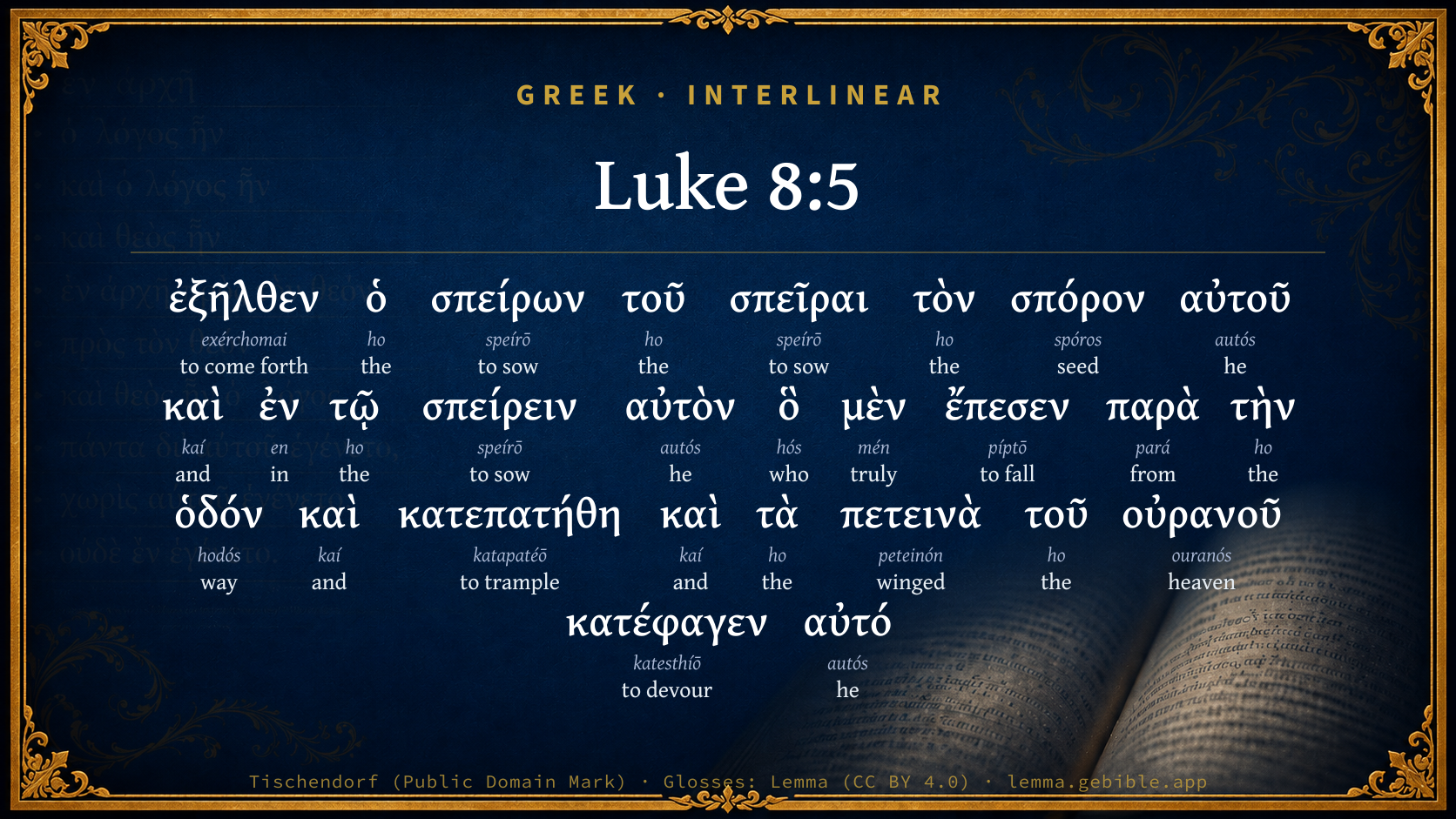
Greek (Tischendorf 8th ed.) Luke 8:5 appears in the Greek New Testament. The text above is from the Tischendorf 8th edition. Each word links to its Strong’s number and a concise gloss. Click any word for its full Thayer’s Greek Lexicon entry.
Download image
Cite this verse

Luke 8:5 (World English Bible). Public Domain. Lemma interlinear Bible study tool, https://lemma.gebible.app/v/luke/8/5.

Show BibTeX & RIS
BibTeX
RIS
English Translation
"The farmer went out to sow his seed. As he sowed, some fell along the road, and it was trampled under foot, and the birds of the sky devoured it.
World English Bible · Public Domain
Download a study sheet

One document with this verse’s original text, its word-by-word gloss line, the meaning frame, cross-references with their text, attributed commentary, and full source and license credits — printable, and it pastes into notes with its structure intact.

This verse Autodidact and up

Study sheet (.html) Plain text (.txt)

A passage Seminary Student

Up to 50 verses in one chapter. A passage sheet keeps up to 6 commentary sources and 12 cross-references per verse, in the order this page ranks them, and says so on the sheet whenever that leaves anything out. Ask for a single verse and you get the Autodidact verse sheet above.

Everything on this page stays free to read, with no account — the sheet is a download of what is already on screen, not access to it.

Want to remove ads? Support Godless Engineer
Compare translations 3

The same verse in 3 English versions, stacked beneath the original-language interlinear above. Click any original word for its lexicon entry.

Each is an independent rendering of the whole verse — the interlinear is not word-aligned to these translations.

Highlighted words mark where these versions differ — a whole-verse word diff, not a word-by-word alignment.

  • World English Bible Public Domain
    "The farmer went out to sow his seed. As he sowed, some fell along the road, and it was trampled under foot, and the birds of the sky devoured it.
  • King James Version Public Domain
    A sower went out to sow his seed: and as he sowed, some fell by the way side; and it was trodden down, and the fowls of the air devoured it.
  • unfoldingWord Literal Text CC BY-SA 4.0
    “The sower went out to sow his seed, and as he sowed, some fell beside the road, and it was trampled underfoot, and the birds of the sky devoured it.

unfoldingWord Literal Text — © unfoldingWord, licensed CC BY-SA 4.0. Word-aligned USFM3 via Door43 (git.door43.org/unfoldingWord/en_ult).

Versions to compare (up to 4)

3 of 4 selected

Show all 19 translations

Every available English version of this verse, each an independent rendering of the whole verse.

  • World English Bible Public Domain
    "The farmer went out to sow his seed. As he sowed, some fell along the road, and it was trampled under foot, and the birds of the sky devoured it.
  • Berean Standard Bible Public Domain
    “A farmer went out to sow his seed. And as he was sowing, some seed fell along the path, where it was trampled, and the birds of the air devoured it.
  • Majority Standard Bible Public Domain
    “A farmer went out to sow his seed. And as he was sowing, some seed fell along the path, where it was trampled, and the birds of the air devoured it.
  • King James Version Public Domain
    A sower went out to sow his seed: and as he sowed, some fell by the way side; and it was trodden down, and the fowls of the air devoured it.
  • American Standard Version (1901) Public Domain
    The sower went forth to sow his seed: and as he sowed, some fell by the way side; and it was trodden under foot, and the birds of the heaven devoured it.
  • Revised Version (1885) Public Domain
    The sower went forth to sow his seed: and as he sowed, some fell by the way side; and it was trodden under foot, and the birds of the heaven devoured it.
  • Geneva Bible (1599) Public Domain
    A sower went out to sowe his seede, and as he sowed, some fell by the wayes side, and it was troden vnder feete, and the foules of heauen deuoured it vp.
  • Douay-Rheims (1899) Public Domain
    The sower went out to sow his seed. And as he sowed, some fell by the way side, and it was trodden down, and the fowls of the air devoured it.
  • Young's Literal Translation Public Domain
    `The sower went forth to sow his seed, and in his sowing some indeed fell beside the way, and it was trodden down, and the fowls of the heaven did devour it.
  • Literal Standard Version CC BY-SA 4.0
    “The sower went forth to sow his seed, and in his sowing some indeed fell beside the way, and it was trodden down, and the birds of the sky devoured it.
  • Unlocked Literal Bible CC BY-SA 4.0
    “A farmer went out to sow his seed. As he sowed, some fell beside the road and it was trampled underfoot, and the birds of the sky devoured it.
  • unfoldingWord Literal Text CC BY-SA 4.0
    “The sower went out to sow his seed, and as he sowed, some fell beside the road, and it was trampled underfoot, and the birds of the sky devoured it.
  • Darby Bible Public Domain
    The sower went out to sow his seed; and as he sowed, some fell along the way, and it was trodden under foot, and the birds of the heaven devoured it up;
  • World Messianic Bible Public Domain
    “The farmer went out to sow his seed. As he sowed, some fell along the road, and it was trampled under foot, and the birds of the sky devoured it.
  • Webster's Bible Public Domain
    A sower went out to sow his seed: and as he sowed, some fell by the way side; and it was trodden down, and the fowls of the air devoured it.
  • Free Bible Version CC BY-SA 4.0
    “A farmer went out to sow his seed. As he scattered the seed, some fell on the road where people trampled on it and birds ate it up.
  • Bible in Basic English Public Domain
    A man went out to put in seed, and while he was doing it, some was dropped by the wayside and it was crushed under foot, and was taken by the birds of heaven.
  • Text-Critical English NT CC BY 4.0
    “A sower went out to sow his seed. As he sowed, some seed fell along the path and was trampled underfoot, and the birds of the sky devoured it.
  • Tyndale New Testament (1534) Public Domain
    A sower went out to sowe his seede: and as he sowed some fell by the waye syde and it was troden vnder fete and the foules of the ayre devoured it vp.

Literal Standard Version (2020), Covenant Press — licensed CC BY-SA 4.0. Text via the HelloAO Bible API (eBible.org). Unlocked Literal Bible (unfoldingWord) — licensed CC BY-SA 4.0. Text via the HelloAO Bible API (eBible.org). unfoldingWord Literal Text — © unfoldingWord, licensed CC BY-SA 4.0. Word-aligned USFM3 via Door43 (git.door43.org/unfoldingWord/en_ult). Free Bible Version, Dr. Jonathan Gallagher — licensed CC BY-SA 4.0. Text via the HelloAO Bible API (eBible.org).

Word by word

More ways to search: Search by grammar → Find every occurrence → Compare this word →

Practice this passage: Drill this verse → Learn its vocabulary →

σπόρον
spóros
G4703
“seed”
Noun, Accusative, Singular, Masculine
Part of Speech
Noun
Case
Accusative
Number
Singular
Gender
Masculine
Full Thayer's Definition

Origin: from G4687

TDNT: 15:56,1

1. a sowing 2. seed (used in sowing)
  1. ἐξῆλθεν exérchomai G1831 “to come forth” Verb, Aorist, Active, Indicative, 3rd person, Singular
  2. ὁ ho G3588 “the” Article, Nominative, Singular, Masculine
  3. σπείρων speírō G4687 “to sow” Verb, Present, Active, Participle, Nominative, Singular, Masculine
  4. τοῦ ho G3588 “the” Article, Genitive, Singular, Neuter
  5. σπεῖραι speírō G4687 “to sow” Verb, Aorist, Active, Infinitive
  6. τὸν ho G3588 “the” Article, Accusative, Singular, Masculine
  7. αὐτοῦ autós G846 “he” Personal pronoun, Genitive, Singular, Masculine
  8. καὶ kaí G2532 “and” Conjunction
  9. ἐν en G1722 “in” Preposition
  10. τῷ ho G3588 “the” Article, Dative, Singular, Neuter
  11. σπείρειν speírō G4687 “to sow” Verb, Present, Active, Infinitive
  12. αὐτὸν autós G846 “he” Personal pronoun, Accusative, Singular, Masculine
  13. ὃ hós G3739 “who” Relative pronoun, Nominative, Singular, Neuter
  14. μὲν mén G3303 “truly” Particle
  15. ἔπεσεν píptō G4098 “to fall” Verb, Aorist, Active, Indicative, 3rd person, Singular
  16. παρὰ pará G3844 “from” Preposition
  17. τὴν ho G3588 “the” Article, Accusative, Singular, Feminine
  18. ὁδόν hodós G3598 “way” Noun, Accusative, Singular, Feminine
  19. καὶ kaí G2532 “and” Conjunction
  20. κατεπατήθη katapatéō G2662 “to trample” Verb, Aorist, Passive, Indicative, 3rd person, Singular
  21. καὶ kaí G2532 “and” Conjunction
  22. τὰ ho G3588 “the” Article, Nominative, Plural, Neuter
  23. πετεινὰ peteinón G4071 “winged” Noun, Nominative, Plural, Neuter
  24. τοῦ ho G3588 “the” Article, Genitive, Singular, Masculine
  25. οὐρανοῦ ouranós G3772 “heaven” Noun, Genitive, Singular, Masculine
  26. κατέφαγεν katesthíō G2719 “to devour” Verb, Aorist, Active, Indicative, 3rd person, Singular
  27. αὐτό autós G846 “he” Personal pronoun, Accusative, Singular, Neuter

About this verse

These counts appear in no published source. They are computed here, from the morphology-tagged text and Lemma’s own curated glosses. What Lemma adds →

28
words
16
distinct lemmas
Gospels
section

Notable vocabulary

The rarest word here is σπόρον seed G4703 — appearing just 5 times in the whole Greek New Testament.

Shared distinctive vocabulary

σπόρον seed G4703 occurs in 5 verses of the Greek New Testament. Also found in:

Repetition

Words recur within this verse:

  • σπείρων to sow G4687 ×3
  • ὁ the G3588 ×7
  • αὐτοῦ he G846 ×3
  • καὶ and G2532 ×3

Cross-references

13

Topical passages linked to Luke 8:5 in the Treasury of Scripture Knowledge — connected by theme and wording, ordered by reader-vote popularity; previews shown in the World English Bible.

  • Hebrews 2:1 Therefore we ought to pay greater attention to the things that were heard, lest perhaps we drift away.
  • James 1:23–24 For if anyone is a hearer of the word and not a doer, he is like a man beholding his natural face in a mirror;
  • Mark 4:15 These are the ones by the road, where the word is sown; and when they have heard, immediately Satan comes, and takes away the word which has been sown in them.
  • Luke 8:11–12 Now the parable is this: The seed is the word of God.
  • Genesis 15:11 The birds of prey came down on the carcasses, and Abram drove them away.
  • Mark 4:26–29 He said, "The Kingdom of God is as if a man should cast seed on the earth,
  • Psalms 119:118 You reject all those who stray from your statutes, For their deceit is in vain.
  • Matthew 5:13 "You are the salt of the earth, but if the salt has lost its flavor, with what will it be salted? It is then good for nothing, but to be cast out and trodden under the feet of men.
  • Matthew 13:3–4 He spoke to them many things in parables, saying, "Behold, a farmer went out to sow.
  • Matthew 13:18–19 "Hear, then, the parable of the farmer.
  • Matthew 13:24–26 He set another parable before them, saying, "The Kingdom of Heaven is like a man who sowed good seed in his field,
  • Matthew 13:37 He answered them, "He who sows the good seed is the Son of Man,
  • Mark 4:2–4 He taught them many things in parables, and told them in his teaching,

Cross-references courtesy of OpenBible.info (CC BY 4.0).

Commentary

Notes on Luke 8:5 from classic Christian and Jewish commentators (each source and its license shown beneath its notes). The classic Christian expositions comment on the surrounding passage and are grouped to its opening verse, so a note may address several verses; the Jewish commentaries on the Tanakh (Rashi and others) are per-verse, so they appear only where the commentator wrote on this verse.

Lemma curates 59 commentaries, every one of them public domain or Creative Commons licensed, each selected and text-cleaned for this edition rather than reprinted as found. About our sources →

The Biblical Illustrator

Joseph S. Exell

Luk_8:5

Some fell by the wayside

The field-path

This first kind of soil is the only one of the four mentioned in which nothing came of the sowing.

In this alone there is a combination of causes which renders any good result impossible. Three causes are shown:

1. Before the sowing the soil was incapable of receiving the seed, for it was beaten hard by constant traffic.

2. After the seed had fallen upon it men trod it under foot and crushed out its life.

3. That which remained upon the surface the birds devoured.

The connection between the three is obvious. Had the soil not been trodden hard beforehand, neither would the after-treading have destroyed the seed, nor would the birds have found it lying ready. Hid in the bosom of the earth, it would have been safe from both. It is the picture of a thoroughly worldly man--not what would commonly be called a wicked man, not a man whose life is a scandal to the society in which he moves, by reason of the grossness of his vices, or the profane or ribald licence of his conversation, but simply one who may be in all outward and social respects without a speck or flaw in his character--nay, who may even be scrupulous in performing all such external acts of religion as the world is pleased to account marks of respectability and good taste, but who is withal simply incapable of receiving any wholesome impression from the ministry of the Word of God, because he has given up his whole heart and mind to worldly things, and heart and mind under their unopposed influence have become completely hardened. Such a man hears the Word. It is beautiful to him, it is pleasant to him, just as, and in no other way, than some history, or poem, or fiction, written by the hand, inspired by the genius of a fellow-man, is pleasant or beautiful. As the work of Gods hand, the revelation of Gods mind, he never for a moment recognizes it; as the voice of Gods Spirit speaking to and bearing witness with His own spirit he never for a moment thinks of it or feels it. And this because there is drawn over his heart and mind and spirit--over all that part of his being in which exists most fully the image of God and the counterpart of the Divine mind--that hard, callous covering of worldliness which is the common road of all that is unprofitable and vain, but is like armour of proof against the entrance of aught that is good and holy into the soil beneath. (C. S. Turner, M. A.)

How to reclaim the indifferent

If the farmer wish to throw into one his separated fields, and make the old roadway part of his productive soil, he knows that the very causes of its hardness have added some fertilizing elements, and that only deep and thorough tillage is needed to accomplish his purpose. But he carefully chooses the time to put in the plough. He does not begin his work when the frost has bound the land in its icy fetters, nor when the drought and heat have reduced it to stony hardness. But meantime he is diligently removing the fences and clearing away, as opportunity may offer, the obstructions which have accumulated. And then some day, when he sees it softened by gentle showers, which the shading clouds have allowed to soak into its bosom, he ploughs deep and harrows thoroughly, and lo, the work is done I In the same way must we deal with this indifference to religion. If we attack such a man when his heart is cold and careless, or when some angry spirit of controversy warms him into resistance, we shall meet only disappointment. In fact, we are sure to be disappointed if we attack him at all. We must wait patiently and watch closely. We must gently and quietly remove as we may the barriers which most frequently we have ourselves erected about him. So long as we keep him fenced out from the companionship and familiar intercourse of pious people, we can make no impression upon him. It was not John the Baptist, but Jesus the Christ who was the friend of publicans and sinners. If we seek the society of such people, and show interest and pleasure in their company, at first they may be shy, but we shall soon see that pass. If we are careful not to obtrude our religion upon them they will always be careful not to make their irreligion offensive to us. And then some time, when the clouds of sorrow have overshadowed them, and the gentle rain of kindly sympathy has softened the hard crust of reserve, God gives us our opportunity, and we may drop the rich seed of His saving truth into the deep furrows which lie open in the mellowed soil. Who knows but that when the harvest season comes, we may trace the old roadway all through the burdened field by the line of heavier sheaves which it has ripened! (R. Wilson, M. D.)

The highway ground

I. THE KIND OF SOIL.

1. As a highway lieth careless, neglected, unbounded, common, not several, but is trodden and beaten with the feet of all sorts of passengers, so these hearers hearts are not closed and made several for the seed of Gods Word, and for heavenly things, but lie common and open to all temptations and suggestions of Satan, to the covetous and carnal desires of earthly things, which eat up heavenly; to vain wandering, idle cogitations and thoughts, all which make a thoroughfare and beaten path in the heart.

2. As in an highway if any seed fall, no man looks to cover it, no man respects it, as looking for no good at all of it, but leaves it to be trodden of beasts, and eaten up of birds: so with these hearers, when the Word is preached, they hear it carelessly, without all attention, or affection, they care not to understand it, never cover it by meditation, nor receive it further than by giving it the hearing; they expect no good from it; let errors and lusts come and tread it down, let the devil by suggestions and tentations devour it up; they care neither to understand, nor receive, nor remember it.

3. As highway ground can neither receive nor cover the seed, or if it should, it is so hard and padded, that it cannot afford it the least rooting, at least to come unto fruit, the crop will never fill a mans hand: even so these hearers, like hard and paved earth, continually trodden and trampled with wandering thoughts, and fruitless cogitations, and tentations of the devil, hear the Word sometimes, but without heart, mind, affection. A little seed may lie on the superficies or top of their brain, or tongue, or may make a little show on the outside, but nothing of it gets within them, nor takes any root, and consequently yields no fruit of faith, of Gods fear, of piety or Christian conversation.

II. CAUSES OF UNFRUITFULNESS.

1. Inward. Their own disposition: they tread the seed under foot; that is, despise and undervalue it. It is the careless hearer who understands not, nor attains. The careless hearer is the worst hearer of all, as this first ground is the worst ground of all. The other two are bad both, yet they gave the seed some cover, and receive it in; but these hold it out, and leave it where they found it.

2. Outward. The malice of the devil (see Luk_8:12). Where are three things to be considered:

(1) The description of this malicious person, both by his name and by a similitude.

(2) The exercise of his malice: he cometh.

3. The end of his coming; threefold:

(1) To steal the Word.

(2) To hinder faith.

(3) To bereave men of salvation. (Thomas Taylor, D. D.)

Seed on the wayside; or, the heedless hearer

This part of the parable is founded on the principle that attention is the first claim of the gospel. The gospel claims attention from us--

I. AS TRUTH By a mental law, truth and the mind can have no connection but through the medium of attention.

1. The attention is voluntary.

2. Attention is under the law of habit.

3. An obligation rests on man to exercise and improve this power. For we know that some of the highest obligations of life involve a right exercise of attention.

II. AS A SYSTEM OF TRUTH HAVING PECULIAR DIFFICULTIES TO THE HUMAN MIND. For it includes--

1. Spiritual facts as its basis and its end. The difficulties of life have been the occasion of making all the greatness the world has ever witnessed in men.

2. Painful truths; being a direct, unqualified attack upon cherished desires and confirmed habits.

3. The doctrines of the gospel are contested truths. And the contest, our Lord informs us, is first begun by another party before man takes it up. Some find insuperable difficulties in particular doctrines. Others are prejudiced against the principles for being so much better than those who profess to believe them. And he has taught another class in his school to look within themselves for illumination.

III. As TRUTH or SUPREME IMPORTANCE.

1. It is Gods special revelation in human language. It is Gods Word, addressed to all men, and to every man. Then, by everything sacred and decent, by every consideration of propriety and of duty, every human being should listen to the Word of God. And again we are bound to give such attention, because the Scriptures--

2. Fully and strongly exhibit our duties; the chief of which are those we owe to God. They also fully exhibit our duty to man.

3. God here treats of life and death eternal. This is the sum. (E. N. Kirk, D. D.)

World-hardened

They hear the Word as a man hears in a dream. They do not attend to it. It is a mere sound that has no meaning in it to them. If you ask them, What think ye of Christ? they reply by saying that they have not thought at all. He is not personal to them at all. It is a common thing to meet men and women who have been church-goers all their lives, and who tell you with the blandest manner, when you speak to them about their souls, that they have never really given the matter any serious thought. No impression of truth has been made upon their hearts. They are indifferent to it all, though keenly alive to and intelligent concerning a score or a hundred earthly interests. They are sometimes called gospelhardened, but this is a great mistake. They are world-hardened. They are like the mill-owner who had given half the money required to build a stately church upon the services of which he attended, and who, when asked what he thought of the sermon of dedication, to which he had been outwardly listening, said: The fact is, I did not hear what the pastor was saying. I could not help thinking all through the service, as I looked at the spacious proportions of this edifice, if it was a cotton mill how many spindles I could set up in it. The man was mill-hardened. A lady confessed to me once that, during the sermon, though she heard the words of it and understood the theme as I discussed it, she had been planning for a dinner party that she was to give during the week. Here was a heart society-hardened. I knew another man who acknowledged that during the sermon he had been mentally making a note of the men whom he noticed in the congregation, and arranged in his own mind how and when he would see them in order to induce them to take out policies in a great life insurance company, of which he had recently been made the local agent. Thus do men harden their hearts and become wayside hearers. (G. F. Pentecost.)

The Biblical Illustrator, edited by Joseph S. Exell (c. 1880s–1900s) — public domain. Text from a community e-Sword module.

Tyndale Open Study Notes

Tyndale Open Resources

8:5 The custom in planting was first to scatter seed and then to plow it into the soil. • The seed that fell on a footpath running through the fields would not be plowed in, so it was stepped on and eaten by birds.

Tyndale Open Study Notes — © Tyndale Open Resources, licensed CC BY-SA 4.0. Text via the HelloAO Bible API.

Bengel's Gnomon

Johann Albrecht Bengel

Luk 8:5. Ὁ σπείρων τοῦ σπεῖραι τὸν σπόρον, a sower to sow his seed) Conjugate words excite attention.

Bengel's Gnomon of the New Testament — English translation (T&T Clark, Edinburgh, 1860) — public domain. Text from a community e-Sword module.

Expositor's Greek Testament

ed. W. Robertson Nicoll

Luk 8:5 . τὸν σπόρον α .: an editorial addition, that could be dispensed with. ὃ μὲν , one part, ὃ neuter, replied to by καὶ ἕτερον = ἕτερον δὲ in Luk 8:6 .

The Expositor's Greek Testament, edited by W. Robertson Nicoll (1897–1910) — public domain. Text from a community e-Sword module.

Adam Clarke's Commentary

Verse 5. A sower went out to sow] See all this parable largely explained on Mt 13:1-23.

Adam Clarke's Commentary on the Bible (1810–1826) — public domain. Text from a community e-Sword/MySword module.

Ellicott's Commentary for English Readers

(5-15) A sower went out to sow.—See Notes on Mat_13:3-23. Better, the sower. The vivid touch that the seed was “trodden down” is peculiar to St. Luke.

A Bible Commentary for English Readers, edited by Charles John Ellicott (1878–1897) — public domain. Text from a community e-Sword module.

The Cambridge Bible for Schools and Colleges

gen. ed. J. J. S. Perowne

5. A sower went out] Rather, The sower; as also the rock, the thorns. St Mark (Mar_4:3) preserves for us the graphic detail that Jesus prefaced this new method of teaching by the one emphatic word “Hearken!” as though to prepare them for something unusual and memorable.

some fell by the way side] The nature of the land in the plain of Gennesareth would, as Dean Stanley noticed (Sin. and Palest, p. 496), and as many have subsequently remarked, furnish an immediate illustration of the words. In the fields close to the shore may be seen the hard beaten paths into which no seed can penetrate; the flights of innumerable birds ready to peck it up; the rocks thinly covered with soil, and the stony ground; the dense tangled growth of weeds and thistles in neglected corners; and the rich deep loam on which the harvests grew with unwonted luxuriance.

it was trodden down] This touch is found in St Luke only.

The Cambridge Bible for Schools and Colleges (gen. ed. J. J. S. Perowne; Cambridge University Press, 1878–1918) — public domain. Text from a community e-Sword module.

John Gill's Exposition

A sower went out to sow his seed,.... By whom Jesus Christ is chiefly designed; though it is true of every preacher of the Gospel: who goes forth, being sent by Christ, with the precious seed of the word: for the phrase, "his seed", which only Luke has, best agrees with Christ, he being the proprietor and subject of it. The Alexandrian copy reads, "the seed of himself", The Persic version reads the whole clause thus, "a sower chose ground, and there he sowed seed": he fixed on the spot of ground to sow his seed in, as Christ did on the people of the Jews, and afterwards the Gentiles.

And, as he sowed, some fell by the wayside; on the road, which was by the side of the field, in which people commonly walked, and so was beaten hard, and the seed lay upon it, and was not received; which designs such hearers of the word, as are not susceptive of it, do not take it in, and have no manner of understanding of it.

And it was trodden down; by every one that passed by, as the Gospel preached to such hardened and ignorant hearers, is despised and trampled under foot by them.

And the fowls of the air devoured it; who generally flock about places where seed is sowing; and here intend the devil and his angels, that have their dwelling in the air; and frequent places of public worship to hinder the usefulness of the ministry of the word, as much as in them lies.

John Gill's Exposition of the Whole Bible (1746–1763) — public domain (CC PDM 1.0). Text via the HelloAO Bible API.

The Pulpit Commentary

A sower went out to sow his seed. The Master"s words, in after-days, must often have come home to the disciples. They would feel that in each of them, if they were faithful to their work, the "sower" of the parable was reproduced; they would remember what they had heard from his lips; how he had warned them of the reception which their words would surely meet with; how by far the greater proportion of the seed they would sow, would perish. But though the disciples and all true Christian men in a greater or less degree reproduce the sower of the parable, still the great Sower, it must be remembered, is the Holy Spirit. Every true teacher or sower of the Word does but repeat what they have learned from him. And as he sowed, some fell by the wayside. Dean Stanley, on the scenery of the parable, thus writes: "Is there anything on the spot to suggest the images thus conveyed? So I asked as I rode along the tract under the hillside, by which the Plain of Gennesaret is approached. So I asked at the moment, seeing nothing but the steep sides of the hill, alternately of rock and grass. And when I thought of the parable of the sower, I answered that here at least was nothing on which the Divine teaching could fasten; it must have been the distant corn-fields of Samaria or Esdraelon on which his mind was dwelling. The thought had hardly occurred to me when a slight recess in the hillside, close upon the plain, disclosed at once, in detail, and with a conjunction which I remember nowhere else in Palestine, every feature of the great parable. There was the undulating corn-field descending to the water"s edge; there was the trodden pathway running through the midst of it, with no fence or hedge to prevent the seed from falling here and there on either side of it, or upon it; itself hard with the constant tramp of horse and mule and human foot" ("Sinai and Palestine," ch. 13).

The Pulpit Commentary (1880–1919), ed. H.D.M. Spence-Jones & Joseph S. Exell — public domain. Text from a community e-Sword module.

McGarvey & Pendleton's Commentaries

J. W. McGarvey

J. W. McGarvey's The Fourfold Gospel [LIV. B. Parable of the Sower].

LIV. THE FIRST GREAT GROUP OF PARABLES. (Beside the Sea of Galilee.) Subdivision B. PARABLE OF THE SOWER. aMATT. XIII. 3-23; bMARK IV. 3-25; cLUKE VIII. 5-18.

aBehold, c5 The sower went forth to sow his seed [Orientals live in cities and towns. Isolated farmhouses are practically unknown. A farmer may therefore live several miles from his field, in which case he literally "goes forth" to it]: b4 And it came to pass, as he sowed, some seed aseeds fell by the way side, cand it was trodden under foot, and the birds of heaven acame and cdevoured it up. athem: [Palestine is an unfenced land, and the roads or paths lead through the fields. They are usually trodden hard by centuries of use. Grain falling on them could not take root. Its fate was either to be crushed by some foot, or to be carried off by some bird.] b5 And other aothers fell upon the rocky places, con the rock; bwhere it athey bhad not much earth; and straightway it athey bsprang up, because it athey bhad no deepness of earth: 6 and when the sun was risen, it was athey were bscorched; and because it athey bhad no root, it athey withered away. cand as soon as it grew, it withered away, because it had no moisture. [This seed fell upon a ledge of rock covered with a very thin coating of soil. Its roots were prevented by the rock from striking down to the moisture, and so under the blazing Syrian sun it died ere it had well begun to live.] b7 And other aothers bfell among aupon camidst bthe thorns, and the thorns grew up, cwith it, band [329] choked it, { athem: band it yielded no fruit. [Palestine abounds in thorns. Celsius describes sixteen varieties of thorny plants. Porter tells us that in the Plain of Gennesaret thistles grow so tall and rank that a horse can not push through them.] 8 And others { cother bfell into aupon bthe good ground, cand grew, and brought forth a hundredfold, band yielded fruit, growing up and increasing; and brought forth, thirtyfold, and sixtyfold, and a hundredfold. asome a hundredfold, some sixty, some thirty. [Thirty-fold is a good crop in Palestine, but it is asserted that a hundred-fold has been reaped in the Plain of Esdraelon even in recent years. These four several conditions of soil may be readily found lying close to each other in the Plain of Gennesaret. A sowing like this described may have been enacted before the eyes of the people even while Jesus was speaking.] cAs he said these things, he cried [a method of emphasis rarely employed by Jesus], b9 And he said, a9 He that bWho hath ears to hear, let him hear. [A saying often used by Jesus. He intended it to prevent the people from regarding the parable as merely a beautiful description. It warned them of a meaning beneath the surface, and incited them to seek for it.] 10 And when he was alone [that is, after he had finished speaking all the parables. The explanation of the parable is put next to the parable to aid us in understanding it], athe disciples came, bthey that were about him with the twelve c9 and his disciples basked him of the parables. cwhat this parable might be. aand said unto him, Why speakest thou unto them in parables? [Their questions show that as yet parables were unusual.] 11 And he answered and said unto them, Unto you is given to know the mysteries { bis given the mystery aof the kingdom of heaven, bof God: abut to them cthe rest ait is not given. [save] cin parables; bunto them that are without, all things are done in parables. [Jesus adapted his lessons to the condition of his pupils; hence his disciples might know what the multitude must not yet know ( 1Co_2:6-11). [330] Jesus already drew a line of demarcation between disciples and unbelievers; which line became more marked and visible after the church was organized at Pentecost. The word "mystery" in current language means that which is not understood; but as used in the Scriptures it means that which is not understood because it has not been revealed, but which is plain as soon as revealed. Bible mysteries are not unraveled by science, but are unfolded by revelation-- Col_1:26, 1Ti_3:16, Mat_11:25, Mat_11:26, Rev_17:5, Dan_2:47.] a12 For whosoever hath, to him shall be given, and he shall have abundance: but whosoever hath not, from him shall be taken away even that which he hath. [To understand this saying, we must remember that it was the teaching of Jesus which was under discussion. In the beginning of his ministry Jesus taught plainly, and all his hearers had equal opportunity to know his doctrine and believe in him. But from now on his teaching would be largely veiled in parables. These parables would enrich their knowledge and understanding of the believers; but they would add nothing to the store of unbelievers, and their efforts to understand the parables would withdraw their minds from the truths which they had already learned, so that they would either forget them or fail to profit by them. If we improve our opportunities, they bring us to other and higher ones; but if we neglect them, even the initial opportunities are taken away.] 13 Therefore speak I to them in parables: b12 that seeing they may see, and not perceive; and hearing they may hear, and not understand; cthat seeing they may not see, and hearing they may not understand. abecause seeing they see not, and hearing they hear not, neither do they understand. blest haply they should turn again, and it should be forgiven them. a14 And unto them is fulfilled the prophecy of Isaiah [ Isa_6:9, Isa_6:10], which saith, By hearing ye shall hear, and shall in no wise understand; And seeing ye shall see, and shall in no wise perceive: 15 For this people's heart is waxed gross, And their ears are dull of hearing. [331] And their eyes they have closed; Lest haply they should perceive with their eyes, And hear with their ears, And understand with their heart, And should turn again, and I should heal them. [The language here is an elaboration of the thoughts contained in the Mat_13:12. The people saw Christ's miracles, but not in their true light; they heard his words, but not in their true meaning. Jesus could thus teach without hindrance, but, unfortunately for the unbelieving, they were hearing without obtaining any blessing. In the original passage which Matthew quotes, Isaiah is apparently commanded to harden the hearts of the people. If read superficially, it might seem that God desired to harden their hearts. The true meaning is that God commanded Isaiah to teach, even though the people, by hardening themselves against his teaching, should be made worse rather than better by it. Thus, though rebellious, Israel might not be blessed by Isaiah's teaching; they might, by their example, waken a wholesome fear in their posterity, and cause it to avoid like a sin.] 16 But blessed are your eyes, for they see; and your ears, for they hear. [Jesus here addresses his disciples, who were a cheering contrast to the unbelievers.] 17 For verily I say unto you, that many prophets and righteous men desired to see the things which ye see, and saw them not; and to hear the things which ye hear, and heard them not. [Our Lord here gives us a glance into the very hearts of the prophets, and reveals to us their desire to be witnesses of Messiah's ministry. But knowing they were not to see their visions realized, they contented themselves with trying to understand the full meaning of their visions, that they might anticipate the days which were to come-- 1Pe_1:10-12.] b13 And he saith unto them, Know ye not this parable? and how shall ye know all the parables? [This is a concession rather than a reproof. Parables could not be understood without a key; but a few examples of parables explained would furnish such a key.] a18 Hear then ye the parable of the sower. c11 Now the parable is this: The seed is the word of [332] God. b14 The sower soweth the word. 15 And these cthose bby the way side, where the word is sown; aare they that have heard; band when they have heard,; cthen bstraightway cometh Satan, cthe devil, and taketh away the word from their heart, bwhich hath been sown in them. cthat they may not believe and be saved. a19 When any one heareth the word of the kingdom, and understandeth it not, then cometh the evil one, and snatcheth away that which hath been sown in his heart. This is he that was sown by the way side. [The four soils are four hearts into which truth is sown. The first heart, represented by the wayside, is one which is too hardened for the Word to make any impression. It represents several classes of people, as: 1. Those whose hearts have been made insensible by the routine of meaningless rites and lifeless formalities. 2. Those who had deadened their sensibilities by perversity and indifference. 3. Those whose hearts were hardened by the constant march and countermarch of evil thoughts. God's word lies on the surface of such hearts, and Satan can use any insignificant or innocent passing thoughts as a bird to carry out of their minds anything which they may have heard. The preacher's voice has scarcely died away until some idle criticism of him or some careless bit of gossip about a neighbor causes them to forget the sermon.] b16 And these cthose bin like manner are they that are sown upon the rocky places, crock bwho, when they have heard the word, straightway receive it cthe word with joy; b17 and they cthese bhave no root in themselves, but endure cwho believe for a while; bthen, when affliction or persecution ariseth because of the word, straightway they stumble. cand in time of temptation fall away. a20 And he that was sown upon the rocky places, this is he that heareth the word, and straightway with joy receiveth it; 21 yet hath he not root in himself, but endureth for a while; and when tribulation or persecution ariseth because [333] of the word, straightway he stumbleth. [This shallow, rock-covered soil represents those who are deficient in tenacity of purpose. Those who receive the word, but whose impulsive, shallow nature does not retain it, and whose enthusiasm was as short-lived as it was vigorous. Any opposition, slight or severe, makes them partial or total apostates. As sunlight strengthens the healthy plant, but withers the sickly, ill-rooted one, so tribulation establishes real faith, but destroys its counterfeit.] b18 And others are they that are sown cwhich fell among the thorns, these are they that have heard, bthe word, cand as they go on their way bthe cares of the world, and the deceitfulness of riches, and the lusts of other things entering in, choke the word, and it becometh unfruitful. cthey are choked with cares and riches and pleasures of this life, and bring no fruit to perfection. a22 And he that was sown among the thorns, this is he that heareth the word; and the care of this world, and the deceitfulness of riches, choked the word, and he becometh unfruitful. [This third class represents those who begin well, but afterwards permit worldly cares to gain the mastery. These to-day outnumber all other classes, and perhaps they have always been so.] b20 And those are they that were sown upon c15 And that in the good ground; these are such as in an honest and good heart, having heard bhear cthe word, hold it fast, band accept it, and bear cand bring forth fruit with patience. bthirtyfold, and sixtyfold, and a hundredfold. a23 And he that was sown upon the good ground, this is he that heareth the word, and understandeth it; who verily beareth fruit, and bringeth forth, some a hundredfold, some sixty, some thirty. [Christianity requires three things: a sower, good seed or a pure gospel, and an honest hearer. All hearers are not equal in faithfulness. But we are not to take it that the diversity is limited to the three rates or proportions specified. Of the four hearts indicated, the first one hears, but heeds nothing; the second one heeds, but is checked by [334] external influences; the third heeds, but is choked by internal influences; the fourth heeds and holds fast until the harvest. Gallio exemplifies the first ( Act_18:17). Peter and Mark for a time exemplified the second ( Mar_14:66-72, Act_12:25, Act_13:13, Act_15:37-39). The rich ruler and Demas represent the third ( Mat_19:22, 2Ti_4:10), as does also Judas Iscariot. Cornelius and the Beræans ( Act_10:33, Act_17:11) show us examples of the fourth.] b21 And he said unto them, Is the lamp brought to be put under the bushel, or under a bed, and not to be put on the stand? c16 No man, when he hath lighted a lamp, covereth it with a vessel, or putteth it under a bed; but putteth it on a stand, that they which enter in may see the light. [A passage similar to this is found at Mat_5:15. See page 235.] b22 For there is nothing hid, save that it should be manifested; cthat shall not be made manifest; bneither was anything made secret, but that it should come to light. cthat shall not be known and come to light. b23 If any man hath ears to hear, let him hear. [This passage is often taken to indicate the exposure of all things on the day of judgment. While all things shall be revealed at the judgment, this passage does not refer to that fact. Jesus did not come to put his light under a bushel; that is, to hide his teaching. All inner instruction and private information was but temporary. Our Lord's design was to reveal, not conceal. What was now concealed was only to keep back that in the end it might be more fully known. Jesus covered his light as one might shelter a candle with his hand until the flame has fully caught hold of the wick.] 24 And he said unto them, cTake heed therefore how bwhat ye hear: with what measure ye mete it shall be measured unto you; and more shall be given unto you. cfor whosoever bhe that hath, to him shall be given: cand whosoever bhe that hath not, from him shall be taken away even that which he hath. cwhich he thinketh he hath. [Most of this passage has been explained just [335] above. See page 331. It warns us as to what we hear--things carnal or spiritual--and how we hear them, whether carefully or carelessly. As we measure attention unto the Lord, he measures back knowledge to us.]

[FFG 329-336]

J. W. McGarvey (with Philip Y. Pendleton), Commentaries on the New Testament (The Fourfold Gospel, 1914; Acts; and the epistles) — public domain. Text from a community e-Sword/MySword module.

Cambridge Greek Testament for Schools and Colleges

5. ὁ σπείρων. ‘The sower;’ as also ‘the’ rock, ‘the’ thorns. No doubt these may be regarded as generic articles, marking the class; but they give a more graphic turn to the story, and in all probability Jesus saw, and pointed to, a sower actually working before their eyes. A comparison of the parable and its interpretation in the Synoptists ought alone to prove both their accuracy and their independence. St Mark (Mar 4:3) preserves for us the graphic detail that Jesus prefaced this new method of teaching by the one emphatic word “Hearken!” as though to prepare them for something unusual and memorable.

ὃ μὲν ἔπεσεν παρὰ τὴν ὁδόν. The nature of the land in the plain of Gennesareth would, as Dean Stanley noticed (Sin. and Palest. p. 496), and as many have subsequently remarked, furnish an immediate illustration of the words. In the fields close to the shore may be seen the hard beaten paths into which no seed can penetrate; the flights of innumerable birds ready to peck it up; the rocks thinly covered with soil, and the stony ground; the dense tangled growth of weeds and thistles in neglected corners; and the rich deep loam on which the harvests grew with unwonted luxuriance. Doubtless too, as Godet suggests, he saw in His hearers—in the defiant look of some, the grave preoccupied aspect of others; on some faces a shallow enthusiasm, on others a holy receptivity—the moral and spiritual analogue to the various kinds of soil.

κατεπατήθη. This touch is found in St Luke only.

Cambridge Greek Testament for Schools and Colleges (Cambridge University Press, 1896; 21 vols, various authors incl. Carr, Maclear, Plummer, Farrar, Lumby, Moule, M. R. James, Simcox) — public domain. Text from a community e-Sword module.

International Critical Commentary

5. ἐξῆλθεν ὁ σπείρων. So in all three accounts: “The sower went forth.” The force of the article is “he whose business it is to sow”: he is the representative of a class who habitually have these experiences. Rhem. has “the sower” in all three places, Cran. in Mt. and Mk., Cov. in Mt. For the pres. part. with the article used as a substantive comp. 3:11, 5:31, 6:29, 30, 32, 9:11, 10:16, etc. There is solemnity in the repetition, ὁ σπείρων τοῦ σπεῖραι τὸν σπόρον. The comparison of teaching with sowing is frequent in all literature; but it is possible that Jesus here applies what was going on before their eyes. See me vivid description of a startling coincidence with the parable in Stanley, Sin. & Pal. p. 425.

ἐν τῷ σπείρειν αὐτόν. “During his sowing, while he sowed”: αὐτόν is subj., not obj., and refers to ὁ σπείρων, not τὸν σπόρον. See on 3:21. Note the graphic change of prepositions: παρὰ τὴν ὁδόν (ver. 5), ἐπὶ τὴν πέτραν (ver. 6), ἐν μέσῳ ver. 7), εἰς τὴν γῆν (ver. 8). In this verse Lk: has three features which are wanting in Mt. and Mk.: τὸν σπόρον, καὶ κατεπατήθη, and τοῦοὐρανοῦ.

παρὰ τὴν ὁδόν. Not “along the way,” but “by the side of the way.” It fell on the field, but so close to the road that it was trampled on.

Both Lk. and Mk. here have μέν followed by καί: … καὶ ἔτερον Comp. Mar 9:12. The absence of δέ after μέν is freq. in Acts, Pauline Epp., and Heb. See Bless, Gr. p. 261.

International Critical Commentary — older volumes (1896–1929), various authors — public domain. Text from a community e-Sword module.

Vincent's Word Studies in the New Testament

Marvin R. Vincent

To sow. See on Mt 13:3.

His seed. Peculiar to Luke.

By the way - side. See on Mt 13:4.

Was trodden down. A rendering which would apply better to standing grain. Render, as Rev., trodden under foot. Peculiar to Luke.

Marvin R. Vincent, Word Studies in the New Testament (1887–1900) — public domain. Text from a community e-Sword/MySword module.

Lesson kit

Teaching starters — assembled from the data on this page, not authored interpretation. Every prompt links to the verse data it draws on. Edit before teaching.

Luke, in the Gospels, opens this verse with 28 words (16 distinct Greek lemmas). Its most distinctive word is spóros (“seed”). A historical commentator’s framing appears above. Read the whole chapter for the surrounding context.

Discussion questions

  1. What does “seed” (spóros) contribute to the verse as a whole?
  2. Mark 4:26 shares the word «seed» with this verse. How do the two illuminate each other?
  3. “to sow” occurs 3× in this one verse. What is the effect of the repetition?
  4. The translations on this page render this verse differently — a whole-verse word diff, not a word-by-word alignment. What might account for the different wordings?
  5. Reading how The Biblical Illustrator and Tyndale Open Study Notes read this verse, where do the two commentators agree and where do they part?

Things to notice

Reading settings

Reading text

Shown beneath each verse's original-language words.

Old Testament
Old Testament edition

Read the OT as the Masoretic Hebrew (MT) or the Greek Septuagint (LXX).

English shown for the Greek Septuagint (in the Hebrew ↔ Greek comparison).

Comparing translations? Open the Compare panel on any verse page to stack up to four side by side.