

Luke 13:19
Greek (Tischendorf 8th ed.) Luke 13:19 appears in the Greek New Testament. The text above is from the Tischendorf 8th edition. Each word links to its Strong’s number and a concise gloss. Click any word for its full Thayer’s Greek Lexicon entry.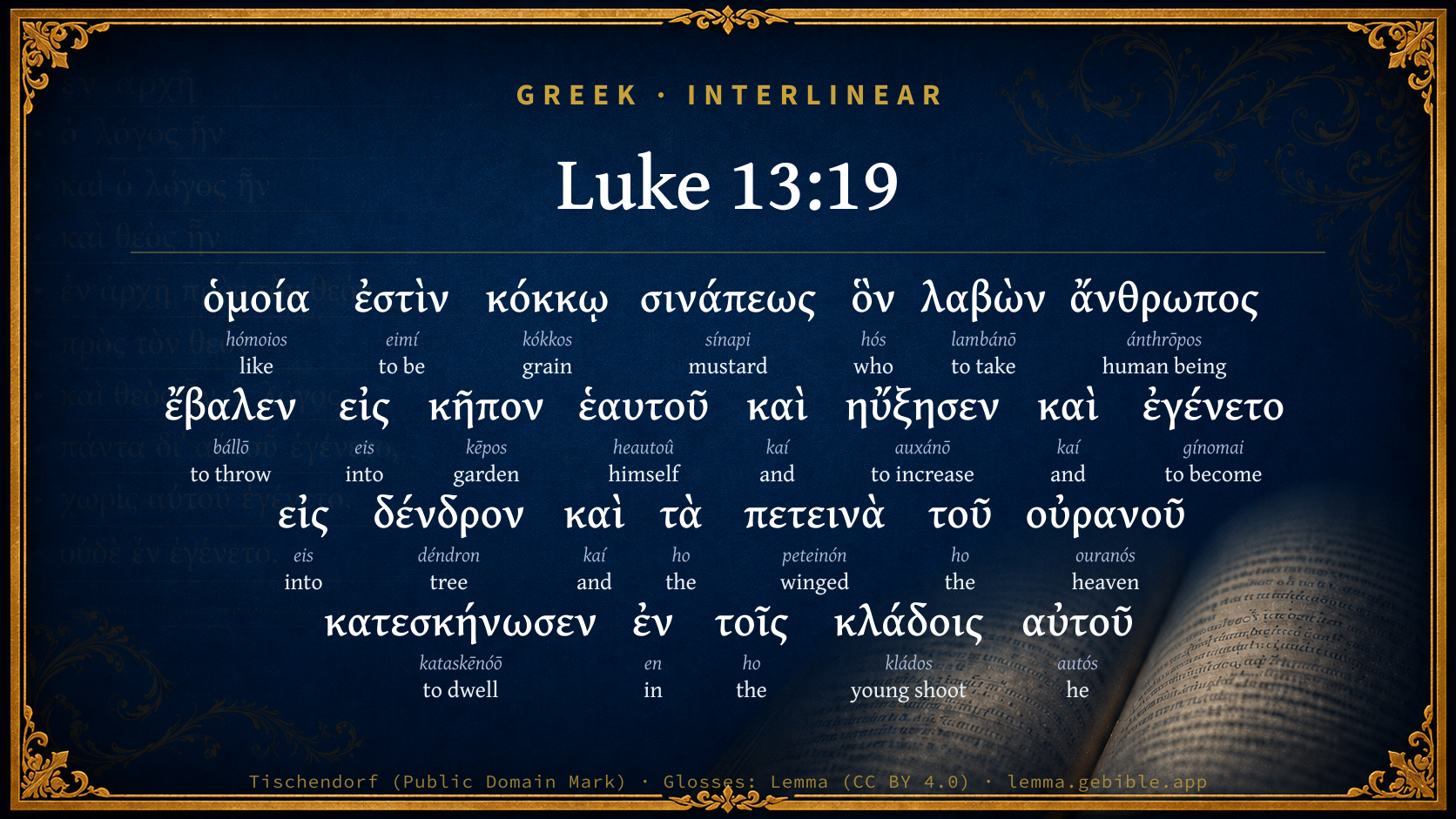
It is like a grain of mustard seed, which a man took, and put in his own garden. It grew, and became a large tree, and the birds of the sky lodged in its branches."
Download a study sheet
One document with this verse’s original text, its word-by-word gloss line, the meaning frame, cross-references with their text, attributed commentary, and full source and license credits — printable, and it pastes into notes with its structure intact.
This verse Autodidact and up
A passage Seminary Student
Up to 50 verses in one chapter. A passage sheet keeps up to 6 commentary sources and 12 cross-references per verse, in the order this page ranks them, and says so on the sheet whenever that leaves anything out. Ask for a single verse and you get the Autodidact verse sheet above.
Everything on this page stays free to read, with no account — the sheet is a download of what is already on screen, not access to it.
Compare translations 3
The same verse in 3 English versions, stacked beneath the original-language interlinear above. Click any original word for its lexicon entry.
Each is an independent rendering of the whole verse — the interlinear is not word-aligned to these translations.
Highlighted words mark where these versions differ — a whole-verse word diff, not a word-by-word alignment.
-
World English Bible Public Domain
It is like a grain of mustard seed, which a man took, and put in his own garden. It grew, and became a large tree, and the birds of the sky lodged in its branches."
-
King James Version Public Domain
It is like a grain of mustard seed, which a man took, and cast into his garden; and it grew, and waxed a great tree; and the fowls of the air lodged in the branches of it.
-
unfoldingWord Literal Text CC BY-SA 4.0
It is like a mustard seed that a man took threw into his garden, and it grew and became a tree, and the birds of the sky nested in its branches.”
unfoldingWord Literal Text — © unfoldingWord, licensed CC BY-SA 4.0. Word-aligned USFM3 via Door43 (git.door43.org/unfoldingWord/en_ult).
Show all 19 translations
Every available English version of this verse, each an independent rendering of the whole verse.
-
World English Bible Public Domain
It is like a grain of mustard seed, which a man took, and put in his own garden. It grew, and became a large tree, and the birds of the sky lodged in its branches."
-
Berean Standard Bible Public Domain
It is like a mustard seed that a man tossed into his garden. It grew and became a tree, and the birds of the air nested in its branches.”
-
Majority Standard Bible Public Domain
It is like a mustard seed that a man tossed into his garden. It grew and became a great tree, and the birds of the air nested in its branches.”
-
King James Version Public Domain
It is like a grain of mustard seed, which a man took, and cast into his garden; and it grew, and waxed a great tree; and the fowls of the air lodged in the branches of it.
-
American Standard Version (1901) Public Domain
It is like unto a grain of mustard seed, which a man took, and cast into his own garden; and it grew, and became a tree; and the birds of the heaven lodged in the branches thereof.
-
Revised Version (1885) Public Domain
It is like unto a grain of mustard seed, which a man took, and cast into his own garden; and it grew, and became a tree; and the birds of the heaven lodged in the branches thereof.
-
Geneva Bible (1599) Public Domain
It is like a graine of mustard seede, which a man tooke and sowed in his garden, and it grewe, and waxed a great tree, and the foules of the heauen made nestes in the branches thereof.
-
Douay-Rheims (1899) Public Domain
It is like to a grain of mustard seed, which a man took and cast into his garden, and it grew and became a great tree, and the birds of the air lodged in the branches thereof.
-
Young's Literal Translation Public Domain
It is like to a grain of mustard, which a man having taken, did cast into his garden, and it increased, and came to a great tree, and the fowls of the heavens did rest in its branches.'
-
Literal Standard Version CC BY-SA 4.0
It is like to a grain of mustard, which a man having taken, cast into his garden, and it increased, and came to a great tree, and the birds of the heavens rested in its branches.”
-
Unlocked Literal Bible CC BY-SA 4.0
It is like a mustard seed that a man took and threw into his garden, and it grew into a big tree, and the birds of heaven built their nests in its branches.”
-
unfoldingWord Literal Text CC BY-SA 4.0
It is like a mustard seed that a man took threw into his garden, and it grew and became a tree, and the birds of the sky nested in its branches.”
-
Darby Bible Public Domain
It is like a grain of mustard [seed] which a man took and cast into his garden; and it grew and became a great tree, and the birds of heaven lodged in its branches.
-
World Messianic Bible Public Domain
It is like a grain of mustard seed which a man took and put in his own garden. It grew and became a large tree, and the birds of the sky live in its branches.”
-
Webster's Bible Public Domain
It is like a grain of mustard-seed, which a man took, and cast into his garden, and it grew, and became a great tree; and the fowls of the air lodged in the branches of it.
-
Free Bible Version CC BY-SA 4.0
It's like a mustard seed that a man planted in his garden. It grew into a tree, and the birds came and nested in its branches.”
-
Bible in Basic English Public Domain
It is like a grain of mustard seed which a man took and put in his garden, and it became a tree, and the birds of heaven made their resting-places in its branches.
-
Text-Critical English NT CC BY 4.0
It is like a grain of mustard seed that a man took and sowed in his garden. It grew and became a large tree, and the birds of the sky nested in its branches.”
-
Tyndale New Testament (1534) Public Domain
It is lyke a grayne of mustard seede which a man toke and sowed in his garden: and it grewe and wexed a greate tree and the foules of the ayer made nestes in the braunches of it.
Literal Standard Version (2020), Covenant Press — licensed CC BY-SA 4.0. Text via the HelloAO Bible API (eBible.org). Unlocked Literal Bible (unfoldingWord) — licensed CC BY-SA 4.0. Text via the HelloAO Bible API (eBible.org). unfoldingWord Literal Text — © unfoldingWord, licensed CC BY-SA 4.0. Word-aligned USFM3 via Door43 (git.door43.org/unfoldingWord/en_ult). Free Bible Version, Dr. Jonathan Gallagher — licensed CC BY-SA 4.0. Text via the HelloAO Bible API (eBible.org).
Word by word
More ways to search: Search by grammar → Find every occurrence → Compare this word →
Practice this passage: Drill this verse → Learn its vocabulary →
- Appears 4× in the Greek New Testament
- First appears at Matthew 13:32
- Part of Speech
- Verb
- Tense
- Aorist
- Voice
- Active
- Mood
- Indicative
- Person
- 3rd person
- Number
- Singular
Full Thayer's Definition
- ὁμοία hómoios G3664 “like” Adjective, Nominative, Singular, Feminine
- ἐστὶν eimí G1510 “to be” Verb, Present, Active, Indicative, 3rd person, Singular
- κόκκῳ kókkos G2848 “grain” Noun, Dative, Singular, Masculine
- σινάπεως sínapi G4615 “mustard” Noun, Genitive, Singular, Neuter
- ὃν hós G3739 “who” Relative pronoun, Accusative, Singular, Masculine
- λαβὼν lambánō G2983 “to take” Verb, Aorist, Active, Participle, Nominative, Singular, Masculine
- ἄνθρωπος ánthrōpos G444 “human being” Noun, Nominative, Singular, Masculine
- ἔβαλεν bállō G906 “to throw” Verb, Aorist, Active, Indicative, 3rd person, Singular
- εἰς eis G1519 “into” Preposition
- κῆπον kēpos G2779 “garden” Noun, Accusative, Singular, Masculine
- ἑαυτοῦ heautoû G1438 “himself” Reflexive pronoun, 3rd person, Genitive, Singular, Masculine
- καὶ kaí G2532 “and” Conjunction
- ηὔξησεν auxánō G837 “to increase” Verb, Aorist, Active, Indicative, 3rd person, Singular
- καὶ kaí G2532 “and” Conjunction
- ἐγένετο gínomai G1096 “to become” Verb, Aorist, Middle deponent, Indicative, 3rd person, Singular
- εἰς eis G1519 “into” Preposition
- δένδρον déndron G1186 “tree” Noun, Accusative, Singular, Neuter
- καὶ kaí G2532 “and” Conjunction
- τὰ ho G3588 “the” Article, Nominative, Plural, Neuter
- πετεινὰ peteinón G4071 “winged” Noun, Nominative, Plural, Neuter
- τοῦ ho G3588 “the” Article, Genitive, Singular, Masculine
- οὐρανοῦ ouranós G3772 “heaven” Noun, Genitive, Singular, Masculine
- κατεσκήνωσεν kataskēnóō G2681 “to dwell” Verb, Aorist, Active, Indicative, 3rd person, Singular
- ἐν en G1722 “in” Preposition
- τοῖς ho G3588 “the” Article, Dative, Plural, Masculine
- κλάδοις kládos G2798 “young shoot” Noun, Dative, Plural, Masculine
- αὐτοῦ autós G846 “he” Personal pronoun, Genitive, Singular, Neuter
About this verse
These counts appear in no published source. They are computed here, from the morphology-tagged text and Lemma’s own curated glosses. What Lemma adds →
- 27
- words
- 22
- distinct lemmas
- Gospels
- section
Notable vocabulary
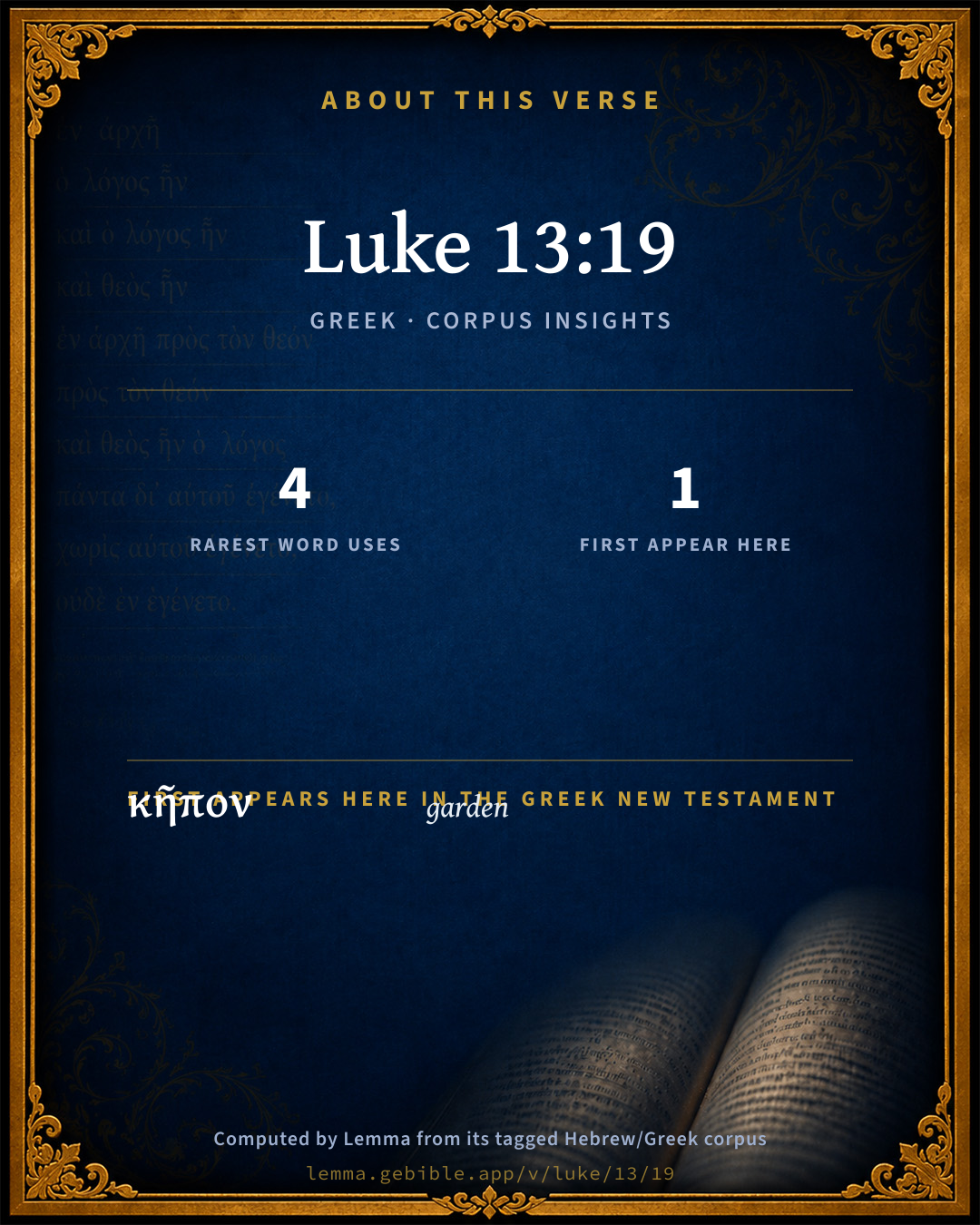
The rarest word here is κατεσκήνωσεν to dwell G2681 — appearing just 4 times in the whole Greek New Testament.
First appearance in Scripture
This word makes its first canonical appearance in the Greek New Testament here:
- κῆπον garden G2779
Shared distinctive vocabulary
κατεσκήνωσεν to dwell G2681 occurs in 4 verses of the Greek New Testament. Also found in:
Cross-references
35Topical passages linked to Luke 13:19 in the Treasury of Scripture Knowledge — connected by theme and wording, ordered by reader-vote popularity; previews shown in the World English Bible.
- Daniel 4:12 The leaves of it were beautiful, and the fruit of it much, and in it was food for all: the animals of the field had shadow under it, and the birds of the sky lived in the branches of it, and all flesh was fed from it.
- Ezekiel 17:22–24 Thus says the Lord Yahweh: I will also take of the lofty top of the cedar, and will set it; I will crop off from the topmost of its young twigs a tender one, and I will plant it on a high and lofty mountain:
- Daniel 2:44–45 In the days of those kings shall the God of heaven set up a kingdom which shall never be destroyed, nor shall the sovereignty of it be left to another people; but it shall break in pieces and consume all these kingdoms, and it shall stand forever.
- Daniel 4:21 whose leaves were beautiful, and the fruit of it much, and in it was food for all; under which the animals of the field lived, and on whose branches the birds of the sky had their habitation:
- Zechariah 2:11 Many nations shall join themselves to Yahweh in that day, and shall be my people; and I will dwell in the midst of you, and you shall know that Yahweh of Hosts has sent me to you.
- Matthew 13:31–32 He set another parable before them, saying, "The Kingdom of Heaven is like a grain of mustard seed, which a man took, and sowed in his field;
- Mark 4:31–32 It's like a grain of mustard seed, which, when it is sown in the earth, though it is less than all the seeds that are on the earth,
- Isaiah 9:7 Of the increase of his government and of peace there shall be no end, on the throne of David, and on his kingdom, to establish it, and to uphold it with justice and with righteousness from henceforth even forever. The zeal of Yahweh of Hosts will perform this.
- Ezekiel 31:6 All the birds of the sky made their nests in its boughs; and under its branches did all the animals of the field bring forth their young; and under its shadow lived all great nations.
- Daniel 2:34–35 You saw until a stone was cut out without hands, which struck the image on its feet that were of iron and clay, and broke them in pieces.
- Zechariah 14:7–9 It will be a unique day which is known to Yahweh; not day, and not night; but it will come to pass, that at evening time there will be light.
- Acts 2:41 Then those who gladly received his word were baptized. There were added that day about three thousand souls.
- Acts 4:4 But many of those who heard the word believed, and the number of the men came to be about five thousand.
- Song of Solomon 6:2 My beloved has gone down to his garden, To the beds of spices, To feed in the gardens, and to gather lilies.
- Isaiah 53:10–54:3 Yet it pleased Yahweh to bruise him; he has put him to grief: when you shall make his soul an offering for sin, he shall see [his] seed, he shall prolong his days, and the pleasure of Yahweh shall prosper in his hand.
- Isaiah 58:11 and Yahweh will guide you continually, and satisfy your soul in dry places, and make strong your bones; and you shall be like a watered garden, and like a spring of water, whose waters don't fail.
- Micah 4:1–2 But in the latter days, It will happen that the mountain of Yahweh's temple will be established on the top of the mountains, And it will be exalted above the hills; And peoples will stream to it.
- Zechariah 8:20–23 Thus says Yahweh of Hosts: "Many peoples, and the inhabitants of many cities will yet come;
- Matthew 17:20 He said to them, "Because of your unbelief. For most assuredly I tell you, if you have faith as a grain of mustard seed, you will tell this mountain, 'Move from here to there,' and it will move; and nothing will be impossible for you.
- Acts 21:20 They, when they heard it, glorified God. They said to him, "You see, brother, how many thousands there are among the Jews of those who have believed, and they are all zealous for the law.
- Psalms 72:16–17 There shall be abundance of grain throughout the land. Its fruit sways like Lebanon. Let it flourish, thriving like the grass of the field.
- Song of Solomon 4:12 A locked up garden is my sister, my bride; A locked up spring, A sealed fountain.
- Song of Solomon 4:16–5:1 Awake, north wind; and come, you south; Blow on my garden, that its spices may flow out. Let my beloved come into his garden, And taste his precious fruits. Lover
- Song of Solomon 8:13 You who dwell in the gardens, with friends in attendance, Let me hear your voice! Beloved
- Isaiah 2:2–3 It shall happen in the latter days, that the mountain of Yahweh's house shall be established on the top of the mountains, And shall be raised above the hills; And all nations shall flow to it.
- Isaiah 49:20–25 The children of your bereavement shall yet say in your ears, The place is too small for me; give place to me that I may dwell.
- Isaiah 51:2–3 Look to Abraham your father, and to Sarah who bore you; for when he was but one I called him, and I blessed him, and made him many.
- Isaiah 53:1 Who has believed our message? and to whom has the arm of Yahweh been revealed?
- Isaiah 60:15–22 Whereas you have been forsaken and hated, so that no man passed through you, I will make you an eternal excellency, a joy of many generations.
- Isaiah 61:11 For as the earth brings forth its bud, and as the garden causes the things that are sown in it to spring forth; so the Lord Yahweh will cause righteousness and praise to spring forth before all the nations.
- Jeremiah 31:12 They shall come and sing in the height of Zion, and shall flow to the goodness of Yahweh, to the grain, and to the new wine, and to the oil, and to the young of the flock and of the herd: and their soul shall be as a watered garden; and they shall not sorrow any more at all.
- Ezekiel 47:1–12 He brought me back to the door of the house; and, behold, waters issued out from under the threshold of the house eastward; (for the forefront of the house was toward the east;) and the waters came down from under, from the right side of the house, on the south of the altar.
- Acts 15:14–18 Simeon has reported how God first visited the Gentiles, to take out of them a people for his name.
- Romans 15:19 in the power of signs and wonders, in the power of God's Spirit; so that from Jerusalem, and around as far as to Illyricum, I have fully preached the Gospel of Christ;
- Revelation 11:15 The seventh angel sounded, and great voices in heaven followed, saying, "The kingdom of the world has become the Kingdom of our Lord, and of his Christ. He will reign forever and ever!"
Cross-references courtesy of OpenBible.info (CC BY 4.0).
Where the printed editions differ
1 variantPlaces in this verse where the major printed Greek editions disagree on the wording in a way that affects the translation — a comparison of editions, not a manuscript-by-manuscript collation. The editions are the modern critical texts (Nestlé-Aland 28/27, SBL, Westcott-Hort, Tregelles, Tyndale House) and the traditional texts behind the KJV (the Textus Receptus and the Byzantine/Majority text). It is not a claim about which reading is original.
-
Extra text
μέγα,
“great”
In TregTRByz Not in NA28NA27TynSBLWHμέγα, (mega) 'great' is only in traditional manuscripts (Treg+TR+Byz)
Textual data: Translators Amalgamated Greek New Testament (STEPBible TAGNT) · CC BY 4.0.
Lesson kit
Teaching starters — assembled from the data on this page, not authored interpretation. Every prompt links to the verse data it draws on. Edit before teaching.
Luke, in the Gospels, opens this verse with 27 words (22 distinct Greek lemmas). Its most distinctive word is kataskēnóō (“to dwell”). A historical commentator’s framing appears above. Read the whole chapter for the surrounding context.
Discussion questions
- The word kataskēnóō carries the sense “to dwell.” How does it shape the verse?
- This is the first place “garden” appears in Scripture (first appears here). What does its debut here establish?
- How does Matthew 13:32, which shares the word «to dwell», read alongside this verse?
- What does the repetition of “into” (2× in this one verse) do in this verse?
- These translations render this verse differently; the difference is in the English rendering, not the original. What questions does that raise?
- Compare how Tyndale Open Study Notes and Bengel's Gnomon read this verse. Where do they agree or differ?
Things to notice
- 1 word makes its first canonical appearance in Scripture here.
- These translations choose different wording for 17 words in this verse.
- “into” occurs 2× in this single verse.
- 22 distinct Greek lemmas span 27 words in this verse.
Commentary
Notes on Luke 13:19 from classic Christian and Jewish commentators (each source and its license shown beneath its notes). The classic Christian expositions comment on the surrounding passage and are grouped to its opening verse, so a note may address several verses; the Jewish commentaries on the Tanakh (Rashi and others) are per-verse, so they appear only where the commentator wrote on this verse.
Lemma curates 59 commentaries, every one of them public domain or Creative Commons licensed, each selected and text-cleaned for this edition rather than reprinted as found. About our sources →
Tyndale Open Study Notes
Tyndale Open Resources
Tyndale Open Study Notes — © Tyndale Open Resources, licensed CC BY-SA 4.0. Text via the HelloAO Bible API.
Bengel's Gnomon
Johann Albrecht Bengel
Bengel's Gnomon of the New Testament — English translation (T&T Clark, Edinburgh, 1860) — public domain. Text from a community e-Sword module.
Expositor's Greek Testament
ed. W. Robertson Nicoll
The Expositor's Greek Testament, edited by W. Robertson Nicoll (1897–1910) — public domain. Text from a community e-Sword module.
Geneva Bible (1599)
Geneva Bible translators
Geneva Bible (1599) marginal notes — public domain. Text via Bolls.life.
The Cambridge Bible for Schools and Colleges
gen. ed. J. J. S. Perowne
The Cambridge Bible for Schools and Colleges (gen. ed. J. J. S. Perowne; Cambridge University Press, 1878–1918) — public domain. Text from a community e-Sword module.
John Gill's Exposition
John Gill's Exposition of the Whole Bible (1746–1763) — public domain (CC PDM 1.0). Text via the HelloAO Bible API.
Trapp's Complete Commentary
John Trapp
John Trapp, A Commentary or Exposition upon All the Books of the Old and New Testament (1647–1656) — public domain. Text from a community e-Sword module.
Haydock's Catholic Bible Commentary
George Leo Haydock (1774–1849), Haydock's Catholic Family Bible and Commentary, 1859 edition — public domain. Excludes Psalms (Douay-Rheims chapter numbering differs from Protestant) and Deuterocanonical books (Catholic canon only).
The Pulpit Commentary
The Pulpit Commentary (1880–1919), ed. H.D.M. Spence-Jones & Joseph S. Exell — public domain. Text from a community e-Sword module.
Cambridge Greek Testament for Schools and Colleges
Cambridge Greek Testament for Schools and Colleges (Cambridge University Press, 1896; 21 vols, various authors incl. Carr, Maclear, Plummer, Farrar, Lumby, Moule, M. R. James, Simcox) — public domain. Text from a community e-Sword module.
International Critical Commentary
International Critical Commentary — older volumes (1896–1929), various authors — public domain. Text from a community e-Sword module.
Vincent's Word Studies in the New Testament
Marvin R. Vincent
Marvin R. Vincent, Word Studies in the New Testament (1887–1900) — public domain. Text from a community e-Sword/MySword module.