

Luke 18:13
Greek (Tischendorf 8th ed.) Luke 18:13 appears in the Greek New Testament. The text above is from the Tischendorf 8th edition. Each word links to its Strong’s number and a concise gloss. Click any word for its full Thayer’s Greek Lexicon entry.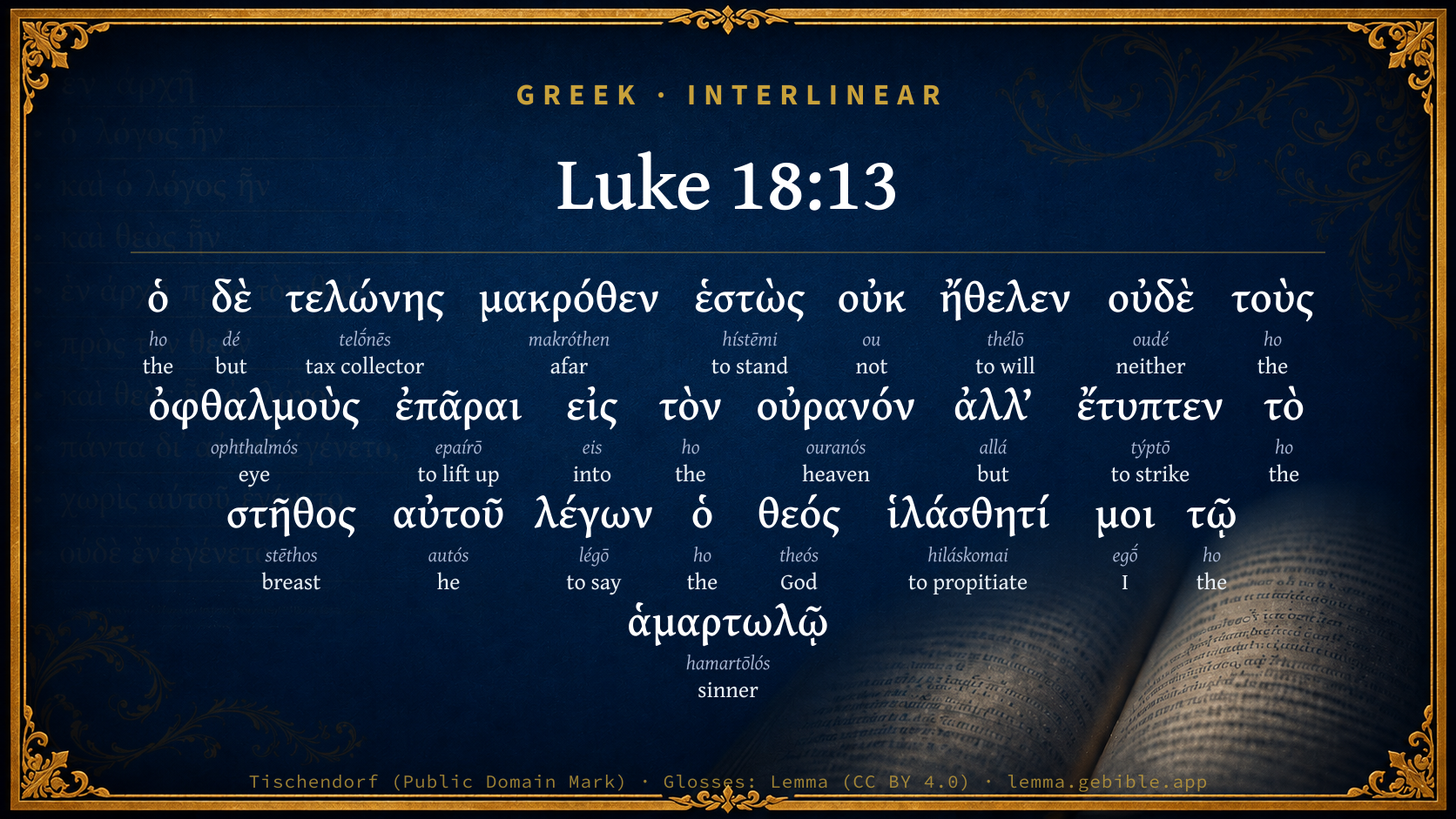
But the tax collector, standing far away, wouldn't even lift up his eyes to heaven, but beat his breast, saying, 'God, be merciful to me, a sinner!'
Download a study sheet
One document with this verse’s original text, its word-by-word gloss line, the meaning frame, cross-references with their text, attributed commentary, and full source and license credits — printable, and it pastes into notes with its structure intact.
This verse Autodidact and up
A passage Seminary Student
Up to 50 verses in one chapter. A passage sheet keeps up to 6 commentary sources and 12 cross-references per verse, in the order this page ranks them, and says so on the sheet whenever that leaves anything out. Ask for a single verse and you get the Autodidact verse sheet above.
Everything on this page stays free to read, with no account — the sheet is a download of what is already on screen, not access to it.
Compare translations 3
The same verse in 3 English versions, stacked beneath the original-language interlinear above. Click any original word for its lexicon entry.
Each is an independent rendering of the whole verse — the interlinear is not word-aligned to these translations.
Highlighted words mark where these versions differ — a whole-verse word diff, not a word-by-word alignment.
-
World English Bible Public Domain
But the tax collector, standing far away, wouldn't even lift up his eyes to heaven, but beat his breast, saying, 'God, be merciful to me, a sinner!'
-
King James Version Public Domain
And the publican, standing afar off, would not lift up so much as his eyes unto heaven, but smote upon his breast, saying, God be merciful to me a sinner.
-
unfoldingWord Literal Text CC BY-SA 4.0
But the tax collector, standing at a distance, did not even want to lift up his eyes toward heaven, but was beating his breast, saying, ‘God, have mercy on me, the sinner.’
unfoldingWord Literal Text — © unfoldingWord, licensed CC BY-SA 4.0. Word-aligned USFM3 via Door43 (git.door43.org/unfoldingWord/en_ult).
Show all 19 translations
Every available English version of this verse, each an independent rendering of the whole verse.
-
World English Bible Public Domain
But the tax collector, standing far away, wouldn't even lift up his eyes to heaven, but beat his breast, saying, 'God, be merciful to me, a sinner!'
-
Berean Standard Bible Public Domain
But the tax collector stood at a distance, unwilling even to lift up his eyes to heaven. Instead, he beat his breast and said, ‘God, have mercy on me, a sinner!’
-
Majority Standard Bible Public Domain
But the tax collector stood at a distance, unwilling even to lift up his eyes to heaven. Instead, he beat his breast and said, ‘God, have mercy on me, a sinner!’
-
King James Version Public Domain
And the publican, standing afar off, would not lift up so much as his eyes unto heaven, but smote upon his breast, saying, God be merciful to me a sinner.
-
American Standard Version (1901) Public Domain
But the publican, standing afar off, would not lift up so much as his eyes unto heaven, but smote his breast, saying, God, be thou merciful to me a sinner.
-
Revised Version (1885) Public Domain
But the publican, standing afar off, would not lift up so much as his eyes unto heaven, but smote his breast, saying, God, be merciful to me a sinner.
-
Geneva Bible (1599) Public Domain
But the Publican standing a farre off, woulde not lift vp so much as his eyes to heauen, but smote his brest, saying, O God, be mercifull to me a sinner.
-
Douay-Rheims (1899) Public Domain
And the publican, standing afar off, would not so much as lift up his eyes towards heaven; but struck his breast, saying: O god, be merciful to me a sinner.
-
Young's Literal Translation Public Domain
`And the tax-gatherer, having stood afar off, would not even the eyes lift up to the heaven, but was smiting on his breast, saying, God be propitious to me -- the sinner!
-
Literal Standard Version CC BY-SA 4.0
And the tax collector, having stood far off, would not even lift up the eyes to the sky, but was striking on his breast, saying, God be propitious to me—the sinner!
-
Unlocked Literal Bible CC BY-SA 4.0
But the tax collector, standing at a distance, would not even lift up his eyes to heaven, but hit his breast, saying, 'God, have mercy on me, a sinner.'
-
unfoldingWord Literal Text CC BY-SA 4.0
But the tax collector, standing at a distance, did not even want to lift up his eyes toward heaven, but was beating his breast, saying, ‘God, have mercy on me, the sinner.’
-
Darby Bible Public Domain
And the tax-gatherer, standing afar off, would not lift up even his eyes to heaven, but smote upon his breast, saying, O God, have compassion on me, the sinner.
-
World Messianic Bible Public Domain
But the tax collector, standing far away, wouldn’t even lift up his eyes to heaven, but beat his chest, saying, ‘God, be merciful to me, a sinner!’
-
Webster's Bible Public Domain
And the publican, standing afar off, would not lift up so much as his eyes to heaven, but smote upon his breast, saying, God be merciful to me a sinner.
-
Free Bible Version CC BY-SA 4.0
But the tax collector stood at a distance. He wouldn't even look up to heaven. Instead he beat his chest and prayed, ‘God, please be merciful to me. I am a sinner.’
-
Bible in Basic English Public Domain
The tax-farmer, on the other hand, keeping far away, and not lifting up even his eyes to heaven, made signs of grief and said, God, have mercy on me, a sinner.
-
Text-Critical English NT CC BY 4.0
But the tax collector stood at a distance and would not even lift up his eyes to heaven, but beat his breast, saying, ‘God, be merciful to me, a sinner!’
-
Tyndale New Testament (1534) Public Domain
And the publican stode afarre of and wolde not lyfte vp his eyes to heven but smote his brest sayinge: God be mercyfull to me a synner.
Literal Standard Version (2020), Covenant Press — licensed CC BY-SA 4.0. Text via the HelloAO Bible API (eBible.org). Unlocked Literal Bible (unfoldingWord) — licensed CC BY-SA 4.0. Text via the HelloAO Bible API (eBible.org). unfoldingWord Literal Text — © unfoldingWord, licensed CC BY-SA 4.0. Word-aligned USFM3 via Door43 (git.door43.org/unfoldingWord/en_ult). Free Bible Version, Dr. Jonathan Gallagher — licensed CC BY-SA 4.0. Text via the HelloAO Bible API (eBible.org).
Word by word
More ways to search: Search by grammar → Find every occurrence → Compare this word →
Practice this passage: Drill this verse → Learn its vocabulary →
- Appears 2× in the Greek New Testament
- First appears here
- Part of Speech
- Verb
- Tense
- Aorist
- Voice
- Passive
- Mood
- Imperative
- Person
- 2nd person
- Number
- Singular
Full Thayer's Definition
- ὁ ho G3588 “the” Article, Nominative, Singular, Masculine
- δὲ dé G1161 “but” Conjunction
- τελώνης telṓnēs G5057 “tax collector” Noun, Nominative, Singular, Masculine
- μακρόθεν makróthen G3113 “afar” Adverb
- ἑστὼς hístēmi G2476 “to stand” Verb, Perfect, Active, Participle, Nominative, Singular, Masculine
- οὐκ ou G3756 “not” Particle, Negative
- ἤθελεν thélō G2309 “to will” Verb, Imperfect, Active, Indicative, 3rd person, Singular
- οὐδὲ oudé G3761 “neither” Conjunction, Negative
- τοὺς ho G3588 “the” Article, Accusative, Plural, Masculine
- ὀφθαλμοὺς ophthalmós G3788 “eye” Noun, Accusative, Plural, Masculine
- ἐπᾶραι epaírō G1869 “to lift up” Verb, Aorist, Active, Infinitive
- εἰς eis G1519 “into” Preposition
- τὸν ho G3588 “the” Article, Accusative, Singular, Masculine
- οὐρανόν ouranós G3772 “heaven” Noun, Accusative, Singular, Masculine
- ἀλλ’ allá G235 “but” Conjunction
- ἔτυπτεν týptō G5180 “to strike” Verb, Imperfect, Active, Indicative, 3rd person, Singular
- τὸ ho G3588 “the” Article, Accusative, Singular, Neuter
- στῆθος stēthos G4738 “breast” Noun, Accusative, Singular, Neuter
- αὐτοῦ autós G846 “he” Personal pronoun, Genitive, Singular, Masculine
- λέγων légō G3004 “to say” Verb, Present, Active, Participle, Nominative, Singular, Masculine
- ὁ ho G3588 “the” Article, Nominative, Singular, Masculine
- θεός theós G2316 “God” Noun, Nominative, Singular, Masculine
- ἱλάσθητί hiláskomai G2433 “to propitiate” Verb, Aorist, Passive, Imperative, 2nd person, Singular
- μοι egṓ G1473 “I” Personal pronoun, 1st person, Dative, Singular
- τῷ ho G3588 “the” Article, Dative, Singular, Masculine
- ἁμαρτωλῷ hamartōlós G268 “sinner” Adjective, Dative, Singular, Masculine
About this verse
These counts appear in no published source. They are computed here, from the morphology-tagged text and Lemma’s own curated glosses. What Lemma adds →
- 26
- words
- 21
- distinct lemmas
- Gospels
- section
Notable vocabulary
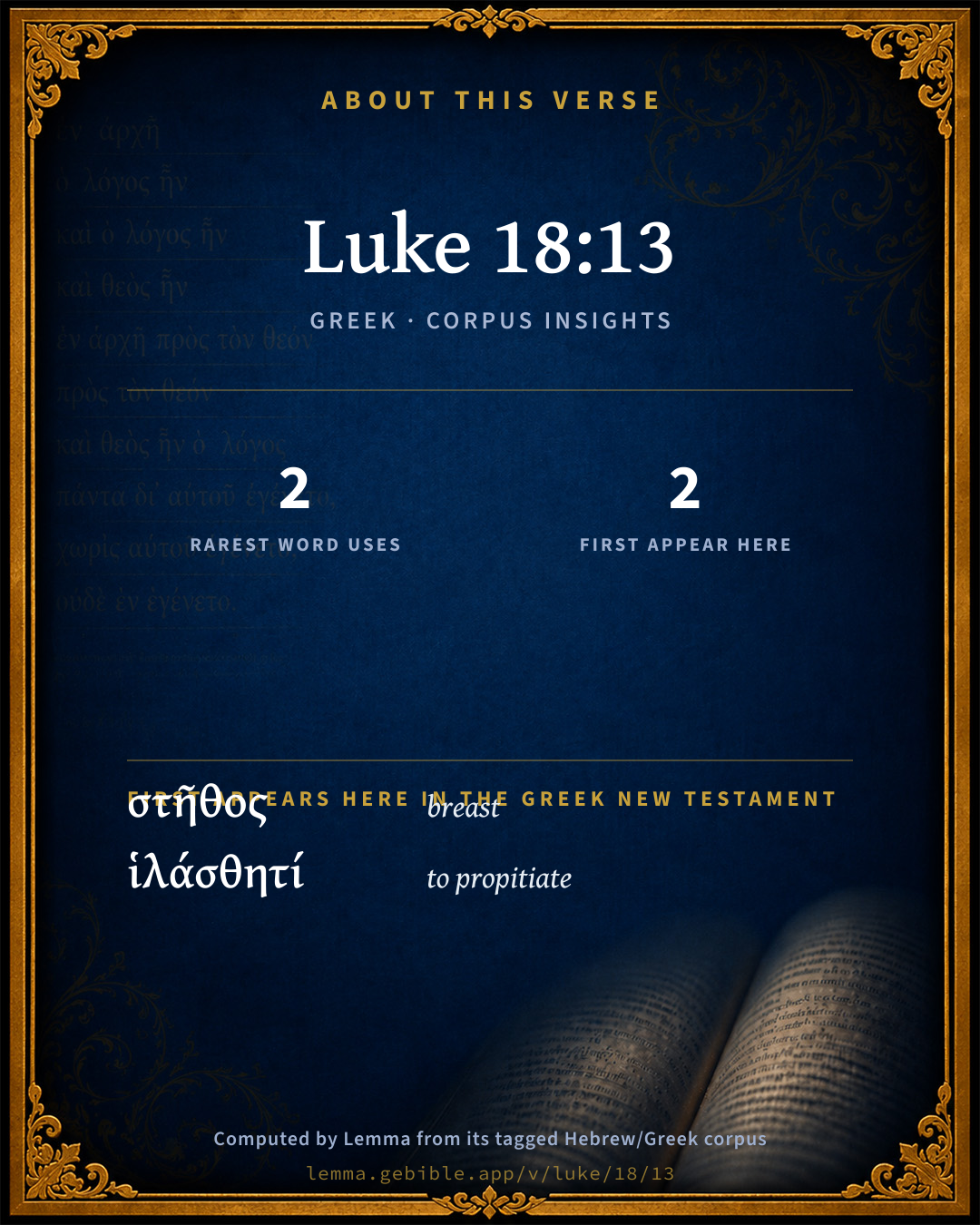
The rarest word here is ἱλάσθητί to propitiate G2433 — appearing just 2 times in the whole Greek New Testament.
First appearance in Scripture
These words make their first canonical appearance in the Greek New Testament here:
Shared distinctive vocabulary
ἱλάσθητί to propitiate G2433 occurs in 2 verses of the Greek New Testament. Also found in:
Repetition
A word recurs within this verse:
- ὁ the G3588 ×6
Cross-references
38Topical passages linked to Luke 18:13 in the Treasury of Scripture Knowledge — connected by theme and wording, ordered by reader-vote popularity; previews shown in the World English Bible.
- Ezra 9:6 and I said, my God, I am ashamed and blush to lift up my face to you, my God; for our iniquities are increased over our head, and our guiltiness is grown up to the heavens.
- 1 John 1:8–10 If we say that we have no sin, we deceive ourselves, and the truth is not in us.
- 1 Timothy 1:15 The saying is faithful and worthy of all acceptance, that Christ Jesus came into the world to save sinners; of whom I am chief.
- Psalms 41:4 I said, "Yahweh, have mercy on me! Heal me, for I have sinned against you."
- Hebrews 8:12 For I will be merciful to their unrighteousness. I will remember their sins and lawless deeds no more."
- Luke 7:6–7 Jesus went with them. When he was now not far from the house, the centurion sent friends to him, saying to him, "Lord, don't trouble yourself, for I am not worthy for you to come under my roof.
- Luke 23:48 All the multitudes that came together to see this, when they saw the things that were done, returned home beating their breasts.
- Hebrews 4:16 Let us therefore draw near with boldness to the throne of grace, that we may receive mercy, and may find grace for help in time of need.
- Psalms 25:11 For your name's sake, Yahweh, Pardon my iniquity, for it is great.
- Luke 5:8 But Simon Peter, when he saw it, fell down at Jesus' knees, saying, "Depart from me, for I am a sinful man, Lord."
- Acts 2:37 Now when they heard this, they were cut to the heart, and said to Peter and the rest of the apostles, "Brothers, what shall we do?"
- Romans 5:8 But God commends his own love toward us, in that while we were yet sinners, Christ died for us.
- Isaiah 6:5 Then I said, "Woe is me! For I am undone, because I am a man of unclean lips, and I dwell in the midst of a people of unclean lips: for my eyes have seen the King, Yahweh of Hosts!"
- Isaiah 64:5–6 You meet him who rejoices and works righteousness, those who remember you in your ways: behold, you were angry, and we sinned: in them [have we been] of long time; and shall we be saved?
- Luke 23:40–43 But the other answered, and rebuking him said, "Don't you even fear God, seeing you are under the same condemnation?
- Job 42:6 Therefore I abhor myself, And repent in dust and ashes."
- Luke 15:18–21 I will get up and go to my father, and will tell him, "Father, I have sinned against heaven, and in your sight.
- Psalms 25:7 Don't remember the sins of my youth, nor my transgressions. Remember me according to your loving kindness, For your goodness' sake, Yahweh.
- Psalms 51:1–3 Have mercy on me, God, according to your loving kindness. According to the multitude of your tender mercies, blot out my transgressions.
- 2 Corinthians 7:11 For behold, this same thing, that you were made sorry in a godly way, what earnest care it worked in you. Yes, what defense, indignation, fear, longing, zeal, and vengeance! In everything you demonstrated yourselves to be pure in the matter.
- Psalms 86:15–16 But you, Lord, are a merciful and gracious God, Slow to anger, and abundant in loving kindness and truth.
- Isaiah 1:18 "Come now, and let us reason together," says Yahweh: "Though your sins be as scarlet, they shall be as white as snow. Though they be red like crimson, they shall be as wool.
- Jeremiah 31:18–19 I have surely heard Ephraim bemoaning himself [thus], You have chastised me, and I was chastised, as a calf unaccustomed [to the yoke]: turn you me, and I shall be turned; for you are Yahweh my God.
- Ezekiel 16:63 that you may remember, and be confounded, and never open your mouth any more, because of your shame, when I have forgiven you all that you have done, says the Lord Yahweh.
- Daniel 9:18–19 My God, turn your ear, and hear; open your eyes, and see our desolations, and the city which is called by your name: for we do not present our petitions before you for our righteousness, but for your great mercies' sake.
- Matthew 9:13 But you go and learn what this means: 'I desire mercy, and not sacrifice,' for I came not to call the righteous, but sinners to repentance."
- Romans 5:20–21 The law came in besides, that the trespass might abound; but where sin abounded, grace did abound more exceedingly;
- 2 Chronicles 33:12–13 When he was in distress, he begged Yahweh his God, and humbled himself greatly before the God of his fathers.
- 2 Chronicles 33:19 His prayer also, and how [God] was entreated of him, and all his sin and his trespass, and the places in which he built high places, and set up the Asherim and the engraved images, before he humbled himself: behold, they are written in the history of Hozai.
- 2 Chronicles 33:23 He didn't humble himself before Yahweh, as Manasseh his father had humbled himself; but this same Amon trespassed more and more.
- Psalms 40:12 For innumerable evils have surrounded me. My iniquities have overtaken me, so that I am not able to look up. They are more than the hairs of my head. My heart has failed me.
- Psalms 106:6 We have sinned with our fathers. We have committed iniquity. We have done wickedly.
- Psalms 119:41 Let your loving kindness also come to me, Yahweh, Your salvation, according to your word.
- Psalms 130:3–4 If you, Yah, kept a record of sins, Lord, who could stand?
- Psalms 130:7 Israel, hope in Yahweh, For with Yahweh there is loving kindness. With him is abundant redemption.
- Daniel 9:5 we have sinned, and have dealt perversely, and have done wickedly, and have rebelled, even turning aside from your precepts and from your ordinances;
- Daniel 9:7–11 Lord, righteousness belongs to you, but to us confusion of face, as at this day; to the men of Judah, and to the inhabitants of Jerusalem, and to all Israel, who are near, and who are far off, through all the countries where you have driven them, because of their trespass that they have trespassed against you.
- Luke 17:12 As he entered into a certain village, ten men who were lepers met him, who stood at a distance.
Cross-references courtesy of OpenBible.info (CC BY 4.0).
Lesson kit
Teaching starters — assembled from the data on this page, not authored interpretation. Every prompt links to the verse data it draws on. Edit before teaching.
Luke, in the Gospels, opens this verse with 26 words (21 distinct Greek lemmas). Its most distinctive word is hiláskomai (“to propitiate”). A historical commentator’s framing appears above. Read the whole chapter for the surrounding context.
Discussion questions
- How does “to propitiate” (hiláskomai) shape what this verse is saying?
- 2 words here appear for the first time in Scripture. What is being introduced at this debut?
- Hebrews 2:17 shares the word «to propitiate» with this verse. How do the two illuminate each other?
- “the” occurs 6× in this one verse. What is the effect of the repetition?
- The translations on this page render this verse differently — a whole-verse word diff, not a word-by-word alignment. What might account for the different wordings?
- Reading how Joseph Benson's Commentary and Tyndale Open Study Notes read this verse, where do the two commentators agree and where do they part?
Things to notice
- 2 words make their first canonical appearance in Scripture here.
- These translations choose different wording for 22 words in this verse.
- “the” occurs 6× in this single verse.
- 21 distinct Greek lemmas span 26 words in this verse.
Commentary
Notes on Luke 18:13 from classic Christian and Jewish commentators (each source and its license shown beneath its notes). The classic Christian expositions comment on the surrounding passage and are grouped to its opening verse, so a note may address several verses; the Jewish commentaries on the Tanakh (Rashi and others) are per-verse, so they appear only where the commentator wrote on this verse.
Lemma curates 59 commentaries, every one of them public domain or Creative Commons licensed, each selected and text-cleaned for this edition rather than reprinted as found. About our sources →
Joseph Benson's Commentary
Joseph Benson's Commentary on the Old and New Testaments (1811–1818) — public domain. Text from a community e-Sword module.
Tyndale Open Study Notes
Tyndale Open Resources
Tyndale Open Study Notes — © Tyndale Open Resources, licensed CC BY-SA 4.0. Text via the HelloAO Bible API.
Bengel's Gnomon
Johann Albrecht Bengel
Bengel's Gnomon of the New Testament — English translation (T&T Clark, Edinburgh, 1860) — public domain. Text from a community e-Sword module.
Meyer's Critical & Exegetical Commentary
Heinrich August Wilhelm Meyer
Meyer — Critical and Exegetical Commentary on the New Testament — English translation by Peter Christie, edited by Frederick Crombie (T&T Clark, 1880) — public domain. Text from a community e-Sword module.
Expositor's Greek Testament
ed. W. Robertson Nicoll
The Expositor's Greek Testament, edited by W. Robertson Nicoll (1897–1910) — public domain. Text from a community e-Sword module.
Geneva Bible (1599)
Geneva Bible translators
Geneva Bible (1599) marginal notes — public domain. Text via Bolls.life.
Jamieson, Fausset & Brown
Robert Jamieson, A. R. Fausset & David Brown
Jamieson, Fausset & Brown — Commentary Critical and Explanatory on the Whole Bible (1871) — public domain (CC PDM 1.0). Text via the HelloAO Bible API.
Adam Clarke's Commentary
Adam Clarke's Commentary on the Bible (1810–1826) — public domain. Text from a community e-Sword/MySword module.
Ellicott's Commentary for English Readers
A Bible Commentary for English Readers, edited by Charles John Ellicott (1878–1897) — public domain. Text from a community e-Sword module.
The Cambridge Bible for Schools and Colleges
gen. ed. J. J. S. Perowne
The Cambridge Bible for Schools and Colleges (gen. ed. J. J. S. Perowne; Cambridge University Press, 1878–1918) — public domain. Text from a community e-Sword module.
John Gill's Exposition
John Gill's Exposition of the Whole Bible (1746–1763) — public domain (CC PDM 1.0). Text via the HelloAO Bible API.
Trapp's Complete Commentary
John Trapp
John Trapp, A Commentary or Exposition upon All the Books of the Old and New Testament (1647–1656) — public domain. Text from a community e-Sword module.
Albert Barnes' Notes on the Bible
Albert Barnes' Notes on the Bible (1834–1885) — public domain. Text from a community e-Sword/MySword module.
Matthew Poole's English Annotations
Matthew Poole's English Annotations on the Holy Bible (1683–1685) — public domain. Text from a community e-Sword/MySword module.
Whedon's Commentary on the Bible
Daniel D. Whedon
Daniel D. Whedon (gen. ed.), Commentary on the Old and New Testaments (1874–1909) — public domain. Text from a community e-Sword module.
The Pulpit Commentary
The Pulpit Commentary (1880–1919), ed. H.D.M. Spence-Jones & Joseph S. Exell — public domain. Text from a community e-Sword module.
John Wesley's Explanatory Notes
John Wesley, Explanatory Notes Upon the Whole Bible (1754–1765) — public domain. Text via the GEBible commentary corpus.
Scofield Reference Notes
C. I. Scofield
The Scofield Reference Bible (1917 edition), notes by C. I. Scofield — public domain. Text from a community e-Sword module.
Kretzmann's Popular Commentary
Paul E. Kretzmann
Paul E. Kretzmann, Popular Commentary of the Bible (1921–1924) — public domain. Text from a community e-Sword module.
The People's New Testament
B. W. Johnson
B. W. Johnson's The People's New Testament with Notes (1889–1891) — public domain. Electronic text from the Christian Classics Ethereal Library (CCEL) ThML edition.
unfoldingWord translationNotes
Door43 World Missions Community
unfoldingWord translationNotes — © Distant Shores Media and the Door43 World Missions Community, licensed CC BY-SA 4.0. Source: git.door43.org/Door43/en_tn.
Cambridge Greek Testament for Schools and Colleges
Cambridge Greek Testament for Schools and Colleges (Cambridge University Press, 1896; 21 vols, various authors incl. Carr, Maclear, Plummer, Farrar, Lumby, Moule, M. R. James, Simcox) — public domain. Text from a community e-Sword module.
Alford’s Greek Testament
Henry Alford
Henry Alford, The Greek Testament (1849–1861) — public domain. Text from a community e-Sword module.
International Critical Commentary
International Critical Commentary — older volumes (1896–1929), various authors — public domain. Text from a community e-Sword module.
Vincent's Word Studies in the New Testament
Marvin R. Vincent
Marvin R. Vincent, Word Studies in the New Testament (1887–1900) — public domain. Text from a community e-Sword/MySword module.