Mark 1:10

Greek (Tischendorf 8th ed.) Mark 1:10 appears in the Greek New Testament. The text above is from the Tischendorf 8th edition. Each word links to its Strong’s number and a concise gloss. Click any word for its full Thayer’s Greek Lexicon entry.
Download image
Cite this verse

Mark 1:10 (World English Bible). Public Domain. Lemma interlinear Bible study tool, https://lemma.gebible.app/v/mark/1/10.

Show BibTeX & RIS
BibTeX
RIS
English Translation
Immediately coming up from the water, he saw the heavens parting, and the Spirit descending on him like a dove.
World English Bible · Public Domain
Download a study sheet

One document with this verse’s original text, its word-by-word gloss line, the meaning frame, cross-references with their text, attributed commentary, and full source and license credits — printable, and it pastes into notes with its structure intact.

This verse Autodidact and up

Study sheet (.html) Plain text (.txt)

A passage Seminary Student

Up to 50 verses in one chapter. A passage sheet keeps up to 6 commentary sources and 12 cross-references per verse, in the order this page ranks them, and says so on the sheet whenever that leaves anything out. Ask for a single verse and you get the Autodidact verse sheet above.

Everything on this page stays free to read, with no account — the sheet is a download of what is already on screen, not access to it.

Want to remove ads? Support Godless Engineer
Compare translations 3

The same verse in 3 English versions, stacked beneath the original-language interlinear above. Click any original word for its lexicon entry.

Each is an independent rendering of the whole verse — the interlinear is not word-aligned to these translations.

Highlighted words mark where these versions differ — a whole-verse word diff, not a word-by-word alignment.

  • World English Bible Public Domain
    Immediately coming up from the water, he saw the heavens parting, and the Spirit descending on him like a dove.
  • King James Version Public Domain
    And straightway coming up out of the water, he saw the heavens opened, and the Spirit like a dove descending upon him:
  • unfoldingWord Literal Text CC BY-SA 4.0
    And immediately, coming up out of the water, he saw the heavens being split open and the Spirit coming down on him like a dove.

unfoldingWord Literal Text — © unfoldingWord, licensed CC BY-SA 4.0. Word-aligned USFM3 via Door43 (git.door43.org/unfoldingWord/en_ult).

Versions to compare (up to 4)

3 of 4 selected

Show all 19 translations

Every available English version of this verse, each an independent rendering of the whole verse.

  • World English Bible Public Domain
    Immediately coming up from the water, he saw the heavens parting, and the Spirit descending on him like a dove.
  • Berean Standard Bible Public Domain
    As soon as Jesus came up out of the water, He saw the heavens breaking open and the Spirit descending on Him like a dove.
  • Majority Standard Bible Public Domain
    As soon as Jesus came up out of the water, He saw the heavens breaking open and the Spirit descending on Him like a dove.
  • King James Version Public Domain
    And straightway coming up out of the water, he saw the heavens opened, and the Spirit like a dove descending upon him:
  • American Standard Version (1901) Public Domain
    And straightway coming up out of the water, he saw the heavens rent asunder, and the Spirit as a dove descending upon him:
  • Revised Version (1885) Public Domain
    And straightway coming up out of the water, he saw the heavens rent asunder, and the Spirit as a dove descending upon him:
  • Geneva Bible (1599) Public Domain
    And assoone as he was come out of the water, Iohn saw the heauens clouen in twaine, and the holy Ghost descending vpon him like a doue.
  • Douay-Rheims (1899) Public Domain
    And forthwith coming up out of he water, he saw the heavens opened, and the Spirit as a dove descending, and remaining on him.
  • Young's Literal Translation Public Domain
    and immediately coming up from the water, he saw the heavens dividing, and the Spirit as a dove coming down upon him;
  • Literal Standard Version CC BY-SA 4.0
    and immediately coming up from the water, He saw the heavens dividing, and the Spirit coming down on Him as a dove;
  • Unlocked Literal Bible CC BY-SA 4.0
    As Jesus came up out of the water, he saw the heavens split open and the Spirit coming down on him like a dove.
  • unfoldingWord Literal Text CC BY-SA 4.0
    And immediately, coming up out of the water, he saw the heavens being split open and the Spirit coming down on him like a dove.
  • Darby Bible Public Domain
    And straightway going up from the water, he saw the heavens parting asunder, and the Spirit, as a dove, descending upon him.
  • World Messianic Bible Public Domain
    Immediately coming up from the water, he saw the heavens parting and the Spirit descending on him like a dove.
  • Webster's Bible Public Domain
    And immediately coming up out of the water, he saw the heavens opened, and the Spirit like a dove descending upon him.
  • Free Bible Version CC BY-SA 4.0
    As Jesus came out of the water, he saw the heavens split apart and the Spirit like a dove descending upon him.
  • Bible in Basic English Public Domain
    And straight away, coming up out of the water, he saw the heavens broken open and the Spirit coming down on him as a dove:
  • Text-Critical English NT CC BY 4.0
    Immediately as he was coming up from the water, he saw the heavens being split apart and the Spirit descending on him like a dove.
  • Tyndale New Testament (1534) Public Domain
    And assone as he was come out of the water Iohn sawe heaven open and the holy goost descendinge vpon him lyke a dove.

Literal Standard Version (2020), Covenant Press — licensed CC BY-SA 4.0. Text via the HelloAO Bible API (eBible.org). Unlocked Literal Bible (unfoldingWord) — licensed CC BY-SA 4.0. Text via the HelloAO Bible API (eBible.org). unfoldingWord Literal Text — © unfoldingWord, licensed CC BY-SA 4.0. Word-aligned USFM3 via Door43 (git.door43.org/unfoldingWord/en_ult). Free Bible Version, Dr. Jonathan Gallagher — licensed CC BY-SA 4.0. Text via the HelloAO Bible API (eBible.org).

Word by word

More ways to search: Search by grammar → Find every occurrence → Compare this word →

Practice this passage: Drill this verse → Learn its vocabulary →

περιστερὰν
peristerá
G4058
“dove”
Noun, Accusative, Singular, Feminine
Part of Speech
Noun
Case
Accusative
Number
Singular
Gender
Feminine
Full Thayer's Definition

Origin: of uncertain derivation

TDNT: 07:03,8

1. a dove
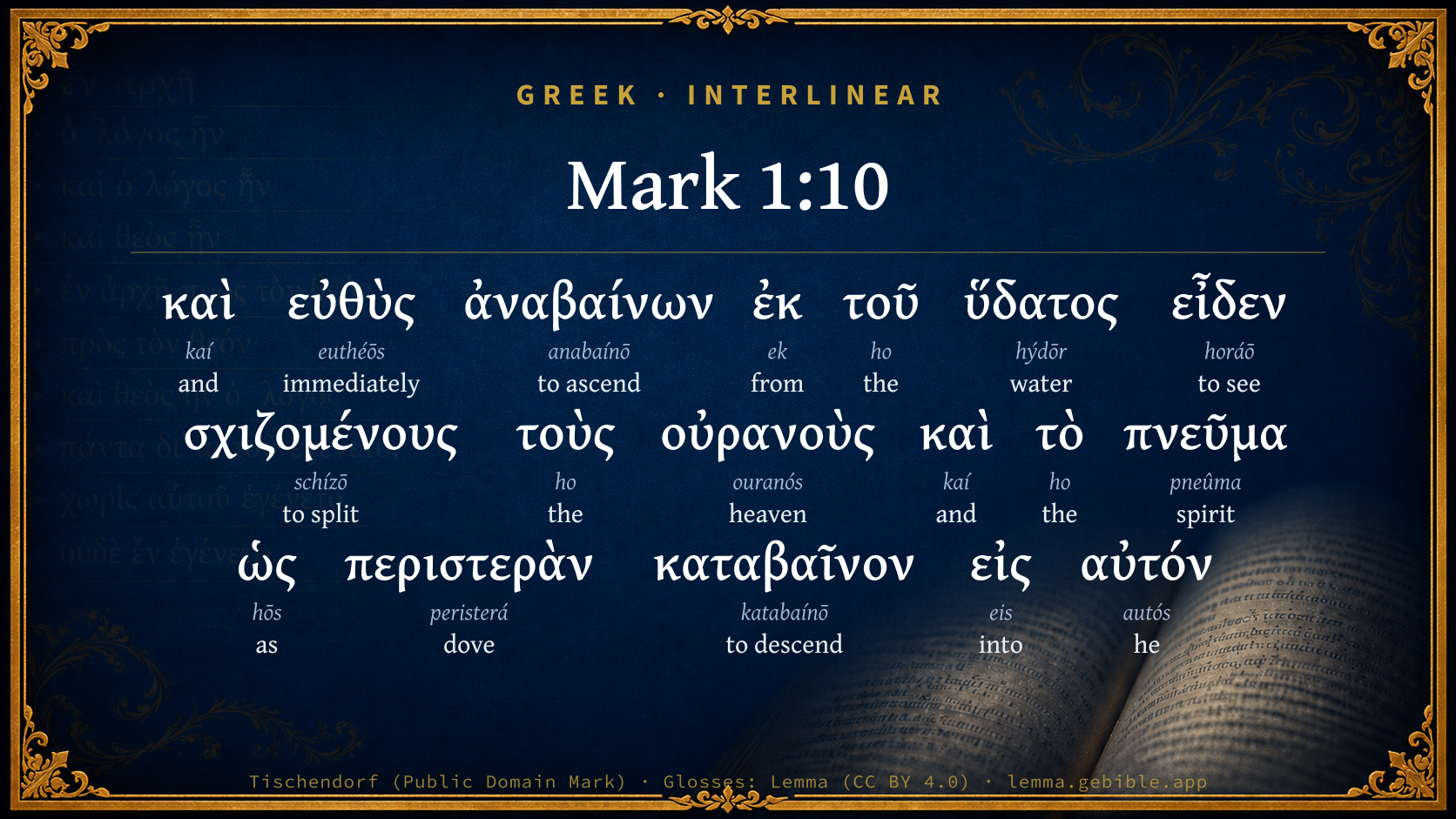
  1. καὶ kaí G2532 “and” Conjunction
  2. εὐθὺς euthéōs G2112 “immediately” Adverb
  3. ἀναβαίνων anabaínō G305 “to ascend” Verb, Present, Active, Participle, Nominative, Singular, Masculine
  4. ἐκ ek G1537 “from” Preposition
  5. τοῦ ho G3588 “the” Article, Genitive, Singular, Neuter
  6. ὕδατος hýdōr G5204 “water” Noun, Genitive, Singular, Neuter
  7. εἶδεν horáō G3708 “to see” Verb, Aorist, Active, Indicative, 3rd person, Singular
  8. σχιζομένους schízō G4977 “to split” Verb, Present, Passive, Participle, Accusative, Plural, Masculine
  9. τοὺς ho G3588 “the” Article, Accusative, Plural, Masculine
  10. οὐρανοὺς ouranós G3772 “heaven” Noun, Accusative, Plural, Masculine
  11. καὶ kaí G2532 “and” Conjunction
  12. τὸ ho G3588 “the” Article, Accusative, Singular, Neuter
  13. πνεῦμα pneûma G4151 “spirit” Noun, Accusative, Singular, Neuter
  14. ὡς hōs G5613 “as” Adverb
  15. καταβαῖνον katabaínō G2597 “to descend” Verb, Present, Active, Participle, Accusative, Singular, Neuter
  16. εἰς eis G1519 “into” Preposition
  17. αὐτόν autós G846 “he” Personal pronoun, Accusative, Singular, Masculine

About this verse

These counts appear in no published source. They are computed here, from the morphology-tagged text and Lemma’s own curated glosses. What Lemma adds →

18
words
15
distinct lemmas
Gospels
section

Notable vocabulary

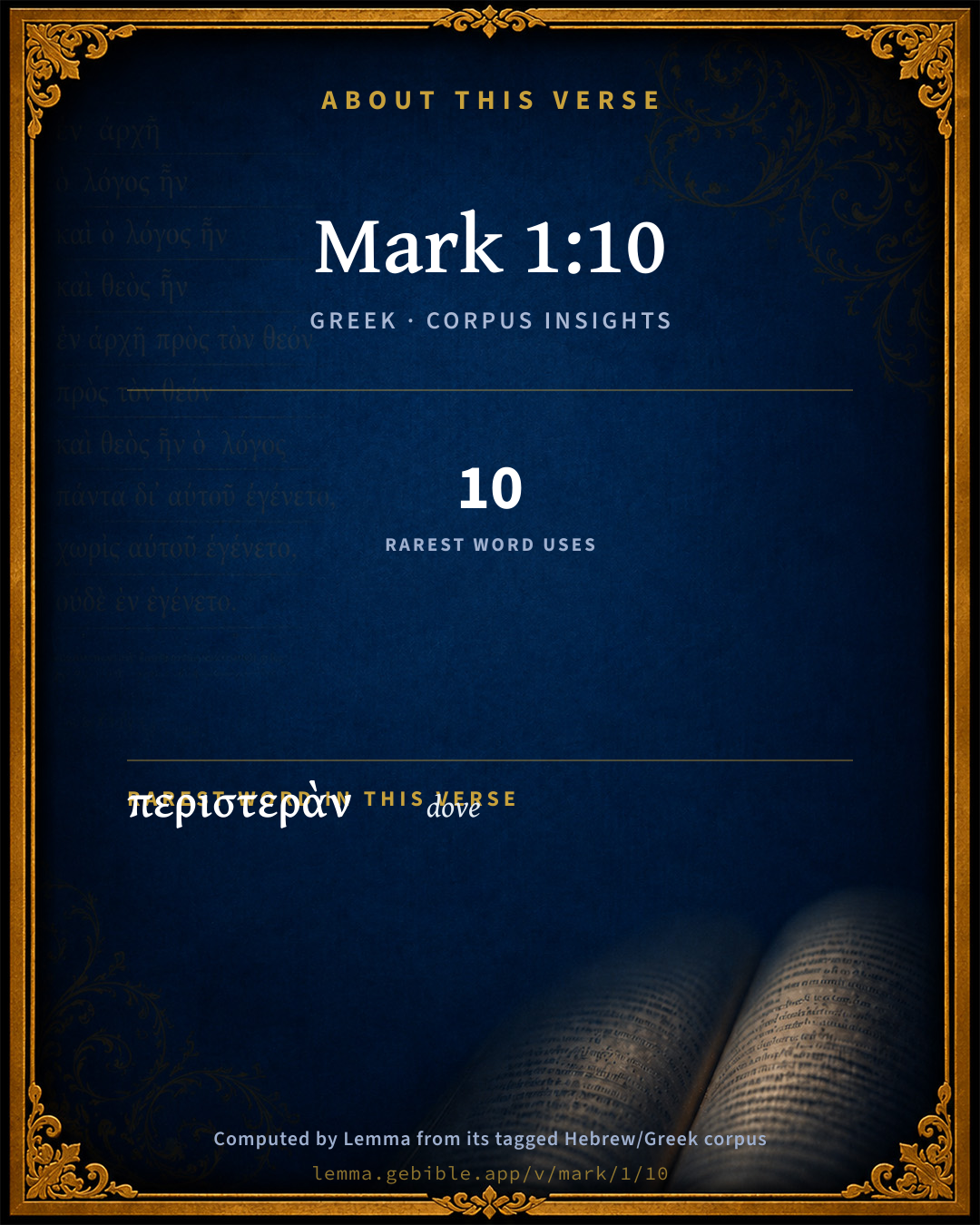
The rarest word here is περιστερὰν dove G4058 — appearing just 10 times in the whole Greek New Testament.

Shared distinctive vocabulary

περιστερὰν dove G4058 occurs in 10 verses of the Greek New Testament. Also found in:

Repetition

Words recur within this verse:

Cross-references

5

Topical passages linked to Mark 1:10 in the Treasury of Scripture Knowledge — connected by theme and wording, ordered by reader-vote popularity; previews shown in the World English Bible.

  • Luke 3:22 and the Holy Spirit descended in a bodily form as a dove on him; and a voice came out of the sky, saying "You are my beloved Son. In you I am well pleased."
  • John 1:31–34 I didn't know him, but for this reason I came baptizing in water: that he would be revealed to Israel."
  • Isaiah 42:1 Behold, my servant, whom I uphold; my chosen, in whom my soul delights: I have put my Spirit on him; he will bring forth justice to the Gentiles.
  • Isaiah 64:1 Oh that you would tear the heavens, that you would come down, that the mountains might quake at your presence,
  • Matthew 3:16 Jesus, when he was baptized, went up directly from the water: and behold, the heavens were opened to him. He saw the Spirit of God descending as a dove, and coming on him.

Cross-references courtesy of OpenBible.info (CC BY 4.0).

Commentary

Notes on Mark 1:10 from classic Christian and Jewish commentators (each source and its license shown beneath its notes). The classic Christian expositions comment on the surrounding passage and are grouped to its opening verse, so a note may address several verses; the Jewish commentaries on the Tanakh (Rashi and others) are per-verse, so they appear only where the commentator wrote on this verse.

Lemma curates 59 commentaries, every one of them public domain or Creative Commons licensed, each selected and text-cleaned for this edition rather than reprinted as found. About our sources →

The Biblical Illustrator

Joseph S. Exell

Mar_1:10

The heavens opened.

The Divine Trinity

This was the inauguration and proclamation of the Messiahs, when He began to be the great Prophet of the New Covenant. And this was the greatest meeting that ever was upon the earth, where the whole cabinet of the mysterious Trinity was opened and shown, as much as the capacities of our present imperfections will permit; the Second Person in the veil of humanity; the Third in the shape, or with the motion, of a dove: but the First kept His primitive state; and as to the Israelites He gave notice by way of caution, Ye saw no shape, but ye heard a voice, so now also God the Father gave testimony to His Holy Son, and appeared only in a voice, without any visible representment. (Bishop Jeremy Taylor.)

The Spirit like a dove.

Like a dove

A most captivating symbol. The eagle, too, was in our Lord; everything about Him was mingled with the sublime; but the dove was predominant. Not only while on earth, but all along the ages, it is the power of His gentleness and tenderness and meekness-His love, in short, that has been victorious. He has wooed and won. (J. Morison, D. D.)

Dovelike properties in Christ

I. Innocent and harmless (Heb_7:26).

II. Loving and tender hearted (Eph_3:19).

III. Meek and gentle (Mat_11:29). This is matter of singular comfort to the faithful members of Christ: for Christ being innocent and harmless like the dove, yea, pure from all spot of sin, this His purity and holiness is imputed to so many as truly believe in Him; and by it they are accepted, as holy and pure through Christ, though in themselves they are polluted and sinful. Again, Christ being also a loving, gentle, and meek Saviour, He will not deal with us in rigour or wrath; but in compassion, love, and gentleness, accepting our weak endeavours in His service, pardoning our wants and infirmities, and cherishing in us the smallest beginnings of grace (Isa_42:2-3). Strive we to imitate our Saviour Christ in these properties of the dove. (G. Petter.)

The dove temper in the Church

The Holy Spirit came as a dove, a gentle, joyous creature, with no bitterness of gall, no fierceness of bite, no violence of rending claws, loving human houses, associating within one home; nurturing their young together; when they fly abroad, hanging in their flight side by side; leading their life in mutual intercourse; giving in concord the kiss of peace with the bill; in every way fulfilling the law of unanimity. This is the singleness of heart that ought to be in the Church; this is the habit of love that must be obtained. (Cyprian.)

How to improve our baptism

To quicken you to improve your baptism consider-

I. Baptism is a perpetual bond obliging us to repentance and a holy life (Rom_6:2-4; Col_3:8-9).

II. The improvement of baptism is the best preparation of the Lords Supper (Joh_13:8). Before the Church, none but baptized persons have a right to the Lords Table; before God, none but those who have the fruit of baptism have a right to the benefit thereof.

III. If we improve it not, baptism will be a witness against us. One Elpidophorus relapsed into Arianism, and the deacon who baptized him showed him the garments in which he had been baptized, and said, These shall be a witness against thee to all eternity. But how shall we improve it?

1. We must personally and solemnly own the covenant made with God in infancy. What was then done for us must now be done by us.

2. Renew often the sense of obligation to God, and keep a constant reckoning of obedience (2Pe_1:9).

3. Use frequent self-reflection to know whether you are indeed washed from the guilt and filth of sin (1Co_6:11).

4. Use it as a great help in all temptations (1Co_6:15). Dionysia comforted her son Majoricus, an African martyr, with this speech, Remember, my son, that thou art baptized in the name of the Father, Son, and Holy Ghost, and be constant. Luther, when tempted to despair, used to say, I am baptized, and believe in Christ crucified. (T. Manton.)

After baptism

I. New revelations gained-The heavens were opened.

II. New gifts imparted-The Spirit.

III. New witness enjoyed-Thou art My beloved Son.

IV. New trial imposed-Tempted of Satan.

V. New triumphs secured.

VI. New privileges conferred-And angels ministered unto Him.

VII. New work assigned-Preaching the gospel.

The Biblical Illustrator, edited by Joseph S. Exell (c. 1880s–1900s) — public domain. Text from a community e-Sword module.

Tyndale Open Study Notes

Tyndale Open Resources

1:10 The expression the heavens splitting apart indicates Jesus’ unique access to God the Father; in 15:38, the same verb includes believers in that access through Jesus’ death. • All four Gospels refer to the Spirit descending on him like a dove. The Spirit, who was involved in the first creation, acted with Jesus in bringing the new creation (Gen 1:2; Rom 8:15-17; 1 Cor 6:11; Eph 1:13-14; 2 Thes 2:13).

Tyndale Open Study Notes — © Tyndale Open Resources, licensed CC BY-SA 4.0. Text via the HelloAO Bible API.

Bengel's Gnomon

Johann Albrecht Bengel

Mar 1:10. Εἶδε, He saw) i.e. Jesus saw: although John also saw it, Joh 1:32.—σχιζομένους, rent open) σχίζεται, is rent open, is said of that, which had not previously been open. Christ was the first who opened heaven.—ἀνοίγειν, to open, Mat 3:16, is used in the general sense; whereas in the special sense it is used in antithesis to [as distinguished from] to rend, Act 7:56. See on the difference of these words, Mat 27:51-52.[7]—τὸ Πνεῦμα, the Spirit) with which Jesus was about to baptize.

[7] ἐσχίσθη is said of the rending in two of the veil: whereas ἀνεῴχθησαν is said of the opening of the tombs.—ED.

Bengel's Gnomon of the New Testament — English translation (T&T Clark, Edinburgh, 1860) — public domain. Text from a community e-Sword module.

Expositor's Greek Testament

ed. W. Robertson Nicoll

Mar 1:10 . εὐθὺς , straightway, a favourite word of Mk.’s, to be taken with εἶδε = as soon as He had ascended, etc., He saw . For similar usage in reference to εἶτα vide Hermann, Viger , p. 772. σχιζομένους , being rent asunder, a sudden event; a stronger word than that used in Mt. and Lk. ( ἀνεῴχθησαν ῆναι ). The subject of εἶδε is Jesus. εἰς αὐτόν : this reading suggests the idea of a descent not merely upon ( ἐπὶ ) but into Him, as if to take up its abode; henceforth the immanent spirit of Jesus.

The Expositor's Greek Testament, edited by W. Robertson Nicoll (1897–1910) — public domain. Text from a community e-Sword module.

Geneva Bible (1599)

Geneva Bible translators

The vocation of Christ from heaven, as head of the Church.

John that went down into the water with Christ.

Geneva Bible (1599) marginal notes — public domain. Text via Bolls.life.

Adam Clarke's Commentary

Verse 10. See Clarke on Mr 1:9.

Adam Clarke's Commentary on the Bible (1810–1826) — public domain. Text from a community e-Sword/MySword module.

Ellicott's Commentary for English Readers

(10) He saw the heavens opened.—Better, as in the margin, rent open, St. Mark’s language here, as elsewhere, being more boldly vivid than that of the other Gospels. (See Notes on Mat_3:16-17.)

A Bible Commentary for English Readers, edited by Charles John Ellicott (1878–1897) — public domain. Text from a community e-Sword module.

The Cambridge Bible for Schools and Colleges

gen. ed. J. J. S. Perowne

10. straightway] This is St Mark’s favourite connecting word, and constantly recurs; comp. Mar_1:12; Mar_1:28, Mar_4:5; Mar_4:15, Mar_8:10. Mar_9:15, Mar_11:3, and other places.

he saw] i. e. Jesus, while engaged, as we learn from St Luk_3:21, in solemn, prayer. We find solemn prayer preceding (i) our Lord’s Baptism, (ii) His choice of the Twelve (Luk_6:12), (iii) His Transfiguration (Luk_9:29), (iv) His Agony in the Garden (Mat_26:39).

opened] Lit rent, or rending asunder, one of St Mark’s graphic touches: see the Introduction. The same word in the original Greek is applied to “the old garment rending the new piece” (Luk_5:36); to the veil of the Temple rent in twain at the Crucifixion (Luk_23:45); to the rending of the rocks at the same time (Mat_27:51); and of the net in the Lake after the Resurrection (Joh_21:11).

The Cambridge Bible for Schools and Colleges (gen. ed. J. J. S. Perowne; Cambridge University Press, 1878–1918) — public domain. Text from a community e-Sword module.

John Gill's Exposition

And straightway coming up out of the water,.... Not John, as many think; though it was true of him, that he came up out of the water, as the administrator of the ordinance of baptism to Christ, but Christ himself; who having descended into the water, the river of Jordan, and being baptized by immersion in it by John, came up out of it; not from the river side, and up the declivity to it, but out of the river itself: when

he saw the heavens opened; or "cloven", or "rent"; this may be understood, either of John, who was the spectator of all this, which was done for the manifestation of the Messiah to him, and the confirmation of his faith in him, and that he might bear record of him; and so the Persic version reads, "John saw", &c. see Joh 1:30, or of Jesus Christ himself, who came up out of the water; and when he did, saw the heavens part,

and the Spirit like a dove descending upon him. The position of these words here, is a little different from that in Mat 3:16, there it is, "the Spirit of God descending like a dove"; which seems rather to point out the manner of his descent, than the form in which he descended: here it is put, "the Spirit like a dove descending on him"; which seems rather to incline to such a sense, that the Spirit appeared in the form of a dove, as well as descended like one; and both may be designed, and indeed the latter follows upon the former: if it was the form of a dove the Spirit of God descended in, it was a very suitable one: the dove is a very proper emblem of the Spirit of God: "the voice of the turtle", in Sol 2:12, is by the Targum interpreted, the voice of the holy Spirit: he may be likened to a dove, for its simplicity and sincerity; he guides into all truth as it is in Jesus, and teaches to speak the word in all plainness, openness, and sincerity, and preserves the saints in the simplicity of the Gospel; and for its mildness and meekness; one of the fruits of the Spirit of God is meekness, Gal 5:23. And this it produces in converted persons, making them meek; humble, and gentle: and also for its harmlessness and innocence; and which appears, or at least should, in those who mind the things of the Spirit: hence that advice of Christ, "be harmless as doves", Mat 10:16. Likewise for its purity and cleanness; the Spirit of God is a Spirit of holiness, he is the author of sanctification; such as are washed, sanctified, and justified, are so in the name of the Lord Jesus, and by the Spirit of our God, Co1 6:11. The dove is a mournful and bemoaning creature; and the Spirit of God makes intercession for the saints, with groanings which cannot be uttered, Rom 8:26. To which may be added, that Noah's dove bringing the olive leaf in its mouth, as a sign, of peace and reconciliation, fitly resembled the holy Spirit, one of whose fruits is peace, Gal 5:22, and which he produces, by leading to the blood, righteousness, and sacrifice of Christ, whereby peace is made, and reconciliation obtained: and his descending upon Christ here, points him out as the peacemaker, through whom was come peace on earth, good will towards men, and glory to God. Christ, on whom he lighted, is comparable to a dove; he is said to have doves' eyes, Sol 5:12, and he has all the fruits and graces of the dove like Spirit of God, which rested on him; like the dove, he is humble, meek, and lowly; in which characters, he is to be followed and imitated by his people: and as that creature is a very loving one to its mate, so is Christ to his church; whom he has so loved, as to give himself for her: and as that is a lovely beautiful creature, so is Christ; he is altogether lovely; and especially his eyes of love, as they are set and fixed upon his church and people. With this descent of the Spirit as a dove on Christ, compare Isa 11:2; See Gill on Mat 3:16.

John Gill's Exposition of the Whole Bible (1746–1763) — public domain (CC PDM 1.0). Text via the HelloAO Bible API.

Trapp's Complete Commentary

John Trapp

10 And straightway coming up out of the water, he saw the heavens opened, and the Spirit like a dove descending upon him:

Ver. 10. He saw the heavens opened] The visible heavens, so that the Baptist saw something above the stars: so did Stephen; so could Christ when he was upon the earth. It is a just wonder that we can look up to so admirable a height of the starry sky, and that the eye is not tired in the way; some say it is 500 years’ journey to it. {a} Other mathematicians tell us, that if a stone should fall from the eighth sphere, and should pass every day 100 miles, it would be 65 years or more before it would come to the ground.

{a} Burton on Melancholy.

John Trapp, A Commentary or Exposition upon All the Books of the Old and New Testament (1647–1656) — public domain. Text from a community e-Sword module.

Haydock's Catholic Bible Commentary

Spirit. The epithet Holy is not found in most of the Greek manuscripts but it is in John i, 32. and 33.

George Leo Haydock (1774–1849), Haydock's Catholic Family Bible and Commentary, 1859 edition — public domain. Excludes Psalms (Douay-Rheims chapter numbering differs from Protestant) and Deuterocanonical books (Catholic canon only).

Whedon's Commentary on the Bible

Daniel D. Whedon

10. Like a dove — At the creation the Spirit of God moved (in the Hebrew brooded) on the face of the waters. Gen_1:2. On which passage of Genesis Rabbi Ephraim (as quoted by Townsend) says the “Spirit brooded like a dove, which flies over its nest.”

Daniel D. Whedon (gen. ed.), Commentary on the Old and New Testaments (1874–1909) — public domain. Text from a community e-Sword module.

The Pulpit Commentary

Straightway (euyewv) coming up out of the water, he saw the heavens opened (scizomenouv); literally, rent asunder. The word euyewv occurs more than forty times in this Gospel, and is so characteristic of St. Mark that, in the Revised Version, it is uniformly rendered by the same English synonym, "straightway." He saw. Elsewhere we are told (Joh_1:32) that St. John the Baptist saw this descent. The earliest heretics took advantage of this statement to represent this event as the descent of the eternal Christ upon the man Jesus for personal indwelling. Later critics have adopted this view. But it need hardly be said here that such an opinion is altogether inconsistent with all that we read elsewhere of the circumstances of the Incarnation, and of the intimate and indissoluble union of the Divine and human natures in the person of the one Christ, from the time of the "overshadowing of the Virgin Mary by the power of the Highest." The Spirit descending upon him at his baptism was not the descent of the eternal Christ upon the man Jesus. It was rather the conveyance to one who was already prepared for it as God and man, of office and authority as the great Prophet that should come into the world. St. Luke says particularly (Luk_3:21) that it was when Jesus had been baptized and was praying, that the Holy Spirit descended upon him; plainly showing us that it was not through the baptism of John, but through the meritorious obedience and the prayer of the Son of God, that the heavens were "rent asunder," and the Holy Spirit descended upon him.

The Pulpit Commentary (1880–1919), ed. H.D.M. Spence-Jones & Joseph S. Exell — public domain. Text from a community e-Sword module.

Kretzmann's Popular Commentary

Paul E. Kretzmann

v. 10. And straightway coming up out of the water, He saw the heavens opened, and the Spirit like a dove descending upon Him;

v. 11. and there came a voice from heaven, saying, Thou art My beloved Son, in whom I am well pleased.

"In those days," while John was having such marvelous success with his message and with his baptizing, in the days when the crowds that resorted to him were largest. Note. Jesus does not expect John to look for Him, though He might have expected that of one who, by his own confession, was lower than Himself. The King goes forth to seek the herald. From Nazareth Jesus came: there He had lived with His parents during all those years of preparation, concerning which we have only the most meager accounts, Luk 2:51-52. His fellow-citizens in that little mountain town had no idea of the greatness of Him whom they were harboring in their midst, whom they knew only as the carpenter, the son of Joseph. The evangelist adds the geographical note "of Galilee" on account of his Roman readers, who might be unfamiliar with the location of towns in Palestine. The various incidents of the story are omitted by Mark; for his purpose the statement as to the fact of Christ’s baptism is sufficient. But the miracle which followed the baptism is important. For when Jesus ascended the bank of the river, as He was leaving the water, there was a manifestation of the Trinity, of which the Christians of all times should know. Jesus had just set foot upon dry ground, when the heavens were cleft open above Him, as though cut apart by a knife. This Jesus saw distinctly; it was a revelation for His benefit. He, who had just received baptism unto the remission of sins, not for His own, but for those of the world that were resting upon Him, was shown the open heaven. It was a manifestation to strengthen Him at the beginning of His ministry, in which He must work out the redemption of mankind. This was further emphasized by the fact that the Holy Spirit, coming down out of the open heavens, descended not merely upon Him, but literally into Him. He was here, in the truest sense of the term, baptized with the Holy Ghost and with power. God, His God, here anointed Him with the oil of gladness, above His fellows, Psa 45:7; Heb 1:9. Therefore the Spirit abode in Jesus, filled His heart and mind, made Him ready, according to His human nature, to perform the work for which He had been born into the world. Here Christ really began to be Christ, as Luther remarks. And His weak human nature needed the assistance of the Spirit. The works peculiar to the redemption of the world were of a nature which no mere man could hope to perform. In the same way there was also a definite reason for the assuring words from heaven when the Father called down: Thou art My beloved Son. The prophet like unto Moses, out of the people of Israel, was about to take up His life-work. But this prophet was, at the same time, the Son of the Most High, beloved of His heavenly Father, who took pleasure in Him, who here publicly declared His complete approval of the work undertaken by Jesus. It was an assurance which stood the Savior in good stead more than once in the course of His ministry and His Passion. Note also: John the Baptist saw and heard all these occurrences as well as Jesus Himself, Joh 1:32-34. He was a witness for the sake of himself and for the sake of his further message to the people. It is a matter of great consolation to us to know that the Triune God, and all the persons of the Godhead, has a definite share in our salvation, that Jesus entered upon His ministry with the approval and cooperation of the Spirit and the Father.

Paul E. Kretzmann, Popular Commentary of the Bible (1921–1924) — public domain. Text from a community e-Sword module.

The People's New Testament

B. W. Johnson

10. Coming up straightway out of the water. The Greek preposition translated “out of” is ek, which means out from within. This could only be true of immersion. Thus all great and candid Pedo-baptist scholars concede that Christ was baptized.

B. W. Johnson's The People's New Testament with Notes (1889–1891) — public domain. Electronic text from the Christian Classics Ethereal Library (CCEL) ThML edition.

Cambridge Greek Testament for Schools and Colleges

10. εὐθύς ([71][72][73][74] 33), not εὐθέως ([75][76][77][78]), is the form used in Mk. So in Mar 1:18; Mar 1:21; Mar 1:29, etc. Elsewhere in N.T. εὐθέως is more freq. ἐκ τοῦ ὕδατος ([79][80][81][82] 33) rather than ἀπὸ τ. ὕδ. ([83][84][85][86][87]). εἰς αὐτόν ([88][89] rather than ἐπʼ αὐτόν ([90][91][92][93] etc.). [94][95] insert καὶ μένον after καταβαῖνον (from Joh 1:33).

[71] Codex Sinaiticus. 4th cent. Discovered by Tischendorf in 1859 at the Monastery of St Katharine on Mount Sinai. Now at St Petersburg. The whole Gospel, ending at Mar 16:8. Photographic facsimile, 1911.

[72] Codex Vaticanus. 4th cent., but perhaps a little later than א. In the Vatican Library almost since its foundation by Pope Nicolas V., and one of its greatest treasures. The whole Gospel, ending at Mar 16:8. Photographic facsimile, 1889.

[73] Codex Regius. 8th cent. An important witness. At Paris. Contains Mar 1:1 to Mar 10:15; Mar 10:30 to Mar 15:1; Mar 15:20 to Mar 16:20, but the shorter ending is inserted between Mar 16:8 and Mar 16:9, showing that the scribe preferred it to the longer one.

[74] Codex Sangallensis. 9th or 10th cent. Contains the Gospels nearly complete, with an interlinear Latin translation. The text of Mark is specially good, agreeing often with CL. At St Gall.

[75] Codex Alexandrinus. 5th cent. Brought by Cyril Lucar, Patriarch of Constantinople, from Alexandria, and afterwards presented by him to King Charles I. in 1628. In the British Museum. The whole Gospel. Photographic facsimile, 1879.

[76] Codex Guelpherbytanus. 6th cent. Contains Mar 1:2-11; Mar 3:5-17; Mar 14:13-24; Mar 14:48-61; Mar 15:12-37.

[77] Codex Sangallensis. 9th or 10th cent. Contains the Gospels nearly complete, with an interlinear Latin translation. The text of Mark is specially good, agreeing often with CL. At St Gall.

[78] Codex Petropolitanus. 9th cent. Gospels almost complete. Mar 16:18-20 is in a later hand.

[79] Codex Sinaiticus. 4th cent. Discovered by Tischendorf in 1859 at the Monastery of St Katharine on Mount Sinai. Now at St Petersburg. The whole Gospel, ending at Mar 16:8. Photographic facsimile, 1911.

[80] Codex Vaticanus. 4th cent., but perhaps a little later than א. In the Vatican Library almost since its foundation by Pope Nicolas V., and one of its greatest treasures. The whole Gospel, ending at Mar 16:8. Photographic facsimile, 1889.

[81] Codex Bezae. 6th cent. Has a Latin translation (d) side by side with the Greek text, and the two do not quite always agree. Presented by Beza to the University Library of Cambridge in 1581. Remarkable for its frequent divergences from other texts. Contains Mark, except Mar 16:15-20, which has been added by a later hand. Photographic facsimile, 1899.

[82] Codex Regius. 8th cent. An important witness. At Paris. Contains Mar 1:1 to Mar 10:15; Mar 10:30 to Mar 15:1; Mar 15:20 to Mar 16:20, but the shorter ending is inserted between Mar 16:8 and Mar 16:9, showing that the scribe preferred it to the longer one.

[83] Codex Alexandrinus. 5th cent. Brought by Cyril Lucar, Patriarch of Constantinople, from Alexandria, and afterwards presented by him to King Charles I. in 1628. In the British Museum. The whole Gospel. Photographic facsimile, 1879.

[84] Codex Guelpherbytanus. 6th cent. Contains Mar 1:2-11; Mar 3:5-17; Mar 14:13-24; Mar 14:48-61; Mar 15:12-37.

[85] Codex Oxoniensis. 9th cent. Contains Mark, except Mar 3:35 to Mar 6:20.

[86] Codex Sangallensis. 9th or 10th cent. Contains the Gospels nearly complete, with an interlinear Latin translation. The text of Mark is specially good, agreeing often with CL. At St Gall.

[87] Codex Petropolitanus. 9th cent. Gospels almost complete. Mar 16:18-20 is in a later hand.

[88] Codex Vaticanus. 4th cent., but perhaps a little later than א. In the Vatican Library almost since its foundation by Pope Nicolas V., and one of its greatest treasures. The whole Gospel, ending at Mar 16:8. Photographic facsimile, 1889.

[89] Codex Bezae. 6th cent. Has a Latin translation (d) side by side with the Greek text, and the two do not quite always agree. Presented by Beza to the University Library of Cambridge in 1581. Remarkable for its frequent divergences from other texts. Contains Mark, except Mar 16:15-20, which has been added by a later hand. Photographic facsimile, 1899.

[90] Codex Sinaiticus. 4th cent. Discovered by Tischendorf in 1859 at the Monastery of St Katharine on Mount Sinai. Now at St Petersburg. The whole Gospel, ending at Mar 16:8. Photographic facsimile, 1911.

[91] Codex Alexandrinus. 5th cent. Brought by Cyril Lucar, Patriarch of Constantinople, from Alexandria, and afterwards presented by him to King Charles I. in 1628. In the British Museum. The whole Gospel. Photographic facsimile, 1879.

[92] Codex Regius. 8th cent. An important witness. At Paris. Contains Mar 1:1 to Mar 10:15; Mar 10:30 to Mar 15:1; Mar 15:20 to Mar 16:20, but the shorter ending is inserted between Mar 16:8 and Mar 16:9, showing that the scribe preferred it to the longer one.

[93] Codex Guelpherbytanus. 6th cent. Contains Mar 1:2-11; Mar 3:5-17; Mar 14:13-24; Mar 14:48-61; Mar 15:12-37.

[94] Codex Sinaiticus. 4th cent. Discovered by Tischendorf in 1859 at the Monastery of St Katharine on Mount Sinai. Now at St Petersburg. The whole Gospel, ending at Mar 16:8. Photographic facsimile, 1911.

[95] Codex Sangallensis. 9th or 10th cent. Contains the Gospels nearly complete, with an interlinear Latin translation. The text of Mark is specially good, agreeing often with CL. At St Gall.

10. εὐθὺς … εἶδεν. As usual, εὐθύς belongs to the finite verb rather than to the participle. This is the first occurrence of Mk’s favourite adv., which he uses 41 times (Matthew 18 times, Luke 7, John 6, Acts 10); cf. Job 5:3. Mt.’s favourite adv. is τότε, which is rare in Mk, while Lk.’s is παραχρῆμα, which Mk does not use at all.

εἶδεν σχιζομένους τοὺς οὐρανούς. Jesus saw the heavens being rent asunder. We must mark the pres. part. and also the difference between Mk’s bold expression and ἀνοίγω, which is the verb almost invariably used of the heavens being opened. So elsewhere in N.T., as in LXX. (Isa 64:1; Eze 1:1) and Testaments of the XII. Patriarchs (Levi xviii. 6; Judah xxiv. 2, which are Messianic parallels to the Gospel narrative). In the Apocalypse of Baruch (xxi. 1) we have the heavens opened and a voice coming from on high. Mk may be thinking of Isa 64:1, Utinam dirumperes coelos et descenderes; but there we have ἀνοίξῃς in LXX.

The nom. to εἶδεν is certainly Ἰησοῦς (Mar 1:9). We know from Joh 1:32 that the Baptist saw also, but the grammatical construction and ἐν σοὶ εὐδόκησα show that the vision, like the voice, was sent to the Christ. It is unnecessary to ask whether, if others were there, which is doubtful (Luk 3:21), they also saw and heard, or whether Jesus and John saw and heard with eye and ear. Aperiuntur coeli, non reseratione elementorum, sed spiritualibus oculorum (Bede). What is clear is that there was no hallucination, but a real reception of the Spirit of God and of the word of God. Euthymius says that these signs were given ἵνα μάθωμεν ὅτι ἐπὶ παντὸς ἀνθρώπου βαπτιζομένου ἀνοίγονται οἱ οὐρανοί, καλοῦντες αὐτὸν εἰς τὴν ἄνω κατοικίαν. Theophylact adds that the Spirit descended, not because the Christ was in need of it, “but that thou mayest know that, when thou art baptized, the Spirit will come to thee.” In Hebrew poetry and in Philo the Dove is a symbol of heavenly attributes; ἐκ φύσεως μιμήματα ἔχει τ. ἁγ. πνεύματος (Euthym.). See Lagrange, S. Marc, p. 12.

εἰς αὐτόν. See crit. note. The prep. indicates that ὡς περιστεράν is not to be taken literally; non veritas sed similitudo monstratur (Jerome). Mt. and Lk. have ἐπʼ αὐτόν, possibly because εἰς αὐτόν might suggest that until then Jesus had been devoid of the Spirit.

Cambridge Greek Testament for Schools and Colleges (Cambridge University Press, 1896; 21 vols, various authors incl. Carr, Maclear, Plummer, Farrar, Lumby, Moule, M. R. James, Simcox) — public domain. Text from a community e-Sword module.

Alford’s Greek Testament

Henry Alford

10.] εὐθύς, or -θέως, is a favourite connecting word with Mark. St. Mark has here taken the oral account verbatim, and applied it to Jesus, ‘He saw,’ &c.—and αὐτόν must mean Himself: otherwise we must understand ὁ Ἰωάν. before εἶδεν, and take ἀναβ. as pendent, which is very improbable.

The construction of the sentence is a remarkable testimony of the independence of Mark and Matt. even when parts of the narrative agree verbatim. See note on Mat 3:16.

σχιζ., peculiar to Mark; and more descriptive than ἀνεῴχθησαν, Matt. Luke.

Henry Alford, The Greek Testament (1849–1861) — public domain. Text from a community e-Sword module.

International Critical Commentary

10. καὶ εὐθὺς—And immediately.3 ἀναβαίνων ἐκ—going up out of.

ἐκ (instead of ἀπὸ) Tisch. Treg. WH. RV. א BDL 13, 28, 33, 69, 124.

σχιζομένους τοὺς οὐρανούς—the heavens opening, not opened. The pres. part. denotes action in its progress, not completed action.4

ὡς περιστερὰν—as a dove. Luk 3:22 says that this resemblance was in bodily shape. And the language itself implies that. The dove was the emblem of guilelessness (Mat 10:16). It was not a bird of prey. The appearance accords with the gentleness of Christ’s reign. The descent of the Spirit was moreover a real event, while the appearance was only a vision. It was not merely a sign that here was a person endued with the Spirit, but a special influence beginning at the time, and preparing him for his new work. It was like the descent of the Spirit at Pentecost, preparing the disciples for their new work. Neither event implied in any way that the Spirit was not present in their lives before.5 And we find in all the Synoptics mention that Jesus began his ministry under the impulsions of the Spirit. See Mat 12:28, Mar 1:12, Luk 4:1, Luk 4:14, Luk 4:18. This descent of the Spirit is moreover indicative of the meaning of our Lord’s baptism. It has already been indicated that the real baptism, of which that in the water is only the sign, is a baptism in the Holy Spirit, and it is this which is signified by the baptism of Jesus, but without the accompanying repentance which belongs to the baptism of the rest of the people.

International Critical Commentary — older volumes (1896–1929), various authors — public domain. Text from a community e-Sword module.

Vincent's Word Studies in the New Testament

Marvin R. Vincent

Straightway

A favorite word with Mark. See Introduction.

Opened (σχιζομένους)

Lit., as Rev., rent asunder: much stronger than Matthew's and Luke's ἀνεῴχθησαν, were opened.

Marvin R. Vincent, Word Studies in the New Testament (1887–1900) — public domain. Text from a community e-Sword/MySword module.

Lesson kit

Teaching starters — assembled from the data on this page, not authored interpretation. Every prompt links to the verse data it draws on. Edit before teaching.

Mark, in the Gospels, opens this verse with 18 words (15 distinct Greek lemmas). Its most distinctive word is peristerá (“dove”). A historical commentator’s framing appears above. Read the whole chapter for the surrounding context.

Discussion questions

  1. How does “dove” (peristerá) shape what this verse is saying?
  2. How does Matthew 3:16, which shares the word «dove», read alongside this verse?
  3. What does the repetition of “the” (3× in this one verse) do in this verse?
  4. These translations render this verse differently; the difference is in the English rendering, not the original. What questions does that raise?
  5. Compare how The Biblical Illustrator and Tyndale Open Study Notes read this verse. Where do they agree or differ?

Things to notice

Reading settings

Reading text

Shown beneath each verse's original-language words.

Old Testament
Old Testament edition

Read the OT as the Masoretic Hebrew (MT) or the Greek Septuagint (LXX).

English shown for the Greek Septuagint (in the Hebrew ↔ Greek comparison).

Comparing translations? Open the Compare panel on any verse page to stack up to four side by side.