1 Peter 1:12

Greek (Tischendorf 8th ed.) 1 Peter 1:12 appears in the Greek New Testament. The text above is from the Tischendorf 8th edition. Each word links to its Strong’s number and a concise gloss. Click any word for its full Thayer’s Greek Lexicon entry.
Download image
Cite this verse

1 Peter 1:12 (World English Bible). Public Domain. Lemma interlinear Bible study tool, https://lemma.gebible.app/v/1-peter/1/12.

Show BibTeX & RIS
BibTeX
RIS
English Translation
To them it was revealed, that not to themselves, but to you, did they minister these things, which now have been announced to you through those who preached the Gospel to you by the Holy Spirit sent out from heaven; which things angels desire to look into.
World English Bible · Public Domain
Download a study sheet

One document with this verse’s original text, its word-by-word gloss line, the meaning frame, cross-references with their text, attributed commentary, and full source and license credits — printable, and it pastes into notes with its structure intact.

This verse Autodidact and up

Study sheet (.html) Plain text (.txt)

A passage Seminary Student

Up to 50 verses in one chapter. A passage sheet keeps up to 6 commentary sources and 12 cross-references per verse, in the order this page ranks them, and says so on the sheet whenever that leaves anything out. Ask for a single verse and you get the Autodidact verse sheet above.

Everything on this page stays free to read, with no account — the sheet is a download of what is already on screen, not access to it.

Want to remove ads? Support Godless Engineer
Compare translations 3

The same verse in 3 English versions, stacked beneath the original-language interlinear above. Click any original word for its lexicon entry.

Each is an independent rendering of the whole verse — the interlinear is not word-aligned to these translations.

Highlighted words mark where these versions differ — a whole-verse word diff, not a word-by-word alignment.

  • World English Bible Public Domain
    To them it was revealed, that not to themselves, but to you, did they minister these things, which now have been announced to you through those who preached the Gospel to you by the Holy Spirit sent out from heaven; which things angels desire to look into.
  • King James Version Public Domain
    Unto whom it was revealed, that not unto themselves, but unto us they did minister the things, which are now reported unto you by them that have preached the gospel unto you with the Holy Ghost sent down from heaven; which things the angels desire to look into.
  • unfoldingWord Literal Text CC BY-SA 4.0
    It was revealed to them that they were not serving themselves, but you, these things which now were declared to you by the ones who proclaimed the gospel to you by the Holy Spirit having been sent from heaven—into which things angels desire to look.

unfoldingWord Literal Text — © unfoldingWord, licensed CC BY-SA 4.0. Word-aligned USFM3 via Door43 (git.door43.org/unfoldingWord/en_ult).

Versions to compare (up to 4)

3 of 4 selected

Show all 19 translations

Every available English version of this verse, each an independent rendering of the whole verse.

  • World English Bible Public Domain
    To them it was revealed, that not to themselves, but to you, did they minister these things, which now have been announced to you through those who preached the Gospel to you by the Holy Spirit sent out from heaven; which things angels desire to look into.
  • Berean Standard Bible Public Domain
    It was revealed to them that they were not serving themselves, but you, when they foretold the things now announced by those who preached the gospel to you by the Holy Spirit sent from heaven. Even angels long to look into these things.
  • Majority Standard Bible Public Domain
    It was revealed to them that they were not serving themselves, but you, when they foretold the things now announced by those who preached the gospel to you by the Holy Spirit sent from heaven. Even angels long to look into these things.
  • King James Version Public Domain
    Unto whom it was revealed, that not unto themselves, but unto us they did minister the things, which are now reported unto you by them that have preached the gospel unto you with the Holy Ghost sent down from heaven; which things the angels desire to look into.
  • American Standard Version (1901) Public Domain
    To whom it was revealed, that not unto themselves, but unto you, did they minister these things, which now have been announced unto you through them that preached the gospel unto you by the Holy Spirit sent forth from heaven; which things angel desire to look into.
  • Revised Version (1885) Public Domain
    To whom it was revealed, that not unto themselves, but unto you, did they minister these things, which now have been announced unto you through them that preached the gospel unto you by the Holy Ghost sent forth from heaven; which things angels desire to look into.
  • Geneva Bible (1599) Public Domain
    Vnto whome it was reueiled, that not vnto themselues, but vnto vs they shoulde minister the things, which are nowe shewed vnto you by them which haue preached vnto you the Gospell by the holy Ghost sent downe from heauen, the which things the Angels desire to beholde.
  • Douay-Rheims (1899) Public Domain
    To whom it was revealed, that not to themselves, but to you they ministered those things which are now declared to you by them that have preached the gospel to you, the Holy Ghost being sent down from heaven, on whom the angels desire to look.
  • Young's Literal Translation Public Domain
    to whom it was revealed, that not to themselves, but to us they were ministering these, which now were told to you (through those who did proclaim good news to you,) in the Holy Spirit sent from heaven, to which things messengers do desire to bend looking.
  • Literal Standard Version CC BY-SA 4.0
    to whom it was revealed, that not to themselves, but to us they were ministering these, which now were told to you (through those who proclaimed good news to you), by the Holy Spirit sent from Heaven, to which things messengers desire to look into intently.
  • Unlocked Literal Bible CC BY-SA 4.0
    It was revealed to them that they were not serving themselves, but you, when they spoke of the things that have now been told to you by those who preached the gospel to you by the Holy Spirit sent from heaven—things into which angels long to look.
  • unfoldingWord Literal Text CC BY-SA 4.0
    It was revealed to them that they were not serving themselves, but you, these things which now were declared to you by the ones who proclaimed the gospel to you by the Holy Spirit having been sent from heaven—into which things angels desire to look.
  • Darby Bible Public Domain
    To whom it was revealed, that not to themselves but to you they ministered those things, which have now been announced to you by those who have declared to you the glad tidings by [the] Holy Spirit, sent from heaven, which angels desire to look into.
  • World Messianic Bible Public Domain
    To them it was revealed that they served not themselves, but you, in these things, which now have been announced to you through those who preached the Good News to you by the Holy Spirit sent out from heaven; which things angels desire to look into.
  • Webster's Bible Public Domain
    To whom it was revealed, that not to themselves, but to us they ministered the things which are now reported to you by them that have preached the gospel to you, with the Holy Spirit sent down from heaven; which things the angels desire to look into.
  • Free Bible Version CC BY-SA 4.0
    It was explained to them that they were not doing this for themselves, but for you—since what they spoke about you've now learned from those who shared the good news with you by the Holy Spirit that heaven sent. Even the angels are eager to find out about all this!
  • Bible in Basic English Public Domain
    And it was made clear to those prophets that they were God's servants not for themselves but for you, to give you word of the things which have now come to your ears from the preachers of the good news through the Holy Spirit sent down from heaven; things which even angels have a desire to see.
  • Text-Critical English NT CC BY 4.0
    It was revealed to them that they were not serving themselves, but you, in regard to the things that have now been announced to you through those who preached the gospel to you by the Holy Spirit sent from heaven. Even angels long to catch a glimpse of these things.
  • Tyndale New Testament (1534) Public Domain
    vnto which Prophetes it was declared that not vnto them selves but vnto vs they shuld minister the thinges which are now shewed vnto you of them which by the holy goost sent doune from heven have preached vnto you the thinges which the angels desyre to beholde.

Literal Standard Version (2020), Covenant Press — licensed CC BY-SA 4.0. Text via the HelloAO Bible API (eBible.org). Unlocked Literal Bible (unfoldingWord) — licensed CC BY-SA 4.0. Text via the HelloAO Bible API (eBible.org). unfoldingWord Literal Text — © unfoldingWord, licensed CC BY-SA 4.0. Word-aligned USFM3 via Door43 (git.door43.org/unfoldingWord/en_ult). Free Bible Version, Dr. Jonathan Gallagher — licensed CC BY-SA 4.0. Text via the HelloAO Bible API (eBible.org).

Word by word

More ways to search: Search by grammar → Find every occurrence → Compare this word →

Practice this passage: Drill this verse → Learn its vocabulary →

παρακύψαι
parakýptō
G3879
“to look into”
Verb, Aorist, Active, Infinitive
Part of Speech
Verb
Tense
Aorist
Voice
Active
Mood
Infinitive
Full Thayer's Definition

Origin: from G3844 and G2955

TDNT: 18:34,8

1. to stoop to a thing in order to look at it 2. to look at with head bowed forward 3. to look into with the body bent 4. to stoop and look into 5. metaph. to look carefully into, inspect curiously a. of one who would become acquainted with something
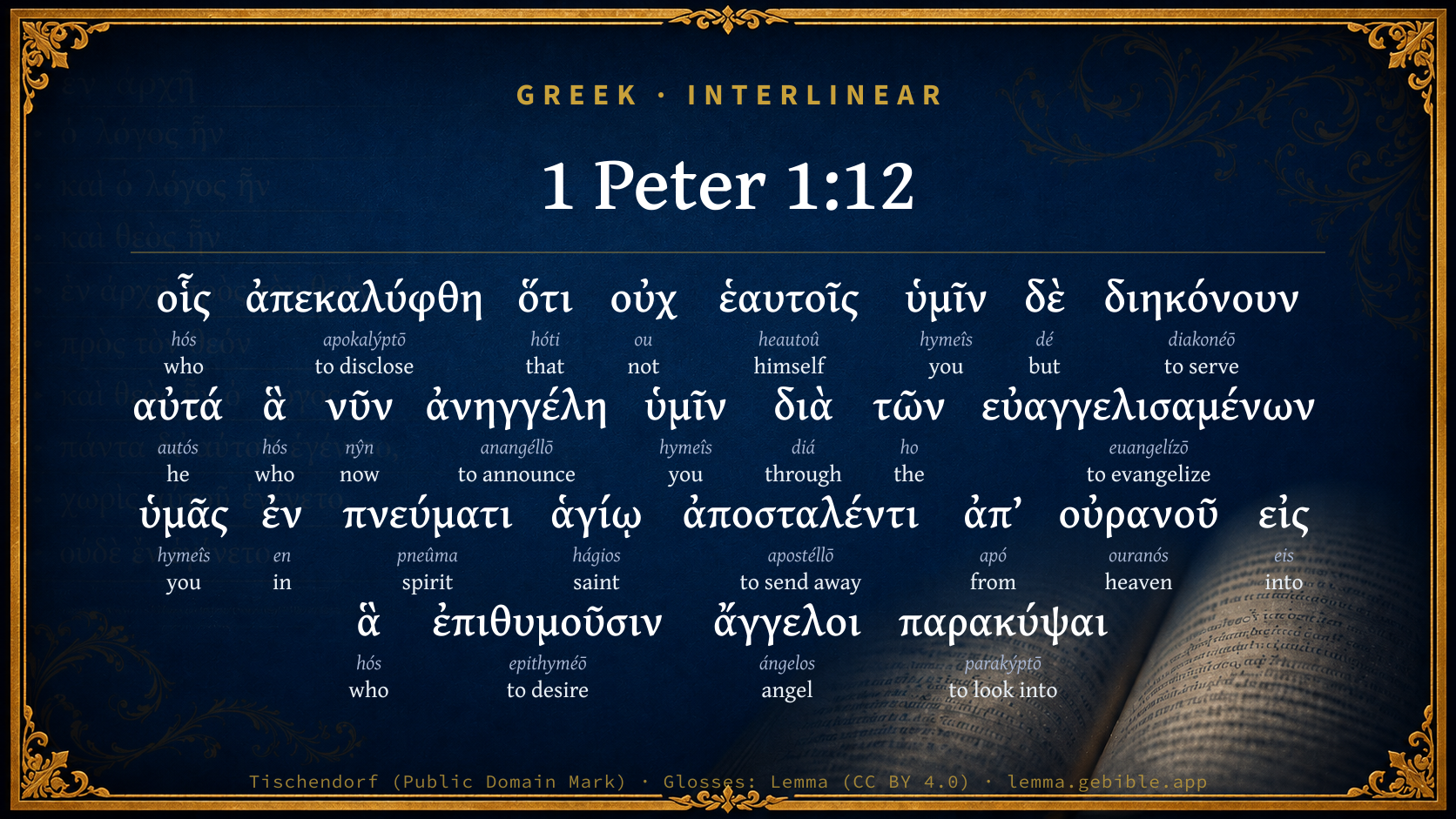
  1. οἷς hós G3739 “who” Relative pronoun, Dative, Plural, Masculine
  2. ἀπεκαλύφθη apokalýptō G601 “to disclose” Verb, Aorist, Passive, Indicative, 3rd person, Singular
  3. ὅτι hóti G3754 “that” Conjunction
  4. οὐχ ou G3756 “not” Particle, Negative
  5. ἑαυτοῖς heautoû G1438 “himself” Reflexive pronoun, 3rd person, Dative, Plural, Masculine
  6. ὑμῖν hymeîs G5210 “you” Personal pronoun, 2nd person, Dative, Plural
  7. δὲ dé G1161 “but” Conjunction
  8. διηκόνουν diakonéō G1247 “to serve” Verb, Imperfect, Active, Indicative, 3rd person, Plural
  9. αὐτά autós G846 “he” Personal pronoun, Accusative, Plural, Neuter
  10. ἃ hós G3739 “who” Relative pronoun, Accusative, Plural, Neuter
  11. νῦν nŷn G3568 “now” Adverb
  12. ἀνηγγέλη anangéllō G312 “to announce” Verb, Aorist, Passive, Indicative, 3rd person, Singular
  13. ὑμῖν hymeîs G5210 “you” Personal pronoun, 2nd person, Dative, Plural
  14. διὰ diá G1223 “through” Preposition
  15. τῶν ho G3588 “the” Article, Genitive, Plural, Masculine
  16. εὐαγγελισαμένων euangelízō G2097 “to evangelize” Verb, Aorist, Middle, Participle, Genitive, Plural, Masculine
  17. ὑμᾶς hymeîs G5210 “you” Personal pronoun, 2nd person, Accusative, Plural
  18. ἐν en G1722 “in” Preposition
  19. πνεύματι pneûma G4151 “spirit” Noun, Dative, Singular, Neuter
  20. ἁγίῳ hágios G40 “saint” Adjective, Dative, Singular, Neuter
  21. ἀποσταλέντι apostéllō G649 “to send away” Verb, Aorist, Passive, Participle, Dative, Singular, Neuter
  22. ἀπ’ apó G575 “from” Preposition
  23. οὐρανοῦ ouranós G3772 “heaven” Noun, Genitive, Singular, Masculine
  24. εἰς eis G1519 “into” Preposition
  25. ἃ hós G3739 “who” Relative pronoun, Accusative, Plural, Neuter
  26. ἐπιθυμοῦσιν epithyméō G1937 “to desire” Verb, Present, Active, Indicative, 3rd person, Plural
  27. ἄγγελοι ángelos G32 “angel” Noun, Nominative, Plural, Masculine

About this verse

These counts appear in no published source. They are computed here, from the morphology-tagged text and Lemma’s own curated glosses. What Lemma adds →

28
words
24
distinct lemmas
General Epistles
section

Notable vocabulary

The rarest word here is παρακύψαι to look into G3879 — appearing just 4 times in the whole Greek New Testament.

Shared distinctive vocabulary

παρακύψαι to look into G3879 occurs in 4 verses of the Greek New Testament. Also found in:

Repetition

Words recur within this verse:

Cross-references

54

Topical passages linked to 1 Peter 1:12 in the Treasury of Scripture Knowledge — connected by theme and wording, ordered by reader-vote popularity; previews shown in the World English Bible.

  • John 15:26 "When the Counselor has come, whom I will send to you from the Father, the Spirit of truth, who proceeds from the Father, he will testify about me.
  • 1 Corinthians 2:10 But to us, God revealed them through the Spirit. For the Spirit searches all things, yes, the deep things of God.
  • Ephesians 3:10 to the intent that now through the assembly the manifold wisdom of God might be made known to the principalities and the powers in the heavenly places,
  • Hebrews 11:39–40 These all, having had testimony given to them through their faith, didn't receive the promise,
  • 1 Peter 1:25 But the Lord's word endures forever." This is the word of good news which was preached to you.
  • Mark 16:15 He said to them, "Go into all the world, and preach the Gospel to the whole creation.
  • Hebrews 4:2 For indeed we have had good news preached to us, even as they also did, but the word they heard didn't profit them, because it wasn't mixed with faith by those who heard.
  • Romans 15:19 in the power of signs and wonders, in the power of God's Spirit; so that from Jerusalem, and around as far as to Illyricum, I have fully preached the Gospel of Christ;
  • 2 Corinthians 1:22 who also sealed us, and gave us the down payment of the Spirit in our hearts.
  • 2 Corinthians 6:6 in pureness, in knowledge, in patience, in kindness, in the Holy Spirit, in sincere love,
  • Revelation 5:11 I saw, and I heard something like a voice of many angels around the throne, the living creatures, and the elders; and the number of them was ten thousands of ten thousands, and thousands of thousands;
  • Acts 2:17–18 'It will be in the last days, says God, That I will pour out my Spirit on all flesh. Your sons and your daughters will prophesy. Your young men will see visions. Your old men will dream dreams.
  • Acts 2:33 Being therefore exalted by the right hand of God, and having received from the Father the promise of the Holy Spirit, he has poured out this, which you now see and hear.
  • Isaiah 44:3–5 For I will pour water on him who is thirsty, and streams on the dry ground; I will pour my Spirit on your seed, and my blessing on your offspring:
  • Daniel 9:24 Seventy weeks are decreed on your people and on your holy city, to finish disobedience, and to make an end of sins, and to make reconciliation for iniquity, and to bring in everlasting righteousness, and to seal up vision and prophecy, and to anoint the most holy.
  • Daniel 12:9 He said, Go your way, Daniel; for the words are shut up and sealed until the time of the end.
  • Daniel 12:13 But go you your way until the end be; for you shall rest, and shall stand in your lot, at the end of the days.
  • Amos 3:7 Surely the Lord Yahweh will do nothing, Unless he reveals his secret to his servants the prophets.
  • John 16:7–15 Nevertheless I tell you the truth: It is to your advantage that I go away, for if I don't go away, the Counselor won't come to you. But if I go, I will send him to you.
  • Acts 2:2–4 Suddenly there came from the sky a sound like the rushing of a mighty wind, and it filled all the house where they were sitting.
  • Daniel 2:28–29 but there is a God in heaven who reveals secrets, and he has made known to the king Nebuchadnezzar what shall be in the latter days. Your dream, and the visions of your head on your bed, are these:
  • Daniel 2:47 The king answered to Daniel, and said, Of a truth your God is the God of gods, and the Lord of kings, and a revealer of secrets, seeing you have been able to reveal this secret.
  • Zechariah 12:10 I will pour on the house of David, and on the inhabitants of Jerusalem, the spirit of grace and of supplication; and they will look to me whom they have pierced; and they shall mourn for him, as one mourns for his only son, and will grieve bitterly for him, as one grieves for his firstborn.
  • Matthew 11:25 At that time, Jesus answered, "I thank you, Father, Lord of heaven and earth, that you hid these things from the wise and understanding, and revealed them to infants.
  • Luke 15:10 Even so, I tell you, there is joy in the presence of the angels of God over one sinner repenting."
  • Romans 1:17 For in it is revealed God's righteousness from faith to faith. As it is written, "But the righteous shall live by faith."
  • Romans 10:15 And how will they preach unless they are sent? As it is written: "How beautiful are the feet of those who preach the Gospel of peace, Who bring glad tidings of good things!"
  • Galatians 1:12 For neither did I receive it from man, nor was I taught it, but it came to me through revelation of Jesus Christ.
  • Galatians 1:16 to reveal his Son in me, that I might preach him among the Gentiles, I didn't immediately confer with flesh and blood,
  • 1 Thessalonians 1:5–6 and that our Gospel came to you not in word only, but also in power, and in the Holy Spirit, and with much assurance. You know what kind of men we showed ourselves to be among you for your sake.
  • Hebrews 2:4 God also bearing witness with them, both by signs and wonders, and by various works of power, and by gifts of the Holy Spirit, according to his own will?
  • Exodus 25:20 The cherubim shall spread out their wings upward, covering the mercy seat with their wings, with their faces toward one another. The faces of the cherubim shall be toward the mercy seat.
  • Proverbs 1:23 Turn at my reproof. Behold, I will pour out my spirit on you. I will make known my words to you.
  • Isaiah 11:2–6 The Spirit of Yahweh shall rest on him, the spirit of wisdom and understanding, the spirit of counsel and might, the spirit of knowledge and of the fear of Yahweh.
  • Isaiah 32:15 until the Spirit be poured on us from on high, and the wilderness become a fruitful field, and the fruitful field be esteemed as a forest.
  • Daniel 2:19 Then was the secret revealed to Daniel in a vision of the night. Then Daniel blessed the God of heaven.
  • Daniel 2:22 he reveals the deep and secret things; he knows what is in the darkness, and the light dwells with him.
  • Daniel 8:13 Then I heard a holy one speaking; and another holy one said to that certain one who spoke, How long shall be the vision [concerning] the continual [burnt-offering], and the disobedience that makes desolate, to give both the sanctuary and the host to be trodden under foot?
  • Daniel 10:1 In the third year of Cyrus king of Persia a thing was revealed to Daniel, whose name was called Belteshazzar; and the thing was true, even a great warfare: and he understood the thing, and had understanding of the vision.
  • Matthew 11:27 All things have been delivered to me by my Father. No one knows the Son, except the Father; neither does anyone know the Father, except the Son, and he to whom the Son desires to reveal him.
  • Matthew 16:17 Jesus answered him, "Blessed are you, Simon Bar Jonah, for flesh and blood has not revealed this to you, but my Father who is in heaven.
  • Luke 2:26 It had been revealed to him by the Holy Spirit that he should not see death before he had seen the Lord's Christ.
  • Luke 9:6 They departed, and went throughout the villages, preaching the Gospel, and healing everywhere.
  • 1 Thessalonians 2:9 For you remember, brothers, our labor and travail; for working night and day, that we might not burden any of you, we preached to you the Gospel of God.
  • Isaiah 53:1 Who has believed our message? and to whom has the arm of Yahweh been revealed?
  • Daniel 12:5–6 Then I, Daniel, looked, and, behold, there stood other two, the one on the brink of the river on this side, and the other on the brink of the river on that side.
  • Joel 2:28 "It will happen afterward, that I will pour out my Spirit on all flesh; And your sons and your daughters will prophesy. Your old men will dream dreams. Your young men will see visions.
  • Hebrews 11:13 These all died in faith, not having received the promises, but having seen them and embraced them from afar, and having confessed that they were strangers and pilgrims on the earth.
  • Acts 4:8 Then Peter, filled with the Holy Spirit, said to them, "You rulers of the people, and elders of Israel,
  • Acts 4:31 When they had prayed, the place was shaken where they were gathered together. They were all filled with the Holy Spirit, and they spoke the word of God with boldness.
  • Acts 8:25 They therefore, when they had testified and spoken the word of the Lord, returned to Jerusalem, and preached the Gospel to many villages of the Samaritans.
  • Acts 10:44 While Peter was still speaking these words, the Holy Spirit fell on all those who heard the word.
  • Acts 16:10 When he had seen the vision, immediately we sought to go out to Macedonia, concluding that the Lord had called us to preach the Gospel to them.
  • Romans 1:15 So, as much as is in me, I am eager to preach the Gospel to you also who are in Rome.

Cross-references courtesy of OpenBible.info (CC BY 4.0).

Where the printed editions differ

1 variant

Places in this verse where the major printed Greek editions disagree on the wording in a way that affects the translation — a comparison of editions, not a manuscript-by-manuscript collation. The editions are the modern critical texts (Nestlé-Aland 28/27, SBL, Westcott-Hort, Tregelles, Tyndale House) and the traditional texts behind the KJV (the Textus Receptus and the Byzantine/Majority text). It is not a claim about which reading is original.

  1. Different wording
    ὑμῖν

    “you”

    In NA28NA27TynSBLWHTregByz Not in TR

    ἡμῖν (hēmin) 'us' occurs in traditional manuscripts (TR) instead of ὑμῖν (humin) 'you' in older manuscripts (NA28+NA27+Tyn+SBL+WH+Treg+Byz)

Textual data: Translators Amalgamated Greek New Testament (STEPBible TAGNT) · CC BY 4.0.

Commentary

Notes on 1 Peter 1:12 from classic Christian and Jewish commentators (each source and its license shown beneath its notes). The classic Christian expositions comment on the surrounding passage and are grouped to its opening verse, so a note may address several verses; the Jewish commentaries on the Tanakh (Rashi and others) are per-verse, so they appear only where the commentator wrote on this verse.

Lemma curates 59 commentaries, every one of them public domain or Creative Commons licensed, each selected and text-cleaned for this edition rather than reprinted as found. About our sources →

Ellicott's Commentary for English Readers

(12) Unto whom it was revealed.—As 1Pe_1:11 expanded and expounded the words “inquired and searched,” so the first part of 1Pe_1:12 expounds the words “prophesied of the grace in reserve for you.” That is to say, the revelation here spoken of is not a special revelation sent in answer to their laborious musings, but rather the very thing which occasioned them; the perplexity consisted in feeling that God had a further meaning for their words. And the exact limits of the revelation are mentioned: they were shown that they spoke for the benefit of futurity, and no more! What a “trial of faith!” What a sublime disappointment! (Heb_11:40.)

Unto us.—Far the better reading is, unto you. It is a distinct characteristic of this Epistle, that “we,” “us,” “our,” are so seldom used (in the best text) where they might have been expected. Where St. Paul throws in his own sympathy, and puts himself on a footing with those whom he addresses, St. Peter utters his lofty pastoral from above. There are but four places in the Epistle (1Pe_1:3; 1Pe_2:24; 1Pe_3:18; 1Pe_4:17) where he associates himself thus with his brethren, and one of those (1Pe_2:24) is really a quotation, and one (1Pe_3:18) at best a very doubtful reading. The same tendency may be observed in his speech (Act_15:7), where the right reading is “made choice among you.”

The things.—In the original simply them; so that a semicolon might better follow than a comma, and which things be put instead of “which.” The most natural thing is to suppose that the pronoun represents the preceding “sufferings in reserve for Messiah and the glories after.” In what sense, then, could the prophets “minister,” either to themselves or to us, the sufferings and glories of Messiah? The word is one which signifies a servant bringing to his master the things which he needs—commonly used (e.g., Joh_12:2) of serving up a meal; and the prophets are said to serve the Messianic sufferings and glories to us, to wait upon us with them, to present them to our use and study and comfort. (Comp. 1Pe_4:10.) When it says, however, that they ministered them “not to themselves but to us,” we must not suppose that they derived no comfort from their predictions (see Joh_8:56): the “not” must be taken in the same sense as in “I will have mercy and not sacrifice” (Mat_9:13).

Which are now reported unto you.—Rather, which things (i.e., the gospel story) now (in contrast with the days of the prophets) were (not “are”) openly declared to you (in all their details, in contrast with the dim and vague way in which they were seen before). Such is the force of this compound Greek verb in Joh_4:25; Act_19:18; Act_20:20; Act_20:27.

By them that have preached.—More correctly, through those who preached; the difference being that St. Peter is referring to the first bearers of the gospel to those parts, not to all who from that time to the date of the Letter had preached. This is a point well worth noticing. The phrase seems to show that St. Peter himself was not of the number. Perhaps half the churches which received the Letter looked to St. Paul as their founder. (See last Note on 1Pe_1:1.) Here, then, we find the Rock-Apostle authoritatively setting his seal to the teaching of his junior colleague, just as he does in the Second Epistle (1Pe_3:15). It seems to imply that these Jewish Christians were beginning to feel a reaction from St. Paul’s evangelical teaching; and the Apostle of the Circumcision is called in to enforce what the Apostle of the Uncircumcision had taught. The revolt of the Hebrew Christians in Asia from evangelical teaching appears again at a still later period (Rev_2:9; Rev_3:9). It was, perhaps, only with Jewish Christians that such an appeal from St. Paul to St. Peter would be made, and need not imply superiority throughout the whole Church. St. Peter’s perfect concurrence with St. Paul here is a sufficient contradiction to the Tubingen theory of their irreconcilable divergence—only the Tubingen school reject the Epistle on the ground that it makes the Apostles too harmonious!

With the Holy Ghost sent down from heaven.—The magnificent phrase seems meant to contrast the full effusion of the Spirit now, with His limited working in the prophets (1Pe_1:11). But it contains more teaching than this. The tense of the participle “sent” is such as might without violence be rendered “sent once and for ever,” “sent in a moment.” Now, remember that almost undoubtedly some of the recipients of the Letter (see last Note on 1Pe_1:1) were eye-witnesses of His being “sent” to St. Peter and the rest on the Day of Pentecost. St. Peter, then, here claims for St. Paul (and St. Silas perhaps) the very same inspiration with which himself was furnished. And as here he claims full inspiration for St. Paul’s preaching, so he does afterwards for his writing (2Pe_3:15).

Which things the angels.—The “which things” here is grammatically parallel to the “which things” of the last sentence, and therefore would mean “the sufferings of Messiah and the glories after.” But logically we have to go back to the beginning of 1Pe_1:10 : “Do I say that prophets, who had the mysteries of our redemption on their lips, yet pored in vain to catch the detailed meaning which you catch? Nay; angels (not “the angels”), who were present at every detail, and bore an active part in it all (see Mat_1:20; Mat_4:11; Mat_28:2; Luk_1:26; Luk_2:9; Luk_22:43; Joh_1:51),—angels, of whom He ‘was seen’ (1Ti_3:16),—covet now to exchange places with you that they may gaze into the mystery.” The word which has here shrunk into our word “to look into,” means really, to bend aside to see. In its literal sense it occurs in Joh_20:5; Joh_20:11, and in Luk_24:12 (a verse not found in the best text), of people standing at the side of the cave so as not to get in their own light, and stooping sideways to peer in. Metaphorically it is used in Jas_1:25, where see Note. It seems to mean a strained attention to something which has caught your eye somewhat out of your usual line of sight. Here then, the intention is to show that we are in a better position to understand the mysteries of redemption, not only than prophets, but also than angels; and they covet to stoop from their own point of view to ours. And why so? Not because of the inherent mysteriousness of the union of the two natures in Christ, for of that they are as intelligent as we, or more so; but because they are incapable of fully understanding human nature, flesh and blood, with its temptations and pains, its need of a Saviour. In Francia’s great picture, the two angels kneel by weeping Mary and dead Christ without a trace of grief on their countenances. The Son of God Himself only became capable of entering into our infirmities through becoming flesh, and experiencing the same (Heb_2:16; Heb_2:18; Heb_4:15). Several passages show us that the tragedy of human history is by no means enacted only for the benefit of the actors, but as a lesson (possibly, as Archbishop Whately pointed out, only a single illustration out of many in one lesson) for the instruction of unfallen spirits (1Co_4:9; Eph_3:10; 1Ti_3:16). Our present passage has impressed itself on Christian lyrics as much, perhaps, as any in the New Testament. Charles Wesley well strikes the meaning in many of his poems: as—

“Ask the Father’s Wisdom how,

Him that did the means ordain;

Angels round our altars bow

To search it out in vain;”

or again—

“Angels in fixt amazement

Around our altars hover,

With eager gaze adore the grace

Of our Eternal Lover.”

Though very possibly the divine intention of the cherubim over the mercy-seat (Exo_25:20) may have been to symbolise that which is here said, yet it is not to be thought that St. Peter was consciously thinking of the symbol.

A Bible Commentary for English Readers, edited by Charles John Ellicott (1878–1897) — public domain. Text from a community e-Sword module.

Joseph Benson's Commentary

1Pe 1:12. Unto whom — So searching; it was revealed, that not unto themselves, but unto us — Not so much for their own benefit as for ours, to whose time the accomplishment of their prophecies was reserved; they did minister the things which are now reported unto you — Performed the office of foretelling the things, the accomplishment whereof has been declared unto you. In other words, that they did not so much by their predictions serve themselves or that generation, as they have served us, who now enjoy what they only saw afar off. With the Holy Ghost sent down from heaven — Confirmed by the inward powerful testimony of the Holy Ghost, as well as the mighty effusion of his miraculous gifts. Which things the angels desire to look into — To obtain a more perfect insight into, and knowledge of, as being matters of their admiration and delight, because in them the manifold wisdom of God is displayed, and by them the salvation of men is procured and effected, which they rejoice in. The expression, the angels desire to look into, is literally, to stoop down to. “But stooping being the action of one who desires to look narrowly into a thing, it properly means to look attentively. The omission of the article before αγγελοι, angels, renders the meaning more grand. Not any particular species of angels, but all the different orders of them, desire to look into the things foretold by the prophets, and preached by the apostles. See Eph 3:10. This earnest desire of the angels to contemplate the sufferings of Christ, was emblematically signified by the cherubim placed in the inward tabernacle, with their faces turned down toward the mercy-seat, Exo 25:20. To that emblem there is a plain allusion in the word παρακυψαι here, to stoop. The apostle’s meaning is, If our salvation, and the means by which it is accomplished, are of such importance as to merit the attention of angels, how much more do they merit our attention, who are so much interested in them!” — Macknight.

Here is a beautiful gradation: prophets, righteous men, kings, desired to hear and see the things which Christ did and taught, Mat 13:17; but what the Holy Ghost taught concerning Christ, the very angels long to understand.

Joseph Benson's Commentary on the Old and New Testaments (1811–1818) — public domain. Text from a community e-Sword module.

Whedon's Commentary on the Bible

Daniel D. Whedon

12. It was revealed—This verse presents an additional truth revealed to, and well understood by, the prophets. The things foretold are identical with those declared by the apostles as having occurred. The long succession of prophets, moved by the Holy Spirit, were at one with the evangelists, filled with the same Holy Spirit, sent down from heaven on the Pentecost, and abiding with his ministers and his Church. Thus does St. Peter endorse St. Paul, the chief founder of the Churches to which he is writing.

5. Angelic interest in the great salvation, 1Pe_1:12.

Which things—Namely, those once predicted and now preached. That the angels of God, of an order of beings different from and higher than men, earnestly desire to look into the work of redemption, marks it as of the highest excellence. The term look into signifies to bend forward in order to look more closely, or to see to the bottom. The facts of the wonderful story, from the promise in Eden to the exaltation to the right hand of God, they are familiar with. That they understand the philosophy of redemption does not admit of question. What they so closely scrutinize is, the practical working of the plan in actually accomplishing what it proposes and promises, in saving from sin and keeping them that believe. In this St. Peter agrees with St. Paul in Eph_3:10.

Daniel D. Whedon (gen. ed.), Commentary on the Old and New Testaments (1874–1909) — public domain. Text from a community e-Sword module.

Tyndale Open Study Notes

Tyndale Open Resources

1:12 eagerly watching: The same Greek word is used of the disciples when they peered into Jesus’ empty tomb (Luke 24:12; John 20:5, 11).

Tyndale Open Study Notes — © Tyndale Open Resources, licensed CC BY-SA 4.0. Text via the HelloAO Bible API.

Bengel's Gnomon

Johann Albrecht Bengel

1Pe 1:12. Οἷς, to whom) searching.—ὅτι) that.—οὐχ ἑαυτοῖς, not to themselves) Mat 13:17; Psa 102:19; Dan 12:13.—ἡμῖν, to us) The times defined by the seventy weeks of Daniel exactly extend to the time of Christ’s appearance on earth, and to the faithful then living: this is the force of unto us. And these weeks came to an end during the time of Peter. See Ord. Temp. p. 366 (Edit. ii. 314).—αὐτὰ) those things: for prophets is understood with ministered, as is evident from the answering clause, not to themselves. Compare διακονέω with an accusative, ch. 1Pe 4:10. Ἃ and εἰς ἃ have reference to αὐτὰ.—νῦν, now) The Latin expression is hodie, to-day.—ἐν, with or in) The Evangelists were infallible witnesses.—ἀπ ̓ οὐρανοῦ, from heaven) that is, from God.—ἐπιθυμοῦσιν, desire) It was not so soon revealed to angels; at any rate, not to all. A well-regulated curiosity is a virtue, not only in prophets, 1Pe 1:10, but also in angels.—ἄγγελοι, angels) The revelation from heaven increases in weight.[9] Prophets, and righteous men, and kings, desired to see and hear the things which Christ spake and did, Matthew 13 : but angels desire to look into the things which the Comforter teaches concerning Christ.—παρακύψαι, to look into) It became known to us by hearing, to angels by sight, which is greater: 1Ti 3:16. And yet it affects us more intimately: it is for angels παρακύπτειν, to take a side-glance at; the force of ΠΑΡᾺ is to be noticed.

[9] Here reaches its climax, viz. in the fact of its being the object of angels’ curiosity.—E.

Bengel's Gnomon of the New Testament — English translation (T&T Clark, Edinburgh, 1860) — public domain. Text from a community e-Sword module.

Meyer's Critical & Exegetical Commentary

Heinrich August Wilhelm Meyer

1Pe_1:12. οἷς ἀπεκαλύφθη] is linked on by way of explanation to ἐρευνῶντες: to whom it was revealed, i.e. in that it was revealed to them. This is to be taken neither as an antithesis to the searching, nor as the result of it, but as an element accompanyingand stimulatingit; see Wiesinger and Schott in loc.

ὅτι οὐχ ἑαυτοῖς ὑμῖν (ἡμῖν) δὲ διηκόνουν αὐτά] ὅτι is not causal here (Luther: for; so also Luthardt and Hofmann). Opposed to this is the circumstance that if ὅτι κ.τ.λ. be taken as a parenthesis, and the ἃ νῦν ἀνηγγέλη κ.τ.λ. following be joined with ἀπεκαλύφθη (Hofmann), this sentence is strangely broken up; if, on the other hand, ἃ νῦν κ.τ.λ. be united with what immediately precedes (Luther), ἀπεκαλύφθη is plainly much too bald. Nor can it be denied that ὅτι naturally connects itself with ἀπεκαλύφθη, and ἃ νῦν is joined with διηκόνουν αὐτά. ὅτι states, then, not the reason, but the contents of what was revealed to the prophets.[74]

ΔΙΑΚΟΝΕῖΝ, both in the N. T. and in the classics, is frequently a transitive verb joined with the accusative, and that in such a way that the accusative denotes either the result of the ΔΙΑΚΟΝΕῖΝ, or the thing to which the service is directed (1Pe_4:10). Here, where ΑὐΤΆ is the accusative dependent on ΔΙΗΚΌΝΟΥΝ, the latter is the case; for that which is announced to the Christians is not the result of the prophets ministrations, but that to which they were directed. That they did their part in bringing to pass by their ministration the salvation which is now preached (Wiesinger, and Schott also), is a thought in no way hinted at here, and in which: did their part is a purely arbitrary addition. The ministration of the prophets consisted not in the bringing to pass of the salvation, but in the proclaiming of that which was revealed to them (Brückner); and this is what is conveyed by αὐτά.

They exercised this ministration, ΟὐΧ, etc., not for their, rather for your (our) benefit, i.e. in such a way that its application was to you (us), not to themselves.

On δέ after the negation, as distinguished from ἈΛΛΆ, cf. Winer, p. 411 [E. T. 621].[75] The difference in the reading ὑμῖν or ἩΜῖΝ does not essentially affect the meaning, since by ὙΜῖΝ, though the readers of the epistle are indeed addressed in the first instance, all the rest of the Christians are naturally thought of as included. Still, the idea expressed in the ὙΜῖΝ or ἩΜῖΝ ΔΈ is not without difficulty. Taken strictly, the ΟὐΧ ἙΑΥΤΟῖς alone was known to the prophetsand along with this likewise, that it was for others, i.e. for those who lived at the time of its fulfilment. But as these others are the Christians, the apostle directly opposes ὑμῖν δέ to ΟὐΧ ἙΑΥΤΟῖςthat is, inserts the definite for the indefinite.

Wiesinger, Schott, Brückner join ΑὐΤΆ closely with the Ἅ which follows: the same as that which now is proclaimed to you; this is, however, incorrect. ΑὐΤΆ is nowhere in the N. T. construed thus with a relative to which it is antecedent; it applies rather to what has been formerly mentioned; here, therefore, doubtless to that of which the ΠΝΕῦΜΑ ΧΡΙΣΤΟῦ testified beforehand to the prophets, and what they prophesied of the ΧΆΡΙς, of which the readers had been made partakers. It is less fitting to limit the reference to the ΤᾺ ΕἸς ΧΡΙΣΤῸΝ ΠΑΘΉΜΑΤΑ, Ἃ Κ.Τ.Λ. being joined to it in a somewhat loose way.

It is entirely arbitrary for Hofmann to assert that Peter does not speak of any prophecies in general, but of the written records in which were contained the prediction of the prophets, who had foretold the extension of grace to the Gentile world; there is nothing here to lead to the supposition that the apostle makes any reference to written records,and predictions with regard to the heathen.

By means of the following Ἃ ΝῦΝ ἈΝΗΓΓΈΛΗ Κ.Τ.Λ., the apostle insists that what the prophets foretold is that which is now proclaimed to the readers.

ΝῦΝ emphasizes the present, in which the facts of salvation are proclaimed as having already taken place, as contradistinguished from the time when they were predicted as future.

ΔΙᾺ ΤῶΝ ΕὐΑΓΓΕΛΙΣΑΜΈΝΩΝ ὙΜᾶς (ἘΝ) ΠΝΕΎΜΑΤΙ ἉΓΊῼ] For the construction of the verb ΕὐΑΓΓΕΛΊΖΕΣΘΑΙ, c. acc, cf. Gal_1:9; Winer, p. 209 [E. T. 279].

If the reading: ἘΝ ΠΝ. be adopted, the Holy Spirit is conceived of as the power, as it were, encompassing and swaying them; if the other reading, as the moving and impelling cause. Like prophecy (1Pe_1:11), the preaching of the gospel proceeds from the illumination and impulse of the Holy Spirit.

ἈΠΟΣΤΑΛΈΝΤΙ ἈΠʼ ΟὐΡΑΝΟῦ] refers to the events of Pentecost; since then the Holy Spirit has His abode and is at work in the church.[76] Though the same Spirit was already in the prophets, 1Pe_1:11, He had not yet at that time been sent from heaven. Who the individuals were who had preached the gospel to the readers, Peter does not say. No doubt the form of the apostles expression does not compel us to think of him as excluded from the τῶν εὐαγγελ.; yet it is very probable that Peter, had he intended to include himself, would somehow have given this to be understood.

εἰς ἃ ἐπιθυμοῦσιν ἄγγελοι παρακύψαι] The relative ἅ clearly goes back to ἃ νῦν ἀνηγγέλη. It is arbitrary to understand (with Schott) by that which the angels desired to see, the nature and origin of the moral transformation wrought by the proclamation of the gospel; or, with Hofmann, to give it this reference, that Christ has died, and been glorified in such a way that now He can and should be preached to the heathen as having died, and been glorified for them; it includes not only the παθήματα and δόξαι of Christ (Wiesinger), but the whole contents of the message of salvation (Brückner), which, as it is a testimony to the facts of redemption, is also a preaching of the σωτηρία founded on them, which is ἑτοίμη ἀποκαλυφθῆναι ἐν καιρῷ ἐσχάτῳ (1Pe_1:5), and which the believers will obtain (1Pe_1:9).[77]

ἐπιθυμοῦσι must not be taken as an aorist (Irenaeus, c. Haer. iv. 67; Oecumenius: ὧν τὴν γνῶσιν καὶ ἔκβασιν καὶ αὐτοὶ οἱ ἄγγελοι ἐπεθύμησαν), for the question is not as to what the angels did at the time of the prophets, but as to what they are now doing. That after which they long is the παρακύψαι εἰς αὐτά. On the inf. aor. after ἘΠΙΘΥΜΟῦΣΙΝ, see Winer, p. 310 f. [E. T. 416].

ΠΑΡΑΚΎΠΤΕΙΝ, properly, to bend to the side so as to examine a thing, means when joined with ΕἸς not only: to look towards, but: to look into anything, and that in order to obtain a more accurate knowledge of the object in question.[78] The παρά of the verb indicates that the angels stand outside the work of redemption, inasmuch as it is not for them, but for man (cf. Heb_2:16). The addition of this clause brings prominently forward the idea, not that the work of salvation is a mystery,concealed even from the angels,but that that which has been proclaimed to the readers is something so glorious that even the angels had a wish and a longing to see what was its fashion, and what the course of its development (cf. Eph_3:10). Nor is it implied in ἐπιθυμοῦσι that the angels cannot attain to a knowledge of the economy of salvation (Schott). It is more than doubtful whether there be here any reference to Exo_25:20, as several interpreters assume. Beza: alludit Ap. ad duos illos Cherubim opercula Arcae insistentes, conversis in ipsam arcam oculis. Piscator: videtur respicere ad Cherubim super arcam foederis, tanquam ad typum.

[74] Luthardt interprets: for there the object was a future one, from which the veil had to he removed by single acts of God; here, it is a present one, which accordingly the messengers simply proclaim, in the power of the now ever present Spirit of God,how much is imported here! Steinmeyer admits that ὅτι is not to he taken αἰτιολογικῶς, but denies at the same time that it states the argumentum τῆς ἀποκαλύψεως; he assumes an inversion, which is to be resolved thus: οἷς ἀπεκαλύφθη (sc. ταῦτα, namely τὰ παθ. κ. δόξαι Χρ.) οὐχ ἑαυτοῖς, ἀλλʼ ὅτι ὑμῖν διηκόνουν αὐτά, and then interprets: h. e. quibus manifestata sunt, non in ipsorum commodum, sed quia nobis ea ministrare jussi erant. But is ὅτι then not still αἰτιολογικῶς? And on what ground should an inversion so very harsh be adopted?

[75] Schotts singular assertion, that οὐ … δέ does not cancel ἑαυτοῖς simply, and put ὑμῖν in its place, but that δέ adds only something new to the preceding which remains standing (in spite of the οὐ!), is based on a misconception of what is said by Hartung, Partikellehre, I. 171, to which Schott appeals. Others than those addressed are not excluded; the latter only are indicated as those for whom the prophecy was intended; thus Hofmann, too, incorrectly.

[76] Weisss assertion (Die Petrin. Frage, above mentioned, p. 642) that, if there be here an allusion to the outpouring of the Spirit on the day of Pentecost, Paul could not have belonged to those who had preached the gospel to the readers, is without foundation, as it is not said here that the εὐαγγελισάμενοι ὑμᾶς belonged to those who received the Holy Spirit at Pentecost, but only that they preached in that Spirit, which was sent from heaven at Pentecost; and this applies to Paul no less than to the other apostles, etc.

[77] The Vulg. translates εἰς ἅ by in quem (i.e. in Spiritum sanctum).

[78] Although Hofmann may not be wrong in asserting that παρακύπτειν is used also to denote a cursory glance at anything (cf. Dem. 4:24, in Pape, s.v.), yet in connection with εἰς it is chiefly employed in cases where a more accurate knowledge is implied; precisely as Pape also interprets παρακύπτειν, to stand beside a thing, and to bend down so as to see it more distinctly; cf. further, Sir_21:23 (Sir_14:23), and in the N. T. besides Jam_1:25, also Joh_20:11 (Luk_24:12; Joh_20:5).

Meyer — Critical and Exegetical Commentary on the New Testament — English translation by Peter Christie, edited by Frederick Crombie (T&T Clark, 1880) — public domain. Text from a community e-Sword module.

Geneva Bible (1599)

Geneva Bible translators

He alludeth to the prophecy of Joel, which was exhibited upon the day of Pentecost, in the Apostles, as it were in the firstfruits of the holy Ghost, which this same our Peter declareth, Acts 2:6.

Geneva Bible (1599) marginal notes — public domain. Text via Bolls.life.

Jamieson, Fausset & Brown

Robert Jamieson, A. R. Fausset & David Brown

Not only was the future revealed to them, but this also, that these revelations of the future were given them not for themselves, but for our good in Gospel times. This, so far from disheartening, only quickened them in unselfishly testifying in the Spirit for the partial good of their own generation (only of believers), and for the full benefit of posterity. Contrast in Gospel times, Rev 22:10. Not that their prophecies were unattended with spiritual instruction as to the Redeemer to their own generation, but the full light was not to be given till Messiah should come; it was well that they should have this "revealed" to them, lest they should be disheartened in not clearly discovering with all their inquiry and search the full particulars of the coming "salvation." To Daniel (Dan 9:25-26) the "time" was revealed. Our immense privileges are thus brought forth by contrast with theirs, notwithstanding that they had the great honor of Christ's Spirit speaking in them; and this, as an incentive to still greater earnestness on our part than even they manifested (Pe1 1:13, &c.).

us--The oldest manuscripts read "you," as in Pe1 1:10. This verse implies that we, Christians, may understand the prophecies by the Spirit's aid in their most important part, namely, so far as they have been already fulfilled.

with the Holy Ghost sent down--on Pentecost. The oldest manuscripts omit Greek preposition en, that is, "in"; then translate, "by." The Evangelists speaking by the Holy Spirit were infallible witnesses. "The Spirit of Christ" was in the prophets also (Pe1 1:11), but not manifestly, as in the case of the Christian Church and its first preachers, "SENT down from heaven." How favored are we in being ministered to, as to "salvation," by prophets and apostles alike, the latter now announcing the same things as actually fulfilled which the former foretold.

which things--"the things now reported unto you" by the evangelistic preachers "Christ's sufferings and the glory that should follow" (Pe1 1:11-12).

angels--still higher than "the prophets" (Pe1 1:10). Angels do not any more than ourselves possess an INTUITIVE knowledge of redemption. "To look into" in Greek is literally, "to bend over so as to look deeply into and see to the bottom of a thing." See on Jam 1:25, on same word. As the cherubim stood bending over the mercy seat, the emblem of redemption, in the holiest place, so the angels intently gaze upon and desire to fathom the depths of "the great mystery of godliness, God manifest in the flesh, justified in the Spirit, seen of angels" (Ti1 3:16). Their "ministry to the heirs of salvation" naturally disposes them to wish to penetrate this mystery as reflecting such glory on the love, justice, wisdom, and power of their and our God and Lord. They can know it only through its manifestation in the Church, as they personally have not the direct share in it that we have. "Angels have only the contrast between good and evil, without the power of conversion from sin to righteousness: witnessing such conversion in the Church, they long to penetrate the knowledge of the means whereby it is brought about" [HOFMAN in ALFORD].

Jamieson, Fausset & Brown — Commentary Critical and Explanatory on the Whole Bible (1871) — public domain (CC PDM 1.0). Text via the HelloAO Bible API.

Adam Clarke's Commentary

Verse 12. Unto whom it was revealed] We may presume that, in a great variety of cases, the prophets did not understand the meaning of their own predictions. They had a general view of God's designs; but of particular circumstances, connected with those great events, they seem to have known nothing, God reserving the explanation of all particulars to the time of the issue of such prophecies. When they wished to find out the times, the seasons, and the circumstances, God gave them to understand that it was not for themselves, but for us, that they did minister the things which are now reported unto us by the preaching of the Gospel. This was all the satisfaction they received in consequence of their earnest searching; and this was sufficient to repress all needless curiosity, and to induce them to rest satisfied that the Judge of all the earth would do right. If all succeeding interpreters of the prophecies had been contented with the same information relative to the predictions still unaccomplished, we should have had fewer books, and more wisdom.

Angels desire to took into.] παρακυψαι. To stoop down to; the posture of those who are earnestly intent on finding out a thing, especially a writing difficult to be read; they bring it to the light, place it so that the rays may fall on it as collectively as possible, and then stoop down in order to examine all the parts, that they may be able to make out the whole. There is evidently an allusion here to the attitude of the cherubim who stood at the ends of the ark of the covenant, in the inner tabernacle, with their eyes turned towards the mercy-seat or propitiatory in a bending posture, as if looking attentively, or, as we term it, poring upon it. Even the holy angels are struck with astonishment at the plan of human redemption, and justly wonder at the incarnation of that infinite object of their adoration. If then these things be objects of deep consideration to the angels of God, how much more so should they be to us; in them angels can have no such interest as human beings have.

We learn from the above that it was the Spirit of Christ in the Jewish prophets that prophesied of Christ; it was that Spirit which revealed him; and it is the same Spirit which takes of the things of Christ, and shows them unto us. Christ was never known by prophecy, but through his own Spirit; and he never was known, nor can be known, to the salvation of any soul, but by a revelation of the same Spirit. It is he alone that bears witness with our spirits that we are the children of God.

Adam Clarke's Commentary on the Bible (1810–1826) — public domain. Text from a community e-Sword/MySword module.

John Calvin's Commentaries

12 Unto whom it was revealed This passage has been strangely perverted by fanatics, so as to exclude the fathers who lived under the law from the hope of eternal salvation. For it does not deny that the prophets usefully ministered to their own age, and edified the church, but teaches us that their ministry is more useful to us, because we are fallen on the ends of the world. We see how highly they extolled the kingdom of Christ, how assiduous they were in adorning it, how diligently they stimulated all to seek it; but they were by death deprived of the privilege of seeing it as it now is. What else then was this, but that they spread the table, that others might afterwards feed on the provisions laid on it. They indeed tasted by faith of those things which the Lord has by their hands transmitted to be enjoyed by us; and they also partook of Christ as the real food of their souls. But what is spoken of now is the exhibition of this blessing, and we know that the prophetic office was confined as it were within limits, in order that they might support themselves and others with the hope of Christ, who was to come. They therefore possessed him as one hidden, and as it were absent — absent, I say, not in power or grace, but because he was not yet manifested in the flesh. Therefore his kingdom also was as yet hid as it were under coverings. At length descending on earth, he in a manner opened heaven to us, so that we might have a near view of those spiritual riches, which before were under types exhibited at a distance. This fruition then of Christ as manifested, forms the difference between us and the prophets. Hence we learn how they ministered to us rather than to themselves.

But though the prophets were admonished from above that the grace which they proclaimed would be deferred to another age, yet they were not slothful in proclaiming it, so far were they from being broken down with weariness. But if their patience was so great, surely we shall be twice and thrice ungrateful, if the fruition of the grace denied to them will not sustain us under all the evils which are to be endured.

Which are now reported to you, or announced to you. He again marks the difference between the ancient doctrine and the preaching of the gospel. For as the righteousness of God is revealed in the gospel, having a testimony from the law and the prophets, so also the glory of Christ, of which the Spirit testified formerly, is now openly proclaimed. And at the same time he hence proves the certainty of the gospel, because it contains nothing but what had been long ago testified by the Spirit of God. He further reminds them, that under the banner of the same Spirit, by his dictation and guidance, the gospel was preached, lest they might think of anything human in this case.

Which things the angels desire to look into It is indeed the highest praise to the gospel, that it contains treasures of wisdom, as yet concealed and hidden from angels. But some one may object, and say that it is not reasonable that things should be open and known to us which are hidden from angels, who always see the face of God, and are his ministers in ruling the church, and in the administration of all his blessings. To this I answer, that things are open to us as far as we see them in the mirror of the word; but our knowledge is not said to be higher than that of angels; Peter only means that such things are promised to us as angels desire to see fulfilled. Paul says that by the calling of the Gentiles the wonderful wisdom of God was made known to angels. for it was a spectacle to them, when Christ gathered into one body the lost world, alienated for so many ages from the hope of life. Thus daily they see with admiration the magnificent works of God in the government of his church. How much greater will their admiration be, at witnessing the last display of divine justice, when the kingdom of Christ shall be completed! This is as yet hidden, the revelation of which they still expect and justly wish to see.

The passage indeed admits of a twofold meaning; either that the treasure we have in the gospel fills the angels with a desire to see it, as it is a sight especially delightful to them; or that they anxiously desire to see the kingdom of Christ, the living image of which is set forth in the gospel. But the last seems to me to be the most suitable meaning.

John Calvin's Commentaries (1540-1563) — public domain. Text from the Calvin Translation Society English edition (1840s-50s) via the Christian Classics Ethereal Library (ccel.org). Calvin's coverage is partial (roughly two-thirds of the Bible); uncommented books and verses are honest gaps, never fabricated. The 19th-century editor's footnotes and remarks are omitted so the notes are faithfully Calvin's own voice.

The Cambridge Bible for Schools and Colleges

gen. ed. J. J. S. Perowne

12. Unto whom it was revealed, that not unto themselves, but unto us] The better MSS. give “you” instead of “us,” obviously with a better sense and in closer agreement with the “you” of the following clause. What is meant, still keeping to the line of interpretation here adopted, is that the prophets who had these previsions, at once of the coming sufferings and coming glories of the Church, had not carried on their ministering work for themselves, bounded, i.e., as by local and personal interests, but with a view to those even of the most distant members of the great family of God. The vision of the heavenly Jerusalem was for the dwellers in Pontus and Asia, in Rome or Corinth, as much as for those who lived within the walls of the earthly city.

which are now reported unto you by them that have preached the gospel] The Greek verbs are in the aorist, and therefore point to something in the past, but English idiom hardly allows us to combine present and past by saying “which now were reported.” Here, it is believed, St Peter speaks of St Luke, St Paul, and the other labourers by whom the provinces of Asia Minor had been evangelised. They too, he recognises, were as fully inspired as the prophets of whom he had just spoken.

which things the angels desire to look into] Better, angels, without the article. See note on 1Pe_1:10. The word for “look” is the same as that used by St James (Jas_1:25), and implies, as in Luk_24:12, Joh_20:5; Joh_20:11, the earnest gaze of one who bends over a given object and scrutinizes it thoroughly. The words fit in, perhaps, with either of the two interpretations, but considering the part assigned to angels in the records of the Gospels, in connexion alike with the Nativity (Mat_2:13; Mat_2:19; Luk_1:11; Luk_1:26; Luk_2:9-15), the Passion (Luk_22:43), the Resurrection (Mat_28:2; Mar_16:5; Luk_24:4; Joh_20:12) and the Ascension (Act_1:10-11), it is more natural to refer them to sufferings and glories that were still future than to those of which they had already been spectators.

The Cambridge Bible for Schools and Colleges (gen. ed. J. J. S. Perowne; Cambridge University Press, 1878–1918) — public domain. Text from a community e-Sword module.

John Gill's Exposition

Unto whom it was revealed,.... The salvation they searched and inquired into, and the grace of it; the time of its being wrought out, and what sort of times they would be when Christ should come, both to the church, and to the world, among Jews and Gentiles; as also what cruel sufferings the Messiah should undergo, and what great glory should be put upon him afterwards:

that not unto themselves, but unto us they did minister. The Vulgate Latin, Arabic, and Ethiopic versions, read "unto you"; and so do some copies. Not that they were ignorant of the things they searched into, and were revealed unto them, and they prophesied of; as the Jews sometimes say (c) of them,

"that they prophesied, and knew not what they prophesied of;

though it is not to be supposed that they had such clear and distinct ideas of things as saints have now under the Gospel dispensation; yet they knew much of the grace of the Gospel, and had the comfort of it, and a view of interest in the great salvation, and saw the day of Christ afar off with pleasure: nor that they did not minister, and were not useful to the saints of the age in which they lived; for their prophecies concerning Christ, and salvation by him, were particularly calculated for their spiritual refreshment and comfort, and the support of their faith and hope under afflictive circumstances; but then they were not to have their accomplishment in their times; for though they sometimes speak of them, because of the certainty of them, as if they were already done, yet they knew they were not to be brought about until the last days; and therefore what was written by them, was written for our learning and instruction chiefly and principally, on whom the ends of the world are come; and though they were both profitable to themselves, and others that lived with them, yet they are more so to the saints under the Gospel dispensations, who are able to compare prophesies and facts together: even

the things which are now reported unto you; as accomplished facts; such as relate to the person and offices of Christ, and salvation wrought out by him; to his incarnation, obedience, sufferings, death, resurrection, ascension into heaven, and session at the right hand of God; of all which there is a true and faithful report made in the Gospel:

by them that have preached the Gospel unto you; meaning himself, and the rest of the apostles, who had been called, and qualified, and sent out by Christ to preach glad tidings, and publish peace, which they had done in the several parts of the world, both to Jew and Gentile:

with the Holy Ghost sent down from heaven; by Christ from the Father, particularly at the day of Pentecost, when the apostles had an extraordinary and plentiful effusion of the Spirit, qualifying them to preach the Gospel to which they were called and sent: and thus, as the great salvation is commended, from the concern that the prophets of old had in it, so from the preaching of it by the apostles, who were influenced and guided by the same Spirit of Christ as they were, and in a far greater manner; and this salvation is still more commended from the great regard the blessed angels have unto it:

which things the angels desire to look into. The Vulgate Latin version reads, "into whom"; either into the Holy Spirit, and the things of the Spirit, which he testified in the prophets, and published by the apostles; or rather into Christ, his person, offices, and grace, the allusion being to the cherubim on the mercy seat, a type of Christ, which looked to one another, and to the mercy seat, Exo 25:20 and was true of them in the days of Christ's flesh, when they ascended and descended on the son of man, Joh 1:51 and when he rose from the dead, and went to heaven; for then was he seen and gazed on by angels, as he now is, Ti1 3:16 or "into which things": so the Syriac, Arabic, and Ethiopic versions read; namely, the sufferings of Christ, and the glories following; the great mystery of redemption and salvation by Christ; the several doctrines of the Gospel, in which the glory of the grace, wisdom, righteousness, truth, and power of God is displayed; things they are highly delighted with, take pleasure in the contemplation of, and desire to have a greater knowledge of, and acquaintance with: they sung glory to God in the highest at the incarnation of Christ; they rejoice at the conversion of a sinner; and disdain not to be ministering spirits to the heirs of salvation; and learn of the church the manifold wisdom of God; which may serve greatly to commend the excellency of Gospel truths, and engage us in the study of them,

(c) T. Bab. Bava Bathra, fol. 119. 2.

John Gill's Exposition of the Whole Bible (1746–1763) — public domain (CC PDM 1.0). Text via the HelloAO Bible API.

Trapp's Complete Commentary

John Trapp

12 Unto whom it was revealed, that not unto themselves, but unto us they did minister the things, which are now reported unto you by them that have preached the gospel unto you with the Holy Ghost sent down from heaven; which things the angels desire to look into.

Ver. 12. Not unto themselves] In regard of the accomplishment of those oracles that they uttered; and yet to themselves, in regard of their right and interest therein.

They did minister] None must hold themselves too good to serve the saints.

The angels desire to look into] To look wishly and intently, as the cherubims of old looked into the mercy seat, Exo 25:18-19. παρακυψαι, Prono capite et propenso cello accurate introspicere.

John Trapp, A Commentary or Exposition upon All the Books of the Old and New Testament (1647–1656) — public domain. Text from a community e-Sword module.

Albert Barnes' Notes on the Bible

Unto whom it was revealed - They were not permitted to know fully the import of the predictions which they were made the instruments of communicating to mankind, but they understood that they were intended for the benefit of future ages.

That not unto themselves - We are not to suppose that they derived no benefit from their own predictions; for, as far as they understood the truth, it was as much adapted to sanctify and comfort them as it is us now: but the meaning is, that their messages had reference mainly to future times, and that the full benefit of them would be experienced only in distant ages. Compare Heb 11:39-40.

Unto us they did minister the things, which are now reported unto you - Not unto us by name, but their ministrations had reference to the times of the Messiah; and those to whom Peter wrote, in common with all Christians, were those who were to enjoy the fruits of the communications which they made. The word reported means announced, or made known.

By them that have preached the gospel unto you - The apostles, who have made known unto you, in their true sense, the things which the prophets predicted, the import of which they themselves were so desirous of understanding.

With the Holy Ghost sent down from heaven - Accompanied by the influences of the Holy Spirit bearing those truths to the heart, and confirming them to the soul. It was the same Spirit which inspired the prophets which conveyed those truths to the souls of the early Christians, and which discloses them to true believers in every age. Compare Joh 16:13-14; Act 2:4; Act 10:44-45. The object of Peter by thus referring to the prophets, and to the interest which they took in the things which those to whom he wrote now enjoyed, seems to have been, to impress on them a deep sense of the value of the gospel, and of the great privileges which they enjoyed. They were reaping the benefit of all the labors of the prophets. They were permitted to see truth clearly, which the prophets themselves saw only obscurely. They were, in many respects, more favored than even those holy men had been. It was for them that the prophets had spoken the word of the Lord: for them and their salvation that a long line of the most holy men that the world ever saw, had lived, and toiled, and suffered; and while they themselves had not been allowed to understand the fall import of their own predictions, the most humble believer was permitted to see what the most distinguished prophet never saw. See Mat 13:17.

Which things the angels desire to look into - The object of this reference to the angels is the same as that to the prophets. It is to impress on Christians a sense of the value of that gospel which they had received, and to show them the greatness of their privileges in being made partakers of it. It had excited the deepest interest among the most holy men on earth, and even among the inhabitants of the skies. They were enjoying the full revelation of what even the angels had desired more fully to understand, and to comprehend which they had employed their great powers of investigation. The things which are here referred to, εἰς ἅ eis ha - unto which) are those which the prophets were so desirous to understand - the great truths respecting the sufferings of Christ, the glory which would follow, and the nature and effects of the gospel. In all the events pertaining to the redemption of a world they felt a deep interest.

The word which is rendered “to look,” (παρακύψσαι parakupsai,) is rendered “stooping down,” and “stooped down,” in Luk 24:12; Joh 20:5, Joh 20:11; looketh, in Jam 1:25; and look, in the place before us. It does not elsewhere occur in the New Testament. It properly means, to stoop down near by anything; to bend forward near, in order to look at anything more closely - Robinson, Lexicon. It would denote that state where one, who was before at so great a distance that he could not clearly see an object, should draw nearer, stooping down in order that he might observe it more distinctly. It is possible, as Grotius supposes, that there may be an allusion here to the posture of the cherubim over the mercy-seat, represented as looking down with an intense gaze, as if to behold what was in the ark. But it is not necessary to suppose that this is the allusion, nor is it absolutely certain that that was the posture of the cherubim. See the notes at Heb 9:5. All that is necessarily implied in the language is, that the angels had an intense desire to look into these things; that they contemplated them with interest and fixed attention, like one who comes near to an object, and looks narrowly upon it. In illustration of this sentiment, we may make the following suggestions:

I. The angels, doubtless, desire to look into all the manifestations of the character of God, wherever those manifestations are made:

It is not unreasonable to suppose that, to a great degree, they acquire the knowledge of God as all other creatures do. They are not omniscient, and cannot be supposed to comprehend at a glance all his doings.

(2)They doubtless employ their faculties, substantially as we do, in the investigation of truth; that is, from things known they seek to learn those that are even unknown.

(3)It is not unreasonable to suppose that there are many things in relation to the divine character and plans, which they do not yet understand. They know, undoubtedly, much more than we do; but there are plans and purposes of God which are yet made known to none of his creatures. No one can doubt that these plans and purposes must be the object of the attentive study of all holy created minds.

(4)They doubtless feel a great interest in the welfare of other beings - of their fellow-creatures, wherever they are. There is in the universe one great brotherhood, embracing all the creatures of God.

(5)They cannot but feel a deep interest in man - a fallen creature, tempted, suffering, dying, and exposed to eternal death. This they have shown in every period of the world’s history. See the notes at Heb 1:14.

II. It is probable, that in each one of the worlds which God has made, there is some unique manifestation of his glory and character; something which is not to be found at all in any other world, or, if found, not in so great perfection; and that the angels would feel a deep interest in all these manifestations, and would desire to look into them:

(1) This is probable from the nature of the case, and from the variety which we see in the form, size, movements, and glory of the heavenly orbs. There is no reason to suppose, that on any one of those worlds all the glory of the divine character would be manifest, which he intends to, make known to the universe.

(2) This is probable from what we can now see of the worlds which he has made. We know as yet comparatively little of the heavenly bodies, and of the manifestations of the Deity there; and yet, as far as we can see, there must be far more striking exhibitions of the power, and wisdom, and glory of God, in many or most of those worlds that roll above us, than there are on our earth. On the body of the sun - on the planets Jupiter and Saturn, so vast in comparison with the earth - there must be far more impressive exhibitions of the glory of the Creator, than there is on our little planet. Saturn, for example, is 82,000 miles in diameter, 1,100 times as large as our earth; it moves at the rate of 22,000 miles an hour; it is encircled by two magnificent rings, 5,000 miles apart, the innermost of which is 21,000 miles from the body of the planet, and 22,000 miles in breadth, forming a vast illuminated arch over the planet above the brightness of our moon, and giving a most beautiful appearance to the heavens there. It is also, doubtless, true of all the worlds which God has made, that in each one of them there may be some unique manifestation of the glory of the Deity.

(3) The universe, therefore, seems suited to give eternal employment to mind in contemplating it; and, in the worlds which God has made, there is enough to employ the study of his creatures forever. On our own world, the most diligent and pious student of the works of God might spend many thousand years, and then leave much, very much, which he did not comprehend; and it may yet be the eternal employment of holy minds to range from world to world, and in each new world to find much to study and to admire; much that shall proclaim the wisdom, power, love, and goodness of God, which had not elsewhere been seen.

(4) Our world, therefore, though small, a mere speck in creation, may have something to manifest the glory of the Creator which may not exist in any other. It cannot be its magnitude; for, in that respect, it is among the smallest which God has made. It may not be the height and the majesty of our mountains, or the length and beauty of our rivers, or the fragrance of our flowers, or the clearness of our sky; for, in these respects, there may be much more to admire in other worlds: it is the exhibition of the character of God in the work of redemption; the illustration of the way in which a sinner may be forgiven; the manifestation of the Deity as incarnate, assuming permanently a union with one of his own creatures. This, so far as we know, is seen in no other part of the universe; “and this is honor enough for one world.” To see this, the angels may be attracted down to earth. When they come, they come not to contemplate our works of art, our painting and our sculpture, or to read our hooks of science or poetry: they come to gather around the cross, to minister to the Saviour, to attend on his steps while living, and to watch over his body when dead; to witness his resurrection and ascension, and to bless, with their offices of kindness, those whom he died to redeem, Heb 1:4.

III. What, then, is there in our world which we may suppose would attract their attention? What is there which they would not see in other worlds? I answer, that the manifestation of the divine character in the plan of redemption, is that which would especially attract their attention here, and lead them from heaven down to earth:

(1) The mystery of the incarnation of the Son of God would be to them an object of the deepest interest. This, so far as we know, or have reason to suppose, has occurred nowhere else. There is no evidence that in any other world God has taken upon himself the form of one of his own creatures dwelling there, and stooped to live and act like one of them; to mingle with them; to share their feelings; and to submit to toil, and want, and sacrifice, for their welfare.

(2) The fact that the guilty could be pardoned would attract their attention, for:

(a) it is elsewhere unknown, no inhabitant of heaven having the need of pardon, and no offer of pardon having been made to a rebel angel.

(b) There are great and difficult questions about the whole subject of forgiveness, which an angel could easily see, but which he could not so easily solve. How could it be done consistently with the justice and truth of God? How could he forgive, and yet maintain the honor of his own law, and the stability of his own throne? There is no more difficult subject in a human administration than that of pardon; and there is none which so much perplexes those who are entrusted with executive power.

(3) The way in which pardon has been shown to the guilty here would excite their deep attention. It has been in a manner entirely consistent with justice and truth; showing, through the great sacrifice made on the cross, that the attributes of justice and mercy may both be exercised: that, while God may pardon to any extent, he does it in no instance at the expense of justice and truth. This blending of the attributes of the Almighty in beautiful harmony; this manifesting of mercy to the guilty and the lost; this raising up a fallen and rebellious race to the favor and friendship of God; and this opening before a dying creature the hope of immortality, was what could be seen by the angels nowhere else: and hence, it is no wonder that they hasten with such interest to our world, to learn the mysteries of redeeming love. Every step in the process of recovering a sinner must be new to them, for it is unseen elsewhere; and the whole work, the atonement, the pardon and renovation of the sinner, the conflict of the child of God with his spiritual foes, the supports of religion in the time of sickness and temptation, the bed of death, the sleep in the tomb, the separate flight of the soul to its final abode, the resurrection of the body, and the solemn scenes of the judgment, all must open new fields of thought to an angelic mind, and attract the heavenly inhabitants to our world, to learn here what they cannot learn in their own abodes, however otherwise bright, where sin, and suffering, and death, and redemption are unknown. In view of these truths we may add:

(1) The work of redemption is worthy of the study of the profoundest minds. Higher talent than any earthly talent has been employed in studying it; for, to the most exalted intellects of heaven, it has been a theme of the deepest interest. No mind on earth is too exalted to be engaged in this study; no intellect here is so profound that it would not find in this study a range of inquiry worthy of itself.

(2) This is a study that is especially appropriate to man. The angels have no other interest in it than that which arises from a desire to know God, and from a benevolent regard for the welfare of others; we have a personal interest in it of the highest kind. It pertains primarily to us. The plan was formed for us. Our eternal all depends upon it. The angels would be safe and happy it they did not fully understand it; if we do not understand it, we are lost forever. It has claims to their attention as a wonderful exhibition of the character and purposes of God, and as they are interested in the welfare of others; it claims our attention because our eternal welfare depends on our accepting the offer of mercy made through a Saviour’s blood.

(3) How amazing, then, how wonderful, is the indifference of man to this great and glorious work! How wonderful, that neither as a matter of speculation, nor of personal concern, he can be induced “to look into these things!” How wonderful that all other subjects engross his attention, and excite inquiry; but that for this he feels no concern, and that here he finds nothing to interest him! It is not unreasonable to suppose, that amidst all the other topics of wonder in this plan as seen by angels, this is not the least - that man by nature takes no interest in it; that in so stupendous a work, performed in his own world, he feels no concern; that he is unmoved when he is told that even God became incarnate, and appeared on the earth where he himself dwells; and that, busy and interested as he is in other things, often of a most trifling nature, he has no concern for that on which is suspended his own eternal happiness. If heaven was held in mute astonishment when the Son of God left the courts of glory to be poor, to be persecuted, to bleed, and to die, not less must be the astonishment than when, from those lofty heights, the angelic hosts look down upon a race unconcerned amidst wonders such as those of the incarnation and the atonement!

Albert Barnes' Notes on the Bible (1834–1885) — public domain. Text from a community e-Sword/MySword module.

Haydock's Catholic Bible Commentary

The Holy Ghost being sent down from heaven, on whom the Angels desire to look.[2] This place is differently expounded. Some refer these words, on whom the Angels desire to look, to Jesus Christ, who was named in the foregoing verse; some to the Holy Ghost, who, being one God with the Father and the Son, the Angels are happy in seeing and loving him. See Estius and the Greek text. (Witham)

===============================

[BIBLIOGRAPHY]

In quem desiderant Angeli prospicere. The Greek manuscripts and copies at present have Greek: eis a, in quæ, which is commonly expounded to agree with the mysteries revealed to the prophets, and which the Angels rejoiced and were delighted to see fulfilled by the coming of Christ. It seems as if the ancient interpreter had read Greek: eis o, agreeing with Greek: pneuma, spiritum; or perhaps Greek: eis on, to agree with Greek: theon, understood. These changes of a letter might easily happen. It appears that not only divers Latin interpreters, but also some of the Greek Fathers brought these words to shew the divinity of the Holy Ghost, as St. Athanasius, Epist. i. ad Serap. p. 653. Edit. Ben.

====================

George Leo Haydock (1774–1849), Haydock's Catholic Family Bible and Commentary, 1859 edition — public domain. Excludes Psalms (Douay-Rheims chapter numbering differs from Protestant) and Deuterocanonical books (Catholic canon only).

Matthew Poole's English Annotations

Unto whom; unto which prophets.

It was revealed; viz. by the Spirit of Christ that was in them.

That not unto themselves; who lived before Christ’s coming in the flesh.

But unto us; not only apostles, but believers, who live since Christ came.

They did minister; declare and foretell. The preaching of the word is called a ministry, Act 6:4; 2Co 4:1; 5:18.

The things; the whole doctrine of the gospel concerning Christ’s person, offices, benefits, kingdom, and the whole New Testament state.

Which are now reported unto you; viz. as fulfilled, and actually exhibited now, which were only foretold by the prophets.

By them that have preached the gospel unto you; the apostles, and other gospel ministers assistant to them: the sense is: The prophets under the Old Testatnent did, by the Spirit, foresee and foretell Christ’s passion, resurrection, ascension, the effusion of the Spirit, the enlargement of the church by the calling of the Gentiles, &c.; but did not live to see their own prophecies, and God’s promises, fulfilled, Heb 11:13, as you now do. They did spread the table that you might feed at it; they had but a taste by faith, and at a distance, of those things you feast upon in their accomplishment; yet they did not grudge to declare these things, being instructed by the Spirit, that what they spake of should not be fulfilled in their time, but in the generations to come; that so ye, by comparing what they said should come to pass with what you have now been assured is come to pass, may be confirmed and established in the belief of the truth, being the same held forth by the prophets formerly, and gospel ministers at present.

With the Holy Ghost sent down from heaven: Christ promised to send the Spirit, Luk 24:49; Joh 14:26; 15:26; 16:7; and actually sent him, Act 2:1-47; the apostles, not of themselves, but acted by this Spirit, have declared unto you the fulfilling of those things, which the former prophets, by the instinct and power of the same Spirit, (the Spirit of Christ, which was in them), did foretell would in their proper season come to pass.

Which things; the things before said to be reported by them that preached the gospel.

The angels desire to look into: it seems to be an allusion to the cherubims that stood above the ark, with their faces toward the mercy-seat, which was a type of Christ. The word signifies a bowing down the head, and stooping to look iuto a thing. Luk 24:12; Joh 20:5; and implies a prying, or looking narrowly into it; which argues an earnest desire to know it. The angels thus look into the mysteries of the gospel, as desirous to see the accomplishment of them, admiring the manifold grace and wisdom of God in them, Eph 3:10, and rejoicing in the salvation of sinners, which is the end and effect of God’s revealing them.

Matthew Poole's English Annotations on the Holy Bible (1683–1685) — public domain. Text from a community e-Sword/MySword module.

The Pulpit Commentary

Unto whom it was revealed, that not unto themselves, but unto us they did minister the things. It was revealed to them, whether in answer to their search as in the case of Daniel, or as part of the original revelation made to them, that the vision was for many days. (Dan_10:14) Compare St. Peter"s quotations from the prophetic Scriptures in Act_2:17, 31 3:24. The best manuscripts read here, "unto you." The prophets, doubtless, like Abraham, rejoiced to see the day of Christ; they saw it by faith, and were glad; (Joh_8:56) but they saw it in the far distance; they desired to see and hear what the apostles saw and heard, but the time was not yet. (see Mat_13:16, Mat_13:17) They did minister the things; i.e. they were made the instruments of revealing them; they presented them to the devout for their spiritual food and support. Which are now reported unto you by them that have preached the gospel unto you with the Holy Ghost lent down from heaven; rather, which were now reported to you through them that preached the gospel unto you (literally, evangelized you) by the Holy Ghost. St. Peter claims for those who evangelized Asia Minor (St. Paul and his companions) the same authority which was possessed by the ancient prophets; they preached as fulfilled the great truths which the prophets foretold as future. The Spirit of Christ was in the prophets; the same Spirit worked and preached through the apostles; nay, he dwelt in them in fuller measure, for he had been sent down from heaven on the great Day of Pentecost, and it was by his aid that the apostles and evangelists preached. Which things the angels desire to look into. The salvation which God"s elect receive is so full of glory and mysterious beauty, that not only did the prophets of old search diligently, but even angels (there is no article) desire to look into it. The verb parakuyai means "to stoop sideways;" it is used of persons standing outside a place who stoop in order to look in. "The para of the verb," says Huther, "indicates that the angels stand outside the work of redemption, inasmuch as it is not for them, but for man." (cf. Heb_2:16) The same verb occurs in Jam_1:25; Joh_20:5, Joh_20:11; Luk_24:12, in which last place it is used of Peter himself, when he stooped to look into the empty sepulcher on the morning of the Lord"s resurrection. St. Paul has a similar thought in Eph_3:10, "To the intent that now unto the principalities and powers in heavenly places might be known by the Church the manifold wisdom of God." The attitude of the golden cherubim, whose wings covered the mercy-seat and whose faces were toward it, (Exo_25:20) seems to imply the same rapt, reverent attention.

The Pulpit Commentary (1880–1919), ed. H.D.M. Spence-Jones & Joseph S. Exell — public domain. Text from a community e-Sword module.

John Wesley's Explanatory Notes

To whom - So searching. It was revealed, that not for themselves, but for us they ministered - They did not so much by those predictions serve themselves, or that generation, as they did us, who now enjoy what they saw afar off. With the Holy Ghost sent down from heaven - Confirmed by the inward, powerful testimony of the Holy Ghost, as well as the mighty effusion of his miraculous gifts. Which things angels desire to look into - A beautiful gradation; prophets, righteous men, kings, desired to see and hear what Christ did and taught. What the Holy Ghost taught concerning Christ the very angels long to know.

John Wesley, Explanatory Notes Upon the Whole Bible (1754–1765) — public domain. Text via the GEBible commentary corpus.

The People's New Testament

B. W. Johnson

12. Unto whom it was revealed. The prophets were, however, taught that the subject matter of their predictions related to a future time, not to their own. They did minister the things. The things which were fulfilled by the gospel preached … unto you. Paul and his companions, who preached under the influence of the Holy Spirit. Which things the angels desire to look into. The profound mysteries of the gospel were subjects of earnest inquiry to the angels, an indication that like the prophets they could not understand until the mystery was revealed.

B. W. Johnson's The People's New Testament with Notes (1889–1891) — public domain. Electronic text from the Christian Classics Ethereal Library (CCEL) ThML edition.

Cambridge Greek Testament for Schools and Colleges

12. οἷς ἀπεκαλύφθη. In answer to their searching enquiry the prophets, says St Peter, though “it was not for them to know the times and seasons which the Father set within His own authority,” were nevertheless permitted to realize that the messages which they were delivering as God’s ministers (διηκόνουν) were not for their own times or their own people only, but that the manifestation of Messiah belonged to the far future and to all mankind. The teaching of the prophets had of course a primary message for their own times, but this did not exhaust its meaning.

νῦν means the Christian dispensation as contrasted with the earlier age of the prophets.

ἀνηγγέλη. The word occurs in Isa 52:15, οἶς οὐκ ἀνηγγέλη περὶ αὐτοῦ ὄψονται, a passage which St Paul applies to his own missionary work among the Gentiles, Rom 15:21, and so here St Peter, in thinking of the announcement to Gentiles, perhaps borrowed the word from St Paul. The verb ἀναγγέλλειν in the N.T. retains its proper classical meaning of announcing in detail. So here the several facts of the Gospel and the implicit teachings and hopes involved in them are announced by Christian teachers.

ὑμῖν. The T.R. reads ἡμῖν, which would mean “us Christians,” but all the best MSS. read ὑμῖν, which suggests the Gentiles.

διὰ τῶν εὐαγγελισαμένων ὑμᾶς, by the agency of those who gladdened you with good tidings. εὐαγγελίζεσθαι is used with an acc. of the person in Lk. and Acts, where the subject of the message is not given, otherwise the dative is used. The preachers referred to would include St Paul, Barnabas, Silas, Timothy, Epaphras (see Col.), and others whose names are unknown, but St Peter does not definitely claim any personal share in the work, and we have no evidence that he had ever visited Asia Minor.

πνεύματι ἁγίῳ ἀποσταλέντι ἀπʼ οὐρανοῦ. The T.R. has ἐν, an early Alexandrian interpolation, and the simple dative is almost unique. The “dynamic” dative describes that in virtue of which a thing exists or is done. The “instrumental” sense is only one aspect of this. πνεῦμα ἅγιον without the article might mean one who is none other than a spirit of holiness (cf. Heb 1:2, ἐλάλησεν ἡμῖν ἐν υἱῷ = one who is a Son and no mere prophet). It was the same Holy Spirit who “spake by the prophets,” but the mode of His operation was different. The outpouring of the Spirit, His mission to the world as sent (ἀποσταλέντι) by the Son from the Father did not take place until after the Ascension, cf. Joh 7:39, οὔπω γὰρ ἦν πνεῦμα ὅτι Ἰησοῦς οὔπω ἐδοξάσθη.

παρακύψαι. κύπτειν and its compounds are used of bending the body up, down, or forwards, e.g. κύψας = stooping down, συγκύπτειν = to be bowed together, ἀνακύπτειν = to straighten oneself or look up. So παρακύπτειν means to stretch the head forward to look into or down upon something. It is used of St John “peeping into” the tomb (Joh 20:5) and again in Jas 1:25 of a man who “glances into the perfect law of liberty.” So in the Book of Henoch (IX. i. p. 83, ed. Dillm.), from which St Peter may be borrowing here, it is used of the four archangels “looking down” upon the earth out of the sanctuary of heaven.

The angels are described as spectators of the Christian’s conflict in 1Co 4:9, θέατρον ἐγενήθημεν … ἀγγέλοις. They rejoice over one sinner that repents, Luk 15:10. They were watching the unfolding of the mystery of God’s loving purpose for the world in the Incarnation (ὤφθη ἀγγέλοις, 1Ti 3:16). So here the admission of the Gentiles is a further unfolding of that mystery pointing forward to “the final consummation of all things,” and each stage is watched with eager longing eyes by God’s angels as they “look down” upon the world. Similarly in Eph 3:10 St Paul says that the admission of the Gentiles into the Church is a making known of the manifold wisdom of God to principalities and powers in heavenly places.

This thought adds dignity to the position of Christians as God’s “chosen people.” Their “election” is due to the Father’s foreknowledge, it is effected by the sanctifying influence of the Holy Spirit, and sealed by the sprinkled blood of Christ as the covenant victim. They are begotten to a new life by the resurrection. A glorious inheritance is theirs. Their salvation was no new thing—no afterthought. It was the subject of anxious search on the part of the prophets who foretold it, and its future development is watched by angels with eager anticipation.

Cambridge Greek Testament for Schools and Colleges (Cambridge University Press, 1896; 21 vols, various authors incl. Carr, Maclear, Plummer, Farrar, Lumby, Moule, M. R. James, Simcox) — public domain. Text from a community e-Sword module.

Alford’s Greek Testament

Henry Alford

12.] to whom (taking up again προφῆται οἱ …) it was revealed (how are these words to be taken? Does ἀπεκαλύφθη, 1. correspond to ἐραυνῶντες κ.τ.λ., so as to signify that the revelation was the result of their search, or the answer to it? The difficulty in such a rendering would be, that in one instance only would this be true, viz. that of Daniel, and even in that, not strictly correspondent: whereas it is here predicated of the Prophets generally. Most certainly it cannot be in any sense said of them, that the exact time of the fulfilment of their prophecies was revealed to them. Or does it, 2. signify that just so much was revealed to them, as that their prophecies were not to be fulfilled in their own time, but in ours? This again would be objectionable, seeing, α. that there would be nothing corresponding to it in prophetic history, with the sole exception of Daniel, as before: β. that it would rather indicate a stop and discouragement of their search, than its legitimate result. Add to this, that the cases in which St. Peter himself, in the Acts, cites the prophecies, shew how he intended this ἀπεκαλύφθη to be taken: e. g. he quotes Joel, Act 2:17, speaking of the things prophesied by him as to take place ἐν ταῖς ἐσχάταις ἡμέραις: he says of David, ib. ver. 31, προϊδὼν ἐλάλησεν περὶ τῆς ἀναστάσεως: and ib. 3:24, he says, καὶ πάντες δὲ οἱ προφῆται ἀπὸ Σαμουὴλ καὶ τῶν καθεξῆς ὅσοι ἐλάλησαν καὶ κατήγγειλαν τὰς ἡμέρας ταύτας. From these examples it would appear, that the ἀπεκαλύφθη here is not said of any result or consequence of their ἐραυνῆσαι, but of the general revelation made to them: that it is co-ordinate with, not subordinate to ἐραυνῶντες. So in substance Wiesinger: the great stream of interpreters being the other way, or not touching the difficulty at all), that (not, ‘because,’ as on interpretation (1) above it must be, and as Luther, al. take it: this clause does not contain the reason for the ἀπεκαλύφθη, but the content and purport of the ἀποκάλυψις) not to themselves (dat. commodi) but to you they were ministering (i. e. by announcing, foretelling: see reff.: on Psa_48, vol. ii. p. 718, διακονεῖν τὸν λόγον: Jos. Antt. vi. 13. 6, of David’s message to Nabal, ταῦτα τῶν πεμφθέντων διακονησάντων πρὸς τὸν Νάβαλον κ.τ.λ.) the things (in their previous announcement and foreshadowing) which now have been declared (aor., ‘were declared:’ νῦν embracing the N. T. period: but we in English cannot join ‘were’ with ‘now’) unto you by means of those who preached the gospel to you by (dat. instrumental) the Holy Spirit sent (historic tense again, referring distinctly to the day of Pentecost) from heaven (herein consists the great difference between Prophet and Evangelist: the former was the organ of τὸ ἐν αὐτῷ πνεῦμα χριστοῦ, the latter preached by the πνεῦμα ἅγιον ἀποσταλὲν ἀπʼ οὐρανοῦ. Still, both are one in design, and in the contents of their testimony: cf. the τῆς εἰς ὑμᾶς χάριτος, and τὰ εἰς χριστὸν παθήματα. And both are here mentioned, to set before the readers their exceeding happiness in being the favoured objects of the ministration of salvation by Prophets and Apostles alike. “Ideo præcesserunt eorum vaticinia, quo certior esset fides nobis, qui nunc eadem vobis nuntiamus facta quæ prædixerant illi futura.” Erasm. (paraph.)), which things (viz. the things announced to you: the αὐτὰ … ἅ: not, as many, the future glories promised to us: see below) angels (generic, as προφῆται above: see there) desire to look into (παρακύψαι, see reff., to stoop down and peer into. It enhances further still the excellence of the salvation revealed to us, that angels, for whom it is not designed as for us (Heb 2:16), long to pry into its mysteries. To the principalities and powers in heavenly places is made known, by the Church, the manifold wisdom of God, Eph 3:10. Hofmann remarks, Schriftb. i. 313, “Angels have only the contrast between good and evil, without the power of conversion from sin to righteousness. Being then witnesses of such conversion to God, they long to penetrate the knowledge of the means by which it is brought about.… They themselves are placed outside the scheme of salvation: therefore it is said that they desire to look into the facts of the apostolic preaching”).

Henry Alford, The Greek Testament (1849–1861) — public domain. Text from a community e-Sword module.

Vincent's Word Studies in the New Testament

Marvin R. Vincent

Did minister [διηκονουν] . Imperfect tense, were ministering. See on Mr 9:35. The term is applicable to any kind of service, official or not. Compare 2Co 3:3.

Desire (ejpiqumousin). The word commonly denotes intense desire. It is used by Christ in expressing his wish to eat the passover (Luk 22:15); of the prodigal's desire to satisfy his hunger with the husks (Luk 14:16); and of the flesh lusting against the spirit (Gal 5:17). To look into [παρακυψαι] . A very graphic word, meaning to stoop sideways [παρα] . Used by Aristophanes to picture the attitude of a bad harp - player. Here it portrays one stooping and stretching the neck to gaze on some wonderful sight. It occurs in Jas 1:25, describing him who looks into the perfect law of liberty as into a mirror; and in Luk 24:12; Joh 20:5, 11, of Peter and John and Mary stooping and looking into the empty tomb. Possibly the memory of this incident unconsciously suggested the word to Peter. The phrase illustrates Peter's habitual emphasis upon the testimony of sight (see Introduction). Bengel acutely notes the hint in para, beside, that the angels contemplate the work of salvation from without, as spectators and not as participants. Compare Heb 2:16; Eph 3:10.

Marvin R. Vincent, Word Studies in the New Testament (1887–1900) — public domain. Text from a community e-Sword/MySword module.

Lesson kit

Teaching starters — assembled from the data on this page, not authored interpretation. Every prompt links to the verse data it draws on. Edit before teaching.

1 Peter, in the General Epistles, opens this verse with 28 words (24 distinct Greek lemmas). Its most distinctive word is parakýptō (“to look into”). A historical commentator’s framing appears above. Read the whole chapter for the surrounding context.

Discussion questions

  1. The word parakýptō carries the sense “to look into.” How does it shape the verse?
  2. How does John 20:5, which shares the word «to look into», read alongside this verse?
  3. What does the repetition of “who” (3× in this one verse) do in this verse?
  4. These translations render this verse differently. What is at stake in choosing one wording over another?
  5. Compare how Ellicott's Commentary for English Readers and Joseph Benson's Commentary read this verse. Where do they agree or differ?

Things to notice

Reading settings

Reading text

Shown beneath each verse's original-language words.

Old Testament
Old Testament edition

Read the OT as the Masoretic Hebrew (MT) or the Greek Septuagint (LXX).

English shown for the Greek Septuagint (in the Hebrew ↔ Greek comparison).

Comparing translations? Open the Compare panel on any verse page to stack up to four side by side.