John 6:41

Greek (Tischendorf 8th ed.) John 6:41 appears in the Greek New Testament. The text above is from the Tischendorf 8th edition. Each word links to its Strong’s number and a concise gloss. Click any word for its full Thayer’s Greek Lexicon entry.
Download image
Cite this verse

John 6:41 (World English Bible). Public Domain. Lemma interlinear Bible study tool, https://lemma.gebible.app/v/john/6/41.

Show BibTeX & RIS
BibTeX
RIS
English Translation
The Jews therefore murmured concerning him, because he said, "I am the bread which came down out of heaven."
World English Bible · Public Domain
Download a study sheet

One document with this verse’s original text, its word-by-word gloss line, the meaning frame, cross-references with their text, attributed commentary, and full source and license credits — printable, and it pastes into notes with its structure intact.

This verse Autodidact and up

Study sheet (.html) Plain text (.txt)

A passage Seminary Student

Up to 50 verses in one chapter. A passage sheet keeps up to 6 commentary sources and 12 cross-references per verse, in the order this page ranks them, and says so on the sheet whenever that leaves anything out. Ask for a single verse and you get the Autodidact verse sheet above.

Everything on this page stays free to read, with no account — the sheet is a download of what is already on screen, not access to it.

Want to remove ads? Support Godless Engineer
Compare translations 3

The same verse in 3 English versions, stacked beneath the original-language interlinear above. Click any original word for its lexicon entry.

Each is an independent rendering of the whole verse — the interlinear is not word-aligned to these translations.

Highlighted words mark where these versions differ — a whole-verse word diff, not a word-by-word alignment.

  • World English Bible Public Domain
    The Jews therefore murmured concerning him, because he said, "I am the bread which came down out of heaven."
  • King James Version Public Domain
    The Jews then murmured at him, because he said, I am the bread which came down from heaven.
  • unfoldingWord Literal Text CC BY-SA 4.0
    Then the Jews began to murmur about him because he said, “I am the bread having come down from heaven.”

unfoldingWord Literal Text — © unfoldingWord, licensed CC BY-SA 4.0. Word-aligned USFM3 via Door43 (git.door43.org/unfoldingWord/en_ult).

Versions to compare (up to 4)

3 of 4 selected

Show all 19 translations

Every available English version of this verse, each an independent rendering of the whole verse.

  • World English Bible Public Domain
    The Jews therefore murmured concerning him, because he said, "I am the bread which came down out of heaven."
  • Berean Standard Bible Public Domain
    At this, the Jews began to grumble about Jesus because He had said, “I am the bread that came down from heaven.”
  • Majority Standard Bible Public Domain
    At this, the Jews began to grumble about Jesus because He had said, “I am the bread that came down from heaven.”
  • King James Version Public Domain
    The Jews then murmured at him, because he said, I am the bread which came down from heaven.
  • American Standard Version (1901) Public Domain
    The Jews therefore murmured concerning him, because he said, I am the bread which came down out of heaven.
  • Revised Version (1885) Public Domain
    The Jews therefore murmured concerning him, because he said, I am the bread which came down out of heaven.
  • Geneva Bible (1599) Public Domain
    The Iewes then murmured at him because hee sayde, I am that bread, which is come downe from heauen.
  • Douay-Rheims (1899) Public Domain
    The Jews therefore murmured at him, because he had said: I am the living bread which came down from heaven.
  • Young's Literal Translation Public Domain
    The Jews, therefore, were murmuring at him, because he said, `I am the bread that came down out of the heaven;'
  • Literal Standard Version CC BY-SA 4.0
    The Jews, therefore, were murmuring at Him, because He said, “I AM the bread that came down out of Heaven”;
  • Unlocked Literal Bible CC BY-SA 4.0
    Then the Jews grumbled about him because he had said, “I am the bread that has come down from heaven.”
  • unfoldingWord Literal Text CC BY-SA 4.0
    Then the Jews began to murmur about him because he said, “I am the bread having come down from heaven.”
  • Darby Bible Public Domain
    The Jews therefore murmured about him, because he said, I am the bread which has come down out of heaven.
  • World Messianic Bible Public Domain
    The Judeans therefore murmured concerning him, because he said, “I am the bread which came down out of heaven.”
  • Webster's Bible Public Domain
    The Jews then murmured at him, because he said, I am the bread which came down from heaven.
  • Free Bible Version CC BY-SA 4.0
    Then the Jews began to grumble about him because he had said, “I am the bread that came down from heaven.”
  • Bible in Basic English Public Domain
    Now the Jews said bitter things about Jesus because of his words, I am the bread which came down from heaven.
  • Text-Critical English NT CC BY 4.0
    Then the Jews began to grumble about him because he said, “I am the bread that came down from heaven.”
  • Tyndale New Testament (1534) Public Domain
    The Iewes then murmured at him because he sayde: I am that breed which is come doune from heaven.

Literal Standard Version (2020), Covenant Press — licensed CC BY-SA 4.0. Text via the HelloAO Bible API (eBible.org). Unlocked Literal Bible (unfoldingWord) — licensed CC BY-SA 4.0. Text via the HelloAO Bible API (eBible.org). unfoldingWord Literal Text — © unfoldingWord, licensed CC BY-SA 4.0. Word-aligned USFM3 via Door43 (git.door43.org/unfoldingWord/en_ult). Free Bible Version, Dr. Jonathan Gallagher — licensed CC BY-SA 4.0. Text via the HelloAO Bible API (eBible.org).

Word by word

More ways to search: Search by grammar → Find every occurrence → Compare this word →

Practice this passage: Drill this verse → Learn its vocabulary →

Ἐγόγγυζον
gongýzō
G1111
“to murmur”
Verb, Imperfect, Active, Indicative, 3rd person, Plural
Part of Speech
Verb
Tense
Imperfect
Voice
Active
Mood
Indicative
Person
3rd person
Number
Plural
Full Thayer's Definition

Origin: of uncertain derivation

TDNT: 13:08,1

1. to murmur, mutter, grumble, say anything against in a low tone a. of the cooing of doves b. of those who confer secretly together c. of those who discontentedly complain
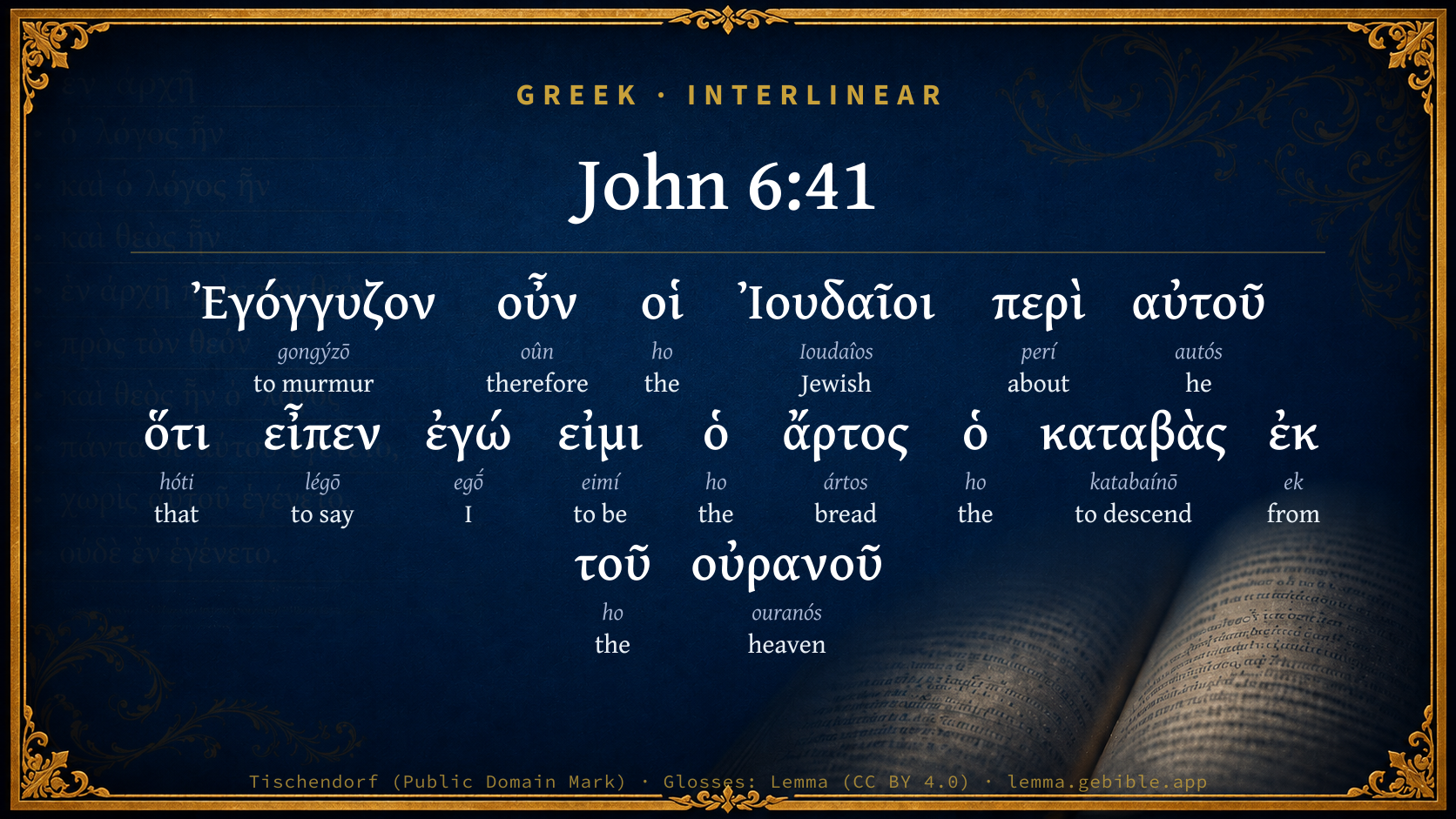
  1. οὖν oûn G3767 “therefore” Conjunction
  2. οἱ ho G3588 “the” Article, Nominative, Plural, Masculine
  3. Ἰουδαῖοι Ioudaîos G2453 “Jewish” Adjective, Nominative, Plural, Masculine
  4. περὶ perí G4012 “about” Preposition
  5. αὐτοῦ autós G846 “he” Personal pronoun, Genitive, Singular, Masculine
  6. ὅτι hóti G3754 “that” Conjunction
  7. εἶπεν légō G3004 “to say” Verb, Aorist, Active, Indicative, 3rd person, Singular
  8. ἐγώ egṓ G1473 “I” Personal pronoun, 1st person, Nominative, Singular
  9. εἰμι eimí G1510 “to be” Verb, Present, Active, Indicative, 1st person, Singular
  10. ὁ ho G3588 “the” Article, Nominative, Singular, Masculine
  11. ἄρτος ártos G740 “bread” Noun, Nominative, Singular, Masculine
  12. ὁ ho G3588 “the” Article, Nominative, Singular, Masculine
  13. καταβὰς katabaínō G2597 “to descend” Verb, Aorist, Active, Participle, Nominative, Singular, Masculine
  14. ἐκ ek G1537 “from” Preposition
  15. τοῦ ho G3588 “the” Article, Genitive, Singular, Masculine
  16. οὐρανοῦ ouranós G3772 “heaven” Noun, Genitive, Singular, Masculine

About this verse

These counts appear in no published source. They are computed here, from the morphology-tagged text and Lemma’s own curated glosses. What Lemma adds →

17
words
14
distinct lemmas
Gospels
section

Notable vocabulary

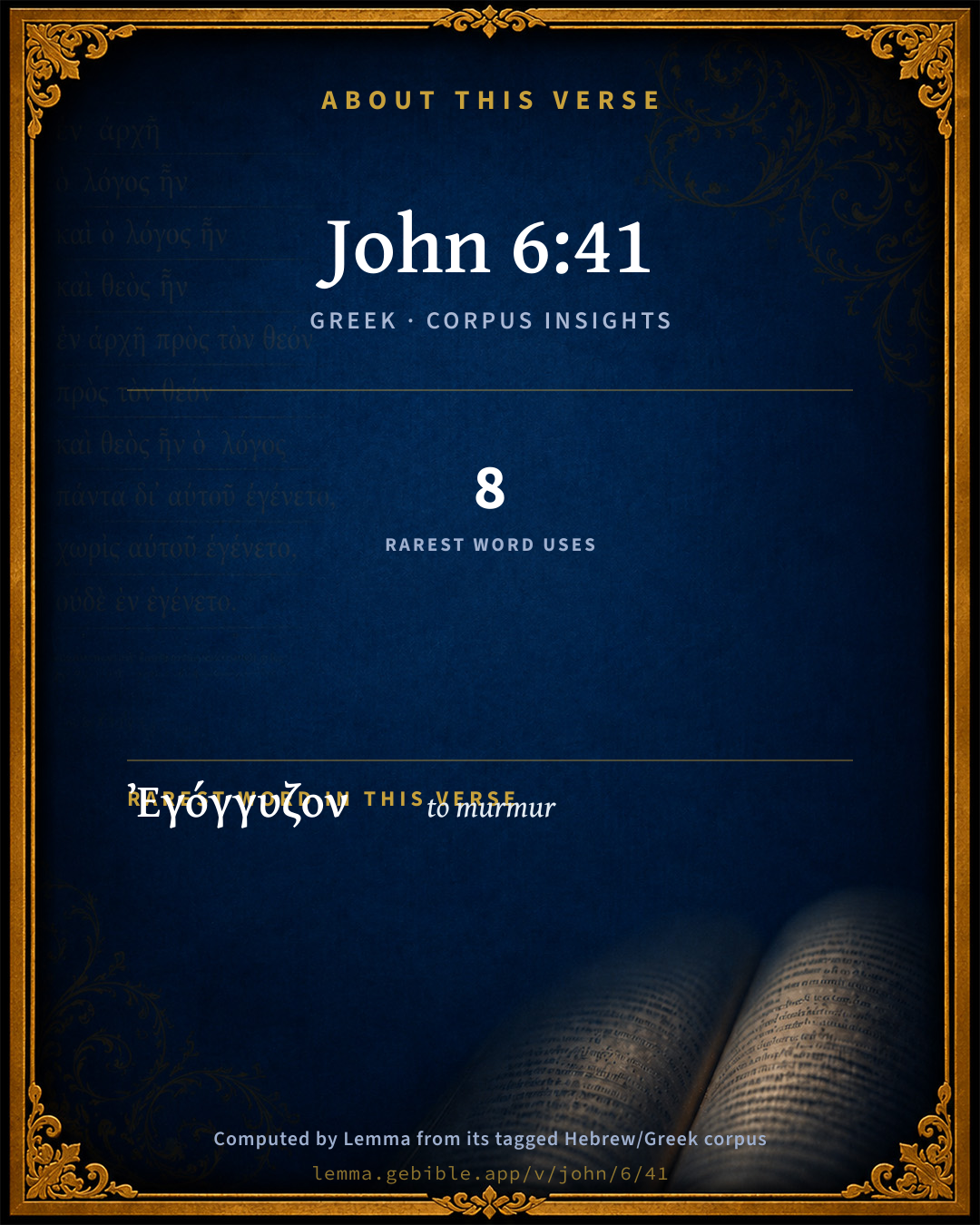
The rarest word here is Ἐγόγγυζον to murmur G1111 — appearing just 8 times in the whole Greek New Testament.

Shared distinctive vocabulary

Ἐγόγγυζον to murmur G1111 occurs in 7 verses of the Greek New Testament. Also found in:

Repetition

A word recurs within this verse:

Cross-references

13

Topical passages linked to John 6:41 in the Treasury of Scripture Knowledge — connected by theme and wording, ordered by reader-vote popularity; previews shown in the World English Bible.

  • John 6:51–52 I am the living bread which came down out of heaven. If anyone eats of this bread, he will live forever. Yes, the bread which I will give for the life of the world is my flesh."
  • John 6:33 For the bread of God is that which comes down out of heaven, and gives life to the world."
  • John 6:48 I am the bread of life.
  • John 6:60 Therefore many of his disciples, when they heard this, said, "This is a hard saying! Who can listen to it?"
  • John 6:66 At this, many of his disciples went back, and walked no more with him.
  • John 7:12 There was much murmuring among the multitudes concerning him. Some said, "He is a good man." Others said, "Not so, but he leads the multitude astray."
  • Luke 5:30 Their scribes and the Pharisees murmured against his disciples, saying, "Why do you eat and drink with the tax collectors and sinners?"
  • Luke 15:2 The Pharisees and the scribes murmured, saying, "This man welcomes sinners, and eats with them."
  • Luke 19:7 When they saw it, they all murmured, saying, "He has gone in to lodge with a man who is a sinner."
  • John 6:43 Therefore Jesus answered them, "Don't murmur among yourselves.
  • John 6:58 This is the bread which came down out of heaven-- not as our fathers ate the manna, and died. He who eats this bread will live forever."
  • Jude 1:16 These are murmurers and complainers, walking after their lusts (and their mouth speaks proud things), showing respect of persons to gain advantage.
  • 1 Corinthians 10:10 Neither grumble, as some of them also grumbled, and perished by the destroyer.

Cross-references courtesy of OpenBible.info (CC BY 4.0).

Commentary

Notes on John 6:41 from classic Christian and Jewish commentators (each source and its license shown beneath its notes). The classic Christian expositions comment on the surrounding passage and are grouped to its opening verse, so a note may address several verses; the Jewish commentaries on the Tanakh (Rashi and others) are per-verse, so they appear only where the commentator wrote on this verse.

Lemma curates 59 commentaries, every one of them public domain or Creative Commons licensed, each selected and text-cleaned for this edition rather than reprinted as found. About our sources →

The Biblical Illustrator

Joseph S. Exell

Joh_6:41-51

The Jews then murmured at Him because He said, I am the bread which came down from heaven

Weighty truths

I.

THAT CHRISTS LOWLY CONDITION IS A STUMBLING-BLOCK TO THE NATURAL MAN.

1. Had He come as a conqueror with royal favours for His followers they would have received Him willingly; but their pride refused to believe that the lowly prophet was from God.

2. There is nothing surprising in this. It is human nature showing itself in its true colours (1Co_1:23). Thousands reject the gospel because of its humbling doctrines. Christs teaching and example they admire, but His blood they cannot away with.

II. MANS NATURAL INABILITY TO REPENT AND BELIEVE, until the Father draws him. We are spiritually dead and without the power to give ourselves life. The will of man is the part of him that is in fault. It would not be true to say that a man has wish to come, but no power; it is that a man has no power because he has no desire.

III. THE SALVATION OF A BELIEVER IS A PRESENT THING. It is not said that he shall have life at the judgment day, but that he has it now. (Bishop Ryle.)

Four enigmas solved

I. The enigma of CHRISTS HEAVENLY ORIGIN (Joh_6:41-43).

1. The mystery propounded. The difficulty was not that the Messiahs origin should be mysterious. The popular opinion, based on Dan_7:13, was that when Christ came no one should know whence He was (vii. 27). But the Jews supposed that they knew exactly whence Jesus was, and that He should have come down from heaven seemed absurd.

2. The mystery resolved. What to the learned Scripturists of His day was a puzzle He left a puzzle. To have refuted their objections by a declaration of what took place at Bethlehem would only have increased their incredulity. The true method of faith is not to believe that Christ is Divine because the Incarnation story is authentic: but that Christ having been powerfully declared to be the Son of God with power by His resurrection (Rom_1:4), the account given of His conception must be correct.

II. The enigma of MANS RESPONSIBLITY (verses 43-45).

1. The difficulty set forth. Christ blamed His hearers for their unbelief (verse 36), and yet affirmed (verse 44). This is what the intellect of centuries has wrestled with.

2. The difficulty set aside.

(1) Not by denying the fact of mans responsibility (Joh_5:40; Joh_6:36). This the Scripture often declares (Rom_1:18; Rom_6:23; Eph 1Pe_3:12) and conscience confirms.

(2) Not by explaining away the alleged necessity of Divine grace (verses 37, 44, 45). But

(3) By showing that the Fathers drawing interferes pot with human freedom. In naming it drawing and a teaching Christ makes it a moral suasion.

III. Enigma of SAVING FAITH (verses 46, 47).

1. The perplexity stated. If no one could come to Him without first hearing and learning of the Father, then no one could come (Exo_33:20; 1Ti_6:16). This, though not expressed, was clearly the hearers thoughts.

2. The perplexity recognized. He admitted that no one had ever seen the Father.

3. The perplexity removed. He, the Son, had seen the Father (verses 19; 1:18; 16:28). Hence to hear and learn of the Father was to hear and learn of Him whom He had sent. To learn of the Father one must be a disciple of Christ.

IV. The enigma of ETERNAL LIFE (verses 47-51).

1. The riddle proposed. The manna had only supported physical life for a few years, and those who had partaken of it were dead. The Jews were at a loss to know how Christ could do more for them than Moses.

2. The riddle read.

(1) The bread of life was a living, spiritual Person (verse 48).

(2) It was in itself living and life-giving.

(3) When eaten by the soul it communicates to the soul the life itself contained.

(4) The soul thus vivified could not die. (T. Whitelaw, D. D.)

Reason and faith

There is nothing so truly reasonable as to exclude reason from the province of faith; and nothing so truly irrational as to lose sight of reason in things which are not necessarily of faith. The two excesses are equally dangerous--to shut out reason, or to make it all in all. Faith tells us what the senses cannot tell; but it never contradicts them; it is above, and not against them. (Pascal.)

Murmuring a great sin

Consider that murmuring is a mercy-embittering sin, a mercy-souring sin. As the sweetest things put into a sour vessel sours them, or put into a bitter vessel embitters them, so murmuring puts gall and wormwood into every cup of mercy that God gives into our hands. The murmurer writes Marah, that is, bitterness, upon all his mercies, and he reads and tastes bitterness in them all. As to the hungry soul every bitter thing is sweet, so to the murmuring soul every sweet thing is bitter. (T. Brook.)

Murmuring a hydra-headed sin

As the River Nile bringeth forth many crocodiles, and the scorpion many serpents, at one birth, so murmuring is a sin that breeds and brings forth many sins at once. It is like the monster hydra--cut off one head and many will rise up in its room. It is the mother of harlots, the mother of all abominations, a sin that breeds many other sins, viz., disobedience, contempt, ingratitude, impatience, distrust, rebellion, cursing, carnality; yea, it charges God with folly, yea, with blasphemy. The language of a murmuring soul is this, Surely God might have done this sooner, and that wiser, and the other thing better. (T. Brooks.)

No man can come unto Me, except the Father which hath sent Me draw him

Coming to Christ

I. THE RELIGIOUS ACTION OF WHICH CHRIST SPEAKS. Coming to Him--a frequent Scriptural phrase expressive of the first step in religion.

1. Its nature. An act of the soul. There was no impediment to a literal approach. He was always accessible. Coming is used for faith in Christ as prophet, priest, and king, and living on His fulness for all spiritual purposes.

2. Its importance.

(1) Implied in the invitation of Scripture, Come unto Me.

(2) In the promises (Joh_6:37).

(3) In the directions, Believe on the Lord Jesus Christ.

(4) In the decisions, If ye believe not ye shall die.

II. THE INABILITY OF MAN TO PERFORM IT OF HIMSELF. Whence does this arise?

1. Not from any Divine decree, for it would be neither just nor reasonable to command men to believe and to decree that they should not. But

2. From the depravity of the heart.

3. And in some cases carnal policy operates to fetter the mind to its moral powers. Success in life is the one thing needful.

4. From religious mistakes. Some imagine that they have come in sacramental actions, or by the repetition of certain words, or by good works.

III. THE DIVINE AGENCY BY WHICH IT IS ACCOMPLISHED.

1. The Father. He draws by moral and persuasive means. He draws man as guilty that He may be pardoned; as ignorant, that he may be instructed, etc.

2. The process is generally conviction of sin, desire for salvation, direction to the cross, discovery of a Saviour, trust, safety, rest.

IV. THE DELIVERANCE PROMISED.

1. The solemn event which the language implies. We must die.

2. The resurrection promised. The event is general, but the benefit is particular.

3. The agency by which it is effected. I, which shows the dignity and power of Christ.

4. The period of its performance--the last day. The day for which all others were made, and to which they are introductory.

Conclusion:

1. In coming to Christ nothing can prevent your salvation (Joh_10:27-29).

2. In turning from Him-nothing can save you from perdition. (J. E. Good.)

The Christian now drawn to Christ, and hereafter to be raised by Him

I. OUR COMING TO CHRIST.

1. This is not to be understood corporeally. It was not so taken by Himself. Ye will not come, and yet many literally come from captiousness, curiosity, for loaves and fishes, and under temporary emotion, and after awhile went back.

2. But the expression is taken from the body, and there is hardly a part of it that has not been used to hold forth the operations of faith. Sometimes the reference is

(1) To the eye; then believing is seeing Christ.

(2) To the ear; then believing is hearing Him.

(3) To the taste; then believing is eating His flesh and drinking His blood.

(4) To the head; then believing is knowing Him.

(5) To the feet; then believing is coming to Him.

3. This coming to Christ implies

(1) Absence. Else why come?

(2) Accessibleness. How can we come unless we can approach

Him? Lo, I am with you alway.

(3) Application. We come to Him

(a) As the way that we may walk with Him;

(b) As to a refuge that we may enter Him;

(c) As to a fountain that we may be cleansed;

(d) As a foundation on which we may build;

(e) As to a physician for cure;

(f) As our prophet, priest, and king, to be taught, saved, and ruled over by Him.

4. Faith is trust, confidence.

II. MANS INABILITY WITHOUT DIVINE AGENCY.

1. This is a very unwelcome doctrine, even to those who admit human depravity; but it is wrapped up in that depravity.

2. This is a Scriptural doctrine--In our flesh dwelleth no good thing.

3. This is a doctrine based upon the nature of things. As we cannot perform natural actions without the concurrence of nature, how can we perform spiritual actions without the concurrence of the Spirit?

4. This is a doctrine of importance.

(1) It serves to show those who are the subjects of this work what is their duty to bless and praise God for His sovereign grace.

(2) It serves to show sinners their duty to pray to Him who wills all men to be saved.

III. THE INFLUENCE BY WHICH THE SOUL IS BROUGHT TO THE SAVIOUR. In a general way the Father draws thus.

1. There is a confliction of sin

2. This produces distress and fear:

3. Hence renunciation and despair.

4. Yet along with this is hope.

5. Concurrently new desires after Jesus.

6. Reception of Jesus as a Saviour, and reliance on His salvation.

IV. THE FINAL BLESSEDNESS RESULTING FROM THIS.

1. The speciality of this reference. He will raise all, but the privilege is limited to some.

2. The memory of this blessedness. It is the completion of the blessedness of a persevering Christian life. Without the body the Christian man would be incomplete. Man will be raised infinitely improved.

3. The Author of it. Christ is not only the model of this resurrection, but its accomplisher.

4. Its certainty. If it were not so, He would have told them. Because I live ye shall live also. (W. Jay.)

Human inability

I. MANS INABILITY. Wherein does this consist?

1. Not in any physical defect. If in coming to Christ moving the body should be any assistance, or includes the utterance of a prayer, man can come.

2. Nor in any mental lack. Man can believe in the Bible and in Christ as in anything else. But

3. In his nature, which is so debased by the Fall that it is impossible for him to come without the assistance of the Holy Spirit. To enter into the subject of this inability note

(1) It lies in the obstinacy of the human will, which is set on mischief and disinclined to that which is good.

(2) The understanding is darkened so that it cannot perceive the things of God until opened by the Holy Spirit.

(3) The affections are depraved and must be renewed. We love that we ought to hate, and hate that we ought to love.

(4) Conscience has been impaired by the Fall, and must be repaired.

4. So that while largely this is a question of the will, it is not exclusively so, for sometimes even in the regenerate there is will without power, much more in those who are dead in trespasses and sins.

5. Were it otherwise, how are we to account for the uniform testimony of the Scriptures that our salvation is wholly due to God?

6. This doctrine is condemned for its hurtful tendency. But what doctrine is there that will not hurt a man if he chooses to make hurt of it? So with this otherwise it only hurts Satans kingdom.

7. You are not warranted in saying, If I cannot save myself and cannot come to Christ, I must sit still and do nothing. There are many things you can do.

(1) To be found continually in the house of God is in your power.

(2) To study the Word of God.

(3) To renounce outward sin.

(4) To make your life honest, sober, righteous.

8. But your want of power is no excuse, seeing you have no desire to come, and are living in wilful rebellion. Suppose a liar has been a liar so long that he says he has no power to speak the truth, is that an excuse? Ii a drunkard has become so foully a drunkard that he cannot pass a public-house, do you therefore excuse him? No; because his inability to reform lies in his nature, which he has no desire to conquer.

II. THE FATHERS DRAWINGS.

1. God draws men by the preaching of the gospel, but not by this alone, for the men of Capernaum had the gospel in its fulness, and attested by miracles. There is such a thing as being drawn by a minister without being drawn by God.

2. Clearly it is a Divine drawing, a sending out of the Third Person in the Holy Trinity.

3. In this there is no compulsion. Christ saves no one against his will.

4. How then does the Holy Spirit draw him? By making him willing. He goes to the secret fountain of the heart and he knows how, by some mysterious operation, to turn the will in an opposite direction. But he is saved with full consent, for he is made willing in the day of Gods power. Draw me and I will run after Thee.

5. How this is done is a mystery, but the apparent way is:

(1) He finds a man with a good opinion of himself--an effectual barrier to coming to Christ--and lays bare,the mans heart, full of sin, so that he stands aghast.

(2) The man says I will try and reform--another barrier--but the Holy Spirit shows him he cannot do this.

(3) The heart sinks, and the man is ready to despair--then the Spirit shows him the Cross and enables him to believe.

III. APPLICATION:

1. One says, If all this be true, what is to become of my religion? I must give it up and begin again. That will be better than building on the sand of your ability, and as soon as you say, I cannot come to Christ; Lord draw me, grace is begun in your heart, and God will not leave you till the work is finished.

2. Careless sinner, thy salvation hangs in Gods hand, and He is the Gad thou art grieving every day. Does not this make them tremble. If so the Spirit has begun to draw.

3. Some of you are conscious that you are coming to Christ. It is the Fathers doing--With lovingkindness have I drawn thee.

4. Rejoice in this love those of you who have come. (C. H. Spurgeon.)

Things to be remembered

I. We must never suppose that the doctrine of this verse TAKES AWAY MANS RESPONSIBILITY to God for his soul. On the contrary, the Bible always distinctly declares that if any man is lost, it is his own fault Mar_8:36). If we cannot reconcile Gods sovereignty and mans responsibility now, we need not doubt that it will be all plain at the last day.

II. Nor does Christs teaching here LIMIT THE OFFERS OF SALVATION TO SINNERS. On the contrary, we must hold firmly that pardon and peace are to be offered freely through Christ to all without exception. We never know who they are that God will draw, and have nothing to do with it. Our duty is to invite all, and leave it to God to choose the vessels of mercy.

III. We must not suppose THAT WE, OR ANYBODY ELSE, ARE DRAWN, UNLESS WE COME TO CHRIST BY FAITH. This is the grand mark and evidence of any one being the subject of the Fathers drawing work. If drawn he comes to Christ, believes, and lives. Where there is no faith and love, there may be talk, self-conceit, and high profession. But there is no drawing of the Father.

IV. We must always remember THAT GOD ORDINARILY WORKS BY MEANS, and specially by such means as He Himself has appointed. No doubt He acts as a sovereign. But we must carefully maintain the great principle that God ordinarily draws through the instrumentality of His Word. The man that neglects the public preaching and private reading of Gods Word, has no right to expect that God will draw him. The thing is possible, but highly improbable.

V. WE MUST NEVER ALLOW OURSELVES OR OTHERS TO WASTE TIME IN TRYING TO FIND out, as a first question, WHETHER WE ARE DRAWN OF GOD the Father, elect, chosen, and the like. The first and main question is, whether we have come to Christ by faith. If we have, let us take comfort and be thankful. (Bp. Ryle.)

The drawing of the Father

Man is like a waggon sunk in the mire under a heavy load, and Divine love is the strong team which draws it up and draws it forward. (R. Besser, D. D.)

Just as the magnet does not attract everything, but only iron, so there must be in man a disposedness of heart, before Gods drawing can take hold of him. (Theophylact.)

A man cannot come to Christ unassisted by the Holy Spirit

I have seen a captive eagle, caged far from its distant home, as he sat mournful-like on his perch, turn his eye sometimes heavenwards; there he would sit in silence, like one wrapt in thought, gazing through the bars of his cage up into the blue sky; and after a while, as if noble but sleeping instincts had suddenly awoke, he would start and spread out his broad sails, and leap upward, revealing an iron chain that, usually covered by his plumage, drew him back again to his place. But though this bird of heaven knew the way to soar aloft, and sometimes, under the influence of old instincts, decayed, but not altogether dead, felt the thirst of freedom, freedom was not for him, till a power greater than his own proclaimed liberty to the captive, and shattered the shackles that bound him to his perch. Nor is there freedom for us till the Holy Spirit sets us free, and by the lightning force of truth, breaks the chains that bind us to sin. (Dr. Guthrie.)

Why men cannot come to Christ

You see a mother with her babe in her arm. You put a knife into her hand and tell her to stab that babe to the heart. She replies, very truthfully, I cannot. Now, so far as her bodily power is concerned she can if she pleases, there is the knife, and there is the child. But she is quite correct when she says she cannot do it. Her nature as a mother forbids her doing that from which her soul revolts. It is even so with a sinner. Coming to Christ is so obnoxious to human nature that, although so far as physical and mental forces are concerned men could come if they would, it is strictly correct to say that they cannot and will not unless the Father who hath sent Christ doth draw them. (C. H.Spurgeon.)

And they shall be all taught of God

The teachings of God opened

I. WHAT IS IMPORTED BY OUR BEING TAUGHT OF GOD.

1. Negatively. The text is not to be understood

(1) of any extraordinary, visional appearances, or miraculous and immediate voice of God (Num_12:8; Heb_1:1-2),

(2) nor as opposite to or exclusive of the teachings of men. Saul was taught of God (Gal_1:12). Yet the ministry of Ananias was honoured (Act_9:4; Act_9:17).

2. Positively: the teachings of God (2Co_4:6 : Joh_14:26) are

(1) The sanctifying impressions of the Holy Spirit by virtue of which the soul receives marvellous light and insight into spiritual things, and this not only at conversion but continuously (1Jn_2:27; Joh_7:17; Jer_31:33). Sanctification gives the soul experience of the truths of Scripture.

(2) The gracious assistances of the Spirit as our need requires Mat_10:19; Joh_14:26).

II. WHAT THOSE SPECIAL TRUTHS ARE WHICH BELIEVERS LEARN.

1. That there is abundantly more evil in their natures than they ever discerned before (Joh_16:8-9). There is threefold knowledge of sin.

(1) Traditional in the rude multitude;

(2) discursive in the more rational;

(3) intuitive in the divinely enlightened.

2. The wrath and misery which hang over the world in consequence of sin. Scripture threatenings were before slighted (Isa_28:15; Psa_50:21); now they see that the wages of sin is death (Rom_6:1-23.).

3. That deliverance from sin is the greatest business man has to do in this Act_16:30).

4. That though it be obligatory to strive after salvation, yet ones own strength is insufficient to attain it.

5. That though the case be sad it is not remediless. There is a door of hope and way of escape.

6. That there is a fulness of saving power in Christ whereby any soul that duly receives Him may be delivered from all its guilt and misery Heb_7:25; Col_1:19; Mat_28:18).

7. That we can never reap any benefit from the blood of Christ without union with Christ (1Jn_5:12; Eph_4:16).

8. That whatever is necessary in order to this union is to be obtained in the way of prayer (Eze_36:37).

9. To abandon their former ways and companions (Isa_55:7; 2Co_5:17; Psa_119:115), and to see the beauty and excellency of the ways and people of God (Psa_16:3; Zec_8:23).

10. That whatever difficulties there maybe in religion they must not be discouraged or return to sin (Luk_9:62; 1Co_9:24).

III. WHAT ARE THE PROPERTIES OF DIVINE TEACHING. God teaches

1. Powerfully (2Co_10:4; 1Th_1:4-5; 1Co_14:25).

2. Sweetly (Son_1:3; Son_5:16),

3. Clearly (2Co_3:16; Luk_24:45).

4. Infallibly (Joh_14:13).

5. Abidingly (Psa_119:98; Jer_31:33).

6. Savingly (2Ti_3:15; Joh_17:3).

7. Penetratively (Mat_11:25; Isa_32:4).

8. Transformingly (2Co_3:18; Rom_6:17).

IV. WHAT INFLUENCE DIVINE TEACHINGS HAVE UPON SOULS IN BRINGING THEM TO CHRIST.

1. They have an influence upon the means (2Co_3:6; 1Co_3:7).

2. Upon the mind to remove what hindered it from Christ.

3. They powerfully allure the sinner to Christ (Hos_2:14).

V. WHY IS IT IMPOSSIBLE FOR ANY MAN TO COME TO CHRIST WITHOUT THE FATHERS TEACHINGS. Because

1. Of the power of sin

(1) Sin is co-natural with the soul (Psa_51:4; Isa_48:8).

(2) The power of sin hath been strengthened by long continued custom which gives it the force of a second nature (Jer_15:23).

(3) Sin is the delight of the sinner (Pro_10:23).

2. Of the indisposition of man (1Co_2:14). Before he can come to Christ

(1) His blind understanding must be enlightened, which is the work of God (2Co_4:6; Rev_3:17; Eph_5:8).

(2) His hard heart must be broken and melted (Act_5:31; Eze_36:26).

(3) His stiff and obstinate will must be conquered (Php_2:13).

3. Of the nature of faith, everything in which is supernatural.

(1) The habit (Eph_2:8).

(2) The light (Heb_11:1; Heb_11:27).

(3) The adventures (Rom_4:18).

(4) The self-denial (Mat_5:29).

(5) The victories (Heb_11:33-34; Act_15:9; 1Jn_5:4). (John Flavel.)

The Christian taught of God

I. THE RECIPIENTS OF THE TEACHING. The people of God; all of them, from the least to the greatest; and that not only instrumentally but directly.

II. ITS SUBJECTS. Spiritual things generally, called

1. Things of God, pertaining to Him and our relationship to Him. His nature and ours; His moral character and ours; His sovereignty and our dependence and duty; His salvation and our need of it.

2. Things of Christ, relating to His person, offices and work.

3. Things of the Spirit, our need of Him; the reality of His influence; His indwelling.

III. ITS NECESSITY.

1. They must be taught. Why so?

(1) Because an all-wise God has ordained it.

(2) Because our ignorance and spiritual darkness require it.

(3) Because this knowledge is the germ of everything of a saving and holy character in a sinners heart.

2. None but God can effectually teach them.

(1) He does not supersede the teaching of His servants, but energizes it.

(2) When the ordinary means fail He does His own teaching.

IV. ITS MEANS.

1. His written Word.

(1) To this all others are subsidiary, and are only helpful so far as they are related to it. Preaching; creeds.

(2) This excludes tradition, modern, so called, inspiration.

(3) But the written Word is not sufficient without the aid of the

Holy Spirit to act upon the heart and to apply its truths.

2. His providence. The man of commerce forgets, e.g., that they that will be rich fall into a temptation and a snare, and the God of providence by a calamity brings it to his mind.

3. The Christians inward experience. This harmonizes wonderfully with Scripture, throwing light upon it, and confirming it.

V. ITS EFFECT. God teaches that He may

1. Save.

2. Comfort.

3. Sanctify.

4. Make useful.

5. Make meet for heaven. (C. Bradley, M. A.)

Divine light necessary to our salvation

The gospel is a picture of Gods free grace to sinners. Were we in a room hung with the finest paintings, and adorned with the most exquisite statues, we could not see one of them if all light were excluded. Now the blessed Spirits illumination is the same to the mind that outward light is to the bodily eyes. A compass is of no use to the mariner unless he have light to see it by. (Toplady.)

Conviction by the Holy Spirit necessary to conversion

Take the cold iron, and attempt to weld it, if you can, into a certain shape. How fruitless the effort! Lay it on the anvil, seize the blacksmiths hammer with all your might, let blow after blow fall upon it, and you will have done nothing; but put it in the fire, let it be softened and made malleable, then lay it on the anvil, and each stroke shall have a mighty effect, so that you may fashion it into any form you may desire; so take your heart, not cold as it is, not stony as it is by nature, but put it into the furnace; there let it be molten, and after that it can be turned like wax to the seal, and fashioned into the image of Jesus Christ. (C. H. Spurgeon.)

Divine teaching necessary

No human teacher can do it. Conscience cannot do it. Law in none of its forms, human or Divine, can do it. Nay, the gospel itself cannot do it. Although the Word of God is the sword of the Spirit, yet, unless the Spirit of God draws forth that sword, it lies powerless in its sheath. Only when the Spirit of God wields it, is it quick and powerful, and sharper than a two-edged sword, piercing to the dividing asunder of the soul and spirit, a discerner of the thoughts and purposes of the heart. Therefore, as the work of convincing the world of sin is one which nothing less than the Spirit of God can effect--and which yet must be effected thoroughly, if sin is to be driven out from the world--our Saviour was mercifully pleased to send the Comforter to produce this conviction in mankind. (Archdeacon Hare.)

Taught of God

I. THE PERSONS TO WHOM THE PROMISE IS MADE.

1. They must be living ones or they cannot be taught anything. They become so by being quickened together with Christ (Eph_2:5).

2. They are described in Isa_54:13.

3. All that the Father hath given Christ (verses 37, 39). Given

(1) in the covenant of grace to preserve and to teach;

(2) in effectual calling (Joh_17:6).

4. In short, they are those who are loved by the Father, redeemed by the Son and quickened by the Spirit.

II. WHAT SHALL THEY BE TAUGHT?

1. To know themselves

(1) as sinful (Luk_15:18; Rom_7:18).

(2) Their own helplessness (Isa_38:14; Mat_14:30; Joh_15:5).

(3) Their own ignorance (Psa_25:5; Job_36:22).

2. To know Christ as their way of life and salvation.

(1) The suitableness of His righteousness (Isa_45:24).

(2) The completeness of His atonement (Heb_1:26).

(3) The riches and efficacy of His grace (Joh_1:16; Tit_2:12).

(4) In short to embrace Him as their wisdom, etc. (1Co_1:36), and their Saviour from the charge, punishment, guilt, love, and dominion of sin.

3. To use the means of grace

(1) Prayer;

(2) Reading and hearing Gods Word.

(3) The Lords Supper. (S. Barnard.)

The character of faith

The text shows us

I. WHAT FAITH IS. COMING TO CHRIST.

II. THE REASONABLENESS OF FAITH. It is not the offspring of a diseased imagination, but the result of Divine teaching.

III. THE IMPORTANCE OF CHRIST. All Gods teaching is designed to make us feel our need of Christ. (Preachers Analyst.)

The Biblical Illustrator, edited by Joseph S. Exell (c. 1880s–1900s) — public domain. Text from a community e-Sword module.

Joseph Benson's Commentary

Joh 6:41-47. The Jews then murmured at him — The dispositions of the greatest part of the Jews being carnal, the doctrine of our Lord respecting the spiritual nature of the blessings which his followers were to receive, and especially his affirming that he was the bread of life, and that he came down from heaven, greatly offended them. And they said, Is not this Jesus, the son of Joseph, &c. — Was he not born into the world as other men are, and are we not well acquainted with his parents, and know him to be earth- born? How then can he pretend to have come down from heaven? Jesus answered, Murmur not among yourselves — On account of my words, for it is not want of truth in them, but want of affection to my doctrine, and your not considering the testimony God hath given to it, that makes you thus to murmur at and reject what I say. Set yourselves, therefore, to reflect seriously on your present state, and on your true interest. I know indeed that your prejudices against me are strong, and, without the influences of divine grace, will prove invincible and fatal: for, such is the moral blindness and degeneracy of human nature, that no man can come to me — Namely, by a saving faith; except the Father which hath sent me draw him — By the influence of his Holy Spirit on the heart, saving faith being of the operation of God, and the gift of God, Col 2:12; Eph 2:8. In other words, no man can believe in Christ to the saving of his soul, unless God give him power: God draws us first by good desires, not by compulsion, not by laying the will under any necessity; but by the strong and sweet, yet still resistible motions of his heavenly grace. That the expression, applied to reasonable agents, does not import any force or constraint, is plain from Jer 31:3, where God says to Israel, With loving kindness have I drawn thee; that is, by the manifold benefits which I have bestowed on thee, and particularly by the revelation of my will committed to thee, and have prevailed with thee to obey me. Thus also our Lord uses the expression, Joh 12:32; If I be lifted up from the earth I will draw all men unto me; that is, being put to death on the cross, and raised from the dead, and exalted into heaven, and preached through the world, I will, by my word and Spirit, persuade many to follow me to heaven. Thus also, Hos 11:4, God says, he drew Israel with the cords of a man, with bands of love. Wherefore, by the Father’s drawing men to Christ we may understand his persuading them to believe on him, by the several proofs wherewith he has supported his mission, by the doctrine of his gospel, and by those influences of his grace, which are necessary to give men a right discernment of the evidences of religion, and of the certainty and importance of the great truths of it, and to impress these things deeply on their minds. Accordingly, in the following verse, the effect which the Father’s drawing hath upon men, is described by their hearing and learning of him. It is written in the prophets, (see the margin,) they shall be all taught of God — Namely, not merely by his word, but also and especially by his Spirit, termed therefore, (Eph 1:17,) the Spirit of wisdom and revelation. “Before the coming of Christ the Father spake to the world concerning him by the prophets, and when he appeared in the human nature on earth, he demonstrated the truth of his mission by the testimony of John, and by voices from heaven, declaring him to be his beloved Son, and commanding all men to hear him. He did the same likewise by the doctrines which he inspired Jesus to preach, by the miracles which he gave him to perform, and by the influences of the Spirit which he empowered him to dispense.” Every man therefore, &c. — Every one that hath heard and understood what the Father hath said concerning the Messiah, whether by the prophets or by John the Baptist, or by the voices from heaven, or by my doctrine and miracles, and has also been enlightened, and drawn by the influences of the Holy Spirit; cometh unto me — Will believe on me, and cordially receive me under the character I profess. Not that any man hath seen the Father — Not that I mean, when I speak of men’s hearing and learning of God, that they can see God personally, and be taught of him in the manner that a scholar is taught of his master; save he who is of God — No man hath seen the Father personally, except the Son, who is come to men as the great ambassador from God; he, indeed, being statedly resident with him, and inseparably united to him, has seen the Father, and enjoyed that intimacy with him which no creature can pretend to have known.

Joseph Benson's Commentary on the Old and New Testaments (1811–1818) — public domain. Text from a community e-Sword module.

Tyndale Open Study Notes

Tyndale Open Resources

6:41-42 When Jesus identified himself as the true bread . . . from heaven, the crowd faced a decision. • Isn’t this . . . the son of Joseph? They stumbled because their familiarity with Jesus made his claims seem outlandish.

Tyndale Open Study Notes — © Tyndale Open Resources, licensed CC BY-SA 4.0. Text via the HelloAO Bible API.

Bengel's Gnomon

Johann Albrecht Bengel

Joh 6:41. Ἐγόγγυζον, began to murmur) Jesus however was aware of it [though not spoken aloud]: Joh 6:43, “Murmur not among yourselves.”—ὁ ἄρτος, the bread) They take hold of the language of His, that was allegorical: they neglect the explanation, which was added in plain words.

Bengel's Gnomon of the New Testament — English translation (T&T Clark, Edinburgh, 1860) — public domain. Text from a community e-Sword module.

Meyer's Critical & Exegetical Commentary

Heinrich August Wilhelm Meyer

Joh_6:41-42. They murmured, and this μετʼ ἀλλήλων, Joh_6:43, against Him with reference to what He had said, viz. that, etc. Upon all the rest they reflect no further, but this assertion of Jesus impresses them all the more offensively, and among themselves they give expression half aloud to their dissatisfaction. This last thought is not contained in the word itself (comp. Joh_7:32; Joh_7:12; according to Pollux, v. 89, it was also used of the cooing of doves), but in the context (οἱ Ἰουδαῖοι). We are not therefore, as De Wette supposes, to think of it merely as a whispering. Comp. rather Joh_6:61; Mat_20:11; Luk_5:30; 1Co_10:10; Num_11:1; Num_14:27; Sir_10:24; Jdt_5:22; Lobeck, ad Phryn. p. 358.

οἱ Ἰουδαῖοι] The opposition party among the Jews were therefore among the ὄχλος (Joh_6:5; Joh_6:22; Joh_6:24). Even in the congregation of the synagogue itself (Joh_6:59), though it included many followers of Jesus (Joh_6:60), there may have been present members of the spiritual aristocracy (see on Joh_1:19). The assumption that the ὄχλος itself is here called οἱ Ἰουδαῖοι, on account of its refusal to recognise Jesus (De Wette, Tholuck, Baur, Brückner, Hengstenberg, Godet, and most others), is more far-fetched, for hitherto the ὄχλος had shown itself sensuously eager indeed after miracles, but not hostile.

ἐγώ εἰμι ὁ ἄρτος κ.τ.λ.] compiled from Joh_6:33; Joh_6:35; Joh_6:38.

οὗτος] on both occasions, contemptuously.

ἡμεῖς] we on our part.

οἴδαμεν τ. πατ. κ. τ. μητ.] This human descent which they knew (comp. Mat_13:55) seemed to them in contradiction with that assertion, and to exclude the possibility of its truth. Heb_7:3 (ἀπάτωρ ἀμήτωρ) does not apply here, because it is not a question of the Messiahship of Jesus, but of His coming down from heaven.

τὸν πατέρα κ. τὴν μητ.] The words, on the face of them, convey the impression that both were still alive; the usual opinion that Joseph (whom subsequent tradition represents as already an old man at the time of his espousal with Mary; see Thilo, ad Cod. Apocr. I. p. 361) was already dead, cannot, to say the least, be certainly proved (comp. also Keim, Gesch. J. I. 426), though in John also he is entirely withdrawn from the history.

Meyer — Critical and Exegetical Commentary on the New Testament — English translation by Peter Christie, edited by Frederick Crombie (T&T Clark, 1880) — public domain. Text from a community e-Sword module.

Expositor's Greek Testament

ed. W. Robertson Nicoll

Joh 6:41-51 . In this paragraph we are first told how the Jews were staggered by our Lord’s affirming that He had come down from heaven; second, how Jesus explains that in order to understand and receive Him they must be taught of God; and third, how He reiterates His claim to be the Bread of Life, adding now the explanation that it is His flesh which He will give for the life of the world.

Joh 6:41 . Ἐγόγγυζον … οὐρανοῦ . “The Jews,” not as we might expect, “the Galileans,” probably because John identifies this unbelieving crowd with the characteristically unbelieving Jews. ἐγόγγυζον in Exo 16:7-9 , 1Co 10:10 , etc., has a note of malevolence, but in Joh 7:32 no such note. “Murmur” thus corresponds to it, as carrying both meanings. The ground of their murmuring was His asserting Ἐγώ εἰμι … οὐρανοῦ . Cf. Joh 6:33 , ὁ καταβαίνων , and Joh 6:38 , καταβέβηκα . Lücke says: “When John makes the descent from heaven the essential, inherent predicate of the bread, he uses the present: when the descent from heaven is regarded as a definite fact in the manifestation of Christ, the aorist”. They not merely could not understand how this could be true, but they considered that they had evidence to the contrary (Joh 6:42 ), καὶ ἔλεγον , Οὐχ … καταβέβηκα ; the emphatic ἡμεῖς more clearly discloses their thought. We ourselves know where He comes from. The road from heaven, they argued, could not be through human birth. This was one of the real difficulties of the contemporaries of Jesus. The Messiah was to come “in the clouds,” suddenly to appear; but Jesus had quietly grown up among them. From this passage an argument against the miraculous birth of our Lord has been drawn. The murmurers represent the current belief that He had a father and mother, and in His reply Jesus does not repudiate His father. But He could not be expected to enter into explanations before a promiscuous crowd. As Euthymius says: He passes by His miraculous birth, “lest in removing one stumbling block He interpose another”. To explain is hopeless.

The Expositor's Greek Testament, edited by W. Robertson Nicoll (1897–1910) — public domain. Text from a community e-Sword module.

Godet's Commentaries

Frédéric Louis Godet

2. Vv. 41-51.

A murmur which rises in the assembly (Joh 6:41-42) forces Jesus to declare to the Jews distinctly their incompetency in this matter (Joh 6:43-46); after which, with an increasing solemnity, He again affirms Himself to be the bread of life (Joh 6:47-51); and this while adding in the last words (Joh 6:51 b) a striking, defining phrase, which becomes the occasion of a new phase of the conversation.

ADDITIONAL NOTES BY THE AMERICAN EDITOR.

Vv. 41-51a.

1. The Jews mentioned in Joh 6:41 were probably persons who were present during the conversation with the ὄχλος, and in this sense a part of it; but we may infer from the technical use of this expression that they formed only a part of the company, and were of a similar character to that of the leading adversaries of Jesus in Jerusalem, who are ordinarily designated by this title in the Fourth Gospel.

2. The opinion of Meyer seems to be correct, that Joh 6:42 conveys, rather than otherwise, the impression that Joseph, as well as Mary, were still alive at this time. As the design of the sentence, however, is found, not in itself, but in the words which follow in the closing part of the verse, no conclusion can be confidently drawn from it.

3. The general thought of this passage is similar to that of the verses which immediately precede—the non-receptivity of the unsusceptible soul, and the life which the susceptible soul receives through Christ. The following points, however, may be especially noticed:

(a) The giving of the Father is here explained as a drawing —it is a Divine influence working upon the soul.

(b) The soul, in connection with this drawing influence, hears the Father’s voice and learns from Him.

(c) As thus learning, the soul is ready to find in Christ the full revelation of the Father and of the life (the light-life in which there is no darkness), and thus to believe on Him.

(d) Believing on Him and finding eternal life in Him, the soul recognizes in Him the bread which gives life and the bread which has life in itself (ὁ ἄρτος τῆς ζωῆς — ὀ ἄρτος ὁ ζῶν, Joh 6:48; Joh 6:51), and, feeding upon this bread, it will find its life not ending in death, as was the case with those who ate the manna, but continuing forever.

4. The whole development of thought in this discourse, which bears upon the inner life of the soul, seems to show clearly that, in such verses as Joh 6:44; Joh 6:37, the question is not of God’s electing purpose, but of the inward susceptibility to Divine influence. And the same is true of other similar passages in this Gospel.

Vv. 41, 42. “The Jews therefore murmured concerning him, because he said: I am the bread which came down from heaven. 42. And they said: Is not this Jesus, the son of Joseph, whose father and mother we ourselves know? How then does he say:I came down from heaven?”

The term: murmured, must denote an unfavorable whispering which made itself heard in the circle of hearers. The objective words περὶ αὐτοῦ, concerning Him, are explained by the following words: The term ᾿Ιουδαῖοι, the Jews, might refer to the emissaries of the Sanhedrim, who, according to the Synoptics, had come from Judea to watch the words and actions of Jesus in Galilee. But the following words: we know, are more easily explained in the mouths of the Galileans themselves. John applies to them here this title, which is customary in his Gospel (Introd., vol. I., p. 128), because of the community in unbelief which, from this time, unites them with the mass of the Jewish nation which persists in remaining Jewish and refuses to become believing. It is impossible for them to recognize a heavenly being, who has become incarnate, in Him with whose human filiation they are perfectly acquainted.

The pronoun ἡμεῖς, we, does not necessarily indicate a personal acquaintance, from which it might be inferred that Joseph was still living. This expression may signify: “We know the name of his parents.” Νῦν, now, may be read with some Alexandrian documents, instead of οὖν,therefore : it means: in this state of things. Criticism has asked how the people could be ignorant of the miraculous birth of Jesus, if this were a real fact, and why Jesus did not notice this point in His reply. But Jesus’ birth had taken place in Judea; thirty years separated it from the period in which we now find ourselves. During the long obscurity which had enveloped the childhood and youth of Jesus, all had passed into oblivion, and that, probably, even in the places where the facts had occurred; how much more in Galilee, where the mass of the people had always been ignorant of them. Assuredly, neither the parents of Jesus, nor Jesus Himself could make allusion to them in public; this would have been to expose the most sacred mystery of family history to a profane, and, in addition to this, useless discussion. For the miraculous origin of Jesus is not a means of producing faith; it can be accepted only by the heart already believing. As Weiss says: “It is not really these scruples which are the cause of their unbelief. And this is the reason why Jesus does not stop to refute them.” Instead, therefore, of descending to this ground, Jesus remains in the moral sphere, and discovers to the Galileans, as He had done to the inhabitants of Jerusalem, chap. 5, the true cause of their unbelief.

Frédéric Louis Godet — Commentaries on Luke, John, Romans, and 1 Corinthians — English translation (T&T Clark, Edinburgh, 1870s–1890s) — public domain. Text from a community e-Sword module.

Geneva Bible (1599)

Geneva Bible translators

Flesh cannot perceive spiritual things, and therefore the beginning of our salvation cometh from God, who changeth our nature, so that we being inspired of him, may abide to be instructed and saved by Christ.

Geneva Bible (1599) marginal notes — public domain. Text via Bolls.life.

Jamieson, Fausset & Brown

Robert Jamieson, A. R. Fausset & David Brown

Jews murmured--muttered, not in our Lord's hearing, but He knew it (Joh 6:43; Joh 2:25).

he said, I am the bread, &c.--Missing the sense and glory of this, and having no relish for such sublimities, they harp upon the "Bread from heaven." "What can this mean? Do we not know all about Him--where, when, and of whom He was born? And yet He says He came down from heaven!"

Jamieson, Fausset & Brown — Commentary Critical and Explanatory on the Whole Bible (1871) — public domain (CC PDM 1.0). Text via the HelloAO Bible API.

Adam Clarke's Commentary

Verse 41. The Jews then murmured] Because the whole of his discourse event to prove that he was infinitely greater than Moses; and that he alone could give present peace and eternal glory to men.

Adam Clarke's Commentary on the Bible (1810–1826) — public domain. Text from a community e-Sword/MySword module.

John Calvin's Commentaries

41. The Jews therefore murmured concerning him. The Evangelist explains the cause of the murmuring to have been, that the Jews were offended at the mean condition of Christ’s human nature, and did not perceive in him any thing Divine or heavenly. Yet he shows that they had a twofold obstruction. One they had framed for themselves out of a false opinion, when they said, Is not this Jesus, the son of Joseph, whose father and mother we know? Another arose from a wicked sentiment, that they did not think that Christ was the Son of God, because he came down to men clothed with our flesh. But we are guilty of excessive malignity, if we despise the Lord of glory because on our account

he emptied himself, and took upon him the form of a servant, (Philippians 2:7;)

for this was rather an illustrious proof of his boundless love towards us, and of his wonderful grace. Besides, the Divine majesty of Christ was not so concealed under the mean and contemptible appearance of the flesh, as not to give out the rays of his brightness in a variety of ways; but those gross and stupid men wanted eyes to see his conspicuous glory.

We, too, sin daily in both of these ways. First, it is a great hinderance to us, that it is only with carnal eyes that we behold Christ; and this is the reason why we perceive in him nothing magnificent, for by our sinful views we pervert all that belongs to him and to his doctrine, so unskilful are we to profit by them, or to view them in the proper light. Secondly, not satisfied with this, we adopt many false imaginations, which produce a contempt of the Gospel. Nay, there are even many who frame for themselves monsters, that they may make them a pretense for hating the Gospel. In this manner the world deliberately drives away the grace of God. Now the Evangelist expressly names the Jews, in order to inform us that the murmuring proceeded from those who gloried in the title of faith and of the Church, that we may all learn to receive Christ with reverence, when he comes down to us, and that, in proportion as he comes nearer to us, we may more cheerfully approach to him, that he may raise us to his heavenly glory.

John Calvin's Commentaries (1540-1563) — public domain. Text from the Calvin Translation Society English edition (1840s-50s) via the Christian Classics Ethereal Library (ccel.org). Calvin's coverage is partial (roughly two-thirds of the Bible); uncommented books and verses are honest gaps, never fabricated. The 19th-century editor's footnotes and remarks are omitted so the notes are faithfully Calvin's own voice.

Ellicott's Commentary for English Readers

(41) The Jews murmured at him.—Better, concerning Him, as in Joh_7:12; Joh_7:32. Here, too, it was “among themselves” (Joh_6:43). With the true spirit of objectors, they do not regard what He has since said in explanation, but fasten upon what they do not understand in its most striking form. Perhaps they have not listened to what has followed; indeed, the words imply that they were for some time talking to one another, and interrupting His discourse, and that this led to His answering them. They are the Jewish authorities, representing, and probably in part consisting of, members of the Sanhedrin. (Comp. Note on Joh_1:19.)

A Bible Commentary for English Readers, edited by Charles John Ellicott (1878–1897) — public domain. Text from a community e-Sword module.

The Cambridge Bible for Schools and Colleges

gen. ed. J. J. S. Perowne

41. The Jews then murmured at him] Better, The Jews therefore muttered respecting Him, talked in an under tone among themselves about Him: it does not necessarily mean that they found fault, though the context shews that they did (comp. Joh_6:61, Joh_7:12). From the mention of the Jews we are to understand that there were some of the hostile party among the multitude, perhaps some members of the Sanhedrin; but not that the whole multitude were hostile, though carnally-minded and refusing to believe without a further sign. Comp. Joh_1:19, Joh_2:18, Joh_5:10, Joh_7:11, &c.

I am the bread which came down from heaven] They put together the statements in Joh_6:33; Joh_6:35; Joh_6:38.

The Cambridge Bible for Schools and Colleges (gen. ed. J. J. S. Perowne; Cambridge University Press, 1878–1918) — public domain. Text from a community e-Sword module.

John Gill's Exposition

And they said, is not this Jesus the son of Joseph?.... From murmuring they go to mocking and scoffing at his parentage and descent, and object this to his coming down from heaven; and intend by it to upbraid him with the meanness of his birth, being the son of Joseph, a poor carpenter; and suggest, that it was great arrogance in him to claim an heavenly original, and to ascribe such things to himself, that he was the bread of God, and the bread of life, and came from heaven:

whose father and mother we know? for Capernaum and Nazareth were not at a great distance from each other; so that Joseph and Mary might be personally known by the inhabitants of Capernaum, and they might be intimately acquainted with them.

How is it then that he saith, I came down from heaven? they could not tell how to reconcile these things, not knowing either his miraculous conception and incarnation, nor his divine sonship; otherwise his being made of a woman, or born of a virgin on earth, is consistent with his being the Lord from heaven.

John Gill's Exposition of the Whole Bible (1746–1763) — public domain (CC PDM 1.0). Text via the HelloAO Bible API.

Trapp's Complete Commentary

John Trapp

41 The Jews then murmured at him, because he said, I am the bread which came down from heaven.

Ver. 41. The Jews therefore murmured] They were as good at this as ever their fathers had been in the wilderness, and afterwards, Zec 7:12; Act 7:51.

John Trapp, A Commentary or Exposition upon All the Books of the Old and New Testament (1647–1656) — public domain. Text from a community e-Sword module.

Haydock's Catholic Bible Commentary

I am the living bread, which came down from heaven. These Jews did not believe that Christ was the true and eternal Son of God, who came down from heaven, and was made flesh, was made man. He speaks of this faith in him, when he calls himself the living bread, the mystical bread of life, that came to give life everlasting to all true and faithful believers. In this sense St. Augustine said, (trac. xxv. p. 489) why dost thou prepare thy teeth and belly? only believe, and thou hast eaten; but afterwards he passeth to his sacramental and real presence in the holy sacrament. (Witham)

George Leo Haydock (1774–1849), Haydock's Catholic Family Bible and Commentary, 1859 edition — public domain. Excludes Psalms (Douay-Rheims chapter numbering differs from Protestant) and Deuterocanonical books (Catholic canon only).

Matthew Poole's English Annotations

The Jews were exceedingly prone to this sin of murmuring, which is a complaining either through indignation, or impatience of what men hear spoken, or see done: the thing which offended, seemeth not to be his calling himself the true bread, and the bread of life; but because he said, that he came down from heaven.

Matthew Poole's English Annotations on the Holy Bible (1683–1685) — public domain. Text from a community e-Sword/MySword module.

Whedon's Commentary on the Bible

Daniel D. Whedon

41. The Jews—Used in an adverse sense, as opposers of Christ.

Murmured—The character and destiny he has assigned them (36-40) now elicit their hostility.

Down from heaven—The popular view of the coming of the Son of man from heaven, was doubtless modeled on the scene described in Daniel 7.

Daniel D. Whedon (gen. ed.), Commentary on the Old and New Testaments (1874–1909) — public domain. Text from a community e-Sword module.

The Pulpit Commentary

Vers. 41-51. (c) The murmur of the Jews met by additional claim that his flesh is the living bread. The passage here following resumes the narrative of the impression produced by the extraordinary discourse that had preceded. The question of "the Jews" does not turn at all upon the explanation he had just given to his disciples in vers. 36-40, but goes back to the theme of vers. 29-36. "The Jews" need not be restricted to the Jewish or the aristocratic or bigoted portion of the Galilaean oclov , but rather to the Jewish authorities of the towns of Bethsaida and Capernaum, who had been stirred up into active opposition by the report of the miracles and of the explanation which the Lord had put upon them.

The Jews therefore murmured concerning him. Perhaps in Joh_7:32 gogguzein means simply "whisper;" but throughout the New Testament (1Co_10:10 Luk_5:30, with prov ; Mat_20:11, with kata ; cf. Act_6:1 Php_2:14 1Pe_4:9 RAPC Wis 1:10) it has the malevolent meaning conveyed in the LXX It is used to denote very rebellious feelings against God. (Exo_16:7 Num_11:1 Num_14:27) The Attic writers used tonyorizw . Because he said, I am the Bread which cometh down from heaven. This was a reasonable putting together of the three assertions: "I am the Bread of life" (ver. 35); "I have come down from heaven" (ver. 38); and "The bread of God is that which cometh down from heaven" (ver. 33). "The Jews" did not misunderstand his meaning. They understood it perfectly, and rebelled against it.

Vers. 41-51. Our Lord"s explanation of Jewish unbelief.

A rupture was clearly near at hand.

I THE MURMURING OF THE JEWS. "The Jews then murmured concerning him, because he said, I am the Bread which came down from heaven." It sprang:

1. Partly from doubt. (Joh_7:12)

2. Partly from contemptuous surprise.

3. Partly from dissatisfaction.

II THE GROUND OF THEIR MURMURING. "And they said, Is not this Jesus, the Son of Joseph, whose father and mother we know?

1. The Jews of Capernaum must have been personally acquainted with the humble family at Nazareth, which was not far distant.

2. They did not know of the miraculous conception of Jesus, which was yet concealed in the heart of Mary, and was not to be revealed till after his resurrection.

3. The miracles that Jesus wrought could not undo the impression made upon their minds by the circumstances of his familiar life at Nazareth. He was still, notwithstanding all his miracles, but the carpenter"s Son.

III OUR LORD"S ANSWER TO THEIR MURMURED DISSATISFACTION.

1. He attributes it to their incapacity to understand his saying. Their moral condition explained their ignorance.

2. He emphasizes the necessity of a Divine influence to work faith in their hearts. "No man can come to me, except the Father which hath sent me draw him.

(1) The reason is that men are naturally in a state of alienation and darkness, at once estranged from God by their "carnal enmity," and unable to see the true Light.

(2) Faith is God"s gift. (Eph_2:8 Php_1:23)

(3) The attracting power of the Father is

(a) not mere moral suasion.

(b) It is nothing merely arbitrary.

(c) It has no compulsory efficacy; for, as Bernard says, "No man is saved against his will.

(d) It is something distinct from the power of doctrine or miracles.

(e) It is that influence which makes a sinner willing in the day of God"s power, (Psa_110:3) enlightening his understanding, renewing his will, and alluring his heart by the power of his grace. "He draws with the bands of love.

(4) Yet there is a human side to the process by which sinners are drawn to Christ. "It is written in the prophets, And they shall be all taught of God. Every man therefore that hath heard, and hath learned of the Father, cometh unto me.

(a) The teaching which is contained in the writings of Moses (vers. 46, 47) and the Word of God in general (ver. 38) discloses sin, and makes the sinner realize the nothingness of his own righteousness.

(b) The teaching enables us to learn concerning the Father"s love, grace, and mercy, so that the sinner is led to commit his soul to Christ.

(c) This teaching, however precious, is not immediate. "Not that any man hath seen the Father, save he which is of God, he hath seen the Father.

(i) We are bound, notwithstanding, to believe in the revelation of the unseen Father just as we rejoice, believingly, in the unseen Saviour. (1Pe_1:8)

(ii) Because that revelation reaches us through him who is a sharer in Deity, "who is of God.

(5) Christ makes a further advance in his teaching.

(a) He repeats several truths.

(i) The connection between faith and eternal life. "He that believeth on me hath everlasting life.

(ii) The fact that he is himself the Bread of life.

(iii) The fact that their fathers were fed on the manna, and yet died.

(iv) The life-giving properties of the true manna that "cometh down from heaven.

(b) And then he explains its life-giving properties. "And the bread that I will give him is my flesh, which I will give for the life of the world.

(i) This refers, not to his incarnation, but to his atoning death, for he speaks of the gift as still future.

(ii) The design or application of the gift. "For the life of the world." There is here no narrow particularism. His life was to be sacrificed for the salvation of the world.

The Pulpit Commentary (1880–1919), ed. H.D.M. Spence-Jones & Joseph S. Exell — public domain. Text from a community e-Sword module.

Kretzmann's Popular Commentary

Paul E. Kretzmann

The murmuring Jews:

v. 41. The Jews then murmured at Him because He said, I am the Bread which came down from heaven.

v. 42. And they said, Is not this Jesus, the son of Joseph, whose father and mother we know? How is it, then, that He saith, I came down from heaven?

v. 43. Jesus therefore answered and said unto them, Murmur not among yourselves.

v. 44. No man can come to Me except the Father which hath sent Me draw him; and I will raise him up at the last day.

v. 45. It is written in the prophets, And they shall be all taught of God. Every man, therefore, that hath heard and hath learned of the Father cometh unto Me.

v. 46. Not that any man hath seen the Father save He which is of God, He hath seen the Father.

At this point the Jews started to grumble, to murmur among themselves, to express their disapproval. The idea that this man should Himself be that wonderful Bread which had come down from heaven seemed preposterous to them. They could not merely not understand how this could be true, but they believed themselves to be in possession of evidence to the contrary. They were sure that they knew His antecedents, they were acquainted with His mother, they knew the name of His father. Note: It has always been an offense to the reason of man that God and man are united in the person of Jesus. But the Lord here advises against all murmuring, against all attempts to make the matter plausible to reason. For no man can come to Christ by His own reason and strength. All brooding and disputing will not work faith in the heart. There must be a drawing on the part of the Father, by whose strength faith is worked in the heart. Without this work on the part of the Father there can be no faith nor any rising to eternal life. That is the origin, the reason of belief in Jesus: the Father draws to the Son; He influences heart and will in such a way that a person accepts Jesus as His Savior and disregards entirely all difficulties which his reason may experience in the understanding of the person of the Savior. God not only gives the power to come to faith and to choose the good, but He works, creates all good in man and makes him willing. Faith is altogether a work of God. "What does ’no man’ mean? Do you think it refers only to a cow or ass, or some other animal? Rather ’no man’ here refers to the entire human race, the whole world, no man excepted, the most powerful, the most holy, the most prudent, the wisest. It is spoken briefly, but it is a powerful phrase, which thrusts down and throws to the ground all that is called human wisdom, reason, judgment, righteousness, and holiness, also religion and worship. For to come to this article and salvation in Christ no wisdom helps, no prudence, no shedding of blood and giving of alms, nor what the entire human generation is able to do with wisdom, with piety and sanctity. For it says: No man can come to Me, except the Father draw him. This should be taught" This fact Jesus substantiates by a passage from the prophets: They will all be taught by God, Isa 54:13. Those that are taught of God, that have learned the lesson of their own inability and lack of strength, and therefore both hear the Father and in all things learn of Him, only they can come to faith in Christ. The Father uses no compulsion, but makes use of teaching only. He appeals to the reason and understanding, to the heart and the will of men, teaches and persuades and makes them willing. And this is possible only because God incidentally illumines the heart. In that way the Father works the willingness, in that way man becomes eager to come to Jesus by faith in His atonement. This is not to be understood as though there were any physical contact between God and man; the knowledge of God was not communicated directly, by immediate vision of God. There is only one Man who has received His Being directly from God and who is also in immediate communication with God; He it is that has seen the Father. For that reason it is essential that a Christian believe the Word of Jesus without the slightest doubt, since His deity demands as much.

Paul E. Kretzmann, Popular Commentary of the Bible (1921–1924) — public domain. Text from a community e-Sword module.

Burkitt's Expository Notes on the New Testament

William Burkitt

Although Christ had in the foregoing verses plainly asserted himself to be the true bread that came down from heaven, for the benefit of the world; yet the Jews understanding his words carnally, are offended with him, for pretending to come down from heaven, when they knew him to be the son of Joseph and Mary. They understood nothing of his divine nature, nor of his miraculous conception by the over-shadowing of the Holy Ghost, and therefore were highly offended at him.

Thence learn, That ignorance of Christ’s divine nature was the ground and occasion of that contempt which was cast upon his person.

Observe farther, The proof which Christ gave of his divine nature, in his knowing the hearts and thoughts of these murmuring Jews; Jesus said, Murmur not among yourselves. Christ knows and observes the most secret murmurings and repinings that are found in the breasts of the children of men: and this his knowledge is an evidence and proof of his divinity, that he is truly and really God.

William Burkitt's Expository Notes on the New Testament (1700–1703) — public domain. Text from a community e-Sword module.

unfoldingWord translationNotes

Door43 World Missions Community

Connecting Statement:

The Jewish leaders interrupt Jesus as he is speaking to the crowd.

grumbled

talked unhappily

I am the bread

Just as bread is necessary for our physical life, Jesus is necessary for our spiritual life. See how you translated this in John 6:35. AT: "I am the one who is like true bread" (See: Metaphor)

Is not this Jesus ... whose father and mother we know?

This remark appears in the form of a question to emphasize that the Jewish leaders believe that Jesus is no one special. AT: "This is just Jesus, the son of Joseph, whose father and mother we know! (See: Rhetorical Question)

How then does he now say, 'I have come down from heaven'?

This remark appears in the form of a question to emphasize that the Jewish leaders do not believe that Jesus came from heaven. AT: "He is lying when he says that he came from heaven!" (See: Rhetorical Question)

translationWords

Jew

Joseph (NT)

bread

heaven

unfoldingWord translationNotes — © Distant Shores Media and the Door43 World Missions Community, licensed CC BY-SA 4.0. Source: git.door43.org/Door43/en_tn.

Cambridge Greek Testament for Schools and Colleges

41. ἐγόγγυζον. Talked in an undertone respecting Him: the word in itself does not necessarily mean that they found fault, but the context shews that they did (comp. Joh 6:61, Joh 7:12; Mat 20:11; Luk 5:30). Moreover, O.T. associations have given this shade of meaning to the word, which is frequent in LXX. for the murmurings in the wilderness, especially in the compound διαγογγύζω: comp. 1Co 10:10. Some members of the hostile party (οἱ Ἰουδαῖοι), and possibly some of the Sanhedrin, were now present; but we are not to understand that the whole multitude were hostile, though carnally-minded and demanding a further sign: Joh 1:19, Joh 2:18, Joh 5:10, Joh 7:11, &c.

ἐγώ εἰμι … οὐρανοῦ. They put together Joh 6:33; Joh 6:35; Joh 6:38.

Cambridge Greek Testament for Schools and Colleges (Cambridge University Press, 1896; 21 vols, various authors incl. Carr, Maclear, Plummer, Farrar, Lumby, Moule, M. R. James, Simcox) — public domain. Text from a community e-Sword module.

Alford’s Greek Testament

Henry Alford

41.] Not different hearers, nor does the scene of the discourse here change: they were the same,—perhaps the principal among them, the official superintendents of the synagogue:—for John generally uses οἱ Ἰουδαῖοι in this official sense.

Henry Alford, The Greek Testament (1849–1861) — public domain. Text from a community e-Sword module.

International Critical Commentary

41. A new stage in the argument is reached at v. 41, but it is not suggested that new interlocutors have appeared on the scene. The questioners are called (here and at v. 52) οἱ Ἰουδαῖοι, and it has been thought by some that they were officials of the synagogue at Capernaum, where Jn. represents the conversation as taking place (v. 59), or emissaries of the Sanhedrim, who had been sent to inquire into the discourses and the acts of Jesus (cf. Mar 7:1). But the context shows that Jn. thinks of them as Gaiilæans (cf. vv. 24, 42). They were not οἰ ὀυδαῖοι in the sense that they were inhabitants of Judæa, but they were “Jews” by religious conviction and by race in the larger sense of “Israelite.” It was “Jews” like them who were the chief opponents of Jesus, and Jn. nearly always uses the term as connoting a certain hostility to Jesus and unbelief in His claims. See above on 1:19. Hostility, however, is not yet suggested. For this section of the Discourse, see Introd., pp. cxi, clxvii.

ἐγόγγυζον, “they were murmuring,” sc. in critical mood, as at vv. 43, 61 (cf. Exo 16:7f.); neither at 7:32 nor here does γογγύζειν carry any implication of open hostility. The word does not occur in Mk., but is found Mat 20:11, Luk 5:30.

The difficulty of the questioners was caused by the claims involved in ἐγώ εἰμι ὁ ἄρτος ὁ καταβὰς ἐκ τοῦ οὐρανοῦ (cf. vv. 33, 35). The idea of heavenly bread might have been accepted (see above on v. 34); but these words of Jesus seemed to imply that He was not like ordinary men in the manner of His birth, in that He had “come down from heaven” (see on 3:13).

No distinction can be drawn between ἐκ τοῦ οὐρανοῦ here (also vv. 51, 58) and ἀπὸ τοῦ οὐρανοῦ in v. 38, where see note.

International Critical Commentary — older volumes (1896–1929), various authors — public domain. Text from a community e-Sword module.

Vincent's Word Studies in the New Testament

Marvin R. Vincent

Then [ουν] . Rev., rightly, therefore : because of His words.

Murmured [εγγογυζον] . See on Jude 1:16, and compare 1Co 10:10; Phi 2:14. The word is constantly used in the Septuagint of the murmuring of Israel in the wilderness. Wyc., grudged of Him. So Chaucer, "Judas grucched agens the Maudeleyn whan sche anoynted the hed of oure Lord" (" Parson's Tale "); and Shakespeare,

"Served Without or grudge or grumbling." " Tempest " 1, 2, 249.

At Him [περι αυτου] . Implying that they addressed their remonstrances to Him. But peri means about or concerning. So Rev., properly, concerning.

Marvin R. Vincent, Word Studies in the New Testament (1887–1900) — public domain. Text from a community e-Sword/MySword module.

Lesson kit

Teaching starters — assembled from the data on this page, not authored interpretation. Every prompt links to the verse data it draws on. Edit before teaching.

John, in the Gospels, opens this verse with 17 words (14 distinct Greek lemmas). Its most distinctive word is gongýzō (“to murmur”). A historical commentator’s framing appears above. Read the whole chapter for the surrounding context.

Discussion questions

  1. What does “to murmur” (gongýzō) contribute to the verse as a whole?
  2. Matthew 20:11 shares the word «to murmur» with this verse. How do the two illuminate each other?
  3. “the” occurs 4× in this one verse. What is the effect of the repetition?
  4. These translations render this verse differently; the difference is in the English rendering, not the original. What questions does that raise?
  5. Reading how The Biblical Illustrator and Joseph Benson's Commentary read this verse, where do the two commentators agree and where do they part?

Things to notice

Reading settings

Reading text

Shown beneath each verse's original-language words.

Old Testament
Old Testament edition

Read the OT as the Masoretic Hebrew (MT) or the Greek Septuagint (LXX).

English shown for the Greek Septuagint (in the Hebrew ↔ Greek comparison).

Comparing translations? Open the Compare panel on any verse page to stack up to four side by side.