Matthew 24:30

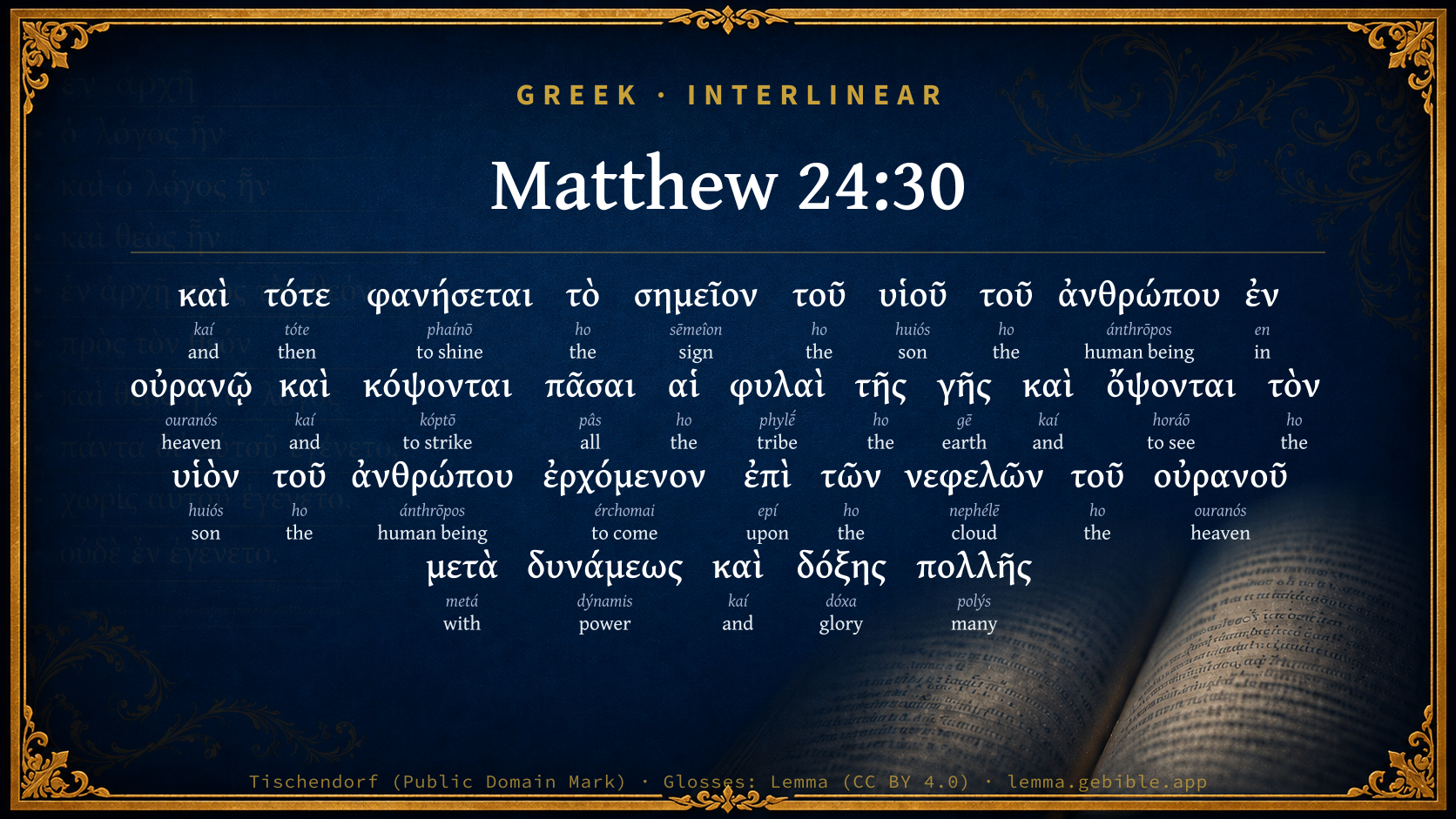
Greek (Tischendorf 8th ed.) Matthew 24:30 appears in the Greek New Testament. The text above is from the Tischendorf 8th edition. Each word links to its Strong’s number and a concise gloss. Click any word for its full Thayer’s Greek Lexicon entry.
Download image
Cite this verse

Matthew 24:30 (World English Bible). Public Domain. Lemma interlinear Bible study tool, https://lemma.gebible.app/v/matthew/24/30.

Show BibTeX & RIS
BibTeX
RIS
English Translation
and then the sign of the Son of Man will appear in the sky. Then all the tribes of the earth will mourn, and they will see the Son of Man coming on the clouds of the sky with power and great glory.
World English Bible · Public Domain
Download a study sheet

One document with this verse’s original text, its word-by-word gloss line, the meaning frame, cross-references with their text, attributed commentary, and full source and license credits — printable, and it pastes into notes with its structure intact.

This verse Autodidact and up

Study sheet (.html) Plain text (.txt)

A passage Seminary Student

Up to 50 verses in one chapter. A passage sheet keeps up to 6 commentary sources and 12 cross-references per verse, in the order this page ranks them, and says so on the sheet whenever that leaves anything out. Ask for a single verse and you get the Autodidact verse sheet above.

Everything on this page stays free to read, with no account — the sheet is a download of what is already on screen, not access to it.

Want to remove ads? Support Godless Engineer
Compare translations 3

The same verse in 3 English versions, stacked beneath the original-language interlinear above. Click any original word for its lexicon entry.

Each is an independent rendering of the whole verse — the interlinear is not word-aligned to these translations.

Highlighted words mark where these versions differ — a whole-verse word diff, not a word-by-word alignment.

  • World English Bible Public Domain
    and then the sign of the Son of Man will appear in the sky. Then all the tribes of the earth will mourn, and they will see the Son of Man coming on the clouds of the sky with power and great glory.
  • King James Version Public Domain
    And then shall appear the sign of the Son of man in heaven: and then shall all the tribes of the earth mourn, and they shall see the Son of man coming in the clouds of heaven with power and great glory.
  • unfoldingWord Literal Text CC BY-SA 4.0
    And then the sign of the Son of Man will appear in heaven, and then all the tribes of the earth will mourn. And they will see the Son of Man coming on the clouds of heaven with power and much glory.

unfoldingWord Literal Text — © unfoldingWord, licensed CC BY-SA 4.0. Word-aligned USFM3 via Door43 (git.door43.org/unfoldingWord/en_ult).

Versions to compare (up to 4)

3 of 4 selected

Show all 19 translations

Every available English version of this verse, each an independent rendering of the whole verse.

  • World English Bible Public Domain
    and then the sign of the Son of Man will appear in the sky. Then all the tribes of the earth will mourn, and they will see the Son of Man coming on the clouds of the sky with power and great glory.
  • Berean Standard Bible Public Domain
    At that time the sign of the Son of Man will appear in heaven, and all the tribes of the earth will mourn. They will see the Son of Man coming on the clouds of heaven, with power and great glory.
  • Majority Standard Bible Public Domain
    At that time the sign of the Son of Man will appear in heaven, and all the tribes of the earth will mourn. They will see the Son of Man coming on the clouds of heaven with power and great glory.
  • King James Version Public Domain
    And then shall appear the sign of the Son of man in heaven: and then shall all the tribes of the earth mourn, and they shall see the Son of man coming in the clouds of heaven with power and great glory.
  • American Standard Version (1901) Public Domain
    and then shall appear the sign of the Son of man in heaven: and then shall all the tribes of the earth mourn, and they shall see the Son of man coming on the clouds of heaven with power and great glory.
  • Revised Version (1885) Public Domain
    and then shall appear the sign of the Son of man in heaven: and then shall all the tribes of the earth mourn, and they shall see the Son of man coming on the clouds of heaven with power and great glory.
  • Geneva Bible (1599) Public Domain
    And then shall appeare the signe of the Sonne of man in heauen: and then shall all the kinreds of the earth mourne, and they shall see the Sonne of man come in the cloudes of heauen with power and great glorie.
  • Douay-Rheims (1899) Public Domain
    And then shall appear the sign of the Son of man in heaven: and then shall all tribes of the earth mourn: and they shall see the Son of man coming in the clouds of heaven with much power and majesty.
  • Young's Literal Translation Public Domain
    and then shall appear the sign of the Son of Man in the heaven; and then shall all the tribes of the earth smite the breast, and they shall see the Son of Man coming upon the clouds of the heaven, with power and much glory;
  • Literal Standard Version CC BY-SA 4.0
    and then will appear the sign of the Son of Man in the sky; and then will all the tribes of the earth strike the breast, and they will see the Son of Man coming on the clouds of Heaven, with power and much glory;
  • Unlocked Literal Bible CC BY-SA 4.0
    Then the sign of the Son of Man will appear in the sky, and all the tribes of the earth will mourn. They will see the Son of Man coming on the clouds of the sky with power and great glory.
  • unfoldingWord Literal Text CC BY-SA 4.0
    And then the sign of the Son of Man will appear in heaven, and then all the tribes of the earth will mourn. And they will see the Son of Man coming on the clouds of heaven with power and much glory.
  • Darby Bible Public Domain
    And then shall appear the sign of the Son of man in heaven; and then shall all the tribes of the land lament, and they shall see the Son of man coming on the clouds of heaven with power and great glory.
  • World Messianic Bible Public Domain
    and then the sign of the Son of Man will appear in the sky. Then all the tribes of the earth will mourn, and they will see the Son of Man coming on the clouds of the sky with power and great glory.
  • Webster's Bible Public Domain
    And then shall appear the sign of the Son of man in heaven: and then shall all the tribes of the earth mourn, and they shall see the Son of man coming in the clouds of heaven with power and great glory.
  • Free Bible Version CC BY-SA 4.0
    Then the sign of the Son of man will appear in heaven, and all the peoples of the earth will mourn. They will see the Son of man coming on the clouds of heaven with power and in brilliant glory.
  • Bible in Basic English Public Domain
    And then the sign of the Son of man will be seen in heaven: and then all the nations of the earth will have sorrow, and they will see the Son of man coming on the clouds of heaven with power and great glory.
  • Text-Critical English NT CC BY 4.0
    Then the sign of the Son of Man will appear in the heavens, and all the tribes of the earth will mourn when they see the Son of Man coming on the clouds of heaven with power and great glory.
  • Tyndale New Testament (1534) Public Domain
    And then shall appere the sygne of the sonne of man in heven. And then shall all the kynreddes of the erth morne and they shall se the sonne of man come in the cloudes of heven with power and greate glorie.

Literal Standard Version (2020), Covenant Press — licensed CC BY-SA 4.0. Text via the HelloAO Bible API (eBible.org). Unlocked Literal Bible (unfoldingWord) — licensed CC BY-SA 4.0. Text via the HelloAO Bible API (eBible.org). unfoldingWord Literal Text — © unfoldingWord, licensed CC BY-SA 4.0. Word-aligned USFM3 via Door43 (git.door43.org/unfoldingWord/en_ult). Free Bible Version, Dr. Jonathan Gallagher — licensed CC BY-SA 4.0. Text via the HelloAO Bible API (eBible.org).

Word by word

More ways to search: Search by grammar → Find every occurrence → Compare this word →

Practice this passage: Drill this verse → Learn its vocabulary →

κόψονται
kóptō
G2875
“to strike”
Verb, Future, Middle deponent, Indicative, 3rd person, Plural
Part of Speech
Verb
Tense
Future
Voice
Middle deponent
Mood
Indicative
Person
3rd person
Number
Plural
Full Thayer's Definition

Origin: a root word

TDNT: 16:50,5

1. to cut, strike, smite 2. to cut from, cut off 3. to beat one's breast for grief
  1. καὶ kaí G2532 “and” Conjunction
  2. τότε tóte G5119 “then” Adverb
  3. φανήσεται phaínō G5316 “to shine” Verb, Future, Passive, Indicative, 3rd person, Singular
  4. τὸ ho G3588 “the” Article, Nominative, Singular, Neuter
  5. σημεῖον sēmeîon G4592 “sign” Noun, Nominative, Singular, Neuter
  6. τοῦ ho G3588 “the” Article, Genitive, Singular, Masculine
  7. υἱοῦ huiós G5207 “son” Noun, Genitive, Singular, Masculine
  8. τοῦ ho G3588 “the” Article, Genitive, Singular, Masculine
  9. ἀνθρώπου ánthrōpos G444 “human being” Noun, Genitive, Singular, Masculine
  10. ἐν en G1722 “in” Preposition
  11. οὐρανῷ ouranós G3772 “heaven” Noun, Dative, Singular, Masculine
  12. καὶ kaí G2532 “and” Conjunction
  13. πᾶσαι pâs G3956 “all” Adjective, Nominative, Plural, Feminine
  14. αἱ ho G3588 “the” Article, Nominative, Plural, Feminine
  15. φυλαὶ phylḗ G5443 “tribe” Noun, Nominative, Plural, Feminine
  16. τῆς ho G3588 “the” Article, Genitive, Singular, Feminine
  17. γῆς gē G1093 “earth” Noun, Genitive, Singular, Feminine
  18. καὶ kaí G2532 “and” Conjunction
  19. ὄψονται horáō G3708 “to see” Verb, Future, Middle deponent, Indicative, 3rd person, Plural
  20. τὸν ho G3588 “the” Article, Accusative, Singular, Masculine
  21. υἱὸν huiós G5207 “son” Noun, Accusative, Singular, Masculine
  22. τοῦ ho G3588 “the” Article, Genitive, Singular, Masculine
  23. ἀνθρώπου ánthrōpos G444 “human being” Noun, Genitive, Singular, Masculine
  24. ἐρχόμενον érchomai G2064 “to come” Verb, Present, Middle or Passive deponent, Participle, Accusative, Singular, Masculine
  25. ἐπὶ epí G1909 “upon” Preposition
  26. τῶν ho G3588 “the” Article, Genitive, Plural, Feminine
  27. νεφελῶν nephélē G3507 “cloud” Noun, Genitive, Plural, Feminine
  28. τοῦ ho G3588 “the” Article, Genitive, Singular, Masculine
  29. οὐρανοῦ ouranós G3772 “heaven” Noun, Genitive, Singular, Masculine
  30. μετὰ metá G3326 “with” Preposition
  31. δυνάμεως dýnamis G1411 “power” Noun, Genitive, Singular, Feminine
  32. καὶ kaí G2532 “and” Conjunction
  33. δόξης dóxa G1391 “glory” Noun, Genitive, Singular, Feminine
  34. πολλῆς polýs G4183 “many” Adjective, Genitive, Singular, Feminine

About this verse

These counts appear in no published source. They are computed here, from the morphology-tagged text and Lemma’s own curated glosses. What Lemma adds →

35
words
21
distinct lemmas
Gospels
section

Notable vocabulary

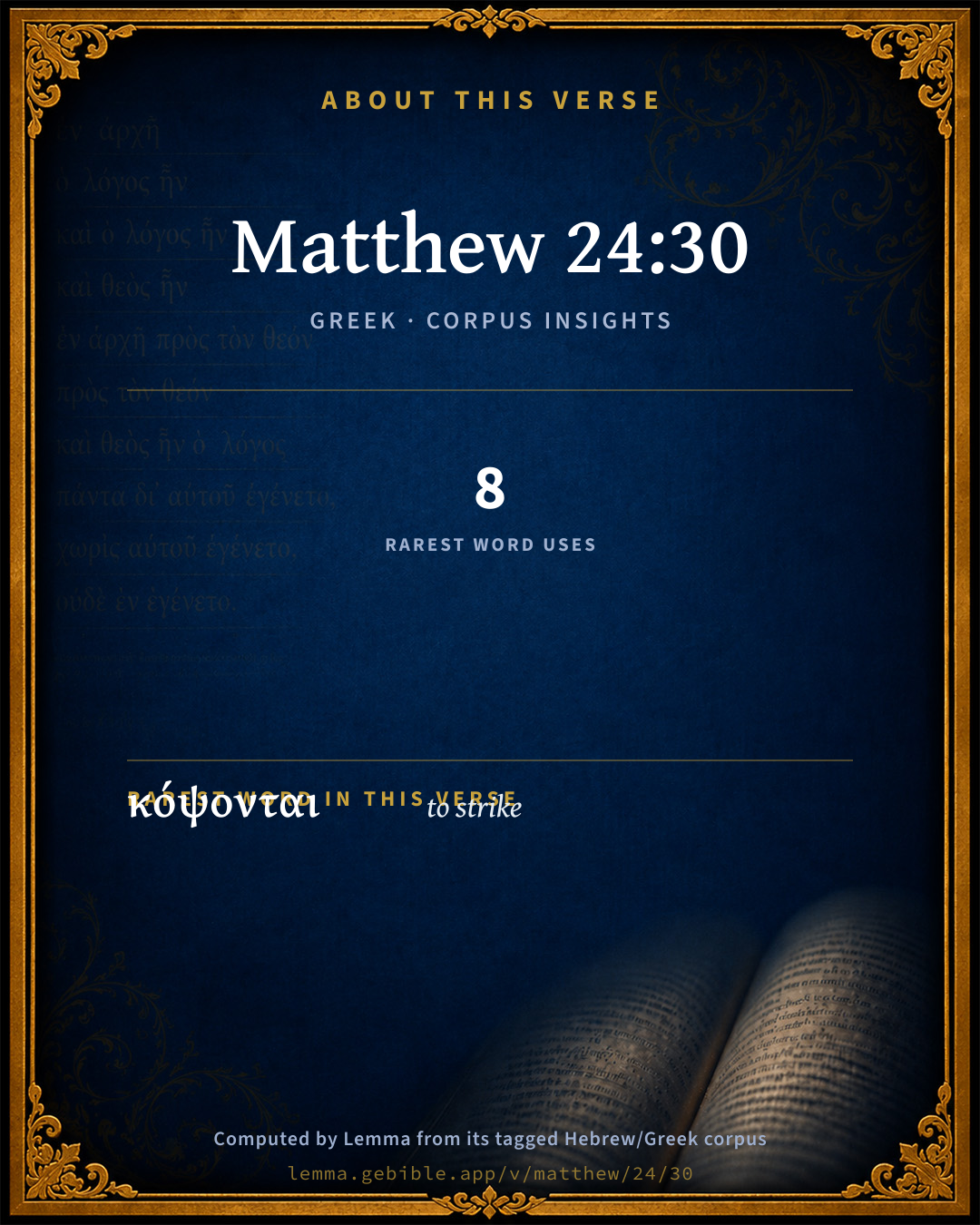
The rarest word here is κόψονται to strike G2875 — appearing just 8 times in the whole Greek New Testament.

Shared distinctive vocabulary

κόψονται to strike G2875 occurs in 8 verses of the Greek New Testament. Also found in:

Repetition

Words recur within this verse:

  • υἱοῦ son G5207 ×2
  • ἀνθρώπου human being G444 ×2
  • οὐρανῷ heaven G3772 ×2
  • τὸ the G3588 ×9
  • καὶ and G2532 ×4

Cross-references

13

Topical passages linked to Matthew 24:30 in the Treasury of Scripture Knowledge — connected by theme and wording, ordered by reader-vote popularity; previews shown in the World English Bible.

  • Revelation 1:7 Behold, he is coming with the clouds, and every eye will see him, including those who pierced him. All the tribes of the earth will mourn over him. Even so, Amen.
  • Daniel 7:13 I saw in the night-visions, and, behold, there came with the clouds of the sky one like a son of man, and he came even to the ancient of days, and they brought him near before him.
  • Luke 21:27 Then they will see the Son of Man coming in a cloud with power and great glory.
  • Matthew 26:64 Jesus said to him, "You have said it. Nevertheless, I tell you, henceforth you will see the Son of Man sitting at the right hand of Power, and coming on the clouds of the sky."
  • Acts 1:11 who also said, "You men of Galilee, why do you stand looking into the sky? This Jesus, who was received up from you into the sky will come back in the same way as you saw him going into the sky."
  • Matthew 16:27–28 For the Son of Man will come in the glory of his Father with his angels, and then he will render to everyone according to his deeds.
  • Mark 13:26 Then they will see the Son of Man coming in clouds with great power and glory.
  • Zechariah 12:10 I will pour on the house of David, and on the inhabitants of Jerusalem, the spirit of grace and of supplication; and they will look to me whom they have pierced; and they shall mourn for him, as one mourns for his only son, and will grieve bitterly for him, as one grieves for his firstborn.
  • Matthew 24:3 As he sat on the Mount of Olives, the disciples came to him privately, saying, "Tell us, when will these things be? What is the sign of your coming, and of the end of the age?"
  • 2 Thessalonians 1:7 and to give relief to you that are afflicted with us, when the Lord Jesus is revealed from heaven with his mighty angels in flaming fire,
  • Mark 14:62–64 Jesus said, "I AM. You will see the Son of Man sitting at the right hand of Power, and coming with the clouds of the sky."
  • Luke 22:69 From now on, the Son of Man will be seated at the right hand of the power of God."
  • Mark 13:4 "Tell us, when will these things be? What is the sign that these things are all about to be fulfilled?"

Cross-references courtesy of OpenBible.info (CC BY 4.0).

Commentary

Notes on Matthew 24:30 from classic Christian and Jewish commentators (each source and its license shown beneath its notes). The classic Christian expositions comment on the surrounding passage and are grouped to its opening verse, so a note may address several verses; the Jewish commentaries on the Tanakh (Rashi and others) are per-verse, so they appear only where the commentator wrote on this verse.

Lemma curates 59 commentaries, every one of them public domain or Creative Commons licensed, each selected and text-cleaned for this edition rather than reprinted as found. About our sources →

Matthew Poole's English Annotations

Mark saith, Mar 13:26,27, And then shall they see the Son of man coming in the clouds with great power and glory. And then shall he send his angels, and shall gather together his elect from the four winds, from the uttermost part of the earth to the uttermost part of heaven.

Luke saith, Luk 21:27,28, And then shall they see the Son of man coming in a cloud with great power and glory. And when these things begin to come to pass, then look up, and lift up your heads; for your redemption draweth nigh.

Interpreters are also divided about these words, as about the former, some understanding them concerning the destruction of Jerusalem, and judging that by the sign of the coming of the Son of man is probably meant some prodigy or some comet seen before that destruction, which should be of that nature as it should make the Jews (here called the tribes of the earth) to mourn; they by the angels and trumpet, mentioned Mat 24:31, understanding the ministers of the gospel, who after the destruction of Jerusalem should go and preach the gospel over all the world, and so gather in the elect into the gospel church. But I cannot agree to this sense, and most interpreters expound these words of the last judgment. What is meant by

the sign of the Son of man all are not so well agreed. Two of the evangelists say only the Son of man. Matthew mentions first the appearance of the sign of the Son of man, then the Son of man himself; probably it signifieth some great prodigy that shall be seen before that great and terrible day. Those things which incline me to think that the day of judgment, not the destruction of Jerusalem, is that which is spoken of in these verses, is;

1. That all the phrases are such as the Scripture useth to express Christ’s coming to the last judgment: his coming in the clouds of heaven, Mat 26:64; Rev 1:7; the tribes of the earth mourning, Rev 1:7; his coming with the angels, and the sound of a trumpet, Mat 25:31; Mar 8:38; 1Co 15:52; 1Th 4:16; his sending his angels to gather the elect, Mat 13:49.

2. The tribes of the earth mourning, seems to signify more than the twelve tribes of Israel.

3. That which Luke hath, Look up, and lift up your heads; for your redemption draweth nigh; seemeth hardly applicable to the destruction of Jerusalem, rather to the redemption of the body, mentioned Rom 8:23.

For the gospel before this time was carried to the Gentiles; nor do I know that that is any where called redemption. Those things which have led some learned interpreters to expound Mat 24:29-31 of the destruction of Jerusalem, are, I conceive, those particles, immediately after the tribulation of those days, Mat 24:29 and the particle then, Mat 24:30; together with Mat 24:34 where our Saviour saith, This generation shall not pass, till all these things be fulfilled. But the term, immediately after the tribulation of those days, may signify not only the destruction of Jerusalem, but that, and all the calamities of those days that should follow that, to the end of the world: and it is very usual for prophetical scriptures to speak of things to come long after as if they were presently to come to pass, Deu 32:35; and the day of judgment is ordinarily spoken of as if it were at hand, 1Th 4:15; Jam 5:8; 1Jo 2:18, both to denote the certainty of it, and to keep us from security, and to let us know that a thousand years in God’s sight are but as one day, 2Pe 3:8. For in Mat 24:34, we shall give the sense of it, in its order.

Matthew Poole's English Annotations on the Holy Bible (1683–1685) — public domain. Text from a community e-Sword/MySword module.

Joseph Benson's Commentary

Mat 24:30-31. Then shall appear the sign of the Son of man in heaven — Christ proceeds here in the same figurative style, and the plain meaning of his words is, that the destruction of Jerusalem and of the Jewish state, civil and religious, would be such a remarkable instance of divine vengeance, and such a signal manifestation of Christ’s power and glory, that all the Jewish tribes should mourn, and many should be led from thence to acknowledge him for the true Messiah. To explain this further it may be observed, “The sign from heaven, which both the disciples and Pharisees expected, was some visible appearance of the Messiah in the clouds, and some miraculous interposition of his power, by which the Romans, the masters of the world, were to be destroyed, and a universal empire over all nations erected in behalf of the Jews. This sign they were led to expect, because Daniel had said prophetically, of the Son of man, (Dan 7:13,) that he saw him coming in the clouds of heaven, and that there was given him dominion, and glory, and a kingdom, &c. Nevertheless, by the coming of the Son of man in the clouds, Daniel meant his interposing for the destruction of his enemies, particularly the unbelieving Jews; and the erection of his own kingdom over all nations; a spiritual kingdom, a new dispensation of religion, which should comprehend the whole world within its pale. Therefore, to show the disciples that they had mistaken the prophecy, which referred wholly to the destruction of Jerusalem, and to the conversion of the Gentiles, he adopted it into his prediction of these events, and thereby settled its true meaning.” — Macknight. The figurative expression, Coming in the clouds of heaven, in several other passages of Scripture, signifies God’s interposing evidently and irresistibly, to execute vengeance on a wicked generation, and to assert his own government over the world. See 2Sa 22:10-12; Psa 97:2; Isa 19:1. He shall send his angels with a great sound of a trumpet, &c. — This also is in the style of the prophets, and, stripped of its figures, means only that after the destruction of Jerusalem, Christ by his angels, or ministers, going forth with their powerful preaching, termed here the great sound of a trumpet, should gather to himself a glorious church, out of all the nations under heaven: that the Jews being thrust out, as he expresses it, Luk 13:28, &c., believers should come from the east and from the west, from the north and from the south, and should sit down in the kingdom, of God. Agreeably to this interpretation, we find the name αγγελους, angels, used of common messengers, Jas 2:25; and of the ministers of the Asian churches, Rev 2:3.; of prophets, 2Ch 36:16; and of priests, Mal 2:7. And the preaching of the messengers of God is compared to the sound of a trumpet, Isa 58:1; Jer 6:17; Eze 33:3-6. No person, versed at all in ecclesiastical history, needs to be told that the Christian religion spread and prevailed mightily after this period; and that hardly any one thing contributed more to this success of the gospel than the destruction of Jerusalem and the ruin of the Jewish nation, falling out in the very manner and with the very circumstances so particularly foretold by our Lord.

Joseph Benson's Commentary on the Old and New Testaments (1811–1818) — public domain. Text from a community e-Sword module.

Tyndale Open Study Notes

Tyndale Open Resources

24:30 the sign that the Son of Man is coming (literally the sign of the Son of Man): The sign is probably the Son of Man himself (see 12:38-42; 16:4). His coming expresses his vindication (see 26:64) and will bring deep mourning to those who experience God’s judgment. • All the peoples of the earth could be translated all the tribes of the land. The term used here is not the usual Greek term for Gentile nations (ethnoi), but a term used frequently of the tribes (phulai) of Israel (the land), suggesting that a national disaster in Israel might be in view (see 21:43; Zech 12:10-14). • the Son of Man coming on the clouds: See Dan 7:13. Many believe that this means a descent of the Son of Man from God’s presence to reside on earth as Judge and Deliverer—i.e., the second coming of Christ. Others have argued that this describes the Son of Man coming in judgment, but not necessarily the second coming of Christ (see Matt 10:23; 16:27; 19:28; 25:31; 26:64; 28:18).

Tyndale Open Study Notes — © Tyndale Open Resources, licensed CC BY-SA 4.0. Text via the HelloAO Bible API.

Bengel's Gnomon

Johann Albrecht Bengel

Mat 24:30. Τὸ σημεῖον τοῦ Υἱοῦ τοῦ ἀνθρώπου, the sign of the Son of Man[1055]) This is a more special sign; those which are mentioned in Luk 21:25 precede it, and are more general. The very appellation, “the Son of Man,” agrees with these things (cf. Gnomon on ch. Mat 16:13): for the mourning of the tribes of the earth is joined in Rev 1:7, with their seeing Him in person. Our Lord means therefore to say, “Do not seek for any previous sign;” see Mat 24:27. He Himself will be His own sign, as in Luk 2:12; and so much the more so, because conjointly with His actual appearance, or a little before it mankind will behold a triumphal procession (pompam) in the clouds: unless indeed a thick darkness, a dazzling glory, the form of the cross, or some star, also appear. Cf. ch. Mat 2:2. Before this He had been a sign which was spoken against (see Luk 2:34): then He will be a sign manifest to all. A Sign denotes something very remarkable and striking to the eyes, whether it contain the signification of something else, or of itself; see Rev 12:1. The sun, moon, and stars, having been extinguished, that sign will be visible in the brightness of the Lord, and thence in that of a cloud, and of the clouds.[1056] In short, the sign (cf. Mar 13:26; Mar 13:4) is the triumphal train of the Son of man coming in His glory, who is Himself to be beheld presently after, as this passage tells us—αἱ φυλαὶ, the tribes) especially of Israel.—ὄψονται, shall see) Cf. Num 24:17.—ἐπὶ τῶν νεφελῶν, on the clouds) St Luke says, ἐν νεφέλῃ, on a cloud) He will be attended by many chariots;[1057] He will be borne on a very magnificent one.

[1055] Herein is contained a reply to the question proposed at Mat 24:3.—V. g.

[1056] Bengel’s expression, “nubis ac nubium,” “of a cloud and of the clouds,” evidently refers to Luk 21:27, “Then shall they see the Son of Man coming IN A CLOUD, with power and great glory,” and to the words which occur in the present verse, “they shall see the Son of Man coming IN THE CLOUDS of Heaven with power and great glory.”—(I. B.)

[1057] As is usual in a royal procession.—V. g.

Bengel's Gnomon of the New Testament — English translation (T&T Clark, Edinburgh, 1860) — public domain. Text from a community e-Sword module.

Meyer's Critical & Exegetical Commentary

Heinrich August Wilhelm Meyer

Mat_24:30. Καὶ τότε] and then, when what is intimated at Mat_24:29 shall have arrived.

φανήσεται] universally, and so not visible merely to the elect (Cremer), which would not be in keeping with what follows.

τὸ σημεῖον τοῦ υἱοῦ τ. ἀνθρ.] accordingly the sign inquired about in Mat_24:3, that phenomenon, namely, which is immediately to precede the coming Messiah, the Son of man of Dan_7:13, and which is to indicate that His second advent is now on the point of taking place, which is to be the signal of this latter event. As Jesus does not say what this is to be, it should be left quite indefinite; only this much may be inferred from what is predicted at Mat_24:29 about the darkening of the heavenly bodies, that it must be of the nature of a manifestation of light, the dawning of the Messianic δόξα which is perhaps to go on increasing in brilliancy and splendour until the Messiah Himself steps forth from the midst of it in the fulness of His glory. There is no foundation for supposing, with Cyril, Hilary, Chrysostom, Augustine, Jerome, Erasmus, that the allusion is to a cross appearing in the heavens; with Hebart, that it is to the rending of heaven or the appearing of angels; with Fleck and Olshausen, that it is to the star of the Messiah (Num_24:17); similarly Bleek, though rather more by way of conjecture. Following the older expositors, Fritzsche, Ewald, Hengstenberg, R. Hofmann understand the coming Messiah Himself: miraculum, quod Jesus revertens Messias oculis objiciet (accordingly, taking τοῦ υἱοῦ τ. ἀνθρ. as a genitive of subject; while Wolf, Storr, Weiss, Bibl. Theol. p. 56, ed. 2, assume it to be a genitive of apposition). This view is inconsistent not only with what follows, where the words καὶ ὄψονται τὸν υἱὸν, κ.τ.λ. evidently point to something still farther in the future, and which the σημεῖον serves to introduce, but also with the question of the disciples, Mat_24:3. R. Hofmann thinks that the reference is to that apparition in the form of a man which is alleged to have stood over the holy of holies for a whole night while the destruction of the capital was going on. A legendary story (chronicled by Ben-Gorion); and it may be added that what is said, vv 2931, certainly does not refer to the destruction of Jerusalem, after which event Hofmann supposes our evangelist to have written. Lastly, some (Schott, Kuinoel) are even of opinion that σημεῖον does not point to any new and special circumstance at allto anything beyond what is contained in Mat_24:29; but the introduction of the sequel by τότε is decidedly against this view.

καὶ τότε] a new point brought forward: and then, when this σημεῖον has been displayed.

κόψονται] Comp. Zec_12:10; Rev_1:7; with what a totally different order of things are they now on the point of being confronted, what a breaking up and subversion of all the previous relationships of life, what a separation of elements hitherto mingled together, and what a deciding of the final destinies of men at the judgment of the old and the ushering in of the new αἰῶν! Hence, being seized with terror and anguish, they will mourn (see on Mat_11:17). The sorrow of repentance (Dorner, Ewald) is not to be regarded as excluded from this mourning. There is no adequate reason to suppose, with Ewald, that, in the collection of our Lords sayings (the λογία), ὄψονται probably occurred twice here, and that it was reserved for the last redactor of those sayings to make a play upon the word by substituting κόψονται.

ἐρχόμενον, κ.τ.λ.] as in Dan_7:13.

μετὰ δυνάμ. κ. δόξ. πολλ.] This great power and majesty will also be displayed in the accompanying angel-hosts, Mat_24:31. The πᾶσαι αἱ Φυλαὶ τῆς are not: omnes familiae Judaeorum (Kuinoel), as those who explain Mat_24:29 ff. of the destruction of Jerusalem must understand the words, but: all the tribes of the earth. Comp. Gen_12:3; Gen_28:14.

Meyer — Critical and Exegetical Commentary on the New Testament — English translation by Peter Christie, edited by Frederick Crombie (T&T Clark, 1880) — public domain. Text from a community e-Sword module.

Expositor's Greek Testament

ed. W. Robertson Nicoll

Mat 24:30 . καὶ τότε . Amid the general crash what longing would arise in Christian hearts for the presence of the Christ! To this longing the announcement introduced by these words “and then ” responds. τὸ σημεῖον τ . υἱ . τ . ἀ . The question what is this sign has greatly perplexed commentators, who make becoming confessions of ignorance. “We must not be positive in conjecturing,” Morison. “What this shall be it is vain to conjecture,” Cambridge N. T. Is the reference not to Dan 7:13 , “one like the Son of Man,” and the meaning: the sign which is the Son of Man, τ . υ . τ . ἀ . being genitive of appos.? So Weiss after Storr and Wolf. (“ σημεῖον υἱοῦ , similis est illis quibus profani passim utuntur quando dicunt βία Ἡρακλέος ,” i.e. , “vis Herculis seu ipse Hercules,” Wolf, Curae Phil. ) Christ His own sign, like the lightning or the sun, self-evidencing . καὶ τότε κόψονται , etc.: a clause not in Mk. and obscure in meaning; why mourn? because they recognise in the coming One their Judge? or because they see in Him one who had been despised and rejected of men, and penitently (taking the sin home to themselves) acknowledge His claims? (“believed on in the world,” 1Ti 3:16 ). ἐρχόμενον … πολλῆς , description of the coming, here as in Mat 16:27 , Mat 26:64 , in terms drawn from Dan 7:13 .

The Expositor's Greek Testament, edited by W. Robertson Nicoll (1897–1910) — public domain. Text from a community e-Sword module.

Geneva Bible (1599)

Geneva Bible translators

The exceeding glory and majesty, which shall bear witness, that Christ the Lord of heaven and earth draweth near to judge the world.

All nations: and he alludeth to the dispersion which we read of, Gen. 10 and 11, or to the dividing of the people of Israel.

They shall be in such sorrow, that they shall strike themselves: and it is transferred to the mourning.

Sitting upon the clouds, as he was taken up into heaven.

Geneva Bible (1599) marginal notes — public domain. Text via Bolls.life.

Adam Clarke's Commentary

Verse 30. Then shall appear the sign of the Son of man] The plain meaning of this is, that the destruction of Jerusalem will be such a remarkable instance of Divine vengeance, such a signal manifestation of Christ's power and glory, that all the Jewish tribes shall mourn, and many will, in consequence of this manifestation of God, be led to acknowledge Christ and his religion. By της γης, of the land, in the text, is evidently meant here, as in several other places, the land of Judea and its tribes, either its then inhabitants, or the Jewish people wherever found.

Adam Clarke's Commentary on the Bible (1810–1826) — public domain. Text from a community e-Sword/MySword module.

Ellicott's Commentary for English Readers

(30) Then shall appear the sign of the Son of man.—Can we picture to ourselves what this sign shall be? Is it distinct from the coming of the Son of Man which here is so closely united with it? Men have given wildly conjectural answers to these questions, and have dreamt of the cross as appearing in the sky (as if the vision of Constantine were to be reproduced in the last days), or the lightning flash that shall dazzle all men with its brightness, or of some visible manifestation which none can imagine till it shall come. The vision of Dan_7:13 supplies, it is believed, the true answer. The sign of the Son of Man is none other than the presence of the Son of Man Himself, coming in the clouds of heaven, in the ineffable glory of His majesty. And here, too, we must remember that we are still in the region of apocalyptic symbols. All such imagery falls short of the ultimate reality, and a “sign in heaven” is something more than a visible appearance in the sky.

Then shall all the tribes of the earth.—It lies in the nature of the case, that the “tribes” are those who have done evil, and who therefore dread the coming of the Judge. The words find their best comment in Rev_1:7, where St. John combines them freely with the prediction of Zec_12:10, “They also which pierced Him,” obviously including not only those who were sharers in the actual “piercing” of the crucified body of the Lord Jesus (Joh_19:37), but all who in any age “crucify the Son of God afresh” (Heb_6:6).

A Bible Commentary for English Readers, edited by Charles John Ellicott (1878–1897) — public domain. Text from a community e-Sword module.

The Cambridge Bible for Schools and Colleges

gen. ed. J. J. S. Perowne

30. the sign of the Son of man in heaven] What this shall be it is vain to conjecture, but when it appears its import will be instantly recognised by the faithful.

in the clouds] Translate, on the clouds.

The Cambridge Bible for Schools and Colleges (gen. ed. J. J. S. Perowne; Cambridge University Press, 1878–1918) — public domain. Text from a community e-Sword module.

John Gill's Exposition

And he shall send his angels,.... Not the angels, i.e. ministering spirits, so called, not from their nature, but their office, as being sent forth by God and Christ; but men angels, or messengers, the ministers and preachers of the Gospel, whom Christ would call, qualify, and send forth into all the world of the Gentiles, to preach his Gospel, and plant churches there still more, when that at Jerusalem was broken up and dissolved. These are called "angels", because of their mission, and commission from Christ, to preach the Gospel; and because of their knowledge and understanding in spiritual things; and because of their zeal, diligence, and watchfulness,

With a great sound of a trumpet, meaning the Gospel; see Isa 27:13 so called in allusion either to the silver trumpets which Moses was ordered to make of one piece, and use them for the calling of the assembly, the journeying of the camps, blowing an alarm for war, and on their solemn and festival days, Num 10:1. The Gospel being rich and precious, all of a piece, useful for gathering souls to Christ, and to his churches; to direct saints in their journey to Canaan's land; to encourage them to fight the Lord's battles; and is a joyful sound, being a sound of love, grace, and mercy, peace, pardon, righteousness, life and salvation, by Christ: or else so called, in allusion to the trumpet blown in the year of "jubilee"; which proclaimed rest to the land, liberty to prisoners, a release of debts, and restoration of inheritances; as the Gospel publishes rest in Christ, liberty to the captives of sin, Satan, and the law, a payment of debts by Christ, and a release from them upon that, and a right and title to the heavenly inheritance. The Vulgate Latin reads it, "with a trumpet, and a great voice"; and so does Munster's Hebrew Gospel; and so it was read in four of Beza's copies:

and they shall gather his elect from the four winds, from one end of heaven to the other; that is, by the ministration of the Gospel; the Spirit of God accompanying it with his power, and grace, the ministers of the word should gather out of the world unto Christ, and to his churches, such persons as God had, before the foundation of the world, chosen in Christ, unto salvation, through sanctification of the Spirit, and belief of the truth; wherever they are under the whole heavens, from one end to another; or in any part of the earth, though at the greatest distance; for in Mar 13:27 it is said, "from the uttermost part of the earth, to the uttermost part of the heaven". The Jews (h) say, that "in the after redemption (i.e. by the Messiah) all Israel shall be gathered together by the sound of a trumpet, from the four parts of the world.

(h) Zohar in Lev. fol. 47. 1.

John Gill's Exposition of the Whole Bible (1746–1763) — public domain (CC PDM 1.0). Text via the HelloAO Bible API.

Trapp's Complete Commentary

John Trapp

30 And then shall appear the sign of the Son of man in heaven: and then shall all the tribes of the earth mourn, and they shall see the Son of man coming in the clouds of heaven with power and great glory.

Ver. 30. The sign of the Son of man] That is, either Christ himself (by a Hebraism), or the dreadful dissolution of the world’s fabric, or that cloud of heaven that was of old the sign of the Son of man in the wilderness, Exo 13:21, or the scars of his wounds, or his cross, or something else that we cannot describe, and need not search into. Look how a king, when he would gather his forces into one, sets up his standard, or appoints his rendezvous; so such shall be the brightness of Christ’s coming, that all his shall be gathered unto him by that token, not to fight; but to triumph with him and divide the spoil, as it were, being more than conquerors; and what is that but triumphers? The expectation of this day must (as that did with David’s soldiers at Ziklag) digest all our sorrows.

And then shall all the tribes of the earth mourn] This to prevent, we must judge ourselves, 1Co 11:31, and take unto us words against our sins, if we would not have Christ take unto him words against our souls, Hos 14:3. Good men have been exceedingly affected at the hearing of God’s judgments against others, as Hab 3:16.

John Trapp, A Commentary or Exposition upon All the Books of the Old and New Testament (1647–1656) — public domain. Text from a community e-Sword module.

Albert Barnes' Notes on the Bible

The sign of the Son of man - The “evidence” that he is coming to destroy the city of Jerusalem. It is not to be denied, however, that this description is applicable also to his coming at the day of judgment. The disciples had asked him Mat 24:3 what should be the sign of his coming, and “of the end of the world.” In his answer he has reference to both events, and his language may be regarded as descriptive of both. At the destruction of Jerusalem, the sign or evidence of his coming was found in the fulfillment of these predictions. At the end of the world, the sign of his coming will be his personal approach with the glory of his Father and the holy angels, 1Th 4:16; Luk 21:27; Mat 26:64; Act 1:11.

All the tribes of the earth mourn - That is, either all the “tribes or people” of the land of Judea shall mourn at the great calamities coming upon them, or all the nations of the world shall wail when he comes to judgment. All the wicked shall mourn at the prospect of their doom, Rev 1:7. The cause of their wailing at the day of judgment will be chiefly that they have pierced, killed, rejected the Saviour, and that they deserve the condemnation that is coming upon them, Joh 19:37; Zec 12:12.

And they shall see the Son of man - The Lord Jesus coming to judgment. Probably this refers more directly to his coming at the last day, though it may also mean that the “evidence” of his coming to destroy Jerusalem will then be seen.

In the clouds of heaven - He ascended in a cloud, Act 1:9. He shall return in like manner, Act 1:11. “The clouds of heaven” denote not the clouds in heaven, but the clouds that appear to shut heaven, or the sky, from our view.

With power - Power, manifest in the destruction of Jerusalem, by the wonders that preceded it, and by the overturning of the temple and city. In the day of judgment, power manifest by consuming the material world 2Pe 3:7, 2Pe 3:10, 2Pe 3:12; by raising the dead Joh 5:29-30; 1Co 15:52; by changing those who may be alive when he shall come - that is, making their bodies like those who have died, and who have been raised up 1Th 4:17; 1Co 15:52; by bringing the affairs of the world to a close, receiving the righteous to heaven Mat 25:34; 1Co 15:57, and sending the wicked, however numerous or however strong, down to hell, Mat 25:41, Mat 25:46; Joh 5:29.

Great glory - The word “glory” here means the visible display of honor and majesty. This glory will be manifested by the manner of his coming Mat 26:64, by the presence of the angels Mat 25:31, and by the wonders that shall attend him down the sky.

Albert Barnes' Notes on the Bible (1834–1885) — public domain. Text from a community e-Sword/MySword module.

Haydock's Catholic Bible Commentary

The sign of the Son of man, &c. The Fathers generally expound this of the cross of Christ, that shall be seen in the air. (Witham) --- This sign is the cross, much more resplendent than the sun itself. Therefore the sun hides its diminished head, whilst the cross appears in glory; because the great standard of the cross, excels in brightness all the refulgent rays that dart from the meridian sun. (St. John Chrysostom, hom. lxxvii.) --- The Jews, looking upon him whom they had pierced, now coming in the clouds of heaven with power and exceedingly great glory, shall have great lamentations. Bitterly will they weep over their misery, in having despised and insulted him on a cross, who ought to have been the object of their veneration, adoration, and love. (St. John Chrysostom, hom. lxxvii.)

George Leo Haydock (1774–1849), Haydock's Catholic Family Bible and Commentary, 1859 edition — public domain. Excludes Psalms (Douay-Rheims chapter numbering differs from Protestant) and Deuterocanonical books (Catholic canon only).

Whedon's Commentary on the Bible

Daniel D. Whedon

30. The sign — The token, the visible glory preceding the distinguishable person of the Son of man. The sign of his presence will appear before the outline of his form can be described. Tribes mourn because they see him, for his person soon becomes visible after the pomp of his glory has announced him.

Daniel D. Whedon (gen. ed.), Commentary on the Old and New Testaments (1874–1909) — public domain. Text from a community e-Sword module.

The Pulpit Commentary

And then; i.e. after the great physical changes mentioned in the last verse. The sign of the Son of man. This has been differently interpreted

(1) as the appearance of Christ himself in the clouds of heaven, (Mat_26:64 Dan_7:13, Dan_7:14) when the glory and majesty of his advent will prove that he is Saviour and Judge. But this explanation seems to confuse the sign and that which it represents, the token of Messiah and Messiah himself who cometh afterward. And the definite article, the sign," seems to imply something already well known to denote him, whereas his appearance could not be known beforehand.

(2) A star, which shall herald his second coming, as a star announced his birth. This, which is Olshausen"s suggestion, is entirely arbitrary, and has nothing to support it, especially as the meaning of the star would not be directly intelligible to all men.

(3) Meyer and De Wette suppose a bright light, or a kind of Shechinah. This, which doubtless will be manifested, was indeed a token of the presence of God, but could not be recognized at once as the sign of the Son of man.

(4) We come to what has been the almost universal interpretation of the Fathers and early commentators, who saw in the sign the cross of Christ, which is indeed the ensign and standard of the gospel. Nothing, equally with this, can characterize the Son of man, the emblem of his humiliation and his triumph. Then. When they behold this sign in the sky, and know unmistakably that Christ in person is about to appear. Shall all the tribes of the earth mourn (koyontai , shall beat the breast). Not alone the Jews, looking on him whom they pierced, shall bewail their blindness and impenitence, (Zec_12:10-14 Isa 53) but all the nations, the races and peoples who have rejected him whom they ought to have received. The cross shows that he died for them, though they profited not by his sacrifice. (comp. Rev_1:7 Rev_6:15-17) They shall see (oqontai , an echo of the preceding koqontai). The sign is followed by the advent of Christ in person. Coming in the clouds of heaven. Some have taken "clouds" to mean angels, comparing Mat_16:27; but them is no need for considering the term here to be metaphorical. The accompaniments of the theophanies are always thus announced. (see Psa_18:10-12 Isa_19:1 Dan_7:13, etc.; Mat_26:64) He thus claims to be the God of whom these words are continually used, and he leaves his hearers to gather that he will come visibly, not spiritually to individual souls or Churches, but manifestly to the whole of mankind, whether quick or risen. With power. In his full omnipotence. Cum virtute multa (Vulgate). The expression must not be taken as denoting the attendant angels; they are named in the next verse. It denotes that he who on earth met with naught but pain and humiliation should be displayed to the same earth with that splendour and majesty which essentially belonged to him.

The Pulpit Commentary (1880–1919), ed. H.D.M. Spence-Jones & Joseph S. Exell — public domain. Text from a community e-Sword module.

John Wesley's Explanatory Notes

Then shall appear the sign of the Son of man in heaven - It seems a little before he himself descends. The sun, moon, and stars being extinguished, (probably not those of our system only) the sign of the Son of man (perhaps the cross) will appear in the glory of the Lord.

John Wesley, Explanatory Notes Upon the Whole Bible (1754–1765) — public domain. Text via the GEBible commentary corpus.

Burkitt's Expository Notes on the New Testament

William Burkitt

Then shall the tribes mourn; that is, then shall the Jews be convinced that their destruction was the punishment of their sin, in rejecting and crucifying Christ; and accordingly they that pierced him shall behold him, and mourn over him. Thus it was before the destruction of Jerusalem, and thus will it be before the final judgment. They that pierced him shall be brought before him.

Lord, how will the sight of a pierced Christ pierce their souls with horror! they who have not seen a pierced Christ in the sorrows of repentence, shall hereafter see him in the sorrows of despair.

To behold Christ with the eye of sense hereafter, will be very dreadful and terrible to all those that have not beheld him with the eye of faith here.

And he shall send his angels with the sound of trumpet. Those that apply this to the destruction of Jerusalem, by the angels understand the ministers of the gospel, who by the trumpet of the word did bring in believers throughout all Judea, who were saved from that destruction. Those that understand it of the general judgment, take it literally, that Christ at the great day will send forth his holy angels, and gather all his elect to himself with the sound of a trumpet.

Probably, as there was an audible sound of a trumpet at the giving of the law, so there shall be the like sound of a trumpet, when Christ shall summon the world to judgment, for transgressing that law. A joyful sound will this be to the friends of Christ, a doleful, dreadful sound in the ears of his enemies.

William Burkitt's Expository Notes on the New Testament (1700–1703) — public domain. Text from a community e-Sword module.

The People's New Testament

B. W. Johnson

30. Then. After the long period of apostasy. Shall appear the sign of the Son of man. Some sign of his coming that every one will recognize when it is manifested. All the tribes of the earth mourn. Because of their sins. They shall see the Son of man coming. It will be visible to every eye and will be in splendor.

B. W. Johnson's The People's New Testament with Notes (1889–1891) — public domain. Electronic text from the Christian Classics Ethereal Library (CCEL) ThML edition.

unfoldingWord translationNotes

Door43 World Missions Community

the Son of Man ... He ... his

Jesus is speaking about himself in the third person. (See: First, Second, or Third Person)

all the tribes

Here "tribes" refers to people. AT: "all the people of the tribes" or "all the people" (See: Metonymy)

He will send his angels with a great sound of a trumpet

"He will have a trumpet sounded and send his angels" or "He will have an angel blow a trumpet, and he will send his angels"

they will gather

"his angels will gather"

his elect

These are the people whom the Son of Man has chosen.

from the four winds, from one end of the sky to the other

Both of these mean the same thing. They are idioms that mean "from everywhere." AT: "from all over the world" (See: Parallelism and Idiom)

translationWords

sign

Son of Man

heaven

tribe

power

glory

angel

trumpet

chosen one

unfoldingWord translationNotes — © Distant Shores Media and the Door43 World Missions Community, licensed CC BY-SA 4.0. Source: git.door43.org/Door43/en_tn.

Cambridge Greek Testament for Schools and Colleges

30. τὸ σημεῖον τοῦ υἱοῦ τοῦ ἀνθρώπου. What this shall be it is vain to conjecture, but when it appears its import will be instantly recognised by the faithful.

ἐπὶ τ. ν. On the clouds, not, as in A.V., in the clouds.

Cambridge Greek Testament for Schools and Colleges (Cambridge University Press, 1896; 21 vols, various authors incl. Carr, Maclear, Plummer, Farrar, Lumby, Moule, M. R. James, Simcox) — public domain. Text from a community e-Sword module.

Alford’s Greek Testament

Henry Alford

30.] This τότε, so emphatically placed and repeated, is a definite declaration of time,—not a mere sign of sequence or coincidence, as e.g. in ver. 23:—when these things shall have been somewhile filling men’s hearts with fear,—then shall, &c.

It is quite uncertain what the σημεῖον shall be:—plainly, not the Son of Man Himself, as Some explain it (even Bengel, generally so valuable in his explanations, says ‘Ipse erit signum sui,’ and quotes Luk 2:12 as confirming this view; but there the swaddling clothes and the manger were the ‘sign,’ not the child), nor any outward marks on his body, as his wounds; for both these would confuse what the prophecy keeps distinct—the seeing of the sign of the Son of Man, and all tribes of the earth mourning, and afterwards seeing the Son of Man Himself. This is manifestly some sign in the Heavens, by which all shall know that the Son of Man is at hand The Star of the Wise Men naturally occurs to our thoughts—but a star would not be a sign which all might read.

On the whole I think no sign completely answers the conditions but that of the Cross:—and accordingly we find the Fathers mostly thus explaining the passage. But as our Lord Himself does not answer the question, τί τὸ σημεῖον τῆς σῆς παρουσίας; we may safely leave the matter. I mention, just to shew how sensible expositors can be misled by a false interpretation of the whole, Wetstein’s strange paraphrase of τὸ σημεῖον τ. υ. τ. ἀνθ.,—‘fumus Hierosolymorum incensorum, qui interdiu solem, nocte vero lunam et Stellas obscurat.’

πᾶσαι αἱ φ. τ. γ.] see Zec 12:10-14, where the mourning is confined to the families of Israel:—here, it is universal: see reff. Rev.; also 6:15-17. This coming of the Son of Man is not that spoken of ch. 25:31, but that in 1Th 4:16, 1Th 4:17, and Rev 19:11 ff.,—His coming at the commencement of the millennial reign to establish His Kingdom: see Dan 7:13, Dan 7:14.

δύναμις is the power of this Kingdom, not, the host of heaven.

Henry Alford, The Greek Testament (1849–1861) — public domain. Text from a community e-Sword module.

International Critical Commentary

(E) 30. And then shall appear the sign of the Son of Man in heaven.] The words do not occur in Mk. They appear to be the answer to v. 3 τί τὸ σημεῖον τῆς σῆς παρουσίας; There, however, the “sign” seems to be distinct from the “coming.” “What shall be the sign which warns of Thy coming?” Here by analogy we should render: “Then shall appear the sign which precedes the Son of Man,” as though the sign were some independent and unexplained phenomenon. Possibly this is the editor’s meaning, who thinks of the sign as some unique portent which heralds the immediate coming of the Son of Man. But more probably the direct reference is to Dan 7:13. The coming of one like a Son of Man there predicted was itself a sign: “Then shall appear the well-known sign of the Son of Man predicted by Daniel.”

(E) And then shall all the tribes of the land wail.] The words are not in Mk. They are based on Zec 12:12 καὶ κόψεται ἡ γῆ κατὰ φυλὰς φυλάς.

(M) And they shall see the Son of Man coming upon the clouds of heaven with power and great glory.] Mk. has: “And then shall they see the Son of Man coming in clouds with great power and glory.” Mt. has transferred τότε to the previous clause. The words are based on Dan 7:13, with a reminiscence of Zec 12:10 For Mk.’s ἐν νεφέλαις, Mt. substitutes ἐπὶ τῶν νεφελῶν τοῦ οὐρανοῦ, to assimilate to the LXX. of Daniel. See Driver on Dan 7:13. For the “glory” of the Son of Man, see on 16:27.

The same combination of Zec 12:10-12 with Dan 7:13 occurs in Rev 1:7. It is, of course, possible that one writer is dependent on the other, but equally possible that this combination of the two passages was a commonplace of Christian Apocalyptic study. For the Messianic application of the previous clause of Zec 12:10, cf. Joh 19:37. Bousset on Rev 1:7 suggests that there is implied in the passage a belief that Christ would appear with or on the cross. If Mt. had this in mind, the “sign of the Son of Man” would mean the crucified Saviour appearing in the air.

30. καὶ τότε κόψονται πᾶσαι αἱ φυλαὶ τῆς γῆς] S1 omits, and has “ye will see” for the following ὄψονται. Merit believes the clause to be a gloss from Rev 1:7 καὶ κόψονται ἐπʼ αὐτὸν πᾶσαι αἱ φυλαὶ τῆς γῆς. The clause is a résumé of Zec 12:10 κόψονται ἐπʼ αὐτόν, 12 κόψεται ἡ γῆ, 14 πᾶσαι—φυλαί. It is certainly curious that Mt. and Rev. should agree so closely in an inexact quotation of this kind. But the words may well have been a current Jewish-Christian adaptation of Zec. to the Second Coming known to both writers. Wellhausen remarks that the clause is not very suitable here, because in this connection the appearance of the Son of Man should be a sign of joy that the period of the great tribulation is at an end, and that the redemption of the elect has come. But to the anti-Pharisaic editor the joy of the elect would not be diminished by the remembrance that their anti-Christian Jewish persecutors would wail when the Son of Man appeared. The editor simply wishes to remind his readers that when the sign of the Son of Man was seen the prophecy of Zechariah would be fulfilled.

International Critical Commentary — older volumes (1896–1929), various authors — public domain. Text from a community e-Sword module.

Vincent's Word Studies in the New Testament

Marvin R. Vincent

Mourn [κοψονται] . Stronger : beat their breasts in anguish.

Marvin R. Vincent, Word Studies in the New Testament (1887–1900) — public domain. Text from a community e-Sword/MySword module.

Lesson kit

Teaching starters — assembled from the data on this page, not authored interpretation. Every prompt links to the verse data it draws on. Edit before teaching.

Matthew, in the Gospels, opens this verse with 35 words (21 distinct Greek lemmas). Its most distinctive word is kóptō (“to strike”). A historical commentator’s framing appears above. Read the whole chapter for the surrounding context.

Discussion questions

  1. How does “to strike” (kóptō) shape what this verse is saying?
  2. How does Matthew 11:17, which shares the word «to strike», read alongside this verse?
  3. What does the repetition of “son” (2× in this one verse) do in this verse?
  4. These translations render this verse differently; the difference is in the English rendering, not the original. What questions does that raise?
  5. Compare how Matthew Poole's English Annotations and Joseph Benson's Commentary read this verse. Where do they agree or differ?

Things to notice

Reading settings

Reading text

Shown beneath each verse's original-language words.

Old Testament
Old Testament edition

Read the OT as the Masoretic Hebrew (MT) or the Greek Septuagint (LXX).

English shown for the Greek Septuagint (in the Hebrew ↔ Greek comparison).

Comparing translations? Open the Compare panel on any verse page to stack up to four side by side.