John 3:5

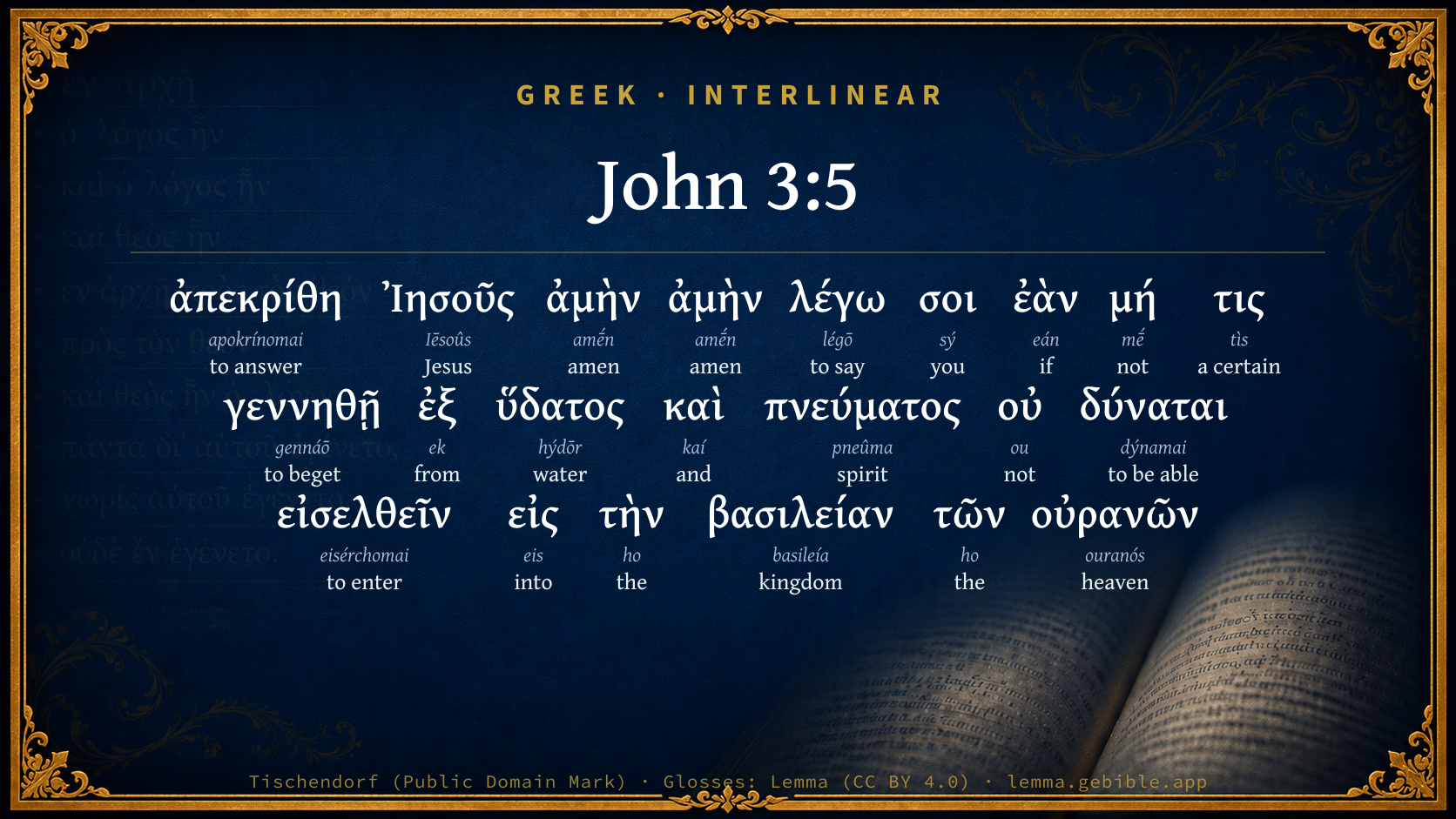
Greek (Tischendorf 8th ed.) John 3:5 appears in the Greek New Testament. The text above is from the Tischendorf 8th edition. Each word links to its Strong’s number and a concise gloss. Click any word for its full Thayer’s Greek Lexicon entry.
Download image
Cite this verse

John 3:5 (World English Bible). Public Domain. Lemma interlinear Bible study tool, https://lemma.gebible.app/v/john/3/5.

Show BibTeX & RIS
BibTeX
RIS
English Translation
Jesus answered, "Most assuredly I tell you, unless one is born of water and spirit, he can't enter into the Kingdom of God!
World English Bible · Public Domain
Download a study sheet

One document with this verse’s original text, its word-by-word gloss line, the meaning frame, cross-references with their text, attributed commentary, and full source and license credits — printable, and it pastes into notes with its structure intact.

This verse Autodidact and up

Study sheet (.html) Plain text (.txt)

A passage Seminary Student

Up to 50 verses in one chapter. A passage sheet keeps up to 6 commentary sources and 12 cross-references per verse, in the order this page ranks them, and says so on the sheet whenever that leaves anything out. Ask for a single verse and you get the Autodidact verse sheet above.

Everything on this page stays free to read, with no account — the sheet is a download of what is already on screen, not access to it.

Want to remove ads? Support Godless Engineer
Compare translations 3

The same verse in 3 English versions, stacked beneath the original-language interlinear above. Click any original word for its lexicon entry.

Each is an independent rendering of the whole verse — the interlinear is not word-aligned to these translations.

Highlighted words mark where these versions differ — a whole-verse word diff, not a word-by-word alignment.

  • World English Bible Public Domain
    Jesus answered, "Most assuredly I tell you, unless one is born of water and spirit, he can't enter into the Kingdom of God!
  • King James Version Public Domain
    Jesus answered, Verily, verily, I say unto thee, Except a man be born of water and of the Spirit, he cannot enter into the kingdom of God.
  • unfoldingWord Literal Text CC BY-SA 4.0
    Jesus answered, “Truly, truly, I say to you, unless someone would be born from water and Spirit, he is not able to enter into the kingdom of God.

unfoldingWord Literal Text — © unfoldingWord, licensed CC BY-SA 4.0. Word-aligned USFM3 via Door43 (git.door43.org/unfoldingWord/en_ult).

Versions to compare (up to 4)

3 of 4 selected

Show all 19 translations

Every available English version of this verse, each an independent rendering of the whole verse.

  • World English Bible Public Domain
    Jesus answered, "Most assuredly I tell you, unless one is born of water and spirit, he can't enter into the Kingdom of God!
  • Berean Standard Bible Public Domain
    Jesus answered, “Truly, truly, I tell you, no one can enter the kingdom of God unless he is born of water and the Spirit.
  • Majority Standard Bible Public Domain
    Jesus answered, “Truly, truly, I tell you, no one can enter the kingdom of God unless he is born of water and the Spirit.
  • King James Version Public Domain
    Jesus answered, Verily, verily, I say unto thee, Except a man be born of water and of the Spirit, he cannot enter into the kingdom of God.
  • American Standard Version (1901) Public Domain
    Jesus answered, Verily, verily, I say unto thee, Except one be born of water and the Spirit, he cannot enter into the kingdom of God!
  • Revised Version (1885) Public Domain
    Jesus answered, Verily, verily, I say unto thee, Except a man be born of water and the Spirit, he cannot enter into the kingdom of God.
  • Geneva Bible (1599) Public Domain
    Iesus answered, Verely, verely I say vnto thee, except that a man be borne of water and of the Spirite, hee can not enter into the kingdome of God.
  • Douay-Rheims (1899) Public Domain
    Jesus answered: Amen, amen I say to thee, unless a man be born again of water and the Holy Ghost, he cannot enter into the kingdom of God.
  • Young's Literal Translation Public Domain
    Jesus answered, `Verily, verily, I say to thee, If any one may not be born of water, and the Spirit, he is not able to enter into the reign of God;
  • Literal Standard Version CC BY-SA 4.0
    Jesus answered, “Truly, truly, I say to you, if anyone may not be born of water and the Spirit, he is not able to enter into the Kingdom of God;
  • Unlocked Literal Bible CC BY-SA 4.0
    Jesus replied, “Truly, truly, unless someone is born of water and the Spirit, he cannot enter into the kingdom of God.
  • unfoldingWord Literal Text CC BY-SA 4.0
    Jesus answered, “Truly, truly, I say to you, unless someone would be born from water and Spirit, he is not able to enter into the kingdom of God.
  • Darby Bible Public Domain
    Jesus answered, Verily, verily, I say unto thee, Except any one be born of water and of Spirit, he cannot enter into the kingdom of God.
  • World Messianic Bible Public Domain
    Yeshua answered, “Most certainly I tell you, unless one is born of water and Spirit, he can’t enter into God’s Kingdom.
  • Webster's Bible Public Domain
    Jesus answered, Verily, verily, I say to thee, Except a man be born of water, and of the Spirit, he cannot enter into the kingdom of God.
  • Free Bible Version CC BY-SA 4.0
    “I tell you the truth, you can't enter God's kingdom unless you are born of water and the Spirit,” Jesus told him.
  • Bible in Basic English Public Domain
    Jesus said in answer, Truly, I say to you, If a man's birth is not from water and from the Spirit, it is not possible for him to go into the kingdom of God.
  • Text-Critical English NT CC BY 4.0
    Jesus answered, “Truly, truly, I say to yoʋ, unless one is born of water and the Spirit, he cannot enter the kingdom of God.
  • Tyndale New Testament (1534) Public Domain
    Iesus answered: verely verely I saye vnto the: except that a man be boren of water and of the sprete he cannot enter into the kyngdome of god.

Literal Standard Version (2020), Covenant Press — licensed CC BY-SA 4.0. Text via the HelloAO Bible API (eBible.org). Unlocked Literal Bible (unfoldingWord) — licensed CC BY-SA 4.0. Text via the HelloAO Bible API (eBible.org). unfoldingWord Literal Text — © unfoldingWord, licensed CC BY-SA 4.0. Word-aligned USFM3 via Door43 (git.door43.org/unfoldingWord/en_ult). Free Bible Version, Dr. Jonathan Gallagher — licensed CC BY-SA 4.0. Text via the HelloAO Bible API (eBible.org).

Word by word

More ways to search: Search by grammar → Find every occurrence → Compare this word →

Practice this passage: Drill this verse → Learn its vocabulary →

ὕδατος
hýdōr
G5204
“water”
Noun, Genitive, Singular, Neuter
Part of Speech
Noun
Case
Genitive
Number
Singular
Gender
Neuter
Full Thayer's Definition

Origin: genitive case, hudatos hoo'-dat-os, etc., from the base of G5205

TDNT: 13:14,1

1. water a. of water in rivers, in fountains, in pools b. of the water of the deluge c. of water in any of the earth's repositories d. of water as the primary element, out of and through which the world that was before the deluge, arose and was compacted e. of the waves of the sea f. fig. used of many peoples
  1. ἀπεκρίθη apokrínomai G611 “to answer” Verb, Aorist, Middle deponent, Indicative, 3rd person, Singular
  2. Ἰησοῦς Iēsoûs G2424 “Jesus” Noun, Nominative, Singular, Masculine
  3. ἀμὴν amḗn G281 “amen” Hebrew transliteration
  4. ἀμὴν amḗn G281 “amen” Hebrew transliteration
  5. λέγω légō G3004 “to say” Verb, Present, Active, Indicative, 1st person, Singular
  6. σοι sý G4771 “you” Personal pronoun, 2nd person, Dative, Singular
  7. ἐὰν eán G1437 “if” Conditional
  8. μή mḗ G3361 “not” Particle, Negative
  9. τις tìs G5100 “a certain” Indefinite pronoun, Nominative, Singular, Masculine
  10. γεννηθῇ gennáō G1080 “to beget” Verb, Aorist, Passive, Subjunctive, 3rd person, Singular
  11. ἐξ ek G1537 “from” Preposition
  12. καὶ kaí G2532 “and” Conjunction
  13. πνεύματος pneûma G4151 “spirit” Noun, Genitive, Singular, Neuter
  14. οὐ ou G3756 “not” Particle, Negative
  15. δύναται dýnamai G1410 “to be able” Verb, Present, Middle or Passive deponent, Indicative, 3rd person, Singular
  16. εἰσελθεῖν eisérchomai G1525 “to enter” Verb, Aorist, Active, Infinitive
  17. εἰς eis G1519 “into” Preposition
  18. τὴν ho G3588 “the” Article, Accusative, Singular, Feminine
  19. βασιλείαν basileía G932 “kingdom” Noun, Accusative, Singular, Feminine
  20. τῶν ho G3588 “the” Article, Genitive, Plural, Masculine
  21. οὐρανῶν ouranós G3772 “heaven” Noun, Genitive, Plural, Masculine

About this verse

These counts appear in no published source. They are computed here, from the morphology-tagged text and Lemma’s own curated glosses. What Lemma adds →

22
words
20
distinct lemmas
Gospels
section

Repetition

Words recur within this verse:

  • ἀμὴν amen G281 ×2
  • τὴν the G3588 ×2

Cross-references

29

Topical passages linked to John 3:5 in the Treasury of Scripture Knowledge — connected by theme and wording, ordered by reader-vote popularity; previews shown in the World English Bible.

  • Ezekiel 36:25–27 I will sprinkle clean water on you, and you shall be clean: from all your filthiness, and from all your idols, will I cleanse you.
  • Ephesians 5:26 that he might sanctify it, having cleansed it by the washing of water with the word,
  • Acts 2:38 Peter said to them, "Repent, and be baptized, everyone of you, in the name of Jesus Christ for the forgiveness of sins, and you will receive the gift of the Holy Spirit.
  • 1 Peter 3:21 This is a symbol of baptism, which now saves you-- not the putting away of the filth of the flesh, but the answer of a good conscience toward God, through the resurrection of Jesus Christ,
  • 1 Corinthians 6:11 Such were some of you, but you were washed. But you were sanctified. But you were justified in the name of the Lord Jesus, and in the Spirit of our God.
  • 1 John 5:6–8 This is he who came by water and blood, Jesus Christ; not with the water only, but with the water and the blood. It is the Spirit who testifies, because the Spirit is the truth.
  • Isaiah 44:3–4 For I will pour water on him who is thirsty, and streams on the dry ground; I will pour my Spirit on your seed, and my blessing on your offspring:
  • Matthew 3:11 I indeed baptize you in water for repentance, but he who comes after me is mightier than I, whose shoes I am not worthy to carry. He will baptize you in the Holy Spirit.
  • Titus 3:4–7 But when the kindness of God our Savior and his love toward mankind appeared,
  • 2 Corinthians 5:17–18 Therefore if anyone is in Christ, he is a new creation. The old things have passed away. Behold, all things have become new.
  • John 3:3 Jesus answered him, "Most assuredly, I tell you, unless one is born anew, he can't see the Kingdom of God."
  • Mark 16:16 He who believes and is baptized will be saved; but he who disbelieves will be condemned.
  • 1 Corinthians 2:12 But we received, not the spirit of the world, but the Spirit which is from God, that we might know the things that were freely given to us by God.
  • Romans 14:17 for the Kingdom of God is not eating and drinking, but righteousness, peace, and joy in the Holy Spirit.
  • Galatians 6:15 For in Christ Jesus neither is circumcision anything, nor uncircumcision, but a new creation.
  • 1 John 5:1 Whoever believes that Jesus is the Christ is born of God. Whoever loves the father also loves the child who is born of him.
  • Matthew 18:3 and said, "Most assuredly I tell you, unless you turn, and become as little children, you will in no way enter into the Kingdom of Heaven.
  • John 1:13 who were born not of blood, nor of the will of the flesh, nor of the will of man, but of God.
  • 1 John 2:29 If you know that he is righteous, you know that everyone who practices righteousness is born of him.
  • 1 Peter 1:2 according to the foreknowledge of God the Father, in sanctification of the Spirit, that you may obey Jesus Christ and be sprinkled in his blood: Grace to you and peace be multiplied.
  • Matthew 28:19 Therefore go, and make disciples of all nations, baptizing them in the name of the Father and of the Son and of the Holy Spirit,
  • Luke 13:3 I tell you, no, but, unless you repent, you will all perish in the same way.
  • Acts 3:19 "Repent therefore, and turn again, that your sins may be blotted out, so that there may come times of refreshing from the presence of the Lord,
  • Ephesians 2:4–10 But God, being rich in mercy, for his great love with which he loved us,
  • Matthew 5:20 For I tell you that unless your righteousness exceeds that of the scribes and Pharisees, there is no way you will enter into the Kingdom of Heaven.
  • Luke 13:24 "Strive to enter in by the narrow door, for many, I tell you, will seek to enter in, and will not be able.
  • 2 Thessalonians 2:13–14 But we are bound to always give thanks to God for you, brothers loved by the Lord, because God chose you from the beginning for salvation through sanctification of the Spirit and belief in the truth;
  • Romans 8:2 For the law of the Spirit of life in Christ Jesus made me free from the law of sin and of death.
  • Luke 13:5 I tell you, no, but, unless you repent, you will all perish in the same way."

Cross-references courtesy of OpenBible.info (CC BY 4.0).

Commentary

Notes on John 3:5 from classic Christian and Jewish commentators (each source and its license shown beneath its notes). The classic Christian expositions comment on the surrounding passage and are grouped to its opening verse, so a note may address several verses; the Jewish commentaries on the Tanakh (Rashi and others) are per-verse, so they appear only where the commentator wrote on this verse.

Lemma curates 59 commentaries, every one of them public domain or Creative Commons licensed, each selected and text-cleaned for this edition rather than reprinted as found. About our sources →

Jamieson, Fausset & Brown

Robert Jamieson, A. R. Fausset & David Brown

of water and of the Spirit--A twofold explanation of the "new birth," so startling to Nicodemus. To a Jewish ecclesiastic, so familiar with the symbolical application of water, in every variety of way and form of expression, this language was fitted to show that the thing intended was no other than a thorough spiritual purification by the operation of the Holy Ghost. Indeed, element of water and operation of the Spirit are brought together in a glorious evangelical prediction of Ezekiel (Eze 36:25-27), which Nicodemus might have been reminded of had such spiritualities not been almost lost in the reigning formalism. Already had the symbol of water been embodied in an initiatory ordinance, in the baptism of the Jewish expectants of Messiah by the Baptist, not to speak of the baptism of Gentile proselytes before that; and in the Christian Church it was soon to become the great visible door of entrance into "the kingdom of God," the reality being the sole work of the Holy Ghost (Tit 3:5).

Jamieson, Fausset & Brown — Commentary Critical and Explanatory on the Whole Bible (1871) — public domain (CC PDM 1.0). Text via the HelloAO Bible API.

Albert Barnes' Notes on the Bible

Be born of water - By “water,” here, is evidently signified “baptism.” Thus the word is used in Eph 5:26; Tit 3:5. Baptism was practiced by the Jews in receiving a Gentile as a proselyte. It was practiced by John among the Jews; and Jesus here says that it is an ordinance of his religion, and the sign and seal of the renewing influences of his Spirit. So he said Mar 16:16, “He that believeth and is baptized shall be saved.” It is clear from these places, and from the example of the apostles Act 2:38, Act 2:41; Act 8:12-13, Act 8:36, Act 8:38; Act 9:18; Act 10:47-48; Act 16:15, Act 16:33; Act 18:8; Act 22:16; Gal 3:27, that they considered this ordinance as binding on all who professed to love the Lord Jesus. And though it cannot be said that none who are not baptized can be saved, yet Jesus meant, undoubtedly, to be understood as affirming that this was to be the regular and uniform way of entering into his church; that it was the appropriate mode of making a profession of religion; and that a man who neglected this, when the duty was made known to him, neglected a plain command of God. It is clear, also, that any other command of God might as well be neglected or violated as this, and that it is the duty of everyone not only to love the Saviour, but to make an acknowledgment of that love by being baptized, and by devoting himself thus to his service.

But, lest Nicodemus should suppose that this was all that was meant, he added that it was necessary that he should “be born of the Spirit” also. This was predicted of the Saviour, that he should “baptize with the Holy Ghost and with fire,” Mat 3:11. By this is clearly intended that the heart must be changed by the agency of the Holy Spirit; that the love of sin must be abandoned; that man must repent of crime and turn to God; that he must renounce all his evil propensities, and give himself to a life of prayer and holiness, of meekness, purity, and benevolence. This great change is in the Scripture ascribed uniformly to the Holy Spirit, Tit 3:5; 1Th 1:6; Rom 5:5; 1Pe 1:22.

Cannot enter into - This is the way, the appropriate way, of entering into the kingdom of the Messiah here and hereafter. He cannot enter into the true church here, or into heaven in the world to come, except in connection with a change of heart, and by the proper expression of that change in the ordinances appointed by the Saviour.

Albert Barnes' Notes on the Bible (1834–1885) — public domain. Text from a community e-Sword/MySword module.

Tyndale Open Study Notes

Tyndale Open Resources

3:5 John the Baptist baptized with water; Jesus baptizes with the Spirit (1:33).

Tyndale Open Study Notes — © Tyndale Open Resources, licensed CC BY-SA 4.0. Text via the HelloAO Bible API.

Bengel's Gnomon

Johann Albrecht Bengel

Joh 3:5. Ἐξ ὕδατος καὶ Πνεύματος, of water and the Spirit) Jesus renders His speech the more difficult, in order to try [discipline] Nicodemus, and at the same time declares the difference between birth from above, and birth from a mother: and He defines birth from above by communion with [the partaking of] Himself and with [of] the Spirit (for He speaks concerning Himself and concerning the Spirit also at Joh 3:11, “we speak that we do know”). Comp. 1Co 6:11, “Ye are washed, ye are sanctified, ye are justified in the name of the Lord Jesus, and by the Spirit of our God.” No one can enjoy God without the Son and His Spirit. Water denotes the baptism of John into [preparing for] Christ Jesus, Joh 3:22-23 [Jesus tarried in the land of Judæa with His disciples, and baptized: “John was also baptizing in Ænon,” etc.]; which baptism the colleagues of Nicodemus, by omitting, Joh 3:1, despised the counsel of God: Luk 7:30, “The Pharisees and lawyers rejected the counsel of God against themselves, being not baptized of John;” when nevertheless the Jews were accustomed to baptisms: Heb 9:10, “divers washings.” And Nicodemus himself appears to have entertained not sufficiently exalted views of John and his baptism, as being one who had wrought no miracle. Comp. Joh 3:2 [where he emphasises the ‘miracles’ of Jesus; thus forming a contrast to John]. Nor is communion needful with Christ only, but also with His Spirit: Act 2:38, “Repent and be baptized—in the name of Jesus Christ, for the remission of sins, and ye shall receive the gift of the Holy Ghost.” And because the same Spirit glorifies Christ, for this reason, the mention of water being presently after omitted, mention is made of the Spirit alone, of whom we are to be born again: nor does He say at Joh 3:6, that which is born of water is water. Therefore the necessity of regeneration primarily, and of baptism secondarily, is here confirmed (comp. a similar καί, and, ch. Joh 6:40, every one which seeth the Son and believeth on Him): otherwise there would be but little hope of infants dying without baptism. Comp. as to water and the Spirit, Tit 3:5, “Not by works which we have done, but according to His mercy He saved us, by the washing of regeneration, and renewing of the Holy Ghost.”—εἰσελθεῖν, enter) Answering to the word enter [a second time into his mother’s womb] of the previous verse. The severity of His expression increases: comp. see, Joh 3:3. He cannot even enter, much less see. He must enter a house, whoever wishes to see thoroughly its internal structure. That which is not born, uses neither eyes nor feet.

Bengel's Gnomon of the New Testament — English translation (T&T Clark, Edinburgh, 1860) — public domain. Text from a community e-Sword module.

Meyer's Critical & Exegetical Commentary

Heinrich August Wilhelm Meyer

Joh_3:5. Jesus now explains more fully the ἄνωθεν γεννηθῆναι onwards to Joh_3:8.

ἐξ ὕδατος κ. πνεύματος] water, inasmuch as the man is baptized therewith (1Jn_5:7-8; Eph_5:26) for the forgiveness of sins (Act_2:33; Act_22:16; 2Co_6:11), and spirit, inasmuch as the Holy Ghost is given to the person baptized in order to his spiritual renewal and sanctification; both together[152]the former as causa medians, the latter as causa efficiensconstitute the objective and causative element, out of which (comp. Joh_1:13) the birth from above is produced (ἐκ), and therefore baptism is the ΛΟΥΤΡῸΝ ΠΑΛΙΓΓΕΝΕΣΊΑς (Tit_3:5; comp. Tertullian c. Marc. i. 28). But that Christian baptism (Joh_3:22; Joh_4:2), and not that of John (B. Crusius; Hofmann, Schriftbeweis, II. 2. 12; Lange, who, however, generalizes ideally; and earlier comm.), is to be thought of in ὕδατος, is clear from the Κ. ΠΝΕΎΜΑΤΟς joined with it, and from the fact that He who had already appeared as Messiah could no longer make the baptism of His forerunner the condition, not even the preparatory condition, of His Messianic grace; for in that case He must have said ΟὐΚ ἘΞ ὝΔΑΤΟς ΜΌΝΟΝ, ἈΛΛᾺ ΚΑΊ. If Nicodemus was not yet able to understand ὝΔΑΤΟς as having this definite reference, but simply took the word in general as a symbolical designation of Messianic expiation of sin and of purification, according to O. T. allusions (Eze_36:25; Isa_1:16; Mal_3:3; Zec_13:1; Jer_33:8), and to what he knew of Johns baptism, still it remained for him to look to the immediate future for more definite knowledge, when the true explanation could not escape him (Joh_4:2, Joh_3:22). We are not therefore to conclude from this reference to baptism, that the narrative is a proleptic fiction (Strauss, Bruno Bauer), and, besides Mat_18:3, to suppose in Justin and the Clementines uncanonical developments (Hilgenfeld and others; see Introduction, § 2). Neither must we explain it as if Jesus were referring Nicodemus not to baptism as such, but only by way of allusion to the symbolic import of the water in baptism (Lücke; Neander, p. 910). This latter view does not satisfy the definite γεννηθῇ ἐξ, upon which, on the other side, Theodore of Mopsuestia and others, in modern times Olshausen in particular, lay undue stress, taking the water to be the female principle in regeneration (the Spirit as the male)water being, according to Olshausen, the element of the soul purified by true repentance. All explanations, moreover, must be rejected which, in order to do away with the reference to baptism,[153] adopt the principle of an ἓν διὰ δυοῖν, for water and Spirit are two quite separate conceptions. This is especially in answer to Calvin, who says: of water, which is the Spirit, and Grotius: spiritus aqueus, i.e. aquae instar emundans. It is further to be observed, (1) that both the words being without the article, they must be taken generically, so far as the water of baptism and the Holy Spirit are included in the general categories of water and Spirit; not till we reach Joh_3:6 is the concrete term used;(2) that ὕδατος is put first, because the gift of the Spirit as a rule (Act_2:38) followed upon baptism (Act_10:47 is an exceptional case);(3) that believing in Jesus as the Messiah is presupposed as the condition of baptism (Mar_16:16);(4) that the necessity of baptism in order to participation in the Messianic kingdom (a doctrine against which Calvin in particular, and other expositors of the Reformed Church, contend) has certainly its basis in this passage, but with reference to the convert to Christianity, and not extending in the same way to the children of Christians, for these by virtue of their Christian parentage are already ἅγιοι (see on 1Co_7:14). Attempts to explain away this necessitye.g. by the comparative rendering: not only by water, but also by the Spirit (B. Crusius; comp. Schweizer, who refers to the baptism of proselytes, and Ewald)are meanings imported into the words.

[152] Weisse, who does not regard the rite of baptism by water as having originated in the institution of Christ, but considers that it arose from a misapplication of His words concerning the baptism of the Spirit, greatly errs when he declares that to make regeneration depend upon baptism by water is little better than blasphemy (Evangelienfrage, p. 194).

[153] Krummacher, recently, in the Stud. u. Krit. 1859, p. 509, understands by the water the working of the Holy Spirit. How untenable! for the Spirit is named as a distinct factor side by side with water.

Meyer — Critical and Exegetical Commentary on the New Testament — English translation by Peter Christie, edited by Frederick Crombie (T&T Clark, 1880) — public domain. Text from a community e-Sword module.

Expositor's Greek Testament

ed. W. Robertson Nicoll

Joh 3:5 . Ἀμὴν , ἀμὴν λέγω σοι , ἐὰν μή τις γεννηθῆ ἐξ ὕδατος καὶ πνεύματος , οὐ δύναται εἰσελθεῖν εἰς τὴν β . To remove as far as possible the difficulty of Nicodemus as to the πῶς of the second birth our Lord declares that the two great factors in it are “water” and “spirit”. Calvin thinks this is a ἐν διὰ δυοῖν , and that the two names cover one reality. “Spiritum et aquam pro eodem posuit.” “ Aqua nihil aliud est quam interior Spiritus sancti purgatio et vegetatio.” And he defends this by a reference to the Baptist’s announcement that the Messiah would baptise with the spirit and fire. Grotius takes the same line, but cautiously adds: “Si quis tamen malit ista decernere, ut aqua significet mali fugam, spiritus vero impetum ad optima quaeque agenda, inveniet quo hanc sententiam fulciet”. Lk. (Luk 7:30 ) tells us that the Pharisees, to whom belonged Nicodemus, were not baptised of John; their reason being that to submit to the same rite as Gentiles and acknowledge the insufficiency of their Jewish birth was a humiliation they could not suffer. To receive the Spirit from the Messiah was no humiliation; on the contrary, it was a glorious privilege. But to go down into Jordan before a wondering crowd and own their need of cleansing and new birth was too much. Therefore to this Pharisee our Lord declares that an honest dying to the past is as needrul as new life for the future. To be born of the Spirit involves a dying to the past, and therefore it is only the Spirit that is spoken of in the subsequent verses; but it is essential that our past be recognised as needing cleansing and forgiveness. These two factors, water and spirit, are not strictly co-ordinate. Water is not an actual spiritual agency in the second birth; it is only a symbol. But in every true second birth there is a negative as well as a positive side, a renunciation of the past as well as a new life created. The same idea is found in Tit 3:3-5 , “We were [of the flesh] but He saved us by the bath of regeneration and the renewal of the Holy Ghost”. The same combination is found in Eze 36:25-27 , “Then will I sprinkle clean water upon you and ye shall be clean: from all your filthiness and from all your idols will I cleanse you. A new heart also will I give you, and a new spirit will I put within you.” The water, then, is considered as that which cleanses from sin: the Spirit as the principle of the new life.

The Expositor's Greek Testament, edited by W. Robertson Nicoll (1897–1910) — public domain. Text from a community e-Sword module.

Cambridge Greek Testament for Schools and Colleges

5. ἐξ ὕδατος κ. πνεύματος. The ἐξ answers to the εἰς which follows and reminds us of the ἐν in Joh 1:33. The convert is immersed in the material and spiritual elements, rises new-born out of them, and enters into the kingdom. Christ leaves the foolish question of Nicodemus to answer itself: He goes on to explain what is the real point, and what Nicodemus has not asked, the meaning of ἄνωθεν: ‘of water and (the) Spirit.’ The outward sign and inward grace of Christian baptism are here clearly given, and an unbiassed mind can scarcely avoid seeing this plain fact. This becomes still more clear when we compare Joh 1:26; Joh 1:33, where the Baptist declares ‘I baptize with water;’ the Messiah ‘baptizeth with the Holy Ghost.’ The Fathers, both Greek and Latin, thus interpret the passage with singular unanimity. Thus once more S. John assumes without stating the primary elements of Christianity. Baptism is assumed here as well known to his readers, as the Eucharist is assumed in chap. 6. To a well-instructed Christian there was no need to explain what was meant by being born of water and the Spirit. The words therefore had a threefold meaning, past, present, and future. In the past they looked back to the time when the Spirit moved upon the water, causing the new birth from above of Order and Beauty out of Chaos. In the present they pointed to the divinely ordained (Joh 1:33) baptism of John: and through it in the future to that higher rite, to which John himself bore testimony. Thus Nicodemus would see that he and the Pharisees were wrong in rejecting John’s baptism (Luk 7:30). Of the two elements, water signifies the purifying power, spirit the life-giving power: the one removes hindrances, making the baptized ready to receive the other (Act 2:38; Tit 3:5). Note that ἐκ is not repeated before πνεύματος, so that the two factors are treated as inseparable: moreover, neither has the article; it is the kind of factors rather than a definite instance that is indicated.

The Sinaiticus and some other authorities here read τῶν οὐρανῶν for τοῦ Θεοῦ. This reading renders Justin’s reference to the passage still more certain (see on Joh 3:3).

Cambridge Greek Testament for Schools and Colleges (Cambridge University Press, 1896; 21 vols, various authors incl. Carr, Maclear, Plummer, Farrar, Lumby, Moule, M. R. James, Simcox) — public domain. Text from a community e-Sword module.

International Critical Commentary

5. ὁ must be omitted before Ἰησοῦς, as in v. 3. See on 1:29.

For γεννηθῇ nearly all the Latin versions have renatus (f alone has natus), which may point to a Western reading ἀναγεννηθῇ. But probably the Latin rendering is of the nature of an interpretation (with a reminiscence of γεννηθῇ ἄνωθεν in v. 3), the verb ἀναγεννάω occurring in N.T. only at 1Pe 1:3, 1Pe 1:23.

Another Western variant1 is τὴν βασιλείαν τῶν οὐραῶν, for the rec. τὴν βας.τοῦ θεοῦ, which is supported by אcABLNWΓΔΘ. א* 511 e m support τῶν οὐρανῶν, which is also read in Justin (Apol. i. 61), Hippolytus (Ref. viii. 10), Irenæus (Frag. xxxiii., ed. Harvey), and ps.—Cyprian de Rebaptismate 3. Tertullian has in regnum caelorum (de Bapt. 13); but in another place in regnum dei (de Anima 39). Origen’s witness is alike uncertain, his Latin translation giving both caelorum (Hom. xiv. in Lucam, and Comm. in Rom. ii. 7) and dei (Hom. v. in Exod.). Perhaps, as Hort says, the Western reading was suggested by the greater frequency of the phrase εἰσέρχεσθαι εἰς τὴν βασιλείαν τῶν οὐρανῶν in Mt.

The seal of the baptismal waters is thrice mentioned by Hermas (Sim. ix. 15, 16) as a pre-requisite to entering the kingdom of God; and in 2 Clem. 6 (before 140 a.d.) we have “if we keep not our baptism pure and undefiled, with what confidence shall we enter into the kingdom of God?” It is possible that here we have reminiscences of the language of v. 5. See Introd., p. lxxvi.

The reference in the word ὕδατος is clearly to Christian baptism (see Introd., p. clxiv). But, so far as Nicodemus was concerned, this would have been an irrelevant reference; the argument being darkened by the presence of ὕδατος καὶ before πνεύματος. Jesus explains that Nicodemus must be “begotten from above” before he can enter the kingdom of God, i.e. that a spiritual change must pass upon him, which is described in v. 6 as being “begotten of the Spirit.” The words ὕδατος καί have been inserted in v. 8 by א a b e, etc. (see note in loc.), although they form no part of the true text; and it has been suggested that, in like manner, in the verse before us they are only an interpretative gloss.2 There is, however, no MS. evidence for their omission here (although the Sinai Syriac transposes the order of words and testifies to a reading “begotten of Spirit and of water”), nor is there extant any patristic citation of the verse which speaks of “being begotten of the Spirit” and does not mention the water. The passage from Justin (Apol. i. 61) by which Lake supports his argument is as follows: ἔπειτα ἄγονται ὑφʼ ἡμῶν ἔνθα ὕδωρ ἐστί, καὶ τρόπον ἀναγεννήσεως, ὃν καὶ ἡμεῖς αὐτοὶ ἀνεγεννήθημεν, ἀναγεννῶνται … καὶ γὰρ ὁ Χριστὸς εἶπεν, Ἂν μὴ ἀναγεννηθῆτε, οὐ μὴ εἰσέλθητε εἰς τὴν βασιλείαν τῶν οὐρανῶν. Justin is quoting loosely (after his manner), and it is not certain whether it is Joh 3:3 or Joh 3:5 that he has in his mind. But there is nothing to suggest that the reading before him was ἐὰν μή τις γεννηθῇ ἐκ Πνεύματος κτλ. Indeed, in another place (Tryph. 138) he has the phrase τοῦ ἀναγεννηθέτος ὑπʼ αὐτοῦ διʼ ὕδατος καὶ πίστεως καὶ ξύλου.

We conclude that the words ὕδατος καί cannot be extruded from the text of Jn., but that they are not to be regarded as representing precisely the saying of Jesus. They are due to a restatement by Jn. of the original saying of v. 3, and are a gloss, added to bring the saying of Jesus into harmony with the belief and practice of a later generation.1

ἐὰν μή τις γεννηθῇ κτλ. We have seen (on 1:13) that those who believe on the name of Christ are described as “begotten of God,” ἐκ θεοῦ γεγεννημένοι, and the references given in the note show that this is a characteristic Johannine phrase. It is necessary to interpret the words ὁ γεγεννημένος ἐκ τοῦ πνεύματος (vv. 5, 6, 8) in similar fashion, and to understand them as describing the man who “is begotten of the Spirit.” “God is Spirit” (4:24), and the phrases “begotten of God” and “begotten of the Spirit” mean the same thing. At 1Jn 3:9 we have πᾶς ὁ γεγεννημένος ἐκ τοῦ θεοῦ ἀμαρτίαν οὐ ποιεῖ, ὅτι σπέρμα αὐτοῦ ἐν αὐτῷ μένει, but a few verses later (1Jn 3:24) it is said of those who keep God’s commandments γινώσκομεν ὅτι μένει ἐν ἡμῖν, ἐκ τοῦ πνεύματος οὖ ἡμῖν ἔδωκεν. The “seed of God” is the “Spirit,” whereof believers are made partakers by a spiritual begetting. That is to say, the words ἐκ τοῦ Πνεύματος in this verse point to the Spirit as the Begetter of believers.

To translate “born of the Spirit” suggests that the image is of the Spirit as the female parent of the spiritual child, whereas Johannine usage (and O.T. usage also, as we have seen on 1:13) shows that the image is that of the Spirit as the Begetter. It has been pointed out already (on 1:13) that the Latin rendering natus must not be taken as excluding the meaning begotten.

In Semitic languages the Spirit, Ruḥ, is feminine; e.g. the Old Syriac of 14:26 runs, “The Spirit, the Paraclete, she shall teach you all things.” Thus the phrase “begotten of the Spirit,” which we have found reason for accepting as Johannine, would be inconsistent with the Aramaic origin of the Fourth Gospel. If, as Burney held, Jn. were originally written in Aramaic, then the original behind τὸ γεγεννημένον ἐκ τοῦ Πνεύματος must have meant “born of the Spirit.” But this does not harmonise with 1:13 or 1Jn 3:9.

International Critical Commentary — older volumes (1896–1929), various authors — public domain. Text from a community e-Sword module.

Vincent's Word Studies in the New Testament

Marvin R. Vincent

Born of water and the Spirit. The exposition of this much controverted passage does not fall within the scope of this work. We may observe,

1. That Jesus here lays down the preliminary conditions of entrance into His kingdom, expanding and explaining His statement in ver. 3.

2. That this condition is here stated as complex, including two distinct factors, water and the Spirit.

3. That the former of these two factors is not to be merged in the latter; that the spiritual element is not to exclude or obliterate the external and ritual element. We are not to understand with Calvin, the Holy Spirit as the purifying water in the spiritual sense : "water which is the Spirit."

4. That water points definitely to the rite of baptism, and that with a twofold reference - to the past and to the future. Water naturally suggested to Nicodemus the baptism of John, which was then awakening such profound and general interest; and, with this, the symbolical purifications of the Jews, and the Old Testament use of washing as the figure of purifying from sin (Psa 2:2, 7; Eze 36:25; Zec 13:1). Jesus ' words opened to Nicodemus a new and more spiritual significance in both the ceremonial purifications and the baptism of John which the Pharisees had rejected (Luk 7:30). John's rite had a real and legitimate relation to the kingdom of God which Nicodemus must accept.

5. That while Jesus asserted the obligation of the outward rite, He asserted likewise, as its necessary complement, the presence and creating and informing energy of the Spirit with which John had promised that the coming one should baptize. That as John's baptism had been unto repentance, for the remission of sins, so the new life must include the real no less than the symbolic cleansing of the old, sinful life, and the infusion by the Spirit of a new and divine principle of life. Thus Jesus ' words included a prophetic reference to the complete ideal of Christian baptism - "the washing of regeneration and the renewing of the Holy Ghost" (Tit 3:5; Eph 5:26); according to which the two factors are inseparably blended (not the one swallowed up by the other), and the new life is inaugurated both symbolically in the baptism with water, and actually in the renewing by the Holy Spirit, yet so as that the rite, through its association with the Spirit's energy, is more than a mere symbol : is a veritable vehicle of grace to the recipient, and acquires a substantial part in the inauguration of the new life. Baptism, considered merely as a rite, and apart from the operation of the Spirit, does not and cannot impart the new life. Without the Spirit it is a lie. It is a truthful sign only as the sign of an inward and spiritual grace.

6. That the ideal of the new life presented in our Lord 's words, includes the relation of the regenerated man to an organization. The object of the new birth is declared to be that a man may see and enter into the kingdom of God. But the kingdom of God is an economy. It includes and implies the organized Christian community. This is one of the facts which, with its accompanying obligation, is revealed to the new vision of the new man. He sees not only God, but the kingdom of God; God as King of an organized citizenship; God as the Father of the family of mankind; obligation to God implying obligation to the neighbor; obligation to Christ implying obligation to the church, of which He is the head, "which is His body, the fullness of Him that filleth all things with all things" (Eph 1:23). Through water alone, the mere external rite of baptism, a man may pass into the outward fellowship of the visible church without seeing or entering the kingdom of God. Through water and the Spirit, he passes indeed into the outward fellowship, but through that into the vision and fellowship of the kingdom of God.

Enter into. This more than see (ver. 3). It is to become partaker of; to go in and possess, as the Israelites did Canaan.

Marvin R. Vincent, Word Studies in the New Testament (1887–1900) — public domain. Text from a community e-Sword/MySword module.

Adam Clarke's Commentary

Verse 5. Of water and of the Spirit] To the baptism of water a man was admitted when he became a proselyte to the Jewish religion; and, in this baptism, he promised in the most solemn manner to renounce idolatry, to take the God of Israel for his God, and to have his life conformed to the precepts of the Divine law. But the water which was used on the occasion was only an emblem of the Holy Spirit. The soul was considered as in a state of defilement, because of past sin: now, as by that water the body was washed, cleansed, and refreshed, so, by the influences of the Holy Spirit, the soul was to be purified from its defilement, and strengthened to walk in the way of truth and holiness.

When John came baptizing with water, he gave the Jews the plainest intimations that this would not suffice; that it was only typical of that baptism of the Holy Ghost, under the similitude of fire, which they must all receive from Jesus Christ: see Mt 3:11. Therefore, our Lord asserts that a man must be born of water and the Spirit, i.e. of the Holy Ghost, which, represented under the similitude of water, cleanses, refreshes, and purifies the soul. Reader, hast thou never had any other baptism than that of water? If thou hast not had any other, take Jesus Christ's word for it, thou canst not, in thy present state, enter into the kingdom of God. I would not say to thee merely, read what it is to be born of the Spirit: but pray, O pray to God incessantly, till he give thee to feel what is implied in it! Remember, it is Jesus only who baptizes with the Holy Ghost: see Joh 1:33. He who receives not this baptism has neither right nor title to the kingdom of God; nor can he with any propriety be termed a Christian, because that which essentially distinguished the Christian dispensation from that of the Jews was, that its author baptized all his followers with the Holy Ghost.

Though baptism by water, into the Christian faith, was necessary to every Jew and Gentile that entered into the kingdom of the Messiah, it is not necessary that by water and the Spirit (in this place) we should understand two different things: it is probably only an elliptical form of speech, for the Holy Spirit under the similitude of water; as, in Mt 3:3, the Holy Ghost and fire, do not mean two things, but one, viz. the Holy Ghost under the similitude of fire-pervading every part, refining and purifying the whole.

Adam Clarke's Commentary on the Bible (1810–1826) — public domain. Text from a community e-Sword/MySword module.

John Calvin's Commentaries

5. Unless a man be born of water. This passage has been explained in various ways. Some have thought that the two parts of regeneration are distinctly pointed out, and that by the word Water is denoted the renunciation of the old man, while by the Spirit they have understood the new life. Others think that there is an implied contrast, as if Christ intended to contrast Water and Spirit, which are pure and liquid elements, with the earthly and gross nature of man. Thus they view the language as allegorical, and suppose Christ to have taught that we ought to lay aside the heavy and ponderous mass of the flesh, and to become like water and air, that we may move upwards, or, at least, may not be so much weighed down to the earth. But both opinions appear to me to be at variance with the meaning of Christ.

Chrysostom, with whom the greater part of expounders agree, makes the word Water refer to baptism. The meaning would then be, that by baptism we enter into the kingdom of God, because in baptism we are regenerated by the Spirit of God. Hence arose the belief of the absolute necessity of baptism, in order to the hope of eternal life. But though we were to admit that Christ here speaks of baptism, yet we ought not to press his words so closely as to imagine that he confines salvation to the outward sign; but, on the contrary, he connects the Water with the Spirit, because under that visible symbol he attests and seals that newness of life which God alone produces in us by his Spirit. It is true that, by neglecting baptism, we are excluded from salvation; and in this sense I acknowledge that it is necessary; but it is absurd to speak of the hope of salvation as confined to the sign. So far as relates to this passage, I cannot bring myself to believe that Christ speaks of baptism; for it would have been inappropriate.

We must always keep in remembrance the design of Christ, which we have already explained; namely, that he intended to exhort Nicodemus to newness of life, because he was not capable of receiving the Gospel, until he began to be a new man. It is, therefore, a simple statement, that we must be born again, in order that we may be the children of God, and that the Holy Spirit is the Author of this second birth. For while Nicodemus was dreaming of the regeneration (παλιγγενεσία) or transmigration taught by Pythagoras, who imagined that souls, after the death of their bodies, passed into other bodies, Christ, in order to cure him of this error, added, by way of explanation, that it is not in a natural way that men are born a second time, and that it is not necessary for them to be clothed with a new body, but that they are born when they are renewed in mind and heart by the grace of the Spirit.

Accordingly, he employed the words Spirit and water to mean the same thing, and this ought not to be regarded as a harsh or forced interpretation; for it is a frequent and common way of speaking in Scripture, when the Spirit is mentioned, to add the word Water or Fire, expressing his power. We sometimes meet with the statement, that it is Christ who baptizeth with the Holy Ghost and with fire, (Matthew 3:11; Luke 3:16,) where fire means nothing different from the Spirit, but only shows what is his efficacy in us. As to the word water being placed first, it is of little consequence; or rather, this mode of speaking flows more naturally than the other, because the metaphor is followed by a plain and direct statement, as if Christ had said that no man is a son of God until he has been renewed by water, and that this water is the Spirit who cleanseth us anew and who, by spreading his energy over us, imparts to us the rigor of the heavenly life, though by nature we are utterly dry. And most properly does Christ, in order to reprove Nicodemus for his ignorance, employ a form of expression which is common in Scripture; for Nicodemus ought at length to have acknowledged, that what Christ had said was taken from the ordinary doctrine of the Prophets.

By water, therefore, is meant nothing more than the inward purification and invigoration which is produced by the Holy Spirit. Besides, it is not unusual to employ the word and instead of that is, when the latter clause is intended to explain the former. And the view which I have taken is supported by what follows; for when Christ immediately proceeds to assign the reason why we must be born again, without mentioning the water, he shows that the newness of life which he requires is produced by the Spirit alone; whence it follows, that water must not be separated from the Spirit

John Calvin's Commentaries (1540-1563) — public domain. Text from the Calvin Translation Society English edition (1840s-50s) via the Christian Classics Ethereal Library (ccel.org). Calvin's coverage is partial (roughly two-thirds of the Bible); uncommented books and verses are honest gaps, never fabricated. The 19th-century editor's footnotes and remarks are omitted so the notes are faithfully Calvin's own voice.

Ellicott's Commentary for English Readers

(5) Again the words “Verily, verily” (comp. Note on chap Joh_1:51), calling attention to the deeper truth which follows; and again the words of authority, “I say unto thee.”

Of water and of the Spirit.—We are here on the borderland of a great controversy. The subject is closely connected with that of the discourse in Capernaum (John 6), and so far as it is a subject for the pages of a Commentary at all, it will be better to treat of it in connection with that discourse. (See Excursus C: The Sacramental Teaching of St. John’s Gospel.) Our task here is to ask what meaning the words were intended by the Speaker to convey to the hearer; and this seems not to admit of doubt. The baptism of proselytes was already present to the thought; the baptism of John had excited the attention of all Jerusalem, and the Sanhedrin had officially inquired into it. Jesus Himself had submitted to it, but “the Pharisees and lawyers” [Nicodemus was both] “rejected the counsel of God against themselves, being not baptised of him” (Luk_7:29). The key to the present verse is found in the declaration of John, “I baptise with water . . . He baptiseth with the Holy Ghost” (Joh_1:26; Joh_1:33), and this key must have been then in the mind of Nicodemus. The message was, baptism with water; baptism with water, by which the Gentile had been admitted as a new-born babe to Judaism, the rite representing the cleansing of the life from heathen pollutions and devotion to the service of the true God; baptism with water, which John had preached in his ministry of reformation (comp. Mat_3:7), declaring a like cleansing as needed for Jew and Gentile, Pharisee and publican, as the gate to the kingdom of heaven, which was at hand; baptism with water, which demanded a public profession in the presence of witnesses, and an open loyalty to the new kingdom, not a visit by night, under the secrecy of darkness—this is the message of God to the teacher seeking admission to His kingdom. This he would understand. It would now be clear to him why John came baptising, and why Jews were themselves baptised confessing their sins. There is no further explanation of the “outward and visible sign,” but the teaching passes on to the “inward and spiritual grace,” the baptism of the Holy Ghost, the birth of the Spirit, which was the work of the Messiah Himself. Of this, indeed, there were foreshadowings and promises in the Old Testament Scriptures (comp., e.g., Eze_36:25 et seq.; Jer_31:33; Joe_2:28); but the deeper meaning of such passages was buried beneath the ruins of the schools of prophets, and few among later teachers had penetrated to it. It is hard for this Rabbi to see it, even when it is brought home to him.

(5) It is believed that the rendering adopted agrees with the whole context, and gives a fuller sense to the words of the great Teacher.

A Bible Commentary for English Readers, edited by Charles John Ellicott (1878–1897) — public domain. Text from a community e-Sword module.

The Cambridge Bible for Schools and Colleges

gen. ed. J. J. S. Perowne

5. of water and of the Spirit] Christ leaves the foolish question of Nicodemus to answer itself: He goes on to explain what is the real point, and what Nicodemus has not asked, the meaning of ‘from above:’ ‘of water and (of the) Spirit.’ The outward sign and inward grace of Christian baptism are here clearly given, and an unbiassed mind can scarcely avoid seeing this plain fact. This becomes still more clear when we compare Joh_1:26; Joh_1:33, where the Baptist declares ‘I baptize with water;’ the Messiah ‘baptizeth with the Holy Ghost.’ The Fathers, both Greek and Latin, thus interpret the passage with singular unanimity. Thus once more S. John assumes without stating the primary elements of Christianity. Baptism is assumed here as well known to his reader, as the Eucharist is assumed in chap. 6. To a well-instructed Christian there was no need to explain what was meant by being born of water and the Spirit. The words therefore had a threefold meaning, past, present, and future. In the past they looked back to the time when the Spirit moved upon the water causing the birth from above of Order and Beauty out of Chaos. In the present they pointed to the divinely ordained (Joh_1:33) baptism of John: and through it in the future to that higher rite, to which John himself bore testimony.

The Cambridge Bible for Schools and Colleges (gen. ed. J. J. S. Perowne; Cambridge University Press, 1878–1918) — public domain. Text from a community e-Sword module.

John Gill's Exposition

That which is born of the flesh, is flesh,.... Man by his natural birth, and as he is born according to the flesh of his natural parents, is a mere natural man; that is, he is carnal and corrupt, and cannot discern spiritual things; nor can he, as such, enter into, and inherit the kingdom of God; see Co1 2:14. And therefore there is a necessity of his being born again, or of the grace of the Spirit, and of his becoming a spiritual man; and if he was to be, or could be born again of the flesh, or ever so many times enter into his mothers womb, and be born, was it possible, he would still be but a natural and a carnal man, and so unfit for the kingdom of God. By "flesh" here, is not meant the fleshy part of man, the body, as generated of another fleshy substance; for this is no other than what may be said of brutes; and besides, if this was the sense, "spirit", in the next clause, must mean the soul, whereas one soul is not generated from another: but by flesh is designed, the nature of man; not merely as weak and frail, but as unclean and corrupt, through sin; and which being propagated by natural generation from sinful men, cannot be otherwise; for "who can bring a clean thing out of an unclean? not one", Job 14:4. And though the soul of man is of a spiritual nature, and remains a spirit, notwithstanding the pollution of sin; yet it being defiled with the flesh, and altogether under the power and influence of the lusts of the flesh, it may well be said to be carnal or fleshly: hence "flesh", as it stands opposed to spirit, signifies the corruption of nature, Gal 5:17; and such who are in a state of unregeneracy, are said to be after the flesh, and in the flesh, and even the mind itself is said to be carnal, Rom 8:5.

And that which is born of the Spirit, is spirit: a man that is regenerated by the Spirit of God, and the efficacy of his grace, is a spiritual man; he can discern and judge all things of a spiritual nature; he is a fit person to be admitted to spiritual ordinances and privileges; and appears to be in the spiritual kingdom of Christ; and has a right to the world of blessed spirits above; and when his body is raised a spiritual body, will be admitted in soul, body, and spirit, into the joy of his Lord. "Spirit" in the first part of this clause, signifies the Holy Spirit of God, the author of regeneration and sanctification; whence that work is called the sanctification of the Spirit, and the renewing of the Holy Ghost, Pe1 1:2. And "spirit", in the latter part, intends the internal work of grace upon the soul, from whence a man is denominated a spiritual man; and as a child bears the same name with its parent, so this is called by the same, as the author and efficient cause of it: and besides, it is of a spiritual nature itself, and exerts itself in spiritual acts and exercises, and directs to, and engages in spiritual things; and has its seat also in the spirit, or soul of man.

John Gill's Exposition of the Whole Bible (1746–1763) — public domain (CC PDM 1.0). Text via the HelloAO Bible API.

Trapp's Complete Commentary

John Trapp

5 Jesus answered, Verily, verily, I say unto thee, Except a man be born of water and of the Spirit, he cannot enter into the kingdom of God.

Ver. 5. Be born of water, and the Holy Ghost] That is, of the Holy Ghost working like water, cooling, cleansing, &c. In allusion, belike, to that first washing of a newly born babe from his blood, Eze 16:4. Or else to those Levitical washings, and not without some reference to Nicodemus and his fellow Pharisees, who placed a great part of their piety in external washings, as do also the Mahometans at this day. Every time they ease nature (saith one that had been among them) they wash those parts, little regarding who stands by. If a dog chance to touch their hands, they wash presently; before prayer they wash both face and hands, sometimes the head and privates, &c.

John Trapp, A Commentary or Exposition upon All the Books of the Old and New Testament (1647–1656) — public domain. Text from a community e-Sword module.

Haydock's Catholic Bible Commentary

Unless a man be born again of water, and the Holy Ghost. Though the word Holy be now wanting in all Greek copies, it is certainly the sense. The ancient Fathers, and particularly St. Augustine in divers places, from these words, prove the necessity of giving baptism to infants: and by Christ’s adding water, is excluded a metaphorical baptism. See also Acts viii. 36. and x. 47. and Titus iii. 5. (Witham) --- Except a man be born again. That is, unless you are born again by a spiritual regeneration in God, all the knowledge which you learn from me, will not be spiritual but carnal. But I say to you, that neither you nor any other person, unless you be born again in God, can undestand or conceive the glory which is in me. (St. John Chrysostom)

George Leo Haydock (1774–1849), Haydock's Catholic Family Bible and Commentary, 1859 edition — public domain. Excludes Psalms (Douay-Rheims chapter numbering differs from Protestant) and Deuterocanonical books (Catholic canon only).

Matthew Poole's English Annotations

To excite his spirit and attention, our Saviour again expresses the authority of his person,

I say; and twice repeats the solemn asseveration,

Verily, verily, to show the infallible certainty and importance of what he propounds, that it is a truth worthy of his most serious consideration, and to be embraced with a stedfast belief. After this preface, he declares, If any one be not born of water and the Spirit, to rectify the carnal conceit of Nicodemus about regeneration. In Joh 3:3 our Saviour compared the spiritual birth with the natural, and with respect to that a reviewed man is born a second time. But in this verse he expresses the cause and quality of the new birth, that distinguishes it from the natural birth, and resolves the vain, carnal objection of Nicodemus. He speaks not of the terrestrial, animal birth, but of the celestial and Divine; that is suitable to that principle from whence it proceeds, the Holy Spirit of God. There is a great difference among interpreters about the meaning of being

born of water. The Romanists, and rigid Lutherans, understand the water in a proper sense, for the element of baptism, and from hence infer the absolute necessity of baptism for salvation; but the exposition and conclusion are both evidently contrary to the truth. Indeed the new birth is signified, represented, and sealed by baptism, it is the soul, and substance of that sacred ceremony; and if our Saviour had only said, that whoever is born of water and the Spirit shall enter into the kingdom of heaven, it might have been congruously understood of baptism; because it is an undoubted truth, that all who are truly regenerated in baptism shall be saved. But our Saviour says, He that is not born of water and the Spirit cannot enter into the kingdom of heaven: the exclusion of the unsanctified is peremptory and universal. And our Saviour shows a manifest difference between an affirmative and negative proposition; when having declared, that whoever believeth and is baptized shall be saved; and coming to the negative, he only adds, but he that believeth not shall be damned, Mar 16:16. The reason why he does not say, Whoever is not baptized shall be condemned, is evident; for without faith it is impossible to be saved; but without baptism, even as the Romanists themselves grant, many have been saved. For if we consider the time when our Saviour spake these words, they acknowledge that believers were not then, obliged to receive the baptism of Christ for salvation; for our Saviour had this conference with him some years before his death; and they hold, that before the death of Christ baptism was not necessary, neither by virtue of Divine command, nor as a means to obtain salvation; therefore the believers that lived then might enter into heaven without baptism. They also declare, that martyrdom supplies the want of baptism; and that persons instructed in the doctrine of the gospel, and sincerely believing it, if prevented by death without being baptized, their faith and earnest desire is sufficient to qualify them for partaking of the heavenly kingdom. But if by water here be meant the elementary water of baptism, the words of our Saviour are directly contrary to what they assert; for neither the blood of martyrs, nor the desire and vow of receiving baptism, are the water of baptism, which they pretend is properly and literally named by our Saviour. And certainly, if as the apostle Peter instructs us, it is not the cleansing of the flesh in the water of baptism that says, 1Pe 3:21, it is not the mere want of it, without contempt and wilful neglect, that condemneth. By

water then we are to understand the grace of the Holy Spirit in purifying the soul, which is fitly represented by the efficacy of water. And this purifying, refreshing virtue of the Spirit is promised in the prophecies that concern the times of the Messiah, under the mystical expression of water. Thus it is twofold by Isaiah, I will pour water upon him that is thirsty, and floods upon the dry ground, Isa 44:3. And this is immediately explained, I will pour my Spirit upon thy seed; and the Divine birth follows, they shall spring up as among the grass. In the same manner the effects of the Holy Spirit are expressed by Ezekiel: I will sprinkle clean water upon you, and ye shall be clean; and presently after, I will put my Spirit within you, Eze 36:25,27. Our Saviour instructing a Pharisee, to whom the prophetical writings were known, expressly uses these two words, and in the same order as they are all set down there, first water, and then the Spirit, that the latter might interpret the former; for water and the Spirit, by a usual figure when two words are employed to signify the same thing, signify spiritual water, that is, his Divine grace in renewing the soul; as when the apostle says, in demonstration of the Spirit and of power, to signify the powerful Spirit. Thus John the Baptist foretold of Christ, that he should baptize with the Holy Ghost and fire, that is, with the Spirit, that has the force and efficacy of fire to refine us from our dross and corruptions. Thus our Saviour plainly instructs Nicodemus of the absolute necessity of an inward spiritual change and renovation, thereby showing the inefficacy of all the legal washings and sprinklings, that could not purify and make white one soul, which were of high valuation among the Jews. Entering into the kingdom of God, is of the same import and sense with the seeing the kingdom of God, in Joh 3:3; that is, without regeneration no man can truly be joined with the society of the church of God, nor partake of the celestial privileges and benefits belonging to it, here and hereafter.

Matthew Poole's English Annotations on the Holy Bible (1683–1685) — public domain. Text from a community e-Sword/MySword module.

Whedon's Commentary on the Bible

Daniel D. Whedon

5. Jesus now proceeds to tell the

how. Of water and of the Spirit—Of water, as the external indication of the external kingdom; of Spirit, as the internal induction into the internal kingdom. The former supposes the latter as its previous condition, and is its external profession or sign. Those who refuse to perform and accept the sign, do wilfully exclude themselves from the kingdom of God. Yet, although the conditional duty, it does not stand on the same ground of an absolute condition without which salvation is in itself impossible, as is the case in being born of the Spirit. This we see intimated in Mar_16:16, where baptism is required; but there is a careful avoidance of saying that he that is not baptized shall be damned. Baptism may in many eases be impossible. There are many, however, who by gross negligence or for other reasons stay out of the Christian Church; abandoning thereby the ordinances of God both of baptism and communion, and yet suppose themselves to be justified Christians. For aught they do the rites of baptism and the Lord’s Supper would die out. How they will answer this contempt of the solemn requirements of Christ at the judgment-day, is for themselves to answer. Except a man be born of water as well as of Spirit he cannot enter into the kingdom of God.

The term regeneration is seldom used in the Bible; but the words that express it are used often. All those expressions that embrace the idea of renovation, renewal, being created anew, being begotten anew, come under the collective term regeneration. As being born again is here spoken of water, there is some excuse for the early Fathers who called baptism regeneration, and spoke of baptismal regeneration; provided the water regeneration be not confounded with that real regeneration, of which the water regeneration is but the symbol.

Daniel D. Whedon (gen. ed.), Commentary on the Old and New Testaments (1874–1909) — public domain. Text from a community e-Sword module.

The Pulpit Commentary

Jesus answered, Verily, verily, I say unto thee, Except a man (any one) have been born (out) of water and the Spirit, he cannot enter into the kingdom of God. This memorable utterance has been the occasion of much controversy, arising from the contested sanction thus supposed to be given to the opus operatura of baptism, and to the identification of water baptism with Spirit baptism. Expositors have asserted that the rite of water baptism is not merely regarded as the expressive symbol and prophecy of the spiritual change which is declared to be indispensable to admission into the kingdom, but the veritable means by which that baptism of the Spirit is effected. Now, in the first place, we observe that the sentence is a reply to Nicodemus, who had just expressed his blank astonishment at the idea that a fundamental change must pass over a man, in any sense equivalent to a second birth, before he can see the kingdom of God. Our Lord modifies the last clause, and speaks of entering into the kingdom of God rather than perceiving or discerning the features of the kingdom. Some have urged that idein of ver. 3 is equivalent to eiselyein eiv of ver. 5. The vision, say they, is only possible to those who partake of the privileges of the kingdom. But the latter phrase does certainly express a further idea a richer and fuller appreciation of the authority and glory of the King; just as the "birth of water and of the Spirit" conveys deeper and further thought to Nicodemus, than did the previously used expression, gennhyh anwyen . The first expression was dark in the extreme; the latter pours light upon it. "Birth of water" points at once to the method so frequently adopted in Jewish ceremonial, by which a complete change of state and right before God was instituted by water. Thus, a man who had not gone through the appropriate and commanded lustrations was unfit to present his offering, to receive the benediction sought by his sacrificial presentment; the priest was not in a fit state to carry the blood of the covenant into the holy place without frequent washings, which indicated the extent and defilement of his birth stain. Nicodemus for probably thirty years had seen priests and men thus qualifying themselves for solemn functions. So great was the urgency of these ideas that, as he must have known, the Essenes had formed separate communities, with the view of carrying out to the full consummation the idea of ritual purity. More than this, it is not improbable that proselytes from heathen nations, when brought into covenant relation with the theocratic people, were, at the very time of this conversation, admitted by baptismal rites into this privilege. To the entire confusion of Pharisee and Sadducee, John the Baptist had demanded of every class of the holy people "repentance unto remission of sins," a demand which was accepted on the part of the multitudes by submitting to the rite of baptism. The vastly important question then arises Did John by this baptism, or by any power he wielded, give to the people repentance or remission of sins? Certainly not, if we may conclude from the repeated judgment pronounced by him self and by the apostles after him. Nothing but the blood and Spirit of Christ could convey either remission or repentance to the souls of men. John preached the baptism of repentance unto remission, but could confer neither. He taught the people to look to One who should come after him. He sharply discriminated the baptism with water from the baptism of the Spirit and fire. This discrimination has been repeatedly referred to already in this Gospel. Thus the Fathers of the Church saw distinctly that there was no regenerating efficacy in the water baptism of John, and the Council of Trent elevated this position into a canonical dogma. It is most melancholy that they did not also perceive that this judgment of theirs about the baptism of John applied to water baptism altogether. Christ"s disciples baptized (not Christ himself, Joh_4:2) with water unto repentance and remission; but even up to the day of Pentecost there is no hint of this process being more than stimulus to that repentance which is the gift of God, and to the consequent pardon which was the condition of still further communication of the Holy Spirit. The great baptism which Christ would administer was the baptism of Spirit and fire. The references to the baptism of the early Church are not numerous in the New Testament, but they are given as if for the very purpose of showing that the water baptism was not a necessary or indispensable condition to the gift of the Holy Ghost. Cornelius and his friends received the sacred bestowment before baptism. The language of the Ethiopian ennuch shows that he had received the holy and best gift of Divine illumination and faith before baptism. Simon Magus was baptized with water by Philip, but was in the gall of bitterness and unspirituality. There is no proof at all that the apostles of Christ (with the exception of Paul) wore ever baptized with water, unless it were at the hands of John. Consequently, we cannot believe, with this entire group of facts before us, that our Lord was making any ceremonial rite whatsoever indispensable to entrance into the kingdom. His own reception and forgiveness of the woman that was a sinner, of the paralytic, and of the dying brigand, his breathing over his disciples as symbolic of the great spiritual gift they were afterwards to receive, is the startling and impressive repudiation of the idea that Christian baptism in his own name, or, still less, that that ordinance treated as a supernaturally endowed and divinely enriched sacrament, was even so much as referred to in this great utterance. But the entire system of Jewish, proselyte, and Johannine baptisms was in the mind of both Nicodemus and Christ. These were all symbolic of the confession and repentance, which are the universal human conditions of pardon, and, as a ritual, were allowed to his disciples before and after Pentecost, as anticipatory of the great gift of the Holy Spirit. No baptism, no "birth out of water," can give repentance or enforce confession; but the familiar process may indicate the imperative necessity for both, and prove still more a prophecy of the vital, spiritual transformation which, in the following verse, is dissociated from the water altogether. Calvin, while admitting the general necessity for baptism, repudiates the idea that the rite is indispensable to salvation, and maintains that "water" here means nothing different or other than "the Spirit," as descriptive of one of its great methods of operation, just as "Holy Spirit and fire" are elsewhere conjoined.

"Born of water and of the Spirit.

I OBSERVE THE TRUE TEACHER. This verse is in answer to a question. The first word of Jesus to Nicodemus is a word that brings a question. The true teacher seeks to provoke activity of mind and curiosity in the learner. The question is certainly a most absurd one, but Nicodemus had no time to prepare a sensible one. It is easy for us to be wise over the introductory declaration of Jesus, because we look at it with plenty of illustrations and explanations shining upon it. But Nicodemus, in all his previous thinking, had nothing to make him expect Jesus would thus speak; and so it is little wonder to find him staggered, confused, utterly bewildered, to hear Jesus speaking thus calmly of such a wondrous experience. The question, however absurd, leads on to a piece of most practical information.

II THE FURTHER EXPLANATION OF JESUS. We are not likely to suppose that being born again means to live natural life over again. Few would care for that, travelling over the old road, meeting the old difficulties, fighting the old battles. Jesus explains that to be born again is to be born of water and of the Spirit. Being born of water means, of course, passing through the experience of repentance. The true disciple of John the Baptist was born of water. He repented, changed from his old view of life, manifested that changed view by changed habits and practices, and, for sign of all this, was baptized with water. Nicodemus evidently had this experience still to go through. He had not been a disciple of John the Baptist. He had yet to see what a poor shallow affair an outward kingdom is. But being born of water takes us only a small way into the regeneration. Yon must follow up discipleship of John with discipleship of Jesus. You may cease to care for the old, and yet not have found your way to possession of the new. The only new creature worth calling such is the new creature in Christ Jesus. You must feel on your heart the breath of him who has eternal life. By repentance, old things pass away; by spiritual birth, all things become new. The spiritual man looks on a virtually new world. The precious becomes worthless, and the worthless precious; the once neglected is sought for, and the once sought for is neglected. Y.

The Pulpit Commentary (1880–1919), ed. H.D.M. Spence-Jones & Joseph S. Exell — public domain. Text from a community e-Sword module.

John Wesley's Explanatory Notes

Except a man be born of water and of the Spirit - Except he experience that great inward change by the Spirit, and be baptized (wherever baptism can be had) as the outward sign and means of it.

John Wesley, Explanatory Notes Upon the Whole Bible (1754–1765) — public domain. Text via the GEBible commentary corpus.

Burkitt's Expository Notes on the New Testament

William Burkitt

Nicodemus not rightly understanding Christ’s meaning in the former verse, our Saviour is pleased to explain himself in this, and tells him, That the birth he spake of was not natural, but spiritual, wrought in the soul by the Spirit of God, whose working is like water, cleansing and purifying the soul from all sinful defilement.

Learn hence, That the regenerating change is wrought in the soul by the Spirit of God, which purifies it from its natural defilement, and renews it after the divine likeness and image. We never understand divine truths aright, till Christ opens our understandings; till then they will be denied, nay, perhaps derided, even by those that are profoundly learned.

William Burkitt's Expository Notes on the New Testament (1700–1703) — public domain. Text from a community e-Sword module.

The People's New Testament

B. W. Johnson

5. Except a man be born of water and of the Spirit, he cannot enter into the kingdom of God. Jesus does not reply directly to the question of Nicodemus, but proceeds to give a more explicit statement concerning the new birth. One must be born of water and of the Spirit. Whatever this may mean, it will be admitted by all (1) that no one is a member of the kingdom of God until he is born again; (2) that the Savior declares the impossibility of one entering who is not born of water and of the Spirit. All agree that the birth of the Spirit refers to the inward, or spiritual change that takes place, and all candid authorities agree that born of water refers to baptism. So Alford, Wesley, Abbott, Whitby, Olshausen, Tholuck, Prof. Wm. Milligan, the Episcopal Prayer Book, the Westminister Confession, the M. E. Discipline, and M. E. Doctrinal Tracts, and also the writers of the early Church all declare. Alford says: “All attempts to get rid of this have sprung from doctrinal prejudices.” Abbott says: “We are to understand Christ as he expected his auditor to understand him. John the Baptist baptized both Jew and Gentile as a sign of purification by repentance from past sins. Nicodemus would then have certainly understood by the expression, 'born of water,' a reference to this rite of baptism.”

B. W. Johnson's The People's New Testament with Notes (1889–1891) — public domain. Electronic text from the Christian Classics Ethereal Library (CCEL) ThML edition.

unfoldingWord translationNotes

Door43 World Missions Community

Truly, truly

You can translate this in the same way you did in John 3:3.

born of water and the Spirit

There are two possible meanings: 1) "baptized in water and in the Spirit" or 2) "born physically and spiritually" (See: Metaphor)

enter into the kingdom of God

The word "kingdom" is a metaphor for the rule of God in one's life. AT: "experience the rule of God in his life" (See: Metaphor)

translationWords

Holy Spirit

kingdom of God

flesh

spirit

unfoldingWord translationNotes — © Distant Shores Media and the Door43 World Missions Community, licensed CC BY-SA 4.0. Source: git.door43.org/Door43/en_tn.

Alford’s Greek Testament

Henry Alford

5.] Our Lord passes by the question of Nicodemus without notice, further than that this His second assertion takes as it were the ground from under it, by explaining the token and means of the new birth.

There can be no doubt, on any honest interpretation of the words, that γεννηθῆναι ἐξ ὕδατος refers to the token or outward sign of baptism,—γ. ἐκ πνεύματος to the thing signified, or inward grace of the Holy Spirit. All attempts to get rid of these two plain facts have sprung from doctrinal prejudices, by which the views of expositors have been warped. Such we have in Calvin: “spiritum, qui nos repurgat, et qui virtute sua in nos diffusa vigorem inspirat cœlestis vitæ;”—Grotius: “spiritum aquæ instar emundantem;”—Cocceius: “gratiam Dei, sordes et vitia abluentem;”—Lampe: “obedientiam Christi;”—Tholuck, who holds that not Baptism itself, but only its idea, that of cleansing, is referred to;—and others, who endeavour to resolve ὕδατος καὶ πνεύματος into a figure of ἕν διὰ δυοῖν, so as to make it mean ‘the cleansing or purifying Spirit.’ All the better and deeper expositors have recognized the co-existence of the two, water and the Spirit. So for the most part the ancients: so Lücke (in his last edition), De Wette, Neander, Stier, Olshausen, &c.

This being then recognized, to what does ὕδωρ refer? At that time, two kinds of baptism were known: that of the proselytes, by which they were received into Judaism,—and that of John, by which, as a preparatory rite, symbolizing repentance, the people were made ready for Him who was to baptize them with the Holy Ghost. But both these were significant of one and the same truth; that namely of the entire cleansing of the man for the new and spiritual life on which he was to enter, symbolized by water cleansing the outward person. Both were appointed means,—the one by the Jewish Church,—the other, stamping that first with approval, by God Himself,—towards their respective ends. John himself declared his baptism to be incomplete,—it was only with water; One was coming, who should baptize with the Holy Ghost. That declaration of his is the key to the understanding of this verse. Baptism, complete, with water and the Spirit, is the admission into the kingdom of God. Those who have received the outward sign and the spiritual grace, have entered into that Kingdom. And this entrance was fully ministered to the disciples when the Spirit descended on them on the day of Pentecost. So that, as spoken to Nicodemus, these words referred him to the baptism of John, which probably (see Luk 7:30) he had slighted. But they were not only spoken to him. The words of our Lord have in them life and meaning for all ages of His Church: and more especially these opening declarations of His ministry. He here unites together the two elements of a complete Baptism which were sundered in the words of the Baptist, ch. 1:33—in which united form He afterwards (Mat 28:19, Mat 28:20: Mar 16:16) ordained it as a Sacrament of His Church. Here He speaks of spiritual Baptism, as in ch. 6. of spiritual Communion, and in both places in connexion with the outward conditions and media of these sacraments. It is observable that here, as ordinarily (with a special exception, Act 10:44 ff.), the outward sign comes first, and then the spiritual grace, vouchsafed in and by means of it where duly received.

εἰσελθεῖν εἰς is more than ἰδεῖν above, though no stress is to be laid on the difference. The former word was perhaps used because of Nicodemus’s expectation of teaching being all that was required: but now, the necessity of a real vital change having been set forth, the expression is changed to a practical one—the entering into the Kingdom of God.

Henry Alford, The Greek Testament (1849–1861) — public domain. Text from a community e-Sword module.

Godet's Commentaries

Frédéric Louis Godet

Ver. 5. “Jesus answered: Verily, verily, I say unto thee that except a man is born of water and of spirit, he cannot enter into the kingdom of God.”

The words, of water and spirit, substituted for ἄνωθεν (from the beginning) indicate to Nicodemus the new factors, and consequently the totally different nature of this second birth. The first term: of water, agrees better with the idea of a new birth, than with that of a heavenly birth. Spiritualism, embarrassed by the material character of this first means, has often sought to unite it with the second. Thus Calvinparaphrases the expression of water and spirit by the term aquae spiritales; he finds support in the expressionbaptism of the Spirit and of fire (Luk 3:16). But the spiritual sense of the word fire could not be questioned in that phrase.

It was otherwise with the word water in the saying with which we are occupied, especially at the time when Jesus was speaking thus. The baptism of John was producing at that time an immense sensation in Israel, so that the thought of Nicodemus, on hearing the words, birth by water, must have turned immediately to that ceremony; as it was celebrated in the form of a total or partial immersion, it quite naturally represented a birth. Jesus, moreover, at the moment when He thus expressed Himself, was in a sense coming out from the water of baptism; it was when completing this rite that He had Himself received the Holy Spirit. How, in such circumstances, could this expression:Born of water, have possibly designated on His lips anything else than baptism? Thus, also, is explained the negative and almost menacing form: Except a man ...Nicodemus was a Pharisee, and we know that the Pharisees had refused to submit to John’s baptism (Luk 7:30); this saying contained, therefore, a very real admonition addressed to Nicodemus. Weiss, laying stress upon the absence of the article before the word water, rejects this special allusion to the rite of baptism. He sees in the water only an image of the purification of sin effected by the new spiritual birth. But the absence of the article simply makes prominent the quality of the means, and does not prevent us from thinking of the special practical use which was made of it by John at that time. Nicodemus must learn that the acceptance of the work of the forerunner was the first condition of entering into the new life.

This first term, therefore, contained a positive invitation to break with the line of conduct adopted by the Pharisaic party towards John the Baptist. But what is the relation between baptism and the new birth (Joh 3:3)? Lucke makes prominent in baptism the subjective element of repentance (μετάνοια). He thinks that Jesus meant to say: First of all, on the part of man, repentance (of which baptism is the emblem); afterwards, on the part of God, the Spirit. But the two defining words are parallel, depending on one and the same preposition; the one cannot represent something purely subjective and the other something purely objective. The water also contains something objective, divine; this divine element in baptism is expressed in the best way by Strauss. “If baptism is, on the part of man,” he says, “the declaration of the renunciation of sin, it is, on the part of God, the declaration of the pardon of sins.” The baptism of water, in so far as offered and administered on the part of God and in His name, contains the promise of pardon, of which it is the visible pledge, in favor of the sinner who accepts it.

In this sense, Peter says on the day of Pentecost, Act 2:38 : “Be baptized, every one of you, in the name of Jesus Christ for the pardon of sins; and [following upon this pardon] you shall receive the gift of the Holy Spirit.” And it must, indeed, be noticed that he says: “The pardon of sins,” and not of his sins. For it is the idea of baptismin itself, and not that of its individual efficacy, which Peter wishes to indicate. Baptism is, indeed, the crowning-point of the symbolic lustrations of the Old Testament; comp. Psalms 51, 4, 9, “Wash me from mine iniquity...Cleanse me from my sin with hyssop; wash me and I shall be whiter than snow.” Eze 36:25, “I will sprinkle upon you clean water, and you shall be clean.” Zec 13:1, “In that day there shall be a fountain opened to the house of David and to the inhabitants of Jerusalem for sin and for uncleanness.” Water is, in all these passages, the emblem of the expiatory blood, the only real means of pardon. Comp. 1Jn 5:6, where the water, the blood and the Spirit are placed in connection with one another; the water, on the one hand, as the symbol of the blood which reconciles and, on the other, as the pledge of the Spirit which regenerates. To accept the baptism of water administered by John was, therefore, while bearing witness of one’s repentance, to place oneself under the benefit of the promise of the Messianic pardon. The condemnation being thus taken away, the baptized person found himself restored before God to his normal position, that of a man who had not sinned; and consequently he found himself fitted to receive from the Messiah Himself the gift of the Spirit. The Spirit: Here is the active, efficient principle of the new birth, of the renewal of the will and of the dispositions of the heart, and thereby even of the whole work of sanctification. Jesus sums up, therefore, in these two words: Of water and spirit, the essential principles of the Christian salvation, pardon and sanctification, those two conditions of entrance into the divine kingdom.

In the following verses, no further mention of water is made, precisely because it has in the new birth only a negative value; it removes the obstacle, the condemnation. The creative force proceeds from the Spirit. The absence of the article with the word spirit, is explained in the same way as with the word water. The question is of the nature or quality of the factors co-operating in this supernatural birth. The expression, εἰσελθεῖν (to enter), is substituted here for the term ἰδεῖν (to see), of Joh 3:3. The figure of entering into, is in more direct correspondence with that of being born. It is by coming forth from (ἐκ) the two elements indicated, in which the soul is plunged, that it enters into (εἰς), the kingdom. The reading of the Sinaitic MS.: “the kingdom of heaven,” is found also, according to Hippolytus, among the Docetae of the second century; it is found in a recently discovered fragment of Irenaeus, in the Apostolical Constitutions, and in Origen (transl.). These authorities are undoubtedly not sufficient to authorize us to substitute it for the received reading, as Tischendorf does. But this variant must be extremely ancient. At all events, it overthrows the objection raised against the reality of the quotation of our passage in Justin, Apol. 1.61. (See Introd., p. 152, 153.)

In speaking thus to Nicodemus, Jesus did not think of making salvation depend, either in general or in each particular case, on the material act of baptism. The example of the thief on the cross proves that pardon could be granted without the baptism of water. But, when the offer of this sign has been made and the sinner has rejected it, the position is different; and this was the case with Nicodemus. By the two following sentences, Jesus demonstrates the necessity (Joh 3:6 a), and the possibility (Joh 3:6 b), of the new birth, by leaving aside the water, to keep closely to the Spirit only.

Frédéric Louis Godet — Commentaries on Luke, John, Romans, and 1 Corinthians — English translation (T&T Clark, Edinburgh, 1870s–1890s) — public domain. Text from a community e-Sword module.

Lesson kit

Teaching starters — assembled from the data on this page, not authored interpretation. Every prompt links to the verse data it draws on. Edit before teaching.

John, in the Gospels, opens this verse with 22 words (20 distinct Greek lemmas). Its most distinctive word is hýdōr (“water”). A historical commentator’s framing appears above. Read the whole chapter for the surrounding context.

Discussion questions

  1. What does “water” (hýdōr) contribute to the verse as a whole?
  2. How does Ezekiel 36:25–27, which shares this passage’s theme, read alongside this verse?
  3. What does the repetition of “amen” (2× in this one verse) do in this verse?
  4. These translations render this verse differently; the difference is in the English rendering, not the original. What questions does that raise?
  5. Compare how Jamieson, Fausset & Brown and Albert Barnes' Notes on the Bible read this verse. Where do they agree or differ?

Things to notice

Reading settings

Reading text

Shown beneath each verse's original-language words.

Old Testament
Old Testament edition

Read the OT as the Masoretic Hebrew (MT) or the Greek Septuagint (LXX).

English shown for the Greek Septuagint (in the Hebrew ↔ Greek comparison).

Comparing translations? Open the Compare panel on any verse page to stack up to four side by side.