
Matthew 8:11

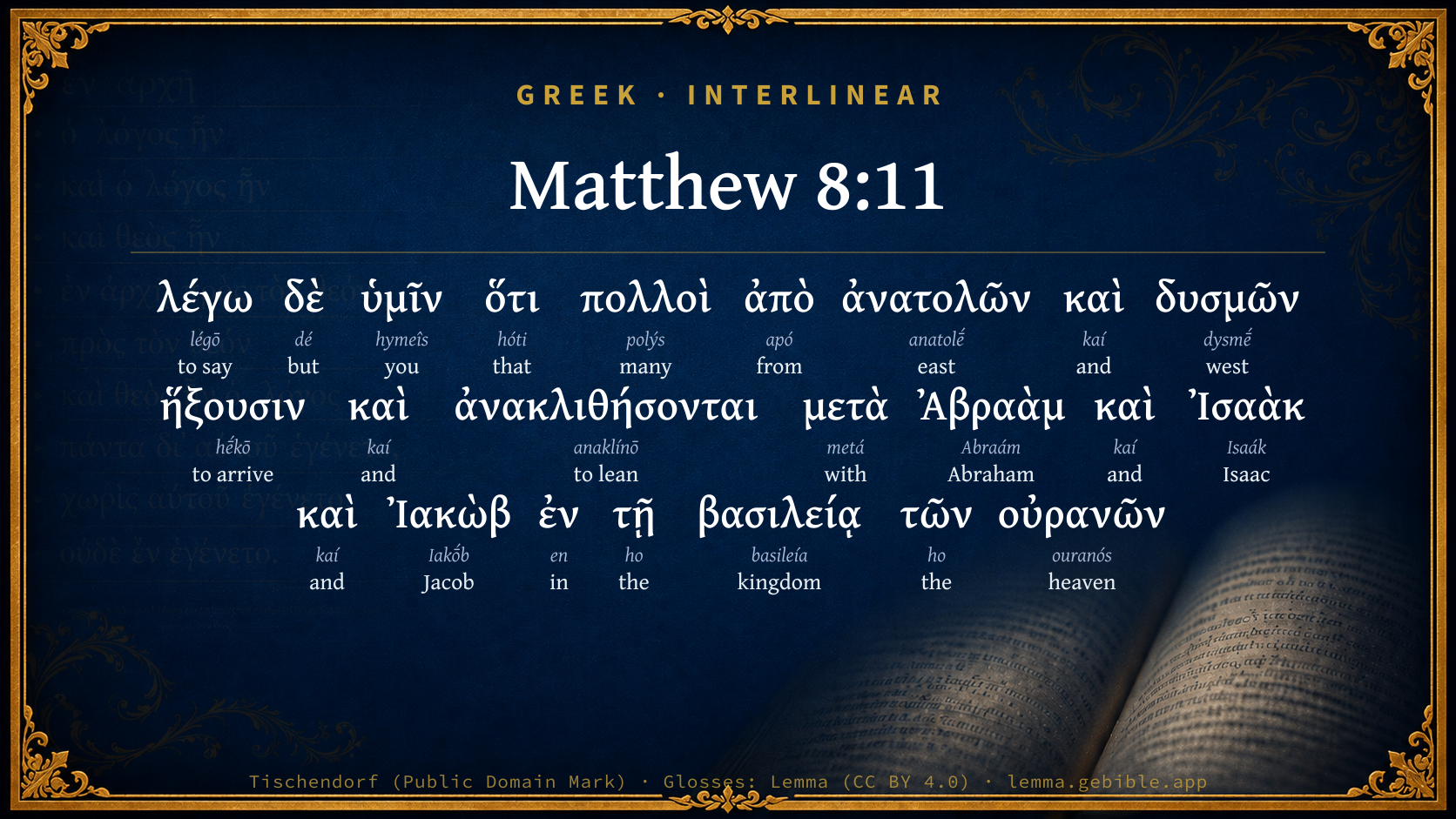
Greek (Tischendorf 8th ed.) Matthew 8:11 appears in the Greek New Testament. The text above is from the Tischendorf 8th edition. Each word links to its Strong’s number and a concise gloss. Click any word for its full Thayer’s Greek Lexicon entry.
Download image
Cite this verse

Matthew 8:11 (World English Bible). Public Domain. Lemma interlinear Bible study tool, https://lemma.gebible.app/v/matthew/8/11.

Show BibTeX & RIS
BibTeX
RIS
English Translation
I tell you that many will come from the east and the west, and will sit down with Abraham, Isaac, and Jacob in the Kingdom of Heaven,
World English Bible · Public Domain
Highlights
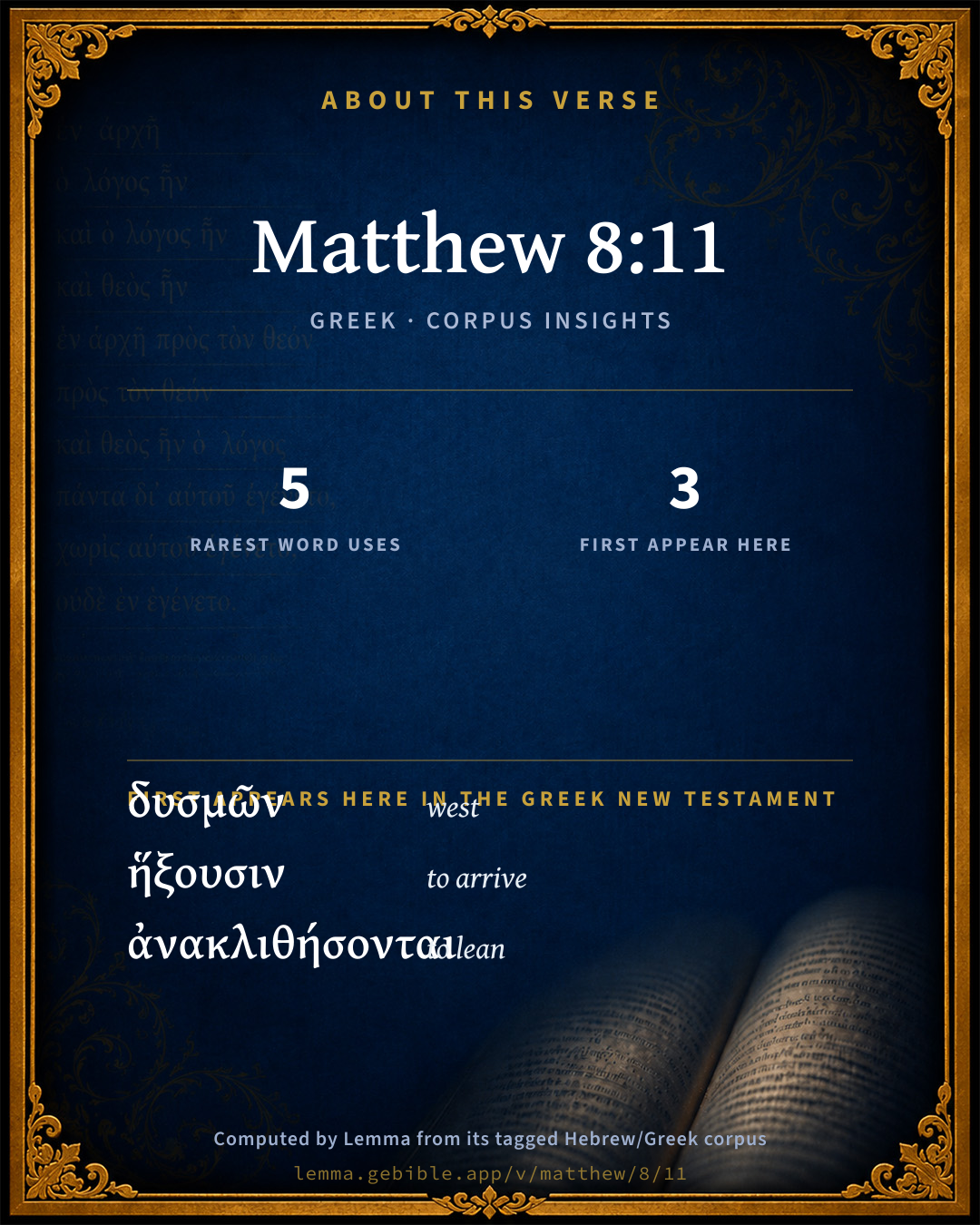
  • 3 first appearances in the Greek New Testament
Full analysis ↓
Download a study sheet

One document with this verse’s original text, its word-by-word gloss line, the meaning frame, cross-references with their text, attributed commentary, and full source and license credits — printable, and it pastes into notes with its structure intact.

This verse Autodidact and up

Study sheet (.html) Plain text (.txt)

A passage Seminary Student

Up to 50 verses in one chapter. A passage sheet keeps up to 6 commentary sources and 12 cross-references per verse, in the order this page ranks them, and says so on the sheet whenever that leaves anything out. Ask for a single verse and you get the Autodidact verse sheet above.

Everything on this page stays free to read, with no account — the sheet is a download of what is already on screen, not access to it.

Want to remove ads? Support Godless Engineer
Compare translations 3

The same verse in 3 English versions, stacked beneath the original-language interlinear above. Click any original word for its lexicon entry.

Each is an independent rendering of the whole verse — the interlinear is not word-aligned to these translations.

Highlighted words mark where these versions differ — a whole-verse word diff, not a word-by-word alignment.

  • World English Bible Public Domain
    I tell you that many will come from the east and the west, and will sit down with Abraham, Isaac, and Jacob in the Kingdom of Heaven,
  • King James Version Public Domain
    And I say unto you, That many shall come from the east and west, and shall sit down with Abraham, and Isaac, and Jacob, in the kingdom of heaven.
  • unfoldingWord Literal Text CC BY-SA 4.0
    But I tell you that many will come from east and west, and they will recline to eat with Abraham and Isaac and Jacob in the kingdom of the heavens.

unfoldingWord Literal Text — © unfoldingWord, licensed CC BY-SA 4.0. Word-aligned USFM3 via Door43 (git.door43.org/unfoldingWord/en_ult).

Versions to compare (up to 4)

3 of 4 selected

Show all 19 translations

Every available English version of this verse, each an independent rendering of the whole verse.

  • World English Bible Public Domain
    I tell you that many will come from the east and the west, and will sit down with Abraham, Isaac, and Jacob in the Kingdom of Heaven,
  • Berean Standard Bible Public Domain
    I say to you that many will come from the east and the west to share the banquet with Abraham, Isaac, and Jacob in the kingdom of heaven.
  • Majority Standard Bible Public Domain
    I say to you that many will come from the east and the west to share the banquet with Abraham, Isaac, and Jacob in the kingdom of heaven.
  • King James Version Public Domain
    And I say unto you, That many shall come from the east and west, and shall sit down with Abraham, and Isaac, and Jacob, in the kingdom of heaven.
  • American Standard Version (1901) Public Domain
    And I say unto you, that many shall come from the east and the west, and shall sit down with Abraham, and Isaac, and Jacob, in the kingdom of heaven:
  • Revised Version (1885) Public Domain
    And I say unto you, that many shall come from the east and the west, and shall sit down with Abraham, and Isaac, and Jacob, in the kingdom of heaven:
  • Geneva Bible (1599) Public Domain
    But I say vnto you, that many shall come from the East and West, and shall sit downe with Abraham, and Isaac, and Iacob, in the kingdome of heauen.
  • Douay-Rheims (1899) Public Domain
    And I say to you that many shall come from the east and the west, and shall sit down with Abraham, and Isaac, and Jacob in the kingdom of heaven:
  • Young's Literal Translation Public Domain
    and I say to you, that many from east and west shall come and recline (at meat) with Abraham, and Isaac, and Jacob, in the reign of the heavens,
  • Literal Standard Version CC BY-SA 4.0
    and I say to you that many from east and west will come and recline with Abraham, and Isaac, and Jacob, in the kingdom of the heavens,
  • Unlocked Literal Bible CC BY-SA 4.0
    I tell you, many will come from the east and the west, and they will recline at the table with Abraham, Isaac, and Jacob, in the kingdom of heaven.
  • unfoldingWord Literal Text CC BY-SA 4.0
    But I tell you that many will come from east and west, and they will recline to eat with Abraham and Isaac and Jacob in the kingdom of the heavens.
  • Darby Bible Public Domain
    But I say unto you, that many shall come from [the] rising and setting [sun], and shall lie down at table with Abraham, and Isaac, and Jacob in the kingdom of the heavens;
  • World Messianic Bible Public Domain
    I tell you that many will come from the east and the west, and will sit down with Abraham, Isaac, and Jacob in the Kingdom of Heaven,
  • Webster's Bible Public Domain
    And I say to you, that many shall come from the east and the west, and shall sit down with Abraham, and Isaac, and Jacob in the kingdom of heaven.
  • Free Bible Version CC BY-SA 4.0
    I tell you that many will come from the east and the west, and sit down with Abraham and Isaac and Jacob in the kingdom of heaven.
  • Bible in Basic English Public Domain
    And I say to you that numbers will come from the east and the west, and will take their seats with Abraham and Isaac and Jacob, in the kingdom of heaven:
  • Text-Critical English NT CC BY 4.0
    I tell you that many will come from east and west, and recline with Abraham, Isaac, and Jacob at the banquet table in the kingdom of heaven,
  • Tyndale New Testament (1534) Public Domain
    I say therfore vnto you that many shall come from the eest and weest and shall rest with Abraham Isaac and Iacob in the kingdome of heven:

Literal Standard Version (2020), Covenant Press — licensed CC BY-SA 4.0. Text via the HelloAO Bible API (eBible.org). Unlocked Literal Bible (unfoldingWord) — licensed CC BY-SA 4.0. Text via the HelloAO Bible API (eBible.org). unfoldingWord Literal Text — © unfoldingWord, licensed CC BY-SA 4.0. Word-aligned USFM3 via Door43 (git.door43.org/unfoldingWord/en_ult). Free Bible Version, Dr. Jonathan Gallagher — licensed CC BY-SA 4.0. Text via the HelloAO Bible API (eBible.org).

Word by word

More ways to search: Search by grammar → Find every occurrence → Compare this word →

Practice this passage: Drill this verse → Learn its vocabulary →

δυσμῶν
dysmḗ
G1424
“west”
Noun, Genitive, Plural, Feminine
Part of Speech
Noun
Case
Genitive
Number
Plural
Gender
Feminine
Full Thayer's Definition

Origin: from G1416

TDNT: None

1. the setting of the sun 2. the region of the sunset, the west
  1. λέγω légō G3004 “to say” Verb, Present, Active, Indicative, 1st person, Singular
  2. δὲ dé G1161 “but” Conjunction
  3. ὑμῖν hymeîs G5210 “you” Personal pronoun, 2nd person, Dative, Plural
  4. ὅτι hóti G3754 “that” Conjunction
  5. πολλοὶ polýs G4183 “many” Adjective, Nominative, Plural, Masculine
  6. ἀπὸ apó G575 “from” Preposition
  7. ἀνατολῶν anatolḗ G395 “east” Noun, Genitive, Plural, Feminine
  8. καὶ kaí G2532 “and” Conjunction
  9. ἥξουσιν hḗkō G2240 “to arrive” Verb, Future, Active, Indicative, 3rd person, Plural
  10. καὶ kaí G2532 “and” Conjunction
  11. ἀνακλιθήσονται anaklínō G347 “to lean” Verb, Future, Passive, Indicative, 3rd person, Plural
  12. μετὰ metá G3326 “with” Preposition
  13. Ἀβραὰμ Abraám G11 “Abraham” Noun, Proper, indeclinable
  14. καὶ kaí G2532 “and” Conjunction
  15. Ἰσαὰκ Isaák G2464 “Isaac” Noun, Proper, indeclinable
  16. καὶ kaí G2532 “and” Conjunction
  17. Ἰακὼβ Iakṓb G2384 “Jacob” Noun, Proper, indeclinable
  18. ἐν en G1722 “in” Preposition
  19. τῇ ho G3588 “the” Article, Dative, Singular, Feminine
  20. βασιλείᾳ basileía G932 “kingdom” Noun, Dative, Singular, Feminine
  21. τῶν ho G3588 “the” Article, Genitive, Plural, Masculine
  22. οὐρανῶν ouranós G3772 “heaven” Noun, Genitive, Plural, Masculine

About this verse

These counts appear in no published source. They are computed here, from the morphology-tagged text and Lemma’s own curated glosses. What Lemma adds →

23
words
19
distinct lemmas
Gospels
section

Notable vocabulary

The rarest word here is δυσμῶν west G1424 — appearing just 5 times in the whole Greek New Testament.

First appearance in Scripture

These words make their first canonical appearance in the Greek New Testament here:

  • δυσμῶν west G1424
  • ἥξουσιν to arrive G2240
  • ἀνακλιθήσονται to lean G347

Shared distinctive vocabulary

δυσμῶν west G1424 occurs in 5 verses of the Greek New Testament. Also found in:
Repetition

Words recur within this verse:

Cross-references

38

Topical passages linked to Matthew 8:11 in the Treasury of Scripture Knowledge — connected by theme and wording, ordered by reader-vote popularity; previews shown in the World English Bible.

  • Luke 13:28–29 There will be weeping and gnashing of teeth, when you see Abraham, Isaac, Jacob, and all the prophets, in the Kingdom of God, and yourselves being thrown outside.
  • Ephesians 3:6 that the Gentiles are fellow heirs, and fellow members of the body, and fellow partakers of his promise in Christ Jesus through the Gospel,
  • Malachi 1:11 For from the rising of the sun even to the going down of the same, my name is great among the nations, and in every place incense will be offered to my name, and a pure offering: for my name is great among the nations," says Yahweh of Hosts.
  • Galatians 3:28–29 There is neither Jew nor Greek, there is neither slave nor free man, there is neither male nor female; for you are all one in Christ Jesus.
  • Ephesians 2:11–14 Therefore remember that once you, the Gentiles in the flesh, who are called "uncircumcision" by that which is called "circumcision," (in the flesh, made by hands);
  • Micah 4:1–2 But in the latter days, It will happen that the mountain of Yahweh's temple will be established on the top of the mountains, And it will be exalted above the hills; And peoples will stream to it.
  • Isaiah 2:2–3 It shall happen in the latter days, that the mountain of Yahweh's house shall be established on the top of the mountains, And shall be raised above the hills; And all nations shall flow to it.
  • Matthew 24:31 He will send out his angels with a great sound of a trumpet, and they will gather together his chosen ones from the four winds, from one end of the sky to the other.
  • Luke 12:37 Blessed are those servants, whom the lord will find watching when he comes. Most assuredly I tell you, that he will dress himself, and make them recline, and will come and serve them.
  • Acts 10:45 They of the circumcision who believed were amazed, as many as came with Peter, because the gift of the Holy Spirit was also poured out on the Gentiles.
  • Acts 11:18 When they heard these things, they held their peace, and glorified God, saying, "Then God has also granted to the Gentiles repentance to life!"
  • Colossians 3:11 where there can't be Greek and Jew, circumcision and uncircumcision, barbarian, Scythian, bondservant, freeman; but Christ is all, and in all.
  • Isaiah 59:19 So shall they fear the name of Yahweh from the west, and his glory from the rising of the sun; for he will come as a rushing stream, which the breath of Yahweh drives.
  • Acts 14:27 When they had arrived, and had gathered the assembly together, they reported all the things that God had done with them, and that he had opened a door of faith to the Gentiles.
  • Matthew 3:2 "Repent, for the Kingdom of Heaven is at hand!"
  • Luke 16:22 It happened that the beggar died, and that he was carried away by the angels to Abraham's bosom. The rich man also died, and was buried.
  • Acts 14:22 confirming the souls of the disciples, exhorting them to continue in the faith, and that through many afflictions we must enter into the Kingdom of God.
  • Romans 15:9–13 and that the Gentiles might glorify God for his mercy. As it is written, "Therefore will I give praise to you among the Gentiles, And sing to your name."
  • 1 Corinthians 6:9 Or don't you know that the unrighteous will not inherit the Kingdom of God? Don't be deceived. Neither the sexually immoral, nor idolaters, nor adulterers, nor male prostitutes, nor homosexuals,
  • 1 Corinthians 15:20 But now Christ has been raised from the dead. He became the first fruits of those who are asleep.
  • 2 Thessalonians 1:5 This is an obvious sign of the righteous judgment of God, to the end that you may be counted worthy of the Kingdom of God, for which you also suffer.
  • Revelation 3:20–21 Behold, I stand at the door and knock. If anyone hears my voice and opens the door, then I will come in to him, and will dine with him, and he with me.
  • Revelation 7:6 Of the tribe of Asher twelve thousand, Of the tribe of Naphtali twelve thousand, Of the tribe of Manasseh twelve thousand,
  • Genesis 12:3 I will bless those who bless you, and I will curse him who curses you. In you will all of the families of the earth be blessed."
  • Genesis 22:18 In your seed will all the nations of the earth be blessed, because you have obeyed my voice."
  • Genesis 28:14 Your seed will be as the dust of the earth, and you will spread abroad to the west, and to the east, and to the north, and to the south. In you and in your seed will all the families of the earth be blessed.
  • Genesis 49:10 The scepter will not depart from Judah, Nor the ruler's staff from between his feet, Until he comes to whom it belongs. To him will the obedience of the peoples be.
  • Psalms 22:27 All the ends of the earth shall remember and turn to Yahweh. All the relatives of the nations shall worship before you.
  • Psalms 98:3 He has remembered his loving kindness and his faithfulness toward the house of Israel. All the ends of the earth have seen the salvation of our God.
  • Isaiah 11:10 It shall happen in that day, that the root of Jesse, who stands for an ensign of the peoples, to him shall the nations seek; and his resting-place shall be glorious.
  • Isaiah 49:6 yes, he says, It is too light a thing that you should be my servant to raise up the tribes of Jacob, and to restore the preserved of Israel: I will also give you for a light to the Gentiles, that you may be my salvation to the end of the earth.
  • Isaiah 52:10 Yahweh has made bare his holy arm in the eyes of all the nations; and all the ends of the earth have seen the salvation of our God.
  • Isaiah 60:1–6 Arise, shine; for your light is come, and the glory of Yahweh is risen on you.
  • Jeremiah 16:19 Yahweh, my strength, and my stronghold, and my refuge in the day of affliction, to you shall the nations come from the ends of the earth, and shall say, Our fathers have inherited nothing but lies, [even] vanity and things in which there is no profit.
  • Daniel 2:44 In the days of those kings shall the God of heaven set up a kingdom which shall never be destroyed, nor shall the sovereignty of it be left to another people; but it shall break in pieces and consume all these kingdoms, and it shall stand forever.
  • Zechariah 8:20–23 Thus says Yahweh of Hosts: "Many peoples, and the inhabitants of many cities will yet come;
  • Luke 14:23–24 "The lord said to the servant, 'Go out into the highways and hedges, and compel them to come in, that my house may be filled.
  • Isaiah 49:12 Behold, these shall come from far; and, behold, these from the north and from the west; and these from the land of Sinim.

Cross-references courtesy of OpenBible.info (CC BY 4.0).

Commentary

Notes on Matthew 8:11 from classic Christian and Jewish commentators (each source and its license shown beneath its notes). The classic Christian expositions comment on the surrounding passage and are grouped to its opening verse, so a note may address several verses; the Jewish commentaries on the Tanakh (Rashi and others) are per-verse, so they appear only where the commentator wrote on this verse.

Lemma curates 59 commentaries, every one of them public domain or Creative Commons licensed, each selected and text-cleaned for this edition rather than reprinted as found. About our sources →

The Biblical Illustrator

Joseph S. Exell

Mat_8:11-12

Many shall come from the east and west.

The extent if Gods family

I. That the number of the saved shall be great. Many. Might expect the contrary from aspect of society. God has secret servants.

II. That the large company shall be made up of men from all nations. From the east and west.

III. That all these persons shall be united in heaven in society. Sit down together. The happiness of heaven will not be solitary; it will not be without union.

IV. This change takes place in heaven. Must not take earthly conceptions of this celestial state; it is a state connected with God.

V. We may infer something with regard to the nature and completeness of the happiness that will be enjoyed by the saints in glory,

1. Rest. They shall sit down.

2. Sovereignty. They shall sit on thrones as kings. (J. W. Cunningham, M. A.)

The connection

Christ receives applications from all sorts of characters. The centurion-conscious of personal unworthiness-concerned for his domestics-unbounded confidence in the capacity of Christ.

I. The exulting prophecy. Implies that God is no respecter of persons (Isa_45:6; Isa_59:19; Mal_1:11); that many shall be saved; that heaven is an exalted state of felicity, rest, and social intercourse, etc. (Ch 25:10, 26:29; Luk_14:15; Luk_22:30 : Rev_19:7-11). Loyal submission to the King, enjoyment of His presence, admiration of His glories; laud and magnify His name.

II. The agency by which it shall be effected. Manifold-chiefly by the preaching of the gospel (1Co_1:21); adapted-to every stage of human society, to every order of mind, and to every moral condition; efficient-the power of the Holy Ghost, awakening, convicting, etc. (1Th_1:5, &c.). All the ends of the earth shall see the salvation of our God. (A. Tucker.)

Bigotry must not limit the number of the saved

The readiest way in the world to thin heaven, and replenish the regions of hell, is to call in the spirit of bigotry. This will immediately arraign, and condemn, and execute all that do not bow down and worship the image of our idolatry. Possessing exclusive prerogatives, it rejects every other claim-Stand by, I am sounder than thou. The temple of the Lord, the temple of the Lord, the temple of the Lord are we! How many of the dead has this intolerance sentenced to external misery, who will shine like stars in the kingdom of our Father! How many living characters does it not reprobate, who are placing in it all their glory! No wonder, if under the influence of this consuming zeal, we form lessening views of the number of the saved: I only am left-yes, they are few indeed, if none belong to them who do not belong to your party-that do not see with your eyes-that do not believe election with you, or universal redemption with you-that do not worship under a steeple with you, Grin a meeting-house with you-that are not dipped with you, or sprinkled with you! But hereafter we shall find that the righteous were not so circumscribed. (Jay.)

Hen then converts

Mosheu, an African chief, visited Dr. Moffat at Kuruman. The missionary availed himself of the opportunity to speak of the one thing needful, but without apparent effect. After some time Mosheu repeated his visit to Kuruman, bringing with him a very large retinue. He was agonizing to enter the kingdom of God. When first I visited you, he said to Dr. Moffat. I had only one heart, but now I have come with two. I cannot rest; my eyes will not slumber, because of the greatness of the things you told me on nay first visit.

Heaven and Hell

I. A glorious promise.

1. It is a land of rest-sit down.

2. The good company they sit with, Abraham and Isaac. etc.

3. Man? I shall come. I have no wish for a small heaven; many mansions.

4. Where they come from-from all places and classes, even the most hopeless.

5. The certainty shall.

II. The children of the kingdom cast out.

1. Those noted for externals in religion.

2. The children of pious fathers and mothers.

3. They are to be cast out. Where to? (C. H. Spurgeon.)

The heavenly state

1. Many, will be there. What are many in the Divine authentic? Must not lower the standard of admission.

2. The imagery that of a banquet, the attitude assigned to the assembly. Nest and repose after labour and conflict.

3. The celestial citizens are to know one another, else it would little avail to sit down with Abraham, etc. The meeting-place of generations. (H. Melvill, B. D.)

The wonderful M.

The Countess of Huntingdon used to say, She thanked God for the wonderful letter M, for it turned any into many; thus the Word of God reads, Not many wise, not many mighty, not many noble are called (1Co_1:26), therefore she could be found amongst the not many. The wonderful M shows forth the extent of Gods grace. Man does not enter heaven by virtue of his poverty or his riches, sufferings or rejoicings, morality or immorality, but by virtue of the atonement and the shedding of the precious blood of Christ. None can rightly say, I have had so much trial and trouble down here that I am sure God will provide a place for me; nor can they say, I am so noble, and have such power in this world that I surely must have a place above. God is no respecter of persons. All, whatever their station or circumstances, find but one entrance into eternal glory, even through our Lord and Saviour Jesus Christ-the only door, the one way, by which alone any can be saved,

The children of the kingdom

I. By the children of the kingdom are intended the Jews, who were Gods peculiar people.

1. God was in an especial manner their King. He revealed Himself as their King and Saviour. He fought against their enemies.

2. As a king He laid down laws which they were to follow.

3. They were not only subjects of the kingdom; they were to be children of it.

4. The justice of that sentence, which, after their ejection, deprived the children of the kingdom of their glorious inheritance.

II. How were they cast into outer darkness.

1. They were withdrawn immediately from that which is light even on earth-the enjoyment of Gods grace, and the enlightenment of His Holy Spirit. This was outer darkness of soul.

2. They were driven into the darkness of sorrow and affliction.

III. The cause why this happened-their unbelief. We are now the children of the kingdom; have Gods laws written in our hearts. (J. Garbett)

The Biblical Illustrator, edited by Joseph S. Exell (c. 1880s–1900s) — public domain. Text from a community e-Sword module.

Joseph Benson's Commentary

Mat 8:11-12. From this exalted pitch of faith, found in a heathen, Jesus took occasion to declare the merciful purpose which God entertained toward all the Gentiles, namely, that he would accept their faith as readily as the faith of the Jews, and admit them, with the founders of the Jewish nation, to the privileges and blessings of his kingdom. Many, says he, shall come from the east and west, &c. — Many, from the farthest parts of the earth, shall embrace the terms, and enjoy the rewards, of the gospel covenant established with Abraham. But the Jews, who have the first title to them, shall be shut out from the feast; from grace here, and glory hereafter. The words, ανακλιθησονται μετα Αβρααμ, &c., properly signify, shall sit down at table with Abraham, &c., a phraseology often used in Scripture, which represents the present privileges and future rewards of the righteous, and especially the latter, under the idea of a sumptuous entertainment. See Luk 14:15; Mat 22:1; Rev 19:9. And, though the joys of heaven be all of a spiritual kind, this metaphor needs not be thought strange, since, as Le Clerc observes, “we can neither speak ourselves, nor understand others speaking of our state in the life to come, unless phrases taken from the affairs of this life be made use of.” But the children of the kingdom — So he terms the Jews, even the unbelieving Jews, because they had been born and brought up within the pale of the visible Church, and enjoyed all the advantages which it afforded its members: shall be cast out into outer darkness — Our Lord here alludes to the custom which the ancients had of making their great entertainments, for the most part, in the evening, with candlelight. And the outer darkness, or darkness without the house, signifies, 1st, the state of heathenish darkness, or of ignorance and error, in which those are who are without the pale of the Church of God, and into which, it is here foretold, the Jews should be cast for their rejection of Christ; and, 2d, the state of future misery, into which, as many of them as continued till death in impenitence and unbelief, should finally be cast, with all hypocrites and unbelievers. And Jesus said, Go thy way, &c. — Having spoken, as observed above, he dismissed the centurion with an assurance that his servant was well; and at the same time intimated that the miracle had been wrought in consequence of, and according to, his faith, which, though not the meritorious cause of the cure, had been the means through which the Lord Jesus had been pleased to effect it. And his servant was healed in the self-same hour — Or, rather, in that instant, as εν τη ωρα εκεινη, here evidently means.

Joseph Benson's Commentary on the Old and New Testaments (1811–1818) — public domain. Text from a community e-Sword module.

Tyndale Open Study Notes

Tyndale Open Resources

8:11-12 The influx of Gentiles fulfills Old Testament promises (Isa 2:2-3). God’s promise to Abraham included being a blessing to many nations (Gen 18:18). Christ fulfills this promise (Gal 3:8, 16).

Tyndale Open Study Notes — © Tyndale Open Resources, licensed CC BY-SA 4.0. Text via the HelloAO Bible API.

Bengel's Gnomon

Johann Albrecht Bengel

Mat 8:11. Πολλοὶ, many) who, being not Jews, are similar to the centurion. This is intended to awaken the emulation of the Jews.—ἀπὸ ἁναταλῶν, from the east) see ch. Mat 2:1,—from the east and from the west; an euphemism for “from the Gentiles.”—ἥξουσι, shall come) A prophecy: they shall come in spirit [and by faith.—V. g.]—μετὰ, together with) see Heb 12:23.[366]—ἘΝ Τῇ ΒΑΣΙΛΕΊᾼ, in the kingdom) sc. in this life, and in that which is to come.

[366] With the Fathers in the faith, Heb 11:9—V. g.

Bengel's Gnomon of the New Testament — English translation (T&T Clark, Edinburgh, 1860) — public domain. Text from a community e-Sword module.

Meyer's Critical & Exegetical Commentary

Heinrich August Wilhelm Meyer

Mat_8:11. Ἀπὸ ἀνατ. καὶ δυσμ.] from the most widely separated quarters of the world

Gentiles. Comp. Isa_45:6; Mal_1:11.

According to Jewish ideas, one of the main elements in the happiness of the Messianic kingdom was the privilege of participating in splendid festive entertainments along with the patriarchs of the nation. Bertholdt, Christol. p. 196. Schoettgen on this passage. Jesus employs the expression in a symbolical sense (Mat_26:29; Luk_13:28; Luk_14:15; Rev_19:9; Mat_22:30; 1Co_15:50): many Gentiles will become believers, and so have their part in the blessings of the Messianic kingdom in happy fellowship with the patriarchs of the people of God. In sharp contrast to incarnate (Mat_3:9) Jewish pride, Tanchum (in Schoettgen): In mundo futuro, (dixit Deus) mensam ingentem vobis sternam, quod gentiles videbunt et pudefient. Bertholdt, p. 176. Hilgenfeld sees in the whole narrative the milder comprehensive Judaeo-Christianity of the author of the revised Gospel; but Keim again, while upholding the account in all other points, ascribes Mat_8:11 f. to the hand that framed the later version, although, with Mat_8:10, preparing the way for them, the words neither interrupt the connection nor clash with the then standpoint of Jesus (Mat_3:9), seeing that in the Sermon on the Mount (especially Mat_7:21 f.) He has taken away from the kingdom of God anything like national limitation.

Meyer — Critical and Exegetical Commentary on the New Testament — English translation by Peter Christie, edited by Frederick Crombie (T&T Clark, 1880) — public domain. Text from a community e-Sword module.

Expositor's Greek Testament

ed. W. Robertson Nicoll

Mat 8:11-12 . This logion is given by Luke (Luk 13:28-29 ) in a different connection, and it may not be in its historical place here. But its import is in thorough harmony with the preceding reflection on the spiritual state of Israel. One who said the one thing was prepared to say the other. At whatever time said it would give offence. It is one of the heavy burdens of the prophet that he cannot be a mere patriot, or say complimentary things about his nation or his Church. ἀνακλιθήσονται : Jesus expresses Himself here and throughout this logion in the language of His time and people. The feast with the patriarchs, the outer darkness, the weeping and the gnashing of teeth (observe the article before σκότος , κλαυθμὸς , βρυγμὸς , implying that all are familiar ideas) are stock phrases. The imagery is Jewish, but the thought is anti-Jewish, universalistic, of perennial truth and value.

The Expositor's Greek Testament, edited by W. Robertson Nicoll (1897–1910) — public domain. Text from a community e-Sword module.

Geneva Bible (1599)

Geneva Bible translators

A Metaphor taken of banquets, for they that sit down together are fellows in the banquet.

Geneva Bible (1599) marginal notes — public domain. Text via Bolls.life.

Adam Clarke's Commentary

Verse 11. Many shall come from the east and west] Men of every description, of all countries, and of all professions; and shall sit down, that is, to meat, for this is the proper meaning of ανακλιθησονται, intimating the recumbent posture used by the easterns at their meals. The rabbins represent the blessedness of the kingdom of God under the notion of a banquet. See several proofs of this in Schoettgenius. This was spoken to soften the unreasonable prejudices of the Jews, which they entertained against the Gentiles, and to prepare them to receive their brethren of mankind into religious fellowship with themselves, under the Christian dispensation.

With Abraham, and Isaac, and Jacob] In the closest communion with the most eminent followers of God. But if we desire to inherit the promises, we must be followers of them who through faith and patience enjoy them. Let us therefore imitate Abraham in his faith, Isaac in his obedience unto death, and Jacob in his hope and expectation of good things to come, amidst all the evils of this life, if we desire to reign with them.

Adam Clarke's Commentary on the Bible (1810–1826) — public domain. Text from a community e-Sword/MySword module.

Ellicott's Commentary for English Readers

(11) St. Luke does not give the words that follow, and the omission is significant. Either he did not know of them, and then we must infer the entire independence of his record, or knowing them, he, writing for Gentiles, thought it best to omit words here which our Lord had afterwards repeated, and which he had therefore another opportunity of recording (Luk_13:28). Such verbal reproduction of what had been said before was, it will be remembered, entirely after our Lord’s manner.

Many shall come from the east and west.—It is clear that our Lord saw in the centurion the first-fruits of the wide harvest of the future. Like the words of the Baptist in Mat_3:9, what He now said contained, by implication, the whole gospel which St. Paul preached to the Gentiles. “East and west,” even without the formal addition of “north and south,” which we find in the parallel passage of Luk_13:29, were used as limits that included all the nations of the earth.

Shall sit down.—Literally, shall recline, as at the table of a feast; that being, as in the phrase of Abraham’s bosom, the received parable of the blessedness of the kingdom.

A Bible Commentary for English Readers, edited by Charles John Ellicott (1878–1897) — public domain. Text from a community e-Sword module.

The Cambridge Bible for Schools and Colleges

gen. ed. J. J. S. Perowne

11. sit down] i. e. recline at a feast. The image of a banquet is often used to represent the joy of the kingdom of heaven. Luk_14:15; Luk_22:29-30; Rev_19:9.

The Cambridge Bible for Schools and Colleges (gen. ed. J. J. S. Perowne; Cambridge University Press, 1878–1918) — public domain. Text from a community e-Sword module.

John Gill's Exposition

But the children of the kingdom,.... The Jews, who were subjects of the kingdom, and commonwealth of Israel, from which the Gentiles were aliens; and who were also in the church of God, which is his kingdom on earth; and besides, had the promise of the Gospel dispensation, sometimes called the kingdom of heaven, and by them, often the world to come; and were by their own profession, and in their apprehension and expectation, children, and heirs of the kingdom of glory. These phrases, , "a son of the world to come", and , "children of the world to come" (o), are frequent in their writings: these, Christ says,

shall be cast out; out of the land of Israel, as they were in a few years after, and out of the church of God: these branches were broken off, and the Gentiles grafted in, in their room; and will be excluded from the kingdom of heaven, where they hoped to have a place,

and cast into outer darkness: into the Gentile world, and into judicial blindness, and darkness of mind, and into the blackness of darkness in hell,

where shall be weeping, and gnashing of teeth. Phrases expressive of the miserable state and condition of persons out of the kingdom of heaven; who are weeping for what they have lost, and gnashing their teeth with the pain of what they endure. The Jews say (p),

"he that studies not in the law in this world, but is defiled with the pollutions of the world, he is taken , "and cast without": this is hell itself, to which such are condemned, who do not study the law.''

The allusion in the text is, to the customs of the ancients at their feasts and entertainments; which were commonly made in the evening, when the hall or dining room, in which they sat down, was very much illuminated with lamps and torches; but without in the streets, were entire darkness: and where were heard nothing but the cries of the poor, for something to be given them, and of the persons that were turned out as unworthy guests; and the gnashing of their teeth, either with cold in winter nights, or with indignation at their being kept out. Christ may also be thought to speak in the language, and according to the notions of the Jews, who ascribe gnashing of teeth to the devils in hell; for they say (q), that

"for the flattery with which they flattered Korah, in the business of rioting, "the prince of hell , gnashed his teeth at them".''

The whole of this may be what they call , "the indignation", or "tumult of hell" (r).

(o) T. Bab. Beracot, fol. 4. 2. Taanith, fol. 22. 1. Megilla, fol. 28. 2. Yoma, fol. 88. 1. & Sanhedrim, fol. 88. 2. Raziel, fol. 37. 1. & 38. 1. Caphtor, fol. 15. 1. & 18. 2. & 60. 1. & 84. 2. Raya Mehimna, in Zohar in Lev. fol. 34. 2. (p) Zohar in Gen. fol. 104. 3. (q) T. Bab. Sanhedrim, fol. 52. 1. (r) Targum in Job, iii 17.

John Gill's Exposition of the Whole Bible (1746–1763) — public domain (CC PDM 1.0). Text via the HelloAO Bible API.

Trapp's Complete Commentary

John Trapp

11 And I say unto you, That many shall come from the east and west, and shall sit down with Abraham, and Isaac, and Jacob, in the kingdom of heaven.

Ver. 11. Many shall come from the east] They shall "fly as a cloud," saith Isaiah (speaking of the conversion of the Gentiles), and so flock to the Church, as if a whole flight of doves, driven by some hawk or tempest, should scour into the columbary, and rush into the windows, Isa 60:8. The Tyrians had a hand in building the temple. The molten sea stood upon twelve oxen, which looked towards east, west, north, and south. The New Jerusalem hath twelve gates, to show that there is every way access for all sorts to Christ, who is also fitly called the second Adam, the Greek letters of which name (as St Cyprian observeth) do severally signify all the quarters of the earth. {a} He was born in an inn, to show that he receives all comers (πανδοχειον); his garments were divided into four parts, to show that out of what part of the world soever we come, if we be naked, Christ hath robes to clothe us; if we be harbourless, Christ hath room to lodge us. Jethor, an Ishmaelite, may become an Israelite, 1Ch 7:17; cf. 2Sa 17:25, and Araunah the Jebusite may be made an exemplary proselyte, 2Sa 24:18; cf. Zec 9:7. Vide Junium in locum.

{a} Α. Ανατολη. Δ. Δυσις, Α. Αρκτος Μ. Μεσημβρια.

John Trapp, A Commentary or Exposition upon All the Books of the Old and New Testament (1647–1656) — public domain. Text from a community e-Sword module.

Albert Barnes' Notes on the Bible

Many shall come from the east ... - Jesus takes occasion from the faith of a Roman centurion to state that this conversion would not be solitary; that many pagans - many from the east and west would be converted to the gospel, and be saved, as Abraham, Isaac, and Jacob were. The phrase “from the east and from the west,” in the Scripture, is used to denote the “whole world,” Isa 45:6; Isa 59:19. The phrase, “shall sit down,” in the original, refers to the manner of sitting at meals (see the notes at Mat 23:6); and the enjoyments of heaven are described under the similitude of a feast or banquet - a very common manner of speaking of it, Mat 26:29; Luk 14:15; Luk 22:30. It is used here to denote felicity, enjoyment, or honor. To sit with those distinguished men was an honor, and would be expressive of great felicity.

Albert Barnes' Notes on the Bible (1834–1885) — public domain. Text from a community e-Sword/MySword module.

Haydock's Catholic Bible Commentary

In consequence of the faith of this Gentile, Jesus Christ takes occasion to declare that many Gentiles would be called to sit at table with Abraham, Isaac, and Jacob, in the kingdom of heaven, which is frequently represented under the figure of a feast. See chap. xxii. 2; Luke xii. 29. and xvi. 16; Apocalypse xix. 9. In ancient times, the guests were reclined on beds when they took their means. (Bible de Vence)

George Leo Haydock (1774–1849), Haydock's Catholic Family Bible and Commentary, 1859 edition — public domain. Excludes Psalms (Douay-Rheims chapter numbering differs from Protestant) and Deuterocanonical books (Catholic canon only).

Matthew Poole's English Annotations

That is, in short, many of those who are now heathens shall be saved; and many of the Jews shall be damned.

Many, not all,

shall come from the east and west, from all parts, from the remotest parts in the world. Luke saith, east, west, north, and south, Luk 13:29; Isa 11:12; 43:5,6.

And sit down with Abraham, Isaac, and Jacob in the kingdom of God; in heaven, where Abraham, Isaac, and Jacob, the heads of the Jewish nation, are, to whom the promises were made; or, in the church of God, for the church triumphant and militant are both but one church. They shall

sit down with them, as men sit down at a banquet, an expression oft used to signify the rest and pleasure the saints shall have in heaven, Isa 25:6-8; Luk 22:29,30.

But the children of the kingdom, the Jews, who boast much that they are the children of Abraham, and think themselves the only church, and the only heirs of glory, and who are indeed the only church of God as yet,

shall be cast out into outer darkness: either the darkness of errors, ignorance, and superstition, the gospel light shall not shine upon them, they shall be no more the church of God; or, the darkness of hell, where shall be nothing but pain and misery, and lamentations for the gospel, and the grace thereof, first offered to them, but unthankfully rejected by them, by which they judge themselves unworthy of the grace of God and of eternal life, Act 13:46.

Matthew Poole's English Annotations on the Holy Bible (1683–1685) — public domain. Text from a community e-Sword/MySword module.

Whedon's Commentary on the Bible

Daniel D. Whedon

11. Many… from the east and west — Our Lord here predicts the call of the Gentiles to occupy a place in the Gospel dispensation. With Abraham — They should become his spiritual descendants, and occupy the place of his natural offspring. Sit down — Rather recline. The image is taken from a banquet, and the ancients did not sit at table on chairs, but reclined upon couches. Kingdom of heaven — Both above and below.

Daniel D. Whedon (gen. ed.), Commentary on the Old and New Testaments (1874–1909) — public domain. Text from a community e-Sword module.

The Pulpit Commentary

Vers. 11, 12. In Luke (Luk_13:28, Luk_13:29) not joined to this miracle, but placed after the warning about mere professors. (our Mat_7:23) Also they are there given in the reverse order. Taking the other facts (ver. 5, note) about this miracle into consideration, there can be little doubt but that St. Matthew does not place these verses in their historical connexion. He wishes to emphasize the teaching of the miracle, that Gentiles accept Christ, though Jews reject him. For this reason also he gives the two verses in the reverse order. And. In contrast (de) to this comparative absence of belief in Israel. Many. Not in the parallel passage in Luke, but it agrees with the aim of St. Matthew"s Gospel. Shall come. Though not emphatic, as it is in the parallel passage in Luke, yet expressive of purpose and decision. From the east and (Revised Version. the) west. Not only residents in Palestine, like this centurion, but from the furthest limits of the earth. The thought was well known; e.g. Mal_1:11 Isa_59:19; also Jer_16:19 Zec_8:22. And shall sit down; i.e. at a feast. The image, taken from Isa_25:6, is exceedingly common in Jewish Haggadic (i.e. mostly parabolic) teaching (cf. Dr. Taylor"s "Sayings," etc., 3:25; Schurer, II2. 174). With Abraham, and Isaac, and Jacob, in the kingdom of heaven. An early" Western" reading is, "in the bosom of Abraham," etc. (cf. Luk_16:23) Probably a traditional form current among Jewish Christians. But the children; sons (Revised Version). Those who ought rightfully to enjoy its privileges. (Mat_5:9, note) In Mat_13:38 those so called answer fully to the appellation. Of the kingdom. "Rather than of the king; since many are in the kingdom, whom notwithstanding the king rejects as traitors; whereas all the children of the king are adopted as co-heirs with his only begotten Son" (Beza, in Ford). This interpretation is attractive, but doubtless false. The Hebrew idiom enables the writer to suggest the idea of the Jews, who are by nature heirs of the Divine kingdom, being notwithstanding excluded. (cf Act_13:46) Shall be cast out (Revised Version, forth); ekbkhyhsontai . (Mat_7:4, note) The "Western" reading, exeleusontai , suggests that they shall go out by their own present act of refusing blessing. Into (Revised Version, the) outer darkness. The form of the expression, which comes only in Matthew, (Mat_22:13 Mat_25:30) points to a double conception; they shall be cast into the darkness, and cast outside the palace within which the feast is going on. Such is the loss in its personal (eiv to skotov) and in its social (to exwteron) aspect. There shall be (Revised Version, the) weeping and gnashing of teeth. The article, which should strictly be repeated before gnashing, points to a recognized conception. The phrase occurs (except in the parallel passage, Luk_13:28) only in St. Matthew, (Mat_13:42, 50 22:13 24:51 25:30) in each case contrasting the place into which the wicked are sent with that which they might have enjoyed. Observe the description of "hell absence of spiritual light; separation from the company of the saved; lamentation; impotent rage. The second couplet corresponds to the first.

The Pulpit Commentary (1880–1919), ed. H.D.M. Spence-Jones & Joseph S. Exell — public domain. Text from a community e-Sword module.

John Wesley's Explanatory Notes

Many from the farthest parts of the earth shall embrace the terms and enjoy the rewards of the Gospel covenant established with Abraham. But the Jews, who have the first title to them, shall be shut out from the feast; from grace here, and hereafter from glory. Luke xiii, 29.

John Wesley, Explanatory Notes Upon the Whole Bible (1754–1765) — public domain. Text via the GEBible commentary corpus.

Scofield Reference Notes

C. I. Scofield

heaven

kingdom, (See Scofield "Mat 3:2").

The Scofield Reference Bible (1917 edition), notes by C. I. Scofield — public domain. Text from a community e-Sword module.

Burkitt's Expository Notes on the New Testament

William Burkitt

This was the first occasion that Christ took to speak of the calling of the Gentiles, and rejection of the Jews.

Observe, here, That the unbelieving Jews are called the children of the kingdom, because born within the pale of the visible church: they presumed that the kingdom of heaven was entailed upon them, because they were Abraham’s seed; they boasted of, and gloried in, their external and outward privileges.

Note, thence, 1. That gospel ordinances, and church-privileges enjoyed, are a special honour to a people admitted to the participation of them: our Saviour here stiles the Jews upon that account, The children of the kingdom.

2. That such privileges enjoyed, but not improved, do provoke Almighty God to inflict the heaviest of judgments upon a people; The children of the kingdom shall be cast unto outer darkness; that is, into the darkness of hell, where shall be perpetual lamentations for the remembrance of the gospel kindly offered, but unthankfully rejected.

William Burkitt's Expository Notes on the New Testament (1700–1703) — public domain. Text from a community e-Sword module.

The People's New Testament

B. W. Johnson

11. Many shall come from the east and west. The terms, “the east and the west,” the extreme points of the compass, are taken to indicate the regions that are far away, the whole world. The Lord means not only those who are geographically far away from Israel, but those who have been far away spiritually, Gentiles as well as Jews. Shall sit down with Abraham, and Isaac, and Jacob. The Jews were accustomed to speak to the delights of the Messiah's kingdom as a feast with the patriarchs. The language implies intimate domestic intercourse and fellowship. The kingdom of heaven refers, here, rather to the eternal blessed state than to the church on earth.

B. W. Johnson's The People's New Testament with Notes (1889–1891) — public domain. Electronic text from the Christian Classics Ethereal Library (CCEL) ThML edition.

unfoldingWord translationNotes

Door43 World Missions Community

you

Here "you" is plural and refers to "those who were following him" in Matthew 8:10. (See: Forms of You)

from the east and the west

Using the opposites "east" and "west" is a way of saying "everywhere." AT: "from everywhere" or "from far away in every direction" (See: Merism)

recline at the table

People in that culture would lie down beside the table while eating. This phrase indicates that all those at the table are family and close friends. The joy in the kingdom of God is frequently spoken of as if the people there were feasting. AT: "live as family and friends" (See: Metonymy)

in the kingdom of heaven

Here "kingdom of heaven" refers to God's rule as king. The phrase "kingdom of heaven" is used only in the book of Matthew. If possible, keep "heaven" in your translation. AT: "when our God in heaven shows that he is king" (See: Metonymy)

the sons of the kingdom will be thrown

This can be stated in active form. AT: "God will throw the sons of the kingdom" (See: Active or Passive)

the sons of the kingdom

The phrase "sons of" is a metonym, referring to the unbelieving Jews of the kingdom of Judea. There is also irony here because the "sons" will be thrown out while the strangers will be welcomed. AT: "those who should have allowed God to rule over them" (See: Metonymy and Irony)

the outer darkness

Here "outer darkness" is a metonym for the place where God sends those who reject them. This is a place that is completely separated from God forever. AT: "the dark place away from God" (See: Metonymy)

weeping and grinding of teeth

"Grinding of teeth" here is a symbolic act, representing extreme sadness and suffering. AT: "weeping and showing their extreme suffering" (See: Symbolic Action)

so may it be done for you

This can be stated in active form. AT: "so I will do it for you" (See: Active or Passive)

the servant was healed

This can be stated in active form. AT: "Jesus healed the servant" (See: Active or Passive)

at that very hour

"at the exact time Jesus said he would heal the servant"

translationWords

Abraham

Isaac

Jacob

kingdom of God

son

darkness

centurion

believe

hour, hours

unfoldingWord translationNotes — © Distant Shores Media and the Door43 World Missions Community, licensed CC BY-SA 4.0. Source: git.door43.org/Door43/en_tn.

Cambridge Greek Testament for Schools and Colleges

11. ἀνατολῶν. See note ch. Mat 2:1.

ἀνακλιθήσονται, i.e. recline at a feast. The image of a banquet is often used to represent the joy of the kingdom of heaven. Luk 14:15; Luk 22:29-30; Rev 19:9. Cp. Isa 25:6.

Cambridge Greek Testament for Schools and Colleges (Cambridge University Press, 1896; 21 vols, various authors incl. Carr, Maclear, Plummer, Farrar, Lumby, Moule, M. R. James, Simcox) — public domain. Text from a community e-Sword module.

Alford’s Greek Testament

Henry Alford

11.] ‘Amen, inquit, dico vobis, non inveni tantam fidem in Israel; propterea dico vobis quia multi ab Or. et Occ … &c. Quam late terram occupavit oleaster! Amara silva mundus hic fuit: sed propter humilitatem, propter “Non sum dignus ut sub tectum meum intres,” multi ab Or. et Occ. venient. Et puta quia venient: quid de illis fiet? Si enim venient, jam præcisi sunt de silva: ubi inserendi sunt, ne arescant? Et recumbent, inquit, cum Abraham et Isaac et Jacob … Ubi? In regno, inquit, cœlorum. Et quid erit de illis qui venerunt de stirpe Abrahæ? quid fiet de ruinis quibus arbor plena erat? quid nisi quia præcidentur, ut isti inserantur? Doce quia præcidentur: Filii autem regni ibunt in tenebras exteriores.’ in Johan. tract. xvi. 6, vol. iii. pt. ii. Compare a remarkable contrast in the Rabbinical books illustrating Jewish pride: ‘Dixit Deus S. B. Israelites: “In mundo futuro mensam ingentem vobis sternam, quod Gentiles videbunt et pudefient.” ’ Schöttgen, i. p. 86.

ἐθαύμασεν] to be accepted simply as a fact, as when Jesus rejoiced, wept, was sorrowful; not, as Aug. de Genes. cont. Manich. cited by Wordsw., to be rationalized away into a mere lesson to teach us what to admire. The mysteries of our Lord’s humanity are too precious thus to be sacrificed to the timidity of theologians.

Henry Alford, The Greek Testament (1849–1861) — public domain. Text from a community e-Sword module.

International Critical Commentary

11. And I say to you, That many from east and west shall come and sit down with Abraham, and Isaac, and Jacob, in the kingdom of the heavens.] For this and the next verse, cf. Luk 13:28-30. The gap between this and the last verse must be bridged by the thought that such faith as that exhibited by the Gentilic centurion would admit him into the kingdom. And he was only typical of a class. Many in all parts of the world would be found to have this faith. When the kingdom came, they would come from the remote corners of the world, and, entering into it, would sit down to feast with the righteous patriarchs. The metaphor of a meal is frequently used in the N.T. to symbolise the joys of the kingdom. Cf. 26:29, Luk 14:15-24, Luk 22:30, Rev 3:20, Rev 19:9. It is common in Jewish literature. Cf. Aboth 3:20 “Everything is prepared for the banquet,” Secrets of Enoch 42:5 “At the last coming they will lead forth Adam with our forefathers, and conduct them there, that they may rejoice, as a man calls those whom he loves to feast with him”; and Pesikta 188b. Behemoth and Leviathan are reserved for the meal of the righteous. Cf. Volz, Jüd. Eschat. 331; Enoch 62:14, Apoc. Bar 29:4.

(L)

International Critical Commentary — older volumes (1896–1929), various authors — public domain. Text from a community e-Sword module.

Vincent's Word Studies in the New Testament

Marvin R. Vincent

Shall sit down [ανακλιθησονται] . Lit., recline. The picture is that of a banquet. Jews as well as Romans reclined at table on couches.

Marvin R. Vincent, Word Studies in the New Testament (1887–1900) — public domain. Text from a community e-Sword/MySword module.

Lesson kit

Teaching starters — assembled from the data on this page, not authored interpretation. Every prompt links to the verse data it draws on. Edit before teaching.

Matthew, in the Gospels, opens this verse with 23 words (19 distinct Greek lemmas). Its most distinctive word is dysmḗ (“west”). A historical commentator’s framing appears above. Read the whole chapter for the surrounding context.

Discussion questions

  1. What does “west” (dysmḗ) contribute to the verse as a whole?
  2. 3 words here appear for the first time in Scripture. What is being introduced at this debut?
  3. Matthew 24:27 shares the word «west» with this verse. How do the two illuminate each other?
  4. “and” occurs 4× in this one verse. What is the effect of the repetition?
  5. These translations render this verse differently. What is at stake in choosing one wording over another?
  6. Reading how The Biblical Illustrator and Joseph Benson's Commentary read this verse, where do the two commentators agree and where do they part?

Things to notice

  • 3 words make their first canonical appearance in Scripture here.
  • These translations choose different wording for 10 words in this verse.
  • “and” occurs 4× in this single verse.
  • 19 distinct Greek lemmas span 23 words in this verse.

Reading settings

Reading text

Shown beneath each verse's original-language words.

Old Testament
Old Testament edition

Read the OT as the Masoretic Hebrew (MT) or the Greek Septuagint (LXX).

English shown for the Greek Septuagint (in the Hebrew ↔ Greek comparison).

Comparing translations? Open the Compare panel on any verse page to stack up to four side by side.