
Genesis 24:3

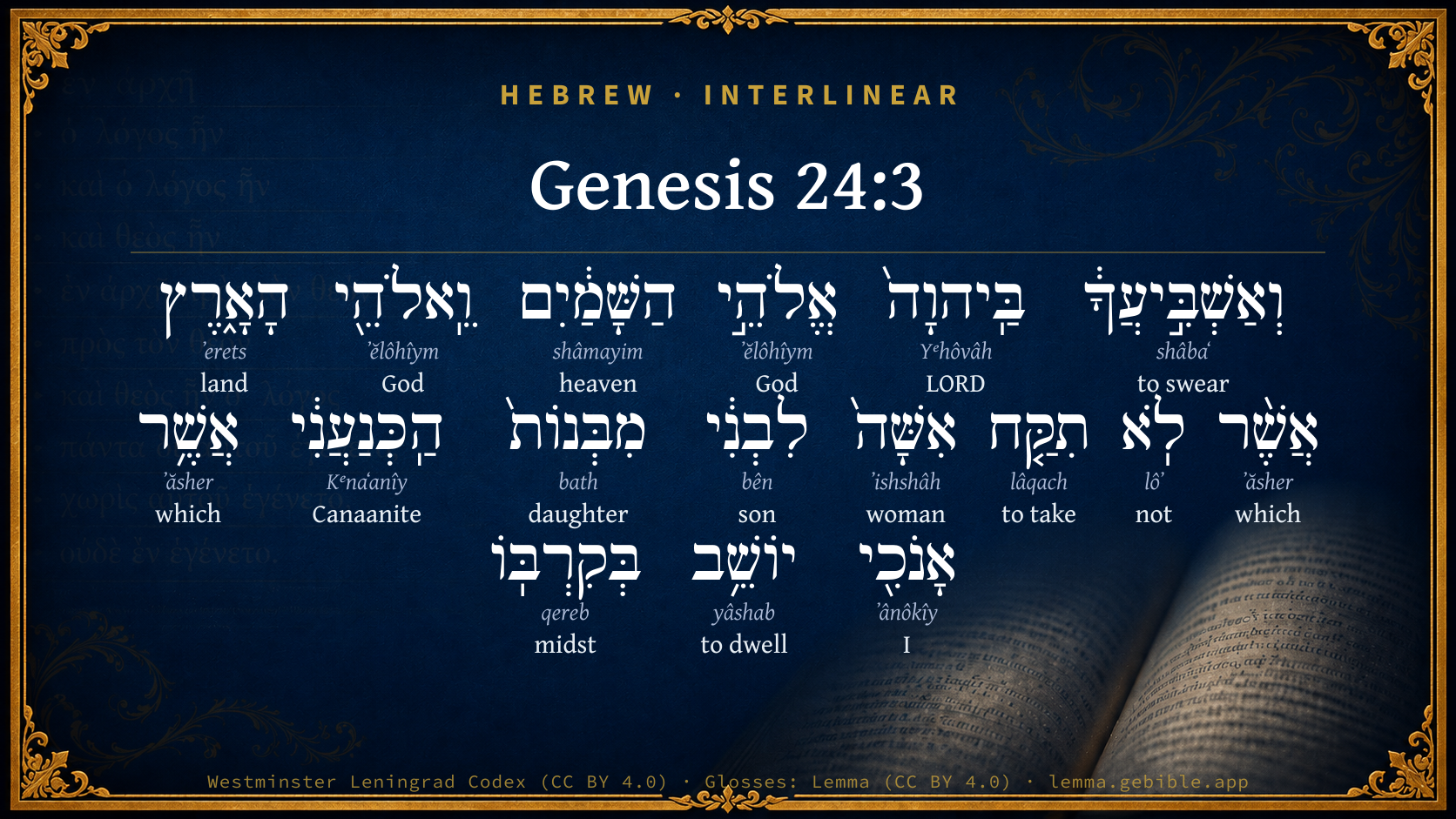
Hebrew (Westminster Leningrad Codex) Genesis 24:3 appears in the Hebrew Old Testament. The text above is from the Westminster Leningrad Codex. Each word links to its Strong’s number, a concise gloss, and parsing drawn from the Open Scriptures Hebrew Bible morphology. Click any word for its full Brown-Driver-Briggs (BDB) entry.
Download image
Cite this verse

Genesis 24:3 (World English Bible). Public Domain. Lemma interlinear Bible study tool, https://lemma.gebible.app/v/genesis/24/3.

Show BibTeX & RIS
BibTeX
RIS
English Translation
I will make you swear by Yahweh, the God of heaven and the God of the earth, that you shall not take a wife for my son of the daughters of the Canaanites, among whom I live.
World English Bible · Public Domain
Download a study sheet

One document with this verse’s original text, its word-by-word gloss line, the meaning frame, cross-references with their text, attributed commentary, and full source and license credits — printable, and it pastes into notes with its structure intact.

This verse Autodidact and up

Study sheet (.html) Plain text (.txt)

A passage Seminary Student

Up to 50 verses in one chapter. A passage sheet keeps up to 6 commentary sources and 12 cross-references per verse, in the order this page ranks them, and says so on the sheet whenever that leaves anything out. Ask for a single verse and you get the Autodidact verse sheet above.

Everything on this page stays free to read, with no account — the sheet is a download of what is already on screen, not access to it.

Want to remove ads? Support Godless Engineer
Compare translations 3

The same verse in 3 English versions, stacked beneath the original-language interlinear above. Click any original word for its lexicon entry.

Each is an independent rendering of the whole verse — the interlinear is not word-aligned to these translations.

Highlighted words mark where these versions differ — a whole-verse word diff, not a word-by-word alignment.

  • World English Bible Public Domain
    I will make you swear by Yahweh, the God of heaven and the God of the earth, that you shall not take a wife for my son of the daughters of the Canaanites, among whom I live.
  • King James Version Public Domain
    And I will make thee swear by the LORD, the God of heaven, and the God of the earth, that thou shalt not take a wife unto my son of the daughters of the Canaanites, among whom I dwell:
  • unfoldingWord Literal Text CC BY-SA 4.0
    and I will have you swear by Yahweh, the God of the heavens and the God of the earth, that you will not take a wife for my son from the daughters of the Canaanites whom I am living among,

unfoldingWord Literal Text — © unfoldingWord, licensed CC BY-SA 4.0. Word-aligned USFM3 via Door43 (git.door43.org/unfoldingWord/en_ult).

Versions to compare (up to 4)

3 of 4 selected

Show all 18 translations

Every available English version of this verse, each an independent rendering of the whole verse.

  • World English Bible Public Domain
    I will make you swear by Yahweh, the God of heaven and the God of the earth, that you shall not take a wife for my son of the daughters of the Canaanites, among whom I live.
  • Berean Standard Bible Public Domain
    and I will have you swear by the LORD, the God of heaven and the God of earth, that you will not take a wife for my son from the daughters of the Canaanites among whom I am dwelling,
  • Majority Standard Bible Public Domain
    and I will have you swear by the LORD, the God of heaven and the God of earth, that you will not take a wife for my son from the daughters of the Canaanites among whom I am dwelling,
  • King James Version Public Domain
    And I will make thee swear by the LORD, the God of heaven, and the God of the earth, that thou shalt not take a wife unto my son of the daughters of the Canaanites, among whom I dwell:
  • American Standard Version (1901) Public Domain
    And I will make thee swear by Jehovah, the God of heaven and the God of the earth, that thou wilt not take a wife for my son of the daughters of the Canaanites, among whom I dwell.
  • Revised Version (1885) Public Domain
    and I will make thee swear by the LORD, the God of heaven and the God of the earth, that thou shalt not take a wife for my son of the daughters of the Canaanites, among whom I dwell:
  • Geneva Bible (1599) Public Domain
    And I will make thee sweare by ye Lord God of the heauen, and God of the earth, that thou shalt not take a wife vnto my sonne of the daughters of the Canaanites among who I dwel.
  • Douay-Rheims (1899) Public Domain
    That I may make thee swear by the Lord the God of heaven and earth, that thou take not a wife for my son, of the daughters of the Chanaanites, among whom I dwell:
  • Young's Literal Translation Public Domain
    and I cause thee to swear by Jehovah, God of the heavens, and God of the earth, that thou dost not take a wife for my son from the daughters of the Canaanite, in the midst of whom I am dwelling;
  • Literal Standard Version CC BY-SA 4.0
    and I cause you to swear by YHWH, God of the heavens and God of the earth, that you do not take a wife for my son from the daughters of the Canaanite, in the midst of whom I am dwelling;
  • Unlocked Literal Bible CC BY-SA 4.0
    and I will make you swear by Yahweh, the God of heaven and the God of the earth, that you will not get a wife for my son from the daughters of the Canaanites, among whom I make my home.
  • unfoldingWord Literal Text CC BY-SA 4.0
    and I will have you swear by Yahweh, the God of the heavens and the God of the earth, that you will not take a wife for my son from the daughters of the Canaanites whom I am living among,
  • Darby Bible Public Domain
    and I will make thee swear by Jehovah, the God of the heavens and the God of the earth, that thou take not a wife for my son of the daughters of the Canaanites, among whom I am dwelling;
  • World Messianic Bible Public Domain
    I will make you swear by the LORD, the God of heaven and the God of the earth, that you shall not take a wife for my son of the daughters of the Canaanites, among whom I live.
  • Webster's Bible Public Domain
    And I will make thee swear by the LORD, the God of heaven and the God of the earth, that thou wilt not take a wife for my son of the daughters of the Canaanites among whom I dwell:
  • Free Bible Version CC BY-SA 4.0
    and swear an oath by the Lord, the God of heaven and the God of earth, that you won't arrange for my son to marry any daughter of the these Canaanite people that I'm living among.
  • Bible in Basic English Public Domain
    And take an oath by the Lord, the God of heaven and the God of the earth, that you will not get a wife for my son Isaac from the daughters of the Canaanites among whom I am living;
  • JPS Tanakh (1917) Public Domain
    And I will make thee swear by the LORD, the God of heaven and the God of the earth, that thou shalt not take a wife for my son of the daughters of the Canaanites, among whom I dwell.

Literal Standard Version (2020), Covenant Press — licensed CC BY-SA 4.0. Text via the HelloAO Bible API (eBible.org). Unlocked Literal Bible (unfoldingWord) — licensed CC BY-SA 4.0. Text via the HelloAO Bible API (eBible.org). unfoldingWord Literal Text — © unfoldingWord, licensed CC BY-SA 4.0. Word-aligned USFM3 via Door43 (git.door43.org/unfoldingWord/en_ult). Free Bible Version, Dr. Jonathan Gallagher — licensed CC BY-SA 4.0. Text via the HelloAO Bible API (eBible.org).

Word by word

More ways to search: Search by grammar → Find every occurrence → Compare this word →

Practice this passage: Drill this verse → Learn its vocabulary →

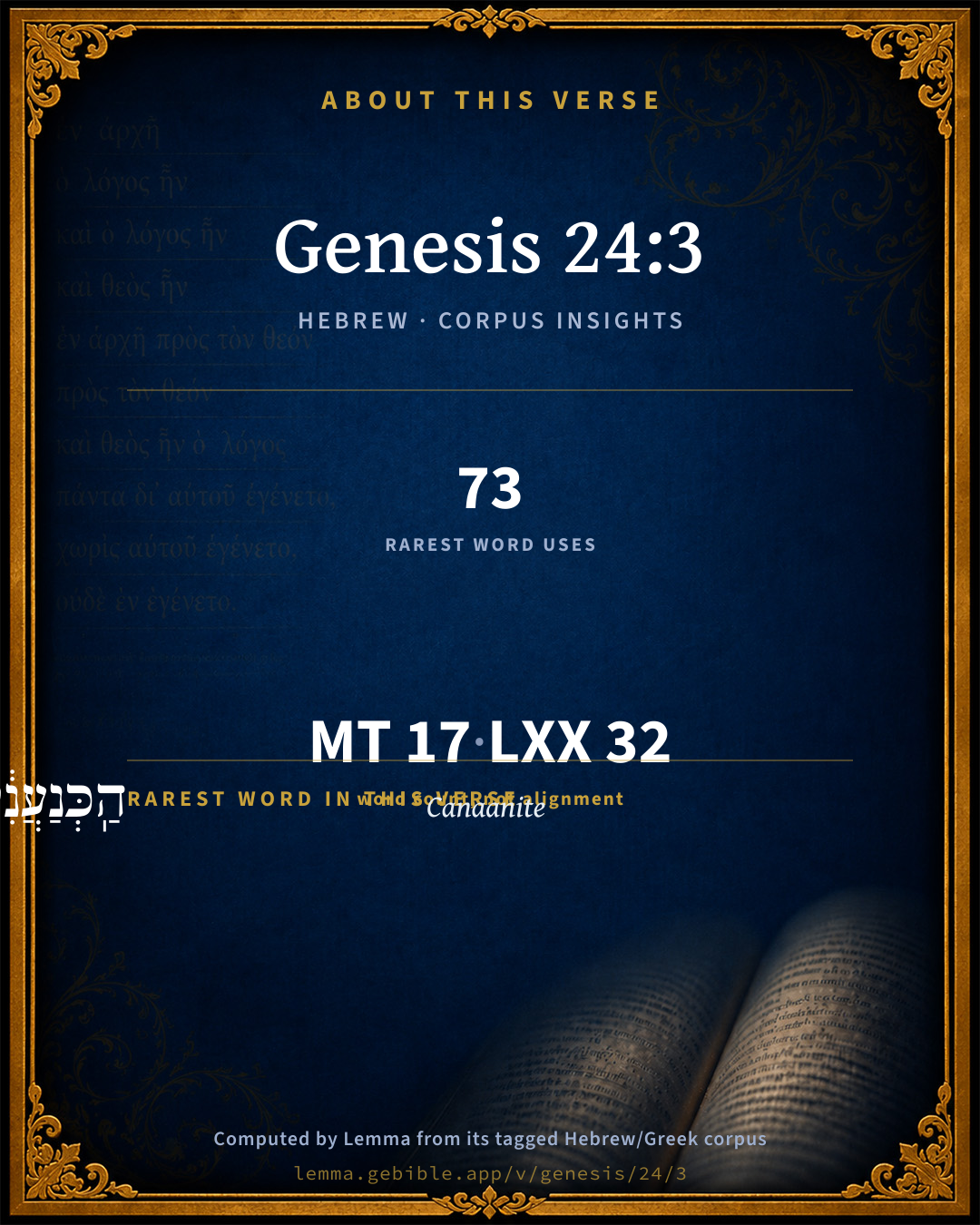
הַֽכְּנַעֲנִ֔י
Kᵉnaʻanîy
H3669
“the · Canaanite”
Particle, Definite Article + Noun, Gentilic, Masculine, Singular, Absolute
Part of Speech
Particle + Noun
Type
Gentilic
Gender
Masculine
Number
Singular
State
Absolute
Full BDB Definition

Origin: patrial from H3667

TWOT: 1002a , 1002b

Canaanite = see Cana " zealous" - descendant of inhabitant of Canaan (adjective) - descendant or inhabitant of Canaan (noun) - a merchant, trader (noun)
  1. וְאַשְׁבִּ֣יעֲךָ֔ shâbaʻ H7650 “and · to swear · you” Conjunction + Verb, Hiphil, Imperfect, 1st Person, Common, Singular + Suffix, Personal, 2nd Person, Masculine, Singular
  2. בַּֽיהוָה֙ Yᵉhôvâh H3068 “in/at · LORD” Preposition + Noun, Proper
  3. אֱלֹהֵ֣י ʼĕlôhîym H430 “God(s) of” Noun, Common, Masculine, Plural, Construct
  4. הַשָּׁמַ֔יִם shâmayim H8064 “the · heaven(s)” Particle, Definite Article + Noun, Common, Masculine, Plural, Absolute
  5. וֵֽאלֹהֵ֖י ʼĕlôhîym H430 “and · God(s) of” Conjunction + Noun, Common, Masculine, Plural, Construct
  6. הָאָ֑רֶץ ʼerets H776 “the · land” Particle, Definite Article + Noun, Common, Both, Singular, Absolute
  7. אֲשֶׁ֨ר ʼăsher H834 “which” Particle, Relative
  8. לֹֽא lôʼ H3808 “not” Particle, Negative
  9. תִקַּ֤ח lâqach H3947 “to take” Verb, Qal, Imperfect, 2nd Person, Masculine, Singular
  10. אִשָּׁה֙ ʼishshâh H802 “woman” Noun, Common, Feminine, Singular, Absolute
  11. לִבְנִ֔י bên H1121 “to/for · son · my” Preposition + Noun, Common, Masculine, Singular, Construct + Suffix, Personal, 1st Person, Common, Singular
  12. מִבְּנוֹת֙ bath H1323 “from · daughters of” Preposition + Noun, Common, Feminine, Plural, Construct
  13. אֲשֶׁ֥ר ʼăsher H834 “which” Particle, Relative
  14. אָנֹכִ֖י ʼânôkîy H595 “I” Pronoun, Personal, 1st Person, Common, Singular
  15. יוֹשֵׁ֥ב yâshab H3427 “dwelling” Verb, Qal, Participle Active, Masculine, Singular, Absolute
  16. בְּקִרְבּֽוֹ qereb H7130 “in/at · midst · his” Preposition + Noun, Common, Masculine, Singular, Construct + Suffix, Personal, 3rd Person, Masculine, Singular

About this verse

These counts appear in no published source. They are computed here, from the morphology-tagged text and Lemma’s own curated glosses. What Lemma adds →

17
words
15
distinct lemmas
Pentateuch
section

Grammatical profile

  • 3 verbs
  • 10 nouns
  • 1 pronoun
  • 3 particles

Verb forms

  • וְאַשְׁבִּ֣יעֲךָ֔ Hiphil · Imperfect
  • תִקַּ֤ח Qal · Imperfect
  • יוֹשֵׁ֥ב Qal · Participle Active

Repetition

Words recur within this verse — often emphatic in Hebrew:

  • אֱלֹהֵ֣י God H430 ×2
  • אֲשֶׁ֨ר which H834 ×2

Hebrew & Septuagint length

In English translation the verse runs 37 words from the Hebrew and 43 from the Septuagint (LXX English) — closely comparable.

A rough comparison of the two English renderings, which tokenize alike — not a word-level alignment.

Word counts can differ between the Hebrew and the Greek without any difference in meaning — e.g. the Hebrew direct-object marker אֵת has no separate Greek word, and Greek often adds the article ὁ.

In the original languages it is 17 Hebrew tokens and 32 Greek tokens — but the two are counted differently (Hebrew bundles its prefixes and suffixes into one token; the Greek is in lemma form), so that isn’t a like-for-like length.

Cross-references

38

Topical passages linked to Genesis 24:3 in the Treasury of Scripture Knowledge — connected by theme and wording, ordered by reader-vote popularity; previews shown in the World English Bible.

  • Genesis 26:34–35 When Esau was forty years old, he took as wife Judith, the daughter of Beeri the Hittite, and Basemath, the daughter of Elon the Hittite.
  • 2 Corinthians 6:14–17 Don't be unequally yoked with unbelievers, for what fellowship have righteousness and iniquity? Or what communion has light with darkness?
  • Genesis 28:8 Esau saw that the daughters of Canaan didn't please Isaac, his father.
  • Deuteronomy 7:3–4 neither shall you make marriages with them; your daughter you shall not give to his son, nor his daughter shall you take to your son.
  • Nehemiah 13:25 I contended with them, and cursed them, and struck certain of them, and plucked off their hair, and made them swear by God, [saying], You shall not give your daughters to their sons, nor take their daughters for your sons, or for yourselves.
  • Genesis 10:15–19 Canaan became the father of Sidon (his firstborn), Heth,
  • Exodus 34:16 and you take of their daughters to your sons, and their daughters play the prostitute after their gods, and make your sons play the prostitute after their gods.
  • 2 Kings 19:15 Hezekiah prayed before Yahweh, and said, Yahweh, the God of Israel, who sit [above] the cherubim, you are the God, even you alone, of all the kingdoms of the earth; you have made heaven and earth.
  • Jeremiah 10:11 Thus shall you say to them, The gods that have not made the heavens and the earth, these shall perish from the earth, and from under the heavens.
  • 1 Corinthians 7:39 A wife is bound by law for as long as her husband lives; but if the husband is dead, she is free to be married to whoever she desires, only in the Lord.
  • Genesis 6:2 that God's sons saw that men's daughters were beautiful, and they took for themselves wives of all that they chose.
  • Genesis 6:4 The Nephilim were in the earth in those days, and also after that, when God's sons came to men's daughters. They bore children to them: the same were the mighty men who were of old, men of renown.
  • Genesis 14:19 He blessed him, and said, "Blessed be Abram of God Most High, possessor of heaven and earth:
  • Genesis 21:23 Now therefore swear to me here by God that you will not deal falsely with me, nor with my son, nor with my son's son. But according to the kindness that I have done to you, you shall do to me, and to the land in which you have lived as a foreigner."
  • Genesis 27:46–28:2 Rebekah said to Isaac, "I am weary of my life because of the daughters of Heth. If Jacob takes a wife of the daughters of Heth, such as these, of the daughters of the land, what good will my life do me?"
  • Genesis 31:44–53 Now come, let us make a covenant, you and I; and let it be for a witness between me and you."
  • Genesis 50:25 Joseph took an oath of the children of Israel, saying, "God will surely visit you, and you shall carry up my bones from here."
  • Exodus 20:7 "You shall not take the name of Yahweh your God in vain, for Yahweh will not hold him guiltless who takes his name in vain.
  • Exodus 23:13 "Be careful to do all things that I have said to you; and don't invoke the name of other gods, neither let them be heard out of your mouth.
  • Numbers 5:21 then the priest shall cause the woman to swear with the oath of cursing, and the priest shall tell the woman, 'Yahweh make you a curse and an oath among your people, when Yahweh allows your thigh to fall away, and your body to swell;
  • Deuteronomy 6:13 You shall fear Yahweh your God; and him shall you serve, and shall swear by his name.
  • Deuteronomy 10:20 You shall fear Yahweh your God; him shall you serve; and to him shall you cleave, and by his name shall you swear.
  • Joshua 2:12 Now therefore, please swear to me by Yahweh, since I have dealt kindly with you, that you also will deal kindly with my father's house, and give me a true token;
  • 2 Chronicles 2:12 Huram said moreover, Blessed be Yahweh, the God of Israel, that made heaven and earth, who has given to David the king a wise son, endowed with discretion and understanding, that should build a house for Yahweh, and a house for his kingdom.
  • Nehemiah 9:6 You are Yahweh, even you alone; you have made heaven, the heaven of heavens, with all their host, the earth and all things that are thereon, the seas and all that is in them, and you preserve them all; and the host of heaven worships you.
  • Genesis 14:22 Abram said to the king of Sodom, "I have lifted up my hand to Yahweh, God Most High, possessor of heaven and earth,
  • Genesis 26:28–31 They said, "We saw plainly that Yahweh was with you. We said, 'Let there now be an oath between us, even between us and you, and let us make a covenant with you,
  • Exodus 22:11 the oath of Yahweh shall be between them both, whether he hasn't put his hand to his neighbor's goods; and the owner of it shall accept it, and he shall not make restitution.
  • Leviticus 19:12 "'You shall not swear by my name falsely, and profane the name of your God. I am Yahweh.
  • 1 Samuel 20:17 Jonathan caused David to swear again, for the love that he had to him; for he loved him as he loved his own soul.
  • Psalms 115:15 Blessed are you by Yahweh, Who made heaven and earth.
  • Isaiah 45:23 By myself have I sworn, the word is gone forth from my mouth [in] righteousness, and shall not return, that to me every knee shall bow, every tongue shall swear.
  • Isaiah 65:16 so that he who blesses himself in the earth shall bless himself in the God of truth; and he who swears in the earth shall swear by the God of truth; because the former troubles are forgotten, and because they are hid from my eyes.
  • Jeremiah 4:2 and you shall swear, As Yahweh lives, in truth, in justice, and in righteousness; and the nations shall bless themselves in him, and in him shall they glory.
  • Jeremiah 12:16 It shall happen, if they will diligently learn the ways of my people, to swear by my name, As Yahweh lives; even as they taught my people to swear by Baal; then shall they be built up in the midst of my people.
  • Zephaniah 1:5 those who worship the host of the sky on the housetops, those who worship and swear by Yahweh and also swear by Malcam,
  • Isaiah 48:1 Hear you this, house of Jacob, who are called by the name of Israel, and are come forth out of the waters of Judah; who swear by the name of Yahweh, and make mention of the God of Israel, but not in truth, nor in righteousness
  • Hebrews 6:16 For men indeed swear by a greater one, and in every dispute of theirs the oath is final for confirmation.

Cross-references courtesy of OpenBible.info (CC BY 4.0).

Hebrew and Greek witnesses Masoretic Hebrew ↔ Greek Septuagint

The same verse in the two great witnesses to the Old Testament, shown verse-for-verse.

These are two independent witnesses, not word-aligned to each other, and the Septuagint is shown in lemma (dictionary) form.

Hebrew Genesis 24:3 Masoretic · Westminster Leningrad Codex

וְאַשְׁבִּ֣יעֲךָ֔ בַּֽיהוָה֙ אֱלֹהֵ֣י הַשָּׁמַ֔יִם וֵֽאלֹהֵ֖י הָאָ֑רֶץ אֲשֶׁ֨ר לֹֽא תִקַּ֤ח אִשָּׁה֙ לִבְנִ֔י מִבְּנוֹת֙ הַֽכְּנַעֲנִ֔י אֲשֶׁ֥ר אָנֹכִ֖י יוֹשֵׁ֥ב בְּקִרְבּֽוֹ

I will make you swear by Yahweh, the God of heaven and the God of the earth, that you shall not take a wife for my son of the daughters of the Canaanites, among whom I live.

World English Bible · Public Domain

Greek LXX Genesis 24:3 Septuagint · lemma form

καί ἐκὀρκίζω σύ κύριος ὁ θεός ὁ οὐρανός καί ὁ θεός ὁ γῆ ἵνα μή λαμβάνω γυνή ὁ υἱός ἐγώ ισαακ ἀπό ὁ θυγάτηρ ὁ χαναναῖος μετά ὅς ἐγώ οἰκέω ἐν αὐτός

and I will adjure you by the Lord the God of heaven, and the God of the earth, that you take not a wife for my son Isaac from the daughters of the Chananites, with whom I dwell, in the midst of them.

LXX2012 (modern English Septuagint) · Public Domain

Hebrew: Westminster Leningrad Codex (CC BY 4.0). Greek: Septuagint (public domain); English from LXX2012 (modern English Septuagint) (Public Domain). How the Septuagint differs from the Hebrew →

Targum (Aramaic paraphrase)

2

The Targum is the ancient Jewish Aramaic paraphrase of the Hebrew Scriptures — an interpretive translation, not the Hebrew text itself. Onkelos (literal) and Pseudo-Jonathan (expansive) render the Torah, and Jonathan the Prophets. Coverage is partial: where no permissively-licensed English translation exists for a verse, only the Aramaic is shown. This is verse-level text, not a word-by-word alignment to the Hebrew.

  1. Targum Onkelos Torah (Genesis–Deuteronomy)
    וַאֲקַיֵּם עֲלָךְ בְּמֵימְרָא דַּיְיָ אֱלָהָא דִּשְׁמַיָּא וֵאלָהָא דְאַרְעָא דְּלָא תִסַּב אִתְּתָא לִבְרִי מִבְּנַת כְּנַעֲנָאֵי דִּי אֲנָא יָתֵב בֵּינֵיהוֹן

    (no public-domain English translation for this verse)

    Targum Onkelos — Aramaic: “Onkelos Genesis” (public domain); “Onkelos Exodus” (public domain); “Onkelos Leviticus” (public domain); “Onkelos Numbers” (public domain); “Onkelos Deuteronomy” (public domain). English: “Sefaria Community Translation” (CC0 1.0 (public-domain dedication)); “J.W. Etheridge. The Targums of Onkelos and Jonathan Ben Uzziel on the Pentateuch. London: Longmans, Green, 1862” (public domain). Text via Sefaria.

  2. Targum Pseudo-Jonathan Torah (Genesis–Deuteronomy)
    וְאוֹמִינָךְ בְּשׁוּם מֵימְרָא דַיְיָ אֱלָהָא דְמוֹתְבֵיהּ בִּשְׁמֵי מְרוֹמָא הוּא אֱלָהָא דְשׁוּלְטָנֵיהּ עַל אַרְעָא דִי לָא תִיסַב אִיתָא לִבְרִי מִבְּנַתְהוֹן דִכְנַעֲנָאֵי דִי אֲנָא יָתִיב בֵּינֵיהוֹן

    And swear to me in the name of the Word of the Lord God, whose habitation is in heaven on high, the God whose dominion is over the earth, that thou wilt not take a wife for my son from the daughters of the Kenaanites among whom I dwell;

    Targum Pseudo-Jonathan — Aramaic: “Targum Jonathan on Genesis” (public domain); “Targum Jonathan on Exodus” (public domain); “Targum Jonathan on Leviticus” (public domain); “Targum Jonathan on Numbers” (public domain); “Targum Jonathan on Deuteronomy” (public domain). English: “The Targum of Jonathan ben Uzziel, trans. J. W. Etheridge, London, 1862” (public domain). Text via Sefaria.

Commentary

Notes on Genesis 24:3 from classic Christian and Jewish commentators (each source and its license shown beneath its notes). The classic Christian expositions comment on the surrounding passage and are grouped to its opening verse, so a note may address several verses; the Jewish commentaries on the Tanakh (Rashi and others) are per-verse, so they appear only where the commentator wrote on this verse.

Lemma curates 59 commentaries, every one of them public domain or Creative Commons licensed, each selected and text-cleaned for this edition rather than reprinted as found. About our sources →

Trapp's Complete Commentary

John Trapp

Gen 24:3 And I will make thee swear by the LORD, the God of heaven, and the God of the earth, that thou shalt not take a wife unto my son of the daughters of the Canaanites, among whom I dwell:

Ver. 3. I will make thee swear by the Lord.] Who alone is the proper object of an oath. {Isa 65:16} Howbeit, in lawful contracts with an infidel or idolater, we may allow such oaths, whereby they swear by false gods; as those of old, that swore by God and Malcom; and the Turks’ great oath now-a-days is, By the immortal God, and by the four hundred prophets, by Mohammed, by his father’s soul, by his own children, and by the sword wherewith he is girt, &c. {a}

That thou shalt not take a wife unto my son, &c.] Lest they should "turn away" his heart "from following God," {Deu 7:3-4} as those "foreign wives" did Solomon, {Neh 13:26} whom therefore God Almighty punished both in himself and his successor Rehoboam, his only son (that we read of) by so many wives and concubines; and he was none of the wisest, nor happiest: tam auspicata sunt coniugia contra Dei legem contracta, saith the divine chronologer. "Be not unequally yoked," {2Co 6:14} therefore, with any untamed heifer that bears not Christ’s yoke. If religion be any other than a cipher, how dare we disregard it in our most important choice? I wish Manoah could speak so loud, saith a reverend divine, {b} that all our Israelites might hear him. "Is there never a woman among the daughters of thy brethren, or among all God’s people, that thou goest to take a wife of the uncircumcised Philistines?" {Jdg 14:3} What is the reason the Pope will not dispense in Spain or Italy, if a Papist marry a Protestant (yet here they will); but in hope to draw more to them? For they well know what power wives many times get over their husbands, as Jezebel did over Ahab; the hen was suffered to crow, and all went as she would have it. And therefore the Legates in the Council of Trent were blamed for allowing the article of priests’ marriage to be disputed, as dangerous, {c} because it is plain that married priests will turn their affections and love to wife and children; and, by consequence, to their house and country. So that the strict dependence that the clergy hath upon the apostolic See would cease: and to grant marriage to priests would destroy the ecclesiastical hierarchy, and make the Pope to be Bishop of Rome only.

{a} Turk. Hist., 345.

{b} Dr Hall

{c} History of Council of Trent. 680.

John Trapp, A Commentary or Exposition upon All the Books of the Old and New Testament (1647–1656) — public domain. Text from a community e-Sword module.

Joseph Benson's Commentary

Gen 24:3. I will make thee swear — This was both for Abraham’s own satisfaction, and to engage his servant to all possible care and diligence in this important business. Thus God swears his servants to their work, that, having sworn, they may perform it. By the Lord, (Hebrews Jehovah,) the God of heaven and the God of earth — Observe with what reverence Abraham speaks of God, and with what solemnity this oath is administered and taken! And see how careful Abraham is that his son should not marry one of corrupt principles and manners. He was in such high esteem among the Canaanites, that, undoubtedly, he could have married Isaac to a daughter of one of the princes of the land. But he saw that the Canaanites were degenerating into great wickedness, and knew that they were designed for ruin; and he would not marry his son among them, lest they should be a snare to his soul. To obtain for him, as a partner in life, a person of piety and virtue, is his chief, if not his sole concern, and therefore he sends even to a distant country for such a one. Alas! how different is this from the conduct of many! Wealth and dignity are the chief objects they fix their thoughts on in marrying their children. They seek not in their choice those that are sincere and devout worshippers of God, but those who have the largest possessions; not those rich in good works, but those rich in the world. And this, perhaps, is one chief and principal cause of the great corruption of manners among us.

Joseph Benson's Commentary on the Old and New Testaments (1811–1818) — public domain. Text from a community e-Sword module.

Tyndale Open Study Notes

Tyndale Open Resources

24:3 Isaac knew how wicked and threatening the local Canaanite people were, so he maintained separation from them (cp. 26:34-35; 27:46; 28:8-9).

Tyndale Open Study Notes — © Tyndale Open Resources, licensed CC BY-SA 4.0. Text via the HelloAO Bible API.

Geneva Bible (1599)

Geneva Bible translators

This showeth that an oath may be required in a lawful cause.

Geneva Bible (1599) marginal notes — public domain. Text via Bolls.life.

Jamieson, Fausset & Brown

Robert Jamieson, A. R. Fausset & David Brown

thou shalt not take a wife, &c.--Among pastoral tribes the matrimonial arrangements are made by the parents, and a youth must marry, not among strangers, but in his own tribe--custom giving him a claim, which is seldom or never resisted, to the hand of his first cousin. But Abraham had a far higher motive--a fear lest, if his son married into a Canaanitish family, he might be gradually led away from the true God.

Jamieson, Fausset & Brown — Commentary Critical and Explanatory on the Whole Bible (1871) — public domain (CC PDM 1.0). Text via the HelloAO Bible API.

Adam Clarke's Commentary

Verse 3. I will make thee swear] See Clarke on Ge 24:9.

Of the Canaanites] Because these had already been devoted to slavery, &c., and it would have been utterly inconsistent as well with prudence as with the design of God to have united the child and heir of the promise with one who was under a curse, though that curse might be considered to be only of a political nature. See the curse of Canaan, Ge 9:25.

Adam Clarke's Commentary on the Bible (1810–1826) — public domain. Text from a community e-Sword/MySword module.

John Calvin's Commentaries

3. That thou shalt not take a wife. The kind of discipline which prevailed in Abraham’s house is here apparent. Although this man was but a servant, yet, because he was put in authority by the master of the family, his servile condition did not prevent him from being next in authority to his lord; so that Isaac himself, the heir and successor of Abraham, submitted to his direction. To such an extent did the authority of Abraham and reverence for him prevail, that when he substituted a servant in his place, he caused this servant, by his mere will or word, to exercise a power which other masters of families find it difficult to retain for themselves. The modesty also of Isaac, who suffered himself to be governed by a servant, is obvious; for it would have been in vain for Abraham to enter into engagements with his servant, had he not been persuaded that his son would prove submissive and tractable. It here appears what great veneration he cherished towards his father; because Abraham, relying on Isaac’s obedience, confidently calls his servant to him. Now this example should be taken by us as a common rule, to show that it is not lawful for the children of a family to contract marriage, except with the consent of parents; and certainly natural equity dictates that, in a matter of such importance, children should depend upon the will of their parents. How detestable, therefore, is the barbarity of the Pope, who has dared to burst this sacred bond asunder! Wherefore the wantonness of youths is to be restrained, that they may not rashly contract nuptials without consulting their fathers.

John Calvin's Commentaries (1540-1563) — public domain. Text from the Calvin Translation Society English edition (1840s-50s) via the Christian Classics Ethereal Library (ccel.org). Calvin's coverage is partial (roughly two-thirds of the Bible); uncommented books and verses are honest gaps, never fabricated. The 19th-century editor's footnotes and remarks are omitted so the notes are faithfully Calvin's own voice.

The Cambridge Bible for Schools and Colleges

gen. ed. J. J. S. Perowne

3. the God of heaven … earth] This solemn title of Jehovah as God of the whole universe is more common in later Hebrew writings; cf. Ezr_5:11. This form of adjuration indicates the conviction of the writer that the God of the Hebrews was the God of the whole world, not merely of a particular locality or nation: compare Gen_18:25. No change of country, no lapse of time, would constitute an exemption from the binding character of the oath.

of the daughters of the Canaanites] The dread of the marriage of an Israelite with a Canaanite which is found here, is also expressed in Gen_26:34-35, Gen_27:46; Exo_34:16; Deu_7:3; Ezr_9:2. For “Canaanite,” cf. Gen_10:18-19, Gen_12:6, Gen_13:7 (J).

Religious feeling underlies this prohibition. The purity of the Hebrew race is to be maintained. Intermarriage would involve participation in religious rites. Separateness would give a corresponding freedom from moral contamination.

The Cambridge Bible for Schools and Colleges (gen. ed. J. J. S. Perowne; Cambridge University Press, 1878–1918) — public domain. Text from a community e-Sword module.

John Gill's Exposition

And I will make thee swear by the Lord, the God of heaven, and the God of earth,.... The Maker and possessor of heaven and earth, by whom Abraham used to swear whenever he did, and by whom only men should swear, see Gen 14:22. The Targum of Jonathan is,"I will make thee swear by the name of the Word of the Lord God,''which strengthens the sense given of the rite before observed:

that thou wilt not take a wife unto my son of the daughters of the Canaanites, among whom I dwell; these being not only idolaters, and very wicked people, degenerated yet more and more, but were the seed of the accursed Canaan; and who in process of time would be dispossessed of the land, and be destroyed. Now though Isaac was forty years of age, and one would think at an age sufficient to have chosen a wife for himself; but as Abraham knew that he had a great respect for this servant, and would be influenced by him in such a choice, and especially as this affair was now about to be committed to his care, and no doubt with the consent of Isaac, therefore he thus charges and adjures him.

John Gill's Exposition of the Whole Bible (1746–1763) — public domain (CC PDM 1.0). Text via the HelloAO Bible API.

Matthew Poole's English Annotations

i.e. Not persuade nor engage my son to take; for Isaac, though forty years old, was not only willing to be governed by his father in this affair, but also to hearken to the counsel of this wise and faithful servant, of whom both his father and himself had such long and large experience. He knew that

the Canaanites were not only gross idolaters and heinous sinners, for so many others were; but that they were a people under God's peculiar curse, Gen 9:25, and devoted to extirpation and utter destruction, which was to be inflicted upon them by Abraham's posterity; and therefore to marry his son to such persons had been a high degree of self-murder, whereby the holy and blessed seed had been in danger of great infection from them, and utter ruin with them. And Abraham's practice was afterwards justified by God, who hath oft showed his dislike of such unequal matches of his people with those infidels and idolaters, by severe prohibitions and sharp censures. See Exo 34:16; Deu 7:3; Jos 23:12; Ezr 9:1-3; Neh 13:23-25; 2Co 6:14-15.

Matthew Poole's English Annotations on the Holy Bible (1683–1685) — public domain. Text from a community e-Sword/MySword module.

Whedon's Commentary on the Bible

Daniel D. Whedon

3. Swear by the Lord — To the sacredness of the manner of the oath is added the solemnity of this use of the holy NAME. This servant must swear by Jehovah, God of the heavens and God of the earth. Thus Abraham puts him under the most solemn oath that could then bind the conscience of a man.

Not… of the Canaanites — Lot’s case might have been a sufficient warning, and the idolatries and growing iniquity of the Amorites, though not yet full, (Gen_15:16,) were plainly such as to show the pious patriarch the fearful danger of matrimonial alliances with them. Here we note the ancient enforcing of the principle of the apostolic precept: “Be ye not unequally yoked together with unbelievers.” 2Co_6:14. What sorrows and soul-losses have followed from such unhallowed unions!

Daniel D. Whedon (gen. ed.), Commentary on the Old and New Testaments (1874–1909) — public domain. Text from a community e-Sword module.

Ramban (Nachmanides)

Rabbi Moshe ben Nachman (Ramban / Nachmanides)

AND I WILL MAKE THEE SWEAR BY THE ETERNAL. It would have been proper for Abraham to command his son Isaac that he should not take a wife from the daughters of Canaan. But since it was his wish to dispatch someone during his lifetime to his country and his family, and he made the servant swear to do so whether in his lifetime or after his death, therefore Abraham found it necessary in any case to make the servant swear to go there. In addition he found it necessary to say to him, “I command you that you should not take a woman for my son of the daughters of Canaan. Instead you are to go to my country and take for him a wife from my father’s house.” Now having required the servant to swear to this, he no longer found it necessary to command Isaac at all for he knew that he would not transgress his father’s wish or the oath which he made his servant swear, as the matter was indeed known to Isaac.It is also possible that the servant Eliezer was the administrator of his possessions, and Abraham commanded him to marry off Isaac in accordance with his will and cause him to inherit his estate on this condition, [namely, that he marry in accordance with his father’s wish]. This is the significance of the expression, that ruled over all that he had.

THE G-D OF THE HEAVEN, AND THE G-D OF THE LAND. (the land) to mean “the land of Israel.” The Holy One, blessed be He, is called the G-d of the Land of Israel, as it is written, They know not the manner of the G-d of the land, and it is further written, And they spoke of the G-d of Jerusalem, as of the gods of the people of the earth. There is a secret in this matter which I will yet explain with the help of G-d. However [in Verse 7], further on where it says, Who took me from my father’s house, it does not say “the G-d of the land” because he [Abraham] was then in Haran or Ur of the Chaldees. So also the Rabbis have said: “He who lives outside the land of Israel is as if he had no G-d, as it said, For they have driven me out this day that I should not cleave unto the inheritance of the Eternal, saying, Go, serve other gods. However this verse teaches you that he who lives outside of the land of Israel is considered as if he worshipped idols. (Ibid.)

Ramban (Nachmanides) on the Tanakh — English translation: “Commentary on the Torah by Ramban (Nachmanides). Translated and annotated by Charles B. Chavel. New York, Shilo Pub. House, 1971-1976” (CC BY 4.0). Text via Sefaria.

Radak

Rabbi David Kimhi (Radak)

ואשביעך..ואלוקי הארץ, meaning that the same G’d Who is ruler in the heavens also exercises His control down here on earth. Do not think that if you do not honour an oath made to the G’d in heaven that failure to honour it would not have negative consequences for you here on earth. When Avraham speaks of his own self, as opposed to the need to make someone else take an oath, he only needs to refer to the “G’d of the heavens” (compare verse 7) Avraham was well aware of G’d being also the G’d on earth. In Bereshit Rabbah 59,8 Rabbi Pinchas is quoted as saying that until He revealed Himself to His creatures G’d was known only as the “G’d of the heavens,” whereas after He revealed Himself to His creatures [or to an individual creature by performing a miracle for such a person Ed.] He also became known as the ”G’d of the earth.”

מבנות הכנעני, for the entire Canaanite tribe is cursed since the days of Noach, and Avraham’s seed is not to be merged with that of a cursed tribe.

יושב בקרבו, compare the verses 36 in our chapter as well as Genesis 48,16 where one or the other of these words is used to describe the environment in which our patriarchs lived.

Radak on the Tanakh — English translations: “Sefaria Community Translation” (CC0 1.0 (public-domain dedication)); “Eliyahu Munk, HaChut Hameshulash” (CC BY 4.0); “Rabbi Mike Feuer, Jerusalem Anthology” (CC BY 4.0); and “R. David Kimhi on the first book of Psalms, Translated by R.G. Finch, London, 1919” (public domain). Text via Sefaria.

Lesson kit

Teaching starters — assembled from the data on this page, not authored interpretation. Every prompt links to the verse data it draws on. Edit before teaching.

Genesis, in the Pentateuch, opens this verse with 17 words (15 distinct Hebrew lemmas). Its most distinctive word is Kᵉnaʻanîy (“Canaanite”). A historical commentator’s framing appears above. Read the whole chapter for the surrounding context.

Discussion questions

  1. What does “Canaanite” (Kᵉnaʻanîy) contribute to the verse as a whole?
  2. How does Genesis 26:34–35, which shares this passage’s theme, read alongside this verse?
  3. What does the repetition of “God” (2× in this one verse) do in this verse?
  4. These translations render this verse differently; the difference is in the English rendering, not the original. What questions does that raise?
  5. «וְאַשְׁבִּ֣יעֲךָ֔» is a Hiphil Imperfect verb. How does that grammatical form shape the action described?
  6. Compare how Trapp's Complete Commentary and Joseph Benson's Commentary read this verse. Where do they agree or differ?

Things to notice

Reading settings

Reading text

Shown beneath each verse's original-language words.

Old Testament
Old Testament edition

Read the OT as the Masoretic Hebrew (MT) or the Greek Septuagint (LXX).

English shown for the Greek Septuagint (in the Hebrew ↔ Greek comparison).

Comparing translations? Open the Compare panel on any verse page to stack up to four side by side.