
Exodus 9:10

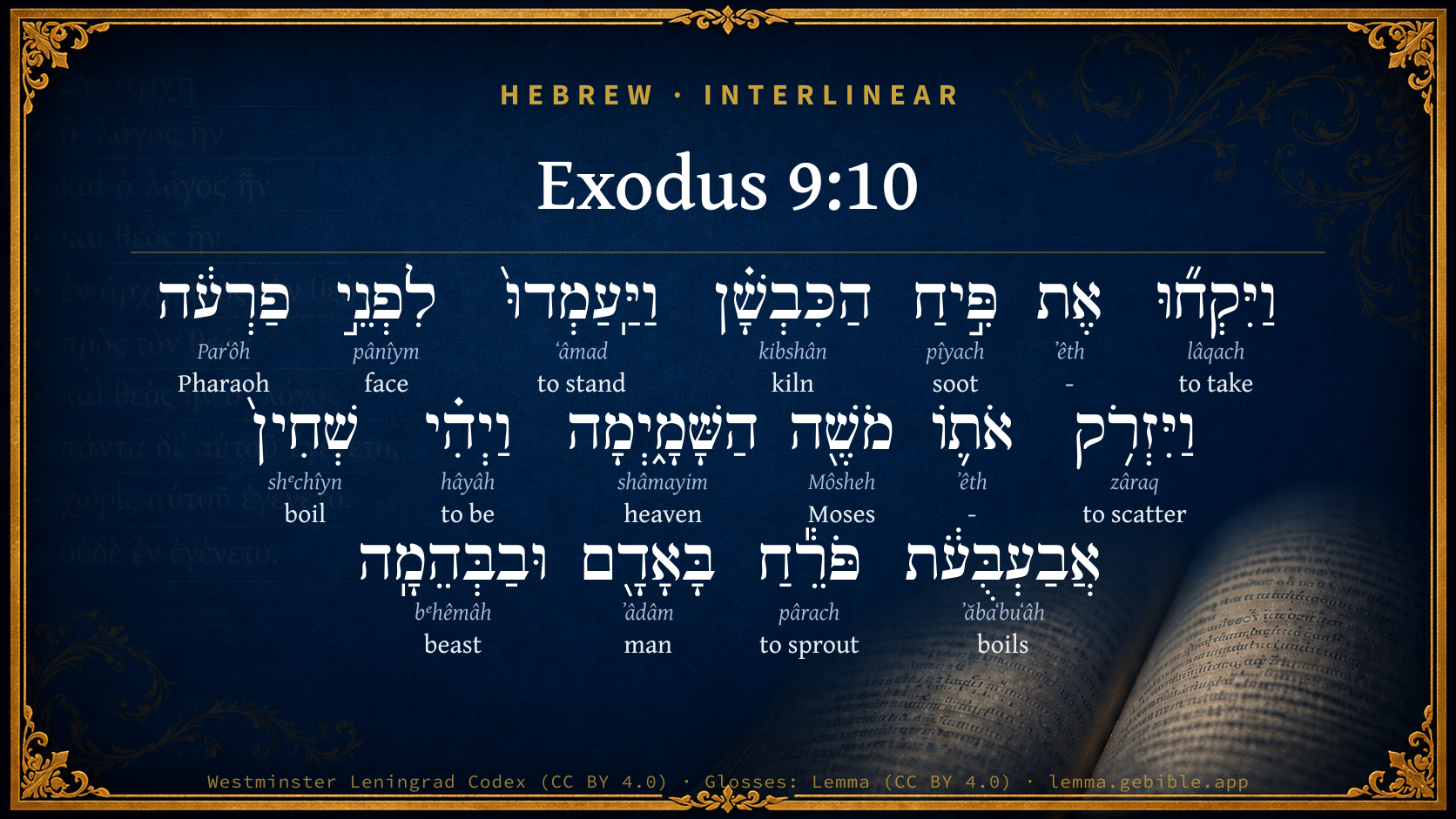
Hebrew (Westminster Leningrad Codex) Exodus 9:10 appears in the Hebrew Old Testament. The text above is from the Westminster Leningrad Codex. Each word links to its Strong’s number, a concise gloss, and parsing drawn from the Open Scriptures Hebrew Bible morphology. Click any word for its full Brown-Driver-Briggs (BDB) entry.
Download image
Cite this verse

Exodus 9:10 (World English Bible). Public Domain. Lemma interlinear Bible study tool, https://lemma.gebible.app/v/exodus/9/10.

Show BibTeX & RIS
BibTeX
RIS
English Translation
They took ashes of the furnace, and stood before Pharaoh; and Moses sprinkled it up toward the sky; and it became a boil breaking forth with boils on man and on animal.
World English Bible · Public Domain
Download a study sheet

One document with this verse’s original text, its word-by-word gloss line, the meaning frame, cross-references with their text, attributed commentary, and full source and license credits — printable, and it pastes into notes with its structure intact.

This verse Autodidact and up

Study sheet (.html) Plain text (.txt)

A passage Seminary Student

Up to 50 verses in one chapter. A passage sheet keeps up to 6 commentary sources and 12 cross-references per verse, in the order this page ranks them, and says so on the sheet whenever that leaves anything out. Ask for a single verse and you get the Autodidact verse sheet above.

Everything on this page stays free to read, with no account — the sheet is a download of what is already on screen, not access to it.

Want to remove ads? Support Godless Engineer
Compare translations 3

The same verse in 3 English versions, stacked beneath the original-language interlinear above. Click any original word for its lexicon entry.

Each is an independent rendering of the whole verse — the interlinear is not word-aligned to these translations.

Highlighted words mark where these versions differ — a whole-verse word diff, not a word-by-word alignment.

  • World English Bible Public Domain
    They took ashes of the furnace, and stood before Pharaoh; and Moses sprinkled it up toward the sky; and it became a boil breaking forth with boils on man and on animal.
  • King James Version Public Domain
    And they took ashes of the furnace, and stood before Pharaoh; and Moses sprinkled it up toward heaven; and it became a boil breaking forth with blains upon man, and upon beast.
  • unfoldingWord Literal Text CC BY-SA 4.0
    And they took ash of a furnace, and they stood before the face of Pharaoh. And Moses sprinkled it toward the heavens, and it became boils, bursting blisters, on man and on beast.

unfoldingWord Literal Text — © unfoldingWord, licensed CC BY-SA 4.0. Word-aligned USFM3 via Door43 (git.door43.org/unfoldingWord/en_ult).

Versions to compare (up to 4)

3 of 4 selected

Show all 18 translations

Every available English version of this verse, each an independent rendering of the whole verse.

  • World English Bible Public Domain
    They took ashes of the furnace, and stood before Pharaoh; and Moses sprinkled it up toward the sky; and it became a boil breaking forth with boils on man and on animal.
  • Berean Standard Bible Public Domain
    So they took soot from the furnace and stood before Pharaoh. Moses tossed it into the air, and festering boils broke out on man and beast.
  • Majority Standard Bible Public Domain
    So they took soot from the furnace and stood before Pharaoh. Moses tossed it into the air, and festering boils broke out on man and beast.
  • King James Version Public Domain
    And they took ashes of the furnace, and stood before Pharaoh; and Moses sprinkled it up toward heaven; and it became a boil breaking forth with blains upon man, and upon beast.
  • American Standard Version (1901) Public Domain
    And they took ashes of the furnace, and stood before Pharaoh; and Moses sprinkled it up toward heaven; and it became a boil breaking forth with blains upon man and upon beast.
  • Revised Version (1885) Public Domain
    And they took ashes of the furnace, and stood before Pharaoh; and Moses sprinkled it up toward heaven; and it became a boil breaking forth with blains upon man and upon beast.
  • Geneva Bible (1599) Public Domain
    Then they tooke ashes of the fornace, and stoode before Pharaoh: and Moses sprinkled them towarde the heauen, and there came a scab breaking out into blisters vpon man, and vpon beast.
  • Douay-Rheims (1899) Public Domain
    And they took ashes out of the chimney, and stood before Pharao, and Moses sprinkled it in the air: and there came boils with swelling blains in men and beasts.
  • Young's Literal Translation Public Domain
    And they take the soot of the furnace, and stand before Pharaoh, and Moses sprinkleth it towards the heavens, and it is a boil `with' blains, breaking forth, on man and on beast;
  • Literal Standard Version CC BY-SA 4.0
    And they take the soot of the furnace, and stand before Pharaoh, and Moses sprinkles it toward the heavens, and it is a boil [with] blisters breaking forth on man and on beast;
  • Unlocked Literal Bible CC BY-SA 4.0
    So Moses and Aaron took ashes from a kiln and stood in front of Pharaoh. Then Moses threw the ashes up into the air. The ashes caused blisters and sores to break out on people and animals.
  • unfoldingWord Literal Text CC BY-SA 4.0
    And they took ash of a furnace, and they stood before the face of Pharaoh. And Moses sprinkled it toward the heavens, and it became boils, bursting blisters, on man and on beast.
  • Darby Bible Public Domain
    And they took ashes of the furnace, and stood before Pharaoh; and Moses sprinkled it toward the heavens; and it became boils [with] blisters breaking out on man and on cattle.
  • World Messianic Bible Public Domain
    They took ashes of the furnace, and stood before Pharaoh; and Moses sprinkled it up toward the sky; and it became boils and blisters breaking out on man and on animal.
  • Webster's Bible Public Domain
    And they took ashes of the furnace, and stood before Pharaoh; and Moses sprinkled it towards heaven; and it became a boil breaking forth with blains upon man, and upon beast.
  • Free Bible Version CC BY-SA 4.0
    They got soot from a furnace, and went to see Pharaoh. Moses threw it into the air, and open sores broke out on people and animals.
  • Bible in Basic English Public Domain
    So they took some dust from the fire, and placing themselves before Pharaoh, Moses sent it out in a shower up to heaven; and it became a skin-disease bursting out on man and on beast.
  • JPS Tanakh (1917) Public Domain
    And they took soot of the furnace, and stood before Pharaoh; and Moses threw it up heavenward; and it became a boil breaking forth with blains upon man and upon beast.

Literal Standard Version (2020), Covenant Press — licensed CC BY-SA 4.0. Text via the HelloAO Bible API (eBible.org). Unlocked Literal Bible (unfoldingWord) — licensed CC BY-SA 4.0. Text via the HelloAO Bible API (eBible.org). unfoldingWord Literal Text — © unfoldingWord, licensed CC BY-SA 4.0. Word-aligned USFM3 via Door43 (git.door43.org/unfoldingWord/en_ult). Free Bible Version, Dr. Jonathan Gallagher — licensed CC BY-SA 4.0. Text via the HelloAO Bible API (eBible.org).

Word by word

More ways to search: Search by grammar → Find every occurrence → Compare this word →

Practice this passage: Drill this verse → Learn its vocabulary →

פִּ֣יחַ
pîyach
H6368
“soot of”
Noun, Common, Masculine, Singular, Construct
Part of Speech
Noun
Type
Common
Gender
Masculine
Number
Singular
State
Construct
Full BDB Definition

Origin: from H6315

TWOT: 1741a

soot, ashes
  1. וַיִּקְח֞וּ lâqach H3947 “and · to take” Conjunction + Verb, Qal, Sequential Imperfect, 3rd Person, Masculine, Plural
  2. אֶת ʼêth H853 “-” Particle, Direct Object
  3. הַכִּבְשָׁ֗ן kibshân H3536 “the · kiln” Particle, Definite Article + Noun, Common, Masculine, Singular, Absolute
  4. וַיַּֽעַמְדוּ֙ ʻâmad H5975 “and · to stand” Conjunction + Verb, Qal, Sequential Imperfect, 3rd Person, Masculine, Plural
  5. לִפְנֵ֣י pânîym H6440 “to/for · face(s) of” Preposition + Noun, Common, Both, Plural, Construct
  6. פַרְעֹ֔ה Parʻôh H6547 “Pharaoh” Noun, Proper
  7. וַיִּזְרֹ֥ק zâraq H2236 “and · to scatter” Conjunction + Verb, Qal, Sequential Imperfect, 3rd Person, Masculine, Singular
  8. אֹת֛וֹ ʼêth H853 “- · him” Particle, Direct Object + Suffix, Personal, 3rd Person, Masculine, Singular
  9. מֹשֶׁ֖ה Môsheh H4872 “Moses” Noun, Proper
  10. הַשָּׁמָ֑יְמָה shâmayim H8064 “the · heaven(s) · toward” Particle, Definite Article + Noun, Common, Masculine, Plural, Absolute + Suffix, Demonstrative
  11. וַיְהִ֗י hâyâh H1961 “and · to be” Conjunction + Verb, Qal, Sequential Imperfect, 3rd Person, Masculine, Singular
  12. שְׁחִין֙ shᵉchîyn H7822 “boil” Noun, Common, Masculine, Singular, Absolute
  13. אֲבַעְבֻּעֹ֔ת ʼăbaʻbuʻâh H76 “boils” Noun, Common, Feminine, Plural, Absolute
  14. פֹּרֵ֕חַ pârach H6524 “sprouting” Verb, Qal, Participle Active, Masculine, Singular, Absolute
  15. בָּאָדָ֖ם ʼâdâm H120 “in/at the · man” Preposition, Determined + Noun, Common, Masculine, Singular, Absolute
  16. וּבַבְּהֵמָֽה bᵉhêmâh H929 “and · in/at the · beast” Conjunction + Preposition, Determined + Noun, Common, Feminine, Singular, Absolute

About this verse

These counts appear in no published source. They are computed here, from the morphology-tagged text and Lemma’s own curated glosses. What Lemma adds →

17
words
16
distinct lemmas
Pentateuch
section

Notable vocabulary

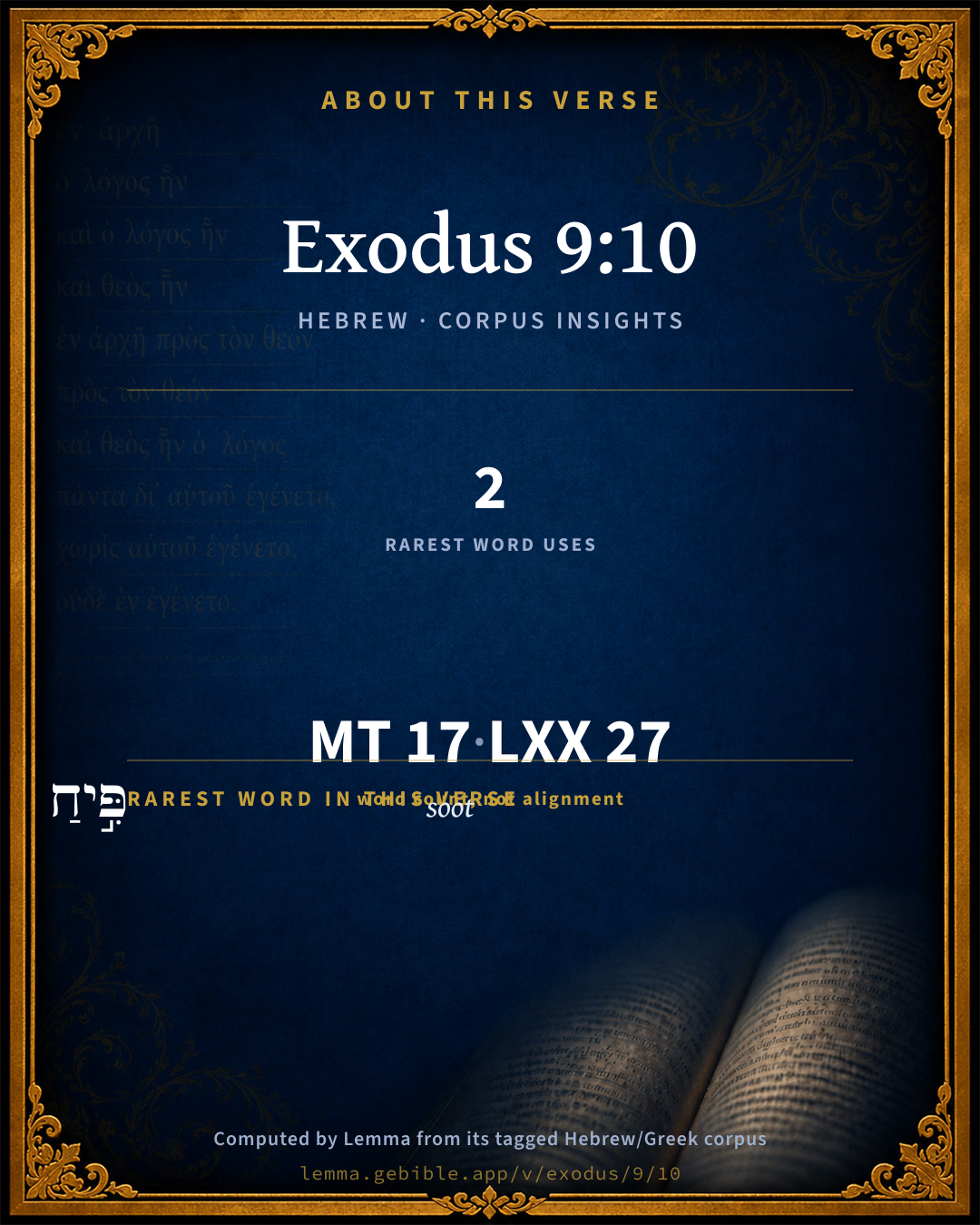
The rarest word here is פִּ֣יחַ soot H6368 — appearing just 2 times in the whole Hebrew Bible.

Shared distinctive vocabulary

פִּ֣יחַ soot H6368 occurs in 2 verses of the Hebrew Bible. Also found in:

Grammatical profile

  • 5 verbs
  • 10 nouns
  • 2 particles

Verb forms

  • וַיִּקְח֞וּ Qal · Sequential Imperfect
  • וַיַּֽעַמְדוּ֙ Qal · Sequential Imperfect
  • וַיִּזְרֹ֥ק Qal · Sequential Imperfect
  • וַיְהִ֗י Qal · Sequential Imperfect
  • פֹּרֵ֕חַ Qal · Participle Active

Hebrew & Septuagint length

In English translation the verse runs 32 words from the Hebrew and 30 from the Septuagint (LXX English) — closely comparable.

A rough comparison of the two English renderings, which tokenize alike — not a word-level alignment.

Word counts can differ between the Hebrew and the Greek without any difference in meaning — e.g. the Hebrew direct-object marker אֵת has no separate Greek word, and Greek often adds the article ὁ.

In the original languages it is 17 Hebrew tokens and 27 Greek tokens — but the two are counted differently (Hebrew bundles its prefixes and suffixes into one token; the Greek is in lemma form), so that isn’t a like-for-like length.

Cross-references

1

Topical passages linked to Exodus 9:10 in the Treasury of Scripture Knowledge — connected by theme and wording, ordered by reader-vote popularity; previews shown in the World English Bible.

  • Deuteronomy 28:27 Yahweh will strike you with the boil of Egypt, and with the tumors, and with the scurvy, and with the itch, of which you can not be healed.

Cross-references courtesy of OpenBible.info (CC BY 4.0).

Hebrew and Greek witnesses Masoretic Hebrew ↔ Greek Septuagint

The same verse in the two great witnesses to the Old Testament, shown verse-for-verse.

These are two independent witnesses, not word-aligned to each other, and the Septuagint is shown in lemma (dictionary) form.

Hebrew Exodus 9:10 Masoretic · Westminster Leningrad Codex

וַיִּקְח֞וּ אֶת פִּ֣יחַ הַכִּבְשָׁ֗ן וַיַּֽעַמְדוּ֙ לִפְנֵ֣י פַרְעֹ֔ה וַיִּזְרֹ֥ק אֹת֛וֹ מֹשֶׁ֖ה הַשָּׁמָ֑יְמָה וַיְהִ֗י שְׁחִין֙ אֲבַעְבֻּעֹ֔ת פֹּרֵ֕חַ בָּאָדָ֖ם וּבַבְּהֵמָֽה

They took ashes of the furnace, and stood before Pharaoh; and Moses sprinkled it up toward the sky; and it became a boil breaking forth with boils on man and on animal.

World English Bible · Public Domain

Greek LXX Exodus 9:10 Septuagint · lemma form

καί λαμβάνω ὁ αἰθάλη ὁ καμιναία ἐναντίον φαραώ καί πάσσω αὐτός μωυσῆς εἰς ὁ οὐρανός καί γίγνομαι ἕλκος φλυκτίς ἀναζέω ἐν ὁ ἄνθρωπος καί ἐν ὁ τετράπους

So he took of the ashes of the furnace before Pharao, and Moses scattered it toward heaven, and it became sore blains breaking forth both on men and on beasts.

LXX2012 (modern English Septuagint) · Public Domain

Hebrew: Westminster Leningrad Codex (CC BY 4.0). Greek: Septuagint (public domain); English from LXX2012 (modern English Septuagint) (Public Domain). How the Septuagint differs from the Hebrew →

Targum (Aramaic paraphrase)

2

The Targum is the ancient Jewish Aramaic paraphrase of the Hebrew Scriptures — an interpretive translation, not the Hebrew text itself. Onkelos (literal) and Pseudo-Jonathan (expansive) render the Torah, and Jonathan the Prophets. Coverage is partial: where no permissively-licensed English translation exists for a verse, only the Aramaic is shown. This is verse-level text, not a word-by-word alignment to the Hebrew.

  1. Targum Onkelos Torah (Genesis–Deuteronomy)
    וּנְסִיבוּ יָת פִּיחָא דְאַתּוּנָא וְקָמוּ קֳדָם פַּרְעֹה וּזְרַק יָתֵהּ משֶׁה לְצֵית שְׁמַיָא וַהֲוָה שִׁיחֲנָא אֲבַעְבֻּעִין סָגֵי בַּאֲנָשָׁא וּבִבְעִירָא:

    (no public-domain English translation for this verse)

    Targum Onkelos — Aramaic: “Onkelos Genesis” (public domain); “Onkelos Exodus” (public domain); “Onkelos Leviticus” (public domain); “Onkelos Numbers” (public domain); “Onkelos Deuteronomy” (public domain). English: “Sefaria Community Translation” (CC0 1.0 (public-domain dedication)); “J.W. Etheridge. The Targums of Onkelos and Jonathan Ben Uzziel on the Pentateuch. London: Longmans, Green, 1862” (public domain). Text via Sefaria.

  2. Targum Pseudo-Jonathan Torah (Genesis–Deuteronomy)
    וּנְסִיבוּ יַת קִיטְמָא דְאַתּוּנָא וְקָמוּ לִקְדָם פַּרְעה וּדְרַק יָתֵיהּ משֶׁה לְצֵית שְׁמַיָא וַהֲוָה שְׁחִין שַׁלְפוּקִין סַגִי בְּאֵינָשָׁא וּבִבְעִירָא

    And they took ashes of the furnace, and arose to meet Pharoh; and Mosheh sprinkled them towards the height of the heavens; and there came a boil multiplying tumours upon man and beast.

    Targum Pseudo-Jonathan — Aramaic: “Targum Jonathan on Genesis” (public domain); “Targum Jonathan on Exodus” (public domain); “Targum Jonathan on Leviticus” (public domain); “Targum Jonathan on Numbers” (public domain); “Targum Jonathan on Deuteronomy” (public domain). English: “The Targum of Jonathan ben Uzziel, trans. J. W. Etheridge, London, 1862” (public domain). Text via Sefaria.

Commentary

Notes on Exodus 9:10 from classic Christian and Jewish commentators (each source and its license shown beneath its notes). The classic Christian expositions comment on the surrounding passage and are grouped to its opening verse, so a note may address several verses; the Jewish commentaries on the Tanakh (Rashi and others) are per-verse, so they appear only where the commentator wrote on this verse.

Lemma curates 59 commentaries, every one of them public domain or Creative Commons licensed, each selected and text-cleaned for this edition rather than reprinted as found. About our sources →

Trapp's Complete Commentary

John Trapp

Exo 9:10 And they took ashes of the furnace, and stood before Pharaoh; and Moses sprinkled it up toward heaven; and it became a boil breaking forth [with] blains upon man, and upon beast.

Ver. 10. And they took ashes of the furnace.] Whereby, being cast up towards heaven, was sent up, as it were, a complaint to God against the oppression of the Israelites in the furnace of the brick kilns, - see Deu 4:20, - which came down with a vengeance upon man and beast.

John Trapp, A Commentary or Exposition upon All the Books of the Old and New Testament (1647–1656) — public domain. Text from a community e-Sword module.

Geneva Bible (1599)

Geneva Bible translators

The sixth plague.

Geneva Bible (1599) marginal notes — public domain. Text via Bolls.life.

Jamieson, Fausset & Brown

Robert Jamieson, A. R. Fausset & David Brown

Moses took ashes from the furnace--Hebrew, "brick-kiln." The magicians, being sufferers in their own persons, could do nothing, though they had been called; and as the brick-kiln was one of the principal instruments of oppression to the Israelites [Deu 4:20; Kg1 8:51; Jer 11:4], it was now converted into a means of chastisement to the Egyptians, who were made to read their sin in their punishment.

Jamieson, Fausset & Brown — Commentary Critical and Explanatory on the Whole Bible (1871) — public domain (CC PDM 1.0). Text via the HelloAO Bible API.

Ellicott's Commentary for English Readers

(10) Moses sprinkled it up toward heaven.—Presenting it, as it were, to God, in evidence of His people’s wrongs.

A boil breaking forth with blains.—Heb., an inflammation, producing pustules. Diseases of this character are not uncommon in Egypt (comp. Deu_28:27), but they are not often very severe; nor do they attack indifferently man and beast. The miraculous character of the plague was shown (1) by its being announced beforehand; (2) by its severity (Exo_9:11); (3) by its universality (Exo_9:11); and (4) by its extension to animals.

A Bible Commentary for English Readers, edited by Charles John Ellicott (1878–1897) — public domain. Text from a community e-Sword module.

The Cambridge Bible for Schools and Colleges

gen. ed. J. J. S. Perowne

10. The soot of a kiln, and tossed it for ‘sprinkled it up,’ as v. 8.

The Cambridge Bible for Schools and Colleges (gen. ed. J. J. S. Perowne; Cambridge University Press, 1878–1918) — public domain. Text from a community e-Sword module.

John Gill's Exposition

And they took ashes of the furnace,.... Which was near at hand, perhaps in Pharaoh's kitchen:

and stood before Pharaoh; not in his palace, or in any covered room, but in some place open to the heaven, a courtyard or garden adjoining to the palace: and Moses sprinkled it up towards heaven; cast it up in the air; this being again ascribed to Moses, seems to confirm the notion of those who think he only did it; but, for the reasons before given, both may be thought to be concerned:

and it became a boil breaking forth with blains, upon man, and upon beast; these failing down in the manner before described, on whomsoever they lighted, whether man or beast, produced sore boils and inflammations, and raised blisters and blotches; and hence arose those lying scandalous stories of the Israelites being a scabby people, and of their being driven out of Egypt on that account, affirmed by Manetho, Lysimachus, Diodorus Siculus, Tacitus, Justin, and others; See Gill on Exo 4:6 with this plague the first vial poured forth on mystical Egypt, or antichrist, has some agreement, Rev 16:2.

John Gill's Exposition of the Whole Bible (1746–1763) — public domain (CC PDM 1.0). Text via the HelloAO Bible API.

Matthew Poole's English Annotations

God multiplying that dust, and heating it, and then dispersing it over all the land, and causing it to fall and rest upon the bodies of the Egyptians.

Matthew Poole's English Annotations on the Holy Bible (1683–1685) — public domain. Text from a community e-Sword/MySword module.

The Pulpit Commentary

The furnace. It is perhaps not very important what kind of "furnace" is meant. But the point has been seriously debated. Some suppose a furnace for the consumption of victims, human or other; some a baking oven, or cooking stove; others a furnace for smelting metal; others again a limekiln. The ordinary meaning of the word used, kibshon, is a "brick-kiln;" but bricks were not often baked in Egypt. Nor is it at all clear that any victims were ever consumed in furnaces. Probably either a brick-kiln or a furnace for the smelting of metals is meant.

The Pulpit Commentary (1880–1919), ed. H.D.M. Spence-Jones & Joseph S. Exell — public domain. Text from a community e-Sword module.

John Wesley's Explanatory Notes

Ashes of the furnace - Sometimes God shews men their sin in their punishment: they had oppressed Israel in the furnaces, and now the ashes of the furnace are made as much a terror to them as ever their task-masters had been to the Israelites. This is afterwards called the botch of Egypt, Deut. xxviii, 27, as if it were some new disease, never heard of before, and known ever after by that name.

John Wesley, Explanatory Notes Upon the Whole Bible (1754–1765) — public domain. Text via the GEBible commentary corpus.

Rashi

Rabbi Shlomo Yitzchaki (Rashi)

באדם ובבהמה UPON MAN AND UPON CATTLE — If you ask, “Whence did they obtain these cattle”? Has it not already been stated, (v. 6) “And all the cattle of Egypt died”? I reply that this judgment was decreed only against the cattle that were in the fields, as it is said, (v. 3) “[The hand of the Lord is] upon thy cattle which is in the field”, and everyone who feared the Lord took his cattle in-doors. So it is taught in the Mechilta in the comment on (Exodus 14:7) “And he took six hundred chosen chariots.”

Rashi on the Tanakh — English translations: “The Judaica Press complete Tanach with Rashi, translated by A. J. Rosenberg” (CC BY 4.0); “Pentateuch with Rashi's commentary by M. Rosenbaum and A.M. Silbermann, 1929-1934” (public domain); “The Metsudah Tanach series, Lakewood, N.J” (CC BY 4.0); and “The Book of Joshua, Metsudah Publications, 1997” (CC BY 4.0). Text via Sefaria.

Lesson kit

Teaching starters — assembled from the data on this page, not authored interpretation. Every prompt links to the verse data it draws on. Edit before teaching.

Exodus, in the Pentateuch, opens this verse with 17 words (16 distinct Hebrew lemmas). Its most distinctive word is pîyach (“soot”). A historical commentator’s framing appears above. Read the whole chapter for the surrounding context.

Discussion questions

  1. How does “soot” (pîyach) shape what this verse is saying?
  2. Exodus 9:8 shares the word «soot» with this verse. How do the two illuminate each other?
  3. These translations render this verse differently. What is at stake in choosing one wording over another?
  4. The verb «וַיִּקְח֞וּ» is Qal Sequential Imperfect. How does its form color the action?
  5. Reading how Trapp's Complete Commentary and Geneva Bible (1599) read this verse, where do the two commentators agree and where do they part?

Things to notice

Reading settings

Reading text

Shown beneath each verse's original-language words.

Old Testament
Old Testament edition

Read the OT as the Masoretic Hebrew (MT) or the Greek Septuagint (LXX).

English shown for the Greek Septuagint (in the Hebrew ↔ Greek comparison).

Comparing translations? Open the Compare panel on any verse page to stack up to four side by side.