Hebrews 9:23

Greek (Tischendorf 8th ed.) Hebrews 9:23 appears in the Greek New Testament. The text above is from the Tischendorf 8th edition. Each word links to its Strong’s number and a concise gloss. Click any word for its full Thayer’s Greek Lexicon entry.
Download image
Cite this verse

Hebrews 9:23 (World English Bible). Public Domain. Lemma interlinear Bible study tool, https://lemma.gebible.app/v/hebrews/9/23.

Show BibTeX & RIS
BibTeX
RIS
English Translation
It was necessary therefore that the copies of the things in the heavens should be cleansed with these; but the heavenly things themselves with better sacrifices than these.
World English Bible · Public Domain
Download a study sheet

One document with this verse’s original text, its word-by-word gloss line, the meaning frame, cross-references with their text, attributed commentary, and full source and license credits — printable, and it pastes into notes with its structure intact.

This verse Autodidact and up

Study sheet (.html) Plain text (.txt)

A passage Seminary Student

Up to 50 verses in one chapter. A passage sheet keeps up to 6 commentary sources and 12 cross-references per verse, in the order this page ranks them, and says so on the sheet whenever that leaves anything out. Ask for a single verse and you get the Autodidact verse sheet above.

Everything on this page stays free to read, with no account — the sheet is a download of what is already on screen, not access to it.

Want to remove ads? Support Godless Engineer
Compare translations 3

The same verse in 3 English versions, stacked beneath the original-language interlinear above. Click any original word for its lexicon entry.

Each is an independent rendering of the whole verse — the interlinear is not word-aligned to these translations.

Highlighted words mark where these versions differ — a whole-verse word diff, not a word-by-word alignment.

  • World English Bible Public Domain
    It was necessary therefore that the copies of the things in the heavens should be cleansed with these; but the heavenly things themselves with better sacrifices than these.
  • King James Version Public Domain
    It was therefore necessary that the patterns of things in the heavens should be purified with these; but the heavenly things themselves with better sacrifices than these.
  • unfoldingWord Literal Text CC BY-SA 4.0
    Therefore necessary on the one hand the examples of the things in the heavens to be cleansed with these, but on the other hand, the heavenly things themselves, with better sacrifices than these,

unfoldingWord Literal Text — © unfoldingWord, licensed CC BY-SA 4.0. Word-aligned USFM3 via Door43 (git.door43.org/unfoldingWord/en_ult).

Versions to compare (up to 4)

3 of 4 selected

Show all 19 translations

Every available English version of this verse, each an independent rendering of the whole verse.

  • World English Bible Public Domain
    It was necessary therefore that the copies of the things in the heavens should be cleansed with these; but the heavenly things themselves with better sacrifices than these.
  • Berean Standard Bible Public Domain
    So it was necessary for the copies of the heavenly things to be purified with these sacrifices, but the heavenly things themselves with better sacrifices than these.
  • Majority Standard Bible Public Domain
    So it was necessary for the copies of the heavenly things to be purified with these sacrifices, but the heavenly things themselves with better sacrifices than these.
  • King James Version Public Domain
    It was therefore necessary that the patterns of things in the heavens should be purified with these; but the heavenly things themselves with better sacrifices than these.
  • American Standard Version (1901) Public Domain
    It was necessary therefore that the copies of the things in the heavens should be cleansed with these; but the heavenly things themselves with better sacrifices than these.
  • Revised Version (1885) Public Domain
    It was necessary therefore that the copies of the things in the heavens should be cleansed with these; but the heavenly things themselves with better sacrifices than these.
  • Geneva Bible (1599) Public Domain
    It was then necessary, that the similitudes of heauenly things should be purified with such things: but the heauenly things them selues are purified with better sacrifices then are these.
  • Douay-Rheims (1899) Public Domain
    It is necessary therefore that the patterns of heavenly things should be cleansed with these: but the heavenly things themselves with better sacrifices than these.
  • Young's Literal Translation Public Domain
    `It is' necessary, therefore, the pattern indeed of the things in the heavens to be purified with these, and the heavenly things themselves with better sacrifices than these;
  • Literal Standard Version CC BY-SA 4.0
    [It is] necessary, therefore, the pattern indeed of the things in the heavens to be purified with these, and the heavenly things themselves with better sacrifices than these;
  • Unlocked Literal Bible CC BY-SA 4.0
    Therefore it was necessary that the copies of the things in heaven should be cleansed with these animal sacrifices. However, the heavenly things themselves had to be cleansed with much better sacrifices.
  • unfoldingWord Literal Text CC BY-SA 4.0
    Therefore necessary on the one hand the examples of the things in the heavens to be cleansed with these, but on the other hand, the heavenly things themselves, with better sacrifices than these,
  • Darby Bible Public Domain
    [It was] necessary then that the figurative representations of the things in the heavens should be purified with these; but the heavenly things themselves with sacrifices better than these.
  • World Messianic Bible Public Domain
    It was necessary therefore that the copies of the things in the heavens should be cleansed with these, but the heavenly things themselves with better sacrifices than these.
  • Webster's Bible Public Domain
    It was therefore necessary that the patterns of things in the heavens should be purified with these; but the heavenly things themselves with better sacrifices than these.
  • Free Bible Version CC BY-SA 4.0
    So if the copies of what is in heaven needed to be cleansed in this way, the things in heaven needed cleansing by better sacrifices.
  • Bible in Basic English Public Domain
    For this cause it was necessary to make the copies of the things in heaven clean with these offerings; but the things themselves are made clean with better offerings than these.
  • Text-Critical English NT CC BY 4.0
    So it was necessary for the copies of the things in heaven to be purified with these sacrifices, but for the heavenly things themselves to be purified with better sacrifices than these.
  • Tyndale New Testament (1534) Public Domain
    It is then nede that the similitudes of hevenly thynges be purified with soche thynges: but the hevenly thynges them selves are purified with better sacrifises then are those.

Literal Standard Version (2020), Covenant Press — licensed CC BY-SA 4.0. Text via the HelloAO Bible API (eBible.org). Unlocked Literal Bible (unfoldingWord) — licensed CC BY-SA 4.0. Text via the HelloAO Bible API (eBible.org). unfoldingWord Literal Text — © unfoldingWord, licensed CC BY-SA 4.0. Word-aligned USFM3 via Door43 (git.door43.org/unfoldingWord/en_ult). Free Bible Version, Dr. Jonathan Gallagher — licensed CC BY-SA 4.0. Text via the HelloAO Bible API (eBible.org).

Word by word

More ways to search: Search by grammar → Find every occurrence → Compare this word →

Practice this passage: Drill this verse → Learn its vocabulary →

ὑποδείγματα
hypódeigma
G5262
“copy”
Noun, Accusative, Plural, Neuter
Part of Speech
Noun
Case
Accusative
Number
Plural
Gender
Neuter
Full Thayer's Definition

Origin: from G5263

TDNT: 02:32,1

1. a sign suggestive of anything, delineation of a thing, representation, figure, copy 2. an example: for imitation a. of the thing to be imitated b. for a warning, of a thing to be shunned
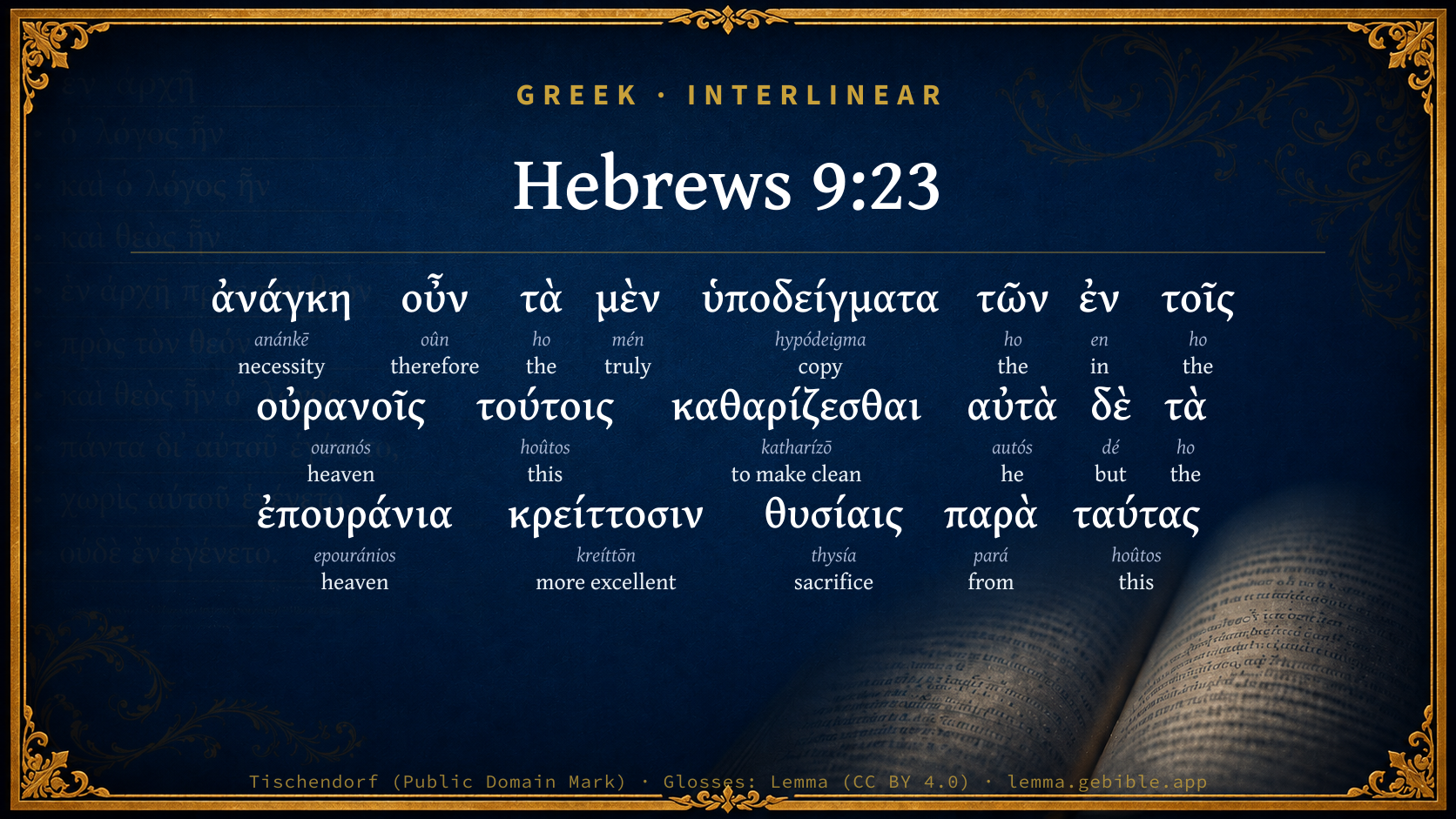
  1. ἀνάγκη anánkē G318 “necessity” Noun, Nominative, Singular, Feminine
  2. οὖν oûn G3767 “therefore” Conjunction
  3. τὰ ho G3588 “the” Article, Accusative, Plural, Neuter
  4. μὲν mén G3303 “truly” Particle
  5. τῶν ho G3588 “the” Article, Genitive, Plural, Neuter
  6. ἐν en G1722 “in” Preposition
  7. τοῖς ho G3588 “the” Article, Dative, Plural, Masculine
  8. οὐρανοῖς ouranós G3772 “heaven” Noun, Dative, Plural, Masculine
  9. τούτοις hoûtos G3778 “this” Demonstrative pronoun, Dative, Plural, Neuter
  10. καθαρίζεσθαι katharízō G2511 “to make clean” Verb, Present, Passive, Infinitive
  11. αὐτὰ autós G846 “he” Personal pronoun, Accusative, Plural, Neuter
  12. δὲ dé G1161 “but” Conjunction
  13. τὰ ho G3588 “the” Article, Accusative, Plural, Neuter
  14. ἐπουράνια epouránios G2032 “heaven” Adjective, Accusative, Plural, Neuter
  15. κρείττοσιν kreíttōn G2909 “more excellent” Adjective, Dative, Plural, Feminine
  16. θυσίαις thysía G2378 “sacrifice” Noun, Dative, Plural, Feminine
  17. παρὰ pará G3844 “from” Preposition
  18. ταύτας hoûtos G3778 “this” Demonstrative pronoun, Accusative, Plural, Feminine

About this verse

These counts appear in no published source. They are computed here, from the morphology-tagged text and Lemma’s own curated glosses. What Lemma adds →

19
words
15
distinct lemmas
General Epistles
section

Notable vocabulary

The rarest word here is ὑποδείγματα copy G5262 — appearing just 6 times in the whole Greek New Testament.

Shared distinctive vocabulary

ὑποδείγματα copy G5262 occurs in 6 verses of the Greek New Testament. Also found in:

Repetition

Words recur within this verse:

  • τὰ the G3588 ×4
  • τούτοις this G3778 ×2

Cross-references

13

Topical passages linked to Hebrews 9:23 in the Treasury of Scripture Knowledge — connected by theme and wording, ordered by reader-vote popularity; previews shown in the World English Bible.

  • 1 Peter 1:19–21 but with precious blood, as of a lamb without spot, the blood of Christ;
  • Hebrews 10:4 For it is impossible that the blood of bulls and goats should take away sins.
  • Hebrews 9:14 how much more will the blood of Christ, who through the eternal Spirit offered himself without blemish to God, cleanse your conscience from dead works to serve the living God?
  • Hebrews 9:9–12 which is a symbol of the present age, where gifts and sacrifices are offered that are incapable, concerning the conscience, of making the worshipper perfect;
  • Hebrews 9:24 For Christ hasn't entered into holy places made with hands, which are representations of the true, but into heaven itself, now to appear in the presence of God for us;
  • Hebrews 8:5 who serve a copy and shadow of the heavenly things, even as Moses was warned by God when he was about to make the tabernacle, for he said, "See, you shall make everything according to the pattern that was shown to you on the mountain."
  • Revelation 5:9 They sang a new song, saying, "You are worthy to take the book, And to open its seals: For you were killed, And bought us for God with your blood, Out of every tribe, language, people, and nation,
  • Luke 24:26 Didn't the Christ have to suffer these things and to enter into his glory?"
  • Luke 24:46 He said to them, "Thus it is written, and thus it was necessary for the Christ to suffer and to rise from the dead the third day,
  • Colossians 2:17 which are a shadow of the things to come; but the body is Christ's.
  • Hebrews 10:10–17 by which will we have been sanctified through the offering of the body of Jesus Christ once for all.
  • John 14:3 If I go and prepare a place for you, I will come again, and will receive you to myself; that where I am, you may be there also.
  • Hebrews 10:1 For the law, having a shadow of the good to come, not the very image of the things, can never with the same sacrifices year by year, which they offer continually, make perfect those who draw near.

Cross-references courtesy of OpenBible.info (CC BY 4.0).

Commentary

Notes on Hebrews 9:23 from classic Christian and Jewish commentators (each source and its license shown beneath its notes). The classic Christian expositions comment on the surrounding passage and are grouped to its opening verse, so a note may address several verses; the Jewish commentaries on the Tanakh (Rashi and others) are per-verse, so they appear only where the commentator wrote on this verse.

Lemma curates 59 commentaries, every one of them public domain or Creative Commons licensed, each selected and text-cleaned for this edition rather than reprinted as found. About our sources →

Matthew Henry's Commentary

In this last part of the chapter, the apostle goes on to tell us what the Holy Ghost has signified to us by the legal purifications of the patterns of the things in heaven, inferring thence the necessity of better sacrifices to consecrate the heavenly things themselves.

I. The necessity of purifying the patterns of the things in heaven, Heb 9:23. This necessity arises both from the divine appointment, which must always be obeyed, and from the reason of that appointment, which was to preserve a proper resemblance between the things typifying and the things typified. It is observable here that the sanctuary of God on earth is a pattern of heaven, and communion with God in his sanctuary is to his people a heaven upon earth.

II. The necessity that the heavenly things themselves should be purified with better sacrifices than of bulls and goats; the things themselves are better than the patterns, and must therefore be consecrated with better sacrifices. These heavenly things are the privileges of the gospel state, begun in grace, perfected in glory. These must be ratified by a suitable sanction or consecration; and this was the blood of Christ. Now it is very evident that the sacrifice of Christ is infinitely better than those of the law. 1. From the places in which the sacrifices under the law, and that under the gospel, were offered. Those under the law were the holy places made with hands, which are but figures of the true sanctuary, Heb 9:24. Christ's sacrifice, though offered upon earth, was by himself carried up into heaven, and is there presented in a way of daily intercession; for he appears in the presence of God for us. He has gone to heaven, not only to enjoy the rest and receive the honour due to him, but to appear in the presence of God for us, to present our persons and our performances, to answer and rebuke our adversary and accuser, to secure our interest, to perfect all our affairs, and to prepare a place for us. 2. From the sacrifices themselves, Heb 9:26. Those under the law were the lives and blood of other creatures of a different nature from the offerers - the blood of beasts, a thing of small value, and which would have been of none at all in this matter had it not had a typical respect to the blood of Christ; but the sacrifice of Christ was the oblation of himself; he offered his own blood, truly called, by virtue of the hypostatical union, the blood of God; and therefore of infinite value. 3. From the frequent repetition of the legal sacrifices. This showed the imperfection of that law; but it is the honour and perfection of Christ's sacrifice that, being once offered, it was sufficient to all the ends of it; and indeed the contrary would have been absurd, for then he must have been still dying and rising again, and ascending and then again descending and dying; and the great work had been always in fieri - always doing, and always to do, but never finished, which would be as contrary to reason as it is to revelation, and to the dignity of his person: But now once in the end of the world hath he appeared, to put away sin by the sacrifice of himself. The gospel is the last dispensation of the grace of God to men. 4. From the inefficacy of the legal sacrifices, and the efficacy of Christ's sacrifice. The legal sacrifices could not of themselves put away sin, neither procure pardon for it now power against it. Sin would still have lain upon us, and had dominion over us; but Jesus Christ by one sacrifice has made an end of sin, he has destroyed the works of the devil.

III. The apostle illustrates the argument from the appointment of God concerning men (Heb 9:27, Heb 9:28), and observes something like it in the appointment of God concerning Christ.

1. The appointment of God concerning men contains in it two things: - (1.) That they must once die, or, at least, undergo a change equivalent to death. It is an awful thing to die, to have the vital knot loosed or cut asunder, all relations here dropped at once, an end put to our probation and preparation state, and to enter into another world. It is a great work, and it is a work that can be but once done, and therefore had need to be well done. This is matter of comfort to the godly, that they shall die well and die but once; but it is matter of terror to the wicked, who die in their sins, that they cannot return again to do that great work better. (2.) It is appointed to men that after death they shall come to judgment, to a particular judgment immediately after death; for the soul returns to God as to its judge, to be determined to its eternal state; and men shall be brought to the general judgment, at the end of the world. This is the unalterable decree of God concerning men - they must die, and they must be judged. It is appointed for them, and it is to be believed and seriously considered by them.

2. The appointment of God concerning Christ, bearing some resemblance to the other. (1.) He must be once offered, to bear the sins of many, of all the Father had given to him, of all who should believe in his name. He was not offered for any sin of his own; he was wounded for our transgressions. God laid on him the iniquity of all his people; and these are many, though not so many as the rest of mankind; yet, when they are all gathered to him, he will be the first-born among many brethren. (2.) It is appointed that Christ shall appear the second time without sin, to the salvation of those who look for him. [1.] He will then appear without sin; at his first appearance, though he had no sin of his own, yet he stood charged with the sins of many; he was the Lamb of God that bore upon him the sins of the world, and then he appeared in the form of sinful flesh; but his second appearance will be without any such charge upon him, he having fully discharged it before, and then his visage shall not be marred, but shall be exceedingly glorious. [2.] This will be to the salvation of all who look for him; he will then perfect their holiness, their happiness; their number shall then be accomplished, and their salvation completed. Observe, It is the distinguishing character of true believers that they are looking for Christ; they look to him by faith; they look for him by hope and holy desires. They look for him in every duty, in every ordinance, in every providence now; and they expect his second coming, and are preparing for it; and though it will be sudden destruction to the rest of the world, who scoff at the report of it, it will be eternal salvation to those who look for it.

Matthew Henry's Commentary on the Whole Bible (1708–1710) — public domain (CC PDM 1.0). Text via the HelloAO Bible API.

Joseph Benson's Commentary

Heb 9:23. It was, therefore, &c. — That is, it plainly appears from what has been said, it was necessary — According to the appointment of God; that the patterns of things in the heavens — Termed the figures of the true, (Heb 9:24,) namely, the covenant, the book, the tabernacle, with all the vessels of its ministry, which were shadowy representations of heavenly things — That is, of the things of the gospel, whether belonging to the church militant or the church triumphant; should be purified with these — Should be procured for, or opened and sanctified to the enjoyment of the priests and people, by these oblations and sprinklings with blood, and those other things which were appointed by the law to be all used for their purification. He says purified, or cleansed, not because the tabernacle and its utensils, the book of the law, &c., were unclean in themselves, but because through the uncleanness of the people they would have been considered as polluted if not thus purified. But the heavenly things themselves — That is, the things whereof the others were patterns, — the redemption, worship, salvation, and eternal glory of the church; by better sacrifices than these — Namely, by the one sacrifice of Christ, expressed in the plural number, because it included the signification of all other sacrifices, exceeded them indignity, and was of more use and efficacy than they all. For by this alone could spiritual and eternal blessings, the privileges of God’s church on earth and in heaven, be laid open to the enjoyment of guilty and polluted sinners. In other words, and especially as the Jewish tabernacle, including the holy and the most holy place, could not be entered by the priests, and opened to the prayers and other acts of religious worship of them and of the people, nor the utensils and ceremonies of the tabernacle service be sanctified to them, without the sacrifices and atonements appointed in the law; so the heavenly holy places represented by them, could not be opened for the reception of the prayers and praises of God’s people while they are here, nor of their persons hereafter, except through the sacrifice and intercession of Christ. Or, as Mr. Scott paraphrases the passage, “It was then necessary by the appointment of the law for the exemplars or types of heavenly things to be purified by the sacrifice of innocent animals, and by the application of their blood, or they could not be acceptably used in the worship of God; but it was necessary, for more durable and immutable reasons, that the heavenly things themselves should be purified by an atonement of superior excellence, even by the one sacrifice of the death of Christ. In order to his efficaciously interceding for sinners in heaven, and opening for them the way to the mercy-seat, it was necessary that Christ should on earth, in our nature, shed his blood, and die a sacrifice on the cross; that he might have the infinite merit of that sacrifice to plead before the throne, in behalf of all who should come unto God by him; otherwise mercy, shown to sinners, would dishonour the justice and holiness of God, and their admission into heaven would, as it were, defile that holy place.”

Joseph Benson's Commentary on the Old and New Testaments (1811–1818) — public domain. Text from a community e-Sword module.

The Preacher's Complete Homiletical Commentary

Joseph S. Exell (gen. ed.)

CRITICAL AND EXEGETICAL NOTES

Heb_9:23. Patterns.—Copies, outlines, earthly representations. These.—Blood-sheddings; sacrifices of beasts. Heavenly things.—Spiritual things; things of conscience and will; the spiritual realities of sin against God and broken relations with Him. Better sacrifices.—Spiritual as contrasted with material. The argument of the writer is that Christ’s sacrifice must be better, because it is the Divine Man’s surrendered will; and that is the very highest, sublimest thing in God’s universe.

Heb_9:24. Made with hands.—Touchable, so earthly. Figures of the true.—Observe the writer’s frequent repetition of this idea. He was most anxious to get the Christian Jews thoroughly to loosen their hold on that old Mosaic system. Heaven itself.—The holy place of God; the spiritual realm. For us.—As the high priest did. First position: Christ is in the spiritual world as our Mediator. Second position: One such spiritual sacrifice suffices. Imperfection is shown by the need for repetition. Repetition is needed for “picture teaching,” which prepares for the reception of something that can be final.

Heb_9:26. Often have suffered.—Our Redeemer’s work is still regarded as covering sin from the earliest ages. In the end of the world.—Not “absolute end.” It fits in with the apostolic idea of the “last times.” Put away sin.—Clearly a moral work.

Heb_9:27. Once to die.—As the seal of sin. Judgment.—As the Divine recognition of sin.

Heb_9:28. Once offered.—Only the sacrifice of one whole, representative life could be needed. Bear the sins.—I.e. bear the burden or work of putting them away. Without sin.—Or apart from sin; apart from all connection with it, because, when He comes, His redemptive work will be complete. “To return for our salvation as the everlasting Victor over sin and over death.”

MAIN HOMILETICS OF THE PARAGRAPH.—Heb_9:23-28

One Spiritual Sacrifice is Enough.—The point of the paragraph is evidently this—if you have symbolical, teaching sacrifices, you must repeat your object-lessons over and over again. If you have a spiritual sacrifice, embodying the principle which you have been teaching, once will do, and there is no call for repetition; your whole energy can be put into applying, adapting, and working out the principle. Christ’s was a spiritual sacrifice; “once at the end of the ages hath He been manifested to put away sins by the sacrifice of Himself.” “Christ also having been once offered to bear the sins of many.”

I. Christ’s sacrifice is the better sacrifice.—So much better as is represented by the difference between the dumb, unintelligent animal, and the speaking, thinking, feeling man, who has both will, and affections, and religious instincts. The gift of an animal could not interest God or win His favour, save as it stood for something, expressed something, carried to God a man’s devotion and love. Then when a man was able to give that devotion and love directly, as Jesus Christ did, without the need of any animal to express His surrender, then we have the “better sacrifice.” When we have that better sacrifice to represent our devotion and our love, we can contentedly let the lower forms of sacrifice pass away. We are satisfied; we are now worthily represented; it is enough.

II. Christ, with His sacrifice, remains in the spiritual Holy of Holies.—The old high priest went into the second chamber, taking the blood of the goat, but he did not stay in there; only the few drops that were sprinkled remained there. He came out, and must needs go in again by-and-by, when gathering human wilfulness and sin had broken off, or made uncertain, the relations of the people with God. But our spiritual High Priest went into the most secret chamber of the “temple not made with hands,” took His sacrifice, which was Himself, with Him, and has never come out, and never will. He, our Priest, is there; He, our sacrifice, is there. And our standing with God abides; it cannot be imperilled. It is a standing on the ground of His acceptance, of the merit of His sacrifice. It is a standing secured and maintained by His priestly mediation. There is no call for any repetition of the sacrifice, for any renewal of the atonement day. The day never comes to an end. That is the better, the all-satisfying sacrifice which God has always before Him. That is the all-sufficient priest, who never has to go into the Holy of Holies, because He is there, and abides there, ever ministering in His unchangeable priesthood.

III. Christ’s sacrifice is the climax of sacrifices.—For humanity it is the perfect sacrifice. It is inconceivable that man can ever have, to give to God, a better sacrifice than Christ gave. And it is as inconceivable that God, dissatisfied with that, can ever want another from man. And why? Because the absolutely perfect sacrifice which the creature man can make to God is “himself, and himself at the very best that man can possibly be.” But that is precisely the sacrifice which Christ offered to God. It was the “sacrifice of Himself,” the “Man Christ Jesus.” It was Himself as tested and proved, by the strains of a human life, and the agony of a painful and shameful death, to be the very best man that could possibly be. That cannot be repeated. It is a climax once reached, and it stands us for ever. Man has offered to God at last the sacrifice which God demands, and which through the long ages his sacrifices of bulls and goats did but vainly aim to reach. This is the “Lamb of God” who offered Himself for man, and, infinitely acceptable to God, “takes away the sin of the world.” It is not only the better sacrifice; it is the best. Let man think the matter fully out, and he will surely fail to conceive a better sacrifice for humanity than Jesus is.

IV. Christ’s sacrifice need not be repeated, because it fully accomplished its ends.—This is intimated in the reference to the judgment in Heb_9:27-28. Death and the judgment represent all the woes brought into the world by sin. A redemption can do everything else, if it can deliver us from the death we dread, and give us salvation in the day when our earthly life is Divinely appraised. This is the power of the redemption in Christ’s priesthood and sacrifice. “Because He lives we shall live also.” And when before the throne, He, our Daysman, will be there for us, not now having to deal with our sin, “apart from sin,” but to secure our full and final “salvation.” Actual repetitions of the sacrifice of Christ there cannot be, there need not be, for the sacrifice is made once for all. Pictorial and symbolical representations of the sacrifice may be perilous, as suggesting doubts of the infinite value and sufficiency of the one offering once offered, which our High Priest is ever in the act of offering. The spiritual reality of the sacrifice needs to be fully realised, and then our interest in the historical occasion of the sacrifice, or the sublime occasion of the cross, would be felt to need no repetition in fact, and no pictorial or mystical reproduction. The “once” of the sacrifice is “once for all”; it is enough for ever.

Heb_9:24. Heaven itself.—It is manifestly not in accordance with the writer’s purpose to show that Christ has entered into the place of future bliss prepared for God’s redeemed people. By heaven itself he means the spiritual world, the realm of spiritual realities. Heaven itself is contrasted with the “holy places made with hands.” The tabernacle was a material tabernacle; Christ’s mediation belongs to the spiritual tabernacle. Priests ministered with material things, the patterns and pictures of spiritual, heavenly things; the great High Priest with the spiritual, heavenly things themselves. In the earthly tabernacle there was the symbol of the Divine Presence; in heaven, in the spiritual world, is the Presence itself. Christ’s work wholly belongs to the spiritual spheres.

SUGGESTIVE NOTES AND SERMON SKETCHES

Heb_9:23. The Better Sacrifice is Christ Himself.—After we have made the most of the ancient sacrificial system, we are still much in the dark as to the connection between the death of the sacrificial victim and the pardon of sin. The Levitical sacrifices did not deal effectually with the problem. They were merely putative atonements for artificial sins—for the ignorances or ritual errors of the people, not for their great moral transgressions. More light comes to us by reflection on the nature of the sacrifice by which the new covenant is inaugurated than from the whole Levitical system. Here for the first time we have priest and victim united in one. Christ’s sacrifice is Himself. Here the virtue lies not in the blood, though that is formally mentioned, but in the offering of a perfect will through the eternal spirit of holy love. In this offering God can take pleasure, not because of the pain and the blood-shedding, but in spite of these. By the virtue of this offering God is reconciled to the world, and can regard with a benignant eye a guilty race. We are accepted in the Beloved, the Messianic King and His subjects being an organic unity in God’s sight.—Dr. A. B. Bruce.

Heb_9:24. The Ascension.—“Into heaven itself.” We celebrate on this day the foundation, or rather the first manifestation to the world, of a great kingdom, of which our Lord is the supreme Head. He who was a perfect Man, the Exemplar of all goodness, at His departure was only removed from us in respect of sensible presence, and did not cease to be connected with us; He was transplanted to an invisible throne in heaven, where He reigns over us now, the King both of the living and the dead. He reigns over the Church triumphant. He reigns over this world below in which man still struggles with temptation and sin. What ought to be our feelings who know that our Lord and God, who reigns in heaven, is man too—that He is man now, and will be for ever in the fulness of glorified human nature? Different feelings possess us as we contemplate this glorified human nature in Christ our Judge, or our Intercessor. How would great numbers of men who follow their wills in this world, pursue through life an avaricious and selfish scheme, give all the strength of their faculties to gain worldly ends, but who do it all under a specious outside, and have explanations and justifications of their own conduct to themselves, feel if they knew that they had to undergo an examination and an estimate from a very wise, sagacious, and discerning man here, in this world? Would they not immediately be in a state of the most painful fear and apprehension? The Man Christ Jesus now scrutinises these men. However we may fear the countenance of man, we cannot escape being judged by One who is man. What a motive this ought to be to us to examine ourselves, to be true to ourselves, not to tamper with our own consciences, not to cloak our sins, not to dissemble and walk in crooked ways! But we also celebrate the entrance into heaven of our Mediator, Intercessor, and Advocate. He sits there as High Priest to present to the Father His own atonement and sacrifice for the sins of the whole world. He thus sits as High Priest and Mediator between God and man because He is man. He who is man could plead for man. It is our Lord’s supreme place in the universe now, and His reign now in the worlds visible and invisible, which we commemorate in His ascension. We are specially told in Scripture never to think of our Lord as having gone away and left His Church, but always to think of Him as now reigning, now occupying His throne in heaven, and from thence ruling over all. This day especially puts before us our Lord in His human nature, because it was in that He ascended up to heaven. As Judge, He sees into all hearts; as Intercessor, He pleads our cause.—J. B. Mozley, D.D.

Heb_9:27. The Death-law for Humanity.—“It is appointed unto men once to die.” In this man does but take rank with the animals, and share natural conditions with them. The law of creation is that the living things, vegetable and animal, shall have possession of the earth in a constant succession, no one creature holding possession long, but producing its successor, and then itself passing away in what is called “death.” So far as man is an animal, there is nothing to be said. It would be a woe for creation if man broke into the natural order as an exception. What has to be seriously considered is—How does the death-law affect man as a moral being, a being into whom is breathed a Divine life? This subject demands a treatise, and it can receive but a hint. At first sight we incline to think that God might have arrested the death-law, and given man an immortality on earth, in which he might grow into moral perfection. The reader must think out how certainly, for various reasons, moral man could never have reached moral perfection here on earth. The death certainty and uncertainty are the mightiest moral forces acting on man.

Heb_9:28. Christ bearing the Sins of Transgressors.—In what sense or manner is it that Christ bears the sins of the world? They were not put upon Him, or transferred to Him, so as to be His? That is impossible. Guilt is a matter so strictly and eternally personal, that nobody can be in it but the transgressor himself to whom it belongs. Apart from him it is nothing. Christ does not bear our sins in the sense that He bears our punishment. Everlasting justice forbids any such commutation of places in punishment. It is not conceivable that Christ bears our sin, in the sense that the abhorrence of God to our sin is laid upon Him, and expressed through and by means of His sufferings. How can God lay abhorrence upon what is not abhorrent? Christ, in bearing the sins of transgressors, simply fulfils principles of duty or holiness that are common to all moral beings, and does it as being obliged by those principles. If there is any fundamental truth in morals, it is that there is no superlative kind of merit or excellence; that so far as kind is concerned, the same kind is for us all, and there is no other. We are not then to look for some artificial, theologically contrived, never before heard of kind of good in the bearing of sins, but simply to look after what lies in the first principles of religious love and devotion, as related to the conduct of all.

I. A general answer is this—that Christ bears the sins of the world in a certain representative sense, analogous to that in which the priests and the sacrifices of the former altar-service bore the sins of the people worshipping. The phrase, “he shall bear his sin,” or “bear his iniquity,” when applied to the priests and sacrifices, cannot mean that they have the guilt actually put upon them: the words are to be taken in an accommodated, ritually formal sense, where the same thing is true representatively; the design being to let the people feel or believe that their sins are being taken away, as if put over upon the priests or upon the head of the victims. When the iniquities of Israel were put upon the head of their scape-goat, and he was driven out into the desert, they knew not where, there was neither any sin upon the goat nor any punishment. The reality of the whole matter stood in what was representatively signified, viz. the removal and clearance of their sin.

II. A more particular statement of the subject-matter included under the general answer embraces three particular modes, or distinctly and rationally conceived methods, of bearing sin by Him in His mission as a Redeemer.

1. He bears the sin of the world, by that assumption which His love must needs make of it. Love puts every being, from the eternal God downwards, into the case of all wrong-doers, sufferers, and enemies, to assume their evil, and be concerned for them. Being love, it assumes their loss, danger, present suffering, suffering to be; all their want, sorrow, shame, and disorder; and goes into their case to restore and save. When it is said that Christ “bare our sicknesses,” it cannot mean that He literally bore the fevers, leprosies, etc., that He healed; it means that He took them upon His sympathy, bore them as a burden upon His compassionate love. In that sense, exactly, He assumed and bore the sins of the world. He took them on His love, and put Himself, by mighty throes of feeling, and sacrifice, and mortal passion, to the working out of their deliverance. Because the world in sin took hold of His feeling, was He able, in turn, to get hold of the feeling of the world, and become its true Deliverer and Saviour. In this fact lay embosomed the everlasting gospel. This must in no way be apprehended as if all meant was, that Christ came into such a life of sympathy and death of passion just to give us an example which we are to copy. Nothing could be more impotent or further from the truth. Giving and copying examples is too tame a matter to be conceived as making out a gospel.

2. It is another and equally true conception of the bearing of sins by Christ, that He is incarnated into the state of sin, including all the corporate woes of penalty or natural retribution under it—woes that infest the world, the body, and the social and political departments of human affairs. The “curse,” as a Scripture term, means that state of retributive disorder and disjunction that follows, under natural laws, the outbreak of sin. When Christ comes down into the world, to be incarnate in it and do His work of love, He enters Himself into its corporate evils, and takes them just as they are. His body, as being born in the flesh, has the mortal maladies and temptations of the curse working subtlely in it. The jealousy of Herod is the curse before which He flies into Egypt. The chief priests, and the rabbins, and the council, and Pilate, and Herod, all combined against Him, only represent the corporate wrath, and wrong, and curse of the world.

3. Christ bears the sin of the world, in the sense that He bears, consentingly, the direct attacks of wrong or sin upon His person; doing it, of course, in but a few instances, such as may have been included in His comparatively short life, but showing in these few instances how all the human wrongs are related to His feeling, or would be if He suffered them all. And here again it is that He gets an amazing power, as a Redeemer, over the sin of the world. He did not come into the world to suffer these wrongs as an end, or to brave them by an ostentation of patience. Coming into the world as the incarnate Word of God, God manifest in the flesh, He bears the wrong-doing of sin, not deficiently, but as feeling after the sin; letting it see what wrong it has in its nature to do, when the Son of God comes to it ministering love and forgiveness. When the sin found such a Being, even the incarnate Word of the Father, taking its blows in such patience, and dying under the blows, how dreadful the recoil of feeling it suffered! How wild, and weak, and low was it made to appear in its own sight. Thus it was that, in His bearing of sin upon the cross, Christ broke it down for ever. That death of His was great in power, not because He bore it, but because He was in the work of God’s love, and bore it on His way, unable to be diverted from His end by that or any other death. In just that manner and degree it was in His heart to bear sin.—Horace Bushnell, D.D.

Christ’s Second Appearing.—“Shall appear a second time, apart from sin, to them that wait for Him, unto salvation.” Some care is necessary if we are to see why, and for what purpose, the writer introduced this reference to our Lord’s second appearing. Moses Stuart helps us by translating, “Shall make His appearance a second time, without a sin-offering, for the salvation of those who wait for Him.” Having died once for sin, Jesus will never repeat His sacrifice, and there can be no possible reason why He should. When He comes again it will be for another purpose, even to bestow rewards on those who trust in Him, and wait for His coming. Then we are left to consider what sort of a coming it must be which distributes rewards to His faithful ones, whose life-stories get completed at all sorts of times through all the Christian ages. It sets us upon serious thought how it is that the martyrs of the first age can be made to wait for their reward until Christ shall come again, in some material way, in some wondrous day that is yet to dawn. And it is puzzling to think how a bodily appearance of Christ, with temporal rewards, can possibly meet the needs of redeemed souls who have, for long ages, been in the spiritual world as spiritual beings. It is evident that our apprehensions of the second coming of Christ need to be reconsidered, and need to be spiritualised. There can be no doubt that the early Christian disciples and Christian teachers anticipated the bodily reappearance of Christ in their time. If they were right in that anticipation, then Jesus did come to earth again in bodily form before the last of His apostles died. But we have to face the fact, that He did not come again in any bodily form in those times, and He has never come in such form at any time since then. What can we do in face of this fact, but say that the disciples must have misunderstood His promise, and translated literally what He meant to be taken spiritually. “The words which I speak unto you are spirit and are life.” Christ does come again, and come with rewards. But He belongs to the spiritual world; His rewards are spiritual rewards; He gives them to spiritual men when they are free from the entanglements of the human body. He appears again to the soul in the moments of its freedom—appears for perfecting its salvation.

The Preacher's Complete Homiletical Commentary (gen. ed. Joseph S. Exell; Funk & Wagnalls, c. 1892) — public domain (pre-1929). A full-Bible homiletical/sermon-outline anthology covering 65 of 66 books (2 John is absent from the source module). Text from a community e-Sword module.

Lange's Commentary on the Holy Scriptures

IV

The necessary, yet never repeated sacrificial death of Christ has introduced a perfectly satisfactory propitiation

Heb_9:23-28

23It was therefore necessary that the patterns [copies] of the things in the heavens should be purified with these; but the heavenly things themselves with better sacrifices than these. 24For Christ is not entered [did not enter] into the holy places made with hands, which are the figures [counterparts] of the true [genuine, ἀληθινῶν]; but into heaven itself, now to appear [to be manifested, ἐμφανισθῆναι] in the presence of God 25for us: Nor yet [and not, οὐδέ] that he should [may] offer himself often, as the high priest entereth into the holy place every year with the blood of others: 26For then must he often have suffered since the foundation of the world: but now [as it is, νυνί] once in the end of the world [ages, αἰώνων] hath he appeared [been manifested, πεφανέρωται] 27to put away sin by the sacrifice of himself [by means of his sacrifice]. And as [in so much as καθ̓ ὅσον] it is appointed [reserved, ἀπόκειται] unto men once to die, but after 28that the judgment: So [also]14 Christ was once [for all] offered to bear the sins of many; and unto them that look for him shall he appear the second time without sin unto salvation.

[Heb_9:23.—τὰ μὲν ὑποδείγματα, the copies indeed; or while the copies. ὑπόδειγμα something shown or exhibited under in subordination to, something else, whether as a pattern, or a copy; here clearly the latter; though perhaps it may be better to take ὑπό as lessening, lowering down, the signification, thus faint sketch, delineation, outline.

Heb_9:24.—οὐ γὰρ εἰς χειροποίητα εἰσῆλ., for not into a sanctuary made with hands did Christ enter=for it was no sanctuary made with hands, into which, etc.—Τῶν ἀληθινῶν, the genuine, the archetypal.—ἐμφανισθῆναι to be manifested, not simply to appear.

Heb_9:25.—οὐδ ἵνα—προσφἐρῃ nor that he may (not might) offer himself.

Heb_9:26.—ἐπεὶ ἔδει=ἔδει ἄν, since it were, would be, necessary for him frequently to suffer; ἔδει logical as Heb_2:1,=he must frequently have suffered.* The meaning is not, with Del. and Alf., that His making repeated offerings now in the heavenly sanctuary, would necessitate His having previously frequently suffered on earth, inasmuch as each offering in the sanctuary presupposes a previous suffering on earth. This is a thought altogether too far-fetched for the scope of the passage. The writer argues, in my judgment, simply from the historical fact, or perhaps rather confirms his statement by a reference to the historical fact. If He were entered into the heavenly sanctuary, in order to make, as the high-priest did, repeated entrances into it, it would follow, as a logical conclusion, that there must have been a series of such acts in former ages. If, like the entrances of the Levitical high-priest, His entrance and presentation of Himself were of such a nature as to require repetition, then, of course, there should have been a series of sufferings and entrances in former times. But in contrast with that, and as showing the single and decisive character of His High-Priestly entrance, he has, in fact, (νυνὶ δέ) been manifested but once, and that, once for all, at the consummation of the ages.—διὰ τῆς θυσίας αὐτοῦ, by His sacrifice=the sacrifice which He made. It was, indeed, a sacrifice of Himself, but this is not expressed in the text.

Heb_9:27.—καθ’ ὅσον not simply as (ὡς, or καθώς) but inasmuch as, assigning a ground or reason.—ἀπόκειται, it (lies away) is reserved for, not is appointed.—εἰς σωτηρίαν for salvation is by some connected with the Part. ἀπεκδεχ. but by most better with ὀφθήσεται, will appear for salvation.—K.].

EXEGETICAL AND CRITICAL

Heb_9:23. It was necessary now, etc.—The nature of the following verse renders it more desirable to supply ἧν (Ebr., Del.), than ἐστίν (Lün.). The ἐπουράνια are not the heavenly blessings (Seb. Schmidt, Ramb., and others); not the Christian Church (Chrys., Theod., Este, Lapid., Calov, Heubn. etc.); but the heavenly εanctuary in contrast with its earthly copy made with hands. The plur. κρείττοσι θυσίαις points not to the sufferings, prayers, and works of love of Christians, in common with the sacrificial death of Jesus (Grot., Paul.). It is the plural of kind, or class. But to transform purification into consecration (Bl., Lün., De W., etc.) is totally unallowable, as is also the substituting in the place of the heavenly sanctuary, the men who belong to the New Test. economy (Thom. Aqu., Beng., Menk., Thol., etc.). But neither is the cleansing in question an actual purging of heaven by the casting out of Satan, which Akersloot would refer to Luk_10:18, Joh_12:31; while Bleek would explain in accordance with Rev_12:7-9. The context demands an expiatory purification, i.e., a doing away of the influence of human sin upon the heavenly sanctuary (Stier, Hofm., Del., Riehm, Alf.).

Heb_9:24. For not into a sanctuary made with hands, etc.—The author is not assigning the ground why there is now need of better sacrifices for the cleansing of the heavenly sanctuary (Hofm.), nor giving the proof that Christ has actually entered into the heavenly sanctuary, (Bl., Lün.,) nor illustrating the contrast between the earthly and the heavenly sanctuary (Ebr.), nor is he demonstrating the necessity of better offerings for the heavenly world from the reality of the one which has been furnished and offered to God (Del.). He is confirming the declaration of the previous verse, that the purification argued as necessary, has been actually accomplished. Hofm. now concedes, that the Infin. Aor. ἐμφανισθῆναι constitutes no ground of objection (Win. § 44; Mat_20:26; 1Pe_4:2) to our understanding the νῦν of the permanent presence of Christ before the unveiled face of God in heaven. The position of the ὑπὲρ ἡμῶν at the end of the clause, throws intentional and weighty emphasis upon the soteriological significance of this ἐμφανισθῆυαι, a significance referable in its purpose to the persons of the readers. This word expresses (Act_24:1) strikingly the reciprocal and unveiled face to face manifestation of God and Christ, and is found in no corresponding sense among the technical expressions of the old covenant.

Heb_9:25.—May offer himself, etc.—The προσφέρειν ἑαυτόν refers not to Christ’s offering Himself on earth. In that case it were virtually =παθεῖν, Heb_9:26, which, as Heb_13:12, is to be understood of the suffering of death. But the offering of the blood in the heavenly all-holy presupposes the slaying of the victim outside of the Adyton, and is brought about by the entrance of the high-priest, of whom after his entrance, was required a two-fold offering of different kinds of blood (Heb_9:7), as his entrance was preceded by the slaughter of two different victims. To this refer the expressions of our passage, in which to avoid a misapprehension of the plur. θυσίαις, used in Heb_9:23, the idea is repelled that in the heavenly all-holy, whither Christ has entered, not in alien but in His own blood, He has now to offer Himself at repeated times. Had repeated offerings of Himself been the purpose of His entrance into heaven, which assuredly is in every case to be conceived of as but a single one (Schlicht. and Böhme, Bl., Hofm., Del.), then must also a πολλάκις παθεῖν have preceded, and that indeed “from the foundation of the world,” i.e., Christ would have been obliged to suffer just as many times before His entrance to God, as He now was repeatedly to offer Himself before God (Hofm., Del., Alf.). But this would contradict the fact that Christ has become man, not at the beginning, but at the end of the world. This explanation is far more probable than the common one that Christ would otherwise have been obliged every time to return into the world.

[I do not see much to choose between the two explanations: viz., that which urges the singleness of Christ’s entrance and offering in the heavenly sanctuary, on the ground that otherwise He would have had repeatedly to descend and suffer, inasmuch as every προσφέρειν implied a previous παθεῖν, and that which urges the singleness of His προσφέρειν, on the ground that otherwise He must have gone through a series of sacrificial sufferings while remaining on earth, in order to accumulate, as it were, a stock of sacrificial suffering, on the strength of which He might make an equal number of priestly offerings in the heavenly sanctuary. Or rather it seems to me that the latter view, though supported by Del., Alf., and Moll, is much the harsher and more improbable of the two. For although it is undoubtedly true, as Del. urges, that the author takes his stand on the assumption of only a single presentation of Christ in heaven, yet it is equally true that this is based on the actually existing state of facts, viz., on the singleness of Christ’s sacrificial suffering on earth. For it surely is not more monstrous to assume a series of descents to earth and reëntrances into heaven after suffering death, than to assume a series of deaths continuously occurring on earth to be followed subsequently by as many successive high-priestly entrances into the heavenly sanctuary. The latter seems to me, considering the analogy of the Jewish rites, much the more unnatural of the two. In point of fact I do not believe that the writer had in mind precisely either of the above ideas, though that which he had comes much nearer to the first than the second. The question is not in his mind a question of the relation between a supposed series of priestly offerings in heaven, and a corresponding series of sufferings on earth. It is simply a logical deduction from a matter of fact. If Christ’s entrance into heaven were of the nature of the Jewish priest’s entrances into the Mosaic sanctuary, such, viz., as to involve a repetition of His entrances, and offerings from time to time, this must have led inevitably to, and manifested itself in, His repeated sufferings in the successive ages of the world. But there has been no such manifestation. He has, in fact, (νυνί) appeared and suffered but once, and that at the very close of the old period, and when the former age is about to merge into the new. This fact is in itself decisive of the nature of His priesthood. It at once grows out of, and demonstrates the fact, that His priesthood, unlike that of the Levitical priests, is one in which one act of suffering on earth, and one priestly entrance into and offering in heaven, accomplish the whole work.—K.].

The πεφανέρωται refers not to the appearance in heaven before God, (Grot., Schultz, etc.), but to the φανέ ρωσις ἐν σαρκί, 1Ti_3:16; 1Pe_1:20; 1Pe_5:4; 1Jn_2:28; 1Jn_3:5; 1Jn_3:8. The expression ἐπὶ συντελείᾳ τῶν αἰώνων is in sense=ἐπ’ ἐσχάτου τῶν ἡμερῶν τούτων Heb_1:1; and like the Pauline (1Co_10:11) τὰ τέλῃ τῶν αἰώνων, is a translation of the Heb. קֵץ הָעוֹלָם. The connection of the words διὰ τῆς θυσίας αὐτοῦ with πεφανέρωται (Grot., Carpz., Böhme, Thol. etc.), is unnatural, “since θυσία appears much rather as expressing the end of the manifestation of Christ than the means of that manifestation.” (Del.). These words are thus to be closely connected with εἰς ἀθέτησιυ ἁμαρτίας, which gives the object of Christ’s appearance on the world’s theatre of action, viz., “the doing away, absolutely, and beyond the need of being supplemented with any second similar manifestation, of all that is sinful.”

Heb_9:27. And inasmuch as it is reserved, etc.—Καθ̓ ὅσον constitutes not, like καθώς, merely a comparison, but at the same time a reason, in this case for the fact that in Christ also, along with His death, the work of His first appearance on earth has been once for all completed, and admits no repetition; but that something corresponding to the judgment is still also in reference to Him to be looked for. This reason lies in His real assumption of human nature. The author for this reason also employs the Pass. προσενεχθείς, “being offered,” because in this comparison the sacrifice of Christ is regarded not as a voluntary offering, but as a suffering appointed to Him, as something befalling Him (Hofm.). We must therefore not, with Chrys., supply ὑφ’ ἑαυτοῦ, by Himself. Ἀνενεγκεῖν is understood by the Pesh., Chrys., Œc., Theoph., Michael., of the presenting and offering up of sins in sacrifice; by Luth., Schlicht., Grot., Bl., Hofm. (Schriftb. 1 Ed.), Lün., etc., of the taking them away=ἀφαιρεῖν, Heb_10:4; by Hofm. in 2 Ed. of Schriftb., in its classic sense of bearing up under, sustaining, enduring them; by Jac. Cappell., Calov, Beng., etc., of bearing them to the cross, according to 1Pe_2:24; by August., Este, Seb. Schmidt, Böhme, De W., Bisp., Del., Riehm, Alf., of vicarious bearing, according to Isa_53:12, where it is said of the Servant of Jehovah: αὐτὸς ἁμαρτίας πολλῶν ἀνηνεγκε. This latter view, now also ably defended by Ebr. (Allg. Kirchenzeit., 1856, Nr. 116–127) has specially in its favor the declaration that Christ, at His second coming will appear χωρὶς ἁμαρτίας. Chrys., Theod., Grot, and others refer erroneously this latter expression to the redeemed, who will then be entirely perfected. It refers to the person of Christ. Even in His first appearance His person was sinless, and sin was not in Jesus in the form of concupiscentia, as maintained by Dippel, Menken, Irving. But it partly assailed Him in the form of temptation, Heb_4:15, partly lay upon Him in the form of punishment, 2Co_5:21. The expression χωρὶς αμαρτίας stands in antithesis to the εἰς τὸ πολλὰ ἀνενεγ. ἁμαρτ. Thus in the main rightly Œc., Theophyl., Carpz., De W., Bisp., Hofm., Del. and others. We need not, however, for this reason take ἁμαρτία as sin-offering (J. Capp., Storr, etc.), or as punishment for sin (Klee, Thol., etc.), or (with Schultz) having to do with sin. Unauthorized alike by the language and by the fact, is the view of Theodor. Mops., Theodoret, Bl., that the phrase in question implies that there will then be no realm of evil and of sin which could require the work and agency of the reappearing Christ. A visible return is indicated by the ὀφθήσεται, and it is characterized as the second appearance, because the appearances to the disciples, which took place after the resurrection and before the ascension, belong to the period of Christ’s first coming to earth. The reading διὰ πίστεως either after or before εἰς σωτηρίαν (adopted by Lachm. after A. 31, 47, but in 1850 again expunged), is a gloss. Still less are we authorized to connect εἰς σωτηρίαν with ἀπεκδεχομένοις (Primas., Camerar., Klee, Stein, etc.). It elongs to ὀφθήσεται, and points to final deliverance from all misery.

DOCTRINAL AND ETHICAL

1. In the death of Christ that has been really fulfilled which the sprinkling of the sacred book and of the sacred vessels of the temple with blood, symbolically represented. The sanctuary originated in reference to human guilt and sin, but has been purified from the guilt of the general corruption, by the fact that the Son of God, who, by the establishment of the covenant with sinful men, has, although from pure grace, yet assumed the obligation of their ransom, has actually and all-sufficiently offered Himself as a vicarious offering.

2. By Jesus Christ’s single and unrepeated, yet all-sufficient offering of Himself, the guilty relations of collective humanity are objectively removed, at whatever time its members may live upon the earth; so that neither does a repeated presentation of Himself take place in heaven (which would presuppose a corresponding repetition of the sufferings of Christ, since the beginning of the world), nor is the second coming of the Messiah, which is in the certain future, for the purpose of a second vicarious suffering. By virtue of the true deity of the Saviour, His single offering is for ever sufficient; by virtue of His true humanity He is incapable of rendering it more than once.

3. The “now” of the manifestation of Christ on our behalf before the face of God in heaven, so that no veiling cloud intervenes, such as was in the Mosaic sanctuary, Lev_16:2, is the present period of salvation, which, as the closing period, lasts until the parousia, and has, as its condition and historical commencement, the appearance of Christ in the flesh with His single and final offering.

4. Christ has not merely entered, from love and compassion, into the fellowship of human suffering, but He has taken upon Himself the burden of human sin; and this burden, under which men were in danger of utterly succumbing, He has been able to lift from them in no other way than by voluntarily enduring for them the punishment of sins which they had deserved, and by His vicarious death taking it from all the guilty—who here, as Heb_2:10, are called many, not in the particularistic sense of an exclusion of some from salvation merely by virtue of the electing purpose of God, nor in reference to the failure of some to fulfil the condition of a participation in salvation, but, as Mat_20:28; Mat_26:28; Luk_22:20; Mar_14:34, with reference to the fact that the single offering of the one God-man, is forever efficacious for humanity in all its manifold members. To the application of the doctrine of vicarious suffering to the passage before us, it cannot, with Hofm., be objected, that an expiatory bearing of sin cannot be designated as the aim and object of His offering of Himself. With entire correctness Del. replies to the objection: “Atonement for sin was not indeed the purpose of men in bringing upon Him this infliction; but might be none the less the purpose of God in subjecting Him to it, and his own in submitting to it.”

5. The earlier opinion, still held by Heubner, that for individuals judgment follows immediately upon their death, but that after the resurrection follows the manifestation of the judgment in relation to all, cannot at least be deduced from our passage. The contemporaneousness of the judgment and of the second coming of Christ, follow clearly from Heb_10:25; Heb_10:37 ff.; and the decision according to which the lot of the one class is perdition (ἀπώλεια) and that of the other περιποίησις ψυχῆς, is mentioned Heb_10:38 ff., as a consequence of the coming of Christ. Nevertheless, when the Judge in our Epistle is expressly designated (Heb_10:30 ff; Heb_12:23; Heb_12:25; Heb_12:29; Heb_13:4) not Christ, but God is named, which might stand connected with the fact (D. Schultz) that God is the being that makes the enemies of Christ His footstool. Since, however, the glory and majesty of Christ, are elsewhere strongly emphasized in our Epistle, it might at first seem surprising that the judgment is no where expressly ascribed to Christ. From this, however, we may not with Bleek, deduce the inference that that Divine judgment which destroys the adversaries, precedes the parousia. This may, with Riehm, be more simply and satisfactorily explained, from the fact that the exalted Christ stood before the author’s mind as a heavenly High-priest, and it was therefore entirely natural to regard as the object of His reappearance upon earth, merely the consummation of His high-priestly work, i.e., the complete salvation of believers, and on the other hand, to ascribe to God Himself the accompanying judgment, and the punishment of the adversaries.

HOMILETICAL AND PRACTICAL

The appearance of Jesus Christ on earth terminates one, and opens another section of the history of the world.—How does the entrance of Christ into heaven stand related to the object of His appearance on earth?—The likeness and the unlikeness of the death of Jesus Christ, and of the dying of the children of men, 1, in their causes, 2, in their results.—The divine ordering in the connection of sin, death, and judgment.—How does the second appearance of Jesus Christ in the world distinguish itself from the first? 1, in respect to His person; 2, in His relation to sin; 3, in His influence on the world.—In Christ we experience that there is a contact with sin, which does not defile, but which annihilates sin.—The doing away of the hinderances to our blessedness.—The looking forward of believers to the appearance of the Lord, 1, in its authorization; 2, in its satisfaction; 3, in its obligation.

Starke:—There are, indeed, many offerings made to the Lord, but the most from hypocrisy, and although such have great outward show, yet they do not please Him. The sacrifices which please God, are a broken heart and a contrite spirit, Psa_51:19.—The appearance of Christ in the presence of God is not merely the presentation and holding forth of His person and of His propitiatory sacrifice; but extends also to a true, glorious, and powerful intercession, in the strictest sense of the word. But He prays no longer thus humbly as when He was upon earth; for His prayer belongs to His state of exaltation, and is a fruit of His sitting at the right hand of God, the Father.—Men are at no time so holy as to be absolutely beyond sinning; but since we daily sin much, and deserve punishment, we always need purification through the blood of Jesus.—The single offering of Christ upon the cross, takes away sin.—Only once has He been sacrificed, and more than once He may not be sacrificed, and therefore not in the sacred Supper.—The last judgment is as certain as death.—Observe, that upon death follows the judgment. Look to it, then, and strive with the highest industry, that thou die happy, and that thou mayest await with joy the appearance of thy Saviour for thy salvation.—To await Christ’s coming unto salvation is the prerogative of believers, who have received for this, in a living hope, the first fruits of the Spirit; who love the appearing of the Lord, and, in order that they may hold themselves in readiness for a blissful death, deny the world and say: Even so, Come Lord Jesus, Rev_22:20.—The ungodly will not be looking for the coming of Christ at the final judgment, although He will appear unto them, whether they will or no; and this undesired appearing will to them be full of sadness (Judges 15, Rev_1:7).—Only when Christ shall appear will believers become perfectly blessed, Col_3:4.

Rieger:—The heavenly sanctuary which Christ has entered in His appearing before God, is also the goal to which He will bring all who come to God by Him.—Whosoever learns from the Gospel the cause and fruit of the appearance of Jesus in the flesh, and of His offering for sin, and learns it with a loving knowledge, he may look with joy for His appearance in glory, and for the consummation of His own blessedness.—What a difference between the two appearances of Jesus, in weakness and in glory! then, under the burden of our sins, with the accompaniments of shame, the cross, and death; now, in His endless life, in the power of God and His revelation in glory.

Heubner:—Only in eternity shall we see from what an abyss Christ has rescued us, and into what glory He translates us.—Redemption was, in the mind of God, virtually effected from eternity, 2Ti_1:9. There was, then, need of no appearance in the presence of God; but that appearance of the crucified One which has taken place in time, was made to reveal the counsel of God to the world of spirits.—The duration of the world is limited to a fixed period of time. As surely as it has a beginning, so surely will it have an end.—Waiting is the Christian’s art. He waits for the appearance of Christ, whereby the truth of faith is victoriously confirmed, and Christ is manifested to be the Being whom Christians regard Him.

Steinhofer:—Jesus, the founder of the new covenant, has gathered up the sin of the whole world, together with all its evil fruits, upon the cross, and has, once for all, so completely driven them away, that, under the testimony of the Gospel, we need make no further distinction in respect of many, or of great sins.

Menken:—If even the earthly figures of heavenly things were desecrated and defiled by the communion which sinful men had with them, and could, therefore, remain in connection with them only on account of offered sacrifices, and only by means of certain holy expiations and purifyings, how much less could we anticipate an immediate, unconditional, unobstructed communion of dying and sinful men with heavenly things!

Hahn:—The heavenly things flee before us in our impurity, and thither may no impure person come; and yet all the treasures of the suffering and death of Christ are deposited there, and thence must we obtain them. If we wish anything therefrom, we must again be reconciled with the sanctuary. But this is accomplished only through the blood of Christ.—Happy is he who has laid the foundation of his faith in the first appearing of Christ; he will behold Him with joy in the second.

Footnotes:

[14]Heb_9:27.—καί is to be read after οὕτως, according to the united testimony of the Uncials.

Lange's Commentary on the Holy Scriptures (Critical, Doctrinal, and Homiletical), ed. John Peter Lange, English translation edited by Philip Schaff (1864–1880) — public domain. Text from a community e-Sword module.

Tyndale Open Study Notes

Tyndale Open Resources

9:23 This verse argues from lesser to greater (see study note on 9:14). Just as heaven is greater than the earthly Tabernacle, so Christ’s sacrifice had to be . . . far better than the earthly sacrifices. • That is why: See 9:16-22; Lev 16:14-19. • copies of things in heaven: See study note on Heb 8:5. • in heaven, had to be purified: Just as the Tabernacle had to be cleansed because of the sin of the Israelites (Lev 16:16-19), the heavenly Tabernacle required that the uncleanness be removed from those who would enter heaven under the new covenant.

Tyndale Open Study Notes — © Tyndale Open Resources, licensed CC BY-SA 4.0. Text via the HelloAO Bible API.

Bengel's Gnomon

Johann Albrecht Bengel

Heb 9:23. Οὖν, therefore) The particle intimates that the execution of those things which were mentioned at Heb 9:18 is comprehended in this Passage.—κρείττοσι θυσίαις, with better victims or sacrifices) The plural, corresponding to the Levitical plural, is used for the singular, on account of the excellence of the one sacrifice of Christ, which was perfect in all its parts. If a Jew asks, What are your sacrifices? We answer: Our sacrifices consist in the one matchless sacrifice of Him who was crucified. In this Apodosis, the word καθαρίζεσθαι, to be purified, which is to be supplied, makes a Hypallage;[52] for the heavenly things are pure in themselves, but we needed to be purified in order that we might enjoy them, Heb 9:14. So ἁγιάζεται, is sanctified, 1Ti 4:5; 1Ti 4:4, i.e. the use is rendered holy in respect of us. Comp. Lev 16:16; Lev 16:19; Num 18:1.

[52] See Append. A change, whereby a thing is attributed to one subject which ought to be attributed to another. Here purification is attributed to the heavenly things, which really applies to ourselves.—ED.

Bengel's Gnomon of the New Testament — English translation (T&T Clark, Edinburgh, 1860) — public domain. Text from a community e-Sword module.

Meyer's Critical & Exegetical Commentary

Heinrich August Wilhelm Meyer

Heb_9:23. The first of the two statements dependent on ἀνάγκη οὖν (τὰ μὲν … καθαρίζεσθαι) is deduced as a necessary consequence from Heb_9:18-22, while then the second statement (αὐτὰ δὲ κ.τ.λ.) is derived as a necessary postulate from the first, and in such manner a return is effected to the necessity for the death of Christ, already shown at Heb_9:16-17, in order to set forth the same on a fresh side. The necessity of the first-mentioned fact of Heb_9:23 is evident from the norm instanced, which is of validity in the domain of the Mosaic law; the necessity of that last mentioned, from the difference between the Christian and the Judaic. The main thought, however, lies in the second half of the clause, to which the first forms logically only the bridge.

οὖν] sc. because blood is so necessary a means for expiation and consecration.

ἀνάγκη οὖν] it is then needful. To ἀνάγκη οὖν we have to supplement ἐστίν, not, with Faber Stapulensis, Ebrard, Bloomfield, Delitzsch, Alford, Moll, Kurtz, and others, ἦν. For although the author has only one special fact in mind in connection with both members of the sentence, yet, as is shown by the plural θυσίαις, he expresses himself universally; because he is reasoning from the inner necessity, as this is presupposed by the state of the matter itself.

τὰ μὲν ὑποδείγματα τῶν ἐν τοῖς οὐρανοῖς τούτοις καθαρίζεσθαι, αὐτὰ δὲ κ.τ.λ.] that the copy, indeed, of that which is in heaven should be purified with these, but the heavenly place itself with better sacrifices than these, i.e. for the characteristically Judaic the means of expiation and consecration are necessarily determined in accordance with the norm specified in the Mosaic law; but since Judaic and Christian are distinguished from each other as the mere copy of the heavenly place and the heavenly place itself, so of necessity must the means of expiation and consecration in the Christian domain be a more excellent one than in the Judaic.

By τὰ ἐν τοῖς οὐρανοῖς and τὰ ἐπουράνια we have to understand neither the heavenly possessions (Seb. Schmidt, Wolf, Rambach, and others), nor yet the Christian Church and its members (Zeger, Estius, Corn. a Lapide, Calov, Böhme, Stengel, al.; comp. also Tholuck). Still less can these expressions denote: that which, where God is essentially present, brings with it His relation to the Church, i.e. first, His dwelling with it,namely, in that the glorified human nature of Christ is the dwelling for the whole fulness of the divine nature; secondly, the human nature, in its consecration to God, in which Christ presents and offers it up to the Father; and thirdly, the place where Gods wrath against human sin meets with expiatory satisfaction, by which it is averted,thus Christ, who, as the propitiation for our sins, stands between the Church and its God (Hofmann, Schriftbew. II. 1, 2 Aufl. p. 436 ff. [comp. also Owen]). Rather is the heavenly sanctuary specially meant thereby, as is evident from Heb_9:24. For in Heb_9:24 the meaning of ἅγια is supposed to be already known from Heb_9:23; inasmuch, namely, as ἅγια is there almost accentless, while all the emphasis is laid upon the adjectives χειροποίητα, etc. In accordance with this, too, is determined the meaning of τὰ ὑποδείγματα τῶν ἐν τοῖς οὐρανοῖς as the earthly sanctuary, inasmuch as it was the imperfect imitation or copy of the former, as accordingly already, at Heb_8:5, the Levitical sanctuary had been characterized as ὑπόδειγμα καὶ σκιὰ τῶν ἐπουρανίων. The plural τὰ ὑποδείγματα is placed, just because the author has already before his mind, in Heb_9:23, the plural τὰ ἅγια, Heb_9:24. Thus, then, the first clause of Heb_9:23 has respect to the special fact already brought forward at Heb_9:21, whereas the second clause receives its elucidation by means of the special fact of which mention is made at Heb_9:24.

τούτοις] by such things as these, i.e. by blood of slain animals, and similar means of purifying, which belong to the earthly sanctuary; to which general rubric, also, the ashes of the red heifer mentioned at Heb_9:13, but not here coming under consideration, belong. With marvellous inversion of the sense, Paulus: to be declared pure for these, i.e. the Israelites.

καθαρίζεσθαι] is passive. Arbitrarily is it taken as a middle by Heinrichs, who will have ἡμᾶς supplemented as object. Against this the tenor of the foregoing verse is in itself decisive. The notion of being purified is not, it is true, applicable to the second clause, αὐτὰ δὲ τὰ ἐπουράνια κ.τ.λ. For the heavenly sanctuary is removed from contact with the sinful world; it has no need, therefore, of an expiation or purification.[94] We are warranted, however, in supplying in thought, without any hesitation, from ΚΑΘΑΡΊΖΕΣΘΑΙ, a kindred verb to the second member of the sentence, by the assuming of a zeugma. But since now, in accordance with that which precedes, the ΚΑΘΑΊΖΕΣΘΑΙ is an idea which entirely subordinates itself to the idea of the ἘΓΚΑΙΝΊΖΕΙΝ, Heb_9:18, the former having only the design of the latter, we shall best extract from the notion of being purified, in the first clause, the notion of being consecrated to the service of God, for the second clause, understanding this consecration of the heavenly sanctuary of the opening up of the access to the same, effected through the blood of Christ (comp. Heb_10:19-20).

κρείττοσιν θυσίαις] The plural is chosen, although the author is thinking exclusively of the death of Christ, on account of the universal form of discourse, Heb_9:23, as a plural of the category (de Wette). False the interpretation of Grotius and Stengel: in addition to the sacrificial death of Christ, the sufferings of believers, together with their prayers and works of love (Heb_13:15-16), are thought of; and in like manner Paulus: the sacrifices of Jesus and all Christians for the good which pertains to duty; but false, also, the explanation of Beza: the fact is hinted at that the one sacrifice of Christ is instead of many.

On παρά with the comparative, see at Heb_1:4.

[94] Otherwise, indeed, do Delitzsch, Riehm (Lehrbegr. des Hebräerbr. p. 542 ff.), Alford, Moll, and Kurtz decide. According to Delitzsch, the meaning of the author is: The supra-terrestrial Holy of Holies, i.e. the uncreated eternal heaven of God, although unsullied light in itself, had need of a καθαρίζεθαι, in so far as the light of love towards mankind had there been, so to speak, out-glowed and eclipsed by the fire of wrath at that which was sinful; and the heavenly tabernacle, i.e. the place of His glorious self-manifestation in love, a self-manifestation for men and angels, had need of a καθαρίζεσθαι, in so far as men had rendered this spot, from the beginning designed for them, too, inaccessible on account of sin, and thus had first to be transformed into the accessible place of manifestation of a God graciously disposed towards men. As well with regard to τὰ ἅγια as with regard to τὴν σκηνήν, thus to τὰ ἐπουράνια. altogether, there was need of a taking away of the action of human sin upon it, and a taking away of the divine reaction against sin, the wrath, or, what is the same thing, a changing of the same into love. [Similarly also Whitby, MLean, and Stuart.]Not less far-fetched and forced upon the context is that which Bleek, following the precedent of Akersloot, regards as probable. According to this view, to which Woerner assents, an objective καθαρίζεσθαι of the heavenly sanctuary, after the analogy of the passages Luk_10:18, Joh_12:31, Act_12:7-9, was thought of, in accordance with which Satan with his angels is, after the death and exaltation of the Saviour, cast forth out of heaven, and thus deprived of all influence which he might exert there as accuser of men in the presence of God, or for the destruction of the blessedness of the inhabitants of heaven.

Heb_9:23-28. If the earthly sanctuary needed to be cleansed and consecrated by such things as these, there was required of necessity for the dedication of the heavenly sanctuary a more excellent sacrifice. This Christ has presented in the end of the world by means of His sin-cancelling sacrificial death; and at His return, which is now to be expected for the salvation of those that hope in Him, no repetition of His sacrifice will be required.

Meyer — Critical and Exegetical Commentary on the New Testament — English translation by Peter Christie, edited by Frederick Crombie (T&T Clark, 1880) — public domain. Text from a community e-Sword module.

Expositor's Greek Testament

ed. W. Robertson Nicoll

Heb 9:23-28 . The necessity of cleansing the heavenly sanctuary and the efficiency and finality of Christ’s one sacrifice.

Heb 9:23 . ἀνάγκη οὖν τὰ μὲν ὑποδείγματα … “It was necessary, therefore, that the copies indeed of the heavenly things be cleansed with these, but the heavenlies themselves with better sacrifices than these.” ἀνάγκη οὖν , the οὖν carries to its consequence Heb 9:22 ; and the necessity arises from the injunction of the law there mentioned. τὰ μὲν ὑποδ . the μὲν … δὲ show that the second clause is that to which attention is to be given, the first clause introducing it. The statement is almost equivalent to “As it was necessary … so it was necessary” … The ὑποδείγ . are the tabernacle and its furnishings, in accordance with Heb 8:5 ; which see. τούτοις , viz. , the things mentioned in Heb 9:19 . αὐτὰ δὲ τὰ ἐπουράνια . If the copies were cleansed by material rites, realities being spiritual and eternal can only be cleansed by what is spiritual and eternal, cf. Heb 9:14 . κρείττοσιν θυσίαις , the plural is suggested by τούτοις , and states an abstract inference. But do the “heavenlies” need cleansing? Bruce says, “I prefer to make no attempt to assign a theological meaning to the words. I would rather make them intelligible to my mind by thinking of the glory and honour accruing even to heaven by the entrance there of ‘the Lamb of God’. I believe there is more of poetry than of theology in the words. For the writer is a poet as well as a theologian, and on this account, theological pedants, however learned, can never succeed in interpreting satisfactorily this epistle”. But it is scarcely permissible to exclude at this point of the author’s argument the theological inference that in some sense and in some relation the heavenlies need cleansing. The earthly tabernacle, as God’s dwelling, might have been supposed to be hallowed by His presence and to need no cleansing, but being also His meeting-place with men it required to be cleansed. And so our heavenly relations with God, and all wherewith we seek to approach Him, need cleansing. In themselves things heavenly need no cleansing, but as entered upon by sinful men they need it. Our eternal relations with God require purification.

The Expositor's Greek Testament, edited by W. Robertson Nicoll (1897–1910) — public domain. Text from a community e-Sword module.

Geneva Bible (1599)

Geneva Bible translators

The similitudes of heavenly things were earthly, and therefore they were to be set forth with earthly things, as with the blood of beasts, and wool, and hyssop. But under Christ all things are heavenly, and therefore they could not but be sanctified with the offering of his lively blood.

Geneva Bible (1599) marginal notes — public domain. Text via Bolls.life.

Jamieson, Fausset & Brown

Robert Jamieson, A. R. Fausset & David Brown

patterns--"the suggestive representations"; the typical copies (see on Heb 8:5).

things in the heavens--the heavenly tabernacle and the things therein.

purified with these--with the blood of bulls and goats.

heavenly things themselves--the archetypes. Man's sin had introduced an element of disorder into the relations of God and His holy angels in respect to man. The purification removes this element of disorder and changes God's wrath against man in heaven (designed to be the place of God's revealing His grace to men and angels) into a smile of reconciliation. Compare "peace in heaven" (Luk 19:38). "The uncreated heaven of God, though in itself untroubled light, yet needed a purification in so far as the light of love was obscured by the fire of wrath against sinful man" [DELITZSCH in ALFORD]. Contrast Rev 12:7-10. Christ's atonement had the effect also of casting Satan out of heaven (Luk 10:18; Joh 12:31, compare Heb 2:14). Christ's body, the true tabernacle (see on Heb 8:2; Heb 9:11), as bearing our imputed sin (Co2 5:21), was consecrated (Joh 17:17, Joh 17:19) and purified by the shedding of His blood to be the meeting place of God and man.

sacrifices--The plural is used in expressing the general proposition, though strictly referring to the one sacrifice of Christ once for all. Paul implies that His one sacrifice, by its matchless excellency, is equivalent to the Levitical many sacrifices. It, though but one, is manifold in its effects and applicability to many.

Jamieson, Fausset & Brown — Commentary Critical and Explanatory on the Whole Bible (1871) — public domain (CC PDM 1.0). Text via the HelloAO Bible API.

Adam Clarke's Commentary

Verse 23. The patterns of things in the heavens] That is: The tabernacle and all its utensils, services, c., must be purified by these, viz.: The blood of calves and goats, and the sprinkling of the blood and water with the bunch of hyssop bound about with scarlet wool. These are called patterns, υποδειγματα, exemplars, earthly things, which were the representatives of heavenly things. And there is no doubt that every thing in the tabernacle, its parts, divisions, utensils, ministry, c., as appointed by God, were representations of celestial matters but how far and in what way we cannot now see.

Purification implies, not only cleansing from defilement, but also dedication or consecration. All the utensils employed in the tabernacle service were thus purified though incapable of any moral pollution.

But the heavenly things themselves]

1. Some think this means heaven itself, which, by receiving the sacrificed body of Christ, which appears in the presence of God for us, may be said to be purified, i.e., set apart for the reception of the souls of those who have found redemption in his blood.

2. Others think the body of Christ is intended, which is the tabernacle in which his Divinity dwelt and that this might be said to be purified by its own sacrifice, as he is said, Joh 17:19, to sanctify himself; that is, to consecrate himself unto God as a sin-offering for the redemption of man.

3. Others suppose the Church is intended, which he is to present to the Father without spot or wrinkle or any such thing.

4. As the entrance to the holy of holies must be made by the sprinkling of the blood of the sacrifice, and as that holy of holies represented heaven, the apostle's meaning seems to be that there was and could be no entrance to the holiest but through his blood; and therefore, when by a more perfect tabernacle, Heb 9:11; Heb 9:12, he passed into the heavens, not with the blood of bulls and goats, but by his own blood, he thus purified or laid open the entrance to the holiest, by a more valuable sacrifice than those required to open the entrance of the holy of holies. It was necessary, therefore, for God had appointed it so, that the tabernacle and its parts, c., which were patterns of things in the heavens, should be consecrated and entered with such sacrifices as have already been mentioned but the heaven of heavens into which Jesus entered, and whither he will bring all his faithful followers, must be propitiated, consecrated, and entered, by the infinitely better sacrifice of his own body and blood. That this is the meaning appears from the following verse.

Adam Clarke's Commentary on the Bible (1810–1826) — public domain. Text from a community e-Sword/MySword module.

John Calvin's Commentaries

23. The patterns, or exemplars, etc. Lest any one should object and say that the blood by which the old testament was dedicated was different from that of a testator, the Apostle meets this objection, and says that it was no wonder that the tabernacle which was earthly was consecrated by the sacrificing of beasts; for there was an analogy and a likeness between the purification and the things purified. But the heavenly pattern or exemplar of which he now speaks was to be consecrated in a very different way; there was here no need of goats or of calves. It hence follows that the death of the testator was necessary.

The meaning then is this, — as under the Law there were only earthly images of spiritual things, so the rite of expiation was also, so to speak, carnal and figurative; but as the heavenly pattern allows of nothing earthly, so it requires another blood than that of beasts, such as may correspond with its excellency. Thus the death of the testator is necessary, in order that the testament may be really consecrated.

He calls the kingdom of Christ heavenly things, for it is spiritual and possesses a full revelation of the truth. Better sacrifices he mentions instead of “a better sacrifice,” for it was only one; but he uses the plural number for the sake of the antithesis or contrast.

John Calvin's Commentaries (1540-1563) — public domain. Text from the Calvin Translation Society English edition (1840s-50s) via the Christian Classics Ethereal Library (ccel.org). Calvin's coverage is partial (roughly two-thirds of the Bible); uncommented books and verses are honest gaps, never fabricated. The 19th-century editor's footnotes and remarks are omitted so the notes are faithfully Calvin's own voice.

Ellicott's Commentary for English Readers

(23) The patterns of things in the heavens.—Rather, the tokens (Heb_8:5) of the things in the heavens. In the first part of the verse a conclusion is drawn from the sacred history, which related the accomplishment of the divine will, and showed therefore what was “necessary.” But the real stress lies on the second part. The whole may be paraphrased thus: “Whilst then it is necessary that what are but tokens of the things in the heavens should be cleansed with these things, it is necessary that the heavenly things themselves should be cleansed with better sacrifices than these.” The meaning of “these things” might perhaps be found in Heb_9:19 (the various instruments of purification), or in Heb_9:13 (the two sin offerings there spoken of); but, from the prominence given to repetition in the following verses, the plural seems rather to mean with these sacrifices repeated from time to time. The common thought in the two parts of the verse appears to be (as in Heb_9:21) that everything relating to the covenant of God with sinful man must be brought under the symbol of expiation, without which he can have no part in that covenant. The “heavenly things” are not defiled by sin; but the true heavenly sanctuary cannot be entered by man, the new fellowship between God and man “in heavenly places” cannot be inaugurated, till the heavenly things themselves have been brought into association with the One atoning sacrifice for man.

Better sacrifices.—Here again the use of the plural is remarkable. It seems to arise from the studious generality in the terms of this verse. To “these things” the natural antithesis is “better sacrifices.” That in the ministry of the true High Priest there was a presentation of but one sacrifice is not assumed here, because it is to be strongly brought out below (Heb_9:25-26).

A Bible Commentary for English Readers, edited by Charles John Ellicott (1878–1897) — public domain. Text from a community e-Sword module.

The Cambridge Bible for Schools and Colleges

gen. ed. J. J. S. Perowne

23. patterns] Rather, “copies,” or outlines—Abbilden (not Urbilden), Heb_4:11, Heb_8:5.

the heavenly things themselves] Not “the New Covenant,” or “the Church,” or “ourselves as heirs of heaven,” but apparently the Ideal Tabernacle in the Heavens, which was itself impure before Him to whom “the very heavens are not clean.” If this conception seem remote we must suppose that by the figure called Zeugma the verb “purified” passes into the sense of “handselled,” “dedicated.”

with better sacrifices than these] The plural is here only used generically to express a class. He is alluding to the one transcendent sacrifice.

The Cambridge Bible for Schools and Colleges (gen. ed. J. J. S. Perowne; Cambridge University Press, 1878–1918) — public domain. Text from a community e-Sword module.

John Gill's Exposition

It was therefore necessary,.... On account of the divine appointment, and that types and antitypes might correspond; and especially it was necessary with respect to the Messiah, the substance and body of all types. So Jonathan ben Uzziel paraphrases the text in Exo 40:9,

"and thou shalt take the anointing oil, and thou shalt anoint the tabernacle, and all that is in it; and thou shall sanctify it, because of the crown of the kingdom of the house of Judah, and the King Messiah, who shall redeem Israel in the latter days.''

Upon his account it was necessary,

that the patterns of things in the heavens should be purified with these; that is, that all the people, and the book of the covenant, and the tabernacle, and its vessels, which were types and patterns of persons and things in Gospel churches, should be purified with blood and water, and with scarlet wool and hyssop.

But the heavenly things themselves, with better sacrifices than these; the sum and substance of the above patterns, shadows, and examples, such as heaven itself; which though not impure in itself, yet some think it, may be said to be purified, because saints are made meet for it, by being purged with the blood of Christ; others observe, that sin reaches to heaven, and provokes God that dwells there; hence atonement for it may be called a purification of heaven: but rather this may be said of it, inasmuch as by the blood of Christ an entrance and preparation is made for the saints into it. Likewise, the human nature of Christ is among these heavenly things; not that it is heavenly, as to the matter and substance of it, but may be so called, because of its wonderful formation; and which has been purified, not from any real internal pollution that was in it, but from what was imputed to it, the sin of his people. Also the whole church, triumphant and militant, may be intended by heavenly things: the Old Testament saints went to heaven before Christ came; and though they were not impure, but were the spirits of just men made perfect, yet their iniquities were purged by the blood and sacrifice of Christ, after they were gone to heaven; see Heb 9:15. The church militant, or believers on earth, may be said to be heavenly, since they are partakers of an heavenly birth and calling; their head is in heaven, and their conversation is there; and they have a right unto it, and are making meet for it; and they are in themselves defiled with sin, and are purified by the blood of Christ, and sanctified by the offering up of his body once for all: to which may be added, that spiritual blessings are heavenly things; they are from heaven, and saints are blessed with them in heavenly places and these come to them through the blood and sacrifice of Christ; yea, the Gospel, which is from heaven, and the doctrines of it, are sealed and confirmed by the blood of Christ: his sacrifice is expressed in the plural number; not that there has been a repetition of it, for it is but one sacrifice, and but once offered up, and will never be reiterated; but to show the excellency of it, being usual with the Jews to use the plural number of things the most excellent; so Christ is called "Wisdoms", Pro 1:20 besides, respect may be had to the many sacrifices under the law, which were types of it, and were answered and fulfilled by it; and to the many persons on whose account it was offered; and to the parts of it, the soul and body of Christ: and this is a better sacrifice than the legal ones, in its own nature and in its use and efficacy to take away sin, and make perfect, which they could not.

John Gill's Exposition of the Whole Bible (1746–1763) — public domain (CC PDM 1.0). Text via the HelloAO Bible API.

Trapp's Complete Commentary

John Trapp

23 It was therefore necessary that the patterns of things in the heavens should be purified with these; but the heavenly things themselves with better sacrifices than these.

Ver. 23. But the heavenly things] Those spiritual good things set forth by the types of the law; or the Church under the gospel, called Jerusalem that is above, &c.

John Trapp, A Commentary or Exposition upon All the Books of the Old and New Testament (1647–1656) — public domain. Text from a community e-Sword module.

Albert Barnes' Notes on the Bible

The patterns of things in the heavens - The tabernacle and its various utensils; see the notes on Heb 8:5.

Be purified with these - With water and blood, and by these ceremonies.

But the heavenly things themselves - The heavenly tabernacle or sanctuary into which Christ has entered, and where he performs the functions of his ministry. The use of the word “purified” here applied to heaven, does not imply that heaven was before “unholy,” but it denotes that it is now made accessible to sinners; or that they may come and worship there in an acceptable manner. The ancient tabernacle was purified or consecrated by the blood of the victims slain, so that people might approach with acceptance and worship; the heavens by purer blood are rendered accessible to the guilty. The necessity for “better sacrifices” in regard to the latter was, that it was designed to make the conscience pure, and because the service in heaven is more holy than any rendered on earth.

With better sacrifices than these - To wit, the sacrifice made by the offering of the Lord Jesus on the cross. This infinitely surpassed in value all that had been offered under the Jewish dispensation.

Albert Barnes' Notes on the Bible (1834–1885) — public domain. Text from a community e-Sword/MySword module.

Haydock's Catholic Bible Commentary

It is, or was necessary that the patterns of heavenly things (i.e. the former tabernacle and sanctuary) should be cleansed with these; that is, by the blood of such victims then offered. --- But the heavenly things themselves with better sacrifices. By the heavenly things, may be understood the faithful, who are the members of Christ’s Church, to whom heaven is prepared, and who must be cleansed by better sacrifices; that is, by the blood of Christ, and by his sacrifice on the cross. (Witham)

George Leo Haydock (1774–1849), Haydock's Catholic Family Bible and Commentary, 1859 edition — public domain. Excludes Psalms (Douay-Rheims chapter numbering differs from Protestant) and Deuterocanonical books (Catholic canon only).

Matthew Poole's English Annotations

It was therefore necessary: this conclusion the Spirit draweth from the antecedent, Heb 9:18, proved in the following verses, therefore is it here rehearsed. The illative particle therefore, is but to sum up the use of blood about the first tabernacle, and that Testament dispensation. It is positively necessary by the will of God, expressively enjoining them, to point out better, and that there might be an agreement of the type with the truth.

That the patterns of things in the heavens should be purified with these: the tabernacles in all their parts, the book of the covenant, vessels, services, &c., being types, signs, examples, shadows of things in heaven, must be ceremonially purged and separated from common use to Divine, by those external, ritual sprinklings and lustrations, especially with beasts’ blood, mystically representing better blood and purifications of persons and things than these.

But the heavenly things themselves with better sacrifices than these; but things more excellent and glorious than earthly ones, the gospel tabernacle in its parts, testament, and services, about which Christ ministereth, which are heavenly for their descent, agreeableness with, and tendency to it; they are spiritual and incorruptible, Heb 9:11,12; Heb 9:8:2; 12:22; Gal 4:26; Rev 21:1-27; are to be dedicated, set apart, put in force, and sanctified to God by the one sacrifice of Christ, of more value, worth, and virtue than all the legal sacrifices together. It is expressed plurally, to answer the opposite term, and to set out its excellency, being far above all others; the blood of it being that of God by personal union, and which is only efficacious for eternal good, and available with him; so ought it to be esteemed as it was in truth, and not quarrelled with by these Hebrews.

Matthew Poole's English Annotations on the Holy Bible (1683–1685) — public domain. Text from a community e-Sword/MySword module.

Whedon's Commentary on the Bible

Daniel D. Whedon

23. Therefore—Inference from the testamentary character of the ritual.

Patterns—Rather, copies; for the heavenly is the pattern, and the earthly is its copy.

These—Blood, sheddings.

Heavenly things—Literally, the heavenlies; same word as in Eph_1:3, where see note. The phrase here is unequivocally local, signifying things and places in the highest heavens, as is absolutely shown by in the presence of God, Heb_9:24. See notes on 2Co_12:2; Eph_2:2; 1Th_4:17.

But it is a question among commentators how the heavenlies could be said to be purified by Christ’s sacrificial death. Alford, following Delitzsch, understands that the highest heavens, though intrinsically perfectly pure, are purified from the divine wrath towards sin, and so rendered approachable by man. But the idea of sanctifying, not from sin but from wrath, seems rather inadmissible.

We may note that Christ says, (Joh_14:2,) “I go to prepare a place for you.” So that some preparation of “a place,” either in fact or in effect, was to be made subsequently to his ascension. Now, to sanctify a thing, is to set it apart. Note on 1Th_5:23. So, ritually, inanimate things and places were sanctified or set apart for special divine uses. And this was, ritually, done by blood. Intrinsically, the place or thing could not be any holier after the rite than before it. It was only relatively, and by a relative setting apart or consecrating, that the thing or place could be holy—holy for a certain occupancy or use. Now space or place, even in the superstellar regions, can have only this relative holiness. A locality can be holy only by holy uses and the holy things it may contain. By the sacrificial death and ascension of Christ he does prepare a place for us, making it relatively holy—relatively a fit place for beings rendered holy by his sacrifice. Conceptually, the heaven of the redeemed, as well as the redeemed themselves, are rendered holy by the efficacy of the atonement. As the high priest was better, and the sanctuary better, so the sacrifices were better.

We have now, in Heb_9:24-28, three contrastive parallelisms.

1. Between the sanctuary entered by Christ and that of the human high priest, Heb_9:24.

2. Between the singleness of Christ’s sacrifice and the repetition of the Jewish sacrifices, Heb_9:25 and Heb_9:26.

3. Between Christ’s death and its results, and man’s death and its results. The summary of the whole is this. Christ enters not an earthly sanctuary, but the highest heavens, where is the real presence of God; he does this, not by repetition, but once for all; and as men once die and go to the judgment bar to be judged, so Christ once dies and goes to the judgment throne to judge.

Daniel D. Whedon (gen. ed.), Commentary on the Old and New Testaments (1874–1909) — public domain. Text from a community e-Sword module.

The Pulpit Commentary

It was therefore necessary (i.e. in accordance with the principle above expressed) that the patterns (rather, copies, see Heb_8:5, supra) of things in the heavens should be purified with these; but the heavenly things themselves with better sacrifices than these. According to the view taken under Heb_8:2 and Heb_9:11, "the heavenly things" here must be taken to denote the corresponding realities in the heavenly sphere of things to which Christ has gone. But how can they themselves be said to require purification or cleansing? The mundane tabernacle did, being itself conceived as polluted by human sin; but how so of the unpolluted heavenly tabernacle? The answer may be that the expressions, chosen to suit the case of the earthly type, need not be pressed in all their details as applying to the heavenly sanctuary. With regard to the latter, they may he meant only to express that, though it be itself pure, yet man requires purification for access to it, and that for this purpose "better sacrifices" are required. "In hac apodosi verbum kaqarizesyai , mundari, subauditum, facit hypallagem: nam exleslia per se sunt pura, sed nos purificandi fuimus, ut ilia possemus capessere" (Bengel). The general meaning is obvious enough. Commentators sometimes raise needless difficulties, and may sometimes even miss the essential purport of a passage by the too constant application of the critical microscope. If, however, it be thought necessary to find a sense in which the heavenly sanctuary may be said to need purification, the idea may be the appeasing of Divine wrath which bars the entrance of mankind.

Vers. 23-28. Perfection of Christ"s atonement.

In these verses the writer contrasts the incompleteness of the Mosaic sacrifices with the finality which attaches to the sacrificial work of the Lord Jesus.

I THREE GREAT CHRISTIAN DOCTRINES. These rest respectively upon three facts, viz. the death and the ascension of Christ, which are matters of history; and the second advent, which is still future.

1. Christ died as a Sacrifice for sin. (Ver. 28) His death was a stupendous event being that of a Divine Person. It did not occur as the result of disease, or of natural decay. It was not an accidental death. It was judicially inflicted. Sentence was pronounced upon Jesus, not merely in the high priest"s palace and in Pilate"s judgment-hall, but in the court of heaven. "It pleased the Lord to bruise him; "The Lord hath laid on him the iniquity of us all.

2. He ascended to heaven as our Priest. (Ver. 24) Of the three offices which Jesus executes, the prophetical occupied the most prominent place while he was on earth; his priestly office has seemed to come into the foreground now that he has gone to heaven; and his kingly functions will appear to be most fully discharged after the second advent. Why was it necessary that he should enter heaven as our Priest?

(1) To purify the heavenly tabernacle. (Ver. 23) The Hebrew sanctuary was sprinkled with blood to cleanse it from ceremonial pollution. The true tabernacle may be said to be purified with Christ"s blood in this sense, that his atonement has made it a righteous thing for God to receive sinful men into his favor, and to give them grace and glory.

(2) To present himself before God as our Representative. (Ver. 24) He appears "before the face of God for us." His very presence in heaven is a perpetual and prevalent intercession. On the basis of his own finished work he introduces each believer to the Father, and acts as his Advocate before the throne. He lifts up in heaven his nail-pierced hand, and pleads for "mercy" to us, and for "grace to help.

3. He shall come again to consummate the salvation of his people. (Ver. 28) On the Day of Atonement, after Aaron had sprinkled the mercy-seat with the blood, he came forth from the holy of holies, reclothed himself in his splendid vestments of blue and red and purple, trimmed with pomegranates and golden bells, and appeared outside to bless the waiting multitudes. So our High Priest, although he still tarries in the heavenly tabernacle, filling it with the fragrant incense of his intercession, shall appear at the end of the ages, wearing the robes of his immortal glory, to say to his expectant people, "Come, ye blessed of my Father." He shall appear "apart from sin." When he came the first time, he was "made to be sin on our behalf," although he "knew no sin;" but at his second advent he shall not again assume the dreadful burden. He shall appear "unto salvation," i.e. to complete the redemption of his people. By his first coming he saved their souls; at his second coming, he shall save their bodies. Or, rather, at his first coming he paid down the ransom-price of our redemption; while at his second coining he shall receive the final installment of his purchased possession.

II THE DOCTRINAL FOCUS OF THE PASSAGE. The chief point of thought for the sake of which these three doctrines are adduced is marked by the repetition of the word "once" in vers. 26-28; and by the contrast between this once" and the "often" or "year by year" of ver. 25. Christ died only once; he ascended only once; he shall come again only once. Why is it that, while Aaron entered the Hebrew holy of holies every year, Jesus Christ has gone into the heavenly sanctuary "once for all"? Two reasons are assigned: the one, that to repeat his sacrifice would be unnatural; and the other, that to do so is unnecessary.

1. It would be unnatural. (Vers. 27, 28) Jesus Christ is the Son of man, and in all things he has been "made like unto his brethren." Now, it is a human thing to die once; and the death of every child of Adam will be followed by his appearance at the general judgment. So "it was in harmony with the law of mortality in this world that Christ should die but once. There would have been something unnatural in his dying and rising, and dying and rising, again and again without end" (Dr. Lindsay). The Lord"s death and his second advent are parallel arrangements to what is the common lot of man.

2. It is unnecessary. This reason is still more satisfying, and it receives great prominence in the verses before us. It was not needful that Christ should die and ascend and come again oftener than once; for:

(1) He has effected a real atonement for sin. (Ver. 26) By his death he has "put away sin." He has accomplished its abolition. That is to say, he has reconciled a guilty world to God, and procured peace of conscience for the believer. His obedience and sufferings were those of a Divine Person of him who is "the Effulgence of God"s glory, and the very Image of his substance;" and therefore his death constituted an atonement, not only of transcendent magnificence, but of infinite merit.

(2) The efficacy of the atonement extends over all the past. (Ver. 26) Its saving influence has been retrospective. Daniel and David, Elijah and Enoch, Abraham and Adam, and all the Old Testament saints, lived really under the shadow of Calvary. The cross of Christ has been powerful to redeem from "the transgressions that were under the first covenant" (ver. 15). And any devout men belonging to the vast heathen world whom God may have accepted notwithstanding that they had never heard the gospel, have been saved on the ground of that one atonement. But if the blood which was shed once had virtue to cover all sin in the past, its efficacy may be expected to extend equally into the future.

(3) Christ"s atonement has opened the door of mercy to the world. (Ver. 28) The Savior has borne "the sins of many," i.e. of myriads, of mankind in general. Although he cherishes a special love for his own people, and although he gave himself in a special sense for them, he is "the Propitiation for the whole world". (1Jn_2:2) His cross points out the way of life to all men, and invites every one to walk in that way. Not one sinner shall finally perish because no room could be found for him in the great atonement. The perdition of every lost man shall be entirely his own fault. And, seeing all these things are so, it is evident that Christ needed to offer himself but once.

The Pulpit Commentary (1880–1919), ed. H.D.M. Spence-Jones & Joseph S. Exell — public domain. Text from a community e-Sword module.

John Wesley's Explanatory Notes

Therefore - That is, it plainly appears from what has been said. It was necessary - According to the appointment of God. That the tabernacle and all its utensils, which were patterns, shadowy representations, of things in heaven, should be purified by these - Sacrifices and sprinklings. But the heavenly things themselves - Our heaven-born spirits: what more this may mean we know not yet. By better sacrifices than these - That is, by a better sacrifice, which is here opposed to all the legal sacrifices, and is expressed plurally, because it includes the signification of them all, and is of so much more eminent virtue.

John Wesley, Explanatory Notes Upon the Whole Bible (1754–1765) — public domain. Text via the GEBible commentary corpus.

Kretzmann's Popular Commentary

Paul E. Kretzmann

The demands of the new covenant satisfied by Christ’s perfect sacrifice:

v. 23. It was therefore necessary that the patterns of things in the heavens should be purified with these, but the heavenly things themselves with better sacrifices than these.

v. 24. For Christ is not entered into the holy places made with hands, which are the figures of the true, but into heaven itself, now to appear in the presence of God for us;

v. 25. nor yet that he should offer Himself often, as the high priest entereth into the Holy Place every year with the blood of others;

v. 26. for then must He often have suffered since the foundation of the world; but now once in the end of the world hath he appeared to put away sin by the sacrifice of Himself.

v. 27. And as it is appointed unto men once to die, but after this the Judgment,

v. 28. so Christ was once offered to bear the sins of many; and unto them that look for Him shall He appear the second time without sin unto salvation.

Here the necessity of cleansing the heavenly sanctuary, as well as the efficiency and the finality of Christ’s one sacrifice, is emphasized. Of the first point the author saps: It was necessary, then, that the copies of the things in the heavens be cleansed by these, but the heavenly things themselves by better sacrifices than these. The copies, or patterns, of the heavenly things, the Tabernacle and its appointments, had to be cleansed and consecrated with the blood of the sacrificial animals. That was the ordinance of God, and this form of purification was sufficient SO long as things of this world mere concerned. For the Tabernacle with all it contained, being only a type and shadow of heavenly things, more than this purification was not needed. But it is different with the heavenly sanctuary itself; for its holiness is so immeasurably elevated above that of anything on earth that it required a more excellent and more perfect sacrifice, lest the influence of human sin and weakness defile this divine shrine, make the entrance into its holy portals impossible. In themselves things heavenly need no cleansing, but as entered upon by sinful men they need it.

The purification is now explained: For not has Christ entered into the holy places made with hands, the mere counterparts of the genuine, but into heaven itself, now to appear before the face of God in our behalf. Christ, our High Priest, is in every way elevated far above the high priests of the Old Testament. For, unlike them, He did not enter into the sanctuary, into the Most Holy Place of the earthly Tabernacle, made by the hands of men, this being a mere type, figure, or counterpart of the real Holy Place in heaven. Into heaven itself, the true sanctuary, Christ has entered; by the shedding of His holy blood He laid open the entrance to the Most Holy Place of the tabernacle above. And it is not a mere earthly mercy-seat before which He appeared, at a place where the glory of the Lord was revealed only occasionally, to commune with His servants, but it is the throne of glory itself where He is now standing, in the very presence of the Lord of glory. All this He did in our behalf, as our Mediator, the Mediator of the new and better covenant.

This fact of Christ’s vicarious sacrifice is emphasized also from another side: Nor that He might offer Himself often, just as the high priest entered the Most Holy Place yearly with strange blood; for in that case He would have been obliged often to suffer since the foundation of the world; now, however, once, at the end of the world periods, has He been manifested for the abolition of sin through His sacrifice. The sacrifice which Christ made for us differed from that made by the Jewish high priests year after year, on the great Day of Atonement, also in this respect, that their offering had to be made repeatedly, had to be renewed every year, or the covenant would not stand. Like everything else that is performed by human beings, all the rites and ceremonies and sacrifices were incomplete and imperfect. And the high priests of old, in addition to this, performed the work of the atonement with, or in, strange blood, the blood of the offering being the instrument which enabled them to enter the sanctuary. But the sacrifice of blood not one’s own is necessarily imperfect. If the same thing held true in the case of Christ, then it would have been incumbent upon Him to suffer again and again since the creation of the world. If the entrance had always required repetition, then Jesus would have been obliged to be subject to periodical suffering and death. But now that Christ’s Passion and death is eternally efficacious, it was altogether sufficient for Him to appear now, at the consummation of the ages, in the fullness of the times, in the period of the world when all the types and prophecies of the Old Testament find their interpretation and fulfillment, in the period preceding the end of the world. Instead of making His sacrifice for every succeeding generation of men, He has made a single offering, this sacrifice being altogether sufficient to abolish and put away sin forever, because it consisted of His own body as the sacrificial victim. On the basis of Christ’s single sacrifice we are justified in saying that all is finished that was necessary for the salvation of the world.

To substantiate his statement that Christ’s sacrifice was once and for always, the inspired writer refers to the normal conditions of the death of men: And insomuch as it is fixed for men once to die, but after that the Judgment, so also Christ, being offered once to bear the sins of many, shall appear the second time without sin to those that patiently expect Him unto salvation. It is a stern truth which the writer here uses to emphasize the point he wants to make. It is fixed, appointed, to men, to all men, once to die. That is a fact stated in Scripture and supported by the experience of the ages: mortal men must die. But death is not the end, death is not destruction; it is rather so that after death there comes the Judgment, when all men must appear before the judgment-seat of Christ, that every one may receive the things done in his body, whether they be good or bad, 2Co 5:10. But just as the results of every man’s life are settled when he dies, thus the death of Christ settled the matter of sin and salvation. He was offered up as a sacrifice once, to bear the sins of many. That was the burden which Christ took upon Himself and bore, even to the death on the cross: the trespasses, the guilt, the punishment of many, of the entire human family. But just as certain as this fact is the other, that Christ will appear a second time, that He will return in glory to judge the quick and the dead. And when He does appear, visible to the eye, it will not be for the purpose of establishing a millennial kingdom here on earth, but of giving, transmitting, to those that have patiently waited for Him in faith, eternal salvation, of taking them up to the eternal mansions. See 2Ti 4:8. Thus Jesus Christ is the Mediator of a better covenant than that of the Old Testament. Thus may we put our firm trust in Him as our Savior.

Summary

In showing that the Old Testament cult is inferior to the perfection of Christ’s sacrifice, the inspired writer gives a description of the Tabernacle and its appointments, indicates how imperfect the ministry of the Old Testament priests was in comparison with the office of Christ, argues for the necessity of His death, proving, incidentally, that the demands of the new and better covenant are fully satisfied by Christ’s perfect sacrifice.

Paul E. Kretzmann, Popular Commentary of the Bible (1921–1924) — public domain. Text from a community e-Sword module.

Burkitt's Expository Notes on the New Testament

William Burkitt

As if the apostle had said, "If the tabernacle and utensils thereunto belonging, which were patterns and types of heavenly things, must be consecrated by the blood of bulls and goats, much more must the heavenly things themselves, which were shadowed by them, be purified and consecrated by better blood than the blood of beasts, even with the precious blood of Jesus Christ."

Learn hence, 1. That there is such uncleanness in our natures, in our persons, in our duties, in all our services, that, unless they and we are purified by the blood of Christ, neither we nor they can have any acceptance with God.

Learn, 2. That the sacrifice of Christ is the one only everlasting fountain and spring of all sanctification and sacred dedication, whereby the whole new creation is purified and dedicated unto God.

Learn, 3. That neither heaven itself, nor heavenly things, could have been made meet for us, or we for them, had not they been dedicated, and we purged, by the sacrifice of Christ. By heavenly things here we may understand heaven itself, of which the tabernacle was a type.

Now as the purification which their persons might be presented before God; in like manner, was heaven itself prepared and purified for us by our Lord’s entrance into it, with his own atonement, or propitiatory sacrifice. Christ’s entering into heaven, and his appearing with his blood of sprinkling in the presence of God for us, procures the acceptance of our prayers and praises whilst we live, and our admission into those heavenly mansions of bliss and glory prepared for us when we die.

William Burkitt's Expository Notes on the New Testament (1700–1703) — public domain. Text from a community e-Sword module.

The People's New Testament

B. W. Johnson

23–26. The patterns of things in the heavens. See chapter 8:5. The tabernacle and all its service were shadows. These were purified, as we have just seen, by blood. The heavenly things with better sacrifices. By the heavenly things are meant all of which the tabernacle was typical. The holy place was a type of the church, which is cleansed with the blood of Christ. Perhaps, too, there is a reference to the redeemed church above, in the heavens, which eternally praises him who cleansed it with his blood.

B. W. Johnson's The People's New Testament with Notes (1889–1891) — public domain. Electronic text from the Christian Classics Ethereal Library (CCEL) ThML edition.

unfoldingWord translationNotes

Door43 World Missions Community

Connecting Statement:

The writer emphasizes that Christ (now in heaven interceding for us) had to die only once for sins and that he will return to earth a second time.

the copies of the things in heaven should be cleansed with these animal sacrifices

This can be stated in active form. AT: "the priests should use these animal sacrifices to cleanse what are copies of things that are in heaven" (See: Active or Passive and Assumed Knowledge and Implicit Information)

the heavenly things themselves had to be cleansed with much better sacrifices

That is, better than the sacrifices used to cleanse the earthly copies. This can be stated in active form. AT: "as for the heavenly things themselves, God had to cleanse them with much better sacrifices" (See: Active or Passive)

the most holy place made with hands, which

Here "with hands" means "by humans." This can be stated in active form. AT: "the most holy place, which humans made, and which" (See: Synecdoche and Active or Passive)

of the true one

"of the true most holy place"

translationWords

heaven

clean

sacrifice

Christ

holy place

true

God

unfoldingWord translationNotes — © Distant Shores Media and the Door43 World Missions Community, licensed CC BY-SA 4.0. Source: git.door43.org/Door43/en_tn.

Cambridge Greek Testament for Schools and Colleges

23. ὑποδείγματα. “Copies,” or outlines—Abbilden (not Urbilden) Heb 4:11, Heb 8:5.

αὐτὰ δὲ τὰ ἐπουράνια. Not “the New Covenant,” or “the Church,” or “ourselves as heirs of heaven,” but apparently the Ideal Tabernacle in the Heavens, which was itself impure before Him to whom “the very heavens are not clean.” If this conception seem remote we must suppose that by the figure called Zeugma the verb “purified” passes into the sense of “handselled,” “dedicated.”

κρείττοσιν θυσίαις. The plural is here only used generically to express a class. He is alluding to the one transcendent sacrifice.

Cambridge Greek Testament for Schools and Colleges (Cambridge University Press, 1896; 21 vols, various authors incl. Carr, Maclear, Plummer, Farrar, Lumby, Moule, M. R. James, Simcox) — public domain. Text from a community e-Sword module.

Alford’s Greek Testament

Henry Alford

23.] There (was) (more probably than ‘is,’ seeing that he was before speaking, not of the renewed cleansing year by year, but of the solemn inauguration: and much more, now that he is coming to speak of the heavenly sanctuary, must he be asserting a necessity not of continually renewed cleansing, but of a past one, once for all) necessity therefore (this first inference follows from the facts just mentioned: and is introduced only to lead the way to the second, αὐτὰ δέ κ.τ.λ., which itself is a conclusion from the analogy between type and antitype, and is the converse of the ‘a fortiori’ proposition of vv. 13, 14) that the delineations not, “patterns:” at least not in the present acceptation of that word. The heavenly things themselves would be the patterns, or antitypes. See on ch. 8:5) of the things in the heavens (i. e. of the heavenly tabernacle with its contents: see below) should be purified (for the ἐγκαινίζειν was in fact not only an inauguration, but a purification likewise: and the proposition of ver. 22,—‘wherever there is ἄφεσις, there is αἱματεκχυσία,’—will bear converting,—wherever there is a sprinkling with blood, there is remission, and consequently, purification) with these (i. e. not the various purifications mentioned up to this time, the ashes of the red heifer included, as Lünem., al.; for these last were never used to purify the tabernacle or its vessels: nor again, “blood and the like,” e. g. the oil which was used with it, as De Wette, al.; for this has not been mentioned: nor, “talibus, nempe rebus Leviticis,” as Böhme, which is far too vague. It is the blood, and that only, which is meant: the plural being used most probably to indicate the animals slain, the τράγοι κ. μόσχοι), but the heavenly things themselves (i. e. heaven and the things therein: cf. εἰς αὐτὸν τὸν οὐρανόν in the next verse, of which Bleek well remarks, that the junction to this by γάρ can only then be valid when those words refer to the same as our αὐτὰ τὰ ἐπουράνια. But it has appeared difficult to Commentators to understand, how heaven itself should need this cleansing. Consequently various expedients have been adopted: and various meanings given, either to τὰ ἐπουράνια or to the verb. Luther, Calv., Beza, Grot., Le Clerc, Ebrard, Lünem., al. (not Bleek, as Ebr.) would understand καθαρίζεσθαι to be applied only by zeugma to the second member of our sentence, and would get out of it the idea ἐγκαινίζεσθαι, or “aditum pati,” or something of the kind. But to this we may answer, with Delitzsch, that every kind of inauguration, or patefaction, passed upon the heavenly things themselves by means of blood, must mean an inauguration or patefaction by means of propitiatory purification: so that the difficulty remains where it was. Thos. Aquinas (“Mundantur cœlestia, quatenus homines mundantur a peccatis”), Bengel (“i. e. usus redditus sanctus respectu nostri”), Tholuck, al. understand it of our being purified to inherit or enter heaven: which Delitzsch properly calls, after the difference which has been already in the text indicated between the purification of person and of the tabernacle, a precarious ‘quid pro quo.’ Still less can we accept the interpretations given in the ancient expositors, e. g. Chrys. (αὐτὰ τὰ ἐπουράνια, τουτέστι τὴν φιλοσοφίαν τὴν παρʼ ἡμῖν, τοὺς ἐκεῖ κεκλημένους), Œc. (τουτέστι, τὰ τῆς νέας (διαθήκης)), Thdrt. (οὐράνια δὲ τὰ πνευματικὰ κέκληκεν, οἷς ἡ ἐκκλησία καθαίρεται), Thl. (τουτέστι, τὰ τῆς ἐκκλησίας τὰ ἡμέτερα): so also Primasius, Aymo, Psuedo-Anselm. See this view well met in Justiniani. More literally, some have interpreted it with a view to the expulsion of Satan from heaven spoken of Luk 10:18: Joh 12:31, and especially Rev 12:7-9: see also our ch. 2:14. So Akersloot, and Bleek. But this does not meet the requirements of the case. There would thus be no cleansing, as far as the relations of God and men are concerned: none, to which the propitiatory effect of blood would in any way apply. We must therefore rest in the plain and literal sense: that the heaven itself needed, and obtained, purification by the atoning blood of Christ. And if we enquire how this could be, we may find an answer in reflecting on the consequence of man’s sin on the mind and aspect of God towards him. That unclouded benignity wherewith the Creator contemplated his creation, Gen 1:31, had become overcast by the divine anger on account of sin, but was again restored by Him in whom the Father εὐδόκησεν, the darkness being by His blood turned into light, the frown into an eternal smile. So Delitzsch beautifully: “If I see aright, the meaning of the Writer is, in its ground thought, this: the supernal holiest place, i. e., as ver. 24 shews, αὐτὸς ὁ οὐρανός, the uncreated eternal heaven of God, although in itself untroubled light, yet needed a καθαρίζεσθαι in so far as the light of Love towards man was, so to speak, outflared and obscured by the fire of wrath against sinful man; and the heavenly tabernacle, i. e. the place of God’s revealing of His majesty and grace for angels and men, needed a καθαρίζεσθαι, in so far as men had rendered this place, which was destined for them from the beginning, unapproachable by reason of their sin, and so it must be changed into an approachable place of manifestation of a God gracious to men”) with sacrifices (categoric plural of an abstract proposition: not therefore implying that the sacrifice was repeated: applicable in its reality, only to the one Sacrifice of the body of Christ once for all, and most emphatically designating that as a sacrifice) better than (see on ch. 1:4) these.

Henry Alford, The Greek Testament (1849–1861) — public domain. Text from a community e-Sword module.

Vincent's Word Studies in the New Testament

Marvin R. Vincent

The heavenly sanctuary required a better purification than the Levitical.

The patterns of things in the heavens. The earthly tabernacle and its furniture. See on ch. Heb 8:5.

With these [τουτοις] . Things specified in ver. 19.

With better sacrifices [κρειττοσι θυσιαις] . How can it be said that the heavenly things needed cleansing? It is not easy to answer. Various explanations have been proposed, which the student will find collected in Alford's note on this passage. The expression is rhetorical and figurative, and appears to be founded on that feature of the Levitical ritual according to which the high priest was required, on the Great Day of Atonement, to make an atonement for the sanctuary, "because of the uncleanness of the children of Israel." He was to do this also for the tabernacle of the congregation, and for the great altar. See Lev 16:16 ff. The rite implied that even the holy of holies had contracted defilement from the people's sin. Similarly, the atoning blood of Christ is conceived as purifying the things of the heavenly sanctuary which had been defiled by the sins of men. "If the heavenly city of God, with its Holy Place, is, conformably with the promise, destined for the covenant - people, that they may there attain to perfect fellowship with God, then their guilt has defiled these holy things as well as the earthly, and they must be purified in the same way as the typical law appointed for the latter, only not by the blood of an imperfect, but of a perfect sacrifice" (Delitzsch). 215

Marvin R. Vincent, Word Studies in the New Testament (1887–1900) — public domain. Text from a community e-Sword/MySword module.

Lesson kit

Teaching starters — assembled from the data on this page, not authored interpretation. Every prompt links to the verse data it draws on. Edit before teaching.

Hebrews, in the General Epistles, opens this verse with 19 words (15 distinct Greek lemmas). Its most distinctive word is hypódeigma (“copy”). A historical commentator’s framing appears above. Read the whole chapter for the surrounding context.

Discussion questions

  1. The word hypódeigma carries the sense “copy.” How does it shape the verse?
  2. John 13:15 shares the word «copy» with this verse. How do the two illuminate each other?
  3. “the” occurs 4× in this one verse. What is the effect of the repetition?
  4. These translations render this verse differently; the difference is in the English rendering, not the original. What questions does that raise?
  5. Reading how Matthew Henry's Commentary and Joseph Benson's Commentary read this verse, where do the two commentators agree and where do they part?

Things to notice

Reading settings

Reading text

Shown beneath each verse's original-language words.

Old Testament
Old Testament edition

Read the OT as the Masoretic Hebrew (MT) or the Greek Septuagint (LXX).

English shown for the Greek Septuagint (in the Hebrew ↔ Greek comparison).

Comparing translations? Open the Compare panel on any verse page to stack up to four side by side.