
Luke 9:54

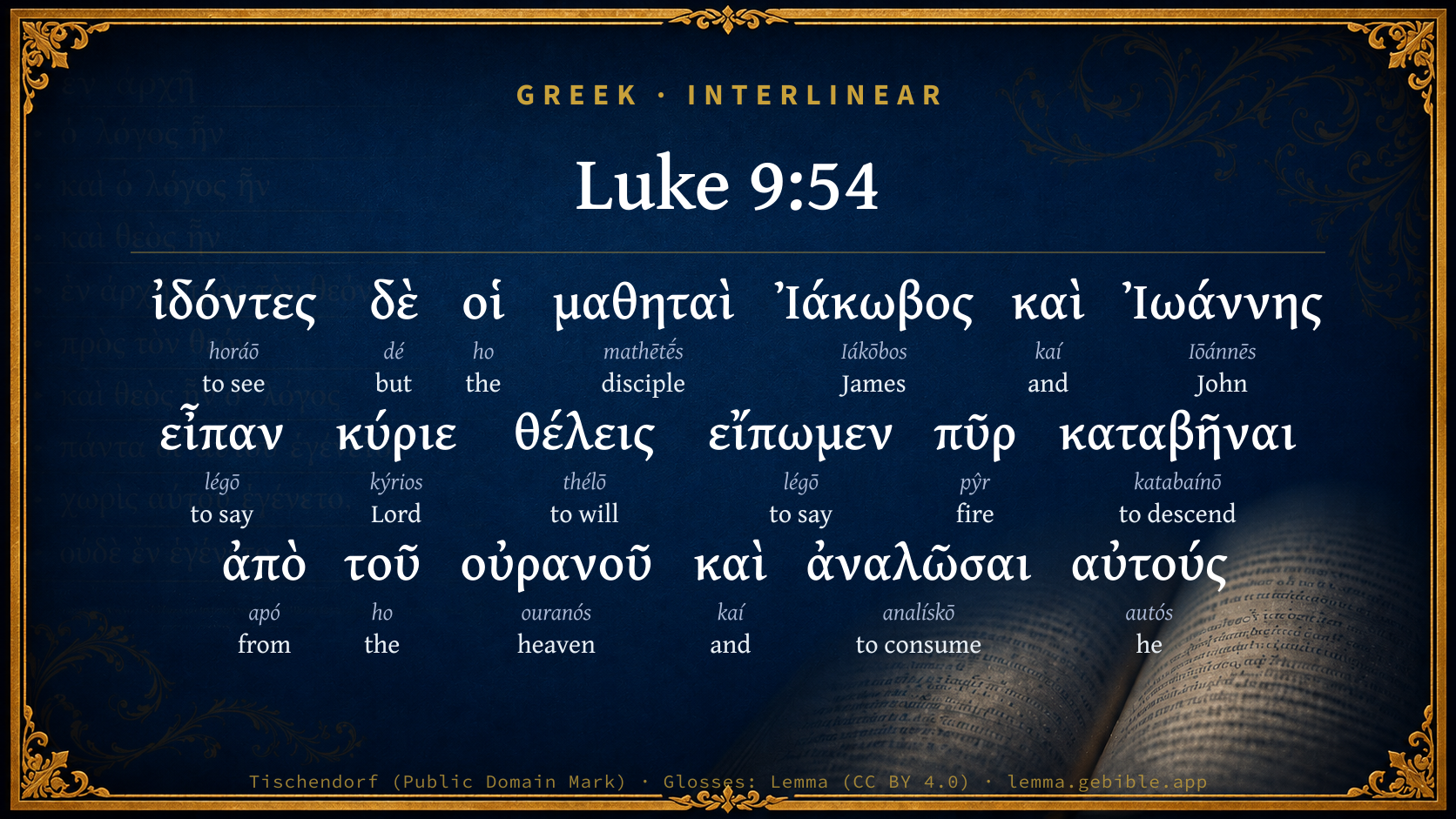
Greek (Tischendorf 8th ed.) Luke 9:54 appears in the Greek New Testament. The text above is from the Tischendorf 8th edition. Each word links to its Strong’s number and a concise gloss. Click any word for its full Thayer’s Greek Lexicon entry.
Download image
Cite this verse

Luke 9:54 (World English Bible). Public Domain. Lemma interlinear Bible study tool, https://lemma.gebible.app/v/luke/9/54.

Show BibTeX & RIS
BibTeX
RIS
English Translation
When his disciples, James and John, saw this, they said, "Lord, do you want us to command fire to come down from the sky, and destroy them, just as Elijah did?"
World English Bible · Public Domain
Highlights
  • 1 first appearance in the Greek New Testament
Full analysis ↓
Download a study sheet

One document with this verse’s original text, its word-by-word gloss line, the meaning frame, cross-references with their text, attributed commentary, and full source and license credits — printable, and it pastes into notes with its structure intact.

This verse Autodidact and up

Study sheet (.html) Plain text (.txt)

A passage Seminary Student

Up to 50 verses in one chapter. A passage sheet keeps up to 6 commentary sources and 12 cross-references per verse, in the order this page ranks them, and says so on the sheet whenever that leaves anything out. Ask for a single verse and you get the Autodidact verse sheet above.

Everything on this page stays free to read, with no account — the sheet is a download of what is already on screen, not access to it.

Want to remove ads? Support Godless Engineer
Compare translations 3

The same verse in 3 English versions, stacked beneath the original-language interlinear above. Click any original word for its lexicon entry.

Each is an independent rendering of the whole verse — the interlinear is not word-aligned to these translations.

Highlighted words mark where these versions differ — a whole-verse word diff, not a word-by-word alignment.

  • World English Bible Public Domain
    When his disciples, James and John, saw this, they said, "Lord, do you want us to command fire to come down from the sky, and destroy them, just as Elijah did?"
  • King James Version Public Domain
    And when his disciples James and John saw this, they said, Lord, wilt thou that we command fire to come down from heaven, and consume them, even as Elias did?
  • unfoldingWord Literal Text CC BY-SA 4.0
    And the disciples James and John, having seen this, said, “Lord, do you want us to tell fire to come down from heaven and consume them?”

unfoldingWord Literal Text — © unfoldingWord, licensed CC BY-SA 4.0. Word-aligned USFM3 via Door43 (git.door43.org/unfoldingWord/en_ult).

Versions to compare (up to 4)

3 of 4 selected

Show all 19 translations

Every available English version of this verse, each an independent rendering of the whole verse.

  • World English Bible Public Domain
    When his disciples, James and John, saw this, they said, "Lord, do you want us to command fire to come down from the sky, and destroy them, just as Elijah did?"
  • Berean Standard Bible Public Domain
    When the disciples James and John saw this, they asked, “Lord, do You want us to call down fire from heaven to consume them?”
  • Majority Standard Bible Public Domain
    When His disciples James and John saw this, they asked, “Lord, do You want us to call down fire from heaven to consume them, just as Elijah did?”
  • King James Version Public Domain
    And when his disciples James and John saw this, they said, Lord, wilt thou that we command fire to come down from heaven, and consume them, even as Elias did?
  • American Standard Version (1901) Public Domain
    And when his disciples James and John saw `this', they said, Lord, wilt thou that we bid fire to come down from heaven, and consume them?
  • Revised Version (1885) Public Domain
    And when his disciples James and John saw this, they said, Lord, wilt thou that we bid fire to come down from heaven, and consume them?
  • Geneva Bible (1599) Public Domain
    And when his disciples, Iames and Iohn sawe it, they saide, Lord, wilt thou that we commaund, that fire come downe from heauen, and consume them, euen as Elias did?
  • Douay-Rheims (1899) Public Domain
    And when his disciples James and John had seen this, they said: Lord, wilt thou that we command fire to come down from heaven, and consume them?
  • Young's Literal Translation Public Domain
    And his disciples James and John having seen, said, `Sir, wilt thou `that' we may command fire to come down from the heaven, and to consume them, as also Elijah did?'
  • Literal Standard Version CC BY-SA 4.0
    And His disciples James and John having seen, said, “Lord, will You [that] we may command fire to come down from Heaven, and to consume them, as Elijah also did?”
  • Unlocked Literal Bible CC BY-SA 4.0
    When the disciples James and John saw this, they said, “Lord, do you want us to command fire to come down from heaven and destroy them?”
  • unfoldingWord Literal Text CC BY-SA 4.0
    And the disciples James and John, having seen this, said, “Lord, do you want us to tell fire to come down from heaven and consume them?”
  • Darby Bible Public Domain
    And his disciples James and John seeing [it] said, Lord, wilt thou that we speak [that] fire come down from heaven and consume them, as also Elias did?
  • World Messianic Bible Public Domain
    When his disciples, Jacob and Yochanan, saw this, they said, “Lord, do you want us to command fire to come down from the sky and destroy them, just as Elijah did?”
  • Webster's Bible Public Domain
    And when his disciples James and John saw this, they said, Lord, wilt thou that we command fire to come down from heaven, and consume them, even as Elijah did?
  • Free Bible Version CC BY-SA 4.0
    When James and John saw this, they asked Jesus, “Master, do you want us to call fire down from heaven to burn them up?”
  • Bible in Basic English Public Domain
    And when his disciples, James and John, saw this, they said, Lord, may we send fire from heaven and put an end to them?
  • Text-Critical English NT CC BY 4.0
    When his disciples James and John saw this, they said, “Lord, do yoʋ want us to command fire to come down from heaven and consume them, just like Elijah did?”
  • Tyndale New Testament (1534) Public Domain
    When his disciples Iames and Iohn sawe that they sayde: Lorde wilt thou that we commaunde that fyre come doune from heven and consume them even as Helias dyd?

Literal Standard Version (2020), Covenant Press — licensed CC BY-SA 4.0. Text via the HelloAO Bible API (eBible.org). Unlocked Literal Bible (unfoldingWord) — licensed CC BY-SA 4.0. Text via the HelloAO Bible API (eBible.org). unfoldingWord Literal Text — © unfoldingWord, licensed CC BY-SA 4.0. Word-aligned USFM3 via Door43 (git.door43.org/unfoldingWord/en_ult). Free Bible Version, Dr. Jonathan Gallagher — licensed CC BY-SA 4.0. Text via the HelloAO Bible API (eBible.org).

Word by word

More ways to search: Search by grammar → Find every occurrence → Compare this word →

Practice this passage: Drill this verse → Learn its vocabulary →

ἀναλῶσαι
analískō
G355
“to consume”
Verb, Aorist, Active, Infinitive
Part of Speech
Verb
Tense
Aorist
Voice
Active
Mood
Infinitive
Full Thayer's Definition

Origin: from G303 and a form of the alternate of G138

TDNT: None

1. to expend a. to consume, e.g. spend money 2. to consume, use up, destroy
  1. ἰδόντες horáō G3708 “to see” Verb, Aorist, Active, Participle, Nominative, Plural, Masculine
  2. δὲ dé G1161 “but” Conjunction
  3. οἱ ho G3588 “the” Article, Nominative, Plural, Masculine
  4. μαθηταὶ mathētḗs G3101 “disciple” Noun, Nominative, Plural, Masculine
  5. Ἰάκωβος Iákōbos G2385 “James” Noun, Nominative, Singular, Masculine
  6. καὶ kaí G2532 “and” Conjunction
  7. Ἰωάννης Iōánnēs G2491 “John” Noun, Nominative, Singular, Masculine
  8. εἶπαν légō G3004 “to say” Verb, Aorist, Active, Indicative, 3rd person, Plural
  9. κύριε kýrios G2962 “Lord” Noun, Vocative, Singular, Masculine
  10. θέλεις thélō G2309 “to will” Verb, Present, Active, Indicative, 2nd person, Singular
  11. εἴπωμεν légō G3004 “to say” Verb, Aorist, Active, Subjunctive, 1st person, Plural
  12. πῦρ pŷr G4442 “fire” Noun, Accusative, Singular, Neuter
  13. καταβῆναι katabaínō G2597 “to descend” Verb, Aorist, Active, Infinitive
  14. ἀπὸ apó G575 “from” Preposition
  15. τοῦ ho G3588 “the” Article, Genitive, Singular, Masculine
  16. οὐρανοῦ ouranós G3772 “heaven” Noun, Genitive, Singular, Masculine
  17. καὶ kaí G2532 “and” Conjunction
  18. αὐτούς autós G846 “he” Personal pronoun, Accusative, Plural, Masculine

About this verse

These counts appear in no published source. They are computed here, from the morphology-tagged text and Lemma’s own curated glosses. What Lemma adds →

19
words
16
distinct lemmas
Gospels
section

Notable vocabulary

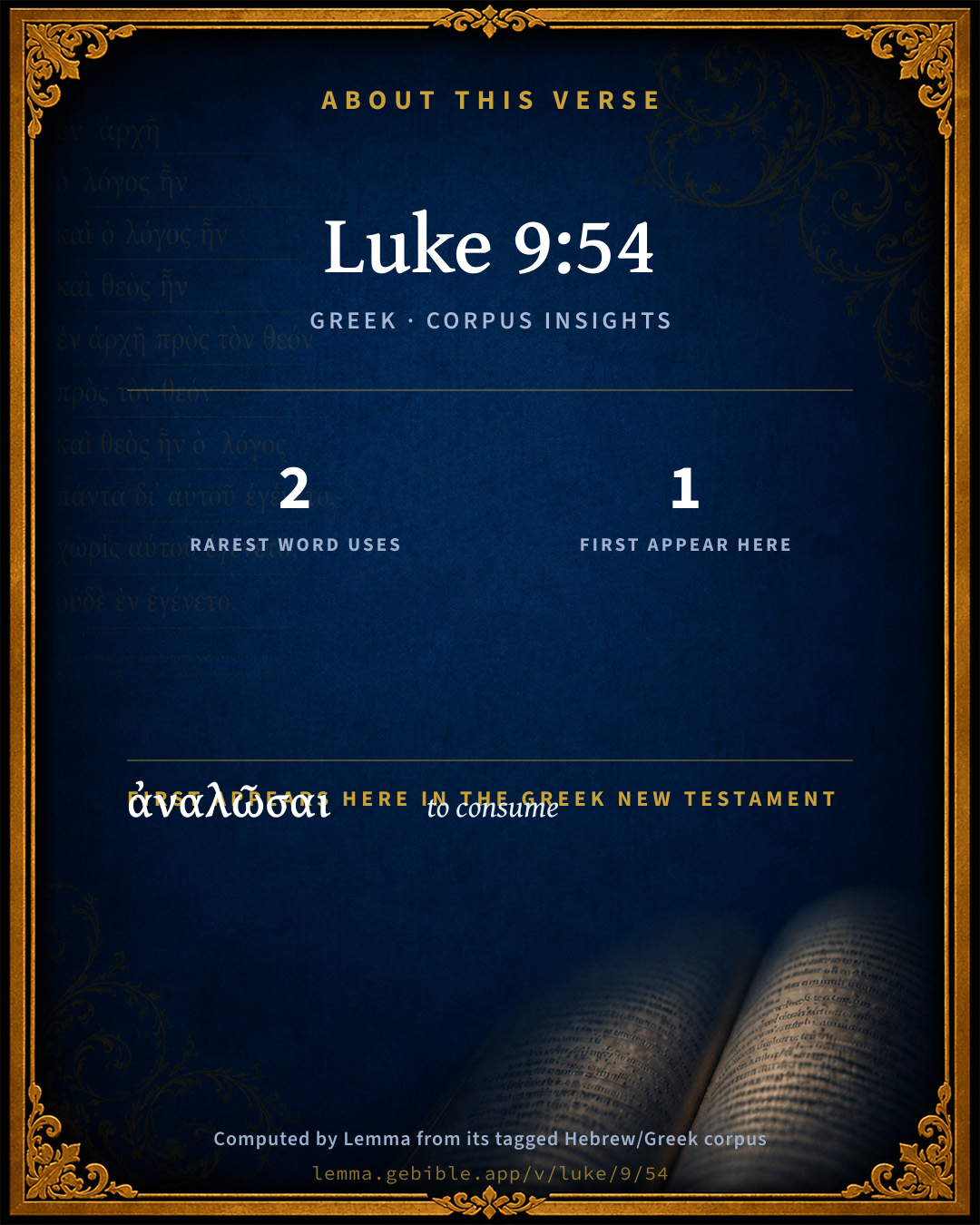
The rarest word here is ἀναλῶσαι to consume G355 — appearing just 2 times in the whole Greek New Testament.

First appearance in Scripture

This word makes its first canonical appearance in the Greek New Testament here:

  • ἀναλῶσαι to consume G355

Shared distinctive vocabulary

ἀναλῶσαι to consume G355 occurs in 2 verses of the Greek New Testament. Also found in:
Repetition

Words recur within this verse:

Cross-references

4

Topical passages linked to Luke 9:54 in the Treasury of Scripture Knowledge — connected by theme and wording, ordered by reader-vote popularity; previews shown in the World English Bible.

  • 2 Kings 1:10–14 Elijah answered to the captain of fifty, If I be a man of God, let fire come down from the sky, and consume you and your fifty. Fire came down from the sky, and consumed him and his fifty.
  • James 1:19–20 So, then, my beloved brothers, let every man be swift to hear, slow to speak, and slow to anger;
  • James 3:14–18 But if you have bitter jealousy and selfish ambition in your heart, don't boast and don't lie against the truth.
  • Acts 4:29–30 Now, Lord, look at their threats, and grant to your servants to speak your word with all boldness,

Cross-references courtesy of OpenBible.info (CC BY 4.0).

Where the printed editions differ

1 variant

Places in this verse where the major printed Greek editions disagree on the wording in a way that affects the translation — a comparison of editions, not a manuscript-by-manuscript collation. The editions are the modern critical texts (Nestlé-Aland 28/27, SBL, Westcott-Hort, Tregelles, Tyndale House) and the traditional texts behind the KJV (the Textus Receptus and the Byzantine/Majority text). It is not a claim about which reading is original.

  1. Extra text
    ὡς καὶ Ἠλίας ἐποίησεν;

    “as and Elijah did?”

    In TRByz Not in NA28NA27TynSBLWHTreg

    ὡς καὶ Ἠλίας ἐποίησεν; (hōs kai Ēlias epoiēsen) 'as and Elijah did?' is only in traditional manuscripts (TR+Byz)

Textual data: Translators Amalgamated Greek New Testament (STEPBible TAGNT) · CC BY 4.0.

Commentary

Notes on Luke 9:54 from classic Christian and Jewish commentators (each source and its license shown beneath its notes). The classic Christian expositions comment on the surrounding passage and are grouped to its opening verse, so a note may address several verses; the Jewish commentaries on the Tanakh (Rashi and others) are per-verse, so they appear only where the commentator wrote on this verse.

Lemma curates 59 commentaries, every one of them public domain or Creative Commons licensed, each selected and text-cleaned for this edition rather than reprinted as found. About our sources →

Joseph Benson's Commentary

Luk 9:54-56. When his disciples, James and John — Who attended him; saw this — When the messengers returned with the account of what had passed in the village, whither they had been sent, these two disciples, being exceedingly incensed at this rude treatment; said, Lord, wilt thou that we command fire to come down from heaven — To destroy these inhospitable wretches immediately; even as Elias did — After the example of the Prophet Elijah, who at, or near, this very place, thus destroyed the men who had evil-entreated him. Perhaps the place might put it into the minds of these apostles to make this motion now, rather than at any other time, or place, where Christ had received the like affront. “That these disciples, so remarkably distinguished by their Lord’s favour, should have some distinguished zeal and faith, may seem less wonderful, than that a person of so sweet a disposition as John should make so severe a proposal.” But he turned and rebuked them — Jesus, whose meekness on all occasions was admirable, sharply reprimanded his disciples for entertaining so unbecoming a resentment of this offence; and said, Ye know not what manner of spirit ye are of — Ye do not know the sinfulness of the disposition which ye have just now expressed, neither do ye sufficiently know your own hearts; which if you were more diligently to examine, you would soon find that there is a great deal of personal resentment and ostentation mingled with that zeal for me, which you so warmly express on this occasion. Add to this, you do not consider the genius of the gospel, so much more gentle than that of the law; nor the difference of times, persons, and circumstances. The severity which Elijah exercised on the men who came from Ahaziah to apprehend him, was a reproof of an idolatrous king, court, and nation, very proper for the times, and very agreeable to the characters both of the prophet who gave it, and of the offenders to whom it was given; at the same time it was not unsuitable to the nature of the dispensation they were under. But the gospel breathes a very different spirit from the law, (whose punishments were chiefly of a temporal kind,) and therefore it does not admit of this sort of rigour and severity. He told them, further, that to destroy men’s lives was utterly inconsistent with the design of his coming into the world, which was to save them — Alluding to his miracles, by which he restored health to the diseased bodies of men, as well as to his doctrine and death, by which he gives life to their souls. Having said these things, he went with them to another village, the inhabitants of which were men of better dispositions. This was a noble instance of patience under a real and unprovoked injury; an instance of patience which expressed infinite sweetness of disposition, and which, for that reason, should be imitated by all who call themselves Christ’s disciples.

Joseph Benson's Commentary on the Old and New Testaments (1811–1818) — public domain. Text from a community e-Sword module.

Tyndale Open Study Notes

Tyndale Open Resources

9:54 call down fire from heaven to burn them up: Some manuscripts add as Elijah did. Three times, Elijah called down fire from heaven against the enemies of God (1 Kgs 18:38; 2 Kgs 1:1-17). In their zeal, James and John wanted to do the same.

Tyndale Open Study Notes — © Tyndale Open Resources, licensed CC BY-SA 4.0. Text via the HelloAO Bible API.

Bengel's Gnomon

Johann Albrecht Bengel

Luk 9:54. Ἰάκωβος καὶ Ἰωάννης, James and John) Who had been selected above the others to see the glory of Jesus, Luk 9:28, along with Peter, who however in this instance remained quiet. After that they had heard of the approaching death of Jesus [Luk 9:44], on that account the more they try now to preserve His life. They seem also to have had in mind that injunction which is recorded, Luk 9:5: see Mar 9:41.—πῦρ, fire) It was not for this end that they were named the Sons of Thunder. Christ wrought miracles in all the elements except fire. Fire was reserved for the end (consummation) of the present world.—ἀπὸ τοῦ οὐρανοῦ, from heaven) Vengeance being impotent on earth, is readily disposed to stretch out its hand, its wishes, its sighs, to heaven for the weapons from above.—ὡς καὶ, even as) We are too willing to imitate the saints just in the cases where we ought not.—Ἡλίας, Elias) who also did so, as in the present case, against the Samaritans, 2Ki 1:2, seqq. They at the time had Elias fresh in their remembrance and thoughts; Luk 9:8; Luk 9:19; Luk 9:30.

Bengel's Gnomon of the New Testament — English translation (T&T Clark, Edinburgh, 1860) — public domain. Text from a community e-Sword module.

Meyer's Critical & Exegetical Commentary

Heinrich August Wilhelm Meyer

Luk_9:54-56. Ἰδόντες] they saw it in the return of the messengers, who would not otherwise have come back.

The two disciples are not to be identified with the messengers (Euthymius Zigabenus, Erasmus).

πῦρ] Fire, not: fulmen (Wetstein, Kuinoel), a modern mode of explaining away, of which, neither in 2Ki_1:10-12 (when at the word of Elias fire from heaven devours the people of Ahaziah) nor on the part of the disciples is there any notion.

οὐκ οἴδατε κ.τ.λ.] As in respect of ὑμεῖς the emphatic contrast with Elias is not to be disregarded (retunditur provocatio ad Eliam, Bengel), so it is objectionable to explain, with Bornemann: Nonne perpenditis, qualem vos … animum prodatis? Certe non humaniorem, quam modo vobis Samaritani praestiterunt. The Samaritans had not, indeed, refused to receive Jesus from lack of humanity; see on Luk_9:53. Rightly the expositors have explained οἵου πνεύματος of a spirit which is differently disposed from that displayed by Elias. In that respect the form of the saying has been taken by some affirmatively (so Erasmus, Beza, Castalio, Calvin, Grotius, and others; latest of all, Ewald), some interrogatively (so Luther, Zeger, and most of the later critics); but the matter of it has been so understood that Jesus is made to say to the disciples either (a) that they knew not that they were allowing themselves to be guided by a wholly different spirit from that of Elias (see as early as Augustine, C. Adimant. 17, Calvin, Grotius: Putatis vos agi Spiritu tali, quali olim Elias …; sed erratis. Habetis quidem ζῆλον, sed οὐ κατʼ ἐπίγνωσιν, et qui proinde humani est affectus, non divinae motionis), so in substance Ch. F. Fritzsche also in his Nov. Opusc. p. 264; or (b) that they knew not that they as His disciples were to follow the guidance of a wholly different spirit from that of Elias,the evangelical spirit of meekness, not the legal spirit of severity (so Theophylact, Erasmus, Zeger, Jansen, Bengel, and most of the later commentators). The view under (a) bears on the face of it the motives on which it depends, viz. to avoid making Jesus rebuke the spirit of Elias. The view under (b) is simply in accordance with the words, and is to be preferred in the interrogative form, as being more appropriate to the earnestness of the questioner; yet πνεύματος is not to be explained, as most of the later commentators explain it, of the human spirit (affectus animi, Grotius), but (rightly, even so early as Euthymius Zigabenus) of the Holy Spirit.[124] To this objective πνεῦμα the categorical ἐστέ points (which does not mean: ye ought to be). As to εἶναί τινος, whereby is expressed the relation of dependence, see on Mar_9:41, and Winer, p. 176 [E. T. 243 f.].

Luk_9:56. ἑτέραν] into a village which was not Samaritan. Theophylact: ὅτι οὐκ ἐδέξαντο αὐτὸν, οὐδὲ εἰσῆλθεν εἰς Σαμάρειαν. Thus the journey at its very commencement diverged from the direct course that had been decided on (in opposition to Wieseler, p. 326). To suppose the further progress of the journey through Samaria (in this place consequently Schenkel misplaces the incident in John 4) is altogether without authority in the text.

[124] Τοῦτο γὰρ ἀγαθόν ἐστι καὶ ἀνεξίκακον, Euthymius Zigabenus. But not as though Jesus indirectly denied to Elias the Holy Spirit (comp. already on Luk_1:17), but in His disciples the Holy Spirit is in His operations different from what He was in the old prophets, seeing that He was in them the instrument of the divine chastisement.

Meyer — Critical and Exegetical Commentary on the New Testament — English translation by Peter Christie, edited by Frederick Crombie (T&T Clark, 1880) — public domain. Text from a community e-Sword module.

Expositor's Greek Testament

ed. W. Robertson Nicoll

Luk 9:54 . Ἰάκωβος καὶ Ἰωάννης : their outburst of temper, revealed in their truculent proposal, probably indicated the attitude of the whole company. In that case journeying through Samaria was hopeless. καταβῆναι , infinitive, instead of ἵνα with subjunctive as often after εἰπεῖν .

The Expositor's Greek Testament, edited by W. Robertson Nicoll (1897–1910) — public domain. Text from a community e-Sword module.

Geneva Bible (1599)

Geneva Bible translators

We must take heed of the immoderateness of zeal, and fond imitation, even in good causes, that whatsoever we do, we do it to God’s glory, and the profit of our neighbor.

Geneva Bible (1599) marginal notes — public domain. Text via Bolls.life.

Jamieson, Fausset & Brown

Robert Jamieson, A. R. Fausset & David Brown

James and John--not Peter, as we should have expected, but those "sons of thunder" (Mar 3:17), who afterwards wanted to have all the highest honors of the Kingdom to themselves, and the younger of whom had been rebuked already for his exclusiveness (Luk 9:49-50). Yet this was "the disciple whom Jesus loved," while the other willingly drank of His Lord's bitter cup. (See on Mar 10:38-40; and Act 12:2). That same fiery zeal, in a mellowed and hallowed form, in the beloved disciple, we find in Jo1 5:10; Jo3 1:10.

fire . . . as Elias--a plausible case, occurring also in Samaria (Kg2 1:10-12).

Jamieson, Fausset & Brown — Commentary Critical and Explanatory on the Whole Bible (1871) — public domain (CC PDM 1.0). Text via the HelloAO Bible API.

Adam Clarke's Commentary

Verse 54. That we command fire] Vengeance belongs to the Lord. What we suffer for his sake, should be left to himself to reprove or punish. The insult is offered to him, not to us. See Clarke on Mr 3:17.

Adam Clarke's Commentary on the Bible (1810–1826) — public domain. Text from a community e-Sword/MySword module.

Ellicott's Commentary for English Readers

(54) When his disciples James and John saw this.—The burning zeal of the sons of Zebedee, more fiery even than that of Peter, was eminently characteristic of those whom our Lord had named as the Sons of Thunder (Mar_3:17). Their anger was probably heightened by the contrast with His former reception in a city of the same people (Joh_4:40-41), and by the feeling that what seemed to them an act of marvellous condescension was thus rudely repelled. Did not such a people deserve a punishment like that which Elijah had inflicted on the messengers of Ahaziah (2Ki_1:10; 2Ki_1:12; 2Ki_1:14)? The latter words, “as Elias did,” are, however, wanting in some of the best MSS.

A Bible Commentary for English Readers, edited by Charles John Ellicott (1878–1897) — public domain. Text from a community e-Sword module.

The Cambridge Bible for Schools and Colleges

gen. ed. J. J. S. Perowne

54. James and John] “What wonder that the Sons of Thunder wished to flash lightning?” St Ambrose. But one of these very disciples afterwards went to Samaria on a message of love (Act_8:14-25).

fire to come down from heaven] To avenge their helplessness under this gross and open insult of the Messiah. “Christ wrought miracles in every element except fire. Fire is reserved for the consummation of the age.” Bengel.

even as Elias did] These words are omitted by N, B, L. But (i) they are singularly appropriate, since the incident referred to also occurred in Samaria (2Ki_1:5-14); and (ii) while it would be difficult to account for their insertion, it is quite easy to account for their omission either by an accidental error of the copyists, or on dogmatic grounds, especially from the use made of this passage by the heretic Marcion (Tert. adv. Marc. iv. 23) to disparage the Old Testament, (iii) They are found in very ancient MSS., versions, and Fathers, (iv) The words seem to be absolutely required to defend the crude spirit of vengeance, and might have seemed all the more natural to the still half-trained Apostles because they had so recently seen Moses and Elias speaking with Jesus on the Mount of Transfiguration. They needed, as it were, a Scriptural precedent, to conceal from themselves the personal impulse which really actuated them.

The Cambridge Bible for Schools and Colleges (gen. ed. J. J. S. Perowne; Cambridge University Press, 1878–1918) — public domain. Text from a community e-Sword module.

John Gill's Exposition

And it came to pass, as they went in the way,.... From one village of the Samaritans, to the other; though if this is the same history related in Mat 8:19 it was as Christ went from Capernaum to the sea side, in order to go to the other side of it; and must be inserted here, without regard to the order of time:

a certain man said unto him; if the same as in Matthew, he is there said to be a "Scribe";

Lord, I will follow thee, wheresoever thou goest. The Arabic and Ethiopic versions read these words by way of question, "Lord, shall I not follow thee wheresoever thou goest?" See Gill on Mat 8:19.

John Gill's Exposition of the Whole Bible (1746–1763) — public domain (CC PDM 1.0). Text via the HelloAO Bible API.

Trapp's Complete Commentary

John Trapp

54 And when his disciples James and John saw this, they said, Lord, wilt thou that we command fire to come down from heaven, and consume them, even as Elias did?

Ver. 54. And when his disciples] These two brethren, sons of thunder, how soon was their choler up! they had quick and hot spirits.

Wilt thou that we command] It were to be wished that we would first consult with Christ in his word, ere we stir hand or foot to revenge.

John Trapp, A Commentary or Exposition upon All the Books of the Old and New Testament (1647–1656) — public domain. Text from a community e-Sword module.

Albert Barnes' Notes on the Bible

James and John - They were called Boanerges - sons of thunder - probably on account of their energy and power in preaching the gospel, or of their vehement and rash zeal - a remarkable example of which we have in this instance, Mar 3:17.

Wilt thou ... - The insult had been offered to Jesus, their friend, and they felt it; but their zeal was rash and their spirit bad. Vengeance belongs to God: it was not theirs to attempt it.

Fire from heaven - Lightning, to consume them.

As Elias did - By this they wished to justify their zeal. Perhaps, while they were speaking, they saw Jesus look at them with disapprobation, and to vindicate themselves they referred to the case of Elijah. The case is recorded in 2Ki 1:10-12.

Albert Barnes' Notes on the Bible (1834–1885) — public domain. Text from a community e-Sword/MySword module.

Haydock's Catholic Bible Commentary

Wilt thou that we command fire, &c. In the Greek is added as Elias did. These words might be first in the margin, and thence by transcribers taken into the text. The two apostles, called the sons of thunder, knew their Master was greater than Elias; and therefore they are for calling for fire from heaven, as he had done. (Witham) --- It was probably this trait in the life of James and John, which gained t hem the name of boanerges, the sons of thunder. Their too great zeal for the glory of Jesus Christ, and the spirit of revenge, of which they were not yet healed, caused them to make this petition; which seemed in some manner justified by the example of Elias, 4th book of Kings, chap. i. 10. Many editions have the addition of these words, as Elias did. (Calmet)

George Leo Haydock (1774–1849), Haydock's Catholic Family Bible and Commentary, 1859 edition — public domain. Excludes Psalms (Douay-Rheims chapter numbering differs from Protestant) and Deuterocanonical books (Catholic canon only).

Matthew Poole's English Annotations

The history of Elijah to which the disciples refer, is doubtless that, 2Ki 1:10, where Elijah, not without direction from God, called fire from heaven to destroy those captains and their fifties which the king sent to take him.

Matthew Poole's English Annotations on the Holy Bible (1683–1685) — public domain. Text from a community e-Sword/MySword module.

Whedon's Commentary on the Bible

Daniel D. Whedon

54. His disciples—It does not appear that the twelve, besides James and John, were in this company. Nor, if this was a journey to the Feast of Tabernacles, is there anything to indicate that any one of these was there with Jesus. James and John were evidently not of the messengers, for they knew nothing of the opposition of this village till they arrive with Jesus.

Wilt thou that we—They did not ask Jesus to command the fire, as if conscious that such would be a strange work for him. Nor do they imagine that they can perform the miracle without his permission. Nor do they doubt their own power, if done by his order.

As Elias did—It was in this same Samaria, perhaps in some near locality, that Elijah the Tishbite called fire from heaven and consumed the fifties of the wicked king sent to take him. The suggestion of this example was not, then, as Olshausen says, an after thought, to protect themselves from the reproof expected from Jesus, but a forethought, awakened by both the circumstances and the place. There is a great temptation to suppose that this was a disposition to call down a thunderbolt upon the wicked, and that the name of sons of thunder given to these two apostles was a memento of their zeal. But, first, it may be doubted whether it was lightning or thunder which the words fire come down designate. Second, their name seems not so much to refer to the fire as to the roar of thunder. And, third, as Mark (Mar_3:16-17) gives the surnames of the three principal apostles in connection as being bestowed by Jesus, we must hold the epithets not as bitter mementoes of sin, but as testimonies of honour.

Daniel D. Whedon (gen. ed.), Commentary on the Old and New Testaments (1874–1909) — public domain. Text from a community e-Sword module.

The Pulpit Commentary

And when his disciples James and John saw this, they said, Lord, wilt thou that we command fire to come down from heaven, and consume them, even as Elias did? The natural fiery temper and burning zeal of these highly favoured and loved brethren who, we know, received, perhaps in half-playful rebuke from their Master, the epithet Boanerges, sons of thunder-flamed forth at this insult offered to their adored Master in return for his tender, loving consideration for this hated people. Possibly, what these two had lately witnessed on the Transfiguration mount had deepened their veneration for their Lord, and caused them the more bitterly to resent an insult levelled at him. So they prayed him him whom they had so lately seen radiant with the awful fire of heaven prayed him to call that fire down, and so wither in a moment those impious despisers of his gracious goodness. The words, "even as Elias did," form a very appropriate historical instance, but they are of doubtful authenticity the older authorities have them not.

The Pulpit Commentary (1880–1919), ed. H.D.M. Spence-Jones & Joseph S. Exell — public domain. Text from a community e-Sword module.

John Wesley's Explanatory Notes

As Elisha did - At or near this very place, which might put it into the minds of the apostles to make the motion now, rather than at any other time or place, where Christ had received the like affront.

John Wesley, Explanatory Notes Upon the Whole Bible (1754–1765) — public domain. Text via the GEBible commentary corpus.

Burkitt's Expository Notes on the New Testament

William Burkitt

Here observe, 1. The crime which these men were guilty of: no affront must be accounted little, no indignity light, that is offered to the Son of God. But these Samaritans did not revile Christ, nor any of his retinue, that we read of; they did not violently assault him, they did not follow him with stones in their hands, or blasphemies in their mouths, but the wrong and injury was only negative: They received him not. They denied him a night’s lodging, and this is not out of any dislike of his person, but from an antipathy against his nation.

Observe, 2. The carriage of the disciples upon this occasion: it was thus far commendable, that from the endeared love which they bore to their Master, they did highly resent the churlish denial of an act of kindness towards him.

A gracious heart is holily impatient at the sight of an indignity offered to Christ; but their fault was, that they were too far transported with passion and revenge, even to desire the death and destruction of the uncivil Samaritans: Wilt thou that we command fire to come down from heaven, and consume them? They do not say, Master, will it please thee, who art Lord of the creature, to command fire to come down? Nor did they say, if it be thy pleasure command us to call down fire; but, Wilt thou that we command fire? This savours too much of pride, cruelty, and revenge; so dangerous is a misguided zeal.

William Burkitt's Expository Notes on the New Testament (1700–1703) — public domain. Text from a community e-Sword module.

unfoldingWord translationNotes

Door43 World Missions Community

saw this

"saw that the Samaritans did not receive Jesus"

command fire to come down from heaven and destroy them

James and John suggested this method of judgment because they knew that this was how the prophets such as Elijah had judged people who rejected God. (See: Assumed Knowledge and Implicit Information)

he turned and rebuked them

"Jesus turned and rebuked James and John." Jesus did not condemn the Samaritans as the disciples expected.

translationWords

James (son of Zebedee)

John (the apostle)

command

heaven

rebuke

unfoldingWord translationNotes — © Distant Shores Media and the Door43 World Missions Community, licensed CC BY-SA 4.0. Source: git.door43.org/Door43/en_tn.

Cambridge Greek Testament for Schools and Colleges

54. ὡς καὶ Ἡλίας ἐποίησεν. ACD La[191] [W.[192]]. It is omitted in אBL Vulg[193], but very probably for dogmatic reasons.

[191] La. Lachmann.

[192] W.H Westcott and Hort.

[193] Vulg. Vulgate.

54. Ἰάκωβος καὶ Ἰωάννης. “What wonder that the Sons of Thunder wished to flash lightning?” St Ambrose. But one of these very disciples afterwards went to Samaria on a message of love (Act 8:14-25).

θέλεις εἴπωμεν; This is really a deliberative subjunctive, and it is frequently used after words like θέλεις and βούλει. Comp. Luk 6:42, Luk 22:9. Winer, p. 356.

πῦρ καταβῆναι ἀπὸ τοῦ οὐρανοῦ. To avenge their helplessness under this gross and open insult of the Messiah. “Christ wrought miracles in every element except fire. Fire is reserved for the consummation of the age.” Bengel.

[ὡς καὶ Ἠλίας ἐποίησεν.] These words are omitted by אBL. But (i) they are singularly appropriate, since the incident referred to also occurred in Samaria (2Ki 1:5-14); and (ii) while it would be difficult to account for their insertion, it is quite easy to account for their omission either by an accidental error of the copyists, or on dogmatic grounds, especially from the use made of this passage by the heretic Marcion (Tert. adv. Marc. IV. 23) to disparage the Old Testament. (iii) They are found in very ancient MSS., versions, and Fathers. (iv) The words seem to be absolutely required to defend the crude spirit of vengeance, and might have seemed all the more natural to the still half-trained Apostles because they had so recently seen Moses and Elias speaking with Jesus on the Mount of Transfiguration. They needed, as it were, a Scriptural precedent, to conceal from themselves the personal impulse which really actuated them. It is curious to trace the way in which this passage has been tampered with by copyists.

Cambridge Greek Testament for Schools and Colleges (Cambridge University Press, 1896; 21 vols, various authors incl. Carr, Maclear, Plummer, Farrar, Lumby, Moule, M. R. James, Simcox) — public domain. Text from a community e-Sword module.

Alford’s Greek Testament

Henry Alford

54.] The disciples whom He named ‘sons of thunder,’ Mar 3:17. They saw some insult of manner, or actual refusal to allow the Lord to enter their village. That a collision of this kind did take place is plain from the last verse, and implied from the occasion alluded to by the two Apostles, where the fire was invoked in the presence of the offending persons. It happened also in Samaria.

πῦρ, not lightning, but fire, as in the passage alluded to, and in 1Ki 18:38.

It is exceedingly difficult to determine the true reading in this passage, which seems to have been more than usually tampered with, or wrongly written. It is hardly conceivable that the shorter text, as edited by ., … ἀναλῶσαι αὐτούς; στραφεὶς δὲ ἐπετίμησεν αὐτοῖς. καὶ ἐπορεύθησαν … should have been the original, and all the rest, insertion. Homœoteleuton may have had some share in the omission of the latter debated portion, from ΚΑΙΕΙΠ to ΚΑΙΕΠ: but this does not touch ὡς καὶ Ἡλ. ἐπ. It has been suggested that those words may have been removed as involving indirect censure of Elias: but surely this lay too far off to create any offence. And their insertion into the text is quite inexplicable. In this great uncertainty, I have thought the candid way is to let my edited text reflect such uncertainty, and I have therefore printed these latter debatable words in the same type as the text, and have annotated on them. Let it be remembered that in both cases, versions far more ancient than our oldest mss. contain these words.

Henry Alford, The Greek Testament (1849–1861) — public domain. Text from a community e-Sword module.

International Critical Commentary

54. ἱδότες δέ. They saw the messengers returning from their fruitless errand. Their recent vision of Elijah on the mount may have suggested to them the calling down fire from heaven. The two brothers here, and perhaps also in ver. 49, show their fiery temper as “sons of thunder.” Yet Lk., who alone gives this illustration of the title, does not give the title itself (Mar 3:17). Quid mirum filios tonitrui fulgurare voluisse? (Ambrose).

Θέλεις εἴπωμεν. For the constr. comp. 18:41, 22:9; Mat 20:32; Mar 10:51: Soph. O. T. 650. In class. Grk. this constr. is more common with βούλομαι; but in N.T. θέλω is about five times as frequent as βούλομαι, which in mod. Grk. has almost gone out of use. Note that ἵνα, which sometimes follows θέλω, is not inserted when the first verb is in the second person and the second verb in the first person. Win., xli. 4. b, p. 356; Burton., § 171. Syr-Sin.has “Our Lord” for Κύριε.

The words ὡς καὶ Ἡλίας ἐποίησεν (A C D X etc.) are probably a gloss. That they were omitted (א; B L Ξ) because some Gnostics used them to disparage the O.T., or because they seem to make Christ’s rebuke to the disciples a condemnation of Elijah, is not probable. Rendel Harris thinks that the insertion is due to Marcionite influence both in this case and the next (Study of Codex Besæ p. 233, in Texts and Studies, ii. 1). There is less doubt about καὶ εἶπεν Οὑκ οἲδατε ποίου πνεύματός ἑστε (D F K M etc); and least of all about ὁ γὰρ υἱὸς τους ἀνθρώπου οὐκ ἦλθεν ψυχὰς ἀνθρρώπων ἀπολέσαι ἀλλὰ σῶσαι (Ϝ Κ Μ etc.). These two may safely be omitted as later additions to the text. In the last of them there are several variations in the witnesses which insert the words. Some omit γάρ, some omit ἀνθώπων, and some have ἀποκτεῖναι for ἀπόλεσαι. WH. ii. App. pp. 59, 60; Sanday, App. ad N.T. pp. 118, 119.

It is quite possible that Οὐκ ὄδατε ποίου πνεύματός ἐστε is a genuine saying of Christ, although no part of this Gospel. The remainder, ὁ γὰρ υἱὸς, κ.τ.λ., may be an adaptation of Mat 5:17 and [18:11] (comp. Luk 19:10), and could more easily have been constructed out of familiar materials.

For other instances of what may be Marcionite influence upon the text see 4:16 and 23:2.

International Critical Commentary — older volumes (1896–1929), various authors — public domain. Text from a community e-Sword module.

Lesson kit

Teaching starters — assembled from the data on this page, not authored interpretation. Every prompt links to the verse data it draws on. Edit before teaching.

Luke, in the Gospels, opens this verse with 19 words (16 distinct Greek lemmas). Its most distinctive word is analískō (“to consume”). A historical commentator’s framing appears above. Read the whole chapter for the surrounding context.

Discussion questions

  1. What does “to consume” (analískō) contribute to the verse as a whole?
  2. This is the first place “to consume” appears in Scripture (first appears here). What does its debut here establish?
  3. How does Galatians 5:15, which shares the word «to consume», read alongside this verse?
  4. What does the repetition of “to say” (2× in this one verse) do in this verse?
  5. These translations render this verse differently. What is at stake in choosing one wording over another?
  6. Compare how Joseph Benson's Commentary and Tyndale Open Study Notes read this verse. Where do they agree or differ?

Things to notice

  • 1 word makes its first canonical appearance in Scripture here.
  • These translations choose different wording for 21 words in this verse.
  • “to say” occurs 2× in this single verse.
  • 16 distinct Greek lemmas span 19 words in this verse.

Reading settings

Reading text

Shown beneath each verse's original-language words.

Old Testament
Old Testament edition

Read the OT as the Masoretic Hebrew (MT) or the Greek Septuagint (LXX).

English shown for the Greek Septuagint (in the Hebrew ↔ Greek comparison).

Comparing translations? Open the Compare panel on any verse page to stack up to four side by side.