John 1:32

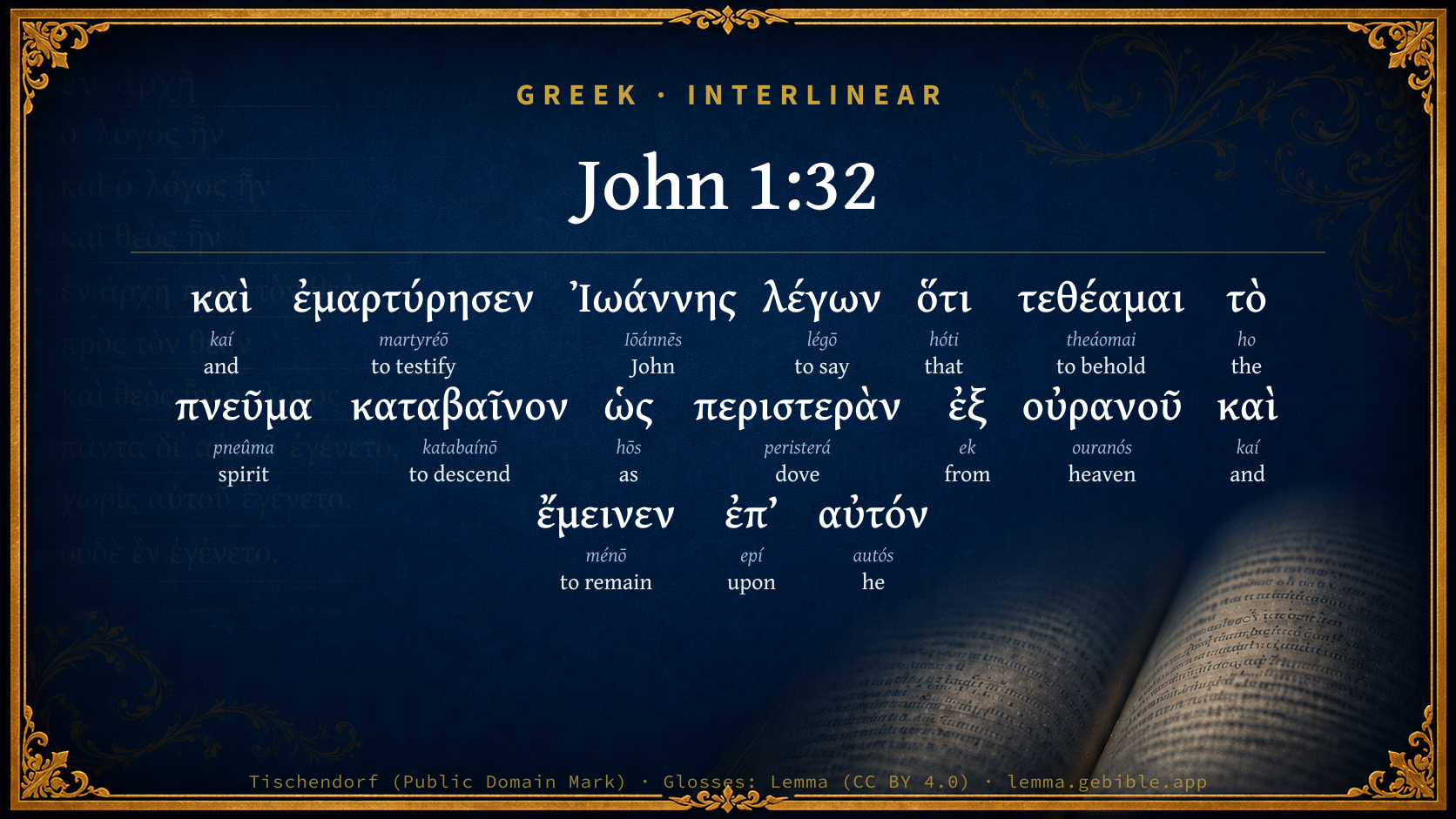
Greek (Tischendorf 8th ed.) John 1:32 appears in the Greek New Testament. The text above is from the Tischendorf 8th edition. Each word links to its Strong’s number and a concise gloss. Click any word for its full Thayer’s Greek Lexicon entry.
Download image
Cite this verse

John 1:32 (World English Bible). Public Domain. Lemma interlinear Bible study tool, https://lemma.gebible.app/v/john/1/32.

Show BibTeX & RIS
BibTeX
RIS
English Translation
John testified, saying, "I have seen the Spirit descending like a dove out of heaven, and it remained on him.
World English Bible · Public Domain
Download a study sheet

One document with this verse’s original text, its word-by-word gloss line, the meaning frame, cross-references with their text, attributed commentary, and full source and license credits — printable, and it pastes into notes with its structure intact.

This verse Autodidact and up

Study sheet (.html) Plain text (.txt)

A passage Seminary Student

Up to 50 verses in one chapter. A passage sheet keeps up to 6 commentary sources and 12 cross-references per verse, in the order this page ranks them, and says so on the sheet whenever that leaves anything out. Ask for a single verse and you get the Autodidact verse sheet above.

Everything on this page stays free to read, with no account — the sheet is a download of what is already on screen, not access to it.

Want to remove ads? Support Godless Engineer
Compare translations 3

The same verse in 3 English versions, stacked beneath the original-language interlinear above. Click any original word for its lexicon entry.

Each is an independent rendering of the whole verse — the interlinear is not word-aligned to these translations.

Highlighted words mark where these versions differ — a whole-verse word diff, not a word-by-word alignment.

  • World English Bible Public Domain
    John testified, saying, "I have seen the Spirit descending like a dove out of heaven, and it remained on him.
  • King James Version Public Domain
    And John bare record, saying, I saw the Spirit descending from heaven like a dove, and it abode upon him.
  • unfoldingWord Literal Text CC BY-SA 4.0
    And John testified, saying, “I saw the Spirit descending like a dove from heaven, and it remained upon him.

unfoldingWord Literal Text — © unfoldingWord, licensed CC BY-SA 4.0. Word-aligned USFM3 via Door43 (git.door43.org/unfoldingWord/en_ult).

Versions to compare (up to 4)

3 of 4 selected

Show all 19 translations

Every available English version of this verse, each an independent rendering of the whole verse.

  • World English Bible Public Domain
    John testified, saying, "I have seen the Spirit descending like a dove out of heaven, and it remained on him.
  • Berean Standard Bible Public Domain
    Then John testified, “I saw the Spirit descending from heaven like a dove and resting on Him.
  • Majority Standard Bible Public Domain
    Then John testified, “I saw the Spirit descending from heaven like a dove and resting on Him.
  • King James Version Public Domain
    And John bare record, saying, I saw the Spirit descending from heaven like a dove, and it abode upon him.
  • American Standard Version (1901) Public Domain
    And John bare witness, saying, I have beheld the Spirit descending as a dove out of heaven; and it abode upon him.
  • Revised Version (1885) Public Domain
    And John bare witness, saying, I have beheld the Spirit descending as a dove out of heaven; and it abode upon him.
  • Geneva Bible (1599) Public Domain
    So Iohn bare recorde, saying, I behelde that Spirit come downe from heauen, like a doue, and it abode vpon him,
  • Douay-Rheims (1899) Public Domain
    And John gave testimony, saying: I saw the Spirit coming down, as a dove from heaven, and he remained upon him.
  • Young's Literal Translation Public Domain
    And John testified, saying -- `I have seen the Spirit coming down, as a dove, out of heaven, and it remained on him;
  • Literal Standard Version CC BY-SA 4.0
    And John testified, saying, “I have seen the Spirit coming down out of Heaven as a dove, and [that] One remained on Him;
  • Unlocked Literal Bible CC BY-SA 4.0
    John testified, saying, “I saw the Spirit descending like a dove from heaven, and it stayed upon him.
  • unfoldingWord Literal Text CC BY-SA 4.0
    And John testified, saying, “I saw the Spirit descending like a dove from heaven, and it remained upon him.
  • Darby Bible Public Domain
    And John bore witness, saying, I beheld the Spirit descending as a dove from heaven, and it abode upon him.
  • World Messianic Bible Public Domain
    Yochanan testified, saying, “I have seen the Spirit descending like a dove out of heaven, and it remained on him.
  • Webster's Bible Public Domain
    And John bore testimony, saying, I saw the Spirit descending from heaven like a dove, and it abode upon him.
  • Free Bible Version CC BY-SA 4.0
    John gave his evidence about him, saying, “I saw the Spirit descend from heaven like a dove and rest upon him.
  • Bible in Basic English Public Domain
    And John gave this witness, saying, I saw the Spirit coming down from heaven like a dove and resting on him.
  • Text-Critical English NT CC BY 4.0
    Then John testified, “I saw the Spirit descending from heaven like a dove, and it remained upon him.
  • Tyndale New Testament (1534) Public Domain
    And Iohn bare recorde sayinge: I sawe the sprete descende from heven lyke vnto a dove and abyde apon him

Literal Standard Version (2020), Covenant Press — licensed CC BY-SA 4.0. Text via the HelloAO Bible API (eBible.org). Unlocked Literal Bible (unfoldingWord) — licensed CC BY-SA 4.0. Text via the HelloAO Bible API (eBible.org). unfoldingWord Literal Text — © unfoldingWord, licensed CC BY-SA 4.0. Word-aligned USFM3 via Door43 (git.door43.org/unfoldingWord/en_ult). Free Bible Version, Dr. Jonathan Gallagher — licensed CC BY-SA 4.0. Text via the HelloAO Bible API (eBible.org).

Word by word

More ways to search: Search by grammar → Find every occurrence → Compare this word →

Practice this passage: Drill this verse → Learn its vocabulary →

περιστερὰν
peristerá
G4058
“dove”
Noun, Accusative, Singular, Feminine
Part of Speech
Noun
Case
Accusative
Number
Singular
Gender
Feminine
Full Thayer's Definition

Origin: of uncertain derivation

TDNT: 07:03,8

1. a dove
  1. καὶ kaí G2532 “and” Conjunction
  2. ἐμαρτύρησεν martyréō G3140 “to testify” Verb, Aorist, Active, Indicative, 3rd person, Singular
  3. Ἰωάννης Iōánnēs G2491 “John” Noun, Nominative, Singular, Masculine
  4. λέγων légō G3004 “to say” Verb, Present, Active, Participle, Nominative, Singular, Masculine
  5. ὅτι hóti G3754 “that” Conjunction
  6. τεθέαμαι theáomai G2300 “to behold” Verb, Perfect, Middle or Passive deponent, Indicative, 1st person, Singular
  7. τὸ ho G3588 “the” Article, Accusative, Singular, Neuter
  8. πνεῦμα pneûma G4151 “spirit” Noun, Accusative, Singular, Neuter
  9. καταβαῖνον katabaínō G2597 “to descend” Verb, Present, Active, Participle, Accusative, Singular, Neuter
  10. ὡς hōs G5613 “as” Adverb
  11. ἐξ ek G1537 “from” Preposition
  12. οὐρανοῦ ouranós G3772 “heaven” Noun, Genitive, Singular, Masculine
  13. καὶ kaí G2532 “and” Conjunction
  14. ἔμεινεν ménō G3306 “to remain” Verb, Aorist, Active, Indicative, 3rd person, Singular
  15. ἐπ’ epí G1909 “upon” Preposition
  16. αὐτόν autós G846 “he” Personal pronoun, Accusative, Singular, Masculine

About this verse

These counts appear in no published source. They are computed here, from the morphology-tagged text and Lemma’s own curated glosses. What Lemma adds →

17
words
16
distinct lemmas
Gospels
section

Notable vocabulary

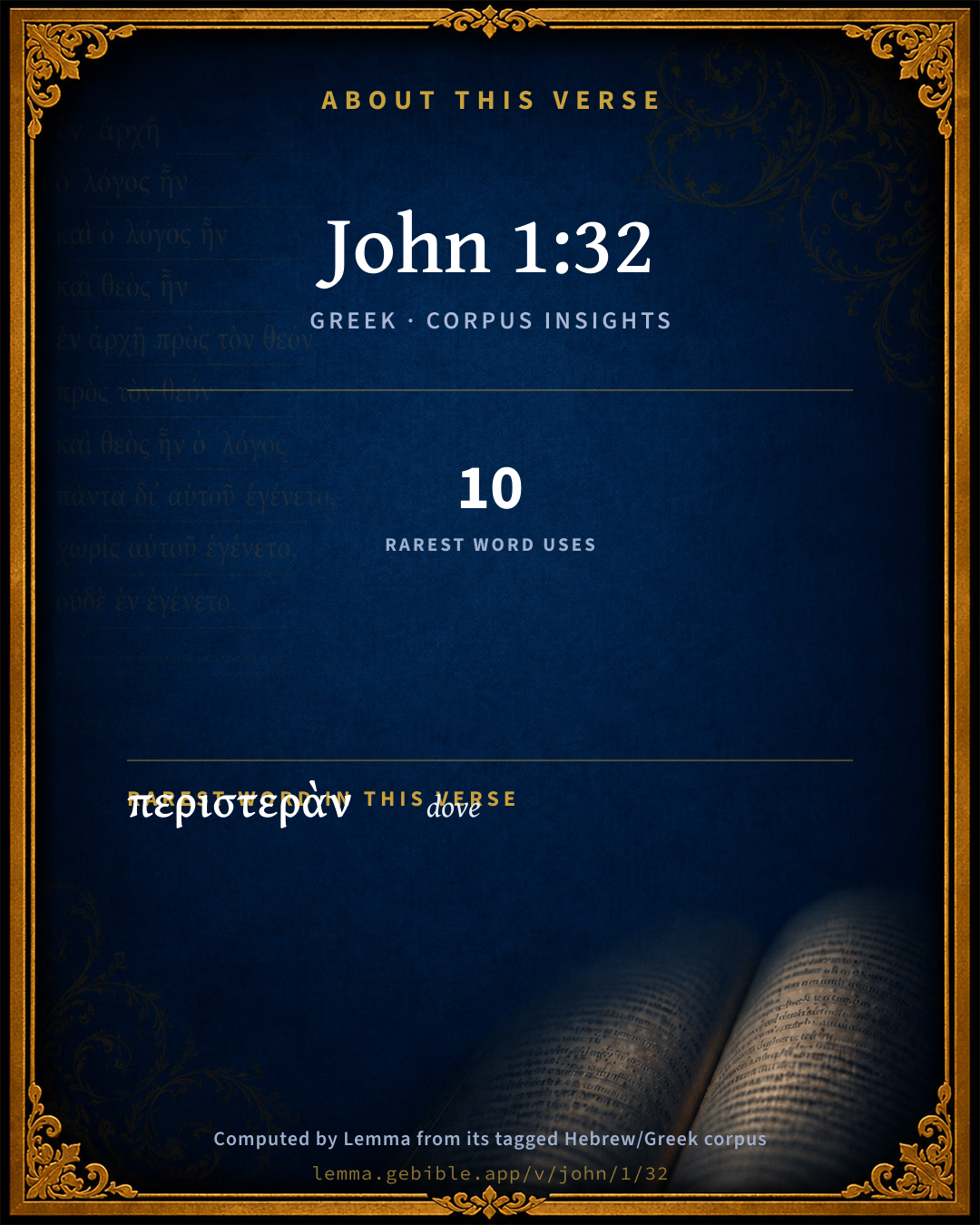
The rarest word here is περιστερὰν dove G4058 — appearing just 10 times in the whole Greek New Testament.

Shared distinctive vocabulary

περιστερὰν dove G4058 occurs in 10 verses of the Greek New Testament. Also found in:

Repetition

A word recurs within this verse:

Cross-references

5

Topical passages linked to John 1:32 in the Treasury of Scripture Knowledge — connected by theme and wording, ordered by reader-vote popularity; previews shown in the World English Bible.

  • Luke 3:22 and the Holy Spirit descended in a bodily form as a dove on him; and a voice came out of the sky, saying "You are my beloved Son. In you I am well pleased."
  • Mark 1:10 Immediately coming up from the water, he saw the heavens parting, and the Spirit descending on him like a dove.
  • Matthew 3:16 Jesus, when he was baptized, went up directly from the water: and behold, the heavens were opened to him. He saw the Spirit of God descending as a dove, and coming on him.
  • John 1:7 The same came as a witness, that he might testify about the light, that all might believe through him.
  • John 5:32 It is another who testifies about me. I know that the testimony which he testifies about me is true.

Cross-references courtesy of OpenBible.info (CC BY 4.0).

Commentary

Notes on John 1:32 from classic Christian and Jewish commentators (each source and its license shown beneath its notes). The classic Christian expositions comment on the surrounding passage and are grouped to its opening verse, so a note may address several verses; the Jewish commentaries on the Tanakh (Rashi and others) are per-verse, so they appear only where the commentator wrote on this verse.

Lemma curates 59 commentaries, every one of them public domain or Creative Commons licensed, each selected and text-cleaned for this edition rather than reprinted as found. About our sources →

Tyndale Open Study Notes

Tyndale Open Resources

1:32 John the Baptist’s second testimony (see 1:19-23) told what happened when Jesus was baptized. • In the Old Testament, kings and prophets were anointed with the Holy Spirit, but these anointings were temporary and tied to a particular office or occasion. By contrast, with the Spirit’s resting on him, Jesus’ anointing was permanent (see 3:34).

Tyndale Open Study Notes — © Tyndale Open Resources, licensed CC BY-SA 4.0. Text via the HelloAO Bible API.

Bengel's Gnomon

Johann Albrecht Bengel

Joh 1:32. Ἐμαρτύρησεν, bare record) as concerning a fact seen by himself and not by the people. The words which follow [comp. Joh 1:34] were part of his record [testimony]: the words which are spoken, Joh 1:29, etc. [comp. Joh 1:15; Joh 1:27], were part of his demonstration [the clear proof of Jesus’ Messiahship, which John demonstrated] from the record. The Evangelist interposes this in the midst of the connected words of the Baptist, as a sort of parenthesis; ἐμαρτύρησεν—ὅτι, John bare record, saying.—τεθέαμαι) I beheld.—ἐξούρανοῦ, from heaven) Construe this with καταβαῖνον, descending. The descent, at least in its last and lowest part, was equally determinate [in its direction] towards Jesus, as its abiding on Him.—ἔμεινεν, it abode) with a considerable stay [continuance].

Bengel's Gnomon of the New Testament — English translation (T&T Clark, Edinburgh, 1860) — public domain. Text from a community e-Sword module.

Meyer's Critical & Exegetical Commentary

Heinrich August Wilhelm Meyer

Joh_1:32. What John had said in Joh_1:31, viz. that though Jesus was unknown to him as the Messiah, yet his commission was to make Him known to the people, needed explanation; and that as to the way in which he himself had come to recognise Him as the Messiah. This was, indeed, a necessary condition before he could make the φανέρωσις to the people. This explanation he now gives in the following testimony (not first spoken upon another occasion, Ewald) concerning the divine σημεῖον, which he beheld. And the evangelist considers this testimony so weighty, that he does not simply continue the words of the Baptist, but solemnly and emphatically introduces the testimony as such: καὶ ἐμαρτύρησεν, κ.τ.λ., words which are not therefore parenthetical (Bengel, Lücke, and most), but from an impressive part of the record: And a testimony did John bear, when he said. The following ὅτι simply recitative.

τεθέαμαι] I have seen; Perfect, like ἑώρακα in Joh_1:34, which see. The phenomenon itself took place at the baptism, which is assumed as known through the Gospel tradition, and is referred to in Joh_1:33 by ὁ πέμψας με βαπτίζειν ἐν ὕδατι, which implies that the σημεῖον was to take place at the baptism of the person spoken of. This is in answer to Baur, p. 104 ff., according to whom there is no room here for the supposition that Jesus was baptized by John,an assertion all the more groundless, because if we insert the baptism of Jesus before Joh_1:19, there is no place in the plan of this Gospel for the narration of a fact which is assumed as universally known.

The sight itself here spoken of was no mere production of the imagination, but a real sight; it indicates an actual event divinely brought about, which was traditionally worked up by the Synoptics into a visible occurrence more or less objective (most unhesitatingly by Luke), but which can be the subject of testimony only by virtue of a θεωρία νοητική (Origen). See on Mat_3:17, note.

ὡς περιστεράν] i.e. shaped like a dove: ἀντίτυπον μίμημα πελειάδος, Nonnus. See on Mat_3:16. According to Ewald, the sudden downward flight of a bird, coming near to Him at the moment, confirmed the Baptists presentiment, etc. Conjectures of this kind are additions quite alien to the prophetic mode of view.

καὶ ἔμεινεν ἐπʼ αὐτόν] The transition here to the finite verb is owing to the importance of the fact stated. Bernhardy, p. 473; Buttmann, N. T. Gk. p. 327 [E. T. p. 382]. ἐπʼ αὐτόν, however, is not synonymous with ἐπʼ αὐτοῦ (Joh_19:31); the idea is, remained (fluttered not away, Luther) directed towards Him. We are to suppose the appearance of a dove coming down, and poising itself for a considerable time over the head of the person. See on ἐπί with the accusative (Joh_3:36; 1Pe_4:14), seemingly on the question where? Schaef. ad Long. p. 427; Matthiae, p. 1375; Kühner, ad Xen. Anab. i. 2. 2.

Meyer — Critical and Exegetical Commentary on the New Testament — English translation by Peter Christie, edited by Frederick Crombie (T&T Clark, 1880) — public domain. Text from a community e-Sword module.

Expositor's Greek Testament

ed. W. Robertson Nicoll

Joh 1:32 . τεθέαμαι τὸ πνεῦμα … ἐπʼ αὐτόν . “I have seen the Spirit coming down like a dove out of heaven, and it remained upon Him.” “I have seen, perfect, in reference to the sign divinely intimated to him, in the abiding fulfilment of which he now stood.” Alford. τεθέαμαι is used (as in Joh 1:14 ) in its sense of seeing with intelligence, with mental or spiritual observation and inference ( cf. Aristoph., Clouds , 363, “Have you ever seen it rain without elouds?”). In what sense did the Baptist “see” the Spirit descending? Origen distinctly declared that these words οἰκονομὶας τρόπῳ γέγραπται οὐχ ἱστορικὴν διήγησιν ἔχοντα ἀλλὰ θεωρίαν νοητήν , ii. 239. The ὡς περιστερὰν ἐξ οὐρανοῦ does not necessarily involve that an actual dove was visible. It was not the dove which was to be the sign; but, as the Baptist affirms in Joh 1:33 , the descent and abiding of the Spirit. John was scarcely the type of man who would be determined in an important course of action by the appearance of a bird. What he saw was the Spirit descending. This he can best have seen in the demeanour of Jesus, in His lowliness and sympathy and holiness, all of which came to their perfect bloom at and in His baptism. It was the possession of this spirit by Jesus that convinced John that He could baptise with the Holy Spirit. That this conviction came to him at the baptism of Christ with a clearness and firmness which authenticated it as divine is guaranteed by the words of this verse. It was as plain to him that Jesus was possessed by the Spirit as if he had seen the Spirit in a visible shape alighting upon Him. To a mind absorbed in this one idea it may have actually seemed as if he saw it with his bodily eyes. Ambrose, De Sacram. , i., 5, “Spiritus autem sanctus non in veritate columbae, sed in specie columbae descendit de coelo”. The dove was in the East a sacred bird, and the brooding dove was symbolic of the quickening warmth of nature. In Jewish writings the Spirit hovering over the primeval waters is expressly compared to a dove: “Spiritus Dei ferebatur super aquas, sicut columba, quae fertur super pullos suos nec tangit illos”. Cf. also Noah’s dove as symbol of the new creation. (See Suicer, s.v. , περιστερά , and Strauss, i., 362.) Such a symbol of the Spirit would scarcely have been imagined by the Baptist, who was all for stern and violent methods.

The Expositor's Greek Testament, edited by W. Robertson Nicoll (1897–1910) — public domain. Text from a community e-Sword module.

Geneva Bible (1599)

Geneva Bible translators

Christ is proved to be the Son of God, by the coming down of the holy Ghost, by the Father’s voice, and by John’s testimony.

Geneva Bible (1599) marginal notes — public domain. Text via Bolls.life.

Adam Clarke's Commentary

Verse 32. I saw the Spirit descending, c.] See the notes on Mat 3:16, Mat 3:17.

Adam Clarke's Commentary on the Bible (1810–1826) — public domain. Text from a community e-Sword/MySword module.

John Calvin's Commentaries

32. I saw the Spirit, descending like a dove. This is not a literal but a figurative mode of expression; for with what eyes could he see the Spirit? But as the dove was a certain and infallible sign of the presence of the Spirit, it is called the Spirit, by a figure of speech in which one name is substituted for another; not that he is in reality the Spirit, but that he points him out, as far as human capacity can admit. And this metaphorical language is frequently employed in the sacraments; for why does Christ call the bread his body, but because the name of the thing is properly transferred to the sign? especially when the sign is, at the same time, a true and efficacious pledge, by which we are made certain that the thing itself which is signified is bestowed on us. Yet it must not be understood that the dove contained the Spirit who fills heaven and earth, (Jeremiah 23:24,) but that he was present by his power, so that John knew that such an exhibition was not presented to his eyes in vain. In like manner, we know that the body of Christ is not connected with the bread, and yet we are partakers of his body.

A question now arises, why did the Spirit at that time appear in the form of a dove? We must always hold that there is a correspondence between the sign and the reality. When the Spirit was given to the apostles, they saw cloven tongues of fire, (Acts 2:3,) because the preaching of the gospel was to be spread through all tongues, and was to possess the power of fire. But in this passage God intended to make a public representation of that mildness of Christ of which Isaiah speaks in lofty terms,

The smoking flax he will not quench, and the bruised reed he will not break, (Isaiah 42:3.)

It was then, for the first time, that the Spirit was seen descending on him; not that he had formerly been destitute of him, but because he might be said to be then consecrated by a solemn rite. For we know that he remained in concealment, during thirty years, like a private individual, because the time for his manifestation was not yet come; but when he intended to make himself known to the world, he began with his baptism. At that time, therefore, he received the Spirit not only for himself, but for his people; and on that account his descent was visible, that we may know that there dwells in him an abundance of all gifts of which we are empty and destitute. This may easily be inferred from the words of the Baptist; for when he says, Upon whom thou shalt see the Spirit descending, and remaining on him, it is he who baptizeth with the Spirit, his meaning is, that the reason why the Spirit was beheld in a visible form, and remained on Christ, was, that he might water all his people with his fullness. What it is to baptize with the Spirit I have already noticed in a few words; namely, that he imparts its efficacy to baptism, that it may not be vain or useless, and this he accomplishes by the power of his Spirit.

John Calvin's Commentaries (1540-1563) — public domain. Text from the Calvin Translation Society English edition (1840s-50s) via the Christian Classics Ethereal Library (ccel.org). Calvin's coverage is partial (roughly two-thirds of the Bible); uncommented books and verses are honest gaps, never fabricated. The 19th-century editor's footnotes and remarks are omitted so the notes are faithfully Calvin's own voice.

Ellicott's Commentary for English Readers

(32) I saw.—Better, I have seen, or beheld. The vision is in its result ever present, and is all-conclusive evidence. (Comp. the words in their historic setting, Mat_3:16, Note.)

(32, 33) In these verses the Evangelist again makes prominent the solemn witness of John, giving the process by which conviction had come to his own mind.

A Bible Commentary for English Readers, edited by Charles John Ellicott (1878–1897) — public domain. Text from a community e-Sword module.

The Cambridge Bible for Schools and Colleges

gen. ed. J. J. S. Perowne

32. bare record] Better, bare witness; comp. Joh_1:7-8; Joh_1:15; Joh_1:19; Joh_1:34.

I saw] Better, I have beheld, or contemplated (1Jn_4:12; 1Jn_4:14), the perfect of the verb used in Joh_1:14; Joh_1:38.

like a dove] This was perhaps visible to Christ and the Baptist alone. A real appearance is the natural meaning here and is insisted on by S. Luke (Luk_3:22). And if we admit the ‘bodily shape’ at all, there can be no sound reason for rejecting the dove. The marvel is that the Holy Spirit should be visible in any way (comp. ‘the tongues of fire,’ Act_2:3), not that He should assume the form of a dove in particular. Of course this visible descent of the Spirit made no change in the nature of Christ. It served two purposes, (1) to make the Messiah known to the Baptist, and through him to the world; (2) to mark the official commencement of the ministry of the Messiah, like the anointing of a king. The whole incident is very parallel to the Transfiguration. In both Christ is miraculously glorified previous to setting out to suffer; in both a voice from heaven bears witness to Him; at both ‘the goodly fellowship of the Prophets’ is nobly represented.

The Cambridge Bible for Schools and Colleges (gen. ed. J. J. S. Perowne; Cambridge University Press, 1878–1918) — public domain. Text from a community e-Sword module.

John Gill's Exposition

And John bare record,.... The same day that he said the above things, and at the same time:

saying, I saw the Spirit; that is, of God, as is said in Mat 3:16 and which Nonnus here expresses; and the Ethiopic version reads, "the Holy Ghost",

descending from heaven like a dove; at the time of his baptism; see Gill on Mat 3:16.

And it abode upon him; for some time; so long as that John had a full sight of it, and so was capable of giving a perfect account of it, and bearing a certain and distinct testimony to it.

John Gill's Exposition of the Whole Bible (1746–1763) — public domain (CC PDM 1.0). Text via the HelloAO Bible API.

Trapp's Complete Commentary

John Trapp

32 And John bare record, saying, I saw the Spirit descending from heaven like a dove, and it abode upon him.

Ver. 32. {See Trapp on "Mat 3:16"} {See Trapp on "Mar 1:10"}

John Trapp, A Commentary or Exposition upon All the Books of the Old and New Testament (1647–1656) — public domain. Text from a community e-Sword module.

Albert Barnes' Notes on the Bible

Bare record - Gave testimony.

I saw the Spirit ... - See the notes at Mat 3:16-17.

Albert Barnes' Notes on the Bible (1834–1885) — public domain. Text from a community e-Sword/MySword module.

Matthew Poole's English Annotations

Saith John, According to the revelation which I had, when I received my extraordinary commission to baptize, so it fell out to me, I did see, when he was baptized, the heaven opening, and a representation of the Spirit of God (for no man can see God and live) descending. The form of the representation was like that of a dove. And it was not a mere transient sight, but it did for some time abide upon that person, in that sensible representation; by that token I knew that he was the Son of God.

Matthew Poole's English Annotations on the Holy Bible (1683–1685) — public domain. Text from a community e-Sword/MySword module.

Whedon's Commentary on the Bible

Daniel D. Whedon

32. It abode upon him—The mystic symbol did not alight and then fly off again; it remained until it became invisible, as if fusing down into his person.

Daniel D. Whedon (gen. ed.), Commentary on the Old and New Testaments (1874–1909) — public domain. Text from a community e-Sword module.

The Pulpit Commentary

Vers. 32, 33. And John bore testimony, saying, I have seen (perfect) the Spirit descending like a dove out of heaven, and it (he) abode upon him. And I knew him not, but he that sent me to baptize with (in) water, he said to me, Upon whomsoever thou mayest see the Holy Spirit descending, and abiding on him, this (one) is he that baptizeth with (in) the Holy Spirit. The preparation by special teaching for a mysterious vision is the key to the vision itself, which John is here said to have described. There can be no reasonable doubt that the evangelist makes reference to the synoptic tradition of the baptism of Jesus by John, although it may suit some uncompromising opponents of the Fourth Gospel to say that the baptism is here omitted. The act of the rite is not totidem verbis described; but the chief accompaniment and real meaning of the baptism is specially portrayed. All the well known cycles of criticism make their special assault on the narratives at this point. Rationalism finds in a thunderstorm and the casual flight of a pigeon what John magnified into a supernatural portent; Straussianism sees the growth of a legend from prepared sources of Hebrew tradition, and endeavours to aggravate into irreconcilable discrepancy the various accounts; Baur and Hilgenfeld accentuate the objectively supernatural portent, so as the more easily to put it into the region of ignorant superstition; others find the hint or sign of Gnostic handling; and Keim suggests that it is the poetic colouring which a later age unconsciously attributed to the Baptist and the Christ. Let it be noticed:

(1) That the present Gospel does not augment, but diminishes, the miraculous element as compared with the synoptic narrative. The "Gospel of the Hebrews" added further embellishments still. Our Gospel compels us to believe that the mind of the Baptist was the chief region of the miracle.

(2) The author of this Gospel might, if he had chosen, have selected his own experience on the Mount of Transfiguration in vindication of a Divine attestation of the Sonship; but he preferred to fall back upon the testimony of his revered master. Peter, James, and John were unprepared for what they saw and heard on that occasion; and Peter knew not what he said, so great was the awful wonder that fell upon him then. Here, however, is recorded a vision for which the mind of the great forerunner was prepared. He expected to see the Spirit of God in some manner blend his energy with that of the individual who would prove to be the Baptizer with the Holy Ghost.

(3) John does not discriminate the methods of the two communications, and from this narrative all that could be inferred positively is that the mind of John, by objective or subjective process, of which we know nothing, received the communication and the sacred impression.

(4) The synoptic narrative, prima facie, differs from this representation. At all events Luk_3:21, 22 speaks of "opened heavens," "the Holy Spirit in bodily form as a dove," and a voice addressed to the Lord, "Thou art my beloved Son; in thee I am well pleased." This account is taken by Strauss as the key to the other three, and he urges that they must all be interpreted in harmony with it. But from the time of Origen, the exegesis of Matthews account no less emphatically states (i.e. if with De Wette, Bleck, Baur, and Keim, we take o Iwannhv as the subject of eiden) that John saw the Holy Spirit descending like a dove and coming upon (Christ) him, and that the voice was addressed to John, "This is my beloved Son," etc. In Mark"s account the eiden and auton are susceptible of the same interpretation. It should be observed that Luke"s narrative clearly implies that our Lord"s baptism took place at some unspecified opportunity, and simply gives the summing up of the impression produced upon the mind of John. It is more reasonable to interpret Luke in harmony with the main conception of Matthew and John than to press the latter into forced harmony with the former.

(5) The great difficulty is the expression, swmatikw eidei . But surely the prophetic mind was accustomed to dwell in the midst of similar visual shapes of spiritual things. There was swmatiko enough in the cherubim, olive trees, horses, armies, vials, and cities of the Apocalypse, and there were "voices" heard by Ezekiel, Hosea, Elijah, and by John himself which could be, were, and even must be, described in terms of physical facts, which no interpreters have ever felt compelled to transfer into the region of phenomena. There are still intensely vivid intuitions of spiritual fact which transcend all sensible or logical proof. If John saw and heard these things so far as his own consciousness was concerned, there is enough to account for every peculiarity of the narrative. He saw the Shechinah glory hovering over the Lord Jesus, officially consecrating a human personality. The dove like (wv peristeran ) form and motion taken by the heavenly light reminded him of the brooding of the Spirit of God upon the primaeval waters. He looked into the face of the Holy One of God majesty and meekness, Divine glory, human gentleness, a sanctity as of the holy place, a freedom as of the birds of heaven, force like that of the steeds of the rising sun, inward peace like the calm of a brooding dove, transfigured the Lord. This dovelike splendour abode upon him, passed into him; and the voice (the invincible conviction, the resistless consciousness that often can find no other expression than "Thus saith the Lord") was heard, "This is my beloved Son," etc. We cannot say what John saw; we know what he said; and it covered the consciousness of the most stupendous reality yet enacted on the earth. That which John had been taught to predict as approaching was now seen to have actually come about, he who baptizeth with the Holy Ghost has commenced his wondrous mission.

(6) The whole question as to the relation of the Holy Spirit and the Logos the relation between the statement of ver. 13 and vers. 31-33 demands special consideration. A few words here may suffice. Baur, Eichhorn, and others have urged that either the Logov and Pneuma are identical, and that that which John means (vers. 1-14) by the Logos he afterwards resolves into the pneuma, or that this scene and these words are incompatible with the prologue. It is true that Philo and Justin ("Apol.," 1:33) do use the two terms as practically identical. But John has recorded our Lord"s own words as to the antithesis of the pneuma and sarx (ch. 3), declaring in his prologue that the Logos is the Source of all the life and light of men, and that the Logos came into the world and became flesh. Now, if John did not abide firmly in this thought, he would have represented incarnate God as undergoing the process of regeneration at his baptism, than which nothing would be more abhorrent to his entire theory of the Christ. The relations of the Logos and the Pneuma to each other and to the Father, metaphysically considered, are profoundly intricate, but the relations of Father, Word, and Holy Spirit to the Person of the Lord Jesus have been several times asserted by the apostles, and cannot be interchanged (see my "John the Baptist," lect. 5.; Lucke, "Comm. uber d. Evang. Joh.," vol. 1. pp. 433-443)

The Pulpit Commentary (1880–1919), ed. H.D.M. Spence-Jones & Joseph S. Exell — public domain. Text from a community e-Sword module.

The People's New Testament

B. W. Johnson

32–34. I saw the Spirit descending from heaven like a dove. See Matt. 3:16, and notes. It was revealed to John that the Christ would thus be revealed. Indeed it was the anointing of the Spirit that made Jesus the Anointed, the Christ.

B. W. Johnson's The People's New Testament with Notes (1889–1891) — public domain. Electronic text from the Christian Classics Ethereal Library (CCEL) ThML edition.

unfoldingWord translationNotes

Door43 World Missions Community

descending

coming down from above

like a dove

This phrase is a simile. The "Spirit" comes down just like a dove lands on a person. (See: Simile)

heaven

The word "heaven" refers to the "sky."

the Son of God

Some copies of this text say "Son of God"; others say "chosen one of God." (See: Textual Variants)

Son of God

This is an important title for Jesus, the Son of God. (See: Translating Son and Father)

translationWords

testimony

Holy Spirit

dove

heaven

Son of God

unfoldingWord translationNotes — © Distant Shores Media and the Door43 World Missions Community, licensed CC BY-SA 4.0. Source: git.door43.org/Door43/en_tn.

Cambridge Greek Testament for Schools and Colleges

32. ἐμαρτ. The Evangelist insists again and again on this aspect of the Baptist: he bears witness to the Messiah; 7, 8, 15, 19, 34.

τεθέαμαι. I have beheld (Joh 1:14; Joh 1:38; 1Jn 4:12; 1Jn 4:14). The testimony of the vision still remains; hence the perfect.

ὡς περιστερὰν. Perhaps visible only to Jesus and the Baptist. A real appearance is the natural meaning here, and is insisted on by S. Luke (Luk 3:22); just as a real voice is the natural meaning in Joh 12:29. And if we admit the ‘bodily shape,’ there is no sound reason for rejecting the dove. The marvel is that the Holy Spirit should be visible in any way, not that He should assume the form of a dove or of ‘tongues of fire’ (Act 2:3) in particular. This symbolical vision of the Spirit seems to be analogous to the visions of Jehovah granted to Moses and other Prophets.

The descent of the Spirit made no change in the nature of Christ: but possibly it awoke a full consciousness of His relation to God and to man: He had been increasing in favour with both (Luk 2:52). It served two purposes; (1) to make the Messiah known to the Baptist and through him to the world; (2) to mark the official beginning of His ministry, like the anointing of a king. As at the Transfiguration, Christ is miraculously glorified before setting out to suffer, a voice from heaven bears witness to Him, and ‘the goodly fellowship of the Prophets’ shares in the glory. For ἔμεινεν see next verse.

ἐπ’ αὐτόν. Pregnant construction; a preposition of motion with a verb of rest. Thus both the motion and the rest are indicated. Comp. Joh 1:18, Joh 3:36, Joh 19:13, Joh 20:19, Joh 21:4; Gen 1:2.

Cambridge Greek Testament for Schools and Colleges (Cambridge University Press, 1896; 21 vols, various authors incl. Carr, Maclear, Plummer, Farrar, Lumby, Moule, M. R. James, Simcox) — public domain. Text from a community e-Sword module.

International Critical Commentary

32. John now explains how and when it was that he came to recognise Jesus as the Christ.

ἐμαρτύρησεν. This testimony, as the aorist denotes, was delivered at a definite moment; cf. contra μαρτυρεῖ in v. 15. The testimony is to the effect that John saw a dove or pigeon alight on Jesus at His baptism. There is no hint that we are to think of a spiritual vision; the verb θεᾶσθαι (see on 1:14) is always used in the N.T. of seeing with the bodily eyes. The incident is related differently by Mk. (1:10), who implies (as does Mat 3:16) that Jesus Himself saw the Spirit descending like a dove. Luk 3:22 does not say who saw it, but all agree that a dove was seen, the words of Lk., σωματικῷ εἴδει, laying emphasis on the objective and physical nature of the incident. All the evangelists, that is, agree in recording that a dove alighted upon Jesus when presenting Himself for baptism.

The dove was regarded in Palestine as a sacred bird. Xenophon (Anab. i. iv. 9) reports that it was not lawful in Syria to hunt doves; and this is suggested by Tibullus (i. 7. 17):

Quid referam ut uolitet crebras intacta per urbes

Alta Palaestino sancta columba Syro.

So Lucian explains that to the Syrians a dove is tabu, and that any one unwittingly touching a dove is counted unclean (de Dea Syria, 54; cf. 14). Phm 1:1 comments on the great number of doves at Ascalon, and upon their tameness, due to the circumstance that from ancient times the people were not allowed to eat them, so that they were never caught (ap. Euseb. Praep. Evangel. viii. 14, 64).2

Furthermore, the dove was regarded among the Semites as a symbol of the Spirit. Of φωνὴ τῆς τρυγόνος, “the voice of the turtle” (Son 2:12), there is a Chaldee interpretation, reported by Wetstein, “the Voice of the Spirit.” And by the Jewish doctors the Spirit hovering over the primeval waters (Gen 1:2) was compared to a dove: “Spiritus Dei ferebatur super aquas, sicut columba, quae fertur super pullos suos nec tangit illos.”3

Hence we can understand why a dove alighting upon Jesus should have been regarded as symbolic of a descent of the Divine Spirit.4 The words ascribed to the Baptist are explicit. He saw the dove, and forthwith recognised it as the sign which he had been expecting (v. 33).

For the expression καταβαίνειν ἐξ οὐρανοῦ see on 3:13.

Some other divergences from the Synoptic accounts of the Baptism should be observed. Jn. says nothing of the heavens being opened (Mar 1:10 and parallels), or of the Voice from heaven (see on 12:28 below); and having regard to his knowledge of Mk.,5 with whose account of the Baptist he has so much in common (see on v. 6), it would seem that these omissions are deliberate. Here, as in v. 31, the Johannine narrative appears to be more primitive than that of the Synoptists.

καὶ ἔμεινεν ἐπʼ αὐτόν (cf. for the constr. 3:36). This is, on the other hand, a detail not found in the Synoptic narratives, perhaps added here with a reminiscence of Isa 11:2, where it is said of the Messianic King, ἀναπαύσεται ἐπʼ αὐτὸν πνεῦμα τοῦ θεοῦ.1 Jerome (on Isa 11:2) quotes the following from the Gospel of the Hebrews: “When the Lord was come up out of the water, the whole fount of the Holy Spirit descended and rested upon Him, and said to Him: My Son, in all the prophets was I waiting for thee that thou shouldest come, and I might rest in thee. For thou art my rest, thou art my first-begotten Son that reigneth for ever.” This is a doctrinal combination of the Synoptic and Johannine narratives, probably intended to teach the permanence of the spiritual gift here vouchsafed through Christ to mankind.2

The form in which the Dove and the Voice from heaven at the Baptism of Jesus are mentioned in the Odes of Son_3 is curious. Ode xxiv. begins: “The Dove fluttered over the Christ, because He was her head, and she sang over Him and her voice was heard,” sc. in the Underworld. The singing or cooing of the dove is as it were a Heavenly Voice; and “fluttering” recalls the verb used by Justin, ὡς περιστερὰν τὸ ἅγιον πνεῦμα ἐπιπτῆναι ἐπʼ αὐτόν (Dial. 88). The verb ἐπιπτῆναι is also found, in reference to the Baptism of Christ, in the Sibylline Oracles (vii. 67) and in Origen (c. Cels. i. 40, 41), and its rendering volare or devolare in Tertullian (adv. Val. 27) and in Hilary (in Psa 54:7), showing that it had a place in some extra canonical record. This idea of the dove “fluttering” is, as we have seen, associated in Hebrew thought with the idea of the Spirit “brooding” over the waters; cf. Gen 1:2, Deu 32:11.

International Critical Commentary — older volumes (1896–1929), various authors — public domain. Text from a community e-Sword module.

Godet's Commentaries

Frédéric Louis Godet

The Gift Made to Jesus in the Baptism.

Vv. 32, 33, suggest an important question: Did Jesus really receive anything at His baptism? Meyer denies this, alleging that this idea has no support in our Gospel, and that, if the Synoptics say more, it is because they contain a tradition which had been already altered. The real fact was solely the vision granted to John in view of the testimony which he was to render to Jesus. This vision was transformed by tradition into the event related by the Synoptics. The idea of the real communication of the Holy Spirit to Jesus would be incompatible with that of the incarnation of the Logos. Lucke and de Wette think, also, that Jesus received nothing new at that moment. John was only instructed, by means of the vision, as to a permanent fact in the life of Jesus, His communion with the Holy Spirit. Neander, Tholuck and Ebrard think that there was simply progress in the consciousness which Jesus had of Himself.

Baumgarten-Crusius, Kahnis Luthardt, Gess, allow a real communication, but only with reference to the task which Jesus had to fulfill, that of His own ministry, and of the communication of the Holy Spirit to other men. The opinion of Meyer, as well as that of Lucke, sacrifices the narrative of the Synoptics, and even that of John to a dogmatic prejudice; for John saw the Spirit not only abiding, but descending, and this last feature must correspond to a reality, as well as the other. The view of Neander is true, but inadequate. There was certainly wrought, at that moment, a decided advance in the consciousness of Jesus, as is indicated by the fact of the divine address: Thou art my Son; but the symbol of the descent of the dove must also correspond to a real fact. Finally, the view which admits an actual gift, but only in relation to the public activity of Jesus, appears to me superficial. In a life so completely one as that of Jesus, where there is nothing purely ritual, where the external is always the manifestation of the internal, the beginning of a new activity supposes a change in His own personal life.

When we lay hold of the idea of the incarnation with the force with which it is apprehended and presented by Paul and John (see Joh 1:14, and the Appendix to the Prologue), when we recognize the fact that the Logos divested Himself of the divine state, and that He entered into a really human state, in order to accomplish the normal development originally assigned to every man, there is nothing further to prevent us from holding that, after having accomplished the task of the first Adam on the pathway of free obedience, He should have seen opening before Him the sphere of the higher life for which man is destined, and that, as the first among the violent who take the kingdom of heaven by force, He should have forced the entrance into it for Himself and for all.

Undoubtedly, His entire existence had passed on under the constant influence of the Holy Spirit which had presided over his birth. At every moment, He had obeyed this divine guide, and each time this docility had been immediately rewarded by a new impulse. The vessel was filled in proportion as it enlarged, and it enlarged in proportion as it was filled. But to be under the operation of the Spirit is not to possess the Spirit (Joh 14:17). With the hour of the baptism, the moment came when the previous development was to be transformed into the definite state, that of the perfect stature (Eph 4:13). “First, that which is psychical,” says Paul, in 1Co 15:46, “afterwards that which is spiritual.” If the incarnation is a verity, this law must apply to the development of Jesus, as much as to that of every other man. Till then, the Spirit was upon Him ἑπ᾿ αὐτό [τὸ παιδίον] Luk 2:40; He increased, under this divine influence, in wisdom and grace. From the time of the baptism, the Spirit becomes the principle of His psychical and physical activity, of His whole personal life; He can begin to be called Lord-Spirit (2Co 3:17-18); life-giving Spirit (1Co 15:45).

The baptism, therefore, constitutes in His interior life as decisive a crisis as does the ascension in His external state. The open heaven represents His initiation into the consciousness of God and of His designs. The voice: Thou art my Son, indicates the revelation to His inmost consciousness of His personal relation with God, of His eternal dignity as Son, and, at the same time, of the boundlessness of divine love towards Him, and towards humanity on which such a gift is bestowed. He fully apprehends the name of Father as applied to God, and can proclaim it to the world. The Holy Spirit becomes His personal life, makes Him the principle and source of life for all men. Nevertheless, His glorification is not yet; the natural life, whether psychical or physical, still exists in Him, as such. It is after the ascension only that His soul and body will be completely spiritualized (σῶμα πνευματικόν, 1Co 15:44).

But, it is asked, does not the gift of the Holy Spirit form a needless repetition of the miraculous birth? By no means; for in this latter event the Holy Spirit acts only as a life-giving force in the stead and place of the paternal principle. He wakens into the activity of life the germ of a human existence deposited in the womb of Mary, the organ prepared for the Logos that He may realize there a human development; in the same way as, on the day of creation, the soul of the first man, breath of the creating God, came to dwell in the bodily organ prepared for its abode and for its earthly activity (Gen 2:7).

Some modern theologians, in imitation of some of the Fathers, think that the Logos is confounded by John with the Spirit. But undoubtedly every one will acknowledge the truth of this remark of Lucke : “No more could we say, on the one hand, ‘The Spirit was made flesh,’ than we could say, on the other, ‘I have seen the Logos descend upon Jesus.’” The distinction between the Logos and the Spirit, scrupulously observed by John, even in chaps. 14-16, where Reuss thinks it is sometimes wholly effaced (Hist. de la th. chret . ii., p. 533f.), is the following: The Logos is the principle of objective revelation, and, through his incarnation, the culminating point of that revelation, while the Spirit is the principle acting internally by which we assimilate to ourselves that revelation subjectively. Hence it results that, without the Spirit, the revelation remains for us a dead letter, and Jesus a simple historical personage with whom we do not enter into any communion. It is by the Spirit alone that we appropriate to ourselves the revelation contained in the word and person of Jesus. Thus, from the time when the Spirit begins to do His work in us, it is Jesus Himself who begins to live within us. As, through the Spirit, Jesus lived on earth by the Father, so, through the Spirit, the believer lives by Jesus (Joh 6:57). This distinction of offices between Christ and the Spirit is steadily maintained throughout our whole Gospel.

This solemn testimony being given, the forerunner expresses the feeling of satisfaction with which this grand task accomplished inspires him, yet so as, at the same time, to make his hearers understand that their own task is beginning.

Ver. 32. “And John bore witness saying: I have seen the Spirit descending as a dove, and it abode upon Him.”

This declaration is introduced with a peculiar solemnity by the words: “And John bore witness.” Here, indeed, is the decisive act, as Hengstenberg calls it, the punctum saliens of the entire ministry of John the Baptist, his Messianic testimony properly so called. With what sense had John seen? With the bodily eye, or with the inner sense? This is to ask whether the fact mentioned here took place only in the spiritual world, or also in the external world. According to the narratives of Mark (Mar 1:10-11), and of Matthew (Mat 3:16-17), it was the object of the perception of Jesus only. “And behold, the heavens were opened, and he saw the Spirit...” (Matt.): “And straightway coming out of the water he saw ...” (Mark). In Luke the narrative is completely objective: “It came to pass that.....the heaven was opened” (Luk 3:21-22). But the narrative in Matthew makes the Baptist also participate in this heavenly manifestation by the form of the declaration of God: “This is my Son;” not as in Mark and Luke: “Thou art my Son.” The divine declaration in Matthew addresses itself, therefore, not to Jesus who is the object, but to him who is the witness of it, namely, John. Now, if it was perceived simultaneously by Jesus and by John, it must have had an objective reality, as the narrative of Luke says. The following is, perhaps, the way in which we can represent to ourselves the relation between the perception of Jesus and that of John: The divine communication, properly so called (the declaration of the Father and the communication of the Spirit), was given from God to Jesus, and the latter had knowledge of the fact at once by the impression which He received, and by a vision which rendered it sensible to him. As to John, he was associated in the perception of this symbolic manifestation, and thereby initiated into the spiritual fact, of which it was as if the covering. Thus the voice which said to Jesus: “Thou art my Son,” sounded within him in this form: “This is my Son.” Neander cannot admit that a symbolic communication, a vision, could have found a place in the relation between Jesus and God. But this rule is applicable only to the time which followed the baptism. It has been wrongly concluded from the expression, I have seen, that, according to the fourth Gospel, the vision was only perceived by John, to the exclusion of Jesus. It is forgotten that the forerunner, in his present account, has no other aim but to justify his testimony. For this purpose he does not have to speak of anything else than that which he has himself seen. This is the reason why he relates the fact of the baptism only from the point of view of his own perception.

In the fact here described, we must distinguish the real gift made to Jesus, which is indicated by the narrative in these words: the Spirit descending and abiding upon Him; and the symbolic representation of this gift intended for the consciousness of Christ and for that of John: the visible form of the dove. The heaven as we behold it with the bodily eye, is the emblem of the state perfect in holiness, in knowledge, in power, in felicity. It is, consequently, in the Scriptures the symbol of the place where God manifests His perfections, in all their splendor, where His glory shines forth perfectly, and from which the supernatural revelations and forces proceed. John sees descending from the sky, which is rent, a luminous form like a dove, which rests and abides upon Jesus. This symbol is nowhere employed in the Old Testament to represent the Holy Spirit. In the Syrian religions, the dove was the image of the force of nature which broods over all beings. But this analogy is too remote for the explanation of our passage. The words of Mat 10:16 :

“Be ye harmless as doves,” have no direct relation to the Holy Spirit. We find some passages in the Jewish Rabbis, where the Spirit who hovered over the waters (Gen 1:3) is connected with the Spirit of the Messiah, and compared to a dove, which hovers over its young without touching them (see Lucke, p. 426). Perhaps this comparison, familiar to the Jewish mind, is that which explains for us, most naturally, the present form of the divine revelation. This emblem was admirably adapted to the decisive moment of the baptism of Jesus. It was a matter, indeed, of nothing less than the new creation, which was to be the consummation of the first creation. Humanity passed at that instant from the sphere of the natural or psychical life to that of the spiritual life, with a view to which it had been created at the first, 1Co 15:46. The creative Spirit which had of old brooded with His life-giving power over chaos, to draw from it a world full of order and harmony, was going, as if by a new incubation, to transform the first humanity into a heavenly humanity. But that which must here be observed is the organic form which the luminous apparition assumes. An organism is an indivisible whole. At Pentecost, the Spirit descends in the form of “cloven tongues (διαμεριζόμεναι γλῶσσαι)” which distribute themselves among the believers. This is the true symbol of the way in which the Holy Spirit dwells in the Church, distributing to each one His gifts according as He pleases (1Co 12:11). But at the baptism of Jesus, the fact is another and the emblem is different. The Spirit descends upon Christ in His fullness. “God,” it is said in Joh 3:34, “gives not to Him the Spirit by measure.” Comp. Isa 11:1-2, where the seven forms of the Spirit, enumerated in order to designate His fullness, come to rest upon the Messiah. We must notice, finally, the term to abide, which is a precise allusion to the word נוּחַ, H5663, in this passage of Isaiah (Joh 11:2). The prophets received occasional inspirations: the hand of the Lord was upon them; then, withdrawing Himself, the Spirit left them to themselves. It was thus, also, with John the Baptist. But Jesus will not only be visited by the Spirit; the Spirit will dwell in Him, and will even one day be poured forth from Him, as if from His source, upon believers; this is the reason why in Joh 1:33 the idea of abiding is placed in close connection with that ofbaptizing with the Holy Spirit. The reading ὡσεί emphasizes more strongly even than the simple ὡς the purely symbolic character of the luminous appearance. The μένον of the Sinaitic MS. is a correction arising from the καταβαῖνον which precedes. The proposition is broken off designedly (καὶ ἔμεινεν), in order to make more fully apparent the idea of abiding, by isolating it from what precedes. The construction of the accusative ἐπ᾿ αὐτόν, upon Him, with the verb of rest to abide, springs from the living character of the relation, (comp. Joh 1:1; Joh 1:18). But had John the Baptist properly interpreted the vision? Had he not ascribed to it a meaning which it did not have? This last possible doubt is answered by the fact related in the following verse.

Frédéric Louis Godet — Commentaries on Luke, John, Romans, and 1 Corinthians — English translation (T&T Clark, Edinburgh, 1870s–1890s) — public domain. Text from a community e-Sword module.

Lesson kit

Teaching starters — assembled from the data on this page, not authored interpretation. Every prompt links to the verse data it draws on. Edit before teaching.

John, in the Gospels, opens this verse with 17 words (16 distinct Greek lemmas). Its most distinctive word is peristerá (“dove”). A historical commentator’s framing appears above. Read the whole chapter for the surrounding context.

Discussion questions

  1. What does “dove” (peristerá) contribute to the verse as a whole?
  2. How does Matthew 3:16, which shares the word «dove», read alongside this verse?
  3. What does the repetition of “and” (2× in this one verse) do in this verse?
  4. These translations render this verse differently; the difference is in the English rendering, not the original. What questions does that raise?
  5. Compare how Tyndale Open Study Notes and Bengel's Gnomon read this verse. Where do they agree or differ?

Things to notice

Reading settings

Reading text

Shown beneath each verse's original-language words.

Old Testament
Old Testament edition

Read the OT as the Masoretic Hebrew (MT) or the Greek Septuagint (LXX).

English shown for the Greek Septuagint (in the Hebrew ↔ Greek comparison).

Comparing translations? Open the Compare panel on any verse page to stack up to four side by side.