
1 Corinthians 15:47

Greek (Tischendorf 8th ed.) 1 Corinthians 15:47 appears in the Greek New Testament. The text above is from the Tischendorf 8th edition. Each word links to its Strong’s number and a concise gloss. Click any word for its full Thayer’s Greek Lexicon entry.
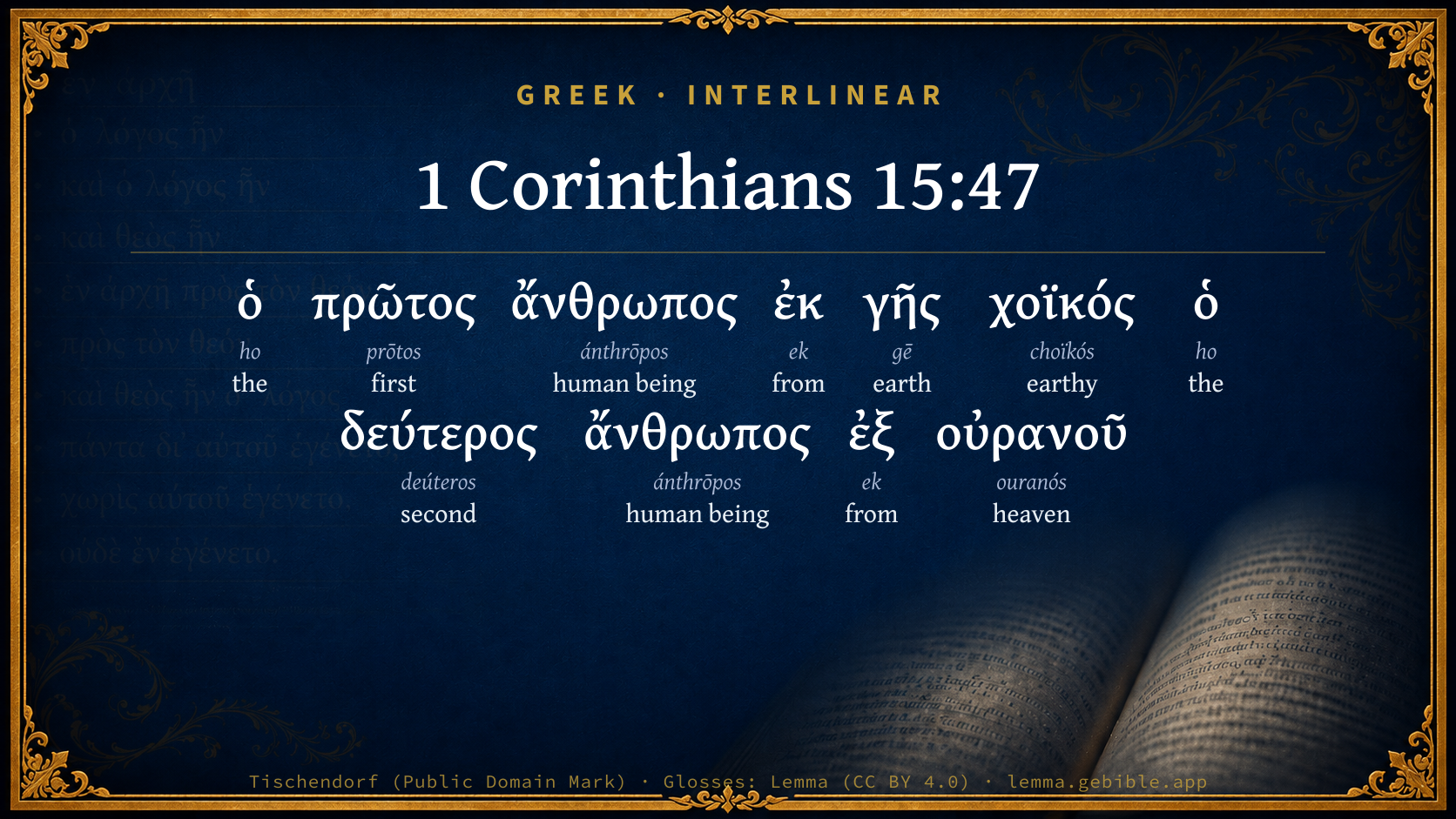
Download image
Cite this verse

1 Corinthians 15:47 (World English Bible). Public Domain. Lemma interlinear Bible study tool, https://lemma.gebible.app/v/1-corinthians/15/47.

Show BibTeX & RIS
BibTeX
RIS
English Translation
The first man is of the earth, made of dust. The second man is the Lord from heaven.
World English Bible · Public Domain
Highlights
  • 1 first appearance in the Greek New Testament
Full analysis ↓
Download a study sheet

One document with this verse’s original text, its word-by-word gloss line, the meaning frame, cross-references with their text, attributed commentary, and full source and license credits — printable, and it pastes into notes with its structure intact.

This verse Autodidact and up

Study sheet (.html) Plain text (.txt)

A passage Seminary Student

Up to 50 verses in one chapter. A passage sheet keeps up to 6 commentary sources and 12 cross-references per verse, in the order this page ranks them, and says so on the sheet whenever that leaves anything out. Ask for a single verse and you get the Autodidact verse sheet above.

Everything on this page stays free to read, with no account — the sheet is a download of what is already on screen, not access to it.

Want to remove ads? Support Godless Engineer
Compare translations 3

The same verse in 3 English versions, stacked beneath the original-language interlinear above. Click any original word for its lexicon entry.

Each is an independent rendering of the whole verse — the interlinear is not word-aligned to these translations.

Highlighted words mark where these versions differ — a whole-verse word diff, not a word-by-word alignment.

  • World English Bible Public Domain
    The first man is of the earth, made of dust. The second man is the Lord from heaven.
  • King James Version Public Domain
    The first man is of the earth, earthy; the second man is the Lord from heaven.
  • unfoldingWord Literal Text CC BY-SA 4.0
    The first man of the earth, made of dust. The second man from heaven.

unfoldingWord Literal Text — © unfoldingWord, licensed CC BY-SA 4.0. Word-aligned USFM3 via Door43 (git.door43.org/unfoldingWord/en_ult).

Versions to compare (up to 4)

3 of 4 selected

Show all 19 translations

Every available English version of this verse, each an independent rendering of the whole verse.

  • World English Bible Public Domain
    The first man is of the earth, made of dust. The second man is the Lord from heaven.
  • Berean Standard Bible Public Domain
    The first man was of the dust of the earth, the second man from heaven.
  • Majority Standard Bible Public Domain
    The first man was of the dust of the earth; the second man is the Lord from heaven.
  • King James Version Public Domain
    The first man is of the earth, earthy; the second man is the Lord from heaven.
  • American Standard Version (1901) Public Domain
    The first man is of the earth, earthy: the second man is of heaven.
  • Revised Version (1885) Public Domain
    The first man is of the earth, earthy: the second man is of heaven.
  • Geneva Bible (1599) Public Domain
    The first man is of the earth, earthly: the second man is the Lord from heauen.
  • Douay-Rheims (1899) Public Domain
    The first man was of the earth, earthly: the second man, from heaven, heavenly.
  • Young's Literal Translation Public Domain
    The first man `is' out of the earth, earthy; the second man `is' the Lord out of heaven;
  • Literal Standard Version CC BY-SA 4.0
    The first man [is] out of the earth—earthly; the second Man [is] the LORD out of Heaven;
  • Unlocked Literal Bible CC BY-SA 4.0
    The first man is of the earth, made of dust. The second man is from heaven.
  • unfoldingWord Literal Text CC BY-SA 4.0
    The first man of the earth, made of dust. The second man from heaven.
  • Darby Bible Public Domain
    the first man out of [the] earth, made of dust; the second man, out of heaven.
  • World Messianic Bible Public Domain
    The first man is of the earth, made of dust. The second man is the Lord from heaven.
  • Webster's Bible Public Domain
    The first man is from the earth, earthy: the second man is the Lord from heaven.
  • Free Bible Version CC BY-SA 4.0
    The first man is from the dust of the earth; the second man is from heaven.
  • Bible in Basic English Public Domain
    The first man is from the earth, and of the earth: the second man is from heaven.
  • Text-Critical English NT CC BY 4.0
    The first man was from the earth, made of dust; the second man is the Lord from heaven.
  • Tyndale New Testament (1534) Public Domain
    The fyrst man is of the erth erthy: the seconde man is the Lorde from heaven.

Literal Standard Version (2020), Covenant Press — licensed CC BY-SA 4.0. Text via the HelloAO Bible API (eBible.org). Unlocked Literal Bible (unfoldingWord) — licensed CC BY-SA 4.0. Text via the HelloAO Bible API (eBible.org). unfoldingWord Literal Text — © unfoldingWord, licensed CC BY-SA 4.0. Word-aligned USFM3 via Door43 (git.door43.org/unfoldingWord/en_ult). Free Bible Version, Dr. Jonathan Gallagher — licensed CC BY-SA 4.0. Text via the HelloAO Bible API (eBible.org).

Word by word

More ways to search: Search by grammar → Find every occurrence → Compare this word →

Practice this passage: Drill this verse → Learn its vocabulary →

About this verse

These counts appear in no published source. They are computed here, from the morphology-tagged text and Lemma’s own curated glosses. What Lemma adds →

11
words
8
distinct lemmas
Pauline Epistles
section

Notable vocabulary

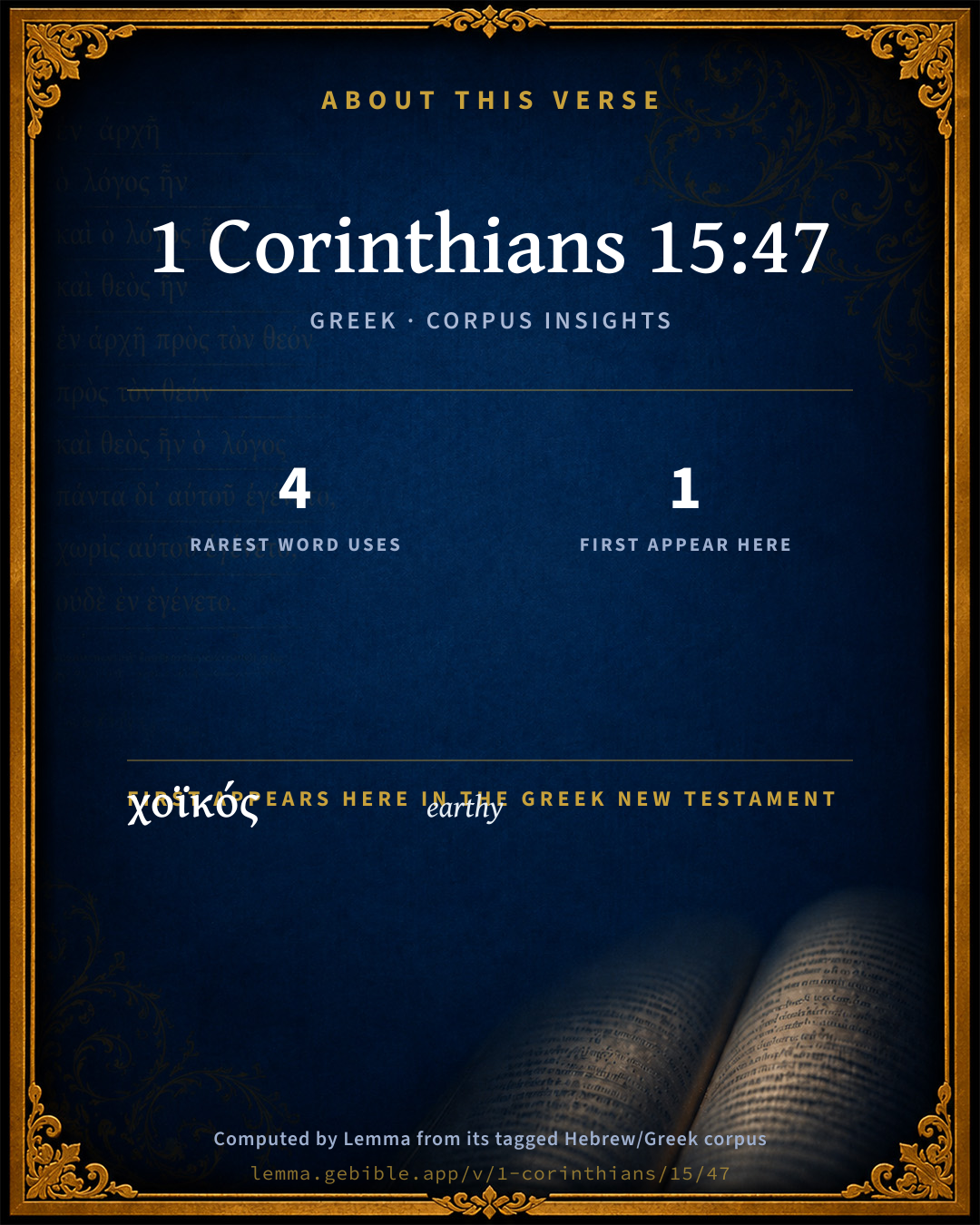
The rarest word here is χοϊκός earthy G5517 — appearing just 4 times in the whole Greek New Testament.

First appearance in Scripture

This word makes its first canonical appearance in the Greek New Testament here:

  • χοϊκός earthy G5517

Shared distinctive vocabulary

χοϊκός earthy G5517 occurs in 3 verses of the Greek New Testament. Also found in:
Repetition

Words recur within this verse:

  • ἄνθρωπος human being G444 ×2
  • ὁ the G3588 ×2
  • ἐκ from G1537 ×2

Cross-references

15

Topical passages linked to 1 Corinthians 15:47 in the Treasury of Scripture Knowledge — connected by theme and wording, ordered by reader-vote popularity; previews shown in the World English Bible.

  • John 3:31 He who comes from above is above all. He who is from the Earth belongs to the Earth, and speaks of the Earth. He who comes from heaven is above all.
  • Genesis 2:7 Yahweh God formed man from the dust of the ground, and breathed into his nostrils the breath of life; and man became a living soul.
  • Genesis 3:19 By the sweat of your face will you eat bread until you return to the ground, for out of it you were taken. For you are dust, and to dust you shall return."
  • 2 Corinthians 5:1 For we know that if the earthly house of our tent is dissolved, we have a building from God, a house not made with hands, eternal, in the heavens.
  • Isaiah 9:6 For to us a child is born, to us a son is given; and the government shall be on his shoulder: and his name shall be called Wonderful, Counselor, Mighty God, Everlasting Father, Prince of Peace.
  • Luke 2:11 For there is born to you, this day, in the city of David, a Savior, who is Christ the Lord.
  • John 3:12–13 If I told you earthly things and you don't believe, how will you believe if I tell you heavenly things?
  • 1 Corinthians 15:45 So also it is written, "The first man, Adam, became a living soul." The last Adam became a life-giving spirit.
  • Jeremiah 23:6 In his days Judah shall be saved, and Israel shall dwell safely; and this is his name by which he shall be called: Yahweh our righteousness.
  • Matthew 1:23 "Behold, the virgin shall be with child, And shall bring forth a son. They shall call his name Immanuel;" Which is, being interpreted, "God with us."
  • Luke 1:16–17 He will turn many of the children of Israel to the Lord, their God.
  • John 6:33 For the bread of God is that which comes down out of heaven, and gives life to the world."
  • Acts 10:36 The word which he sent to the children of Israel, preaching good news of peace by Jesus Christ--he is Lord of all--
  • 1 Timothy 3:16 Without controversy, the mystery of godliness is great: God was revealed in the flesh, Justified in the spirit, Seen by angels, Preached among the nations, Believed on in the world, And received up in glory.
  • Ephesians 4:9–11 Now this, "He ascended," what is it but that he also first descended into the lower parts of the earth?

Cross-references courtesy of OpenBible.info (CC BY 4.0).

Where the printed editions differ

1 variant

Places in this verse where the major printed Greek editions disagree on the wording in a way that affects the translation — a comparison of editions, not a manuscript-by-manuscript collation. The editions are the modern critical texts (Nestlé-Aland 28/27, SBL, Westcott-Hort, Tregelles, Tyndale House) and the traditional texts behind the KJV (the Textus Receptus and the Byzantine/Majority text). It is not a claim about which reading is original.

  1. Extra text
    ὁ κύριος

    “[is] the Lord”

    In TRByz Not in NA28NA27TynSBLWHTreg

    ὁ κύριος (ho kurios) '[is] the Lord' is only in traditional manuscripts (TR+Byz)

Textual data: Translators Amalgamated Greek New Testament (STEPBible TAGNT) · CC BY 4.0.

Commentary

Notes on 1 Corinthians 15:47 from classic Christian and Jewish commentators (each source and its license shown beneath its notes). The classic Christian expositions comment on the surrounding passage and are grouped to its opening verse, so a note may address several verses; the Jewish commentaries on the Tanakh (Rashi and others) are per-verse, so they appear only where the commentator wrote on this verse.

Lemma curates 59 commentaries, every one of them public domain or Creative Commons licensed, each selected and text-cleaned for this edition rather than reprinted as found. About our sources →

The Biblical Illustrator

Joseph S. Exell

1Co_15:47-49

The first man is of the earth, earthy: the second man is the Lord from heaven.

The first and second man

I. The first--is of the earth, earthy--consequently--

1. Confined to earth.

2. Perishes with the earth.

II. The second--from heaven, heavenly.

1. Rules the earth.

2. Opens heaven.

3. Lives for ever. (J. Lyth, D.D.)

Of the earth, earthy

Χοϊκος properly means clayey, but is here used to express mans terrestrial nature. Because he is of the earth in his origin--i.e., as to his body, there is a terrestrial side to his nature and sphere of action. From this we may infer--

I. That man in his sinless state had a body capable of dying. If he had continued sinless, his body would have been rendered immortal by a Divine act, and we gather from Gen_3:22 that the tree of life was the appointed sacrament of immortality. This is consistent with Rom_5:12. In the case of man sin brought death, not mortality, into the world. The correctness of this hypothesis is confirmed by the side light it throws upon the voluntariness of Christs death. As Christ was sinless, death was not a necessity to Him, though He had a mortal body; and as He was Divine as well as sinless, death was impossible to Him without a voluntary act of laying down His life.

II. That the divine image in adam consisted, negatively, in sinlessness and, positively, in a potential and rudimentary goodness; by no means in the full perfection of human nature. Christ does infinitely more than restore our original state (cf. Wis_8:1)

. (Principal Edwards.)

The second man

In what sense is our Lord the second man? There were so many millions intervening between Him and Adam. The answer is that all the others were mere copies of the first; whereas Christ introduced a new kind of man, and became the head of a new family.

I. The differences between Adam and Christ. There is a difference.

1. Of origin.

(1) The first man is of the earth, earthy.

(a) Whatever may be said of Adams Divine parentage, according to his physical nature, he and his belong essentially to this earth; they are part of its fauna, and stand at the head of long lines of animal life, which, commencing with the lowest of sensitive creatures, find their highest term in man. All the materials of his physical life and being belong to the planet of which he is the chief inhabitant, of whose vital forces he is simply the highest outcome, the most elaborated product.

(b) There are many who tell us that man is of the earth, earthy, in the sense of being descended from the lower forms of animal life through the process of natural selection; but this can only be received as an hypothesis; yet there is nothing in it contrary to Scripture. If true it gives a new and most marvellous aspect to the Incarnation. Of course, if our ancestors were marine ascidians, so were His; and thus we see Him in an unexpected sense, gathering together in one, and summing up in Himself all created life (Eph_1:10), and reuniting it unto God. I do not know why a Christian should be staggered at the thought of one unbroken continuity of life; for the great gap in the cycle of life, which seemed to be eternally impassable, was above man, not below him, and yet we know that this gulf which separated the highest creature by an infinite distance from the Creator was bridged by the condescension of the Son.

(2) For the second man was the Lord from heaven. His origin was as distinctly Divine and heavenly as Adams origin was earthy.

2. Of nature. This difference was not in wealth, happiness, beauty, nor in any of those things which ordinarily make one man superior to another, for in all these things Christ voluntarily placed Himself at a disadvantage; but it was in holiness.

(1) Adam was a rebel, a sinner; and after him all we are the same. No doctrine of the Scripture is more confirmed by constant experience, or more in accordance with modern science than that of hereditary sin. For not only does every child afford a fresh example of the tendency to do wrong, but as the instinct by which the young bird feeds itself is the transmitted experience of its remote ancestors, so the mortal evil which began in Adam has become an inseparable characteristic of his race.

(2) But Christ was not sinful. Coming into the world by a miraculous and immaculate conception, it was said to Mary, That holy thing which shall be born of thee shall be called the Son of God; and this holiness, which belonged to Him by virtue of His origin, He kept spotless amidst all the temptations of His earthly life. And what was the consequence of this holiness? This--that He was by right immortal and incorruptible, even as man; death and the grave could have no claim on One who had no sin. But did He not die? Yes, truly; but it was by His own permission. Being holy, although He was capable of death, it was not possible that He should be holden of it. I have seen some large insect fly into a spiders web, and the hungry spider has come forth with haste, thinking he has caught a finer prize than has fallen into his clutches for many a long day. But the prisoner is stronger than any for which the web was made; he gathers up his might, he throws himself hither and thither, he shakes the web violently, he rends it from top to bottom--he is gone, and has left the broken net and the baffled spider behind him. Even so death had spread his snares for the sons of men, and had caught them all one by one, and had held them fast; at last came the Son of Man, and He, too, died like men, and death and hell rejoiced together over their notable captive. But they did not rejoice long; their toils were not made for Him. The bands of death were to Him as the green withes were to Samson. As the flush of morning comes back upon the earth, as the tints of spring return upon the trees, and we cannot say at what moment it begins, so did Christ rise, we know not when; it needed no effort nor preparation; it was as natural and proper to Him to live, to be abroad in the freedom of unfettered life, as it is for the dew to rise when the sun is warm.

II. Christ is called the second adam because--

1. He introduced into the world a new type, a new order of humanity--a child of man, indeed, but such a child of man as had never been seen before. He was the beau ideal of the human race; all that is noble and lovely in other human beings was united in Him, and all that is noble and lovely in our dreams and fancies about what human beings might be was realised in Him. You have heard of those tropical plants which are said to blossom but once in a hundred years, then, having thrown up a single spike of exquisite white blossom, to die. This (however exaggerated in fact) may serve to illustrate the relation of Christ to the human race: once, and once only, humanity blossomed up and put forth one exquisite faultless flower, in which its entire life culminated, in which all its possibilities were exhausted; that flower was Christ, the Son of Man, par excellence, the second man.

2. But Adam not only set a type, but he began a race, a series like himself, and thus he became the fountain-head of a guilty and perishing humanity. In like manner Christ began a new race, and became the fountain.head of a new regenerate human life, cleansing itself from sin, rising victorious over death. (R. Winterbotham, M.A.)

The believers pedigree

1. On the one side traced to Adam who is of the earth--on the other to Christ who is the Lord from heaven.

2. On the one side he derives an earthly nature, on the other a heavenly.

3. On the one side he is stamped with the features of the earthy, on the other with those of the heavenly.

4. On the one side he can claim no inheritance in the kingdom of God, on the other becomes heir of all things. (J. Lyth, D.D.)

As is the earthy, such are they also that are earthy.--

The earthy and the heavenly

I. The earthy--frail, sensual, dying--can only produce his like.

II. The heavenly--pure, spiritual, immortal--communicates His own nature by a new birth, to be consummated in the resurrection. (J. Lyth, D.D.)

As is the heavenly, such are they also that are heavenly.--

The assimilation of Christians to the Redeemer

I. The redeemer of the world is the heavenly.

1. The Scriptures represent Him as the express character of Gods person, the brightness of His glory. The perfections of the Divine nature indeed shine forth in all the works of creation; but there is a clearer and more glorious display of them all in God manifest in the flesh.

2. His life and character demonstrate Him to be the Heavenly.

II. The points of similarity between the heavenly and those with whom he stands connected.

1. That we may be humble, contemplate the dissimilarity. There is in Him the complete perfection of those various graces and virtues of which, in the saints, there is only an extremely remote resemblance.

2. But although the dissimilarity be great, there is an obvious similarity.

(1) In heavenliness of mind. A carnal Christian is a contradiction in terms.

(2) In faith. Like Christ, they put their trust in their heavenly Father.

(3) In being of a devotional spirit.

(4) In humility.

(5) In their conversation.

(6) In active goodness. (T. Swan.)

On heavenly-mindedness

A soul chained down to earth is as little suited for the occupations of heaven as is a body framed of the dust for becoming the eternal tenement of a spirit that liveth for ever. Temper, in its widest acceptation, is the uniform frame of the mind; the disposition, which it partly derives from nature and partly from circumstance; but to which, in its better condition, it is principally reduced by Divine grace and by religious cultivation. Thought is a sudden conception or a process of the intellect, and the fitful spring of action. Passion is a desultory violence of the soul when roused by external impressions. Both thought and passion are subject to variations in the same breast, and both may have intervals of cessation. But disposition is the inward light--the permanent hue of the heart, which tinctures the moral complexion, and blends with the whole course of thought, action, passion and existence. What, then, is that spirit, that disposition, which prevails among the blessed above, and by imitating which we may humbly aspire to be joined to their high and holy association?

1. In its reference to God it implies a spirit of devotion. To acquire the habit of contemplating, under all circumstances, the bond which connects earth with heaven, and of acknowledging the impulse which all the affairs of life are constantly receiving from an unseen arm: to discover providence where ignorance sees but chance, or where pride confesses only the power of man; to hear the voice of God in the accents of instruction; to trace His workmanship in the magnificence of Nature; to admire His beneficence throughout the varied year, whether crowned with blossoms or laden with sheaves--this is to imbibe the spirit of the heavenly; for the works and the wonders of Providence, we may rest assured, for ever occupy the meditations, the converse, and the praises, of the blessed, in the courts of light.

2. The temper and spirit of heaven may be considered, secondly, as it relates to our neighbour. Charity is the bond of union among the blessed above; all is there harmonious as the silent chime of the spheres.

3. It now remains to consider heavenly-mindedness in its immediate relation to ourselves. Humility is the pre-eminent virtue of the heavens. Another feature in the disposition which looks towards a heavenly prototype, and a feature relating to ourselves, is purity. The enjoyments of heaven, and the affections of its inhabitants, we may be sure, are unstained by the cloud or shadow of a thought that may suffuse the mind with the tinge of shame. But the crowning quality of temper, which at once unites and assimilates probationary mortals unto the multitude--the Sabaoth of heaven--is serenity. To this entire composure it cannot be expected that creatures such as we, in a state like that which we inherit, can attain. But here, too, though all may not be achieved or hoped, the task is not to be wholly relinquished. Some self-discipline is practicable; and what is practicable is what God expects. We have the treasury of grace for our feebleness--we have devotion as the key which unlocks it. (J. Grant, M.A.)

As we have borne the image of the earthy, we shall also bear the image of the heavenly.

The image of the earthy and of the heavenly

I. The image of the earthy.

1. Sin.

2. Sorrow.

3. Death.

II. The image of the heavenly.

1. Holiness.

2. Happiness.

3. Life. (F. A. Cox, LL.D.)

The attainment of the image of the heavenly

The great hindrance to our reception of the full power of these words lies in the difficulty of realising them as a present experience. We fancy that death is the great magician. Paul contemplated the change as actually begun. We were once merely natural men, and knew nothing of the higher spiritual world. Then quickened by the grace of God in Christ we became spiritual. Thus because the quickening Spirit of Christ is forming His image in us now, the earthly shall perish, and we shall wear the image of the heavenly. Just as the flowers which open beneath the summer sunshine are folded in the dark buds which are beaten and tossed in the winter winds; just as the strength of will, the fire of feeling, etc., of a man are hidden in the child, so the heavenly life is within us now, and because it is there it is possible for us to reach the full formed image of the heavenly.

I. The great aim of Christian aspiration--to bear the image, etc. This is one of the deepest longings of the soul. We yearn for rest, for service, for happiness; but there is a deeper longing; we want to be holier, heavenlier men. This is also the all-embracing Christian aim. Every prayer for light, blessedness, strength, is gathered up and centred in the aim to be like Christ. Observe His image has three great features.

1. Divine vision--the spiritual insight that realises the presence of God and the unseen world. It is true that we cannot see God and the radiance of eternity with the bodily eye; but were we like Christ, we should apprehend them through the sympathies of the soul.

2. Divine love. We admit the feebleness of our love to God, yet in many ways we aspire after a deeper love. What means our perpetual unrest, our constant effort after the unattained, etc., but the yearning after that love of God which alone can fill us, our longing after the image of Christ who realised it fully.

3. Divine power.

II. The hindrance to its attainment. The image of the earthy, i.e., the body of corruption whose tendency is--

1. To limit aspiration to the earthy.

2. To become an aid to the sin of the soul.

Conclusion:

1. Our aspirations must be earnest and real. What we sincerely aspire to be we may become.

2. Our endeavour must be practical. Meditation alone will do but little.

3. God will aid us by the discipline of life. Many strokes may be needed; but as the form of immortal loveliness lies concealed in the block of stone, and is being moulded stroke by stroke by the sculptors genius, so the heavenly form in man is being developed by the Eternal Sculptor, who by His discipline is unveiling in us the image of His Son. (E. L. Hull, B.A.)

Perfection in heaven

I. Wherein consists the image of the earthy.

1. In innocent infirmities; hunger, thirst, weariness, etc., and the like. How unlike are we in this respect to the blessed who hunger no more, and thirst no more, and rest not day nor night.

2. In sinful imperfections, commonly expressed by the want of original righteousness, and the corruption of nature.

3. In the consequences.

(1) The miseries of this life.

(2) Death.

(3) A liableness to suffer under the wrath and curse of God for ever.

II. The respects in which true believers shall bear the image of the heavenly.

1. In the glorious spirituality of the body. How vastly will it differ from what it now is (verses 42-44).

2. In the perfect holiness of the soul.

3. In complete happiness.

4. In immortality. (D. Whittey.)

The believers assimilation to Christ

I. The characters here placed in contrast.

1. The earthy.

2. The heavenly.

II. The fact assumed--that we have all borne, etc.

1. The first man is emphatically styled earthy (verse 47).

(1) On account of his origin.

(2) Because of his tendency.

(3) Because of his apostasy.

2. But Christ is the heavenly One, because of--

(1) His pre-existence.

(2) The moral beauty and glory displayed by Him while on earth.

3. Therefore it is said that we have borne the image of the earthy.

4. And not only because of this, but also because the first mans moral image has become characteristic of us.

III. The promise in reference to believers. A perfect moral resemblance to Christ will be attained at the last day. (J. Scott.)

Mans present and future

I. Confirm the lamentable fact that, by nature, we all bear the image of the earthly. So says my text; so says my experience, the melancholy experience of all ages and nations; so witness our own feelings in the endurance of those ills to which mortality is subject. Behold it--

1. In our bodies, which are earthly, frail, and tending to dissolution. What is that in the cold corpse which shocks the feelings of humanity, and harrows up the soul? It is the image of the earthly Adam! And ere long you shall bear it too.

2. We all bear this image in our souls.

(1) Our souls are defiled with sin.

(2) Our souls are exposed to Divine wrath, and thus bear the image of the earthly.

II. Rejoice in the glorious truth that, as believers, we shall also bear the image of the Lord from heaven.

1. It is first impressed upon us at the time of our regeneration. Effectual grace then gives a new bias to the mind, and the Father of the spirits of all flesh then makes us new creatures in Christ Jesus. The Saviour imparted to us the principle of grace; He made us, who before lived only for folly and sin, to pant after holiness as our noblest pursuit; to grasp after purity as our noblest attainment.

2. This image shall visibly discover itself through the whole course of the Christians life, producing a happy effect upon his temper, his passions, his pursuits; it shall make him to speak, to look, to live, like the children of God.

3. This image shall be rendered more striking and glorious on the resurrection morning. (T. Spencer.)

The Biblical Illustrator, edited by Joseph S. Exell (c. 1880s–1900s) — public domain. Text from a community e-Sword module.

Joseph Benson's Commentary

1Co 15:47-49. The first man is [was] of the earth, earthy — Being from earth, and having forfeited his immortality by sin, he became subject to corruption and dissolution, like the earth from which he came. The second man is the Lord from heaven — St. Paul could not well say, “is of, or from heaven, heavenly:” because though man owes it to the earth that he is earthy, yet the Lord does not owe it to heaven that he is glorious. He himself made the heavens, and by descending from them, showed himself to us as the Lord. Christ is called the second Adam in this respect, that as Adam was a public person who acted in the stead of all mankind, so was Christ; and as Adam was the first general representative of men, Christ was the second and the last: and what they severally did, terminated not in themselves, but affected all whom they represented. As is the earthy —

The first Adam after his fall; such are they also that are earthy — Who continue without any higher principle; they are sinful, mortal, corruptible creatures: such a body as Adam had, have all his posterity while they remain on earth. And as is the heavenly — Man, Christ, at present; such are — Or rather, shall be; they that are heavenly — Who are united to Christ by the quickening and regenerating influences of his Spirit. That they may live with him in heaven, they shall at last have glorious bodies like his. And as we have borne the image of the earthy — As assuredly as we are now sinful, afflicted, and mortal men, like the first Adam; we shall also bear the image of the heavenly — So surely shall we be brought to resemble Christ in holiness, glory, and immortality.

Joseph Benson's Commentary on the Old and New Testaments (1811–1818) — public domain. Text from a community e-Sword module.

Tyndale Open Study Notes

Tyndale Open Resources

15:47 made from the dust of the earth: Adam’s earthly origin (Gen 2:7) is here contrasted with Christ’s heavenly origin.

Tyndale Open Study Notes — © Tyndale Open Resources, licensed CC BY-SA 4.0. Text via the HelloAO Bible API.

Bengel's Gnomon

Johann Albrecht Bengel

1Co 15:47. Ὁ πρῶτος ἄνθρωπος, ἐκ γῆς, χοϊκος· ὁ δεύτερος, ὁ Κύριος ἐξ οὐρανοῦ, the first man is of the earth, earthy; the second man is the Lord from heaven) We have here an exact antithesis. The first man, ἐκ γῆς, viz. ὢν, since he is of the earth, is χοϊκὸς, earthy, affected in the same way as a heap of earth (χοῦς) χυτὴ, accumulated, and then scattered: the reason of this is, because he is sprung from the earth. This is the protasis; the apodosis follows, in which it would not have been appropriate to say, the second man, from [of] heaven, heavenly; for man owes to the earth his obligations for this, that he is earthy; but the Lord does not owe His glory to heaven, inasmuch as it was He Himself who made heaven what it is, and by descending from heaven, presented Himself to us as the Lord. Therefore the order of the words is now changed, the Lord, from heaven [Lord coming before from heaven; whereas earthy, the antithesis to Lord, comes after of earth]. The word Lord signifies the same thing in the concrete, as glory does in the abstract (Germ. Herr, Herrlichkeit, Lord, Lordship), whence it is properly opposed to earthy, 1Co 15:43; Php 3:20, etc.: and from this glory is derived the incorruptibility of Christ’s flesh, Act 2:24; Act 2:31. In this way the received reading is defended, and the various readings, although ancient, which are mentioned in the Apparatus, are withdrawn.[144]

[144] BCD corr. later, G Vulg. g (these last three add οὐράνιος) f omit ὁ Κύριος. Rec. Text retains the words, with A (according to Tisch., but Lachm. quotes A against the words), Marcion (according to Tertullian) both Syr. Versions. Origen, 2,559d supports them. But in 4,302d he rejects them.—ED.

Bengel's Gnomon of the New Testament — English translation (T&T Clark, Edinburgh, 1860) — public domain. Text from a community e-Sword module.

Meyer's Critical & Exegetical Commentary

Heinrich August Wilhelm Meyer

1Co_15:47, by the concrete phenomena of the two heads of the race of mankind, Adam and Christ.

The principal emphasis is upon πρῶτος and δεύτερος, so that the former corresponds to the πρῶτον, and the latter to the ἔπειτα of 1Co_15:46; hence, too, ἔσχατος is not used here again. The first man (not the second) is of earthly origin, earthy (consisting of earth-material); the second man (not the first) is of heavenly origin.

ἐκ γῆς χοϊκός] Origin and material nature. Comp. Gen_2:7, χοῦνλαβὼν ἀπὸ τῆς λῆς; Ecc_3:20; Ecc_12:7; 1Ma_2:63. That the article (Joh_3:31) was not required with γῆς (in opposition to van Hengel, who, on account of the lacking article, explains it, terrenus sc. terram sapiens; and then χοϊκός; humilia spirans) is clear not only in general (see Winer, p. 114 [E. T. 149]), but also from passages such as Wis_15:8; Wis_17:1; Sir_36:10; Sir_40:11. It may be added, that since, by the words ἐκ γῆς χοϊκός, Adams body is characterized as ψυχικὸν σῶμα, as in 1Co_15:45, and the psychical corporeity, again, taken purely in itself (without the intervention of a modifying relation), includes mortality (1Co_15:44), it is clear that Paul regards Adam as created mortal, but so that he would have become immortal, and would have continued free from death, if he had not sinned. The protoplasts are accordingly in his eyes such as under an assumed condition potuerunt non mori, which, however, through the non-fulfilment of this condition, i.e. through the Fall, came to nothing; so that now death, and that as a penalty, came to be a reality,a view which agrees alike with his own doctrinal statement, Rom_5:12,[85] and also with Genesis. For had the protoplasts not sinned, they would, according to Genesis, have remained in Paradise, and would have become immortal (Gen_3:22) through the enjoyment of the tree of life (Gen_2:9), which God had not forbidden to them (Gen_2:16-17). But they were driven out of Paradise, before they had yet eaten of this tree (Gen_3:22); and so, certainly, according to Genesis also, through sin came death into the world as the penalty appointed for them by God (Gen_2:17). Comp. Augustin, De pecc. meritis et remiss. i. 5 : ipsum mortale non est factum mortuum nisi propter peccatum; see, too, Ernesti, l.c. p. 248 f.; Ewald, Jahrb. II. p. 153 f.

ἐξ οὐρανοῦ] of heavenly derivation. This applies to the glorification of the body of Christ,[86] originating from heaven, i.e. wrought by God (comp. 2Co_5:2), in which glorified body He is in heaven, and will appear at His Parousia (comp. Php_3:20). Comp. on 1Co_15:45. According to de Wette (comp. also Beyschlag in the Stud. u. Krit. 1860, p. 437 f., and Christol. pp. 228, 242), it applies to the whole personality of Jesus, which, through its preponderating spirituality, has also a spiritual body, or to the heavenly origin characterizing the nature of the whole person (Beyschlag). But the above-given definite reference is the only one which corresponds, in accordance with the text, to the contrast of ἐκ γῆς χοϊκός, which applies to the formation of Adams body, as well as to the whole point of the development (σῶμα πνευματικόν). Van Hengel is wrong in seeking to conclude from the absence of the article here also, that the heavenly dignity of Jesus is meant. Comp. 2Co_5:2; Gal_1:8. Paul has the article before οὐρανός or ΟὐΡΑΝΟΊ, after ἘΚ or ἈΠΌ, only in 1Th_1:10.

No predicate in the second clause corresponds to the ΧΟΪΚΌς of the first half of the verse,[87] because the material of the glorified body of Christ transcends alike conception and expression.

[85] In connection with this, no difficulty whatever is occasioned by the ἐφʼ ᾦ πάντες ἥμαρτον, Rom_5:12, according to its correct interpretation, which does not make it refer to the individual sins of the posterity; see on Rom. l. c. The Pelagian view, that Adam, even if he had not sinned, would have died, is decidedly against the Pauline doctrinal conception. This in opposition to Schleiermacher, Neander, and others; especially, also, against Mau, v. Tode, d. Solde der Sünde, 1841.

[86] Hence Gess (v. d. Person Chr. p. 75) very irrelevantly objects to the reference to the body of Christ, that that body was not from heaven, but from the seed of David. Delitzsch (Psychol. p. 334 ff.), by referring ἐξ οὐρανοῦ back to the incarnation, which is contrary to the context, mixes up things that differ. Beyschlag (comp. also his Christol. p. 226) finds in our text a heavenly humanity of Christ (human pre-existence); but the connection and the contrast lead us only to the heaven-derived body of the risen and exalted One. Comp., too, Hofmann and J. Müller, v. d. Sünde, p. 412, ed. 5; Weiss, bibl. Theol. p. 315 f.

[87] Delitzsch, Psychol. p. 336, prefers the Marcionitic reading: ὁ δεύτερος κύρ. ἐξ οὐρ., i.e. the second is Lord from heaven. According to the critical evidence, this reading deserves no consideration. Offence was taken at ἄνθρωπος.

Meyer — Critical and Exegetical Commentary on the New Testament — English translation by Peter Christie, edited by Frederick Crombie (T&T Clark, 1880) — public domain. Text from a community e-Sword module.

Expositor's Greek Testament

ed. W. Robertson Nicoll

1Co 15:47-49 draw another contrast between the two “men,” types of the two eras of humanity, which is suggested by the words χοῦν ἀπὸ τῆς γῆς (‘ aphâr minha’adamâh ) of Gen 2:7 . The first is ἐκ γῆς , χοϊκός ( terrenus , Vg [2556] ; more literally, pulvereus , Bz [2557] ); the second is ἐξ οὐρανοῦ (om. ὁ Κύριος ). The former epithets, and by antithesis the latter, point to bodily origin and substance ( cf. 40, also 2Co 4:7 , ἐν ὀστρακίνοις σκεύεσιν ), but connote the whole quality of the life thus determined. The expression ἐξ οὐρανοῦ ( e cœlo , Bz [2558] ; not de cœlo , Vg [2559] ) has led to the identifying of the δεύτερος ἄνθρ . with the incarnate Christ (see Ed [2560] ), to the confusion of Paul’s argument ( cf. note on 1Co 15:45 ). This phrase is suggested by the antithetical ἐκ γῆς : the form of existence in which the risen Jesus appeared was super-terrestrial and pneumatic (cf. 2Co 5:2 ); it possessed a life and attributes imparted “from heaven” by an immediate and sovereign act of God (Rom 1:4 ; Rom 6:4 , 2Co 13:4 , Eph 1:19 f., Peter 1Co 1:21 , etc.). This transformation of the body of Jesus was foreshadowed by His Transfiguration, and consummated in His Ascension; P. realised it with the most powerful effect in the revelation to himself of the risen Christ “from heaven”. The glorious change attested , indeed, the origin of Christ’s personality, but it should not be confused with that origin (Rom 1:4 ; cf. Mat 17:5 ). From His resurrection onwards, Christ became to human faith the ἄνθρωπος ἐπουράνιος (Rom 6:9 f., Rev 1:17 ff.), who was taken previously for a θνητὸς and χοϊκὸς like other men. Baur, Pfleiderer, Beyschlag ( N.T. Theology ), Sm [2561] , and others, see in the ἄνθρωπος ἐξ οὐρανοῦ the pre-existent Christ , whom they identify with Philo’s ideal or “heavenly man” of Gen 1:26 (see note on 1Co 15:45 above); on this interpretation an entire Christology is based the theory that Christ in his pre-in-carnate state was simply the Urmensch , the prototype of humanity, existing thus, either in fact or in the Divine idea, with God from eternity, and being in this sense the Eternal Son. Doubtless the “second man” is ideally first and reveals the true end and type of humanity, and this conception is, so far, a just inference from Paul’s teaching. But what P. actually sets forth is the historical relation of the two Adams in the development of mankind, Christ succeeding and displacing our first father (1Co 15:46 , see note; 49), whereas the Baurian Urmensch is antecedent to the earthly Adam.

[2556] Latin Vulgate Translation.

[2557] Beza’s Nov. Testamentum: Interpretatio et Annotationes (Cantab., 1642).

[2558] Beza’s Nov. Testamentum: Interpretatio et Annotationes (Cantab., 1642).

[2559] Latin Vulgate Translation.

[2560] T. C. Edwards’ Commentary on the First Ep. to the Corinthians . 2

[2561] P. Schmiedel, in Handcommentar zum N.T. (1893).

The above χοϊκὸς and ἐπουράνιος have severally their copies in χοϊκοὶ and ἐπουράνιοι (1Co 15:48 ). Is this a purely physical distinction, between pre- and post-resurrection states of the same men ( cf. 1Co 15:44 )? or is there a moral connotation implied, as Hf [2562] and Ed [2563] suggest? The latter seems likely, esp. on comparison of Phi 3:18 ff., Col 3:1-4 , Rom 6:4 , and in transition to the exhortation of 1Co 15:49 . Those who are to be “heavenly” in body hereafter already “sit in heavenly places” (Eph 2:6 ), while those are “earthy” in every sense “whose flesh hath soul to suit,” οἱ τὰ ἐπίγεια φρονοῦντες . Admitting the larger scope of 1Co 15:48 , we accept the strongly attested hortatory φορέσωμεν of 1Co 15:49 : “Let us wear also the image of the Heavenly One”. The εἰκὼν embraces the entire “man” not the body alone, the σχῆμα and σκεῦος ἀνθρώπου (Phi 2:7 , 2Co 4:7 , 1Th 4:4 ) in Adam and Christ respectively ( cf. 1Co 11:7 , 2Co 3:18 , Rom 8:29 , Col 1:15 ; Col 3:10 ); and we are exhorted to “put on Christ” (Rom 13:14 , Gal 3:27 ), realising that to wear His moral likeness here carries with it the wearing of His bodily likeness hereafter: see 1Co 15:20-23 , Rom 8:11 ; 1Jn 3:2 f.

[2562] J. C. K. von Hofmann’s Die heilige Schrift N.T. untersucht , ii. 2 (2te Auflage, 1874).

[2563] T. C. Edwards’ Commentary on the First Ep. to the Corinthians . 2

The Expositor's Greek Testament, edited by W. Robertson Nicoll (1897–1910) — public domain. Text from a community e-Sword module.

Hodge's Commentary on Romans, Ephesians & First Corinthians

Charles Hodge

1Co_15:47

The first man (is) of the earth, earthy: the second man (is) the Lord from heaven.

The general principle stated in the preceding verse, that the natural precedes the spiritual, is here illustrated by the fact that Adam came before Christ. The first man was of the earth, i.e. formed out of the earth, and therefore earthy. The second man is the Lord from heaven. Here the text is doubtful. The authorities are about equally divided for and against the reading ὁ κύριος, the Lord. The sentence is more simple if that word be omitted. The first man was from the earth; the second man was from heaven. If the common text be retained, the word Lord is in apposition with the words the second man. The second man, the Lord, was from heaven. This passage was used by the early heretics of the Gnostic school to sustain their doctrine that our Lord was not really born of the Virgin Mary, but was clothed in a body derived from heaven, in opposition to whom the early creeds declare that he was as to his human nature consubstantial with man, and as to his divine nature consubstantial with God. The text, however, simply asserts the heavenly origin of Christ. Adam was of the earth; Christ was from heaven; comp. Joh_3:13. Adam, therefore, had a body suited to the earth; Christ has a body suited to heaven.

Charles Hodge — Commentary on Romans (1835), First Corinthians (1857), and Ephesians (1856) — public domain. Text from a community e-Sword module.

Geneva Bible (1599)

Geneva Bible translators

The Lord is said to come down from heaven by that kind of speech, whereby that which is proper to one is touched of another.

Wallowing in dirt, and wholly given to an earthly nature.

Geneva Bible (1599) marginal notes — public domain. Text via Bolls.life.

Jamieson, Fausset & Brown

Robert Jamieson, A. R. Fausset & David Brown

of the earth--inasmuch as being sprung from the earth, he is "earthy" (Gen 2:7; Gen 3:19, "dust thou art"); that is, not merely earthly or born upon the earth, but terrene, or of earth; literally, "of heaped earth" or clay. "Adam" means red earth.

the Lord--omitted in the oldest manuscripts and versions.

from heaven-- (Joh 3:13, Joh 3:31). Humanity in Christ is generic. In Him man is impersonated in his true ideal as God originally designed him. Christ is the representative man, the federal head of redeemed man.

Jamieson, Fausset & Brown — Commentary Critical and Explanatory on the Whole Bible (1871) — public domain (CC PDM 1.0). Text via the HelloAO Bible API.

Adam Clarke's Commentary

Verse 47. The first man is of the earth] That is: Adam's body was made out of the dust of the earth; and hence the apostle says he was χοικος, of the dust; for the body was made עפר מן האדמה aphar min ha-adamah, dust from the ground; Ge 2:7.

The second man is - from heaven.] Heavenly, ουρανιος, as several good MSS. and versions read. The resurrection body shall be of a heavenly nature, and not subject to decay or death. What is formed of earth must live after an earthly manner; must be nourished and supported by the earth: what is from heaven is of a spiritual nature; and shall have no farther connection with, nor dependence upon, earth. I conceive both these clauses to relate to man; and to point out the difference between the animal body and the spiritual body, or between the bodies which we now have and the bodies which we shall have in the resurrection. But can this be the meaning of the clause, the second man is the Lord from heaven? In the quotation I have omitted οκυριος, the Lord, on the following authorities: MANUSCRIPTS - BCD*EFG, and two others. VERSIONS - Coptic, AEthiopic, Armenian in the margin, Vulgate, and Itala. FATHERS - Origen, who quotes it once and omits it once; Athanasius, Basil, the two Gregories, Nyssen and Nazianzen; Isidore, Cyril, Tertullian, Cyprian, Hilary, Zeno, Ambrose, Augustine, Jerome, Ambrosiaster, Philaster, Leo, Pacianus, Primasius, Sedulius, Bede, and others. See these authorities more at large in Wetstein. Some of the most eminent of modern critics leave out the word, and Tertullian says that it was put in by the heretic Marcion. I do think that the word is not legitimate in this place. The verse is read by the MSS., versions, and fathers referred to, thus: The first man is of the earth, earthy; the second man is of heaven, heavenly; κυριος being omitted and ουρανιος added. The first man and the second man of this verse are the same as the first Adam and the second Adam of 1Co 15:45, and it is not clear that Christ is meant in either place. Some suppose that there is a reference here to what Eve said when she brought forth Cain: I have gotten a man from the Lord, קניתי איש את יהוה kanithi ish eth Yehovah, I have possessed or obtained a man, the Lord; that is, as Dr. Lightfoot explains it, that the Lord himself should become man: and he thinks that Eve had respect to the promise of Christ when she named her son; as Adam had when he named his wife. If Eve had this in view, we can only say she was sadly mistaken: indeed the conjecture is too refined.

The terms first man of the earth, and second man from heaven, are frequent among the Jews: אדם לעילא the superior Adam; and אדם תתאה Adam the inferior; that is, the earthly and the heavenly Adam: Adam before the resurrection, and Adam after it.

Adam Clarke's Commentary on the Bible (1810–1826) — public domain. Text from a community e-Sword/MySword module.

Ellicott's Commentary for English Readers

(47) The second man is the Lord from heaven.—Better, the second man is from heaven. The words “the Lord,” which occur in the English version, are not in the best Greek MSS. The word which is twice rendered “of” in this verse has the force of “from,” “originating from,” in the Greek. The first representative man was from the earth, the second representative man was from heaven; and as was the first earthly Adam, so are we in our merely physical condition; and as is the second heavenly Adam, so shall we be in our heavenly state.

A Bible Commentary for English Readers, edited by Charles John Ellicott (1878–1897) — public domain. Text from a community e-Sword module.

The Cambridge Bible for Schools and Colleges

gen. ed. J. J. S. Perowne

47. The first man is of the earth, earthy] See Gen_2:7. The word earthy (χοϊκός from χοῦς dust) is an allusion to the ‘dust of the ground’ in that passage, in the Septuagint χους.

the second man is the Lord from heaven] The Vulgate reads, is from heaven, heavenly, Tyndale follows the Vulgate, and also Wiclif, who translates however, the secunde man of heuene is heueneli. Alford reads the second man is from heaven, with the majority of MSS. and versions. The law of progress, above referred to, is illustrated by the creation of the second man. The first man was ‘dust of the ground,’ and God breathed a breath of life into his soul. But the second man is not created anew altogether, but takes the first man as the starting-point of the new life. By the agency of the Holy Spirit Jesus Christ took our flesh in the womb of the Blessed Virgin, being a new creation, but not directly from heaven. See note on 1Co_15:21. This passage bears a strong resemblance to St Joh_3:31; and in the reading we have mentioned the resemblance is even stronger than in the authorized version. The margin of St Joh_3:3 may also be compared.

The Cambridge Bible for Schools and Colleges (gen. ed. J. J. S. Perowne; Cambridge University Press, 1878–1918) — public domain. Text from a community e-Sword module.

John Gill's Exposition

Now this I say, brethren,.... Upon the whole, I assert this, and observe it to you, out of a truly Christian respect for you, as brethren in the Lord, that

flesh and blood cannot inherit the kingdom of God: this shows the necessity there is of a difference between the body that now is, and that which shall be, which the apostle has so largely insisted on, and so clearly proved and explained, in the preceding verses; because the body, as it now is, is not capable of possessing the heavenly glory; was it to be introduced into heaven, in the condition it is now, it would break in pieces, and crumble into dust; it would not be able to bear the glory of that state and place: by flesh and blood is meant, not human nature as to the substance of it, or as consisting of flesh and blood, for that can and does inherit the kingdom of God; witness the human nature, or body of Christ, the bodies of the saints that rose after his resurrection, and those of Enoch and Elijah, who were translated body and soul to heaven; so that this passage makes nothing for those that deny the resurrection of the same body, and plead for a new and an aerial one: but the human nature, or body, so and so qualified, is here meant; either as corrupted with sin, for without holiness and righteousness no man shall see the Lord, or enter into and possess the kingdom of heaven; or flesh and blood, or an human body, as it is now supported in this animal life, with meat and drink, &c. and as it is frail and mortal, and subject to death, in which sense the phrase is used in Scripture; see Mat 16:17 and often by the Jews; so Abraham is represented by them as saying (i),

"I am , "flesh and blood", tomorrow I shall depart out of the world, or die:''

it would be endless to give the many instances that might be produced of this use of the phrase with them, and in which sense it is to be taken here: and the meaning is, that saints in their frail mortal bodies, such as they now are, are not capable of enjoying the heavenly glory; which is called "the kingdom", because of its riches, glory, grandeur, and magnificence; and the kingdom "of God", because it is of his preparing and giving; and what he calls his people to, and makes them meet for, and in which they will reign with him for evermore: heirs of it they may be, and are now whilst in this frail and mortal state; but inherit, possess, and enjoy it, they cannot, as not without holiness of soul, so not without immortality of body; and therefore it is necessary that the body should rise different in qualities from, though the same in substance with, the present body; that it should rise incorruptible, glorious, powerful, and spiritual; that it may be fitted for, and be able to bear the exceeding weight of glory in the other world:

neither doth corruption inherit incorruption: by corruption is not so much meant sin, or the corruption of nature, or man as corrupted by sin, though it is true of such an one, that he does not, and cannot inherit incorruption; the incorruptible crown, the crown of glory that fadeth not away, the incorruptible inheritance, reserved in the heavens, those riches which moth and rust corrupt not; but the body, as it is generated in corruption, is supported by corruptible things, and is subject to corruption and worms; in such a situation it is unfit for, and incapable of inheriting eternal glory; it must be different from what it is; it must put on immortality, and be clothed with incorruption: the word inherit in both clauses shows, that the heavenly glory is an inheritance, and belongs to children only; is their heavenly Father's bequest unto them; is not bought or acquired by anything of theirs; and is what they enter into and upon, in virtue and consequence of the death of the testator, Christ.

(i) Bemibdar Rabba, sect. 11. fol. 202. 3.

John Gill's Exposition of the Whole Bible (1746–1763) — public domain (CC PDM 1.0). Text via the HelloAO Bible API.

Trapp's Complete Commentary

John Trapp

47 The first man is of the earth, earthy: the second man is the Lord from heaven.

Ver. 47. Of the earth, earthy] Gr. dusty, slimy, ex terra friabili. Let this pull down proud flesh. Let us throw this proud Jezebel out of the windows of our hearts, and lay her honour in the dust, by remembering that we are but earth and dust. Adam of Adamah, red earth; homo ab humo. Humility comes from the same root, because it lays a man flat on the ground; and because, like the earth, it is the most weighty of all virtues.

The Lord from heaven] Not for the matter of his body, for he was "made of a woman;" but for the original and dignity of his person, whereof see a lively and lofty description, Heb 1:2-3.

John Trapp, A Commentary or Exposition upon All the Books of the Old and New Testament (1647–1656) — public domain. Text from a community e-Sword module.

Albert Barnes' Notes on the Bible

The first man - Adam.

Is of the earth - Was made of the dust; see Gen 2:7.

Earthy - Partaking of the earth; he was a mass of animated clay, and could be appropriately called “dust;” Gen 3:19. Of course, he must partake of a nature that was low, mean, mortal, and corruptible.

The second man - Christ; see the note on 1Co 15:45. He is called the second man, as being the second who sustained a relation to people that was materially to affect their conduct and destiny; the second and the last 1Co 15:45, who should sustain a special headship to the race.

The Lord from heaven - Called in 1Co 2:8, the “Lord of glory;” see note on that place. This expression refers to the fact that the Lord Jesus had a heavenly origin, in contradistinction from Adam, who was formed from the earth. The Latin Vulgate renders this, “the second man from heaven is heavenly;” and this idea seems to accord with the meaning in the former member of the verse. The sense is, evidently, that as the first man had an earthly origin, and was, therefore, earthy, so the second man being from heaven, as his proper home, would have a body adapted to that abode; unlike that which was earthy, and which would be suited to his exalted nature, and to the world where he would dwell. And while, therefore, the phrase “from heaven” refers to his heavenly origin, the essential idea is, that he would have a body that was adapted to such an origin and such a world - a body unlike that which was earthy. That is, Christ had a glorified body to which the bodies of the saints must yet be made like.

Albert Barnes' Notes on the Bible (1834–1885) — public domain. Text from a community e-Sword/MySword module.

Matthew Poole's English Annotations

Adam, who was the first man, was of the earth, Gen 2:7, and was of an earthy constitution, like unto the earth out of which he was formed; but Christ had another original: for though his body was formed in the womb of the virgin, and he was flesh of her flesh, yet she conceived by the Holy Ghost overshadowing her, and Christ had an eternal generation (as to his Divine nature) from his Father.

Matthew Poole's English Annotations on the Holy Bible (1683–1685) — public domain. Text from a community e-Sword/MySword module.

Whedon's Commentary on the Bible

Daniel D. Whedon

47. Of—Rather, from the earth, as the second man is from heaven. In Gen_2:7, the same Greek words occur, from the earth.

The Lord— This phrase is rejected as spurious by the best scholars; the true reading is the second man is the Lord from heaven. By this antithesis, as by the former, (1Co_15:45; 1Co_15:49,) Adam is viewed at his creation, and Christ at his second advent, producing our resurrection.

Daniel D. Whedon (gen. ed.), Commentary on the Old and New Testaments (1874–1909) — public domain. Text from a community e-Sword module.

The Pulpit Commentary

Earthy. Made of" the dust of the ground". (Gen_2:7) Is the Lord from heaven. The words "the Lord" are a gloss, not found in a, B, C, D, E, F, G. The verse remarkably resembles Joh_3:31, and probably oral reminiscences of our Lord"s discourses were current among the apostles long before the Gospels were written. Tertullian attributes the insertion of "the Lord" to Marcion.

The Pulpit Commentary (1880–1919), ed. H.D.M. Spence-Jones & Joseph S. Exell — public domain. Text from a community e-Sword module.

John Wesley's Explanatory Notes

The first man was from the earth, earthy; the second man is the Lord from heaven-The first man, being from the earth, is subject to corruption and dissolution, like the earth from which he came. The second man - St. Paul could not so well say, "Is from heaven, heavenly:" because, though man owes it to the earth that he is earthy, yet the Lord does not owe his glory to heaven. He himself made the heavens, and by descending from thence showed himself to us as the Lord. Christ was not the second man in order of time; but in this respect, that as Adam was a public person, who acted in the stead of all mankind, so was Christ. As Adam was the first general representative of men, Christ was the second and the last. And what they severally did, terminated not in themselves, but affected all whom they represented.

John Wesley, Explanatory Notes Upon the Whole Bible (1754–1765) — public domain. Text via the GEBible commentary corpus.

Godbey's Commentary on the New Testament

William B. Godbey

MORTAL, BUT DESIGNED FOR IMMORTALITY

47. “The first man is from earth earthy, the second man is from Heaven.

48. “As is the earthy, such also are they which are earthy; as is the Heavenly, such also are they who are Heavenly:

49. “As we have borne the image of the earthy, so also we must bear the image of the Heavenly.” These Scriptures clearly involve the conclusion that man was created out of earthly elements and mortal. However, the conclusion does not follow that he would have died if he had never sinned, because God had created the tree of life, the normal effect of whose fruit was to confer immortality. Hence, if they had never sinned, when they had been duly tried and tested and stood their earthly probation, guided by instinct or Providence, they would have had access to the tree of life, of whose fruit they were never forbidden to take. The effect of this fruit would have conferred immortality, i. e., ripened them for translation, which would have enabled them to fly away from this probationary world like Enoch and Elijah, and range ad libitum through the fenceless fields of glory, winging their flight from world to world. If sin had never entered, the race would have multiplied with great rapidity on the earth, pursuant to the mandate already given to “multiply and replenish the earth”; instead of getting old and dying, their families, well cognizant that their beloved parents we are ripening for glory, would have kept their eyes on them, like Elisha pursuing and watching Elijah, that he might see the last of him. Thus translation at the expiration of probation, which probably would have been a thousand and more years, was evidently the original economy. This conclusion is clearly involved from the fact that, as we live in these houses of clay bearing the image of the earthy, so are we to live in a glorified spiritual body, thus bearing the image of the Heavenly; in our case death supervened as a sanctified auxiliary under the redemptive scheme, which never would have been known if the original twain had sustained their probation. Still, however, having been created in the earthly image, they also would have passed by translation into the Heavenly.

William B. Godbey, Commentary on the New Testament (1896–1900) — public domain. Text from a community e-Sword module.

McGarvey & Pendleton's Commentaries

J. W. McGarvey

The first man is of the earth, earthy: the second man is of heaven .

J. W. McGarvey (with Philip Y. Pendleton), Commentaries on the New Testament (The Fourfold Gospel, 1914; Acts; and the epistles) — public domain. Text from a community e-Sword/MySword module.

The People's New Testament

B. W. Johnson

47. The first man is of the earth. Was fashioned out of the earth. Genesis 2:7. The second man is the Lord who came from heaven.

B. W. Johnson's The People's New Testament with Notes (1889–1891) — public domain. Electronic text from the Christian Classics Ethereal Library (CCEL) ThML edition.

unfoldingWord translationNotes

Door43 World Missions Community

The first man is of the earth, made of dust

God made the first man, Adam, from the dust of the earth. (See: Active or Passive)

dust

dirt

the man of heaven

Jesus Christ

those who are of heaven

"those who belong to God"

have borne the image ... will also bear the image

"have been just like ... will also be just like"

translationWords

earth

heaven

image

unfoldingWord translationNotes — © Distant Shores Media and the Door43 World Missions Community, licensed CC BY-SA 4.0. Source: git.door43.org/Door43/en_tn.

Cambridge Greek Testament for Schools and Colleges

47. [ὁ κύριος] bef. ἐξ οὐρανοῦ rec. with A and Peshito. Text אBCDEFG Vetus Lat. Vulg. Vulg. adds coelestis at the end of the verse. So also FG.

47. χοϊκός. χοϊκός from χοῦς, dust, is an allusion to the ‘dust of the ground’ in Gen 2:7; in the LXX. χοῦς.

ὁ δεύτερος ἄνθρωπος ἐξ οὐρανοῦ. The law of progress, above referred to, is illustrated by the creation of the second man. The first man was ‘dust of the ground,’ and God breathed a breath of life into his soul. But the second man is not created anew altogether, but takes the first man as the starting-point of the new life. By the agency of the Holy Spirit Jesus Christ took our flesh in the womb of the Blessed Virgin, being a new creation, but not directly from heaven. See note on 1Co 15:21; 1Co 15:45. This passage bears a strong resemblance to Joh 3:31; and in the reading we have followed the resemblance is even stronger than in the rec. text. Joh 3:3 may also be compared.

Cambridge Greek Testament for Schools and Colleges (Cambridge University Press, 1896; 21 vols, various authors incl. Carr, Maclear, Plummer, Farrar, Lumby, Moule, M. R. James, Simcox) — public domain. Text from a community e-Sword module.

Alford’s Greek Testament

Henry Alford

47.] So exactly in Gen 2:7. God made man χοῦν λαβὼν ἀπὸ τῆς γῆς. Meyer has some excellent remarks here, with which I entirely agree:—“Since the body of Adam is thus characterized as a ψυχικὸν σῶμα, as ver. 45, and psychical organism involves mortality (ver. 44), it is clear that Paul treats of Adam not as created exempt from death: in strict accordance with Gen 2:7; Gen 3:19. Nor does this militate against his teaching that death came into the world through sin. Rom 5:12. For had our first parents not sinned, they would have remained in Paradise, and would, by the use of the Tree of Life, which God had not forbidden them (Gen 2:16, Gen 2:17), have become immortal (Gen 3:22). But they were driven out of Paradise, ere yet they had tasted of this tree (Gen 3:22), and so, according to the record in Genesis also, Death came into the world by sin.” See also some striking remarks on the verse in Genesis in Stier, ‘Andeutungen für glaübiges Schriftver-ständniss,’ pp. 202, 3.

ἐξ οὐρανοῦ] either, in this glorified Body, at his coming,—as Meyer: or, in his whole Personality (De W.) as the God-man: this latter seems more probable from Joh 3:13, where ὁ υἱὸς τοῦ ἀνθρώπου is designated as ὁ ἐκ τοῦ οὐρανοῦ καταβάς.

Henry Alford, The Greek Testament (1849–1861) — public domain. Text from a community e-Sword module.

International Critical Commentary

47. ὁ πρῶτος ἄνθρωπος ἐκ γῆς χοϊκός. ‘The first man is of the earth, made of dust’: ἔπλασεν ὀ Θεὸς τὸν ἄνθρωπον χοῦν ἀπὸ τῆς γῆς (Gen 2:7). Otherwise we might have had γήϊνος or γηγενής: comp. γηγενοῦς ἀπόγονος πρωτοπλάστου (Wisd. 7:1). In Mar 6:11, χοῦς is used for κονιορτός (Mat 10:14; Luk 9:5; Act 13:51): comp. Rev 18:19. But χοῦς (χέω) is ‘soil’ loosened and heaped up rather than ‘dust’: χοϊκός occurs nowhere else in Biblical Greek. De terra terrenus (Vulg.); better, e terra pulvereus (Beza). What is ἐκ γῆς is liable to decay, death, and dissolution; what is ἐξ οὐρανοῦ is imperishable.

ἐξ οὐρανοῦ. This refers to the Second Advent rather than to the Incarnation. The Apostle is answering the question, ‘With what kind of a body do they come?’ It was ἐξ οὐρανοῦ, e caelo, that the Risen Lord appeared to St Paul. From the Ascension to the Return, Christ is ἐξ οὐρανοῦ in His relation to mankind. They are still ‘of earth,’ He is now ‘of heaven.’ See Briggs, Church Unity, pp. 282 f., for some valuable remarks on this passage in its bearing on eucharistic doctrine.

The AV., with A K L P, Syrr. Arm. Goth., Chrys., inserts ‘the Lord,’ ὀ κύριος, before ἐξ οὐρανοῦ: א* B C D* E F G 17, Latt. Copt. Aeth., Tert. Cypr. Hil omit. Tertullian attributes the insertion, or rather the substitution of κύριος for ἄνθρωπος, to Marcion: Primus inquit (stultissimus haereticus), homo de humo terrenus, secundus dominus de caelo. Quare secundus, si non homo, guod et primus? Aut numquid et primus dominus, si et secundus (Adv. Marcion. v. 10). Tertullian himself gives two renderings; Primus homo de terrae limo, secundus homo de caelo (De Carne Chr. 8); Primus homo de terra choicus, id est limaceus, id est Adam, secundus homo de caelo (De Res. 49). Cyprian has de terrae limo repeatedly, and once e terrae limo.

International Critical Commentary — older volumes (1896–1929), various authors — public domain. Text from a community e-Sword module.

Vincent's Word Studies in the New Testament

Marvin R. Vincent

Earthy [χοικος] . Only in this chapter. The kindred noun couv dust appears Mr 6:11; Rev 18:19. From cew to pour; hence of earth thrown down or heaped up : loose earth. Compare Gen 2:7, Sept., where the word is used.

From heaven [εζ ουρανου] . Ex out of, marking the origin, as ejk ghv out of the earth. Meyer acutely remarks that "no predicate in this second clause corresponds to the earthy of the first half of the verse, because the material of the glorified body of Christ transcends alike conception and expression." The phrase includes both the divine origin and the heavenly nature; and its reference, determined by the line of the whole argument, is to the glorified body of Christ - the Lord who shall descend from heaven in His glorified body. See Phi 3:20, 21. 13 4

Marvin R. Vincent, Word Studies in the New Testament (1887–1900) — public domain. Text from a community e-Sword/MySword module.

Godet's Commentaries

Frédéric Louis Godet

Vv. 47. “The first man is of the earth, earthy: the second man is from heaven.”

Here is the sovereign application of the general law enunciated in the previous verse. To the psychical state, which must come first, there corresponds the earthly body of the first man; as to the spiritual state, which comes second, there corresponds the heavenly body of the second Adam. This double correlation is natural; for the organ, the body, should be adapted to the mode of life of which it is the agent. And each of the two periods consecrated to these two modes of living was inaugurated by a typical individual who represented it in its entirety.

The epithet second is here intentionally substituted for last (1Co 15:45), because the point in question is no longer the final destination of man, but the relation of succession to the preceding phase. The δεύτερος, second, answers, as Meyer says, to the ἔπειτα, afterwards, of 1Co 15:46. — The qualifications: of the earth and earthy, belong both to the predicate: “The first man is of the earth, earthy.” The second term, χοϊκός, is added to show that it is in respect of the body that Paul thus speaks. The word ὁ or ἡ χοῦς denotes the fine dust which lends itself most easily to become organic matter. This term, which is found nowhere else in the New Testament except in Mar 6:11 and Rev 18:19, is borrowed from the LXX.; Gen 2:7: “God formed man of the dust of the earth” (χοῦν ἀπὸ τῆς γῆς). — Because of the contrast, the second man will also be characterized in respect of the body.

The term ὁ κύριος, the Lord, which is added by the T. R. with some documents, after ὁ δεύτερος ἄνθρωπος, has nothing corresponding in the former member; and in this context it naturally excites surprise. As it is wanting in the majority of the documents, it should be rejected from the text. The qualifying phrase from heaven corresponds at once to the two predicates of the foregoing sentence. In our ignorance as to what a heavenly body is, Paul could add no precise qualification regarding its nature to contrast with the expression: earthy.

The important question is to what time we should refer the regimen: from heaven. Does it refer to the fact of the incarnation, the coming of the heavenly Christ to the earth to complete the work of redemption? So Athanasius, Baur, Beyschlag, Edwards. Or should we apply this ἐξ οὐρανοῦ, from heaven, to the Advent, when the Lord will descend again in His glorified body to glorify the faithful? It is from the first interpretation that the Tübingen school have deduced their theory, according to which the pre-existing Christ was, in Paul’s view, a celestial man, the prototype of terrestrial humanity, possessing a luminous (spiritual) body. And thus this school has succeeded in finding an intermediate being between the purely human Christ of the synoptics and the wholly Divine Christ of St. John. But if such was Paul’s view, he must have changed his conception between our Epistles to the Corinthians and those of the Roman captivity (Colossians, Philippians), for in these he distinctly affirms the Divine state of the pre-existing Christ; he must even have changed it between our Epistle and the very near date when he composed the Epistle to the Romans, in which he ascribes to Jesus a body entirely similar to our sinful body (1Co 8:3), and therefore by no means celestial and luminous, but made of dust like ours. He must even have changed his view in the course of our Epistle, for in chap. 1Co 8:6 he ascribes to the pre-existing Christ the work of creation, and in 1Co 10:4 he identifies Him with the Lord guiding Israel in the cloud; declarations which it is impossible to harmonize with the conception of a Christ pre-existing as a celestial man. But above all, to refer these words to the fact of the incarnation, is to wrench them absolutely from the context. Gess rightly reminds us that everything here tends to the solution of the question: “With what body do they come?” a question which must of course be solved by the relation of the resurrection body, not to the body of the pre-existing, but to that of the risen Christ. As to the ἐξ οὐρανοῦ, from heaven, Gess justly quotes as parallels: 1Th 4:16 (καταβήσεται ἐξ οὐρανοῦ) and 2Th 1:7 (ἐν τῇ ἀποκαλύψει τοῦ κ. ᾿Ι. ἀπ᾿ οὐρανοῦ), two passages which point to the Advent. But the parallel Php 3:20-21, is that which above all appears to me decisive in favour of this application in our passage. There, as here, the apostle is comparing our Lord’s glorified body as well as that of risen believers made like His, with our present body, which he calls the body of our humiliation; then he says expressly: “Our citizenship is in heaven, whence we look for the Saviour, the Lord” (ἐξ οὗ ἀπεκδεχόμεθα...); exactly our ἐξ οὐρανοῦ. Similarly the ὁ ἐπουράνιος, the heavenly, 1Co 15:48, can only be Christ risen and glorified. For it is to Him we shall be made like, and not to the pre-existing Christ. The title ἐπουράνιοι, given in the same verse to glorified believers, would be enough to prove this. Finally, would it not be strange if Paul, after laying down the principle: first the inferior, then the better, should cite as an illustration of the rule an example which would prove exactly the contrary? For, according to this Christological theory, the heavenly Christ would be first and the earthly Christ second. Thus falls the one solitary ground which the Tübingen school has attempted to find in the whole of the New Testament in favour of the alleged Pauline conception of Christ as a pre-existing celestial man. A similar idea has been put forth as developed by Philo. In commenting on the double account of man’s creation, in Genesis, this philosopher lays down a distinction between man celestial and man terrestrial. Only, according to him the celestial is first and the terrestrial second, and that very naturally, because the former is a pure ideal belonging to the world of conceptions. It is thus obvious how far we are from the idea ascribed to Paul. As to the Rabbinical passages, which present similar expressions, they are probably much later than the first age of Christianity. Besides, did not the Old Testament lead men to compare the Messiah with Adam by way of contrast, even as with Moses by analogy?

After showing the law of 1Co 15:46 realized in the two heads, Paul applies it to the two humanities which proceed from them, and he thus reaches the conclusion relative to the resurrection-body of believers.

Frédéric Louis Godet — Commentaries on Luke, John, Romans, and 1 Corinthians — English translation (T&T Clark, Edinburgh, 1870s–1890s) — public domain. Text from a community e-Sword module.

Lesson kit

Teaching starters — assembled from the data on this page, not authored interpretation. Every prompt links to the verse data it draws on. Edit before teaching.

1 Corinthians, in the Pauline Epistles, opens this verse with 11 words (8 distinct Greek lemmas). Its most distinctive word is choïkós (“earthy”). A historical commentator’s framing appears above. Read the whole chapter for the surrounding context.

Discussion questions

  1. The word choïkós carries the sense “earthy.” How does it shape the verse?
  2. The word “earthy” first appears here in Scripture. What is being introduced at this debut?
  3. 1 Corinthians 15:48 shares the word «earthy» with this verse. How do the two illuminate each other?
  4. “human being” occurs 2× in this one verse. What is the effect of the repetition?
  5. These translations render this verse differently. What is at stake in choosing one wording over another?
  6. Reading how The Biblical Illustrator and Joseph Benson's Commentary read this verse, where do the two commentators agree and where do they part?

Things to notice

  • 1 word makes its first canonical appearance in Scripture here.
  • These translations choose different wording for 4 words in this verse.
  • “human being” occurs 2× in this single verse.
  • 8 distinct Greek lemmas span 11 words in this verse.

Reading settings

Reading text

Shown beneath each verse's original-language words.

Old Testament
Old Testament edition

Read the OT as the Masoretic Hebrew (MT) or the Greek Septuagint (LXX).

English shown for the Greek Septuagint (in the Hebrew ↔ Greek comparison).

Comparing translations? Open the Compare panel on any verse page to stack up to four side by side.