Hebrews 12:26

Greek (Tischendorf 8th ed.) Hebrews 12:26 appears in the Greek New Testament. The text above is from the Tischendorf 8th edition. Each word links to its Strong’s number and a concise gloss. Click any word for its full Thayer’s Greek Lexicon entry.
Download image
Cite this verse

Hebrews 12:26 (World English Bible). Public Domain. Lemma interlinear Bible study tool, https://lemma.gebible.app/v/hebrews/12/26.

Show BibTeX & RIS
BibTeX
RIS
English Translation
whose voice shook the earth, then, but now he has promised, saying, "Yet once more I will shake not only the earth, but also the heavens."
World English Bible · Public Domain
Download a study sheet

One document with this verse’s original text, its word-by-word gloss line, the meaning frame, cross-references with their text, attributed commentary, and full source and license credits — printable, and it pastes into notes with its structure intact.

This verse Autodidact and up

Study sheet (.html) Plain text (.txt)

A passage Seminary Student

Up to 50 verses in one chapter. A passage sheet keeps up to 6 commentary sources and 12 cross-references per verse, in the order this page ranks them, and says so on the sheet whenever that leaves anything out. Ask for a single verse and you get the Autodidact verse sheet above.

Everything on this page stays free to read, with no account — the sheet is a download of what is already on screen, not access to it.

Want to remove ads? Support Godless Engineer
Compare translations 3

The same verse in 3 English versions, stacked beneath the original-language interlinear above. Click any original word for its lexicon entry.

Each is an independent rendering of the whole verse — the interlinear is not word-aligned to these translations.

Highlighted words mark where these versions differ — a whole-verse word diff, not a word-by-word alignment.

  • World English Bible Public Domain
    whose voice shook the earth, then, but now he has promised, saying, "Yet once more I will shake not only the earth, but also the heavens."
  • King James Version Public Domain
    Whose voice then shook the earth: but now he hath promised, saying, Yet once more I shake not the earth only, but also heaven.
  • unfoldingWord Literal Text CC BY-SA 4.0
    the voice of whom at that time shook the earth, but now he has promised, saying, “Still once I myself will shake not only the earth, but also the heaven.”

unfoldingWord Literal Text — © unfoldingWord, licensed CC BY-SA 4.0. Word-aligned USFM3 via Door43 (git.door43.org/unfoldingWord/en_ult).

Versions to compare (up to 4)

3 of 4 selected

Show all 19 translations

Every available English version of this verse, each an independent rendering of the whole verse.

  • World English Bible Public Domain
    whose voice shook the earth, then, but now he has promised, saying, "Yet once more I will shake not only the earth, but also the heavens."
  • Berean Standard Bible Public Domain
    At that time His voice shook the earth, but now He has promised, “Once more I will shake not only the earth, but heaven as well.”
  • Majority Standard Bible Public Domain
    At that time His voice shook the earth, but now He has promised, “Once more I will shake not only the earth, but heaven as well.”
  • King James Version Public Domain
    Whose voice then shook the earth: but now he hath promised, saying, Yet once more I shake not the earth only, but also heaven.
  • American Standard Version (1901) Public Domain
    whose voice then shook the earth: but now he hath promised, saying, Yet once more will I make to tremble not the earth only, but also the heaven.
  • Revised Version (1885) Public Domain
    whose voice then shook the earth: but now he hath promised, saying, Yet once more will I make to tremble not the earth only, but also the heaven.
  • Geneva Bible (1599) Public Domain
    Whose voyce then shooke the earth and nowe hath declared, saying, Yet once more will I shake, not the earth onely, but also heauen.
  • Douay-Rheims (1899) Public Domain
    Whose voice then moved the earth; but now he promiseth, saying: Yet once more, and I will move not only the earth, but heaven also.
  • Young's Literal Translation Public Domain
    whose voice the earth shook then, and now hath he promised, saying, `Yet once -- I shake not only the earth, but also the heaven;'
  • Literal Standard Version CC BY-SA 4.0
    whose voice shook the earth then, and now He has promised, saying, “Yet once [more]—I shake not only the earth, but also Heaven”;
  • Unlocked Literal Bible CC BY-SA 4.0
    At one time, his voice shook the earth. But now he has promised and said, “One more time I will shake not only the earth, but also the heavens.”
  • unfoldingWord Literal Text CC BY-SA 4.0
    the voice of whom at that time shook the earth, but now he has promised, saying, “Still once I myself will shake not only the earth, but also the heaven.”
  • Darby Bible Public Domain
    whose voice then shook the earth; but now he has promised, saying, Yet once will *I* shake not only the earth, but also the heaven.
  • World Messianic Bible Public Domain
    whose voice shook the earth then, but now he has promised, saying, “Yet once more I will shake not only the earth, but also the heavens.”
  • Webster's Bible Public Domain
    Whose voice then shook the earth: but now he hath promised, saying, Yet once more I shake not the earth only, but also heaven.
  • Free Bible Version CC BY-SA 4.0
    Back then God's voice shook the earth, but his promise is now: “One more time I'm going to shake not only the earth, but heaven too.”
  • Bible in Basic English Public Domain
    Whose voice was the cause of the shaking of the earth; but now he has made an oath, saying, There will be still one more shaking, not only of the earth, but of heaven.
  • Text-Critical English NT CC BY 4.0
    At that time his voice shook the earth, but now he has promised, “Yet once more I will shake not only the earth, but also the heavens.”
  • Tyndale New Testament (1534) Public Domain
    whose voyce the shouke the erth and now declareth sayinge: yet once more will I shake not the erth only but also heven.

Literal Standard Version (2020), Covenant Press — licensed CC BY-SA 4.0. Text via the HelloAO Bible API (eBible.org). Unlocked Literal Bible (unfoldingWord) — licensed CC BY-SA 4.0. Text via the HelloAO Bible API (eBible.org). unfoldingWord Literal Text — © unfoldingWord, licensed CC BY-SA 4.0. Word-aligned USFM3 via Door43 (git.door43.org/unfoldingWord/en_ult). Free Bible Version, Dr. Jonathan Gallagher — licensed CC BY-SA 4.0. Text via the HelloAO Bible API (eBible.org).

Word by word

More ways to search: Search by grammar → Find every occurrence → Compare this word →

Practice this passage: Drill this verse → Learn its vocabulary →

σείσω
seíō
G4579
“to shake”
Verb, Future, Active, Indicative, 1st person, Singular
Part of Speech
Verb
Tense
Future
Voice
Active
Mood
Indicative
Person
1st person
Number
Singular
Full Thayer's Definition

Origin: apparently a primary verb

TDNT: 10:16,1

1. to shake, agitate, cause to tremble a. of men, to be thrown into a tremor, to quake for fear b. metaph. to agitate the mind
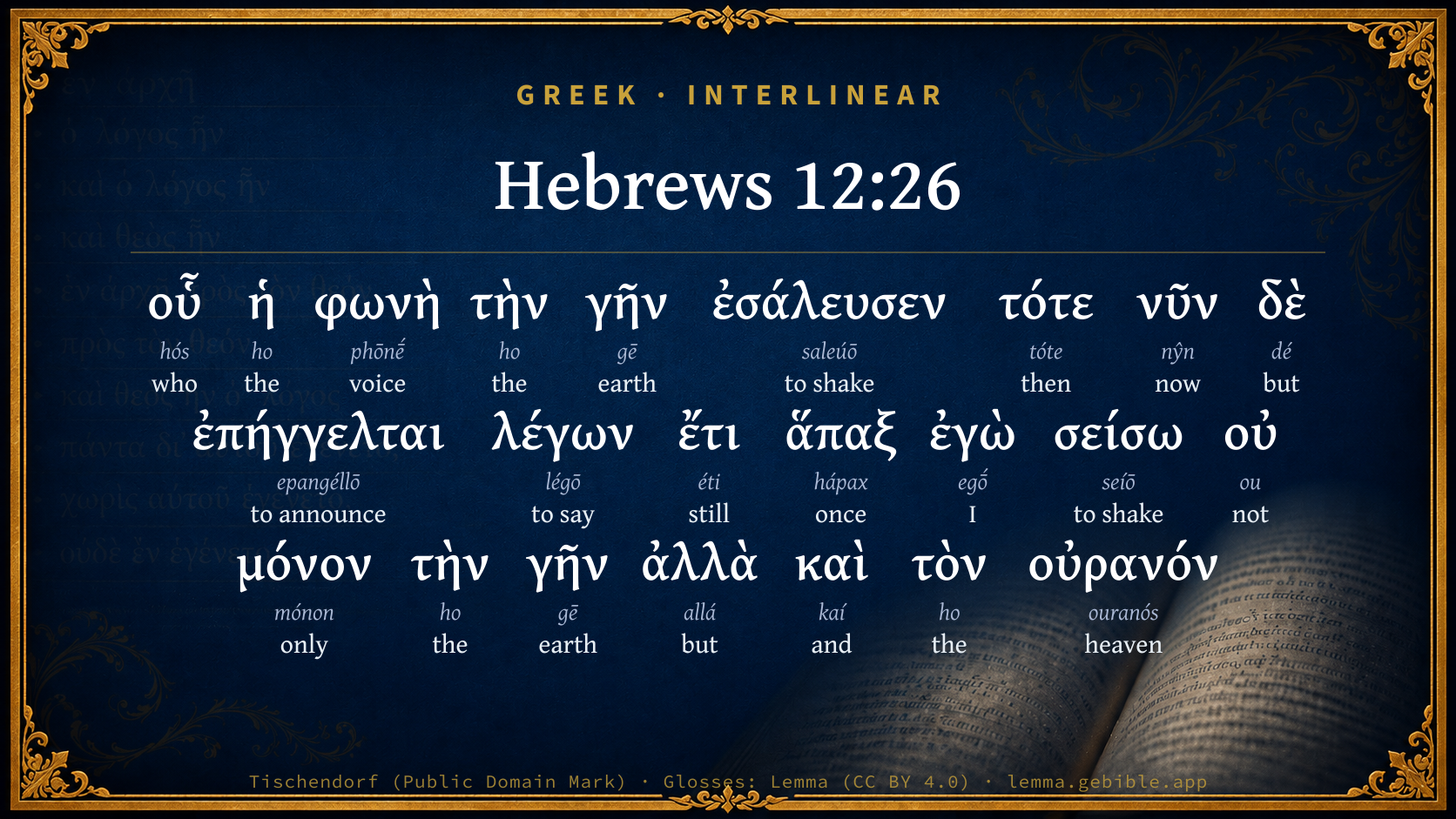
  1. οὗ hós G3739 “who” Relative pronoun, Genitive, Singular, Masculine
  2. ἡ ho G3588 “the” Article, Nominative, Singular, Feminine
  3. φωνὴ phōnḗ G5456 “voice” Noun, Nominative, Singular, Feminine
  4. τὴν ho G3588 “the” Article, Accusative, Singular, Feminine
  5. γῆν gē G1093 “earth” Noun, Accusative, Singular, Feminine
  6. ἐσάλευσεν saleúō G4531 “to shake” Verb, Aorist, Active, Indicative, 3rd person, Singular
  7. τότε tóte G5119 “then” Adverb
  8. νῦν nŷn G3568 “now” Adverb
  9. δὲ dé G1161 “but” Conjunction
  10. ἐπήγγελται epangéllō G1861 “to announce” Verb, Perfect, Middle or Passive deponent, Indicative, 3rd person, Singular
  11. λέγων légō G3004 “to say” Verb, Present, Active, Participle, Nominative, Singular, Masculine
  12. ἔτι éti G2089 “still” Adverb
  13. ἅπαξ hápax G530 “once” Adverb
  14. ἐγὼ egṓ G1473 “I” Personal pronoun, 1st person, Nominative, Singular
  15. οὐ ou G3756 “not” Particle, Negative
  16. μόνον mónon G3440 “only” Adverb
  17. τὴν ho G3588 “the” Article, Accusative, Singular, Feminine
  18. γῆν gē G1093 “earth” Noun, Accusative, Singular, Feminine
  19. ἀλλὰ allá G235 “but” Conjunction
  20. καὶ kaí G2532 “and” Conjunction
  21. τὸν ho G3588 “the” Article, Accusative, Singular, Masculine
  22. οὐρανόν ouranós G3772 “heaven” Noun, Accusative, Singular, Masculine

About this verse

These counts appear in no published source. They are computed here, from the morphology-tagged text and Lemma’s own curated glosses. What Lemma adds →

23
words
19
distinct lemmas
General Epistles
section

Notable vocabulary

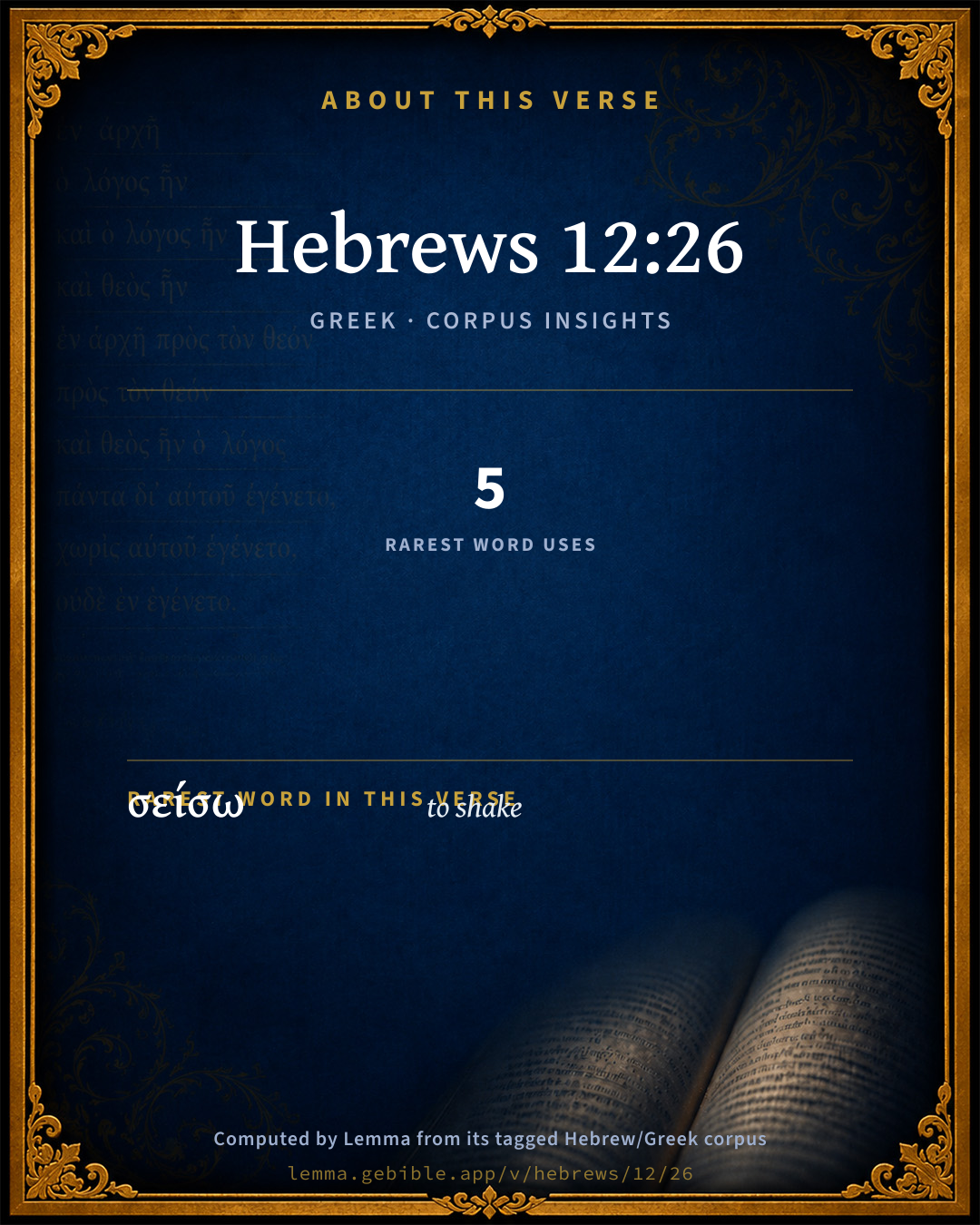
The rarest word here is σείσω to shake G4579 — appearing just 5 times in the whole Greek New Testament.

Shared distinctive vocabulary

σείσω to shake G4579 occurs in 5 verses of the Greek New Testament. Also found in:

Repetition

Words recur within this verse:

Cross-references

9

Topical passages linked to Hebrews 12:26 in the Treasury of Scripture Knowledge — connected by theme and wording, ordered by reader-vote popularity; previews shown in the World English Bible.

  • Haggai 2:6–7 For this is what Yahweh of Hosts says: 'Yet once, it is a little while, and I will shake the heavens, the earth, the sea, and the dry land;
  • Isaiah 13:13 Therefore I will make the heavens to tremble, and the earth shall be shaken out of its place, in the wrath of Yahweh of hosts, and in the day of his fierce anger.
  • Exodus 19:18 Mount Sinai, the whole of it, smoked, because Yahweh descended on it in fire; and its smoke ascended like the smoke of a furnace, and the whole mountain quaked greatly.
  • Isaiah 2:19 Men shall go into the caves of the rocks, And into the holes of the earth, From before the terror of Yahweh, And from the glory of his majesty, When he arises to shake the earth mightily.
  • Joel 3:16 Yahweh will roar from Zion, And thunder from Jerusalem; And the heavens and the earth will shake; But Yahweh will be a refuge to his people, And a stronghold to the children of Israel.
  • Psalms 114:6–7 You mountains, that you skipped like rams; You little hills, like lambs?
  • Habakkuk 3:10 The mountains saw you, and were afraid. The tempest of waters passed by. The deep roared and lifted up its hands on high.
  • Hebrews 12:27 This phrase, "Yet once more," signifies the removing of those things that are shaken, as of things that have been made, that those things which are not shaken may remain.
  • Haggai 2:22 I will overthrow the throne of kingdoms. I will destroy the strength of the kingdoms of the nations. I will overthrow the chariots, and those who ride in them. The horses and their riders will come down, everyone by the sword of his brother.

Cross-references courtesy of OpenBible.info (CC BY 4.0).

Commentary

Notes on Hebrews 12:26 from classic Christian and Jewish commentators (each source and its license shown beneath its notes). The classic Christian expositions comment on the surrounding passage and are grouped to its opening verse, so a note may address several verses; the Jewish commentaries on the Tanakh (Rashi and others) are per-verse, so they appear only where the commentator wrote on this verse.

Lemma curates 59 commentaries, every one of them public domain or Creative Commons licensed, each selected and text-cleaned for this edition rather than reprinted as found. About our sources →

Joseph Benson's Commentary

Heb 12:26-27. Whose voice — Namely, Christ’s, who appeared to Moses at the bush, gave the law, and conducted Israel through the wilderness; see on Exo 3:2; Isa 63:9; 1Co 10:9; then shook the earth — When, at the giving of the law, he spoke from Sinai, and the whole mount quaked greatly, Exo 19:18; but now — In the gospel times; he hath promised — Or declared, saying, (Hag 2:6,) Yet once more I shake not the earth only, but also heaven — Meaning, probably, the abolition of the civil and ecclesiastical constitution of the Jews, with the destruction of Jerusalem and the temple, Mat 24:29; Joh 4:21; Joh 4:23; and even the overthrow of the heathen idolatry, Joh 16:11, and the propagation of the gospel throughout the world: changes which, in the nature of things, could not take place without great commotions, and the shaking of governments and nations. Dreadful commotions and wars preceded the coming of Christ in the flesh, of which see on Hag 2:6 : but the shakings here intended must be those consequent on his so coming, and productive of the events now referred to. They may, however, look forward even to Christ’s second coming, and the final consummation of all things. For this word, Yet once more — Or once for all, not only signifieth the removing of those things that are shaken — The total subversion of the Jewish commonwealth and church, with the ordinances of Moses; as of things that are made — Namely, by human hands; or constituted or appointed only for a time; (the verb ποιειν, here used, frequently meaning to constitute or appoint, as chap. Heb 3:2; Mar 3:14, in both which passages it is translated to appoint, as it is also in many other places;) that those things which cannot be shaken — A dispensation to be changed no more; may remain — Fixed on a perpetual basis; even that eternal kingdom of righteousness and peace which God hath established by his Son Jesus Christ. This inference the apostle rightly draws from the expression, yet once more. For, as it implies that God would make but one alteration more in the religious worship of the world, it certainly follows that the form to be substituted in the room of the things to be shaken or removed, shall be permanent. The gospel, therefore, will remain to the end of the world, as the only form of religion acceptable to God. And then, as the words also imply, the heaven and the earth shall themselves be removed, as things made and intended only to endure for a time; and those things which cannot be shaken, the new heaven and the new earth, shall remain, to be the inheritance of God’s people for ever, Rev 21:1, &c.

Joseph Benson's Commentary on the Old and New Testaments (1811–1818) — public domain. Text from a community e-Sword module.

Tyndale Open Study Notes

Tyndale Open Resources

12:26-27 shook the earth: Exod 19:18; Judg 5:5; Pss 68:8; 77:18. • “Once again I will shake not only the earth but the heavens also”: Quoting Hag 2:6, the author emphasizes that all of creation will be shaken and removed at the judgment at the end of the age (1 Cor 7:31; 2 Pet 3:10, 12; Rev 21:1).

Tyndale Open Study Notes — © Tyndale Open Resources, licensed CC BY-SA 4.0. Text via the HelloAO Bible API.

Bengel's Gnomon

Johann Albrecht Bengel

Heb 12:26. Οὗ ἡ φωνὴ) as being One whose voice. Hereby is explained what kind of speaking that was on earth, and what kind of speaking of oracles, χρηματισμὸς, this is from the heavens. Therefore the article τὸν in Heb 12:25 does not prevent it from being one and the same person who spoke on earth and who now speaks from heaven. There is however a Mimesis,[85] and the feelings of those are expressed who do not acknowledge Him that speaketh.—τὴν γῆν) Γῆ ἘΣΕΊΣΘΗ, the earth was shaken, Psa 68:9, רָעָשָׁה, and Haggai uses this same word. The psalm mentions, that even the heavens dropped at that time, namely, those near to the mountain; but Haggai speaks of the whole created (made) heavens.—νῦν, now) The apostle shows not only what GOD now has promised, but what He is doing (is to do).—ἐπήγγελται) He hath promised. It is a promise intended to excite the hope of the saints, although the ungodly are terrified at it: therefore this passage contains an admonition entirely evangelical: comp. ch. Heb 2:3.—ἔτι ἁπαξ ἐγὼ σείσω οὐ μόνον τὴν γῆν, ἀλλὰ καὶ τὸν οὐρανὸν, yet once more I will shake not only the earth, but also heaven) עוד אחת מעט היא ואני מרעיש ונ, LXX. ἜΤΙ ἍΠΑΞ, Κ.Τ.Λ., and Heb 12:21, ἘΓῺ ΣΕΊΩ, Κ.Τ.Λ., yet once I will shake the heaven and the earth and the sea and the dry land, etc.; and Heb 12:21, I shake the heaven and the earth and the sea and the dry land. The apostle brings the two verses into one, by which he shows that it was one and the same shaking, of which the one verse of Haggai denotes the beginning, the other the end. For that shaking began at the first coming of the Messiah; it will be finished at the second: concerning the former, comp. Mat 3:17; Mat 27:51; Mat 28:2; Act 2:2; Act 4:31: concerning the latter, Mat 24:7; Rev 16:20; Rev 20:11. There is an illustrious testimony given by Sir Isaac New ton on Daniel, p. 94: “And there is scarcely any prophecy concerning Christ in the whole of the Old Testament, which does not, to some extent at least, refer to His second coming.”—ΣΕΊΣΩ, I will shake) Others read σείω. The LXX. have both, as we have now seen; but σείω, I will shake, expresses the promise.[86]

[85] See Append.

[86] And that reading in the larger Ed. is not reckoned among those to be approved; on the marg. of the 2d Ed. it is equal to the reading σείω, and is decidedly preferred in the Germ. Vers.—E. B.

AC Vulg. Memph. and Theb. read σείσω. But Df and Rec. Text σείω, with less authority.—ED.

Bengel's Gnomon of the New Testament — English translation (T&T Clark, Edinburgh, 1860) — public domain. Text from a community e-Sword module.

Meyer's Critical & Exegetical Commentary

Heinrich August Wilhelm Meyer

Heb_12:26. Like as the author has stated the fact, Heb_12:25, as a sign of the inferiority of Judaism to Christianity, that God in connection with the former was One ἐπὶ γῆς χρηματίζων, in connection with the latter, on the other hand, One ἀπʼ οὐρανῶν χρηματίζων, so does he now in like manner urge, as a further proof of that inferiority, the circumstance that God then only shook the earth, but now in accordance with the prophecy will shake not only the earth, but at the same time also the heavens.

ἐσάλευσεν] is to be understood in the literal sense, not, with Estius and others, in the figurative.

τότε] then, sc. at the promulgation of the Mosaic law. Comp. Exo_19:18 (where, however, the LXX., probably in reading הָעָם instead of הָהָר, translate: καὶ ἐξέστη πᾶς ὁ λαὸς σφόδρα); Jdg_5:4 f.; Psa_68:9 [8], Psa_114:7 : ἀπὸ προσώπου κυρίου ἐσαλεύθη ἡ γῆ.

νῦν δὲ ἐπήγγελται λέγων] who now, on the other hand, has promised as follows. A constructio ad sensum, since the words form the second member of the relative clause; but, notwithstanding that, a bound is suddenly made from the preceding subject ἡ φωνή to the subject contained in the οὗ, namely, God Himself.

νῦν] now, has certainly the sense: in regard to the present Christian period (more exactly: in regard to the epoch of the consummation of the divine kingdom by the coming again of Christ). Grammatically, however, νῦν κ.τ.λ. has arisen from the contracting of two statements in one, and is to be resolved, with Schlichting, into: nunc vero commovebit non solum terram sed etiam coelum, sicut promisit apud prophetam, dicens, etc.

ἐπήγγελται] in the middle sense, as Rom_4:21. See Winer, Gramm., 7 Aufl. p. 246.

The citation is from Hag_2:6, but reproduced in a free and abbreviated form (LXX.: ἔτι ἅπαξ ἐγὼ σείσω τὸν οὐρανὸν καὶ τὴν γῆν καὶ τὴν θάλασσαν καὶ τὴν ξηράν).

ἔτι ἅπαξ] Faulty rendering of the LXX. instead of: yet a little while.

Meyer — Critical and Exegetical Commentary on the New Testament — English translation by Peter Christie, edited by Frederick Crombie (T&T Clark, 1880) — public domain. Text from a community e-Sword module.

Geneva Bible (1599)

Geneva Bible translators

It appeareth evidently in this that the Prophet speaketh of the calling of the Gentiles, that these words must be referred to the kingdom of Christ.

He compareth the steadfast majesty of the Gospel, wherewith the whole world was shaken, and even the very frame of heaven was as it were astonished, with the small and vanishing sound of the governance by the Law.

Geneva Bible (1599) marginal notes — public domain. Text via Bolls.life.

Jamieson, Fausset & Brown

Robert Jamieson, A. R. Fausset & David Brown

then shook--when He gave the law on Sinai.

now--under the Gospel.

promised--The announcement of His coming to break up the present order of things, is to the ungodly a terror, to the godly a promise, the fulfilment of which they look for with joyful hope.

Yet once more--Compare Notes, see on Hag 2:6; Hag 2:21-22, both of which passages are condensed into one here. The shaking began at the first coming of Messiah; it will be completed at His second coming, prodigies in the world of nature accompanying the overthrow of all kingdoms that oppose Messiah. The Hebrew is literally, "it is yet one little," that is, a single brief space till the series of movements begins ending in the advent of Messiah. Not merely the earth, as at the establishment of the Sinaitic covenant, but heaven also is to be shaken. The two advents of Messiah are regarded as one, the complete shaking belonging to the second advent, of which the presage was given in the shakings at the first advent: the convulsions connected with the overthrow of Jerusalem shadowing forth those about to be at the overthrow of all the God-opposed kingdoms by the coming Messiah.

Jamieson, Fausset & Brown — Commentary Critical and Explanatory on the Whole Bible (1871) — public domain (CC PDM 1.0). Text via the HelloAO Bible API.

Adam Clarke's Commentary

Verse 26. Whose voice then shook the earth] Namely, at the giving of the law on Mount Sinai; and from this it seems that it was the voice of Jesus that then shook the earth, and that it was he who came down on the mount. But others refer this simply to God the Father giving the law.

Not the earth only, but also heaven.] Probably referring to the approaching destruction of Jerusalem, and the total abolition of the political and ecclesiastical constitution of the Jews; the one being signified by the earth, the other by heaven; for the Jewish state and worship are frequently thus termed in the prophetic writings. And this seems to be the apostle's meaning, as he evidently refers to Hag 2:6, where this event is predicted. It may also remotely refer to the final dissolution of all things.

Adam Clarke's Commentary on the Bible (1810–1826) — public domain. Text from a community e-Sword/MySword module.

John Calvin's Commentaries

26. Whose voice then shook the earth, etc. Though God shook the earth when he published his Law, yet he shows that he now speaks more gloriously, for he shakes both earth and heaven. He quotes on the subject the testimony of the Prophet Haggai, though he gives not the words literally; but as the Prophet foretells a future shaking of the earth and the heaven, the Apostle borrows the idea in order to teach us that the voice of the Gospel not only thunders through the earth, but also penetrates above the heavens. But that the Prophet speaks of Christ’s kingdom, is beyond any dispute, for it immediately follows in the same passage, “I will shake all nations; and come shall the desire of all nations, and I will fill this house with glory.” It is however certain that neither all nations have been gathered into one body, except under the banner of Christ, nor has there been any desire in which we ought to acquiesce but Christ alone, nor was the temple of Solomon exceeded in glory until the magnificence of Christ became known through the whole world. The Prophet then no doubt refers to the time of Christ. But if at the commencement of Christ’s kingdom, not only the lower parts of the world were shaken, but his power also reached the heaven, the Apostle justly concludes that the doctrine of the Gospel is sublimer than that of the Law, and ought to be more distinctly heard by all creatures.

John Calvin's Commentaries (1540-1563) — public domain. Text from the Calvin Translation Society English edition (1840s-50s) via the Christian Classics Ethereal Library (ccel.org). Calvin's coverage is partial (roughly two-thirds of the Bible); uncommented books and verses are honest gaps, never fabricated. The 19th-century editor's footnotes and remarks are omitted so the notes are faithfully Calvin's own voice.

Ellicott's Commentary for English Readers

(26) Shook the earth.—Exo_19:18-19; Jdg_5:4-5. The terrors of Sinai were, moreover, a type of a more terrible revelation of judgment, when not only shall the earth tremble, but the earth and the heaven shall be moved, and all that is transitory and mutable shall pass away. The words of Hag_2:6 are taken as a prophecy of this consummation. The reference of the prediction of which this forms part to the first coming of the Messiah is passed over; it is only as bearing upon the last days that the words are quoted here.

Now he hath promised.—This whole time of waiting is included in the “now.” It is as if the words were: “now we have this promise, and are looking for its fulfilment.”

I shake.—Rather (according to the better reading), I will move (or, make to tremble).

A Bible Commentary for English Readers, edited by Charles John Ellicott (1878–1897) — public domain. Text from a community e-Sword module.

The Cambridge Bible for Schools and Colleges

gen. ed. J. J. S. Perowne

26. whose voice then shook the earth] Exo_19:18; Jdg_5:4; Psa_114:7.

but now he hath promised, saying, Yet once more] Rather, “again, once for all.” The quotation is from Hag_2:6-7, “yet once, it is a little while” (comp. Hos_1:4).

but also heaven] “For the powers of the heavens shall be shaken” (Luk_21:26).

The Cambridge Bible for Schools and Colleges (gen. ed. J. J. S. Perowne; Cambridge University Press, 1878–1918) — public domain. Text from a community e-Sword module.

John Gill's Exposition

And this word yet once more,.... Or as it is in Hag 2:6 "yet once it is a little while"; which suggests, that as something had been done already, so in a very little time, and at once, something very marvellous and surprising would be effected: and it

signifieth the removing of those things that are shaken, as of things that are made; which some understand of what will be done at Christ's coming to judgment; as the passing away of the heavens and the earth, which are things that are made, or created, by the power of God; when there will be a shaking of them, so as that they shall be removed, and pass away with a great noise; and so they interpret the next clause, of the permanency of the new heavens and the new earth, and of the immovable kingdom of glory, and the never fading inheritance of the saints; and of their fixed, unalterable, and unshaken state: but rather this is to be understood of Christ's coming to the destruction of Jerusalem; when there was an entire removal of the Jewish state, both political and ecclesiastical; and of the whole Mosaic economy; and of things appertaining to divine worship, which were made with hands, as the temple, and the things in it; and which were made to be removed; for they were to continue no longer than the time of reformation: and this removing of them designs the abolition of them, and entire putting an end to them; at which time, not only their civil government was wholly put down, but their ecclesiastic state also; for the place of their worship was destroyed, the daily sacrifice ceased, and the old covenant, and the manner of administering it, vanished away; and all the legal institutions and ordinances, which were abolished by the death of Christ, were no more performed in Jerusalem; the temple and temple service perishing together:

that those things which cannot be shaken may remain: the kingdom and priesthood of Christ, which are everlasting; and the good things which come by him, as remission of sins, justification, adoption, sanctification, and the heavenly inheritance; as also the Gospel, and the doctrines and ordinances of it, baptism, and the Lord's supper, and the mode of Gospel worship; all which are to continue until Christ's second coming.

John Gill's Exposition of the Whole Bible (1746–1763) — public domain (CC PDM 1.0). Text via the HelloAO Bible API.

Trapp's Complete Commentary

John Trapp

26 Whose voice then shook the earth: but now he hath promised, saying, Yet once more I shake not the earth only, but also heaven.

Ver. 26. Whose voice then shook, &c.] viz. When he gave the law; what shall he do when he comes to judgment?

Not the earth only, &c.] Not men only, but angels, who stand amazed at the mystery of Christ. As for men, they will never truly desire Christ till they are shaken, Hag 2:7. God’s shaking ends in settling; it is not to ruin, but to refine us.

John Trapp, A Commentary or Exposition upon All the Books of the Old and New Testament (1647–1656) — public domain. Text from a community e-Sword module.

Albert Barnes' Notes on the Bible

Whose voice then shook the earth - When he spake at Mount Sinai. The meaning is, that the mountain and the region around quaked; Exo 19:18. The “voice” here referred to is that of God speaking from the holy mount.

But now hath he promised, saying - The words here quoted are taken from Hag 2:6, where they refer to the changes which would take place under the Messiah. The meaning is, that there would be great revolutions in his coming, “as if” the universe were shaken to its center. The apostle evidently applies this passage as it is done in Haggai, to the first advent of the Redeemer.

I shake not the earth only - This is not quoted literally from the Hebrew, but the sense is retained. In Haggai it is, “Yet once it is a little while, and I wilt shake the heavens and the earth, and the sea, and the dry land; and I will shake all nations, and the desire of all nations shall come.” The apostle lays emphasis on the fact that not only the earth was to be shaken but also heaven. The shaking of the earth here evidently refers to the commotions among the nations that would prepare the way for the coming of the Messiah.

But also heaven - This may refer either:

(1)To the extraordinary phenomena in the heavens at the birth, the death, and the ascension of Christ; or.

(2)To the revolutions in morals and religion which would be caused by the introduction of the gospel, as if everything were to be changed - expressed by “a shaking of the heavens and the earth;” or.

(3)It may be more literally taken as denoting that there was a remarkable agitation in the heavens - in the bosoms of its inhabitants - arising from a fact so wonderful as that the Son of God should descend to earth, suffer, and die.

I see no reason to doubt that the latter idea may have been included here; and the meaning of the whole then is, that while the giving of the Law at Mount Sinai, fearful and solemn as it was, was an event that merely shook the earth in the vicinity of the holy Mount, the introduction of the gospel agitated the universe. Great changes upon the earth were to precede it; one revolution was to succeed another preparatory to it, and the whole universe would be moved at an event so extraordinary. The meaning is, that the introduction of the gospel was a much more solemn and momentous thing than the giving of the Law - and that, therefore, it was much more fearful and dangerous to apostatize from it.

Albert Barnes' Notes on the Bible (1834–1885) — public domain. Text from a community e-Sword/MySword module.

Haydock's Catholic Bible Commentary

Whose voice then moved the earth, by such signs and prodigies on Mount Sinai: but now he promiseth, saying by the prophet Aggeus [Haggai]: yet once; and I will move not only the earth, but heaven also. These words of the prophet are commonly understood of Christ’s first coming at his incarnation, when at his birth a star appeared, Angels were sent, and sung his praises, when the heavens opened at his baptism, when the earth trembled at his resurrection, when the sun and moon were darkened at his death, &c. Yet others expound these words of Christ’s coming to redeem mankind, so as to comprehend all the time of the law of grace, and even his second coming to judge all men, at the end of the world, of which may particularly be understood those words, (ver. 27.) of the translation of the moveable things; that is, of the elements, and of the heavens changed to a more perfect state. See here St. John Chrysostom; St. Augustine, lib. 18. de civ. Dei. chap. xxxv. p. 517. Nov. Editionis. (Witham)

George Leo Haydock (1774–1849), Haydock's Catholic Family Bible and Commentary, 1859 edition — public domain. Excludes Psalms (Douay-Rheims chapter numbering differs from Protestant) and Deuterocanonical books (Catholic canon only).

Matthew Poole's English Annotations

Whose voice then shook the earth: the sin and punishment of gospel despisers and rejecters, is aggravated by the Person concerned in both. It is that Jesus, the great Angel of the covenant, speaking now by his blood, whose voice at the delivery of the law on Mount Sinai, and selling Israel in a church state under that covenant dispensation, Exo 20:1,19; Deu 4:12; 5:2,4,22, did shake the mount, Exo 19:18; Psa 68:7,8; 114:4,7; and not only the literal Sinai, but that low, earthly condition and state of Israel coming out of Egypt, and bearing its reproach as a common people of the earth, together with other nations, Jos 5:9. This he removed away, and brought them then into a church state with himself by covenant, which church state obtained the name or title of heaven, Mat 21:43, and is by the prophet styled the old heaven, Isa 65:17, which was to be shaken and removed also.

But now he hath promised, saying, Yet once more I shake not the earth only, but also heaven: but now the same Jesus so shaking them had promised, and had at this time in part fulfilled what he spake, Hag 2:6,7, even after the prophets little while was expired, and Christ the desire of all nations was come; that yet

once more he would shake the Israelitish church state, pitched till the time of reformation; not the earthly one only, as he did at Mount Sinai, which yet Jesus literally did at his death and resurrection, Mat 27:51,54; 28:2, and the heavens also by his star, Mat 2:2, light to the shepherds, Luk 2:9, his baptism, Mat 3:17, transfiguration, Mat 17:5; his prayer, Joh 12:28-30, his passion, Mat 27:51; Luk 23:44,45, effusion of the Holy Ghost, Act 2:2-4; but this is also a powerful, moral shaking, so as to change and remove that heavenly church frame pitched in the Jewish tabernacle; that he might pitch a tabernacle himself more heavenly and spiritual, whereof Jesus should be the Lord High Priest and Ruler, as well as Minister, Heb 3:1,2.

Matthew Poole's English Annotations on the Holy Bible (1683–1685) — public domain. Text from a community e-Sword/MySword module.

Whedon's Commentary on the Bible

Daniel D. Whedon

26. He—See note on the last verse.

Then… now—At Sinai then, at Zion now. The former the inauguration of Mosaicism, the latter of Christianity.

Earth… also heaven—Delitzsch and Alford labour painfully to refer the latter shaking to Christ’s second advent to judge the world. The antithesis, then, would be between the scene of Sinai and the final conflagration and renewal of the earth. This is, again, a very incongruous antithesis. The shaking of Sinai would be physically a very insignificant event, out of all comparison with such a mundane revolution as the earth’s destruction. Alford fully urges that “it is wrong to understand this shaking of the mere breaking down of Judaism.” But surely the overthrow of the old dispensation was as important an event as its first establishment. The inauguration of the new kingdom by Christ’s first advent was an immensely more stupendous event than the first inauguration of the law. Symbolically, Zion is, a far taller mountain than Sinai. As a physical phenomenon, the proper antithesis to the day of Sinai is the day of Pentecost. See our notes on Act_2:1-4. On that day heaven and earth were shaken physically, and as broadly as at Sinai, and with an infinitely sublimer significance; a significance pervading all the Christian ages.

Daniel D. Whedon (gen. ed.), Commentary on the Old and New Testaments (1874–1909) — public domain. Text from a community e-Sword module.

The Pulpit Commentary

Whose voice then shook the earth: (see Exo_19:18, "The whole mount quaked greatly," though there the LXX has laov instead of orov : but of Jud_1:5, "The earth trembled," and Psa_114:7, "Tremble, thou earth," etc., with reference to the phenomena at Sinai; also Hab_3:6, Hab_3:10) but now he hath promised, saying, Yet once more I shake not the earth only, but also heaven. The prophecy referred to is Hag_2:6, Hag_2:7, "Yet once, it is a little while, and I will shake the heavens, and the earth, and the sea, and the dry land; and I will shake all nations, and the Desire of all nations shall come: and I will fill this house with glory, saith the LORD of hosts." Again, ver. 21, "I will shake the heavens and the earth". (cf. Heb 2) The prophecy was uttered with reference to the second temple, the glory of which was to be greater than the glory of the first, in that it should be the scene of the LORD"S final revelation of himself to his people. Its first fulfillment is rightly seen in Christ"s first coming. (cf. Hab_2:9, "And in this place will I give peace, saith the Lord of hosts;" and Mal_3:1, "The Lord, whom ye seek, shall suddenly come to his temple But the language used points evidently, even in itself, to a further fulfillment; nor do readers need to be reminded here of the pregnant and far-reaching sense of all Messianic prophecy. "Illustre est testimonium Psalm Newtoni ad Dan. p. 91: vixque in omni VT. aliquod de Christo extat vaticinium, quod non, aliquatenus saltem, secundum ejus ad-ventum respiciat" (Bengel). The ultimate reference is what is seen dimly afar off in so many of the prophetic visions the final dissolution of the whole present order of things, to be succeeded by the kingdom of eternal righteousness. (cf. Psa_102:25, etc.) By the heaven that is to be shaken in that great day is meant, of course, not the eternal abode of God, but that which is created and visible (twn pepoihmenwn , ver. 27). This final shaking is set against the local and typical shaking of Mount Sinai in two points of contrast its extending to the whole creation, and its being once for all (eti apax); and from the latter expression the removing of the things thus finally shaken is in the next verse inferred. This inference, though not following necessarily from the expression itself, is involved in the general drift of Haggai"s prophecy, taken in connection with other cognate ones, in which an entirely new and heavenly order is pictured as rising over the ruins of the old. (cf. Isa_65:17 Isa_66:22, referred to in 2Pe_3:7, 2Pe_3:10, 2Pe_3:13, "new heavens and a new earth, wherein dwelleth righteousness

The Pulpit Commentary (1880–1919), ed. H.D.M. Spence-Jones & Joseph S. Exell — public domain. Text from a community e-Sword module.

John Wesley's Explanatory Notes

Whose voice then shook the earth - When he spoke from Mount Sinai. But now - With regard to his next speaking. He hath promised - It is a joyful promise to the saints, though dreadful to the wicked. Yet once more I will shake, not only the earth, but also the heaven - These words may refer in a lower sense to the dissolution of the Jewish church and state; but in their full sense they undoubtedly look much farther, even to the end of all things. This universal shaking began at the first coming of Christ. It will be consummated at his second coming. Haggai ii, 6.

John Wesley, Explanatory Notes Upon the Whole Bible (1754–1765) — public domain. Text via the GEBible commentary corpus.

Burkitt's Expository Notes on the New Testament

William Burkitt

As if the apostle had said, "The voice of God, at the promulging of the law on mount Sinai, shook the earth; but he promised after this to shake all nations, and that Christ, the expected Messias, the desire of all nations, should come, which is now fulfilled."

Question. But what means our apostle by God’s shaking not the earth only, but also heaven?

Answer. He means thereby all the Mosaical worship, all the Judaical state, those were shaken at the coming of Christ, in order to the introduction of the immoveable gospel-state, which was perpetually to remain.

Learn hence, That the coming of the Messias was to be the last dispensation of God for the salvation of mankind, and consequently was to be perpetual and unchangeable. The apostle argues from the words, once more, that the former dispensation should be removed to make way for that which should perpetually remain.

Several things are here asserted by our apostle,

1. That there were some things which were intended by God to be shaken, namely, the Levitical priesthood, and all the Jewish sacrifices and services; these things were to be shaken, moved, yea, altogether removed out of the way.

2. That there were things that could not be shaken or removed, but remain; these were the gospel-state, the Christian religion, which shall continue until time shall be no more.

3. That the former things were removed, that the latter might be introduced and established; the law and the gospel were inconsistent; the legal and evangelical administration could not stand in force together, therefore there was a necessity for the nulling of the one, in order to the establishing of the other.

4. That the removal of the law, to bring the more perfect administration of the gospel, doth prove the stability and immutability of the gospel, that it stands fast forever; there shall be no more shaking, no farther alteration in matters of religion to the end of the world. For thus it follows.

William Burkitt's Expository Notes on the New Testament (1700–1703) — public domain. Text from a community e-Sword module.

The People's New Testament

B. W. Johnson

26. Whose voice then shook the earth. At Sinai (Exod. 19:18). But now he hath promised. See Haggai 2:6, which declares the removal of the heavens and earth at Christ's coming.

B. W. Johnson's The People's New Testament with Notes (1889–1891) — public domain. Electronic text from the Christian Classics Ethereal Library (CCEL) ThML edition.

Cambridge Greek Testament for Schools and Colleges

26. γῆν ἐσάλευσεν. Exo 19:18; Jdg 5:4; Psa 114:7.

ἐπήγγελται. “He has promised.” The verb has the sense of the middle voice as in Rom 4:21.

Ἔτι ἅπαξ. “Again, once for all.” The quotation is from Hag 2:6-7, “yet once, it is a little while” (comp. Hos 1:4).

καὶ τὸν οὐρανόν. “For the powers of the heavens shall be shaken” (Luk 21:26).

Cambridge Greek Testament for Schools and Colleges (Cambridge University Press, 1896; 21 vols, various authors incl. Carr, Maclear, Plummer, Farrar, Lumby, Moule, M. R. James, Simcox) — public domain. Text from a community e-Sword module.

Alford’s Greek Testament

Henry Alford

26.] whose voice (see on last verse) shook the earth then (ὅτε, φησί, ἐνομοθέτει ἐν τῷ ὄρει τῷ Σινᾷ. So in ref. Judg., in Deborah’s Song, γῆ ἐσείσθη … ὄρη ἐσαλεύθησαν ἀπὸ προσώπου κυρίου ἐλωΐ, τοῦτο Σινᾶ ἀπὸ προσώπου κυρίου θεοῦ Ἰσραήλ. Cf. ref. Ps. In Exo 19:18, where the E. V. has after the Heb., “the whole mount quaked greatly,” the LXX render, καὶ ἐξέστη πᾶς ὁ λαὸς σφόδρα: reading, perhaps, with some Hebrew mss., הָעָם instead of הָהָר. σαλεύειν is intransitive as well as transitive in the classics (e. g. Soph. Œd. Tyr. 23), but in Hellenistic Greek transitive only: see reff. Some take this shaking of the earth to be meant of a figurative excitement of men’s minds: so Justiniani (“Ait Apostolus divinam vocem tunc movisse terram, cum angeli opera tam multa signa in monte Sinai edidit, quæ non modo ingentem admirationem pepererunt, sed non exiguum incusserunt terrorem: nonnullam etiam lætitiam attulerunt bonis, quod legem ab ipso Deo immortali acciperent”), Estius. But there can be little doubt, that the material explanation is the true one. The so-called pentameter, οὗ ἡ φωνὴ τὴν γῆν ἐσάλευσε τότε, could hardly have been observed, but by one whose eye was quicker than his ear), but now (νῦν, not only ut res nunc se habent, but here in a more temporal sense, as opposed to τότε: now, under the prophetic revelations since the captivity,—under the N. T. dispensation in which those prophecies will find their fulfilment) hath He (God: see above) promised (perf. pass., in middle sense, see ref. and Winer, § 39. 3. Cf. also Act 13:2; Act 16:10; Act 25:12: Exo 3:18 al. Böhme and Vater would render it passive, “hath it been promised:” but λέγων following, though it might suit the style of the Apocalypse, will not agree with the careful precision of our Epistle), saying, Yet once (more), and I will shake not only the earth, but also the heaven. The prophecy in Haggai is uttered, like the whole of his prophecies, with reference to the second temple, which was then rising out of the ruins of the first, smaller indeed and poorer, but destined to witness greater glories. It was to be the scene of the last revelation of Jehovah to His people: and the house of David, then so low, was to rise above the ruins of the thrones of the earth, and endure as the signet on God’s right hand (Hag 2:21-23). It is this ruin of earthly powers, this antitypical shaking of the earth and all that is in it, after the typical material shaking at Sinai, of which the Prophet speaks. And the result of this shaking was to be, that the best treasures of all nations (not to be understood personally of Christ, but as LXX, ἥξει τὰ ἐκλεκτὰ πάντων τῶν ἐθνῶν), should be brought to adorn that temple. The expression here (as in LXX) rendered ἔτι ἅπαξ κ.τ.λ. is in the Heb. עוֹד אַחַת מְעַט הִיא וְ, i. e., as in E. V. (see Hofmann, Weissag. u. Erfüll. i. 330, and Hitzig in loc.), “Yet once, it is a little while, and:” i. e. the period which shall elapse shall be but one, not admitting of being broken into many; and that one, but short. Thus the prophecy seems to point to the same great final bringing of all the earth under the Kingdom of God, which is spoken of in Zec_14 when the Lord shall come and all his saints with Him, the great antitype of Sinai (cf. Deu 33:2), so often the subject of ancient prophecy. See this more fully entered upon in Hofmann, as above, and in Delitzsch’s note here. It is clearly wrong, with some interpreters, to understand this shaking of the mere breaking down of Judaism before the gospel, or of any thing which shall be fulfilled during the Christian œconomy, short of its glorious end and accomplishment. The οὐ μόνον, ἀλλὰ καί, which the Writer has substituted for the simple καί of the LXX, is adopted for the sake of bringing out the point which is before him, the earth, and the speaking from the earth, on the one hand, the heaven, and the speaking from the heaven, on the other. But the οὐρανός here, that is to be shaken, is the material heaven stretched above this earth.

Henry Alford, The Greek Testament (1849–1861) — public domain. Text from a community e-Sword module.

Westcott on Hebrews & the Epistles of John

Brooke Foss Westcott

26. οὗ ἡ φωνή...) The words go back to Ὁ. 25 τὸν λαλοῦντα Ex. xix. 18 f. (Hebr.), Ὁρᾷς ὅτι τότε ὁ λαλῶν αὐτὸς ἦν ὁ νῦν ἀπ᾽ οὐρανοῦ χρηματίζων ἡμῖν (Theophict.).

For ἐσάλενσεν compare Ex. xix. 18 ὄρη ἐσαλεύθησαν. Ps. cxiv. 7 (LXx.) ἀπὸ προσώπου κυρίον ἐσαλεύθη ἡ γῆ The word is used of violent elemental: convulsions (6.9. Matt. xxiv. 29).

νῦν δὲ .] Hagg. i. 6. But now, in relation to the Christian ordor as distinguished from that of Sinai (rore), He hath promised, whose voice then shook the carth....

The former outward ‘shaking’ was the symbel of a second ‘shaking’ far more extensive and effective. Heaven and earth will at last bo movod that mon may contributo to tho fulfilment of tho divino purposo, And the announcoment of this final catastrophs of the world, however awful in itself, is a ‘promise,’ because it is for the triumph of the cause of God that believers look.

The prophecy of Haggai (ii. 6 Ε΄,

given the promise).

Brooke Foss Westcott (1825–1901), The Epistle to the Hebrews (1889) and The Epistles of St John (1883) — public domain (pre-1929). Text recovered from Internet Archive / Google Books OCR scans. Westcott’s Gospel of John commentary is not included (its OCR lost the chapter running-heads required for reliable verse-keying). Some Greek quoted in the Hebrews volume is imperfectly rendered by the OCR.

Lesson kit

Teaching starters — assembled from the data on this page, not authored interpretation. Every prompt links to the verse data it draws on. Edit before teaching.

Hebrews, in the General Epistles, opens this verse with 23 words (19 distinct Greek lemmas). Its most distinctive word is seíō (“to shake”). A historical commentator’s framing appears above. Read the whole chapter for the surrounding context.

Discussion questions

  1. How does “to shake” (seíō) shape what this verse is saying?
  2. How does Matthew 21:10, which shares the word «to shake», read alongside this verse?
  3. What does the repetition of “earth” (2× in this one verse) do in this verse?
  4. These translations render this verse differently. What is at stake in choosing one wording over another?
  5. Compare how Joseph Benson's Commentary and Tyndale Open Study Notes read this verse. Where do they agree or differ?

Things to notice

Reading settings

Reading text

Shown beneath each verse's original-language words.

Old Testament
Old Testament edition

Read the OT as the Masoretic Hebrew (MT) or the Greek Septuagint (LXX).

English shown for the Greek Septuagint (in the Hebrew ↔ Greek comparison).

Comparing translations? Open the Compare panel on any verse page to stack up to four side by side.