
Hebrews 9:24

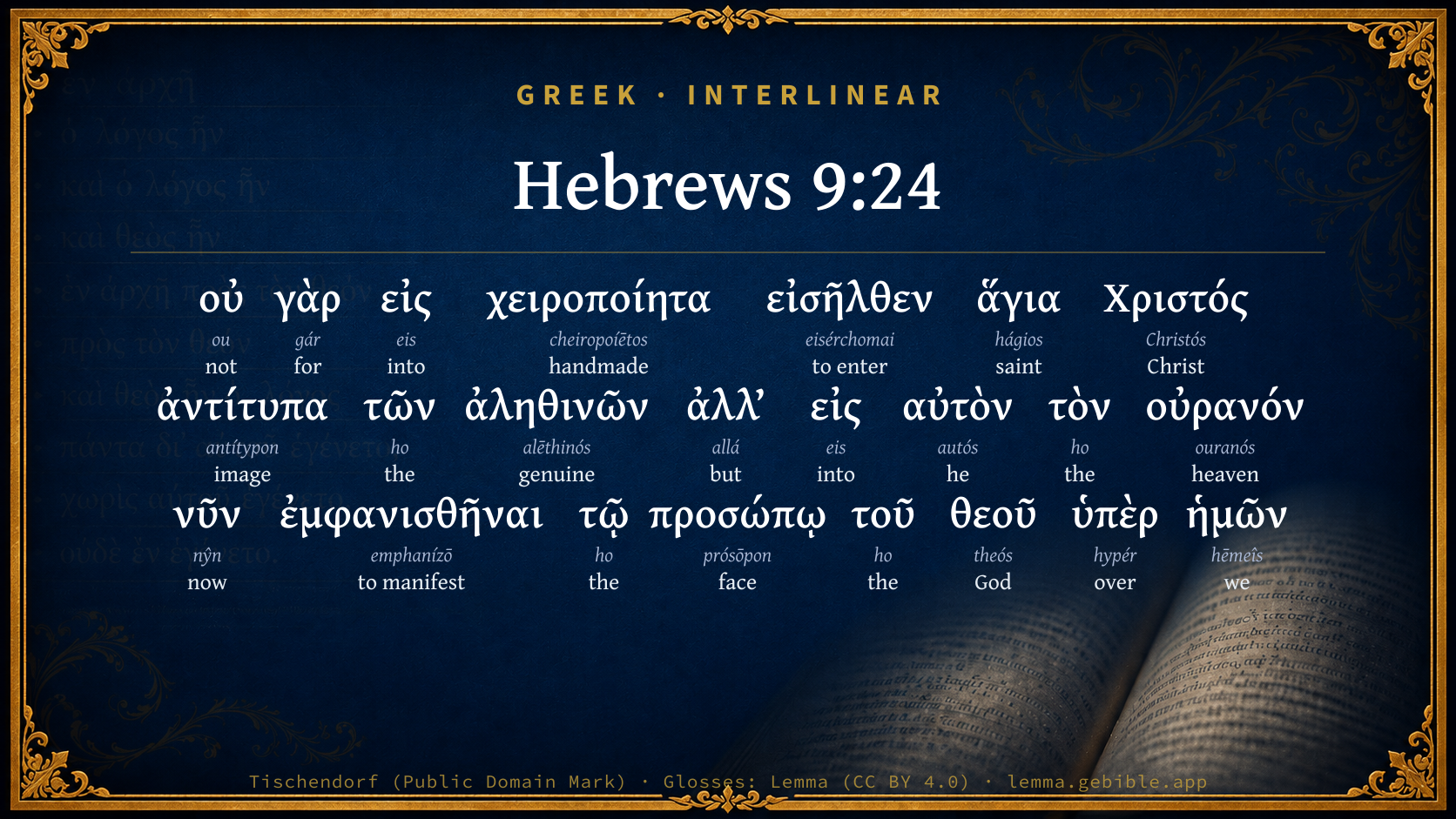
Greek (Tischendorf 8th ed.) Hebrews 9:24 appears in the Greek New Testament. The text above is from the Tischendorf 8th edition. Each word links to its Strong’s number and a concise gloss. Click any word for its full Thayer’s Greek Lexicon entry.
Download image
Cite this verse

Hebrews 9:24 (World English Bible). Public Domain. Lemma interlinear Bible study tool, https://lemma.gebible.app/v/hebrews/9/24.

Show BibTeX & RIS
BibTeX
RIS
English Translation
For Christ hasn't entered into holy places made with hands, which are representations of the true, but into heaven itself, now to appear in the presence of God for us;
World English Bible · Public Domain
Highlights
  • 1 first appearance in the Greek New Testament
Full analysis ↓
Download a study sheet

One document with this verse’s original text, its word-by-word gloss line, the meaning frame, cross-references with their text, attributed commentary, and full source and license credits — printable, and it pastes into notes with its structure intact.

This verse Autodidact and up

Study sheet (.html) Plain text (.txt)

A passage Seminary Student

Up to 50 verses in one chapter. A passage sheet keeps up to 6 commentary sources and 12 cross-references per verse, in the order this page ranks them, and says so on the sheet whenever that leaves anything out. Ask for a single verse and you get the Autodidact verse sheet above.

Everything on this page stays free to read, with no account — the sheet is a download of what is already on screen, not access to it.

Want to remove ads? Support Godless Engineer
Compare translations 3

The same verse in 3 English versions, stacked beneath the original-language interlinear above. Click any original word for its lexicon entry.

Each is an independent rendering of the whole verse — the interlinear is not word-aligned to these translations.

Highlighted words mark where these versions differ — a whole-verse word diff, not a word-by-word alignment.

  • World English Bible Public Domain
    For Christ hasn't entered into holy places made with hands, which are representations of the true, but into heaven itself, now to appear in the presence of God for us;
  • King James Version Public Domain
    For Christ is not entered into the holy places made with hands, which are the figures of the true; but into heaven itself, now to appear in the presence of God for us:
  • unfoldingWord Literal Text CC BY-SA 4.0
    for Christ did not enter into holy made with hands—copies of the true ones—but into heaven itself, to be made visible now in the presence of God on our behalf,

unfoldingWord Literal Text — © unfoldingWord, licensed CC BY-SA 4.0. Word-aligned USFM3 via Door43 (git.door43.org/unfoldingWord/en_ult).

Versions to compare (up to 4)

3 of 4 selected

Show all 19 translations

Every available English version of this verse, each an independent rendering of the whole verse.

  • World English Bible Public Domain
    For Christ hasn't entered into holy places made with hands, which are representations of the true, but into heaven itself, now to appear in the presence of God for us;
  • Berean Standard Bible Public Domain
    For Christ did not enter a man-made copy of the true sanctuary, but He entered heaven itself, now to appear on our behalf in the presence of God.
  • Majority Standard Bible Public Domain
    For Christ did not enter a man-made copy of the true sanctuary, but He entered heaven itself, now to appear on our behalf in the presence of God.
  • King James Version Public Domain
    For Christ is not entered into the holy places made with hands, which are the figures of the true; but into heaven itself, now to appear in the presence of God for us:
  • American Standard Version (1901) Public Domain
    For Christ entered not into a holy place made with hands, like in pattern to the true; but into heaven itself, now to appear before the face of God for us:
  • Revised Version (1885) Public Domain
    For Christ entered not into a holy place made with hands, like in pattern to the true; but into heaven itself, now to appear before the face of God for us:
  • Geneva Bible (1599) Public Domain
    For Christ is not entred into ye holy places that are made with hands, which are similitudes of ye true Sanctuarie: but is entred into very heauen, to appeare now in ye sight of God for vs,
  • Douay-Rheims (1899) Public Domain
    For Jesus is not entered into the holies made with hands, the patterns of the true: but into heaven itself, that he may appear now in the presence of God for us.
  • Young's Literal Translation Public Domain
    for not into holy places made with hands did the Christ enter -- figures of the true -- but into the heaven itself, now to be manifested in the presence of God for us;
  • Literal Standard Version CC BY-SA 4.0
    for the Christ did not enter into holy places made with hands—figures of the true—but into Heaven itself, now to be manifested in the presence of God for us;
  • Unlocked Literal Bible CC BY-SA 4.0
    For Christ did not enter into the most holy place made with hands, which is only a copy of the true one. Instead he entered into heaven itself, to appear now in God's presence for us.
  • unfoldingWord Literal Text CC BY-SA 4.0
    for Christ did not enter into holy made with hands—copies of the true ones—but into heaven itself, to be made visible now in the presence of God on our behalf,
  • Darby Bible Public Domain
    For the Christ is not entered into holy places made with hand, figures of the true, but into heaven itself, now to appear before the face of God for us:
  • World Messianic Bible Public Domain
    For Messiah hasn’t entered into holy places made with hands, which are representations of the true, but into heaven itself, now to appear in the presence of God for us;
  • Webster's Bible Public Domain
    For Christ hath not entered into the holy places made with hands, which are the figures of the true; but into heaven itself, now to appear in the presence of God for us:
  • Free Bible Version CC BY-SA 4.0
    For Christ hasn't entered a Most Holy Place constructed by human beings that is only a pattern of the original. He has entered heaven itself, and now appears on our behalf, speaking for us in God's presence.
  • Bible in Basic English Public Domain
    For Christ did not go into a holy place which had been made by men's hands as the copy of the true one; but he went into heaven itself, and now takes his place before the face of God for us.
  • Text-Critical English NT CC BY 4.0
    For Christ did not enter holy places made with hands, which are copies of the true ones; he entered heaven itself, so that he might now appear before God on our behalf.
  • Tyndale New Testament (1534) Public Domain
    For Christ is not entred into the holy places that are made with hondes which are but similitudes of true thynges: but is entred into very heven for to appere now in the syght of God for vs:

Literal Standard Version (2020), Covenant Press — licensed CC BY-SA 4.0. Text via the HelloAO Bible API (eBible.org). Unlocked Literal Bible (unfoldingWord) — licensed CC BY-SA 4.0. Text via the HelloAO Bible API (eBible.org). unfoldingWord Literal Text — © unfoldingWord, licensed CC BY-SA 4.0. Word-aligned USFM3 via Door43 (git.door43.org/unfoldingWord/en_ult). Free Bible Version, Dr. Jonathan Gallagher — licensed CC BY-SA 4.0. Text via the HelloAO Bible API (eBible.org).

Word by word

More ways to search: Search by grammar → Find every occurrence → Compare this word →

Practice this passage: Drill this verse → Learn its vocabulary →

ἀντίτυπα
antítypon
G499
“image”
Adjective, Accusative, Plural, Neuter
Part of Speech
Adjective
Case
Accusative
Number
Plural
Gender
Neuter
Full Thayer's Definition

Origin: neuter of a compound of G473 and G5179

TDNT: 12:06,1

1. a thing formed after some pattern 2. a thing resembling another, its counterpart a. something in the Messianic times which answers to the type, as baptism corresponds to the deluge ( 1 Pet 3:21 )
  1. οὐ ou G3756 “not” Particle, Negative
  2. γὰρ gár G1063 “for” Conjunction
  3. εἰς eis G1519 “into” Preposition
  4. χειροποίητα cheiropoíētos G5499 “handmade” Adjective, Accusative, Plural, Neuter
  5. εἰσῆλθεν eisérchomai G1525 “to enter” Verb, Aorist, Active, Indicative, 3rd person, Singular
  6. ἅγια hágios G40 “saint” Adjective, Accusative, Plural, Neuter
  7. Χριστός Christós G5547 “Christ” Noun, Nominative, Singular, Masculine
  8. τῶν ho G3588 “the” Article, Genitive, Plural, Neuter
  9. ἀληθινῶν alēthinós G228 “genuine” Adjective, Genitive, Plural, Neuter
  10. ἀλλ’ allá G235 “but” Conjunction
  11. εἰς eis G1519 “into” Preposition
  12. αὐτὸν autós G846 “he” Personal pronoun, Accusative, Singular, Masculine
  13. τὸν ho G3588 “the” Article, Accusative, Singular, Masculine
  14. οὐρανόν ouranós G3772 “heaven” Noun, Accusative, Singular, Masculine
  15. νῦν nŷn G3568 “now” Adverb
  16. ἐμφανισθῆναι emphanízō G1718 “to manifest” Verb, Aorist, Passive, Infinitive
  17. τῷ ho G3588 “the” Article, Dative, Singular, Neuter
  18. προσώπῳ prósōpon G4383 “face” Noun, Dative, Singular, Neuter
  19. τοῦ ho G3588 “the” Article, Genitive, Singular, Masculine
  20. θεοῦ theós G2316 “God” Noun, Genitive, Singular, Masculine
  21. ὑπὲρ hypér G5228 “over” Preposition
  22. ἡμῶν hēmeîs G2249 “we” Personal pronoun, 1st person, Genitive, Plural

About this verse

These counts appear in no published source. They are computed here, from the morphology-tagged text and Lemma’s own curated glosses. What Lemma adds →

23
words
19
distinct lemmas
General Epistles
section

Notable vocabulary

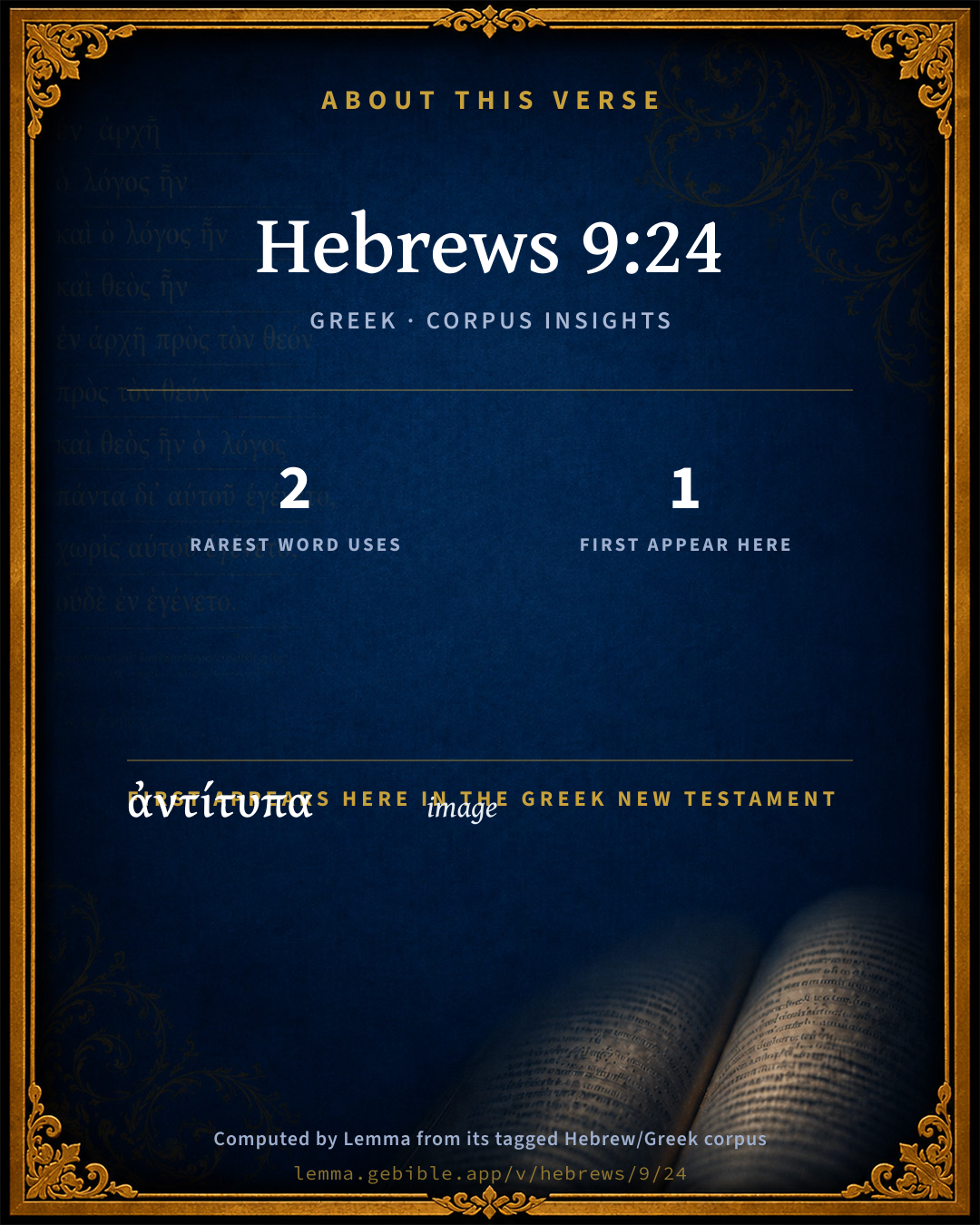
The rarest word here is ἀντίτυπα image G499 — appearing just 2 times in the whole Greek New Testament.

First appearance in Scripture

This word makes its first canonical appearance in the Greek New Testament here:

  • ἀντίτυπα image G499

Shared distinctive vocabulary

ἀντίτυπα image G499 occurs in 2 verses of the Greek New Testament. Also found in:
Repetition

Words recur within this verse:

Cross-references

28

Topical passages linked to Hebrews 9:24 in the Treasury of Scripture Knowledge — connected by theme and wording, ordered by reader-vote popularity; previews shown in the World English Bible.

  • Hebrews 12:2 looking to Jesus, the author and perfecter of faith, who for the joy that was set before him endured the cross, despising shame, and has sat down at the right hand of the throne of God.
  • Hebrews 9:11–12 But Christ having come as a high priest of the coming good things, through the greater and more perfect tabernacle, not made with hands, that is to say, not of this creation,
  • Hebrews 9:23 It was necessary therefore that the copies of the things in the heavens should be cleansed with these; but the heavenly things themselves with better sacrifices than these.
  • Hebrews 8:2 a minister of the sanctuary, and of the true tabernacle, which the Lord pitched, not man.
  • John 16:28 I came out from the Father, and have come into the world. Again, I leave the world, and go to the Father."
  • Exodus 28:29 Aaron shall bear the names of the children of Israel in the breastplate of judgment on his heart, when he goes in to the holy place, for a memorial before Yahweh continually.
  • Mark 14:58 "We heard him say, 'I will destroy this temple that is made with hands, and in three days I will build another made without hands.'"
  • Mark 16:19 So then the Lord Jesus, after he had spoken to them, was received up into heaven, and sat down at the right hand of God.
  • Luke 24:51 It happened, while he blessed them, that he withdrew from them, and was carried up into heaven.
  • John 2:19–21 Jesus answered them, "Destroy this temple, and in three days I will raise it up."
  • Acts 3:21 whom heaven must receive until the times of restoration of all things, which God spoke long ago by the mouth of his holy prophets.
  • Romans 8:33 Who could bring a charge against God's chosen ones? It is God who justifies.
  • Ephesians 1:20–22 which he worked in Christ, when he raised him from the dead, and made him to sit at his right hand in the heavenly places,
  • Ephesians 4:8–11 Therefore he says, "When he ascended on high, he led captivity captive, and gave gifts to men."
  • Colossians 3:2 Set your mind on the things that are above, not on the things that are on the earth.
  • Exodus 28:12 You shall put the two stones on the shoulder-pieces of the ephod, to be stones of memorial for the children of Israel: and Aaron shall bear their names before Yahweh on his two shoulders for a memorial.
  • Psalms 68:18 You have ascended on high. You have led away captives. You have received gifts among men, Yes, among the rebellious also, that Yah God might dwell there.
  • Zechariah 3:1 He showed me Joshua the high priest standing before the angel of Yahweh, and Satan standing at his right hand to be his adversary.
  • John 6:62 Then what if you would see the Son of Man ascending to where he was before?
  • Acts 1:9–11 When he had said these things, as they were looking, he was taken up, and a cloud received him out of their sight.
  • Hebrews 1:3 His Son is the radiance of his glory, the very image of his substance, and upholding all things by the word of his power, when he had by himself made purification for our sins, sat down on the right hand of the Majesty on high;
  • Hebrews 6:20 where as a forerunner Jesus entered for us, having become a high priest forever after the order of Melchizedek.
  • Hebrews 8:5 who serve a copy and shadow of the heavenly things, even as Moses was warned by God when he was about to make the tabernacle, for he said, "See, you shall make everything according to the pattern that was shown to you on the mountain."
  • Hebrews 9:9 which is a symbol of the present age, where gifts and sacrifices are offered that are incapable, concerning the conscience, of making the worshipper perfect;
  • 1 Peter 3:22 who is at the right hand of God, having gone into heaven, angels and authorities and powers being made subject to him.
  • Revelation 8:3 Another angel came and stood over the altar, having a golden censer. Much incense was given to him, that he should add it to the prayers of all the saints on the golden altar which was before the throne.
  • Hebrews 7:25–26 Therefore he is also able to save to the uttermost those who draw near to God through him, seeing he ever lives to make intercession for them.
  • 1 John 2:1–2 My little children, I write these things to you so that you may not sin. If anyone sins, we have a Counselor with the Father, Jesus Christ, the righteous.

Cross-references courtesy of OpenBible.info (CC BY 4.0).

Commentary

Notes on Hebrews 9:24 from classic Christian and Jewish commentators (each source and its license shown beneath its notes). The classic Christian expositions comment on the surrounding passage and are grouped to its opening verse, so a note may address several verses; the Jewish commentaries on the Tanakh (Rashi and others) are per-verse, so they appear only where the commentator wrote on this verse.

Lemma curates 59 commentaries, every one of them public domain or Creative Commons licensed, each selected and text-cleaned for this edition rather than reprinted as found. About our sources →

Ellicott's Commentary for English Readers

(24) For Christ is not entered.—Better, For Christ did not enter into a holy place made with hands. of like pattern to the true (or, real) holy place. In the second part of Heb_9:23 the two thoughts were the “heavenly things themselves” and “better sacrifices.” Of these the first is taken up here; the second in Heb_9:25-26. That verse was general: this sets forth the actual fact. “For the sanctuary into which Christ entered is not a copy or a token of the things in the heavens, but heaven itself.” “Of like pattern,” see Heb_8:5; “the true,” Heb_8:2; “into heaven itself,” Heb_8:1.

Now to appear in the presence of God for US.—Better, now to be made manifest before the face of God for us. We cannot doubt that these words continue the contrast between the true High Priest and the high priest on earth. On the Day of Atonement the high priest came before what was but a symbol of the Divine Presence; he caused the Holiest Place to be filled with the smoke of the incense before he entered with the blood of the offering. He did not dare to delay his return, even by prolonging his prayer, lest he should “excite terror in Israel.” In the heavenly sanctuary the High Priest is made manifest before the face of God. (Comp. Exo_33:20.) Three different words in these verses (Heb_9:24; Heb_9:26; Heb_9:28) are in the Authorised version rendered by the same word “appear”: “to make manifest,” “to manifest,” “to appear,” may serve as renderings which shall keep in mind the difference of the words. The form of the Greek verb might seem to imply a single appearance only; by the added word “now the writer corrects, or rather enlarges, the thought, and shows that the true meaning is a manifestation which is both one and unceasing. With emphasis he places at the close the words which indicate “the people” whose High Priest He has become. As in Heb_8:1 his language was “we have such a High Priest,” and in Heb_9:14, “shall purge our conscience;” so here, it is on our behalf that Christ is manifested unto God.

A Bible Commentary for English Readers, edited by Charles John Ellicott (1878–1897) — public domain. Text from a community e-Sword module.

Joseph Benson's Commentary

Heb 9:24-26. For Christ is, or, hath, not entered — With the sacrifice of his crucified body; into the holy places made with hands — He never went into the holy of holies of the temple at Jerusalem; the figures of the true tabernacle in heaven; Greek, αντιτυπα, the antitypes. “In the mount Moses had τυπος, the type, or model of the tabernacles, and of the services to be performed in them, showed to him. Hence the tabernacles, with their services, which he formed according to that model, are called antitypes, or images of that model; consequently images of heaven itself, and of the services to be performed by Christ as the High-Priest of the heavenly holy places, of all which the model showed to Moses in the mount was a shadow or dark representation.” But unto heaven itself, now to appear — As our glorious High-Priest and powerful Intercessor; in the presence of God for us — That is, before the manifestation of the divine presence, to officiate on our account. Nor yet — Was it needful that he should offer himself often — The atonement made by Christ being founded on the sovereign pleasure of God, it was to be made according to the appointment of God. Wherefore Christ having made that atonement only once, it follows that no more atonement was required by God in order to his pardoning believers in all nations and ages. As the high-priest entereth into the earthly holy place every year — On the day of atonement; with the blood of others — Of another kind of creatures, that is, of bullocks and goats. For then must he (Christ) often have suffered since the foundation of the world — “This reasoning,” says Macknight, “merits the reader’s particular attention, because it supposes two facts which are of great importance. The first is, that from the fall of Adam to the end of the world, no man will be pardoned but through Christ’s offering himself to God a sacrifice for sin. The second is, that although Christ offered himself only once, that one offering is in itself so meritorious, and of such efficacy in procuring pardon for the penitent, that its influence reacheth backward to the beginning of the world, and forward to the end of time; on which account Christ is with great propriety termed, (Rev 13:8,) the Lamb slain from the foundation of the world;” or from the time of man’s fall, for the necessity of Christ’s offering himself a sacrifice for sin did not take place immediately at the creation, but at the fall. But now once in the end of the world — At the conclusion of the Mosaic dispensation, and the entrance of gospel times, which are the last season of God’s grace to the church. The apostle’s expression, συντελεια των αιωνων, may be properly rendered, the consummation, or conclusion, of the ages, or divine dispensations, termed the dispensation of the fulness of times, Eph 1:10. See also Gal 4:4. The sacrifice of Christ divides the whole age or duration of the world into two parts, and extends its virtue backward and forward. He hath appeared — Πεφανερωται, been manifested; to put away sin — Or, for the abolition of sin, as the original expression signifies; that is, to remove both its guilt and power, (and not merely, or chiefly, to abolish the Levitical sin-offerings, as Macknight strangely interprets the clauses) by the sacrifice of himself — Which at once purchases the pardon of it for us, and grace to subdue it, and effectually teaches us to mortify it, when we see such a ransom paid for our forfeited lives.

Joseph Benson's Commentary on the Old and New Testaments (1811–1818) — public domain. Text from a community e-Sword module.

Tyndale Open Study Notes

Tyndale Open Resources

9:24 Under the new covenant, Christ did not offer his sacrifice in the earthly Tabernacle. Rather, he entered into the very presence of God in heaven to act on our behalf. His sacrifice makes him a much better mediator to bring us into a right relationship with God (2 Cor 5:19-21).

Tyndale Open Study Notes — © Tyndale Open Resources, licensed CC BY-SA 4.0. Text via the HelloAO Bible API.

Bengel's Gnomon

Johann Albrecht Bengel

Heb 9:24. Οὐ, not) Jesus never went into the inmost recesses of the temple at Jerusalem; never caused a sacrifice to be offered for Himself, during the whole period that elapsed between His baptism and the offering up of Himself.—ἀντίτυπα τῶν ἀληθιονῶν, the figures of the true) The true were the more ancient: those made with hands were imitations of them; Heb 8:5.—εἰς αὐτὸν τὸν οὐρανὸν, into heaven itself) and there is nothing beyond it.—νῦν, now) So Heb 9:26.—ἐμφανισθῆναι, to present Himself, to appear) An appropriate word in respect to GOD: in respect to us, πεφανέρωαται, He hath been manifested, Heb 9:26, and ὀφθήσεται, He shall be seen, Heb 9:28 [The Engl. Vers. loses the distinction, translating all alike, appear].—τῷ προσώπῳ τοῦ Θεοῦ, before the face [in the presence] of God) More than Aaron in the tabernacle before the ark.

Bengel's Gnomon of the New Testament — English translation (T&T Clark, Edinburgh, 1860) — public domain. Text from a community e-Sword module.

Meyer's Critical & Exegetical Commentary

Heinrich August Wilhelm Meyer

Heb_9:24. Confirmatory justification of αὐτὰ τὰ ἐπουράνια, Heb_9:23, by the proof that in reality the heavenly sanctuary is that consecrated by the sacrifice of Christ. Wrongly is it assumed by Delitzsch, that at Heb_9:24 the indispensable requirement of better sacrifices for the heavenly world is proved from the actual nature of the one rendered and presented to God. For the argument passes over to the character of Christs sacrifice, as offered once for all, only at Heb_9:25.

οὐ γὰρ εἰς χειροποίητα ἅγια εἰσῆλθεν Χριστός] for Christ entered not into a holy place (i.e. most holy place, see at Heb_9:8) made with hands (Heb_9:11).

χειροποίητα] as the main idea emphatically preposed.

ἀντίτυπα τῶν ἀληθινῶν] a copy of the true (Heb_8:2), real one. ἀντίτυπα denotes neither the copy of a copy, as is supposed by Bleek, after the precedent of Michaelis, ad Peirc., Cramer, Chr. Fr. Schmid, upon the presupposition that the author already thought of the τύπος, Heb_8:5, as a mere copy of the original; nor is it to be taken as equivalent to the simple τύπος, as is done by Chrysostom, Theophylact, Jac. Cappellus, Schlichting, Grotius, Wolf, Carpzov, and others. What is meant is the corresponding image, i.e. the copy or imitation, formed after the proportions of the τύπος or pattern, which God had shown to Moses (comp. Heb_8:5). The expression, therefore, is of essentially the same import as ὑπόδειγμα, Heb_8:5, Heb_9:23.

ἀλλ ̓ εἰς αὐτὸν τὸν οὐρανόν] but into heaven itself, into the heavenly Holy of Holies, where the throne of God itself exists, in opposition to the earthly Most Holy Place, not to the heavenly fore-tabernacle, Heb_9:11.

υῦν ἐμφανισθῆναι τῷ προσώπῳ τοῦ θεοῦ ὑπὲρ ἡμῶν] now to appear before the face of God on our behalf (as our advocate, and intent upon our salvation, comp. Heb_7:25).

νῦν] now, after He has obtained His abiding dwelling-place in heaven.

Before the face of God. In this respect, too, a pointing to the exaltedness of Christ, the heavenly high priest. For, according to Exo_33:20, no man could continue to live who had seen the face of God; on which account also the earthly high priest might not even enter the earthly Holy of Holies until this had first been filled with the smoke of the altar of incense, and in this way the typical presence of God there existing had been veiled from his glance. Comp. Lev_16:12-13.

Meyer — Critical and Exegetical Commentary on the New Testament — English translation by Peter Christie, edited by Frederick Crombie (T&T Clark, 1880) — public domain. Text from a community e-Sword module.

Expositor's Greek Testament

ed. W. Robertson Nicoll

Heb 9:24 . οὐ γὰρ εἰς χειροποίητα .… The connection, indicated by γὰρ , is “I say αὐτὰ τὰ ἐπουράνια , for it is not into a holy place constructed by man that Christ has entered, but into heaven itself”. Others prefer to connect this verse with κρείττοσιν θυσίαις . “Better sacrifices” were needed, for not into, etc. The humanly constructed tabernacle, being made after the divine pattern, Heb 8:5 , is here called ἀντίτυπα τῶν ἀληθινῶν . According to Heb 8:5 a τύπος of the heavenly realities was shown to Moses, and what he constructed from that model was an ἀντίτυπον , answering to the type. But as here used with τῶν ἀληθ ., ἀντίτυπα (in agreement with ἅγια ) must mean what we usually speak of as a type, that which corresponds to and prefigures. In the only other instance of its occurrence, 1Pe 3:21 , it has the converse meaning, the reality of baptism which corresponds to or is the antitype of the deluge. The ἀντίτυπα are contrasted with αὐτὸν τὸν οὐρανόν , heaven itself [ αὐτὸν in contrast to the mere likeness or copy] the ultimate reality, the presence of spiritual and eternal things. “Coelum in quod Christus ingressus est, non est ipsum coelum creatum quodcunque fuerit, sed est coelum in quo Deus est etiam quando coelum creatum nullum est, ipsa gloria divina” (Seb. Schmidt in Delitzsch). νῦν ἐμφανισθῆναι … “now to appear openly before the face of God in our behalf”, νῦν “now,” after His completed work on earth, and as his present continuous function; in contrast both to the past ministries, in which face to face communion was impossible, and to Christ’s reappearance to men, Heb 9:28 . ἐμφανισθῆναι τ . προσώπῳ τ . θεοῦ . The meaning of ἐμφανίζω is most clearly seen from such passages as Exo 33:18 , Joh 14:21 . In the passive it means “to be manifest,” “to appear openly” or “clearly,” “to show one’s self,” as in Mat 27:53 of the bodies of the saints, ἐνεφανίσθησαν πολλοῖς . The infinitive is the infinitive of designed result common in N.T., as in classics, especially after verbs of motion, cf. Mat 2:2 ; Mat 11:8 , etc. The aorist may here be used to denote that “the manifestation of Christ, in whom humanity is shown in its perfect ideal before the face of God is ‘one act at once’ ”; but this is doubtful. The force of ἐμφαν . is strengthened still more by the emphatic τ . προσώπῳ τ . θεοῦ . In the earthly sanctuary the law was τὸ πρόσωπόν μου οὐκ ὀφθήσεται (Exo 33:23 ) but ἐν νεφέλῃ ὀφθήσομαι ἐπὶ τ . ἱλαστηρίου (Lev 16:2 ). In Psa 42:2 we find indeed πότε ἥξω καὶ ὀφθήσομαι τ . προσώπῳ τ . θεοῦ ; but this is the non-literal expression of a poet. In the present passage the words are not the loose expression of the ordinary worshipper but are meant to be taken literally. And the intentionally emphatic character of the whole phrase is best accounted for by the fact that the darkness and clouds of incense in the old sanctuary were meant as much to veil the unworthiness of the priest from God as the glory of God from the priest. Now Christ appears before God face to face with no intervening cloud. Perfect fellowship is attained by His perfect and stainless offering of Himself. All is clear between God and man. For it is ὑπὲρ ἡμῶν “for us” He enters this presence and fellowship; not that He alone may enjoy it, but that we may enter into the rest and blessedness that He has won for us.

The Expositor's Greek Testament, edited by W. Robertson Nicoll (1897–1910) — public domain. Text from a community e-Sword module.

Geneva Bible (1599)

Geneva Bible translators

Another double comparison: the Levitical high Priest entered into the Sanctuary, which was made indeed by the commandment of God, but yet with men’s hands, that it might be a pattern of another more excellent, to wit, of the heavenly place. But Christ entered even into heaven itself. Again, he appeared before the Ark, but Christ before God the Father himself.

Geneva Bible (1599) marginal notes — public domain. Text via Bolls.life.

Jamieson, Fausset & Brown

Robert Jamieson, A. R. Fausset & David Brown

Resumption more fully of the thought, "He entered in once into the holy place," Heb 9:12. He has in Heb 9:13-14, expanded the words "by his own blood," Heb 9:12; and in Heb 9:15-23, he has enlarged on "an High Priest of good things to come."

not . . . into . . . holy places made with hands--as was the Holy of Holies in the earthly tabernacle (see on Heb 9:11).

figures--copies "of the true" holiest place, heaven, the original archetype (Heb 8:5).

into heaven itself--the immediate presence of the invisible God beyond all the created heavens, through which latter Jesus passed (see on Heb 4:14; Ti1 6:16).

now--ever since His ascension in the present economy (compare Heb 9:26).

to appear--To PRESENT HIMSELF; Greek, "to be made to appear." Mere man may have a vision through a medium, or veil, as Moses had (Exo 33:18, Exo 33:20-23). Christ alone beholds the Father without a veil, and is His perfect image. Through seeing HIM only can we see the Father.

in the presence of God--Greek, "to the face of God." The saints shall hereafter see God's face in Christ (Rev 22:4): the earnest of which is now given (Co2 3:18). Aaron, the Levitical high priest for the people, stood before the ark and only saw the cloud, the symbol of God's glory (Exo 28:30).

for us--in our behalf as our Advocate and Intercessor (Heb 7:25; Rom 8:34; Jo1 2:1). "It is enough that Jesus should show Himself for us to the Father: the sight of Jesus satisfied God in our behalf. He brings before the face of God no offering which has exhausted itself, and, as only sufficing for a time, needs renewal; but He himself is in person, by virtue of the eternal Spirit, that is, the imperishable life of His person, now and for ever freed from death, our eternally present offering before God" [DELITZSCH in ALFORD].

Jamieson, Fausset & Brown — Commentary Critical and Explanatory on the Whole Bible (1871) — public domain (CC PDM 1.0). Text via the HelloAO Bible API.

Adam Clarke's Commentary

Verse 24. Christ is not entered into the holy places made with hands] He is not gone into the holy of holies of the tabernacle or temple, as the Jewish high priest does once in the year with the blood of the victim, to sprinkle it before the mercy-seat there; but into heaven itself, which he has thus opened to all believers, having made the propitiatory offering by which both he and those whom he represents are entitled to enter and enjoy eternal blessedness. And hence we may consider that Christ, appearing in his crucified body before the throne, is a real offering of himself to the Divine justice in behalf of man; and that there he continues in the constant act of being offered, so that every penitent and believer, coming unto God through him, find him their ever ready and available sacrifice, officiating as the High Priest of mankind in the presence of God.

Adam Clarke's Commentary on the Bible (1810–1826) — public domain. Text from a community e-Sword/MySword module.

John Calvin's Commentaries

24. For Christ is not entered, etc. This is a confirmation of the former verse. He had spoken of the true sanctuary, even the heavenly; he now adds that Christ entered there. It hence follows that a suitable confirmation is required. The holy places he takes for the sanctuary; he says that it is not made with hands, because it ought not to be classed with the created things which are subject to decay; for he does not mean here the heaven we see, and in which the stars shine, but the glorious kingdom of God which is above all the heavens. He calls the old sanctuary the ἀντίτυπον, the antitype of the true, that is, of the spiritual; for all the external figures represented as in a mirror what would have otherwise been above our corporeal senses. Greek writers sometimes use the same word in speaking of our sacraments, and wisely too and suitably, for every sacrament is a visible image of what is invisible.

Now to appear, etc. So formerly the Levitical priest stood before God in the name of the people, but typically; for in Christ is found the reality and the full accomplishment of what was typified. The ark was indeed a symbol of the divine presence; But it is Christ who really presents himself before God, and stands there to obtain favor for us, so that now there is no reason why we should flee from God’s tribunal, since we have so kind an advocate, through whose faithfulness and protection we are made secure and safe. Christ was indeed our advocate when he was on earth; but it was a further concession made to our infirmity that he ascended into heaven to undertake there the office of an advocate. So that whenever mention is made of his ascension into heaven, this benefit ought ever to come to our minds, that he appears there before God to defend us by his advocacy. Foolishly, then, and unreasonably the question is asked by some, has he not always appeared there? For the Apostle speaks here only of his intercession, for the sake of which he entered the heavenly sanctuary.

John Calvin's Commentaries (1540-1563) — public domain. Text from the Calvin Translation Society English edition (1840s-50s) via the Christian Classics Ethereal Library (ccel.org). Calvin's coverage is partial (roughly two-thirds of the Bible); uncommented books and verses are honest gaps, never fabricated. The 19th-century editor's footnotes and remarks are omitted so the notes are faithfully Calvin's own voice.

The Cambridge Bible for Schools and Colleges

gen. ed. J. J. S. Perowne

24. For Christ is not entered] “For not into any Material Sanctuary did Christ enter—a (mere) imitation of the Ideal,—but into Heaven itself, now to be visibly presented before the face of God for us.” The Ideal or genuine Tabernacle is the eternal uncreated Archetype as contrasted with its antitype (or “imitation”) made with hands. The Ideal in the Alexandrian philosophy, so far from being an antithesis of the real, meant that which alone is absolutely and eternally real; it is the antithesis of the material which is but a perishing imitation of the Archetype. The word “to be visibly presented” (ἐμφανισθῆναι) is not the same as that used in Heb_9:26 (πεφανέρωται “He hath been manifested,”) nor with that used in Heb_9:28 (ὀφθήσεται “He shall be seen,”) though all these are rendered in English by the verb “appear.”

The Cambridge Bible for Schools and Colleges (gen. ed. J. J. S. Perowne; Cambridge University Press, 1878–1918) — public domain. Text from a community e-Sword module.

John Gill's Exposition

For Christ is not entered into the holy places made with hands,.... The most holy place in the tabernacle of Moses, or in the temple built by Solomon, and rebuilt by Zerubbabel, and repaired by Herod,

which are the figures of the true; that is, the most holy place in the tabernacle and temple, was a figure of the truth of that type; see Heb 9:9 as follows. Josephus (m) suggests the same, when speaking of the most holy place; he says, that it was inaccessible to the priests, that it might be as heaven to God.

But into heaven itself; not the visible heavens, the airy and starry ones, through which he passed, but the third heaven, the habitation of God, angels, and glorified saints: this shows that heaven is a place; that Christ, as man, was out of it when on earth; and that at his ascension he entered into it, having done the work he came about, and that with acceptance: the end of his entrance was

now to appear in the presence of God for us; Christ, as God, was always in his presence, from everlasting; as Mediator, he was with him in the council of peace; while he was here on earth his Father was with him, he was not alone; but now in his human nature he is at his right hand, where he appears before him, as a favourite before his Prince, on the behalf of another, or as an advocate on the behalf of his client: Christ appears in the court of heaven for his elect, by representing their persons; by presenting himself, his blood, sacrifice, and righteousness, before God on their account; by introducing them into the presence of God, and offering up their prayers with the incense of his mediation; by presenting them to himself, and to his Father, and obtaining every blessing for them. And this he does "now", since his entrance; not that he did not appear before God for the saints of the Old Testament, for he was the angel of God's presence then, though he did not appear then in the manner he does now, as the Lamb in the midst of the throne, as if it had been slain; but it denotes the continuance and perpetuity of his appearance for his people; he is ever interceding for them.

(m) Antiqu. l. 3. c. 5. sect. 4. & c. 7. sect. 8.

John Gill's Exposition of the Whole Bible (1746–1763) — public domain (CC PDM 1.0). Text via the HelloAO Bible API.

Trapp's Complete Commentary

John Trapp

24 For Christ is not entered into the holy places made with hands, which are the figures of the true; but into heaven itself, now to appear in the presence of God for us:

Ver. 24. To appear in the presence] As a lawyer appears for his client, opens the cause, pleads the cause, and it is carried, εμφανισθηναι.

John Trapp, A Commentary or Exposition upon All the Books of the Old and New Testament (1647–1656) — public domain. Text from a community e-Sword module.

Albert Barnes' Notes on the Bible

For Christ is not entered into the holy places made with hands - Into the temple or tabernacle. The Jewish high priest alone entered into the most holy place; and the other priests into the holy place. Jesus, being of the tribe of Judah, and not of Levi, never entered the temple proper. He had access only to the courts of the temple, in the same way as any other Jew had; see the notes on Mat 21:12. He has entered into the true temple - heaven - of which the earthly tabernacle was the type.

Which are the figures of the true - Literally, “the antitypes” - ἀντίτυπα antitupa. The word properly means what is formed after a model, pattern, or type; and then what corresponds to something or answers to it. The idea here is, that the “type” or “fashion” - the “true” figure or form - was shown to Moses in the Mount, and then the tabernacle was made after that model, or corresponded to it. The “true original” figure is heaven itself; the tabernacle was an antitype of that - or was so formed as in some sense to correspond to it. That is, it corresponded in regard to the matters under consideration - the most holy place denoted heaven; the mercy-seat and the shekinah were symbols of the presence of God, and of the fact that he shows mercy in heaven; the entrance of the high priest was emblematical of the entrance of the Redeemer into heaven; the sprinkling of the blood there was a type of what the Redeemer would do in heaven.

Now to appear in the presence of God for us - As the Jewish high priest appeared before the shekinah, the symbol of the divine presence in the tabernacle, so Christ appears before God himself in our behalf in heaven. He has gone to plead for our salvation; to present the merits of his blood as a permanent reason why we should be saved; Rom 8:34 note; Heb 7:25 note.

Albert Barnes' Notes on the Bible (1834–1885) — public domain. Text from a community e-Sword/MySword module.

Matthew Poole's English Annotations

For Christ is not entered into the holy places made with hands: for shows this to be a rational proof of the transcendency of Christ’s death and sacrifice; and this he demonstrates from the place of his ministry, far exceeding that of his type. The gospel High Priest did not, like Aaron, enter with his blood into the holy of holiest of an earthly tabernacle, frail and movable, and appear before the mercy-seat on the ark there, Heb 9:9.

Which are the figures of the true; all these were but like and correspondent figures and resemblances of the true, holy, and glorious place of God’s residence.

But into heaven itself; but he, as our High Priest, did enter with his atoning blood, after the sacrificing of himself on the cross, into the heaven of heavens, and approached the throne of justice, and propitiated it, making it a mercy-seat and true throne of grace unto penitent, believing sinners; and then perfected the work of propitiation and redemption: afterwards at his triumphant ascension, he entered in his whole person immortal, and laid open a way for our entering there.

Now to appear in the presence of God for us; where he now appears as our advocating Mediator, pleading his merit for the remission of our sins, and rendering of God’s face smiling on and favouring his clients, which was terrifying and affrighting to guilty Adam before: see Heb 7:25; 10:19; Rom 8:34; 1Jo 2:1; 2Ki 5:6. Here he represents our persons to God’s face, fitting in the mean while us beneath for our seeing him face to face, and being blessed in the enjoyment of that prospect for ever.

Matthew Poole's English Annotations on the Holy Bible (1683–1685) — public domain. Text from a community e-Sword/MySword module.

Whedon's Commentary on the Bible

Daniel D. Whedon

24. For—Reason for the better of last verse.

Made with hands— Humanly built, as in Heb_9:11, where see note.

True—Original and real.

Heaven itself—Of which the second apartment, the holiest, was type.

The presence of God—Typified by the glory on the mercy-seat of the ark, between the cherubim.

For us—Just as the earthly sacrifice or victim was for us, the human offerers.

Daniel D. Whedon (gen. ed.), Commentary on the Old and New Testaments (1874–1909) — public domain. Text from a community e-Sword module.

The Pulpit Commentary

For not into holy places made with hands did Christ enter, which are figures (antitupa , antitypes) of the true, but into heaven itself, now to appear in the presence of (literally, before the face of) God for us. This verse confirms the view that "the heavenly things" of ver. 23 denoted the heavenly regions into which Christ is entered.

Agia at the beginning of the verse may be better translated "holy place" (as at vers. 12 and 25) rather than "places," since here the heavenly counterpart of the holy of holies, as distinguished from the" first tabernacle," appears to be in view, viz. "heaven itself," the heaven of heavens, the immediate presence or "face" of God, the "throne of the Majesty on high," to which Christ passed through the intermediate heavens. There he now (the perpetual now of the new era of accomplished redemption), in his humanity, in behalf of and representing all humanity, beholds for ever the very face of the eternal God, which Moses could not see and live, and of which the typical high priest saw from year to year but the emblem, in transitory glimpses, through intervening clouds of incense. The word antipupa , like upodeigmata in ver. 23, expresses the idea of the earthly sanctuary being a visible representation answering to a heavenly reality. The original tupov (type) was shown to Moses in the mount; (Heb_8:5) what was constructed by him on the earth below was the antitype to it. The words tupov and antitupov are elsewhere used to express respectively a prophetic figure of a fulfillment to come and the fulfillment itself, (as in Rom_5:14 and 1Pe_3:21, baptism in the latter text being regarded as the antitupon of the Deluge) but still with the same idea of the type being prior to the antitype, the latter answering to the former.

Heaven itself. "For Christ entered... into heaven itself, now to appear in the presence of God for us." Our text teaches

I THAT HEAVEN ITSELF IS A LOCALITY. It is spoken of here as a place into which Christ entered. In his glorified body he entered there, and we cannot conceive of the existence of a body apart from space and place. Body cannot exist apart from place. Our Lord said to his disciples, "I go to prepare a place for you." Doubtless the blessedness of heaven is chiefly a thing of moral condition, not of circumstances; of character, not of locality. If a person"s soul be impure, sinful, and possessed by wicked passions, no place could afford him joy. To such a one "heaven itself" would be a place of intolerable misery. Heaven as a state is in the holy soul; but there is also heaven as a place in which the holy dwell. We know not where this place is. We know it is not in the visible, stellar heavens; for Christ passed through them (Heb_4:14) into heaven itself. But where it is situated we know not. We know not its aspects or the character of its scenery. But we are convinced that it must be supremely beautiful. There are scenes of exquisite beauty and glorious grandeur and awful sublimity in this world. And we cannot but believe that in this respect heaven will, at least, be not less beautiful, or grand, or sublime. Rather, does not every consideration encourage the belief that it will present scenes that for beauty and sublimity, grandeur and glory, will immeasurably surpass everything that we know at present?

II THAT HEAVEN ITSELF IS THE SCENE OF THE SUPREME MANIFESTATION OF GOD. "The presence of God" is manifested there. "The face of God" is seen there. Moses said unto Jehovah, "I beseech thee, show me thy glory;" and he was answered, "Thou canst not see my face: for there shall no man see me, and live Thou shalt see my back parts; but my face shall not be seen". (Exo_33:18-23) It must, we conceive, in one sense remain forever true that no man shall see the unveiled face of God, and live. "Whom no man hath seen, nor can see". (1Ti_6:16) But it is also true that in the future there will be granted unto his people a spiritual vision of God of much greater clearness and fullness than any which they have in this present state. Their "future life will be spent in God"s presence, in a sense which does not apply to our present life." For this the intensely religious soul of David yearned. "As for me, I will behold thy face in righteousness," etc. (Psa_17:15) With ardent desire St. Paul anticipated that he should see him "face to face". (1Co_13:12) And St. John was thrilled with the sublime and sanctifying hope that he should "see him as he is". (1Jn_3:2) At present we see him through his works. Creation is a revelation of his might and majesty, his wisdom and goodness. But a nearer and clearer vision of him awaits us in the future. In that future our perceptions will doubtless be more quick and true, more comprehensive and strong, than they are at present. Here and now some men discern signs of the Divine presence and catch sounds of the Divine voice, where others recognize nothing Divine. Cleon sees no charms in nature in a daisy, I; Cleon hears no anthem ringing in the sea and sky: Nature sings to me for ever earnest listener, I

But the perceptions of even the spiritual and thoughtful man here are dim to what they will be hereafter. Then we shall see him, not through the veil of flesh, not through the clouds which our doubts and sins interpose between us and him, but with the clarified vision of the pure heart. (Mat_5:8) This vision is promised unto his servants. "His servants shall serve him; and they shall see his face". (Rev_22:3, Rev_22:4; see also Rev_7:15 Rev_21:3) This vision of God is:

1. Enrapturing. "In thy presence is fullness of joy; at thy right hand there are pleasures for evermore.

2. Transforming. When Moses came down from Mount Sinai, after forty days" communion with God, "the skin of his face shone." He had caught something of the glory of the august and awful Being with whom he had been in communication. How much more will the saints in heaven receive of his glory! For

(1) Moses saw only his "back parts," but "they shall see his face

(2) Moses saw him and caught of his glory in his fleshly and mortal body, but they shall see him in their spiritual and immortal bodies.

(3) Moses was with him but for forty days, but they shall be with him forever. For this vision is:

3. Abiding. In heaven itself the manifestation of God will not be occasional or intermittent, but regular and constant. "He will dwell with them," etc. (Rev_21:3)

III THAT HEAVEN ITSELF IS THE ABODE OF THE CHRIST AND THE SCENE OF HIS PRESENT MINISTRY. "Christ entered into heaven itself, now to appear before the face of God for us." He is there in his mediatorial glory. (Heb_1:3 Heb_8:1)

1. He is there as the Representative of man. The expression, "to appear in the presence of God for us," suggests that he is in heaven as our Representative or Advocate. (cf. Heb_7:25 Rom_8:34) As the Aaronic high priest, on the great Day of Atonement, went into the holy of holies as the representative of the people; so our Savior, "when he had made purification of sins," "entered into heaven itself," etc.

2. He is there continuously as the Representative of man. The meaning of the "now" is, "from the point of time when he entered heaven as our High Priest, onward indefinitely." It implies the continuance of his appearance before the face of God for us.

3. He is there as the Forerunner of man. (Cf. Heb_6:20 Joh_14:2, Joh_14:3)

CONCLUSION. Let us seek for heaven in the soul, or we can never be admitted into heaven itself. "Blessed are the pure in heart," etc.. (Mat_5:8) "Follow after holiness," etc.. W.J. (Heb_12:14)

The Pulpit Commentary (1880–1919), ed. H.D.M. Spence-Jones & Joseph S. Exell — public domain. Text from a community e-Sword module.

John Wesley's Explanatory Notes

For Christ did not enter into the holy place made with hands - He never went into the holy of holies at Jerusalem, the figure of the true tabernacle in heaven, chap. viii, 2. But into heaven itself, to appear in the presence of God for us - As our glorious high priest and powerful intercessor.

John Wesley, Explanatory Notes Upon the Whole Bible (1754–1765) — public domain. Text via the GEBible commentary corpus.

Burkitt's Expository Notes on the New Testament

William Burkitt

Observe here, 1. The person spoken of, and that is Christ, our Great High Priest, the mediator of the new covenant.

Observe, 2. What is spoken of him:

1. Negatively, That he is not entered into the holy place of the sanctuary, or tabernacle made with hands, that is, built by the hands of men, which was a figure of the true holy of holies, to wit, heaven. All God’s appointments in his service have their proper season, their proper glory, beauty, and use; even the tabernacle, and the external utensils thereof, made with men’s hands, had so, whilst they had the force of a divine institution.

2. Positively, He is entered into the heaven itself, the place of the peculiar residence of the presence, majesty, and glory of God; where all his blessed saints enjoy him, and his holy angels minister unto him.

Observe, 3. The end of our Great High Priest’s entrance into heaven declared, now to appear in the presence of God for us. The priests of old, when they entered the holy place, were forced soon to go out again to prepare for a new sacrifice: But this word now is expressive of the whole season and duration of time, from the entrance of Christ into heaven, until the consummation of all things: There is no moment of time in which it may not be said, he now appeareth in the presence of God for us.

Learn hence, That the continual appearance of our Lord Jesus Christ for us in heaven, as our Great High Priest, in the presence of his Father, is the foundation both of our safety and our comfort, from whence relief may he derived upon all occasions, whatever difficulties, temptation and trials may be before us.

William Burkitt's Expository Notes on the New Testament (1700–1703) — public domain. Text from a community e-Sword module.

Godbey's Commentary on the New Testament

William B. Godbey

ARGUMENT 10

THE TWO COMINGS OF JESUS.

24-26. These verses vividly recapitulate the wonderful work of Christ contrastively with the Aaronic high priest, who was under the necessity of annual repetition while the Son of God by one offering at the end of the ages has manifested Himself to the world and all other worlds in the complete expiation of sin out of the universe, by the sacrifice of Himself. This argument stands purely on the human hemisphere of the Christhood. The whole Bible is simply the biography of Christ; the Old Testament that of Christ excarnate, and the New Testament that of Christ incarnate. The entire Apostolic Church, without a dissenting voice, remained orthodox in the Cliristhood, constantly anticipating His personal return and millennial kingdom, down to the Constantinian apostasy; after which heresy and defection, relative to the coming kingdom, began to creep in. The theological world at present exhibits a medley of irreconcilable contradict ions relative to the Christhood, sweeping throughout the entire arc, from the radical heresy of the soul-sleeper on the one side, repudiating all spirituality, to the ultimathule or Swedenborgianism on the other side, ignoring utterly the literal Christhood, even to the repudiation of physical resurrection. We have need to come back to first principles, taking the Bible as it is, losing sight of creeds and accepting the magnificent globe of perfect, consistent, revealed truth, delineating and expounding the Christhood, in His unutterable grandeur and glory, both human and divine. Of course the divine Christ has never left this world, but in His condescending mercy has stayed with us, pursuant to the promise He made to His faithful disciples while preaching the Gospel to all nations: “Lo, I am with you alway, even unto the end of the age.” But the glorified Man-Christ ascended up from Mt. Olivet and sat on the mediatorial throne at God’s right hand. He will certainly, pursuant to His promise, ride down on the throne of His glory, set up His kingdom on the earth and reign a thousand years. The statement, “end of the world,” in Heb 9:26, should read “end of the ages.” The Edenic, antediluvian, patriarchal, Mosaic and Judaic ages had come and gone and the Gentile age, the last of all to precede the millennial kingdom, had culminated when Jesus came on the earth; Augustus Caesar, a Gentile monarch, sitting on the throne of the world, his crown radiant with the rays of an unsetting sun, and his scepter sweeping the circumference of the earth. Mat 24:3. “End of the world,” and other similar statements, which should read “end of the age,” have given prominence to the popular dogma that this world is going to be blotted out of existence. It will certainly at the end of time be sanctified by fire, but not exterminated. On the contrary, having been thoroughly sanctified by the crematory fires, Omnipotence will resume the work of creation, make it new, transform it into a heaven and add it back to the celestial empire, to which it belonged before Satan broke it loose in view of adding it to hell. The last two chapters of the Bible describe this world after its glorious sanctification, re-creation, celestialization and re- occupancy by glorified saints and angels, here shine and shout forever, hoary Time having his ourney now superseded by the roll of eternal ages.

27, 28. “It is appointed unto men once to die.” Dying once here is antithetical to the dying of Christ on the cross, alluded to in the same sentence. Hence the emphasis is on the death of sin which must take place when Adam the first in our hearts is nailed to he cross, like Adam the Second when He bled and died for a guilty world. Just as the death of Christ on the cross gave Him the victor’s wreath and the monarch’s crown, and seated Him on the throne of His glory to reign forever, so the death of Adam the first in the human heart, which consummates entire sanctification, gives us the victory over the world, the flesh and the devil, and crowns us king in Zion forever. In regeneration, Christ comes into the heart the first time homogeneously with his first advent into the world. In sanctification, He comes into the heart the second tune homogeneously with His coming into the world the second time to sit on the throne of His glory and reign forever. He came the first time to suffer and to die for the sins of the world. He will come the second time to conquer and to reign forever. All the truly sanctified who have received His second coming in their experiences are ready, watching and waiting for Him to come on the earth the second time. The great reason why the preachers and church members are not looking for Jesus to come the second time is because they are not ready to receive Him, neither will they ever be ready till they receive Him into their hearts as their Sanctifier in a second work of grace. There is perfect harmony between the two hemispheres of the Christhood, i.e., the spiritual and the literal. The coming of the spiritual Christ into the heart is necessary to prepare us for the reception of the glorified Man Jesus. Nothing but entire sanctification, which is wrought by the spiritual Christ in His second coming into the heart, can prepare us to meet our glorious coming King. The unsanctified preachers are not preaching on the Lord’s second coming from the simple fact that they are not ready for Him. For this reason the Church gave up the expectancy of her coming Lord and His glorious earthly kingdom, when she apostatized from the glorious doctrine and triumphant experience of entire sanctification.

William B. Godbey, Commentary on the New Testament (1896–1900) — public domain. Text from a community e-Sword module.

The People's New Testament

B. W. Johnson

24. The holy places made with hands. The tabernacle on earth. Figures of the true. Pictures, copies. Into heaven itself. The true Holy of Holies. There, in the presence of God, Christ intercedes for us, as the high priest below interceded before the Shekinah.

B. W. Johnson's The People's New Testament with Notes (1889–1891) — public domain. Electronic text from the Christian Classics Ethereal Library (CCEL) ThML edition.

Cambridge Greek Testament for Schools and Colleges

24. Χριστός אACD. By the time that this Epistle was written the title ὁ Χριστὸς (rec.) had been superseded in general by the name Χριστός.

24. οὐ γὰρ εἰς χειροποίητα κ.τ.λ. “For not into any Material Sanctuary did Christ enter—a (mere) imitation of the Ideal,—but into Heaven itself, now to be visibly presented before the face of God for us.” The Ideal or genuine Tabernacle is the eternal uncreated Archetype as contrasted with its antitype (or “imitation”) made with hands. The Ideal in the Alexandrian philosophy, so far from being an antithesis of the real, meant that which alone is absolutely and eternally real; it is the antithesis of the material which is but a perishing imitation of the Archetype.

ἐμφανισθῆναι. The inf. of purpose. The aor. is used to call attention to the special moment of the God-man’s manifestation before the Presence of God. The word “to be visibly presented” (ἐμφανισθῆναι) is not the same as that used in Heb 9:26 (πεφανέρωται “He hath been manifested”), nor with that used in Heb 9:28 (ὀφθήσεται “He shall be seen”), though all these are rendered in English by the verb “appear.”

Cambridge Greek Testament for Schools and Colleges (Cambridge University Press, 1896; 21 vols, various authors incl. Carr, Maclear, Plummer, Farrar, Lumby, Moule, M. R. James, Simcox) — public domain. Text from a community e-Sword module.

Alford’s Greek Testament

Henry Alford

24.] He now reasserts, under the fuller light which has since been cast upon it, that which was enounced in vv. 11, 12, and by it shews at what the word ἐπουράνια above pointed. In fact, as Delitzsch observes, the proposition of vv. 11, 12, has been in course of elucidation ever since: in vv. 13, 14 he explained διὰ τοῦ ἰδίου αἵματος, in vv. 15-23 the ἀρχιερεὺς τῶν μελλόντων ἀγαθῶν, and now the εἰσῆλθεν ἐφάπαξ εἰς τὰ ἅγια. For (resumption of τὰ ἐπουράνια above) not into holy places made with hands (such as those into which the Jewish high priests entered: see above, ver. 11: and the two expressions Act 7:48; Act 17:24) did Christ enter, counterfeits of the true (holy places) (ἀντίτυπος, correspondent to the τύπος; either, as in this case, copies from a pattern, viz. the τύπος shewn in the mount, however understood, ch. 8:5, also Rom 5:14, ὅς (Ἀδάμ) ἐστι τύπος τοῦ μέλλοντος,—or the reality corresponding to a previously shewn figure (τύπος), as baptism in ref. 1 Pet., where Baptism is the ἀντίτυπον to the flood of Noah: and which latter is our more usual English sense of antitype. The ancients mostly take ἀντίτυπα here as = τύπους. So Chrys., Thl. (τουτέστι, τοῦ οὐρανοῦ ἦσαν τύπος), not Œc., Jac. Cappellus, Schlicht., al. A copious collection of the senses and examples of ἀντίτυπος may be found in Suicer, sub voce. The Sacraments were often designated by this epithet, as representing to us Christ: and indeed Baptism in both the senses here given: thus Cæsarius, Quæst. Ult. p. 208 (cited by Suicer, but not to be found in Edn. Migne), calls Baptism ἀντίτυπον of Circumcision; while Cyril-jerus., Catech. xx. 6, p. 313, calls it τῶν τοῦ χριστοῦ παθημάτων ἀντίτυπον. Several of the Fathers speak of the Eucharistic elements as ἀντίτυπα τοῦ ἁγίου σώματος καὶ αἵματος τοῦ χριστοῦ. The true, genuine holy places are those in heaven, where God’s presence is manifested. See below), but into the heaven itself (αὐτὸς ὁ οὐρανός,—none of the οὐρανοί, all of which the Lord διελήλυθεν, ch. 4:14,—but the very holiest place, where God peculiarly reveals Himself, and which is uncreated. Delitzsch quotes from Seb. Schmidt, “Cœlum in quod Christus ingressus est, non est ipsum cœlum creatum, quodcunque fuerit, sed est cœlum in quo Deus est etiam quando cœlumcreatum nullum est,—ipsa gloria divina.” Hence what follows), now (in the present dispensation: almost = henceforth. It is an anticipation of the οὐδʼ ἵνα πολλάκις κ.τ.λ. of the next verse) to be manifested (first, as to the tense. Hofmann, Schriftb. ii. 1. 368, says that the aorist forbids the enduring “henceforth” sense of νῦν. But there can be no doubt that he is wrong. The infinitive of purpose is often expressed in the aorist when duration is distinctly implied, but, I believe, only in those cases where the commencement of the fulfilment of the purpose is contemporaneous with the act narrated whereby the purpose is to be served: so εἰσῆλθεν τοῦ μεῖναι σὺν αὐτοῖς, Luk 24:29: ὅν κατέστησεν ὁ κύριος ἐπὶ τῆς οἰκετείας αὐτοῦ, τοῦ δοῦναι αὐτοῖς τὴν τροφήν, Mat 24:45,—in these cases the μένειν and the διδόναι, as here the ἐμφανίζεσθαι, beginning with the act related. It is obvious that these remarks apply only to cases where an enduring course of action is described: in other cases the aorist would be accounted for in other ways.

Next, as to the peculiar propriety of the word ἐμφανισθῆναι. It will be seen by reff., that it is one found mostly in St. Luke (Acts). It is there principally in the sense of making manifest, giving information: in ref. Matt. it is used of the bodies of the saints appearing to many: and in reff. John, of Jesus manifesting himself to his people. But the key-text to the understanding of it here is ref. Exod. ὀφθῆναι, not ἐμφανισθῆναι, is the word commonly used for the divine appearances: but Moses desired to advance beyond the mere ὄψις of God, and prayed ἐμφάνισόν μοι σεαυτόν. This, which might not be granted to Moses (nor to any man, cf. Lev 16:13)—this open sight of God, is that which takes place between the Father and the Son. “None knoweth the Son but the Father.” There is no veil hiding the Father’s face from the Son: so completely does this ἐμφανισμός take place, that he is the perfect image of the Father: “He that hath seen me hath seen the Father:” “No man knoweth the Father but the Son and he to whom the Son will reveal Him.” The Commentators refer to a treatise of Deyling’s, “Jesu Christi ἐμφανισμός in conspectu Dei,” Lips. 1722, which I have not seen) to (before) the face of God (see Rev 22:4, where it is said that the servants of God shall see τὸ πρόσωπον αὐτοῦ. Commonly (see reff.) it is τὸ πρόσωπον (τοῦ) κυρίου. See Stier here) for us (this is the intent of His entrance into the heavenly sanctuary, to appear and to plead for us: see ch. 7:25. “He brings before the face of God no offering which has exhausted itself and, as only sufficing for a time, needs renewal; but He himself is in person our offering and by virtue of the eternal Spirit, i. e. of the imperishable life of His person, now for ever freed from death, our eternally present offering before God.” Delitzsch):

Henry Alford, The Greek Testament (1849–1861) — public domain. Text from a community e-Sword module.

Vincent's Word Studies in the New Testament

Marvin R. Vincent

Under the old covenant, the bloodshedding was symbolical : the death of the institutor was by proxy. In the ratification of the new covenant, Christ himself was the covenant - victim, and a real cleansing power attaches to his blood as the offering of his eternal spirit.

The holy places made with hands [χειροποιητα αγια] . For holy places rend. a holy place, the plural being used of the sanctuary. Christ is not entered into a hand - made sanctuary.

Figures [αντιτυπα] . Or. figure. Only here and 1Pe 3:21, see note. Answering to the patterns in the heavens, ch. 8 5. Rev. like in pattern. Now to appear [νυν εμφανισθηναι] . Now, not only in contrast with the time of the old, typical economy, but also implying a continually - present manifestation, for us, now, as at his first entrance into the heavenly sanctuary. jEmfanisqhnai, rend. to be manifested. Better than to appear, because it exhibits the manifestation of Christ as something brought about as the result of a new and better economy, and distinctly contemplated in the institution of that economy. Christ is made openly manifest before the face of God. The Levitical priest was compelled to shroud the ark and the shekinah with incense - smoke, that he might not look upon God face to face.

Marvin R. Vincent, Word Studies in the New Testament (1887–1900) — public domain. Text from a community e-Sword/MySword module.

Westcott on Hebrews & the Epistles of John

Brooke Foss Westcott

24. ov γὰρ εἰς χειρ] The clause justifies the reference to the purification of the heavenly things. If we consider what was needed for the duc preparation of that spiritual Tabernacle for man’s service and God's revelation of Himself we shall feel the greatness of the requirements. For it was no Holy place made by hands Christ entered, and entered once for all, but heaven tise He has fulfilled therefore, necessarily fulfilled, all those requirements to which the symbols pointed.

The epithet χειροποίητα stands emphatically first: ‘for it was not into a hand-made sanctuary Christ entered.’

proper namo: v. 11; 0. fil, 6, It stands omphnatically at the ond of the sentence a8 χειροποίητα at the beginning.

ἀγίτυπα τῶν ἀλ.] like to the pattern (τύπος c. vill. 5) Qf the true....Vulg. exemplaria verorum, O.L. exemplarium veritatis (allegoria verorum).

In the two passages in which the word ἀντίτυπον is used in the N.T. the sense corresponds with the two fundamentally different ideas of τύπος. The τύπος may be the archetype (comp. Acts vii. 44) of which the ἀντίτυπον is the provisional copy, as here; or the τύπος may be the provisional adumbration (comp. Acts vil. 43) of that which the ἀντίτυπον more completely expresses. 80 the wator of baptism answered as ἀντίτυπον to the water of the flood which bore in safety the tenants of the ark (1 Pot. iii. 21).

Nor must wo limit the conception of the appearance of Ohrist before the face of God to one part of His work. It is commonly rogarded only as tho effoctive manifestation of His redeeming Paasion (e.g. apparet vultui, id cst preesentiss et benevolentiss Dei Patris, intercedens apud eum pro nobis ostendendo cicatrices vuluerum quse nostra redemptione pertulit. Herv.); but it is necessary to include in it also the thought of the revelation of

25. The writer of the Epistle goes

on to meet another difficulty of his Jewish readers while he unfolds the absolute uniqueness of Christ's Death. They found it hard to understand how Christ should die, and how one death could have never-ending virtue. It is shewn from the very nature of the case that He could only dio once, and that by this Death He satisfied completely the wants of humanity.

ovd iva...) Nor yet did He enter (εἰσῆλθεν) in order that He may again often offer Himself, and so enter afresh as the High-pricst from time to time. The main idea of the writer seems to be: ‘Christ did not enter in order to secure an access to God which might be available on repeated occasions.’ Thon for such a phrase as ‘in order to repeat His entrance’ ho substitutes ‘in order to offer Himself, and thus by bringing into preeminonce the preliminary condition of ontrance ho shews the impossibility of repetition.

πολλάκις] The parallel is between Christ’s offering and entrance and the High-priest’s offering and entrance as a whole repeated year by year. The idea that the parallel is between Ohrist’s work and the repeated entrances of the High-priest into tho IIoly of Holies on each day of Atonement, which involved the two sacrifices of the bullock and goat, is against the whole form of the argument in the Epistle. The ceremony of the Day of Atonement is treated as one great act. Tho thought of tho Highprioat’s offoring for himsolf is nocossarily excluded in the case of Christ (vii. 27); but this consideration does not come into account here.

προσφέρῃ favrov) Two different interpretations of this offering have been proposed. It has been su to correspond with the bringing of

origine mundi. Compare c. iv. 3 note. A prospect is opened beyond the beginning of the Mosaic system. The divine counsel had a universal scope. γυνὶ δέ] but now, as things actually aro, once for all, at the close of the ages, hath He bcon mantfceted to disannul (set at naught) sin by the sacrifice Of Himseclf, Vulg. nunc autem semel in consummatione swaculorum ad destitutionem peccati per hostiam δια apparuit. Each elemont in this sentence brings out some contrast between the work of Ohrist and that

conclusion drawn from an identity between two objects in some particular respects (comp. καθώς.. οὕτω v. 3), while dowep...o¥res...(uot found in this Epistle) describes a complote correspondence 80 far as the objects are compared (Roum. v. 12, 19, 21).

ἀπόκειται] Vulg. statutum ost. Doath lies stored in the future, ‘laid up’ for each man; 2 Tim. iv. 8; Col. i. 5.

pera δὲ τοῦτο..} and after this cometh judgment, not in immediate sequence of time, but in the develop-

ment of personal being. Tho writer appears to connect the Judgment with the Return of Christ on ‘the Day’: 6. x. 25, 37 f.

For the distinction of κρίσις, the act, the process, of judgment, from κρίμα, the issue of judgment, the sentence, compare ὁ. vi. 2 with x. 27; see also John ix. 39; 1 John iv. 17 note.

Brooke Foss Westcott (1825–1901), The Epistle to the Hebrews (1889) and The Epistles of St John (1883) — public domain (pre-1929). Text recovered from Internet Archive / Google Books OCR scans. Westcott’s Gospel of John commentary is not included (its OCR lost the chapter running-heads required for reliable verse-keying). Some Greek quoted in the Hebrews volume is imperfectly rendered by the OCR.

Lesson kit

Teaching starters — assembled from the data on this page, not authored interpretation. Every prompt links to the verse data it draws on. Edit before teaching.

Hebrews, in the General Epistles, opens this verse with 23 words (19 distinct Greek lemmas). Its most distinctive word is antítypon (“image”). A historical commentator’s framing appears above. Read the whole chapter for the surrounding context.

Discussion questions

  1. How does “image” (antítypon) shape what this verse is saying?
  2. This is the first place “image” appears in Scripture (first appears here). What does its debut here establish?
  3. How does 1 Peter 3:21, which shares the word «image», read alongside this verse?
  4. What does the repetition of “into” (2× in this one verse) do in this verse?
  5. These translations render this verse differently; the difference is in the English rendering, not the original. What questions does that raise?
  6. Compare how Ellicott's Commentary for English Readers and Joseph Benson's Commentary read this verse. Where do they agree or differ?

Things to notice

  • 1 word makes its first canonical appearance in Scripture here.
  • These translations choose different wording for 15 words in this verse.
  • “into” occurs 2× in this single verse.
  • 19 distinct Greek lemmas span 23 words in this verse.

Reading settings

Reading text

Shown beneath each verse's original-language words.

Old Testament
Old Testament edition

Read the OT as the Masoretic Hebrew (MT) or the Greek Septuagint (LXX).

English shown for the Greek Septuagint (in the Hebrew ↔ Greek comparison).

Comparing translations? Open the Compare panel on any verse page to stack up to four side by side.