

John 1:52
Greek (Tischendorf 8th ed.) John 1:52 appears in the Greek New Testament. The text above is from the Tischendorf 8th edition. Each word links to its Strong’s number and a concise gloss. Click any word for its full Thayer’s Greek Lexicon entry.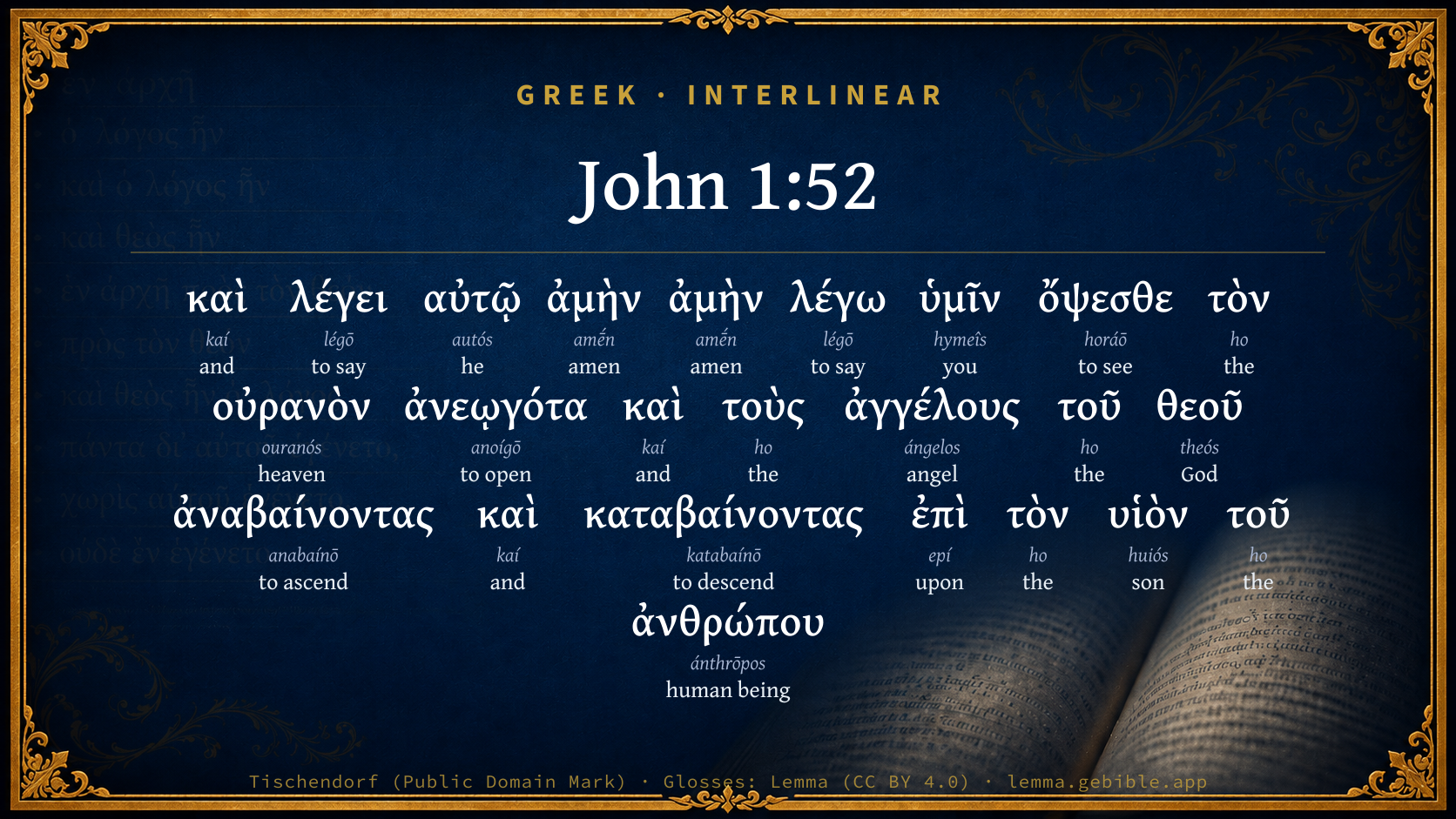
Download a study sheet
One document with this verse’s original text, its word-by-word gloss line, the meaning frame, cross-references with their text, attributed commentary, and full source and license credits — printable, and it pastes into notes with its structure intact.
This verse Autodidact and up
A passage Seminary Student
Up to 50 verses in one chapter. A passage sheet keeps up to 6 commentary sources and 12 cross-references per verse, in the order this page ranks them, and says so on the sheet whenever that leaves anything out. Ask for a single verse and you get the Autodidact verse sheet above.
Everything on this page stays free to read, with no account — the sheet is a download of what is already on screen, not access to it.
Compare translations 3
The same verse in 3 English versions, stacked beneath the original-language interlinear above. Click any original word for its lexicon entry.
Each is an independent rendering of the whole verse — the interlinear is not word-aligned to these translations.
-
World English Bible Public Domain
(No text available for this verse in this version)
-
King James Version Public Domain
(No text available for this verse in this version)
-
unfoldingWord Literal Text CC BY-SA 4.0
(No text available for this verse in this version)
unfoldingWord Literal Text — © unfoldingWord, licensed CC BY-SA 4.0. Word-aligned USFM3 via Door43 (git.door43.org/unfoldingWord/en_ult).
Word by word
More ways to search: Search by grammar → Find every occurrence → Compare this word →
Practice this passage: Drill this verse → Learn its vocabulary →
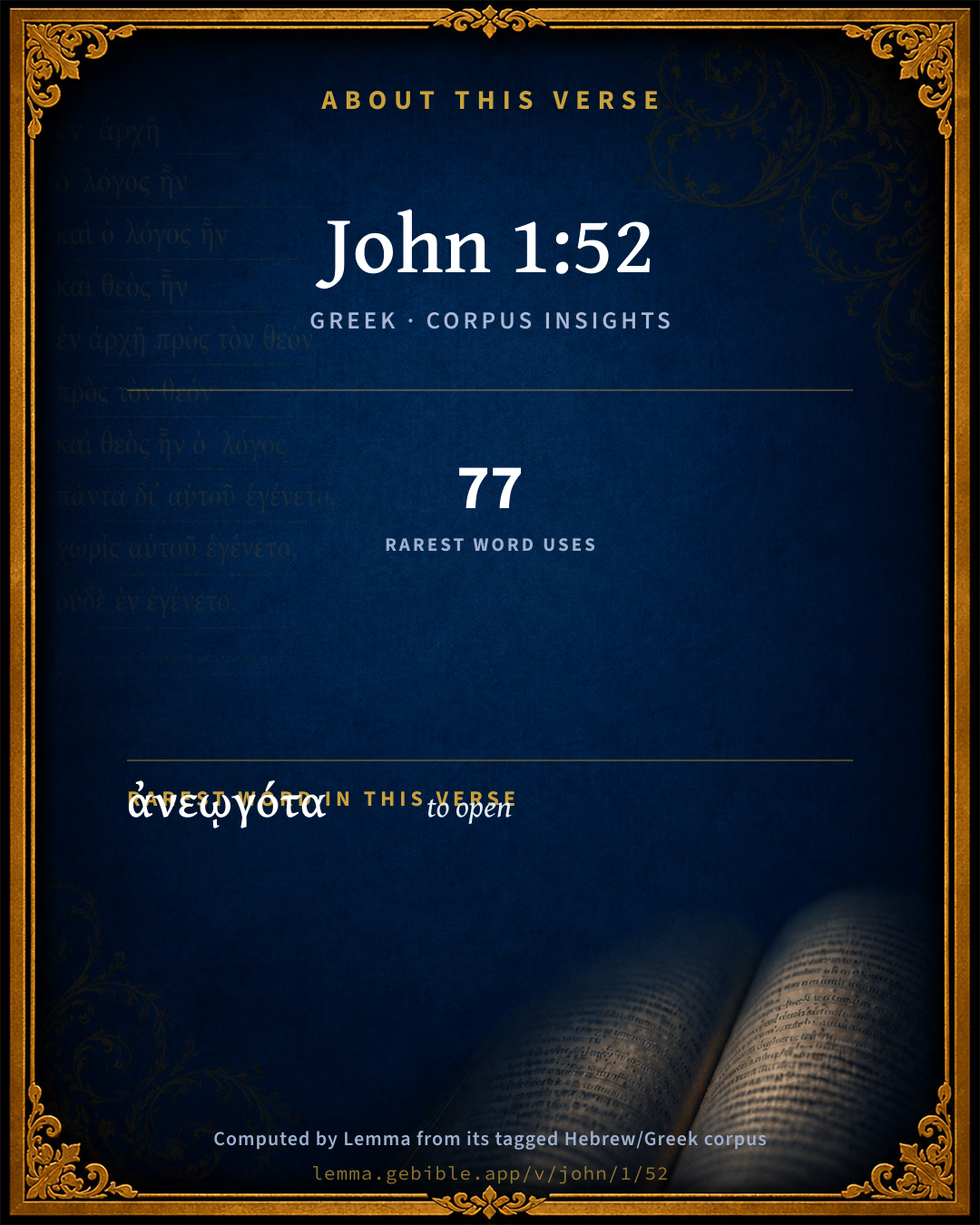
- Appears 77× in the Greek New Testament
- First appears at Matthew 2:11
- Part of Speech
- Verb
- Tense
- Perfect
- Voice
- Active
- Mood
- Participle
- Case
- Accusative
- Number
- Singular
- Gender
- Masculine
Full Thayer's Definition
- καὶ kaí G2532 “and” Conjunction
- λέγει légō G3004 “to say” Verb, Present, Active, Indicative, 3rd person, Singular
- αὐτῷ autós G846 “he” Personal pronoun, Dative, Singular, Masculine
- ἀμὴν amḗn G281 “amen” Hebrew transliteration
- ἀμὴν amḗn G281 “amen” Hebrew transliteration
- λέγω légō G3004 “to say” Verb, Present, Active, Indicative, 1st person, Singular
- ὑμῖν hymeîs G5210 “you” Personal pronoun, 2nd person, Dative, Plural
- ὄψεσθε horáō G3708 “to see” Verb, Future, Middle deponent, Indicative, 2nd person, Plural
- τὸν ho G3588 “the” Article, Accusative, Singular, Masculine
- οὐρανὸν ouranós G3772 “heaven” Noun, Accusative, Singular, Masculine
- ἀνεῳγότα anoígō G455 “to open” Verb, Perfect, Active, Participle, Accusative, Singular, Masculine
- καὶ kaí G2532 “and” Conjunction
- τοὺς ho G3588 “the” Article, Accusative, Plural, Masculine
- ἀγγέλους ángelos G32 “angel” Noun, Accusative, Plural, Masculine
- τοῦ ho G3588 “the” Article, Genitive, Singular, Masculine
- θεοῦ theós G2316 “God” Noun, Genitive, Singular, Masculine
- ἀναβαίνοντας anabaínō G305 “to ascend” Verb, Present, Active, Participle, Accusative, Plural, Masculine
- καὶ kaí G2532 “and” Conjunction
- καταβαίνοντας katabaínō G2597 “to descend” Verb, Present, Active, Participle, Accusative, Plural, Masculine
- ἐπὶ epí G1909 “upon” Preposition
- τὸν ho G3588 “the” Article, Accusative, Singular, Masculine
- υἱὸν huiós G5207 “son” Noun, Accusative, Singular, Masculine
- τοῦ ho G3588 “the” Article, Genitive, Singular, Masculine
- ἀνθρώπου ánthrōpos G444 “human being” Noun, Genitive, Singular, Masculine
About this verse
These counts appear in no published source. They are computed here, from the morphology-tagged text and Lemma’s own curated glosses. What Lemma adds →
- 24
- words
- 16
- distinct lemmas
- Gospels
- section
Commentary
Notes on John 1:52 from classic Christian and Jewish commentators (each source and its license shown beneath its notes). The classic Christian expositions comment on the surrounding passage and are grouped to its opening verse, so a note may address several verses; the Jewish commentaries on the Tanakh (Rashi and others) are per-verse, so they appear only where the commentator wrote on this verse.
Lemma curates 59 commentaries, every one of them public domain or Creative Commons licensed, each selected and text-cleaned for this edition rather than reprinted as found. About our sources →
Alford’s Greek Testament
Henry Alford
Henry Alford, The Greek Testament (1849–1861) — public domain. Text from a community e-Sword module.