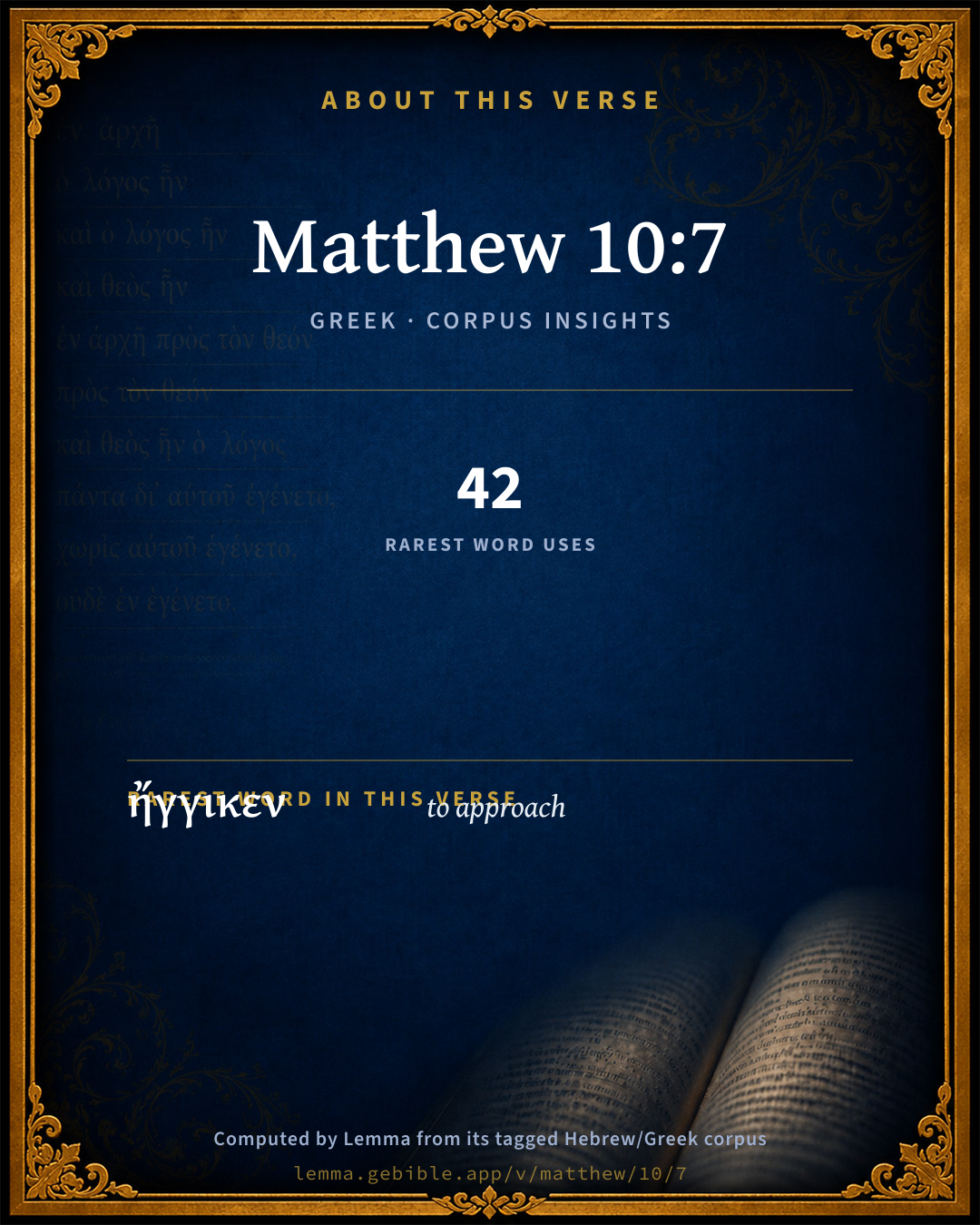
Matthew 10:7

Greek (Tischendorf 8th ed.) Matthew 10:7 appears in the Greek New Testament. The text above is from the Tischendorf 8th edition. Each word links to its Strong’s number and a concise gloss. Click any word for its full Thayer’s Greek Lexicon entry.
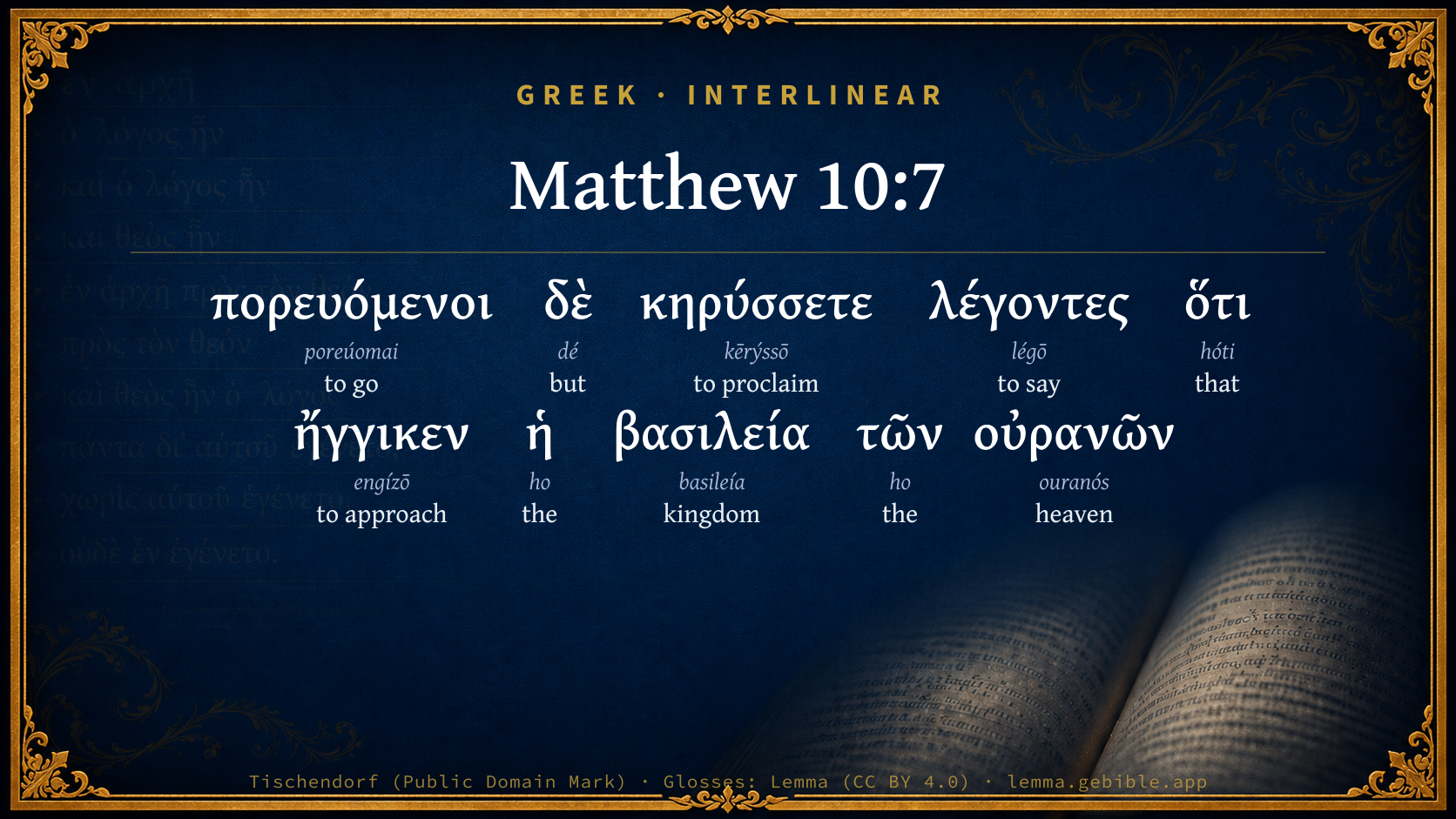
Download image
Cite this verse

Matthew 10:7 (World English Bible). Public Domain. Lemma interlinear Bible study tool, https://lemma.gebible.app/v/matthew/10/7.

Show BibTeX & RIS
BibTeX
RIS
English Translation
As you go, preach, saying, 'The Kingdom of Heaven is at hand!'
World English Bible · Public Domain
Download a study sheet

One document with this verse’s original text, its word-by-word gloss line, the meaning frame, cross-references with their text, attributed commentary, and full source and license credits — printable, and it pastes into notes with its structure intact.

This verse Autodidact and up

Study sheet (.html) Plain text (.txt)

A passage Seminary Student

Up to 50 verses in one chapter. A passage sheet keeps up to 6 commentary sources and 12 cross-references per verse, in the order this page ranks them, and says so on the sheet whenever that leaves anything out. Ask for a single verse and you get the Autodidact verse sheet above.

Everything on this page stays free to read, with no account — the sheet is a download of what is already on screen, not access to it.

Want to remove ads? Support Godless Engineer
Compare translations 3

The same verse in 3 English versions, stacked beneath the original-language interlinear above. Click any original word for its lexicon entry.

Each is an independent rendering of the whole verse — the interlinear is not word-aligned to these translations.

Highlighted words mark where these versions differ — a whole-verse word diff, not a word-by-word alignment.

  • World English Bible Public Domain
    As you go, preach, saying, 'The Kingdom of Heaven is at hand!'
  • King James Version Public Domain
    And as ye go, preach, saying, The kingdom of heaven is at hand.
  • unfoldingWord Literal Text CC BY-SA 4.0
    Now you are going, preach, saying, ‘The kingdom of the heavens has come near.’

unfoldingWord Literal Text — © unfoldingWord, licensed CC BY-SA 4.0. Word-aligned USFM3 via Door43 (git.door43.org/unfoldingWord/en_ult).

Versions to compare (up to 4)

3 of 4 selected

Show all 19 translations

Every available English version of this verse, each an independent rendering of the whole verse.

  • World English Bible Public Domain
    As you go, preach, saying, 'The Kingdom of Heaven is at hand!'
  • Berean Standard Bible Public Domain
    As you go, preach this message: ‘The kingdom of heaven is near.’
  • Majority Standard Bible Public Domain
    As you go, preach this message: ‘The kingdom of heaven is near.’
  • King James Version Public Domain
    And as ye go, preach, saying, The kingdom of heaven is at hand.
  • American Standard Version (1901) Public Domain
    And as ye go, preach, saying, The kingdom of heaven is at hand.
  • Revised Version (1885) Public Domain
    And as ye go, preach, saying, The kingdom of heaven is at hand.
  • Geneva Bible (1599) Public Domain
    And as ye goe, preach, saying, The kingdome of heauen is at hand.
  • Douay-Rheims (1899) Public Domain
    And going, preach, saying: The kingdom of heaven is at hand.
  • Young's Literal Translation Public Domain
    `And, going on, proclaim saying that, the reign of the heavens hath come nigh;
  • Literal Standard Version CC BY-SA 4.0
    And going on, proclaim, saying that the kingdom of the heavens has come near;
  • Unlocked Literal Bible CC BY-SA 4.0
    and as you go, preach and say, 'The kingdom of heaven has come near.'
  • unfoldingWord Literal Text CC BY-SA 4.0
    Now you are going, preach, saying, ‘The kingdom of the heavens has come near.’
  • Darby Bible Public Domain
    And as ye go, preach, saying, The kingdom of the heavens has drawn nigh.
  • World Messianic Bible Public Domain
    As you go, proclaim, saying, ‘The Kingdom of Heaven is at hand!’
  • Webster's Bible Public Domain
    And as ye go, proclaim, saying, The kingdom of heaven is at hand.
  • Free Bible Version CC BY-SA 4.0
    Wherever you go, tell the people, ‘The kingdom of heaven has arrived.’
  • Bible in Basic English Public Domain
    And, on your way, say, The kingdom of heaven is near.
  • Text-Critical English NT CC BY 4.0
    As you go, preach that the kingdom of heaven has drawn near.
  • Tyndale New Testament (1534) Public Domain
    Go and preach sayinge: that the kyngdome of heven is at hande.

Literal Standard Version (2020), Covenant Press — licensed CC BY-SA 4.0. Text via the HelloAO Bible API (eBible.org). Unlocked Literal Bible (unfoldingWord) — licensed CC BY-SA 4.0. Text via the HelloAO Bible API (eBible.org). unfoldingWord Literal Text — © unfoldingWord, licensed CC BY-SA 4.0. Word-aligned USFM3 via Door43 (git.door43.org/unfoldingWord/en_ult). Free Bible Version, Dr. Jonathan Gallagher — licensed CC BY-SA 4.0. Text via the HelloAO Bible API (eBible.org).

Word by word

More ways to search: Search by grammar → Find every occurrence → Compare this word →

Practice this passage: Drill this verse → Learn its vocabulary →

About this verse

These counts appear in no published source. They are computed here, from the morphology-tagged text and Lemma’s own curated glosses. What Lemma adds →

10
words
9
distinct lemmas
Gospels
section

Shared distinctive vocabulary

ἤγγικεν to approach G1448 occurs in 41 verses of the Greek New Testament. Also found in:

Repetition

A word recurs within this verse:

Cross-references

18

Topical passages linked to Matthew 10:7 in the Treasury of Scripture Knowledge — connected by theme and wording, ordered by reader-vote popularity; previews shown in the World English Bible.

  • Acts 28:31 preaching the Kingdom of God, and teaching the things concerning the Lord Jesus Christ with all boldness, without hinderance.
  • Matthew 3:2 "Repent, for the Kingdom of Heaven is at hand!"
  • Matthew 4:17 From that time, Jesus began to preach, and to say, "Repent! For the Kingdom of Heaven is at hand."
  • Luke 9:60 But Jesus said to him, "Leave the dead to bury their own dead, but you go and announce the Kingdom of God."
  • Luke 10:9–11 Heal the sick who are therein, and tell them, 'The Kingdom of God has come near to you.'
  • Luke 16:16 The law and the prophets were until John. From that time the Gospel of the Kingdom of God is preached, and everyone is forcing his way into it.
  • Luke 9:2 He sent them forth to preach the Kingdom of God, and to heal the sick.
  • Isaiah 61:1 The Spirit of the Lord Yahweh is on me; because Yahweh has anointed me to preach good news to the humble; he has sent me to bind up the broken-hearted, to proclaim liberty to the captives, and the opening [of the prison] to those who are bound;
  • Matthew 11:1 It happened that when Jesus had finished directing his twelve disciples, he departed from there to teach and preach in their cities.
  • Matthew 21:31 Which of the two did the will of his father?" They said to him, "The first." Jesus said to them, "Most assuredly I tell you that the tax collectors and the prostitutes are entering into the Kingdom of God before you.
  • Matthew 21:43 "Therefore I tell you, the Kingdom of God will be taken away from you, and will be given to a nation bringing forth its fruits.
  • Mark 6:12 They went out and preached that people should repent.
  • Luke 9:6 They departed, and went throughout the villages, preaching the Gospel, and healing everywhere.
  • Matthew 11:11–12 Most assuredly I tell you, among those who are born of women there has not arisen anyone greater than John the Baptizer; yet he who is least in the Kingdom of Heaven is greater than he.
  • Matthew 23:13 "Woe to you, scribes and Pharisees, hypocrites! For you devour widows' houses, and as a pretense you make long prayers. Therefore you will receive greater condemnation.
  • John 3:2 The same came to him by night, and said to him, "Rabbi, we know that you are a teacher come from God, for no one can do these signs that you do, unless God is with him."
  • Acts 4:2 being upset because they taught the people and proclaimed in Jesus the resurrection from the dead.
  • Acts 10:25 When it happened that Peter entered, Cornelius met him, fell down at his feet, and worshiped him.

Cross-references courtesy of OpenBible.info (CC BY 4.0).

Commentary

Notes on Matthew 10:7 from classic Christian and Jewish commentators (each source and its license shown beneath its notes). The classic Christian expositions comment on the surrounding passage and are grouped to its opening verse, so a note may address several verses; the Jewish commentaries on the Tanakh (Rashi and others) are per-verse, so they appear only where the commentator wrote on this verse.

Lemma curates 59 commentaries, every one of them public domain or Creative Commons licensed, each selected and text-cleaned for this edition rather than reprinted as found. About our sources →

The Biblical Illustrator

Joseph S. Exell

Mat_10:7

And as ye go, preach.

Preaching and going

I. Who are to preach?

II. What are they to preach? The kingdom of heaven. etc. Then we must speak of the King. Tell them He is King of grief, grace, and glory.

III. When are they to preach? As ye go.

1. We are always on the go in this busy world.

2. As ye go-travelling.

3. While you are walking.

4. As long as you live.

IV. Where are we to preach? Go not into the way of the Gentiles, etc. To kith and kin first.

V. Why are we to preach? Freely ye have received. (T. Spurgeon.)

Preaching first to our own kith and kin

Do you remember how it was with Samson? He found honey in the carcase of the lion which he had himself destroyed; and when he found the honey he, like a very sensible man, took of it and did eat; and he went along eating, with his hands full of honey. I do not know whether he had not time to eat it all up before he got to the end of the journey; but I am inclined to think that he was not so selfish as to wish to keep it all to himself. At all events, we read that when he got to the house of his father and of his mother he gave them of the honey, and they did eat. Hast thou found honey? Have it not to thyself? Take it home to those who have it not. And, Saviour, there is no honey that drops from earthly honeycombs like Thy love-sweeter than honey and the honeycomb. (H. W. Beecher.)

The Biblical Illustrator, edited by Joseph S. Exell (c. 1880s–1900s) — public domain. Text from a community e-Sword module.

Joseph Benson's Commentary

Mat 10:7-8. And as ye go, preach — Κηρυσσετε, proclaim, namely, with ardour and zeal, as becomes my heralds. The word is derived from κηρυξ, a herald. “Probably,” says Doddridge, “they were to make this proclamation with a loud voice, as they passed through the streets of the towns they went to, as Jonah delivered his message to Nineveh.” The kingdom of heaven is at hand — Ηγγικεν, hath approached. Publish everywhere the glad tidings of the approach of the Messiah’s kingdom, promised by the prophets. Properly speaking, the kingdom of heaven, or gospel kingdom, did not begin till the Jewish dispensation was abolished, and therefore the apostles, in our Lord’s time, and even our Lord himself, preached the approach only, and not the actual existence of that kingdom. But though the apostles were directed to preach the approach of this kingdom, they did not yet fully understand its nature, that it was not to be a temporal, but a spiritual kingdom, consisting in the dominion of truth and grace, of righteousness, peace, and joy within men. Heal the sick, cleanse the lepers, &c. — Perform all these miraculous cures in confirmation of your mission, to prove to men the certain truth and unspeakable importance of your message. Freely ye have received — All things; in particular the power of working miracles: freely give — Exert that power wherever you come, and that in a manner honourable to yourselves and me: scorn the thought of making any gain of those for whom these works of mercy and power are performed. That this clause relates to the miraculous cures which the apostles were empowered to perform, and not to the stated offices of the apostolical function, is evident from Luk 10:7, where our Lord, in giving a like commission to the seventy, bid them eat and drink what was set before them, “because the labourer was worthy of his hire.” Nay, in this very charge, no sooner did he order the apostles to give freely, than he forbade them to provide gold, &c., because the labourer, says he, is worthy of his meat, plainly insinuating that while they were preaching the gospel, they had a right to a maintenance from those who enjoyed the benefit of their labours, and should in the course of the divine providence be supplied with all things necessary.

Joseph Benson's Commentary on the Old and New Testaments (1811–1818) — public domain. Text from a community e-Sword module.

Tyndale Open Study Notes

Tyndale Open Resources

10:7-8 By doing these things in the name and authority of Jesus, the apostles demonstrated Jesus’ status as Messiah (see 11:2-6).

Tyndale Open Study Notes — © Tyndale Open Resources, licensed CC BY-SA 4.0. Text via the HelloAO Bible API.

Bengel's Gnomon

Johann Albrecht Bengel

Mat 10:7. Πορευόμενοι, as ye go) Answering to πορεύεσθε (go ye), in Mat 10:6.—κηρύσσετε, preach ye) Here were the disciples going forth like students in theology, who practise the rudiments of the ministry and perform the functions of curates, and afterwards return to receive further instruction.[455]—ἤγγικεν, is at hand) This was to be the burden and sum of their discourses;[456] cf. Mar 6:12.

[455] They themselves, in fact, were as yet destitute of perfect knowledge of Jesus Christ, who not until afterwards instructed them more distinctly concerning His passion, death, and resurrection. In the meantime, their preaching, confirmed as it was by very many miracles, prepared the minds of men, so as that they subsequently, without difficulty, yielded themselves up to obey Him, on His advent among them, of whom the hope had been presented to them by this preparatory announcement. Comp. Mat 10:23.—Harm., p. 293.

[456] Which exhorted to repentance.—V. g.

Bengel's Gnomon of the New Testament — English translation (T&T Clark, Edinburgh, 1860) — public domain. Text from a community e-Sword module.

Expositor's Greek Testament

ed. W. Robertson Nicoll

Mat 10:7 . πορευόμενοι κηρύσσετε , as ye go, keep preaching; participle and finite verb, both present. Preaching first in the Master’s thoughts, if not in the evangelist’s (Mat 10:1 ). ἤγγικεν ἡ βασιλεία τ . ο .: the theme is, of course, the kingdom longed for by all, constantly on the lips of Jesus. The message is: It has come nigh to you and is here. Very general, but much more, it may be taken for granted, was said. The apprentice apostles could as yet make no intelligent theoretic statement concerning the Kingdom , but they could tell not a little about the King , the Master who sent them, the chief object of interest doubtless for all receptive souls. It was a house mission (not in synagogue) on which they were sent (Mat 10:12 ). They were to live as guests in selected dwellings, two in one, and two in another, for a time, and their preaching would take the form of familiar conversation on what they had seen and heard Jesus do and say. They would talk by the hour, healing acts would be very occasional, one or two in a village.

The Expositor's Greek Testament, edited by W. Robertson Nicoll (1897–1910) — public domain. Text from a community e-Sword module.

Geneva Bible (1599)

Geneva Bible translators

The sum of the Gospel: or preaching of the Apostles.

Geneva Bible (1599) marginal notes — public domain. Text via Bolls.life.

Jamieson, Fausset & Brown

Robert Jamieson, A. R. Fausset & David Brown

And as ye go, preach, saying, The kingdom of heaven is at hand--(See on Mat 3:2).

Jamieson, Fausset & Brown — Commentary Critical and Explanatory on the Whole Bible (1871) — public domain (CC PDM 1.0). Text via the HelloAO Bible API.

Adam Clarke's Commentary

Verse 7. And as ye go, preach] πορευομενοι δε κηρυσσετε, and as you proceed, proclaim like heralds - make this proclamation wherever ye go, and while ye are journeying. Preach and travel; and, as ye travel, preach-proclaim salvation to all you meet. Wherever the ministers of Christ go, they find lost, ruined souls; and, wherever they find them, they should proclaim Jesus, and his power to save. For an explanation of the word proclaim or preach, See Clarke on Mt 3:1.

From this commission we learn what the grand subject of apostolic preaching was - THE KINGDOM OF HEAVEN IS AT HAND! This was the great message. "They preached," says Quesnel, "to establish the faith; the kingdom, to animate the hope; of heaven, to inspire the love of heavenly things, and the contempt of earthly; which is at hand, that men may prepare for it without delay."

Adam Clarke's Commentary on the Bible (1810–1826) — public domain. Text from a community e-Sword/MySword module.

Ellicott's Commentary for English Readers

(7) Preach—i.e., “proclaim—act as heralds,” as elsewhere. The repetition of the self-same words as had described first the Baptist’s teaching and then our Lord’s, seems to suggest that this was actually a formula of proclamation. The two envoys of the King were to enter into town or village, and there, standing in the gate, to announce that His kingdom had come near, and then, when this had drawn crowds to listen, to call men to the repentance without which they could not enter it.

A Bible Commentary for English Readers, edited by Charles John Ellicott (1878–1897) — public domain. Text from a community e-Sword module.

John Gill's Exposition

Heal the sick,.... For so he had given them power to do, and this both for the confirmation of their doctrine, and the recommendation of them to men; for nothing could more evidently prove their mission to be divine, and their doctrine from heaven, or be more acceptable to men, than to "heal" their "sick" friends and relations, who were given up by physicians, and incurable by the art of man; and to do this without the use of medicines, either by a word speaking, or by laying on of their hands, or by anointing with oil, joined with prayer; and particularly to

cleanse the lepers, of which there were many in Israel, who otherwise could not get rid of that disorder, and by the law were deprived of many privileges, and advantages, which others enjoyed: and especially to

raise the dead, which had never been done before the times of Christ, since the days of Elijah and Elisha; and which must be allowed by all men to be more than human, and to require the arm of almighty power: and lastly, to

cast out devils, the sworn enemies of mankind, and who had taken possession of the bodies, as well as souls of multitudes in the Jewish nation; all which they are ordered to do, without taking any thing of the people, for so doing:

freely ye have received, freely give; which refers both to the working of miracles, and preaching of the Gospel. As they had these miraculous gifts freely imparted to them by Christ, they had them not of themselves, nor did they procure them at any charge, or expense of their's, or purchase them with their money, as Simon Magus impiously proposed to the apostles; so they were freely to make use of these wonderful powers, they were possessed of, for the relief of the distressed, without insisting upon, or receiving any thing for the same; a practice which was formerly disapproved and condemned in Gehazi, the servant of Elisha: and with respect to the Gospel, as the knowledge of it was freely communicated to them by Christ, and gifts qualifying them for the preaching of it, were of his mere grace and goodness bestowed upon them, so they were to dispense it without making a gain of godliness, or discovering in the least an avaricious disposition. Our Lord seems to have respect to a rule frequently inculcated by the Jews concerning teaching their oral law (g); which is this;

"in the place where they teach the written law for a reward, it is lawful to teach it for a reward; but it is forbidden to teach the oral law for a reward, as it is said, "behold, I have taught you statutes and judgments, even as the Lord my God commanded me", &c. Deu 4:5. As I have "freely" learned, and ye have also "freely" learnt of me; so when ye learn posterity, , "teach them freely, as ye have learnt of me".''

Now what the Jews say of their traditions, Christ applies to the Gospel: in dispensing of which he would not have his disciples come behind them; but as they had freely received the Gospel from his lips; so they would as freely, as well as faithfully, make it known to others; and which no ways contradicts the maintenance of the Gospel ministers by the people; only forbids amassing wealth and riches by it, or preaching for sordid gain, or filthy lucre's sake: for otherwise it is Christ's own ordinance, that the preachers of the Gospel should live by it; and which is confirmed in the following verses.

(g) Maimon. Talmud Tora, c. 1. sect. 7. T. Bab. Nedarim, fol. 36. 2. & 37. 1. & Becorat, fol. 29. 1. Maimon. & Bartenora in Misn. Nedarim, c. 4. sect. 3. & in Pirke Abot. c. 4. sect. 5.

John Gill's Exposition of the Whole Bible (1746–1763) — public domain (CC PDM 1.0). Text via the HelloAO Bible API.

Trapp's Complete Commentary

John Trapp

7 And as ye go, preach, saying, The kingdom of heaven is at hand.

Ver. 7. The kingdom of heaven is at hand] Repent therefore. Men will do much for a kingdom. And nothing less than a kingdom, and that of heaven, can buy men out of their sweet sins. How many hear we daily making answer to the motion of this heavenly kingdom offered them by God, as the olive and vine did in Jotham’s parable! Shall I leave my fat and sweet sins, to reign, though with God? {a} And yet every man must be either a king or a captive; reign in heaven, or roar for ever in hell. And this the apostles were bidden, wherever they came, to preach; not to sing mass, which is the chief office of priest among the Papists. And for the people, they are taught to believe that the mass only is a work of duty; but the going to sermons a matter of convenience, and such as is left free to men’s leisures and opportunities, without imputation of sin.

{a} At Paris, ut vivat regnetque beatus, cogi posse negat.

John Trapp, A Commentary or Exposition upon All the Books of the Old and New Testament (1647–1656) — public domain. Text from a community e-Sword module.

Albert Barnes' Notes on the Bible

The kingdom of heaven is at hand - Or, more literally, the “reign” of heaven, or of God, draws near. See the notes at Mat 3:2.

Albert Barnes' Notes on the Bible (1834–1885) — public domain. Text from a community e-Sword/MySword module.

Haydock's Catholic Bible Commentary

And going, &c. What the apostles were to preach, is the second thing to be taken notice of in their mission. We here learn what it is, viz. that The kingdom of heaven is at hand. We here behold the great dignity to which the apostles were raised, when sent to preach. For, says St. Chrysostom, they are not sent to announce sensible things, like Moses and the prophets, but something wholly new, and before unheard of. They are not like the prophets, to confine themselves to the preaching of temporal things, their doctrine is wholly heavenly; they are sent to announce the good things of eternity. (St. Thomas Aquinas)

George Leo Haydock (1774–1849), Haydock's Catholic Family Bible and Commentary, 1859 edition — public domain. Excludes Psalms (Douay-Rheims chapter numbering differs from Protestant) and Deuterocanonical books (Catholic canon only).

Matthew Poole's English Annotations

In these words he gives them power,

1. To preach the gospel.

2. To confirm the doctrine they preached to be of God by miraculous operations, healing the sick, cleansing lepers, raising the dead, casting out devils.

He bids them

go preach, Khrussete, Cry like heralds; something like Isaiah’s commission, Isa 58:1, Cry aloud, spare not, lift up thy voice like a trumpet. He teacheth them what should be the sum of their sermons,

The kingdom of heaven is at hand; the same thing which John Baptist preached, Mat 3:2, which Christ preached, Mar 1:15, and which he directed the seventy to preach, Luk 10:9; not that they were to use no other words, but that all the words they used were to have this tendency, to declare that the time was now come, when God had fulfilled his promise of the Messiah, who was setting up his kingdom in the world, and to whose laws they were to be obedient. This doctrine they were to confirm by miracles, which he gives them a charge they should work freely, without receiving any reward for them, that the miracles being used to their private profit, might not lose their end, which was the confirmation of their doctrine.

Matthew Poole's English Annotations on the Holy Bible (1683–1685) — public domain. Text from a community e-Sword/MySword module.

Whedon's Commentary on the Bible

Daniel D. Whedon

7. As ye go — Our Lord here implies that they would continually extend their missionary travels. They were to be true itinerants, travelling after they had preached, and preaching as they travelled.

The kingdom of heaven — A kingdom which is the opposite of the kingdoms of this world, and still more of the kingdom of hell. Of this kingdom the crown prince is Messiah. When, therefore, they proclaimed the approach of this kingdom, they of course implied the Messiah’s coming.

Daniel D. Whedon (gen. ed.), Commentary on the Old and New Testaments (1874–1909) — public domain. Text from a community e-Sword module.

The Pulpit Commentary

Parallel passages: Luk_9:2 (the twelve); Luk_10:9 (the seventy; observe that the substance of the proclamation was to be the same). And as ye go. For your journey is not to one place, but many. Preach. Aloud and publicly. Saying, The kingdom of heaven is at hand. That which men had so long been desiring (vide Mat_3:2 Mat_4:17) was now near. But had it not come? (Mat_12:28 Mat_11:12) Not in full realization. But its near realization was then a possibility, and was only not brought about because, as a nation, they rejected him who introduced it.

The Pulpit Commentary (1880–1919), ed. H.D.M. Spence-Jones & Joseph S. Exell — public domain. Text from a community e-Sword module.

Kretzmann's Popular Commentary

Paul E. Kretzmann

The message itself and the accompanying signs:

v. 7. And as ye go, preach, saying, The kingdom of heaven is at hand.

v. 8. Heal the sick, cleanse the lepers, raise the dead, cast out devils. Freely ye have received, freely give.

While on your missionary journey, preach; preaching the first and foremost duty and necessity. Its subject: The kingdom of the heavens is even now at hand. In the person of the lowly Nazarene, Jesus Christ, all the types and prophecies are fulfilled. He that accepts Him in faith has the Kingdom, is a member of the Kingdom. So perform your work as heralds, from house to house. And whenever it was necessary, they were empowered to confirm the Word with signs following, Mar 16:20. Not only should ordinary sicknesses yield to their authority, but even the uncleanness of the lepers. Even the power to call the dead back to life and to control evil spirits was entrusted to them. Circumstances may not have required the use of all these miracles in any one city or town, and it is likely that the apostles did not raise any people from the dead before Christ Himself arose from the dead. There is also some probability that, at that time, their faith was not yet strong enough to perform the greatest miracle, Mat 17:20. But so far as Christ’s commission to them was concerned, they received all the authority necessary to back up their preaching with such works as must be accepted as proof positive for their divine mission. But this power was not to be for hire, not to be sold for money.

Miracles

The simple belief in the miracles of the Bible which characterized the early centuries of the Christian Church, and which, during the Middle Ages, was, by false analogy, expanded into a credulousness that placed the so-called acts of the saints, spurious inventions of a superstitious age, on a level with the great deeds of God, has long since been declared impossible under modern conditions. Beginning about three centuries ago, the enemies of the Bible have been increasingly active, until at the present time, both without and within the Church, the miraculous element in the Bible is being discarded.

The objections to the Bible account of miracles and therefore to the miracles themselves may be divided into two classes, the radical and the conservative. The first class denies the possibility of miracles outright, without excuse or apology. It has been stated that miracles are violations of the laws of nature, although the statement concedes the existence of a law-maker whose right to suspend laws as well as to make them should be unquestioned. It is declared that miracles are excluded by the uniformity of nature, although experience itself is alterable and indefinite. The critics have said that the human mind is turning away from miracles, that the whole body of modern sciences yields the immense result that there is no supernatural. The miraculous stories are said to be the creations of a credulous and superstitious age. It is argued that it requires no mental effort to cut out of the New Testament the miraculous element. So-called scholars "have examined, in the scientific spirit, our Bible, and at every step they have found the record of miracles mythical or legendary, always incredible as fact. They believe that miracles do not occur, that they never have occurred, that they never will occur. The miraculous element, so it is more and more widely held, is the constant and spurious accompaniment, in ancient times, of every great religious movement. " One critic asks, with reference to the resurrection of Christ: "Is the testimony sufficient to show that a man thoroughly dead... came back to life, passed through closed doors, and ascended into the sky?" And he adds: "I cannot speak for others, but most certainly I cannot believe such monstrous facts on such evidence."

The conservative class of critics desires to save the Bible, such remnants as they still concede to be true, by arguing that miracles need not be believed, that they are not necessary for the truth of Scriptures and of the Christian faith. Most of the Old Testament miracles are explained away by declaring that they are mere poetical ornamentation and have no fundamental connection with the story. We might possess, they say, the miracles of the Lord without possessing the Lord Himself; does it not follow that we might lose the miracles of the Lord and still retain Him? It is frankly stated that the apologist of the present time has an interest in minimizing the miraculousness of miracles, and making them appear as natural as possible. The present temper of the religious public would seem to be to naturalize not only miracles, but the whole spiritual world.

In view of these facts, it is essential, first of all, to know what a miracle is. The following definition is generally accepted: "A miracle is an event making known to the senses the presence of a personal power above the physical and human plane, working towards a moral end. " Under this explanation, which includes miracles, signs, and wonders, we may divide them into three classes. There are the miracles of the constant revelation of God in nature and history, the many evidences of supernatural intervention. There are the miracles or occurrences within the ordinary course of nature, which, nevertheless, human strength and wisdom cannot accomplish without the creative and providential power of God, including all the physiological changes within living organisms due to life. There are the miracles or phenomena outside of nature’s course and known laws, brought about by a deliberate suspension of the physical order of the universe, including both the miracles of Scripture and the many cases of supernatural preservation.

To deny the existence of miracles in nature about us is to deny the evidence of all the senses and the results of centuries of research. And to deny the miracles of Scripture is to deny the veracity of the entire Bible-account, for it is impossible to divorce the miraculous from the Christian religion, since all true religion is a miracle. That the Old Testament contains but few miracle stories, and that these are confined to Exodus and the lives of Elisha and Elijah, as has been stated, is so manifestly untrue that a reference to the Bible is sufficient as refutation. To separate the miraculous element from the Gospel-accounts, is to take away the essence of the Gospel-narrative. The miracles of Jesus were seals, credentials, because they were signs, essential features, of His mission. If we remove all references to miracles, the gospels lie before us in ruins.

As for the necessity of miracles, the fact that the Lord found them so ought to be sufficient warrant for their happening. The Gospel arose from witnessing miracles and is a record and explanation of these facts. If the resurrection of Jesus had been a delusion, it would have shared the fate of all delusions in being short-lived. And all the other miracles are credible, because they are associated with the miracle of the resurrection. The Christian religion was introduced into the midst of its enemies by means of the miraculous. Thus the miracles are the sign and seal of divine approbation. God would not have sanctioned such a series if they had been falsehoods. And no magicians could have performed them. The miracles were made in defense of a religion of the most perfect righteousness and universal truth, to stand forever in evidence of the unblemished beauty of Christ’s moral character and of the divine call of His disciples. It is sufficient for us to know that He thereby revealed His glory, Joh 1:14; Joh 2:11, and that the miracles of the New Testament were recorded that we might believe that Jesus is the Christ, the Son of God, and that believing we might have life through His name, Joh 20:31.

Paul E. Kretzmann, Popular Commentary of the Bible (1921–1924) — public domain. Text from a community e-Sword module.

Burkitt's Expository Notes on the New Testament

William Burkitt

Observe here, 1. The duty enjoined the apostles in order to the bringing home of lost souls to Christ, and that is, preaching; As ye go, preach.

Note thence, That the plain and persuasive preaching of the gospel, is the special mean appointed by Christ for the salvation of lost sinners.

Observe, 2. The doctrine they are enjoined to preach, namely, that the kingdom of heaven is at hand; that is, that the promised Messiah was come, and had set up his kindom in the world, and expected their obedience to his laws.

Where note, How that the preaching of John, of Christ, and his apostles, was one and the same; namely, the doctrine of repentance: repent, say they all, for the kingdom of heaven is at hand; that is, the time of the Messiah’s appearing, which has been so long expected, is now come.

William Burkitt's Expository Notes on the New Testament (1700–1703) — public domain. Text from a community e-Sword module.

The People's New Testament

B. W. Johnson

7. Preach … The kingdom of heaven is at hand. John the Baptist, and Christ also, had preached, “The kingdom is at hand.” It had not yet been inaugurated. So the apostles were still to preach. It was near, but not in existence. There was no such charge in the second commission. Then “all power in heaven and in earth was in the hands of Christ.” He became King after he suffered, and his kingdom was inaugurated on earth on the day of Pentecost. When he was “lifted up” (John 3:15), he became King.

B. W. Johnson's The People's New Testament with Notes (1889–1891) — public domain. Electronic text from the Christian Classics Ethereal Library (CCEL) ThML edition.

Alford’s Greek Testament

Henry Alford

7.] This announcement shews the preparatory nature of this first apostolic mission. Compare, shewing the difference of their ultimate message to the world, Col 1:26-28.

Henry Alford, The Greek Testament (1849–1861) — public domain. Text from a community e-Sword module.

International Critical Commentary

(L) 7. And as you go, preach, saying that The kingdom of the heavens is at hand.] Cf. 3:2, 4:17.

International Critical Commentary — older volumes (1896–1929), various authors — public domain. Text from a community e-Sword module.

Lesson kit

Teaching starters — assembled from the data on this page, not authored interpretation. Every prompt links to the verse data it draws on. Edit before teaching.

Matthew, in the Gospels, opens this verse with 10 words (9 distinct Greek lemmas). Its most distinctive word is engízō (“to approach”). A historical commentator’s framing appears above. Read the whole chapter for the surrounding context.

Discussion questions

  1. How does “to approach” (engízō) shape what this verse is saying?
  2. Matthew 3:2 shares the word «to approach» with this verse. How do the two illuminate each other?
  3. “the” occurs 2× in this one verse. What is the effect of the repetition?
  4. The translations on this page render this verse differently — a whole-verse word diff, not a word-by-word alignment. What might account for the different wordings?
  5. Reading how The Biblical Illustrator and Joseph Benson's Commentary read this verse, where do the two commentators agree and where do they part?

Things to notice

Reading settings

Reading text

Shown beneath each verse's original-language words.

Old Testament
Old Testament edition

Read the OT as the Masoretic Hebrew (MT) or the Greek Septuagint (LXX).

English shown for the Greek Septuagint (in the Hebrew ↔ Greek comparison).

Comparing translations? Open the Compare panel on any verse page to stack up to four side by side.