

Revelation 21:10
Greek (Tischendorf 8th ed.) Revelation 21:10 appears in the Greek New Testament. The text above is from the Tischendorf 8th edition. Each word links to its Strong’s number and a concise gloss. Click any word for its full Thayer’s Greek Lexicon entry.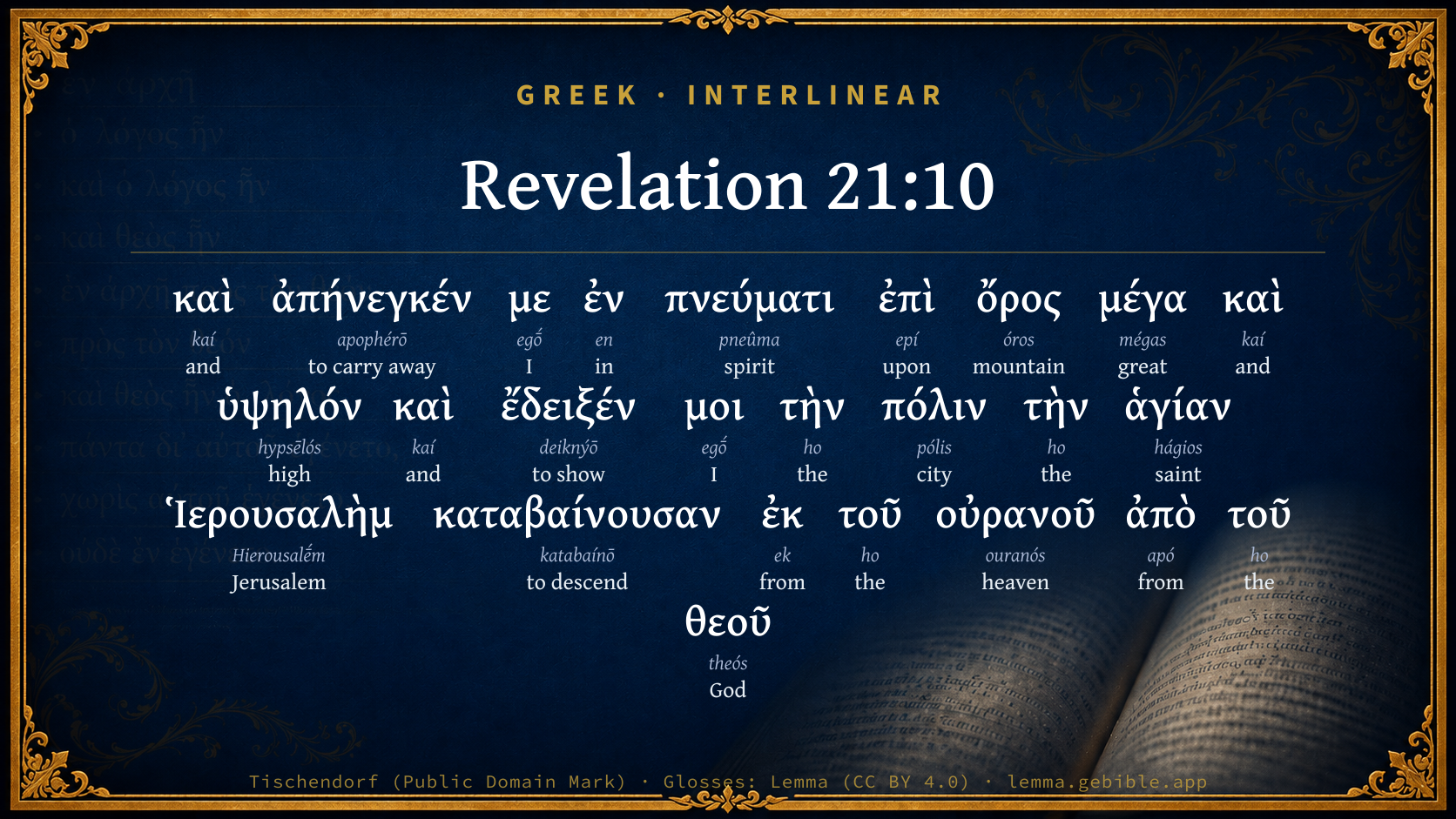
He carried me away in the Spirit to a great and high mountain, and showed me the holy city, Jerusalem, coming down out of heaven from God,
Download a study sheet
One document with this verse’s original text, its word-by-word gloss line, the meaning frame, cross-references with their text, attributed commentary, and full source and license credits — printable, and it pastes into notes with its structure intact.
This verse Autodidact and up
A passage Seminary Student
Up to 50 verses in one chapter. A passage sheet keeps up to 6 commentary sources and 12 cross-references per verse, in the order this page ranks them, and says so on the sheet whenever that leaves anything out. Ask for a single verse and you get the Autodidact verse sheet above.
Everything on this page stays free to read, with no account — the sheet is a download of what is already on screen, not access to it.
Compare translations 3
The same verse in 3 English versions, stacked beneath the original-language interlinear above. Click any original word for its lexicon entry.
Each is an independent rendering of the whole verse — the interlinear is not word-aligned to these translations.
Highlighted words mark where these versions differ — a whole-verse word diff, not a word-by-word alignment.
-
World English Bible Public Domain
He carried me away in the Spirit to a great and high mountain, and showed me the holy city, Jerusalem, coming down out of heaven from God,
-
King James Version Public Domain
And he carried me away in the spirit to a great and high mountain, and shewed me that great city, the holy Jerusalem, descending out of heaven from God,
-
unfoldingWord Literal Text CC BY-SA 4.0
And he carried me away in the Spirit to a great and high mountain, and he showed me the holy city, Jerusalem, coming down out of heaven from God,
unfoldingWord Literal Text — © unfoldingWord, licensed CC BY-SA 4.0. Word-aligned USFM3 via Door43 (git.door43.org/unfoldingWord/en_ult).
Show all 19 translations
Every available English version of this verse, each an independent rendering of the whole verse.
-
World English Bible Public Domain
He carried me away in the Spirit to a great and high mountain, and showed me the holy city, Jerusalem, coming down out of heaven from God,
-
Berean Standard Bible Public Domain
And he carried me away in the Spirit to a mountain great and high, and showed me the holy city of Jerusalem coming down out of heaven from God,
-
Majority Standard Bible Public Domain
And he carried me away in the Spirit to a mountain great and high, and showed me the great holy city of Jerusalem coming down out of heaven from God,
-
King James Version Public Domain
And he carried me away in the spirit to a great and high mountain, and shewed me that great city, the holy Jerusalem, descending out of heaven from God,
-
American Standard Version (1901) Public Domain
And he carried me away in the Spirit to a mountain great and high, and showed me the holy city Jerusalem, coming down out of heaven from God,
-
Revised Version (1885) Public Domain
And he carried me away in the Spirit to a mountain great and high, and shewed me the holy city Jerusalem, coming down out of heaven from God,
-
Geneva Bible (1599) Public Domain
And he caried me away in the spirit to a great: and an hie mountaine, and he shewed me that great citie, that holie Hierusalem, descending out of heauen from God,
-
Douay-Rheims (1899) Public Domain
And he took me up in spirit to a great and high mountain: and he shewed me the holy city Jerusalem coming down out of heaven from God,
-
Young's Literal Translation Public Domain
and he carried me away in the Spirit to a mountain great and high, and did shew to me the great city, the holy Jerusalem, coming down out of the heaven from God,
-
Literal Standard Version CC BY-SA 4.0
and he carried me away in the Spirit to a mountain great and high, and showed me the great city, the holy Jerusalem, coming down out of Heaven from God,
-
Unlocked Literal Bible CC BY-SA 4.0
Then he carried me away in the Spirit to a great and high mountain and showed me the holy city Jerusalem coming down out of heaven from God.
-
unfoldingWord Literal Text CC BY-SA 4.0
And he carried me away in the Spirit to a great and high mountain, and he showed me the holy city, Jerusalem, coming down out of heaven from God,
-
Darby Bible Public Domain
And he carried me away in [the] Spirit, [and set me] on a great and high mountain, and shewed me the holy city, Jerusalem, coming down out of the heaven from God,
-
World Messianic Bible Public Domain
He carried me away in the Spirit to a great and high mountain, and showed me the holy city, Jerusalem, coming down out of heaven from God,
-
Webster's Bible Public Domain
And he carried me away in the spirit to a great and high mountain, and showed me that great city, the holy Jerusalem, descending out of heaven from God,
-
Free Bible Version CC BY-SA 4.0
He took me in the Spirit to the top of a very high mountain. There he showed me the holy city Jerusalem descending from God out of heaven,
-
Bible in Basic English Public Domain
And he took me away in the Spirit to a great and high mountain, and let me see the holy town Jerusalem, coming down out of heaven from God,
-
Text-Critical English NT CC BY 4.0
And he carried me away in the Spirit to a great and high mountain and showed me the holy city Jerusalem coming down out of heaven from God.
-
Tyndale New Testament (1534) Public Domain
And he caryed me awaye in the sprete to a grett and an hye mountayne and he shewed me the grett cite holy Ierusalem descendinge out of heven from God
Literal Standard Version (2020), Covenant Press — licensed CC BY-SA 4.0. Text via the HelloAO Bible API (eBible.org). Unlocked Literal Bible (unfoldingWord) — licensed CC BY-SA 4.0. Text via the HelloAO Bible API (eBible.org). unfoldingWord Literal Text — © unfoldingWord, licensed CC BY-SA 4.0. Word-aligned USFM3 via Door43 (git.door43.org/unfoldingWord/en_ult). Free Bible Version, Dr. Jonathan Gallagher — licensed CC BY-SA 4.0. Text via the HelloAO Bible API (eBible.org).
Word by word
More ways to search: Search by grammar → Find every occurrence → Compare this word →
Practice this passage: Drill this verse → Learn its vocabulary →
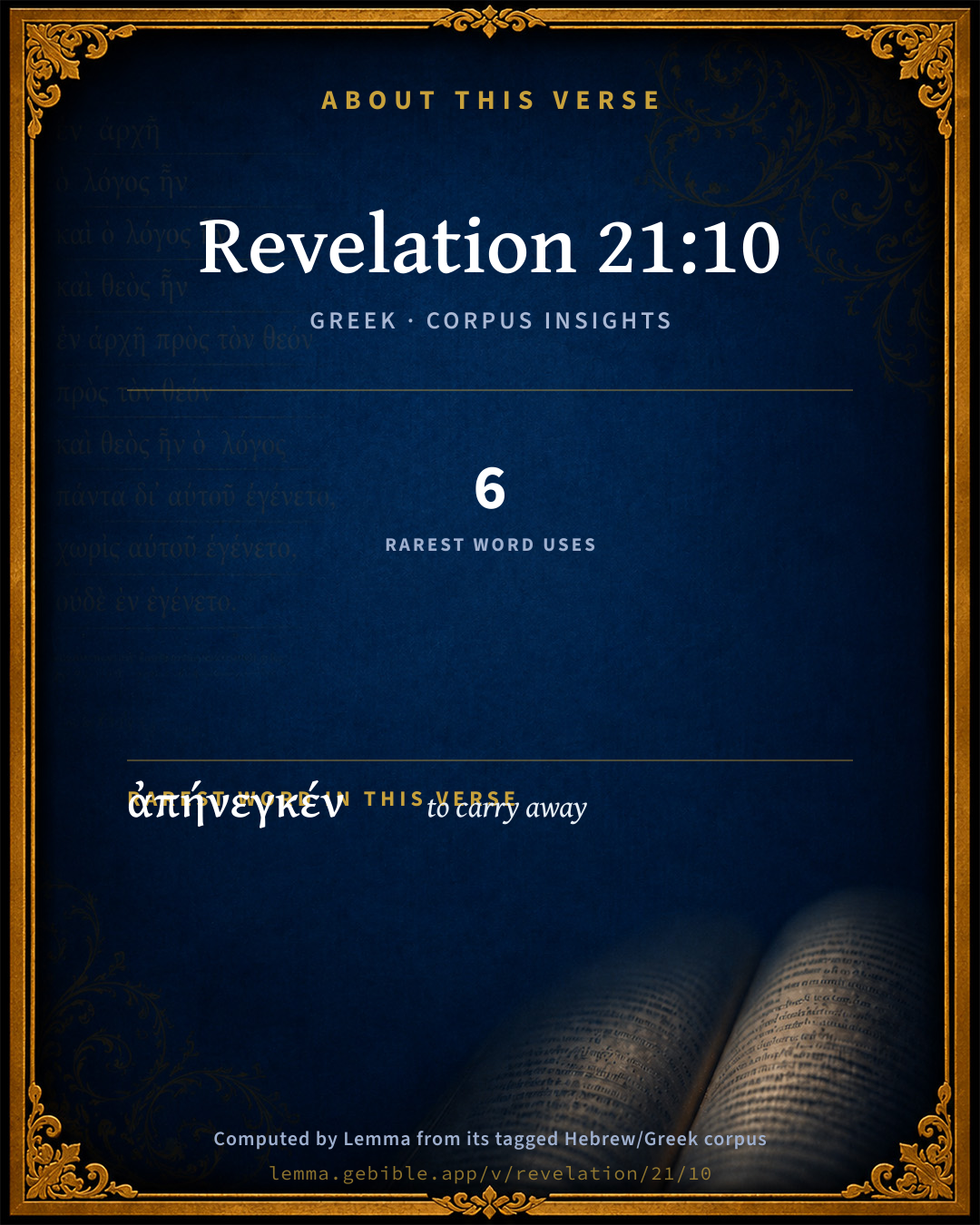
- Appears 6× in the Greek New Testament
- First appears at Mark 15:1
- Part of Speech
- Verb
- Tense
- Aorist
- Voice
- Active
- Mood
- Indicative
- Person
- 3rd person
- Number
- Singular
Full Thayer's Definition
- καὶ kaí G2532 “and” Conjunction
- ἀπήνεγκέν apophérō G667 “to carry away” Verb, Aorist, Active, Indicative, 3rd person, Singular
- με egṓ G1473 “I” Personal pronoun, 1st person, Accusative, Singular
- ἐν en G1722 “in” Preposition
- πνεύματι pneûma G4151 “spirit” Noun, Dative, Singular, Neuter
- ἐπὶ epí G1909 “upon” Preposition
- ὄρος óros G3735 “mountain” Noun, Accusative, Singular, Neuter
- μέγα mégas G3173 “great” Adjective, Accusative, Singular, Neuter
- καὶ kaí G2532 “and” Conjunction
- ὑψηλόν hypsēlós G5308 “high” Adjective, Accusative, Singular, Neuter
- καὶ kaí G2532 “and” Conjunction
- ἔδειξέν deiknýō G1166 “to show” Verb, Aorist, Active, Indicative, 3rd person, Singular
- μοι egṓ G1473 “I” Personal pronoun, 1st person, Dative, Singular
- τὴν ho G3588 “the” Article, Accusative, Singular, Feminine
- πόλιν pólis G4172 “city” Noun, Accusative, Singular, Feminine
- τὴν ho G3588 “the” Article, Accusative, Singular, Feminine
- ἁγίαν hágios G40 “saint” Adjective, Accusative, Singular, Feminine
- Ἱερουσαλὴμ Hierousalḗm G2419 “Jerusalem” Noun, Proper, indeclinable
- καταβαίνουσαν katabaínō G2597 “to descend” Verb, Present, Active, Participle, Accusative, Singular, Feminine
- ἐκ ek G1537 “from” Preposition
- τοῦ ho G3588 “the” Article, Genitive, Singular, Masculine
- οὐρανοῦ ouranós G3772 “heaven” Noun, Genitive, Singular, Masculine
- ἀπὸ apó G575 “from” Preposition
- τοῦ ho G3588 “the” Article, Genitive, Singular, Masculine
- θεοῦ theós G2316 “God” Noun, Genitive, Singular, Masculine
About this verse
These counts appear in no published source. They are computed here, from the morphology-tagged text and Lemma’s own curated glosses. What Lemma adds →
- 25
- words
- 19
- distinct lemmas
- Revelation
- section
Cross-references
14Topical passages linked to Revelation 21:10 in the Treasury of Scripture Knowledge — connected by theme and wording, ordered by reader-vote popularity; previews shown in the World English Bible.
- Revelation 21:2 I saw the holy city, New Jerusalem, coming down out of heaven from God, made ready like a bride adorned for her husband.
- Ezekiel 11:24 The Spirit lifted me up, and brought me in the vision by the Spirit of God into Chaldea, to them of the captivity. So the vision that I had seen went up from me.
- Ezekiel 8:3 He put forth the form of a hand, and took me by a lock of my head; and the Spirit lifted me up between earth and the sky, and brought me in the visions of God to Jerusalem, to the door of the gate of the inner [court] that looks toward the north; where was the seat of the image of jealousy, which provokes to jealousy.
- Ezekiel 11:1 Moreover the Spirit lifted me up, and brought me to the east gate of Yahweh's house, which looks eastward: and see, at the door of the gate twenty-five men; and I saw in the midst of them Jaazaniah the son of Azzur, and Pelatiah the son of Benaiah, princes of the people.
- Ezekiel 40:1–49 In the five and twentieth year of our captivity, in the beginning of the year, in the tenth [day] of the month, in the fourteenth year after that the city was struck, in the same day, the hand of Yahweh was on me, and he brought me there.
- Acts 8:39 When they came up out of the water, the Spirit of the Lord caught Philip away, and the eunuch didn't see him any more, for he went on his way rejoicing.
- 2 Corinthians 12:2–4 I know a man in Christ, fourteen years ago (whether in the body, I don't know, or whether out of the body, I don't know; God knows), such a one caught up into the third heaven.
- Revelation 1:10 I was in the Spirit on the Lord's day, and I heard behind me a loud voice, like a trumpet
- Revelation 17:3 He carried me away in the Spirit into a wilderness. I saw a woman sitting on a scarlet-colored animal, full of blasphemous names, having seven heads and ten horns.
- Ezekiel 3:14 So the Spirit lifted me up, and took me away; and I went in bitterness, in the heat of my spirit; and the hand of Yahweh was strong on me.
- Revelation 4:2 Immediately I was in the Spirit. Behold, there was a throne set in heaven, and one sitting on the throne
- 1 Kings 18:12 It will happen, as soon as I am gone from you, that the Spirit of Yahweh will carry you I don't know where; and so when I come and tell Ahab, and he can't find you, he will kill me: but I your servant fear Yahweh from my youth.
- 2 Kings 2:16 They said to him, See now, there are with your servants fifty strong men; let them go, we pray you, and seek your master, lest the Spirit of Yahweh has taken him up, and cast him on some mountain, or into some valley. He said, You shall not send.
- Ezekiel 48:15–22 The five thousand that are left in the breadth, in front of the twenty-five thousand, shall be for common use, for the city, for dwelling and for suburbs; and the city shall be in the midst of it.
Cross-references courtesy of OpenBible.info (CC BY 4.0).
Where the printed editions differ
1 variantPlaces in this verse where the major printed Greek editions disagree on the wording in a way that affects the translation — a comparison of editions, not a manuscript-by-manuscript collation. The editions are the modern critical texts (Nestlé-Aland 28/27, SBL, Westcott-Hort, Tregelles, Tyndale House) and the traditional texts behind the KJV (the Textus Receptus and the Byzantine/Majority text). It is not a claim about which reading is original.
-
Extra text
τὴν μεγάλην
“<the> great”
In TRByz Not in NA28NA27TynSBLWHTregτὴν μεγάλην (tēn megalēn) 'great' is only in traditional manuscripts (TR+Byz)
Textual data: Translators Amalgamated Greek New Testament (STEPBible TAGNT) · CC BY 4.0.
Lesson kit
Teaching starters — assembled from the data on this page, not authored interpretation. Every prompt links to the verse data it draws on. Edit before teaching.
Revelation, in the Revelation, opens this verse with 25 words (19 distinct Greek lemmas). Its most distinctive word is apophérō (“to carry away”). A historical commentator’s framing appears above. Read the whole chapter for the surrounding context.
Discussion questions
- The word apophérō carries the sense “to carry away.” How does it shape the verse?
- How does Mark 15:1, which shares the word «to carry away», read alongside this verse?
- What does the repetition of “the” (4× in this one verse) do in this verse?
- These translations render this verse differently. What is at stake in choosing one wording over another?
- Compare how Tyndale Open Study Notes and Geneva Bible (1599) read this verse. Where do they agree or differ?
Things to notice
- These translations choose different wording for 5 words in this verse.
- “the” occurs 4× in this single verse.
- 19 distinct Greek lemmas span 25 words in this verse.
Commentary
Notes on Revelation 21:10 from classic Christian and Jewish commentators (each source and its license shown beneath its notes). The classic Christian expositions comment on the surrounding passage and are grouped to its opening verse, so a note may address several verses; the Jewish commentaries on the Tanakh (Rashi and others) are per-verse, so they appear only where the commentator wrote on this verse.
Lemma curates 59 commentaries, every one of them public domain or Creative Commons licensed, each selected and text-cleaned for this edition rather than reprinted as found. About our sources →
Tyndale Open Study Notes
Tyndale Open Resources
Tyndale Open Study Notes — © Tyndale Open Resources, licensed CC BY-SA 4.0. Text via the HelloAO Bible API.
Geneva Bible (1599)
Geneva Bible translators
Geneva Bible (1599) marginal notes — public domain. Text via Bolls.life.
Jamieson, Fausset & Brown
Robert Jamieson, A. R. Fausset & David Brown
Jamieson, Fausset & Brown — Commentary Critical and Explanatory on the Whole Bible (1871) — public domain (CC PDM 1.0). Text via the HelloAO Bible API.
Adam Clarke's Commentary
Adam Clarke's Commentary on the Bible (1810–1826) — public domain. Text from a community e-Sword/MySword module.
Ellicott's Commentary for English Readers
A Bible Commentary for English Readers, edited by Charles John Ellicott (1878–1897) — public domain. Text from a community e-Sword module.
John Gill's Exposition
John Gill's Exposition of the Whole Bible (1746–1763) — public domain (CC PDM 1.0). Text via the HelloAO Bible API.
Trapp's Complete Commentary
John Trapp
John Trapp, A Commentary or Exposition upon All the Books of the Old and New Testament (1647–1656) — public domain. Text from a community e-Sword module.
Albert Barnes' Notes on the Bible
Albert Barnes' Notes on the Bible (1834–1885) — public domain. Text from a community e-Sword/MySword module.
Matthew Poole's English Annotations
Matthew Poole's English Annotations on the Holy Bible (1683–1685) — public domain. Text from a community e-Sword/MySword module.
Whedon's Commentary on the Bible
Daniel D. Whedon
Daniel D. Whedon (gen. ed.), Commentary on the Old and New Testaments (1874–1909) — public domain. Text from a community e-Sword module.
The Pulpit Commentary
The Pulpit Commentary (1880–1919), ed. H.D.M. Spence-Jones & Joseph S. Exell — public domain. Text from a community e-Sword module.
John Wesley's Explanatory Notes
John Wesley, Explanatory Notes Upon the Whole Bible (1754–1765) — public domain. Text via the GEBible commentary corpus.
The People's New Testament
B. W. Johnson
B. W. Johnson's The People's New Testament with Notes (1889–1891) — public domain. Electronic text from the Christian Classics Ethereal Library (CCEL) ThML edition.
Expositor's Greek Testament
ed. W. Robertson Nicoll
The Expositor's Greek Testament, edited by W. Robertson Nicoll (1897–1910) — public domain. Text from a community e-Sword module.
Cambridge Greek Testament for Schools and Colleges
Cambridge Greek Testament for Schools and Colleges (Cambridge University Press, 1896; 21 vols, various authors incl. Carr, Maclear, Plummer, Farrar, Lumby, Moule, M. R. James, Simcox) — public domain. Text from a community e-Sword module.
Vincent's Word Studies in the New Testament
Marvin R. Vincent
Marvin R. Vincent, Word Studies in the New Testament (1887–1900) — public domain. Text from a community e-Sword/MySword module.