Hebrews 12:23

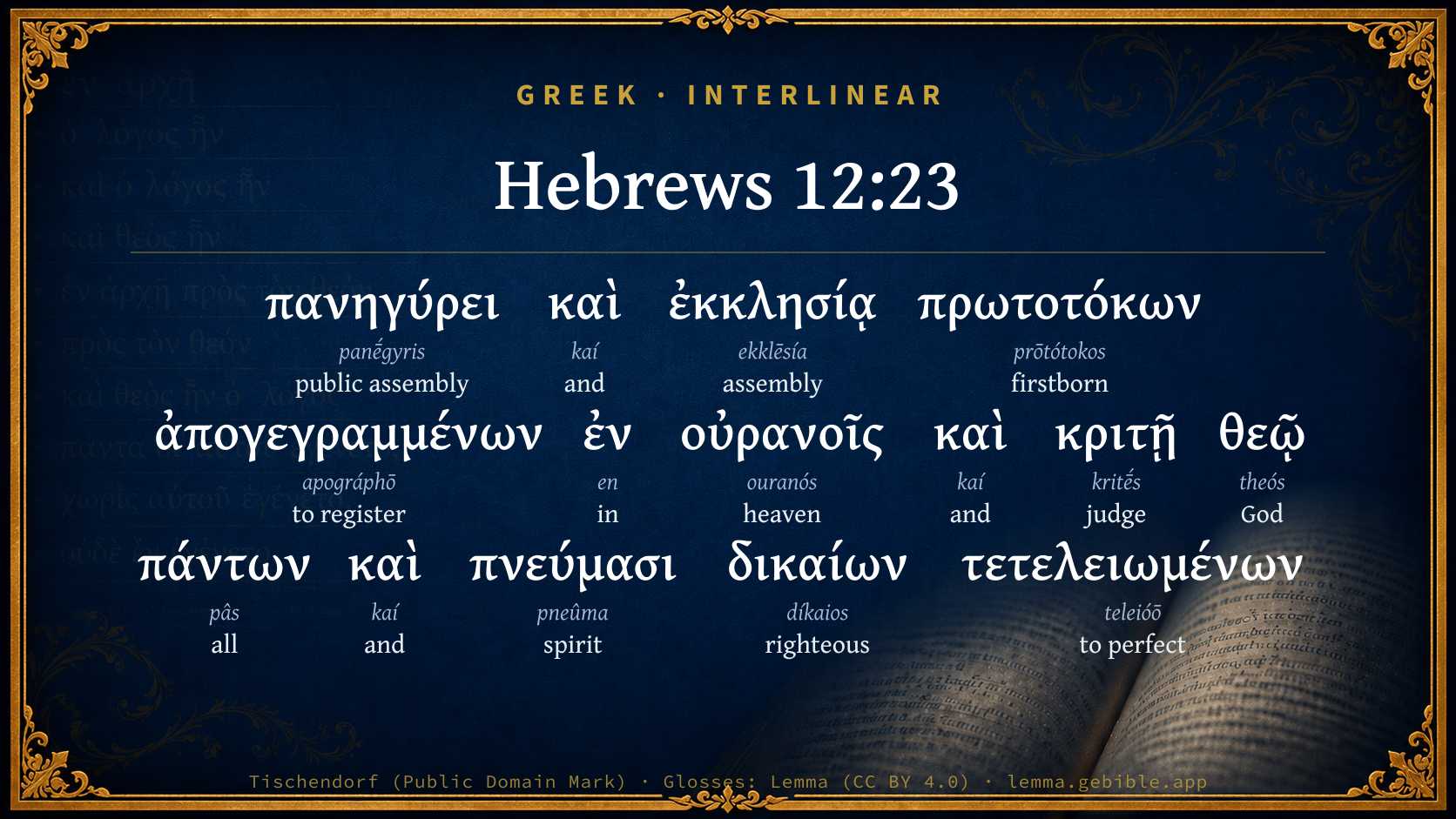
Greek (Tischendorf 8th ed.) Hebrews 12:23 appears in the Greek New Testament. The text above is from the Tischendorf 8th edition. Each word links to its Strong’s number and a concise gloss. Click any word for its full Thayer’s Greek Lexicon entry.
Download image
Cite this verse

Hebrews 12:23 (World English Bible). Public Domain. Lemma interlinear Bible study tool, https://lemma.gebible.app/v/hebrews/12/23.

Show BibTeX & RIS
BibTeX
RIS
English Translation
to the general assembly and assembly of the firstborn who are enrolled in heaven, to God the Judge of all, to the spirits of just men made perfect,
World English Bible · Public Domain
Highlights
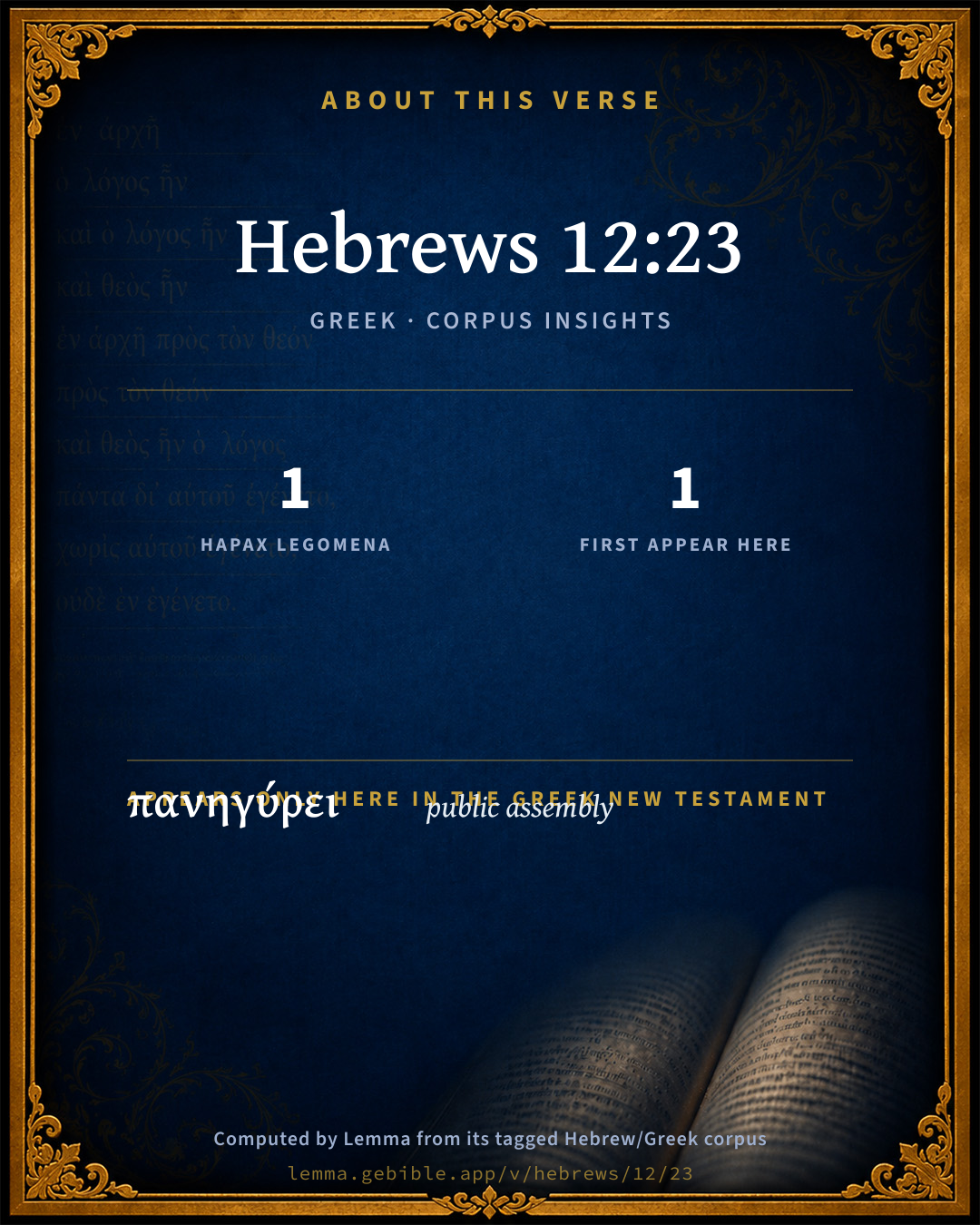
  • 1 hapax legomenon — only here in the Greek New Testament
  • 1 first appearance in the Greek New Testament
Full analysis ↓
Download a study sheet

One document with this verse’s original text, its word-by-word gloss line, the meaning frame, cross-references with their text, attributed commentary, and full source and license credits — printable, and it pastes into notes with its structure intact.

This verse Autodidact and up

Study sheet (.html) Plain text (.txt)

A passage Seminary Student

Up to 50 verses in one chapter. A passage sheet keeps up to 6 commentary sources and 12 cross-references per verse, in the order this page ranks them, and says so on the sheet whenever that leaves anything out. Ask for a single verse and you get the Autodidact verse sheet above.

Everything on this page stays free to read, with no account — the sheet is a download of what is already on screen, not access to it.

Want to remove ads? Support Godless Engineer
Compare translations 3

The same verse in 3 English versions, stacked beneath the original-language interlinear above. Click any original word for its lexicon entry.

Each is an independent rendering of the whole verse — the interlinear is not word-aligned to these translations.

Highlighted words mark where these versions differ — a whole-verse word diff, not a word-by-word alignment.

  • World English Bible Public Domain
    to the general assembly and assembly of the firstborn who are enrolled in heaven, to God the Judge of all, to the spirits of just men made perfect,
  • King James Version Public Domain
    To the general assembly and church of the firstborn, which are written in heaven, and to God the Judge of all, and to the spirits of just men made perfect,
  • unfoldingWord Literal Text CC BY-SA 4.0
    and to the church of the firstborn ones, have been registered in the heavens, and to God the Judge of all, and to the spirits of the righteous ones made perfect,

unfoldingWord Literal Text — © unfoldingWord, licensed CC BY-SA 4.0. Word-aligned USFM3 via Door43 (git.door43.org/unfoldingWord/en_ult).

Versions to compare (up to 4)

3 of 4 selected

Show all 19 translations

Every available English version of this verse, each an independent rendering of the whole verse.

  • World English Bible Public Domain
    to the general assembly and assembly of the firstborn who are enrolled in heaven, to God the Judge of all, to the spirits of just men made perfect,
  • Berean Standard Bible Public Domain
    in joyful assembly, to the congregation of the firstborn, enrolled in heaven. You have come to God the Judge of all, to the spirits of the righteous made perfect,
  • Majority Standard Bible Public Domain
    in joyful assembly, to the congregation of the firstborn, enrolled in heaven. You have come to God the Judge of all, to the spirits of the righteous made perfect,
  • King James Version Public Domain
    To the general assembly and church of the firstborn, which are written in heaven, and to God the Judge of all, and to the spirits of just men made perfect,
  • American Standard Version (1901) Public Domain
    to the general assembly and church of the firstborn who are enrolled in heaven, and to God the Judge of all, and to the spirits of just men made perfect,
  • Revised Version (1885) Public Domain
    to the general assembly and church of the firstborn who are enrolled in heaven, and to God the Judge of all, and to the spirits of just men made perfect,
  • Geneva Bible (1599) Public Domain
    And to the assemblie and congregation of the first borne, which are written in heauen, and to God the iudge of all, and to the spirits of iust and perfite men,
  • Douay-Rheims (1899) Public Domain
    And to the church of the firstborn, who are written in the heavens, and to God the judge of all, and to the spirits of the just made perfect,
  • Young's Literal Translation Public Domain
    to the company and assembly of the first-born in heaven enrolled, and to God the judge of all, and to spirits of righteous men made perfect,
  • Literal Standard Version CC BY-SA 4.0
    to the assembly-place and Assembly of the Firstborn registered in Heaven, and to God the judge of all, and to spirits of righteous men made perfect,
  • Unlocked Literal Bible CC BY-SA 4.0
    You have come to the congregation of the firstborn, who have been registered in heaven. You have come to God, the Judge of all, and to the spirits of the righteous ones who have been made perfect.
  • unfoldingWord Literal Text CC BY-SA 4.0
    and to the church of the firstborn ones, have been registered in the heavens, and to God the Judge of all, and to the spirits of the righteous ones made perfect,
  • Darby Bible Public Domain
    the universal gathering; and to [the] assembly of the firstborn [who are] registered in heaven; and to God, judge of all; and to [the] spirits of just [men] made perfect;
  • World Messianic Bible Public Domain
    to the festal gathering and assembly of the firstborn who are enrolled in heaven, to God the Judge of all, to the spirits of just men made perfect,
  • Webster's Bible Public Domain
    To the general assembly and church of the first-born, who are written in heaven, and to God the Judge of all, and to the spirits of just men made perfect,
  • Free Bible Version CC BY-SA 4.0
    You have come to the church of the firstborn whose names are written down in heaven, to God, the judge of everyone, and to those good people whose lives are complete.
  • Bible in Basic English Public Domain
    To the great meeting and church of the first of those who are named in heaven, and to God the judge of all, and to the spirits of good men made complete,
  • Text-Critical English NT CC BY 4.0
    to the festive gathering and assembly of the firstborn, whose names are enrolled in heaven. You have come to God, the judge of all, and to the spirits of righteous people who have been made perfect.
  • Tyndale New Testament (1534) Public Domain
    and vnto the congregacion of the fyrst borne sonnes which are writte in heven and to God the iudge of all and to the spretes of iust and parfecte men

Literal Standard Version (2020), Covenant Press — licensed CC BY-SA 4.0. Text via the HelloAO Bible API (eBible.org). Unlocked Literal Bible (unfoldingWord) — licensed CC BY-SA 4.0. Text via the HelloAO Bible API (eBible.org). unfoldingWord Literal Text — © unfoldingWord, licensed CC BY-SA 4.0. Word-aligned USFM3 via Door43 (git.door43.org/unfoldingWord/en_ult). Free Bible Version, Dr. Jonathan Gallagher — licensed CC BY-SA 4.0. Text via the HelloAO Bible API (eBible.org).

Word by word

More ways to search: Search by grammar → Find every occurrence → Compare this word →

Practice this passage: Drill this verse → Learn its vocabulary →

πανηγύρει
panḗgyris
G3831
“public assembly”
Noun, Dative, Singular, Feminine
Part of Speech
Noun
Case
Dative
Number
Singular
Gender
Feminine
Full Thayer's Definition

Origin: from G3956 and a derivative of G58

TDNT: 17:02,8

1. a festal gathering of the whole people to celebrate public games or other solemnities 2. a public festal assembly
  1. καὶ kaí G2532 “and” Conjunction
  2. ἐκκλησίᾳ ekklēsía G1577 “assembly” Noun, Dative, Singular, Feminine
  3. πρωτοτόκων prōtótokos G4416 “firstborn” Adjective, Genitive, Plural, Masculine, Superlative
  4. ἀπογεγραμμένων apográphō G583 “to register” Verb, Perfect, Passive, Participle, Genitive, Plural, Masculine
  5. ἐν en G1722 “in” Preposition
  6. οὐρανοῖς ouranós G3772 “heaven” Noun, Dative, Plural, Masculine
  7. καὶ kaí G2532 “and” Conjunction
  8. κριτῇ kritḗs G2923 “judge” Noun, Dative, Singular, Masculine
  9. θεῷ theós G2316 “God” Noun, Dative, Singular, Masculine
  10. πάντων pâs G3956 “all” Adjective, Genitive, Plural, Masculine
  11. καὶ kaí G2532 “and” Conjunction
  12. πνεύμασι pneûma G4151 “spirit” Noun, Dative, Plural, Neuter
  13. δικαίων díkaios G1342 “righteous” Adjective, Genitive, Plural, Masculine
  14. τετελειωμένων teleióō G5048 “to perfect” Verb, Perfect, Passive, Participle, Genitive, Plural, Masculine

About this verse

These counts appear in no published source. They are computed here, from the morphology-tagged text and Lemma’s own curated glosses. What Lemma adds →

15
words
13
distinct lemmas
General Epistles
section

Notable vocabulary

1 hapax legomenon — a word that appears only here in the entire Greek New Testament:

  • πανηγύρει public assembly G3831

First appearance in Scripture

This word makes its first canonical appearance in the Greek New Testament here:

  • πανηγύρει public assembly G3831

Shared distinctive vocabulary

ἀπογεγραμμένων to register G583 occurs in 4 verses of the Greek New Testament. Also found in:

Repetition

A word recurs within this verse:

Cross-references

41

Topical passages linked to Hebrews 12:23 in the Treasury of Scripture Knowledge — connected by theme and wording, ordered by reader-vote popularity; previews shown in the World English Bible.

  • James 1:18 Of his own will he brought us forth by the word of truth, that we should be a kind of first fruits of his creatures.
  • Luke 10:20 Nevertheless, don't rejoice in this, that the spirits are subject to you, but rejoice that your names are written in heaven."
  • Hebrews 11:40 God having provided some better thing concerning us, so that apart from us they should not be made perfect.
  • Genesis 18:25 Be it far from you to do things like that, to kill the righteous with the wicked, that so the righteous should be as the wicked. May that be far from you. Shouldn't the Judge of all the earth do right?"
  • Exodus 4:22 You shall tell Pharaoh, 'Thus says Yahweh, Israel is my son, my firstborn,
  • Revelation 14:4 These are those who were not defiled with women, for they are virgins. These are those who follow the Lamb wherever he goes. These were redeemed by Jesus from among men, the first fruits to God and to the Lamb.
  • Revelation 20:15 If anyone was not found written in the book of life, he was cast into the lake of fire.
  • Psalms 94:2 Rise up, you judge of the earth. Pay back the proud what they deserve.
  • Psalms 96:13 Before Yahweh; for he comes, For he comes to judge the earth. He will judge the world with righteousness, The peoples with his truth.
  • 2 Thessalonians 1:5–7 This is an obvious sign of the righteous judgment of God, to the end that you may be counted worthy of the Kingdom of God, for which you also suffer.
  • Hebrews 6:10–12 For God is not unrighteous, so as to forget your work and the labor of love which you showed toward his name, in that you served the saints, and still do serve them.
  • Hebrews 9:27 Inasmuch as it is appointed for men to die once, and after this, judgment,
  • Revelation 7:14–17 I told him, "My lord, you know." He said to me, "These are those who came out of the great tribulation. They washed their robes, and made them white in the Lamb's blood.
  • Psalms 98:9 Let them sing before Yahweh, For he comes to judge the earth. He will judge the world with righteousness, And the peoples with equity.
  • Matthew 25:31–34 "But when the Son of Man comes in his glory, and all the holy angels with him, then he will sit on the throne of his glory.
  • John 5:27 He also gave him authority to execute judgment, because he is a son of man.
  • Acts 20:28 Take heed, therefore, to yourselves, and to all the flock, in which the Holy Spirit has made you overseers, to shepherd the assembly of the Lord and God which he purchased with his own blood.
  • Ephesians 1:22 He put all things in subjection under his feet, and gave him to be head over all things for the assembly,
  • Philippians 4:3 Yes, I beg you also, true yoke-fellow, help these women, for they labored with me in the Gospel, with Clement also, and the rest of my fellow workers, whose names are in the book of life.
  • 1 Timothy 3:5 (but if a man doesn't know how to rule his own house, how will he take care of the assembly of God?)
  • Hebrews 11:4 By faith, Abel offered to God a more excellent sacrifice than Cain, through which he had testimony given to him that he was righteous, God bearing witness with respect to his gifts; and through it he, being dead, still speaks.
  • 1 Peter 2:23 Who, when he was cursed, didn't curse back. When he suffered, didn't threaten, but committed himself to him who judges righteously;
  • Revelation 13:8 All who dwell on the earth will worship him, everyone whose name has not been written from the foundation of the world in the book of life of the Lamb who has been killed.
  • Exodus 13:2 "Sanctify to me all of the firstborn, whatever opens the womb among the children of Israel, both of man and of animal. It is mine."
  • Deuteronomy 21:17 but he shall acknowledge the firstborn, the son of the hated, by giving him a double portion of all that he has; for he is the beginning of his strength; the right of the firstborn is his.
  • Psalms 50:5–6 "Gather my saints together to me, Those who have made a covenant with me by sacrifice."
  • Psalms 69:28 Let them be blotted out of the book of life, And not be written with the righteous.
  • Psalms 89:7 A very awesome God in the council of the holy ones, To be feared above all those who are around him?
  • Psalms 89:27 I will also appoint him my firstborn, The highest of the kings of the earth.
  • Psalms 111:1 Praise Yah! I will give thanks to Yahweh with my whole heart, In the council of the upright, and in the congregation.
  • Ecclesiastes 12:7 And the dust returns to the earth as it was, And the spirit returns to God who gave it.
  • Jeremiah 31:9 They shall come with weeping; and with petitions will I lead them: I will cause them to walk by rivers of waters, in a straight way in which they shall not stumble; for I am a father to Israel, and Ephraim is my firstborn.
  • 1 Corinthians 13:12 For now we see in a mirror, dimly, but then face to face. Now I know in part, but then I will know fully, even as I was also fully known.
  • 1 Corinthians 15:54 But when this corruptible will have put on incorruption, and this mortal will have put on immortality, then what is written will happen: "Death is swallowed up in victory."
  • 2 Corinthians 5:8 We are of good courage, I say, and are willing rather to be absent from the body, and to be at home with the Lord.
  • Ephesians 5:24–27 But as the assembly is subject to Christ, so let the wives also be to their own husbands in everything.
  • Philippians 1:21–23 For to me to live is Christ, and to die is gain.
  • Philippians 3:12–21 Not that I have already obtained, or am already made perfect; but I press on, if it is so that I may take hold of that for which also I was taken hold of by Christ Jesus.
  • Colossians 1:12 giving thanks to the Father, who made us fit to be partakers of the inheritance of the saints in light;
  • Colossians 1:24 Now I rejoice in my sufferings for your sake, and fill up on my part that which is lacking of the afflictions of Christ in my flesh for his body's sake, which is the assembly;
  • Exodus 32:32 Yet now, if you will, forgive their sin-- and if not, please blot me out of your book which you have written."

Cross-references courtesy of OpenBible.info (CC BY 4.0).

Commentary

Notes on Hebrews 12:23 from classic Christian and Jewish commentators (each source and its license shown beneath its notes). The classic Christian expositions comment on the surrounding passage and are grouped to its opening verse, so a note may address several verses; the Jewish commentaries on the Tanakh (Rashi and others) are per-verse, so they appear only where the commentator wrote on this verse.

Lemma curates 59 commentaries, every one of them public domain or Creative Commons licensed, each selected and text-cleaned for this edition rather than reprinted as found. About our sources →

Joseph Benson's Commentary

Heb 12:23-24. To the general assembly — To the Christian Church, consisting of the whole number of true believers spread over all the world. The word πανηγυρις, here used, properly signifies a stated convention, upon some joyful and festival occasion: particularly it is applied to the concourse at the Olympic games; in which view it presents a very elegant and lively opposition to the case of the Israelites, who were struck with a general terror when they were convened before mount Sinai. And church of the firstborn — The whole body of true believers, consisting of converted Jews and Gentiles. The saints are called the firstborn, because under the law the firstborn were peculiarly appropriated to God, and heirs of a double honour and inheritance: and the saints are in a special manner devoted to God, are made his children by a gratuitous adoption, and entitled to the heavenly inheritance. Therefore they are said (Rev 14:4) to be redeemed from among men, the first-fruits to God and the Lamb, being the most excellent of mankind, as the first-fruits were judged to be the best of the harvest. Which are written in heaven — The firstborn of Israel were enrolled by Moses in catalogues kept on earth, but these are registered in heaven as citizens of the New Jerusalem, and entitled to all the privileges and immunities of the church of God, whether militant or triumphant. See note on Philippians 3:23, and Php 4:3. And to God the Judge of all — Instead of standing afar off, as your fathers did at Sinai, you are allowed to draw near to God as to a friend and father, and to have intercourse and communion with him, who, as Judge of all, will reward you with a crown of glory, and inflict on your persecutors condign punishment. And to the spirits of just, or righteous, men made perfect — Namely, the spirits of the saints in paradise, with whom the saints on earth have communion by faith, hope, and love, and make up one body with them. These are said to be made perfect, because, being justified before God, and fully sanctified in their natures, they are completely holy; and being freed from all the infirmities of the body, are perfected in a much higher sense than any who are still on earth. Hence it is evident, says Whitby, “that the souls of just men are not reduced by death to a state of insensibility; for, can a soul that reasons and perceives good things be made perfect by perceiving nothing at all? Can a spirit, which here enjoyed the pleasures of a good conscience, of a life of faith, of communion with God, and the comforts of the Holy Ghost, be advanced to perfection by a total deprivation of all those satisfactions and enjoyments?” And to Jesus the Mediator of the new covenant — Far exceeding that established with Israel of old by the mediation of Moses, a covenant founded on better promises, and ratified with unspeakably greater solemnity. And to the blood of sprinkling — To all the virtue of Christ’s precious blood shed for you, whereby you are sprinkled from an evil conscience. This blood of sprinkling was the foundation of our Lord’s mediatorial office. The expression is used in allusion both to the sprinkling of the Israelites with blood, when the covenant was made at Sinai, and to the sprinkling of the blood of the sin-offerings before the veil and on the mercy-seat. For the former sprinkling typified the efficacy of Christ’s blood in procuring the new covenant, and the latter its efficacy in procuring the pardon of sin, acceptance with God, his renewing Spirit, and all the other blessings of the gospel, for all them who believe in him with their hearts unto righteousness. That speaketh better things than the blood of Abel — For whereas Abel’s blood called for vengeance upon him that wickedly shed it, the blood of Jesus obtained mercy and salvation for his malicious and cruel murderers. This is the general interpretation of the clause. But Dr. Whitby, and some others, by the blood of Abel, understand not his own blood, which called for vengeance on his murderer, (see Gen 4:10,) but the blood of the sacrifice which he offered in faith, of which God testified his acceptance, and by which, it is said, he being dead yet speaketh; understanding the sense to be, that the blood, or sacrifice, of Christ speaks, or procures, better things than Abel’s sacrifice, his procuring acceptance for himself alone, but Christ’s meriting it for all believers; his only declaring himself righteous, but Christ’s interceding to God for the justification of all men. But, as Doddridge observes, there is a harshness not easily to be paralleled in calling the blood of Abel’s sacrifice his blood. The other interpretation, therefore, seems preferable, as referring to the gentle and gracious character of Christ, and the blessings, instead of vengeance, drawn down by his blood. “There seems, throughout this whole period, to be a reference to the manifestation God made of himself upon mount Sion, as being milder than that upon mount Sinai. And the heavenly society with which Christians are incorporated is considered as resembling the former (that is, mount Sion) in those circumstances in which it was more amiable than the latter. Sion was the city of God. In the temple, which stood there, cherubim were the ornaments of the walls, both in the holy and most holy place, to signify the presence of angels. There was a general assembly and congregation of the priests, which were substituted instead of the firstborn, of whose names catalogues were kept. There was God, as the supreme Judge of controversies, giving forth his oracles. The high-priest was the mediator between God and Israel, (comp. Luk 1:8-10,) and the blood of sprinkling was daily used.” — Doddridge.

Joseph Benson's Commentary on the Old and New Testaments (1811–1818) — public domain. Text from a community e-Sword module.

MacLaren's Expositions of Holy Scripture

Alexander MacLaren

Hebrews

FAITH’S ACCESS TO THE JUDGE, AND HIS ATTENDANTS

Heb 12:23

THE principle of arrangement in this grand section of this letter is obscure, and I am afraid that I cannot east much, if any, light upon it. We might, at first sight, have expected that the two clauses of our present text should have been inverted, so as to bring all the constituent parts of ‘the city of the living God’ closely together - viz., ‘the angels,’ the members of the militant Church on earth, and those of the triumphant Church in heaven; and also to bring together ‘God the Judge of all,’ and ‘Jesus the Mediator of the New Covenant.’ But the arrangement, as it stands in our text, may he compared profitably with that of the preceding verses, which we were considering in the last sermon. There, as here, the allusion to the immediate presence of God passed at once into the reference to the citizens of the heavenly Jerusalem. And just as there Zion, the palace, was immediately connected with the city of the living God, so here the writer, harking back, as it were, to his original starting-point, no sooner names ‘God the Judge’ than he passes on to set before us ‘the spirits of just men made perfect.’ In the earlier clauses we have had the more general reference to the palace and the city around it. Here, if I may so say, we pass within the palace gates, and the writer tells us what we find there. This interweaving of the presence of God with that of the creatures that live in His love witnesses to the great truth that our God dwells in no isolated supremacy, but in the midst of a blessed society; and that the solitary souls who find their way into His presence have a welcome, not only from Him, but from all their brethren Of His great family.

So the arrangement may not be so inexplicable as, at first sight, it strikes us as being, if it suggests to us the close and indissoluble connection between God Himself and all those who, in every place, whether the place above or the place beneath, call upon the name of Him who is both their God and ours. In dealing with these words, I have simply to consider these two ideas thus set before us.

I. Faith plants us at the very bar of God.

‘Ye are come to God the Judge of all.’ Now, it is to be observed that, more accurately, the words might be rendered, ‘Ye are come to the God of all as Judge’; for the point which the writer wishes to bring out is not so much the general idea of the divine presence, as that presence considered under a specific aspect, and referring to one mode of His action - viz., the judicial It is further to be noticed that the judgment which is here spoken about is not, as the very language, ‘Ye are come to the Judge; implies, future, but present. The Old Testament, with continual reference to which this letter is saturated, has a great deal more to say about the present continuous judgment which God works all through the ages than about the final future judgment, And, in accordance, not only with the language of our text, which makes coming a present thing, but, in accordance also with the whole tone of the Old Testament, we should recognise here, not so much a reference to the final tribunal Before which all mankind must stand {at which the Judge is characteristically represented in the New Testament as being, not God the Father, But Jesus Christ}, as to the continual judgment, both in the sense of decision as to character and infliction of consequences, which is being exercised now by the God of all.

So, then, the first thought that I would suggest from this idea is, Here is a truth which it is the office of faith to realise continually in our daily lives. Your loving access to God, Christian men and women, has brought you right under the eye of the Judge, and, though there be no terror in our approach to that tribunal, there ought to be a wholesome awe as the permanent attitude of our spirits, the awe which is the very opposite of the cowering dread which hath torment. He would be a bold criminal who would commit crimes in the very judgment-hall and before the face of his judge. And that must be a very defective Christian faith which, like the so- called faith of many amongst us, goes through life and sins in entire oblivion of the fact that it stands in the very presence of the Judge of all the earth. Oh, if we could rend the veil as death will rend it, and see the things which are, as faith will help us to see them - for it thins, if it does not tear, the envious curtain between - would it be possible that we should live the low, mean, selfish, earthly, sinful lives, devoured by anxieties, defaced by stains, depressed by trivial sorrows, which, alas! so many of us do live? ‘Ye are come.., unto God the Judge of all.’ ‘If ye call Him Father, who, without respect of persons, judgeth according to every man’s work, pass the time of your sojourning here in fear.’

Then, again, notice that this judgment of God is one which a Christian man should joyfully accept. ‘The Lord will judge His people,’ says one of the psalms. ‘You only have I known of all the inhabitants of the earth; therefore will I punish you for your iniquities,’ says one of the prophets. Such sayings represent this present judgment as inevitable, just because of the close connection into which true faith brings a man with his Father in heaven. Inevitable, and likewise most blessed and desirable, for in the thought are included all the methods by which, in providence, and by ministration of His truth and of His Spirit, God reveals to us our hidden meannesses; and delivers us sometimes, even by the consequences which accrue from them, from the burden and power of our sin.

So, then, the office of faith in regard to this continuous judgment which God is exercising upon us because He loves us is, first of all, to open our hearts to it by confession, by frank communion, by referring all our actions to Him to court that investigation. That judgment is no mere knowledge by cold omniscience, such as a heathen conception of the divine eye might make it to be; but just as a careful gardener will go over his rose-trees, and the more carefully the more precious they are in his sight, to pick from each nestling-place at the junction of the leaves with the stem the tiny insects that are sucking out the sap and destroying them, so God will search our hearts in order to pluck from these the crawling evils which, microscopic and tiny as they may be, will yet, in their multitude innumerable, be destructive of our spirits’ lives.

It is a gospel when we say, ‘The Lord will judge His people.’ Therefore in many a psalm we have the writers spreading themselves out before God, and beseeching Him to come and search them, and try them, and sift them through His sieve, and know them altogether, in the sure confidence that wheresoever He beholds an evil He will be ready to cure it, and that whosoever spreadeth out his sin before God will be lightened of the burden of his sin.

This merciful judgment, which is, in fact, all directed to the perfecting and sanctifying of its subjects, reaches its end in the measure in which we register its decisions in our consciences. God writes His mind about us on them, and when they speak they are only speaking an echo of the sentence that has been pronounced from that loftier tribunal. Therefore, whosoever professeth himself to be a Christian and does anything, be it great or small, which his conscience rebukes when done, and prohibited before it was done, that man is despising the judgment of God, and bringing down upon himself the condemnation which follows despised judgment. ‘If we should judge ourselves we should not be judged.’ Reverence your consciences: they are the echo of the Judge’s voice; peruse their records; they are the register of the Judge’s sentence; and whensoever that inward voice speaks, bow before it and say, ‘Lord! servant heareth.’

And then, further, remember that this judgment is one that demands our thankful acceptance of the discipline which it puts in force. If we knew ourselves we should bless God for our sorrows. These are His special means of drawing His children away from their evil. ‘When we are chastened, we are chastened of the Lord that we should not be condemned with the world.’ Oh! there would be less impatience, less blank amazement when suffering comes to us, less vain and impotent regrets for vanished blessings, if we saw in all the dealings of our Father’s hands the results of His judgment, and believed that it is better for us to be separated, though it be with violence and much bleeding of torn-away hearts, from our idols than that our idolatry should destroy us and mar them. ‘Whom the Lord loveth He chasteneth.’ This judgment is not only the merciful separation of us from our sins, but it is also a judgment on our behalf.

The office of the early Jewish judges was not only the judicial one which we mean by the word, but was much wider, and some trace of that wider idea runs through almost all the Old Testament references to the divine judgment. It comes to mean, not merely a decision adverse or favorable, as the ease may be, as to the moral character of its subjects, but it also substantially means pleading their cause, defending their right, intervening for them, and so in many a psalm you will find such petitions as this, ‘Judge me, O Lord; for I am poor and needy. Plead my cause against them which rise up against me.’ And the same conception of the Judge’s office appears in one of our Lord’s parables, familiar to us all, in which we are told that ‘the Lord will judge His own elect though He bear long with them.’

Thus, another of the blessed thoughts that come out of this conception of our approach to ‘the Judge of all’ is that we may confidently commit our cause to Him, and leave our vindication in His hands. So, abstinence from self-assertion, from self-vindication, from vengeance or recompense, patience, courage, consolation, strength, all these virtues will be ours if we understand to whom we come by our faith, and can behold, on the throne of the universe, One who will plead our cause, and undertake for us whensoever we are burdened and oppressed.

II. Secondly, Faith carries us while living to the society of the living dead.

‘The Judge of all, and the spirits of just men made perfect.’ Immediately on the thought of God arising in the writer’s mind, there rises also the blessed thought of the blessed company in the centre of whom He lives and reigns. We can say little about that subject, and perhaps the less we say the more we shall understand, and the more deeply we shall feel We get glimpses but no clear vision, as when a flock of birds turn in their rapid flight, and for a moment the sun glances on their white wings; and then, with another turn, they drift away, spots of blackness in the blue. So we see but for a moment as the light falls, and then lose the momentary glory, but we may at least reverently note the exalted words here.

‘The spirits of... men made perfect.’ That is to say, they dwell freed from the incubus and limitations, and absolved from the activities, of a bodily organisa-tion. We cannot understand such a condition. To us it may seem to mean passivity or almost unconsciousness, but we know, as another New Testament writer has told us, that to be absent from the body is to be present with the Lord; and that in some deep, and to us now undiscoverable, fashion, that which the corporeal frame does for men here, immersed in the material world, there the encircling Christ in whom they rest does for them. We know little more, but we have a glimpse of a land of deep peace in which repose is not passivity nor unconsciousness; any more than service is weariness. And there we have to leave it, knowing only this, that it is possible for a man to exist and to be, in a relative sense, perfected without a body. Then, further, these spirits are ‘perfect.’

The writer has said, at the close of the preceding chapter, that the ancient saints ‘without us should not be made perfect.’ And here he employs the same word with distant reference, as I suppose, to his previous declaration. From which I infer that that old thought is true, that Jesus Christ shot some rays of His victorious and all-reconciling power from His Cross into the regions of darkness, and brought thence those who had been waiting for His coming through many a long age. A great painter has left on the walls of a little cell in his Florentine convent a picture of the victorious Christ, white-robed and banner-bearing, breaking down the iron gates that shut in the dark, rocky cave; and flocking to Him, with outstretched hands of eager welcome, the whole long series from the first man downwards, hastening to rejoice in His light, and to participate in His redemption.

So the ancient Church was ‘perfected’ in Christ; but the words refer, not only to those Old Testament patriarchs and saints, but to all who, up to the time of the writer’s composition of his letter, ‘slept in Jesus.’ They have reached their goal in Him. The end for which they were created has been attained. They are in the summer of their powers, and full-grown adults, whilst we here, the maturest and the wisest, the strongest and the holiest, are but as babes in Christ.

But yet that ‘perfecting’ does not exclude progress, continuous through all the ages; and especially it does not exclude one great step in advance which, as Scripture teaches us, will be taken when the resurrection of the body is granted. Corporeity is the perfecting humanity. Body, soul, and spirit, these make the full-summed man in all his powers. And so the souls beneath the altar, clothed in white, and rapt in felicity, do yet wait ‘for the adoption, even the redemption of the body.’

Mark, further, that these spirits perfected would not have been perfected there unless they had been made just here. That is the first step, without which nothing in death has any tendency to ennoble or exalt men. If we are ever to come to the perfecting of the heavens, we must begin with the justifying that takes place on earth.

Let me point you to one other consideration, bearing not so much on the condition as on the place of these perfected spirits. It is very significant, as I tried to point out, that they should be closely associated in our text with ‘God the Judge of all.’ Is there any hint there that men who have been redeemed, who being unjust, have been made just, and have had experience of restoration and of the misery of departure, shall, in the ultimate order of things, stand nearer the throne than unfallen spirits, and teach angels? If the ‘just man made perfect,’ and not the festal assembly of the angels, that are brought into connection here with ‘the Judge of all.’ Is there any hint that in some sense these perfected spirits are assessors of God in His great judgment? ‘Ye shall sit on twelve thrones, judging the twelve tribes of Israel,’ seems to point in that direction. But the ground is precarious, and I only point to the words in passing as possibly affording a foothold for a ‘perhaps.’

But the more important consideration is the real unity between poor souls here who are knit to Jesus Christ, and the spirits of the just made perfect who stand so close to the judgment seat.

Ah, brethren! we have to alter the meaning of the words ‘present’ and ‘absent’ when we come to speak of spiritual realities. The gross localized conceptions that are appropriate to material space, and to transitory time, have nothing to do with that higher religion. It is no mere piece of rhetoric or sentiment to say that where our treasure is, there are our hearts, and where our hearts are there are we.

Love has no localities. It knits together two between whom oceans wide roll; it knits together saints on earth and saints in heaven. To talk of place is irrelevant in reference to such a union; for if our love, our aims, our hopes be the same, we are together. And if they on the upper side, and we on the lower, grasp each the outstretched hand of the same God, then we are one in Him, and the same life will tingle through our earthly frames and through their perfected spirits. He is the centre of the great wheel whose spokes are light and blessedness; and all who stand around Him are brought into unity by their common relation to the centre.

Our sorrows would be less sorrowful, our loss less utter, if we truly believed that while apart we are still together. Our courage and our hope would rise if we came closer in loving contemplation and believing thought to the present blessedness of those once our fellow-travelers, who, weak as we, have entered into rest. Heaven itself would gain some touch of true attractiveness if we more clearly saw, and more thankfully felt, that there is

‘the Judge of all,’ and there also ‘the spirit of just men made perfect.’ But howsoever great may be the encouragement, the consolation, the quieting that come from them, let us turn away our eyes from the surrounding and lower seats to fix them on the central throne. Let us ever realise that we are ever in our great Judge’s eye. Let us spread out our hearts for His scrutiny and decision, for His discipline if need be. Let us commit to Him our cause, and, in the peace that comes therefrom, we may understand why it was that psalmists of old called upon earth to rejoice and the hills to be glad because He ‘cometh to judge the earth, to judge the world with righteousness, and the people with His truth.’

Alexander MacLaren, Expositions of Holy Scripture (1904–1910) — public domain. Text from a community e-Sword module.

Tyndale Open Study Notes

Tyndale Open Resources

12:23 The word translated assembly is usually translated “church”; it speaks of God’s assembled people. • God’s firstborn children refers to people who are members of the new covenant (cp. 1:6; 2:10-13). • The concept that God’s people have their names . . . written in heaven speaks of God’s special attention to his people (see also Exod 32:32; Ps 69:28; Isa 4:3; Dan 12:1; Luke 10:20; Phil 4:3; Rev 3:5). • For God’s children, God as judge is the vindicator of his people (cp. Pss 9:8; 58:11; 94:2; Isa 11:4; Jer 22:16). • Those who have already died have now been made perfect by the sacrifice of Christ (Heb 10:14).

Tyndale Open Study Notes — © Tyndale Open Resources, licensed CC BY-SA 4.0. Text via the HelloAO Bible API.

Bengel's Gnomon

Johann Albrecht Bengel

Heb 12:23. Καὶ ἐκκλησίᾳ πρωτοτόκων ἐν οὐρανοῖς ἀπογεγραμμένων, and to the church of the first-born that are written in heaven) The sons of GOD, of the ages that preceded the first coming of Christ, and the believing Israelites, come under the denomination of the first-born; Exo 4:22; Jer 31:9; Eph 1:12; especially the patriarchs, Mat 8:11, and those who first attended Him who rose as the First-born from the dead, Mat 27:53, as well as also the rest, so to say, of the ordinary flock. The church or assembly consists of these, as the general assembly consists of the angels.[81] The first-born in the time of Moses were written (in a roll), Num 3:40; but these, of whom the apostle speaks, are written in heaven, because they are citizens of the heavenly city: comp. ἀπογράφεσθαι, to be enrolled (written in a roll), Luk 2:1. Hence it is plain, that it does not follow on this account that they themselves are not in heaven, because they are written in heaven. They are, however, also written [as well as being actually in heaven], that their names may be at some future period publicly read over: Rev 20:12; Rev 21:27. The antithesis, made perfect, is a sweet antithesis to these first-born; for the van of the host of the blessed is led by the one, the rear is brought up (is closed) by the other. Finally, it is remarkable that these first-born in the Gradation are more nearly connected with the mention of GOD, than the angels; comp. Jas 1:18.—καὶ κριτῇ Θεῷ πάντων, and to God the Judge of all) He is the GOD of all, Eph 4:6: your Judge, favourable to you, opposed to His enemies.—καὶ πνεύμασι δικαίων τετελειωμένων, and to the spirits of just men made perfect) In this last place, the apostle enumerates the things which more gently affect and refresh the eyes of travellers, dazzled with the splendour of the economy of God, and which are derived from the economy of Christ. The spirits, souls in the separate state, 1Pe 3:19. The three young men [Ananias, Azarias, Misael], in their song, exclaim: “O ye spirits and souls of the righteous, bless ye the Lord.” The just made perfect are New Testament believers, who enjoy, after their death, the full benefit of the perfection which was consummated by the death of Christ, and of the righteousness derived from it: comp. ch. Heb 11:40, note. The number of these was still imperfect; and for this reason also they have been separated from the ten thousands, and therefore from the first-born. Why the first-born, and the spirits of just men made perfect, are separated in the description, will be evident from the train of thought which will be presently unfolded. While Paul himself is alive, he declares that he is not perfect, Php 3:12: for the verb, τετέλεκα, has one reference, 2Ti 4:7; the verb, ΤΕΛΕΙΟῦΜΑΙ, has another. The former refers to the office, the latter to the person. ΤΕΛΕΙΟῦΜΑΙ does not apply so long as a man has yet even one step before him, although now (at this point) he may make no more progress in his internal perfection. Christ Himself was ΤΕΛΕΙΩΘΕἸς, made perfect, at death: Heb 5:9. In the 2d to Timothy, Paul congratulates himself on having finished his course. In the Epistle to the Philippians, he urges them to engage with alacrity in the race; and with that object before him, he makes himself one who is yet far from the goal: comp. Heb 3:14, note.

[81] Or else, For there is a church or assembly of them, as there is a general assembly of angels.—ED.

Bengel's Gnomon of the New Testament — English translation (T&T Clark, Edinburgh, 1860) — public domain. Text from a community e-Sword module.

Meyer's Critical & Exegetical Commentary

Heinrich August Wilhelm Meyer

Heb_12:23. Πανηγύρει καὶ ἐκκλησίᾳ πρωτοτόκων, ἀπογεγραμμένων ἐν οὐρανοῖς] to the festive assembly and congregation of the first-born, who are enrolled in heaven, πανήγυρις, in the N. T. a ἅπαξ λεγόμενον, designates the total gathering under the form of conception of a being gathered together in festivity and jubilant joy [cf. Joseph. Antt. v. 2. 12]; whereas ἐκκλησία characterizes those assembled as bound together in inner unity. To be enrolled in heaven, however, signifies to stand recorded upon the book of heavens citizens, or to have part in the rights and privileges of the heavenly citizens. From the connection (προσεληλύθατε Ἱερουσαλὴμ ἐπουρανίῳ καὶ μυριάσιν ἀγγέλων) beings must be intended, who already dwell in heaven, are actually in possession of the civil rights and immunities of heaven, not those by whom the enjoyment of the same is only to be looked for in the future. Since, then, they are by means of πρωτότοκοι represented as those who in point of time first (before others as yet) became sons of God, we have to think most naturally, with Calvin, Bengel, Chr. Fr. Schmid, Woerner, and others, of the patriarchs and saints of the Old Covenant (comp. chap. 11), who, it is true only upon the condition of union with Christ (Heb_11:40), but yet by reason of their filial relation to God, did, in a temporal respect before the Christians, receive a dwelling-place and rights of citizenship in heaven. According to Nösselt, Storr, Kurtz, and others, we have to understand by the πρωτότοκοι, still the angels before mentioned, as being the earliest inhabitants of heaven; but for the designation of the angels, the characteristic ἀπογεγραμμένοι ἐν οὐρανοῖς is unsuitable. The majority discover in πρωτότοκοι a reference to the Christians; and that either, as Primasius and Grotius suppose, specially to the apostlesagainst which, however, stands πανηγύρει καὶ ἐκκλησίᾳ, which involves the idea of a great host; or, as Schlichting, J. L. Mosheim (de ecclesia primogenitorum in coelo adscriptorum, Helmst. 1733, 4to), Schulz, Bleek, Ebrard, and others, to the first believers from among the Jews and Gentiles, particularly the former, quite apart from the question of their being now dead or still living; or, as Knapp, Böhme. Kuinoel, Tholuck, Delitzsch, Riehm (Lehrbegr. des Hebräerbr p. 117), Alford, Hofmann (Schriftbew. II. 2, p. 147, 2 Aufl.), Moll, and others, specially to the church which is still upon earth, so that in connection with πρωτότοκοι we have to hold fast only to the particular fact of the dignity, while we retain no reference to time; or, as de Wette and Maier, specially to those who have fallen asleep in the faith of Christ, and perhaps even were glorified by martyrdom; or finally, as Piscator, Owen, Carpzov, Stein, Stuart, Stengel, and others, to the members of the New Covenant in general. But the thought of Christians in this place is a remote one; since the mention of them, in harmony with the order of relating now chosen, would more naturally take place only later, in connection with the mention of Christ Himself, and not already here, between that of the angels and God.

καὶ κριτῇ θεῷ πάντων] and to Him as Judge, who is God over all. πάντων is usually construed with κριτῇ. But from its position it can depend only upon θεῷ. πάντων is masculine, and refers not merelyas Knapp and Bleek supposeto the fore-mentioned angels and πρωτότοκοι. It stands absolutely; so that God, in delicate opposition to the Jewish particularism, is characterized as in general the God of all. The apparently unsuitable characterization of God in this connection (because one containing nothing specifically Christian), namely, as the Judge, is justified from the aim of the writer, to warn the readers against laxity of morals, and consequently against apostasy from Christianity (comp. Heb_12:25; Heb_12:29).

καὶ πνεύμασιν δικαίων τετελειωμένων] and to the spirits of the perfected just ones. πνεύματα: designation of the departed spirits, as divested of the body (comp. 1Pe_3:19; Luk_24:39; Act_7:59), inasmuch as these only at the resurrection will be clothed with a new body. Most probably the Christians fallen asleep are those meant (Grotius, Mosheim, Bengel, Sykes, Baumgarten, Chr. Ft. Schmid, Storr, and many). Others, as Corn. a Lapide, Schlichting, Wittich, Wolf, Schulz, Bleek, de Wette, Ebrard, Maier, think of the saints of the O. T. (chap, 11); or, as Knapp, Böhme, Tholuck, Bisping, Delitzsch, Riehm (Lehrbegr. des Hebräerbr. p. 122), Alford, Moll, Kurtz, alike of the departed saints of the O. T. and those of the New. The δίκαιοι, however, are called τετελειωμένοι, not in the sense of the perfect just ones (Theophylact, Luther, Stengel, al.),for which the expression τέλειοι would much more naturally have presented itself,nor yet because they have finished their lifes course and overcome the weaknesses and imperfections of the earthly life (Calvin, Limborch, Böhme, Kuinoel, Kurtz, and others), but because they have already been brought by Christ to the goal of consummation. Comp. Heb_2:10, Heb_10:14, Heb_11:40.

Meyer — Critical and Exegetical Commentary on the New Testament — English translation by Peter Christie, edited by Frederick Crombie (T&T Clark, 1880) — public domain. Text from a community e-Sword module.

Geneva Bible (1599)

Geneva Bible translators

So he calleth them that are taken up into heaven, although one part of them sleep in the earth.

Geneva Bible (1599) marginal notes — public domain. Text via Bolls.life.

Jamieson, Fausset & Brown

Robert Jamieson, A. R. Fausset & David Brown

written in heaven--enrolled as citizens there. All those who at the coming of "God the Judge of all" (which clause therefore naturally follows), shall be found "written in heaven," that is, in the Lamb's book of life (Rev 21:27). Though still fighting the good fight on earth, still, in respect to your destiny, and present life of faith which substantiates things hoped for, ye are already members of the heavenly citizenship. "We are one citizenship with angels; to which it is said in the psalm, Glorious things are spoken of thee, thou city of God" [AUGUSTINE]. I think ALFORD wrong in restricting "the Church of the first-born written in heaven," to those militant on earth; it is rather, all those who at the Judge's coming shall be found written in heaven (the true patent of heavenly nobility; contrast "written in the earth," Jer 17:13, and Esau's profane sale of his birthright, Heb 12:16); these all, from the beginning to the end of the world, forming one Church to which every believer is already come. The first-born of Israel were "written" in a roll (Num 3:40).

the spirits of just men made perfect--at the resurrection, when the "JUDGE" shall appear, and believers' bliss shall be consummated by the union of the glorified body with the spirit; the great hope of the New Testament (Rom 8:20-23; Th1 4:16). The place of this clause after "the JUDGE OF ALL," is my objection to BENGEL and ALFORD'S explanation, the souls of the just in their separate state perfected. Compare Notes, see on Heb 11:39-40, to which he refers here, and which I think confirms my view; those heretofore spirits, but now to be perfected by being clothed upon with the body. Still the phrase, "spirits of just men made perfect," not merely "just men made perfect," may favor the reference to the happy spirits in their separate state. The Greek is not "the perfected spirits," but "the spirits of the perfected just." In no other passage are the just said to be perfected before the resurrection, and the completion of the full number of the elect (Rev 6:11); I think, therefore, "spirits of the just," may here be used to express the just whose predominant element in their perfected state shall be spirit. So spirit and spirits are used of a man or men in the body, under the influence of the spirit, the opposite of flesh (Joh 3:6). The resurrection bodies of the saints shall be bodies in which the spirit shall altogether preponderate over the animal soul (see on Co1 15:44).

Jamieson, Fausset & Brown — Commentary Critical and Explanatory on the Whole Bible (1871) — public domain (CC PDM 1.0). Text via the HelloAO Bible API.

Adam Clarke's Commentary

Verse 23. To the general assembly] πανηγυρει. This word is joined to the preceding by some of the best MSS., and is quoted in connection by several of the fathers: Ye are come-to the general assembly of innumerable angels; and this is probably the true connection.

The word πανηγυρις is compounded of παν, all, and αγυρις, an assembly; and means, particularly, an assembly collected on festive occasions. It is applied to the assembly of the Grecian states at their national games, Olympic, Isthmian, c. and hence a speech pronounced in favour of any person at such festive assemblies was called πανηγυρικος λογος, a panegyrical discourse; and hence our word panegyric.

The first-born] Those who first received the Gospel of Christ, and who are elsewhere termed the first fruits: this is spoken in allusion to the first-born among the Israelites, who were all considered as the Lord's property, and were dedicated to him. The Jews gave the title בכור bechor, first-born, to those who were very eminent or excellent; what we would term the head or top of his kin. The Church of the first-born is the assembly of the most excellent.

Which are written in heaven] Who are enrolled as citizens of the New Jerusalem, and are entitled to all the rights, privileges, and immunities of the Church here, and of heaven above. This is spoken in allusion to the custom of enrolling or writing on tables, c., the names of all the citizens of a particular city and all those thus registered were considered as having a right to live there, and to enjoy all its privileges. All genuine believers are denizens of heaven. That is their country, and there they have their rights, c. And every member of Christ has a right to, and can demand, every ordinance in the Church of his Redeemer and wo to him who attempts to prevent them!

God the Judge of all.] The supreme God is ever present in this general assembly: to him they are all gathered; by him they are admitted to all those rights, c. under his inspection they continue to act; and it is he alone who erases from the register those who act unworthily of their citizenship. Judge here is to be taken in the Jewish use of the term, i.e. one who exercises sovereign rule and authority.

The spirits of just men made perfect] We cannot understand these terms without the assistance of Jewish phraseology. The Jews divide mankind into three classes: -

1. The JUST PERFECT, צדיקים גמורים tsaddikim gemurim.

2. The wicked perfect, רשעים גמורים reshaim gemurim.

3. Those between both, בינוניים beinoniyim.

1. The just perfect are those, 1. Who have conquered all brutal appetites and gross passions. 2. Who have stood in the time of strong temptation. 3. Who give alms with a sincere heart. 4. Who worship the true God only. 5. Who are not invidious. 6. Those from whom God has taken יצר הרע yetser hara, evil concupiscence, and given יצר טוב yetser tob, the good principle.

2. The wicked perfect are those, 1. Who never repent. 2. They receive their portion in this life, because they can have none in the life to come, and are under the influence of יצר הרע yetser hara, the evil principle.

3. The intermediate are those who are influenced partly by the evil principle, and partly by the good. - See Schoettgen.

In several parts of this epistle τελειος, the just man, signifies one who has a full knowledge of the Christian system, who is justified and saved by Christ Jesus; and the τετελειωνεμοι are the adult Christians, who are opposed to the νηπιοι or babes in knowledge and grace. See Heb 5:12-14; Heb 8:11; and Ga 4:1-3. The spirits of the just men made perfect, or the righteous perfect, are the full grown Christians; those who are justified by the blood and sanctified by the Spirit of Christ. Being come to such, implies that spiritual union which the disciples of Christ have with each other, and which they possess how far soever separate; for they are all joined in one spirit, Eph 2:18; they are in the unity of the spirit, Eph 4:3; Eph 4:4; and of one soul, Ac 4:32. This is a unity which was never possessed even by the Jews themselves in their best state; it is peculiar to real Christianity: as to nominal Christianity, wars and desolations between man and his fellows are quite consistent with its spirit. See at the end of the chapter. See "Heb 12:29"

Adam Clarke's Commentary on the Bible (1810–1826) — public domain. Text from a community e-Sword/MySword module.

John Calvin's Commentaries

23. The firstborn, etc. He does not call the children of God indiscriminately the firstborn, for the Scripture calls many his children who are not of this number; but for the sake of honor he adorns with this distinction the patriarchs and other renowned saints of the ancient Church. He adds, which are written in heaven, because God is said to have all the elect enrolled in his book or secret catalogue, as Ezekiel speaks.

The judge of all, etc. This seems to have been said to inspire fear, as though he had said, that grace is in such a way altered to us, that we ought still to consider that we have to do with a judge, to whom an account must be given if we presumptuously intrude into his sanctuary polluted and profane.

The spirits of just men, etc. He adds this to intimate that we are joined to holy souls, which have put off their bodies, and left behind them all the filth of this world; and hence he says that they are consecrated or “made perfect”, for they are no more subject to the infirmities of the flesh, having laid aside the flesh itself. And hence we may with certainty conclude, that pious souls, separated from their bodies, still live with God, for we could not possibly be otherwise joined to them as companions.

John Calvin's Commentaries (1540-1563) — public domain. Text from the Calvin Translation Society English edition (1840s-50s) via the Christian Classics Ethereal Library (ccel.org). Calvin's coverage is partial (roughly two-thirds of the Bible); uncommented books and verses are honest gaps, never fabricated. The 19th-century editor's footnotes and remarks are omitted so the notes are faithfully Calvin's own voice.

Ellicott's Commentary for English Readers

(23) And to God the Judge of all.—The order of the Greek seems to require the rendering, and to a Judge (who is) God of all. Up to this point our thought has rested on the heavenly world and those who from the time of their creation have been its inhabitants. Men who have passed through this earthly life have no essential right to citizenship in the “heavenly Jerusalem.” They come before a Judge (comp. Heb_9:27). “The Lord shall judge His people” (Heb_10:30), severing between His servants and His foes (Mal_3:18; Mal_4:1), condemning the wicked, and receiving the righteous to His own dwelling-place. This Judge is “God of all”—of angels and of righteous souls (Wis_3:1), and of Christian men who “draw nigh” to the celestial city. How characteristic of the writer and his theme is the introduction of these solemn words into the midst of this description of Christian privilege and blessing.

And to the spirits of just men made perfect.—The last verses of Hebrews 11 are at once called before the mind by these words. The “righteous” men have “by faith” run their course (Heb_10:38; Heb_11:4; Heb_11:7; Php_3:12); they have obtained the promises (Heb_6:15; Heb_11:1). The analogy of Scripture forbids us to consider their present state as the full consummation; for that, these “spirits” and we who are yet “in the body” await the day of the resurrection. These words, however, do not refer to the period of the Old Covenant only; indeed they do not in strictness belong to that period at all. The spirits of the righteous servants of Christ join the same fellowship; and only when Christ was manifested does the state to which the name “perfection” is thus given seem to have begun. What was received by those “spirits of the righteous” when they saw the day of Christ, we cannot tell; but. the teaching of Scripture seems to be that they were raised to some higher state of blessedness. These are the new inhabitants of the world above; they have come into the presence of God by means of the blood of sprinkling, through Jesus.

A Bible Commentary for English Readers, edited by Charles John Ellicott (1878–1897) — public domain. Text from a community e-Sword module.

The Cambridge Bible for Schools and Colleges

gen. ed. J. J. S. Perowne

23. to the general assembly] The word Pançguris means a general festive assembly, as in Son_6:13 (LXX.). It has been questioned whether both clauses refer to Angels—“To myriads of Angels, a Festal Assembly, and Church of Firstborn enrolled in Heaven”—or whether two classes of the Blessed are intended, viz. “To myriads of Angels, (and) to a Festal Assembly and Church of Firstborn.” The absence of “and” before Pançguris makes this latter construction doubtful, and the first construction is untenable because the Angels are never called in the N.T. either “a Church” (but see Psa_89:5) or “Firstborn.” On the whole the best and simplest way of taking the text seems to be “But ye have come … to Myriads—a Festal Assembly of Angels—and to the Church of the Firstborn … and to spirits of the Just who have been perfected.”

and church of the firstborn, which are written in heaven] Rather, “who have been enrolled in heaven.” This refers to the Church of living Christians, to whom the Angels are “ministering spirits,” and whose names, though they are still living on earth, have been enrolled in the heavenly registers (Luk_10:20; Rom_8:16; Rom_8:29; Jas_1:18) as “a kind of firstfruits of His creatures” unto God and to the Lamb (Rev_14:4). These, like Jacob, have inherited the privileges of firstborn which the Jews, like Esau, have rejected.

to God the Judge of all] Into whose hands, rather than into the hands of man, it is a blessing to fall, because He is “the righteous Judge” (2Ti_4:8).

and to the spirits of just men made perfect] That is, to saints now glorified and perfected—i.e. brought to the consummation of their course—in heaven (Rev_7:14-17). This has been interpreted only of the glorified saints of the Old Covenant, but there is no reason to confine it to them. The writer tells the Hebrews that they have come not to a flaming hill, and a thunderous darkness, and a terror-stricken multitude, but to Mount Sion and the Heavenly Jerusalem, where they will be united with the Angels of joy and mercy (Luk_15:10), with the happy Church of living Saints, and with the spirits of the Just made perfect. The three clauses give us a beautiful conception of “the Communion of the Saints above and the Church below” with myriads of Angels united in a Festal throng, in a Heaven now ideally existent and soon to be actually realised.

The Cambridge Bible for Schools and Colleges (gen. ed. J. J. S. Perowne; Cambridge University Press, 1878–1918) — public domain. Text from a community e-Sword module.

John Gill's Exposition

And to Jesus, the Mediator of the new covenant,.... Of the new covenant, and, of Christ's being the Mediator of it, See Gill on Heb 8:6. See Gill on Heb 8:8. Coming to Christ is by faith; and is different from a corporeal coming to him in the days of his flesh; and from an outward attendance on ordinances; it is a coming to him under a sense of want, and upon a sight of fulness; and is the produce of God's efficacious grace; and souls must come to Christ as naked sinners; and without a Mediator, without anything of their own to ingratiate them; and it is free to all sensible sinners to come to him, and is the great privilege of saints: it is the blessing of blessings; such are safe, and settled, and at peace, who are come to Jesus; they can want no good thing, for all are theirs; they have free access to God through him, and a right to all privileges:

and to the blood of sprinkling: that is, the blood of Christ; so called, either in allusion to the blood of the passover, which was received in a basin, and with a bunch of hyssop was sprinkled upon the lintel and two side posts of the doors of the houses, in which the Israelites were; which being looked upon by Jehovah, he passed over them, and all were safe within, so that the destroyer did not touch them, when the firstborn in Egypt were destroyed, Exo 12:1 which is the case of all such as are sprinkled with the blood of Jesus: or else to the blood of the covenant, sprinkled by Moses on the book, and on all the people, Exo 24:8 or to the several sprinklings of blood in the legal sacrifices: and the phrase may denote the application of Christ's blood to his people, for justification, pardon, and cleansing, which is their great mercy and privilege:

that speaketh better things than that of Abel; either "than Abel", as the Vulgate Latin, and Syriac versions render it, who being dead, yet speaks; and who was a type of Christ in his death, and the punishment of it; for as he was slain by his own brother, who was punished for it, so Christ was put to death by his own nation and people, the Jews, for which wrath is come upon them to the uttermost: but the efficacy of Christ's blood for the procuring pardon, peace, reconciliation, and the redemption and purchase of his church and people, shows him to be greater than Abel; and it speaks better things than he did, or does: or else, "than the blood of Abel", as the Arabic version renders it; Abel's blood cried for vengeance; Christ's blood cries for peace and pardon, both in the court of heaven, where it is pleaded by Christ, and in the court of conscience, where it is sprinkled by his spirit: or than the sprinkling of the blood of Abel's sacrifice, or than Abel's sacrifice; which was the first blood that was sprinkled in that way, and the first sacrifice mentioned that was offered up by faith, and was typical of Christ's; but then Christ's sacrifice itself is better than that; and the sprinkling of his blood, to which believers may continually apply for their justification, remission, and purgation, and by which they have entrance into the holiest of all, is of greater efficacy than the sprinkling of blood in Abel's sacrifice; and calls for and procures better things than that did; which sense may the rather be chosen, since the apostle's view, in this epistle, is to show the superior excellency of Christ's sacrifice to all others, even to the more excellent of them, as Abel's was, Heb 11:4.

John Gill's Exposition of the Whole Bible (1746–1763) — public domain (CC PDM 1.0). Text via the HelloAO Bible API.

Trapp's Complete Commentary

John Trapp

23 To the general assembly and church of the firstborn, which are written in heaven, and to God the Judge of all, and to the spirits of just men made perfect,

Ver. 23. To the general assembly] Or public meeting of a whole country, as at a great assize, or some solemn celebrity. The Roman emperors raised up ample amphitheatres in a circular form, that the people sitting all around, might have a commodious sight of such pleasant spectacles as were set before them. That which Pompey erected was of such extent, that it was able to receive 40,000 men, as Pliny witnesseth. But, oh, what a glorious amphitheatre is that of heaven! What a stately congregation house! O praeclarum diem cum ad illud animorum concilium caetumque proficiscar, et cure ex hac turba et colluvione discedam! (Cie. de Sencetute.) Surely, if Cicero or some other heathen could say so, how much more may we exult and say, Oh, that dear day when we shall go out of this wretched world, and wicked company, to that general assembly of holy and happy souls! And how should we in the mean while turn every solemnity into a school of divinity; as when Fulgentius saw the nobility of Rome sit mounted in their bravery, it mounted his meditation to the heavenly Jerusalem. And another, when he sat and heard a sweet concert of music, seemed upon this occasion carried up for the time beforehand to the place of his rest, saying very passionately, What music may we think there is in heaven! (Mr Esty, Art of Meditat., by Dr Hall.)

Which are written in heaven] In Jerusalem records were kept of the names of all the citizens, Psa 48:3; so in heaven. And as the citizens of Rome might not accept of freedom in any other city; so neither should we seek things on earth, as those whose names are written in the earth, Jer 17:13.

John Trapp, A Commentary or Exposition upon All the Books of the Old and New Testament (1647–1656) — public domain. Text from a community e-Sword module.

Albert Barnes' Notes on the Bible

To the general assembly - see the notes on Heb 12:22.

And church of the first-born - That is, you are united with the church of the first-born. They who were first-born among the Hebrews enjoyed special privileges, and especially pre-eminence of rank; see the notes on Col 1:15. The reference here is, evidently, to those saints who had been distinguished for their piety, and who may be supposed to be exalted to special honors in heaven - such as the patriarchs, prophets, martyrs. The meaning is, that by becoming Christians, we have become in fact identified with that happy and honored church, and that this is a powerful motive to induce us to persevere. It is a consideration which should make us adhere to our religion amidst all temptations and persecutions, that we are identified with the most eminently holy men who have lived, and that we are to share their honors and their joys. The Christian is united in feeling, in honor, and in destiny, with the excellent of all the earth, and of all times. He should feel it, therefore, an honor to be a Christian; he should yield to no temptation which would induce him to part from so goodly a fellowship.

Which are written in heaven - Margin, enrolled. The word here was employed by the Greeks to denote that one was enrolled as a citizen, or entitled to the privileges of citizenship. Here it means that the names of the persons referred to were registered or enrolled among the inhabitants of the heavenly world; see the notes, Luk 10:20.

And to God the Judge of all - God, who will pronounce the final sentence on all mankind. The object of the reference here to God as judge does not appear to be to contrast the condition of Christians with that of the Jews, as is the case in some of the circumstances alluded to, but to bring impressively before their minds the fact that they sustained a especially near relation to him from whom all were to receive their final allotment. As the destiny of all depended on him, they should be careful not to provoke his wrath. The design of the apostle seems to be to give a rapid glance of what there was in heaven, as disclosed by the eye of faith to the Christian, which should operate as a motive to induce him to persevere in his Christian course. The thought that seems to have struck his mind in regard to God was, that he would do right to all. They had, therefore, everything to fear if they revolted from him; they had everything to hope if they bore their trials with patience, and persevered to the end.

And to the spirits of just men made perfect - Not only to the more eminent saints - the “church of the firstborn” - but to “all” who were made perfect in heaven. They were not only united with the imperfect Christians on earth, but with those who have become completely delivered from sin, and admitted to the world of glory. This is a consideration which ought to influence the minds of all believers. They are even now united with “all” the redeemed in heaven. They should so live as not to be separated from them in the final day. Most Christians have among the redeemed already not a few of their most tenderly beloved friends. A father may be there; a mother, a sister, a smiling babe. It should be a powerful motive with us so to live as to be prepared to be reunited with them in heaven.

Albert Barnes' Notes on the Bible (1834–1885) — public domain. Text from a community e-Sword/MySword module.

Matthew Poole's English Annotations

To the general assembly: other inhabitants of this heavenly city and polity with whom believers are incorporated, are such, into whose communion they have admittance here below, viz. to the catholic assembly of Christ, his whole body, the fulness of him who filleth all in all; all assembly gathered out of all nations, Rev 5:9; 7:9, throughout the world, extended to all times and ages, especially to that part of it which is on earth, sojourning here, fitting for heaven; the other part is triumphing in it. They are not called or incorporated only into a particular national assembly, a straitened society, as the Old Testament church was; the general assembly of saints are more helpful to holiness than a lesser, Psa 22:27,28; Ga 4:25-27.

And church of the firstborn: this

general assembly is not a rout, but a

church, such as are called out of the world with a holy calling, subjecting themselves to Christ as their Head, and are, as quickened, so ordered and ruled by him: it is not a weak or an infant church, but strong and perfect, come unto maturity, in respect of the great discoveries of the mysteries of God made by Christ to them, Heb 5:12,13; 6:1; Gal 4:1,3,4. This chosen, called, and well ordered society, were only of such persons who were the first-born of God, and partners of Christ’s sonship and primogeniture, being regenerated by him, and dignified with his birthright privileges, Rom 8:17,29. They are the might and excellency of Christ; whereas the church at Sinai, for the body of them, were but typically, literally, and externally so, Exo 4:22; Col 1:15,18, and did not universally enjoy, as those do, the strength and fulness of grace from God, Joh 1:16; Gal 3:26,29; are joint-heirs with Christ, Rom 8:17, and made by him kings and priests to God and his Father, 1Pe 2:5; Rev 1:6.

Which are written in heaven: they were not, as the church at Sinai, of an earthly enrolment, registered here to know their families and descent, whether right Jews and priests or no, whose genealogy was preserved to that end, Ezr 2:43, &c.; but had their register in heaven, were written in the Lamb’s book of life, to be of heavenly descent, born of God, partakers of the Divine nature, and who had a right and title by faith in Christ to the heavenly inheritance, and were free denizens of it, Luk 10:20, and have all heavenly privileges derived to them, Luk 20:12,19; 21:27. How obliging, influencing, and promoting are these privileges of every Christian’s pursuit of holiness!

And to God the Judge of all; they were as Christians privileged with an access, not as Israel had at Sinai, with fear, and terror, and trembling, so as to fly from the great Author, Lord, and Judge of the covenant, lest they died, as Exo 20:18; but with liberty and boldness of faith, in the strength of love and with firmness of hope, they come now in Sion, Isa 59:20; Heb 10:19, unto God in his being and sovereignty, who ruleth all, and who giveth to all according to their works, and in a most eminent manner ruleth them; who, as he is their Judge, hath not, as at Sinai, any bars to keep them from him, Exo 19:12; Eph 2:18, nor is terrifying and consuming, as then, Deu 5:24,25, but justifying them; full of grace and love to all approaching him in Christ, his throne is a throne of grace to them, he comforting and encouraging them to make home to him, Joh 5:22; Act 10:22; Rom 3:6. So as they have boldness in the day of judgment, and stand unshaken before their Judge, and are strengthened by him, Rom 8:1,33,34; 1Jo 4:17. He rewards them gloriously, 2Ti 2:8, perfecting holiness in them beneath, and crowning them with glory above. What a help is this to pursue holiness!

And to the spirits of just men made perfect: the perfect state to which the gospel covenant leadeth is promoting holiness, for they have an access to the same lot, and are come into the same way of being perfected in holiness, which the spirits of the righteous, separated from their bodies, enjoy in heaven; and have a right unto, and shall have the certain enjoyment of, the same privilege, which carrieth through all difficulties in the pursuit of it, expecting themselves by death to be put in possession with them of the same state, Rom 8:22,23; 2Co 5:1,2,8; compare Phi 3:12-14.

Matthew Poole's English Annotations on the Holy Bible (1683–1685) — public domain. Text from a community e-Sword/MySword module.

Whedon's Commentary on the Bible

Daniel D. Whedon

23. While angels are a finished Church above, in future communion with them is a Church below.

Firstborn—The term literally designates an eldest son. But as the eldest enjoyed, by Jewish and patriarchal law, a high supremacy, so the word is figuratively used to designate any superior or supreme person, whether eldest or not. So Israel, and Ephraim, and the Messiah, are each termed God’s firstborn. Exo_4:22; Jer_31:9; Psa_89:27. And so our author considers his Hebrews to be, Heb_12:16, and counsels them not, like Esau, to sell their birthright. And this whole allegory is written to prevent their relapsing from their glorious Christian birthright into Judaism. In coming into Christianity they truly are come into communion with the universal Church of the firstborn, the historic successional Church living on earth in all ages.

Written in heaven—See our note on Luk_10:20. It is the heir of heavenly citizenship on earth whose name is registered in heaven. Closing term of the first four is,

God the Judge of all—Following the Greek order of the words, Lunemann and others render this, To the Judge (who is) God of all. Alford, however, vindicates on good grounds the English translation.

The last triad of our seven unfolds the nearer and dearer glories, under Jesus, of the New Covenant. They are, 5, the spirits of the Christian brethren now in paradise made perfect; 6, Jesus, who is the mediator of the covenant by which they are perfected; and, 7, the blood through which that consummation has been wrought. Yet even here, as the blood of the atonement reflects back upon the old covenant, so also the spirits of the ancient saints are presupposed as perfected. They are specially associated with Jesus, as being those already actually redeemed by him.

Spirits—The disembodied in the intermediate state of paradise, or hades. Note, Heb_11:39-40; 1Pe_3:10; Luk_24:39; Act_7:59.

Just— By faith, pardon, and sanctification.

Made perfect—Not simply made perfect in holiness; not merely complete by the finishing of earthly life and the dropping of bodily infirmities; but brought through Christ to the completed stage of a glorified yet disembodied spirit. There is a perfected resurrection stage and state, the ultimate completion of completions and perfecting of perfections yet to come, even for these spirits made perfect. And these disembodied paradisaic spirits are waiting for us, for without us they cannot attain that final resurrectional perfection.

Daniel D. Whedon (gen. ed.), Commentary on the Old and New Testaments (1874–1909) — public domain. Text from a community e-Sword module.

John Wesley's Explanatory Notes

To the general assembly - The word properly signifies a stated convention on some festival occasion. And church - The whole body of true believers, whether on earth or in paradise. Of the first-born-The first-born of Israel were enrolled by Moses; but these are enrolled in heaven, as citizens there. It is observable, that in this beautiful gradation, these first-born are placed nearer to God than the angels. See Jam i, 18. And to God the Judge of all - Propitious to you, adverse to your enemies. And to the spirits - The separate souls. Of just men - It seems to mean, of New Testament believers. The number of these, being not yet large, is mentioned distinct from the innumerable company of just men whom their Judge hath acquitted. These are now made perfect in an higher sense than any who are still alive. Accordingly, St. Paul, while yet on earth, denies that he was thus made perfect, Phil. iii, 12.

John Wesley, Explanatory Notes Upon the Whole Bible (1754–1765) — public domain. Text via the GEBible commentary corpus.

Scofield Reference Notes

C. I. Scofield

church

Church (true), Summary: The true church, composed of the whole number of regenerate persons from Pentecost to the first resurrection 1Co 15:52 united together and to Christ by the baptism with the Holy Spirit 1Co 12:12; 1Co 12:13 is the body of Christ of which He is the Head Eph 1:22; Eph 1:23. As such, it is a holy temple for the habitation of God through the Spirit Eph 2:21; Eph 2:22 is "one flesh" with Christ Eph 5:30; Eph 5:31 and espoused to Him as a chaste virgin to one husband 2Co 11:2-4.

perfect (See Scofield "Mat 5:48").

The Scofield Reference Bible (1917 edition), notes by C. I. Scofield — public domain. Text from a community e-Sword module.

The People's New Testament

B. W. Johnson

23. General assembly and church, etc. The universal church of Christ. The first born son in Israel inherited the birthright, but all the saints have the birthright and hence are called the first born. They are all enrolled, not on earthly registers, but their names are written in heaven. To God the Judge of all, who will inflict judgment in behalf of the persecuted church. The spirits of just men made perfect. To the fellowship of all the sainted dead now perfected above.

B. W. Johnson's The People's New Testament with Notes (1889–1891) — public domain. Electronic text from the Christian Classics Ethereal Library (CCEL) ThML edition.

Cambridge Greek Testament for Schools and Colleges

23. πανηγύρει. The word means a general festive assembly, as in Son 7:1 (LXX.). It has been questioned whether both clauses refer to Angels—“To myriads of Angels, a Festal Assembly, and Church of Firstborn enrolled in Heaven”—or whether two classes of the Blessed are intended, viz. “To myriads of Angels, (and) to a Festal Assembly and Church of Firstborn.” The absence of “and” before πανήγυρις makes this latter construction doubtful, and the first construction is untenable because the Angels are never called in the N.T. either “a Church” (but see Psa 89:5) or “Firstborn.” On the whole the best and simplest way of taking the text seems to be “But ye are come … to Myriads—a Festal Assembly of Angels—and to the Church of the Firstborn … and to spirits of the Just who have been perfected.”

ἀπογεγραμμένων ἐν οὐρανοῖς. “Who have been enrolled in heaven.” This refers to the Church of living Christians, to whom the Angels are “ministering spirits,” and whose names, though they are still living on earth, have been enrolled in the heavenly registers (Luk 10:20; Rom 8:16; Rom 8:29; Jas 1:18) as “a kind of firstfruits of His creatures” unto God and to the Lamb (Rev 14:4). These, like Jacob, have inherited the privileges of firstborn which the Jews, like Esau, have rejected.

κριτῇ θεῷ πάντων. Into whose hands, rather than into the hands of man, it is a blessing to fall, because He is “the righteous Judge” (2Ti 4:8).

τετελειωμένων. That is, to saints now glorified and perfected—i.e. brought to the consummation of their course—in heaven (Rev 7:14-17). This has been interpreted only of the glorified saints of the Old Covenant, but there is no reason to confine it to them. The writer tells the Hebrews that they have come not to a flaming hill, and a thunderous darkness, and a terror-stricken multitude, but to Mount Sion and the Heavenly Jerusalem, where they will be united with the Angels of joy and mercy (Luk 15:10), with the happy Church of living Saints, and with the spirits of the Just made perfect. The three clauses give us a beautiful conception of “the Communion of the Saints above and the Church below” with myriads of Angels united in a Festal throng, in a Heaven now ideally existent and soon to be actually realised.

Cambridge Greek Testament for Schools and Colleges (Cambridge University Press, 1896; 21 vols, various authors incl. Carr, Maclear, Plummer, Farrar, Lumby, Moule, M. R. James, Simcox) — public domain. Text from a community e-Sword module.

Alford’s Greek Testament

Henry Alford

23.] Before rendering this verse, the difficult question of its punctuation must be dealt with. I extract in substance Delitzsch’s note. The following varieties are possible, and occur, not only as proposed by Commentators, but as set down in mss. and editions:—

I. καὶ μυριάσιν ἀγγέλων πανηγύρει, καὶ …

a. καὶ μυριάσιν, ἀγγέλων πανηγύρει, καὶ …

b. καὶ μυριάσιν ἀγγέλων, πανηγύρει, καὶ …

II. καὶ μυριάσιν ἀγγέλων, πανηγύρει καὶ …

III. καὶ μυριάσιν, ἀγγέλων πανηγύρει, καὶ …

According to I., which is found in most uncial mss., &c., and is adopted by Erasmus, and by Tischendorf, the inner relation of the words of which the clause consists is left uncertain: all is undefined, for we punctuate as if it were καὶ μυρίων as in D1, or as it might certainly be, καὶ μυριάδων ἀγγέλων πανηγύρει. This inaccuracy precludes both I. a (Griesbach, Knapp, Seb. Schmidt, Wolf, Böhme, Kuinoel, Tholuck), as making μυριάσιν in apposition with ἀγγέλων πανηγύρει,—and I. b (Œc. (πανηγύρει ἐν μυριάσιν ἀγγέλων ὑπερεχούσῃ), Thl. (ἡ πανήγυρις οὖν αὐτὴ ἐν μυριάσιν ἀγγέλων συνίσταται), Syr. (“ad cœtus myriadum angelorum”), D-lat. (“et multitudinem angelorum frequentem”), (below), Jerome (“et multorum millium angelorum frequentiam”): E. V. (“to an innumerable company of angels”), and so in A, C, and many cursive mss.), which makes πανηγύρει in apposition with μυριάσιν ἀγγέλων. The former of these two has nothing against it except that one cannot see any reason for μυριάσιν standing first so isolated: the latter is condemned by the unmeaning πανηγύρει lagging at the end. According to II. (Elzev., Beza, Jo. Gregor., Matthæi: also Calov., Kypke, Carpzov, Cramer, Baumgarten, Storr, De Wette (transl. 2nd edn.)), a new clause begins with πανηγύρει καὶ ἐκκλησίᾳ: for which arrangement Lünemann and Hofmann have decided, the former remarking, that πανήγυρις assembles the company of the firstborn in feast and jubilee, while ἐκκλησία binds them together in unity; the latter, that πανήγυρις and ἐκκλησία answer to the Heb. עֲצָרָה and קָהָל, the one denoting an assembly for worship, the other an assembly politically ordered. But it is difficult to see why the coupling of clause to clause by καί, which prevails through the sentence, should thus be broken through: and while the former of these Hebrew words is only once (ref. Amos) rendered πανήγυρις by the LXX, the two words never occur together in the O. T. We have then left III. (Bengel, C. F. Schmid, Ernesti, Schulz, Vater, Lachm., De Wette (transl. 3rd edn.), Theile), for which Bleek also decides, remarking rightly, that only on this view is the beginning of the sentence by the simple word μυριάσιν explained. The Writer begins with it, in order afterwards to say per partes of what these myriads consist, as in the O. T. also we read of רִבְבוֹת both of angels, ref. Deut., and of the congregation, Num 10:36. πανήγυρις is the complete, multitudinous, above all, jubilant, festal and blissful assembly: thus Ambrose renders “et decem millibus Iætantium angelorum,” and Aug. “exultantium.” Adopting then this arrangement, the verse will stand,—and to myriads (reff.: commonly used of the angelic company surrounding Jehovah), the festal host of angels and the assembly of the firstborn which are written in heaven (who are these? Why are they put with the angels? Why does the Writer place κριτῇ θεῷ πάντων between the assembly of the firstborn and the spirits of just men made perfect? These, says Delitzsch, are three closely connected questions, and among the very hardest in our Epistle. The answers to them are very various. Many understand them of the first-fruits of the Christian church (ἀπαρχή, Rev 14:4: see also 2Th 2:13 v. r.): so De Wette, “those who are fallen asleep in the faith of Christ, and possibly also glorified by martyrdom, who have entered earlier than others, as it were the firstborn, into blissful union with God and Christ.” As Del. observes, if we hold them to be martyrs, the following words, καὶ κριτῇ θεῷ πάντων, might have a certain propriety from Rev 6:9 f., where the souls of the martyrs under the altar cry, ἕως πότε.… οὐ κρίνεις καὶ ἐκδικεῖς τὸ αἷμα ἡμῶν ἐκ τῶν κατοικούντων ἐπὶ τῆς γῆς; But this view seems altogether to fail when we attempt to explain by it ἀπογεγραμμένων ἐν οὐρανοῖς. Those of whom our Lord says, Luk 10:20, χαίρετε ὅτι τὰ ὀνόματα ὑμῶν ἐγγέγραπται ἐν τοῖς οὐρανοῖς, are yet living on earth. According to St. Luke’s manner of speaking, the firstborn are hereby designated as enrolled (see reff. Luke) in the heavenly roll: and Scripture usage seems to demand that we consider one thus described, as not yet in possession of everlasting life in the fullest sense, but as destined to life (cf. Isa 4:3: Act 13:48). This would forbid us from thinking of the 144,000 whom St. John saw with the Lamb on the heavenly Sion, who bore on their foreheads the name of the Lamb and of the Father. For this sealing was among the insignia of their eternal glorification: whereas the being enrolled in the book of life is the token to us, while here below, of our heavenly citizenship, and seems to lose all its significance, as soon as we have entered the heavenly city and need no assurance of our citizenship either for ourselves or for others. So that though we are tempted, both by the fact of their being classed with the angels, and by their being πρωτότοκοι (cf. ἀπὸ τῶν ἀνθρώπων ἀπαρχή, Rev 14:4), to identify these with the χιλιάδες seen by St. John, we must give up the parallel, these ἀπογεγραμμένοι ἐν οὐρανοῖς being not yet citizens of heaven who have taken up their full citizenship by passing through death, but persons to whom their citizenship is assured, they being as yet here below. Add to which, that they are distinguished from the spirits of just men made perfect, by the term ἐκκλησία: and that it would be difficult or rather impossible, on this hypothesis, to give any account of the sense or arrangement of the two following clauses. Just as inadmissible is it, or even more so, to understand, with Lünem., by the πρωτότοκοι the patriarchs and saints of the O. T., and then by πνεύμασι δικαίων τετελ., not, as De W., the O. T. but the N. T. saints. So that, to say nothing of other varieties of interpretation not worth mentioning, there is no way left but to see, in the ἐκκλησίᾳ πρωτοτόκων ἐν οὐρανοῖς ἀπογεγραμμένων, the church below. And this view, far from being a last refuge, is justified by every consideration. For, 1. thus ἐκκλησία is explained, which every where when used of men and not of angels, Psa 88:5, designates the assembly of saints on earth: 2. the adjunct ἀπογεγρ. ἐν οὐρ. is accounted for, indicating as it does the heavenly charter of the church below, the invisible side of their sonship and citizenship (cf. 1Jn 3:2), with which in this description of heaven we are mainly concerned: 3. we get an explanation of the choice of the term πρωτοτόκων to describe Christian believers. The Writer having given the warning example of Esau, who for a morsel of meat sold his birthright, has prepared the way for such a designation, while at the same time, as Knapp rightly remarks, the long sentence beginning at ver. 18 aims at this, “ut Christiani contra ἀπιστίαν muniantur et bona sua (τὰ πρωτοτόκια αὐτῶν) nosse discant.” There is no distinction between firstborn and later-born Christians, but, as Hofmann also acknowledges, all Christians as such are called πρωτότοκοι because of their heritorship of the heavenly inheritance. We may also remark that thus the analogy with the firstborn of Israel is completely fulfilled. They were dedicated to God specially as his priests (Exo 13:1, Exo 13:2, Exo 13:11-15), and royal succession was in the firstborn: so that in πρωτότοκοι we have that which St. John says: ἐποίησεν ἡμᾶς βασιλείαν, ἱερεῖς τῷ θεῷ καὶ πατρὶ αὐτοῦ. This primogeniture, which belonged to Israel as such (Exo 4:22), belongs to Christians as such, and to every one of them: they are enrolled not merely in an earthly register, cf. Num 3:42, but in the book of life in heaven. We also thus, 4. obtain an explanation of the juxtaposition in the sentence of the myriads of angels and the myriads of the firstborn: the key to it being found in ch. 1:14, where God is said to have apportioned the angels as λειτουργικὰ πνεύματα to minister to the heirs of salvation. Thus we have the heavenly spirits and the firstborn whose names are in heaven, the jubilant choir above and the militant church below, ranged together. But, 5. we also get, what we find on no other hypothesis, an explanation of the sequence of κριτῇ θεῷ πάντων on ἐκκλησίᾳ πρωτοτόκων, and of that of πνεύμασιν δικαίων τετελειωμένων on κριτῇ θεῷ πάντων. The key to the words is in ch. 10:30, κύριος κρινεῖ τὸν λαὸν αὐτοῦ. The church militant here below brings to mind those enemies and persecutors, for deliverance and righting from whom she looks to the righteous judgment of God. And he who is in fellowship (1Jn 1:7) with the great Judge has no judgment to fear, but is δεδικαιωμένος; thereby leading on to the πνεύμασιν δικαίων τετελειωμένων which follows. Thus, according to Delitzsch’s note, which in the main I have here followed, the connexion between the clauses is established, and the arrangement justified: and I own this interpretation seems to me the only one which in any way fulfils those requirements. A summary of other interpretations may be seen in Bleek and Lünemann. There is a monograph by Mosheim, De Ecclesia Primogenitorum in Cœlo adscriptorum ex Hebr. xii., Helmst. 1733, which I have not seen. He takes them, in common with Bleek, De W., al., as the first converts to Christianity already entered into glory. Estius most nearly approaches the interpretation given above. His whole note is very good; the conclusion especially so: “Sensus igitur hujus partis est: aggregati estis et adscripti in societatem eorum qui præ cæteris mortalibus electi sunt a Deo et ab aliis separati, tanquam primogeniti, et in cœlis, tanquam beatitudinis cœlestis hæredes, conscripti. Hæc vero dicens significat et ipsos esse primogenitos et conscriptos in cœlis”), and to God the judge of all (not, as many moderns,—Erasm. (annot. appy.), Hermann de Wall, Bengel, Wetst., Cramer, Michaelis, C. F. Sehmid, Storr, Knapp, Dindorf, Vater, Paulus, De Wette, Bleek, Stuart, Lünem., Delitzsch,—“to the (a) judge, the God of all.” For, 1. the order of the words in the clause is the natural one where a predicate is brought out into prominence for any reason, whether to be affirmed, or made the subject of attention: cf., for the first, 1Th 4:6, διότι ἔκδικος κύριος περὶ πάντων τούτων, and for the second Jas 1:5, παρὰ τοῦ διδόντος θεοῦ πᾶσιν: 2. all the Greek expositors, and the ancients without exception, took the words so, e. g. as Thl., πάντων γάρ, οὐχὶ Ἰουδαίων μόνον, ἀλλὰ καὶ πιστῶν ἐστι κριτής: 3. if they meant, “to a judge, the God of all,” surely they would have been otherwise expressed,—κριτῇ (τῶν) πάντων θεῷ or the like: 4. thus only, by uplifting the universal right judgment of God, does the clause fit the context, coming between the mention of the elect, written in heaven, and the spirits of the just, shewing that the ἀπογραφή is no arbitrary selection,—the δικαίωσις no unreasonable procedure. It is not improbable that the Writer may have had in view Abraham’s question Gen 18:25, “Shall not the judge of all the earth do right?” I only stop to protest, even for those who adopt the θεῷ πάντων view, against the idea of Delitzsch, al., that πάντων is neuter. God could not be said to be θεὸς πάντων in the neuter sense of πάντα. He is ὁ ἐπὶ πάντων θεός, Rom 9:5, which is widely different: διʼ ὃν τὰ πάντα καὶ διʼ οὗ τὰ πάντα, ch. 2:10, which again is widely different: He is θεὸς τῶν πνευμάτων καὶ πάσης σαρκός: but He is not θεὸς τοῦ κόσμου, nor θεὸς τῶν πάντων (neut.). He is God of πάντες, but not of πάντα; the God not of the dead, but of the living. Primas., Œc., Thl., Faber Stap., Braun understand this of Christ: but it is a characteristic of this Epistle that all judgment is formally, and in words, referred to God the Father: see ch. 4:11 f.; 10:30 f.; ver. 29; ch. 13:4), and to the spirits of just men who have been perfected (i. e. the whole number of the just who have passed into their rest, from righteous Abel downwards; not yet δικαίοις τετελειωμένοις, because they are as yet disembodied and awaiting the resurrection, but πνεύμασιν δικαίων τετελειωμένων. This τελείωσις has been through sufferings, through trials, through running and having ended their race. All is accomplished, their probation, their righteousness, God’s purposes respecting them. They are not sleeping, they are not unconscious, they are not absent from us: they are perfected, lacking nothing, except, and that is our defect because we are as yet imprisoned in an unspiritual body, communion with us: their spirits are perfect, and therefore not suspended from the spirit life, but waiting only for bodily perfection also. The exposition of this clause has been much disturbed by the mistaken views taken of the former ones. It has been variously explained; of the N. T. saints only (Grot., Mosh., Bengel, Sykes, Baumgarten, C. F. Schmid, Storr, al.), of the O. T. saints (Corn. a-Lap., Schlicht., Wolf, Schulz, Bleek, De W., Ebrard). It is understood as above by Knapp, Böhme, Tholuck, Bisping, Delitzsch. The Greek expositors also give it a general reference: e. g. Thl., τουτέστι, ταῖς ψυχαῖς τῶν εὐδοκιμησάντων καὶ τελείων φανέντων παρὰ θεῷ, διὰ πίστεως δηλαδή, ὡς ἀπέδειξεν. This perfection of the just is the result of the (anticipated) just judgment of God, and thus aptly follows κριτῇ θεῷ πάντων),

Henry Alford, The Greek Testament (1849–1861) — public domain. Text from a community e-Sword module.

Lesson kit

Teaching starters — assembled from the data on this page, not authored interpretation. Every prompt links to the verse data it draws on. Edit before teaching.

Hebrews, in the General Epistles, opens this verse with 15 words (13 distinct Greek lemmas). Its most distinctive word is panḗgyris (“public assembly”). A historical commentator’s framing appears above. Read the whole chapter for the surrounding context.

Discussion questions

  1. The word panḗgyris carries the sense “public assembly.” How does it shape the verse?
  2. This verse holds 1 word here found nowhere else in the Greek New Testament. What might the rare word draw attention to?
  3. The word “public assembly” first appears here in Scripture. What is being introduced at this debut?
  4. Luke 2:1 shares the word «to register» with this verse. How do the two illuminate each other?
  5. “and” occurs 3× in this one verse. What is the effect of the repetition?
  6. The translations on this page render this verse differently — a whole-verse word diff, not a word-by-word alignment. What might account for the different wordings?
  7. Reading how Joseph Benson's Commentary and MacLaren's Expositions of Holy Scripture read this verse, where do the two commentators agree and where do they part?

Things to notice

  • 1 word in this verse appears nowhere else in the Greek New Testament.
  • 1 word makes its first canonical appearance in Scripture here.
  • These translations choose different wording for 16 words in this verse.
  • “and” occurs 3× in this single verse.
  • 13 distinct Greek lemmas span 15 words in this verse.

Reading settings

Reading text

Shown beneath each verse's original-language words.

Old Testament
Old Testament edition

Read the OT as the Masoretic Hebrew (MT) or the Greek Septuagint (LXX).

English shown for the Greek Septuagint (in the Hebrew ↔ Greek comparison).

Comparing translations? Open the Compare panel on any verse page to stack up to four side by side.